Slashdot Mirror
Domain: stereo3d.com
Stories and comments across the archive that link to stereo3d.com.
Comments · 36
-
I love my 3D TV, I love 3D games
Perfect for games. I've always wanted this ever since ASUS V3800 included LCD shutter glasses with the nVidia TNT2. I played Unreal, Need for Speed, Doom and many others in 3D, it blew my mind as a kid that suddenly all of the games I enjoyed could be enhanced in such a way at the click of the button. Any game that supported a 3D API could be played this way (if your monitor supported 120Hz refresh at that resolution, which limited me to 800x600). The 3DS is great too and showed how 3D could help create new puzzles, Mario 3D Land and Zelda showed that off quite well. I just hope they don't stop building inexpensive 3D displays.
-
VFX was the pong
I had a full vr helmet in the late 90s to play doom, decent, and so on. I can't remember the name of the helmet but it came with a mouse that looked like a hockey puck.
I would venture that this was the VFX family of helmet (VFX-1, VFX-3D)
It was one of the first 3D helmet, with extensive support in games.
Resolution was shitty (~260 vertical column per eye) in fact so shitty, that manufacturer did give separate count of R, G and B pixels (call it "790" horizontal resolution !).
Field of view was also awfully small (think looking into a small windows in front of you, as if you looked a laptop screen, instead of today's occulus rift's "surrounded by the picture everywhere").
Image was blurry (LCD. All this was happening long before the advent of OLED and other fast refresh devices).But still, even if it was in its infancy, it was one of the first big thing to arrive on mainstream market.
I've never had one my self, luckily the local computer shop had one and I hacked around a bit.A bit later, the "I-glasses" family of device started to get popular. Much lighter, slighty higher resolution, and used a mirror system that made possible to overlay picture over the actual sight ("augmented" reality).
Personnally, much later, I managed to land an eMagine 3D Visor (was working in medical research, had more money than when I was a kid).
Slightly better angle of view (45 one of the best pre-occulus), OLED display (so no blur, high resolution, etc.)
(though support for non-nVidia hardware required ordering a new firmware on a swappable ROM chip)Nowadday Occulus Rift and the like have advanced a lot:
- replaced the complex optics and simple display, with simple optics and shaders to compensate distortion.
- actual real full field of view. you don't look through a small windows, you actually have a picture completely surrounding you.
- high resolution (thanks to all the "Apple Retina" and "Cram a FullHD 1080p resolution on a smartwarch" craze, we have small high resolution displays)
- really fast / low latency tracking (thanks to cheap high speed cameras, which supplements the electronic accelerometer/gyroscopes of old time)We've reached the point where the technical short-comings are more or less being solved.
Thus we aren't as much in the Pong-era, as in the late 8bits / early 16bits console era:
technical problems are being solved, hardware gets available and affordable, now we need to learn to harness the medium and develop nice stuff.
Artists need to learn what can be done with this.
We are at the dawn of tons of new things coming out for VR 3D.It's good that indie dev are currently thriving.
-
Re:What I have been telling people.
Breaking the brain?
Oh, I don't think so. There is not a SHRED of evidence to support that.
Further, there is significant difference between the view seen by the two different eyes. Same scene, different position = different image.
The exact same thing happens with two cameras shooting the same action side by side, or CGI generation of images by moving the camera position in the rendering.
http://www.stereo3d.com/img/21st3dvx3.jpg
You are correct about the focal distance being the same even as the object appears to approach. But that is the only flaw, and one your brain compensates for to a degree.
-
Re:There are some 1024x768 is not really high-res
Good overviews are here: http://www.stereo3d.com/hmd.htm http://www.est-kl.com/aufbau_general/index_hard_hmd.html?http://www.est-kl.com/hardware/hmd/kaiser/pv4050stm.html
Nice try, but sorry,
All the above fail under the Looks-like-a-brick-tied-to-my-face criteria. -
Re:There are some 1024x768 is not really high-res
-
Re:New?
The product was called ELSA Revelator. The company went bankrupt in 2002. A company called "Neue ELSA GmbH" was founded by the former CEO of ELSA AG, and went under as well. Another company founded in the wake of the ELSA AG is Devolo AG, which is alive and well and best known for its powerline communication products.
The ELSA Revelator was indeed all that the summary mentions. More info is here. The Achilles heel was driver support, until support for stereo viewing became available in stock Nvidia drivers, but that support didn't last long. Some other problems with the "automatic" stereo separation (without explicit game support) will most likely also plague the reinvention of the concept: Lens flares, halos, crosshairs and HUD elements appear to stick to the screen because they're drawn with a z-value of 0. The range of z-values varies from game to game and it can be problematic to find a stereo separation width that provides a nice 3D effect without causing headaches due to double vision effects. The ELSA programmers tried to solve the latter problem with a library of manually tuned settings for popular games, heuristics for other games and a tweak overlay for manual adjustments.
-
Re:Ignore the monitor!
Currently, you can find 1024x768 OLED or LCD-based HMDs, but they are really pricey.
Thankfully, I managed to snatch my 800x600 3DVisor second hand, at a time when they cost at most $800 in retail (price did double since then, sadly).
-
Actually it is used
Actually there are company producing spinning mirror based holographic display (called volumetric display) that are used to display medical images.
Stereo3D has some references to these kind of companies.
-
3D displays
And as far as the 3D goes
Go to a website like Stereo3D. There are numerous way to enjoy stereo 3D with computers : from ultra cheap hacks, to expensive high tech. From immersive interface to systems enjoyable by a large audience.
It's just that, those display fit very special niches (hardcore players of 3d-hamster-maze like games similar to descent, education, scientific/medical simulation, military training, etc.) and are not very usefull for desktops (their effect ranging from useless gimmicks (Vista-style) up to giving motion sickness).
Nobody has come yet with some 3D desktop interface that wasn't just eyecandy but actually useful. -
This is'nt news
HMD:s the size of normal sun glasses is old news. Take a look at http://www.stereo3d.com/hmd.htm
-
You idiot!
http://www.stereo3d.com/hmd.htm is what you really need!
-
Re:Marketing....
You are right. I was just thinking of it as a computer display.
Here's a great site of information on Head Mounted Displays: http://www.stereo3d.com/hmd.htm#chart
All I want is some small single screen device that I could use bluetooth to connect my cell & PDA and let me SSH into my boxes. 640x480 should be good enough.
(hehe I'd even pay more if it had borg-green glowing things on it! ) -
stereo displays
The vendors have said that autostereo LCDs are on the way in 12 to 18 months, but what can I do in the meantime?
Autostereo LCDs are already here if you have the cash. They are just expensive and those dealers choose not to sell them.
I have several sets of shutter glasses myself (including a Revelator) and love them for gaming. The only problem is that I can only use them for 30 minutes or so before I have to rest or I will get a very severe headache. This can get tiresome for gaming. But images sticking out of (or into) your monitor are pretty addictive and it's hard to stop. So I end up with headaches. I presume you don't have this problem.
I recommend looking into a genuine HMD. I just checked and Christoph Bungert still has his siteup after all these years. It used to be the best site for news and information on stereo displays, especially shutter glasses. I don't know if it still is.
Furthermore, does this mean the end is near for CRTs? While there does still seem to be a market for CRTs, it seems to be dwindling to a narrow niche. Are LCDs ready to take over as the primary computer display or is the retirement of CRTs, premature?
I think it really is the beginning of the end for them as a mainstream consumer product. For that reason it is an especially good time to buy the best one we can afford to hold us over until new stereo display tech is introduced or HMDs drop in price and improve enough in quality to be a viable alternative.
There seem to still be quite a few suitable 21" CRT monitors for sale here for around half of what they cost when I last bought one in the 90s. And some of them have some very high refresh rates at 2048x1536. Hopefully that means 1280x1024 sequential stereo refresh rates will be high enough (60+). I don't know who your vendors are, but I would advise dumping them and just buying from Newegg. -
VR.... It's still here.
-
Re:Lensing Is Awful
Really, the only display tech that really blew me away used dual rear projectors that fed back into one another to achieve alignment, then emitted polarized light onto a single screen. With very light and simple glasses, the effect was utterly seamless.
I vaguely remember the spinning display approach also worked.
I found some info on the web about 3D projectors for use with polarised glasses as well as a spinning display a while back. Are these the ones you are talking about? This website has a lot of information about 3D displays and technology if you're interested.
-
i've seen someHas anyone seen these screens in person?
not these, but i've seen a model from these guys on a fair in helsinki in late 1999. i always thought it would be nice to have a 3d display that worked without glasses, and all of a sudden i found myself standing right in front of one. it was quite impressive, good image quality and yes, a convincing effect. only when i moved my head it took a very short moment to retrack my eyes and readjust the prisms (there are prisms in front of each vertical pixel row. they direct the light so that one eye sees the even and the other the odd numbered pixel columns). the guy peresenting it told me they had played quake III on it
i came across their displays again on cebit a few years later, there also were some by the fraunhofer institute (the ones i've seen are probably not on the page, they had one or two that tracked your eyes and adjusted to your position, and one that only worked at a specific position, iirc).anyway, while searching for the seereal link above, i came across this list of 3d displays, there even are price quotes for a few.
-
Re:platform?
Ok, I'm not as religous a microsoft hater as many here, but is there ANY good reason to have this run on XP?
You'll find a lot of exotic computer gadgets you find on the net tend to use Windows. I presume it's simply because it's probably cheaper to develop for just one platform, and they choose to use the most common one. Here are some examples of fancy displays and input devices I've found on the net...
- Autostereo displays
- Panoram Technologies
- Elumens Corporation
- Actuality Systems (site seems like it's down at the moment)
- Sensable Technologies
- Polhemus.com
- Ascension Technologies
Some of their products may be compatible with other operating systems, but most I looked at have a Windows bias.
-
Re:Cool
I'm left wondering what the grandparent meant with 'true 3D display'
Well, there are volumetric and autostereo displays which could be adequate.
-
More 3D displays already available
There's a list at stereo3d.com. Now all we need is decent resolution and a decent price tag
-
but wait there is more...
fishing in my weblinks....
unreal cave
projection links and type breakdowns
uaeu cave
elumens products are droool
fakespace
vrml 3d projection
not quite cave.... this is 3d projection
this one is further leading.....
io2tech -
Re:Porn just got a lot more interesting..
So who's going to be the first to the market with a 3D-Enhanced porn site?
3D porn sites have been around for quite a while, to sell to the speccy nerds with red/cyan or lcd shutterglasses.
Here's a five-year long stereo3d discussion on the matter. -
Re:SeeReal and other stereo monitor companies
Here is a list of autostereo displays, that includes SeeReal. A few of them have head tracking.
-
Wicked3D
This was done a long time ago under DirectX, Glide, and OpenGL by the Metabyte Wicked3D line of products. You would get glasses with 2 LCD screens and a Wicked3D card or their driver CD. The drivers would then render 2 images that were slightly offset from eachother by intercepting the calls at some level. I almost bought the glasses but decided it wasn't worth the investment if I ended up hating it.
It worked with a shitload of games though, which was cool.
http://www.stereo3d.com/wicked3d.htm -
Re:gl / directxActually, this lends itself to an interesting question. Software like the aforementioned wicked3d or SciTech's GLDirect allows users to see "3D" (actually stereo images) in any game that uses 3D acellerated graphics (DirectX/OpenGL) using either red/blue anaglyph glasses or LCD shutters.
What I'm wondering is does this notebook come with the appropriate drivers to interpret the standard DirectX calls (like the above programs) and display any game in stereo or does the game have to be specifically written for it?
-
I'm a 3d freak...and proud of it.
After the last time
1. I purchased a 3-d jigsaw puzzle from Wal-mart for $15, which came with red-blue glasses. (A wiser idea would've been to go see SpyKids 3d for $6 and save the glasses (which I did later anyway)).
2. I downloaded and installed Anaglyph Stereo Quake and had hours of headachy fun.
3. Downloaded some simple shooter/roller coaster type games from stereo3d.com This site, btw, has a cool chart listing software for which 3d patches have been released, graphics cards supported etc. A really interesting quote about 3d API's:
"The reason why 3D-API's are important for 3D-glasses is the fact games written for these interfaces supply genuine 3D-information in a standard format. These 3D-informations (i.e. depth-informations, Z-values) can be utilized by special universal 3D-glasses-drivers to create real 3D-imagery."
Can't wait for the prices for 3d displays to come down.
-
Re:Ducking and DodgingNote that the 3d effect requires that your head is positioned properly with respect to the screen. Hence, if you really do "duck and dodge" while playing some game, you will loose the 3d effect everytime your head moves too far to the left or right of the center-line.
On a related note, you can buy Stereo LCD projectors, but most require special glasses that alternate between the left and right eye. On the normal LCD flatpanel display the light is polarized, so you can't use the polarized glasses trick.
The nice thing about having glasses is that it doesn't restrict the viewing angle. Although maybe this is a good thing if you don't want the person next to you looking at the screen.
-
Not the first 3D LCD without glasses. link inside
That is not the first autostereo LCD display at all. More information and lot of links on this page.
-
I agree (information on the state of VR tech)
I spent quite a bit of time looking for 3D glasses at Stereo3D.com a while back and ended up with this information:
To the uninitiated, 3D might seem to be a pair of big goggles set on someone's head with inline monitors (and possibly gyros to detect head movement and adjust the view direction accordingly). However, there ARE different methods of 3D. (Goggles are, at the moment the most immersive, but also the most uncomfortable.) Another more "popular" (as in sales) but less known method is 3D shutterglasses. More on those later.
First, a little information on 3D goggles. The resolutions are usually less impressive than their specifications first indicate. The LCD panels usually used in consumer goggles offer a resolution of 789*230 (181470 pixels per eye). That sounds quite good, but it's not. They use 3 pixels (red, green, and blue) to produce one colored pixel. So the true resolution is 263*230*3. There are professional products out there with 1920*480. These should give a resolution of 640*480*3 (640x480).
Any decent (800*600*3) pair of goggles costs upwards of $3000, and those often only have an approximate 31 diagonal field of view. (Typically, a human can see with a horizontal field of view of 200 and a vertical field of view of 135. That's a diagonal view of ~241.3.) Anything more and you get into the tens and hundreds of thousands of dollars ($15000 for a 1024*768(*3?) pair with 35/50 horizontal FOV, and even, in the past, $100000 (yes, $100K) for a 1600*1200(*3?) [CRT] pair with a 40/60/75/90 horizontal FOV).
A second method, 3D shutterglasses, are a thin pair of LCDs that go over your eyes and "mask" (black out) one eye for one frame, then masks the other eye for the next, and so on. When it does this, the monitor draws two images: one for the left eye, and one for the right eye. This gives the appearance of 3D. (With goggles, these two images are drawn separately on each LCD.) There are many problems with this. First, synchronization has to be PERFECT or you'll see the image intended for the other eye, which "spoils" the 3D effect. As a companion to this, many glasses use a shortlived and now largely non-existant "DIN3" connector to synchronize. (Others use special ISA cards. ISA slots don't exist on modern motherboards.) While there are a growing number of glasses using VGA instead of DIN3 to synchronize, some of the "highest-rated" use DIN3. Second, the way 3D glasses work causes the image appear to be darker than it is, because one half of your vision is "black" for each frame. Third, most monitors use slow or medium-slow phospors, which means that they don't become black quickly. This means you can see remnants of the other eye's image in the unintended eye. For a good example of this, watch white-on-black credits, and notice the trails after each line. The only fast phosphors are monochrome, are used for medical equipment, and are rediculously expensive. These can only be colourized through projection. Fourth, your screen refresh rate needs to be and stay high. Because two images need to be drawn per "frame," your refresh rate needs to be at LEAST 60Hz (which, when halved for each eye, ends up being 30Hz or 30fps; seven frames less and you're watching a slideshow). Fifth, the field of view is limited to the size of your monitor. This is no problem for large theatres like IMAX, but even on a 22" screen the range and area is extremely limited. The upside of shutterglasses is that they're cheap. Usually $100 or less per pair. (Excluding the monitor, but you have that anyway.)
A third method, used in IMAX theatres, is projection 3D. This works by polarizing light, and then using polarized glasses to filter out the positive in one eye and the negative in the other. This works extremely well, but you'll be hard pressed to find any projectors capable of polarizing light.
A fourth method, discussed previously on
The final method is holographic technology which is in its extremely infant stages and is not something that a consumer would be able to purchase or use.
Tactile sense is something much harder to do. For the most part, the only common tactile sense creation devices are weighted motors (for example, the vibration system in/on game controllers). For a while there was a chair (the name escapes me) that physically vibrated and had built-in speakers, but that was a flop. Other ways this COULD be accomplished are to wear tight suits with motors in them, but that would be a costly and difficult thing to choreograph correctly. In the end, there really isn't much of a way to do this short of leaving your house and getting into a real fistfight/car accident/gunfight. Yet. -
I agree (information on the state of VR tech)
I spent quite a bit of time looking for 3D glasses at Stereo3D.com a while back and ended up with this information:
To the uninitiated, 3D might seem to be a pair of big goggles set on someone's head with inline monitors (and possibly gyros to detect head movement and adjust the view direction accordingly). However, there ARE different methods of 3D. (Goggles are, at the moment the most immersive, but also the most uncomfortable.) Another more "popular" (as in sales) but less known method is 3D shutterglasses. More on those later.
First, a little information on 3D goggles. The resolutions are usually less impressive than their specifications first indicate. The LCD panels usually used in consumer goggles offer a resolution of 789*230 (181470 pixels per eye). That sounds quite good, but it's not. They use 3 pixels (red, green, and blue) to produce one colored pixel. So the true resolution is 263*230*3. There are professional products out there with 1920*480. These should give a resolution of 640*480*3 (640x480).
Any decent (800*600*3) pair of goggles costs upwards of $3000, and those often only have an approximate 31 diagonal field of view. (Typically, a human can see with a horizontal field of view of 200 and a vertical field of view of 135. That's a diagonal view of ~241.3.) Anything more and you get into the tens and hundreds of thousands of dollars ($15000 for a 1024*768(*3?) pair with 35/50 horizontal FOV, and even, in the past, $100000 (yes, $100K) for a 1600*1200(*3?) [CRT] pair with a 40/60/75/90 horizontal FOV).
A second method, 3D shutterglasses, are a thin pair of LCDs that go over your eyes and "mask" (black out) one eye for one frame, then masks the other eye for the next, and so on. When it does this, the monitor draws two images: one for the left eye, and one for the right eye. This gives the appearance of 3D. (With goggles, these two images are drawn separately on each LCD.) There are many problems with this. First, synchronization has to be PERFECT or you'll see the image intended for the other eye, which "spoils" the 3D effect. As a companion to this, many glasses use a shortlived and now largely non-existant "DIN3" connector to synchronize. (Others use special ISA cards. ISA slots don't exist on modern motherboards.) While there are a growing number of glasses using VGA instead of DIN3 to synchronize, some of the "highest-rated" use DIN3. Second, the way 3D glasses work causes the image appear to be darker than it is, because one half of your vision is "black" for each frame. Third, most monitors use slow or medium-slow phospors, which means that they don't become black quickly. This means you can see remnants of the other eye's image in the unintended eye. For a good example of this, watch white-on-black credits, and notice the trails after each line. The only fast phosphors are monochrome, are used for medical equipment, and are rediculously expensive. These can only be colourized through projection. Fourth, your screen refresh rate needs to be and stay high. Because two images need to be drawn per "frame," your refresh rate needs to be at LEAST 60Hz (which, when halved for each eye, ends up being 30Hz or 30fps; seven frames less and you're watching a slideshow). Fifth, the field of view is limited to the size of your monitor. This is no problem for large theatres like IMAX, but even on a 22" screen the range and area is extremely limited. The upside of shutterglasses is that they're cheap. Usually $100 or less per pair. (Excluding the monitor, but you have that anyway.)
A third method, used in IMAX theatres, is projection 3D. This works by polarizing light, and then using polarized glasses to filter out the positive in one eye and the negative in the other. This works extremely well, but you'll be hard pressed to find any projectors capable of polarizing light.
A fourth method, discussed previously on
The final method is holographic technology which is in its extremely infant stages and is not something that a consumer would be able to purchase or use.
Tactile sense is something much harder to do. For the most part, the only common tactile sense creation devices are weighted motors (for example, the vibration system in/on game controllers). For a while there was a chair (the name escapes me) that physically vibrated and had built-in speakers, but that was a flop. Other ways this COULD be accomplished are to wear tight suits with motors in them, but that would be a costly and difficult thing to choreograph correctly. In the end, there really isn't much of a way to do this short of leaving your house and getting into a real fistfight/car accident/gunfight. Yet. -
Does this actually work?
Here is an article that explains why this device may be nothing more than two simple overlaid workspaces but not true stereoscopic 3-D. In particular, it says in bold red: "For Stereoscopic-3D you'll need special Stereo-3D software in any case, whether it's photography, film, tv, video or computer software. You will never get a real 3D experience out of standard material. There are products which claim to do this, especially pseudo3D-television devices, but those offerings are bogus! - You can't get 3D out of thin air." From what I have previously heard about stereoscopic vision, and confirmed by what the article says, one needs two slightly different points-of-view of a 3-d object (or simulated points-of-view in case of flat images) for the brain to correctly synthesize the notion of depth. That is why one typically uses glasses with accurately sync'ed shutters (so that one frame is delivered to one eye and the next frame to the other---there are any number of schematics available on the web to roll your own provided the display hardware/software can support this). Alternate techniques for generating stereo vision include polarization techniques, etc.
-
Much better than layered LCD has been achieved
-
Much better than layered LCD has been achieved
-
Related links
You can find a list of similar products here. Another interesting link is the Spatial Imaging Group at the MIT Media Lab.
-
since 1997
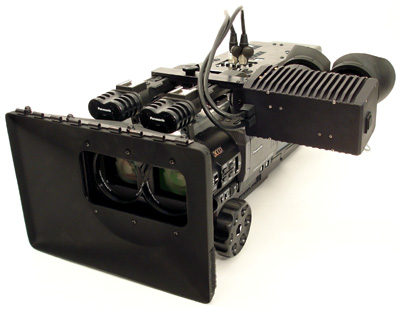
Last months Stereo3D-newsletter mentions a digital 3D camera that has been around since 1997. There's a cool picture too.
-
wait a little bit
I'd love too, but prices haven't changed much for the past few years. Check out stereo3d for other HMDs (warning - heavy on the gfx!). If you look at the "old" models, you'll notice their price is (almost) the same as the "new" models (search elsewhere for the prices...). I think a lot of people will need to buy these things before enough automation is built into assembling these so their price comes down. It's a 'catch 22' type of thing.
And LCD's are REAL OLD STUFF. Tech Web talks about these things like a breakthrough. Yeah, and 20" monitors are the latest greatest breakthrough too... You'll find iodisplays / iglasses sells VGA type stuff cheaper... Their x2 glasses (almost good enough for VGA) are $799... I'm kind of torn between that and a pair of Sony Glasstrons... -
Wearable? Linux on the PCG-C1X
Yep, that would indeed be Kim himself.
With the Sony Glasstron, or one of the many choices at Stereo3d,
Anyone have any experience with CPD for mobile wearable use, or 802.11/Blue Tooth for inter office use?