Slashdot Mirror
Domain: twitter.com
Stories and comments across the archive that link to twitter.com.
Stories · 1,968
-
Data Mining Reveals How Wording Influences Tweet Propagation
KentuckyFC (1144503) writes "One of the most widely shared tweets in history is Obama's "Four more years", posted after his second presidential election victory and currently retweeted 775,000 times. But how would different wording have influenced this tweet's popularity and the way it spread? It's easy to imagine that there's no way of telling what might have been in such an alternative universe. But a surprising phenomenon on Twitter has allowed data scientists to study this kind of alternative reality and work out the factors that make one tweet more popular than another. It turns out that the twitter stream contains a surprisingly large number of tweets from the same authors, pointing to the same content but with different messages. That's a natural experiment in which factors such as the author, the URL, the number of followers and so on are all held constant while the message varies. By studying these pairs of tweets, researchers can measure how well each performs and then determine which factors contribute to their popularity. These turn out to be things like the amount of information the tweet contains, the language it uses and even whether it includes a request for a retweet. The team has developed an algorithm that predicts which of a pair of tweets is more likely to be successful with greater accuracy than humans. And they've even set up a website where anybody can test their tweet-rating ability and thereby improve their chances of writing the perfect tweet." -
Microsoft Doesn't Have Plans For a Dedicated Handheld Gaming Device
DroidJason1 writes: "Rumors have persisted for a while now that Microsoft is working on a dedicated handheld gaming device to go against the Sony PS Vita or Nintendo 3DS. The head of Xbox has now responded to a question about it from an eager gamer on Twitter who asked whether there were any plans for a 'handheld Xbox-One-like gaming device.' The answer is no. Microsoft is focused on Windows Phone, tablets, and perhaps both with controller support someday." -
Kids To Get the Best CS Teachers $15/Hr Can Buy
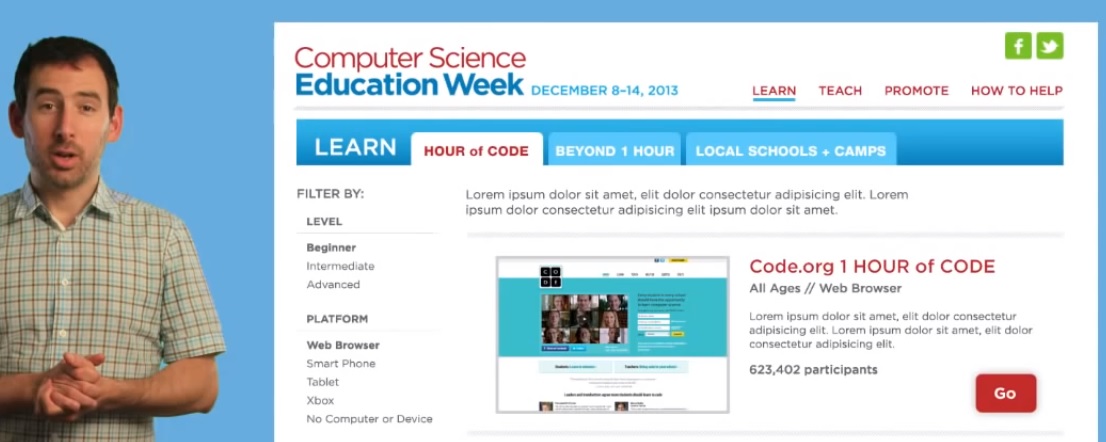
theodp (442580) writes "Billionaire-backed Code.org, enthusiastically tweets U.S. Dept. of Education Chief Arne Duncan, is 'providing tremendous leadership in bringing coding & computer science to our nation's schools.' Including bringing kids in Broward County Public Schools the best computer science teachers $15.00-an-hour can buy, according to a document on the school district's website. One wonders how the Broward teachers feel about Code.org apparently coughing up $38.33-an-hour for Chicago teachers who attend the required Code.org professional development, which ironically covers equity issues. Duncan's shout-out comes days after Code.org claimed in its Senate testimony that 'our students have voted with their actions [participating in an hour-long, Angry Birds-themed Blockly tutorial starring Mark Zuckerberg and Bill Gates]: that learning computer science is this generation's Sputnik moment, that it's part of the new American Dream, and that it should be available to every student, in every school, as part of the standard curriculum.'" -
Zenimax Accuses John Carmack of Stealing VR Tech
John Carmack made waves last year when he left id Software, owned by Zenimax, to join Oculus VR in order to help create its virtual reality headset. Now Zenimax has sent documents to Oculus's legal department claiming Carmack "stole" technology from them when he left. They said, "The proprietary technology and know-how Mr. Carmack developed when he was a ZeniMax employee, and used by Oculus, are owned by ZeniMax. Well before the Facebook transaction was announced, Mr. Luckey acknowledged in writing ZeniMax's legal ownership of this intellectual property. It was further agreed that Mr. Luckey would not disclose this technology to third persons without approval." Carmack says, "No work I have ever done has been patented. Zenimax owns the code that I wrote, but they don't own VR." Oculus was also dismissive: "It's unfortunate, but when there's this type of transaction, people come out of the woodwork with ridiculous and absurd claims." -
OpenSSH No Longer Has To Depend On OpenSSL
ConstantineM writes: "What has been planned for a long time now, prior to the infamous heartbleed fiasco of OpenSSL (which does not affect SSH at all), is now officially a reality — with the help of some recently adopted crypto from DJ Bernstein, OpenSSH now finally has a compile-time option to no longer depend on OpenSSL. `make OPENSSL=no` has now been introduced for a reduced configuration OpenSSH to be built without OpenSSL, which would leave you with no legacy SSH-1 baggage at all, and on the SSH-2 front with only AES-CTR and chacha20+poly1305 ciphers, ECDH/curve25519 key exchange and Ed25519 public keys." -
OpenSSH No Longer Has To Depend On OpenSSL
ConstantineM writes: "What has been planned for a long time now, prior to the infamous heartbleed fiasco of OpenSSL (which does not affect SSH at all), is now officially a reality — with the help of some recently adopted crypto from DJ Bernstein, OpenSSH now finally has a compile-time option to no longer depend on OpenSSL. `make OPENSSL=no` has now been introduced for a reduced configuration OpenSSH to be built without OpenSSL, which would leave you with no legacy SSH-1 baggage at all, and on the SSH-2 front with only AES-CTR and chacha20+poly1305 ciphers, ECDH/curve25519 key exchange and Ed25519 public keys." -
Finding the Next Generation of Teachers With "Innovative Microsoft Ads"
theodp (442580) writes "Back in 2011, the U.S. Dept. of Education delegated teacher recruitment to Microsoft (RFP, pdf). 'The decision to turn over TEACH to [Microsoft] Partners in Learning serves to expand the already outsized influence Gates and his fortune have on public education,' wrote the Washington Post at the time. So, 'what happens when a public institution in a democracy — the US Department of Education — outsources its goal of recruiting good teachers to a private industry?' Well, in addition to Teach.org and redundant social media efforts on Twitter, Facebook, Tumblr, Instagram, Linkedin, and YouTube, the U.S. is now relying on 'Innovative Microsoft Advertising to Recruit the next Generation of Teachers'. From the press release, 'The Ad Council and TEACH have formed a unique outreach campaign with Microsoft's Advertising team in an effort to recruit the next generation of teachers who will drive innovation and redefine teaching in K-12 classrooms. Microsoft donated over 125 million impressions across Xbox 360, Windows 8, and MSN in order to encourage consumers to rediscover teaching through interactive ad units. This media effort is an extension of the Ad Council and TEACH's public service advertising (PSA) campaign, Make More...Throughout March, consumers were able to engage with TEACH "NUads on Xbox", via gesture, voice or controller on their Xbox 360 consoles...Most recently, Microsoft leveraged their Windows 8 platform to provide a unique experience to consumers, enabling them to navigate through a series of questions to help "discover their true passion," along with the opportunity to play challenging mind and word games, such as a word scramble and tangrams.' Check out the demo of the Windows 8 platform experience [YouTube], in which a person is advised 'You'd Make a Great Science & Tech Teacher,' on the basis of a 'Personality Quiz' consisting of five dragged-and-dropped photos." -
SpaceX Files Suit Against US Air Force
Today Elon Musk announced that SpaceX has decided to challenge the U.S. Air Force's restrictions on rocket launches related to national security. Such launches are done with a Russian rocket right now, and that contract is not up for competition with other rocket makers, like SpaceX. Musk says the company has exhausted other options to become part of the bidding process. "We're just protesting and saying these launches should be competed. And if we compete and lose, that's fine, but why were they not even competed?" He also said it's the "wrong time to send hundreds of millions of dollars to the Kremlin," referencing events in the Ukraine.
At the same press conference, Musk announced that SpaceX's recent attempt to soft-land a rocket booster stage was successful. It landed and was in "healthy condition" immediately afterward. Unfortunately, they weren't able to recover it because it landed in the middle of a rough storm, which eventually destroyed the stage. The storm was rough enough that the Coast Guard wouldn't even send a boat out to help recover it. Musk said, "We'll get much bigger boats next time." SpaceX also plans on landing the stage on shore at some point, which makes recovery easier. Musk made this prediction: "I expect we will be able to land a stage back at Cape Canaveral by the end of the year." -
NSA Allegedly Exploited Heartbleed
squiggleslash writes: "One question arose almost immediately upon the exposure of Heartbleed, the now-infamous OpenSSL exploit that can leak confidential information and even private keys to the Internet: Did the NSA know about it, and did they exploit if so? The answer, according to Bloomberg, is 'Yes.' 'The agency found the Heartbeat glitch shortly after its introduction, according to one of the people familiar with the matter, and it became a basic part of the agency's toolkit for stealing account passwords and other common tasks.'" The NSA has denied this report. Nobody will believe them, but it's still a good idea to take it with a grain of salt until actual evidence is provided. CloudFlare did some testing and found it extremely difficult to extract private SSL keys. In fact, they weren't able to do it, though they stop short of claiming it's impossible. Dan Kaminsky has a post explaining the circumstances that led to Heartbleed, and today's xkcd has the "for dummies" depiction of how it works. Reader Goonie argues that the whole situation was a failure of risk analysis by the OpenSSL developers. -
Canada Halts Online Tax Returns In Wake of Heartbleed
alphadogg (971356) writes "Canada Revenue Agency has halted online filing of tax returns by the country's citizens following the disclosure of the Heartbleed security vulnerability that rocked the Internet this week. The country's Minister of National Revenue wrote in a Twitter message on Wednesday that interest and penalties will not be applied to those filing 2013 tax returns after April 30, the last date for filing the returns, for a period equal to the length of the service disruption. The agency has suspended public access to its online services as a preventive measure to protect the information it holds, while it investigates the potential impact on tax payer information, it said." -
How Facebook and Oculus Could Be a Great Combination
Hugh Pickens DOT Com writes: "Nate Swammer writes at Slashgear that with Facebook's purchase of Oculus for a cool $2 billion, the fervor surrounding virtual reality headwear quickly turned to disdain. Betrayal, confusion, and anger became the order of the day for contributors who gave Oculus $2.4 million through its Kickstarter campaign. But now that passions have cooled and looking at the issues dispassionately, the Facebook acquisition may turn out much better than anticipated for users. While many may have a fervent distrust for Facebook, this deal bodes well for Oculus, and by virtue, us.
First Oculus wasn't flush, and although Oculus may have had some hustle behind it, it may not have been enough. John Carmack, Oculus CTO, said via Twitter, 'I expect the FB deal will avoid several embarrassing scaling crisis for VR.' The headwear already famously suffered from a supply chain issue not long ago, which actually stopped it dead in its tracks. Next, in their official announcement of the Facebook deal, gaming was barely a blip on the radar. It wasn't until the very end that gaming was even mentioned, with the bulk of the post discussing 'culture' and driving virtual reality forward. There was little to indicate any big titles were coming for Oculus.
The fact is, Oculus needed help. Not technical assistance, but someone who could be their Sony, more or less. John Carmack says he has 'a deep respect for the technical scale that FB operates at. The cyberspace we want for VR will be at this scale.' Perhaps Facebook isn't the most popular choice, but they are the partner Oculus chose for their future says Swammer. 'Like Google purchasing Android in 2005, it all seems so strange right now [remember this story we discussed in 2009] — but we see how that turned out. If VR really is the next frontier, Facebook just staked their claim to a big slab of land in the heart of some virtual country they'll likely let us see someday — via Oculus."" -
How Facebook and Oculus Could Be a Great Combination
Hugh Pickens DOT Com writes: "Nate Swammer writes at Slashgear that with Facebook's purchase of Oculus for a cool $2 billion, the fervor surrounding virtual reality headwear quickly turned to disdain. Betrayal, confusion, and anger became the order of the day for contributors who gave Oculus $2.4 million through its Kickstarter campaign. But now that passions have cooled and looking at the issues dispassionately, the Facebook acquisition may turn out much better than anticipated for users. While many may have a fervent distrust for Facebook, this deal bodes well for Oculus, and by virtue, us.
First Oculus wasn't flush, and although Oculus may have had some hustle behind it, it may not have been enough. John Carmack, Oculus CTO, said via Twitter, 'I expect the FB deal will avoid several embarrassing scaling crisis for VR.' The headwear already famously suffered from a supply chain issue not long ago, which actually stopped it dead in its tracks. Next, in their official announcement of the Facebook deal, gaming was barely a blip on the radar. It wasn't until the very end that gaming was even mentioned, with the bulk of the post discussing 'culture' and driving virtual reality forward. There was little to indicate any big titles were coming for Oculus.
The fact is, Oculus needed help. Not technical assistance, but someone who could be their Sony, more or less. John Carmack says he has 'a deep respect for the technical scale that FB operates at. The cyberspace we want for VR will be at this scale.' Perhaps Facebook isn't the most popular choice, but they are the partner Oculus chose for their future says Swammer. 'Like Google purchasing Android in 2005, it all seems so strange right now [remember this story we discussed in 2009] — but we see how that turned out. If VR really is the next frontier, Facebook just staked their claim to a big slab of land in the heart of some virtual country they'll likely let us see someday — via Oculus."" -
Weev's Attorney Says FBI Is Intercepting His Client's Mail
Daniel_Stuckey (2647775) writes "The FBI is intercepting the prison correspondence of infamous Internet troll Andrew "weev" Auernheimer, including letters from his defense team, according to his attorney. 'He's sent me between 10 and 20 letters in the last month or two. I've received one,' Tor Ekeland, who had just returned from visiting Auernheimer at the federal corrections institute in Allenwood, PA., told the Daily Dot in a video interview.
Last March, Auernheimer was convicted of accessing a computer without authorization and sentenced to 41 months in prison. As a member of the computer security team Goatse Security, Auernheimer discovered a major security flaw in AT&T's network, which allowed him to download the email addresses of some 114,000 iPad users. Goatse Security reported the flaw to Gawker and provided journalists with the information, who then published it in redacted form." -
Court Orders Turkish Twitter Ban Temporarily Lifted, Twitter Prepares Challenge
redletterdave (2493036) writes "Less than a week after the Turkish government banned Twitter over failing to remove allegations of government corruption from the social network, a Turkish court on Wednesday suspended the ban, calling it 'illegal.'" Unfortunately, according to the BBC Twitter may remain blocked until after the elections: "The administrative court in Ankara issued a temporary injunction on Wednesday ordering the TIB to restore access to Twitter until it could deliver its full verdict on the ban. Turkish media reports suggested the ban would be suspended soon afterwards but a source in Mr Erdogan's office told Reuters news agency the TIB had 30 days to implement or appeal against the court ruling." In the meantime, Twitter is attempting to fight the ban directly. -
College Grads Create Fake Tesla Commercial That Elon Musk Loves
cartechboy (2660665) writes "Two University of Southern California grads were looking to start a digital content company so they decided to roll the dice and create a home-made (but incredibly professional looking) television commercial for Tesla — just to see if they could get some attention for it. Well, apparently, mission accomplished. R.J. Collins and James Khabushani took $1,500 and created a 60-second Tesla 'faux-mercial' dubbed 'Modern Spaceship' that is well, pretty good. Elon Musk noticed, tweeted it and has helped the thing go viral." -
Prominent GitHub Engineer Julie Ann Horvath Quits Citing Harrassment
First time accepted submitter PvtVoid writes in with the story of Julie Ann Horvath alleging a culture of sexism at GitHub. "The exit of engineer Julie Ann Horvath from programming network GitHub has sparked yet another conversation concerning women in technology and startups. Her claims that she faced a sexist internal culture at GitHub came as a surprise to some, given her former defense of the startup and her internal work at the company to promote women in technology." -
In Ukraine, Cyber War With Russia Heating Up
concertina226 writes "If you think the crisis in the Ukraine is limited just to being just on the ground, think again. A cyberwar is flaring up between Ukraine and Russia and it looks like just the beginning. On Friday, communication centers were hijacked by unknown men to install wireless equipment for monitoring the mobile phones of Ukraine parliament members. Since then, Ukrainian hackers have been defacing Russian news websites, while Russia's Roskomnadzor is blocking any IP addresses or groups on social media from showing pro-Ukraine 'extremist' content." Adds reader Daniel_Stuckey: "On the other side of the border, RT — the news channel formerly known as Russia Today and funded by the state — had its website hacked on Sunday morning, with the word 'Nazi' not-so-stealthily slipped into headlines. Highlights included 'Russian senators vote to use stabilizing Nazi forces on Ukrainian territory,' and 'Putin: Nazi citizens, troops threatened in Ukraine, need armed forces' protection.' RT was quick to notice the hack, and the wordplay only lasted about 20 minutes." Finally, as noted by judgecorp, "The Ukrainian security service has claimed that Russian forces in Crimea are attacking Ukraine's mobile networks and politicians' phones in particular. Meanwhile, pro-Russian hackers have defaced Ukrainian news sites, posting a list of forty web destinations where content has been replaced. The pro-Russians have demonstrated Godwin's Rule — their animated GIF equates the rest of Ukraine to Nazis." -
Book Review: Threat Modeling: Designing For Security
benrothke writes "When it comes to measuring and communicating threats, perhaps the most ineffective example in recent memory was the Homeland Security Advisory System; which was a color-coded terrorism threat advisory scale. The system was rushed into use and its output of colors was not clear or intuitive. What exactly was the difference between levels such as high, guarded and elevated? From a threat perspective, which color was more severe — yellow or orange? Former DHS chairman Janet Napolitano even admitted that the color-coded system presented 'little practical information' to the public. While the DHS has never really provided meaningful threat levels, in Threat Modeling: Designing for Security, author Adam Shostack has done a remarkable job in detailing an approach that is both achievable and functional. More importantly, he details a system where organizations can obtain meaningful and actionable information, rather than vague color charts." Read below for the rest of Ben's review. Threat Modeling: Designing for Security author Adam Shostack pages 624 publisher Wiley rating 10/10 reviewer Ben Rothke ISBN 978-1118809990 summary Invaluable guide to create a formal threat modeling program Rather than letting clueless Washington bureaucrats define threats, the book details a formal system in which you can understand and particularize the unique threats your organizations faces.
In the introduction, Shostack sums up his approach in four questions:
1. What are you building?
2. What can go wrong with it once it's built?
3. What should you do about those things that can go wrong?
4. Did you do a decent job of analysis?
The remaining 600 densely packed pages provide the formal framework needed to get meaningful answers to those questions. The book sets a structure in which to model threats, be it in software, applications, systems, software or services, such as cloud computing.
While the term threat modeling may seem overly complex, the book notes that anyone can learn to threat model. Threat modeling is simply using models to find security problems. The book notes that using a model means abstracting away a lot of the details to provide a look at the bigger picture, rather than the specific item, or piece of software code.
An important point the book makes is that there is more than one way to model threats. People often place too much emphasis on the specifics of how to model, rather than focusing on what provides them the most benefit. Ultimately, the best model for your organization is the one that helps you determine what the main threats are. Finally, the point is not just to find the threats; the key is to address them and fix them.
The beauty of the book is that it focuses on gaining empirical data around threats for your organization. Rather than simply taking an approach based on Gartner, USA Today or industry best practices.
While the author states a few times that threat modeling is not necessarily a complex endeavor, it nonetheless does take time. He writes that threat modeling requires involvement from many players from different departments in an organization to provide meaningful input. Without broad input, the threat model will be lacking, and the output will be incomplete.
For those organizations that are willing to put the time and effort into threat modeling, the benefits will be remarkable. At the outset, they will have confidence that they understand the threats their organization is facing, likely spend less on hardware and software, and will be better protected.
Chapter 18 quotes programmer Henry Spencer who observed that "those who do not understand Unix are condemned to reinvent it, poorly". Shostack writes that the same applies to threat modeling. The point he is making is that there are ways to fail at threat modeling. The first is simply not trying. The chapter then goes on into other approaches which can get in the way of an effective threat modeling program.
Why should you threat model for your IT and other technology environments? It should be self-evident from an architecture perspective. When an architect is designing an edifice, they first must understand their environment and requirements. A residence for a couple in Manhattan will be entirely different from the design for a residence for a family in Wyoming. But far too many IT architects take a monolithic approach to threats and that's precisely the point the book is attempting to obviate.
As noted, threat modeling is not overly complex. But even if it was indeed complex, it is far too important not to be done. The message of the book is that organizations need to stop chasing vague threats and industry notions of what threats are, and customize things so they deal with their threats.
For those that still think the topic is complex, the book references Elevation of Privilege (EoP), an easy way to get started threat modeling. EoP is a card game that developers, architects or security teams can play to easily understand the rudiments of threat modeling.
Risk modeling is so important that it must be seen as an essential part of a formal and mature information security program. Having firewalls, IDS, DLP and myriad other infosec appliances can be deceptive in thinking they provide protection. But if they are deployed in an organization that has not defined the threats these devices are expected to address, they only serve the purpose of giving an aura of infosec protection, and not real protection itself.
Amazon has over 800 Disney World guide books. Anyone who is going to invest their time and money to spend a few days at Disney World knows they have to do their research in order to get the most out of their visit.
There are only a handful of books on this topic and Threat Modeling: Designing for Security is perhaps the finest of them. No tourist would be so naïve to go to Disney World uninformed. And conversely, no one should go into the IT world without adequate threat information.
Threat modeling provides compelling benefits in the ability to make better information security decisions, better focus on often limited resources, all while designing a model to protect against current and future threats.
For those serious about the topic, Threat Modeling: Designing for Security will be one of the most rewarding information security books they could hope for.
Reviewed by Ben Rothke.
You can purchase Threat Modeling: Designing for Security from amazon.com. Slashdot welcomes readers' book reviews (sci-fi included) -- to see your own review here, read the book review guidelines, then visit the submission page. -
Live Q&A With Ex-TSA Agent Jason Harrington
Jason Harrington (@Jas0nHarringt0n) is a controversial blogger, frequent contributor to McSweeney's Internet Tendency, and one of the TSA's least favorite ex-employees. His descriptions of life on the job as a TSA agent caused some big waves and restarted a national discussion on security theater. Jason will be answering your questions below for the next couple of hours, or until the security line starts moving again. Please keep it to one question per post so everyone gets a chance. Update: 03/01 02:11 GMT by S : Jason has finished up for now — you can skip to his answers at his user page, or simply browse the comments to read everything. Thanks Jason for answering our questions! -
DDoS Larger Than the Spamhaus Attack Strikes US and Europe
mask.of.sanity writes "CloudFlare has been hit by what appears to be the world's largest denial of service attack, in an assault that exploits an emerging and frightening threat vector. The Network Time Protocol Reflection attack exploits a timing mechanism that underpins a way the Internet works to greatly amplify the power of what would otherwise be a small and ineffective assault. CloudFlare said the attack tipped 400Gbps, 100Gbps higher than the previous record DDoS attack which used DNS reflective amplification." -
Britain's GCHQ Attacked Anonymous Supporters With DDoS
An anonymous reader writes "NBC News reports that, during a 2012 NSA conference called SIGDEV, GCHQ's Joint Threat Research Intelligence Group bragged about using Distributed Denial of Service (DDoS) attacks against members of Anonymous during an operation called Rolling Thunder in 2011 (there is evidence that says it was a SYN flood, so technically it was a simple DoS attack). Regular citizens would face 10 years in prison and enormous fines for committing a DoS / DDoS attack. The same applies if they encouraged or assisted in one. But if you work in the government, it seems like you're an exception to the rule." -
Why Games Should Be In the Public Domain
Robotron23 writes "Rock, Paper, Shotgun writer John Walker shook a hornet's nest by suggesting old videogames should enter the public domain during GOG's Time Machine sale. George Broussard of Duke Nukem fame took to Twitter, saying the author should be fired. In response to these comments RPS commissioned an editorial arguing why games and other media should enter the public domain much more rapidly than at present. 'I would no more steal a car than I would tolerate a company telling me that they had the exclusive rights to the idea of cars themselves.' says Walker, paraphrasing a notorious anti-piracy ad (video). 'However, there are things I'm very happy to "steal," like knowledge, inspiration, or good ideas...It was until incredibly recently that amongst such things as knowledge, inspiration and good ideas were the likes of literature and music.'" -
Book Review: The Art of the Data Center
benrothke writes "At first glance, The Art of the Data Center: A Look Inside the Worlds Most Innovative and Compelling Computing Environments appears like a standard coffee table book with some great visuals and photos of various data centers throughout the world. Once you get a few pages into the book, you see it is indeed not a light-read coffee table book, rather a insightful book where some of the brightest minds in the industry share their insights on data center design and construction." Read below for the rest of Ben's review. The Art of the Data Center: A Look Inside the Worlds Most Innovative and Compelling Computing Environments author Douglas Alger pages 368 publisher Prentice Hall rating 9/10 reviewer Ben Rothke ISBN 978-1587142963 summary Some of the smartest guys in the data center share their build and design advice The book takes a holistic view of how world-class data centers are designed and built. Many of the designers were able to start with a greenfield approach without any constraints; while others were limited by physical restrictions.
Some of the firms profiled in the book are Citi, Digital Realty Trust (who run the world's largest data center in Chicago), eBay, Facebook, IBM, Intel and Yahoo!.
One of the interesting things about hearing 18 different viewpoints, both from the US and Europe-based firms, is that it shows there is not just one way to build a data center. Fundamental data center components such as raised floors are reconsidered in some of the data centers in the book. From UPS, to cooling systems and more, Alger details how the nuances of various data centers have influenced their design.
It is an unfortunate reality that many expensive data center builds and expansions fail.The book profiles those that have succeeded, and it is hoped the reader will take the advice to heart in their build and design.
The book is written in an interview style, where Alger asked the designers various question on how their came to their design, the rationale behind it, what their strategy was, what constraints they ran into, and more
The book highlights a broad range of data centers; from those built into a century old church in Spain, a former Swedish underground military bunker renovated into a modern data center with artificial daylight, manmade waterfalls and submarine engines providing standby power, to those powered by all solar energy.
Many of the data centers that he showcases are designed in order to be LEED (Leadership in Energy and Environmental Design) and Energy Star certified. LEED is a rating systems for the design, construction, operation and maintenance of green buildings, homes and neighborhoods, created by the US Green Building Council (USGBC). It should be noted that as of now, the USGBC hasn't set specific criteria for data center LEED certification.
An important point about LEED made in the book is that for those designers that are thinking about LEED certification, it must be done in the design stage and not as an addendum. Obtaining LEED certification must start at design and end with a formal certification after project completion. It was noted that consulting with a qualified LEED professional or consulting firm at the start of the planning process is a must.
While this is not a coffee table book, it does make good use of photos to highlight the nuances and layouts of the various data centers. There are many pictures that show the various types of equipment in use.
As noted, the book showcases many different aspects and often counterintuitive notions of data center design. One of the most significant is ACT, Inc., a nonprofit that runs the ACT test – a college admissions and placement test taken by more than 1.3 million high school graduates every year, who decided to runs their active and backup data centers in Iowa City, Iowa just 5 miles apart. The book details the designer's rationale behind that. Similar case studies are detailed in the book.
One of the major methods in the book used to reduce power consumption and cost is via the use of virtualization, which many of the data centers have used and optimized.
One topic lacking in the book is that Alger did not ask detailed questions around the physical security of the buildings. Why power, UPS, flooring and the like are critical to the efficacy of a data center; physical security components such as mantraps, access control systems, bollards, surveillance and the like are necessary to ensure all of the previous design items are not placed at risk.
One of the questions he asked every designer is if they could go back and design the data center all over again, what; if anything would they do different. Surprisingly, everyone one of them said that they put a lot of planning in and there was nothing major they would change. Most of the designers did though say each data center had small items though could have been revisited to make the center better. Bu most agreed that many of them are so minor in some respects, that it would not be meaningful to go through them.
An interesting point the data venter architect at Syracuse University stated is that one of the things they did in constructing their data center was to not necessarily be driven by rules of thumb or best practices. Rather they looked at their own requirements and how they could best optimize everything that they could in the design of the facility.
One common metric used throughout the book is power usage effectiveness (PUE). It is a measure of how efficiently a computer data center uses energy; specifically, how much energy is used by the computing equipment, as opposed to cooling and other data center overhead. The lower the number, closest to 1.0, the more of its power is used for computing.
Poor data center planning leads to poor use of valuable capital, can significantly increase operational expense and obviate any computation gains. Many organizations get overwhelmed on the design and focus far too much on speed and power, without taking a larger holistic view of their data center needs.
For those looking for guidance on how to design a world-class data center, The Art of the Data Center: A Look Inside the Worlds Most Innovative and Compelling Computing Environments should be the place you start.
Reviewed by Ben Rothke.
You can purchase The Art of the Data Center: A Look Inside the Worlds Most Innovative and Compelling Computing Environments from amazon.com. Slashdot welcomes readers' book reviews (sci-fi included) -- to see your own review here, read the book review guidelines, then visit the submission page. -
Rome Police Use Twitter To Battle Illegal Parking
cartechboy writes "Illegal parking has always been a major problem in Rome. More than half of Rome's 2.7 million residents use private vehicles, and the ancient city has a staggering ratio of 70 cars per 100 residents. So many residents park, uh, creatively. But now authorities think they've found a way to fight bad parking using social media. Basically, they've asked residents to post photos of bad parking jobs to Twitter. In December, the Italian cops began encouraging smart phone users to snap pics of illegally parked cars and tweet those photos to the department's Twitter account. The new system, which was created by Raffaele Clemente, Rome's chief of traffic police, seems to be working. In the first 30 days, police received more than 1,000 complaints tweeted to their account; (one example is here). Officials were able to respond to around 740 and hand out citations." -
Rome Police Use Twitter To Battle Illegal Parking
cartechboy writes "Illegal parking has always been a major problem in Rome. More than half of Rome's 2.7 million residents use private vehicles, and the ancient city has a staggering ratio of 70 cars per 100 residents. So many residents park, uh, creatively. But now authorities think they've found a way to fight bad parking using social media. Basically, they've asked residents to post photos of bad parking jobs to Twitter. In December, the Italian cops began encouraging smart phone users to snap pics of illegally parked cars and tweet those photos to the department's Twitter account. The new system, which was created by Raffaele Clemente, Rome's chief of traffic police, seems to be working. In the first 30 days, police received more than 1,000 complaints tweeted to their account; (one example is here). Officials were able to respond to around 740 and hand out citations." -
Ask Slashdot: Is Linux Set To Be PC Gaming's Number Two Platform?
monkeyhybrid writes "Following a tweet from the developer of Maia (a cross platform game soon to hit Steam) that Linux was bringing him more game sales than OS X. Gaming On Linux decided to investigate further by reaching out to multiple developers for platform sales statistics. Although the findings and developer comments show Linux sales to still be sitting in third place, behind those of OS X and Windows, they are showing promise. Developer feedback certainly appears to be positive about the platform's future. With Steam OS on its way, surely leading to more big title releases making their way to the Linux platform, could Linux gaming be set to take the number two spot from Apple?" -
Slashdot PT Cruiser Spotted In the Wild
You may remember the Slashdot PT Cruiser if you've been around long enough. You might even wonder what fate befell it. You can sleep comfortably tonight for it has been spotted alive and seemingly well in Walnut Creek. -
Network Solutions Opts Customer Into $1,850 Security Service
An anonymous reader writes "Brent Simmons has posted about a troubling email he received from Network Solutions. He registered two domains with them in the 1990s, and the domains remain registered today. Simmons just received an email informing him that he'd been opted into some kind of security service called Weblock, and that he would be billed $1,850 for the first year. Further, he would be billed $1,350 for every year after the first. Believing it to be a scam, he contacted the official Network Solutions account on Twitter. They said it was real. The email even said he couldn't opt out except by making a phone call." -
Romanian Bitcoin Entrepreneur Steps In To Pay OpenBSD Shortfall
New submitter MrBingoBoingo writes "Recently it was announced here on Slashdot that OpenBSD was facing an impending shortfall that jeopardized its continued existence. A sponsorship to save OpenBSD has been announced, and it wasn't one of the usual culprits that saved OpenBSD, but a Romanian Bitcoin billionaire." -
Book Review: The Digital Crown
benrothke writes "With Adobe Flash, it's possible to quickly get a pretty web site up and running; something that many firms do. But if there is no content behind the flashy web page, it's unlikely anyone will return. In The Digital Crown: Winning at Content on the Web, author Ahava Leibtag does a fantastic job on showing how to ensure that your web site has what it takes to get visitors to return, namely great content." Read below for the rest of Ben's review. The Digital Crown: Winning at Content on the Web author Ahava Leibtag pages 358 publisher Morgan Kaufmann rating 10/10 reviewer Ben Rothke ISBN 978-0124076747 summary Invaluable resource and reference for building an effective web content strategy Make no mistake, creating good content for a large organization is a massive job. But for those organizations that are serious about doing it right, the book provides the extensive details all of the steps required to create content that will bring customers back to your web site.
Leibtag writes in the introduction that the reason so many websites and other digital strategy projects fail is because the people managing them don't focus on what really matters. They begin changing things for the sake of change and to simply update, without first asking why. They also forget to ask what the updates will accomplish. What this does is create a focus on the wrong priorities. Leibtag notes that the obvious priority is content.
So what is this thing called content? The book defines it as all of the information assets of your company that you want to share with the world.
The book is based around 7 rules, which form the foundation of an effective and comprehensive content strategy, namely:
1. Start with Your Audience
2. Involve Stakeholders Early and Often
3. Keep it Iterative
4. Create Multidisciplinary Content Teams
5. Make Governance Central
6. Workflow that Works
7. Invest in Professionals and Trust Them
Chapter 1 (freely available here) takes a high-level look at where branding and content meet, and details the need for a strategic content initiative.
An interesting point the book makes in chapter 2 which is pervasive throughout the book is to avoid using the term users. Rather refer to them as customers. Leibtag feels that the term users as part of a content strategy, makes them far too removed and abstract. Dealing with them as customers makes them real people and changes the dynamics of the content project. Of course, this transition has to be authentic. Simply performing a find/replace of user/customer in your documentation is not what the author intended; nor will such an approach work.
The book is heavy on understanding requirements and has hundreds of questions that need to be asked before creating content. The book is well worth it for that content alone.
It also stresses the importance of getting all stakeholders involved in the content creation process. As part of the requirements gathering process, the book details 3 roadmap steps which much be done in order to facilitate an effective strategy.
The book notes that content is much more than web pages. Content includes various formats, platforms and channels. An effective strategy must take al lof these into account. The book notes that there are hundreds of possible formats for content. While it is impossible to deal with every possible option; an organization must know what they are in order to ensure they are creating content that is appropriate for their customers.
By the time you hit page 100, it becomes quite clear that content is something that Leibtag is both passionate about and has extensive experience with. An important point she makes is that it is crucial not for focus on design right away in the project, as it eats up way too much time. The key is to focus the majority of your efforts on the content.
The dilemma that the book notes is that during the requirements gathering process, far too many organizations are imagining a gorgeous web site with all kinds of bells and whistles, beautiful colors and pictures. That in turn moves them to spend (i.e., waste) a tremendous amount of time on design; which leads them to neglect contact creation and migration.
The book details multichannel publishing, which is the ability to publish your content on any device and any channel. This is a significant detail, as customers will be accessing your site from desktops with huge screens and bandwidth to mobile devices with smaller screens and often limited bandwidth. This requires you to adapt and change your content publishing process. This is clearly not a trivial endeavor. But doing it right, which the book shows how to do, will payoff in the long run.
Another mistake firms make is that they often think content can be done by just a few people. The book notes that it is an imperative to create multidisciplinary content teams, since web content will touch every part of the organization, and needs their respective input.
One of the multidisciplinary content teams that must be involved is governance. The book notes that governance standards help you set a consistent customer experience across all channels. By following them, you can avoid replicating content, muddying your main messages and confusing your customers. Governance is also critical in setting internal organizational controls.
Leibtag lays out what needs to be done in extreme detail. She makes it quite clear that there are no quick fixes that can be done to create good content. Creating an effective content marketing strategy and architecture is complex, expensive and challenging. But for most organizations, it is also absolutely necessary for them in order to compete.
The author is the head of a content strategy and content marketing consultancy firm. Like all good consultants, they focus on getting answers to the questions clients often don't even know to ask. With that, the book has myriad questions and requirements that you must answer before you embark on getting your content online.
The book also provides numerous case studies of sites that understand the importance of content and designed their site accordingly. After reading the book, the way you look at web sites will be entirely different. You will likely find the sites you intuitively return to coincidentally happened to be those very sites that have done it right and have the content you want.
My only critique of the book is that the author quotes herself and references other articles she wrote far too often. While these articles have valid content, this can come across as somewhat overly promotional. Aside from that, the book is about as good as anything could get on the topic.
For firms that are serious about content and looking for an authoritative reference on how to build out their content and do it right, The Digital Crown: Winning at Content on the Web is certain to be an invaluable resource.
Reviewed by Ben Rothke.
You can purchase The Digital Crown: Winning at Content on the Web from amazon.com. Slashdot welcomes readers' book reviews (sci-fi included) -- to see your own review here, read the book review guidelines, then visit the submission page. -
Emmett Plant Talks About the Paper-Based RPG Game Business (Video)
Emmett has a good rep as a video game music composer, and he's worked on a number of Star Trek-related projects, including the recently-released audio book, How to Speak Klingon: Essential Phrases for the Intergalactic Traveler. Emmett freely admits that he has no experience with RPG games. The closest he's come was running a major D&D meetup some years back. But he has experience and contacts developed from many years working online not only within the Star Trek community but (years ago) on Slashdot and as editor for Linux.com. And, he says, when he was a teenager he ran comic book stores. So is Emmett suited to run an RPG company? Possibly. He's actively looking for games to publish. Sales aren't going to start for six months or so, so there is no website for Arrakeen Tactical quite yet. Until there is one, you can contact Emmett about his game venture by emailing angelaATclockworkjetpack.com. -
The iOS 7 Jailbreak Fiasco
Bismillah writes "Evad3rs' new iOS 7 jailbreak featured a Chinese app store that sold pirated software, and which was pulled from Evasi0n7 soon after launch. Latest rumors say that the exploit used for Evasi0n7 was stolen by a certain person, offered up for sale, so the Evad3rs did a deal with TaiG instead. Jay 'Saurik' Freeman of Cydia meanwhile isn't happy about the whole thing, saying he was given no time to test Evasi0n7." -
Book Review: Digital Archaeology: the Art and Science of Digital Forensics
benrothke writes "The book Digital Archaeology: The Art and Science of Digital Forensics starts as yet another text on the topic of digital forensics. But by the time you get to chapter 3, you can truly appreciate how much knowledge author Michael Graves imparts. Archaeology is defined as the study of human activity in the past, primarily through the recovery and analysis of the material culture and environmental data that they have left behind, which includes artifacts, architecture, biofacts and cultural landscapes. The author uses archeology and its associated metaphors as a pervasive theme throughout the book. While most archeology projects require shovels and pickaxes; digital archeology requires an entirely different set of tools and technologies. The materials are not in the ground, rather on hard drives, SD cards, smartphones and other types of digital media." Keep reading for the rest of Ben's review. Digital Archaeology: The Art and Science of Digital Forensics author Michael Graves pages 600 publisher Addison-Wesley Professional rating 9/10 reviewer Ben Rothke ISBN 978-0321803900 summary Excellent introductory text to digital forensics In the preface, Graves writes that in performing an investigation that explores the use of computers or digital data, the investigator is embarking on an archaeological expedition. In order to extract useful artifacts, information when dealing with our topic at hand; the investigator must be exceedingly careful in how he approaches the site. The similarities between a digital investigation and an archaeological excavation are much closer than you might imagine. Data, like physical artifacts, gets dropped into the oddest places. The effects of time and environment are just as damaging, if not more so, to digital artifacts as they are physical mementos.
The book shows you precisely how to extract those artifacts effectively. And in a little over 500 pages, the books 21 chapters, provides a comprehensive overview of every area relevant to digital forensics. The author brings his experience to every page and rather than being a dry reference, Graves writes an interesting reference guide for the reader who is serious about becoming proficient in the topic.
Rather than provide dry overview of the topics and associated hardware and software tools. The books take a real-world approach and provides a detailed narrative of real-world scenarios.
An important point Graves makes is that a digital investigator who does not understand the basic technology behind the systems they are investigating is going to be at a distinct disadvantage. Understanding the technology assists in the investigative process and ensures that the evidence can be held up in court.
The need to a proficiency in digital forensics is manifest in the recent attack against Target stores. After an aggressive attack, the store called in external digital forensics consultants to help them make sense of what happened.
The book starts with an anatomy of a digital investigation, including the basic model an investigator should use to ensure an effective investigation. While the author is not a lawyer; the book details all of the laws, standards, constitutional issues and regulations that an investigator needs to be cognizant of.
The author notes that Warren Kruse and Jay Heiser wrote in Computer Forensics: Incident Response Essentials that the basic computer investigation model was a four-part model with the following steps: assess, acquire, analyze and report. Graves breaks those into more detailed and granular level levels that represent processes that occur within each step. These steps are: identification and assessment, collection and acquisition, preservation, examination, analysis and reporting.
Chapter 2 has a section on the constitutional implications of forensic investigation, of which is the topic is also pervasive throughout the book.
As noted, a significant portion of the book is dedicated to the legal aspects around digital investigations. Graves spends a lot of time on these needed issues such as search warrants and subpoenas, basic elements of obtaining a warrant, the plain view doctrine, admissibility of evidence, keeping evidence authentic, defining the scope of the search, and when the Constitution doesn't apply.
The only chapter that was deficient was chapter 13 – Excavating a Cloud. Graves writes that the rapid emergence of cloud computing has added a number of new challenges for the digital investigator. The chapter does a good job of detailing the basic implications of cloud forensics. But it unfortunately does not dig any deeper, and does not provide the same amount of extensive tool listings as do other chapters.
Each chapter closes with a review of the topic and various exercises. Those wanting to see a sample chapter can do so here.
For those looking for an introductory text on the topics of digital forensics, Digital Archaeology: The Art and Science of Digital Forensics is an excellent read. Its comprehensive overview of the entire topic combined with the authors excellent writing skills and experience, make the book a worthwhile reference.
Reviewed by Ben Rothke.
You can purchase Digital Archaeology: The Art and Science of Digital Forensics from amazon.com. Slashdot welcomes readers' book reviews (sci-fi included) -- to see your own review here, read the book review guidelines, then visit the submission page. -
Evad3rs Announce iOS 7 Jailbreak For Latest Apple Devices
hypnosec writes "Evad3rs, the famous iOS jailbreak team, has announced an iOS 7 jailbreak that will work in all iDevices including iPhone 5S, iPhone 5C and iPad Air running iOS 7.0 through to iOS 7.0.4. The iOS 7 jailbreak was announced without much of a hype, unlike the one for iOS 6. 'Merry Christmas! The iOS 7 jailbreak has been released at http://evasi0n.com/! All donations will go to @publicknowledge, @eff and @ffii,' tweeted evad3rs." Reader FrogBlastTheVentCore adds a note of caution: "They recommend restoring your device to iOS 7.0.4 if it has received OTA updates before attempting to jailbreak." -
Chang'e-3 Lunar Rover Landing Slated For 13:40 UTC Saturday
savuporo writes "The Chinese Chang'e-3 probe will be landing on the moon [Saturday], 13:40 UTC. CCTV is likely to carry the event live as they did for initial launch. According to technical overview of the mission scenario and instruments, the landing will be fully autonomous with active landing hazard avoidance, which is the first time this has been attempted on any planetary landing. More real-time updates can be found on Twitter with ChangE3 hash tag and NASASpaceFlight forums live event section." -
Nokia Still Experimenting With Android Smartphone
Nerval's Lobster writes "According to unnamed sources, Nokia is working on an Android-based smartphone. The test versions of the device, which is codenamed 'Normandy,' run a heavily modified version of Android. In late November, @evleaks posted an alleged image of the phone, which (if accurate) includes many of the Nokia design hallmarks, such as a brightly colored shell and prominent rear camera. Exactly how the software differs from the 'standard' version of Android is an open question, although other companies that have forked the operating system (most notably Amazon, with its Kindle tablets) haven't been shy about modifying the user interface in radical ways. According to AllThingsD, Nokia's 'low-end mobile phone unit' is overseeing the project. 'Normandy aims to repurpose the open-source version of Android into a better entry-level smartphone than Nokia has had with its current Asha line,' the publication explained, 'which is based on the aging Series 40 operating system.' But here's the rub: Nokia's phone unit is well on its way to becoming a Microsoft subsidiary. Microsoft competes against Google in many arenas, including mobile and search. The idea of a Microsoft ancillary producing an Android-based phone to compete in lower-end markets — where cheap Android phones dominate — is liable to provoke a burst of surprised laughter from anyone in tech: surely such a project would never hit store-shelves, given Microsoft's very public backing of Windows Phone as its sole mobile OS. And yet, there's also reason to think Microsoft might actually take a chance on an alternative OS. Over the past few years, the company's legal team has cornered the majority of Android manufacturers worldwide into a stark deal: agree to pay a set fee for every Android device produced, or face a costly patent-infringement lawsuit. As a result of that arm-twisting, Microsoft already makes quite a bit of money off Android (more, perhaps, than it earns selling Windows Phone), which could acclimate it to the idea of taking the leap and actually selling Android devices." -
Tesla Model S Battery Drain Issue Fixed
cartechboy writes "Does the Tesla Model S suck down power even when the car is switched off? Recently, a tweet to Elon Musk with an article saying so sparked the Tesla CEO's attention. He tweeted that it wasn't right and that he'd look into the situation. Then a few hours later, he tweeted that the issue had to do with a bad 12-volt battery. Turns out Tesla had already called the owner of the affected car and sent a service tech to his house to replace that battery — and also install a newer build of the car's software. Now it appears the 'Vampire Draw' has been slain. The car went from using 4.5 kWh per day while turned off to a mere 1.1 kWh. So, it seems to be solved, but Tesla may either need to fix some software, or start sending a few new 12-volt batteries out to the folks still experiencing the issue." -
Ask TechFreedom's Berin Szoka About Govt. Policy and Privacy Online
Berin Szoka is president and founder of the tech policy think tank TechFreedom. The group promotes a wide variety of digital rights and privacy issues. Most recently, they have started a petition demanding reforms to the Electronic Communications Privacy Act (ECPA) so that law enforcement will have to get a warrant before accessing emails stored in the cloud. With so much attention paid to the NSA snooping, Berin believes that the over 25-year-old ECPA has been overshadowed and is in dire need of changes. Mr. Szoka has agreed to answer your questions about privacy and government policy online. As usual, ask as many as you'd like, but please, one question per post. -
Book Review: Digital Outcasts
benrothke writes "Many of us have experimented with what it means to be disabled, by sitting in a wheelchair for a few minutes or putting a blindfold over our eyes. In Digital Outcasts: Moving Technology Forward without Leaving People Behind, author Kel Smith details the innumerable obstacles disabled people have to deal with in their attempts to use computers and the Internet. The book observes that while 1 in 7 people in the world have some sort of disability, (including the fact that 1 in every 10 U.S. children has been diagnosed with ADHD), software and hardware product designers, content providers and the companies who support these teams often approach accessibility as an add-on, not as a core component. Adding accessibility functionality to support disabled people is often seen as a lowest common denominator feature. With the companies unaware of the universal benefit their solution could potentially bring to a wider audience. " Read below for the rest of Ben's review. Digital Outcasts: Moving Technology Forward without Leaving People Behind author Kel Smith pages 288 publisher Morgan Kaufmann rating 9/10 reviewer Ben Rothke ISBN 978-0124047051 summary Manifesto for technology accessibility for all One of the many examples of this which the book provides is how sidewalk ramps are often an easier access method to streets; not just for those in wheelchairs, but for those simply walking and desiring an easier method.
In the book, Smith details how digital outcasts often rely on technology for everyday things that we take for granted. The problem is that poorly designed products create an abyss for these outcasts, who number in the hundreds of millions.
So just what is this digital outcast? Smith notes that the term was first introduced by Gareth White of the University of Sussex to describe people who are left behind the innovation curve with respect to new advances in technology. The term is also relevant to today's Internet user who can't perform a simple function such as making an e-commerce purchase or checking their financial statement; due to inaccessibility of the content, platform or device. These outcasts represent large swaths of forgotten populations.
In the first chapter, Smith makes the chilling observation that all of us, at some point or another, will find that our capabilities have diminished. Today's disabled users are not outliers of the able-bodied population – they are a prototype of what our future looks like.
The book provides a detailed overview of how people with disabilities use technology. More importantly, it shows that creating effective user interfaces for those with disabilities is beneficial for all users.
It showcases numerous application and case studies, including how iPad apps have been used for cognitive therapy, video games to help many types of illnesses and more.
An important point the book makes is that there are no easy answers or silver-bullet solutions. There are no quick add-ons which a firm can use to quickly make their user interfaces outcast compliant. Rather it takes a concerted effort from senior management to make accessibility work.
A key point Smith makes many times is that students with disabilities are left behind. There are many students who fail in antiquated educational systems since the administration can't restructure their curricula around a child's individual talents or aptitudes. He writes that students with disabilities get stigmatized into special education programs, some of which are very good, but can be socially ostracizing.
Throughout the book, Smith quotes many studies and significant amounts of data that shows the power of how software can make significantly positive impacts on the lives of those with disabilities. In chapter 7, he writes that at the Center for Brain Health at The University of Texas, they used virtual worlds and avatars to help autistic children. That form of therapy has proven to be successful and that 4 or 5 sessions using that technology, is worth 2 or 3 years of real world training.
As detailed in many parts of the book, many doctors say the best high-tech treatments are in fact the ones you can download from an app store.
As the end of the book, Smith writes that for accessibility to work, it has to be an enterprise initiative. He provides 8 strategic steps to doing that, including creating an accessibility task force (and engaging them from the very beginning of the project), knowing the legal landscape (and not to be driven solely by law), to designing mobile applications to be run universally, and more.
Smith sadly writes at the end of the book that while Apple has been at the forefront of accessibility, in 2012, despite having no legal mandate, Apple removed the Speak for Yourself (SFY) application; which was an extremely popular and helpful augmentative and alternative communication app. It seems that SFY is now once again available in the App Store, but with legal maneuvering what it is, that could change at any moment.
While the accessibility of technology is getting better every year, there are still many challenges to ahead. Digital Outcasts: Moving Technology Forward without Leaving People Behind articulately and passionately details the groundwork, itemizes what needs to be done, and implores the reader to do something to ensure this trend continues.
This book is an important read for everyone. As there are two types of people, those that are currently digital outcasts, and those that will be sometime in the future.
The book closes with a most accurate observation: digital outcasts are not a biological model for a future we should fear, they are an inspiration for what we can all become.
Reviewed by Ben Rothke.
You can purchase Digital Outcasts: Moving Technology Forward without Leaving People Behind from amazon.com. Slashdot welcomes readers' book reviews (sci-fi included) -- to see your own review here, read the book review guidelines, then visit the submission page. -
Twitter Implements Forward Secrecy For Connections
Fnord666 writes with this excerpt from Tech Crunch "Twitter has enabled Perfect Forward Secrecy across its mobile site, website and API feeds in order to protect against future cracking of the service's encryption. The PFS method ensures that, if the encryption key Twitter uses is cracked in the future, all of the past data transported through the network does not become an open book right away. 'If an adversary is currently recording all Twitter users' encrypted traffic, and they later crack or steal Twitter's private keys, they should not be able to use those keys to decrypt the recorded traffic,' says Twitter's Jacob Hoffman-Andrews. 'As the Electronic Frontier Foundation points out, this type of protection is increasingly important on today's Internet.'" Of course, they are also using Elliptic Curve ciphers. -
John Carmack Leaves id Software
jones_supa writes "John Carmack has left id Software completely. 'John Carmack, who has become interested in focusing on things other than game development at id, has resigned from the studio,' id's studio director Tim Willits told IGN, and continues: 'John's work on id Tech 5 and the technology for the current development work at id is complete, and his departure will not affect any current projects. We are fortunate to have a brilliant group of programmers at id who worked with John and will carry on id's tradition of making great games with cutting-edge technology. As colleagues of John for many years, we wish him well.' Carmack, a co-founder of id, recently joined Oculus VR as Chief Technology Officer, and at the time remained at id Software in some capacity. Earlier this year, id president Todd Hollenshead departed id as well." -
Milverton Wallace Organizes Hackathons in Great Britain (Video)
Milverton Wallace (@milvy on Twitter) might seem an unlikely candidate to be setting up hackathons in the UK; his background is as a journalist, and he was born a few thousand miles away in Jamaica. Nonetheless, when I met up with him at last month’s AppsWorld in London, he was about to conduct another in a series of hackathons at Google’s London campus. He’s got some interesting things to say about the mechanics and reasons for putting a bunch of programmers (and/or kids who aren’t yet programmers per se) into a room, and giving them a good environment for creativity. He has some harsh words for the UK school system’s approach to computer education (which sounds an awful lot like the U.S. approach in far too many schools), and praise for efforts (like the Raspberry Pi Foundation) to bring programming to British classrooms, both earlier and with more depth. The same ideas should apply world-wide. -
Tesla Planning an Electric Pickup Truck, Says Elon Musk
cartechboy writes "Tesla Motors CEO Elon Musk says the company will make an electric pickup truck to compete with America's best-selling Ford F-Series pickups. Musk made the comment yesterday at the end of an interview at a tech conference in New York. Surrounded by questioners, Musk was asked if Tesla would ever make commercial fleet trucks (like for UPS or Fed Ex) and he responded that a consumer truck would be the company's best answer, because America's pickup truck sales numbers don't lie — that's what buyers want, and if Tesla wants to replace the most gasoline miles possible, that's what they should build. Musk said it will be about five years before the company builds its pickup however, giving it time to focus on another hurdle: breaking into the pickup market. Texas is where trucks rule, and Texas, as we know, is the Bermuda Triangle for Tesla." That also gives me five years to save up for one, and (just maybe) five years for Ford, et al to jump in, too. -
Third Tesla Fire Means Feds To Begin Review
cartechboy writes "In early October, a Tesla caught on fire in Washington state — and that created a little bit of a stir. Then just before Halloween a second Tesla caught fire. Yesterday, a third Model S caught fire in Tennessee. With the third fire in the books, all happening in similar fashion, today federal investigators are saying they are going to take a look at the situation more closely. As electric car maker's stock shares continue to tumble, some are saying the fires aren't a big deal." -
Book Review: Testing Cloud Services: How To Test SaaS, PaaS & IaaS
benrothke writes "David Mitchell Smith wrote in the Gartner report Hype Cycle for Cloud Computing last year that while clearly maturing and beyond the peak of inflated expectations, cloud computing continues to be one of the most hyped subjects in IT. The report is far from perfect, but it is accurate in the sense that while cloud computing is indeed ready for prime time, the hype with it ensures that too many firms will be using it with too much hype, and not enough reality and detailed requirements. While there have been many books written about the various aspects of cloud computing, Testing Cloud Services: How to Test SaaS, PaaS & IaaS is the first that enables the reader to successfully make the transition from hype to actuality from a testing and scalability perspective." Read on for the rest of Ben's review. Testing Cloud Services: How to Test SaaS, PaaS & IaaS author Kees Blokland, Jeroen Mengerink, Martin Pol pages 184 publisher Rocky Nook rating 9/10 reviewer Ben Rothke ISBN 978-1-937538-38-5 summary Brings to light the imperative of testing cloud services before deployment The book is an incredibly effective and valuable guide that details the risks that arise when deploying cloud solutions. More importantly, it provides details on how to test cloud services, to ensure that the proposed cloud service will work as described.
It is a great start to the topic. The 6 chapters detail a paradigm that cloud architects, managers and designers can use to ensure the success of their proposed cloud deployments.
The first two chapters are a very brief introduction to cloud computing. In chapter 3, the authors detail the role of the test manager. They write that the book is meant to give substance to the broadening role of the test manager within cloud computing. They encourage firms to make sure the test manager is involved in all stages of cloud computing; from selection to implementation. In fact, they write that it is only a matter of time until this service will be available in the cloud, in the form of TaaS – Testing as a Service.
Besides the great content, the book is valuable since it has many checklists and questions to ask. One of the reasons cloud hype is so overly pervasive, is that the customers believe what the marketing people say, without asking enough questions. It would have been an added benefit if these questions and checklists would be made available in softcopy to the reader.
In chapter 4, the book details performance risks. As to performance, an important aspect of selecting the correct cloud provider is scalability of the service. This then requires a cloud specific test to determine if the scaling capacity (also known as elasticity) of the provider will work efficiently and effectively in practice.
An extremely important point the authors make is that when choosing a cloud service, many firms don't immediately think of having a test environment, because the supplier will themselves test the service. The absence of a test environment is a serious risk.
About 2/3 of the book is in chapter 5 – Test Measures. The chapter mostly details the test measures for SaaS, but also does address IaaS and PaaS testing. The chapter spends a lot of time on the importance of performance testing.
An important point detailed in the chapter is that of testing elasticity and manual scalability. This is an important topic since testing elasticity is a new aspect of performances testing. The objectives of elasticity tests are to determine if the performance of the service meets the requirements across the load spectrum and if the capacity is able to effective scale. The chapter details various load tests to perform.
In the section on guarantees and SLAs, the authors make numerous excellent points, especially in reference to cloud providers that may guarantee very high availabilities, but often hide behind contract language. They provide a number of good points to consider in regards to continuity guarantees, including determining what is meant exactly by up- and down-time; for example, is regular maintenance considered downtime or not.
Another key topic detailed is testing migration. The authors write that when an organization is going to use a service for an existing business process, a migration process is necessary. This includes the processes of going into the cloud, and backing the service out of the cloud.
With all of the good aspects to this book, a significant deficiency in it is that it lacks any mention of specific software testing tools to use. Many times the authors write that "there are many tools, both open source and commercial, that can" but fail to name a single tool. The reader is left gasping at a straw knowing of the need to perform tests, but clueless as to what the best tools to use are. Given the authors expertise in the topic, that lacking is significant.
The only other lacking in the book is in section 5.3 on testing security, the authors fail to mention any of the valuable resources on the topic from the Cloud Security Alliance. Specifically the Cloud Controls Matrix (CCM) and Consensus Assessments Initiative (CAI) questionnaire.
With that, Testing Cloud Services: How to Test SaaS, PaaS & IaaS should be on the required reading list of everyone tasked with cloud computing. This is the first book to deal with the critical aspect of testing as it related to cloud computing. The ease of moving to the cloud obscures the hard reality of making a cloud solution work. This book details the hard, cold realities of turning the potential of cloud computing, in the reality of a working solution.
Had the designers of the Obamacare website taken into consideration the key elements of this book, it is certain that the debacle that ensued would have been minimize and the administration would not have had to send out a cry for help. The Obamacare website will turn into the poster child of how to not to create a cloud solution. Had they read Testing Cloud Services: How to Test SaaS, PaaS & IaaS, things would have been vastly different.
Reviewed by Ben Rothke.
You can purchase Testing Cloud Services: How to Test SaaS, PaaS & IaaS from amazon.com. Slashdot welcomes readers' book reviews (sci-fi included) -- to see your own review here, read the book review guidelines, then visit the submission page. -
Apple Blocks Lawrence Lessig's Comment On iOS 7 Wi-Fi Glitch
destinyland writes "A glitch in iOS7 has cost "a significant number" of Apple users their Wi-Fi access, according to ZDNet. But they also report that Apple is now censoring posts in their "Apple Support Communities" forums where users suggest possible responses to their loss of WiFi capabilities (including exercising their product warranty en masse). "We understand the desire to share experiences in your topic, 'Re: wifi greyed out after update to ios7,'" read one warning sent to Lawrence Lessig, "but because these posts are not allowed on our forums, we have removed it." Lessig — who co-founded Creative Commons (and was a board member of the Free Software Foundation) has been documenting the ongoing "comments slaughter" on his Twitter feed, drawing attention to what he says is the Borg-like behavior of Apple as a corporation. Lessig "is now part of an angry mob in Apple's forums who upgraded to iOS 7 and lost Wi-Fi connectivity," ZDNet notes, adding that as of this morning their reporter has been unable to obtain an official response from Apple." -
Ask Slashdot: Best Cross-Platform (Linux-Only) Audio Software?
blogologue writes "I have played the guitar for some years now, and these days I think it's good therapy to be creative with music, learning the piano and singing as well. So far I've been using Audacity as the tool to compose improvisations and demos. I haven't done much audio work before, but it is already becoming too limited for my needs. Being a Linux-fanboy since the mid-nineties, I'm now looking for a good audio processing/editing/enhancing setup that can run on different platforms, the most important being Linux. Are there any suggestions for Open Source or proprietary audio editing software that run on Linux?" -
What If the "Sharing Economy" Organized a Strike, and Nobody Came?
Nerval's Lobster writes "In Boston, a number of UberX drivers reportedly planned to strike yesterday afternoon in response to a rate cut. (UberX is a low-cost program from Uber, which is attempting to "disrupt" the traditional cab industry via a mobile app that connects ordinary drivers in need of cash with passengers who want to go somewhere.) Uber tried to preempt the strike with a blog posting explaining that the rate cut actually translated into more customers and thus more revenue to drivers, but it needn't have bothered: according to local media (the same media that reported a strike was in the making) a strike failed to materialize. Many of the biggest firms of the so-called 'sharing economy,' such as Uber and Airbnb, are locked in battle with some combination of deeply entrenched industries and government regulators. But if the 'labor' that drives the sharing economy becomes more agitated about its compensation, it could create yet another interesting wrinkle. The Boston strike may have fizzled, but that doesn't mean another one, in a different city, won't enjoy more success." Free (or freer) entry makes occupation-based roadblocks harder to enforce, though, so Uber and other crowd-sourcing matchmakers are tougher to pin down and disrupt in the way that more tightly controlled enterprises are. (Not that city councils and other bodies aren't trying to corral crowd-sourced undertakings into their regulatory purviews, putting a damper on some of that freewheeling disintermediation.) -
Why Does Windows Have Terrible Battery Life?
An anonymous reader writes "Jeff Atwood at Coding Horror is trying to figure out why the battery life for devices running Windows is so much worse than similar (or identical) devices running other operating systems. For example, the Surface Pro 2 made great strides over the original Surface Pro, increasing web-browsing battery life by 42%, but it still lags far behind Android and iOS tablets. The deficit doesn't get any better when Windows is run on Apple hardware. Atwood says, 'Microsoft positions Windows 8 as an operating system that's great for tablets, which are designed for casual web browsing and light app use – but how can that possibly be true when Windows idle power management is so much worse than the competition's desktop operating system in OS X – much less their tablet and phone operating system, iOS?' Anand Lal Shimpi is perplexed, too. Atwood is now reaching out to the community for answers: 'None of the PC vendors he spoke to could justify it, or produce a Windows box that managed similar battery life to OS X. And that battery life gap is worse today – even when using Microsoft's own hardware, designed in Microsoft's labs, running Microsoft's latest operating system released this week. Microsoft can no longer hand wave this vast difference away based on vague references to "poorly optimized third party drivers." ... I just wish somebody could explain to me and Anand why Windows is so awful at managing idle power.'" -
Teachers Get 1 Week To Test Tech Giants' Hour of Code
theodp writes "In a move straight out of Healthcare.gov's playbook, teachers won't get to preview the final lessons they're being asked to roll out to 10 million U.S. students until a week before the Dec. 9th launch of the Hour of Code nation-wide learn-to-code initiative, according to a video explaining the project, which is backed by the nation's tech giants, including Facebook, Microsoft, Apple, Google, and Amazon. The Hour of Code tutorial page showcased to the press sports Lorem Ipsum pseudo-Latin text instead of real content, promised tutorial software is still being developed by Microsoft and Google, and celebrity tutorials by Bill Gates and Mark Zuckerberg are still a work-in-progress. With their vast resources and deep pockets, the companies involved can still probably pull something off, but why risk disaster for such a high-stakes effort with a last-minute rush? One possible explanation is that CS Education Week, a heretofore little-recognized event, is coming up soon. Then again, tech immigration reform is back on the front burner, an initiative that's also near-and-dear to many of same players behind Hour of Code, including Microsoft Chief Counsel Brad Smith who, during the Hour of Code kickoff press conference, boasted that Microsoft's more-high-tech-visas-for-U.S.-kids-computer-science-education deal found its way into the Senate Immigration Bill, but minutes later joined his fellow FWD.us panelists to dismiss a questioner's suggestion that Hour of Code might somehow be part of a larger self-serving tech industry interest."