Slashdot Mirror
Domain: u-tokyo.ac.jp
Stories and comments across the archive that link to u-tokyo.ac.jp.
Comments · 195
-
Re:In a nutshell...Windows is not an Operating system. Windows is a desktop environment.
You need to go back to school, since when does a desktop environment have a kernel? Your desktop environment is based on Microsoft Foundation Classes, but rest assured it is an operating system. If it weren't it would need one to operate. You cannot run KDE or GNOME without an underlying OS. Window's is an operating system an overview of the windows kernel architecture proves you are confused.
-
Susumu Tachi's Version is Better
Susumu Tachi from the University of Tokyo has a much better "invisibility cloak" -- and there ARE pictures of this one in action. It is actually called Optical Camouflage as an image is projected onto the target.
-
Re:So that's about 3.28 times of NetBSD's record
Here's the latest on the I2 LSR: http://lsr.internet2.edu/ The current record: http://data-reservoir.adm.s.u-tokyo.ac.jp/lsr-200
5 1114/sub.html which is 208,800terabit meters / second. -
It's "maglev" horizontally, not verticallyThis isn't a "ropeless elevator". It's a way to make elevators quieter by using a magnetic bearing between the elevator car and the guide rails. That's a nice feature, but not revolutionary.
Here's the technical reference: "Electromagnetic Non-contact Guide System for Elevator Cars", Morishita, M., Akashi, M., Toshiba Corporation, Japan.
There have been some "ropeless elevator" proposals, including ones where linear induction motors drive the elevator cars. The most elaborate proposals involve multiple cars per shaft and switches, like a vertical railroad. This would cut down the amount of building space devoted to elevator shafts considerably. Mitsubishi did some R&D in this area back in the 1990s, but there's no working hardware yet. There's been some military R&D in this area for shipboard weapons lifts, but that's more like a conveyor system. Eventually somebody will probably build such a system, but not yet.
Incidentally, the limit on elevator speed is human tolerance for changes in air pressure. 8 meters per second (downward) appears to be the comfort limit. The Sears Tower elevators were originally set for 9 m/s, and a broken eardrum was reported.
-
Re:It means
I still remeber reading that the whole x86 architecture didn't meet the requirements for virtualization, meaning that this recent trend is probably the result of VMware figuring out some "tricks to make it work", and then everyone else jumping on the bandwagon.
In any case, if you really want to learn about the fundamental concepts behind virtualization, I strongly recommend reading the following paper: Formal Requirements for Virtualizable Third Generation Architectures
Yes, it was published in 1974, but most of the concepts are still very applicable and make a lot of sense. (though the architecture examples are obviously dated)
This is a very good paper which lays out all the ground rules. Sure, it may sound a bit academic in terminology and explanation, but it is still quite readable. -
Re:Podcast from nature
-
Re:Set up a spooky agent?
Woah, everyone take a look at this video. If that's not uncanny valley, nothing is.
-
Set up a spooky agent?
How about this for a random idea...
The Galatea Project is an open-source toolkit for developing life-like animated agents that talks to users and is easily customized with the face, voice, and dialog. And it claims you can create a new moving head for it from a single photo. So set one up with scary dialog and a head created from an image of a disembodied skull. Or the devil. Or the head of an ancestor (use your imagination!). Set the dialog to have everything responded to with random spooky phrases (you're all going to hell... I'm dead and you will die soon too.. the witching hour approaches... I hear Bill Gates is coming to this party...)
The URL to download it is:
http://hil.t.u-tokyo.ac.jp/~galatea/ -
A message to Slashdotters from Tokyo University
http://www.u-tokyo.ac.jp/images/top022.jpg
now all our base are belong to him! -
Finished in 13.677 seconds under linux
I got irritated with the story. Some record. On my laptop I used this source and computed 1M digits of pi in less than 14 seconds. Certainly someone out there has faster hardware so I don't think my "world record" will last very long. Sillyness.
root@jcarr:/home/src/fft/sample2# time
real 0m13.677s
user 0m9.993s
sys 0m0.332s -
Re:300 km/h? Looks much slower in the video
That was my first thought, it looks way too slow. If you go to the lab's site (below) you can see a couple slow motion videos. If you knew the frequency of the fluorescent bulbs (which you can see flickering) and the distance we see the ball travelling, we could figure out the speed that way. Or count the number of frames at 200 fps it takes for the ball to reach the hand. But alas, I'm at work and have "better things to do". http://www.k2.t.u-tokyo.ac.jp/fusion/MiraikanCatc
h ing/ -
300 km/h? Looks much slower in the video
In the video, the ball has a very visible parabolic flight curve over the 2 meters distance. Either the video has been recorded on saturn, or the ball is flying much slower than they say.
-
Video
-
Re:Any More?
There have been many application unfortunately they haven't reached a stage of commercial production on a large scale. In my graduate study, I did a project on Carbon Nanotubes and applications. Here is a site that shows applications of nanotubes in animation.
http://www.photon.t.u-tokyo.ac.jp/~maruyama/agalle ry/agallery.html -
If Jews are smart, Palestinians are too.
Go here:
http://www.forward.com/issues/2001/01.11.30/news7. html
Then, and only if you feel like breaking the law, click here:
http://kinoko.c.u-tokyo.ac.jp/~duraid/stolen_scien ce/The_Origin_of_Palestinians_and_Their_Genetic_Re latedness_With_Other_Mediterranean_Populations.pdf -
Re:Let's see. . . (MOD PARENT UP!)
The full paper is here, and makes for a very interesting read:
http://kinoko.c.u-tokyo.ac.jp/~duraid/stolen_scien ce/
(probably best to get it while you can, because I don't think the publishers will be happy to find it.) -
Re:Holy crap.He's talking about roadmap. Do you have any idea what K9's performance or power consumption will be?
Didn't think so.
Intel, on the other hand, made public the power consumption of and gave performance estimates for one of their upcoming 64-bit processors in public. The processor codenamed "Montecito" is a dual core processor running at around 95W, but with the performance of a ~2.7GHz POWER5; this is comparable to a dual-core 3.2GHz Opteron, and it'll be a while before we see those.
-
GRAPE-DRThe successor to Tokyo University's GRAPE-6 (GRAvity PipE) was recently announced, the 5 year GRAPE-DR program. GRAPE-6 boards contain asics (GRAPE processors) for many body gravity calculations and a few FPGAs (for network I believe). The GRAPE-DR (Data Reservoir) system will apparently also be useable as a general purpose machine and is to get 1 petaflop per node. This is based on 1-2 Tflops per chip each of which integrates 1024 processors. Apparently a 256 node machine is to give 1 petaflop.
Anyway, if you are in Tokyo this week, today and I think tomorrow is open house at the Advanced Research Lab so you could probably see what they have. Today is also linuxworld..
-
funny...but how far are we until somebody builds 1
I've read a couple of stories on the net a few years ago...some physic guys saying it's impossible to create a beam of energy that abruptly finishes (disappears, deflects, etc) in thin year like a light saber...but after seeing this becoming true http://projects.star.t.u-tokyo.ac.jp/projects/MED
I A/xv/oc.html what do you think? -
Re:But..
No, I think what he is describing is a feedback loop leading to oscillations in the system. The computer advertises road A as better than road B, so everybody flocks to A. Ten minutes later A is a parking lot and B is underutilized. Then the system shows B as preferrable and the cycle repeats itself... if this happens you never achieve full utilization of all links at once. This is a real problem, and routing protocols must be carefully designed to avoid it (check out figures 6 and 7). In the case of automobiles there is no central control so it is especially interesting.
-
Re:Amazingintelligence is all about low-level feedback control. when you take a million small such entities working together other things emerge like stragegy and and soul..
try to google : feedback control robot
for example:
http://mundobot.com/projects/melanie/v3/enmelanie3
http://www.ynl.t.u-tokyo.ac.jp/~fabio/bipedloc.htm
Sony Quorio, Honda Asimo etc. -
Re:Live, with a webcam?
Some guys from Tokyo University have a project on this, called optical camouflage
-
Re:Invisibility cloaking
Watch this demo and maybe you'll understand.
-
Re:Invisibility cloaking
A better link would be http://projects.star.t.u-tokyo.ac.jp/projects/MED
I A/xv/oc.html Includes some show-off videos. -
Old News
-
definitely Estonian
These all seem to be Estonian words (my mother tongue) with small misspellings that may have been created by trying to apply finnish grammar to estonian root nouns.
The words mentioned, in English, Estonian and Finnish:
Pine, Mänd, Mänty
Day, Päev, Päivä
Sun, Päike, Aurinko
Mother, Ema, Äiti
Life, Elu, Eläma
Oak, Tamm, Tammi
I believe I have the finnish words correct but hope to be corrected if there is misspellings in there.
As to what this guy is doing, only a true masochist would be learning Estonian of his own free will. It has a very complex grammar with very obscure rules, Im not sure how we manage to learn it ourselves
As a warning example: estonian nouns can have 14 different forms(cases) represented by suffixes added to word root. To make the matters nore difficult, those suffixes vary for same case, for different words.
Quick google turned out this page with following example:
1: Nominative (nimetav): kirik 'a church'
2: Genitive (omastav): kiriku 'of a church'
3: Partitive (osastav): kiriku-t 'a church'
4: Illative (sisseütlev): kiriku-sse 'into a church'
5: Inessive (seesütlev): kiriku-s 'in a church'
6: Elative (seestütlev): kiriku-st 'out of a church'
7: Allative (alaleütlev): kiriku-le '(on)to a church'
8: Adessive (alalütlev): kiriku-l 'on a church'
9: Ablative (alaltütlev): kiriku-lt 'from a church'
10: Translative (saav): kiriku-ks '(change) into a church'
11: Essive (olev): kiriku-na 'as a church'
12: Terminative (rajav): kiriku-ni 'up to a church'
13: Abessive (ilmaütlev): kiriku-ta 'without a church'
14: Comitative (kaasaütlev): kiriku-ga 'with a church'
But if this guy actually manages to come out with a simplified, reasonable grammar for Estonian, I would think it a Good Thing and be very interested. -
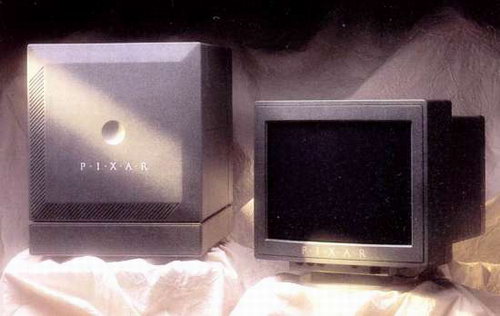
PIXAR Imaging Computer
For those who are curious, here's a photo of the beast:
http://www.3dnews.ru/documents/8124/pic-16.jpg
And another photo with a Sun E450 and Sun SPARCstation 5 for reference:
http://www.nenv.k.u-tokyo.ac.jp/bis/kaoru/kizai01/ images/pixar.jpg -
Re: But...
Coincidentally, the same researchers have a paper on Detecting Dance Motion Structure through Music Analysis. So yes, it is possible that these same researchers could have a robot in the future that can make up decent dance moves to ogg files. From the paper, it looks like they already have some rough computer-generated figures dancing to music files.
-
Re:What's wrong with just puting up English signs?
Many visitors may even be able to pick up easy words from signs in English rather than trying to translate Japanese characters.
They already have signs in English in many places. This is nothing new.
The problem is this is mostly in the touristy areas. Get off the beaten path and everything's Japanese only, and that's never going to change. You're not going to convince the local municipality of Ryu-Gasaki in Ibaraki prefecture to change all of its signs for the three tourists they get per year, for example. That's true of most areas of Japan and even a lot of the non-tourist areas in big cities, and it's true not just of the cities themselves but of small businesses, many of whom are run by people with limited English skills (and so who could not realistically write everything properly in English for tourists anyway).
Giving out these PDA's would basically help free people from having to stay within these few tourist areas (if you read stuff like this, you'd think all of Japan consisted of the Shibuya, Akihabara, and Shinjuku wards of Tokyo), which can only increase tourist business nationwide.
What Japan really needs to go along with this, though, is a major international ad campaign (perhaps partnering with ANA and JAL - they sort of tried this with their "Yokoso Japan" campaign but they didn't actually run any TV ads in the US). Where I live in NYC, we pretty routinely see ads for visiting other countries (mostly in Europe but also Australia, Canada, Singapore, China and others), but I have never once seen an ad for Japan. It's not a place most people seem to think of as a tourist spot. But I don't think there's a real lack of interest, it's just not the first thought people have when considering a vacation - whenever I tell anybody I'm going there, their first reaction is "Oh! That sounds great!" As if I'd just reminded them of something they'd forgotten. -
Re:Nothing new to see here, move along
You can download teddy (the drawing engine)as a java applet from a university website in japan. It also has links to smooth teddy an updated version.
-
Compare to Teddy and SmoothTeddy.
It sure doesn't look as "clean" as Teddy, a modeling program based on drawing 2d shapes and projecting them into 3D. The demonstration video is very impressive.
There's a newer version called SmoothTeddy, but the additional features have made the interface a little tougher, and the demonstration video spends the whole first half talking about technical improvements over the original Teddy.
Teddy was the 3D modeling system used for Alice, a 3D programming environment designed for grade school children.
All of this software is free to download. -
Compare to Teddy and SmoothTeddy.
It sure doesn't look as "clean" as Teddy, a modeling program based on drawing 2d shapes and projecting them into 3D. The demonstration video is very impressive.
There's a newer version called SmoothTeddy, but the additional features have made the interface a little tougher, and the demonstration video spends the whole first half talking about technical improvements over the original Teddy.
Teddy was the 3D modeling system used for Alice, a 3D programming environment designed for grade school children.
All of this software is free to download. -
Free, More open alternatives?
Teddy is a free (as in beer), more open (as in they listen to their users and involve them in the process) package that seems to do just about the same. Not sure on the license, but I know at one point, at least some of the code was opened up. All that, and it's in Java, everyone's favorite cross-operating format!
Check out teddy at:
http://www-ui.is.s.u-tokyo.ac.jp/~takeo/java/smoot hteddy/index.html -
Re:This is a VM platform, not a VMWare competitor
Hmmmm, who am I to argue here. Let me clarify a little: User code runs in direct execution up to where it tries to make a system call or takes a page fault (etc.) and traps into privileged code. Ok. User mode code isn't a problem.. privileged code is... Privileged code is *dynamically* translated at runtime; So then do you actually do emulation the first time around? The x86 instruction set is variable sized making it pretty impossible to accurately translate JIT. I'd imagine you'd have to do some form of emulation the first time around. Since the only worrysome instructions should be iret, pushf, and popf, I can't see why you wouldn't use a translation table. It seems like that'd be a pretty big performance win. This *is* what VirtualPC does. See the following presentation. See the "Guest OS Patching" section. we don't have big tables that tell us exactly where all the instructions in each supported operating system need to be patched. That would be totally impractical. Are you sure? I'm specifically referring to just the problem instructions (iret, pushf, and popf). I certainly have seen many problems with VMWare not being able to run non-supported OSes. I've got an MSDN subscription and have not been able to get *any* checked build to run. I'll look into submitting a bug report. I had just assumed it wasn't supported. VMWare is a fine product. I was try to demonstrate the differences in a Full-Virtualization approach verses a Para-Virtualization. Thanks for clarifying. BTW: I wasn't referring to the guest OS drivers, I was referring to the drivers required for install on the host OS. I assume these are necessary to intercept the traps for syscalls and page faults. An OS module is really modifying the host OS. I was trying to point out that VMWare requires host OS modification in order to work. Just pointing out that it's not as transparent as it appears to be
-
Not unexpected
I was involved in a similar, but very much smaller scale, experiment for my MSc thesis (JANZOS), attempting to find detect gamma rays from the (then very recent) supernova 1987A in the Large Magellanic Cloud.
So supernovae were a prime suspect source back then.
We had three (not four) 2 metre (not 12 metre) telescopes with about 30 'pixels' each (compared to a few thousand for HESS.) (I actually worked on another part of the experiment, which used particle detectors to detect higher energy showers.)
A significant problem is to distinguish between showers created by gamma rays and ones created by charged particles (mostly protons.) The charged particle showers are 'uninteresting', because the direction they come from is uncorrelated to their source - they move on curved paths due to galactic magnetic fields. Unfortunately, they are about 99% of the cosmic rays. We were not able to distinguish, so we had a large 'signal to noise' problem.
There was a single telescope similar to these ones in the mid 80s (the Whipple Telescope, I think) which claimed to be able to distinguish by details of shower structure. (We didn't have the resolution, nor perhaps the light gathering power, to make use of this.) I presume HESS has built on this work.
Note that this result does not necessarily tell us about the very highest energy cosmic rays. There is a change in the slope of the spectrum at (from memory) about 10^15 electron volts, so it is likely that different processess are involved on either side of this boundary. I think there were also theoretical reasons to think that supernovae could not accelerate particles to such high energies.
As I recall, the models for acceleration generally required shock waves in a gas with magnetic fields. Particles could repeatedly bounce across the shock, getting accelerated each time. (Think of a ball bouncing between two walls that are moving towards each other.) -
Re:what about the opposite?
Maybe it's only the tools that are to blame (only this one time, hehe). Might something like Teddy http://www-ui.is.s.u-tokyo.ac.jp/~takeo/teddy/ted
d y.htm be better suited to you? You only have to draw the outline, and the shapes are assumed to be round; You can then cut them as you want.
I've heard Shade (a popular modeller in Japan; Gunnm's author uses it http://jajatom.moo.jp/E-top/Egunnm/3DCG01/cg%20gal lery%20top.html) had a module reminiscent of Teddy in one of its newer versions. Of course, Shade seems to be impossible to find outside Planet Japan, so i'm not sure how much that helps, apart from letting you know that there are alternatives... -
from my blog...
check out my blog, where i post comments interesting stuff related to robotics...
My post on this topic is here and below.
Flexible sensors make robot skin. This could have a number of applications. The first two I imagine are a richer interface between machines and humans and advanced manipulation.
If cheap enough, the machine can understand the precise location and posture of a human. Mentioned in the article are car seats. Imagine a bed which adjusted itself to minimize pressure points.
I should mention a project out of CMU by Chris Atkeson and Daniel Wilson, where he put only a few cheap accelerometers in the floorboard of a house. The algorithm processing these sensors could localize humans in the rooms with remarkable accuracy. The challenge then becomes sensor fusion and system integration, in using this information to boost performance of the entire system. For instance, a human tracker using vision alone would be dwarfed by such a system which had a reasonable seed guess from pressure sensors.
The second application is for rich manipulation. A robot grasping a glass must do so with enough pressure to not drop it, but also enough sensitivity to not break it. I doubt humans use significant higher reasoning in this process, unlike the advantage humans have over computer vision programs. Rather, robots could sense the weight fairly easily, but also the type of surface, and learn how brittle such a surface is. -
Rational Election Reform
Election districts are entirely products of gerrymandering: majority parties design district boundaries to dilute their opponents, while empowering their own candidates, to perpetuate their power. These districts should not be designed by unaccountable politicians. They are simple demographic/geographic entities, and should be designed by simple universal rules to ensure the sampling methods of our ballots are accurate models of the people.
Each state should be mapped as an area cartogram, made up of smaller area cartograms of unit 30,000 people. The smallest state should get two Representatives, and every other state should get representatives in that proportion, rounding to the nearest district count. Each Representative district should include their proportional areas of the cartogram units, centered on the highest population density units. That would produce a House of 1000 Representatives, compared to today's 435. But that number was assigned a century ago, in 1911, when the population was only 92M; only 1/3 of today's 280M. Some other changes to modernize the representation model, like remote voting and binding teleconferences, would keep that new scale more manageable than the old one.
Putting these representation districts in the hands of dull statisticians and cartographers, and out of the hands of unaccountable politicians, will go a long way towards increasing the power of the people, especially in the House which most directly represents us. Until then, lobbyists, corporations, parties and sponsors will be disproportionately represented, at our expense. -
Local NamesI figure this is the right place to plug a project I've been working on.
It's called "Local Names," and it allows you to use short names for URLs.
The idea is that you should be able to use short names in:
- instant messages
- bulletin board posts
- blog posts
- wiki posts
- ...and in your address bar.
We can presently use LocalNames in most wiki (any wiki that supports InterLinks,) in WordPress blogs, and in Firefox browsers.
The LocalNames spec doesn't describe what linking syntax should look like, but it'd generally be something like this: [[short name of URL][long text to link.]] So for example, you might write:
"So, I was on [[Slashdot]] the other day, and I saw [[invisibility cloak][an incredible invisibility cloak!]]"
Which would render out as:
"So, I was on Slashdot the other day, and I saw an incredible invisibility cloak!
The names lists support defaulting, so that you don't have to name every URL you like. If someone makes a names list you like, (for example, the contents of a wiki,) you can just default to it.
There is already: a site for keeping your own names list, a web-browser redirection site, and a site for adapting a Wiki's title index into a Local Names list.
Python programmers may be interested in the Python library reference names, which you can use with FireFox to jump straight to any Python module's documentation.
Bloggers may be interested in MooKitty's plug-in for WordPress that lets you use LocalNames in blog posts.
Really, I get a little upset now when I have to look up URL's mid-post. I think, "Geeze, I've got the LocalName for this right on the tip of my tongue; Why do I have to actually resolve it to a URL myself, and then stick a href tags around it?"
Once you start using short names for stuff, you never want to go back. -
Neutrinoes and 1987A
When supernova 1987A went off, the KAMIOKA detector in japan detected a burst (I think it was ~10) neutrinos. With new detectors online to detect different neutrino flavors, it will be interesting to see if there's any new physics to be found.
-
Re:Neato
Looking at the redshift of some common spectral line will give you an immediate answer. What I want to know is if the neutrino pulse was detected at one of our observatories like super kamiokande like supernova 1987a was. This one is much further away so I don't know if it was possible....
-
Why using this system?Consider these points (click on expert in the computing page):
If similar to the compression rate quoted for smaller project on the homepage,
60% compression of 20TB result set possible to 8TB. But this will still take a week to download at 100Mbps.
Article quotes higher figures than I found on hompage, but says 4.2 teraflops, 812 cpus, 2TB memory.
However in comparison, the GRAPE-6 (GRAvity PipE) system is 64 teraflops and a typical simulation is 1 million stars x 100 million timesteps (1.6 Tflops).
So obviously why didn't they ask to use GRAPE-6 instead of this outdated equipment, is it because they needed more system memory?
Requires 70 hours x 512 cpus x 128MB/cpu memory. Modelling 1 billion point masses I do not see any use of Gravity Pipe (GRAPE) hardware. Currently Japan's GRAPE has more computing power for gravitational simulations than any other Top 500 computer. Of interest in GRAPE: http://www.sit.ac.jp/user/kawai/pkg/grape5/g5catal og.text One objective is to make "synthetic galaxy catalogs" for comparison with results of Sloan Sky Survey and 2dF Survey.
This page shows the kind of cones they are talking about (click for variations of the giant image below).
The snapshots page (click on an image size, needs javascript) shows that they can test for different values of physical constants, this is when speed of light is infinite.So is this system used because of memory requirements or what? Sounds like If they asked to use the GRAPE-6 they would get another magnitude of resolution or more timesteps.
-
Why using this system?Consider these points (click on expert in the computing page):
If similar to the compression rate quoted for smaller project on the homepage,
60% compression of 20TB result set possible to 8TB. But this will still take a week to download at 100Mbps.
Article quotes higher figures than I found on hompage, but says 4.2 teraflops, 812 cpus, 2TB memory.
However in comparison, the GRAPE-6 (GRAvity PipE) system is 64 teraflops and a typical simulation is 1 million stars x 100 million timesteps (1.6 Tflops).
So obviously why didn't they ask to use GRAPE-6 instead of this outdated equipment, is it because they needed more system memory?
Requires 70 hours x 512 cpus x 128MB/cpu memory. Modelling 1 billion point masses I do not see any use of Gravity Pipe (GRAPE) hardware. Currently Japan's GRAPE has more computing power for gravitational simulations than any other Top 500 computer. Of interest in GRAPE: http://www.sit.ac.jp/user/kawai/pkg/grape5/g5catal og.text One objective is to make "synthetic galaxy catalogs" for comparison with results of Sloan Sky Survey and 2dF Survey.
This page shows the kind of cones they are talking about (click for variations of the giant image below).
The snapshots page (click on an image size, needs javascript) shows that they can test for different values of physical constants, this is when speed of light is infinite.So is this system used because of memory requirements or what? Sounds like If they asked to use the GRAPE-6 they would get another magnitude of resolution or more timesteps.
-
Why using this system?Consider these points (click on expert in the computing page):
If similar to the compression rate quoted for smaller project on the homepage,
60% compression of 20TB result set possible to 8TB. But this will still take a week to download at 100Mbps.
Article quotes higher figures than I found on hompage, but says 4.2 teraflops, 812 cpus, 2TB memory.
However in comparison, the GRAPE-6 (GRAvity PipE) system is 64 teraflops and a typical simulation is 1 million stars x 100 million timesteps (1.6 Tflops).
So obviously why didn't they ask to use GRAPE-6 instead of this outdated equipment, is it because they needed more system memory?
Requires 70 hours x 512 cpus x 128MB/cpu memory. Modelling 1 billion point masses I do not see any use of Gravity Pipe (GRAPE) hardware. Currently Japan's GRAPE has more computing power for gravitational simulations than any other Top 500 computer. Of interest in GRAPE: http://www.sit.ac.jp/user/kawai/pkg/grape5/g5catal og.text One objective is to make "synthetic galaxy catalogs" for comparison with results of Sloan Sky Survey and 2dF Survey.
This page shows the kind of cones they are talking about (click for variations of the giant image below).
The snapshots page (click on an image size, needs javascript) shows that they can test for different values of physical constants, this is when speed of light is infinite.So is this system used because of memory requirements or what? Sounds like If they asked to use the GRAPE-6 they would get another magnitude of resolution or more timesteps.
-
Re:Heat --- correction
Ceffecive is a measure of all the capacitance that will be charged/discharged by the switching. It appears in the equation for dynamic (switching) power. Call it what you will, but this is how we determine dynamic power.
I do enjoy being corrected when wrong, but I'm going to have to ask you for some more reliable source than yourself on this one before I can have the joy. Here are some points for you to ponder while you google for something to back up your claim:
Capacitance varies with gate area and inversely with distance between "plates" of the gate (C = k*A / d). Reducing the gate width (space between the plates) actually increases capacitance, and this itself would increase power. But, you're also able to reduce the gate area (though not as much, but in 2-dimensions, so shrinking gates is usually a slight reduction in C). But, if the (dominant) interconnect capacitance (see next point) requires a larger transistor to drive it (which will be the case if voltage is not reduced) then the Area of the gate will increase, and so the capacitance will be right back up to where it was before you shrank the process.
According to Intel, "transitor loads are comprised of >50% interconnect capactiance." Wiring capacitance does not necessarily decrease with process shrinks (and may even increase significantly from cross-capacitance, depending on wire pitch and spacing.)
Most importantly, but probably too complex for this discussion, is the fast that gate capacitance depends strongly on voltage. This relationship is not well understood or investigated other than empirically.
Of course, the simplest way to show you that you're mistaken would be to send you some excerpts from process manuals showing that the capacitances do not drop with simple process shrinks in most cases, but that would probably get me fired. -
Papercraft paper at SIGGRAPH
It's funny that this topic came up on the heels of a paper at SIGGRAPH that looked at generating Papercraft models from 3D meshes. http://www.den.rcast.u-tokyo.ac.jp/~mitani/docs/s
i ggraph04_mitani.pdf (Sorry, I can't seem to make the whole URL disappear into a description.) -
Re:Pepakura
There was an interesting paper at SIGGRAPH this year on the same topic. Again, not origami as cuts are involved, but impressive non the less, enabling smooth surfaces to be modelled in paper.
http://www.den.rcast.u-tokyo.ac.jp/~mitani
http://www.den.rcast.u-tokyo.ac.jp/~suzuki -
Re:Pepakura
There was an interesting paper at SIGGRAPH this year on the same topic. Again, not origami as cuts are involved, but impressive non the less, enabling smooth surfaces to be modelled in paper.
http://www.den.rcast.u-tokyo.ac.jp/~mitani
http://www.den.rcast.u-tokyo.ac.jp/~suzuki -
Re:Patent system is messed upNope, it is real...
Watch the videos, they're pretty impressive.
-
Re:Patent system is messed up