Slashdot Mirror
Domain: umn.edu
Stories and comments across the archive that link to umn.edu.
Comments · 835
-
Re:Shame this happened
Yep, seems to be about that way. I've got some blue tomato seed that has no patents on it (Dancing With Smurfs, actual name), and no one makes a fuss about it. I don't see what their point is here. I was about to mod you up but since I actually work with plant breeding think I'll give my own 2 cents instead.
The claim in TFA about being worried about no more germplasm is totally ridiculous. With my blue tomatoes I've got a bunch of heirloom varieties of things (Blue Jade sweet corn, Dragon Tongue bean, Red Kuri squash, Giant Prague celeriac, Star of David okra, and lots more) that can in no way be patented. They are there, and as long as people keep propagating them they'll always be there, free to use. Furthermore, the patents on plants do expire; Honeycrisp apples used to be pateneted, but they're not anymore (by the way, that patent brought in tons of money to the program that developed it, allowing them to develop some other pretty amazing varieties). And Monsanto (because everyone brings up Monsanto) is not an exception here; their first Roundup Ready soybean goes off patent in a few months. That means this very year, farmers can, if they choose, save that variety and plant it for the 2015 crop. I really can't see the problem people have with these sorts of patents, isn't that how things are supposed to work? Develop, patent, recoup losses, then the invention falls to the public domain, and the profit is reinvested for new innovations (ex. SnowSweet apples and DroughtGard corn). Don't like patented plants? Fine, don't grow them, problem solved. And with the 'farmers sued for cross pollination' thing being a myth (no, accidental cross pollination is not the same as intentional selection any more than making a home movie is the same as recording a film in a theater and selling it), so I really don't get the Monsanto hate people are inevitably going to flame up with this. The vast majority of the reasons they are demonized for are nothing but lies, and yet somehow, Monsanto is still the bad guy here, not the weasels lying and being emotionally manipulative to make an extremely important technology look evil via guilt by proxy.
Additionally, I am envious of these guys if they have a program that has enough money to release things for free, although reading TFA it seems like they will be picking and choosing which is released for free and which is patented, indicating this is just a way to get some good publicity out of things that would otherwise be discarded. I work with a breeding project and you can bet whatever comes out of it will be patented, not because I'm out to get rich (we'd all go corporate if money was the prime concern) but because there is not enough funding for public agriculture research. You think we want to? We don't, but breeding programs need funding. That's a fact of life. Times are hard for funding, and sometimes it seems the only time the public stops long enough to pay attention is to demonize us for saying GMOs don't cause cancer, or autism, or whatever the hell the denialists and conspiracy theorists are prattling on about today. Maybe if everyone called up their local congresscritters and other politicians and demanded more funding for their land grant universities and public agriculture research that wouldn't be the case. Ever been to a corporate lab? Well I have, and it'd be great to have the equipment they can afford. But hey, go on attacking Monsanto and other private breeders for trying to support themselves (anyone think pluots just magically appeared? Someone spend a hell of a lot of time and effort developing those, nice to hear from the anti-plant patent crowd that they deserve to get screwed over for it), I'm sure hurting them will make all the actual problems magically disappear.
All that aside, its damned cool that they're working with quinoa bree
-
Summa Technologiae
You can also read Lem's not fiction Summa Technologiae - recently translated to English.
-
Re:GMOs feed over a billion people
It isn't unreasonable to be opposed to monopoly. I doubt you will find many academic scientists who would disagree with that. It doesn't follow that you should oppose GE crops for that reason though. First off, there is not really a monopoly: there's Monsanto, Syngenta, Bayer Cropscience, Pioneer Hi-Bred (DuPont), BASF, Dow Agrosciences, and various smaller companies. And of course, nothing stops farmers from doing the old fashioned saving of heirloom seed. In fact, if you look at the USDA's page on approved GE crops you can see more than just Monsanto, including a small company in Canada trying to get approval for a consumer oriented trait and a university developed crop, the Rainbow papaya developed by the University of Hawai'i (unfortunately, it is the only currently approved university developed crop, because unfortunately most university scientists do not have the funds to get a GE crop through the over strict approval process, which effectively favors large companies).
Another thing, when you buy organic, who do you think sells those farmers the seed? Monsanto, ect. sell more than just GE seed you know. You may very well be paying extra for more Monsanto seed.
except that they tend to be proprietary
For one thing, there's more than just GE crops that are patented. Ever had a pluot? Patented. Ever had a Honeycrisp apple? Formerly patented, until the patent expired. Neither of those are genetically engineered. Farmers who grow those things are willing to pay extra for those plants because then they can get an advantage out of them, no different than any other investment, and the people who develop those plants patent them so that they can make further investments, like the pluerry or SnowSweet apple (which is my number one favorite apple and would recommend anyone with a back yard buy a plant since the apples aren't commercially available, so I'm rather glad the apple breeding program that developed it was able to support itself on the patent royalties from Honeycrisp).
I don't really see the problem with plant patents. Developer gets exclusive control over the thing they developed for a period of time and hopefully makes enough money to reinvest it, then the patent expires so everyone can use the thing freely, like what happened with the Honeycrisp apple. Isn't that how the system is supposed to work? Unlike the copyright system where things last the life of the universe plus five years, I think this looks pretty good.
-
U of Minn says: about 80 AFUE from heat pump
What exactly is the efficiency of a heat pump when the outside air temp is below 20F like it is in the upper midwest this week?
According to the Unversity of Minnesota (folks who ought to know a thing or two about cold upper Midwest temperatures), a properly installed heat pump can achieve efficiency equivalent to an 80 AFUE gas furnace. http://www.mnshi.umn.edu/kb/scale/gshp.html. When folks down South install heat pumps they generally take shortcuts during the install, trading off easier installation for lower efficiency, but that's their fault.
U of Minn does point out that high-efficiency gas furnaces (90+ AFUE) are cheaper to operate but at a cost of more environmental damage.
So you tried to be snarky and instead got a chance to learn something.
-
Re:On Racism and Hate Speech
Races is all bullshit made up by people to categorize other as inferior *on sight*
Yes, thank you for pointing that out.
In case anybody needs a citation:
"The Myth of Race: America's Original Science Fiction" http://www.ahc.umn.edu/bioethics/afrgen/html/Themythofrace.html -
Re:Blatant Shill
Woah, can't believe anyone else knows about Arc. I was one of the unfortunate few that had to use it for a regression class in college. The language is used in the textbook Applied Regression including Computing Graphics. Since the professor also wrote the textbook and Arc has strong ties to my alma mater, I figured they just had blinders on since the rest of the statistics world was already using R.
If you are interested in trying this (awful) software out for yourself, it is available for download here http://www.stat.umn.edu/arc/software.html.
-
Re:in sue happy america
http://www.extension.umn.edu/yardandgarden/ygbriefs/h238manure-dog-cat.html "Can pet manure be sterilized chemically to make it safe? There are chemical sterilants such as methyl bromide and others that could be used, but the cost and bother is probably not worth the value of the manure. Also, the average homeowner probably is not equipped to handle chemical sterilants. CONCLUSIONS The health hazards associated with cat and dog manure are greater than the potential benefit from its fertilizer value. Cat and dog manure should be disposed of by flushing down the toilet, burying deep in the soil (six inches or more) or by placement in tight plastic bags for garbage collection. "
-
Re:What about natural trans fat?
The FDA tried to ban saccharin and an act of Congress stopped them (food lobby at work)
http://www.fda.gov/AboutFDA/WhatWeDo/History/ThisWeek/ucm117882.htm
http://enhs.umn.edu/current/saccharin/fda.html
The fact is, a lot of research shows that saccharin is bad, yet the lobbies that support it spend a lot of money to keep it on the market.
The FDA has what they call "ADI", acceptable daily intake. In other words, you can eat a little bit of poison and that is ok, just don't eat too much because we're paid to not ban it.
Well, I guess it works for tobacco, that should be banned as well, but it remains legal because of lobbies.
The fact is, lots of stuff is bad for us, but because there is enough money in it, it remains on the market.
That's because the dosage makes the poison. Nothing "is a poison." Everything is a poison at certain doses. Water, oxygen, carbohydrates, anti-oxidents, etc.
All of them lethal at some level but quite necessary for survival.That is why the FDA has a much better standard of "acceptable daily intake" rather than your over-reactionary stance. It turns out that saccharine was bad for rats (which, btw, are not people and do not always react the same as people) at very high doses. But quite safe for humans at "normal" doses. That does not make it a "poison."
-
Re:What about natural trans fat?The FDA tried to ban saccharin and an act of Congress stopped them (food lobby at work)
http://www.fda.gov/AboutFDA/WhatWeDo/History/ThisWeek/ucm117882.htm
http://enhs.umn.edu/current/saccharin/fda.html
The fact is, a lot of research shows that saccharin is bad, yet the lobbies that support it spend a lot of money to keep it on the market.
The FDA has what they call "ADI", acceptable daily intake. In other words, you can eat a little bit of poison and that is ok, just don't eat too much because we're paid to not ban it.
Well, I guess it works for tobacco, that should be banned as well, but it remains legal because of lobbies.
The fact is, lots of stuff is bad for us, but because there is enough money in it, it remains on the market.
-
Could you use a web search at some point?
http://en.wikipedia.org/wiki/Heptavalent_botulism_antitoxin
http://www.infantbotulism.org/general/babybig.php
http://www.ncbi.nlm.nih.gov/pubmed/21918119
http://www.cidrap.umn.edu/news-perspective/2006/02/antitoxin-infant-botulism-slashes-hospital-staysThe lab that discovered the new strain of botulism is a test center for infant poop. The drugs are terribly expensive so when a baby is suspected of having infant botulism, the hospital sends a sample that gets tested. If it's tested positive, the baby is given the antitoxin.
Seriously, use a web search. Not that hard.
-
Re:Pathetic
What is this magic healthcare we pay for that makes them healthy and keeps them alive as long as you and I?
It's called "private medical research" and "medical tourism".
My understanding is no amount of money will fix type 2 diabetes and obesity in a non-compliant patient.
Your understanding is out of date. We are currently using Porcine stem cells and islet transplants to treat diabetes, albeit it's still considered experimental treatment in the U.S. so that insurance companies, which we still have to pay for our healthcare, rather than having a single payer system like the rest of the world, don't have to pay for the treatment:
http://www.mmf.umn.edu/diabetes/
On the other hand, if you are willing to travel to Russia, Finland, the Ukraine, the Czech Republic, Panama, or Poland, they'll happily take your money, and provide treatment for Diabetes, Parkinsons, and a half dozen other conditions, and several of the countries will even let you buy antiaging treatments as well.
When Porcine stem cells are used, you have to sign some pretty strict agreements, since they down't want PERV (Porcine Endogenous Retro Virus) crossing species boundaries, unless you agree to sexually isolate yourself on the order of the protection necessary to prevent the spread of AIDS (condoms, etc.).
-
Re:Who's being interviewed?
Mr. Pegoraro barely gets a word in here and there.
Agreed. Let's have a do-over.
How about an "Ask Rob Pegoraro About Traditional News Decline" story where people submit questions, moderators bring the cream to the top and Rob selects the ones he feels he can best answer? He'd be totally in his element because he did almost exactly that in The Post's Live Online discussions (where readers would submit tech questions and he would select the ones he wanted to answer). He wasn't at DigitalInk/WPNI when they started the transition to digital (for that you'd want to talk to Don Brazeal), but he was there in The Post newsroom when they brought it back in-house and got to see the effects of staffing cuts as the newspaper responded to declining circulation and ad revenue. -
Re:unforseen consequences?
I am not against biotech, I just don't trust Monsanto, and I have my doubts about the FDA. I was tired when I wrote my initial comment so it probably wasn't as well thought out or written as I thought at the time. I apologize if I wasn't clear. GMOs might have different nutritional properties and chemical contents that could cause human health issues or ecological problems.
University of Minnesota lecture notes
I just think it might have been a bad idea to start growing GMO crops on the scale we have before any long term testing has been done. I understand doing a long term study is expensive and might take years or even decades, but think of the scale. Millions of humans health and entire ecosystems are at stake.
I have no role in agriculture other than a consumer, so I don't know if it would be possible to produce enough without GMO's. I think there is a lot of potential in GMOs. I just wish we would have VERY thoroughly tested the technology and were VERY sure of its safety before deploying the technology on such a large scale. This is the reason why I would like to see the US federal government spend more money on R&D. Cutting a few billion from the DoD wouldn't leave the US defenseless and would fund a LOT of research that benefits everyone. -
Faculty use IT when they need it
I am an IT Director / CIO for a small liberal arts university, and I've discussed this issue on my blog about IT leadership in higher ed. What many of us in technology sometimes forget is that technology is fairly new to the workforce, and that includes faculty. Remember, the PC was only introduced to office desktops in the 1980s (unseen mainframes in server rooms don't count). If people enter the workforce in their 20s and retire in their 60s, that's a 40-year work generation. So computers have only been part of the workplace for less than a work generation. There are still a lot of people out there who remember doing their work without technology.
And faculty are less likely than, say, accountants to embrace change. Accountants realized that they could use the computer to add up the numbers and create a spreadsheet to track the income & expenses. People in sales used the computer to write letters and other communication. But for faculty, their job is teaching and for that they have relied on a chalkboard (or whiteboard) for pretty much their entire careers, going back to undergrad. Powerpoint was a stretch for some faculty, but Powerpoint isn't much more than a "captured" version of their whiteboard talk, so many faculty took to Powerpoint as a means of delivering lectures.
One of the faculty at my university often uses the phrase "Technology should be like a rock; it should be that simple to use." And there's a lot to that. Faculty want technology that is easy to use. They don't want to tinker with technology, they don't want to try the latest thing. Faculty only want technology when it supports what they need to do for instruction.
And that's where we in IT see things differently, of course. For us, technology isn't just our job, it's often our passion. We got involved with technology as a career path (programming, desktop support, server admin, databases, etc) because we were pretty much doing that already (building web pages, building our own computers, installing our own OS, etc) and what better job than to get paid doing what you love? So campus technology folks are going to gravitate to the latest technology: the Raspberry Pi, smartboards, video capture, and the like. And we get confused when the faculty don't want to use it, as TFA mentions.
Faculty will adopt technology when they need it to do the job of teaching. The article includes some quotes along those lines.
"I went to [a course management software workshop] and came away with the idea that the greatest thing you could do with that is put your syllabus on the Web and that's an awful lot of technology to hand the students a piece of paper at the start of the semester and say keep track of it." What makes it easier for faculty to focus on teaching? Learning how to put a PDF on the web (or a course management tool like Moodle) when they've never done that before, or printing out a syllabus and asking the students not to lose it.
"What are the gains for students by bringing IT into the class? There isn't any. You could teach all of chemistry with a whiteboard. I really don't think you need IT or anything beyond a pencil and a paper."
One quote that highlighted when faculty were interested in using classroom technology: "They're undergraduates - you need to attract their attention before you can teach them anything." Because that helps the faculty in the job of teaching students, which is the most important thing. In this case, using some technology in the classroom may help get the attention of students, which the professor says you need to do "before you can teach them anything."
I'd also remind anyone working in campus technology to remember three important questions when trying to effect change on campus:
- Is it the right change to make?
- Are the right people behind the change?
- Is the campus ready for this change?
-
Re:Thank you anti-vaxers!
Unfortunately, you (and those who modded you up) seem to have no understanding of the flu vaccine. Your numbers are complete bunk. Unlike most "traditional" vaccines where the target is pretty well understood, the flu vaccine is a crap shoot every single year. If 100% of the population was vaccinated, your risk of getting the flu that year may be the same as another year when no one was vaccinated, because those making the vaccines very well may have guessed wrong on the strains that would be prevalent in that year.
The national news carried reports up until a few weeks ago that this year's vaccine was a great match for the strains circulating in the wild (for example). With flu rates coming in at well-above average, this story suddenly went away. If the vaccine was such a good match when we were urging everyone to get a shot, why it is suddenly so ineffective? (And, yes, that is an actual question, not a smart-ass rhetorical one.)
Actual evidence for the effectiveness of the flu vaccine is non-existent. Do yourself a favor and read some of the recent reports about this from reputable sources. For example, the University of Minnesota's Center for Infectious Disease Research and Policy released a report just a few months ago indicating that influenza vaccinations provide only modest protection for healthy young and middle-age adults and virtually no protection to those 65 and older. They concluded that US federal vaccination recommendations are based on inadequate evidence and poorly executed studies. You can get a PDF of the report here. The Center's director is not an "anti-vaxxer" but an experienced expert and government insider. He still recommends the vaccine in general because it is quite safe even if the paybacks are greatly overstated.
You might also want to review some of the Cochrane Collaboration's reports. In the past few years, they have found there is no evidence that vaccinating health care workers had any effect on influenza or pneumonia deaths in the elderly or that vaccinating the elderly provides any benefits to them, They also found that the flu vaccine has no impact on the number of people hospitalized, transmission rates in the population, or associated health complications. It does appear that in a year when the vaccine and virus mix actually match up well, healthy adults under 65 will see milder/fewer symptoms and gain an average of half a workday.
I do not get the flu vaccine. I also rarely get the flu (perhaps twice in the past decade). My spouse usually gets the vaccine for herself and our children. In my personal observations during the past decade, there is no discernible pattern to our infection rates from year to year, vaccination or not - sometimes our house sees a flu or two despite vaccinations and sometimes we see none despite no vaccinations. I'm not suggesting that the flu vaccine is dangerous or completely ineffective, but it seems obvious that the government and drug companies have vastly oversold it.
-
Re:Interesting theory
There are many citations of the same observation I just made. Here is great one:
http://ageconsearch.umn.edu/bitstream/21101/1/sp06ma03.pdf -
Re:Ah, so there we go....
The request was for an example of an AGW disaster - of course it's cherry-picked. Nobody's claiming the sea level is rising this fast in all places (quite the opposite).
What's also bald-faced cherry-picking is a statement like "basically no net gain since a peak of the early 80s". You have to really try hard to ignore the clear and continuing upwards trend (more importantly for the Tuvaluans, the all-important seasonal peaks keep getting higher, resulting in worse flooding each time). You also have to carefully ignore the altimetry data, which clearly shows a 5mm/year rise since 1993 at Funafuti.
Even more impressive is how you blithely imply that a peer-reviewed study's conclusions are completely wrong, without seeing the underlying data or challenging their methodology, even though the study confirms earlier work like Church 2006. You smoothly fill in the missing GPS data with assumptions of your own that it would naturally support your pre-conceived conclusions instead. This despite your admission that you're still baffled by the long-established connection between rising CO2 levels and rising sea levels.
Did I mention that Tuvalu is cited in at least three different studies on climate change disasters? Maybe you should reassure the Tuvaluan Government that the experts are lying and/or incompetant, AGW is a massive conspiracy, and all that salt water they're seeing must be a figment of their imagination, because your glance at a graph proved that rising sea levels and subsidence "mostly stopped by 1980".
-
Re:Here's a better idea.
A thousand-year tornado is laughable, and makes you sound like you believe the bullshit weather movies on the Syfy channel.
That's just the sort of belligerent hubris that I'm talking about. You're still prattling on about how it's stupid to plan for the worst disaster to hit a plant's area within the last thousand years right after a once-in-a-thousand years earthquake fucked up Fukishima?
As someone who lives in Minnesota
As someone who lives in Minnesota, you'll be well familiar with the 48 tornadoes to swing through Minnesota in one day in 2010, and the flooding in Duluth that washed away homes and roads.
And that's the last two years. What's the worst natural disaster Minnesota's had in the last thousand years?
F5 is as high as they go, and they happen pretty routinely.
50 over a period of 60 years, two in Minnesota. That's not "routinely" for you.
Earthquake? You've got me there. The last earthquake in Minnesota hit in the neighborhood of 100 - 150 years ago and was a 6.something.
You mean 5.0 in 1975? Of course that's not an earthquake to worry about, but of course that means you need to plan for eathquakes even in Minnesota.
So, most of your post is fanboi denialism. Before you double down, the point isn't that Dayton should shut down all the nuclear plants in Minnesota because the next storm system will result in a meltdown. It's that nuclear plants need to be massively over-engineered before you can talk about how safe they are with an honest face. And no, going by the penny pinching corporate bean-counters definition of over-engineered is not going to cut it. Plan for the worst disaster your area might face, and for fucks sakes get the profit motive out of the equation.
-
What College Are You Talking About Here?
Students who want to avoid $200,000 in student-loan debt
Yeah, I don't know how this happens. I mean, I know how it happens
Frankly, I think this article should be titled, "skip the overly expensive college because you'll get a more than adequate education somewhere else." Okay so I have to prove myself in an interview over someone from GWU. Challenge accepted.
And if everyone drops out of college to start their own thing, who are you going to be hiring when your startup needs to transition to a medium to large company? Other dropouts whose ideas were crap. Are you sure you want to advocate this to be a more widespread phenomenon? -
Re:Patriot Failures
No. Simple computer math error due to imprecise representation and rounding. See http://autarkaw.wordpress.com/2008/06/02/round-off-errors-and-the-patriot-missile/ and http://www.ima.umn.edu/~arnold/disasters/patriot.html for details. Interesting problem solved by rebooting the system periodically until a real correction was implemented.
-
Access to rental history
I don't remember titles that well. One of the things I like about Netflix is to know if I have viewed a title previously and if I liked it. See http://movielens.umn.edu/html/tour/index.html for an idea of what your friend should be doing.
-
Re:Not a legal question
You will very likely get oranges if you wait long enough for the tree to mature. It is also likely that the oranges will not be of the same type that you bought in the store, representing segregations from the genetics found in the original parental tree.
Most everything in the produce department will contain viable seeds, which will then grow up to make viable plants. The fruits/etc of the plants you grow will likely not be the same to the produce you bought again because of genetic segregation. There are a few exceptions, like 'seedless' watermelons, which have an extremely low seed production. In these cases there is seed failure not because they are hybrids, but because they are hybrids with a triploid genome content. Theoretically this method could be applied to many plants, but pragmatic difficulties have limited the potential for this technique in many crop species.
A good article examining the reality of what you propose : http://blog.lib.umn.edu/efans/ygnews/2009/03/seed_savers_garden_a_demonstra.html
-
Autonomous Gliders
This is similar to the autonomous glider the people at the Large Lakes Observatory use to get data from something that's not moored in one place like research bouys are. The unit here in Duluth cruises around Lake Superior for a few weeks at a time, but they're standard equipment for oceanographers in bigger, saltier puddles too.
It uses the same means of propulsion: turning up-and-down motion into forward motion with wings. Its power source, however, is some onboard batteries rather than a solar cell limiting its endurance (but freeing it from dragging around the solar rig, so it can go deeper and faster). All the battery does is change the volume of a swim bladder, causing the glider to float or sink. Amazing efficient!
-
Generational differences
Welcome to generational differences. I hope you enjoy your stay. And yes, this exists pretty much everywhere - although maybe not to the point you describe here. Depends on the people you hire, too. But speaking generally, it's a generational thing.
Every generation approaches their work in a different way. I spoke about this a few years ago at Penguicon in my Linux in the Enterprise (Powerpoint) talk. Although my slides don't have a lot of text on them, so you may not get much benefit by looking at the slides on their own. You can also find more on my blog.
In my Penguicon talk, it was about how to pitch Linux to the higher-ups. I mentioned 3 generations that might be your manager. In your case, you are likely experiencing only 2 of these groups:
- My generation (the "Star Wars generation") in their 30's and 40's
- The "boomer generation" in their 50's and 60's
Folks in their 30's and 40's tend to be very conservative. I don't mean to say politically conservative but conservative in their actions. Other slashdotters who are about my age likely saw one of their parents get laid off from their jobs while we were growing up. If your parents weren't laid off, I'm sure one or more of your friends' parents were. And while we may not recognize it, that caused many of my generation to think conservatively. We don't want to see that happen to us. So we tend to view things in terms of risk. Many in my generation are risk-averse, so you really need to be careful in how you introduce new technology and new concepts to them. Approach it as a way to reduce risk or to make things easier. Don't just jump in and expect them to follow, because they're waiting to see what you'll make of it before they touch it. Will this be something that "sticks" or will it be another flash-in-the-pan that goes away after a little while, so a waste of time to learn?
The boomer generation is different. That generation is often motivated by societal change. Witness the societal upheaval in the 1960s and 1970s. And they definitely didn't grow up with technology, they probably "fell into it" and got their start working on mainframes. If they are honest, they may tell you they're more interested in society and social networks (this the generation that Classmates.com was built for) and less motivated by technology. Since they didn't grow up with technology, the boomer generation may not always be comfortable with the rate of change in technology - even those who work in technology. In general, don't expect boomers to share your enthusiasm for new technology. You may need to walk these folks through it. Draw parallels for them, show how this new thing is basically like this other older thing, but with a few improvements.
If you look at your coworkers' behaviors as a symptom of generational differences, you'll be pretty far along.
Your generation, by the way, is often very self-motivated to go search stuff out on their own. (You mentioned this in your post.) Kids in your generation don't often stop to bring other people into what they are doing, they just do their own research. (Sound familiar?) And your generation typically is not interested in going through the same "levels" that previous generations were content to follow. So while you didn't mention this in your post, I'll give it as a caution: if you find that your boss's boss is an expert in some area that you're working on, you probably will just send an email to pick his/her brain on the topic. You wouldn't think anything of it; that's the expert, so you asked. Your boss's boss will probably answer you, too, because that person is probably a boomer - and remember, boomers tend to be motivated by social networking. So your boss's boss will find it hard to resist having that dialogue with you.
And in doing so, you will have piss
-
Re:Minnesota, eh.
It's pretty obvious to me that this was based on loss of revenue for a state that has the highest number of sex offenders in indefinite "treatment". It costs several times the amount to than prison. Add that cost to the new stadium. Several thousand cases will equal at least a few million dollars flowing into the economy.
http://www.bhs.umn.edu/alcohol-policies/pdf/Driving_While_Impaired_FAQ.pdf -
Re:That's just part of the concern..
Not really. Developing new plant varieties is hard work that produces a unique and beneficial to society end produce, and developing a new plant variety is much like developing a new anything in that regard. From Luther Burbank (who was one of the early proponents of what eventually became the Plant Patent Act of 1930 and later the Plant Variety Protection Act of 1970) to modern breeders and genetic engineers, they deserve some control over their work, and it helps innovation. My favorite variety of apple, SnowSweet, is patented & illegal to propagate and would likely not exist were it not for patents on life (and it is not, by the way, genetically engineered).
-
Re:generally good news, but not entirelyThe third factor discussion is on pages 55-71: http://www.tc.umn.edu/~nasims/GSU-opinion.pdf
Her application of the 3d factor analysis (p88) (following the 3d factor discussion) reads"Where a book is not divided into chapters or contains fewer than ten chapters, unpaid copying of no more than 10% of the pages in the book is permissible under factor three. The pages are counted as previously set forth in this Order. In practical effect, this will allow copying of about one chapter or its equivalent. Where a book contains ten or more chapters, the unpaid copying of up to but no more than one chapter (or its equivalent) will be permissible under fair use factor three."
The 10% figure comes from a discussion of the legislative history of the 1976 Copyright Act, specifically a related House Report called the "Agreement on Guidelines for Classroom Copying in Not-For-Profit Educational Institutions with Respect to Books and Periodicals." Interestingly, in her 3d use analysis section she notes that the Guideline figures --including the 10%-- were considered by Congress to be a minimum threshold, not a maximum. So her use of the 10% seems to conflict with her earlier discussion on p59, in which she suggests that such a
"brightline restriction (would stand) in contrast to the statutory scheme described in section 107 (of the US Copyright Act.)"
-
Re:What?We are Master of your domain
http://www.law.umn.edu/uploads/x9/zx/x9zxd7nnmzDMMwHVC-aRHw/Sonbuchner-Final-Online-PDF-04.07.09.pdf
-
Re:Lack of Political Will
Maybe the solution is to quit making bio fuel in probably the worst way possible. I love bio fuels but when algae base fuels don't qualify for any of the subsidies because they are made from the wrong plant (read this a while back in the local paper and can't find the full article but the U of MN page on the summit is still available) there is something wrong with how we are making them.
-
Incomplete Data Lead to Decision to Launch
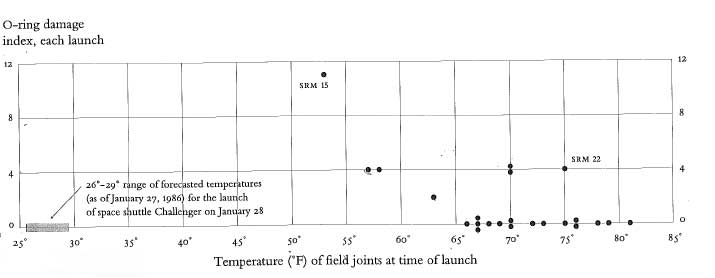
NASA wasn't aware of the link between subzero temperatures and o-ring failures. Boisjoly and Morton Thiokol engineers tried to convince NASA of the issue, but the only evidence they provided was incomplete and showed no correlation. This is the data they provided- http://courses.cs.vt.edu/cs3604/lib/WhistleBlowing/challenger.1.gif This is the FULL data that Morton Thiokol did not present in arguing to delay launch- http://www.d.umn.edu/~cstroupe/f11/4260/assets/tufte_o_ring_damage.jpg
-
They are already moving to make it illegal...
http://www.treehugger.com/green-food/et-tu-minnesota-another-law-proposes-making-factory-farm-photography-illegal.html
http://www.nytimes.com/2011/04/14/us/14video.html
http://animalrights.about.com/b/2011/03/23/bills-to-ban-undercover-factory-farming-videos-moving-ahead-in-iowa-and-florida.htm
http://www.dvafoto.com/2011/03/two-us-states-move-to-outlaw-unauthorized-photos-of-farming-operations/
http://www.silha.umn.edu/news/Summer2011/StatesConsiderBanningUndercoverRecordingatAgriculturalOperations.html
http://www.foodsafetynews.com/2011/03/in-the-past-decade-modern/ -
Re:10% Ethanol
It is even worse than that. Some bio fuels don't count as bio fuels for federal funding. Last year there was an article in the local paper (only summary available online now) about the algae fuel summit being held here in Minnesota. One of the things it mentioned was that algae didn't qualify as a bio fuel. If anyone is interested the University of Minnesota still has the info page available which has a fair amount of info on it.
-
Reminds me of Monty Python
When some politician firmly stated:
"We will tax all foreigners living abroad!"
-
Soudan Underground Mine State Park, Soudan, Minnes
Does anyone know if they still give guided tours? http://www.physics.umn.edu/outreach/soudan/tour/
-
Re:Questions...?
My case in point is how Monsanto patented life in their seeds, and now dominate the markets
So? Aren't plant breeders allowed to have a return on their investment? My favorite apple, SnowSweet, is patented, and were it not for the success of the breeder's last patented apple, HoneyCrisp, it might not exist today. Why should Monsanto be any different? I don't care whether you like them or not, but they're not in the wrong on this one. And by the way, their first patent expires in 2014, and they plan to let it. Seems like they're doing it a lot better than the RIAA & MPAA are handling copyright.
Watch Food Inc. to get the gist of that nightmare
Ugh. That's like saying listen to Jenny McCarthy to understand the vaccine nightmare. Food Inc was biased rubbish geared towards people who know nothing about agriculture. I couldn't even stomach the damn thing. If it's patents you're concerned about, think about this tidbit:
"I have been for years in correspondence with leading breeders, nurserymen, and federal officials, and I despair of anything being done at present to secure to the plant breeder any adequate returns for his enormous outlays of energy and money. A man can patent a mousetrap or copyright a nasty song, but if he gives the world a new fruit that will add millions to the value of the earth’s annual harvests he will be fortunate if he is rewarded so much as having his name connected with the result. Though the surface of the plant experimentation has thus far been only scratched and there is so much immeasurably important work to be done in this line, I would hesitate to advise a young man, no matter how gifted or devoted, to adopt plant breeding as a life work until America takes some action to protect his unquestioned right to some benefit from his achievements."
Sound like paid defender of Monsanto? Nope, that was from a letter written by Luther Burbank, one of the most famous and visionary plant breeders who ever lived, who lived in an age when Mendelian genetics were still novel and was an early supporter of plant patents whose views helped create the Plant Patent Act of 1930 (though he died before it was passed). Plant breeding, and genetic engineering, is a hard, time consuming process that adds a lot of value to the world. Farmers wouldn't buy crops with production orientated traits if they weren't beneficial, and consumers tend to liek things that taste good (like HoneyCrisp apples, which just went off patent recently). Those who do contribute to the world in such a meaningful way deserve their fair share of the return for their investment.
When it comes to patents of science, I don't trust them
Fair enough, I'm not big fan of them either, and I can think of a few. By all means, keep a close eye on corporations, I'm not saying they're to be fully trusted, but there is a big difference between science and a product, and a big difference between a reasonable patent allowing the inventor to get a return on investment.
I like plant patents, I like like that those in plant improvement can make a living, and so should you. I like my SnowSweet, and the program that made it might not even be able to exist without patents. That's just the way of the world. Yes, it'd be nice if this stuff had more public funding (a lot more), but instead funding for these sorts of things at universities is being increasingly cut by short sighted assholes (at my university, the university's president, a pompous douchebag if ever there were one, cut the ag department's budget while increasing his own salary), and no wonder, when people know so little about agriculture that Food Inc wins awards, who can be surprised that this is where we end up, with large corporations leading the way?
-
You should own it
At Minnesota, where I teach, and where I did my Masters and Ph.D. theses, students and faculty own copyright to their original work, including scholarly work (papers, theses, etc.) and original course materials. See http://policy.umn.edu/Policies/Research/COPYRIGHT.html for details. My understanding is that this arrangement is extremely common in the U.S. I am a strong advocate of open source and creative commons, but in this case I would encourage you to simply copyright your thesis. That does not mean others cannot use it, it just means that they must attribute the work to you, and cannot claim it as their own.
-
Re:Not the first sandcrawler corporate HQ.
I know exactly the buildings you're thinking of - just off 494/Penn in Richfield.
Weirdly enough, I was thinking of another Twin Cities building that my friends had dubbed 'The Sandcrawler': McNamara Alumni Center at University of Minnesota. -
Re:Criminally liable?
Farms that sell unpasteurized milk?
Are there regulations that it has to be pasteurized?
In Minnesota you cannot advertise that you sell unpasteurized milk or offer it for commercial sale. You can purchase small quantities directly from the farmer for personal use and need to provide your own container. Here is an excerpt from the University of MN on the subject citing the law:
-
Re:HIV?
According to the literature I'm finding, H1N1 is a single stranded RNA virus as are rhinoviruses. Haven't checked the others, and I should probably RTFA, but where did you get that information?
-
Re:Now everyone's a freakin' expert!
Agree, crashing is unacceptable. But consider this before you put "never crash" into your 'easy 80%': http://www.ima.umn.edu/~arnold/disasters/patriot.html
dave
-
Re:Protip:
Big rigs are different since they are not, as you claim, friction limited. At friction limits on all wheels they are generally dynamically unstable. So stopping with all wheels at the friction limit causes loss of control unless you have control augmentation hardware, just like in stealth fighter planes. None of the production rigs come with it, you only get it in passenger cars, mostly as an option. Big rig brake systems AFAIK are pretty much technological relicts, kept around to cut costs only. I've seen a big rig test bed experiment with disc brakes on each wheel (in both tractor and trailer), and the controller had anti-lock and stability augmentation enabled. It was a sight to behold. You could slam the brakes, activate ABS, and the thing was going exactly where you wanted it to. There was no way to jackknife it while braking, no matter how hard you tried, and the braking distances with 18 tons of load made a joke out of a normal truck. Of course it was experimental, but still the effects that you mention are solely due to implementation choices, there's nothing fundamental about it.
Your test, when done on a car, must be always done with triggering ABS, on all wheels. Otherwise it's not valid -- there's no way for you to tell how close you are to becoming friction limited otherwise. If your emergency brake affects rear wheels, you can stagger ABS activation by adding a preload on the rear brakes. Then when you press the brake pedal you'll first hear rear brakes pulsing, then fronts will join in as you add more braking force. You can adjust the preload to get a good indication for how close you are to getting front ABS coming on.
To a first approximation, friction (thus braking torque, when you're friction limited) is proportional to the normal load -- the weight of the vehicle. That's the basic physics. A heavier vehicle automatically provides you with more available friction force. The AASHTO braking distance equation only depends on initial end final speed, and on coefficient of friction. The coefficient of friction does depend somewhat on tires, of course, so you cannot have an ultimate comparison with different tire types and sizes, unfortunately. You're pretty much bound to testing with one vehicle, with one set of tires, and different loads.
Whatever effects you're seeing are second-order and thus should be small, and relate IIRC first to tire contact area. You could compensate for the latter by adjusting the tire pressure to obtain same axle-to-ground distance. If you are still seeing an effect, then your tire's design is "poor" in that the effective coefficient of friction of tire vs. pavement depends on load; that's -- again IIRC -- due to changes in the geometry of the rubber elements that contact the pavement while being sheared. They deform due to shear in such a way that the effective friction coefficient changes, usually decreasing. I've seen plenty of variation in that effect in different tires. The more the tire is worn, the less pronounced the effect. Whatever we're talking of here is minuscule stuff in single percents. Nothing that will double your braking distance.
-
It Supports It Now, Why Would That Change?
During discussion about proposed changes to our campus-wide wireless network, I asked if the new system would support Macs, Linux and other Operating Systems.
What is the authentication and accreditation methods/technologies involved with this "new system?" It's entirely possible the meeting was for 10,000 feet people and not the actual IT folks. For instance, your current system appears to support Linux (PDF Warning) and I would be surprised if the plan was to drop this.
When I went to the University of Minnesota 2000-2004, the wireless was more or less agnostic to the operating system and their documentation has gotten much better. When I was there I helped set up some Gnu OCR stuff on Linux so that people could scan books in the labs and at halls--perhaps if your response had been to investigate and volunteer documentation for a Linux solution, they wouldn't have treated you as the punchline to a joke? (I know that not everyone has as much free time during college, this is just a suggestion.)Have IT staff ever ridiculed you for asking questions about Linux?
Yes, of course, back in 2000 when I was fresh off the farm, I was constantly ridiculed for asking questions about Linux. But for different reasons. Because I didn't know the difference between Linux, Unix, Solaris and BSD. The labs at UMN supported all of those widely with many many seats (well, maybe not BSD) and when I sat down at one I was temporarily outside of my comfort zone and would ask incredibly stupid questions. If you adopted the role of being the friendly helper to your administration, perhaps they could, as did I, eventually realize the amazing awesomeness and power of these operating systems? If they don't, you can always argue that diversity is great and offer to help with supporting your operating system of choice by making some documentation.
-
Re:They canObtaining justice in their own system is likely to be really, really hard. I don't know for certain but I would imagine that in Egyptian Law the telecom companies would be able to successfully argue that they were merely following governmental orders, and the government will claim some kind of perogative to act - probably grounded in some kind of martial law rights. The problem is that the law as it stood both reflected and enable a specifically ordered power structure - the law would give deference to the government in many areas.
So you're stuck with the hope that the law would be adapted, a process that takes a lot of time and negotiation, and protections for civil society added. Problem - a lot of states forbid ex post facto prosecution. Egypt is a signatory to the Arab Charter on Human Rights which specifically states thato crime and no penalty can be established without a prior provision of the law. In all circumstances, the law most favorable to the defendant shall be applied.
. So the only option is likely to be appeals to international courts. Using the courts as they stand in Egypt is likely to be futile at present, and in the future they'll be unable to claim for injuries suffered prior to the adoption of new laws. It's a difficult situation to be in.
Moreover, there's a lot of reasons to make an international case here - and most of them are rooted in good ol' money and politics. -
Exciting to see it get sorted out
This is especially interesting to me because another experiment failed to detect any evidence of dark matter, which seemed to contradict the (not quite statistically significant) hints that CDMS may have detected dark matter last year.
I'm also confused about which experiment this is. It says it is in the Soudan mine in Minnesota, but it isn't mentioned on either of the websites for the mine. Is it part of MINOS or CDMS, or is it something separate?
Regardless, I have been really excited about these detectors for the last couple years (even more so than the LHC), and it is great to start seeing data.
-
Exciting to see it get sorted out
This is especially interesting to me because another experiment failed to detect any evidence of dark matter, which seemed to contradict the (not quite statistically significant) hints that CDMS may have detected dark matter last year.
I'm also confused about which experiment this is. It says it is in the Soudan mine in Minnesota, but it isn't mentioned on either of the websites for the mine. Is it part of MINOS or CDMS, or is it something separate?
Regardless, I have been really excited about these detectors for the last couple years (even more so than the LHC), and it is great to start seeing data.
-
Re:QQ
There is no significant biological basis for "race". Phenotype is the least significant factor in, for instance, being "Black".
http://www.ahc.umn.edu/bioethics/afrgen/html/Themythofrace.htmlMore food for thought, on the question of racial bigotry vs. racism:
http://www.mdcbowen.org/p2/rm/define/bigots.htmlWhy are so-called "white people" so often uncomfortable thinking about this issue, and so seldom interested in it as a topic for study?
-
Remembering the other Bill (Norris)
http://en.wikipedia.org/wiki/William_Norris
"William Charles Norris (July 14, 1911 near Red Cloud, Nebraska -- August 21, 2006) was the pioneering CEO of Control Data Corporation, at one time one of the most powerful and respected computer companies in the world. He is famous for taking on IBM in a head-on fight and winning, as well as being a social activist who used Control Data's expansion in the late 1960s to bring jobs and training to inner-cities and disadvantaged communities.
Another CDC project that Norris championed was the PLATO system, an online teaching and instruction system developed at the University of Illinois at Urbana-Champaign. The university developed most of the system on a CDC-1604 machine driving graphics terminals of their own design. In 1974 they reached an agreement with CDC to allow CDC to sell PLATO in exchange for free machines on which to run it. PLATO was released in 1975, but saw almost no use due to its high costs and complex maintenance. In the end PLATO did see some use as an employee training tool in large companies, but was never a success in the original education market."I corresponded with him for a time around 1991. He sent me a copy of his biography (by James C. Worthy):
http://www.amazon.com/William-C-Norris-Portrait-Maverick/dp/0887300871He also sent me copies of his essays for CDC publications. I wanted to make them available in OC'd digital form but never quite got approval for that. Here are several of them put up by others though:
http://www.cbi.umn.edu/hostedpublications/NorrisOnTechnology/index.htmlA relevant one from there (on education):
http://www.cbi.umn.edu/hostedpublications/NorrisOnTechnology/Norris_2-Education.pdf
"Another problem is pricing. The present method of financing most formal education with tax dollars, contributions, and tuition at lower than cost inhibits improvements in quality, productivity, and availability. It also restricts options that could otherwise be available and maintains the inequality in educational opportunity that results from uneven district-to-district financial resources."Although I go beyond that here:
http://www.pdfernhout.net/towards-a-post-scarcity-new-york-state-of-mind.html
http://patapata.sourceforge.net/WhyEducationalTechnologyHasFailedSchools.htmlI met my wife around then so things dropped off, but I had hoped maybe I could have been an intern for free with his foundation to help with advanced manufacturing (or something) or somehow worked with him and learned from him.
William C. Norris was an amazing person. He really is a great role model in many ways, and I'm glad I had the chance to read his biography and correspond with him. I sent him a small donation back then (just a struggling grad student at the time) and he said he used it to take a disadvantaged person to lunch. What a guy!
http://reddwarf.wikia.com/wiki/Ace_Rimmer -
Remembering the other Bill (Norris)
http://en.wikipedia.org/wiki/William_Norris
"William Charles Norris (July 14, 1911 near Red Cloud, Nebraska -- August 21, 2006) was the pioneering CEO of Control Data Corporation, at one time one of the most powerful and respected computer companies in the world. He is famous for taking on IBM in a head-on fight and winning, as well as being a social activist who used Control Data's expansion in the late 1960s to bring jobs and training to inner-cities and disadvantaged communities.
Another CDC project that Norris championed was the PLATO system, an online teaching and instruction system developed at the University of Illinois at Urbana-Champaign. The university developed most of the system on a CDC-1604 machine driving graphics terminals of their own design. In 1974 they reached an agreement with CDC to allow CDC to sell PLATO in exchange for free machines on which to run it. PLATO was released in 1975, but saw almost no use due to its high costs and complex maintenance. In the end PLATO did see some use as an employee training tool in large companies, but was never a success in the original education market."I corresponded with him for a time around 1991. He sent me a copy of his biography (by James C. Worthy):
http://www.amazon.com/William-C-Norris-Portrait-Maverick/dp/0887300871He also sent me copies of his essays for CDC publications. I wanted to make them available in OC'd digital form but never quite got approval for that. Here are several of them put up by others though:
http://www.cbi.umn.edu/hostedpublications/NorrisOnTechnology/index.htmlA relevant one from there (on education):
http://www.cbi.umn.edu/hostedpublications/NorrisOnTechnology/Norris_2-Education.pdf
"Another problem is pricing. The present method of financing most formal education with tax dollars, contributions, and tuition at lower than cost inhibits improvements in quality, productivity, and availability. It also restricts options that could otherwise be available and maintains the inequality in educational opportunity that results from uneven district-to-district financial resources."Although I go beyond that here:
http://www.pdfernhout.net/towards-a-post-scarcity-new-york-state-of-mind.html
http://patapata.sourceforge.net/WhyEducationalTechnologyHasFailedSchools.htmlI met my wife around then so things dropped off, but I had hoped maybe I could have been an intern for free with his foundation to help with advanced manufacturing (or something) or somehow worked with him and learned from him.
William C. Norris was an amazing person. He really is a great role model in many ways, and I'm glad I had the chance to read his biography and correspond with him. I sent him a small donation back then (just a struggling grad student at the time) and he said he used it to take a disadvantaged person to lunch. What a guy!
http://reddwarf.wikia.com/wiki/Ace_Rimmer -
The article is crapYou can stop reading at "cyberweapon". Interestingly, the author onhis webpage mentions that he is a victim of this : http://www.phdcomics.com/comics.php?f=1174
The paper making this madness appear on the news is apparently this one : http://www-users.cs.umn.edu/~schuch/papers/lci-ndss.pdf
It describes an attack on BGP routers. From its abstract (that could be the f***ing summary of an article of a "news for nerds" website)Through simulations we show that botnets on the order of 250, 000 nodes can increase process- ing delays from orders of microseconds to orders of hours.
But also what sensationalist newspaper will NEVER publish short of death threaths
We also propose and validate a defense against CXPST. Through simulation we demonstrate that current defenses are insufficient to stop CXPST. We propose an alternative, low cost, defense that is successful against CXPST, even if only the top 10% of Autonomous Systems by degree deploy it. Additionally, we consider more long term defenses that stop not only CXPST, but similar attacks as well.
-
Sigh...
Can nobody find the actual paper? Oh wait, here it is, free from the altering lens of the media.