Slashdot Mirror
Domain: usf.edu
Stories and comments across the archive that link to usf.edu.
Comments · 87
-
Research paper suggests this was deliberate
This article discusses the following research paper which analyses China's efforts to gain the capabilities that brought google down...
https://scholarcommons.usf.edu...
-
Source
The actual research paper being discussed is here: https://scholarcommons.usf.edu...
-
Re:Public Buses are different
Sure, cities will have no problem buying enough busses to have two charging for every one on the road.
You mean one charging for every 10 on the road. Recharging should only take an hour or so, so if the battery can keep the bus on the road for half a day it will just need to stop for an hour, then be back in use. In practice, of course, all municipal bus systems have different loads throughout the course of the day. They buy enough buses to cover their needs during peak transit usage times, and then send most of them back to the depot for cleaning and repair during non-peak times. So as long as the bus batteries are big enough that all buses can be on the road during peak times and others can be rotated in during off-peak times while the rest of the fleet charges, there should be zero downtime for charging.
If somehow bus systems actually did need to recharge buses during times when they really need to be operating, there are several other options as well, because electricity is extremely flexible. One option is oOverhead power lines on some parts of the bus routes. Buses powered by overhead electric lines have long been used in some locations, but have the disadvantage that they can only operate where the lines exist. Battery-powered buses have no such limitation, but can still take advantage of overhead power where available.
Another option is the one mentioned at the top of the thread, battery swapping. Batteries on small trailers would make for extremely easy swaps, but swappable batteries packs in the undercarriage would also be fairly easy to engineer.
Yet another option is to put small (compared to bus engines) diesel or natural gas-powered generators on board as range extenders, perhaps roof-mounted. I really doubt that would be necessary, but it could be done and wouldn't be particularly expensive. For that matter, given the very large surface area of a bus roof, solar panels could provide a small range extension as well, though probably only on the order of 5%.
The option of buying a few more buses might also be perfectly acceptable, given the lower operational costs of EVs. According to this report on Florida buses, fully 20% of a bus system's operating budget is spent on maintenance and repair. With no oil changes, less brake wear (due to regenerative braking) and a far simpler and more reliable power train, those costs should decrease significantly. There will be fuel savings as well, since -- at least in most places -- electricity is significantly cheaper than diesel fuel, particularly since the bus systems will be buying mostly at commercial, off-peak rates.
However, I really doubt that any of that would be necessary. Just charging the buses during normal, expected downtimes should be sufficient.
-
Re:It's OK to hit a nazi
-
"Holier than thou."
The western world has enjoyed adding a bit of color and play to simple text messaging by mixing words and pictures for centuries. Rebus
The geek of course has his emoticons with their roots in the IRC chat and telegraphy. How to Type Emoticons ASCII art is as old as the typewriter.
The geek's distaste for emoji is irrational. The use of pictographs to supplement and enrich terse messages sent over low bandwidth connections makes perfect sense, as does building a strong visual as well as verbal vocabulary.
-
Re:Fewer tickets?
And that study has been found to be flawed by at least one subsequent study.
Council et al. (2005, p. 68) report the percent of fatal angle crashes increased in the after-camera period, as 0.5 percent of angle injury crashes were fatal before camera use and 0.8 percent were fatal after camera use.
the number of fatal angle crashes for the 370 RLC site years was expected to be 4.5 based on before camera data. However, the actual number of fatal angle crashes was 5.0 in the after-camera period, which is more than 10% higher than expected.
for every 100 definite injuries from angle crashes in the before-camera period, 1.28 was fatal, which increased to 1.71 in the after-camera period, a 33.6% increase.
the cost of fatal crashes was omitted from the Council et al. economic analysis.
their estimated annual crash cost savings of $38,845 per RLC site is overestimated since the cost of fatal crashes was excluded.
the actual estimated cost of an angle injury crash was $82,816 before RLCs and $100,176 after RLCs were implemented . . . Instead of using these actual costs, the FHWA study used $64,468 for all angle injury crashes.
because rear-end crashes are more frequent than angle crashes, the total number of crashes (angle plus rear-end) was unchanged following RLC use.
fatal angle crashes increased following RLC use, as did the estimated cost of angle injury crashes.
-
I'd avoid the temptation to forget about it...
Now that I have your attention with my crude joke*, here's the real tip -- coconut oil. virgin. cold pressed.
Greenie article:
http://undergroundhealthreport...Clinical trial:
http://health.usf.edu/NR/rdonl...(*My get out of jail card - a family history of dementia)
-
Re:Step 1: Move to an expensive area
I would imagine most jobs paying $200K are in areas where $200K does't go as far as it would in other places. It is somewhat arbitrary to look at a dollar figure without looking at what it will cost you to live within a reasonable distance of said job.
I'm always amazed at how frequently even supposedly smart people can't see beyond the dollar signs on the paycheck to factor in the true cost (and benefit) of living in a place. But ehn I suppose I'm not the first - Mark Twain couldn't fathom it, either, and obviously had trouble with people who couldn't be convinced that income is only relative to buying power.
-
"Solving a 3.5 Billion-Year-Old Mystery"
The University of South Florida has more about this topic and writes that: "life-producing phosphorus was carried to Earth by meteorites." http://news.usf.edu/article/templates/?a=5477&z=210
-
Re:What the...?
> What state of the US was attacked in WWII?
(keeping in mind that Hawaii wasn't technically a state at the time)
California -- http://www.militarymuseum.org/Ellwood.html
Oregon -- http://www.kilroywashere.org/006-Pages/06-BombOregon.html
And let's not forget the "Fu-Go" (Fire Balloon) attack --http://en.wikipedia.org/wiki/Fire_balloon
On the other side of the US, the Germans sank a few ships off the coast of Florida, and had at least one sub that we know of in Biscayne Bay. Two German spies (planning to blow up targets in Florida) were captured near Jacksonville. http://fcit.usf.edu/Florida/lessons/ww_ii/ww_ii1.htm
-
Re:Don't you have to enter your password?
Regarding which update brought what, I misread Wikipedia previously, so you are indeed correct about 3.0 being when in-app updates were added. As for disabling them, however, I've been scouring the web, and the earliest articles I can find (here are some) regarding the subject of disabling in-app purchases all pre-date iOS 5 but post-date iOS 4.2, and a number of them explicitly mention new restrictions being added in iOS 4.2. That's around a year later than you thought and a around a year earlier than I thought, but it's the most reliable date I can peg down. The only mention I found from prior to 4.2 that mentions the feature was originally published around the time of 4.0, but it had clearly been edited to include 4.2, 4.3 and 5.0 info, making the original publication date worthless.
I've been with iOS since 2.0, and I'm fairly certain 3.1 didn't bring in-app purchase disabling as a feature, since I remember a friend of mine being very grateful that Apple had finally added that feature so much later. Shame on me for not double-checking Wikipedia, regardless.
As for the opinions, I think requiring a password after sleep makes sense, but I am probably in the minority in wishing there was a way to just disable passwords altogether once you unlock your device. I hate having to type in passwords every time I use the App Store to update apps. Maybe for new purchases, sure, but even with in-app purchases I find it annoying to be prompted by a modal dialog to type in my password. I know that having it be jarring like that is the intent, but I find it a nuisance, nonetheless.
-
Re:Could oil plumes occur naturally?
They do exist, and Macondo isn't unique as an oil field either. There is ample evidence for natural plumes of oil and gas seeping from the sea floor at many locations world-wide, including the Gulf of Mexico and offshore California where they have been well-studied. There are some details at this site, which includes a number of publications about California seeps. This site has more information, including a nice aerial photo of the natural oil slick produced by the seeps off the coast of California. This paper [PDF] is a good summary of the best known California locations.
here and here [PDF] are some examples [PDF] of seeps, gas plumes [PDF], and seep-related life [PDF] in the Gulf of Mexico [PDF]. The tube worms growing on asphalt [PDF] or "ice worms" in burrows in gas hydrate (!) [PDF] are particularly cool. Some life *likes* oil and gas leaking into the ocean.
The bottom line is, seeps of gas and liquid hydrocarbons into the water column happen all the time, and the ocean deals with them by bacteria eating the oil. On the sea floor there are flourishing biological communities associated with the release of hydrocarbons, like a little "oasis" of life in the deep sea, supported by creatures eating the bacteria that are in turn eating the hydrocarbons that are expelled. However, the rate of release at the BP well is several times the total output of natural seeps across the entire Gulf of Mexico, so the scale of the release is much bigger and concentrated in one gigantic point source. It would be like trying to feed on a volcano. There certainly won't be any seep communities setting up at the BP well any time soon
-
Re:Dammit...
Yes, completely hilarious.
-
Re:Why laptops?
Most teachers are rather controlling with computers, most kids with their own computer could go more in depth with it. I don't know about anyone else, but generally on school computers I at least tried to do nothing more than what the teacher said, after all no use getting in trouble.
[citation needed]
"Most teachers"? "Most kids"? Do you have facts to support these assertions? No, I didn't think so. (So typical
of those who try to paint all teachers as technophobic curmudgeons.)There are many school districts in the US, forward-thinking school districts that are equipping every student with a laptop, and the technical support to go with it. Some examples:
http://www.irvingisd.net/one2one/main.htm (Irving ISD, Texas)
http://etc.usf.edu/L4L/A-Review.html (Student laptop initiatives, mostly in Florida and California)
http://www.dallasnews.com/sharedcontent/dws/dn/education/stories/092009dnmetnetbooks.388a677.html (More Texas school districts)Technology in education is alive and well.
-
About ten grand a day.
Depends on the size of the ship. The daily rate for the R/V Suncoaster, a 100-foot research vessel that could handle this sort of search and recovery mission (assuming a few extra sonar-type add-ons), exclusive of fuel, is about $3,500 per day. Fuel would probably add about $5,000 per day if running at full speed, which is unlikely if searching for something. The above costs include crew salaries but not the salaries of researchers who might be assisting in the search; that would probably add another $1,000. Smaller vessels cost somewhat less. Note that the R/V Suncoaster, like many research vessels, is partially subsidized by the government.
-
Re:You get what you paid for
Why do you think Amazon called it Kindle?
-
Re:Pictures versus digital photos...
I think we'll have to agree to disagree on whether there's any artistry in photographing a painting...
On the contrary, you're just flat-out wrong -- at least for the sort of photography (for the purpose of archival/preservation/digitization) we're talking about here. The artistry in photography is expressed by the choices of the photographer, but no choices were made! Did the photographer choose the subject? No, he's just systematically shooting each painting in the gallery. Did the photographer choose the composition? No, it's rigidly defined to be orthogonal to the painting and cropped at the edge. Did the photographer choose the lighting, colors, effects, etc.? No, he just used whatever lighting and camera settings would best preserve the color gamut of the original (and "best" isn't his choice either; it means minimizing the measured, mathematical difference). It's a mechanical process, not a creative one!
Now, there can be artistry in photographing a painting, but the photo would have had to been made for some purpose other than digitizing an existing work. For example, this photo (that I found randomly from a Google image search) is copyrightable because it was creatively composed. For another example, this one from one of the images being disputed, perhaps even this would be copyrightable (even though the original is certainly not) because whoever did the cropping had to creatively choose what to focus on -- and the copyright would belong to the cropper, not NPG.
-
Re:No problem dude
-
Re:I shall answer the question!
my school has group "study" rooms in the library. you have to get a key to use one of the rooms and the only way to get a key is by signing up a group of people.
-
Re:A New Kind of Science
For some perspectives on the complete nonprofundity and borderline academic dishonesty of Wolfram's book from some people who _do_ know what they're talking about, see this review (PDF) from the Notices of the American Mathematical Society and this collection of many more links to reviews.
-
Re:Uhmmm...Studies have found that using a mobile phone while driving is dangerous as it slows reaction times and interferes with a driver's perception skills and increases the chance of having a crash. From http://www.rta.nsw.gov.au/roadsafety/mobilephones
. html and http://www.cutr.usf.edu/its/mobile_phone.htm
But you must be in the 17-24 'invincible' age group. But then again, who am I to preach? -
Re:French bashing?
You're drunk on cold war propaganda.
And you're resorting to an ad-hominem attack to begin your argument. Excellent <rolls eyes>.Why don't you take a look at this map of Europe in 1920, after WWI and tell me what nations they "invaded" by the time WWII came around. The answer, simply, is none
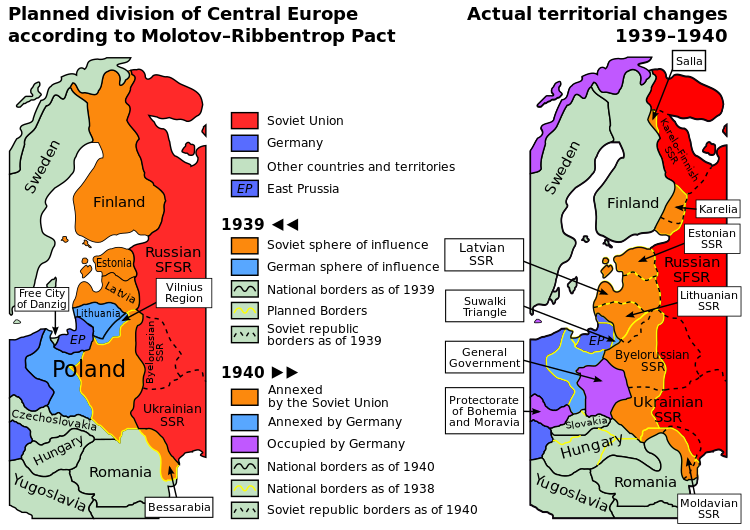
I was talking about the expansion of the USSR after WWII began in Europe. The Molotov-Ribbentrop Pact was the deal made between Germany and the USSR to divide Eastern Europe. After signing this treaty, the USSR invaded Poland, Finland, Romania, Latvia, Estonia, and Lithuania.
So, why don't you take a look at this map of Europe in 1940, you will see that the USSR did indeed invade all of these countries during WWII.In other words, the world-domination plans you speak of were, well, non-existent.
Sorry, but the facts dispute your assertion. -
Re:French bashing?
You're drunk on cold war propaganda. There's no doubt that the USSR and Germany had a pact do divide Europe -- but that's no different than the arms, technology, and supplies that we (as in the US, the UK, and France) gave the Nazis to protect us from the Communist threat we perceived from the USSR. Germany at the end of WWI was not in any sort of position to engineer the huge economic and military comeback that they did on their own -- they had help, and it was from us (the Allies). When the Nazis invaded Czechoslovakia, what did the Allies do? Nothing. The UK and France were deadset on avoiding war, and they feared Stalin, so not only did they appease Hitler, they actually armed him (the US is guilty of this too). And we (the US) entered the European theater in December of 1941, nearly 3 years after WWII started on the continent.
Sure, the USSR and Nazi Germany signed a pact, but neither of them had any intention of honoring it, as the Nazis hated and feared Communists and Stalin gravely underestimated Hitler. And here's the thing -- until people became aware of the atrocities being committed by the Nazi party, what was wrong with supporting them? You must keep the time frame in mind: we now see Nazis as the embodiment of all evil, but before news of the Holocaust got out, the Nazis were just another fascist party. And again, lest you forget, the reason fascism enjoyed such popular support in Europe (and elsewhere) in the late 30s early 40s was because of the Great Depression, which left many people wondering whether or not free market capitalism could even work: the only country left untouched by the depression was the Soviet Union. Now of course we better understand the effects of monetary policy and investment on the economy, and know that that's bunk, but at the time, people thought that crashes like the great depression may be a result of the inherent instability of markets, and statism in its left and right wing forms was immensely popular, especially in nations that had been monarchies in fairly recent memory.
There's one other very important point, and this is mainly why I accused you of being drunk on cold war propaganda. Stalin severely changed the direction of the Soviet Union's expansionist policies by declaring the feasibility of "Socialism in one Nation". You see, up until then, much Communist thinking was centered on the idea that the whole world must be Communist, or capitalist trade would remain a driving economic force on the national level. Sure, the USSR might be communist, but they would still need to buy and sell commodities on the international markets, meaning that they were a socialist enclave that still needed to concern itself with free market details. Trotsky was very much against this idea, and continued to champion the idea of worldwide revolution until his death. Stalin, on the other hand, suggested that the USSR concentrate on itself and less on the rest of the world. He felt that having the USSR be Socialist was enough, and that there was no need to forment revolt in the rest of the world.
In other words, the world-domination plans you speak of were, well, non-existent.
Furthermore, and this I really don't get, you say "they've [the USSR] already invaded several Eastern European countries" -- uhh, which? Why don't you take a look at this map of Europe in 1920, after WWI and tell me what nations they "invaded" by the time WWII came around. The answer, simply, is none -- those nations behind the iron curtain fell under Soviet influence after WWII, and that was a result of the Allies carving up Europe. The poor relations between the Warsaw Pact nations and the NATO nations was a direct result of the Cold War, and the iron curtain was a result of that. Lest you forget, West Germany was also occupied by the Allies.
And just in case you're confused, I'm not saying that the USSR was great in every way -- just that they bled for Europe in a way that cannot possibly be c -
Fine paper, but why not quote all of PAMI ?This is a nice paper by respected researchers in AI+Vision, however pretty much the entire content of the journal this was published in (IEEE Pattern Analysis and Machine Intelligence) is up to that level. Why single out that particular paper ?
Interested readers can browse the content of PAMI current and back issues and either go to their local scientific library (PAMI is recognisable from afar by its bright yellow cover) or search on the web for interesting articles. Often researchers put their own paper on their home page. For example, here is the publication page of one of the authors (I'm not him).
For the record, I think justifying various ad-hoc vision/image analysis techniques using approximations of biological underpining is of limited interest. When asked if computer would think one day, Edsgerd Dijkstra famously answered by "can submarine swim?". In the same manner, it has been observed that (for example) most neural network architectures make worse classifiers than standard logistic regression, not to mention Support Vector Machines, which what this article uses BTW.
The summary by our friend Roland P. is not very goodThis versatile model could one day be used for automobile driver's assistance, visual search engines, biomedical imaging analysis, or robots with realistic vision
- There already exist working automated driving software. The december 2006 issue of IEEE Computers magazing was on them last month. Read about the car that drove a thousand miles on Italy's road thanks to Linux, no less.
- Visual search engine exist, at the research level. The whole field is called "Content Based Retrieval", and the main issue is not so much to search, but to formulate the question.
- Biomedical image analysis has been going strong for decades and is used every day in your local hospital. Ask your doctor !
- Robotic vision is pretty much as old as computers themselves. There are even fun robot competitions like robocup.
I could go on with lists and links but the future is already here, generally inconspicuously. Read about it. -
Re:How can anyone think profiling works?
But over 97% of mass-murders are commited by muslim men (and women). See khartoem, sudan, mogadishu and ethiopia (and others) for the current big problems.
Then there is the question as to WHY this is the case. And then you check the muslim holy book, you know, the one they always tell you to check, and :
"But when the forbidden months are past, then fight and slay the infidels wherever ye find them, and seize them, beleaguer them, and lie in wait for them in every stratagem of war; but if they repent, and establish regular prayers and pay Zakat, then open the way for them: for Allah is Oft- forgiving, Most Merciful." (Quran 9:5)
And then you say
Add to that that every muslim mass-murderer also says that he did it because of these verses and then you start seeing the problem.
--
Let's make a comparison. Why these 2 things. First nothing about racism you can easily compare any two things, especially 2 things that are basically ideas. Why these 2 ? Because it illustrates a glaring problem :
Islam - Nazism
1. Does the ideology inspire people to kill others ?
Islam - Yes, as the londen bomber said "He who kills in the name of allah is excused", see http://www.thereligionofpeace.com/ for a more complete list
Nazism - Yes, see "Final Solution", amongst others
2. Does the ideology inspire people to repress large parts of their own population with extreme measures ?
Islam - Yes, see http://www.speroforum.com/site/article.asp?idartic le=6845
Nazism - Yes, http://fcit.usf.edu/Holocaust/people/victims.htm
3. Is the ideology completely opposed to personal choice and democracy ?
Islam - Yes, see http://islam.tc/ask-imam/view.php?q=15522
Nazism - Yes, see takeover and disbanding of parliament in Germany before the war
4. Does the ideology indoctrinate children with ideas of hate ?
Islam - Yes, see http://www.pmw.org.il/schoolbooks.html (I couldn't find the link about the western "madrassas", that are at least equally bad)
Nazism - This is how they "started" (if you are willing to accept that nazism started, while in reality it has always existed, and prevails even today, but this is what allowed it to expand enough to do damage)
Isn't this exactly what made nazism bad ? Why do we forgive muslims for forcing idiocies like this on their children ?
So you see "islamofascism" is not that bad a name for the ideology of terrorists/taliban/iran's mullahs(/saudis) (because they also match on the other points, the socialism part). It has the added advantage of implying that someone can be muslim without being an islamofascist. (btw, in every muslim country, like egypt, or morocco, they call the terrorists "islamists", also implying a direct connection between the religion and the terrorism)
So yes, if someone is muslim, we try check if they are an islamofascist or not. That's just common sense. A muslim and an islamofascist are 2 coins of the same ideology. If muslims did this themselves, like we try to prevent our own children from becoming nazi's or racists, there would be much less of a problem, and the checks would wither away and die. -
Skype User Satisfaction Survey
While this isn't completely related to the parent article, it is Skype related. A group of students and myself from the University of South Florida are conducting a simple survey on Skype user satisfaction. It consists of a short automated Skype call, followed by a brief questionnaire. The entire process should take less than three minutes. If you would like to help us with our research please visit:
http://skype.cse.usf.edu/
We appreciate your participation, and feel free to suggest the survey to any friends or family that use Skype. -
ecologee.net The Internet with renewables
For ecologee.net means that H.R.5646 will push the awareness towards a "greener" Internet. No more, nevertheless we are happy about this move!
ecologee.net want's to create an Internet enteriley relying on renewables. The more power can be saved the soon this will be likely.
One vision is, that clients, data centers, backbones, phone calls will be routed exclusively over a literally "green" grid, not a VPN.
The Energy Efficient Internet Project --> http://www.csee.usf.edu/~christen/energy/main.html or http://www.ecologee.net/ itself aim for an intelligent use of micro processors, networks and usage of alternative energies.
I am an partner of an ISP in Germany and I am about toconvince them to switch their power consume to one of our ecologic energy providers. Now, we work on an internal initiative to convince other ISP's beeing hosts in a data center in Berlin to move the whole data center to new contracts regarding energy.
If you were a very small center, you could consider switching versa photovoltaic, loads of contries in Europe will even share the cost of private investment in renewables too. You gain a lot.
These data centers already use renewables and if you know one more, feel free to add it, as it's a wiki. --> http://www.ecologee.net/pmwiki.php/Endanwender/%DC bersichtDer%D6ko-ISPs
regards, scoid -
Actually underground cables are quite vulnerable
-
Dr. Wilkinson at USF - best prof i had
at usf, mechanical engineering lab II is no longer a required course to earn a BSChE (which, i think, is a big mistake). but it was when i went there.
i learned more about the proper technique for writing a lab report from Dr. Wilkinson than i learned in any other technical writing class i took.
sure, it was damn near impossible to earn an 'a' in his lab, but the time spent was well worth it. even now, some 15 years later, i still refer back to his class and those labs when preparing a report.
funny how the most informative writing class i had was a lab and not technical writing.
-
M. C. Escher & Dyson.
No discussion of water flowing uphill can go without mention of M.C. Escher's Waterfall and Dyson's fantastic real world recreation (and there's a good explanation of Dyson did it at the BBC.
-
i forgot to mention
While I am obviously much too tired to pursue any of this now, I do think it's worth me mentioning that, when re-reading the introduction to Complexity, I was struck by how huge the questions being asked were. Call me over-the-top, but I actually like hearing people speculate about how the mind works AND how life began, all in one book. I'm not swearing by anything, it's just fun.
Recently I've come across these very good interviews with Professor Hugh LaFollette. I look at them as (re)introductions or reviews, but they're pretty worthwhile and, this being the internet and all, EASY to CONSUME.
Maybe now I can finally sleep. . .
(I failed to confirm I wasn't a script. I'm so tired that I can't even pass a simple Turing Test to prove my humanity! Any program can do that! And I'm not even a program! zzzzz. -
i forgot to mention
While I am obviously much too tired to pursue any of this now, I do think it's worth me mentioning that, when re-reading the introduction to Complexity, I was struck by how huge the questions being asked were. Call me over-the-top, but I actually like hearing people speculate about how the mind works AND how life began, all in one book. I'm not swearing by anything, it's just fun.
Recently I've come across these very good interviews with Professor Hugh LaFollette. I look at them as (re)introductions or reviews, but they're pretty worthwhile and, this being the internet and all, EASY to CONSUME.
Maybe now I can finally sleep. . .
(I failed to confirm I wasn't a script. I'm so tired that I can't even pass a simple Turing Test to prove my humanity! Any program can do that! And I'm not even a program! zzzzz. -
See it in action
See Carl demonstrating this big, bad computer in action:
http://myweb.usf.edu/~tyblagg/hungerforce/epstuff/ s3/ep47/edork4.jpg
Ohhhh, you've been a bad, bad chicken.... -
Re:Annoying
pfft, as if that could ever happen. I mean, come on, who's ever heard of a scientist becoming a smug bastard because he was rushed through highschool and allowed to enter college early. Seriously, it's not like you can just be a jerk and still be treated with respect. You're certainly not gunna found any multimillion dollar companies and publish your own book because everyone with half a brain thinks you've lost it -- whilst the other half of the scienfic community think you might be onto something if only they could figure out what.
-
Bah
I think my screen can handle it...
When we get our 24x17" LCDs next spring, we'll get rid of the black bezels AND have a resolution of 7680x4096. Then, this "HD" nonsense will look like over-scaled garbage! -
USF SGCS
The University of South Florida's Student Government Computer Services has a great system. It's written entirely in-house by a couple CS undergrads. Look under "Meet the managment" and send Kyle Woodlock an email.
-
The Volkswagen Connection: Setting the Stage for aGermany is the home to an automobile industry that is admired and respected worldwide. Their products range from low to high end, with almost every manufacturer commanding respect in their target demographics. From the success of introducing the world's first luxury marque at Mercedes-Benz, to pioneering the mix of luxury-sport at BMW AG, almost all German automobiles are revered. Lately, however, there has been one sore thumb in the almost exclusive group. That would be the long-heralded heritage of home-grown Volkswagen AG.
Volkswagen, literally "people's car," has been producing vehicles in Germany since its original founder, Adolf Hitler, brainstormed their first concept. Their niche was once to build a car that the everyday Aryan could afford, and to bring strength by empowering their people to commute cheaply and effectively where they needed to go. Today, Volkswagen is much more, representing an entry-level German nameplate for automobile owners to get the trademarks set by every German automobile: great styling, great handling, and prohibitively expensive repairs.
Their product repertoire includes several historical namesakes from previous generations, as well as modern day contenders in the 21st century automobile market. The New Beetle and the Jetta are Volkswagen's entry level vehicles for German beginners. Moving up the chain brings you the Passat and the Golf, for European luxury in midsize prices. At the top of the chain brings the near-luxury Touareg (German for "SUV") and Phaeton (German for "German Luxury"). What Volkswagen wants you to forget, however, is their rich lineage which spawned today's vehicles.
Founded in 1932 by the famed Nazi leader, his first project was to design a vehicle which would aid in building the strength of the fascist state. The car would be built to mimic the symbolic ideals of the cult-like ruling Nazi party. The Beetle, it was to be called, would be Volkswagen's first foray into enabling the Nazi leaders to commute to battle meetings to coordinate the death of the Allies. Throughout the War of Europe and subsequently World War II, Volkswagen earned the Nazi regime heavy profits due to its rapid expansion and slave labor. This, in turn, allowed Volkswagen to expand plants to newly-acquired German territory in Russia, as well as Czechoslovakia.
After the crumbling of the Nazi party, and effectively the entire German social structure in 1945, Volkswagen was left without its founder and entire management structure. Influenced by the opportunity of quick expansion, wealthy British entrepreneur Richard Branson, Sr. invested hundreds of millions of dollars into the plants to retool them for postwar production throughout Europe. Volkswagen was then reborn to make models that would carry its rich heritage to nations left unaffected by its founder.
Throughout the 1950's, 60's and 70's, the world went through major changes as a global economy started trickling into every nation.
-
Opening a can of worms.
Playing the Devil's Advocate here, I'm not -1 fucked up and by no means am I advocating incest or eugenics.
The main logical reason that siblings/close family members are prohibited from marrying and even having sex is that any offspring resulting from such a union would be more than likely to be unfit. Close inbreeding tends to diminish genetic diversity and increase homogenisity. That is, they would have a higher than average probability of having a rare genetic disorder. Hemophilia in the royal families of Europe is one example. The royal families of Europe have been interbreeding with each other for centuries, and there are not a whole lot of royal families. Since everyone has a common ancestor if you trace far enough back, some amount of mating with relatives has to be acceptable. I also add that cousins are allowed to marry in some states.
As for moral reasons, these unfit offspring are a burden upon society and the family. It is also a burden upon the resultant offspring.
Now, if the reason that we prohibit close family members from having sex is to protect the health of resultant offspring, and people are okay with this, than logically we should be able to prohibit a pair of carriers for some nasty disease, (hemophilia, tay sachs, etc...) from reproducing as it would produce unfit children.
Since homosexual relationships would not result in offspring, the aforementioned logical and moral reasons against incestual relations would not apply.
In truth, I think that a large portion of the incest taboo stems from the ewwww factor, an innate biological drive to not mate with siblings, but that's theorectical. In support, I offer the observation that in many (most?) mammalian herd/pack species, the male leaves the group it was born in and overtakes or joins another, whereas the females tend to remain in the group they were born into. This bioligical drive would reduce incest and unfit offspring. The ewwww factor is enough for me to not consider incest.
In contrast, there are many known cases of royal siblings marrying and producing offspring. One notable example is that of king Mausollos of Caria and his sister/wife Artemesia. They built the famous Mausoleum of Halicarnassus, one of the seven wonders of the world. The royal families of Europe is another example of incestual marriages, though they were more often cousins than siblings. -
Re:Statistics!!As previous posters pointed out, the DST thing saves us 0.05% of oil.
As for the other calculation:
The average American drives 8000 miles per year (I think car owners drive 17,000 mi/year, so this average includes non-drivers)
Let's say the average car gets 28 mpg
The US has 296M people.
Each barrel of oil yeilds about 20 gallons of fuel.
So we have 8,000 miles/year * (1/28) gallons/mile = 285 gallons used by each American per year, or 285/20 = 14.25 barrels per year.14.25 * 256M = 3.648 billion barrels used by cars in the US per year.
Now the same calculation getting 29 mpg, we get 3.531 billion barrels used, saving us 117 million barrels of oil per year, or 320,500 barrels per day.
-
Not possible.
First of all, this already got decided in the Supreme Court, so this is FUD right?
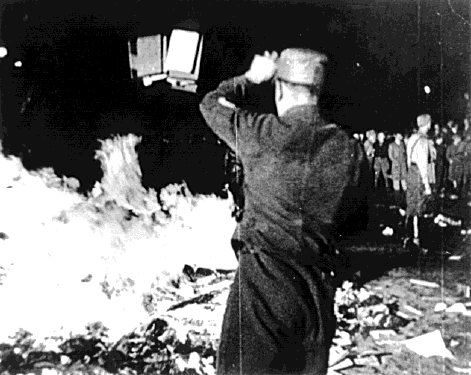
Second of all, if they were to somehow do this, it would be the beginning of the book burnings.
These religious zealots all trying to dream of a way to get rid of pornography while they're busy shacking up with everyone but their wife. 'Nuff said. -
The full joke
A small, 14-seat plane is circling for a landing in Atlanta. It's totally fogged in, zero visibility, and suddenly there's a small electrical fire in the cockpit which disables all of the instruments and the radio. The pilot continues circling, totally lost, when suddenly he finds himself flying next to a tall office building.
He rolls down the window (this particular airplane happens to have roll-down windows) and yells to a person inside the building, "Where are we?" The person responds "In an airplane!"
The pilot then banks sharply to the right, circles twice, and makes a perfect landing at Atlanta International.
As the passengers emerge, shaken but unhurt, one of them says to the pilot, "I'm certainly glad you were able to land safely, but I don't understand how the response you got was any use."
"Simple," responded the pilot. "I got an answer that was completely accurate and totally irrelevant to my problem, so I knew it had to be the IBM building."
(From math funnies, feel free to modify the company and the location for maximum hilarity.) -
hmmm....The AUP at The University of South Florida states:
You are authorized to connect a single computer to a single wall jack. Wiring and/or wall jacks may not be altered or extended beyond the location of their intended use. You may not connect hubs, switches, wireless access points or any other network equipment to the wall jack. If you have a real need for multiple simultaneous computers, please contact Data Network Management.
We're also required to register our computers with the campus DHCP server (a common practice among universities). My roommate had a WAP hooked up last year, he said that within a week or so he got a knock on the door from Network Services telling him to take it down. I have an old desktop running as a router/NAT'ed firewell and I haven't had anyone tell me to remove it yet. Perhaps they're too busy fixing real problems, to bother wasting their time with me. -
Gastrobots
Robots that have biotic stomachs are sometimes called 'Gastrobots'. There is a paper from MIT on the subject. Another paper from some guy at USF has this choice quote:
Few robotics engineers would disagree that robot development has often been inspired by biological examples (Beer et al., 1997)
This is not a unique insight but it is funny if you misread it as "biological examples, e.g. Beer".
-
Re:The Forbin Project
When I first saw it, I thought they were talking about THIS colossus and I was very confused.
-
Re:WiFi-Clearing the air-Pointed answer.-PDF
Physical weight has nothing to do with it.
How Lightening rods work [PDF] -
Snob
I'm sorry, but this is contemporary art. As much as I agree with the author's premise that video games is art, his writing style bears no reality on the current status of art as a discipline and offers about as much insight as my grandma would on the state of open source in the computing disciple. Comparing it to hollywood, which has it's own artistic foundation totally removed from the authors writing, is grotesque.
Holy frickin art snobbery batman!
Really, there is a shitload of good art in videogames. In fact ANYTHING CAN BE ART.
What really makes something "art" is the effort and thought put into it. That's why some buildings are "art" while others are not.
A cheap, pre-fabbed home is not art (typically) but something designed by a guy like IM Pei is.
The medium does not decide if something is or is not art.
The Holocaust Museum in Berlin is an amazing work of art*, but a trailer park is not. The medium is the same, the difference is all in the effort and mastery that was put into their aesthetics.
*So much so that the museum was actually shown before there was even any art in it. -
Re:Flashmob uses bootable CD, releasing ISO
usf.edu is university of southern florida. usfca.edu is USF (San Francisco). The cd was morphix, a live boot version of linux. Also check out cs.usfca.edu.
-
Flashmob uses bootable CD, releasing ISO
I found some more information on the USF Flashmob Computing site. To join you get a CD-ROM which boots your computer: The CD-ROM contains everything you need including an operating system, networking and configuration software and the benchmarking software.
They will be publishing the ISO so we can all go out and create or own flashmobs. -
More Wolfram reviews than you can shake a stick at
A collection of reviews from actual scientists is available right here, for those who are tired reading the opinions of the uninformed.....
-
Re:BitTorrent links hot off the press
Here are the mirror links for the program and the data update in case telestra.org goes down again. There is nothing posted there besides this list anyway.
Maestro for Windows XP/2000/Me/98
Download from NASA Download from Freecache Download from USF FTP (Florida) (Internet II - university students start here) Download from LibertyOutreach Download from KNCL FTP (Texas) Download from Lakewebs (Oklahoma) Download from NJIT (New Jersey) Download from UALR (Arkansas) (Internet II - university students start here) Download from Emporia State Univ. (Kansas) (Internet II - university students start here) Download from TU-Budapest (Hungary) Download from TU-Berlin (Germany) Download via BitTorrent (what's this?) Download via ed2k (what's this?)
Maestro for Mac (requires Java3D)
Download from NASA Download from FreeCache Download from USF FTP (Florida) (Internet II - university students start here) Download from KNCL FTP (Texas) Download from Lakewebs (Oklahoma) Download from NJIT (New Jersey) Download from UALR (Arkansas) (Internet II - university students start here) Download from Emporia State Univ. (Kansas) (Internet II - university students start here) Download from TU-Budapest (Hungary) Download from TU-Berlin (Germany) Download via ed2k (what's this?)
Maestro for Linux
Download from NASA Download from Freecache Download from USF FTP (Florida) (Internet II - university students start here) Download from KNCL FTP (Texas) Download from Lakewebs (Oklahoma) Download from NJIT (New Jersey)