Slashdot Mirror
Domain: uspto.gov
Stories and comments across the archive that link to uspto.gov.
Stories · 664
-
Microsoft Targets The iMac With New All-In-One Surface PCs, Reports Say (networkworld.com)
New submitter Miche67 writes: Two reports say Microsoft is working on an all-in-one (AIO) PC under the Surface brand. If that's true, it would put it in competition with HP and Dell, which have their own AIO lines, as well as put it in competition with Apple's iMac. Network World reports: "Both DigiTimes and Windows Central picked up on the story, each citing their own sources. DigiTimes, a Taiwan-based publication with connections to the PC industry over there (but also a very mixed record of accuracy) said the new devices would come in the third quarter of this year. Windows Central, which is a little better when it comes to rumors, said it did not have a solid release date." Business Insider was able to find a patent filing by Microsoft for a desktop PC that supports the rumored AIO design. "The device is evidently targeting a 'modern and elegant' design and is meant to be something akin to a premium appliance or furniture," Windows Central wrote. Intel's release date of the new Kaby Lake line of processors around Q3 of this year complicates things. While Kaby Lake is said to be more mobile-friendly with less power consumption and heat, they would make for a good choice for an AIO machine. However, it would be pushing it for Microsoft to release its AIO machines in the same quarter that Kaby Lake is due. On a semi-related note, a programmer at Building 88 recently confirmed that Microsoft will release Surface 5 devices next year powered by Kaby Lake processors. He posted pictures of four device holders marked "2017" on his Twitter account. -
Apple Patents a Way To Keep People From Filming At Concerts and Movie Theaters (qz.com)
An anonymous reader writes: Apple has patented a system that prohibits smartphone users from taking photos and videos at concerts, movie theaters and other events where people tend to ignore such restrictions. The patent has been award to Apple today and was first spotted by Patently Apple. QZ reports: "It outlines a system which would allow venues to use an infrared emitter to remotely disable the camera function on smartphones. According to the patent, infrared beams could be picked up by the camera, and interpreted by the smartphone as a command to block the user from taking any photos or videos of whatever they're seeing. The patent also outlines ways that infrared blasters could actually improve someone's experience at a venue. For example, the beams could be used to send information to museum-goers by pointing a smartphone camera at a blaster placed next to a piece of art." The report also mentions that the patent could in theory be used to help police limit smartphone filming of acts of brutality, or help a government shut off filming in certain locations. Last week, SlashGear reported that Alicia Keys is the latest musician to ban cellphones at her events. -
You Could Be Paid To Post Snapchat Selfies With Products, Patent Filing Suggests (latimes.com)
An anonymous reader writes: According to Snapchat's latest patent filings, the company could begin paying users to post photos and videos. Los Angeles Times reports: "The filings reveal that Snapchat automatically could analyze annotations on an image, including text and digital stickers, to prompt users to place their image in a collective gallery. In other words, people who type some variation of 'Clippers!!!' on top of their photo during a Clippers basketball game would have access to a library of images related to the game. Especially intriguing, the company could use computer vision technology to identify objects in an image -- say, a Coke bottle -- to encourage a user to share the shot in a Coca-Cola-sponsored story. Contributors could walk away with cash through a flat fee or some other deal based on views or sales generated by the story. The idea in the patent filing also would give advertisers an official way to compensate people for creative posts, compared with the usual strategy of paying top users to turn their personal accounts into an ad. Other types of automatically generated galleries mentioned in the patent application include stories based on a time stamp, temperature or movement. People could definite their own categories too. Curation of the galleries could be optional, with object recognition and text analysis as potential ways to filter inappropriate submissions. Users who get into audio timeline could get paid too, the patent filing states." -
Google Patents Self-Driving Car That Glues Pedestrians To The Hood In A Crash (cnn.com)
An anonymous reader quotes a report from CNN: Google just got a patent for a special kind of coating on self-driving cars that could help prevent pedestrian injuries. The company wants to coat autonomous vehicles with a sticky substance so that if they hit a pedestrian, the person would be glued to the car instead of flying off. "[The pedestrian] is not thrown from the vehicle, thereby preventing a secondary impact between the pedestrian and the road surface or other object," says the patent, granted on Tuesday. Google explains that an "adhesive layer" would be placed on the hood, front bumper and front side panels of a car. A thin coating would protect it until an impact occurred. Google is paying Arizona residents $20 per hour to test its self-driving vehicles. -
Google Files Patent For Injecting A Device Directly Into Your Eyeball (gizmodo.com)
An anonymous reader writes: It's no secret Google and their parent company Alphabet are interested in developing smart contact lenses for monitoring diabetes. Well, Google-parent Alphabet has filed a patent which takes their development to another level. The patent specifically covers a method for "injecting a fluid into a lens capsule of an eye, wherein a natural lens of the eye has been removed from the lens capsule." It's powered by "radio frequency energy" received by a small antenna inside. The gadget even has its own data storage. Forbes reports, it is designed to help the focusing of light onto the retina, resulting in the correction of poor vision. Samsung is one of the most recent companies to receive a patent for smart contact lenses. Their lenses are for experimenting with new methods of delivering augmented reality interfaces and data. -
Apple Patent Filing Points To a Keyboard With No Keys (digitaltrends.com)
An anonymous reader quotes a report from Digital Trends: Apple's patent, titled "Configurable Force-Sensitive Input Structure for Electronic Devices," was filed in September 2015 and was recently made available to the public on April 7th. It states that this all-in-one input interface consists of a metal contact layer, and a sense layer combined with a drive layer mounted underneath. According to the patent, the sense and drive layers detect a force exerted on the metal contact layer. This is accomplished by using an array of pixels on the sense and drive layers that determine an input location when active pixels are aligned on both layers. The user then gets a response to his or her action thanks to a haptic feedback module and a light guide layer that lights up the "keys" through extremely tiny holes in the metal surface. The components of the force-input sensitive "structure" are enclosed within the device's chassis; thus the only exposed portion is the contact surface itself. In a provided drawing, the illustrated notebook shows four distinct input areas on the surface. However, the patent states that the device can have any number of input areas defined on the contact portion. -
Airbus Patents Adjustable Seats, In-Seat Storage For Aircarft (consumerist.com)
AmiMoJo writes: Airbus, a leading aircraft manufacturer, has recently applied for a pair of airplane seat patents that simultaneously look to increase customer comfort while stripping away what little room remains. The first patent is for a "Re-Configurable Passenger Bench Seat," which allows seat belts and arm rests to be moved to accommodate different size passengers (e.g. two large adults, or two small adults and two small children in a row). The second patent places a storage box under each seat, which is accessed by raising the seat cushion. Of course, this means there wouldn't be room for your feet under the seat in front of you. -
Google Submits Patent Application For Online Voting (thestack.com)
An anonymous reader writes: Google has outlined a concept for real-time online voting in the Google home page in a patent to the U.S. Patent and Trademark Office. Entitled 'Social Voting-Based Campaigns in Search', the application proposes a voting user interface (VUI) that will enable a user to submit one or more votes in a voting-based campaign, giving the hypothetical example of a campaign to vote for the 'Top American Singer', with users authenticated via Google log-ins. If implemented, the system would represent a new foray for Google into generating rather than recording analytics and metrics of popularity. -
Fine Brothers File For Trademark On Word "React"
DewDude writes: You've probably seen them on YouTube: Fine Brothers are the two behind the video series Teens React, Kids React, and Elders React. Well, the two seem to feel they somehow invented this whole thing and have now filed for a very broad trademark. The USPTO filing says the trademark will be published tomorrow and looking at the filing; it is literally for the word "react" and simply shows a screenshot of their YouTube page. They have also apparently gotten approval for "Parents React," "Celebrities React," and "Parents React"; as well as filed applications for things such as "Do They Know It," "Lyric Breakdown," "People v. Technology," and "Try Not To Smile Or Laugh." -
Khan Academy Seeks Patent On Education A/B Testing
theodp writes: The Education Revolution will be patented. USPTO records show that Khan Academy is seeking a patent for Systems and Methods for Split Testing Educational Videos. From the patent application: "Systems and methods are provided for comparing different videos pertaining to a topic. Two different versions of an educational video may be compared using split comparison testing. A set of questions may be provided along with each video about the topic taught in the video. Users may view one of the videos and answer the questions. Data about the user responses may be aggregated and used to determine which video more effectively conveys information to the viewer based on the question responses." Now it's up to the USPTO to decide if something like the test and control studies conducted 40+ years ago (pdf) by the PLATO system to measure the effectiveness of different teaching methods would count as prior art. In response to an earlier post on Khan Academy's pending patents on learning computer programming and 'social programming,' Slashdot user Khan Academy said that the nonprofit is using patents for good, so not to worry. -
USPTO Power Outage Damages Equipment and Shuts Down IT Systems (uspto.gov)
An anonymous reader sends word that many online systems at the United States Patent and Trademark Office are down due to damaged equipment after a power outage. A statement from the USPTO reads in part: "A major power outage at USPTO headquarters occurred last night resulting in damaged equipment that required the subsequent shutdown of many of our online and IT systems. This includes our filing, searching, and payment systems, as well as the systems our examiners across the country use. We are working diligently to assess the operational impact on all our systems and to determine how soon they can be safely brought back into service in the coming days. We understand how critical these systems are for our customers, and our teams will continue to work around the clock to restore them as quickly as possible, though the impacts may be felt through the Christmas holiday. We know many people have questions regarding filing and payment deadlines. We are reviewing this topic and will provide an update when we have further information." -
Google Proposes 'Needle-less' System For Drawing Blood (thestack.com)
An anonymous reader writes: Google has published a patent for a needle-free blood draw technology which could be incorporated into a wrist wearable or hand-held device. The patent filing explained that the system releases a pulse of gas into a barrel or 'hollow cylinder', containing a 'micro-particle' which can break through the skin and draw a small sample of blood. According to Google, once the drop of blood forms it is drawn up into the negative pressure barrel. This technique is a quicker and less invasive alternative to using needles, or other blood measures which administer pin pricks to the finger to release the blood. The patent, which is still pending, suggests that the mechanism could also provide a replacement for glucose testers used by diabetics. -
Apple Loses Patent Suit To University of Wisconsin, Faces Huge Damages (reuters.com)
An anonymous reader writes: Apple has frequently been in the news for various patent battles, but it's usually against one of their competitors. This time, Apple is on the losing end, and they're losing to the University of Wisconsin-Madison. A jury found that the university's patent on improving processor efficiency (5,781,752) was valid, and Apple's A7, A8, and A8X chips infringed upon it. Those chips are found within recent iPhone and iPad models, which generated huge amounts of money. Because of the ruling, Apple could be liable for up to $826.4 million in damages, to be determined by later phases of the trial. -
Samsung Wants To Bring Back the Flip Phone With Bendable Screens
redletterdave writes: A new patent filed last April but published by the U.S. Patent and Trademark Office earlier this month suggests Samsung might be working on a smartphone that can bend in half like a flip phone. The biggest problem, according to the patent, is all the strain that accumulates by continually folding the display, or keeping the display folded for a long period of time, which can result in deformations and imperfections, Samsung notes. But Samsung's patent also describes how the phone could keep track of how long it's been in the folded and unfolded states, so as to alert the user of any strain that needs to be relieved. This could help extend the lifetime of the phone and its display. -
Lawsuit Filed Over Domain Name Registered 16 Years Before Plaintiff's Use
HughPickens.com writes: Cybersquatting is registering, selling or using a domain name with the intent of profiting from the goodwill of someone else's trademark. It generally refers to the practice of buying up domain names that use the names of existing businesses with the intent to sell the names for a profit to those businesses. Now Andrew Allmann writes at Domain Name Wire that New York company Office Space Solutions, Inc. has filed a cybersquatting lawsuit against Jason Kneen over the domain name WorkBetter.com that Kneen registered in 1999 although Office Space Solutions didn't use the term "Work Better" in commerce until 2015. "Workbetter.com is virtually identical to, and/or confusingly similar to the WORK BETTER Service Mark, which was distinctive at the time that the Defendant renewed and/or updated the registration of workbetter.com," says the lawsuit. But according to an Office Space Solutions' filing with the USPTO, it didn't use the term "Work Better" in commerce until 2015. Office Space Solutions is making the argument that the domain name was renewed in bad faith. According to Kneen, Office Space previously tried to purchase the domain name from him and after it failed to acquire the domain name, is now trying to take it via a lawsuit. -
Khan Academy Seeks Patents On Learning Computer Programming, Social Programming
theodp writes: When it announced its brand new Computer Science platform in August 2012, Khan Academy explained it drew inspiration from both Bret Victor and GitHub (SlideShare). Still, that didn't stop Khan Academy from eventually seeking patents on its apparently Victor-inspired Methods and Systems for Learning Computer Programming and GitHub-inspired Systems and Methods for Social Programming, applications for which were quietly disclosed by the USPTO earlier this year. Silicon Valley legal powerhouse Wilson Sonsini Goodrich & Rosati, which provides a pro bono team of 20+ to assist billionaire-backed Khan Academy with its legal needs, filed provisional patent applications for KA in August 2013 — provisional applications can be filed up to 12 months following an inventor's public disclosure of the invention — giving it another 12 months before formal claims had to be filed (KA's non-provisional applications were filed in August 2014). -
Khan Academy Seeks Patents On Learning Computer Programming, Social Programming
theodp writes: When it announced its brand new Computer Science platform in August 2012, Khan Academy explained it drew inspiration from both Bret Victor and GitHub (SlideShare). Still, that didn't stop Khan Academy from eventually seeking patents on its apparently Victor-inspired Methods and Systems for Learning Computer Programming and GitHub-inspired Systems and Methods for Social Programming, applications for which were quietly disclosed by the USPTO earlier this year. Silicon Valley legal powerhouse Wilson Sonsini Goodrich & Rosati, which provides a pro bono team of 20+ to assist billionaire-backed Khan Academy with its legal needs, filed provisional patent applications for KA in August 2013 — provisional applications can be filed up to 12 months following an inventor's public disclosure of the invention — giving it another 12 months before formal claims had to be filed (KA's non-provisional applications were filed in August 2014). -
Khan Academy Seeks Patents On Learning Computer Programming, Social Programming
theodp writes: When it announced its brand new Computer Science platform in August 2012, Khan Academy explained it drew inspiration from both Bret Victor and GitHub (SlideShare). Still, that didn't stop Khan Academy from eventually seeking patents on its apparently Victor-inspired Methods and Systems for Learning Computer Programming and GitHub-inspired Systems and Methods for Social Programming, applications for which were quietly disclosed by the USPTO earlier this year. Silicon Valley legal powerhouse Wilson Sonsini Goodrich & Rosati, which provides a pro bono team of 20+ to assist billionaire-backed Khan Academy with its legal needs, filed provisional patent applications for KA in August 2013 — provisional applications can be filed up to 12 months following an inventor's public disclosure of the invention — giving it another 12 months before formal claims had to be filed (KA's non-provisional applications were filed in August 2014). -
Cute Or Creepy? Google's Plan For a Sci-Fi Teddy Bear
HughPickens.com writes: Time Magazine reports that Google has designed and patented an "anthropomorphic device" that could take the form of a "doll or toy" and interact both with people as well as tech gadgets echoing the "super toy" teddy bear featured in Stephen Spielberg's 2001 movie AI. This could be one of Google's creepiest patents yet — especially if movies like "Chuckie" still give you nightmares. The patent filing diagrams a stuffed teddy bear and a bunny rabbit outfitted with microphones, speakers, cameras and motors as well as a wireless connection to the internet. If it senses you're looking at it, the fuzzy toy will rotate its head and look back at you. Once it receives and recognizes a voice command prompt, you can then tell it to control media devices in your home (e.g. turn on your music or TV). According to the patent filing: "To express interest, an anthropomorphic device may open its eyes, lift its head, and/or focus its gaze on the user or object of its interest. To express curiosity, an anthropomorphic device may tilt its head, furrow its brow, and/or scratch its head with an arm. To express boredom, an anthropomorphic device may defocus its gaze, direct its gaze in a downward fashion, tap its foot, and/or close its eyes. To express surprise, an anthropomorphic device may make a sudden movement, sit or stand up straight, and/or dilate its pupils."
The patent adds that making the device look "cute" should encourage even the youngest members of a family to interact with it. But Mikhail Avady, from SmartUp, said he thought it belonged in "a horror film", and the campaign group Big Brother Watch has also expressed dismay. "When those devices are aimed specifically at children, then for many this will step over the creepy line," says Avady. "Children should be able to play in private and shouldn't have to fear this sort of passive invasion of their privacy." -
Patent Issued Covering Phone Notifications of Delivery Time and Invoice Quantity
eldavojohn writes: The staggering ingenuity of the U.S. Patent system has again been showcased by the EFF's analysis of recent patents. This week's patent and follow-up patent cover the futuristic innovative idea that when you order something, you can update your order and add additional amounts to your order while it's being processed. But wait, it gets even more innovative! You may one day be able to even to notify when you would like it delivered — on your phone! I know, you're busy wiping all that brain matter off your screen as your head seems to have exploded. Well, it turns out that inventor and patent holder Scott Horstemeyer (aka Eclipse IP, LLC of Delray Beach, FL) found no shortage of targets to go after with his new patents. It appears Tiger Fitness (and every other online retailer) was sending notices to customers about shipments. Did I mention Horstemeyer is a lawyer too? But not just a regular lawyer, a "SUPER lawyer" from the same firm that patented social networking in 2007, sued Uber for using location finding technologies in 2013 and sued Overstock.com as well as a small time shoe seller for using shipping notifications in 2014. A related article at Vox makes this case: "The primary problem with the patent system is, well, the patent system. The system makes it too easy to get broad, vague patents, and the litigation process is tilted too far toward plaintiffs. But because so many big companies make so much money off of this system, few in Congress are willing to consider broader reforms." -
Patent Issued Covering Phone Notifications of Delivery Time and Invoice Quantity
eldavojohn writes: The staggering ingenuity of the U.S. Patent system has again been showcased by the EFF's analysis of recent patents. This week's patent and follow-up patent cover the futuristic innovative idea that when you order something, you can update your order and add additional amounts to your order while it's being processed. But wait, it gets even more innovative! You may one day be able to even to notify when you would like it delivered — on your phone! I know, you're busy wiping all that brain matter off your screen as your head seems to have exploded. Well, it turns out that inventor and patent holder Scott Horstemeyer (aka Eclipse IP, LLC of Delray Beach, FL) found no shortage of targets to go after with his new patents. It appears Tiger Fitness (and every other online retailer) was sending notices to customers about shipments. Did I mention Horstemeyer is a lawyer too? But not just a regular lawyer, a "SUPER lawyer" from the same firm that patented social networking in 2007, sued Uber for using location finding technologies in 2013 and sued Overstock.com as well as a small time shoe seller for using shipping notifications in 2014. A related article at Vox makes this case: "The primary problem with the patent system is, well, the patent system. The system makes it too easy to get broad, vague patents, and the litigation process is tilted too far toward plaintiffs. But because so many big companies make so much money off of this system, few in Congress are willing to consider broader reforms." -
Amazon Files Patent For Mobile 3D Printing Delivery Trucks
ErnieKey writes: Amazon has been inching its way into the 3D printing space over the past 10 months or so. This week, however, the U.S. Patent office published a filing by Amazon for mobile 3D printing delivery trucks. The trucks would have 3D printers and CNC machines on board and be able to communicate with a central hub. When a product is ordered, the mobile 3D printing truck that's closest to the consumer's home or office would then get the order, print it, and deliver it as soon as possible. -
Apple Patents Head-Mounted iPhone
mpicpp sends word of a patent newly awarded to Apple, #8,957,835, which describes a head-mounted apparatus that uses an iPhone (or iPod) as a display. The device "temporarily integrates or merges both mechanically and electronically a head-mounted device with a portable electronic device." It sounds a bit like Samsung's Gear VR headset, and many outlets are reporting it as being a virtual reality device. However, the patent itself doesn't mention VR, and it was filed in 2008, long before the VR rush of the past few years. That said, Apple has recently been trying to hire engineers with experience developing VR-related software, so it's something they could be evaluating. -
Apple Awarded Gesture-Control Patent
mpicpp points out a report that Apple has been awarded a broad patent for gesture control of a computer interface (8,933,876). The company inherited the patent after their acquisition of motion-sensor company PrimeSense in 2013. (PrimeSense's technology is used in Microsoft's Kinect gesture control system.) Here's the patent's abstract: A method, including receiving, by a computer executing a non-tactile three dimensional (3D) user interface, a set of multiple 3D coordinates representing a gesture by a hand positioned within a field of view of a sensing device coupled to the computer, the gesture including a first motion in a first direction along a selected axis in space, followed by a second motion in a second direction, opposite to the first direction, along the selected axis. Upon detecting completion of the gesture, the non-tactile 3D user interface is transitioned from a first state to a second state. -
White House Touts Obama's 1-Liner as 2014 Tech Highlight
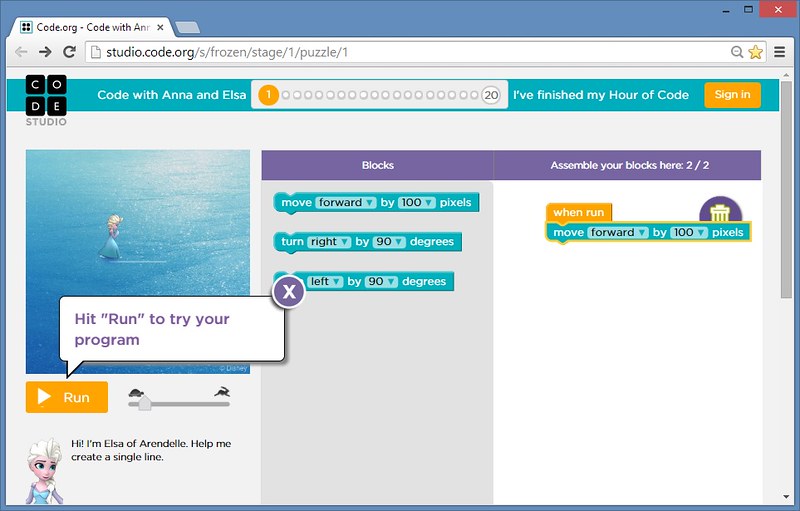
theodp (442580) writes That President Obama became the first President to write a line of code (as a top Microsoft lobbyist looked on) is #1 on the White House's Top 9 science and technology highlights from 2014. To kick off this year's Hour of Code, the President 'learned to code' by moving a Disney Princess Elsa character 100 pixels on a screen, first by dragging-and-dropping Blockly puzzle pieces and then by coding 1 line of JavaScript. Interestingly, Bill Clinton might have been The First President To Write Code had Microsoft seen fit to use its patented, circa-1995 Graphical Programming System and Method for Enabling a Person to Learn Text-Based Programming — which describes how kids as young as 8-12 years of age can be taught to program by progressing from creating a program using graphical objects to doing so using text-based programming — to teach President Clinton to code some 20 years ago! -
GNOME Project Seeks Donations For Trademark Battle With Groupon
Drinking Bleach writes Groupon has released a tablet-based point of sale system called Gnome, despite the well-known desktop environment's existence and trademark status. This is also not without Groupon's internal knowledge of the GNOME project; they were contacted about the infringement and flatly refused to change the name of their own product, in addition to filing many new trademark applications for theirs. The GNOME project is seeking donations to help them in a legal battle against these trademark applications, and to get Groupon to stop using their name. They are seeking at least $80,000 to challenge a first set of ten trademark applications from Groupon, out of 28 applications that have been filed. -
Smart Gun Inspires Smart Mouse Authentification System
dcblogs writes Defense contractor Raytheon has received a patent for a mouse that has a biometric pressure grip. It believes the pressure grip, as a form of authentication, will be particularly hard to defeat because it works from a neurological pattern versus a physical pattern, such as a facial scan. "It's not just how much pressure you exert on the mouse itself, but it's also the x-y coordinates of your position," said Glenn Kaufman, a cybersecurity engineer. The approach was inspired by similar pressure grips used in smart guns. -
US Patent Office Seeking Consultant That Can Stamp Out Fraud By Patent Examiners
McGruber writes: A month after Slashdot discussed "Every Day Is Goof-Off-At-Work Day At the US Patent and Trademark Office," the USPTO issued a statement that it is "committed to taking any measures necessary" to stop employees who review patents from lying about their hours and getting overtime pay and bonuses for work they didn't do.
USPTO officials also told congressional investigators that they are seeking an outside consulting firm to advise them on how managers can improve their monitoring of more than 8,000 patent examiners. The Patent Examiners union responded to the original Washington Post report with a statement that includes this line: "If 'thousands' of USPTO employees were not doing their work, it would be impossible for this agency to be producing the best performance in recent memory and, perhaps, in its entire 224 year history."
In related news, USPTO Commissioner Deborah Cohn has announced plans to resign just months after a watchdog agency revealed that she had pressured staffers to hire the live-in boyfriend of an immediate family member over other, better-qualified applicants. When he finished 75th out of 76 applicants in the final round of screening, Cohn "intervened and created an additional position specifically for the applicant," wrote Inspector General Todd Zinser in a statement on the matter. -
Airbus Patents Windowless Cockpit That Would Increase Pilots' Field of View
Zothecula writes Imagine showing up at the airport to catch your flight, looking at your plane, and noticing that instead of windows, the cockpit is now a smooth cone of aluminum. It may seem like the worst case of quality control in history, but Airbus argues that this could be the airliner of the future. In a new US patent application, the EU aircraft consortium outlines a new cockpit design that replaces the traditional cockpit with one that uses 3D view screens instead of conventional windows. -
Washington Redskins Stripped of Trademarks
BillCable writes: Politico reports, "In a major blow to the Washington Redskins, the U.S. Patent and Trademark Office on Wednesday canceled six federal trademarks of the 'Washington Redskins' team name because it was found to be 'disparaging' to Native Americans. 'We decide, based on the evidence properly before us, that these registrations must be canceled because they were disparaging to Native Americans at the respective times they were registered,' the PTO's Trademark Trial and Appeal Board wrote. The panel voted 2-1 in favor of the decision." Perhaps this move will speed up the inevitable name change, which was expected within the next few years." -
Zazzle.com Thinks Depictions of Pi Are Protected Intellectual Property
Byteme writes: "A number of Zazzle.com users have had their art and products removed from the site after a man named Paul Ingrisano was granted a trademark for 'Pi Productions' using a logo that consists of this freely available version of the pi symbol from the Wikimedia website combined with a period. He made infringement claims against several websites, and Zazzle took down many clothing products that featured designs using the pi symbol. When users called them on it, they locked a public forum thread and said they're evaluating Ingrisano's complaint." -
USPTO Approves Amazon Patent For Taking Pictures
An anonymous reader writes "The U.S. Patent Office granted Amazon a patent in March that basically describes taking a picture with a white background. Amazon claims that their method is unique to current photography methods because they can achieve the effect of a true white background without retouching the photo or using any sort of post-processing technique. Some professional photographers disagree, claiming that plenty of prior art exists embodying Amazon's described method and furthermore that this pre-existing method is what the photography industry calls 'shooting against a seamless white backdrop.'" -
Bill Gates Patents Detecting, Responding To "Glassholes"
theodp (442580) writes "As Google Glass goes on sale [ed: or rather, went on sale] to the general public, GeekWire reports that Bill Gates has already snagged one patent for 'detecting and responding to an intruding camera' and has another in the works. The invention proposes to equip computer and device displays with technology for detecting and responding to any cameras in the vicinity by editing or blurring the content on the screen, or alerting the user to the presence of the camera. Gates and Nathan Myhrvold are among the 16 co-inventors of the so-called Unauthorized Viewer Detection System and Method, which the patent application notes is useful 'while a user is taking public transportation, where intruding cameras are likely to be present.' So, is Bill's patent muse none other than NYC subway rider Sergey Brin?" A more cynical interpretation: closing the analog hole. Vaguely related, mpicpp pointed out that Google filed a patent for cameras embedded in contact lenses. -
$30K Worth of Multimeters Must Be Destroyed Because They're Yellow
An anonymous reader points out a post at the blog of Sparkfun, a hobbyist electronics retailer. They recently received a letter from U.S. Customs saying a shipment of 2,000 multimeters was being barred from entry into the country. The reason? Trademark law. A company named Fluke holds a trademark on multimeters that have a 'contrasting yellow border.' Sparkfun's multimeters are a yellowish orange, but it was enough for Customs to stop the shipment. Returning the shipment is not an option because of import taxes in China, so the multimeters must now be destroyed. At $15 per item, it'll cost Sparkfun $30,000, plus the $150/hr fee for destroying them. Sparkfun had no idea about the trademark, and doesn't mind changing the color, but they say restrictions like these are a flaw in the trademark system. "Small business does not have the resources to stay abreast of all trademarks for all the products they don't carry. If you’re going to put the onus on the little guy to avoid infringing IP then you shouldn't need an army of consultants or attorneys to find this information." -
White House Takes Steps Against Patent Trolls
itwbennett writes "The Obama administration on Thursday launched a website with information to assist people and businesses targeted in patent lawsuits or receiving patent demand letters. The White House also announced that it would launch a new crowdsourcing initiative focused on identifying prior art (evidence of existing inventions) that the USPTO can use to reject bad patent claims and will expand a USPTO patent examiner technical training program by allowing outside technologists to help with the training." -
Pending Apple Patent For 'Inferring User Mood'
theodp writes: "Apple has recently disclosed a pending patent for Inferring User Mood Based on User and Group Characteristic Data, which has received surprisingly scant attention from the press even though it ups the ante for privacy intrusion. The brainchild of iAd team members, Apple boasts its invention will make it possible to 'charge a higher rate for mood based content delivery' by scrutinizing 'channel characteristics, demographic characteristics, behavioral characteristics, spatial-temporal characteristics, and mood-associated characteristics.' Apple further explains: 'Mood-associated physical characteristics can include heart rate; blood pressure; adrenaline level; perspiration rate; body temperature; vocal expression, e.g. voice level, voice pattern, voice stress, etc.; movement characteristics; facial expression; etc. Mood-associated behavioral characteristics can include sequence of content consumed, e.g. sequence of applications launched, rate at which the user changed applications, etc.; social networking activities, e.g. likes and/or comments on social media; user interface (UI) actions, e.g. rate of clicking, pressure applied to a touch screen, etc.; and/or emotional response to previously served targeted content. Mood-associated spatial-temporal characteristics can include location, date, day, time, and/or day part. The mood-associated characteristics can also include data regarding consumed content, such as music genre, application category, ESRB and/or MPAA rating, consumption time of day, consumption location, subject matter of the content, etc. In some cases, a user terminal can be equipped with hardware and/or software that facilitates the collection of mood-associated characteristic data. For example, a user terminal can include a sensor for detecting a user's heart rate or blood pressure. In another example, a user terminal can include a camera and software that performs facial recognition to detect a user's facial expressions.' Your move, Google!" -
Should Self-Driving Cars Chauffeur Shopping 'Whales' For Free?
theodp writes "Probably not the most fortuitous timing, but the USPTO has granted Google its wish for a patent on Transportation-Aware Physical Advertising Conversions, a system that arranges for free or discounted transportation to an advertiser's business location that will be more or less convenient based upon how profitable a customer is deemed. It's reminiscent of the free personal chauffeured limousine rides long enjoyed by Las Vegas casino 'whales', but at scale and using cars that may not have drivers. A server, Google explains, 'arranges the selected transportation option, for example, by dispatching a vehicle or providing instructions for using public transportation.' So, it seems a Larry or Sergey type might expect to be taken gratis to the Tesla dealership via a private autonomous car or even helicopter, while others may get a discount on a SF Muni bus ride to Safeway. Google also describes how advertisers will be able to use a customer's profile 'to exclude a customer from being considered for an offer based on exclusion criteria identified by a business,' such as age, job title, purchasing history, clothing size, or other 'desirable' characteristics." -
Google's Comical New Social Networking Patent
theodp writes "GeekWire reports on Google's just-granted patent on creating and sharing social network status updates in the form of comic strips, a la Bitstrips. Google also envisions an educational role for its new invention, which the search giant has dubbed the Self-Creation of Comic Strips in Social Networks and Other Communications. Google explains, 'Aside from humor, such comic strips are also usable for education, for instance in summarizing a real-time conversation between two political leaders as it is happening. By posting such a comic strip on a social network facility such as a social network blog or tweet, others may more readily follow the flow of the conversation than if it had been summarized in plain text.'" -
JPMorgan Files Patent Application On 'Bitcoin Killer'
Velcroman1 writes "Banking giant JPMorgan Chase has filed a patent application for an electronic commerce system that sounds remarkably like Bitcoin — but never mentions the controversial, Internet-only currency. The patent application was filed in early August but made publicly available only at the end of November; it describes a 'method and system for processing Internet payments using the electronic funds transfer network.' The system would allow people to pay bills anonymously over the Internet through an electronic transfer of funds — just like Bitcoin. It would allow for micropayments without processing fees — just like bitcoin. And it could kill off wire transfers through companies like Western Union — just like Bitcoin. There are 18,126 words in the patent application. 'Bitcoin' is not one of them." -
Facebook Patents Inferring Income of Users
theodp writes "Among the patents granted to Facebook this week by the USPTO is one for Inferring Household Income for Users of a Social Networking System. 'For example,' Facebook explains, 'an assumption might be made about a user that reads CNN.com and nytimes.com every day that the user is in a higher income bracket than another user that only reads TMZ.com and PerezHilton.com on the theory that a user who reads newspapers might be assumed to make more money than a user who only reads celebrity gossip blogs.' Advertisements such as those for travel packages, cars, and home mortgages, Facebook adds, 'are targeted to users based on income bracket,' which might also be inferred by 'gathering and analyzing different types of information about a user's geographic location.' Hey, what could go wrong?" -
Google Patents Fooling Friends With Snooping, Chatbots
theodp writes "Google takes Scroogling to new heights with its just-patented Automated Generation of Suggestions for Personalized Reactions in a Social Network, which not only data mines "e-mail systems, SMS/MMS systems, micro blogging systems, social networks or other systems" to get the buzz on your social circle, but also uses the data it collects to make like ELIZA and formulate appropriate responses for you to send as if they were your own (e.g., 'Happy Birthday, Mom!). Wouldn't Turing be so proud! From the patent: 'In a third example, a friend, David, sends Alice public or private message of a particular but regularly encountered message type (e.g., "how are you doing?" a common way to greet someone in the United States). The suggestion generation module suggest a good set of reactions to David, for example, based on the professional profile of David from the social network indicating that David has changed employers. The suggestion generation module generates a reply message such as "Hey David, I am fine, You were in ABC corp. for 3 years and you recently moved to XYZ corp., how do you feel about the difference, enjoying your new workplace?" The content of this suggestion are based on 1) prior conversations between Alice and David, 2) previous messages sent by Alice to other friends and 3) messages (sent by other connections in Alice's friend circle to David) which are either publicly or privately accessible to Alice, or some combination of these. Thus, the suggestion generation module generates messages that are personalized based upon both the sender and recipient using information that is accessible (public or private) to the sender.' Looks like Facebook may not be the only one strip-mining human society!" -
Google Patenting Less Noble Use of Project Loon Tech
theodp writes "In June, Google unveiled Project Loon to acclaim from the press for its "moonshot" project that aims to use high-altitude balloons to cheaply provide internet connectivity to rural, remote, and underserved areas of the developing world. So it's interesting to see that a just-published Google patent application for Balloon Clumping to Provide Bandwidth Requested in Advance, which pre-dated the Loon launch by a year, paints a not entirely altruistic picture of balloon-powered Internet access technology. Google describes the invention — which had been kept secret with a non-publication request — as just the ticket for those well-to-do enough to pay a tiered-pricing premium to get faster internet access while attending concerts, conferences, air shows, music festivals, and sporting events where a facility's overtaxed Wi-Fi simply won't do. Hope this revelation doesn't make Bill Gates think any less of the project!" -
Facebook Patented Making NSA Data Handoffs Easier
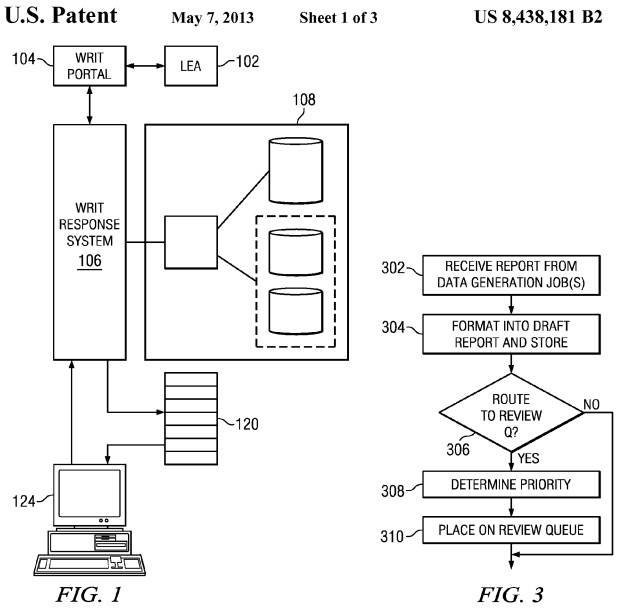
theodp writes "In June, Facebook CEO Mark Zuckerberg blasted 'outrageous press reports' about the PRISM surveillance program, denying that Facebook was ever 'part of any program to give the U.S. or any other government direct access to our servers.' What Zuckerberg didn't mention, and what the press overlooked, is that the USPTO granted Facebook a patent in May for its Automated Writ Response System. Like the NSA-enabling systems described by the NY Times on the same day Zuckerberg cried foul, the patent covers technical methods to more efficiently share the personal data of users with law enforcement agencies (LEAs) in response to lawful government requests via APIs and secured portals installed at company-controlled locations. 'While handing over data in response to a legitimate FISA request is a legal requirement,' the Times noted, 'making it easier for the government to get the information is not, which is why Twitter could decline to do so.'" -
Motorola Patent Uses Neck Tattoo As Microphone
nk497 writes "A Motorola Mobility patent application proposes using an 'electronic skin tattoo' as a smartphone microphone and wireless transceiver. The temporary tattoo would also include a 'power supply configured to receive energizing signals from a personal area network,' according to the filing with the US Patent and Trademark Office. It would be applied to 'a throat region of a body' — otherwise known as the neck. Motorola thinks the technology would be ideal for noisy environments, such as large stadiums and busy streets, or in emergency situations." -
You're Only As Hirable As Your Google+ Circles
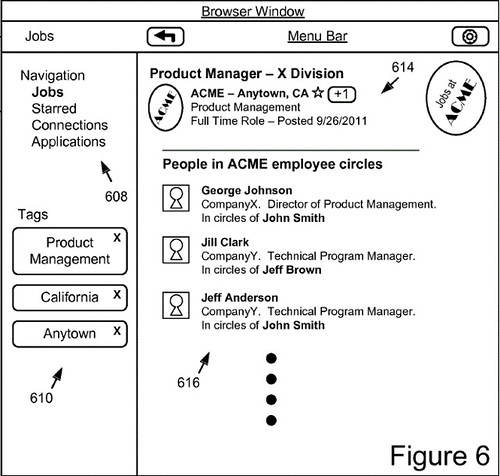
theodp writes "A pending Google patent for Identifying Prospective Employee Candidates via Employee Connections lays out plans for data mining employees' social graphs to find top job candidates. According to the patent application, the system would consider factors including the performance of the employees at the company whose circles you are in — under the assumption that the friends of top performers are more likely to be top performers themselves. It's the invention of three Googlers, including an HR VP who was quoted recently in an article that questioned the wisdom of certain Google hiring practices said to encourage 'echo chamber' hiring." -
Google Wants Patent On Splitting Restaurant Bills
theodp writes "In a classic example of parody coming to life," writes GeekWire's Todd Bishop, "a newly published patent filing reveals Google's ambitions to solve one of the most troublesome challenges known to humanity: Splitting the bill at the end of a meal." In its patent application for Tracking and Managing Group Expenditures, Google boasts that the invention of six Googlers addresses 'a need in the art for an efficient way to track group expenditures and settle balances between group members' by providing technology that thwarts 'group members [who] may not pay back their entire share of the bill or may forget and not pay back their share at all.' -
Personal Genomics Firm 23andMe Patents Designer Baby System
An anonymous reader writes "Consumer genomics company 23andMe has developed a system for helping prospective parents choose the traits of their offspring, from disease risk to hair color. The patent — number 8543339, "Gamete donor selection based on genetic calculations" — describes a technology that would take a customer's preferences for a child's traits, compute the likely genomic outcomes of combinations between a customer's sperm or egg and other people's sex cells, and describe which potential reproductive matches would most likely produce the desired baby." -
Could Technology Create Modern-Day 'Leper Colonies'?
theodp writes "Back in the day, leprosy patients were stigmatized and shunned, quarantined from society in Leper Colonies. Those days may be long gone, but are our mapping, GPS, and social media technologies in effect helping to create modern-day 'Leper Colonies'? The recently-shuttered GhettoTracker.com (born again as Good Part of Town) generated cries of racism by inviting users to rate neighborhoods based on 'which parts of town are safe and which ones are ghetto, or unsafe'. Calling enough already with the avoid-the-ghetto apps, The Atlantic Cities' Emily Badger writes, "this idea toes a touchy line between a utilitarian application of open data and a sly wink toward people who just want to steer clear of 'those kinds of neighborhoods.'" The USPTO has already awarded avoid-crime-ridden-neighborhoods-like-the-plague patents to tech giants Microsoft, IBM, and Google. So, when it comes to navigational apps, where's the line between utility and racism? 'As mobile devices get smarter and more ubiquitous,' writes Svati Kirsten Narula, 'it is tempting to let technology make more and more decisions for us. But doing so will require us to sacrifice one of our favorite assumptions: that these tools are inherently logical and neutral...the motivations driving the algorithms may not match the motivations of those algorithms' users.' Indeed, the Google patent for Storing and Providing Routes proposes to 'remove streets from recommended directions if uploaded route information indicates that travelers seem to avoid the street.' Even faster routes that 'traverse one or more high crime areas,' Google reasons, 'may be less appealing to most travelers'." -
Apple Receives Patent For Accessing Sets of Apps With Different Passcodes
wabrandsma writes, quoting Apple Insider "The technology, detailed in a patent awarded to Apple on Tuesday by the U.S. Patent and Trademark Office, deals with so-called 'access inputs' that determine what apps, device services, and functions can be accessed by a user. Apple's U.S. Patent No. 8,528,072 for a 'Method, apparatus and system for access mode control of a device,' describes a system that creates user access modes guarded by predetermined gesture inputs." Reading the patent, it appears Apple managed to patent allowing access to some programs without a passcode from the lock screen of a device while protecting others, so e.g. you can quickly swipe to make a phone call or control your music, but have to enter a code to read your email or access your word processor documents. -
Microsoft Seeks Patent On 'Quieting Mobile Devices'
theodp writes "GeekWire reports on a pending Microsoft patent that proposes to give parents a centralized dashboard on their phones for remotely monitoring and setting restrictions on other family members' mobile devices. The newly-published patent application for Automatically Quieting Mobile Devices explains how parents could use the dashboard to shut down family members' devices during certain time periods, at designated locations, during specified events, and in designated quiet zones. From the patent: 'Aspects that might be disabled include any type of interactive functions and/or features of a device (except, in some examples, initiating emergency telephone calls or emergency text messages and displaying the current time/date or information related to the quiet time may still be permitted), playing games, communicating (via phone, VOIP applications, text messaging, instant messaging, and/or email), using other applications (e.g., browsers, messaging applications, social networking applications, or consuming certain content (e.g., digital media content).' Microsoft also proposes equipping parents' phones with 'biometric detection' to thwart kids who try to circumvent 'Big Mother'."