Slashdot Mirror
Domain: utexas.edu
Stories and comments across the archive that link to utexas.edu.
Comments · 1,356
-
Hummer with electroactive suspension
I had the pleasure of working with the team at the University of Texas at Austin Center for Electromechanics developing a similar system ("rack and pinion" motor system vs. linear motor).. that was back in 1998 and 2001.. the first time was for developing a ride height sensor for testing the overall movement of the CG of the vehicle
market was pretty weak.. system was too expensive
the CEM system is and has been patented for a while.. there were a number of other companies worldwide (as there always are) working on similar sytems back then too.. even some semi-active systems (rheological fluid is used which increases viscosity under magnetic field.. basically making a variable damper in the dynamic motion equation)
got to drive a HMMWV (military Hummer) fitted with this active suspension.. stock springs replaced with super soft springs and the damper replaced with 3phase DC brushless motor and rack and pinion systems to move the A-arm assembly... the algorithm ran on an Alpha processor to sample acceleromters in the wheel hubs and the frame mounting points for the A-arms.. the difference in acceleration between the relative points would drive the motor to pull the wheel out of the way (or drive it down) of obstacle driving the large acceleration of he wheel hub vs. the mount point sensors...
the engineer turned off the the suspension and only used the soft spring.. did tight donuts in an open field.. the HMMWV had major roll... turned it on, and it was only a couple of degrees of roll.. hardly noticeable at all.. he said they had to actually add a small amount of roll otherwise the the driver couldnt tell when they were turning so fast that they would lose lateral traction and begin sliding (the idea being that roll tells you to back off the accelerator).... cool stuff..
the big push right now is to transfer it to a transit bus.. -
Re:Jesus H Christ
I didn't mean not to say "I had a great fuck last night", I meant you should go an entire month, while you are getting some on a regular basis from the same person, without refering to that person, no "my girlfriend", no "my boyfriend", no "my wife"... I am not just asking you to not talk about sex, I am asking you to not talk about relationships.
First, what evidence? Show me some. I'll be waiting a long time.
here is some.
sorry it took so long.
There are anatomical diferences between strait people and gay people. The acoustics of the lesbean inner ear is not like that of a straight woman's. Subtle features in the brains of gay men are not in the same proportions as they are in strait men. They have done twin studies, examined homosexuality in the animal kingdom, all uncovered physiological and/or anatomical differences between hetero and homosexuals. This is just the tip of the iceberg.
If you don't think this evidence is conclusive, fine. Denying that this evidence exists, makes you either ill informed, or willfully ignorant. -
McDonald Observatory
Well, there are two reasons. One is that the McDonald Observatory, and the largest telescope in the continental U.S. is out there, and their Light Pollution Program has successfully reduced stray light for hundreds of miles.
The other reason is that there just ain't that much stuff out in West Texas. -
Re:Too Many Connections?
Check this out, dude. Twas on slashdot a bit ago.
-
Re:Specific Ocean?
I mean obviously if someone says they live 80 miles north of something, it means you measure from the northern most tip.
Um, looked at a map lately?
-
Re:After reading this article...
the Mexico-Texas border isn't disputed
Sometimes it is. The Rio Grande moves around and people have been known to get up in arms about it. Try this link for info about a dispute that wasn't settled until the 1960s.
-
The Univ. of Texas uses water chilling
They use "chilling stations" to cool our buildings. No big, deep lake to provide the free heat sink, though. It's ultimately cooled in towers and released to the atmosphere.
-
Also from ARL:UT...
Oddly enough, a project exists at ARL that does exactly that. If you feel like reading about it, look at http://sgl.arlut.utexas.edu/.
I don't think it's closed source, but since I'm working on it, it never really seems closed or open to me -
Re:Incomplete testingThe way I've looked at it is this:
A handheld cellular phone emits a maximum of 600mW, but rarely does so in an urban setting. (Remotely mounted antennas are allowed to transmit up to 3W or 4W.) The power emitted is adjusted based upon the tower's reported reception strength. Not only does this conserve battery power, but it helps reduce congestion in the cell network by keeping your signal from straying into the next cell over.
"But it's RF!" you say. So, what is it that RF does? It induces current, and mostly in a conductor the same length (or fraction of the length) as the wavelength of the signal. Now, the 350mm wavelength emitted by an 850mHz transmitter (300,000,000 m/s / 850,000,000Hz = 0.353 meters, or a half length of 0.167 meters (~6-1/2 inches) is actually pretty close to the width of the average skull, so we can assume that the skull will effectively absorb some of that energy. How much?
Interesting
I may have to rethink my cell phone usage...
-
Re:You did not create Life
when was the last time you talked to an Al Qaeda Cleric i'm williing to bet money NEVER so who are you to talk about their ideology?
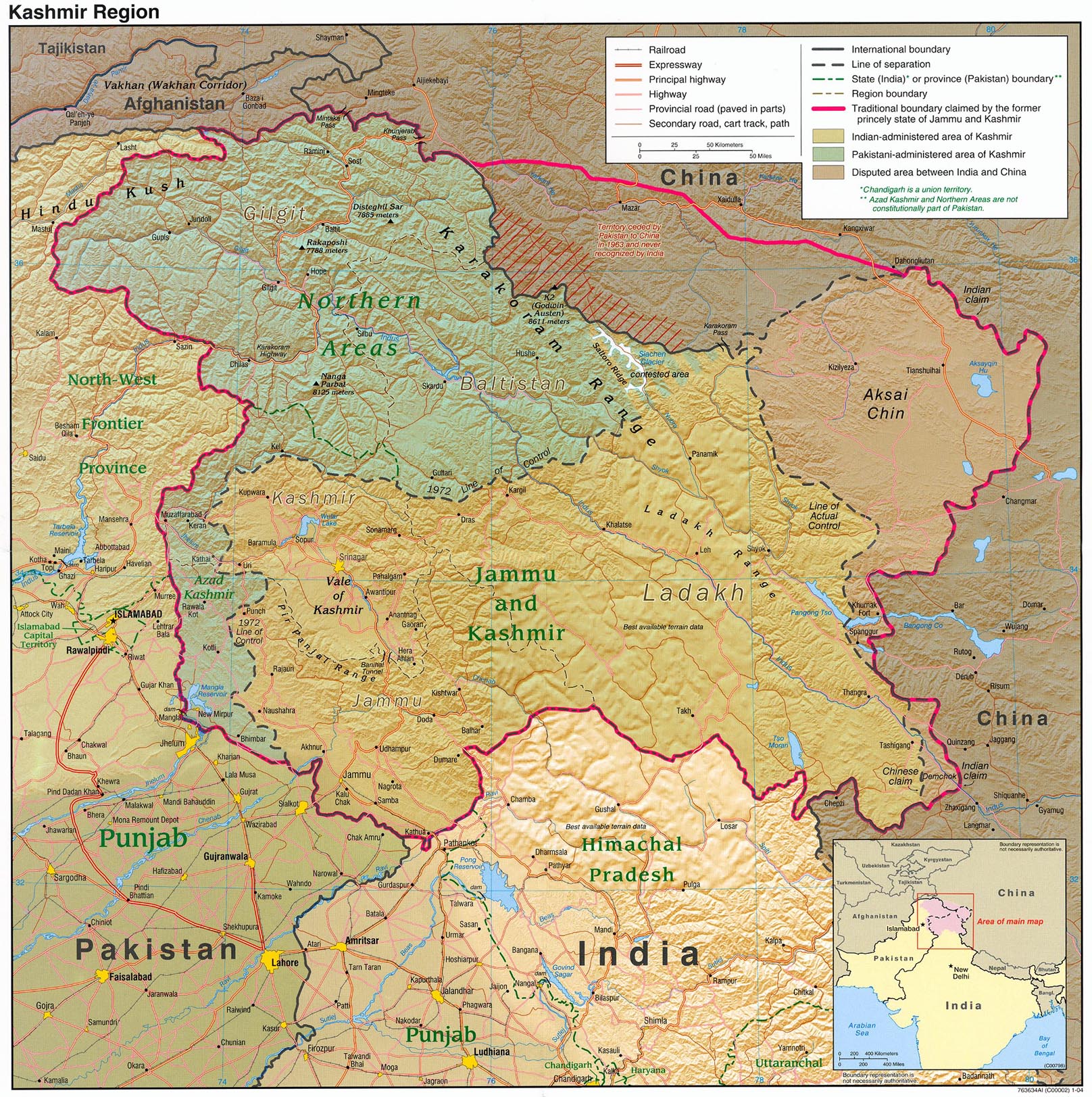
You might lose. The last time I talked to an Imam on his own turf was in a place called Kargil about halfway between Srinigar and Ladahk while hitchhiking in Indian Kashmir (These aren't my photos, someday I'll get around to digitizing my slides). I had a really interesting conversation over dinner with a group of men at a small teahouse on the main drag. The owner had a big poster of the Iranian Ayatollah Khomeini w/ a Death to America caption on his wall. They didn't really have anything against individual Americans, in fact, they were very polite and seemed as curious about me as I was about them, but they were also not very happy with America the country.
The last I heard the road is closed to tourists. Kargil was the area where Muslim guerillas were inflitrated into Indian Kashmir and nearly caused another all out Indo-Pakistan war in 1999. The town was shelled by Pakistan during the fighting. The area where I was treking was close to where several Europeans were taken hostage and killed by local militants not long after I was there.
I've traveled in Pakistan and Bangladesh and many other Muslim countries. When I was an undergrad I had Iranian friends who had to wear masks while protesting against the Shah before the Iranian Revolution because the Shah's secret police were routinely trying to photograph dissenters. I know people who humped medical supplies through Pakistan to the Afghan border for Drs W/Out Borders during the Soviet invasion. I went to grad school with folks from Saudi Arabia who taught me just how little regard the Saudi middle class has for their royals. Today I hang out with people who fled Iran due to the oppression of the Ayatollas ("Meet the new boss, Same as the old boss"). I was back in South Asia picking up my newly adopted 18 month old daughter 6 weeks after 9/11. We flew home across Pakistan and Iran just to the South of Afghanistan while US bombers were striking Afghanistan. Shit, boy, I've been watching the Middle East and South Asian powder kegs since you were in diapers.
I don't really don't need a lesson in ethics from some 19 year old sophomore who has likely never lived outside his native Nebraska or Bavaria or wherever you're from. -
Re:Obligatory non-ugly URL for this article
I wrote one inspired on that one that modifies the links on Slashdot pages, so you don't need to load the page twice to change it. Get it here.
-
Re:Why not rename CS?
As someone (dijkstra? soustroup? one of those guys with a funny name) said, computer science is no more about computers than astronomy is about telescopes.
That would be E. W. Dijkstra
Why don't we change the name of computer science to something more appropriate. Algorithmics? Computational theory? (that one still comes too close to the word "computer") Symbolic processing? (and that one may just be my Lisp background showing through.)
Why not "Informatics"? (In Germany, instead of "Computerwissenschaft" ("Computer Science"), you study "Informatik".) -
Cite specific revision of articleCite the specific revision of the article at the time you site it. You can always pull up a previous revision of an article.
E.g.(http://en.wikipedia.org/wiki/Ahmed_Yassi
n , Revision of 16:20, 6 Apr 2004) -
Re:weight
History shows us that such inventions have their place. Water may be a problem if your operating in desert or desert like conditions. What about Alpine?
real heroes of telemarkI'm watching a bbc series on abc tv called the real heros of telemark (by ray mear) ~ which follows the story of WWII british trained and equiped, norwegian commandoes conducting raids on a Norsk heavy water plant in norway. Hitler had captured this plant to help in the production of nuclear weapons.
where weight matters, extra food gets left behindThe problems they had with carrying their kit, traversing cold climatic conditions where you could expend upwards of 5000/6000 calaries per day this type of food would have gone a long way to solve their problems in surviving.
-
Re:weight
History shows us that such inventions have their place. Water may be a problem if your operating in desert or desert like conditions. What about Alpine?
real heroes of telemarkI'm watching a bbc series on abc tv called the real heros of telemark (by ray mear) ~ which follows the story of WWII british trained and equiped, norwegian commandoes conducting raids on a Norsk heavy water plant in norway. Hitler had captured this plant to help in the production of nuclear weapons.
where weight matters, extra food gets left behindThe problems they had with carrying their kit, traversing cold climatic conditions where you could expend upwards of 5000/6000 calaries per day this type of food would have gone a long way to solve their problems in surviving.
-
Re:weight
History shows us that such inventions have their place. Water may be a problem if your operating in desert or desert like conditions. What about Alpine?
real heroes of telemarkI'm watching a bbc series on abc tv called the real heros of telemark (by ray mear) ~ which follows the story of WWII british trained and equiped, norwegian commandoes conducting raids on a Norsk heavy water plant in norway. Hitler had captured this plant to help in the production of nuclear weapons.
where weight matters, extra food gets left behindThe problems they had with carrying their kit, traversing cold climatic conditions where you could expend upwards of 5000/6000 calaries per day this type of food would have gone a long way to solve their problems in surviving.
-
Just saw the reservation system theory...Just saw the reservation system Java applet (http://www.cs.utexas.edu/users/kdresner/2004aama
s - The cars aren't turning. Are the cars getting highway-style ramps merging parallel into and out of a road, is there an overpass system, or what?
- I'm watching the cars (which are represented by orange rectangles); where is their theory being shown? Some of these cars, when moving through the intersection, are just 1-2 pixels away from a perpendicularly moving car. In the real world, that might just be a 1-2 feet. It says in the description:
The granularity of the reservation system for this simulation is 4 (i.e. the system consists of a 4 x 4 grid of reservation tiles).
Well, I'm not seeing any tiles being allocated or how the applet does it's stuff. It would be nicer if the applet actually showed how the tiles are being allocated and to which car. Source code would be nice as well.
-
Re:codename
Microsoft is giving UT a bad name!
-
Re:Offensive Patents?
You can patent the later!!!
Actually, no, you can't. See here. and here
In particular:
(c) Non-Statutory Process Claims
If the "acts" of a claimed process manipulate only numbers, abstract
concepts or ideas, or signals representing any of the foregoing, the
acts are not being applied to appropriate subject matter. Thus, a
process consisting solely of mathematical operations, i.e., converting
one set of numbers into another set of numbers, does not manipulate
appropriate subject matter and thus cannot constitute a statutory
process.
The fact is, you have no clue as to what you are talking about, and need to spend a little time doing some reading.
-
Re:Many
So then the perfect language is one where all the real programmers have done all the work for you, and you're just a little script monkey.
To that I answer by quoting Dijkstra: "if we wish to count lines of code, we should not regard them as 'lines produced' but as 'lines spent': the current conventional wisdom is so foolish as to book that count on the wrong side of the ledger." (EWD1036, page 11)
And so for example even your 10-line, 40-token launcher is too long; its information content can be expressed succintly as "new Webserver(80)" or even "Webserver 80" in any properly designed language.
When electronic calculators came out, accountants did not say "the calculators do all the arithmetic for you, and you are not a real accountant" (or did they?) Similarly for spreadsheet. The reality is, each time they are relieved of a chore, they find a more worthwhile thing to spend their time on, such as analysing various what-if scenerios, which had been intractible until the advent of spreadsheets --- a fine programming language in its own right. I now quote Asimov on the general idea: "The Machines are only a tool after all, which can help humanity progress faster by taking some of the burdens of calculations and interpretations off its back. The task of the human brain remains what it has always been; that of discovering new data to be analyzed, and of devising new concepts to be tested. -
Typing tutor
I need suggestions for educational games
I taught computer literacy in Ghana, West Africa (see my site), and I didn't find much use for games, educational or otherwise. For one, such software usually assumes a native-level English language ability, which I doubt any student in Uganda will have. Also, you have to keep in mind that most students there may never have even seen a computer before. They will likely be intimidated even by the most basic educational software.
You know what program my students really loved? Notepad! None of them had ever used a computer, so the chance just to type their names was a huge thrill. It helped them overcome their fear of the computer and move on to more advanced programs...such as Minesweeper. (Seriously! They loved it.) They also loved Paint for similar reasons; it was a great way for them to learn how to use the mouse. So, instead of fancy games or educational software, I recommend supplying a simple typing tutor with your laptop. The students will likely benefit from and enjoy it far more than any game.
However, I did find that certain educational titles such as The Way Things Work are helpful as visual aids for science lessons. They do not provide much benefit when used by students alone (again, because of the language barrier and intimidation), but when used by a teacher as part of a group lesson, they can be quite useful.
any great ideas on where I can acquire copies of this software?
Half.com has lots of stuff available second-hand. I've picked up software there for one or two dollars per title.my drive doesn't work 80% of the time
Then perhaps there is no point donating this laptop. Without a CD-ROM, it will be nearly impossible for the recipient to add new software, upgrade the OS, etc. And I doubt they will have the ability to fix or replace what is likely a proprietary part. I strongly suggest getting the drive replaced before sending it, or at least providing an external one as an alternative. (You can get second-hand ones pretty cheap.) Otherwise, the gift you are sending could be just a liability.
Trevor -
Re:Meet the new boss...
Your perception is mostly incorrect, being colored by the media. Teddy Roosevelt and Eisenhower benefit from the haze of history
Let's see -- TR started the Forest Service and many national parks -- no Republican since has ever been so environmentally conscious. Your beloved Reagan said "If you've seen one Redwood, you've seen them all.".
Eisenhower, despite being a career soldier, was intelligent enough to realize the danger of the military industrial complex. Reagan just gave bottom-feeding scum corps like Lockheed and Northrop everything they asked for.
and left-wingers are still very angry that Reagan's policies ended the cold war and saved the U.S. economy.
Communism collapsed of its own accord, helped by the struggles of people behind the iron curtain, which the US never helped despite their desperate pleads (We also screwed over the Czechs and Hungarians by not lifting a finger when they rebelled in the 50's and '60s) Read up on East Germany's "Swords to Ploughshares" movement, for example. Without those protests, the Berlin Wall wouldn't have fell. -
Different password entry schemes?
Not to discuss about IE, what about banks using different password entry schemes?
In Brazil there seems to be a new regulation saying that users of ATM and online banking shouldn't type the password in a numeric pad anymore.
Instead, you get 5 buttons on the touch screen (or a small Java applet, or Javascript thing in the case of the bank where I have an account there) with combinations of two numbers. It looks like "press this if the next number is 3 or 8".
The thing is, the combination changes every time you enter your password. The first button that was "3 or 8" before will be something like "4 or 7" next time. And the combinations change too, not only the position of the buttons.
So it becomes more difficult for spyware to monitor keypresses / mouse clicks, or things like this to work for the scammer. (Ironic or not, the ATM in the pictures at the UT website is from a Brazilian bank).
I haven't seen anything like that in any US bank; it's always a number pad where you type your password, or a text field to type the password online. -
Re:Constitutionally the most power?Let me just clarify a couple of things...
1) Congress can override SCOTUS decisions. It takes a Constitutional amendment to do so (making the law constitutional by changing the Constitution to suit), and so it is very difficult, but it can be done.
Partially true. If SCOTUS interprets something as unconstitutional, Congress and the states must past a constitutional amendment. If the law is unclear and SCOTUS makes a ruling, all Congress needs to do is pass new legislation. There is nothing to prevent Congress from repassing the same legislation either(see the flag burning issue.)
2) The executive branch appoints justices. It's a little-known fact that even SCOTUS justices can be impeached and removed from office, even though they otherwise hold life terms; this has never been done, but it is possible.
Bull shit. Gerald Ford (as house minority leader) tried to impeach Justice William O. Douglas.
http://www.ford.utexas.edu/library/speeches/700415 a.htm
Douglas was a champion of civil rights issues and one of the longest serving members of the court. He was tilted to the left, which should please the
3) The SCOTUS cannot act of its own volition; it must be called upon before it can do anything. The Executive and legislative branches have limited power, but they can use (most of) those powers at will; the SCOTUS is powerless unless actually called on by one of the other branches, or by the people.
Furthermore, Congress has the power to organize the judicial system. This determines which cases the SCOTUS can hear.
Also, this brings up point four, which I'll add:
4) Congress sets the size and make up of SCOTUS and judiciary.
When Roosevelt needed to pass the New Deal to get the American economy started again SCOTUS started declaring many parts of the New Deal as unconstitutional (which they were
The Supreme Court is actually the weakest of the three branches since it's powers are not defined in the constitution. It is a timebomb that went off with FDR. The court can be directly influenced by the other branches. Perhaps if the supreme court's powers were defined better in the constitution we wouldn't have the super large government we have today.
-Electrawn -
I know it's not tin foil, but....
a new application for RF-absorbing materials: Wallpaper that blocks Wi-Fi.
Ok, I know it's not tin foil....
But the important question is, can I use it to make a hat? -
Comparing like with like
That's not evidence of Dubya's virtue, that's evidence of the virtue of the US system, which at least makes an attempt at guaranteeing free elections, and prohibits staying in for more than two terms. Saddam racked up the bodycount that he did because he's been in since 1978.
And the US system also ensures that the power is spread across a cabinet. So it's meaningless to compare a US President's criminal record with that of an Iraqi dictator, who has no "last-call" bell when 8 years are up. Rather, the comparison should be between the current cabinet and Saddam: Bush, Rumsfeld, Cheney, Negroponte , etc.
"Last I checked there weren't any mass graves filled with turkish insurgents on GWB's resume."
If you're talking about the Kurds, I would give several people in the current White House full credit for their part in this. And full credit for helping Saddam brutally crush the Shia uprising too, ensuring that he stayed in power.
Saddam couldn't have done it on his own. -
Re:The need for censorship
It would also have been interesting to see what would have happened had the Japanese been successful at Midway.
I think it would have been the same war, only about a year longer.
Let's posit that the Japanese sink two of three US Navy carriers, only lose two of their own, and that Midway is occupied.
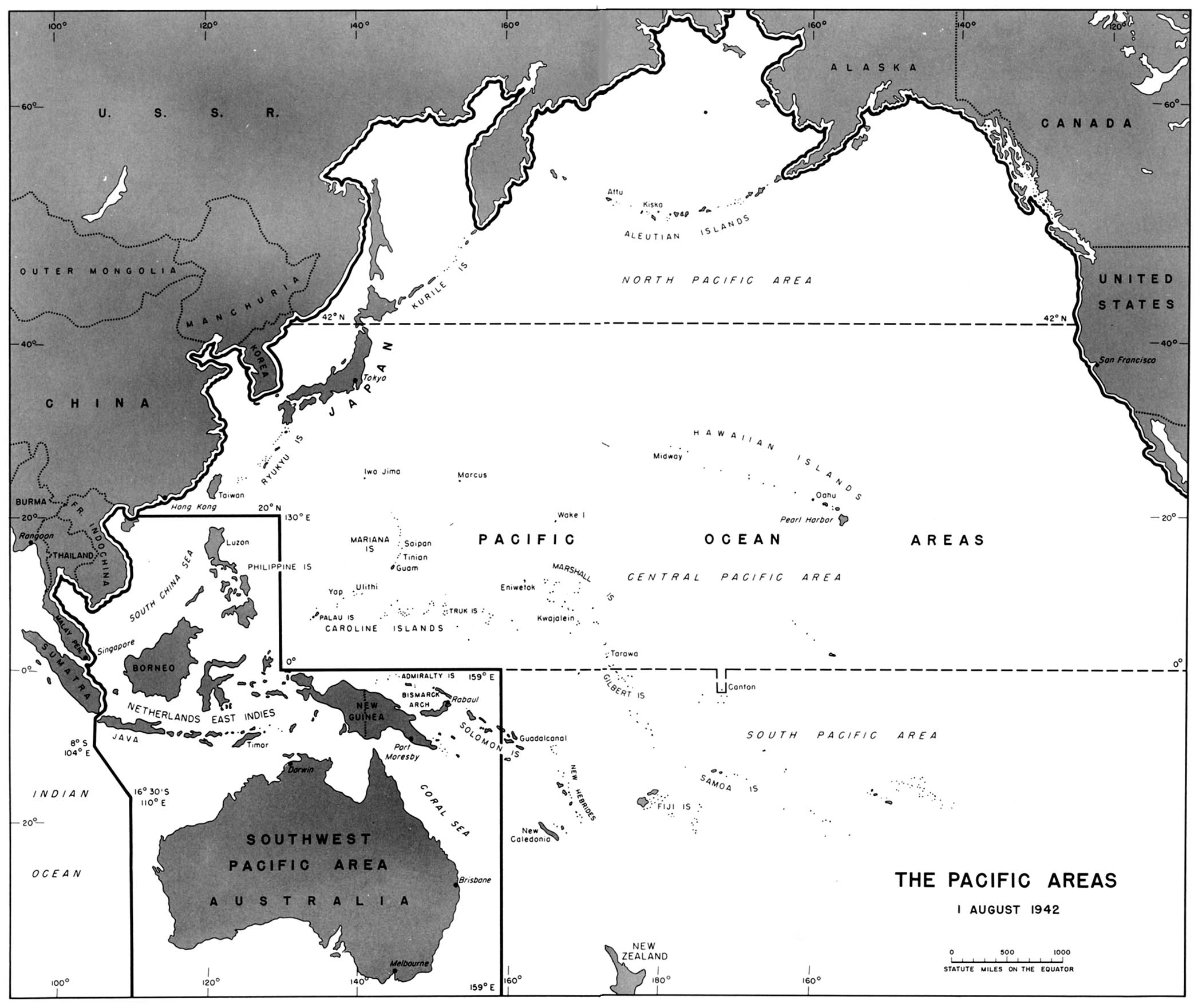
Take a look at this map. Midway is within range of USAAF land-based bombers flying out of Hawaii. It's also a long way from the Home Islands, which entails a supply line problem. In 1942, US Navy fleet submarines were still plagued with defective torpedoes, but that problem was solved within a year. 1943 would have been an unpleasant year for Japanese troops on Midway: starving, thirsty, and living in bombshelters.
Retaking Midway would have been difficult, no doubt, and would have drawn assets needed in the Southwest Pacific, but it would not have been as hard as Tarawa or Iwo Jima, places where the terrain favored the defender, and the Japanese had years to dig in and prepare for an invasion.
The loss of two carriers would have been quite a blow to the US Navy but, to put this into perspective, by 1945 the United States had built 137 carriers (around 30 full sized hulls and the rest smaller escort carriers). The Japanese built 13. The US had a commensurate advantage in aircraft production and the training of personnel.
Finally, there was the matter of the US having broken the Japanese JN-25 naval code, part of the reason the US Navy could anticipate Japan's moves towards Midway. Even after this defeat, the Japanese Navy didn't change their codebooks, leading to the intercept of Admiral Yamamoto's transport plane in 1943. A victory at Midway wouldn't have changed this.
Now, I do admit that this raises the question as to whether the war in Europe would have been lengthened by a setback at Midway. Would Berlin have been the target for the first atomic weapon? Would the Soviets have stopped at the Elbe? The Soviets adopted a stance of neutrality towards Japan until 1945; would they have entered the theatre earlier?
The Cold War battle lines were drawn by WWII. I think that adding 12 to 18 months to the war changes those lines.
k. -
Re:They should exploit Austin's unique advantage..
They should exploit Austin's unique advantage and WiFi the Austin Moontowers.
This is a great idea. And for those areas of town that don't have moontowers and couldn't get wi-fi access that way, they should implement another idea: put in moon towers all over Austin! It'd be a great way to unify the new/bland suburbs with the unique Austin character that you're more likely to find downtown. They'd have to have them custom-built, I'm sure, but it is totally the one thing that is a unique Austin architectural feature, and it would be a wonderful way to tie together the old and the new parts of the city, which right now are very different.
Here is a nice little article describing moon towers, by the way, for those who aren't familiar: link #1, link #2, link #3.
-
UT-Austin's WNGG
The ECE dept here at Univ Texas-Austin just opened a newly $1.5 million remodeled lab for the Wireless Networking & Communications Group. Austin is moving up the ladder in WiFi. Here's the WNCG webpage: WNCG.
-
Re:.au would be insane to accept this
Face it, the majority of America is a fertile farming par[a]dise,
This is not true. If it were, why would they need tarrifs to protect their goods?
Because their labour is too expensive. They are protecting USD$10/hour workers against production from USD$0.10/hour workers in other countries.
our production can't compare to theirs,
This is untrue. Australia is a leader in farming efficiency.
In point of fact, I have an uncle who contributes significantly to this efficiency all by himself. However, it ain't enough.
There are more than ten times as many people in the USA, and I cordially invite you to raise anything but spinifex and kangaroos (sometimes not even that) on more than half of our land area.
Other than that, I agree that US agricultural protectionism is a bit extreme.
However, let me introduce you to an interesting comparison. When my Albany (WestOz) rellies started farming, you could swap a typical good-quality bull for a new four-wheel drive. Now you need to swap something like 700 of them to get one 4WD.
All of the money gets made by merchants and brokers on the other side of the farm gate, and bugger-all gets left for the farmers themselves. Given that they're the ones tied down to huge, inflexible and expensive assets and taking all of the (weather, pests, salinity etc) risks to make those assets produce stuff, that's not exactly equitable. If you can solve that problem, you can quietly do away with a lot of agricultural protectionism and any farmer who isn't terminally greedy and short-sighted will run to help you. -
Re:And now... In Swedish.
The next one to reply is a rotten egg!
Don't you mean...
Zee next oone-a tu reply is a ruttee igg! Bork Bork Bork!
-
I have prior art!In 1999 I wrote a paper comparing Naive-Bayesian classifier learning to a good rule-learning algorithm for classifying email, including spam. And showed how well the Bayesian classifier worked on spam. The paper is linked from Paul Graham's spam research page.
Here is the reference:
Provost, J (1999). Naive-Bayes vs. Rule-Learning in Classification of Email. The University of Texas at Austin, Artificial Intelligence Lab. Technical Report AI-TR-99-284
I should mention that I don't think I'm the first to use Naive-Bayes on email. I think some folks from Microsoft did it in 1998, and there may be others too.
-
Deja vu heap layers
This reminds me of Heap Layers and others; they both try to reinvent malloc()/new().
-
Re:cease to exist?
An example of this is maxima. (Quotes from this link.)
"Maxima is a full symbolic computation program.
Maxima was maintained by Professor Schelter at the University of Texas:
"This particular variant of Macsyma was maintained by William Schelter from 1982 until he passed away in 2001. In 1998 he obtained permission to release the source code under GPL."
"Since William Schelter's passing a group of users and developers has formed to keep Maxima alive and kicking. We are currently in a transitional state, deciding what directions to go in next and seeing what our abilities and resources are. Maxima itself is reasonably feature complete at this stage, with abilities such as symbolic integration, 3D plotting, and an ODE solver, but there is a lot of work yet to be done in terms of bug fixing, cleanup, and documentation. This is not to say there will be no new features, but there is much work to be done before that stage will be reached, and for now new features are not likely to be our focus."
There is more history on this project (e.g. here) -
Re:Did we really need a link to slashdot in the stFrom the article:
Occasionally Slashdot will link to a website that is unprepared for the massive flow of traffic from millions of Slashdot users clicking onto the same link.
I can't believe that they're server is still up - How many times do we need to download that PDF to see that they were unprepared. -
Check out UT's map collection
http://www.lib.utexas.edu/maps/faq.html#3.html
Most of them are public domain. -
Re:If Brown was lying can't Linus sue for slander?
First off, it's libel when it's printed, not slander. (Although if, for instance, Brown were to spout his nonsense on a talk show, I don't know whether it would be libel or slander. Probably the latter.) Second, to win a libel case you have to prove damages, and you have to prove that the information was both false and malicious.
In this case, is it false? Yes. Malicious? That's harder to prove, but could be. Damages? There's the rub. Unless this work damages Linus somehow -- he gets thrown in prison because of allegations in the book, or loses his job (which may I remind you is with a group that is undoubtedly aware of Brown's blatant disregard for the truth), neither of which is likely -- damages would be pretty hard to prove. Especially if sales and usage of Linux continue to climb.
So I think the best course of action is just to refute the FUD everywhere it rears its pointed little head. If Linus were to sue for libel the most likely result would be to make two sets of lawyers richer.
Of course I could be wrong. John Henry Faulk sued AWARE for libel and effectively ended blacklisting in this country. Something similar might come out of a lawsuit against AdTI, but really only Linus could decide if it's worth the effort. -
Re:Where is the commercialization?What oil company in its right mind would continue to operate wells all over the world, maintain a tanker fleet, etc. if they could accomplish the same thing with bio fuels at a lower cost?
With all due respect, you have it backwards. They peg the price per barrel based on the "international market." Their true production cost may be far below that. In 1996 Pemex disclosed it cost them $2.52/bbl. I challenge you to find out how much it costs US domestic producers to extract each barrel. If most of the oil consumed in the US comes from inexpensive sources outside of the Persian Gulf area, then pegging the price high results in a very generous profit margin. Therefore, what oil company in its right mind would want to do anything other than pretend petroleum is a precious, expensive resource on which our very existence as a nation depends?
Petroleum is a cheap, disgusting fluid that comes from the smelly bowels of the earth. Through political trickery, we have been convinced that it is a terribly valuable commodity, for the sole purpose of enriching the men behind the curtain.
Don't peek, now.
-
Programmatic Enforcement
You can get software to enforce the policy to avoid the 10% non-compliance mentioned above. In the Unix/Linux world, you can use something like NPasswd to do it. For you Windows' people, something like Password Bouncer would do the trick.
-
Re:Defect
Yeah, I too disagree with the "if we all work together we can make space travel happen". It's like saying that if we all work together we can eliminate hunger, yeah, we can, but it aint gunna happen. More likely some physics student will have a stroke of genius and the entrepreneurial spirit to turn it into something more than yet another theory of reality. Or a commercial entity will find something in space remotely valuable and lay down the ground work to get to it. The era of government commitment to long term space projects is dead. NASA is all about bang-for-buck small missions now. Consider a mission to the solar foci. This is not beyond our current technological means. If we all worked together we could up and build one of these and in about 25 years we'd have the best telescope ever (radio and optical). So where's the international committee with significant funding to get this happening? There isn't one, because there is no business case and there's a significant chance of failure. So even with the most stable GDP and the most peaceful and enlightened of people, why would there be international co-operation to get this done? Maybe if space technology was so damn cheap that you could build it yourself (like software for example) then maybe we could expect our species to become a space-faring one. But even then, we're making some assumptions about the kind of production available to individuals or even international groups. Yes, we may one day have nanotechnology that could conceivably make production of space technology as feasible as production of software but who is to say how available that technology will be.
-
Re:caffeine
Indeed. Most people don't realise it is actually physically addictive.
Adenosine is a chemical messenger that tells cells to slow down. Caffeine, being structurally similar, can block adenosine receptors in the brain, and thus prevent this slowdown.
However, your brain cells compensate to prolonged exposure by creating more and more adenosine receptors... meaning that you'll be really tired unless you block them with caffeine. Repeat ad addictum.
Check here and here for more info.
On a more personal note, I always find that drinking something with tons of sugars in it keeps me active far longer than caffeine alone. Caffeine just makes me burn through my energy reserves faster, resulting in me being even more tired after a while. -
Re:Some facts
In the novelisation of Star Wars, the hangar bay chief on the Death Star says "THX 1138, why aren't you at your post?"
It's sad that as a 10-year-old proto-geek I had read enough background material on Lucas, and seen the movie enough times, to realize (a) this is not the movie dialog, and (b) where the new number came from.
There is a web page devoted to the stormtrooper ambushed on the Millenium Falcon.
-
Re:Off thread but needing help figuring out distroIf you are willing to pay, I would say choose between Mandrake or SuSE.
Here are my somewhat un-organized thoughts on this issue: Mandrake tends to be buggier (hopefully their new Community and then Official release system will solve this), has poorer configuration tools, but has more third-party packages and has urpmi, which is like apt-get. Basically, you type "urpmi programname" and it automagically downloads and installs it and any other programs or libraries it is dependent on. Mandrake is reasonably fast (moreso than Fedora)
SuSE has a GREAT configurator (called YaST), is stable, but has fewer third-party RPMS (and many of the sites are german-only, SuSE's home language), and there is no urpmi-like tool. It has a great manual though, but is a bit slower than Mandrake. It also has its own ways of doing things, and configuration and the structure of the filesystem are substantially different than other Linuxes. They also leave out divx and DVD support, due to legal concerns -- adding these is a snap in Mandrake (just add the PLF repository to your urpmi config and type urpmi mplayer), but is a bitch in SuSE (you have to track down a bunch of packages and dependancies from Packman). SuSE has a better selection of games. Also, if you want to config things by hand it is a cinch in Mandrake (Mandrake modifies your existing config files if you use the GUI tools), but it is a pain in SuSE (Suse ignores or writes overtop of your hand-made files next time you do anything in YaST -- things you hand-configured will not be picked up by YaST, it maintains its own internal database, and then writes that out to the normal config files.)
If you just want a machine that is ready to go for basic office tasks, SuSE is probably best. If you want to potentially customize your system a little, Mandrake is probably the best.
Both include a full set of dev tools, but they are not installed by default.
-
Re:Programming by Contract?
-
Re:Programming by Contract?
-
Re:What am I missing?No, we are in this situation because there are a pitiful few number of Americans, such as myself, who will take the time to vote and write my representatives and basically get off my ass and do something to get laws changed.
Dude, not enough people give a damn about techie issues like copyright to get the law changed. If you want a law changed, you have to form a PAC that gives money to congressmen to support you. Or challenge the laws in court and have an expensive lawyer convince the judge that what you want is in "every bodies best interest."
I mean, hell, what group of citizens got together to put the DMCA on the books anyway?
Oh yeah companies that give hundreds of thousands of dollars every year in campaign contributions yet represent almost no citizens!
By "go away" I assume you mean that they remain on the books but cops don't bother to enforce them most of the time. The problem is that then you have selectively-enforced laws which is obviously not good. It is better to "clean house" and get those laws off the book. Otherwise, if we end up with lots of laws that are clearly ridiculous and never enforced it makes our system of law look like a damn joke.
What America do you live in... the law books are already a joke. Hell, here in Texas it is still illegal to carry wire cutters because of 19th century cattle theft. Every year, tons of new laws are put on the books to appease certain factions, but many of these are dead laws from the get go. It would take centuries to clean centuries of crudded books.
What I was implying is that when too many people defy the law, the courts (the only branch of the government that still pretends to serve the people) will strike the law down because enforcement is impossible.
As Gandhi showed, massive public disobedience is the only way for the (more numerous) little guys to beat out the big dogs!
-
Re:It's pretty simple
You must know your history. Tulsa was a town in Texas. It doesn't exist any more. I live near Tulsa, OK, and I wasn't aware of a local Intel presence.
TULSA, TEXAS. Tulsa was southeast of Wink in southern Winkler County. Though the settlement was a product of the oil discovery of July 16, 1926, in the Hendricks oilfield,qv it never boomed. A townsite was laid out, and several buildings were erected. A Tulsa post office opened on August 20, 1927, with Cora Higgins as postmistress and closed in 1929, when the building was moved to Wink. Tulsa reported two businesses in 1931 and one in 1933, when the population was twenty-five. After 1948 the store closed, and the community, which was named for the Oklahoma boomtown, vanished.
BIBLIOGRAPHY: A History of Winkler County (Kermit, Texas: Winkler County Historical Commission, 1984).
Julia Cauble Smith
-
Re:Not really that worrying
For example say I had 20 in my back account, nobody would spend 100 in time or money to get to it.
That why they actually use card reader, camera and wireless communication on ATM to duplicate your credit card and get your code. Say to me that you can do it with less than 200$. See it for yourself. -
7-11 sells porno mags? No way!
I really wonder why retailers won't sell AO games, 7-11 sells porno mags, video stores carry porn...
Here in Texas, the ancestral home of 7-11, I don't see porno mags like Penthouse or Hustler or Playboy for sale. Just Maxim, FHM, Stuff, Cosmo, Sports Illustrated...
Ok, I stand corrected. Sorry. -
AppleScript and Perl
AppleScript had the concept of "dialects" which were AppleScript terms written in different languages (they had French, Japanese, Japanese (romanji), German, and Italian working). It was intriguing, I remember actually submitting an AppleScript in French for an assignment in French class in high school circa 1995.
English:
the first character of every word whose style is bold
French:
le premier caractère de tous les mots dont style est gras
Sample of an AppleScript in English and Japanese
Some discussion on it circa 1994
Note, this should not be confused with OSA (Open Scripting Architecture) dialects, like JavascriptOSA, which are different.
Aside from this, the most linguistically extendable language would probably be Perl (especially Perl 6). Having been written by a linguist, I imagine the most awareness of the linguistic aspects of coding in a different lanugage would be.
I mean really, "coding in another language" doesn't mean replacing "for" loops with "pour" loops, it means taking advantage of concepts (like word genders and verb conjugation) that are specific to that language. Programming "in a French way" could lead to constructs, algorithms, and phrasing very different from "standard C".