Slashdot Mirror
Domain: utexas.edu
Stories and comments across the archive that link to utexas.edu.
Comments · 1,356
-
Where's the beef?
I'm sure there's something really cool these guys are doing, but there is a very strong distinction between Big F*cking Huge Graphs (like we see a bunch of in the links) and Big F*cking Graph Analysis using some new technique, which isn't really clearly anywhere in there.
I've been singing the praises of LGL as of late, pushing it into the Opte project (mass internet viz) and such, but truly the interesting applications involve analysis -- and where's the beef on that in this story?
--Dan -
Additional Reading
I'd suggest reading about the economy of orgasms as well.
Science is wonderful, isn't it? -
Re:That is exactly the wrong approach
For those interested in programming in an executable language yet also proving that the code written is correct I present the following:
ACL2
Its a semi automated theorem prover that runs on programs using a subset of Common Lisp. Thus it can verify property correctness, such as (reverse (reverse (x))) == x where x is a list.
Its been used to model systems such as AMD's K5 floating point division algorithm, and processors in phones from Motorola. -
Re:Go to a better school
corrected link Click here
-
Re:Schools
University of Texas already does this, it allows students and professors to view these end-of-semester surveys with numerical data for all categories. link
-
University of Texas at Austin
The University of Texas at Austin Electrical Engineering Department has some good opportunities to study network technology. They have a Network Engineering Laboratory class which lets you build all the components of an enterprise network in-lab using Linux boxes and Cisco gear. There are also general networking classes and some good network protocol implementation classes that you can take from the CS department. Plus an EE degree gives you the foundations you need to work in almost any part of the networking industry.
Beyond the classroom the local chapter of the IEEE Communications Society provides lots of opportunity to do real network engineering. They have a widely recognized Honeypot effort, a project which seeks to replace department land-lines with VOIP phones, and a running series of lectures on network security. UT itself also administrates an impressive enterprise-class network to support the institution, and one of the guys in charge of it is a professor in the EE department.
Cisco also has an office in Austin which employs students as interns and part-time workers. I have a friend who got paid to, among other things, get his Cisco certification and configure test networks in their labs all summer long. There are lots of opportunities to learn about networking at UT, and it's a US top-ten engineering school.
-
University of Texas at Austin
The University of Texas at Austin Electrical Engineering Department has some good opportunities to study network technology. They have a Network Engineering Laboratory class which lets you build all the components of an enterprise network in-lab using Linux boxes and Cisco gear. There are also general networking classes and some good network protocol implementation classes that you can take from the CS department. Plus an EE degree gives you the foundations you need to work in almost any part of the networking industry.
Beyond the classroom the local chapter of the IEEE Communications Society provides lots of opportunity to do real network engineering. They have a widely recognized Honeypot effort, a project which seeks to replace department land-lines with VOIP phones, and a running series of lectures on network security. UT itself also administrates an impressive enterprise-class network to support the institution, and one of the guys in charge of it is a professor in the EE department.
Cisco also has an office in Austin which employs students as interns and part-time workers. I have a friend who got paid to, among other things, get his Cisco certification and configure test networks in their labs all summer long. There are lots of opportunities to learn about networking at UT, and it's a US top-ten engineering school.
-
Why stop at assembly?
First year Electrical Engineering students at the University of Texas at Austin take an Introduction to Computing class that starts with the transistor and uses a book written by Yale Patt, a prof at UT that often teaches the class. The class then teaches how transistors can be combined to make memory circuits, how you store data when represented by bits (2's complement, floating point, ASCII text). You then learn to write basic programs for a simplified computer in actual binary machine code and actually run the code on a simulator developed by students in the advanced computer architecture class. By the time you get to programming in assembly you think it's a relatively high level language and are glad to have it.
The successor to this class picks up where this one leaves off and teaches C from assembly up with an emphasis on what actually happens when you compile, allocate memory, and other things that a lot of students overlook. C++ is introduced in a later class, as well as algorithms, etc.
I personally think that I am a much better programmer for having learned in this manner. I took a senior level class in the UT Computer Science Department (which teaches assembly much later in the game) and found that far too many students, including some that were about to graduate, still didn't understand the fundamental differences between handling text data and binary, non-text data in higher level languages. Most still seem to think code executes in a white fluffy cloud and wonder why on earth 119 + 133 = -4 in their program and think '133' == 133.
-
Why stop at assembly?
First year Electrical Engineering students at the University of Texas at Austin take an Introduction to Computing class that starts with the transistor and uses a book written by Yale Patt, a prof at UT that often teaches the class. The class then teaches how transistors can be combined to make memory circuits, how you store data when represented by bits (2's complement, floating point, ASCII text). You then learn to write basic programs for a simplified computer in actual binary machine code and actually run the code on a simulator developed by students in the advanced computer architecture class. By the time you get to programming in assembly you think it's a relatively high level language and are glad to have it.
The successor to this class picks up where this one leaves off and teaches C from assembly up with an emphasis on what actually happens when you compile, allocate memory, and other things that a lot of students overlook. C++ is introduced in a later class, as well as algorithms, etc.
I personally think that I am a much better programmer for having learned in this manner. I took a senior level class in the UT Computer Science Department (which teaches assembly much later in the game) and found that far too many students, including some that were about to graduate, still didn't understand the fundamental differences between handling text data and binary, non-text data in higher level languages. Most still seem to think code executes in a white fluffy cloud and wonder why on earth 119 + 133 = -4 in their program and think '133' == 133.
-
Why stop at assembly?
First year Electrical Engineering students at the University of Texas at Austin take an Introduction to Computing class that starts with the transistor and uses a book written by Yale Patt, a prof at UT that often teaches the class. The class then teaches how transistors can be combined to make memory circuits, how you store data when represented by bits (2's complement, floating point, ASCII text). You then learn to write basic programs for a simplified computer in actual binary machine code and actually run the code on a simulator developed by students in the advanced computer architecture class. By the time you get to programming in assembly you think it's a relatively high level language and are glad to have it.
The successor to this class picks up where this one leaves off and teaches C from assembly up with an emphasis on what actually happens when you compile, allocate memory, and other things that a lot of students overlook. C++ is introduced in a later class, as well as algorithms, etc.
I personally think that I am a much better programmer for having learned in this manner. I took a senior level class in the UT Computer Science Department (which teaches assembly much later in the game) and found that far too many students, including some that were about to graduate, still didn't understand the fundamental differences between handling text data and binary, non-text data in higher level languages. Most still seem to think code executes in a white fluffy cloud and wonder why on earth 119 + 133 = -4 in their program and think '133' == 133.
-
I think you're confusedI'm not sure what you're asking for. What you suggest is not interesting, and what is similar but actually interesting is clearly impossible.
If you just want to improve light-gathering ability, but not resolution, it is theoretically possible, although difficult.
Normally, when taking a long observation, you take a number of CCD exposures (a charge-coupled device is basically a photon counter, and you need to empty and measure it before it overflows), delete any from the sequence that are corrupted (by, e.g. high-energy radiation), and digitially add the remainder together to produce an image that is conceptually the sum of many hours of observation.
You could, in theory, merge images taken from several telescopes, but you'd have CCD grid alignement issues, and it's easier to just either
- Take a longer exposure at one telescope (integrating over multiple nights is already commonplace), or
- Build a bigger mirror. With all the per-telescope costs, this is cheaper than two smaller telescopes until you get out of the usual amateur range.
It takes 2844 15 cm backyard telescopes to equal the light-gathering power of one 8m telescope, and the loss in resolution is phenomenal, so this is not likely to be terribly interesting. (For low-cost, you have to compete with the 10m Hobby-Eberly telescope built for $13.5 million, so do your math accordingly.)
The exciting thing in modern astronomy that involves multiple telescopes is interferometry, which gives you a telescope with an effective resolution equal to that of a telescope as wide as the spacing between telescopes. You don't get the light-gathering ability of a telescope that big, but that's not usually the limit. You do get the focusing ability.
This, however, requires that you can measure not only the numbers, but also the phase of the arriving photons and combine them properly.
The classical focusing mirror does this directly. The intricate mirrors-on-trolleys arrangement beneath the VLT is another way of doing it.
Radio astronomers work at low enough frequencies that they can record all the information they need on tape at two telescopes (with clocks aligned to the nanosecond) and combine them later, but visible light, from 430 to 750 THz, gives more problems:
- Nobody has enough recording bandwidth to keep track of that information, and
- Nobody has clocks synchronized well enough enough to resolve time differences of less than 1 cycle. Current timekeeping state of the art is 1 ns synchronization between distant clocks; you're asking for 1 fs, six orders of magnitude better.
Thus, optical interferometry currently requires fully optical beam combining; the data is never converted to bits and so it can't be done over the net in the forseeable future. - Take a longer exposure at one telescope (integrating over multiple nights is already commonplace), or
-
The Answer is 126.
Rather than being round, nuclei in that region and beyond could contain bubbles and have strange doughnut-like shapes, Dr. Nazarewicz said.
One of the theories is that our universe is shaped like a doughnut. Universe as Doughnut: New Data, New Debate So, the highest and the deepest reaches are similar in our conception.The discoveries fill a gap at the furthest edge of the periodic table and hint strongly at a weird landscape of undiscovered elements beyond.
I recollect that Star trek starts off with "Space, the final frontier. These are the voyages of the starship Enterprise. It's continuing mission: to explore strange new worlds, to seek out new life and civilizations, to boldly go where no one has gone before."Those numbers should help map out what Dr. Nazarewicz prefers to call generically a "region of stability" among the superheavies. (Because, he says, it could resemble a peninsula more than an island.) Various theories have suggested that the next magic proton number is 114, 120 or 126, he said. There is general agreement that the next magic neutron number is 184, he said.
According to Douglas Adam, the answer is 42. I would say the other possible answers are 84, 126, 168, & 210. So, the correct answer is 126.Q.E.D
-
Be excellent at computer science...
...or don't bother. I hate seeing people who got their degrees but didn't seem to learn anything from them. Or people that don't seem to care about software quality, yet are paid to write code that other people must go and fix. If I was in a management position, I would fire the people at my job that are currently not excellent. (instead, I'm stuck working with them)
Also, "computer science is as much about computers as astronomy is about telescopes" (or something like that) - Edsger W. Dijkstra. -
Re:Linux apps too hard to configure?
I do not understand why Free Software cannot serve the "needs of every retard".
You see the principle of mutual exclusivity between "easy" and "flexible" as a hard coded rule.
It is not.
It is all about quality. It is all about simplicity.
Sure, having more choices may mean spending time to pick, but even that needs not be a hard coded rule, the word "default" comes to mind. KISS comes to mind.
I wish more people took heed of what programming really is: read Dijkstra
and lets slowly but surely build the perfect future.
peace
"/Dread" -
Scientific work on optimal pipeline depth
In case anyone wants some hard facts:
A. Hartstein and Thomas R. Puzak (IBM): The Optimum Pipeline Depth for a Microprocessor, ISCA 2002.
M.S. Hrishikesh, Norman P. Jouppi, Keith I. Farkas, Doug Burger, Stephen W. Keckler, Premkishore Shivakumar (UT Austin, Compaq): The Optimal Logic Depth Per Pipeline Stage is 6 to 8 FO4 Inverter Delays, ISCA 2002.
Eric Sprangle , Doug Carmean (Intel): Increasing Processor Performance by Implementing Deeper Pipelines, ISCA 2002.
A. Hartstein and Thomas R. Puzak (IBM): Optimum Power/Performance Pipeline Depth, MICRO 2003.
What all these papers have in common is that they find that increasing the pipeline depth past 20 stages increases performance. -
Re:Math Geeks
No it's from The Leiter Reports
-
Re:Digital Camera
DV (Digital Video), the standard consumer and prosumer digital video storage, uses up 13 gigs per hour.
Reference, Google for further proof.
-
Re:Car Dealers are financial institutions...
You know those "Buy Here, Pay Here" lots you pass on the way to work every morning? Those are cash cows, that border on usury.
In fact, they're just one part of the larger "second-class economy". Many Slashdotters may have never known this economy, and take it for granted that everyone does their business at banks, credit unions, and the like. Take a drive across the tracks, and find out about some of the major players:
* Pawn Shops. They loan money at rates that make your 21% credit card rate look like free money. Open all night, and they don't ask what you need the money for, or even whether you'll come back for your wife's wedding ring. Cash America, a publicly traded company, makes money hand over fist.
* Check Cashing Joints. You don't have a bank account, but McDonald's pays by check. No problem, just go down to the local Ace Cash Express. You give them a check, they give you 95% or so of it back in cash.
* "Cost-Plus" Grocery Stores. When it's not your money, it's hard to care about where it goes. "Cost-Plus" stores prey on this blind spot with a bizarre pricing scheme. All products are priced super low, but a surcharge of 5%, 10% or more is tacked on at the end. Targeted at people who don't have good math skills and are using their public aid debit cards.
* And then there's the car dealerships, already mentioned, that specialize in arranging financing that you can't afford, so they can sell the same car over and over. Another poster pointed out that they don't always live up to their "Buy Here Pay Here" slogan, but find outrageous APR financing through their vulture financing contacts. There's enough money here, though, that some national chains are showing interest.
I'd look for this legal (but underground) economy to get some scrutiny with these new powers. It would be a good way to launder money (for whatever reason, not limited to terrorism). What would be better, though, would be to start regulating the entire sector out of existence, and move real banking into the reach of those who live paycheck-to-paycheck. -
More about the cluster
Paragraphs, man. They're useful.
Anyway.. no OpenMosix here, this is using MPI. Specifically, on top of DK Panda's MPI libraries, they brought Kazushige Goto in to optimize the BLAS libraries in order to obtain the Top500 ranking of 10+ TF.
Incidentally, the Top500 rankings are based on a standardized LINPACK benchmark and formula, not "raw" processor rankings. I saw another comment that implied the latter.
Other interesting notes:
- With conventional air cooling, the airspeed throughout the facility would have been 60-70MPH+. Try working on a console in a hurricane.
- Dr. Varadarajan is a very very cool guy. He absolutely knows every detail that is going on in this machine, and knows how to make a good story out of it.
- The facility this is in was upgraded to handle 3MW. The current cluster takes around 1.5MW. And you thought your Athlon was hot.
- The #1 Top500 machine, the Earth Simulator, not only runs on custom Hitachi vector hardware, but required an entire new building to be built. The facility is a feat in itself, and is a big portion of the cost (for those of you extrapolating cost/performance if it was built at the same time as System X).
-
Save money HET-style!
The article didn't even mention the 9.2-meter Hobby-Eberly Telescope in west Texas, which was built at a fraction of the cost required by other similarly-sized telescopes. (HET cost only $13.5 million.) The most notable cost-savings being that the telescope is always at a constant tilt, and is only configured for spectroscopy, not imaging. But for sheer size-of-light-bucket per dollar, such a design is hard to beat. There are also plans to build a much larger version of the HET --- I forgot how big and I have no URLs to share, but the new telescope would be at least as large as those mentioned in the article.
-
Re:Free access at Universities
University of Texas is fairly well covered (almost every building, though some of the artsy-shmartsy types are dragging their feet). Of course, I always cringe when I see people checking their bank balances over it, seeing as it is completely unencrypted...
-
Re:What a crock of crap
here's a link to a non-contributorily infringing version. happy holidays.
-
Re:As if there was any doubtI mean, who else really thinks we actually need more of these??
You must have missed the part that said it was Texas A&M who created the cloned deer. Here in Texas, Aggie jokes are a beloved source of humor. Here are a couple (from here) that are apropos:Two Aggies were pulling a large deer through the woods. They came across a Longhorn and he said, "Really nice buck you got there, but I think if you pulled him by his horns it would be a lot better than dragging him by his hind legs."
And another one (adapted a bit):
The Aggies tried it and after a while one said "This sure is better. It's a lot smoother over the ground." The other said, "Yeah, but we sure a getting farther away from the truck."A Longhorn, a Baylor Bear, and an Aggie went hunting. The Baylor kid went and came back with deer. The Longhorn said, "Wow how did you get that?" "I followed the tracks."
Are you still here?
So the Longhorn went out and came back with a bear. The Aggie said, "How did you get that?" "I followed the tracks."
So the Aggie went out and came back all beat up. They both said, "What happened to you?" "I followed the tracks like you said, but before I could shoot anything, the train came!"How many Aggies does it take to eat an armadillo?
Three. One to do the eating, and two to watch for cars. -
Re:what about educational institutions?
Does this answer your question? The University of Texas at Austin essentially bought a site license for half of what Microsoft makes, and that license is good for students, faculty, and staff. Any student or anyone else associated with the University can go into the campus computer store and get any major MS application or operating system for the cost of media.
The down side is that the University is paying a huge fee for the privilege. And it encourages people to use MS products unless there is a REALLY compelling reason not to, because to the individual department, it costs nothing whereas some other vendor's product might cost way more.
-
Lane HaygoodDefeat the GNAA! Join Landover
Baptist Church's very own B.A.S.H. (Baptists Are
Saving Homosexuals) Ministry!
While we at BASH are yet unable to cure niggerism
(or any other such God-inflicted curse of skin pigmentation), we
have had record success turning limp-wristed, "Queer Eye" watching
nancy-boys and bull-dyke lesbians back in to straight, God-fearing,
Republican-voting human beings!
All we need is your pious financial support, plenty of imprecatory
prayer and a good-sized, Leviticus-charged stone or two, and soon the
GNAA will be a thing of the past!
To join, go here and
read all about how you can start saving gay Negroes from Satan's clutches!
This post was brought to you by a Landover Baptist Church Member.
To obtain a copy of this source, and spread the loving, gay nigger-hating word of Jesus, go to BASH's source page and download it for yourself. Post it wherever you see the GNAA rearing its ugly, demonic head! GLORY!
If you or anyone you know exhibits these signs they may be
a homosexual and at risk of joining Satan's Army, or the GNAA. -
Re:Not a win for OSSWhat's amazing is the number of Slashdotters who think that Roland is a "villan" in this case:
"Are they even SELLing that machine anymore? Or are they just being ***s?"
"(But I do hope that Roland can't come up with the required evidence -- free beer is fine by me
"When [Roland] say they are sorry, then we can begin to think about being nice to them again."
If this were the other way around, the same users (likely not innovators themselves) would be outraged.
Mind-boggling.
-
Re:bin laden..
-
Re:my personal favoriteFrom a strictly defined perspective, you are right. However, the term is used to describe the surrounding phenomina as well. Like most biological activities, there are psychological and physiological effects that manifest in most species when actual sperm competition occurs and when there is a threat of sperm competition. It wasn't easy in the time I had to find a great article on the subject, but I wanted to put something that would get the research ball rolling for people. This may clarify a little more:
"Sperm competition occurs when the sperm of two or more males simultaneously occupy the reproductive tract of a female and compete to fertilize an egg. We used a questionnaire to investigate psychological responses to the risk of sperm competition for 194 men in committed, sexual relationships in the United States and in Germany. As predicted, a man who spends a greater (relative to a man who spends a lesser) proportion of time apart from his partner since the couple's last copulation reported (a) that his partner is more attractive, (b) that other men find his partner more attractive, (c) greater interest in copulating with his partner, and (d) that his partner is more sexually interested in him.
For more detail on the biological effects, see this:Shackelford noted that prior research has demonstrated that sperm counts are higher in ejaculate the longer a man is apart from his female partner - with sperm count leaping from 350 million when the man has been with the woman 100% of the time to 800 million when he has only seen her 5% of the time.
Please also remember that this is a new area of research for humans, so you'll see a lot of the same research repeated in relation to human males. -
Re:They say they want to discourage tourism...
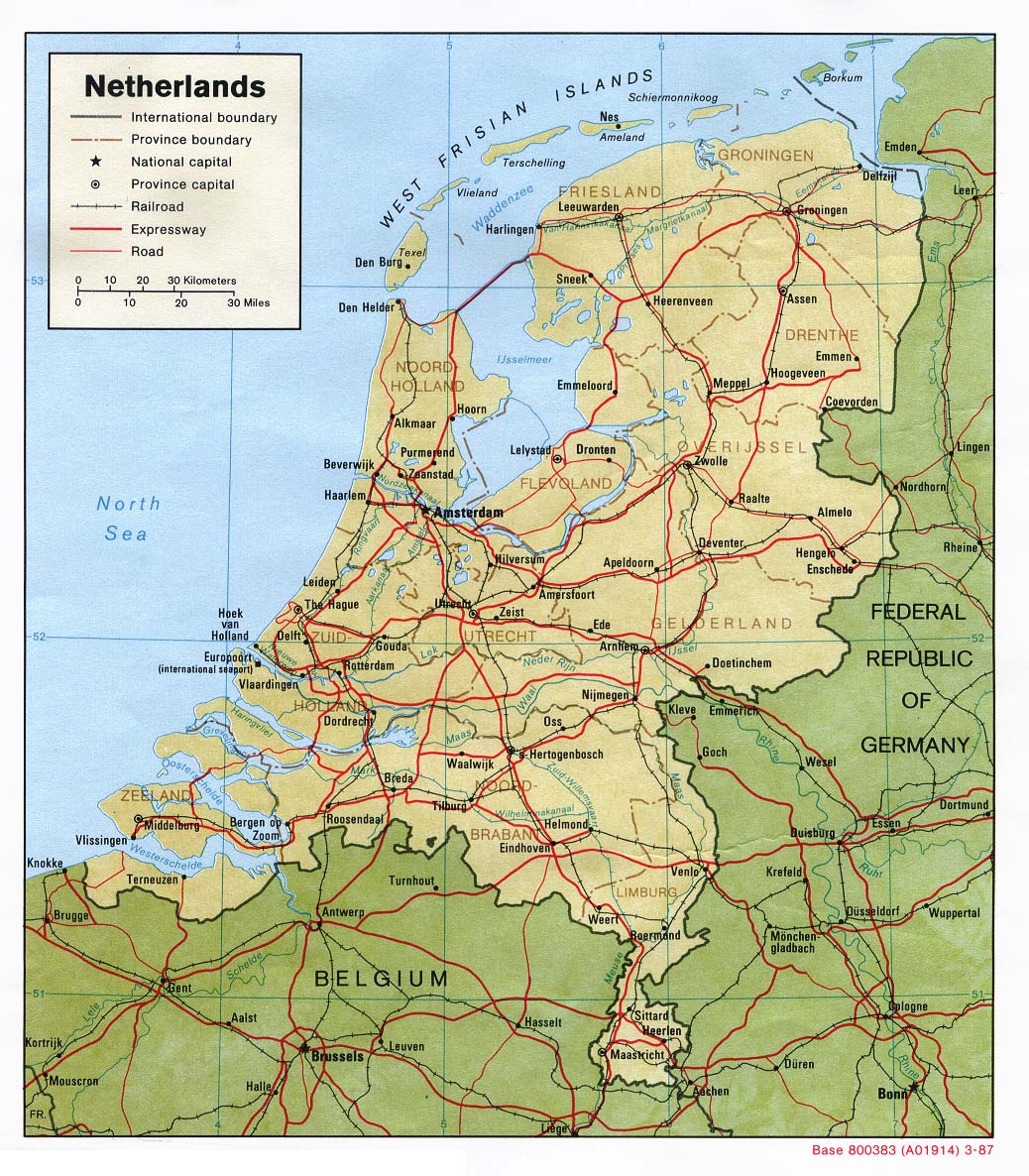
This map is a bit more readable.
-
Re:Why can't you just drink....
My wife actually knows someone that drinks 'magnetic water' to remove various unnamed 'toxins' from her body. Weird.
Well, water does have magnetic properties... IIRC, it's a combination of H+ and OH- ions. Of course, since they come in pairs, the effect is neutralized, but at some level the water *is* "magnetic".
It could be worse. Her friend could have lived in the days of Crazy Water. In Mineral Wells, Texas, the local water had a more direct "cleansing" effect. The water's strength was directly measurable by the distance the "patient" could walk up the boardwalk to the nearby hilltop before making a mad dash back to the Crazy Water Hotel's facilities. -
why Japan and not here
You know, it's a little absurd that a country as small in size of Japan would continue to advance high-speed rail transportation to such extreme levels. It's not even a particularly well-suited geography. The rails for such trains must run without tight turns or changes in elevation while the country is extremely mountainous.
Here in Texas, about 10 years ago there was a proposal in the government to implement a high speed rail system that would connect Houston, Dallas, and San Antonio. Southwest Airlines forcefully lobbied against it and it was succesful at defeating the initiative. We would have been an ideal setting for such a forward-thinking transportation system. Had the rail system been better developed before 9-11, we wouldn't be in such a bind for travel that we're in now. Not to mention how it would help lower our consumption / dependence on foreign oil. -
Re:Ouch...
Please take a look at a Maglev. Notice how it wraps around the track? It is extremely unlikely for one of these suckers to derail, and physically impossible for these things to crash into each other.
I for one welcome our Maglev overlords. At 581kph it should limit my 43 minute train time to school to roughly 8 minutes. Cross country? At most 30. -
reliability and redundancy"Popular opinion once held that the ARPANET was built in direct response to nuclear threat. This is not true. It's design was built around reliability and redundancy so as to allow communication to continue between major nodes in the case of an attack, but was not originally designed under the threat of nuclear war."
Ref: UTexas
Q.
-
Re:Formal proofs?
Actually, Applicative Lisp is used for doing a lot of reasoning. It is sufficiently expressive to model hardware systems. The JVM has been modelled this way and the model can be used to prove properties about basic Java programs. See the ACL2 Homepage for details.
The real barrier to proving anything about programs written in conventional languages is side effects. Imperative programming is just a bad way to go. Even these "basic" properties of Java programs are proven in terms of the underlying Lisp code that implements the interpreter. -
MoveableType Spam vulnerability: mt-send-entry.cgiFunny, just after reading this thread, I happened upon a post to Jaque Distler's blog about a MoveableType vulnerability. Here is an excerpt:
"As if comment spam were not bad enough, MovableType includes, in its default installation, a CGI script called mt-send-entry.cgi which -- you guessed it! -- can be used to send email anonymously to anyone in the world.
And, no, this is not a merely theoretical issue; it's being actively exploited by spammers." There are more details, including a patch, in the blog posting.
-
MoveableType Spam vulnerability: mt-send-entry.cgiFunny, just after reading this thread, I happened upon a post to Jaque Distler's blog about a MoveableType vulnerability. Here is an excerpt:
"As if comment spam were not bad enough, MovableType includes, in its default installation, a CGI script called mt-send-entry.cgi which -- you guessed it! -- can be used to send email anonymously to anyone in the world.
And, no, this is not a merely theoretical issue; it's being actively exploited by spammers." There are more details, including a patch, in the blog posting.
-
Some .torrents!
Because I love you guys. Unfortunately, I only got two of them:
here -
The Humble ProgrammerOne of my favorite Dijkstra papers:
-
DjikstraI found this paper (note?) by Djikstra quite interesting: The Programming Task Considered as an Intellectual Challenge
It talks about software quality and testing -- which seem very applicable, if not entirely in sync with, recent ideas about agile programming, test-driven-development, etc.
-
Collected Works
I believe that there is value in reading the originals. The best way to do this is to checkout or buy various collected works such as Alan Turing's collected works. One great collected works is a book called From Frege to Godel.
In truth, it is a math book, but this is the part of math that gave birth to modern computer science. It was a branch of mathematics known as "metamathematics" or "proof theory", and it dealt with things such as completeness, consistency, and effective procedures. This programme of math failed to achieve its originals goals as people like Turing and Godel proved the goals were impossible.
However, metamathematics succeeded in that it gave rise to modern computer science. "From Frege to Godel" is such a great book because it is a collection of the original papers of the great mathematicians who lived the field of metamathematics. You will learn the problems and solutions as the great mathematicians figure them out through scholarly discourse.
You will gain real insight into what math is, how it is practiced, and the true genesis of computer science.
Not only that, but you will also read a few things that will send your mind into a state of mathematician's nirvana. Something everyone should experience at least once in their life
Follow up "Frege to Godel" with a book called The Undecidable, which contains the selected original works of Church, Turing, and others.
After that, I would look into algorithms papers by people like Dijkstra,
whose works are available on the net.
The utility of this is to see how new problems are dealt with and how new ideas are made. -
Cooley and TukeyIt is my opinion that Cooley and Tukey's paper on the Fast Fourier Transform is one of the greatest most influential CS papers written in the past century.
The (re)discovery of the FFT was a major achievement in itself, and was the algorithm that popularized divide-and-conquer strategies for solving computational problems.
See also; How the FFT gained acceptance for more information about this groundbreaking work.
-
E.W. Dijkstra Archives
This has been reported in Slashdot a while ago, but it deserves another mention: the manuscripts of Edsger W. Dijkstra. There are more than a thousand documents written by Dijkstra in this archive, and very interesting ones too -- careful or you'll lose days browsing it like I did.
-
Re:meaningless sophistry
Actually - we DO have a way of figuring out how many impacts of significant size. Several techniques at least.
First - there is the 'ash layer' found at the K-T boundary. The clay at this layer has concentrations of heavy metals that cannot be accounted for by geological distrubution. I believe there is WAY to much Osmium in that layer - the theory being that the impactor had a large amount of this metal in it. I don't know if there are OTHER such layers in the geological record or not - but if there are, then you can date impactors of a sufficiently large size.
Secondly - if the asteriod in question has a high concentration of iron, or other ferro-magnetic metals, then it will show up as a distortion in the earth's magnetic field. This occurs because the asteriod mass gets 'embedded' in the earth's surface. You are correct that the surface features can (and are) scrubbed away by geological forces - but the mass tends to live on 'under the skin' for billions of years. I would guess (but only guess), that eventually the impactor mass is recycled just like the rest of the earth's surface - but it endures for billions of years.
Thirdly, even if the mass is NOT ferro-magnetic, it's mass causes GRAVITATIONAL anomolies. Very slight, but they CAN (and have!) been mapped from orbit (see the upcoming NASA GRACE project). Again, this is because the impactor tends to 'stay put' for billenia. This is how the Chicxulub impact crater - the one thought to be THE 'dinosaur killer' - was imaged.
Now - you're right. All this tells us is HOW MANY impactors OF A CERTAIN SIZE RANGE there have been within the last couple of billion years.
It can't tell you if an asteriod will smack us tomorrow or not. I don't agree that it has NO bearing - it can allow us to give statisitical probabilities - but you're right if you're thinking that even if there is a 1 in a trillion chance of it happening tomorrow, it still CAN. -
Re:meaningless sophistry
Actually - we DO have a way of figuring out how many impacts of significant size. Several techniques at least.
First - there is the 'ash layer' found at the K-T boundary. The clay at this layer has concentrations of heavy metals that cannot be accounted for by geological distrubution. I believe there is WAY to much Osmium in that layer - the theory being that the impactor had a large amount of this metal in it. I don't know if there are OTHER such layers in the geological record or not - but if there are, then you can date impactors of a sufficiently large size.
Secondly - if the asteriod in question has a high concentration of iron, or other ferro-magnetic metals, then it will show up as a distortion in the earth's magnetic field. This occurs because the asteriod mass gets 'embedded' in the earth's surface. You are correct that the surface features can (and are) scrubbed away by geological forces - but the mass tends to live on 'under the skin' for billions of years. I would guess (but only guess), that eventually the impactor mass is recycled just like the rest of the earth's surface - but it endures for billions of years.
Thirdly, even if the mass is NOT ferro-magnetic, it's mass causes GRAVITATIONAL anomolies. Very slight, but they CAN (and have!) been mapped from orbit (see the upcoming NASA GRACE project). Again, this is because the impactor tends to 'stay put' for billenia. This is how the Chicxulub impact crater - the one thought to be THE 'dinosaur killer' - was imaged.
Now - you're right. All this tells us is HOW MANY impactors OF A CERTAIN SIZE RANGE there have been within the last couple of billion years.
It can't tell you if an asteriod will smack us tomorrow or not. I don't agree that it has NO bearing - it can allow us to give statisitical probabilities - but you're right if you're thinking that even if there is a 1 in a trillion chance of it happening tomorrow, it still CAN. -
Re:un-run is right
No world wars in 50+ years
No world wars? Do you recall the Cold War? Or more recently, the (insert brassy fanfare) "War on Terror"?!? Just because it wasn't an all-out, killeverythingthatmoves kind of war doesn't mean that hostilities didn't occur, or that it didn't involve the "world".
Has negotiated and enforced many peace treaties throughout that time.
And it has failed to negotiate and enforce just as many. Look up a country called Rhodesia and the history of the land it inhabited. No UN intervention there, and we're still seeing the fallout in central Africa. Or better yet, look at the strength of UN resolutions at work in Israel. There have been UN sanctions for decades against Israel, and it hasn't stopped the crimes one bit.
Economic and other sanctions have had positive effects on some countries.
Such sanctions have allowed dictators to divert funds from aid programs to build military infrastructure, enabled "ethnic cleansing" such as that in former Yugoslavia, and created situations leading to attacks on the US and other member nations.
WHO has done some fantastic work in the 3rd world.
Work which includes proposing some of the most restrictive "health" laws ever seen.
Is the world's first supra-national organization and, more remarkably, has had its power seriously challenged only a few times.
First?!? Even the UN admits that the League of Nations existed. And as for serious challenges to UN authority, you can look at the record of the last 50 years to see the endless challenges and flaunts of that authority. The UN has been ignored from Korea to Iraq.
Has, respectively, saved the countries of Korea, Kuwait,and many others i'm forgetting by using multinational forces to defeat a common agressor enemy.
The UN saved Korea? The Korean War didn't end. It is still in a negotiated ceasefire, and is still a divided country. As for Kuwait, the country it was ceased to exist when they were invaded. To say that the UN saved these countries is to ignore the facts. It would be more proper to say that the UN helped to alleviate some of the destruction caused by internal or external aggressors, and in some cases aided the victimized society to rid itself of the invading force.
I'm not trying to say that the UN is a failure. However, the current political and economic climate make the organization more of a pawn to a few powerful nations than a true supranational entity charged with protecting the peace and enforcing international law. While it has contributed somewhat to international stability, it can be seen to offer selective stability, chiefly for Western nations that expect UN backing for their own whims.
</offtopic rant> -
Re:Texas City, Texas
look it up-- the first time anyone figured out "hey, ANFO blows up!" a transport SHIP full of ammonium nitrate bags had become contaminated by fuel oil.
I did look it up, and here are some of the basics:
* The initial explosion, on April 16, 1947, involved a French-owned ship full of ammonium nitrate explosive left over from the war. It was to be recycled into fertilizer. They knew it was explosive, but there were none of our modern regulations on handling it.
* The ship caught fire early in the morning, but the cargo didn't explode until 9:12am. It took with it most of Texas City's firefighters and firefighting equipment, destroying the the entire dock area as well as 1000 homes and businesses.
* Also at the dock was *another* ship full of ammonium nitrate. Inevitably, it caught fire as well. When it exploded 16 hours later, there were no firemen left to combat the blaze.
* At least 600 died, with fewer than 400 identified. Many of the dockworkers were undocumented, untraceable migrant workers.
Sources:
The Handbook of Texas Online has the facts & figures.
The Houston Chronicle's special report on the 50th anniversary, with pictures and personal stories.
MapQuest map to help you find your bearings. -
TCP/IP
From a University of Texas CS instructor's web site:
The Transmission Control Protocol was first formally specified in December of 1974 by Vint Cerf, Yogen Dalal and Carl Sunshine.
The link can be found here:
http://www.cs.utexas.edu/users/chris/think/Early_
D ays_Of_TCP/index.shtmlAnd supporting documentation will be found here:
http://www.cs.utexas.edu/users/chris/think/Early_
D ays_Of_TCP/Annotated_Bibliography/index.shtml -
TCP/IP
From a University of Texas CS instructor's web site:
The Transmission Control Protocol was first formally specified in December of 1974 by Vint Cerf, Yogen Dalal and Carl Sunshine.
The link can be found here:
http://www.cs.utexas.edu/users/chris/think/Early_
D ays_Of_TCP/index.shtmlAnd supporting documentation will be found here:
http://www.cs.utexas.edu/users/chris/think/Early_
D ays_Of_TCP/Annotated_Bibliography/index.shtml -
Re:Composition doesn't determine taste
Most of this is correct, except that cellulose is actually a polymer made up of glucose. More specifically, cellulose is beta(1,4)-linked glucose. This online lecture has a picture of cellulose both as a linear chain and as how linear chains can form a more complex sheets (not pictured: the sheets can then stack). We can't use cellulose because we don't have cellulase, a series of enzymes that can hydrolyze the chain. It's been a while, but I think it pops off glucose pairs, not monomers but I could be mistaken.
-
Re:pardon list?
Pardons can be granted to people before they are convicted of crimes. For example, Gerald Ford pardoned Richard Nixon.