Slashdot Mirror
Domain: webopedia.com
Stories and comments across the archive that link to webopedia.com.
Comments · 311
-
SRAM? Cheap?A mother board with an ATA chipset that could plug in older dirt cheap SRAM or even newer DDR or better. Imagine a 4 gig cache of SRAM attached to your harddrives. A machine left on for a while would start to smoke.
SRam defined
Short for static random access memory, and pronounced ess-ram. SRAM is a type of memory that is faster and more reliable than the more common DRAM (dynamic RAM). The term static is derived from the fact that it doesn't need to be refreshed like dynamic RAM.
SDRam defined
Short for Synchronous DRAM, a type of DRAM that can run at much higher clock speeds than conventional memory. SDRAM actually synchronizes itself with the CPU's bus and is capable of running at 133 MHz, about three times faster than conventional FPM RAM, and about twice as fast EDO DRAM and BEDO DRAM. SDRAM is replacing EDO DRAM in many newer computers.
SRAM is *VERY* costly and is typicaly only used for cache. -
SRAM? Cheap?A mother board with an ATA chipset that could plug in older dirt cheap SRAM or even newer DDR or better. Imagine a 4 gig cache of SRAM attached to your harddrives. A machine left on for a while would start to smoke.
SRam defined
Short for static random access memory, and pronounced ess-ram. SRAM is a type of memory that is faster and more reliable than the more common DRAM (dynamic RAM). The term static is derived from the fact that it doesn't need to be refreshed like dynamic RAM.
SDRam defined
Short for Synchronous DRAM, a type of DRAM that can run at much higher clock speeds than conventional memory. SDRAM actually synchronizes itself with the CPU's bus and is capable of running at 133 MHz, about three times faster than conventional FPM RAM, and about twice as fast EDO DRAM and BEDO DRAM. SDRAM is replacing EDO DRAM in many newer computers.
SRAM is *VERY* costly and is typicaly only used for cache. -
Re:do this for free
In Canada, at least, you cannot see or set ANI digits unless you are an intra-LATA carrier. It's a safe assumption that the same holds true in the USA.
The poster a little farther above is also correct that call centers heavily depend on being able to set CLID digits. By law you have to set the client's contact number on the outdial, which makes this feature critical if you're calling on behalf of a number of different clients on the same trunks. Tantacomm sells a device that does just the trick. All you need is a properly provisioned PRI.
I would think the same should be possible with the right combination of hardware, software, and a plain old ISDN BRI. Sounds like a fun open source project to me.
Matt... -
Rapid Application Development
RAD = Rapid Application Development
-
Not for Mouse & Screen
Many comments so far seem to grouse about the limitations of the 3-D interface vice the 2-D interface. Instead think about such an OS with head mounted display and gesture recognition technology. Now you're talking about an immersive computer experience and croquet would seem to be a good step in that direction.
-
Re:Too much FUD.
Are you confusing the EULA with the Subscription Agreement? For clarity's sake, I would prefer to define the EULA as the one included in off-the-shelf boxed software products, and the SA as the one Valve uses for all Steam related issues. If you read both, they are not exactly the same.
Your second point is preferred by just about everyone. However, if you read the SA's section 4B, you can see where a potention loophole whereby a change in fees and billing methods can result in the credit card holding footing new charges.
There are differences between this SA and the one your ISP uses. For one, ISPs in most places around the world are regulated (ie: regulatory body, lawyer warfare, class action lawsuits, regulatory fines, etc) and Valve is not, at least not to that extent (instead, it's a slew of software patents, decency laws, and other less stringent rules). In some places, an ISP connection can be considered an "essential service" which entails a lot more legal weight than something which is not. Steam games are not an essential service and would be much more difficult to file against Valve/Steam should you find yourself in one the nightmarish examples I posted.
Credit card companies are not likely to take action except when they feel their reputation is being trashed or a large mass of angry card holders complain. However, with the wording in the SA, it is unlikely card holders will get relief (although the card company will no doubt chuckle over the number of people who don't read "agreements" carefully and then issue a news bulletin to their own card holders encouraging them to be more careful).
I agree with your fourth point and I think Valve does as well. You may see a slow, phased adoption should they go subscriber based. Perhaps similar to cellular phone plans and phase in users with incentives, free months, and credits. I know some gamers loath to read such a suggestion, but Steam is already using incentives via their Bronze/Silver/Gold tiering system.
The fifth point is exactly what many gamers will take, but it's not available on shelves until the Valve/Vivendi disputes are settled. New ATI vidcard owners can get the Bronze package or upgrade that to silver by leaving their credit card to Valve's mercy. But not all gamers will wait. Some may opt to use disposable credit card numbers or gift cards from the major credit card companies.
Exploring the possible issues with the SA isn't blowing this out of proportion. And this issue wasn't in the original EULA that came with your Half Life box. The SA and EULA are butt covers for the companies using them and sometimes step beyond what they were initially intended to do. In this case, it may sap consumer confidence among credit card holders.
-
All i have to say is....
I love my Iomega Rev! [insert clicking sound here
-
Re:Random thought here...See my profile.
As stated, not an EE.
The closest to EE work I've done is sandwiching an optoisolator into a (one-way) serial line between two devices (because the computer was running off wall current, and the device off a car battery, and it *really* didn't like being directly connected). I had no idea what I was doing, but I did eventually get it to work.
I'm not saying that the proposed device wouldn't work. I'm just saying it probably isn't as efficient or scale as well as other methods.
Ah, and that's all I was saying. That's all I can say, really! Questions on efficiency, reliability, etc. - that's what we hire EEs for.
I did read your whole post, and actually understood this one, I think.
It has been a very interesting discussion. That's one thing I love about the Internet - it brings you into people, and more importantly, ideas, that you would normally never come across.
-
Adobe's take on the issue
Adobe has put up a page regarding the new format on their site. But for those who couldn't be bothered to read the original article and are posting questions like, "Why bother..."
There are currently two image formats in wide use for high-end cameras. RAW is the format of choice for people who demand high-quality shots with no compression artifacts. Unfortunately, different camera manufacturers have implemented their RAW encoding differently, which means that two cameras that can save to RAW don't necessarily use the same format. As a result, professionals often have to convert between their vendor's RAW format, and that used by their software.
The other format is good old JPEG, but as you probably know, JPEG is a lossy compression algorithim, making it unsuitable for those who demand a certain level of quality in the shots as captured.
The new format is designed to provide the same advantages of RAW, without the cross-vendor incompatibilities. Adobe is calling it "a publicly documented and readily available specification," although I didn't see any kind of license data around the download of the spec (which is on the Adobe page listed above). -
Re:Great work on the story, "editors"
Yes
-
MPC, Take Two?
In other words, they're trying to bring the "MPC" standards from the early 90's back?
http://www.webopedia.com/TERM/M/MPC.html
-
Nice Pun
Oh Slashdot. That is terrible. Using the word 'dithering' in a headline about television standards technology. Shame on you. Punnery is the lowest humor.
-
Plasma monitors
Why don't they make plasma computer monitors?
They used to make them for laptops in the 90s, and as monochrome desktop displays for early graphics stuff. They were known as gas plasma displays. In laptop land they were quickly superceded by LCDs, which had improved battery life. In desktop land they were replaced by colour CRTs which were cheaper and refreshed faster. -
Forget proportional spacing. Kerning is the proof.
A lot has been made of the fact that the text is proportionally spaced. Some have pointed out that a few typewriters has this ability.
Fine.
But what about kerning?
"In typography, kerning refers to adjusting the space between characters, especially by placing two characters closer together than normal. Kerning makes certain combinations of letters, such as WA, MW, TA, and VA, look better. "
There is kerning in the memo with SUBJECT: CYA. It happens between the 'f' and 'e' characters of "interference" and "feedback".
The trouble is that kerning requires remembering the previous character.
As advanced as typewriters might have been in 1973, I doubt any had memory.
-
correction
Webopedia sorry about that.
-
Re:What exactly is a blade?Here you go.
Essentially, it's a computer, but usually shares some common PC aspects with other "blades" (i.e. the power supply, disk storage).
-
Re:Flaw fixed?
For a small or home network with trusted users, sharing the key works just fine. For larger networks, you would still want to secure the wireless access itself and also use IPSec to secure users from each other. This is as true for a wired network with a large user population as it is for a wired network (remember packet sniffers and switch hacks?) IPSec is standard with IPv6 and can also work with IPv4 (the "regular" internet).
-
Re:Forget the Windows/Tux key! Cater to everyone!
Apple makes these things, called personal computers called Macintosh computers. Up until the G4 version of the Macintosh (or "Mac"), Apple used the Apple Desktop Bus for keyboard connections.
So yes, opposed to a USB keyboard.
An "Apple keyboard" is a keyboard manfacutured by Apple Computer Inc. Keyboards made for the Macintosh, therefore, would be called "Macintosh keyboards," or simply, "Mac keyboards."
Much like the usage of calling keyboards for (traditionally) Windows-based IBM PC clones "PC keyboards," "Windows Keyboards," or "keyboards that don't have a place for your one-button mouse to plug in."
As for one that you like, there are many to choose from.
Keyboard preferences are subjective. As much as you want me to, I cannot tell you what you like. -
Re:Forget the Windows/Tux key! Cater to everyone!
Apple makes these things, called personal computers called Macintosh computers. Up until the G4 version of the Macintosh (or "Mac"), Apple used the Apple Desktop Bus for keyboard connections.
So yes, opposed to a USB keyboard.
An "Apple keyboard" is a keyboard manfacutured by Apple Computer Inc. Keyboards made for the Macintosh, therefore, would be called "Macintosh keyboards," or simply, "Mac keyboards."
Much like the usage of calling keyboards for (traditionally) Windows-based IBM PC clones "PC keyboards," "Windows Keyboards," or "keyboards that don't have a place for your one-button mouse to plug in."
As for one that you like, there are many to choose from.
Keyboard preferences are subjective. As much as you want me to, I cannot tell you what you like. -
Re:Graham blew it in his GH essay
OK, I just read that essay "Succinctness is Power." I think his starting hypothesis is totally bogus. He claims that the reason we use high level languages instead of assembly is to make programs shorter. That's a huge generalization. Yes, assembly is usually going to be longer but that's not it's main problem. Just taking the second link from a Google search suggests that the main advantage of high-level languages over low-level languages is that they are easier to read, write, and maintain. High level languages also often have the advantage of being platform independent and abstracting the details of hardware operations.
I would also like to point out that "power" is not that meaningful. The thing we should be talking about is efficiency. I think you have to take into account the amount of mental effort you have to put into the language to get out the power. Not just the first time you look at the code but every time.
To give an extreme example from my own practice - I usually don't even use "i++" to increment a variable. I find that understanding these statements takes me a few extra seconds (over "i=i+1") to convince myself of what's going on. Maybe "i++" has more power since it takes two less characters and can be combined with other actions such as "j=i++", but the efficiency is much lower for me because I have to spend extra time every time I look at that piece of code. -
Re:In related news
This is true. If the earth's magnetic field is strong enough to move a compass needle, don't you think it is strong enough to move electrons? In fact, I have had several monitors that warned me that moving the monitor while it is on will affect the geometry. So of course I tested it with varying degrees of success.
Links:
Northern vs. Southern Hemisphere Monitors
Google Search: CRT southern hemisphere -
smells a little funny...
There are a couple of factual errors in this story that makes me feel uneasy.
From the spectrum article:
While film used in cinema contains pigments that can create an infinitely large number of color variations, TV sets combine discrete amounts of red, green, and blue light to create a much more limited color range.
This isn't true: color slide film uses three layers, just like monitors do: http://www.imx.nl/photosite/technical/E100G/E100G. html
He says that in printing it's common to have inkjet devices that use six, seven, or even eight primaries.
There are good reasons printing uses so many primaries, but it's usually to make an evener tone. My consumer-grade printer has the traditional CMYK (cyan magenta yellow blacK), but it also has two additional colors: light-cyan and light-magenta. They chose these lighter colors so make the blending smoother and the ink spots less noticible; it wasn't to increase the gamut. Printers also use spot-color to make particular colors (such as a company logo) print without needing to use a halftone. These are all just gimicks to get around the fact that printing isn't continuous tone -- in projectors that are continuous tone, these tricks aren't needed.
Basically, it comes down to eyeballs... if you emulate the response curves that your eye is sensitive to, then you can't perceptually do any better.
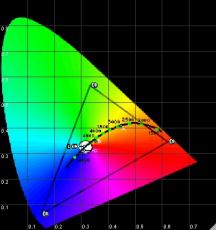
The traditional RGB's and CMY's don't match these curves, so they define a gamut that can be improved on. For example, take this projector's gamut -- its green is far away from the eye's green, so it can't display the cyans well. But, the color model my company is using for its video product uses a much truer green so we can cover much more of the gamut.
disclaimer: IANACE (color expert), but my most recent project has been color calibration to precise standards. -
Silly rabbit, Solaris is for Servers!Does this mean you'll soon be able to ditch OS X and stick on [sic] Solaris 10 onto Macs?
Ugh, why would you want to?
Now, Solaris on an XServe... That makes sense... Server class hardware that doesn't suck, yet doesn't cost an arm and a leg, running perhaps the best multiprocessor Unix ever... Mmmmm.
The ironic thing in my view is that this is sort of what CHiRP was supposed to be - a happy universe where you could buy an RS6000 and run MacOS on it, or a Mac and run Solaris on it, or whatever. But then His Steveness decided that the clones had to go...
-
Why so serious and hostile?
OK, four people used Gopher (give or take an order of magnitude or three). How many people use WWW?
Can you say inertia? I knew you could.
I guess you've never heard of a smily or netiquette.
You might also find that studying Internet history as well as growing up can diminish your cluelessness. -
Re:Maybe More instead of Moore
I hate to quibble but Moore's Law is cited incorrectly more often than not...
It actually refers to transistor density, NOT cpu Hz or any such metric of system speed.
And amazingly, it's still held true give or take a bit. But it's quite possible (in fact, likely) that CPU speed will top out even as Moore's Law continues to hold. -
Stuck harddisk heads
For nostalgic reasons, I wanted to suck all the data off the harddisk in an old 286 system which hadn't booted for about five or six years. System failed the POST with a harddisk error, so I took it in to my brother's work for one of the techie guys there to look at it. He eventually decided to open the harddisk casing and jiggle the head actuator stepper motor a bit by hand (overcoming the stiction), reassembled and the system booted fine! Forget about clean room or anything, this was in a regular office atmosphere. Needless to say, I transferred the data ASAP and haven't ever tried running the system again since then.
-
Re:Dell is a big example
The phenomenon is real, though I haven't checked the rate cited. You can read about it here. Soft errors (a.k.a, "transient faults" or "single event upsets" if you're googling) are caused by external radiation that causes a voltage spike when intersecting a memory or chip logic element and cause random bit flips. Sun Microsystems ate a huge chunk of money replacing Ultra10s that had non-ecc cache chips some years back because the systems would randomly crash, with the frequency of errors being dependent on the elevation of the computing site. Most of the radiation that causes soft errors is cosmic in origin, so the distance between the computer and space is related to the error rate.
-
Re:My Guess
I hope you're aware you're wrong.
SCSI stands for small computer system interface
SAS (serial attach SCSI) will be serial though. -
Maybe do a little more research...?
'INVENTING INVENTED THE INTERNET! No one said Boo about Gore's remark. Then,
the RNC spin-points arrived:'
http://www.dailyhowler.com/dh120302.shtml
The Web is not the Internet,
http://www.webopedia.com/DidYouKnow/Internet/2002/ Web_vs_Internet.asp
'Al Gore and the Internet', By Robert Kahn and Vinton Cerf
http://www.spectacle.org/1100/gore.html
Here's text of some of Gore's legislation...
'High-Performance Computing Act of 1991 '
http://thomas.loc.gov/cgi-bin/bdquery/z?d102:s.002 72:
'Information Infrastructure and Technology Act of 1992'
http://thomas.loc.gov/cgi-bin/bdquery/z?d102:s.029 37:
For example, Gore's '91 Act funded Marc Andreesen's group... they developed the NCSA Mosaic browser.
http://www.ibiblio.org/pioneers/andreesen.html
http://www.totic.org/nscp/demodoc/demo.html -
Re:CRTs will be obsoleteWell, it used to be true at one time. Apparently the crt calibration controls can handle it now. CRT calibration used to be quite primative at one time and even require field techs to do. See here for current status.
For compasses, see
-
JINI + bluetooth + phone/pda ideal solution
Surely his is the perfect place for JINI technology to really shine.
All you need is a bluetooth or WiFi enabled Java/JINI phone/pda or some such gadget. As you walk into the room, your device gets updated with the appropriate GUI control software for all of your entertainment boxes and you just select the ones you want to use and interact with them via the user interface provided via JINI.
No more searching for the correct controller. The too many buttons syndrome could also be overcome because these apps will be able to use rich client interfaces to simplify the huge number of options and even provide help documentation!
I doubt it'll happen any time soon though. -
Re:Where's MS
Maybe they're trying to get publicity for it, and will apply it later down the line to more than just web browsers. Active X works for other things too like databases, which is really useful. If Linux and Mac OS had a similar standard, it could be applied in other programs on both platforms. That kind of functionality is missing on both platforms at the moment, I think. Apple, IBM, and Lotus tried to establish OpenDoc ages ago but it didn't catch.
Macromedia must also be getting into this because Microsoft sees Flash as a threat to their control of the interface and plans to push their own standard, "Sparkle". Flash seems to have accomplished what Java applets were supposed to do on the web, providing a cross-platform programming language that actually works without interference from Microsoft, and can be used for more than just animation. Macromedia Central was supposed to allow Flash to be used for making applications that can work independently of a web browser, seamlessly across different platforms, but I don't know why that hasn't caught on either.
-
The simplest way...
...is to turn on the firewall (excuse me, ICF.)
The average home user thinks NAT is a no-see-um.
The average user plugs the computer into the cable modem. Unless Sparky at Best Buy told them they needed a "Web Router" or a "Broadband Router" and they have the neighborhood geek kid come over and install it.
The average user doesn't know their IP address, gateway, or DNS server. They may have trouble figuring it out even when given instructions over the phone.
KISS!!!
-- Alive and kicking in a VM -
Re:Hardware
Or Redundant Array of Independent Disks (yours makes more sense) LINK
-
Re:Really? Try this one.
I'd like to see a C++ implementation of the Halting Problem that's faster than a Java implementation, please, thank you.
I hate to be pedantic*, but the halting problem is a problem, not an algorithm. If you hand me a correct algorithm for the halting problem, I'm sure it could be coded in C++ so it ran faster than in Java. Of course, that has nothing to do with the languages, I'm also sure 0 would be equal to 1.(That's not actually true. I like being pedantic. I don't like having to do it in public.)
-
Re:Worm vs VirusFrom at least one definition, a virus is:
A program or piece of code that is loaded onto your computer without your knowledge and runs against your wishes.
and
A worm is a special type of virus that can replicate itself and use memory, but cannot attach itself to other programs.
So this certainly qualifies as a virus and, since it logs keystrokes etc, may not even qualify as a worm.
Of course, in the end, who cares whether it's technically a worm or viruse. It's nothing to make a big fuss about, unless you're an annoying little git, are you? -
Away from computers?
I don't want to carry a laptop or a PDA (too expensive, plus I want to be away from computers at least those 2 weeks per year). Any suggestions for a light, cheap, keyboard-equipped device? Like a travel clock + keyboard and more memory and USB?
If you want to be away from computers, use pen and paper to take your notes, like all those guys wearing flannel shirts at your local Starbucks. If a device has USB, keyboard and memory, it's a computer according to the classic definition with embedded software - just as any PDA, but more limited. So... why not to use the PDA anyway? -
Re:Jammers ineffective when CDMA is used
-
Re:Would it really matter?
How on earth does that defeat the whole idea of checksuming? A "checksum" is defined as A simple error-detection scheme in which each transmitted message is accompanied by a numerical value based on the number of set bits in the message. The receiving station then applies the same formula to the message and checks to make sure the accompanying numerical value is the same. If not, the receiver can assume that the message has been garbled.. When a user wants to download a song, s/he generally wants the whole song, and not just a segment of it. Therefore, the whole value of the song is checksummed, not just the packet. (well the packet is too depending on the protocol, but this isn't what's in question.)
So simply, look at the problem again, and then post. -
Re:How many years has IRC been running?
How about a relevant Jughead?
-
Re:my favorite comment from the changelog
-
Re:Oh man
Baud: Pronounced bawd, the number of signaling elements that occur each second. The term is named after J.M.E. Baudot, the inventor of the Baudot telegraph code.
At slow speeds, only one bit of information (signaling element) is encoded in each electrical change. The baud, therefore, indicates the number of bits per second that are transmitted. For example, 300 baud means that 300 bits are transmitted each second (abbreviated 300 bps ). Assuming asynchronous communication, which requires 10 bits per character, this translates to 30 characters per second (cps). For slow rates (below 1,200 baud), you can divide the baud by 10 to see how many characters per second are sent.
At higher speeds, it is possible to encode more than one bit in each electrical change. 4,800 baud may allow 9,600 bits to be sent each second. At high data transfer speeds, therefore, data transmission rates are usually expressed in bits per second (bps) rather than baud. For example, a 9,600 bps modem may operate at only 2,400 baud. (Definition from webopedia) -
Re:It's too bad
For instance, the reason why the world wide web took off was because Microsoft created a HORRIFIC web browser, but since now all computers had a web broswer, everyone had access.
Say what? The web had lots of momentum as early as 95. At which time Microsoft was still in denial about the whole Internet thing. Which is why Windows 95 came with a lot of MSN software and libraries (then based on proprietary protocols) and no TCP/IP stack at all. That fact that MSN began as an "online service" (in the model of pre-Internet AOL and CompuServe) rather than as an ISP indicates how little interest Microsoft had in the Internet in general and the Web in particular.When Microsoft realized that they had backed the wrong horse, they had to come up with their own Internet strategy in a hurry, or be left behind. That is why early versions of IE were such hack jobs. And for some years, other browsers still did more to raise awareness of the Web. But once the Web was established, nobody bothered to install other browsers -- why bother, when Windows came with one? Between that and Netscape's declining interest in browser development...
As for MySQL: when the Web exploded, web developers needed data engines that didn't cost a lot and were easy to understand. The excluded all serious SQL servers. I'm not sure why nobody picked up on simple ISAM systems like Berkeley DB -- perhaps they all had licensing issues. Anyway, MySQL was something they could use for free, it was easy to understand, and it was powerful enough for most web applications. You can't do the complicated operations that separate a true RDBMS from a simple dataset library -- but most web developers didn't have the skill to use these operations anyway.
-
Re:Python's dirty little secretOkay, this is my last post in the thread. You are using the term memory leak in a manner different than I do. If we use your definition then Python, Scheme, Java, C#, Modula-3, Eiffel, Sather, Lisp, Dylan and hundreds of other languages do not leak memory. I don't know why you picked Scheme out of the list and remarked on it specially. I also don't know why you didn't look to see the definition of memory leak being used on the page I linked to: l = []; def leak(self, item): l.append(item)
If Scheme IS immune to this kind of leak then that is news to me. If it ISN'T immune to this kind of leak, then your post is off-topic. If you want to claim that this ISN'T a leak, then you could have said that in the original post rather than bringing Scheme up at all.
-
Will the RIAA Kill Music?Just when you thought things were settling down with the RIAA, the fools are at it again! The Motley Fool and other publications report that the RIAA thinks
I'm a huge fan of the iTunes music store.. So huge, in fact, that I'm actually PURCHASING music through this outstanding service and bought myself a 20 gig ipod. My inclination is hardly to convince the world to pay for their music vs. downloading them ilegally; rather it's because I happen to like paying only $10 for an album. I'm a bargain hunter.
It was bad enough that the RIAA shunned legal digital downloads long enough for the pirates to take over the industry. Add to that their decision to continually fight a customer-driven demand for a more flexible (and cheaper) medium of distribution.. Now just when something out there is working, they want to jack the price up to a level that will send all of those wouldbe legal customers back to the P2P world using anonymousnetworks.
The RIAA needs to wake up and recognize their issues here.. Their customers want a more flexible delivery mechanism, they want to pay less, and need the flexibility they currently have with a CD. Apple accomplished much of this with their product, which the RIAA will subsequently destroy with their greedy price increases.
Let's face it - in business customers drive the industry. When Americans stopped buying domestics, the industry responded with better products that met customer needs. When New Coke flopped, Coca Cola wisely switched back to the old formula.
The RIAA and its member companies had an opportunity in 1997 when illegal MP3's first surfaced to nip this problem. The early adopters were trading heavily on the IRC network, which led the rise of Napster and later Kazaa. These networks suceeded because it was just so darn tough for file traders to find the songs they were looking for. Had the RIAA member companies set up a site at any point between 1997 and 2000 (even without digital rights management), they could have easily circumvented the rise of these illegal networks. CD's themselves were insecure enough to create this massive proliferation in the first place!!
Fight them. Write to them and tell them what a stupid decision this is.
-
It is 1000baseT, not 1000baseTXA lot of (I'd go as far as saying 'all') the inexpensive copper gigabit stuff on the market that are labelled 1000baseTX are incorrect.
Maybe somebody is working on such a standard, which is said to be gigabit over 2 pair of copper wires. However, almost all the current stuff on the market are 1000baseT, which is Gigabit over 4 pairs of wires in a CAT5e cable.
-
Sounds good
But will it affect leading zeroes?
-
Re:New idea
Wolfpack is already dead, and it already has an OS. Sorry.
-
The INI file
For those that want to know, here is the definition.
There is a note about how they apply to NET here.
Remember when you were kids and you showed each other your "outie" or your "innie". It's pronounced like that. -
Re:What's so 'Java' about it?
What is that circular thing on the front of the case? It looks like the data port on the Death Star where R2D2 plugged in and snarfed the plans to the space station.