Slashdot Mirror
Domain: wikipedia.org
Stories and comments across the archive that link to wikipedia.org.
Stories · 7,048
-
Scale Models Can "Compute" Casimir Forces
KentuckyFC writes "Place two conducting parallel plates a few nanometres apart and the well-known but difficult-to-measure Casimir force will push them together. The force depends crucially on the shape of the plates but nobody is exactly sure how. That's because calculations with anything other than flat plates are fiendishly difficult and measurements are even harder. Now a group at MIT has come up with an ingenious new way to investigate Casimir forces. What the team has noticed is a mathematical analogy between the Casimir force acting on microscopic bodies in a vacuum and the electromagnetic behavior of macroscopic bodies floating in a conducting fluid. Their idea is to build a centimeter-scale metal model of the system they want to investigate, place it in salt water, and bombard it with microwaves and see what happens. The team says the experiment does not measure the force on the scale model but instead a quantity that is mathematically related to the force. So the experiment is not a simulator but actually an analog computer that calculates the force (abstract). What's exciting is that the method should for the first time give researchers a way of testing nano-machines designed to exploit the Casimir force." -
Timetable App Developer Gets Nastygram From Transit Sydney
mikesd81 writes "ZDNet Australia writes that NSW state corporation RailCorp has threatened a Sydney software developer with legal action if he fails to withdraw a train timetable application that is currently the second-most-popular application in its category in Apple's App Store. Alvin Singh created Transit Sydney after he began teaching himself how to program in Cocoa Mobile. Within days of its Feb 18 release, Singh received a cease and desist notice from Rail Corporation NSW, the government body that administers Sydney's CityRail network. The email states: 'I advise that copyright in all CityRail timetables is owned by RailCorp. ... Any use of these timetables in a manner which breaches copyright by a third party can only occur through the grant of a suitable licence by RailCorp.'" "As a government body, RailCorp information is protected by Crown copyright, a contentious provision in copyright law that has recently been used to block attempts to access information on the location of Victoria's bushfires and even seemingly innocuous information as the locations of public toilets. 'RailCorp's primary concern here is that our customers receive accurate, up-to-date timetable information,' RailCorp spokesperson Paul Rea explained. 'This includes details of service interruptions, special event services, track work and other changes. ... At this stage, it is not possible for RailCorp to grant third-party developers access to our internal passenger information systems. As such, any third-party CityRail timetable application would contain inaccuracies and have the potential to mislead our customers.'" -
Dan Bernstein Confirms Security Flaw In Djbdns
secmartin writes "Dan Bernstein has just admitted that a security issue has been found in the djbdns software, one of most popular alternatives for the BIND nameserver. As part of the djbdns security guarantee, $1000 will be paid to Matthew Dempsky, the researcher that found the bug. The bug allows a nameserver running djbdns to be poisoned using just a single packet. Other researchers have found a separate issue that allows dnscache, the DNS cache that is also part of the djbdns package, to be poisoned within just 18 minutes when using the default configuration. Anyone using djbdns is strongly encouraged to patch their servers immediately." Reader emad contributes a link to the djbdns mailing list post containing both a patch and a sample exploit, and adds: "In the words of Dan Kaminsky (of recent DNS security fame): 'However, Dempsky's bug in djb's tinydns is way more surprising, if only because ... holy crap, he pulled an exploitable scenario out of THAT?!'" -
Gravitational Waves May Have Been Detected In 1987
KentuckyFC writes "In 1987, a physicist called Joe Weber claimed to have detected gravitational waves at the same time that other scientists spotted a supernova called SN1987A. His claims were largely ignored because of calculations showing that gravitational waves could not be strong enough to be picked up by Weber's equipment, a set of giant aluminium cylinders designed to vibrate as the waves passed by. But these calculations were based on first order effects in the way spacetime can be distorted. Now a new analysis shows that second order effects can enhance gravitational waves by four orders of magnitude, but only when certain asymmetries are present. It turns out that SN1987A possesses just the right kind of asymmetries to make this enhancement possible because the supernova wasn't entirely spherical. Which means that Weber, who died in 2000, may have been the first to see gravitational waves after all." -
Meteorite Hunters Find the West Texas Fireball
An anonymous reader writes "A fireball streaked over Austin, Texas on February 15 producing sonic booms and startling people for hundreds of miles. The video of the event was shown on national television and viewed by thousands of people on the Net. The first news reports speculated that the fireball might have been debris from a February 13th collision between two satellites over Siberia but space experts said that the object was probably a meteor. Now this has been confirmed: experienced meteorite hunters located a strewnfield about 120 miles north of the filming site of the Austin cameraman and have recovered over 100 freshly fallen meteorites." -
Null References, the Billion Dollar Mistake
jonr writes "'I call it my billion-dollar mistake. It was the invention of the null reference in 1965. At that time, I was designing the first comprehensive type system for references in an object oriented language (ALGOL W). My goal was to ensure that all use of references should be absolutely safe, with checking performed automatically by the compiler. But I couldn't resist the temptation to put in a null reference, simply because it was so easy to implement. This has led to innumerable errors, vulnerabilities, and system crashes, which have probably caused a billion dollars of pain and damage in the last forty years. In recent years, a number of program analysers like PREfix and PREfast in Microsoft have been used to check references, and give warnings if there is a risk they may be non-null. More recent programming languages like Spec# have introduced declarations for non-null references. This is the solution, which I rejected in 1965.' This is an abstract from Tony Hoare Presentation on QCon. I'm raised on C-style programming languages, and have always used null pointers/references, but I am having trouble of grokking null-reference free language. Is there a good reading out there that explains this?" -
George Riddick — the One-Man RIAA of Clip Art
An anonymous reader writes "Pages at ireport.com and extortionletterinfo.com have been documenting and researching the activities of George P. Riddick III, previously known for his lawsuits against IMSI and Xoom at the turn of the century. In 2007 he issued a largely-ignored press release claiming the majority of clip art online infringes a copyright and has ranted about how Microsoft and Google are stealing from him. In recent months, he's apparently made a business model of going after web site operators who were using clip art they believed to be legally licensed or public domain, telling them they're infringing clip art collections he hasn't offered commercially in years and making outrageous settlement demands. He seems to have tested the waters on this some years back, but emboldened by the passage of the PRO-IP act, he's gone aggro with it. A few dodgy anonyblogs had popped up to 'out' him as a copyright abuser, but these recent ireport.com and extortionletterinfo.com reports go much deeper in documenting and researching Riddick's recent one-man campaign to be the RIAA of clip art." -
Exoplanet Found In Old Hubble Image
Kristina at Science News writes "A new way to process images reveals an extrasolar planet that had been hiding in an 11-year-old Hubble picture. After ground-based telescopes found three planets orbiting the young star HR 8799, a team took that information and reprocessed some 11-year-old Hubble Space Telescope images. Voila. There was one of the three planets, captured by Hubble but not visible until new knowledge could see the picture in a fresh light. The technique could reveal hidden treasures in many archived telescope images." For reference, the first exoplanet to be (knowingly) directly imaged was 2M1207_b in late 2004. -
Industry Open-Sources Model For Infamous CDS
GlobalEcho writes "Credit default swaps (CDS) are infamous for bringing down AIG and requiring a bailout of hundreds of billions of dollars. Because the market for these was so murky, the US government has insisted that Wall Street create a clearinghouse for these contracts. In a fresh twist, part of the deal is that the models used to price CDS have been standardized, and that the pricing code was made open source, under a somewhat BSD-like license. The source code (originally written by JPMorgan) provides the basic pricing routines, plus an Excel interface. To my knowledge this is the first significant migration of an investment bank product platform from its usual super-secret proprietary home to the rest of the world." -
First Solar Eclipse Recorded From Moon
dazza101 writes "For the first time ever, we have witnessed a solar eclipse from the moon. On 10 February 2009 Japan's Kaguya lunar orbiter captured the sight of the Earth eclipsing the sun. The spacecraft also recorded this video showing the Earth surrounded by a glowing ring and briefly forming the classic diamond ring that often occurs during a solar eclipse, as seen from down here on Earth." -
Comet Lulin Closest To Earth Tonight
William Robinson writes "Comet Lulin, formally known as C/2007 N3, which is on a visit to the inner solar system, will make its closest approach to earth tonight, about 38 million miles away. To the naked eye, the comet looks like a fuzzy patch of hazy light in the southeastern sky near Saturn, at the tip of Leo the Lion's hind leg. After this brief visit, Lulin will be heading back out to its kin in the Oort Cloud." -
Cold-War Era Naval Vessels Up For Grabs
mcleland lets us in on a Wall Street Journal story about two cold-war era, formerly top-secret vessels the US Navy is trying to give away. At issue are the Sea Shadow (the ancestor of all modern naval radar-evading technology) and the Hughes Mining Barge (a floating dry-dock and more-or-less base for the Sea Shadow). While the ships are being 'given away,' there are multiple regulations involved, making the gift a very costly one. "A Naval Museum is 'a bloodthirsty, paper-work ridden, permit-infested, money-sucking hole,' warns the Historic Naval Ships Association. Because the Navy won't pay for anything — not rust-scraping or curating — to keep museums afloat, survival depends on big crowds." -
Cold-War Era Naval Vessels Up For Grabs
mcleland lets us in on a Wall Street Journal story about two cold-war era, formerly top-secret vessels the US Navy is trying to give away. At issue are the Sea Shadow (the ancestor of all modern naval radar-evading technology) and the Hughes Mining Barge (a floating dry-dock and more-or-less base for the Sea Shadow). While the ships are being 'given away,' there are multiple regulations involved, making the gift a very costly one. "A Naval Museum is 'a bloodthirsty, paper-work ridden, permit-infested, money-sucking hole,' warns the Historic Naval Ships Association. Because the Navy won't pay for anything — not rust-scraping or curating — to keep museums afloat, survival depends on big crowds." -
An Early Look at the NASA MMO
Big Download is running an article with details and screenshots from the MMO under development by NASA. The game makes use of Unreal Engine 3, and it's titled Astronaut: Moon, Mars and Beyond. A demo is planned for later this year, and in 2010 they expect "the first episodic installment of the game" to come out. Jerry Heneghan, founder and CEO of Virtual Heroes, described it thus: "This game is going to be a fresh look at the future circa about 2035. ... The core of the gameplay is going to be people building up their characters and as you move forward, you will have more options unlock with new places to go, new equipment to use and new things to do. We are not so much focused on interstellar flight and all that entails... the gameplay is actually about being in a habitat on a planetary surface and doing things like mining Helium-3 for fuel, operating a hydroponics facility to grow plants and create oxygen and operating robots and vehicles." -
Court Reinstates Proof-of-Age Requirement For Nude Ads
arbitraryaardvark writes "An Ohio swinger's magazine objects to keeping proof on file that its advertisers are over 18. I reported here in 2007 that the 6th circuit struck down U.S.C. Title 18, Section 2257 as a First Amendment violation. The full 6th circuit has now overturned that ruling. The case might continue to the Supreme Court. The Cleveland Plain Dealer reports." -
350,000 Linux (Virtual) Desktops Land In Brazil
xufem writes "Millions of Brazilian schoolchildren will soon be 'brought up right' running Linux on over 350,000 seats each using PC sharing hardware and software from Userful and KDE. This is world's largest virtual desktop deployment and probably also the world's largest Linux deployment, and seems to have been selected over OLPC by Brazil. Definitely a moment to celebrate — and just in time for Brazilian Carnival which starts tomorrow!" -
Mars Winds Clean Spirit's Solar Panels Again
Titoxd writes "In a blast from the past, NASA reports that Spirit's solar panels have received a much-needed cleaning courtesy of the Red Planet. The report states, 'The cleaning boosts Spirit's daily energy supply by about 30 watt-hours, to about 240 watt-hours from 210 watt-hours. The rover uses about 180 watt-hours per day for basic survival and communications, so this increase roughly doubles the amount of discretionary power for activities such as driving and using instruments.'" -
Review: F.E.A.R. 2: Project Origin
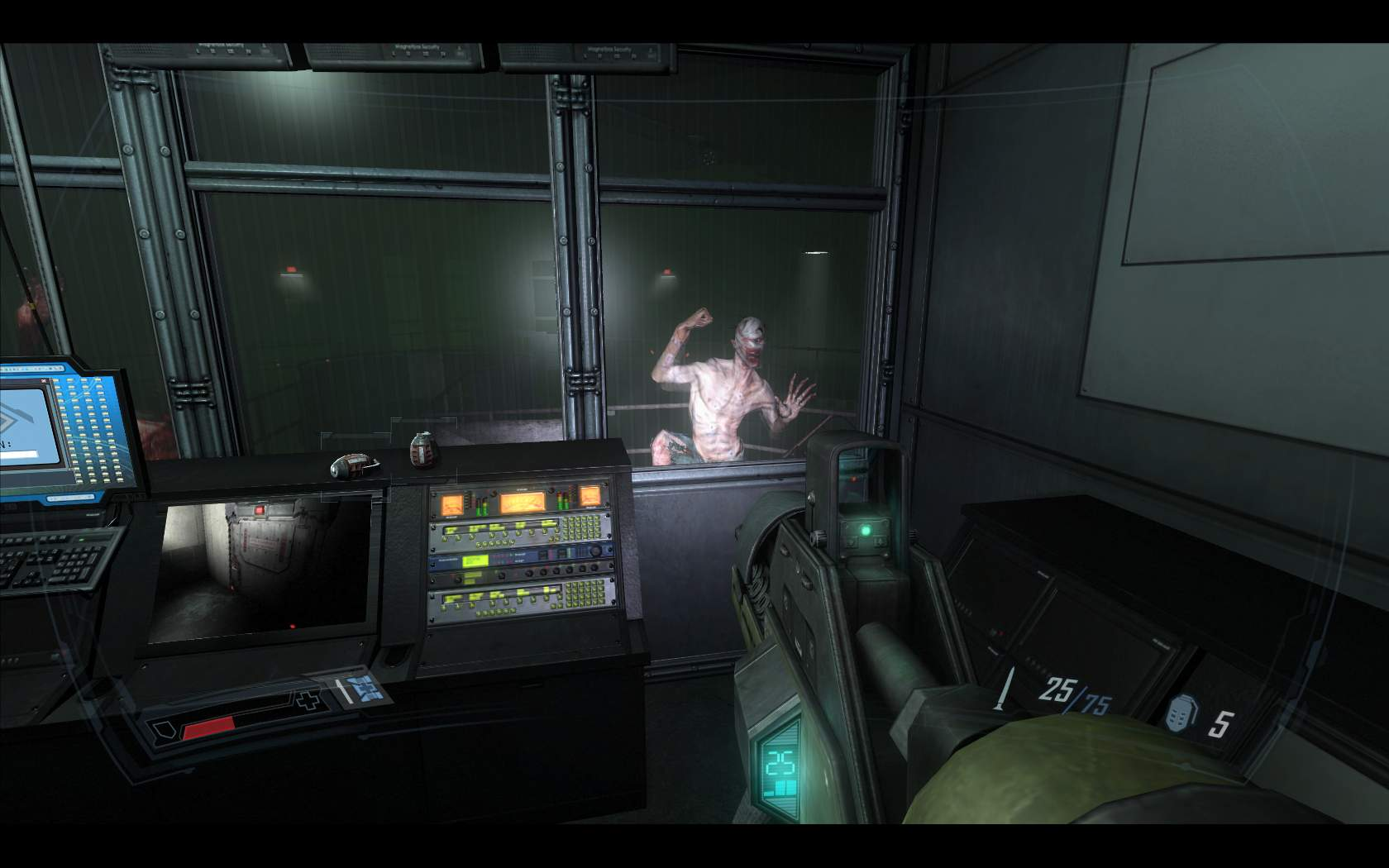
First-person shooters comprise one of the most well-developed video game genres in existence. The number of high-quality games and franchises practically demands that any new entry must have an interesting concept and a rock-solid engine. Otherwise, it will quickly get buried under an avalanche of award-winning titles. When the original F.E.A.R. came out in 2005, a well-crafted horror theme, the AI, and a few gameplay innovations allowed it to succeed despite direct competition from established franchises, such as Quake 4 and Call of Duty 2, among others. F.E.A.R. 2: Project Origin draws on the strengths of its predecessor and adds a few improvements. The question that now remains is whether or not the additions make up for the fact that the game's concept is no longer new and unique. Read on for the rest of my thoughts.- Title: F.E.A.R. 2: Project Origin
- Developer: Monolith Productions
- Publisher: Warner Bros. Interactive Entertainment
- System: Windows, PS3, Xbox 360
- Reviewer: Soulskill
- Score: 7/10
The game starts out with a bang; the first act is extremely well designed. You begin in much the same manner as the first game, given little information and left to wonder what, exactly, is going on. You start in a military transport headed to pick up the president of Armachan Technology Corporation — the typical big, evil corporation developing things they really shouldn't. You're introduced to your squad-mates and then quickly separated from them while being taught some of the gameplay basics. The first serious firefight in the game is located within a room filled with antiques, ceramics, and vases stored in huge glass display cases. It's a brilliant choice in setting — priceless decorations shatter and glass flies everywhere. It's almost theatrical; like being a part of a high-budget action flick. As you shoot your way through the increasingly porous living quarters, hallucinations are induced by Alma, the deranged, telepathic, and telekinetic girl from the first game. The act ends when you witness a nuclear explosion far closer than is healthy, and shortly thereafter struggle to remain conscious as the corporation's doctors do something to you.
It's worth saying again — the first level is incredibly cool. Unfortunately, subsequent levels aren't able to match it. I suppose that's to be expected; after all, it's a horror-themed shooter rather than an epic adventure shooter, but the first level does tend to set expectations. For the next few acts, F.E.A.R. 2 treads mostly on familiar ground. You spend a great deal of time escaping an underground hospital/science facility, and wander your way through broken streets with crumbling buildings. That's not to say it's bad, or even unenjoyable ; the settings are still polished and full of detail, and the plot is continually prodded along in an interesting manner. It's just been done before, and often. If you've played a wide variety of first-person shooters, these levels will probably bring a sense of deja vu . Things pick back up after a while, though. You'll navigate your way through a school that was the site of much violence and destruction, go down into the subway, and even further into a high-tech underground tram. The less you know about any given setting, the more easily it lends itself to creepiness, so the more unique environments in F.E.A.R. 2 keep you focused on the horror aspect much better than the stereotypical science labs.
The visual effects that contribute to the horror theme are integrated quite well into the gameplay. The transition from your normal perception to hallucination is often gradual and seamless. Other times, it's sharp and distinct, using the shock of the immediate change to add an ominous vibe. Sometimes your flashlight will start to flicker in a dark area, and you'll begin to hear your character's panicked breathing and rapid heart rate. I'm on the fence about that; it's used to great effect in a few situations, but since fear in the character isn't mirrored by fear in the player, it also tends to serve as an indicator that something surprising is going to happen — thus negating the surprise. Other horror standards come in to play too. Every so often, Alma will flash into existence somewhere near you, and then disappear. Almost too often... but they find ways of keeping it interesting. The music and sound effects are very well done, laying the foundation for tense scenes, the foreshadowing of a terrible discovery, or giving your fight-or-flight reflexes a little boost.
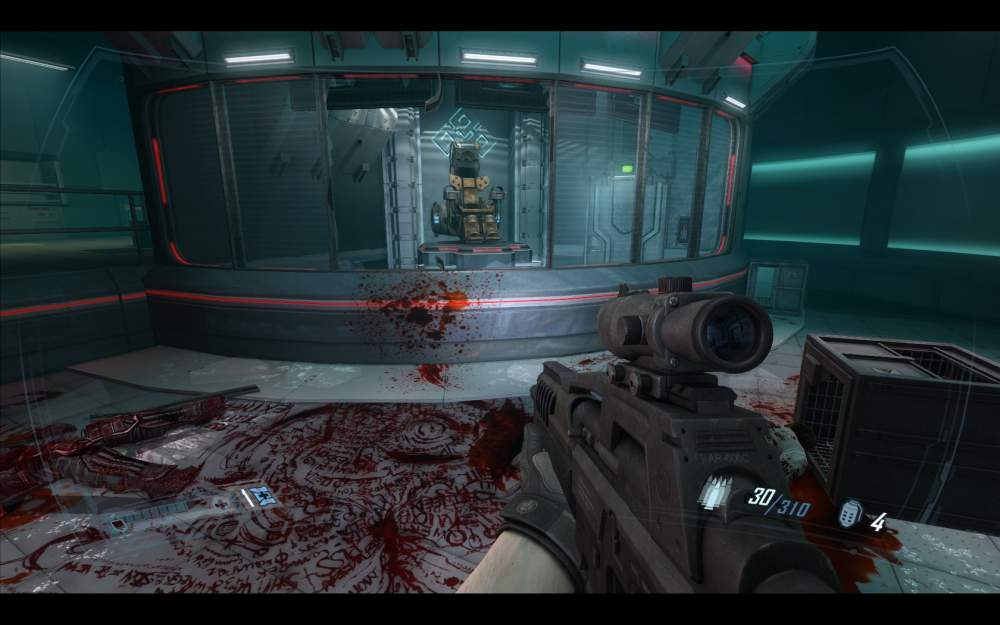
The art team doesn't hesitate to try and scare you with gore, either. The scene I mentioned earlier where you see portions of a medical procedure being performed on yourself is interspersed with hallucinations of zombie doctors tearing out your insides, with gouts of blood flying in every direction. At one point, you sneak up behind a couple of enemy soldiers trying to decipher a huge section of wall that is covered with random words, symbols, and obscenities — all painted with blood. It really does look like something drawn by a psychotic killer, such that I wondered if they contracted the design from a local loony bin. (And presumably, your character feels no cognitive dissonance from gunning down those soldiers, which itself is kind of surreal.) Bloodstains are used liberally, as are all manner of brutal killings. This is definitely not a game for kids or people who faint at the sight of blood. Even aside from the violence and gore, the other artwork is also well done. The attention to detail is refreshing; rooms and objects are correctly proportioned to a greater extent than most shooters. A malfunctioning X-ray machine with throw a series of disjointed X-ray photographs onto a nearby computer monitor. You'll even see T.P.S. reports scattered about an office desk. Everything looks like a real environment, not just an approximation pasted onto an abstract level design.
One of the signature gameplay elements of F.E.A.R. 2 is "reflex time," an ability carried over from the first game. Press a button and, for a short duration, time slows down, giving you a massive advantage over your opponents in a fight. The intention is to make the player feel like an action hero, able to dodge and aim with supernatural speed, and it works. It also makes most fights very easy; I'd recommend going through the game on Normal if it's your first FPS, and on Hard if you have any significant experience. The weapons are another area where F.E.A.R. 2 sets itself apart. There really aren't any bad weapons. They all have their strengths and weaknesses, but you won't spend much time wishing you had a different gun. Even the basic pistol and your melee attack are powerful enough to be interesting. There are definitely some weapons that are more fun, like the missile launcher, the napalm gun, and the laser, but in the end you just wind up switching weapons fairly often as ammo runs out, which does a lot to keep the fights from getting boring.
Another instrument they use to keep the fights interesting is the AI, which, as with the first game, is better than average. Enemies are constantly shifting position, finding new cover, and ducking out from behind an obstacle to shoot at you. It forces you to remain active; camping out behind a barrel will get you killed as enemies advance on you. That's not to say it's without flaws; sometimes a soldier will decide to crawl underneath some hanging metal — a very slow maneuver — while you stand five feet away holding a machine gun. The effectiveness of the AI also varies depending on the type of enemy you fight. There are quite a few different kinds, but you wind up fighting the standard soldiers a disproportionate amount of the time, and they handle the AI better than any others. Other enemies tend to be used for dramatic effect. You'll encounter zombie-like creatures that scuttle quickly on all fours, though they are much less scary when you can slow down time. Another type is almost invisible until they attack hand-to-hand. One of the tougher creatures reanimates dead soldiers, and then finds something to hide behind. They take quite a bit of firepower to kill, so you can expect to deal with the revived grunts repeatedly.
Scattered throughout the game are a few situations where you interact with the environment, and a few QTEs. Both are underutilized to the point where they don't really add anything to the gameplay. The QTEs just involve hammering on a button until you win; it's very simple and doesn't really require any effort or brainpower. Granted, most QTEs are added as a way to keep the player connected to a few mini-cutscenes, but the end result isn't very satisfying. The times when you interact with objects are also very shallow; hold down a single button to move an obstacle out of the way, or to close a valve, or to open a set of elevator doors. The added seconds don't really have any affect on what happens to you, so why take the extra time when you can open a regular door with a single click? I'm going to lump the new part of the cover system in with this as well. You can now flip over tables and crouch behind them to shield yourself from enemy fire. It's neat, but there's really no advantage to doing that instead of hiding behind a crate or the corner of a wall. Existing cover is plentiful.
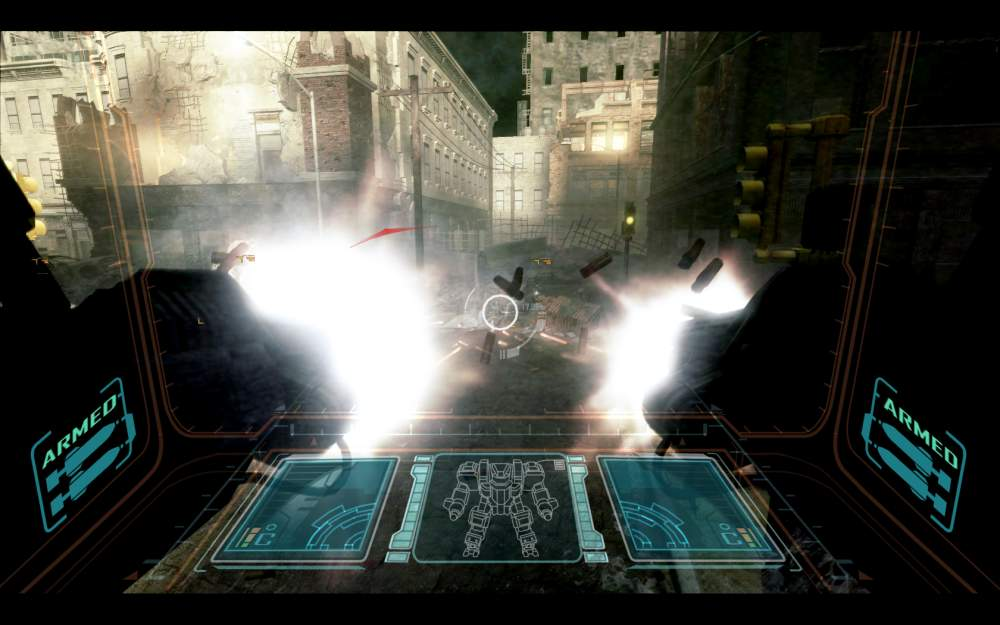
F.E.A.R. 2 infrequently offers a few different ways of fighting. The vast majority of the time, you're on foot holding a weapon of some sort, but you occasionally get to control a turret or a mech. Turrets are very much an upgrade in firepower. Far more enemies swarm than you could normally handle, but the turret cuts them down with ease. Controlling the turret is very easy; some games put silly restrictions like very slow rotation or poor accuracy, but F.E.A.R. 2 gets it right. It's quite fun, and my only complaint is that there aren't more opportunities to use them. The mechs, or "Powered Armor" units are even more powerful, but still very fun and easy to control. You get a couple of mini-guns and a set of rocket launchers, as well as a thermal imaging mode (think Predator). Aside from those two scenarios, there aren't a lot of variations in gameplay. At one point, you're riding on a speeding tram, but you're just walking around on top of it while enemies come to you. There isn't much scenery, and you wouldn't have much time to watch it anyway. The sequence is still fun, but it doesn't hold a candle to similar situations in, say, Gears of War 2.
The game's multiplayer falls into the same trap as the early single-player campaign. It's good, it's fun, and it's interesting, but there's nothing to set it apart from the multiplayer mode of half a dozen other good, fun, interesting shooters. The horror aspect is, of course, completely gone, and the signature time-slowing ability doesn't work because it'd be impossible to code. It has all the standard FPS modes of play (deathmatch, team deathmatch, CTF), and a few other team games that focus on controlling particular points of the map. Armored Front has five such points aligned in a linear manner such that only one is in conflict at a time. You either push the enemy back through successive points or get pushed back yourself. You can use turrets andmechs as well. As I mentioned earlier, all the weapons are relatively powerful in F.E.A.R. 2, and this becomes quite evident in multiplayer games. Players die very quickly without studious use of cover. It may be the case that all the weapons are tuned to be more powerful than they should be. The fights aren't always decided by the first shot, but it happens often enough to be a problem. The maps themselves are, for the most part, very good. There are perhaps a few too many intersections, and a few to many directions you need to watch for enemies, but otherwise they flow quite nicely.
F.E.A.R. 2 is an entertaining game. It's almost exactly what you'd expect out of a triple-A first-person shooter — no more, no less. If you're looking for a quality game and have no problem putting yourself in a state of mind to be creeped out, it will do the job nicely. If you're looking for a title that will push the boundaries of the genre, you're probably better off waiting for another game. There are some great parts to F.E.A.R. 2, and Monolith deserves a lot of credit for making them work as well as they did. This game had the misfortune of coming out after a wave of other, equally compelling titles. It doesn't fall behind, but it doesn't really stand out, either. The bottom line is that if you enjoy horror and first-person shooters, you'll enjoy this game. If your tastes run elsewhere.. well, there's plenty more to pick from.
-
Drug Giant Pledges Cheap Medicine For World's Poor
bmsleight writes in with a Guardian piece on the decision of the world's second biggest pharmaceutical company, GlaxoSmithKline, to radically shift its attitude towards providing cheap drugs to millions of people in the developing world. "[The new CEO] said that GSK will... cut its prices for all drugs in the 50 least developed countries to no more than 25% of the levels in the UK and US — and less if possible — and make drugs more affordable in middle-income countries such as Brazil and India; put any chemicals or processes over which it has intellectual property rights that are relevant to finding drugs for neglected diseases into a 'patent pool,' so they can be explored by other researchers; and reinvest 20% of any profits it makes in the least developed countries in hospitals, clinics, and staff." -
Researchers Snag 60 TB of Everquest 2 Behavioral Data
A group of researchers who went from game developer to game developer looking to acquire data for studying online social interaction got more than they bargained for. Sony Online Entertainment keeps extensive server logs of everything that happens within Everquest 2. When the researchers asked if there was anything they could look at, SOE was happy to share the entire EQ2 database — upwards of 60 TB — for their perusal. In addition to basic gender and age queries — who interacted with whom, and when — the scientists are also trying to find ways to track more subjective characteristics, such as performance, trust, and expertise. "To get estimates of them, the team is experimenting with trying to track physical proximity and direct interactions, such as when characters share experience from an in-game victory. To give a concrete example of the data's utility, Srivastava described how he could explore the phenomenon of customer churn, something that's significant for any sort of subscription-based service, like cell phones or cable TV. With the full dataset, the team can now track how individual customers dropping out of the game influenced others who they typically played or interacted with. Using this data, the spreading rate and influence factor could then be calculated, providing hard measures to work with."
Update: 2/18 at 21:04 by SS: Sony contacted us to set the record straight about the shared information. All information that could identify players was removed from the data given to the researchers. Chat logs were not shared at all. Read on for SOE's full statement. "The information Sony Online Entertainment provided for the research project was scrubbed of all PII (Personally Identifiable Information) prior to being provided to the researchers. For example, no content of any player chat logs were shared with the researchers. The information shared consisted of data such as which in-game characters chatted with each other and the volume and frequency of the contacts. None of this information was connected to, or linked with, the real names or other PII, of any players. Basically, the researchers looked at the connections between players and how their online networks were built and used, not the content of any actual conversations that these players may have had with one another (that content was not made available to the researchers). Additionally, some EQ2 players voluntarily participated in a blind survey concerning their playing habits and demographic backgrounds. This information was anonymously gathered and shared between SOE and the researchers. Finally, corporations such as SOE and the researchers' universities have controls and safeguards in place to help to protect the privacy of individuals who voluntarily participate in surveys for research projects such as this one." -
The Role of Experts In Wikipedia
Hugh Pickens writes "Episteme, a magazine about the social dimensions of knowledge, has a special issue on the epistemology of mass collaboration, with many of the articles focusing on Wikipedia. One of the most interesting articles is by Lawrence M. Sanger on the special role of experts in the age of Wikipedia. Sanger says the main reason that Wikipedia's articles are as good as they are is that they are edited by knowledgeable people to whom deference is paid, although voluntarily, but that some articles suffer precisely because there are so many aggressive people who 'guard' articles and drive off others (PDF), including people more expert than they are. 'Without granting experts any authority to overrule such people, there is no reason to think that Wikipedia'a articles are on a vector toward continual improvement,' writes Sanger. Wikipedia's success cannot be explained by its radical egalitarianism or its rejection of expert involvement, but instead by its freedom, openness, and bottom-up management and there is no doubt that many experts would, if left to their own devices, dismantle the openness that drives the success of Wikipedia. 'But the failure to take seriously the suggestion of any role of experts can only be considered a failure of imagination,' writes Sanger. 'One need only ask what an open, bottom-up system with a role for expert decision-making would be like.' The rest of the articles on the epistemology of mass collaboration are available online, free for now." Sanger was one of the founders of Wikipedia, and of its failed predecessor Nupedia, who left the fold because of differences over the question of the proper role of experts. Sanger forked Wikipedia to found Citizendium, which we have discussed on several occasions. After 2-1/2 years, Citizendium has a few tenths of a percent as many articles as Wikipedia. -
Red Hat Enlists Community Help To Fight Patent Trolls
Stickster writes "Back in 2007, IP Innovation filed a lawsuit against Red Hat and Novell. IP Innovation is a subsidiary of Acacia Technologies. You may have heard of them — they're reported to be the most litigious patent troll in the USA, meaning they produce nothing of value other than money from those whom they sue (or threaten to sue) over patent issues. They're alleging infringement of patents on a user interface that has multiple workspaces. Hard to say just what they mean (which is often a problem in software patents), but it sounds a lot like functionality that pretty much all programmers and consumers use. That patent was filed back on March 25, 1987 by some folks at Xerox/PARC, which means that prior art dated before then is helpful — and art dated before March 25, 1986 is the most useful. (That means art found in a Linux distribution may not help, seeing as how Linus Torvalds first began the Linux kernel in 1991.) Red Hat has invited the community to join in the fight against the patent trolls by identifying prior art. They are coordinating efforts through the Post Issue Peer to Patent site, which is administered by the Center for Patent Innovations at the New York Law School, in conjunction with the US Patent and Trademark Office." -
World of Goo Ported To Linux
christian.einfeldt writes "Lovers of both games and Free Open Source Software will be pleased to see that the popular indie puzzle game World of Goo has been released for Linux. It was designed by a small team of two ex-Electronic Arts developers, Kyle Gabler and Ron Carmel, who used their entire combined savings of $10,000.00 USD to create the gooey game aimed at guiding goo balls to salvation. The developers built their gooey world with open-source technologies such as Simple DirectMedia Layer, Open Dynamics Engine for physics simulation, and TinyXML for configuration and animation files. Subversion and Mantis Bug Tracker were used for work coordination. Blogger Ken Starks points out that the release of this popular game for Linux could be a big step toward ending the chicken-and-egg problem of a dearth of good games that run natively under Linux." -
1,234,567,890 Seconds Since Unix Time Began
os2man was one of many readers to let us know that later on today, at 23:31:30 UTC (30 seconds after this story went live), the number of seconds since January 1st 1970 will be exactly 1234567890. January 1st, 1970 marks the start of the clock for the Unix operating system and many other operating systems. Here is a list of celebrations of the moment around the world. -
How To Build a Short Foucault Pendulum
KentuckyFC writes "Set a pendulum in motion and you'll inevitably give it an ellipsoidal motion, which naturally tends to precess. That's bad news if you want to build a Foucault Pendulum, a bob attached to a long wire swinging in a vertical plane that appears to rotate as the Earth spins beneath it. The natural precession always tends to swamp the rotation due to the Earth's motion. There is a solution, however: the behavior of the ellipsoidal motion is inversely proportional to the pendulum's length. So the traditional answer has been to use a very long pendulum (Foucalt's original in Paris is 67 meters long). Now scientists at Carnegie Mellon University have another solution (abstract). They've created a motor that drives a pendulum in a way that always cancels out the precession. That means the effect of Earth's rotation can be seen on much shorter pendulums such as the 3-meter pendulum on which they've tested their motor. That's just the start though. They say there is no limit to how short the new generation of Foucault Pendulums can be, and even talk about the possibility of tabletop devices." -
Microsoft Slaps $250K Bounty On Conficker Worm
alphadogg writes "The spreading Conficker/Downadup worm is now viewed as such a significant threat that it's inspired the formation of a posse to stop it, with Microsoft leading the charge by offering a $250,000 reward to bring the Conficker malware bad guys to justice. The money will be paid for 'information that results in the arrest and conviction of those responsible for illegally launching the Conficker malicious code on the Internet,' Microsoft said today in a statement, adding it is fostering a partnership with Internet registries and DNA providers such as ICANN, ORG, and NeuStar as well as security vendors Symantec and Arbor Networks, among others, to stop the Conficker worm once and for all. Conficker, also called Downadup, is estimated to have infected at least 10 million PCs. It has been slowly but surely spreading since November. Its main trick is to disable anti-malware protection and block access to anti-malware vendors' Web sites." -
First Doom 4 Production Shots Revealed
An anonymous reader writes "Actor Brad Hawkins has been tapped to do motion-capture work for Doom 4, and revealed that the game features the military and civilians fighting side by side. Does this mean the game is set on Earth for sure? GGL Wire has an interview with Hawkins and a selection of production shots. '[Filmmaker Mark Bristol] was very specific on the civilians having a certain personality and the military characters having a separate one as well. The body language of the civilians is less, well, "trained." They carry their guns in a looser fashion and are a little sloppier when they run, a little more freestyle. The military characters are sharp as razors, with very swift moves, exact hand positioning and can turn on a dime.'" This follows news from last month that British novelist Graham Joyce was brought in to develop the story for the game. -
Houston Courts Shut Down By Malware
Conficker is still at it: dstates writes "The municipal courts of Houston were shut down yesterday after a computer virus spread through the courts' computer systems. The shutdown canceled hearings and suspended arrests for minor offenses and is expected to extend through Monday. The disruption affected many city departments, the Houston Emergency Center was briefly disconnected and police temporarily stopped making some arrests for minor offenses. The infection appears to be contained to 475 of the city's more than 16,000 computers, but officials are still investigating. Gray Hat Research, a technology security company, has been brought in on an emergency contract to eradicate the infection. In 2006, the City spent $10M to install a new computer system and bring the Courts online, but the system has been beset by multiple problems. After threatening litigation, the city reached a $5 million settlement with the original vendor, Maximus, and may seek another vendor." -
The Deceptive Perfection of Auto-Tune
theodp writes "For a medium in which mediocre singing has never been a bar to entry, a lot of pop vocals suddenly sound better than great — they're note- and pitch-perfect. It's all thanks to Auto-Tune, the brainchild of Andy Hildebrand, who realized that the wonders of autocorrelation — which he once used to map drilling sites for the oil industry — could also be used to bestow perfect pitch upon the Britney Spears of the world. While Auto-Tune was intended to be used unnoticed, musicians are growing fond of adjusting the program's retune speed to eliminate the natural transition between notes, which yield jumpy and automated-sounding vocals. 'I never figured anyone in their right mind would want to do that,' says Hildebrand." As these techniques improve and become more popular, it makes me wonder what music produced twenty or fifty years from now will sound like, and how much authenticity will be left. -
The First Federally Certified Voting System
InternetVoting writes "The Election Assistance Commission has announced the first ever federally certified voting system. While the Election Management System (EMS) 4.0 by MicroVote General Corporation has successfully completed 17 months of testing, many questions still remain about the United States' voting system Testing and Certification program. Many systems are still being tested to obsolete standards, the current standards are set to become obsolete soon and cost estimates for future certifications are skyrocketing. The future of improved innovating voting systems does not look bright." -
First-Person Shooter Modified For Fire Drill Simulation
Hugh Pickens writes "Researchers at Durham University have modified a video game and turned it into a fire drill simulator using the Source engine (the 3D game engine used to drive Half-Life 2), and created a virtual model of one of the university's departments. Dr. Shamus Smith said that although 3D modeling software was available, modifying a video game was faster, more cost effective, and had better special effects. 'We were interested in using game technology over a customized application and the Source Engine, from Half-Life, is very versatile,' said Smith. 'We used the simulation to see how people behaved in an actual fire situation and to train people in "good practice" in a fire.' The team says the virtual environment helped familiarize people with evacuation routines and could also help identify problems with a building's layout. One problem, however, was that while the simulation worked for most people, those who played a lot of video games did some unusual things when using the simulation. 'If a door was on fire, [the gamers] would try and run through it, rather than look for a different exit,' said Smith." This makes me wonder to what extent entertainment software will fill the role of non-entertainment software as the tools and engines become more and more powerful. Ars mentions related news that the US Dept. of Naval Research is dumping millions of dollars into "virtual reality-like simulations of small-scale urban conflicts." It's unclear whether this is related to the US Army's similar program. -
Web of Trust For Scientific Publications
An anonymous reader writes "PGP and GnuPG have been utilizing webs of trust to establish authenticity without a centralized certificate authority for a while. Now, a new tool seeks to extend the concept to include scientific publications. The idea is that researchers can review and sign each others' works with varying levels of endorsement, and display the signed reviews with their vitas. This creates a decentralized social network linking researchers, papers, and reviews that, in theory, represents the scientific community. It meshes seamlessly with traditional publication venues. One can publish a paper with an established journal, and still try to get more out of the paper by asking colleagues to review the work. The hope is that this will eventually provide an alternative method for researchers to establish credibility." -
Efficiently Producing Quantum Dots
generica1 writes "The Edmonton Journal is reporting on the University of Alberta's National Institute for Nanotechnology's recent invention of a new method to produce quantum dots — what are currently the world's smallest quantum dots, possibly allowing for startling increases in the efficiency of semiconductor-based equipment. 'Roughly speaking, we predict there could be a 1,000-time reduction in power consumption with electronic computers built in this new way,' said Robert Wolkow, a physicist at the University of Alberta and leader of the team behind the breakthrough. Read the article for a description of the wave-like phenomenon employed by Wolkow's team to accomplish a vastly lower power consumption during the transfer of electrons." -
Political Upheaval In Fictional Czech State
Rog-Mahal writes "The fictional Kingdom of Wallachia has made the front page of Czech newspapers lately. The practical joke turned tourist attraction started by photographer Tomas Harabis has been locked is a power struggle between Bolek Polivka, the current king, and Harabis, the foreign minister. The faux country has received international attention over the years: 'Wallachia makes money several ways, including offering tastings of its famed plum brandy, slivovitz, to corporate clients. Its biggest source of revenue is the Wallachian passport, which costs the equivalent of $7.69. There are roughly 90,000 citizens of the make-believe nation, once including George W. Bush, who was given a passport some years ago by a Czech living in Texas. Mr. Bush's citizenship was revoked in 2003 after the United States invaded Iraq. The passport has created some confusion, however. When a man from Pakistan recently asked the kingdom for political asylum, Mr. Harabis said he had to gently explain that Wallachia was not a real country. The Wallachian passport now warns: "This passport is not yet an official document of the Czech Republic."' We can only hope for a peaceful end to hostilities." -
New Paper Offers Additional Reasoning for Fermi's Paradox
KentuckyFC writes "If the universe is teeming with advanced civilizations capable of communicating over interstellar distances, then surely we ought to have seen them by now. That's the gist of a paradoxical line of reasoning put forward by the physicist Enrico Fermi in 1950. The so-called Fermi Paradox has haunted SETI researchers ever since. Not least because if the number of intelligent civilizations capable of communication in our galaxy is greater than 1, then we should eventually hear from them. Now one astrophysicist says this thinking fails to take into account the limit to how far a signal from ET can travel before it becomes too faint to hear. Factor that in and everything changes. Assuming the average communicating civilization has a lifetime of 1,000 years, ten times longer than Earth has been broadcasting, and has a signal horizon of 1,000 light-years, you need a minimum of over 300 communicating civilizations in the Milky Way to ensure that you'll see one of them. Any less than that and the chances are that they'll live out their days entirely ignorant of each other's existence. Paradox solved, right?" -
Workable Fusion Starship Proposed
Adam Korbitz writes "A former colleague of Edward Teller — father of the hydrogen bomb — has published a new paper proposing a design for what could be the first practical fusion-powered spacecraft (PDF). As described at Centauri Dreams, the design has certain similarities to MagOrion, a 1990s-era proposal for a nuclear-powered spaceship with a magnetic sail and propelled by small-yield fission devices. The proposal's author also has links to the British Interplanetary Society's Project Daedalus, a 1970s proposal for an unmanned fusion-powered interstellar probe designed to reach 12% of the speed of light on its way to Barnard's Star." -
Workable Fusion Starship Proposed
Adam Korbitz writes "A former colleague of Edward Teller — father of the hydrogen bomb — has published a new paper proposing a design for what could be the first practical fusion-powered spacecraft (PDF). As described at Centauri Dreams, the design has certain similarities to MagOrion, a 1990s-era proposal for a nuclear-powered spaceship with a magnetic sail and propelled by small-yield fission devices. The proposal's author also has links to the British Interplanetary Society's Project Daedalus, a 1970s proposal for an unmanned fusion-powered interstellar probe designed to reach 12% of the speed of light on its way to Barnard's Star." -
Ruby 1.9.1 Released
Janwedekind writes "Yuki Sonoda yesterday announced the release of Ruby 1.9.1 (Ruby Inside coverage with lots of links). The VM of Ruby 1.9, formerly known as YARV, was initiated by Koichi Sasada and has been in the making for quite some time. Ruby's creator Yukihiro Matsumoto has already presented many of the upcoming features in his keynote at RubyConf 2007. Most notably, Ruby 1.9 now supports native threads and an implementation of fibers. A lot of work also went into encoding awareness of strings. The 1.9.1 version is said to be twice as fast as the stable 1.8.7. It will take some time though until the majority of existing Ruby extensions get ported to 1.9." -
Making Magnetic Monopoles and Other Physics Exotica
PhysicsDavid writes "Physicists have been searching for magnetic monopoles pretty much since they knew about magnetism and definitely since Maxwell unified electricity and magnetism. Now some researchers have shown that using some weird mirror materials will allow them to create something indistinguishable from a monopole in a lab experiment. A paper about it was published today in the journal Science as an advance online publication (abstract; full article available only to AAAS members). The technique looks like it could be used to create analog systems of other kinds of exotic particles that haven't yet been observed, such as axions. The theorists who proposed this are working with experimenters to try to create these systems and study them in depth this year." -
Data Privacy Day Wrap-Up
Several companies, government bodies and other groups have decided to label January 28th as an annual tech holiday of sorts, Data Privacy Day. Mortimer.CA writes "Various organizations had events on it including Intel, Microsoft, Google, and the Privacy Commissioner of Canada. It seems to have been mostly a quiet affair this time around, but hopefully it will grow over time." -
Mozilla Donates $100K To the Ogg Project
LWATCDR writes "Mozilla has given the Wikimedia foundation $100,000 to fund Ogg development. The reason is simple: 'Open standards for audio and video are important because they can be used by anyone for any purpose without royalties, and can be inspected and improved by an open community. Today, video and audio on the web are dominated by proprietary technologies, most frequently patent-encumbered codecs wrapped into closed-source player widgets.' While Vorbis is a better standard than MP3, everything I have heard about Theora is that it is technically inferior to many other video codecs. I wonder if wouldn't be better to direct effort to Dirac, perhaps putting Dirac into an Ogg container. No mention was made of FLAC or Speex funding. If more media players supported Speex it would be an ideal codec for many podcasts and audio books. It really is too bad that these codecs so often get overlooked." -
Remembering NASA Disasters With an Eye Toward the Future
mattnyc99 writes "This next week marks the anniversary of three sad days in NASA's history: three astronauts died in a capsule fire testing for Apollo 1 exactly 42 years ago today, then the Challenger went down 23 years ago tomorrow, followed by the Columbia disaster six years ago this Super Bowl Sunday. Amidst all this sadness, though, too many average Americans take our space program for granted. Amidst reconsiderations of NASA priorities from the Obama camp as the Shuttle nears retirement, then, the brilliant writer Chris Jones offers a great first-hand account in the new issue of Esquire — an impassioned argument against the impending end of our manned space program. In which camp do you fall: mourner or rocketeer?" -
RAF Ordered to Shoot Down UFOs
Pilots in the RAF have fired upon unidentified objects without success since the 1980s, according to Nick Pope, who used to run the Ministry of Defence's UFO project. "There was a faction in the MoD who said 'We want to shoot down a UFO and that will resolve the issue one way or another. We know of cases where the order has been given to shoot down - with little effect to the UFO," he says. The MoD refused to comment. While not making the best first impression on our alien visitors, this policy assures that the British won't end up in a cookbook. -
MIT Creates Class About Soap Operas
An anonymous reader writes "Wikipedia apparently wasn't enough. There had to be a course on the much needed subject of soap operas at MIT. Here's the Course Description: "The television landscape has changed drastically in the past few years; nowhere is this more prevalent than in the American daytime serial drama, one of the oldest forms of television content. This class examines the history of these "soap operas" and their audiences by focusing on the production, consumption, and media texts of soaps. The class will include discussions of what makes soap operas a unique form, the history of the genre, current experimentation with transmedia storytelling, the online fan community, and comparisons between daytime dramas and primetime serials from 24 to Friday Night Lights, through a study of Procter & Gamble's As the World Turns."" All I really need to know I learned from my evil twin, who fathered my unborn child, who has a extremely rare disease that only one of my many CIA contacts, who is also sleeping with my wife, can cure. -
Edit-Approval System Proposed For English-Language Wikipedia
An anonymous reader writes "A group of powerful Wikipedia insiders are pushing for FlaggedRevisions which will require a 'trusted user' to approve of edits before they go live on the online encyclopedia. There is also opposition but with support of founder Jimbo Wales it is likely to go through. The German version has tried the system, leading to three-week delays between edit and publication. The English wiki with its higher number of anonymous editors per trusted user is expected to suffer longer queues if FlaggedRevisions is implemented on all articles. This comes just a few days after Britannica announced that readers will be allowed to suggest edits and have them reviewed within 20 minutes. Will we see the day when Britannica can be edited almost instantly while editing Wikipedia requires fighting bureaucracy, patience and the right contacts?" Note that, according to the quote from Jimmy Wales in the linked article, this system would only be used "on a subset of articles, the boundaries of which can be adjusted over time to manage the backlog." -
What, Me Worry? MAD Magazine Going Quarterly
theodp writes "MAD Magazine is about to put out its 500th issue, but starting with its April publication, the mag is cutting down to only four issues per year. The feedback we've gotten from readers,' quipped Editor John Ficarra, 'is that only every third issue of MAD is funny, so we've decided to just publish those.' MAD Kids and MAD Classics are ceasing publication entirely. Keep up the what-me-worry game face, Alfred!" -
Efficiency Gains Could Prove Proposed Plasma Ban Shortsighted
hihopes writes "As the EU calls for a ban on plasma TVs, a leading Harvey Norman executive said that the issue should be left to vendors, who at the recent CES Show in the USA showed an array of low-powered TV display screens." -
Sugar-Coated Drug-Dealing Game Approved For iPhone
Pocket Gamer writes "Of course, Apple wouldn't allow such a salacious games as Dope Wars on the hallowed corridors of the App Store. What Catamount's done is sugarcoat its game (quite literally) and turned it into Prohibition 3: Candy Wars — a reskinned version of the exact same game." -
Child Online Protection Act Appeal Rejected
TarrVetus writes "The Associated Press reports that a federal appeals court in Philadelphia has ruled that the Child Online Protection Act will not be revived, upholding a 2007 decision that the unimplemented 1998 law is unconstitutional. The law, which made it a crime for websites to allow children access to 'harmful' material, was declared a violation of the First Amendment because of existing elective filtering technologies and parental controls that are less restrictive to free speech than the 'ineffective' and 'overly broad' ban." -
Google's PageRank Predicts Nobel Prize Winners
KentuckyFC writes "The pattern of citations between scientific papers forms a network that has remarkable similarities to the network formed by the web. So why not use Google's PageRank, the world's most effective search algorithm to rank these papers in the same way it ranks websites? That's exactly what a couple of US researchers have done for physics papers published by the American Physical Society since 1893 (abstract). The results make interesting reading because almost all of the top ten papers resulted in (or were linked to) Nobel Prizes for their authors. Which means that studying the up-and-coming entries on the list ought to be a good way of predicting future winners. Better get your bets in before the bookies get wind of this."