Slashdot Mirror
Domain: wordpress.com
Stories and comments across the archive that link to wordpress.com.
Stories · 597
-
How YouTube's Domination of Streaming Clips the Market's Wings (wordpress.com)
New report from Midia Research firm looks at music fans' behavior in the third quarter of 2018. From the report: YouTube is the dominant music streaming platform, with 55% of consumers regularly watching music videos on YouTube, compared to a combined 37% for all free audio streaming services. YouTube usage skews young, peaking at nearly three quarters of consumers under 25. Although YouTube leads audio streaming in all markets -- even Spotify's native Sweden -- there are some strong regional variations. For example, emerging streaming markets Brazil and Mexico see much higher YouTube penetration, peaking at close to double the level of even traditional music radio in Mexico.
Indeed, radio is feeling the YouTube pinch as much as audio streaming. 68% of those under 45 watch YouTube music videos compared to 41% that listen to music radio. The difference increases with younger audiences and the more emerging the market. For example, in Mexico YouTube music penetration is 84% for 20-24 year olds, compared to 37% for music radio. Streaming may be the future of radio, but right now that streaming future is YouTube. -
2018 Advent Calendars Launched for Computer Programmers and Web Geeks (24ways.org)
An anonymous reader writes: Saturday the Perl Advent Calendar entered its 19th year by describing how the Wise Old Elf used a Calendar::List module from CPAN to update his Elven Perl Monger website with all the dates for 2019. ("It is a well known fact that all of Santa's Elves are enthusiastic Perl Developers in their free time, contributing regularly to many of the amazing Perl projects we've come to know and love...")
But meanwhile, the Perl 6 Advent Calendar was describing how Santa gets data into the North Pole's CRM by defining a grammar unit which can be parsed using a built-in method (to trim out children's signatures) -- only to be chastised by his IT elf for failing to document his solution using Perl 6's built in markup language.
And 24Ways.org is also presenting its 14th annual "advent calendar for web geeks," a nicely-formatted offering that promises "a daily dose of web design and development goodness to bring you all a little Christmas cheer."
Meanwhile, the Go language site Gopher Academy launched their 6th annual advent calendar, describing how to split data with content-defined chunking.
Jose Valim, creator of the Elixir programming language, has also announced the fourth annual "Advent of Code," an ongoing story that presents "a series of small programming puzzles for a variety of skill sets and skill levels in any programming language you like." (The folks behind the Nim programming language are even organizing their own leaderboard at Nim-lang.org.)
And even QEMU, a free and open-source emulator performing hardware virtualization, is getting into the act with a QEMU advent calendar offering "an amazing QEMU disk image" each day through December 24th.
Feel free to leave a comment with your own reactions -- or with the URL for your own favorite online geek advent calendars... -
2018 Advent Calendars Launched for Computer Programmers and Web Geeks (24ways.org)
An anonymous reader writes: Saturday the Perl Advent Calendar entered its 19th year by describing how the Wise Old Elf used a Calendar::List module from CPAN to update his Elven Perl Monger website with all the dates for 2019. ("It is a well known fact that all of Santa's Elves are enthusiastic Perl Developers in their free time, contributing regularly to many of the amazing Perl projects we've come to know and love...")
But meanwhile, the Perl 6 Advent Calendar was describing how Santa gets data into the North Pole's CRM by defining a grammar unit which can be parsed using a built-in method (to trim out children's signatures) -- only to be chastised by his IT elf for failing to document his solution using Perl 6's built in markup language.
And 24Ways.org is also presenting its 14th annual "advent calendar for web geeks," a nicely-formatted offering that promises "a daily dose of web design and development goodness to bring you all a little Christmas cheer."
Meanwhile, the Go language site Gopher Academy launched their 6th annual advent calendar, describing how to split data with content-defined chunking.
Jose Valim, creator of the Elixir programming language, has also announced the fourth annual "Advent of Code," an ongoing story that presents "a series of small programming puzzles for a variety of skill sets and skill levels in any programming language you like." (The folks behind the Nim programming language are even organizing their own leaderboard at Nim-lang.org.)
And even QEMU, a free and open-source emulator performing hardware virtualization, is getting into the act with a QEMU advent calendar offering "an amazing QEMU disk image" each day through December 24th.
Feel free to leave a comment with your own reactions -- or with the URL for your own favorite online geek advent calendars... -
With Few US Students Taking CS Classes, Code.org 'Scales Back' Funding For CS Education (acm.org)
"In 2012, most CS teacher professional development was paid for by the National Science Foundation or Google." And in the years that followed, 80,000 primary and secondary school teachers received opportunities to learn how to teach computer science without paying any fees -- thanks to tech-bankrolled Code.org.
But is anyone taking the classes? Slashdot reader theodp quotes a Communications of the ACM post by University of Michigan professor Mark Guzdial: In 2013, Code.org began, and they changed the face of CS education in the United States . It started out as just a video (linked here, seen over 14 million times), and grew into an organization that created and provided curriculum, offered teacher professional development, and worked with states and districts around public policy initiatives. A recent report from Code.org showed that 44 states have enacted public policies to promote computing education in the five years from 2013 to 2018, and much of that happened through Code.org's influence....
Now, Code.org has announced that they are starting to scale back their funding, which begins a multi-year transition to shift the burden of paying for teacher professional development to the local regions.... The only question is whether it's too soon. Will local regions step up and demonstrate that they value computer science by paying for it...? I'd guess that many states have between 40% and 70% of their high schools now offering computer science. However, even though many schools offer computer science, there are still few students taking computer science.
Indiana reported that only 0.4% of Indiana high school students had enrolled in their most popular course. Meanwhile in one region in Texas, 54 of 159 high schools offer computer science, yet only 2.3% of their students have ever taken a computer science class. But of course, there's another issue.
"If Code.org (or NSF or Google) are paying for all the development of CS teachers, then the districts don't get to say, 'In our community we care about this and we care less about that.' The U.S. education system is organized around the local regions calling the shots, setting the priorities, and deciding what they want teachers to teach." -
Apple's New iPhones Will Come In a Plethora of New Colors, Says Report (9to5mac.com)
According to analyst Ming-Chi Kuo, Apple's new 2018 iPhones will come in a plethora of colors. The 6.5-inch iPhone will be offered in black, white, and a (new) gold, while the entry-level 6.1-inch LCD iPhone will debut in "grey, white, blue, red and orange." 9to5Mac reports: That's a potential five new colors for the LCD model. It is very possible that when Kuo says "grey" and "white" he is referring to the Space Grey and Silver finishes as seen on the current iPhone X. We've mocked up the new finishes by tinting an iPhone X, but note the 6.1-inch LCD iPhone is not expected to have a dual-camera system. However, that still means Apple is looking to introduce four new options. It seems like the higher end models will add gold to the lineup...
The ~$700 6.1-inch LCD 2018 iPhone (which will mostly resemble an iPhone X's design from the front) will have a larger lineup including blue, red and orange. This harkens back to the iPhone 5c era when Apple rolled out a cheaper iPhone sibling in colorful chassis. We have heard some mumblings prior to today's report about Apple expanding the color options for the cheaper phone, but this is the first time someone reputable has reported specifics. It's not clear if the "red" color means PRODUCT(RED)... Kuo also says that the 6.5-inch OLED iPhone Model should be priced around $1,000 like the current iPhone X, and will feature dual SIM capabilities. Meanwhile, the 6.1-inch LCD iPhone X style device should retail for around $700. The other iPhone expected to be released later this year will be a spec-bump upgrade to the 5.8-inch iPhone X currently available.
In other Apple-related news, Intel will reportedly not provide the 5G modems for Apple's 2020 mobile devices. -
Prosecution of UK News Photographer Collapses After Recording Disproves Police Testimony (wordpress.com)
Slashdot reader Andy Smith writes: Slashdot reported last September how I was arrested while standing in a field near a road accident, as I photographed the scene for a newspaper. I was initially given a police warning for "obstruction", but the warning was then cancelled and I was prosecuted for resisting arrest and breach of the peace. These are serious charges and I was facing a prison sentence. Fortunately we had one very strong piece of evidence: A recording of my arrest. Not only did the recording prove that two police officers' testimony was false, but it caught one of them boasting about how he had conspired with a prosecutor to arrest and prosecute me. Yesterday the case was dropped, and now the two police officers and the prosecutor face a criminal investigation. -
'Java EE' Has Been Renamed 'Jakarta EE' (i-programmer.info)
An anonymous reader quotes i-Programmer: The results are in for the vote on the new name for Java Enterprise Edition, and unsurprisingly the voters have chosen Jakarta EE. The renaming has to happen because Oracle refused to let the name Java be used. The vote was to choose between two options - 'Jakarta EE' and 'Enterprise Profile'. According to Mike Milinkovich, executive director at the Eclipse Foundation, almost 7,000 people voted, and over 64% voted in favour of Jakarta EE. The other finalist, "Enterprise Profile," came in at just 35.6% of the votes when voted ended last Friday.
"Other Java projects have also been renamed in Eclipse," notes SD Times. "Glassfish is now Eclipse Glassfish. The Java Community Process is now the Eclipse EE.next Working Group, and Oracle development management is now Eclipse Enterprise for Java Project Management Committee." -
Amateur Astronomer Discovers Long-Dead NASA Satellite Has Come Back To Life (behindtheblack.com)
schwit1 shares a report from Behind The Black: In his hunt to locate Zuma, an amateur astronomer has discovered that a long-dead NASA satellite, designed to study the magnetosphere, has come back to life. IMAGE went dead in 2005, and though NASA thought it might come back to life after experiencing a total eclipse in 2007 that would force a reboot, no evidence of life was seen then. It now appears that the satellite came to life sometime between then and 2018, and was chattering away at Earth waiting for a response. NASA is now looking at what it must do to take control of the spacecraft and resume science operations. Zuma is the secret U.S. government payload that was launched by SpaceX earlier this month and reportedly lost. As for why Scott Tilley -- the amateur radio astronomer -- decided to have a look for the present of secret military satellites, Ars Technica reports that he apparently does this semi-regularly as a hobby and, in this case, was inspired by the Zuma satellite. -
Perl, Perl 6, and Two Application Frameworks Release 2017 Advent Calendars (perladvent.org)
An anonymous reader writes: Friday saw this year's first new posts on the Perl Advent Calendar, a geeky tradition first started back in 2000. It describes Santa including Unicode's "Father Christmas" emoji by enabling UTF-8 encoding and then using the appropriate hexadecimal code.
But in another corner of the North Pole, you can also unwrap the Perl 6 Advent Calendar, which this year celebrates the two-year anniversary of the official launch of Perl 6. Its first post follows a Grinch who used the but and does operators in Perl 6, while wrapping methods and subroutines to add extra sneaky features, "and even mutated the language itself to do our bidding."
Perl/Python guru Joel Berger has also started an advent calendar for the Mojolicious web application framework (written in Perl), and there's apparently also an advent calendar coming for the Perl Dancer web application framework. -
Perl, Perl 6, and Two Application Frameworks Release 2017 Advent Calendars (perladvent.org)
An anonymous reader writes: Friday saw this year's first new posts on the Perl Advent Calendar, a geeky tradition first started back in 2000. It describes Santa including Unicode's "Father Christmas" emoji by enabling UTF-8 encoding and then using the appropriate hexadecimal code.
But in another corner of the North Pole, you can also unwrap the Perl 6 Advent Calendar, which this year celebrates the two-year anniversary of the official launch of Perl 6. Its first post follows a Grinch who used the but and does operators in Perl 6, while wrapping methods and subroutines to add extra sneaky features, "and even mutated the language itself to do our bidding."
Perl/Python guru Joel Berger has also started an advent calendar for the Mojolicious web application framework (written in Perl), and there's apparently also an advent calendar coming for the Perl Dancer web application framework. -
How Two Scientists Accurately Predicted Global Warming in 1967 (medium.com)
Slashdot reader Layzej shares an article from this spring marking the 50th anniversary of the first accurate climate model: Astrophysicist Ethan Siegel looks at a climate model (MW67) published in 1967 and finds "50 years after their groundbreaking 1967 paper, the science can be robustly evaluated, and they got almost everything exactly right."
An analysis on the "Climate Graphs" blog shows exactly how close the prediction has proven to be: "The slope of the CO2-vs-temperature regression line in the 50 years of actual observations is 2.57, only slightly higher than MW67's prediction of 2.36" They also note that "This is even more impressive when one considers that at the time MW67 was published, there had been no detectable warming in over two decades. Their predicted warming appeared to mark a radical change with the recent past:" -
Facebook Removed References To Russia From Fake-News Report (arstechnica.com)
An anonymous reader quotes a report from Ars Technica: Back in April, Facebook published a report called "Information Operations and Facebook" that detailed the company's efforts to combat fake news and other misinformation campaigns on the site. The report was released in the midst of an uproar over potential Russian meddling in the 2016 presidential campaign. But the report doesn't mention Russia by name, saying only that Facebook's data "does not contradict" a January report by the Obama administration detailing Russian meddling in the election. On Friday, The Wall Street Journal reported that the decision not to mention Russia was hotly debated inside Facebook. An earlier draft of the report discussed what Facebook knew at that time about Russian meddling, but that material was ultimately removed from the report before publication. "Some at Facebook pushed to not include a mention of Russia in the report because the company's understanding of Russian activity was too speculative, according to one of the people," according to the Journal. -
Police Allegedly Arrest UK News Photographer For Standing In A Field (wordpress.com)
Long-time Slashdot reader Andy Smith, a Scotland-based news photographer, writes: I'm a press photographer. Slashdot has previously covered how the police used underhanded tactics to seize some of my work photos. But that was far from the end of the story. Several months of harassment culminated in me being arrested for standing in a field, something protected by law here in Scotland. I was given a police caution, which is a formal alternative to prosecution, but the police then cancelled the caution and prosecuted me anyway. Ironically, I was meant to be joining the police this month as a volunteer, but that has now been delayed by at least six months.
Earlier Andy had filmed the same police sergeant warning him not to photograph a minor traffic accident -- which had "seemed to anger him." -
Mathematicians Race To Debunk German Man Who Claimed To Solve The 'P Versus NP' Problem (vice.com)
A German man -- Norbert Blum -- who claimed that P is not equal to NP is seeing several challenges to his solution. From a report: Numerous mathematicians have begun to raise questions about whether the German mathematician solved it at all. Since Blum's paper was published, mathematicians and computer scientists worldwide have been racking their brains as to whether the Bonn-based researcher has, in fact, solved this Millennium Prize Problem. After an initially positive reaction, such as the one from Stanford mathematician Reza Zadeh, doubts are beginning to arise about whether Blum's reasoning is correct. In a forum for theoretical mathematics, a user named Mikhail reached out to Alexander Razborov -- the author of the paper on which Blum's proof is based -- to ask him about Blum's paper. Razborov purports to have discovered an error in Blum's paper: Blum's main argument contradicts one of Razborov's key assumptions. And mathematician Scott Aaronson, who is something of an authority in the math community when it comes to P vs. NP, said he would be willing to bet $200,000 that Blum's mathematical proof won't endure. "Please stop asking," Aaronson writes. If the proof hasn't been refuted, "you can come back and tell me I was a closed-minded fool." In the week since Aaronson's initial blog post, other mathematicians have begun trying to poke holes in Blum's proof. Dick Lipton, a computer science professor at Georgia Tech, wrote in a blog post that Blum's proof "passes many filters of seriousness," but suggested there may be some problems with it. A commenter on that blog post, known only as "vloodin," noted that there was a "single error on a subtle point" in the proof; other mathematicians have since chimed in and confirmed vloodin's initial analysis, and so the emerging consensus among many mathematicians is that a solve for P vs. NP remains elusive. -
Mathematicians Race To Debunk German Man Who Claimed To Solve The 'P Versus NP' Problem (vice.com)
A German man -- Norbert Blum -- who claimed that P is not equal to NP is seeing several challenges to his solution. From a report: Numerous mathematicians have begun to raise questions about whether the German mathematician solved it at all. Since Blum's paper was published, mathematicians and computer scientists worldwide have been racking their brains as to whether the Bonn-based researcher has, in fact, solved this Millennium Prize Problem. After an initially positive reaction, such as the one from Stanford mathematician Reza Zadeh, doubts are beginning to arise about whether Blum's reasoning is correct. In a forum for theoretical mathematics, a user named Mikhail reached out to Alexander Razborov -- the author of the paper on which Blum's proof is based -- to ask him about Blum's paper. Razborov purports to have discovered an error in Blum's paper: Blum's main argument contradicts one of Razborov's key assumptions. And mathematician Scott Aaronson, who is something of an authority in the math community when it comes to P vs. NP, said he would be willing to bet $200,000 that Blum's mathematical proof won't endure. "Please stop asking," Aaronson writes. If the proof hasn't been refuted, "you can come back and tell me I was a closed-minded fool." In the week since Aaronson's initial blog post, other mathematicians have begun trying to poke holes in Blum's proof. Dick Lipton, a computer science professor at Georgia Tech, wrote in a blog post that Blum's proof "passes many filters of seriousness," but suggested there may be some problems with it. A commenter on that blog post, known only as "vloodin," noted that there was a "single error on a subtle point" in the proof; other mathematicians have since chimed in and confirmed vloodin's initial analysis, and so the emerging consensus among many mathematicians is that a solve for P vs. NP remains elusive. -
WordPress Bans Fascist Website Linked To Charlottesville Killer (fastcompany.com)
tedlistens writes: WordPress has said that it does not censor websites like that of self-proclaimed fascist group Vanguard America. But last night, the group's site was taken offline for violating the company's terms of service. The about-face was likely prompted by Vanguard's participation in last weekend's Unite the Right rallies in Charlottesville, Virginia, during which James Alex Fields drove his car into a crowd, killing one person and injuring 19. Fields has claimed allegiance to Vanguard America; the group denies that Fields was a member. For WordPress to drop a site, even a fascist site, is a very big deal; the same is true of GoDaddy's and Google's decision to drop their registration of neo-Nazi site the Daily Stormer (another site that GoDaddy previously said would be permitted on free speech grounds). WordPress hasn't explained the shift in its approach to the website: the company's user agreement and terms of service have not changed since Charlottesville. That policy, like that of other tech platforms, has long stood by strict neutrality and freedom of expression. That may now be changing. -
Syrian Open Source Developer Bassel Khartabil Believed Executed (www.cbc.ca)
TheSync writes: The Syrian open source developer, blogger, entrepreneur, hackerspace founder, and free culture advocate Bassell Khartabil was swept up in a wave of military arrests in March 2012. A CBC report states that his wife wrote on Facebook late Tuesday that she has received confirmation that security services executed Khartabil in October 2015 after torturing him in prison. Before his arrest, his most recent work included a 3D virtual reconstruction of the ancient city of Palmyra in Syria.
At the time of his arrest, Khartabi was 30 years old -- after which he started a blog called "MeInSyrianJail" and a Twitter account called "Live from my cell." Though he spent the last three and half years of his life in prison, he once tweeted that "Jail is not walls, not the executioner and guards. It is the hidden fear in our hearts that makes us prisoners." The latest tweet on his feed says "Rest in power our friend."
Thursday the Creative Commons nonprofit described the developer as "our friend and colleague," and announced the Bassel Khartabil Memorial Fund, "which will support projects in the spirit of Bassel's work." -
China Is Perfecting a New Method For Suppressing Dissent On the Internet (vox.com)
An anonymous reader quotes a report from Vox: The art of suppressing dissent has been perfected over the years by authoritarian governments. For most of human history, the solution was simple: force. Punish people severely enough when they step out of line and you deter potential protesters. But in the age of the internet and "fake news," there are easier ways to tame dissent. A new study by Gary King of Harvard University, Jennifer Pan of Stanford University, and Margaret Roberts of the University of California San Diego suggests that China is the leading innovator on this front. Their paper, titled "How the Chinese Government Fabricates Social Media Posts for Strategic Distraction, Not Engaged Argument," shows how Beijing, with the help of a massive army of government-backed internet commentators, floods the web in China with pro-regime propaganda. What's different about China's approach is the content of the propaganda. The government doesn't refute critics or defend policies; instead, it overwhelms the population with positive news (what the researchers call "cheerleading" content) in order to eclipse bad news and divert attention away from actual problems. This has allowed the Chinese government to manipulate citizens without appearing to do so. It permits just enough criticism to maintain the illusion of dissent and only acts overtly when fears of mass protest or collective action arise. -
24 Cores and the Mouse Won't Move: Engineer Diagnoses Windows 10 Bug (wordpress.com)
Longtime Slashdot reader ewhac writes: Bruce Dawson recently posted a deep-dive into an annoyance that Windows 10 was inflicting on him -- namely, every time he built Chrome, his extremely beefy 24-core (48-thread) rig would begin stuttering, with the mouse frequently becoming stuck for a little over one second. This would be unsurprising if all cores were pegged at 100%, but overall CPU usage was barely hitting 50%. So he started digging out the debugging tools and doing performance traces on Windows itself. He eventually discovered that the function NtGdiCloseProcess(), responsible for Windows process exit and teardown, appears to serialize through a single lock, each pass through taking about 200 microseconds each. So if you have a job that creates and destroys a lot of processes very quickly (like building a large application such as Chrome), you're going to get hit in the face with this. Moreover, the problem gets worse the more cores you have. The issue apparently doesn't exist in Windows 7. Microsoft has been informed of the issue and they are allegedly investigating. -
Researcher Finds Critical OpenVPN Bug Using Fuzzing (zdnet.com)
"Guido Vranken recently published 4 security vulnerabilities in OpenVPN on his personal blog," writes long-time Slashdot reader randomErr -- one of which was a critical remote execution bug. Though patches have been now released, there's a lesson to be learned about the importance of fuzzing -- bug testing with large amounts of random data -- Guido Vranken writes: Most of these issues were found through fuzzing. I hate admitting it, but...the arcane art of reviewing code manually, acquired through grueling practice, are dwarfed by the fuzzer in one fell swoop; the mortal's mind can only retain and comprehend so much information at a time, and for programs that perform long cycles of complex, deeply nested operations it is simply not feasible to expect a human to perform an encompassing and reliable verification.
ZDNet adds that "OpenVPN's audits, carried out over the past two years, missed these major flaws. While a handful of other bugs are found, perhaps OpenVPN should consider adding fuzzing to their internal security analysis in the future."
Guido adds on his blog, "This was a labor of love. Nobody paid me to do this. If you appreciate this effort, please donate BTC..." -
Home Improvement Chains Accused of False Advertising Over Lumber Dimensions (consumerist.com)
per unit analyzer writes: According to Consumerist, an attorney has filed a class-action lawsuit charging Home Depot (PDF) and Menards (PDF) with deceptive advertising practices by selling "lumber products that were falsely advertised and labeled as having product dimensions that were not the actual dimensions of the products sold." Now granted, this may be news to the novice DIYer, but overall most folks who are purchasing lumber at home improvement stores know that the so-called trade sizes don't match the actual dimensions of the lumber. Do retailers need to educate naive consumers about every aspect of the items they sell? (Especially industry quirks such as this...) Furthermore, as the article notes, it's hard to see how the plaintiffs have been damaged when these building materials are compatible with the construction of the purchaser's existing buildings. i.e., An "actual" 2x4 would not fit in a wall previously built with standard 2x4s -- selling the something as advertised would actually cause the purchaser more trouble in many cases. -
Home Improvement Chains Accused of False Advertising Over Lumber Dimensions (consumerist.com)
per unit analyzer writes: According to Consumerist, an attorney has filed a class-action lawsuit charging Home Depot (PDF) and Menards (PDF) with deceptive advertising practices by selling "lumber products that were falsely advertised and labeled as having product dimensions that were not the actual dimensions of the products sold." Now granted, this may be news to the novice DIYer, but overall most folks who are purchasing lumber at home improvement stores know that the so-called trade sizes don't match the actual dimensions of the lumber. Do retailers need to educate naive consumers about every aspect of the items they sell? (Especially industry quirks such as this...) Furthermore, as the article notes, it's hard to see how the plaintiffs have been damaged when these building materials are compatible with the construction of the purchaser's existing buildings. i.e., An "actual" 2x4 would not fit in a wall previously built with standard 2x4s -- selling the something as advertised would actually cause the purchaser more trouble in many cases. -
New Evidence of a Decline In Electricity Use By U.S. Households (wordpress.com)
There's some surprising news from the Energy Institute at the University of California's business school. America's households are using less electricity than they did five years ago. So what is different? Energy-efficient lighting. Over 450 million LEDs have been installed to date in the United States, up from less than half a million in 2009, and nearly 70% of Americans have purchased at least one LED bulb. Compact fluorescent lightbulbs (CFLs) are even more common, with 70%+ of households owning some CFLs. All told, energy-efficient lighting now accounts for 80% of all U.S. lighting sales.
It is no surprise that LEDs have become so popular. LED prices have fallen 94% since 2008, and a 60-watt equivalent LED lightbulb can now be purchased for about $2. LEDs use 85% less electricity than incandescent bulbs, are much more durable, and work in a wide-range of indoor and outdoor settings.
"I would add LED TVs replacing LCD, Plasma and CRTs," writes Slashdot reader schwit1. -
FCC Suspends Net Neutrality Comments, As Chairman Pai Mocks 'Mean Tweets' (gizmodo.com)
An anonymous reader writes:Thursday the FCC stopped accepting comments as part of long-standing rules "to provide FCC decision-makers with a period of repose during which they can reflect on the upcoming items" before their May 18th meeting. Techdirt wondered if this time to reflect would mean less lobbying from FCC Chairman Ajit Pai, but on Friday Pai recorded a Jimmy Kimmel-style video mocking mean tweets, with responses Gizmodo called "appalling" and implying "that anyone who opposes his cash grab for corporations is a moron."
Meanwhile, Wednesday The Consumerist reported the FCC's sole Democrat "is deploying some scorched-earth Microsoft Word table-making to use FCC Chair Ajit Pai's own words against him." (In 2014 Pai wrote "A dispute this fundamental is not for us five, unelected individuals to decide... We should also engage computer scientists, technologists, and other technical experts to tell us how they see the Internet's infrastructure and consumers' online experience evolving.") But Pai seemed to be mostly sticking to friendlier audiences, appearing with conservative podcasters from the Taxpayer Protection Alliance, the AEI think tank and The Daily Beast.
The Verge reports the flood of fake comments opposing Net Neutrality may have used names and addresses from a breach of 1.4 billion personal information records from marketing company River City Media. Reached on Facebook Messenger, one woman whose named was used "said she hadn't submitted any comments, didn't live at that address anymore and didn't even know what net neutrality is, let alone oppose it."
Techdirt adds "If you do still feel the need to comment, the EFF is doing what the FCC itself should do and has set up its own page at DearFCC.org to hold any comments." -
Cable Lobby Survey Backfires; Most Americans Support Net Neutrality (consumerist.com)
New submitter Rick Schumann writes from a report via Consumerist: The NCTA hired polling firm Morning Consult to survey people about their attitudes toward net neutrality. In the results and a blog post about the survey, the organization crows that clearly, everyone thinks regulation is bad. Here's the "TL;DR" version: The NCTA claims Americans want "light touch" regulation of the "internet," but did not ask about regulation of internet service providers. The survey claims most voters believe regulation will harm innovation and investment, but their own numbers show that just as many people believe it won't. Most people don't believe the internet should be regulated like a "public utility," which is good because that's not what net neutrality does. When people were asked their feelings about what neutrality actually does, they overwhelmingly support it. -
Slashdot Asks: What Was Your First Programming Language? (stanforddaily.com)
This question was inspired by news that Stanford's computer science professor Eric Roberts will try JavaScript instead of Java in a new version of the college's introductory computer programming course. The Stanford Daily reports: When Roberts came to Stanford in 1990, CS106A was still taught in Pascal, a programming language he described as not "clean." The department adopted the C language in 1992. When Java came out in 1995, the computer science faculty was excited to transition to the new language. Roberts wrote the textbooks, worked with other faculty members to restructure the course and assignments and introduced Java at Stanford in 2002... "Java had stabilized," Roberts said. "It was clear that many universities were going in that direction. It's 2017 now, and Java is showing its age." According to Roberts, Java was intended early on as "the language of the Internet". But now, more than a decade after the transition to Java, Javascript has taken its place as a web language.
In 2014 Python and Java were the two most commonly-taught languages at America's top universities, according to an analysis published by the Communications of the ACM. And Java still remains the most-commonly taught language in a university setting, according to a poll by the Special Interest Group on Computer Science Education. In a spreadsheet compiling the results, "Python appears 60 times, C++ 54 times, Java 84 times, and JavaScript 28 times," writes a computing professor at the Georgia Institute of Technology, adding "if Java is dying (or "showing its age"...) it's going out as the reigning champ."
I'm guessing Slashdot's readers have their own opinions about this, so share your educational experiences in the comments. What was your first programming language? -
NYC Sues Verizon For Breaking Promise To Make FiOS Available To All Residents (washingtonpost.com)
New submitter erickessler writes: 1 million NYC homes can't get Verizon FiOS, so the city just sued Verizon. Verizon wants another four years to cover remaining 1 million households. Washington Post reports: "New York City has sued Verizon, saying the phone giant broke its 2008 promise (PDF) to make its Fios cable service available to all city residents. The city said in a lawsuit (PDF) Monday that Verizon missed a 2014 deadline to extend wire by every home or apartment building in the city -- in technical parlance, "passing" the home. The city also argues that Verizon hasn't installed service for thousands who requested it. Verizon disagrees with the city's definition of "passing" a home and says it has done its job. Spokesman Ray McConville said Monday that Verizon sees "passed" as meaning that it can reach every home, provided a landlord gives permission. Verizon wants to reach some buildings through other buildings. In a letter to the city Friday, Verizon says 2.2 million households have access to Fios, a phone, cable and high-speed internet network. Verizon said Monday that it is committed to expanding Fios availability to the city's remaining 1 million households." -
NYC Sues Verizon For Breaking Promise To Make FiOS Available To All Residents (washingtonpost.com)
New submitter erickessler writes: 1 million NYC homes can't get Verizon FiOS, so the city just sued Verizon. Verizon wants another four years to cover remaining 1 million households. Washington Post reports: "New York City has sued Verizon, saying the phone giant broke its 2008 promise (PDF) to make its Fios cable service available to all city residents. The city said in a lawsuit (PDF) Monday that Verizon missed a 2014 deadline to extend wire by every home or apartment building in the city -- in technical parlance, "passing" the home. The city also argues that Verizon hasn't installed service for thousands who requested it. Verizon disagrees with the city's definition of "passing" a home and says it has done its job. Spokesman Ray McConville said Monday that Verizon sees "passed" as meaning that it can reach every home, provided a landlord gives permission. Verizon wants to reach some buildings through other buildings. In a letter to the city Friday, Verizon says 2.2 million households have access to Fios, a phone, cable and high-speed internet network. Verizon said Monday that it is committed to expanding Fios availability to the city's remaining 1 million households." -
Police Allegedly Threaten A UK Photographer With Seizure Of All His Computers (wordpress.com)
Andy Smith is a Scotland-based news photographer (and a long-time reader of Slashdot). He writes Recently the police wanted to seize some of my work photos to use as evidence in a prosecution... Rather than trying (and likely failing) to get a warrant to seize the photos, the prosecutor used a tactic that nobody had heard of before: He got a warrant to seize all of my cameras, computers, memory cards, etc, even though the photos were in a secure location, not at my home or in my possession. I was then given 24 hours to retrieve and hand over the photos, or the police would raid my home and take everything, effectively ending my career.
His blog post describes erasing every computer and memory card, though he believes the police only wanted the leverage that came from threatening to seize them. But the journalists' union advised him to surrender the photos, since otherwise his equipment could be held for over a year -- so he complied. "I regret my decision. Everyone on this side of the case has reassured me that it was the right thing to do, but it wasn't."
"As for the warrant, it remains active, with no time limit. I now conduct my work knowing that the police could raid my home at any time, without warning, and take everything." -
Google AMP Is Rolling Out For 1 Billion People In Asia-Pacific Region (meshrepublic.com)
meshrepublic shares a report: As per the latest announcement, Google AMP is rolling out for 1 billion people in Asia Pacific. Baidu and Sogou, which account for around 90% of the search market in China, made the announcement on the opening day of the first AMP developer conference which is taking place in New York. Also, Yahoo Japan will connect to AMP pages from their Search results. This will bring all the benefits of AMP to their 58m daily users in Japan. With the addition of these search giant's, means, a billion more people will be using Google Accelerated Mobile Pages. Per Google research, 70 percent of conventional mobile pages take seven to 10 seconds for visual page content to load. By comparison, AMP pages' load in less than one second, on average. -
Reporter Pans Open Source Laptop Kit TERES-I (theverge.com)
The Verge's Paul Miller has some harsh words for the $242 open source DIY laptop kit TERES-I from Olimex. Instead of buying one hyper-integrated board that has all of the laptop's brains and I/O on it, you buy several little boards and wire them together. Then you put them inside a mostly finished case built by Olimex -- although if you want to go ultra DIY you can 3D print your own case, too. Everything, from the shell's CAD design to the motherboard's wiring, is available on GitHub for perusal or modification, and the modular nature of the internals means you can add a more powerful chipset or modify just about anything you find unsatisfying about the computer if you have the know-how or if Olimex or others offer compatible parts.
But, unfortunately, almost everything about this laptop is unsatisfying right now. It runs a quad-core ARM64 chip, though x86 and MIPS chips might be offered later on. It has a tiny 11.6-inch screen, a huge bezel, a tiny trackpad, a cramped-looking keyboard, and a whole lot of plastic. The OS (Linux, naturally) runs off a microSD card. At least the LCD comes in a 1080p variant, because the default 1366 x 768 resolution is a real throwback. There's even 802.11n Wi-Fi, which has me questioning what decade it is.
But are there any better alternatives? In the comments share your own thoughts about open source laptop kits. -
Raspberry Pi Gets Competitors (hackaday.com)
Hackaday reports that Asus has "quietly released their Tinker board that follows the Pi form factor very closely, and packs a 1.8 GHz quad-core ARM Cortes A17 alongside an impressive spec At £55 (about $68) where this is being written it's more expensive than the Pi, but Asus go to great lengths to demonstrate that it is significantly faster."
And though the Raspberry Pi foundation upgraded their Compute Module, Pine64 has just unveiled their new SOPINE A64 64-bit computing module, a smaller version of the $15 Pine64 computer. An anonymous reader quotes ComputerWorld: At $29, the SOPINE A64 roughly matches the price of the Raspberry Pi Compute Module 3, which ranges from $25 to $30. The new SOPINE will ship in February, according to the website. The SOPINE A64 can't operate as a standalone computer like the Pine64. It needs to be plugged in as a memory slot inside a computer. But if you want a full-blown computer, Pine64 also sells the $15 SOPINE Baseboard Model-A, which "complements the SOPINE A64 Compute Module and turns it into a full single board computer," according to the company...
The original Pine64 was crowdsourced and also became popular for its high-end components like a 64-bit chip and DDR3 memory... It has 2GB RAM, which is twice that of Raspberry Pi's compute module. SOPINE also has faster DDR3 memory, superior to DDR2 memory in Raspberry Pi Compute Module 3 board. -
Perl Advent Calendar Enters Its 17th Year (perladvent.org)
An anonymous reader writes: Thursday brought this year's first new posts on the Perl Advent Calendar, a geeky tradition first started back in 2000. Friday's post described Santa's need for fast, efficient code, and the day that a Christmas miracle occurred during Santa's annual code review (involving the is_hashref subroutine from Perl's reference utility library). And for the last five years, the calendar has also had its own Twitter feed.
But in another corner of the North Pole, you can also unwrap the Perl 6 Advent Calendar, which this year celebrates the one-year anniversary of the official launch of Perl 6. Friday's post was by brian d foy, a writer on the classic Perl textbooks Learning Perl and Intermediate Perl (who's now also crowdfunding his next O'Reilly book, Learning Perl 6). foy's post talked about Perl 6's object hashes, while the calendar kicked off its new season Thursday with a discussion about creating Docker images using webhooks triggered by GitHub commits as an example of Perl 6's "whipupitude". -
Google's AI Translation Tool Creates Its Own Secret Language (techcrunch.com)
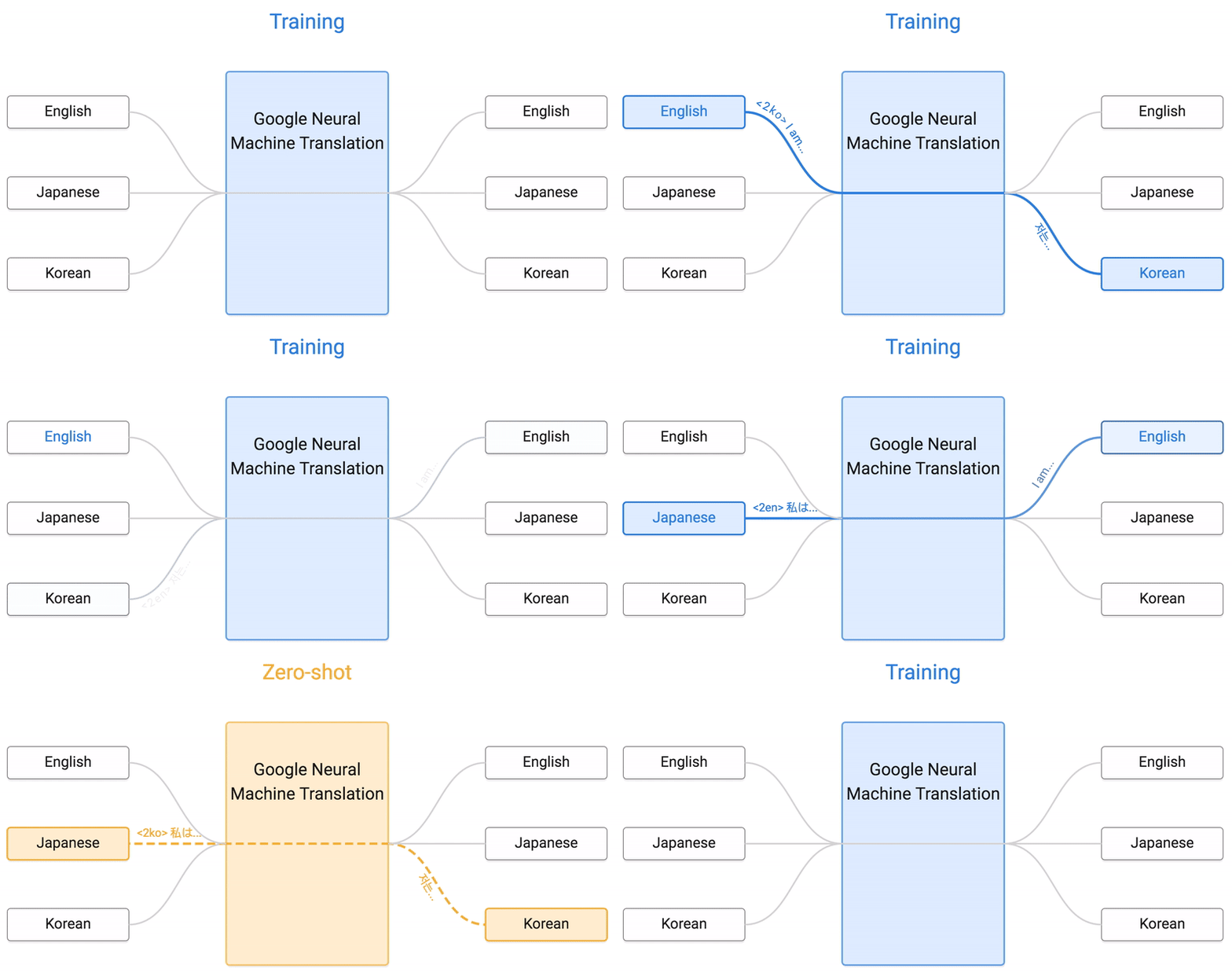
After a little over a month of learning more languages to translate beyond Spanish, Google's recently announced Neural Machine Translation system has used deep learning to develop its own internal language. TechCrunch reports: GNMT's creators were curious about something. If you teach the translation system to translate English to Korean and vice versa, and also English to Japanese and vice versa... could it translate Korean to Japanese, without resorting to English as a bridge between them? They made this helpful gif to illustrate the idea of what they call "zero-shot translation" (it's the orange one). As it turns out -- yes! It produces "reasonable" translations between two languages that it has not explicitly linked in any way. Remember, no English allowed. But this raised a second question. If the computer is able to make connections between concepts and words that have not been formally linked... does that mean that the computer has formed a concept of shared meaning for those words, meaning at a deeper level than simply that one word or phrase is the equivalent of another? In other words, has the computer developed its own internal language to represent the concepts it uses to translate between other languages? Based on how various sentences are related to one another in the memory space of the neural network, Google's language and AI boffins think that it has. The paper describing the researchers' work (primarily on efficient multi-language translation but touching on the mysterious interlingua) can be read at Arxiv. -
Charter Customer Sues Over Hidden Fees, Claims 'Massive Billing Fraud' (arstechnica.com)
An anonymous reader quotes a report from Ars Technica: A Charter customer has sued the cable company, alleging that it falsely advertises a lower price than it actually charges and falsely tells customers that extra fees tacked onto their bills are mandated by the government. The complaint, filed in California State Superior court in San Diego, takes aim at the "Broadcast TV" and "Sports Programming" surcharges that are added to customers' bills despite not being included in the advertised rate. "Charter is committing massive billing fraud by disguising price increases above the advertised and promised service package price in the form of the bogus 'Broadcast TV and Sports Programming Surcharges' line item on customer bills," said the lawsuit filed last week by Michael Song. The plaintiff is a subscriber in California, where Charter, the second largest cable company in the US after Comcast, operates via its newly acquired Time Warner Cable (TWC) subsidiary. Song is paying an extra $8.75 a month from those two fees combined. In addition to subtracting the fees from the advertised price, Charter falsely tells customers that it collects the fees to comply with government mandates, the lawsuit says. A Charter/TWC bill from last month is included in the complaint, and it says, "TWC imposes surcharges to recover costs of complying with its governmental obligations." Song's complaint also has a transcript of a chat with a Charter customer service agent, who claimed that Charter pays the broadcast fee back to the government. The customer service agent apparently has only a limited grasp of English, but the chat transcript helps illustrate one of the ways in which customers are being misinformed about their bills. Song's lawsuit repeatedly refers to the Broadcast TV and Sports Programming surcharges as "bogus" and "hidden," since they subtract a portion of the standard monthly charges from the "services" section of the bill. -
Google Surfaces Fake News About Election Results (theverge.com)
An anonymous reader quotes a report from The Verge: Last week, Facebook faced criticism that the platform's habit for surfacing fake news contributed to the election of Donald Trump -- a claim Mark Zuckerberg denied. This week, Google faces a similar problem, as its search algorithm surfaces fake election results. As Mediaite's Dan Abrams first reported, when you search "final election numbers" or "final vote count 2016," the first result in Google's "in the news" box is from a scrappy-looking Wordpress blog called 70 News that appears to be run by one person. The article, posted on November 12th, features the headline "FINAL ELECTION 2016 NUMBERS: TRUMP WON BOTH POPULAR ( 62.9 M -62.2 M ) AND ELECTORAL COLLEGE VOTES ( 306-232)HEY CHANGE.ORG, SCRAP YOUR LOONY PETITION NOW!" First, the numbers in this post are inaccurate. Though millions of votes have yet to be counted, but Clinton has already been shown to be leading the popular vote by a sizable margin. Current counts have her ahead by around 668,000 total votes, with some polling experts projecting Clinton will ultimately rack up a 2 million-vote lead. Second, the writer of the 70 News post claims that the source material for the article is "Twitter posts," specifically, this tweet from a user named Michael. Michael, on the other hand, is sourcing an article from the ultra-conservative tabloid USA Supreme, which argues that Clinton might win the number of votes "counted" but will not win the number of votes "cast" because of ignored Republican absentee ballots. (Michael also believes that Trump has been singled out by God to be president of the United States, a conspiracy theory popular with 4chan users who believe that Pepe the Frog is a reincarnation of an ancient Egyptian deity.) And yet Michael -- by way of 70 News, by way of Google -- has become the sole source for a story squatting at the top of Google's search results. 70 News has since updated its post with a single line admitting that CNN is showing different numbers -- the headline and the body of the post remains the same. -
Google Surfaces Fake News About Election Results (theverge.com)
An anonymous reader quotes a report from The Verge: Last week, Facebook faced criticism that the platform's habit for surfacing fake news contributed to the election of Donald Trump -- a claim Mark Zuckerberg denied. This week, Google faces a similar problem, as its search algorithm surfaces fake election results. As Mediaite's Dan Abrams first reported, when you search "final election numbers" or "final vote count 2016," the first result in Google's "in the news" box is from a scrappy-looking Wordpress blog called 70 News that appears to be run by one person. The article, posted on November 12th, features the headline "FINAL ELECTION 2016 NUMBERS: TRUMP WON BOTH POPULAR ( 62.9 M -62.2 M ) AND ELECTORAL COLLEGE VOTES ( 306-232)HEY CHANGE.ORG, SCRAP YOUR LOONY PETITION NOW!" First, the numbers in this post are inaccurate. Though millions of votes have yet to be counted, but Clinton has already been shown to be leading the popular vote by a sizable margin. Current counts have her ahead by around 668,000 total votes, with some polling experts projecting Clinton will ultimately rack up a 2 million-vote lead. Second, the writer of the 70 News post claims that the source material for the article is "Twitter posts," specifically, this tweet from a user named Michael. Michael, on the other hand, is sourcing an article from the ultra-conservative tabloid USA Supreme, which argues that Clinton might win the number of votes "counted" but will not win the number of votes "cast" because of ignored Republican absentee ballots. (Michael also believes that Trump has been singled out by God to be president of the United States, a conspiracy theory popular with 4chan users who believe that Pepe the Frog is a reincarnation of an ancient Egyptian deity.) And yet Michael -- by way of 70 News, by way of Google -- has become the sole source for a story squatting at the top of Google's search results. 70 News has since updated its post with a single line admitting that CNN is showing different numbers -- the headline and the body of the post remains the same. -
Facebook Bug Tells Users They Are Dead (fortune.com)
On Friday afternoon, many Facebook users logged into their accounts to see that the social media site declared them to be dead. Fortune's Jeff John Roberts reports that the bug has impacted their editor Rachel King: The lethal online epidemic is causing Facebook to display a small memorial message above users' regular homepage profile. In the case of my editor, Rachel King, Fortune tech writers who visited her page discovered a "Remembering Rachel King" message, and a wish to remember to remember and celebrate her life. I can assure you that Rachel is very much alive (and reminding me about the Oxford comma). But if you're wondering what it looks like, here's a screenshot. I'm still alive (for now) but it appears the bug is spreading quickly to others in the media, and has reportedly even affected the pages of Facebook CEO Mark Zuckerberg. While Friday's wave of Facebook fatalities was clearly a bug or a hoax of some sort, the social network does offer a function that allows people to turn the profile pages of loved ones into a "Memorial." The company has since fixed the bug and offered an apology: "For a brief period today, a message meant for memorialized profiles was briefly posted to other accounts. This was a terrible error that we now have fixed. We are very sorry that this happened and we worked as quickly as possible to fix it." -
IMDb Sues California To Overturn Law Forcing Them To Remove Actors' Ages (theguardian.com)
An anonymous reader quotes a report from The Guardian: The Internet Movie Database (IMDb) is suing California over a law forcing the website to remove the ages of actors on request, saying it is unconstitutional. California passed a law in September ruling that "a commercial online entertainment employment service provider" would be required to remove details of the age of any of its subscribers within five days, on the request of the subscriber. The law was intended to fight age discrimination in the film industry and had been campaigned for by actors' groups. The president of the union Sag-Aftra wrote in August that actors "face blatant age discrimination every day as websites routinely used for casting talent force birth dates and ages on casting decision-makers without their even realizing it." However, IMDb's suit (pdf) claims that the law "does not advance, much less achieve" the goal of reducing age discrimination, and that it violates both the first amendments and commerce clause of the U.S. constitution. IMDb also claims it separately violates federal law "because it imposes liability on IMDb based on factual content that is lawfully posted by its users." The website criticizes the state of California for passing the law, saying it has "chosen to chill free speech and undermine public access to factual information." IMDb says it is being unfairly targeted and that the law does not deal with the main cause of age discrimination. The case claims the law is both too broad -- as it includes all film professionals, rather than just those who could expect to be the target of age discrimination such as actors -- and too narrow, as it fails to impose the same restrictions on the "myriad other sources of the same information," such as Wikipedia, Google or specialist websites that list the birthdays of famous people. IMDb also says that subscribers to its paid professional service, IMDb Pro, have been able to edit or remove biographical details about themselves on the site since 2010. -
Feds Charge 61 People In Indian-Based IRS Phone Scam Case (consumerist.com)
BUL2294 writes: Following the arrests earlier this month in India of call center employees posing as IRS or immigration agents, USA Today and Consumerist are reporting that the U.S. Department of Justice has charged 61 people in the U.S. and India of facilitating the scam, bilking millions from Americans thinking they were facing immediate arrest and prosecution. "According to the indictment (PDF) -- which covers 20 individuals in the U.S. and 32 people and five call centers in India -- since about 2012 the defendants used information obtained from data brokers and other sources to call potential victims impersonating officers from the IRS or U.S. Citizenship and Immigration Services," reports Consumerist. The report adds: "To give the calls an air of authenticity, the organization was able to 'spoof' phone numbers, making the calls appear to have really come from a federal agency. The callers would then allegedly threaten potential victims with arrest, imprisonment, fines, or deportation if they did not pay supposed taxes or penalties to the government. In instances when the victims agreed to pay, the DOJ claims that the call centers would instruct them to go to banks or ATMs to withdraw money, use the funds to purchase prepaid stored value cards from retail stores, and then provide the unique serial number to the caller. At this point, the operations U.S.-based counterparts would use the serial numbers to transfer the funds to prepaid reloadable cards. The cards would then be used to purchase money orders that were transferred into U.S. bank accounts of individuals or businesses. To make matters worse, the indictment claims that the prepaid debit cards were often registered using personal information of thousands of identity theft victims, and the wire transfers were directed by the organizations using fake names and fraudulent identifications. The operation would then use 'hawalas' -- a system in which money is transferred internationally outside of the formal banking system -- to direct the pilfered funds to accounts belonging to U.S.-based individuals. -
US Believes Hackers Are Shielded By Russia To Hide Its Role In Cyberintrusions: WSJ (newsmax.com)
According to a report from The Wall Street Journal (Warining: may be paywalled), U.S. officials are all but certain that the hacker Guccifer 2.0, who hacked the Democratic National Committee in June, is connected to a network of individuals and groups who are being shielded by the Russian government to mask its involvement in cyberintrusions. Even though the hacker denies working for the Russian government, the hacker is thought to be working with the hacking groups Fancy Bear and Cozy Bear, which have ties to the Russian government. The Wall Street Journal reports: Following successful breaches, the stolen data are apparently transferred to three different websites for publication, these people say. The websites -- WikiLeaks, DCLeaks.com and a blog run by Guccifer 2.0 -- have posted batches of stolen data at least 42 times from April to last week. Cybersecurity experts believe that DCLeaks.com and Guccifer 2.0 often work together and have direct ties to Russian hackers. Guccifer 2.0 said in a Twitter direct message sent to The Wall Street Journal that he wants to expose corruption in politics and shine light on how companies influence policy. The hacker said he also hopes to expose "global electronization." "I think I won't have a better opportunity to promote my ideas than this year," Guccifer 2.0 added in a long exchange with a Journal reporter. The Journal cannot verify the identity of the person sending messages on behalf of Guccifer 2.0, but the account is the same one that was used to publish personal information about Democrats. A posting on a blog run by Guccifer 2.0 says he is a man who was born in Eastern Europe, has been a hacker for years and fears for his safety. "I think u've never felt that feeling when u r crazy eager to shout: look everyone, this is me, this is me who'd done it," the hacker wrote to the Journal. "but u can't." WikiLeaks officials didn't respond to requests for comment on whether Russia fed them the stolen files published by WikiLeaks in July. A representative for DCLeaks.com asked the Journal to submit questions via email but hasn't responded to them. Last week, U.S. intelligence chielf James Clapper said it "shouldn't come as a big shock to people" that Russia is behind the hacking operation. While Russia has tried to interfere in U.S. elections since at least the 1960s by spying and funneling money to particular political groups, "I think it's more dramatic maybe because now they have the cyber tools," he said. -
Florida Regulators OK Plan To Increase Toxins In Water (washingtontimes.com)
An anonymous reader quotes a report from Washington Times: Despite the objection of environmental groups, state environmental regulators voted Tuesday to approve new standards that will increase the amount of cancer-causing toxins allowed in Florida's rivers and streams under a plan the state says will protect more Floridians than current standards. The Environmental Regulation Commission voted 3-2 to approve a proposal that would increase the number of regulated chemicals from 54 to 92 allowed in rivers, streams and other sources of drinking water, news media outlets reported. The Miami Herald reports that under the proposal, acceptable levels of toxins will be increased for more than two dozen known carcinogens and decreased for 13 currently regulated chemicals. State officials back the plan because it places new rules on 39 other chemicals that are not currently regulated. The standards still must be reviewed by the U.S. Environmental Protection Agency, but the Scott administration came under withering criticism for pushing the proposal at this time. That's because there are two vacancies on the commission, including one for a commissioner who is supposed to represent the environmental community. -
Nintendo NX Is a Portable Console With Detachable Controllers, Says Report (eurogamer.net)
An anonymous reader writes from a report via Eurogamer.net: We now have a good idea as to what the Nintendo NX will consist of thanks to a new report from Eurogamer. According to a number of sources, Nintendo's upcoming NX will be a portable, handheld console with detachable controllers. Eurogamer.net reports: "On the move, NX will function as a high-powered handheld console with its own display. So far so normal -- but here's the twist: we've heard the screen is bookended by two controller sections on either side, which can be attached or detached as required. Then, when you get home, the system can connect to your TV for gaming on the big screen. A base unit, or dock station, is used to connect the brain of the NX -- within the controller -- to display on your TV. NX will use game cartridges as its choice of physical media, multiple sources have also told [Eurogamer]. Another source said the system would run on a new operating system from Nintendo. It won't, contrary to some earlier rumors, simply run on Android. [...] The system will harness Nvidia's powerful mobile processor Tegra. Graphical comparisons with current consoles are difficult due to the vastly different nature of the device -- but once again we've heard Nintendo is not chasing graphical parity. Quite the opposite, it is sacrificing power to ensure it can squeeze all of this technology into a handheld, something which also tallies with earlier reports. Finally, we've heard from one source that NX planning has recently moved up a gear within Nintendo ahead of the console's unveiling, which is currently slated for September. After the confused PR fiasco of the Wii U launch, the company is already settling on a simple marketing message for NX -- of being able to take your games with you on the go." -
Google Tests Ads That Load Faster and Use Less Power (bbc.co.uk)
Slashdot reader Big Hairy Ian quotes a report from the BBC: Google says it has found a way to make ads load faster on web pages viewed on smartphones and tablets. The company said the ads would also be less taxing on the handsets' processors, meaning their batteries should last longer. The technique is based on work it has already done to make news publishers' articles load more quickly. But it is still in development, and one expert said Google still had questions to answer. The California-based company's online advertising revenue totalled $67.4 billion last year...
The technique limits the scope of JavaScript, and "provides its own activity measurement tools, which are said to be much more efficient," according to article. A Google software engineer explains that this technique "only animates things that are visible on the screen," and throttles animation to fewer frames per second for weaker devices -- or disables the animations altogether. "This ensures that every device gets the best experience it can deliver and makes sure that ads cannot have a negative impact on important aspects of the user experience such as scrolling." -
Fortune 500 Company Hires Ransomware Gang To Hack the Competition (vice.com)
It's no secret that ransomware hackers are in the business to make money. But a new business arrangement hitting the news today may surprise many. Vice's Motherboard, citing research and investigation (PDF) from security firm F-Secure, is reporting that a Fortune 500 company, the name of which hasn't been unveiled, hired a ransomware gang to hack its competitors. From the article: In an exchange with a security researcher pretending to be a victim, one ransomware agent claimed they were working for a Fortune 500 company. "We are hired by [a] corporation to cyber disrupt day-to-day business of their competition," the customer support agent of a ransomware known as Jigsaw said, according to a new report by security firm F-Secure. "The purpose was just to lock files to delay a corporation's production time to allow our clients to introduce a similar product into the market first."In a statement to Motherboard, Mikko Hypponen said, "If this indeed was a case where ransomware was used on purpose to disrupt a competitor's operation, it's the only case we know of." F-Secure adds that the consumer representative noted that "politicians, governments, husbands, wives -- people from all walks of life contract [them] to hack computers, cell phones." -
Researchers Develop Atomic-Scale Hard Drive That Writes Information Atom By Atom (techcrunch.com)
An anonymous reader quotes a report from TechCrunch: Researchers in the Netherlands have created a microscopic storage system that encodes every bit with a single atom -- allowing them to fit a kilobyte in a space under 100 nanometers across. That translates to a storage density of about 500 terabits per square inch. For comparison, those 4-terabyte hard drives you can buy today are about 1 terabit per square inch. That's because, unlike this new system, they use hundreds or thousands of atoms to store a single bit. "Every bit consists of two positions on a surface of copper atoms, and one chlorine atom that we can slide back and forth between these two positions," explained Sander Otte, lead scientist at Delft University of Technology, in a news release. Because chlorine on copper forms into a perfectly square grid, it's easy (relatively, anyway) to position and read them. If the chlorine atom is up top, that's a 1; if it's at the bottom, that's a 0. Put 8 chlorine atoms in a row and they form a byte. The data the researchers chose to demonstrate this was a fragment of a Feynman lecture, "There's plenty of room at the bottom" (PDF) -- fittingly, about storing data at extremely small scales. (You can see a high-resolution image of the array here.) The chlorine-copper array is only stable in a clean vacuum and at 77 kelvin -- about the temperature of liquid nitrogen. Anything past that and heat will disrupt the organization of the atoms. The research was published today in the journal Nature Nanotechnology. -
Ubuntu's Unity desktop environment can run in Windows (wordpress.com)
An anonymous Slashdot reader writes: "This is one of the coolest tickets I've seen on GitHub," writes Ubuntu developer Adolfo Jayme Barrientos, adding "this kind of surreal compatibility between platforms is now enabled...the fact that you can execute and use Linux window managers there, without virtual machines, is simply mind-blowing."
"The Windows 10 Anniversary Update coming in August includes an unusual feature aimed at developers: an Ubuntu sub-system that lets you run Linux software using a command-line interface," explains Liliputing.com "Preview versions have been available since April, and while Microsoft and Canonical worked together to bring support for the Bash terminal to Windows 10, it didn't take long for some users to figure out that they could get some desktop Linux apps to run in Windows. Now it looks like you can even load Ubuntu's Unity desktop environment, making windows 10 look like Ubuntu. -
Facebook Messenger To Get End-To-End Encryption
Reader wiredmikey writes: Facebook announced Friday it would roll out optional "end to end encryption" for its Messenger application, following a trend aimed at stronger security and protection against snooping. The new feature will be known as "secret conversations" which can be read only by the sender and recipient. Facebook shared technical details about its implementation of the security in a technical white paper (PDF). Facebook earlier this year began implementing this end-to-end encryption on its WhatsApp messaging service.ZDNet's Zack Whittaker, however, warns about a catch in Facebook's effort. He writes: But already the company has faced some criticism for not encrypting messages by default, instead making the service opt-in, like Apple's iMessage, or even Facebook's other chat app, WhatsApp, which recently switched on default end-to-end encryption earlier this year. Cryptographer and Johns Hopkins professor Matthew Green, who reviewed an early version of the system, said in a tweet that though you "have to turn on encryption per thread," he added that providing encryption to almost a billion people makes it hard to "put that genie back in the bottle." -
Guccifer 2.0 Calls DNC Hack His "Personal Project," Mocks Security Firms (computerworld.com)
An anonymous reader writes: The notorious hacker most recently in the news for releasing Clinton Foundation documents has said on Thursday in a blog post that the stolen confidential files from the DNC was his "personal project." Guccifer 2.0, as he identifies himself as, added that security firms and the DNC may be trying to blame the attack on Russia, but "they can prove nothing! All I hear is blah-blah-blah, unfounded theories, and somebody's estimates," he wrote. He claims to be Romanian and says he acted alone, pouring water on the theory that he may be a "smokescreen" to divert attention away from the real culprits, that may have been expert hacking teams based in Russia. "I'd like to reveal a secret to all those cool IT-specialists: All the hackers in the world use almost the same tools," he said. "You can buy them or simply find them on the web." He broke into the network using a little-known vulnerability found in the DNC's software, he added. "The DNC used Windows on their server, so it made my work much easier," he said. "I installed my trojan-like virus on their PCs. I just modified the platform that I bought on the hacking forums for about $1.5k." Guccifer 2.0 also disputed the idea that the DNC breach was an intelligence gathering operation for Russia, saying it was hacktivism. -
Study: 78% of Resold Drives Still Contain Readable Personal or Business Data (consumerist.com)
itwbennett writes: Blancco Technology Group, which specializes in data erasure, bought 200 secondhand PC storage drives (PDF) from eBay and Craigslist to see if they could recover any of the old data saved inside. Their findings: 78 percent of the drives contained residual data that could be recovered, 67 percent still held personal files, such as photos with location indicators, resumes and financial data, and 11 percent of the drives also contained company data, such as emails, spreadsheets and customer information. Only 10 percent had all the data securely wiped, Blancco said. The Consumerist points out that Blancco makes their money from promising secure data erasure, so the company has a "strong and vested interest in these results." As for why so many of the drives contain unwanted information, the report says it has to do with the difference between "deleting" data and "erasing" data. Your files aren't actually deleted when you drag them to the Trash or Recycle Bin, or by using the delete key -- shocking, I know. You can format a drive to erase the data, but you have to be careful of the format commands being used. A quick format, which was used on 40% of the drives in the sample, still leaves some residual data on the drive for someone to possibly access. A full format, which was used on 14% of the drives, will do a better job in removing unwanted files, but it too may still miss some crucial information. The solution Blancco recommends: buy a tool to perform complete data erasure.