Slashdot Mirror
Domain: wsj.com
Stories and comments across the archive that link to wsj.com.
Stories · 1,821
-
Under Armour/Lockheed Suit Blamed For US Skating Performance
Koreantoast writes "The United States' surprisingly poor performance in speedskating, despite strong performances in recent World Cup events, has been blamed in part on an untested speedskating suit. The Mach 39, designed through a joint venture between Under Armour and Lockheed Martin, was supposed to provide Team USA with a high tech advantage, using advanced fluid dynamic models and a dimpled surface to disrupt air flow and improve comfort. Instead, performances have been disastrous thus far, with athletes going as far as modifying their suits at the Olympics to try and reverse their fortunes. The suits have caused enough concerns that U.S. Speedskating is taking the unusual step of seeking special dispensation from International Skating Union to ditch the high tech suits and switch back to their old uniforms. Teams are normally required to keep the same equipment through the entire Games. Insert jokes and comparisons to Lockheed's more famous product, the JSF, here." -
Target's Internal Security Team Warned Management
david.emery writes "According to this story, Target's own internal computer security team raised concerns months before the retailer lost millions of credit card numbers in an attack. (Quoting a paywalled story in the Wall Street Journal.) Target's management allegedly 'brushed them off.' 'At least one analyst at the Minneapolis-based retailer wanted to do a more thorough security review of its payment system.' This raises a more general question for the Slashdot community: how many of you have identified vulnerabilities in your company's/client's systems, only to be 'brushed off?' If the company took no action, did they ultimately suffer a breach?" -
Can Electric Current Make People Better At Math?
cold fjord sends this excerpt from the Wall Street Journal: "In a lab in Oxford University's experimental psychology department, researcher Roi Cohen Kadosh is testing an intriguing treatment: He is sending low-dose electric current through the brains of adults and children as young as 8 to make them better at math. A relatively new brain-stimulation technique called transcranial electrical stimulation may help people learn and improve their understanding of math concepts. The electrodes are placed in a tightly fitted cap and worn around the head. ... The mild current reduces the risk of side effects, which has opened up possibilities about using it, even in individuals without a disorder, as a general cognitive enhancer. Scientists also are investigating its use to treat mood disorders and other conditions. ... Up to 6% of the population is estimated to have a math-learning disability called developmental dyscalculia, similar to dyslexia but with numerals instead of letters. [In an earlier experiment, Kadosh] found that he could temporarily turn off regions of the brain known to be important for cognitive skills. When the parietal lobe of the brain was stimulated using that technique, he found that the basic arithmetic skills of doctoral students who were normally very good with numbers were reduced to a level similar to those with developmental dyscalculia. That led to his next inquiry: If current could turn off regions of the brain making people temporarily math-challenged, could a different type of stimulation improve math performance?" -
Death Hovers Politely For Americans' Swipe-and-Sign Credit Cards
schwit1 writes "U.S. banks and merchants are shifting to a more secure way of authorizing credit card transactions in which customers will enter a personal identification number (PIN) at checkout instead of signing a receipt. The US is the last major market in the world using the signature system, which is part of the reason why a disproportionate amount of credit card fraud happens here. The change is especially relevant given the massive fraud perpetrated against customers of Target in the fall. During a Congressional hearing last week, Target CFO John Mulligan said the company is accelerating the $100 million effort to switch to the so-called "chip and pin" system. The change won't happen all at once. Banks must issue cards with microprocessors and merchants need the right equipment to process the chip and PIN transactions, which is likely to happen gradually. But Visa, American Express, and MasterCard have announced that banks and merchants that have not adopted the technology for face-to-face transactions by October 2015 will be liable for fraudulent purchases. That's a strong incentive to get up to date. The new system will also prepare merchants and banks to transition to contactless payments in the near future." -
Judge Says You Can Warn Others About Speed Traps
cartechboy writes "Speeding is against the law, and yes, even going 5 mph over the speed limit is breaking the law. But everyone does it, right? What about when you see a cop? Some cops are ticketing people for notifying fellow motorists about speed traps. In Florida, Ryan Kintner simply flashed his high-beams to warning oncoming cars that there was a cop ahead. He was given a ticket for doing so. He went to court to fight the ticket, and a judge ruled that flashing lights are the equivalent of free speech, thus he had every right to flash his lights to warn oncoming cars." -
Virtual Boss Keeps Workers On a Short Leash
Gr8Apes writes "Hitachi has created a 'perfect virtual boss.' The company is manufacturing and selling a device intended to increase efficiency in the workplace called the Hitachi Business Microscope (paywalled). 'The device looks like an employee ID badge that most companies issue. Workers are instructed to wear it in the office. Embedded inside each badge, according to Hitachi, are "infrared sensors, an accelerometer, a microphone sensor and a wireless communication device." Hitachi says that the badges record and transmit to management "who talks to whom, how often, where and how energetically." It tracks everything. If you get up to walk around the office a lot, the badge sends information to management about how often you do it, and where you go. If you stop to talk with people throughout the day, the badge transmits who you're talking to (by reading your co-workers' badges), and for how long. Do you contribute at meetings, or just sit there? Either way, the badge tells your bosses.'" -
Nintendo Could Base Comeback On Improving Peoples' Health
Nerval's Lobster writes: "It's no secret that Nintendo faces significant challenges: revenues are down, rival platforms such as Microsoft's Xbox One and Sony's PlayStation 4 are attracting a lot of buzz, and iOS and Android have made significant inroads into mobile gaming. Rather than double down on its core business, however, Nintendo reportedly sees its salvation in new, nongaming segments such as... monitoring your health? 'We have now redefined entertainment to mean making it fun for people to improve the quality of their lives,' Nintendo CEO Satoru Iwata told a company strategy meeting, according to The Wall Street Journal. But he refused to part with more detail about Nintendo's plans, except to claim that whatever's in the works isn't a wearable device along the lines of Nike's FuelBand or the FitBit, and it isn't an iteration of the Wii Balance Board, an accessory that measures the user's weight and center of balance while playing games." -
DOJ Announces New Methods For Reporting National Security Requests
As the NSA metadata collection scandal has developed, a number of technology and communications companies have fought to increase the transparency of the data collection process by publishing reports on how much data government agencies are asking them for. These transparency reports have been limited, however, because most government requests are entwined with a gag order. In a speech two weeks back, President Obama said this would change, and now the Dept. of Justice has announced new, slightly relaxed rules about what information companies can share. According to an email from the U.S. Deputy Attorney General (PDF) to the General Counsel of Google, Facebook, LinkedIn, Microsoft, and Yahoo, the companies can publish: how many Criminal Process requests they received, how many National Security Letters they received, how many accounts were affected by NSLs, how many Foreign Intelligence Surveillance Act orders were received (both for communications content and 'non-content'), and how many customers were targeted by FISA requests. The companies still aren't allowed to give specific numbers, but they can report them in bands of 1,000 — for example, 0-999, 1,000-1,999, etc. Information requests for old services cannot be disclosed for at least six months. The first information requests for a new service cannot be disclosed for two years. The companies also have the option of lumping all the NSL and FISA requests together — if they do that, they can report in bands of 250 instead of 1,000. -
An OS You'll Love? AI Experts Weigh In On Her
theodp writes "Weighing in for the WSJ on Spike Jonze's Oscar-nominated, futuristic love story Her (parodies), Stephen Wolfram — whose Wolfram Alpha drives the AI-like component of Siri — thinks that an operating system like Samantha as depicted in the film isn't that far off. In Her, OS Samantha and BeautifulHandwrittenLetters.com employee Theodore Twombly have a relationship that appears to exhibit all the elements of a typical romance, despite the OS's lack of a physical body. They talk late into the night, relax on the beach, and even double date with friends. Both Wolfram and Google director of research Peter Norvig (who hadn't yet seen the film) believe this type of emotional attachment isn't a big hurdle to clear. 'People are only too keen, I think, to anthropomorphize things around them,' explained Wolfram. 'Whether they're stuffed animals, Tamagotchi, things in videogames, whatever else.' By the way, why no supporting actor nomination for Jonze's portrayal of foul-mouthed animated video game character Alien Child?" -
VC Likens Google Bus Backlash To Nazi Rampage
theodp writes "Valleywag reports on legendary Silicon Valley venture capitalist Tom Perkins' WSJ op-ed on class tensions, in which the KPCB founder and former HP and News Corp. board member likens criticism of the techno-affluent and their transformation of San Francisco to one of the most horrific events in Western history. 'I would call attention to the parallels of Nazi Germany to its war on its "one percent," namely its Jews, to the progressive war on the American one percent, namely the "rich,"' Perkins writes. 'There is outraged public reaction to the Google buses carrying technology workers from the city to the peninsula high-tech companies which employ them. We have outrage over the rising real-estate prices which these "techno geeks" can pay...This is a very dangerous drift in our American thinking. Kristallnacht was unthinkable in 1930; is its descendent 'progressive' radicalism unthinkable now?"'" -
Why Whistleblowers Can't Get a Fair Trial
phantomfive writes "'Seven whistleblowers have been prosecuted under the Obama administration,' writes Jesselyn Radack, a lawyer who advised two of them. She explains why they can't get a fair trial. In the Thomas Drake case, the administration retroactively marked documents as classified, saying, 'he knew they should have been classified.' In the Bradley Manning case, the jury wasn't allowed to see what information was leaked. The defendants, all who have been charged with espionage, have limited access to court documents. Most of these problems happen because the law was written to deal with traitorous spies, not whistleblowers." -
Sites Blocked By Smartfilter, Censored in Saudi Arabia
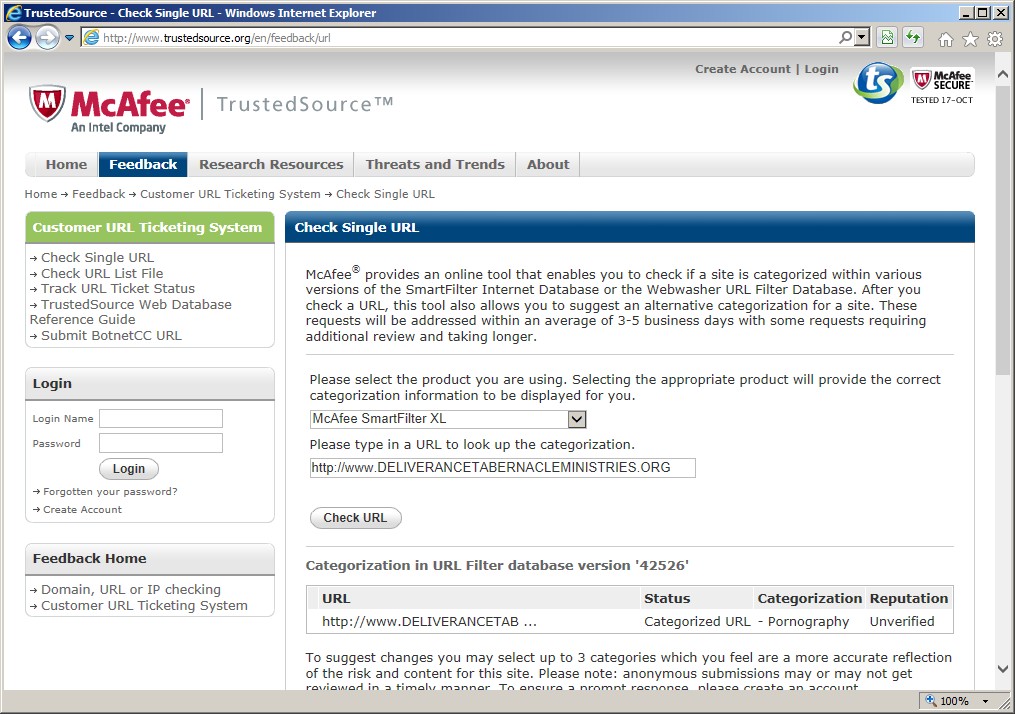
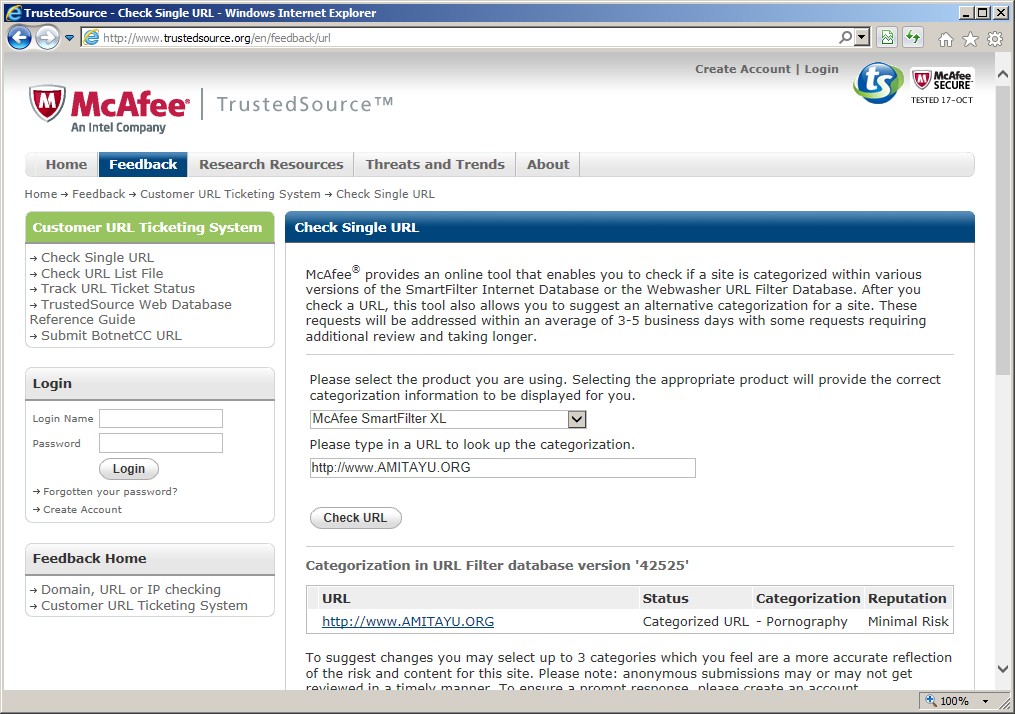
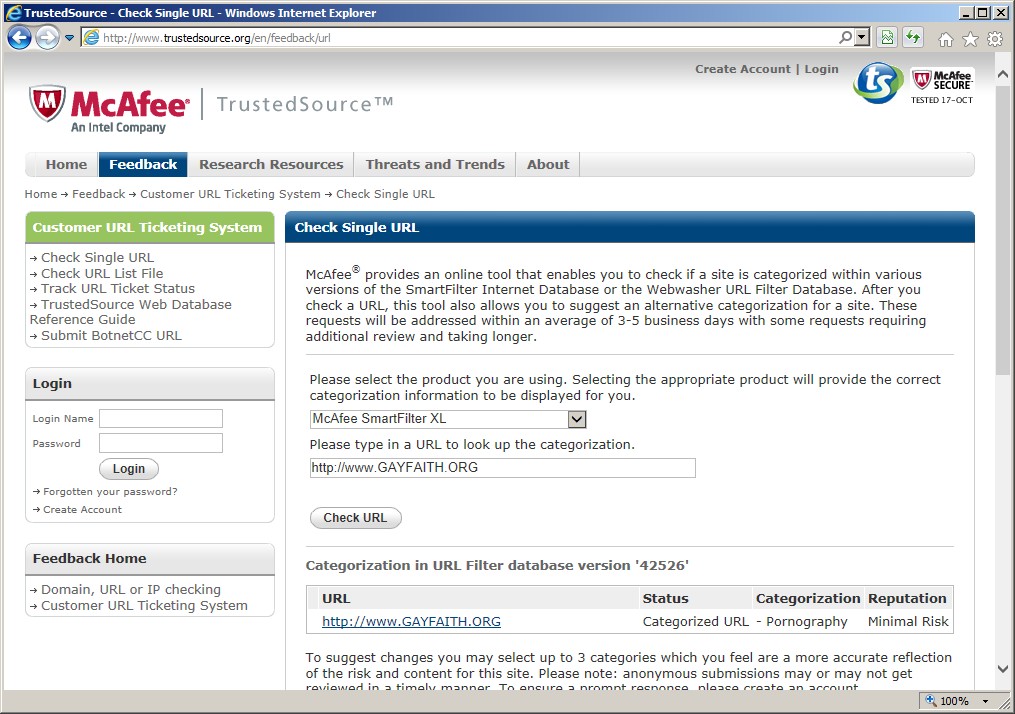
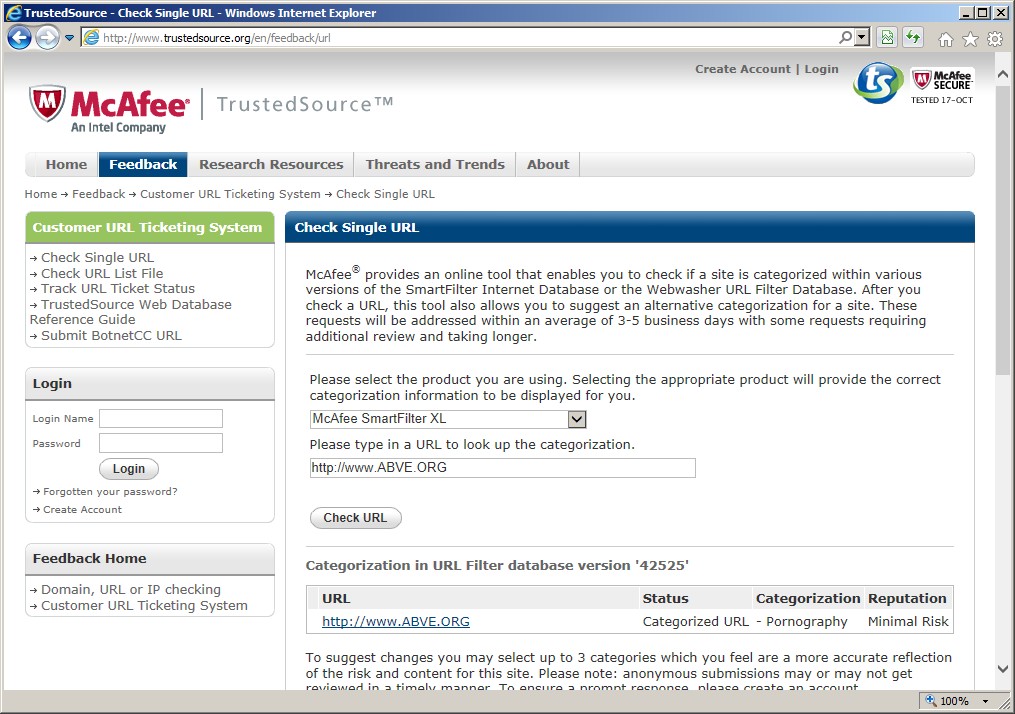
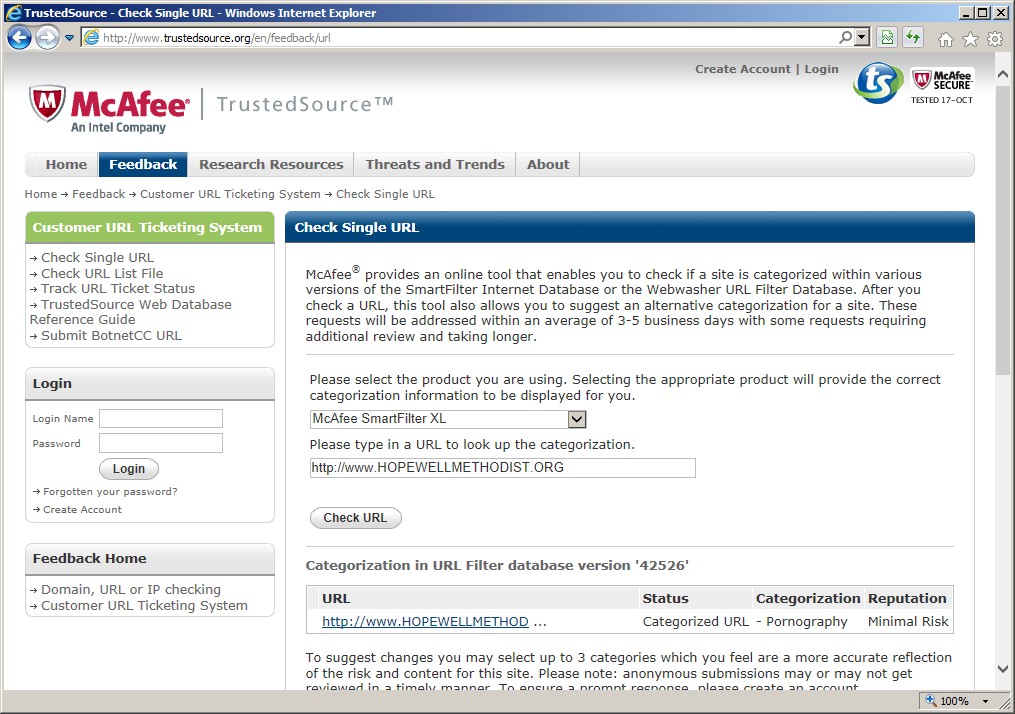
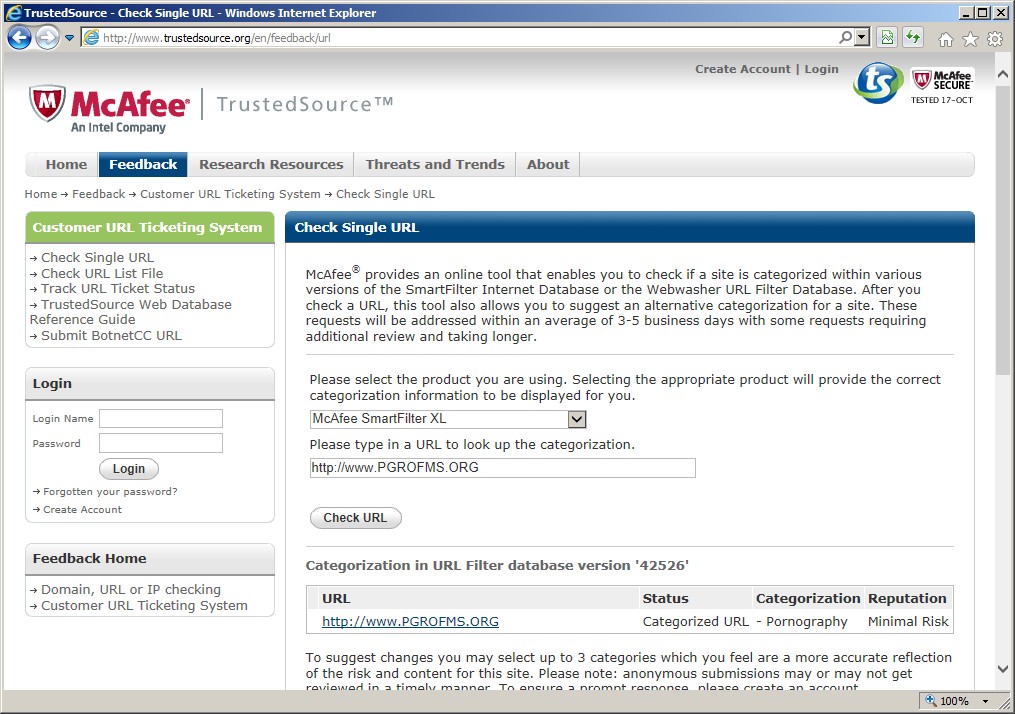
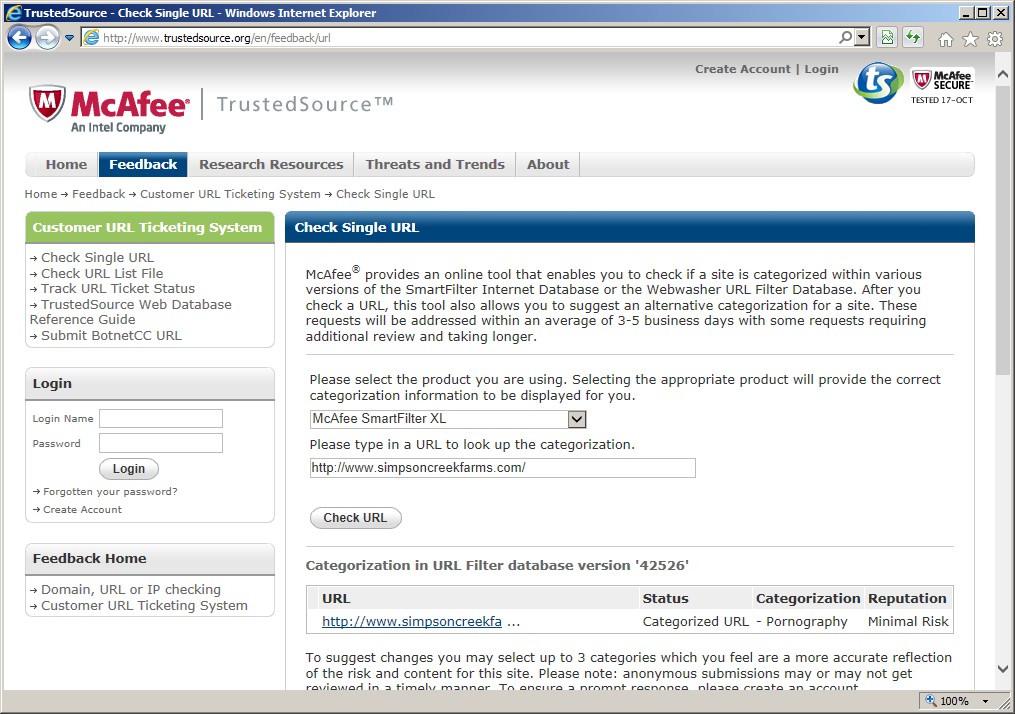
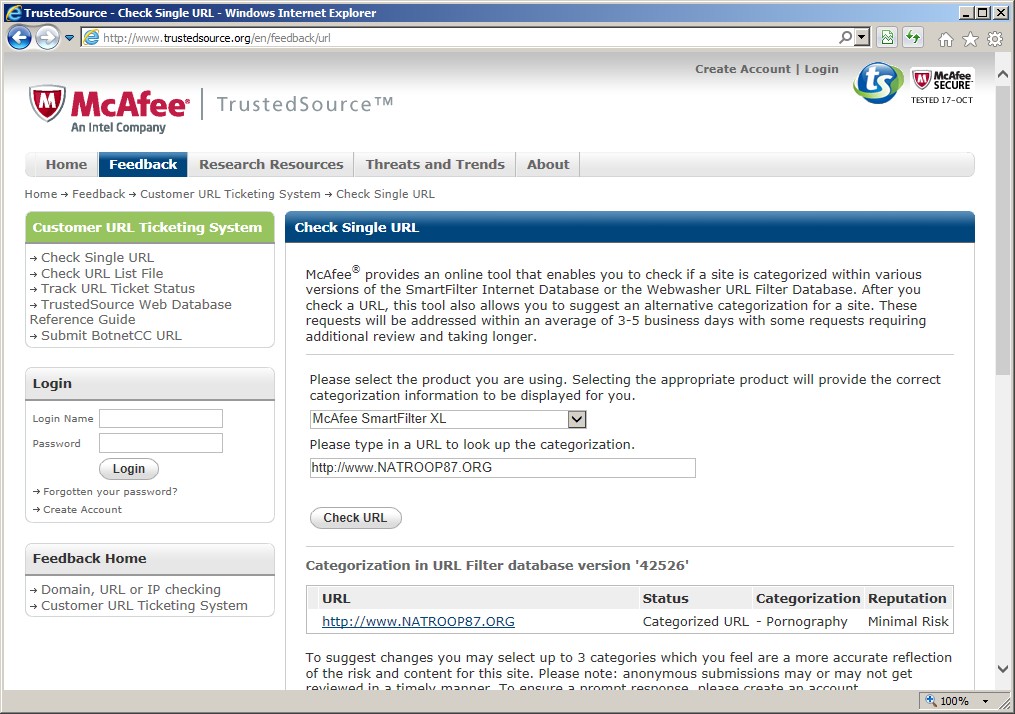
Slashdot contributor Bennett Haselton writes: "Internet users in Saudi Arabia, along with most users in the United Arab Emirates, are blocked by their respective government censors from accessing the websites of the Trinity Davison Lutheran Church, Deliverance Tabernacle Ministries in Pittsburgh, the Amitayu Buddhist Society of Taiwan, and GayFaith.org. An attempt to access any of those websites yields an error page like this one. However, the sites are not blocked because they conflict with the religions beliefs of those countries' governments. Rather, they are blocked because Smartfilter -- the American-made blocking program sold by McAfee, and used for state-mandated Internet censorship in those countries -- classifies those sites as "pornography". You can see the screen shots here, here, here and here." Read on for the rest of Bennett's thoughts.I found these blocked sites by starting with a combination of URL lists and ad hoc spidering, and running as many sites as possible through the Saudi filters to catch the ones that were blocked. Some of the sites were blocked for reasons that were easy to guess -- for example, http://www.bighornbasinsfw.org/, the home page of the Big Horn Basin, Wyoming chapter of Sportsmen for Fish & Wildlife, was almost certainly blocked because of the slang term "nsfw" in their URL. http://www.AgainstPornography.org and http://www.SearchingForMySpermDonorFather.org were presumably blocked because of the presence of the words "porn" and "sperm".
On the other hand, there appears to be no rational reason why the Filipino American Women's Network, the Tuscon Jazz Institute, or the Sacramento Police Activities League would have been blocked by Smartfilter, even by accident. A partial list of the blocked sites that I found is in the blog post I wrote for Citizen Lab, an Internet censorship research center at the University of Toronto.
Articles about sites that are erroneously blocked by Internet censorship software, have a storied history. The first widely read piece was the article "Keys to the Kingdom" written by Brock Meeks and Declan McCullagh in 1996, calling out Cyber Patrol for blocking EnviroLink.org and the University of Newcastle Computer Science Department, and CYBERsitter for blocking the National Organization for Women. I made a minor name for myself and the Peacefire.org site in the late 1990's by writing more pages about sites blocked by other products, including some (like X-Stop and SurfWatch) which no longer exist, and others that are still around, including Smartfilter. I was also one of six people comprising the Censorware Project, a loosely organized group of volunteers that published a few more reports.
By the early 2000's, however, it became clear that anyone whose mind was likely to be changed by information about what kinds of sites were blocked by blocking software, would have changed their mind already (or would, if they came across the research that had already been done up to that point). So the further reports on Internet blocking software errors, by me and other people, slowed to a trickle. I wrote a report in January 2002 on the latest list of sites blocked by Cyber Patrol, a product that most people today have forgotten. In 2006 I worked with the ACLU of Washington to publish a report on sites erroneously blocked by FortiGuard, a program used on computers in some libraries in central Washington, as part of the ACLU's suit to challenge the constitutionality of the program's use on public library terminals. (The Washington State Supreme Court rejected the lawsuit on the grounds that, regardless of what sites were blocked on the computers, it didn't matter because an adult library patron could request for the filter to be turned off.) In 2007 I wrote an article for Slashdot titled "From Bess to Worse" listing some sites that were blocked by an Internet filtering program called Bess (which was later bought out by Smartfilter and discontinued).
Most people's awareness of this debate, if they had heard about it at all, was limited to the perception that "breast cancer sites" and sites about "chicken breast recipes" were sometimes filtered by Internet blocking programs. Or they heard that "Beaver College" actually had to change its name to avoid being censored by web filters. As I tried to explain in a FAQ (written, according to the Wayback Machine, in 1999, but which still broadly holds true today), these examples are true, but they miss the point. These examples make it sound as if blocking software companies are doing the best job they can under the circumstances, and that the errors are unavoidable due to limitations on machine intelligence. In reality, any software algorithm that blocks the American Board of Vocational Experts, the Hopewell United Methodist Church, and the Patriot Guard Riders of Mississippi, as "pornography" (as Smartfilter currently does), is probably not the best algorithm the company could have come up with -- but there's no incentive for them to try harder, because few people will ever look that deep.
And yet, people continue to remember the "breast cancer site" examples. This sounds to me like an example of the narrative fallacy -- people remember that breast cancer sites were blocked, because there's a tidy explanation. There is no tidy explanation for most other examples of blocked sites, so the meme never spreads very far. Conveniently for the blocking companies, the blocked-site errors which make the company look most sloppy (the Kennels at Simpson Creek Farms, the St. Francis Institute of Milwaukee, etc.) are precisely the ones that, due to the narrative fallacy, most people won't remember or hear about.
One company, CYBERsitter, did manage to make a few blocking decisions in the 1990s that were egregious enough that their antics did make the news, and did finally raise some people's awareness that the controversy over private Internet filtering extended beyond "breast cancer sites". After TIME Magazine's website published an article (no longer online) that criticized CYBERsitter's blocking policies, CYBERsitter responded by blocking TIME Magazine's pathfinder.com domain. A few months earlier, CYBERsitter had blacklisted the monthly e-Zine "The Ethical Spectacle, after the Spectacle's founder, Jonathan Wallace, published an article criticizing CYBERsitter for blocking my own Peacefire.org website. And Peacefire.org had been blocked, in turn, because of a page I wrote (now very much out of date) listing some of the sites that CYBERsitter blocked, including the International Gay and Lesbian Human Rights Commission and Mother Jones. (Nowadays, of course, nobody would be surprised that filtering companies block Peacefire.org, since the site publishes ample instructions on how to get around Internet blockers. But at the time, the site's first and only article was the list of sites blocked by CYBERsitter, which is why CYBERsitter received so much criticism for blocking the domain in retaliation.) CYBERsitter also threatened to have Meeks and McCullagh criminally prosecuted for writing "Keys to the Kingdom" and threatened to sue me over the page that I had made.)
The moral, it seems, is that if you want an example of a censored web site to stick in people's minds, it either has to be a forgivable error, or an insane vindictive dick move -- because in either of those cases, people will understand why it happened. The vast swaths of censored websites on the spectrum in between, the ones for which there is no rational explanation for the blocking, go ignored.
These days, though, American and Canadian "censorware" makers have also come under fire for selling censoring software to foreign governments which use them for country-wide censorship. Most of the criticism focuses, naturally, not on the kinds of sites that are accidentally blocked by the blocking software, but on the immorality of these companies enabling statewide foreign censorship in the first place. Netsweeper, Blue Coat, and McAfee have all made the claim that "Once we sell their product to them, we have no control over what they do with it" -- which, as I wrote previously in Slashdot, is nonsense, because for the product to be effective, it has to rely on updates to the blocked-site list, which are provided at regular intervals by the manufacturer. Cut off the updates, and the product will not work, at least not as well.
So the fact that McAfee has classified the Boy Scout Troop 87 of North Andover, the Pan-Iranist Party of Iran, and Reptile Conservation International as "Pornography" is (rightly) overshadowed by the fact that McAfee is selling to government censors in Saudi Arabia and the UAE in the first place. However, as long as the filters are installed, these blocked sites are at least part of the problem for users in those countries, just as much as they are for students or cubicle workers in the U.S. whose network administrators happen to use Smartfilter. And, of course, I sampled only a miniscule fraction of the Web to find these examples of blocked sites, so the true number of stupid blocks affecting Saudi and UAE users is likely to be much larger. For each individual example, you might reasonably ask, "Is it really a big deal if Saudis are blocked from accessing Boy Scout Troop 87 of North Andover?" But it adds up.
-
Amazon: We Can Ship Items Before Customers Order
An anonymous reader writes "The WSJ is reporting that Amazon has obtained a patent for 'anticipatory shipping,'' and claims it knows its customers so well it can start shipping even before orders are placed. The technique could cut delivery time and discourage consumers from visiting physical stores. In the patent document, Amazon says delays between ordering and receiving purchases 'may dissuade customers from buying items from online merchants.' Of course, Amazon's algorithms might sometimes err, prompting costly returns. To minimize those costs, Amazon said it might consider giving customers discounts, or convert the unwanted delivery into a gift. 'Delivering the package to the given customer as a promotional gift may be used to build goodwill,' the patent said. Considering the problems that can arise when shipping something a customer did not order anticipatory shipping has the potential to backfire faster than an Amazon drone can deliver." -
Nobel Prize Winning Economist: Legalize Sale of Human Organs
retroworks writes "Dr. Gary Becker (University of Chicago) and Julio Elias (Universidad CEMA, Argentina) wrote a thought-provoking editorial in last week's WSJ, arguing that the prohibition on voluntary sale and trade of human organs is probably killing people. In 2012, 95,000 American men, women and children were on the waiting list for new kidneys. Yet only about 16,500 kidney transplant operations were performed that year. 'The altruistic giving of organs might decline with an open market, since the incentive to give organs to a relative, friend or anyone else would be weaker when organs are readily available to buy. On the other hand, the altruistic giving of money to those in need of organs could increase to help them pay for the cost of organ transplants.' Paying for organs would lead to more transplants, the article maintains. 'Initially, a market in the purchase and sale of organs would seem strange, and many might continue to consider that market "repugnant." Over time, however, the sale of organs would grow to be accepted, just as the voluntary military now has widespread support.'" -
Why the Major Labels Love (and Artists Hate) Music Streaming
Hugh Pickens DOT Com writes "Jay Frank writes that the big four music distributors and their sister publishers (Sony, Warner, UNI and EMI) make 15% more per year, on average, from paying customers of streaming services like Spotify or Rdio than it does from the average customer who buys downloads, CDs or both. Each label makes 'blanket license' deals with Streaming services with advances in the undisclosed millions, which is virtually the same as selling music in bulk; they receive these healthy licensing fees to cover all activity in a given period rather than allowing Streaming services to 'pay as they go.' 'Artists are up in arms, many are opting out of streaming services,' writes Frank. 'Lost in that noise is a voice that is seldom heard: that of the record companies. There's good reason for that: they're making more money from streaming and the future looks extremely bright for them.' The average 'premium' subscription customer in the U.S. was worth about $16 a year to a major record company, while the average buyer of digital downloads or physical music was worth about $14. Thus, year over year, the premium subscriber was worth nearly 15% more than the person who bought music either digitally or physically." -
India Frees Itself of Polio
An anonymous reader writes "It's been three years since the last recorded polio case in India and health officials hope to officially certify India polio free in the next few weeks. 'Hamid Jafari, director of the WHO's polio-eradication campaign, says the agency's ambitious quest to stop all polio transmission by the end of 2014 is now within reach. If that is achieved, and no new cases crop up for three years, polio—like smallpox—will be officially banished from the planet. "India was one of the most important sources" from where the virus spread to other countries, said Dr. Jafari.'" -
The Quiet Fury of Former Secretary of Defense Robert Gates
An anonymous reader writes "Activities, technologies, equipment, or other matters regarding the U.S. Department of Defense are a common topic on Slashdot, both as stories and in discussions. Despite that, we seldom see stories regarding the senior leadership of DoD as we do for technologists, the political branches, and lately the NSA. Former Secretary of Defense Robert Gates, who served under both Presidents Bush and Obama, has released a rather biting memoir of his tenure as the Secretary of Defense. The Wall Street Journal has an excerpt: '... despite everyone being "nice" to me, getting anything consequential done was so damnably difficult — even in the midst of two wars. I did not just have to wage war in Afghanistan and Iraq and against al Qaeda; I also had to battle the bureaucratic inertia of the Pentagon, surmount internal conflicts within both administrations, avoid the partisan abyss in Congress, evade the single-minded parochial self-interest of so many members of Congress and resist the magnetic pull exercised by the White House, especially in the Obama administration, to bring everything under its control and micromanagement. Over time, the broad dysfunction of today's Washington wore me down, especially as I tried to maintain a public posture of nonpartisan calm, reason and conciliation. ... difficulties within the executive branch were nothing compared with the pain of dealing with Congress. ... I saw most of Congress as uncivil, incompetent at fulfilling their basic constitutional responsibilities (such as timely appropriations), micromanagerial, parochial, hypocritical, egotistical, thin-skinned, and prone to put self (and re-election) before country.' — More at The Washington Post." -
NSA Drowns In Useless Data, Impeding Work, Former Employee Claims
An anonymous reader writes in with this story of confusion at the NSA due to the flood of data they harvest. "Some of the documents released by Mr. Snowden detail concerns inside the NSA about drowning in information. An internal briefing document in 2012 about foreign cellphone-location tracking by the agency said the efforts were 'outpacing our ability to ingest, process and store' data. In March 2013, some NSA analysts asked for permission to collect less data through a program called Muscular because the 'relatively small intelligence value it contains does not justify the sheer volume of collection,' another document shows. In response to questions about Mr. Binney's claims, an NSA spokeswoman says the agency is 'not collecting everything, but we do need the tools to collect intelligence on foreign adversaries who wish to do harm to the nation and its allies.'" -
Could an Erasable Internet Kill Google?
zacharye writes "As Google's share price soars beyond $1,100, it seems like nothing can stop the Internet juggernaut as its land grab strategies continue to win over the eyes of its users and the wallets of its advertising clients. But an analysis published over this past weekend raises an interesting question surrounding a new business model that could someday lead to Google's downfall. Do we want an erasable Internet?" -
Data Broker Medbase200 Sold Lists of Rape & Domestic Violence Victims
McGruber writes "During her testimony (PDF) at a Senate Committee on Commerce, Science, and Transportation hearing Wednesday about the data-broker industry, Pam Dixon, executive director of the World Privacy Forum, revealed that the Medbase200 unit of Integrated Business Services Incorporated had been offering a list of 'rape sufferers' on its website, at a cost of $79 for 1,000 names. The company, which sells marketing information to pharmaceutical companies, also offered lists of domestic violence victims, HIV/AIDS patients, and 'peer pressure sufferers.' In an interview with the Wall Street Journal, Integrated Business Services Incorporated President Sam Tartamella initially denied that his company maintained or sold databases of rape victims. After the Journal provided him a link to the 'rape sufferers' page, he said he would remove it from Medbase200's website and denied ever having sold such a list. The page was removed later Wednesday." -
After 22 Years, Walt Mossberg Writes Final WSJ Column
McGruber writes "Walt Mossberg, principal technology columnist for The Wall Street Journal, has written his last column after 22 years of reviewing consumer technology products for the newspaper. His final column discusses the dozen personal-technology products that were most influential over the past two decades." -
Amazon Workers Strike In Germany As Christmas Orders Peak
Hugh Pickens DOT Com writes "The Washington Post reports that in Germany, Amazon's second-biggest market behind the United States, hundreds of Amazon.com workers went on strike just as pre-Christmas sales were set to peak, in a dispute over pay and conditions that has raged for months. Amazon, which employs 9,000 warehouse staff members in Germany plus 14,000 seasonal workers at nine distribution centers, says that 1,115 employees joined the strike at three sites. 'Amazon must realize it cannot export its anti-union labor model to European shores. We call on the company to come to the table and sign a global agreement that guarantees the rights of workers,' says Philip Jennings of the global trade union UNI. Verdi organized several short stoppages this year to try to force Amazon to accept collective-bargaining agreements ... The union says Amazon workers receive lower wages than others in retail and mail-order jobs and that other retailers pay overtime, but Amazon does not. 'What Amazon is doing is taking this American race-to-the-bottom roadshow to Germany and trying it out on our German brothers and sisters,' says David Freiboth. Amazon has defended its wage policies, saying that employees earn toward the upper end of the pay scale of logistics companies in Germany. Amazon also says it prefers to address employment issues with worker councils at individual sites rather than through negotiations with the union. Amazon says that there have been no delays to deliveries ... adding that Amazon uses its whole European logistics network during the Christmas period to ensure delivery times. A delegation of German workers was set to rally at Amazon's headquarters in Seattle along with U.S. unions. 'We're standing in solidarity with them. We are asking that Amazon respect the union there in Germany and negotiate in a way that is acceptable to Verdi,' says Kathy Cummings of the Washington State Labor Council, AFL-CIO, which was also attending the protest in Seattle." -
Wikipedia's Lamest Edit Wars
Hugh Pickens DOT Com writes "Who says Wikipedians don't have a sense of humor? While perusing Wikipedia I recently came across an article documenting the lamest examples of wikipedia edit wars over the most trivial things. As one wikipedian says: 'Some discussions are born lame; some achieve lameness; some have lameness thrust upon them.' A few of the most amusing examples include: Was Chopin Polish, French, Polish–French, or French–Polish? Can you emigrate from a country of which you are not a citizen? Can you receive citizenship if you already have it? The possibilities for intensive study are endless. Next up, Are U2 an 'Irish band' or simply a band that happen to be from Ireland, since two of their members were born in the UK? A heated discussion took place for over two-and-a-half weeks that resulted in at least one editor getting blocked and many more getting warnings. Next, should members of the Beatles be listed in the 'traditional' order or in alphabetical order? Another edit war which flares up continuously in The Beatles involves whether to identify the band as 'The Beatles' with a capital T or 'the Beatles' with a lower case t. The issue became so contentious it merited an article in the Wall Street Journal. One such installment of this saga was brought before the arbitration committee (by an administrator, no less) where it was quickly declared 'silly.' Next, Is J. K. Rowling's name pronounced like 'rolling' or to rhyme with 'howling'? Rowling is on record claiming she pronounces her name like 'rolling'. An irate editor argues that this is a 'British' pronunciation and the 'American" pronunciation of her name should also be noted. 'This is slightly ridiculous as she is English, and therefore of course will pronounce it in an English manner. Perhaps it rhymes with "Trolling"?' Finally did Jimmy Wales found Wikipedia or co-found it? 'Not surprisingly, those who actually were around at the time and know the answer stayed far away from this one. The casualty list has yet to be compiled, but no doubt editor egos will be among the worst hit.'" -
NSA Uses Google Cookies To Pinpoint Targets For Hacking
Hugh Pickens DOT Com writes "For years, privacy advocates have raised concerns about the use of commercial tracking tools to identify and target consumers with advertisements. The online ad industry has said its practices are innocuous and benefit consumers by serving them ads that are more likely to be of interest to them. Now the Washington Post reports that the NSA secretly piggybacks on the tools that enable Internet advertisers to track consumers, using 'cookies' and location data to pinpoint targets for government hacking and to bolster surveillance. The agency uses a part of a Google-specific tracking mechanism known as the 'PREF' cookie to single out an individual's communications among the sea of Internet data in order to send out software that can hack that person's computer. 'On a macro level, "we need to track everyone everywhere for advertising" translates into "the government being able to track everyone everywhere,"' says Chris Hoofnagle. 'It's hard to avoid.' Documents reviewed by the Post indicate cookie information is among the data NSA can obtain with a Foreign Intelligence Surveillance Act order. Google declined to comment for the article, but chief executive Larry Page joined the leaders of other technology companies earlier this week in calling for an end to bulk collection of user data and for new limits on court-approved surveillance requests." -
Nokia Takeover In Jeopardy Due To Alleged $3.4B Tax Bill In India
New submitter Snotboble_ writes "The government of India apparently thinks Nokia owes a lot of taxes. They originally told Nokia that the company owed around $340 million, but now reports suggest it could be an order of magnitude higher. Such a large liability would have consequences for Nokia's sale of its handset division to Microsoft. From the article: 'Nokia Corp.'s tax troubles in India worsened Tuesday as local authorities ratcheted up the amount of tax they say the Finnish company may owe to more than $3 billion. Nokia's battle to defend itself from the claims—one of the latest surprise tax bills slapped on big foreign companies in India—could affect its plans to sell its handset division to Microsoft Corp. as the phone company's factory in India is part of the $7 billion deal.'" -
Amazon Uses Robots To Speed Up Human 'Pickers' In Fulfillment Centers
cagraham writes "The WSJ, combing through Amazon's Q3 earnings report, found that the company is currently using 1,400 robots across three of their fulfillment centers. The machines are made by Kiva Systems (a company acquired by Amazon last year), and help to warehouses more efficient by bringing the product shelves to the workers. The workers then select the right item from the shelf, box it, and place it on the conveyor line, while another shelf is brought. The management software that runs the robots can speed or slow down item pacing, reroute valuable orders to more experienced workers, and redistribute workloads to prevent backlogs." -
The Ultimate Anti-Action Online Game: Waiting In Line 3D
Freshly Exhumed writes "Looking a lot like the venerable Wolfenstein 3D or similar Id action games of the DOS days, the new online game Waiting in Line 3D was released Monday by developer Rajeev Basu, and was played 50,000 times in its first 24 hours of activity... er... inactivity. Is the complete lack of any action a brilliant satire of computer gaming? Is it software-based performance art? Is it silly? Judge for yourself, if you can meet the challenge!" Now's a good time to confess if you spent a major portion of your post-Thanksgiving dinner recovery time camped out in line for some of those Black Friday come-ons. -
Ask Slashdot: Top Black Friday Tech Picks?
theodp writes "Take a gander at the 2013 Black Friday ads and your head will be spinning with deals that seem too good to be true. And while the WSJ will try to slap you back to reality with a story on The Dirty Secret of Black Friday 'Discounts', it's still hard not to get jazzed over the prospect of picking up an iPad Mini w/$100 gift card for $299 (Walmart), a 16GB Nexus 7 for $199 (Staples), or a 32GB Microsoft Surface for $199.99 (Best Buy). So, if you're playing the game this year — either online or in-person (hey, what could go wrong?), — what are your top tech picks for Black Friday? Any strategy for improving your odds of getting them?" -
FCC To Consider Cellphone Use On Planes
aitikin writes "The Federal Communications Commission is expected to propose allowing passengers to use their cellphones on airplanes. While phone use would still be restricted during takeoff and landing, the proposal would lift an FCC ban on airborne calls and cellular data use by passengers once a flight reaches 10,000 feet. From the article: 'The move would lift a regulatory hurdle, but any use of cellphones on planes would still have to be approved by the airlines, which have said they would approach the issue cautiously due to strong objections from their customers. Airlines would have to install equipment in their planes that would communicate with cellphone towers on the ground.'" -
Airline Pilots Rely Too Much On Automation, Says Safety Panel
Hugh Pickens DOT Com writes "Nearly all people connected to the aviation industry agree that automation has helped to dramatically improve airline safety over the past 30 years but Tom Costello reports at NBC News that according to a new Federal Aviation Administration report commercial airline pilots rely too much on automation in the cockpit and are losing basic flying skills. Relying too heavily on computer-driven flight decks now poses the biggest threats to airliner safety world-wide, the study concluded. The results can range from degraded manual-flying skills to poor decision-making to possible erosion of confidence among some aviators when automation abruptly malfunctions or disconnects during an emergency. 'Pilots sometimes rely too much on automated systems,' says the report adding that some pilots 'lack sufficient or in-depth knowledge and skills' to properly control their plane's trajectory. Basic piloting errors are thought to have contributed to the crash of an Air France Airbus A330 plane over the Atlantic in 2009, which killed all 228 aboard, as well as a commuter plane crash in Buffalo, NY, that same year. Tom Casey, a retired airline pilot who flew the giant Boeing 777, said he once kept track of how rarely he had to touch the controls on an auto-pilot flight from New York to London. From takeoff to landing, he said he only had to touch the controls seven times. 'There were seven moments when I actually touched the airplane — and the plane flew beautifully,' he said. 'Now that is being in command of a system, of wonderful computers that do a great job — but that isn't flying.' Real flying is exemplified by Capt. Chesley Sullenberger, says Casey, who famously landed his US Airways plane without engines on the Hudson River and saved all the passengers in what came to be known as the 'Miracle on the Hudson.' The new report calls for more manual flying by pilots — in the cockpit and in simulations. The FAA says the agency and industry representatives will work on next steps to make training programs stronger in the interest of safety." -
SnapChat Turns Down $3 Billion Offer From Facebook
Dr Herbert West writes about a reported $3 billion offer from Facebook that Snapchat CEO Evan Spiegel turned down. "Snapchat, a rapidly growing messaging service, recently spurned an all-cash acquisition offer from Facebook for close to $3 billion or more, according to people briefed on the matter. The offer, and rebuff, came as Snapchat is being wooed by other investors and potential acquirers. Chinese e-commerce giant Tencent Holdings had offered to lead an investment that would value two-year-old Snapchat at $4 billion. Evan Spiegel, Snapchat’s 23-year-old co-founder and CEO, will not likely consider an acquisition or an investment at least until early next year, the people briefed on the matter said. They said Spiegel is hoping Snapchat’s numbers – of users and messages – will grow enough by then to justify an even larger valuation, the people said." -
Puzzled Scientists Say Strange Things Are Happening On the Sun
Hugh Pickens DOT Com writes "Robert Lee Hotz reports in the WSJ that current solar activity is stranger than it has been in a century or more. The sun is producing barely half the number of sunspots as expected, and its magnetic poles are oddly out of sync. Based on historical records, astronomers say the sun this fall ought to be nearing the explosive climax of its approximate 11-year cycle of activity—the so-called solar maximum. But this peak is 'a total punk,' says Jonathan Cirtain. 'I would say it is the weakest in 200 years,' adds David Hathaway, head of the solar physics group at NASA's Marshall Space Flight Center. Researchers are puzzled. They can't tell if the lull is temporary or the onset of a decades-long decline, which might ease global warming a bit by altering the sun's brightness or the wavelengths of its light. To complicate the riddle, the sun also is undergoing one of its oddest magnetic reversals on record, with the sun's magnetic poles out of sync for the past year so the sun technically has two South Poles. Several solar scientists speculate that the sun may be returning to a more relaxed state after an era of unusually high activity that started in the 1940s (PDF). 'More than half of solar physicists would say we are returning to a norm,' says Mark Miesch. 'We might be in for a longer state of suppressed activity.' If so, the decline in magnetic activity could ease global warming, the scientists say. But such a subtle change in the sun—lowering its luminosity by about 0.1%—wouldn't be enough to outweigh the build-up of greenhouse gases and soot that most researchers consider the main cause of rising world temperatures over the past century or so. 'Given our current understanding of how the sun varies and how climate responds, were the sun to enter a new Maunder Minimum, it would not mean a new Little Ice Age,' says Judith Lean. 'It would simply slow down the current warming by a modest amount.'" -
How Elon Musk Approaches IT At Tesla
onehitwonder writes "In short, they build it themselves. When Tesla Motors needed to improve the back-end software that runs its business, CEO Elon Musk decided not to upgrade the company's SAP system. Instead, he told his CIO, Jay Vijayan, to have the IT organization build a new back-end system, according to The Wall Street Journal. The company's team of 25 software engineers developed the new system in about four months, and it provided the company with speed and agility at a time when it was experiencing costly delivery delays on its all-electric Model S." -
BlackBerry Abandons Sale Plans, Will Replace CEO
An anonymous reader writes "BlackBerry has abandoned plans to sell the company to Fairfax Holdings after the shareholder could not raise enough money. CEO Thorsten Heins is to leave the company. From the article: 'The company also said that Prem Watsa, chairman and CEO of Fairfax, will be appointed Lead Director and chair of the compensation, nomination and governance committee. Mr. Watsa had resigned from the BlackBerry board earlier this year to explore a bid for the company.'" -
Why Amazon Fights State Sales Tax, But Supports It Nationally
cagraham writes "The Wall Street Journal reported this morning that Amazon will begin charging customers in Connecticut, Massachusetts, and Wisconsin sales tax today, after fighting against it for years. Amazon now charges sales tax in 16 states, affecting roughly 163 million Americans. Yet despite Amazon's continued fight against sales tax on the state-level, they support a Senate bill that would allow all states to tax online retailers. It seems like a contradiction, but it's actually a calculated move to undercut rivals like eBay (who would have a far harder time dealing with sales tax laws), and even an unequal playing field (many states that tax Amazon don't tax other online retailers)." -
Facebook Testing Screen-Tracking Software For Users
cagraham writes "Facebook is currently testing software that would track user's cursor movements, as well as monitor how often a user's newsfeed was visible on their mobile phone, according to the Wall Street Journal. The additional data from such tracking would potentially let Facebook raise their ad prices, as they could deliver even more information about user's on-site behavior to advertisers, such as how long users hovered over specific ads. In order to analyze the extra data, Facebook will utilize a custom version of Hadoop." -
How Kentucky Built the Country's Best ACA Exchange
Hugh Pickens DOT Com writes "Dylan Scott writes at TPM that Kentucky, with its deeply conservative congressional delegation, seems like an unlikely place for Obamacare to find success. Instead, Kentucky's online health insurance exchange has proven to be one of the best, and shows that the marketplace concept can work in practice. Kentucky routinely ranks toward the bottom in overall health, and better health coverage is one step toward reversing that norm. It started with the commitment to build the state's own website rather than default to the federal version. On July 17, 2012, a few weeks after the U.S. Supreme Court upheld the Affordable Care Act, Democratic Gov. Steve Beshear created the exchange via executive order, over the objections of a Republican-controlled state legislature, which sought other means — including an effort to prevent the exchange from finding office space — to block the site's creation. ... Testing was undertaken throughout every step of the process, says Carrie Banahan, kynect's executive director, and it was crucial because it allowed state officials to identify problems early in the process. ... From a design standpoint, Kentucky made the conscious choice to stick to the basics, rather than seeking to blow users away with a state-of-the-art consumer interface. It 'doesn't have all the bells and whistles that other states tried to incorporate,' says Jennifer Tolbert. 'It's very straightforward in allowing consumers to browse plans without first creating an account.' A big part of that was knowing their demographics: A simpler site would make it easer to access for people without broadband Internet access, and the content was written at a sixth-grade reading level so it would be as easy to understand as possible." -
The Boss Is Remotely Monitoring Blue-Collar Workers
McGruber writes "The Wall Street Journal reports on the new level of surveillance available to bosses of blue collar workers. Thanks to mobile devices and inexpensive monitoring software, managers can now know where workers are, eavesdrop on their phone calls, tell if a truck driver is wearing his seat belt and intervene if he is tailgating. 'Twenty-five years ago this was pipe dream stuff,' said Paul Sangster, CEO of JouBeh Technologies, a Canadian company that develops tracking, or 'telematics,' technology for businesses. 'Now it is commonly accepted that you are being tracked.' In the U.S., workplace tracking technology is largely unregulated, and courts have found that employees have few rights to privacy on the job. No federal statutes restrict the use of GPS by employers, nor force them to disclose whether they are using it. Only two states, Delaware and Connecticut, require employers to tell workers that their electronic communications — anything from emails to instant messages to texts — are being monitored." -
Most IT Workers Don't Have STEM (Science, Tech, Engineering, Math) Degrees
McGruber writes "The Wall Street Journal's Michael Totty shares some stereotype-shattering statistics about IT workers: Most of them don't have college degrees in computer science, technology, engineering or math. About a third come to IT with degrees in business, social sciences or other nontechnical fields, while more than 40% of computer support specialists and a third of computer systems administrators don't have a college degree at all! The analysis is based upon two job categories as defined by the federal Bureau of Labor Statistics: network and computer systems administrator, and computer support specialist." -
Grocery Store "Smart Shelves" Will Identify Customers, Show Targeted Ads
cagraham writes "Snack company Mondelez International (maker of Oreos, Trident, Cadbury eggs) will introduce so-called 'smart shelves' into store checkout aisles beginning 2015. The shelves will use Microsoft's Kinect software, in addition to other tech, to identify shoppers age and sex, and will then use that info to deliver demographically tailored advertisements. The shelves will be able to track engagement, monitor how long customer's watch each ad, and offer discounts if a customer is considering a purchase (weight sensors will tell the machine if you pick up a product). Mondelez says the software will only use and collect aggregate data, and will not record any video or photos." -
Netflix Pursues Cable-TV Deals
An anonymous reader writes "Netflix is making a push to make its online video service available as an app on set-top boxes. 'A deal would mark the online video service's first such tie-up with a U.S. cable provider and would come after a similar agreement it recently announced with U.K. cable operator Virgin Media Inc. The talks are in early stages and no deal is imminent, the people cautioned. Netflix and U.S. pay-TV companies are rivals in some key respects. Netflix's subscription video offering is an attractive alternative for some consumers who are frustrated with costly cable bills. And both sides want to be the go-to destination for consumers to find on-demand TV programming.'" -
Car Dealers vs the Web: GM Shifts Toward Online Purchasing
cartechboy writes "Car dealers may be in for a new battle, and it turns out existing car manufacturers are joining the fun. Tesla Motors began the rebellion by trying to sell electric cars directly to buyers. Car dealers have fought that effort state-by-state and even complained to the DMV about Tesla's website. But things just got a little more interesting. General Motors announced plans to expand its new web-based shopping tool (aka a shopping web site) that allows customers to bypass showrooms when buying new cars. The idea is to use the Web as a giant test platform to see if the automaker can better target people who use the web to buy things. The catch is that the web app, called 'Shop-Click-Drive' will allow users to do almost everything they'd do at a dealer: customize the car, get pricing and financing and even arrange for delivery. But then when you push the button, your "purchase" will be routed to GM's network of 4,300 dealers, so you still have to visit a local dealer to sign on the dotted line. Even with this limitation, the move is still making dealers nervous. GM dealers aren't required to participate in the web-based test, and company officials say they have had some dealers turn it down." -
Administration Admits Obamacare Website Stinks
Hugh Pickens DOT Com writes "The WSJ reports that six days into the launch of insurance marketplaces created by the new health-care law, the federal government finally acknowledged that design and software problems have kept customers from applying online for coverage. The website is troubled by coding problems and flaws in the architecture of the system, according to insurance-industry advisers, technical experts and people close to the development of the marketplace. Information technology experts who examined the healthcare.gov website at the request of The Wall Street Journal say the site appeared to be built on a sloppy software foundation and five outside technology experts interviewed by Reuters say they believe flaws in system architecture, not traffic alone, contribute to the problems. One possible cause of the problems is that hitting 'apply' on HealthCare.gov causes 92 separate files, plug-ins and other mammoth swarms of data to stream between the user's computer and the servers powering the government website, says Matthew Hancock, an independent expert in website design. He was able to track the files being requested through a feature in the Firefox browser. Of the 92 he found, 56 were JavaScript files... 'They set up the website in such a way that too many requests to the server arrived at the same time,' says Hancock adding that because so much traffic was going back and forth between the users' computers and the server hosting the government website, it was as if the system was attacking itself. The delays come three months after the Government Accountability Office said a smooth and timely rollout could not be guaranteed because the online system was not fully completed or tested. 'If there's not a general trend of improvement in the next 72 hours of use in this is system then it would indicate the problems they're dealing with are more deep seated and not an easy fix,' says Jay Dunlap, senior vice president of health care technology company EXL." -
Whirlpool Ditches IBM Collaboration Software, Moves To Google Apps
cagraham writes "Appliance maker Whirlpool has decided to stop using IBM's "Notes" collaboration software, and instead move to Google Apps for Business. The Wall Street Journal reports that the decision was based on both worker's familiarity with Google Apps, and lessening the IT workload. Because most workers have used (or use) apps like Google Calendar and Google Docs, Whirlpool's IT staff won't have to devote as much time to initial software training. This move lines up with recent enterprise reports, which largely forecast an increasing move to cloud based software. Whirlpool's contract with Google will cover all of their 30,000 employees." -
US Now Produces More Oil and Gas Than Russia and Saudi Arabia
Hugh Pickens DOT Com writes "Claudia Assis writes that the US will end 2013 as the world's largest producer of petroleum and natural gas, surpassing Russia and Saudi Arabia with the Energy Information Administration estimating that combined US petroleum and gas production this year will hit 50 quadrillion British thermal units, or 25 million barrels of oil equivalent a day, outproducing Russia by 5 quadrillion Btu. Most of the new oil was coming from the western states. Oil production in Texas has more than doubled since 2010. In North Dakota, it has tripled, and Oklahoma, New Mexico, Wyoming, Colorado and Utah have also shown steep rises in oil production over the same three years, according to EIA data. Tapping shale rock for oil and gas has fueled the US boom, while Russia has struggled to keep up its output. 'This is a remarkable turn of events,' says Adam Sieminski, head of the US Energy Information Administration. 'This is a new era of thinking about market conditions, and opportunities created by these conditions, that you wouldn't in a million years have dreamed about.' But even optimists in the US concede that the shale boom's longevity could hinge on commodity prices, government regulations and public support, the last of which could be problematic. A poll last month by the Pew Research Center for the People and the Press found that opposition to increased use of fracking rose to 49% from 38% in the previous six months. 'It is not a supply question anymore,' says Ken Hersh. 'It is about demand and the cost of production. Those are the two drivers."'" -
Facebook Building a Company Town
cold fjord writes "The Wall Street Journal reports, 'Facebook Inc.'s sprawling campus in Menlo Park, Calif., is so full of cushy perks that some employees may never want to go home. ... The social network said this week it is working with a local developer to build a $120 million, 394-unit housing community within walking distance of its offices. ... the 630,000 square-foot rental property will include everything from a sports bar to a doggy day care. Even in Silicon Valley, where tech companies compete to lure coveted engineers with over-the-top perks and offices that resemble adult playgrounds, Facebook's plan breaks new ground. A Facebook spokeswoman said employee retention wasn't a major factor in the real estate push. "We're certainly excited to have more housing options closer to campus, but we believe that people work at Facebook because what they do is rewarding and they believe in our mission," she said. Some employees had inquired about places to live near the corporate campus, she said ... The development conjures up memories of so-called "company towns" at the turn of the 20th century, where American factory workers lived in communities owned by their employer and were provided housing, health care, law enforcement, church and just about every other service necessary.'" -
Monsanto Buys Climate Corp. Envisions Big Data Farming
cagraham writes "Agriculture giant Monsanto has purchased the weather analytics firm Climate Corporation for over $930 Millionl. Climate Corp, a firm founded by ex-Google data scientists and software engineers, specializes in hyper-local weather prediction which they use to recommend risk-management and crop-insurance policies for farmers. Monsanto likely wants to use this technology to boost their big data farming systems, and help better market their genetically engineered crop seeds. This news comes the same day that Monsanto posted increased Q4 losses of $0.47 per share." -
Teaching Fractions: The Tootsie Roll Is the New Pie
theodp writes "Following up on a WSJ story, data visualization author Stephen Few illustrates why using lines or bars may be sweeter than pie when it comes to teaching kids fractions. 'Although the metaphor is easy to grasp (the slices add up to an entire pie),' explains Few, 'we know that visual perception does a poor job of comparing the sizes of slices, which is essential for learning to compare fractions. Learning that one-fifth is larger than one-sixth, which is counter-intuitive in the beginning, becomes further complicated when the individual slices of two pies — one divided into five slices and other into six — look roughly the same. Might it make more sense to use two lines divided into sections instead, which are quite easy to compare when placed near one another?' So, is the Tootsie Roll the new pie?" -
Facebook Delivers Viewer Engagement Reports To TV Networks
cagraham writes "Facebook has started delivering custom weekly reports to select TV networks, detailing the total amount of social interactions related to individual TV episodes.According to the Wall Street Journal, Facebook is using its data analytics to track the amount of times an episode is liked, shared, or mentioned each week. The data is then anonymized and delivered to networks. This comes a week after Twitter announced they were pursuing deals with major networks as well. Facebook may be trying to establish itself as a modern alternative to the traditional Nielsen ratings system, the current benchmark for gauging viewership." -
NSA Internet Spying Sparks Race To Create Offshore Havens For Data Privacy
schwit1 writes "Some European leaders are renewing calls for a 'euro cloud,' in which consumer data could be shared within Europe but not outside the region. Brazil is fast-tracking a vote on a once-dormant bill that could require that data about Brazilians be stored on servers in the country. And India plans to ban government employees from using email services from Google and Yahoo Inc. It is too soon to tell if a major shift is under way. But the Information Technology and Innovation Foundation estimates that fallout from revelations about NSA activities could cost Silicon Valley up to $35 billion in annual revenue, much of it from lost overseas business. A survey conducted this summer by the Cloud Security Alliance, an industry group, found that 56% of non-U.S. members said security concerns made it less likely that they would use U.S.-based cloud services. Ten percent said they had canceled a contract. Even some companies that seek to profit from fears about U.S. snooping acknowledge that law-enforcement agencies in other countries want to catch up with Washington's capabilities. 'In the long run, there won't be any difference between what the U.S. or Germany or France or the U.K. is doing,' says Roberto Valerio, whose German cloud-storage company, CloudSafe GmbH, reports a 25% rise in business since the NSA revelations. 'At the end of the day, some agency will spy on you,' he says."