Slashdot Mirror
Domain: aei.org
Stories and comments across the archive that link to aei.org.
Comments · 171
-
Re:Astroturfing Trolls
Your information is way out of date, at lesat for US information. 78% of Medical Doctors are Women. https://www.aei.org/publicatio...
-
Re:Astroturfing TrollsExcept that the majority of Doctors since 2008 are women, right? 59% of Masters Degrees are going to women too, and 56% of Bachelor Degrees. We could also add in 61% of Associates degrees. Let me also be clear that the numbers given here are for White/Caucasian population. If you look at the numbers by Race/Ethnic lines they go even further toward women and away from men.
So is your argument that Women should not be able to choose their degree program and should be forced into STEM?
-
Re:Astroturfing Trolls
The amount of Anonymous Cowards posting the same couple lines makes it obvious. This thread is being astroturfed.
Women are making more money than men for the same job and same amount of work today, especially in cities. Stop reading a bogus 30 year old paper crafted for a narrative and check current reports. or This or This or This and of course This Interestingly most of these are LEFT leaning sites, not Right/Conservative.
PolitiFact has given you the nuts and bolts about the 77 cents statistic -- you can read the two most important works in this area here and here. Basically, there is a wage gap, but it tends to disappear when you compare women and men in the exact same jobs who have the same levels of experience and education. (emphasis mine)
The wage gap gets smaller when you control for job and experience, it doesn't disappear. And it's not certain you should be controlling for those things.
The stat about unmarried women in the 22-30 range earning more is part of it. For one those articles are from 2008-2012 when uneducated males were probably the hardest hit demographic, I'm not sure that stat would be true today.
Also, as they get older that gap is likely to reverse as men move out of apprenticeship positions (in labour or medicine) and as they start moving into management.
Do men get promoted into management because women make different career choices, or because we tend to view men as leaders? The answer to that question affects whether you view the wage gap as legitimate.
Just like 60% of all College students are women, 56% of all College graduates with advanced degrees are women. Yet we continue to hear that we need more women in college.
I'm an egalitarian, not a MRA. I also happen to believe in Socrates' definition of Philosopher, who must seek truth even at their own peril. Sadly the left avoids all truth and distorts everything they can for division and agenda.
More women in College isn't necessarily a sign of equality, women need degrees because uneducated women don't have the same job opportunities as uneducated men in skilled and unskilled labour. I think Iran, hardly an example of gender equality, also has more women in University.
Besides, you're arguing a straw man. The thing you actually year is not "we need more women in college", it's "we need more women in technical fields". There are a lot of well paying fields like software and engineering that women don't pursue, that's also responsible for part of the wage gap. It also leads to the creation of hostile dysfunctional workplaces like the one described in this article.
-
Astroturfing Trolls
The amount of Anonymous Cowards posting the same couple lines makes it obvious. This thread is being astroturfed.
Women are making more money than men for the same job and same amount of work today, especially in cities. Stop reading a bogus 30 year old paper crafted for a narrative and check current reports. or This or This or This and of course This Interestingly most of these are LEFT leaning sites, not Right/Conservative.
PolitiFact has given you the nuts and bolts about the 77 cents statistic -- you can read the two most important works in this area here and here. Basically, there is a wage gap, but it tends to disappear when you compare women and men in the exact same jobs who have the same levels of experience and education. (emphasis mine)
Just like 60% of all College students are women, 56% of all College graduates with advanced degrees are women. Yet we continue to hear that we need more women in college.
I'm an egalitarian, not a MRA. I also happen to believe in Socrates' definition of Philosopher, who must seek truth even at their own peril. Sadly the left avoids all truth and distorts everything they can for division and agenda.
-
Re: It's houses, dummy
In 1977, the median income for a 30-year-old man was about $10,000, or $41,500 adjusted for inflation. Today, the median income for a 30-year-old man is about $35,000
What is the median years of experience for both years? In 1977, a larger percentage of the workforce did not attend college so they would have have had more years to build up experience and pay raises. Going to college will increase your overall lifetime compensation but that is weighted more heavily in the later years, your overall compensation in your 20's will often be lower than someone who went to work directly out of high school. The median age for graduating with a bachelor's degree has also gone up, so that will affect your statistics as well. If someone went to college until they were 26 then it is highly likely that they wouldn't make as much as their peers by age 30, particularly if they studied a major that isn't very marketable. Overall, wages have risen in the last 40 years, although not at the rate of productivity increases.
The median home sale price in 1977 was about $49,000, or $203,000 inflation-adjusted. The median home sale price today is about $325,000
I don't have numbers for 1977, but this article says that the median square footage of homes has gone up over 1000 square feet between 1973 and 2013 and with the lower median household size the living space per person has doubled. The median price per square foot has stayed pretty stable in the last 40 years. If you want the price they were paying in 1977, simply buy the size of house they were buying in 1977.
In 1977, a 4-year college degree at an in-state, public institution cost less than $4,000, or about $16,000 inflation-adjusted for tuition and fees. Today, that's $38,600.
This is the only expense you cited that appears to actually have changed much and it's primarily changed for 3 reasons: easier availability of money (student loans), cutbacks in budgets for state universities and greater demand. I think it's silly for an 18 year old to borrow that kind of money, but it is even more silly to loan that kind of money to 18 year olds. I think the solution to this problem is pretty clear, make student loans dischargable in bankruptcy. This would force lenders to actually evaluate the loan and the likelyhood of repayment instead of just approving anyone who says they need money. The people who are not able to get loans can go to college the old-fashioned way: grants (for the truly needy), scholarships, and work.
Overall, millennials are not as disadvantaged as they think they are. Yes, there are some obstacles to overcome but every generation has had its obstacles.
-
Re:Not too surprising
I think you'll find the slight boost to plant growth is dramatically outweighed by the approx. $250 billion in annual health costs alone.
Did you know that about 100,000 miners have been killed in coal mine accidents since 1900, in the US alone? And a further 200,000 died from black lung disease.
-
Re:The FUTURE!
You are right that we have a long history of people crying wolf. As part of a course on the policy and ethical implications of AI, I am teaching the history of Luddite reactions from the printing press to the more recent robotic "revolution". Even recently with ATMs, there was a prediction of fewer branches and tellers which did not happen. So we're good right? Well...
Unfortunately, there is one thing that should stand out as being potentially different this time -- in previous instances of the Chicken Little scenarios, it was those who were worried about being displaced that were sounding the alarm, not those creating the technology. This time, it's the other way around. The vast majority of AI researchers, particularly in the private sector, are bullish on the elimination of most blue-collar and service jobs (even management and hedge fund investors are not safe) in the not too distant future. And if you have doubts, we have ample room to believe that the changes are not 50 years away:
- Manufacturing jobs are finally returning to North America...for robots
- Chinese factory replaces 90% of human workers with robots. Production rises by 250%, defects drop by 80%
- BBC News: Foxconn replaces '60,000 factory workers with robots'
- Attention all humans of Shanghai! Robo chefs will now whip you up a bowl of ramen in 90 seconds flat
- Japanese white-collar workers are already being replaced by artificial intelligence
- Mining 24 Hours a Day with Robots
- China Has Launched the Robocops You Have Been Waiting For
- Robots are already replacing fast-food workers Trump’s pick for labor chief, the CEO of Hardee's and Carl’s Jr., likes the idea.
- Inside Silicon Valley’s Robot Pizzeria
- Fmr. McDonald's USA CEO: $35K Robots Cheaper Than Hiring at $15 Per Hour
- Fast-food CEO says he's investing in machines because the government is making it difficult to afford employees
And other things to think about....
-
Re:Maybe
Just maybe, we might just sorta think about how we could not even book flights until the intertoobz came along. All of those jets sitting on the runwaysnot in use because without the internet, there was absolutely no way to reserve a flight. Sarcasm much intended.
Look at the history of airfare (chart or articleand before the internet, flying also cost twice as much (even after adding in the dreaded "fees" for shit that most people don't need) and was far less accessible to people of modest means. When people talk about how dignified air service was in the 70s, what they usually meant is that poor people weren't flying.
Of course the internet isn't responsible for the entire drop in prices. But the direct-booking (vs paying travel agents for working the system) and fare comparison contributed something.
-
Re:Great Recession 2.0 coming?
I don't think TARP is the same as QE though I found this link which somewhat reconciles both points.
-
Re:Wait a year
I'll verify it for you, hack moron. I said "Federal".
https://www.aei.org/publicatio... -
Re:I appreciate using the correct Unemployment met
I dispute those numbers.
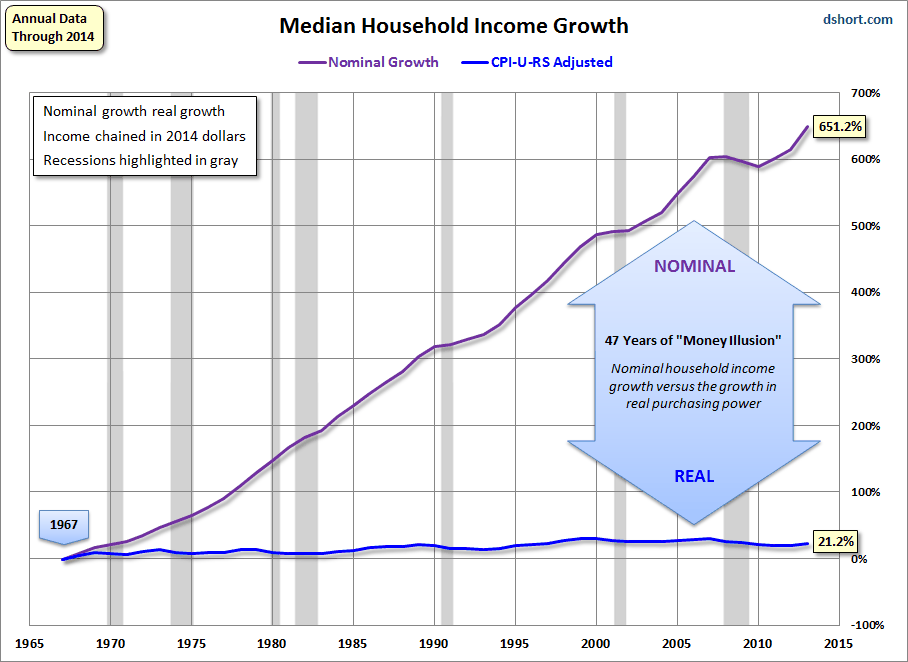
There has been a very real growth in nominal median household income, while people claim that real household income is flat even as far back as pre-1970.
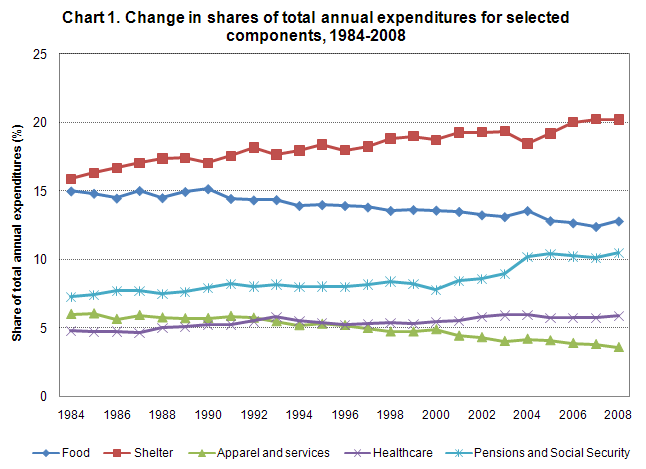
Meanwhile, we see in the long term reductions in the percent of that income spent on food and clothing, as well as a 31% increase in spending on shelter while the median size of shelter increases by 56% and the household size (persons) decreased by 15%. That means spending 84% as much on shelter (and 71% per area per person, but that's irrelevant except to say that we're not cramming lots of people into cramped little spaces).
Even since 2005, the food expenditure was 13% and it's now under 12% (personally, it's 3.9% for me, and I eat out a lot--frequently spending $15 for one meal, but not nearly on every meal). Across the past decades, people have been enabled to put more money into savings, buy more and better healthcare, and spend much of their money on entertainment and other discretionary spending.
That doesn't even get into what accounts for "equivalent goods and services" these days.
Dual-core desktops hit the market in 2005. That's quite a shock compared to 66MHz 486DX or 200MHz Pentium Pro chips that cost $200. Never mind the constantly-falling price of RAM, hard disk, and SSD. PCs, costing thousands of dollars in the early 90s, were $350 commodity items in the mid-2000s.
Cell phones of 1983 cost $4,000 for the phone and $55/month for the service, plus 42 cents per minute voice. Two hours per week would net you $250/month service. That's a $9,000 phone and $550/month service today. Somewhere along the line, we got consumer cell phones with $100/month service; then we had $250 flip phones, $40/month service, and text and video messaging; and now we have heterogeneous hex-core smartphones with 2GB RAM for $350, backed by $60/month service with high-speed data (although I pay $35/month to Ting instead).
An ISDN 128K line in 1998 cost $35/month and required a $250 modem. Today I get 200Mbps Comcast service over an $80 modem--it's $54,687 worth of ISDN lines all tied together for $83. Do you remember DSL talking about their wicked-fast "three megs" in 2005? I have 70 of those.
Even cars only standardized transistor radio and air conditioning in the 1950s. Now we have antilock brakes, traction control, EFI, complex suspension systems, air bags, vehicle dynamics that prevent rolling and skidding, sensors and cameras to assist in lane control and parking, and all other manner of highly-complex systems with many moving parts. Somehow, we don't pay a bigger chunk of our income for these things: cars cost about the same proportion of our income, but come loaded. This will remain true when we all have self-driving vehicles.
Your argument is essentially that somebody else has told you that we're producing more, we're not earning more, and our buying power is not increasing. My argument is that the percentage of the median income being spent on goods like food, clothing, and shelter square-footage has gone down; people have spent more on luxury, leisure, savings, and medical care; and that the common goods and services we consume have rolled in more stuff we couldn't have afforded years and decades ago, essentially taking the same portion of our money and giving us more stuff in exchange.
Reality suggests buying power has increased. A lot. People like me--at $75,000 income--are pocketing all the extra money. I bought a house and paid off the mortgage in 3 years. I'm getting ready to buy a car, but I have a couple debts I want to clear out first (adding payments on top of other payments is stupid). I bought myself a $7,000 piano for the house. I put $18,000 into my 401(k) and $3,385 into my HSA this year
-
Re:Least Untruthful Answer
You should be condemning Wyden for this reckless stunt, not thanking him.
Blame Wyden, not Clapper, for ‘lie’ to Congress on NSA surveillance
The Clapper “Lie,” and the Senate Intelligence Committee -
Re:"alleged"????
You don't seem to be familiar with some important background information on this issue:
The Clapper “Lie,” and the Senate Intelligence Committee
Blame Wyden, not Clapper, for ‘lie’ to Congress on NSA surveillance -
Re:perjury
-
Re:Not just Southern Spain
It's important to note that this is a worst-case scenario, which typically means its somewhat improbable. Of course, the worst-case scenario also just so happens to make the best headlines.
I'm not arguing that the climate isn't changing, or that's it's not worthwhile to curb pollutants and emissions. But I fear this constant fear-mongering is damaging climate science credibility as much as it's helping to push forward good environmental policies. This is highly reminiscent of the now laughable doomsday predictions around the time of our first Earth Day in 1970. Among these:
* Civilization Will End Within 15 Or 30 Years
* 100-200 Million People Per Year Will Be Starving To Death During The Next Ten Years
* Population Will Inevitably And Completely Outstrip Whatever Small Increases In Food Supplies We Make
* Demographers Agree Almost Unanimously Thirty Years From Now, The Entire World Will Be In Famine
* In A Decade, Urban Dwellers Will Have To Wear Gas Masks To Survive Air Pollution
* Childbearing [Will Be] A Punishable Crime Against Society, Unless The Parents Hold A Government License
* By The Year 2000 There Won’t Be Any More Crude OilThere's an interesting article on why most of these dire predictions didn't come to pass, noting some positive outcomes of the increased environmental awareness, like the Clean Water, Clean Air, Endangered Species acts, and other environmental protection laws.
When the experts have been consistently wrong with these constant doomsday predictions for 45 years, is it any wonder that people start to become skeptical of ALL climate and environmental sciences? That's not a good thing.
-
Re:bullshit
So the best modeling offered can predict next years climate with 62% accuracy. That says a lot about climate modeling over the next century.
Keep in mind that while short term predictions can be chaotic, it's sometimes easier to see long-term patterns emerge, and to extrapolate data from those trends, like trending lines through a scatter plot. I agree that anything looking a century out is guesswork at best, but I'm not sure I'd say the same looking a decade out.
Historically, many climate-related doomsday predictions have been laughably innacurate. It's for this reason that I continue to be somewhat skeptical about current doomsday or long term projections, because so far *no one* has had much success with those sorts of predictions. Even so, as we have better instrumentation and more historical data with which to create models, it's all but inevitable that our climate prediction models become more accurate as well, certainly for shorter to medium length predictions, and maybe someday, even longer term.
-
Re:That's OFFICIALLY okay per written regulations
Being Asian doesn't add anything. They're the most heavily discriminated against when applying for medical schools for instance.
-
Re:frist post
this is the US, where guns are easy and cheap to get, and people get routinely shot over the dumbest shit
Your argument is invalid. There is no linkage between email and guns in the US. And while it may be true that people get "routinely shot" (I don't know what you mean by that), this is not because guns are "cheap and easy to get". The US has more guns now than ever before, yet violent crime has been decreasing over the past decades. Look, here's some graphs.
If the simple availability of legal guns really caused violence, then now that we have more guns than ever before, we ought to have more violence than ever before. Yet we don't.
In fact, one could make an argument that the increase in the number of guns reduced the violence in the US. I don't make that argument because correlation does not prove causation. However, you are making a causation claim and there isn't even a correlation to back you up.
I invite you to read the book The Samurai, the Mountie, and the Cowboy which explores why different countries have different amounts of violence. Spoiler: it's more cultural factors than anything else.
-
Re:An easier sollution
what we have instead in this country, on both state-by-state basis, as well as a metro-area basis, is very clear correlations between gun prevalence and gun deaths. and it's summed up thus: more guns = more deaths.
-
Re:Would be nice if it shut up the snark
I see you "judiciously" left out the fact that the people high up in the DOD and DOD IG suspected of criminal misconduct in the retaliation and abuse against the whistle blowers are under investigation and stand a good chance of going to jail?
Snowden should have gone to Congress. Instead he screwed the US and its allies badly.
Your claim that "Clapper's brazen perjury before Congress (without consequences) is proof that Snowden had to run" is rubbish too. Congress already knew the truth of the matter, Clapper had briefed them in secret session. Otherwise how do you think that unethical Senator Wyden knew to ask the question he did, in the way he did, when and where he did? Ron Wyden should never hold a seat on the Intelligence committee again. He is almost as bad of scum as the senior people in DoD that abused their power to prosecute and persecute Drake.
Blame Wyden, not Clapper, for ‘lie’ to Congress on NSA surveillance
Outrage is brewing on the Left and Right over charges that Director of National Intelligence James Clapper lied to Congress about NSA data collection. But the outrage is misdirected. What is outrageous is not that Clapper tried to protect classified information in an open session, but that Senator Ron Wyden asked him the question in open session the first place.
Wyden, an opponent of the NSA program, asked Clapper in front of television cameras: “Does the NSA collect any type of data at all on millions or hundreds of millions of Americans?”
Wyden knew the answer. He knew the answer was classified. He knew that Clapper could not answer it in open session. Yet he asked it anyway.
Wyden was either trying to embarrass Clapper, trip him up, or force him to reveal classified information. Whatever the motivation, it was a reprehensible thing to do. And it put Clapper in an untenable position. There was no truthful answer he could have given in open session that would not have revealed a top secret intelligence program.
If Clapper had simply said “I will be happy to discuss that in closed session,” it would have set off a firestorm of speculation, and been seen as a tacit admission that the US was collecting such data. The program would have been effectively exposed.
If he had said “Yes, but I can’t discuss it in open session,” he would have confirmed the existence of the program, and people would have jumped to all sorts of false conclusions that the NSA was reading our emails and listening to our phone calls (which they are not). And Clapper would not have been at liberty to explain what the NSA was actually doing, and the fact that no Americans’ phone calls were being monitored or recorded.
Clapper did not mislead Congress, as some have suggested, because the committee had already been briefed on the program in closed session. Wyden knew the answer to his question. He wasn’t trying to get information — he was trying to expose a secret in open session.
The fact is Senator Wyden should never have put Clapper in such a position. As a member of the Senate Intelligence Committee, with a top secret security clearance and privileged access to classified intelligence, Wyden has a sworn responsibility to protect our nation’s secrets. Instead, he tried to force their disclosure in a public forum.
-
Re:May spur automation
But then again, it may not...
Here in Ontario, Canada, we raised the minimum wage from $10.25 to $11.00, and unemployment went down in the following months and year, from around 7.5 %to 6.75% (source). While that doesn't prove that minimum wage increases never result in unemployment rises, it does disprove that they always result in unemployment rises.
As others have pointed out, Canada made a small change and saw small changes in unemployment. It would be quite hard to measure the effect because so many other things changed at the same time. As a counter-example, Seattle seems to be losing jobs as Washington state gains them. It's still early so we don't know if this trend will hold.
Finally, I don't know any economist who asserts raising the minimum wage will always raise unemployment. At most they'll say that holding all else equal, that's a likely outcome. Problem is, it's virtually impossible to hold all else equal. It's also entirely possible employers adjust in other ways, such as cutting overtime, reducing benefits, reducing staffing, or increasing automation. Or they may raise prices or cut their profit margins. As it turns out, those last two are very hard to do in highly competitive markets (and many low-wage markets are also highly competitive).
-
See Charles Murray's Argument
Charles Murray's book "In Our Hands" argues that universality is key to the pragmatics of the unconditional basic income for one main reason:
Everyone knows everyone else in the community is getting it.
This changes the community dynamics by placing social responsibility on everyone in the community -- placing the delivery of social goods "in our hands" rather than the government's.
-
Re:It hasn't aways been like this
https://www.aei.org/publicatio...
The chart above shows the dramatic increase in household vehicle ownership since 1960, according to Census data compiled by the Department of Energy (Table 8.5). Here are some highlights of the data in the chart:
1. In 1960, nearly 79% of American households owned fewer than two vehicles: Nearly 57% of households owned only one vehicle and more than one-out-of-five households didn’t own a vehicle at all. Only one in forty households (2.5%) owned three or more vehicles.
2. Since 2000, fewer than 10% of US households had no vehicles, and almost the same share of households in 2010 owned three vehicles or more (19.5%) as owned no vehicles in 1960 (21.5%).
3. The share of US households owning three or more vehicles reached an all-time high of 19.5% in 2010 before falling slightly to 19.1% in 2011, and the share of US households owning no vehicle fell to an all-time low of 9.1% in 2010, before rising slightly to 9.3% in 2011.
4. Prior to 1990, the largest share of US households owned only one vehicle, and in every decade since then the largest share of households own two vehicles.
I can find absolutely no numbers to support any of the claims you've made in this thread - and you have made many. Why yes, yes I am bored. There's a nice pretty graphic at the site. I can find no newer numbers that indicate anything close to what you said. In fact, you've made a bunch of claims and when I go look, Google's directing me to content that indicates your numbers are either really far off or the complete opposite of what those with the data are claiming.
How about some citations?
-
Re:So let me get this straight.
As a Constitutional matter everyone running is qualified. As a political matter pretty much all of them are qualified as well, including pretty much every Republican.
Sanders is an interesting fellow. He seems to be both more open and honest than many of his peers and competitors in the Democratic party, especially H. Clinton. He seems to listen to his constituents despite having some strong particular ideological leanings. Although his policy proposals would bankrupt the US he is probably preferable to Hillary Clinton, especially with a Republican Congress. Clinton's appeal escapes me in pretty much every respect. She has serious temperament issues (record of abusive, vindictive, and arrogant conduct), integrity problems, meager genuine accomplishments, and a penchant for failing solutions. She married well, which is perhaps why she simultaneously maintains that women making rape claims should be believed but has helped suppress women alleging Bill Clinton raped them.
The US middle and working classes are in trouble. A better economy would be a big help, but Obama administration policies and Democratic demands have largely served to either drive things further off the rails or to stifle a stronger economic recovery.
There is something of a pattern in this: No Country for Burly Men
The Democrats block attempts at reforms aimed preventing damage and implement programs that do damage.
The Republicans attempted to reform the mortgage industry problems that led directly to the economic implosion, and the democrats blocked it.
President Obama's time in office has been a disaster for black Americans.
"Obamacare" is imploding.As to the whole Democrat / social democrat / "socialist" / Socialist / Communist thing
-
Re:"nonconsensual sex or touching"
If you look up the study, the exact quote is “nonconsensual penetration or sexual touching involving physical force or incapacitation,”.
The summary is brain-dead, but in a way that *understates* the problem, compared to the actual quote (which doesn't contain the word "rape"). After all, you're interpreting this as lower arms and shoulders, but that's clearly not "sexual touching involving physical force or incapacitation"..
Those were numbers pulled from 2 universities. A sample size of two isn't very impressive. Here's the actual rape numbers, from a study that spanned four years: 1 in 52 women are raped.
-
Re:Free vs Fast Lane
Wallmart didn't reduce the price - they outsourced their wagebill to the taxpayers, you're paying the difference with your taxes - and all the people who never shop at Wallmart are forced to subsidize your savings.
Bullshit. http://www.forbes.com/sites/ti...
Whether those kinds of government programs are a good idea or not is another question, but they are not subsidy to Walmart.
If you ever wondered why a 15 dollar inflation-bound minimum wage is a good idea - there it is right there, so companies cannot outsource their wagebills to the taxpayer like Wallmart does.
If you raise the minimum wage to $15/h, Walmart will only hire people that are worth $15/h, and that's not their current set of employees. In addition, they will simply automate more, and much of what they do can be automated; just look at Europe where labor costs are higher and shops and restaurants run with less staff. No matter what the law, the minimum wage is always $0.
Whatever costs they can't control that way will simply be passed on to consumers in higher prices, hurting particularly the lower income groups that shop at Walmart.
In the real world even wallmart would rather make a slightly smaller profit than no profit at all.
What exactly do you imagine Walmart's profit margins to be? Walmart has very low profit margins compared to other corporations:
https://www.aei.org/publicatio...
Walmart can't and won't reduce their profit margin; any increase in operating costs is simply passed on to customers. Since their customers are often lower income, it places an extra burden on them. So, even if your fiction of government aid to Walmart workers keeping prices low were correct, it would simply mean a wealth transfer from rich to poor (since only about 97.2% of income taxes are paid by those making more than median income, 70.2% by the top 10%), which you argue should be eliminated.
But you are right to a degree: the goal of all this hullabaloo over net neutrality and minimum wage is indeed to eliminate low profit margin, low priced, domestic, diverse companies like Walmart into the kind of high profit margin, high priced, outsourcing, privileged upper middle class company like Apple. It's disgusting that you pretend to be doing that in the name of "social justice" or "benefits to taxpayers".
-
Post-attack 'responsibility' NOISE
Once upon a time, people were generally less stupid.
If any 'claim of responsibility' emerged hours or days after a terrorist attack it would be treated with the utmost suspicion. Even if transmitted directly to them, news networks would notify the authorities of course, but they might not even report it publicly. Unless a phone call or fax was received at the moment of breaking news, some times even minutes before, the information was deemed to be zero-credible or less than zero, more likely than not the work of a crank. And news sources were generally averse to being cranked.
News sources did not even want to be cranked by governments. They'd never forget to add the words "allegedly" or "believed to be" when repeating a government source who was pretty sure who was behind something. Some acts of terrorism in those days would end up being reported as if they were... simply crimes. The 'who' would not be examined at length until or unless individuals were actually brought forth and charged. Then, their connections to organizations would be explored.
Then the 21st century dawned and people have become generally more stupid.
Now ascribing an organization to an attack is as simple as starting a rumor or sending a tweet. Everyone is on the verge of believing anything, they just need a little push either way. There is no burden of proof, only a preponderance of NOISE. Axe-grinding news sources and governments are already blaming them anyway to take advantage of this lower IQ, so they're already on the ball. Just like Michael Ledeen at AEI was blaming Saddam Hussein for 9/11 on the afternoon of 9/11. (Hint: that was Donald Rumsfeld's favorite website. Can you see a decade of bad road ahead?)
Now a claim by a single so-called 'unnamed source within the government' is cause enough for a press association like AP to drop the 'allegedly' and report the deed as having been done by those people, ready to put in the history books.
If all information should be free, we're sure getting what we paid for.
-
Re:This is a good thing.
People complain about the fact that wages don't keep up with price inflation.
Except that Real Compensation Per Hour has been rising (although it had a bit of a plateau during the recession recovery years).
In an economy that bears some semblance to a free market, innovation and competition would naturally increase the purchasing power of a given wage (or at the very least hold it constant) over time. That does not happen under the Federal Reserve system and fractional reserve banking.
Price of 1975 Cray-1 (80 MFLOPS), $8 million.
Price of 2015 iPhone 5s (76.8 GFLOPS), $450.Looking in terms of hours worked, 100.5 hours of work was required to purchase a washing machine in 1959 compared to just 23.3 hours of work (for the average worker) in 2013. Purchasing a TV demanded an astounding 127.8 hours of work in 1959, whereas a worker in 2013 could purchase one with only 20.7 hours of work (see other examples above). More examples here.
-
Re:Politics of homeopathy
Your formulation isn't correct. You might start with these links*:
Obama Skips the Kennedy Tax Cuts
Was JFK really a supply-sider?
The Historical Lessons of Lower Tax Rates*No doubt there are better ones, but time is short.
-
Re:My god you people need to think about economics
pays their full-time workers so little that they can't afford food or a place to live without welfare and foodstamps?
Could you please provide a source for this claim? In 2014, the Wal-Mart blog fisked a hit piece that was claiming things similar to what you just claimed, and pointed out that the average hourly wage at Wal-Mart was $12.91 per hour (and that is specifically not including highly-paid management).
http://blog.walmart.com/fact-check-the-new-york-times-the-corporate-daddy
How does it help me that my tax dollars have to subsidize Walmart employees
Wal-Mart makes about 3% profit. In comparison, Apple Computer makes about 24% profit. Additionally, Wal-Mart has a more ethnically diverse set of employees than Apple Computer has. You seem to hate Wal-Mart; do you hate Apple Computer even more?
Also, low-income people like to shop at Wal-Mart because the low prices are a benefit. Some economists have written papers attempting to estimate the impact.
http://www.forbes.com/sites/timworstall/2013/08/11/walmart-destroys-jobs-yes-but-the-benefits-go-to-consumers-not-the-top/
http://www.nber.org/papers/w11809So, to summarize: Wal-Mart pays a lot of taxes, employs a lot of people at an average hourly rate 78% over the US federal minimum wage, and benefits the poor by helping them spend less on the things they need.
I just don't understand all the Wal-Mart hate.
-
Re:Do It, it worked in AZ
-
Re:Service Sector
but it is very clear that a majority of people are not middle class in terms of wealth
I think this is the key point of your entire post, and being honest, it doesn't say a whole lot.
What metric are you using to define middle class, and furthermore, where exactly does the goalpost reside, and how often does that goalpost change?
Remember that in terms of income, the goalpost is always rising, even in the absence of inflation. For example in one year you could have $20,000 being defined within the scope of middle class, and then the next year it could be defined as poverty, even though the person making $20,000 a year has not become less wealthy. Sure the dollar value may have gone down, however the purchasing power may very well have stayed the same.
As an example for that last sentence: Even though, due to inflation, food prices have gone up over the last few years, however the real cost of food (that is, adjusted for inflation) is presently the lowest it's ever been.
http://www.aei.org/publication...
And before you say that it's because food is less healthy or because everybody buys junk food, that is also wrong:
http://usatoday30.usatoday.com...
People who claim otherwise are usually members of the Church of Organic Food, who seem to believe that organic food is the only healthy way to live, when in reality it's just a big fat waste of time and money (and also the organic food lobby, which is very wealthy, loves you to believe in that bullshit.)
-
Re:We'll do something after it's too late
I predict that your prediction will be as spectacularly wrong as the predictions made on the first Earth Day http://www.aei.org/publication...
-
Re:Science fiction comes to life, again
Yes, the scenario posited was incredible. I don't believe you can show any example of a current significant branch or denomination of Christianity that believes it can change the date of the apocalypse by its actions. It goes against scripture.
Ah yes, those "nut job" Americans.
Q. Are Americans more or less charitable than citizens of other countries?
A. No developed country approaches American giving. For example, in 1995 (the most recent year for which data are available), Americans gave, per capita, three and a half times as much to causes and charities as the French, seven times as much as the Germans, and 14 times as much as the Italians. Similarly, in 1998, Americans were 15 percent more likely to volunteer their time than the Dutch, 21 percent more likely than the Swiss, and 32 percent more likely than the Germans. These differences are not attributable to demographic characteristics such as education, income, age, sex, or marital status. On the contrary, if we look at two people who are identical in all these ways except that one is European and the other American, the probability is still far lower that the European will volunteer than the American.When will the madness end?
The Philippines is a former Spanish colony taken by the US in its war with Spain. It was made independent long ago.
-
Re:Emma Watson is full of it
Except if you actually look into the numbers it's easy to disprove. inb4 lul aei, except that they explain their methodology. And try as people might, they've yet to successfully disprove it.
-
Re:Hmm. I smell a rotten bucket of fish
Yes, the rules designed to keep money from being wasted do cause money to be wasted.
It's like when the military needs to get a hammer. In a sane world, they would just walk over to the local hardware store and buy a hammer, or place an order for hammers with some large company like Home Depot or Amazon. Instead, the military procurement regulations add so much red tape to the process that most companies don't even want to sell anything to the military; but a few companies specialize in military procurement and have full-time staff who know how to successfully navigate the paperwork. So that hammer can only come from one or two companies, and those companies have lots of overhead (need to pay the lawyers who navigate the red tape paperwork maze), and anyway those companies know that they are the only game in town and are not motivated to charge a low price.
-
Re:Buggy whips?
http://blog.heritage.org/2012/...
http://www.thenewamerican.com/...
http://dailycaller.com/2013/07...
http://www.aei.org/article/pol...
But then again, if John Stewart and Colbert don't report it, it never happened
-
Re:Attacked?
Non-Academic Administrators include people like me. I'm a librarian.
Yes, I know what the phrase means, and I didn't mean to imply anything bad about all administrative (or "non-academic") positions -- AT ALL. I'm all for libraries and librarians. Apparently, if this blog is to be believed, the issue at this particular school is that there's also a significant amount of jobs going to friends of existing administrators going on in administrative hiring. I have no idea whether these claims are true, but the implication of the blog is that unnecessary jobs are being "created" and sometimes unqualified people are getting them.
This is NOT an indictment of all administrative staff at all institutions, let alone those who provide important services to students.
On the other hand, the reality of budgets at many schools is that administrative costs are rising at alarming rates (along with costs for new buildings and facilities, etc.), while academic budgets are static or going down, with more and more adjunct faculty hired at levels below minimum wage just to cover basic teaching needs.
These are general trends, and this blog seems to claim that one university has some particularly problematic stuff going on. Again, I have no idea how true it is, but that's the subject of this thread.
That "Non-Academic" phrase gets thrown around a lot and frequently includes people like guidance counselors who DO have an impact on student success.
Yep. That's great. SOME "non-academic" growth is certainly necessary at many universities to provide various kinds of student services, whether that's a career counselor or just an extra person at the registrar's office to facilitate student access to records.
The issue is the rate of growth relative to academic areas, making these administrative costs a significant driver of increasing tuition rates, as discussed in many news stories in the past few years. In many cases, these "administrative" staff have increased anywhere from 5 to 10 TIMES the rate at which faculty and academic staff have increased.
I'm all for providing student services, but if all of these guidance counselors and librarians, etc. are necessary for student success, what had colleges been doing before these giant increases in administrative hiring in the past decade? How could they possibly have functioned before with so few administrators?
I'm not at all saying that administration is somehow "bad" -- it's just that the growth seems disproportionate to other areas, and I'm certainly not the only person to have commented on that trend in the past few years.
-
Re:Gotta be some kind of compensation.
Most of the growth is in the number of administrators. Who don't teach at all.
Nuts. There was supposed to be a link there.
-
Re:So what?
You have to be kidding me. The data shows quite the opposite:
"Average annual earnings of individuals with a bachelor's degree are more than 75 percent higher than the earnings of high school graduates. These additional earnings sum to more than $1 million over a lifetime."
...and the *initial* sex appeal of a male with an expensive-looking (or seeming) car is far greater than one with a standard-mid model car.
So basically, that would say that younger males would rather have really expensive (or expensive-looking) cars to get some quick sex than older males, and younger males would be less likely to want an actual large income because they're more interested in sex than logical life-living M.O.
Just saying... Better income and education is a better idea, but that doesn't make it more of an applied idea due to Human nature.
-
Re:So what?You have to be kidding me. The data shows quite the opposite:
"Average annual earnings of individuals with a bachelor's degree are more than 75 percent higher than the earnings of high school graduates. These additional earnings sum to more than $1 million over a lifetime."
-
Re:Correction
Mod down
The whole point of Sarbanes-Oxley is people had no clue Enron was doing weird shit. You can hate it all you want. but its goal is to encourage transparency to protect its investors. I see nothing wrong with that
Transparency is fine in the abstract, but the implementation has a big role in determining if it is good or bad policy. Sarbanes-Oxley isn't looking so good in retrospect.
Reforming Sarbanes-Oxley: How to Restore American Leadership in World Capital Markets
THE HONORABLE TOM FEENEY: As Milton Friedman said, often a congressional solution is worse than the problem. That's another one of those truisms that has been proved by Sarbanes-Oxley. Another one is that Congress tends to have two speeds-zero and overreact. In the case of Sarbanes-Oxley, we clearly overreacted. And most importantly, I think, Sarbanes-Oxley proves the rule that the unanticipated, unintended consequences of complex legislation are often much, much worse than the positive effects that you intended. . . .
. . . some accountants, for example, have looked at the newspaper subscriptions for the officers in a $2 billion or $5 billion company. We're talking about $70 or $100 or $150 a year for newspapers in a $2 billion company, and that has generated reviews that will cost hundreds of thousands of dollars. Procurement decisions on a very minor level have triggered these things. Why is this?
Obama Endorses Sarbanes-Oxley Reform To Make Small IPOs Easier
President Barack Obama backed the recommendations of his jobs council to amend the Sarbanes-Oxley regulations to make it easier for small companies to go public.
The jobs council, headed by GE CEO Jeff Immelt and including Sheryl Sandberg and Steve Case, found that the Sarbanes-Oxley was a key factor in reducing the number of IPOs smaller than $50 million from 80 percent of all IPOs in the 1990s to 20 percent in the 2000s.
Obama also said the "Spitzer Decree," which bans investment banks from using banking revenues to pay for research and expert analysis of publicly-traded companies, deserves reconsideration as well. The council said the rule shares the blame for the decline in IPOs among small companies.
No one denies that there was a corporate governance problem that came to a head with the Enron scandal. But in their zeal to pass new legislation, no one in Congress ever stepped back to consider the magnitude of the problem. Some 12,000 companies are required to file public financial statements with the Securities and Exchange Commission. According to George Benston, professor of accounting at Emory University, no more than a few dozen per year have ever been implicated in dishonest bookkeeping. But rather than simply step up enforcement by the SEC, all companies were treated as guilty until proven innocent and forced to comply with onerous new regulatory requirements.
The most burdensome provision of the Sarbanes-Oxley legislation is section 404, which requires establishment of extensive new internal controls for financial reporting. A recent study by Financial Executives International, an industry group, found that the average compliance cost for large companies was $4.6 million, involving 35,000 hours of internal manpower, $1.3 million for external consulting and software, and additional audit fees of $1.5 million.
These numbers are probably very low. FEI admits that the complia
-
Re:Wow
Dividends are considered income in the US not capital gains.
More precisely, since 2003, non-qualified dividends (on stocks held under 60 days) are taxed at your normal income tax rate, but qualified dividends (on stocks held more than 60 days) are taxed at a 5% or 15% rate based on your income level.
The Obama Administration has recently suggested ending the tax benefit for qualified dividends for high income individuals and them pay ordinary income tax rates on all dividends.
-
Can police tell AI to pull over?
But if you follow the logic of mandatory seatbelts and motorcycle helmets, red-light cameras and anti-texting laws to their natural conclusion, it’s easy to imagine that some bureaucrats will want to co-author your car’s software. And then what? Will you ever be allowed to go over the speed limit again? Police are already drooling to see our GPS data. Will that become automatic too? Will the cops have the power to tell your car to stop whether you want it to or not? Will authorities be able to tell your car to take a detour to alleviate traffic? Make it turn around when it gets too close to certain off-limit areas?
From: http://www.aei.org/article/society-anda-culture/take-the-wheel-somebody/
-
Re:Getting Real About CapitalismMy 1992 white paper introduces an early version of the idea. The impetus for it came from my work to privatize government technology development programs in space and energy.
Charles Murray of the CATO Institute later wrote a book on an idea related to the citizen's dividend.
-
Re:No love for financial institutions.
Do you know of a website which promotes a much simplified and universal tax scheme?
I do, but if I post it the topic will go off on a tangent of misinformed people bashing the suggestion, despite years and millions of dollars of non-partisan research behind it.
The problem is there's no such thing as a "perfect" system of taxation; there's no system everyone will agree is "fair," and very often people jump on my suggestion because, as a revenue neutral system, it doesn't do anything to solve the spending crisis the U.S. government is having (although, as a means to drive the economy it certainly could mitigate that problem).
People bash this idea because people can cheat the system (ignoring what they do now); they bash it because, as is, doesn't collect enough revenue to cover the U.S. budget (ignoring that that's how it is now); they bash it because they say it's regressive (although people at or near the poverty line will see their spending power increased).
Wouldn't it be great to have a system that encouraged earning and saving? A system where the government wouldn't have to intrude on your fourth amendment rights the way they do now? A system where companies and the very wealthy don't feel the need to shelter their money offshore? A system that would encourage businesses to come here instead of the other way around? A system where the government doesn't take interest free loans at your expense through withholding?
I am talking about the FairTax. No, I don't like the name. No, I don't think it's perfect. No, I don't think prices will come down enough to completely cover the cost of the FairTax as the authors suggest (although I do believe prices will drop when embedded taxes are removed). Yes, I am middle class. No, I don't think the wealthy will stop buying goods and services to avoid paying taxes.
Lastly, no, I'm not going to argue about the FairTax here. Most people are wildly misinformed about it, and make up straw man arguments about it to complain about, like how much it would "really" have to be (well, you know what taxes "really" have to be under the current system in order to cover the U.S. budget? Here's a clue: tax the wealthy at 100% and you're still not even covering the deficit):
Even if individuals earning more than $200,000 were taxed at a 100 percent marginal rate--and we confiscated their passports so they could not flee--the take would come to $1.27 trillion, or just 77 percent of this year's deficit.
(source: Not Taking Other People's Money).
I'm sick of defending the FairTax, with all it's positives over the current system, from complaints that apply equally the current, and every other, suggested system.
So there you have it: the FairTax would be a massive simplification; would not require government intrusion into your private lives; would repeal the 16th amendment; would be a boon to businesses and encourage offshore businesses to come home, and encourage foreign businesses to move here. People whine that they wouldn't get their deductions on things like home mortgage interest... of course you would; not just the interest, either - but the principle. But they can't wrap their heads around it and never come up with something better.
-
Re:Perhaps a compromise
Rate of college education = percentage of population that receives college degrees.
http://www.aei.org/outlook/28863
The US has a relative low rate of college graduation compared to several other countries, and quite high rates of post secondary failure.
It is a frinken disaster, actually, one that will eventually lead to big problems in the US.
-
Re:Education vs indoctrinationYou have it backwards, progressive, not a traditional style of education really started taking hold in the late 60's. With that, independent study was slowly replaced with more group and project oriented study.
E.D. Hirsch, author of The Schools We Need and Why We Don't Have Them and registered democrat, has a short piece here that you should read, it's very interesting as are his books:
http://www.aei.org/docLib/20030228_traditionaledMA97.pdf
Gramsci was not the only observer to predict the inegalitarian consequences of the educational methods variously described as âoenaturalistic,â âoeproject-oriented,â âoecritical-thinking,â and âoedemocratic.â I focus on Gramsci as a revered theorist of the Left in order to make a strategic point. Ideological polarizations on educational issues tend to be facile and premature. Not only is there a practical separation between educational conservatism and political conservatism, but there is an inverse relation between educational liberalism and social liberalism. Educational liberalism is a sure means for preserving the social status quo, whereas the best practices of educational conservatism are the only means whereby children from disadvantaged homes can secure the knowledge and skills that will enable them to improve their condition.
Hirsch dedicted the book I mentioned to Gramsci, who was a Marxist himself.
Interesting that Hirsch would single out the years 1942-1966:
Among other results, hostility to traditional schooling methods and subjects has fostered inequality. The record is clear. In the period from 1942 to 1966â"before progressive theories had spread throughout our schoolsâ"public education had begun to close the economic gap between races and social classes. But after 1966, as SAT scores went into steep decline, the black-white wage gap abruptly stopped shrinking.
-
Re:Isn't this how the USSR ended?
You're both right (self-congratulatory claptrap) and wrong (communism just doesn't work very well). There was no single factor that caused the economic collapse of the Soviet Union, but the most under-reported significant causes were grain (the USSR had no choice but to buy foreign grain to feed its increasingly urbanized population) and oil (the sharp drop in oil prices was a major economic blow). For a more lengthy look into the role of grain and oil in the USSR's collapse, see this article or download the PDF of the article.
-
Re:Isn't this how the USSR ended?
You're both right (self-congratulatory claptrap) and wrong (communism just doesn't work very well). There was no single factor that caused the economic collapse of the Soviet Union, but the most under-reported significant causes were grain (the USSR had no choice but to buy foreign grain to feed its increasingly urbanized population) and oil (the sharp drop in oil prices was a major economic blow). For a more lengthy look into the role of grain and oil in the USSR's collapse, see this article or download the PDF of the article.