Slashdot Mirror
Domain: forbes.com
Stories and comments across the archive that link to forbes.com.
Stories · 979
-
New Horizons' First Ultra High Resolution Photos of Pluto Released
StartsWithABang writes: After a 9 year journey to Pluto, NASA's New Horizons spacecraft made its closest approach to Pluto this past July, taking so much data that it will take a full 16 months to send it all back. The first of the highest resolution photos ever taken were released by NASA earlier today, and before the data has even been scientifically analyzed, a visual inspection teaches us a number of things about its sedimentary history, its active geology and its transient, eroding mountainous terrain. Perhaps the best part: Pluto is the prototype for the most common type of world in the Universe, even though it's not a planet anymore. -
More Than Half of Kepler's Giant Exoplanets Were False Positives
StartsWithABang writes: By surveying an area of the sky containing over 150,000 stars visible to it, the Kepler satellite monitored each one over a multi-year period looking for periodic changes in brightness. Thousands of planetary candidates emerged via the transit method, where periodic dips of 3% or less were noted with regularity. However, a follow-up study has come out on the giant exoplanets, finding that over 50% of them aren't giant planets after all, but wound up being eclipsing binary stars. Perhaps our lone star Solar System is the oddity, after all. -
2 Planets Can Share the Same Orbit, In 3 Different Ways
StartsWithABang writes: One of the most important characteristics of a planet, at least according to the IAU definition, is that it clear its orbit of all other bodies. But if we allowed for a special caveat — the possibility of two similarly-sized objects sharing the same orbit — could we have a stable configuration where that occurred? Surprisingly, not only is the answer yes, but there are three ways to do it: to have one at the L4/L5 Lagrange point of the other, to have a close-orbiting binary planet, or to have orbit-swapping worlds, where they periodically change spots with one another. Unbelievably, our Solar System has a history of all three! -
Dark Matter Grows Hair Around Stars and Planets (forbes.com)
StartsWithABang writes: Dark matter may make up 27% of the Universe's energy density, compared to just 5% of normal (atomic) matter, but in our Solar System, it's notoriously sparse. In particular, there's just a nanogram's worth per cubic kilometer, which makes the fact that we've never directly detected it seem inevitable. But recent work has demonstrated that Earth and all the planets leave a "wake" of dark matter where the density is enhanced by a billion times or more. Time to go put those dark matter detectors where they belong: in the path of these dark matter hairs. -
The Moon's Two Sides Look So Different Thanks To 4.5 Billion-Year-Old Physics (forbes.com)
StartsWithABang writes: 4.5 billion years ago, a giant object collided with our proto-Earth, kicking up debris that eventually coalesced into the Moon. While the near side contains dark maria and lunar lowlands, the far side is almost exclusive heavily cratered, high-mountainous regions. This was a mystery for a long time, but it appears that heating from the hot, young Earth caused a chemical and crustal difference between the two faces. -
Averaging Inanimate Objects Together Produces a Very Human Face
StartsWithABang writes: It's well known that by aligning and averaging a wide variety of human faces together, an eerie "average" human face can be arrived at. But we see faces in things all the time, from natural scenes like terrain to artificial ones like cars, coffeemakers and combination locks. For the first time, someone averaged together a large number of images of objects appearing to have faces, and the result, strikingly, was an eerily human face. You'd think this might say more about the algorithm than the images themselves, but when noise was used, no human face emerged at all. -
Quantum Entanglement Survives, Even Across an Event Horizon
StartsWithABang writes: One of the more puzzling phenomena in our quantum Universe is that of entanglement: two particles remain in mutually indeterminate states until one is measured, and then the other — even if it's across the Universe — is immediately known. In theory, this should be true even if one member of the pair falls into a black hole, although it's impossible to measure that. However, we can (and have) measured that for the laboratory analogue of black holes, known as "dumb holes," and the entanglement survives! -
Hour of Code 2015 Star Wars Tutorial: Spare the IF Statement, Spoil the Child?
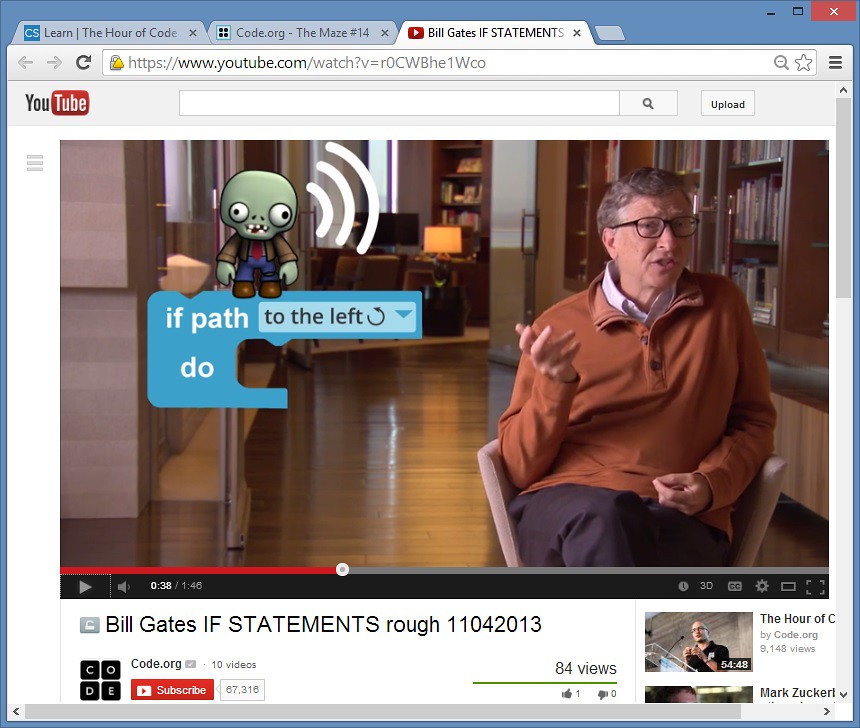
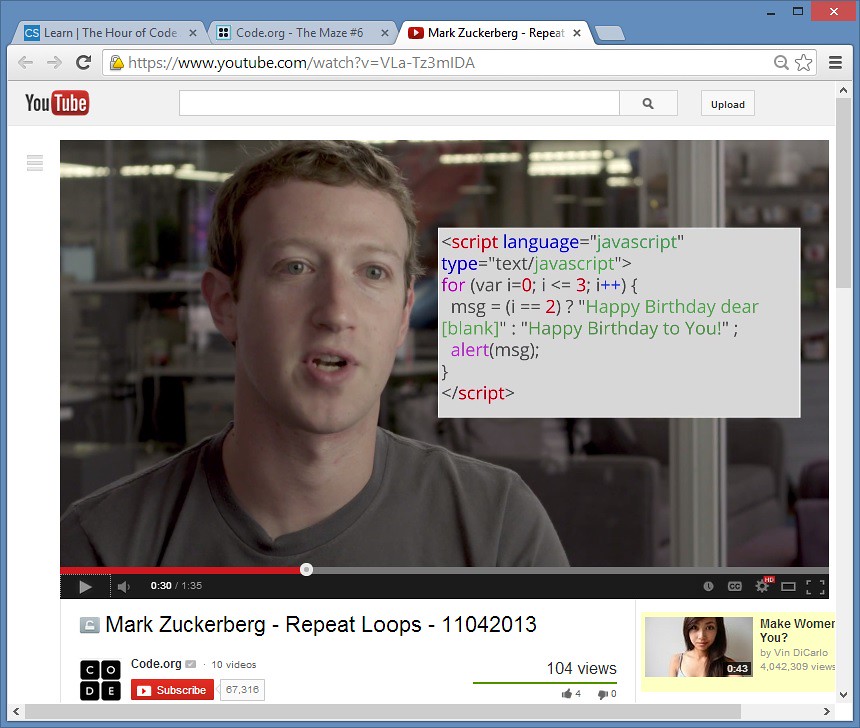
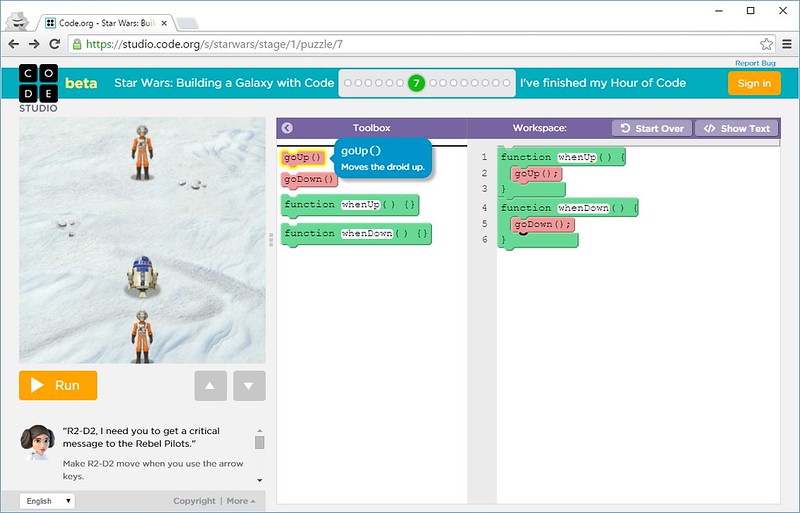
theodp writes: Teaching U.S. K-12 kids their programming fundamentals in past Hours of Code were an IF-fy Bill Gates and a LOOP-y Mark Zuckerberg. Interestingly, the new signature tutorial — Star Wars: Building a Galaxy with Code — created by Lucasfilm and Code.org ("in a locked room with no windows") for this December's Hour of Code, eschews both IF statements and loops. The new learn-to-code tutorial instead elects to show students "events" after they've gone through the usual move-up-down-left-right drills. With the NY Times and National Center for Women & Information Technology recently warning against putting Star Wars in the CS classroom ("Attracting more female high school students to computer science classes might be as easy as tossing out the Star Wars posters," claimed an Aug. 29th NCWIT Facebook post), the theme of the new tutorial seems an odd choice for Code.org, whose stated mission includes "increasing [CS] participation by women." But if Star Wars is, as some suggest, more aimed at boys, perhaps Code.org has something up its sleeve for girls (a la last year's Disney Princesses) with another as yet unannounced signature tutorial that it teased would be "just as HUGE" as the Star Wars one. Any guesses on what that might be? -
Comet Catalina To Pass By Earth For the Final Time
StartsWithABang writes: Originating from the Kuiper belt and the Oort cloud, comets are generally thought of as periodic objects, with their initial trajectories having been perturbed by either Neptune, another distant object or a passing star or rogue planet. But most comets aren't periodic; they're transient instead, where a trip into the inner Solar System gives them additional gravitational perturbations, causing them to either fly into the Sun or gain enough kinetic energy to escape entirely. This latter fate is the case for Comet Catalina, which reaches perihelion on November 15th and then heads out of the Solar System after putting on one final show for observers on Earth. -
Fantasy Sports Sites Ordered To Stop Taking Bets In New York State (nytimes.com)
HughPickens.com writes: The NY Times reports that in a major blow to a multibillion-dollar industry that introduced sports betting to legions of young sports fans, the New York State attorney general has ordered the two biggest daily fantasy sports companies, DraftKings and FanDuel, to stop accepting bets from New York residents. He said their games constituted illegal gambling under state law. "It is clear that DraftKings and FanDuel are the leaders of a massive, multibillion-dollar scheme intended to evade the law and fleece sports fans across the country," says NY attorney general, Eric T. Schneiderman, "Today we have sent a clear message: not in New York, and not on my watch."
Fantasy sports companies contend that their games are not gambling because they involve more skill than luck, and because they were legally sanctioned by a 2006 federal law that exempted fantasy sports from a prohibition against processing online financial wagering. "Fantasy sports is a game of skill and legal under New York state law," says FanDuel. "This is a politician telling hundreds of thousands of New Yorkers they are not allowed to play a game they love and share with friends, family, co-workers and players across the country." The attorney general's office also said that ads on the two sites "seriously mislead New York citizens about their prospects of winning." State investigators found that to date, "the top 1 percent of DraftKings winners receive the vast majority of the winnings." Schneiderman's investigation was spurred after reports arose that a DraftKings employee used internal data to win $350,000 on rival site FanDuel, which the operators denied. While both companies had allowed employees to place bets on the others site, they have since banned such practices. -
NASA's Maven Mission Solves the Mystery of Mars' Lost Atmosphere
StartsWithABang writes: If you came to the Solar System some 500 million years after its formation, you would've found two world with oceans of liquid water, continents and all the conditions we know of for life to begin thriving: Earth and Mars. But unlike our own world, Mars' organic history was cut short when it lost its atmosphere and became a barren, desert wasteland. While we had some pretty compelling theories as to how this happened, it was only with the advent of the Maven mission and its first science results that we discovered exactly how, how fast and when Mars lost its atmosphere. One cool discovery: aurorae appear diffuse and all over the entire night sky on Mars! -
That "Unbreakable" Glass That's "As Strong As Steel" Isn't Either
TheAlexKnapp writes: A number of stories about a new paper in Scientific Reports claim that it describes an "unbreakable" glass that's as "strong as steel." In a report about the paper for Forbes, Carmen Drahl notes that these claims are exaggerated. But that doesn't mean that the researchers haven't produced a promising material. From Carmen's story: "According to their calculations, this glass performed about as well as a heavy duty commercial glass. What this report describes isn't some miracle material, but a well-above-average performing glass that seems promising on a tiny scale." -
Leading Theory of Solar System's Formation Just Disproven (forbes.com)
StartsWithABang writes: In 2005, scientists put forth the Nice Model to explain the configuration of the Solar System's planets. It was thought that the outer planets, Jupiter in particular, migrated through the inner Solar System, and were then pulled back out by the presence of the outer giants, causing the late heavy bombardment of the terrestrial planets as it crossed the asteroid belt. But not only are extra gas giants that have since been ejected required to explain the outer worlds, but the migration would have ejected the inner, terrestrial worlds, indicating that the rocky planets finished forming after the gas giants were already in place. R.I.P., Nice Model: 2005-2015. -
Why Gravity Is the Ultimate Space Telescope (forbes.com)
TheAlexKnapp writes: Ethan Siegel has written a nice overview of gravitational lensing, and how taking advantage of it has enabled to study parts of the universe that otherwise would've require the construction of massive telescopes. From his Forbes article: "Although the first gravitational lens wasn't discovered for some 40 years after it was first theorized, it's now the most prolific tool for weighing distant (foreground) galaxies, and discovering ultra-distant (background) galaxies. Although this isn't a technique we have precision control over — the Universe puts the lenses and the lensed objects where they are, and all we can do is watch — there's a spectacular amount of material that's out there." -
The Popular Over-The-Counter Cold Medicine That Science Says Doesn't Work (forbes.com)
HughPickens.com writes: Back before methamphetamine cooks started buying up non-prescription decongestants to brew crank, all of us were able to buy effective decongestants right off the store shelf without a problem. Now David DiSalvo writes at Forbes that to fill the store-shelf void, drug companies substituted the already-FDA approved ingredient phenylephrine for pseudoephedrine. But the oral decongestant phenylephrine simply doesn't work at the FDA-approved amount found in popular non-prescription brands, and it may not even work at much higher doses. Researchers at the University of Florida are asking the FDA to remove oral phenylephrine from the market. "We think the evidence supports that phenylephrine's status as a safe and effective over-the-counter product should be changed," says Randy Hatton. "We are looking out for the consumer, and he or she needs to know that science says that oral phenylephrine does not work for the majority of people."
In 1976, the FDA deemed a 10 milligram oral dose of phenylephrine safe and effective at relieving congestion, making it possible for companies to use the ingredient without conducting studies. But Leslie Hendeles and Hatton say phenylephrine does not effectively relieve nasal stuffiness at this dose. They say the FDA cited four tests demonstrating efficacy at the 10 milligram dose, two of which were unpublished and sponsored by drug manufacturers. In contrast, the FDA cited six tests demonstrating no significant difference between phenylephrine and placebo. Hendeles said a higher dose may work, but no research has been published regarding safety at higher doses. "They need to do a dose-response study to determine at what higher dose they get both efficacy and safety," says Hendeles adding that until then "consumers should go that extra step and get it (pseudoephedrine) from behind the counter." -
An Experiment Could Determine Whether Gravity Is Quantized (forbes.com)
TheAlexKnapp writes: Physicist Brian Koberlein explains an experimental proposal by Großardt et al, which would attempt to determine whether gravity is quantized. "Their idea," explains Koberlein, "is to take a charged disk of osmium with a mass of about a billionth of a gram and suspend it an electric field. This is small enough that its energy levels in the electric field would take on quantum behavior when cooled to temperatures a fraction of a Kelvin above absolute zero, but its also massive enough that its gravitational pull would affect the quantum behavior."
The two primary approaches to a quantum gravity, the "perturbative approach" and "the semi-classical method," predict different results from this type of interaction. So the results of the experiment, could, in principle, elucidate the right approach for developing future theories of quantum gravity. -
B612 Foundation Loses Partnership With NASA; Asteroids Not a Significant Risk
StartsWithABang writes: Yes, asteroids might be humanity's undoing in the worst-case scenario. It's how the dinosaurs went down, and it could happen to us, too. The B612 foundation has been working to protect us by mapping and then learning to deflect potential threats to our planet, but their proposed mission needed $450 million, a goal they've fallen well short of. As a result, NASA has severed their partnership, which is a good thing for humanity: the risk assessment figures show that worrying about killer asteroids is largely a waste. -
Michigan Mammoth May Have Been Butchered By Humans
Forbes reports that a mammoth recently unearthed in rural Michigan includes evidence that the animal was butchered for food: From the article: A small stone that could potentially be a cutting tool was also found with the mammoth bones. To confirm that this animal was butchered by humans, researchers will examine the bones for cut marks that would indicate people were processing it for meat. A third piece of evidence is the organized way the neck vertebrae of the mammoth were found. "An animal doesn't just come apart naturally leaving a sequence of tightly articulated vertebrae like that," Fisher said, indicating that the animal would have had to have been moved by humans for paleontologists to find the bones laid out in such a fashion. -
Are Enterprise Architects the "Miltons" of Their Organizations?
StewBeans writes: InfoWorld recently pointed out that the "architect" part of enterprise architect is a misnomer, because what they are building can't be a static, unmoving structure or it will fail. Businesses need to remain fluid and flexible as technology and consumer behaviors evolve, so modern enterprise architects must "develop frameworks with constant change as a first principle." The business value of these frameworks, however, is often called into question, and EAs have even been called the "Miltons" (as in Milton from Office Space) of the enterprise. If the field of enterprise architecture is changing to focus more on digital transformation, how does that compete with or compliment IT's role in the enterprise, which is also focused on digital transformation? The enterprise architect of BJ's Wholesale breaks down his responsibilities and addresses some myths about the EA role in this article. -
Another Pharma Company Recaptures a Generic Medication
Applehu Akbar writes: Daraprim, currently used as a niche AIDS medication, was developed and patented by Glaxo (now GlaxoSmithKlein) decades ago. Though Glaxo's patent has long since expired, a startup called Turing Pharmaceuticals has been the latest pharma company to 'recapture' a generic by using legal trickery to gain exclusive rights to sell it in the US. Though Turing has just marketing rights, not a patent, on Daraprim, it takes advantage of pharma-pushed laws that forbid Americans from shopping around on the world market for prescriptions. Not long ago, Google was fined half a billion dollars by the FDA for allowing perfectly legal Canadian pharmacies to advertise on its site. So now that Turing has a lock on Daraprim, it has raised the price from $13.50 a pill to $750. In 2009 another small pharma company inveigled an exclusive on the longstanding generic gout medication colchicine from the FDA, effectively rebranding the unmodified generic so they could raise its price by a similar percentage. -
The Ethical Issues Surrounding OSU's Lab-Grown Brains
TheAlexKnapp writes: Last month, researchers at Ohio State University announced they'd created a "a nearly complete human brain in a dish that equals the brain maturity of a 5-week-old fetus." In the press release, the University hailed this as an "ethical" way to test drugs for neurological disorders. Philosopher Janet Stemwedel, who notes that she works in "the field where we've been thinking about brains in vats for a very long time" highlights some of the ethical issues around this new technology. "We should acknowledge," she says. "that the ethical use of lab-grown human brains is nothing like a no-brainer." -
Chemical Evidence Shows the Nazis Weren't At All Close To Having the Bomb
TheAlexKnapp writes: The Nazis winning World War II by getting the bomb first is a staple of alt-history and it's the reason why James T. Kirk lost the love of his life, Edith Keeler. Einstein also noted possible German efforts to build one in his letter to FDR urging the U.S. develop an atomic weapon. But it turns out there really wasn't a race to build a bomb at all. Materials from Germany's atomic weapons program have been studied by an international team of researchers, who determined that Germany never achieved a self-sustaining nuclear chain reaction — something that Fermi and his colleagues had accomplished in 1942 — which was a key step to actually building an atomic weapon. This chemical evidence supports other historical accounts that the German atomic program never achieved this result. -
Do Tech Firms Really Want Liberal Arts Majors?
Nerval's Lobster writes: Not too long ago, a Forbes writer declared that a liberal arts degree had "become tech's hottest ticket." At so-called 'disruptive juggernauts' such as Facebook and Uber, George Anders wrote, 'the war for talent' had moved into non-technical realms such as marketing and sales. While there's undoubtedly some truth to Anders's thesis, technology recruiters and executives aren't seeing any less demand for strong technical skills in a wide variety of roles (Dice link). When there's a need for tech professionals with 'soft skills,' at least one recruiter just recruits computer-science majors from liberal arts schools, figuring those recruits will be more 'well-rounded.' To be clear, Forbes doesn't suggest that IT employers have begun mixing liberal-arts graduates into their technical teams; the article talks more about those graduates ending up in supporting roles such as sales and marketing, or else becoming intermediaries who translate the customer's product requirements into engineering solutions. But nobody should think that a strong technical background isn't as valued as ever throughout tech companies. -
Windows Telemetry Rolls Out
ihtoit writes: Last week came the warning, now comes the roll out. One of the most most controversial aspects of Windows 10 is coming to Windows 7 and 8. Microsoft has released upgrades which enable the company to track what a user is doing. The updates – KB3075249, KB3080149 and KB3068708 – all add "customer experience and diagnostic telemetry" to the older versions. gHacks points out that the updates will ignore any previous user preferences reporting: "These four updates ignore existing user preferences stored in Windows 7 and Windows 8 (including any edits made to the Hosts file) and immediately starts exchanging user data with vortex-win.data.microsoft.com and settings-win.data.microsoft.com." -
Why the Black Hole Information Paradox Is Such a Problem
New submitter TheAlexKnapp writes: Here's a really nice explanation of the Black Hole Information Paradox for those who are unfamiliar with it. The article lays out the basic gist — that right now if you take two black holes, one made from the collapse of one type of star, and the second from the collapse of a different type, you can't tell which is which. Ethan Siegel points out that Hawking's big announcement was really just a small step heading towards a possible solution, and highlights that the paradox highlights the incompleteness of our understanding of some types of physics. -
NSF Makes It Rain: $722K Award To Evaluate Microsoft-Backed TEALS
theodp writes: Microsoft has $92 billion in cash parked offshore, so it's kind of surprising to see a $722K National Science Foundation award is going towards validating the efficacy of Microsoft TEALS, the pet program of CEO Satya Nadella that sends volunteer software engineers with no teaching experience into high schools to teach kids and their teachers computer science. Among its Program Changes for 2015, TEALS said it "explicitly commits to provide a core set of curriculum materials that are complete, organized, and adaptable," which should help improve the outcome of the Developing Computer Science Pedagogical Content Knowledge through On-the-Job Learning NSF study schools are being asked to participate in. Meanwhile, CSTUY, a volunteer organization led by experienced CS teachers (including Slashdot user zamansky), finds itself turning to Kickstarter for $25K to fund Saturday Hacking Sessions. So, as Microsoft-backed Code.org — which has also attracted NSF award money to validate its CS program — is fond of saying: What's wrong with this picture? (To be fair to TEALS: it may have Microsoft backing, but it's not strictly a Microsoft effort, and also started out as a pure volunteer effort, as founder Kevin Wang explained earlier this year.) -
How Close Are We, Really, To Nuclear Fusion?
StartsWithABang writes: The ultimate dream when it comes to clean, green, safe, abundant energy is nuclear fusion. The same process that powers the core of the Sun could also power everything on Earth millions of times over, if only we could figure out how to reach that breakeven point. Right now, we have three different candidates for doing so: inertial confinement, magnetic confinement, and magnetized target fusion. Recent advances have all three looking promising in various ways, making one wonder why we don't spend more resources towards achieving the holy grail of energy. -
NASA Scientists Paint Stark Picture of Accelerating Sea Level Rise
A NASA panel yesterday announced widely reported finding that global sea levels have risen about three inches since 1992, and that these levels are expected to keep rising as much as several more feet over the next century -- on the upper end of model-based predictions that have been made so far. From the Sydney Morning Herald piece linked above: NASA says Greenland has lost an average of 303 gigatons [of ice] yearly for the past decade. Since it takes 360 gigatons to raise sea level by a millimetre, that would suggest Greenland has done this about eight times over just in the last 10 years or so. "People need to be prepared for sea level rise," said Joshua Willis, an oceanographer at NASA's Jet Propulsion Laboratory in La Cañada Flintridge. "It's not going to stop." -
Donald Trump Thinks Going To Mars Would Be "Wonderful" But There Is a Catch
MarkWhittington writes: Donald Trump, the mercurial real estate tycoon and media personality who, much to the surprise of one and all, has become the front-runner for the Republican nomination for president opened his mind just a little about his attitude toward space exploration, according to a story in Forbes. In an answer to a question put to him about sending humans to Mars, the current focus at NASA, Trump said, "Honestly, I think it's wonderful; I want to rebuild our infrastructure first, ok? I think it's wonderful." In other words, dreams of going to Mars must take a back seat to more Earthly concerns. It is not an answer many space exploration supporters want to hear. -
Death Star Science: The Physics Of Destroying An Earth-Sized Planet
StartsWithABang writes: The ability to destroy an Alderaan-like (or, ahem, Earth-like) planet has long been the dream of slashdotters everywhere. But generating the power necessary to unbind a planet — some 2.24 x 10^32 Joules — is simply impossible on board an object only the size of a small moon. But if, instead, you could house a 1-2 trillion ton asteroid (about 5-7 km across) made of antimatter and deliver it to the planet's core, Einstein's E=mc^2 ensures that the planet will be destroyed in seconds. -
Perseid Meteor Shower Peaks August 12-13
The Perseids have been active in our skies for a couple of weeks already, but the peak of the meteor shower is coming up in just a few days. Overnight at the end of August 12th and the beginning of August 13th, observers in clear and dark conditions can expect to see up to 100 meteors per hour. The meteor shower should be particularly good this year because it occurs just a day before the new moon, so the sky should be even darker than usual. Forbes has an article on how astronomers figured out where such meteor showers were coming from: In 1833, the regular Leonid meteor shower became spectacular, with 1000 meteors per hour creating a meteor storm. For the next 32 years, the Leonids were normal and quiet again, but in 1866, another storm appeared. John Couch Adams, the British astronomer who failed to find Neptune, correctly surmised where meteor showers came from, a picture that's been spectacularly confirmed for all known meteor showers, including this week's coming Perseids! -
Company Testing Standardized Salaries Is Struggling
jmcbain writes: In April 2015, Dan Price, the CEO of online payments company Gravity Payments based in Seattle, announced that all employees would have their salary bumped up to a minimum $70,000. Slashdot covered this news. Since that time, however, things have not gone well. Some employees quit because they felt it was unfair to double the pay of some new hires while the longest-serving staff members got small or no raises. Furthermore, after reducing his own salary from $1M to $70K, Mr. Price is now renting a house 'to make ends meet'. On an unrelated note, Mr. Price's brother, who is a co-founder of the company, is suing him. -
'Stagefright' Flaw: Compromise Android With Just a Text
An anonymous reader writes: Up to 950 million Android phones may be vulnerable to a new exploit involving the Stagefright component of Android, which lets attackers compromise a device through a simple multimedia text — even before the recipient sees it. Researchers from Zimperium zLabs reported the related bugs to Google in April. Google quickly accepted a patch and distributed it to manufacturers, but the researchers say they don't think the manufacturers have yet passed it on to most consumers.
"The weaknesses reside in Stagefright, a media playback tool in Android. They are all "remote code execution" bugs, allowing malicious hackers to infiltrate devices and exfiltrate private data. All attackers would need to send out exploits would be mobile phone numbers, Drake noted. From there, they could send an exploit packaged in a Stagefright multimedia message (MMS), which would let them write code to the device and steal data from sections of the phone that can be reached with Stagefright's permissions. That would allow for recording of audio and video, and snooping on photos stored in SD cards. Bluetooth would also be hackable via Stagefright." -
After Progressive Insurance's Snapshot Hacked, Manufacturer Has Been, Too
An anonymous reader writes: Progressive Insurance sells a tracking device called Snapshot that is advertised as a "little device [that] turns your safe driving into savings." However Snapshot itself has been hacked, and Xirgo Technologies, which makes Snapshot, is currently hacked due to out-of-date software on their website — and has been that way since at least May 5th of 2015. Given that Chrysler just did a recall of 1.4 million cars, people should really think twice before blindly trusting the safety of their cars to any random company, especially if that company can't even keep their WordPress up-to-date or remove hacked code from their site. -
Elon Musk: Faulty Strut May Have Led To Falcon 9 Launch Failure
garyisabusyguy writes: This Forbes article provides the best analysis of the loss of the last Falcon 9 mission based on information released by Elon Musk to reporters. Highlights include:- 1. Sound triangulation led them to identify a strut holding helium tank as root cause where the falling helium tank pinched a line causing overpressure in the LOX tank.
- 2. The failure occurred at 2,000 pounds of force, and the struts were rated at 10,000 pounds of force. They initially dismissed this as a cause until sounds triangulation pointed back to the strut
- 3. Further testing of struts in stock found one that failed at 2,000 pounds of force, with further analysis identifying poor grain structure in the metal, which caused weakness
- 4. It will be months before the next launch while SpaceX goes over procurement and QA processes all struts and bolts, and re-assesses any "near misses" with Air Force and NASA
- 5. Next launch will include failure mode software, which will allow recovery of the Dragon module during loss of the launch vehicle since they determined that it could have saved the Dragon module in this lost mission
.
-
Company Aims To Launch Spacecraft On Beams of Microwaves
MarkWhittington writes: The quest for cheap access to space, to make space travel as inexpensive as air travel, has eluded engineers, government policy makers, and business entrepreneurs from before the beginning of the space age. It has become axiomatic, almost to the point of being a cliché, that the true space age will not begin until launch costs come down significantly. Forbes reported about a company called Escape Dynamics that has a unique approach to the problem. The company proposes to launch payloads into low Earth orbit on beams of microwaves. -
Nokia Wants To Make Phones Again
An anonymous reader writes: Nokia has indicated that it's interested in returning to the phone-making business. In a post on the company's website, spokesman Robert Morlino explains that although they sold their devices business to Microsoft last year, they're still interested in the phone industry. They're not capable of building their own devices, and it looks unlikely that they'll be able to build a new hardware section in a reasonable time frame. Instead, they're looking for a partner to build the actual phones (and support them). Nokia would contribute design and branding. All that said, their deal with Microsoft prevents them from getting back into the phone business until Q4 2016, so we won't be seeing Nokia phones soon either way. -
New Horizons Phones Home After Pluto Flyby -- Craft Healthy, Data Recorded
Tablizer was one of several readers to note that the New Horizons probe has completed its flyby of Pluto and radioed home to confirm that it went without incident. Mission Ops manager Alice Bowman said the spacecraft was healthy, full of data, and sharing telemetry. The images New Horizon collected haven't been downloaded yet, but NASA decided to tide us over by releasing this high-resolution view from the day before. It was taken when the probe was still 768,000 kilometers away with a resolution of 3.8km per pixel. (Closest approach was approximately 12,500km.) They also released an exaggerated-color image of Pluto and Charon which highlights the non-uniformity of both worlds.
Pictures from closest approach are not yet available. Expect another post late Wednesday or early Thursday with those images. The reason for this is that New Horizons can't take pictures and send them to us at the same time, so imaging activity is interspersed with downlinks to Earth to transmit data. Emily Lakdawalla has posted a downlink schedule. On Wednesday afternoon (ET), the probe will transmit three images of Pluto that were taken from 77,000km away, with a resolution of 0.4 km per pixel. They'll be the first three pieces of a mosaic of Pluto's surface, and the dwarf planet will fill all three frames. It will take a full 16 months for New Horizons to transmit all the data it collects. (Lakdawalla also added Pluto to a montage of the biggest non-planets in the solar system. New Horizon's measurements indicate Pluto is slightly larger than we thought. It's now considered the largest of the Kuiper Belt objects.) -
Twitter Stock Jumps Nearly 8 Percent After Fake Report
vivaoporto writes: As noted by Re/code and many other outlets, Twitter stock jumped nearly 8 percent after a bogus report, attributed to Bloomberg News, said Twitter had received a $31 billion buyout offer. The fake story, which cited "people with knowledge of the situation," appeared on a website (Google Cache version) made to look like Bloomberg's business news page and claimed the company had received a takeover offer worth $31 billion.
The website domain, bloomberg.market (now suspended), was registered Friday, according to a search of ICANN's records. The identity of the person or company who registered it is not publicly available. Close scrutiny flagged a number of questionable elements in the report, like the name of Twitter's former chief executive, Richard Costolo, being misspelled. By late afternoon, the web page for bloomberg.market was no longer operable. A message posted on the page said, "account suspended." A spokesman for Bloomberg confirmed the takeover article was fake.
In May, a fake bid for another company, Avon Products, sent its shares as much as 20 percent higher. That offer involved a document filed with the Securities and Exchange Commission. Last month the SEC sued a Bulgarian man, Nedko Nedev, and said he and five others worked together to violate securities laws by creating fake takeover offers. Robert Heim, a former lawyer at the SEC, said these kinds of schemes will probably persist because news spreads so fast over social media and traders have to react so quickly. -
Uber Class-Action Case May Hinge On What the Drivers Want
New submitter shanemccarthy writes with a story at Forbes that lays out a non-intuitive factor in the ongoing class-action suit over alleged labor law violations filed in the name of Uber drivers. Namely: how Uber drivers see themselves in relation to the company. While some drivers consider themselves, or would like to be considered, employees, and accrue the conventional benefits of employee status at a large company (and Uber, for all its crowd-sourcing, disintermediating origin story, is large enough to garner a valuation in the billions), a considerable number of the drivers do not want to give up their status as independent contractors. The rules of class action lawsuits, though, mean that if Uber's drivers are classed as employees, those who would like to remain independent won't have that option -- so the company is lining up examples of drivers who would seem by no one's definition to be employees, and who want to keep it that way. See also this earlier story about workplace classification for these drivers and others in non-traditional work arrangements. -
How Apple Music Can Disrupt Users' iTunes Libraries
An anonymous reader writes: Early adopters of Apple Music are warning others they could get more than they bargained for if they intend to download tracks for offline listening. Since Apple Music is primarily a streaming service, this functionality necessitates turning on iCloud Music for syncing purposes. The way Apple syncs files is to scan your library for known music files, and if it finds one, the service gives your account access to Apple's canonical copy. Unfortunately, this wipes out any custom edits you made to the file's metadata. For those who have put a lot of time into customizing their library, this can do a lot of damage to their organizational system. Apple's efforts to simplify and streamline the process have once again left advanced users with a difficult decision to make. -
iPhone 6S New Feature: Force Touch
New submitter WarJolt writes: Apple is adding Force Touch to their iPhone 6S and iPhone 6S Plus. I'm not sure if Force Touch enough to convince an Android user like myself to switch, but there are definitely some interesting possibilities for app developers. A challenge for App developers will be to make apps compatible with both Force Touch iPhones and non-force touch iPhones. (Here's the Bloomberg report Forbes draws from.) -
Philae's Lost Seven Months Were Completely Unnecessary
StartsWithABang writes: This past weekend, the Philae lander reawakened after seven dormant months, the best outcome that mission scientists could've hoped for with the way the mission unfolded. But the first probe to softly land on a comet ever would never have needed to hibernate at all if we had simply built it with the nuclear power capabilities it should've had. The seven months of lost data were completely unnecessary, and resulted solely from the world's nuclear fears. -
Tesla Rewards Hackers With Bug Bounty
An anonymous reader writes: Tesla Motors is offering up to $1,000 to anyone who uncovers security issues on its website. Forbes reports that the program is not yet available for its vehicles however. Using a security crowdsourcing company called Bugcrowd, researchers have found 22 bugs for Tesla so far. A statement on the Tesla Bugcrowd page reads in part: "We are committed to working with this community to verify, reproduce, and respond to legitimate reported vulnerabilities. We encourage the community to participate in our responsible reporting process." -
Leaked TISA Documents Reveal Privacy Threat
schwit1 writes with some Wikileaks-enabled news at Forbes about the Trade in Services Agreement, a treaty currently under negotiation between the U.S., the European Union and nearly two dozen other parties. Wikileaks' release of 17 documents from the negotiating countries puts some bad light on some of the provisions being considered: From the Forbes report: Under the draft provisions of the latest trade deal to be leaked by Wikileaks, countries could be barred from trying to control where their citizens' personal data is held or whether it's accessible from outside the country. ... These negotiating texts are supposed to remain secret for five years after TISA is finalized and brought into force. Like TTIP and TPP, TISA could be sped through Congress using Trade Promotion Authority (TPA), also known as fast-track authority, which has been passed by the US Senate and may be taken up in the House this month. Under TPA, Congress is barred from making amendments to the trade deals, and most simply give yes-or-no approval. -
The Tricky Road Ahead For Android Gets Even Trickier
HughPickens.com writes: Farhad Manjoo writes in the NYT that with over one billion devices sold in 2014 Android is the most popular operating system in the world by far, but that doesn't mean it's a financial success for Google. Apple vacuumed up nearly 90 percent of the profits in the smartphone business which prompts a troubling question for Android and for Google: How will the search company — or anyone else, for that matter — ever make much money from Android. First the good news: The fact that Google does not charge for Android, and that few phone manufacturers are extracting much of a profit from Android devices, means that much of the globe now enjoys decent smartphones and online services for low prices. But while Google makes most of its revenue from advertising, Android has so far been an ad dud compared with Apple's iOS, whose users tend to have more money and spend a lot more time on their phones (and are, thus, more valuable to advertisers). Because Google pays billions to Apple to make its search engine the default search provider for iOS devices, the company collects much more from ads placed on Apple devices than from ads on Android devices.
The final threat for Google's Android may be the most pernicious: What if a significant number of the people who adopted Android as their first smartphone move on to something else as they become power users? In Apple's last two earnings calls, Tim Cook reported that the "majority" of those who switched to iPhone had owned a smartphone running Android. Apple has not specified the rate of switching, but a survey found that 16 percent of people who bought the latest iPhones previously owned Android devices; in China, that rate was 29 percent. For Google, this may not be terrible news in the short run. If Google already makes more from ads on iOS than Android, growth in iOS might actually be good for Google's bottom line. Still, in the long run, the rise of Android switching sets up a terrible path for Google — losing the high-end of the smartphone market to the iPhone, while the low end is under greater threat from noncooperative Android players like Cyanogen which has a chance to snag as many as 1 billion handsets. Android has always been a tricky strategy concludes Manjoo; now, after finding huge success, it seems only to be getting even trickier. -
Four Quasars Found Clustered Together Defy Current Cosmological Expectations
StartsWithABang writes: Get a supermassive black hole feeding on matter, particularly on large amounts of cool, dense gas, and you're likely to get a quasar: a luminous, active galaxy emitting radiation from the radio all the way up through the X-ray. Our best understanding and observations indicate that these objects should be rare, transient, and isolated; no more than two have ever been found close together before. Until this discovery, that is, where we just found four within a million light years of one another, posing a problem for our current theories of structure formation in the Universe. -
Arab Mars Probe Planned For 2020
SpankiMonki sends word that the United Arab Emirates has announced plans to launch a Mars mission in July, 2020. They want to send a probe (named "al-Amal",or "Hope") that will orbit the Red Planet for several years. It will analyze the Martian atmosphere, observing clouds and dust storms to help scientists figure out how water gradually escaped from Mars over a long time scale. [A]fter being inserted into an elliptical 55-hour orbit in the first quarter of 2021, Hope will carry out its nominal two-year science mission at altitudes ranging between 22,000 to 44,000 kilometers. From there, the mission will investigate how the lower and upper levels of the Martian atmosphere are connected. One goal is to create the first global picture of how the Martian atmosphere changes throughout the day and between seasons. -
John Urschel: The 300 Pound Mathematician Who Hits People For a Living
HughPickens.com writes: Kate Murphy writes at NYT about mathematician John Urschel whose latest contribution to the mathematical realm was a paper for the Journal of Computational Mathematics with the impressively esoteric title, "A Cascadic Multigrid Algorithm for Computing the Fiedler Vector of Graph Laplacians." "Believe me, I am aware that terms such as multigrid, Fiedler, and vector are not words that people use in their daily lives," says Urshel.
But as an offensive guard for the Baltimore Ravens, John Urschel regularly goes head to head with the top defensive players in the NFL and does his best to keep quarterback Joe Flacco out of harm's way. "I play because I love the game. I love hitting people," Urshel writes. "There's a rush you get when you go out on the field, lay everything on the line and physically dominate the player across from you. This is a feeling I'm (for lack of a better word) addicted to, and I'm hard-pressed to find anywhere else."
Urschel acknowledges that he has faced questions from NFL officials, journalists, fans and fellow mathematicians about why he runs the risk of potential brain injury from playing football when he has "a bright career ahead of me in mathematics" but doesn't feel able to quit. "When I go too long without physical contact I'm not a pleasant person to be around. This is why, every offseason, I train in kickboxing and wrestling in addition to my lifting, running and position-specific drill work." -
Dawn Spacecraft Gets a Better Look At Ceres' Bizarre 'White Spots'
StartsWithABang writes: Since its discovery as the first asteroid more than 200 years ago, Ceres has been one of the most poorly understood objects in the Solar System as even imagery from the Hubble Space Telescope is unable to resolve very much. But NASA's Dawn mission, since moving on from Vesta, has begun to map Ceres, constructing the highest resolution global map ever, with better data to come. The greatest mystery so far are two bright white spots at the bottom of a deep crater, brighter and more reflective than anything else on the planet's surface. Right now, three leading possibilities for the origin of these features exist, with Dawn possessing the capabilities to teach us which one (if any) is correct, hopefully by the end of the year!