Slashdot Mirror
Domain: gizmodo.com
Stories and comments across the archive that link to gizmodo.com.
Stories · 717
-
Richard Branson Says He's Going to Send People Into Space by Christmas (cnn.com)
Would you pay $200,000 for a ride into space? I ask beause billionaire Richard Branson "really, really wants you to believe he's going to send people to space -- and soon," reports Gizmodo. "In a new interview with CNN, the Virgin Group founder now says he's "reasonably confident" his spaceflight company can beat out competitors like Blue Origin and SpaceX with crewed trips to space before Christmas."
An anonymous reader quotes CNN: "We have a brilliant group of astronauts who literally believe 100% in the project, and give it their everything," he said. The first few trips to space will be flown by test pilots without anyone else on board. Branson says he will be the first passenger. Eventually, paying tourists will also make the trip....
The design and flight control systems of SpaceShipTwo were overhauled following a 2014 test flight crash that killed a co-pilot. Branson has said the accident made him question whether to continue pursuing his riskiest business venture. But the company said it received an outpouring of support, including from customers who had reserved $200,000 to $250,000 tickets to one day ride in SpaceShipTwo. Hundreds of people are still lined up for a shot. The flight will offer tourists a few minutes of weightlessness and views of Earth's curved horizon....
Branson is known to set deadlines that aren't met. Virgin Galactic has been developing SpaceShipTwo since 2004, and Branson initially said commercial rides would begin in 2007. Eleven years later, the firm is still working on getting its 600 customers into space. "Space is difficult. Rocket science is rocket science," Branson said. "I obviously would love to prove our critics wrong, and I'm reasonably confident that before Christmas, we will do so."
"We'll see," writes Gizmodo. -
When the Internet Archive Forgets (gizmodo.com)
A reminder that Internet Archive's Wayback Machine, which many people assume keeps a permanent trail and origin of web-content, has little feasible choice but to comply with DMCA takedown notices. As a result of which, a portion of the archive of things people submit to the website continues to quietly fade away. Gizmodo: Over the last few years, there has been a change in how the Wayback Machine is viewed, one inspired by the general political mood. What had long been a useful tool when you came across broken links online is now, more than ever before, seen as an arbiter of the truth and a bulwark against erasing history. That archive sites are trusted to show the digital trail and origin of content is not just a must-use tool for journalists, but effective for just about anyone trying to track down vanishing web pages. With that in mind, that the Internet Archive doesn't really fight takedown requests becomes a problem. That's not the only recourse: When a site admin elects to block the Wayback crawler using a robots.txt file, the crawling doesn't just stop. Instead, the Wayback Machine's entire history of a given site is removed from public view.
In other words, if you deal in a certain bottom-dwelling brand of controversial content and want to avoid accountability, there are at least two different, standardized ways of erasing it from the most reliable third-party web archive on the public internet. For the Internet Archive, like with quickly complying with takedown notices challenging their seemingly fair use archive copies of old websites, the robots.txt strategy, in practice, does little more than mitigating their risk while going against the spirit of the protocol. And if someone were to sue over non-compliance with a DMCA takedown request, even with a ready-made, valid defense in the Archive's pocket, copyright litigation is still incredibly expensive. It doesn't matter that the use is not really a violation by any metric. If a rightsholder makes the effort, you still have to defend the lawsuit. -
Elon Musk's Boring Company Cancels Los Angeles Tunnel Following Lawsuit (gizmodo.com)
Elon Musk's Boring Company has settled a lawsuit preventing the company from building a tunnel beneath the 405 freeway in Los Angeles. "[T]he cancellation of the Westside tunnel project is a major blow to Musk's grand plan in the City of Angels," reports Gizmodo. From the report: The Los Angeles Times reports that the project's demise began shortly after the Boring Company obtained a preliminary exemption to skip California's environmental review process and start digging. The city's authorities have been friendly to Musk's plans, but a group of residents in the Westside area filed an environmental suit in May alleging that the tunnel violates state law. The crux of the group's argument was that the Westside tunnel is part of a larger project that the company outlined with a map late last year. According to the suit, California law forbids the approval of individual facets of a larger project, stating that a full environmental review can't "be evaded by chopping large projects into smaller pieces that taken individually appear to have no significant environmental impacts."
The Westside group did not get a ruling on its lawsuit; instead, it seems the two parties settled. The Boring Company did not immediately respond to a request for comment from Gizmodo, but it sent a statement to NBC News that reads: "The parties (The Boring Company, Brentwood Residents Coalition, Sunset Coalition, and Wendy-Sue Rosen) have amicably settled the matter of Brentwood Residents Coalition et al. v. City of Los Angeles (TBC -- The Boring Company). The Boring Company is no longer seeking the development of the Sepulveda test tunnel and instead seeks to construct an operational tunnel at Dodger Stadium." -
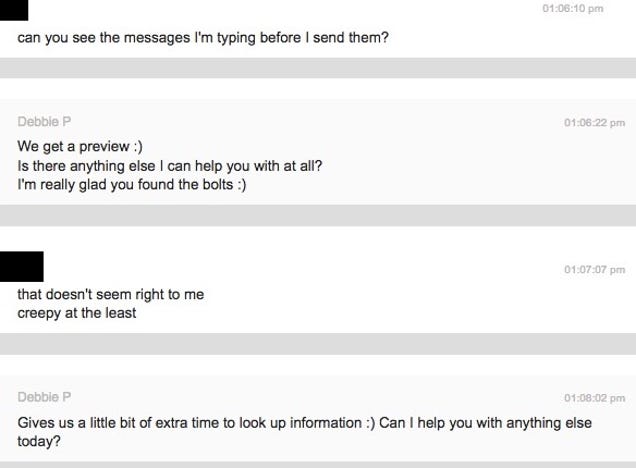
Customer Service Agents Might Be Able To See What You're Typing In Real Time (gizmodo.com)
Gizmodo is warning that some customer service agents might be able to see what you're typing in real time. A reader sent them a transcript from a conversation they had with a mattress company after the agent responded to a message he hadn't sent yet. From the report: Something similar recently happened to HmmDaily's Tom Scocca. He got a detailed answer from an agent one second after he hit send. Googling led Scocca to a live chat service that offers a feature it calls "real-time typing view" to allow agents to have their "answers prepared before the customer submits his questions." Another live chat service, which lists McDonalds, Ikea, and Paypal as its customers, calls the same feature "message sneak peek," saying it will allow you to "see what the visitor is typing in before they send it over." Salesforce Live Agent also offers "sneak peak."
This particular magic trick happens thanks to JavaScript operating in your browser and detecting what's happening on a particular site in real time. It's also how companies capture information you've entered into web forms before you've hit submit. Companies could lessen the creepiness by telling people their typing is seen in real time or could eliminate the send button altogether. So if you don't want to be monitored or send secret messages to agents, put your phone on mute while on hold and copy/paste messages from another document to your customer service chatbox. And in general, be nice to customer service agents. It's not their fault. -
A New Senate Bill Would Hit Robocallers With Up To a $10,000 Fine For Every Call (gizmodo.com)
Massachusetts Democratic Senator Ed Markey and South Dakota Republican Senator John Thune have introduced a bill on Friday that aims to ramp up the penalties on illegal robocalls and stop scammers from sending them. Gizmodo reports: The Telephone Robocall Abuse Criminal Enforcement and Deterrence (TRACED) Act, raises the penalty for robocalls from $1,500 per call to up to $10,000 per call, and allows the Federal Communications Commission (FCC) to take action on illegal robocalls up to three years after the calls are placed, instead of a year. The Act also aims to push the FCC to work along with the Consumer Financial Protection Bureau, Department of Justice, Department of Homeland Security, Federal Trade Commission (FTC), and other agencies to provide information to Congress about advancements in hindering robocall and prosecuting scammers. Perhaps most importantly for us highly annoyed Americans, the bill would also force phone service providers to use call authentication that filters out illegitimate calls before they go through to consumers. -
A Massive Impact Crater Has Been Detected Beneath Greenland's Ice Sheet (gizmodo.com)
An anonymous reader quotes a report from Gizmodo: An unusually large asteroid crater measuring 19 miles wide has been discovered under a continental ice sheet in Greenland. Roughly the size of Paris, it's now among the 25 biggest asteroid craters on Earth. An iron-rich asteroid measuring nearly a kilometer wide (0.6 miles) struck Greenland's ice-covered surface at some point between 3 million and 12,000 years ago, according to a new study published today in Science Advances. The impact would've flung horrific amounts of water vapor and debris into the atmosphere, while sending torrents of meltwater into the North Atlantic -- events that likely triggered global cooling (a phenomenon sometimes referred to as a nuclear or volcanic winter). Over time, however, the gaping hole was obscured by a 1,000-meter-tall (3,200-foot) layer of ice, where it remained hidden for thousands of years. Remarkably, the crater was discovered quite by chance -- and it's now the first large crater to be discovered beneath a continental ice sheet. -
Nasty Adobe Bug Deleted $250,000 Worth of Man's Files, Lawsuit Claims (gizmodo.com)
Freelance videographer Dave Cooper has filed a class action lawsuit against Adobe, alleging that an update to Premiere Pro came with a flaw in the way it handles file management that resulted in the deletion of 500 hours of video clips that he claims were worth around $250,000. Adobe has since patched the bug. Gizmodo reports: Premiere creates redundant video files that are stored in a "Media Cache" folder while a user is working on a project. This takes up a lot of hard drive space, and Cooper instructed the video editing suite to place the folder inside a "Videos" directory on an external hard drive, according to court documents. The "Videos" folder contained footage that wasn't associated with a Premiere project, which should've been fine. When a user is done working on a project they typically clear the "Media Cache" and move on with their lives. Unfortunately, Cooper says that when he initiated the "Clean Cache" function it indiscriminately deleted the contents of his "Videos" folder forever.
Cooper claims that he lost around 100,000 individual clips and that it cost him close to $250,000 to capture that footage. After spending three days trying to recover the data, he admitted that all was lost, the lawsuit says. He also apparently lost work files for edits he was working on and says that he's missed out on subsequent licensing opportunities. On behalf of himself and other users who wish to join the suit, he's asking the court for a jury trial and is seeking "monetary damages, including but not limited to any compensatory, incidental, or consequential damages in an amount that the Court or jury will determine, in accordance with applicable law." -
Foxconn Denies Looking To Transfer Chinese Workers To Incoming Wisconsin Factory (theverge.com)
A Wall Street Journal article published this morning reported that Foxconn is looking to transfer some of its Chinese workers to Wisconsin in time for its new factory opening in Racine. The article says that these workers would likely be engineers and would fill a gap in prospective talent due to a tight labor market. Foxconn has since denied these claims. The Verge reports: In a comment to Gizmodo, Foxconn denied that it was recruiting Chinese workers. The company said: "We can categorically state that the assertion that we are recruiting Chinese personnel to staff our Wisconsin project is untrue. Our recruitment priority remains Wisconsin first and we continue to focus on hiring and training workers from throughout Wisconsin. We will supplement that recruitment from other U.S. locations as required."
In November 2017, Wisconsin pledged $3 billion in subsidies for the Taiwan-based company if it opted to open the factory in Wisconsin. In return, Foxconn said it would create 13,000 jobs and invest $10 billion. (The state subsidy came out to $230,000 per job.) The Wall Street Journal report suggests that the company is struggling to find qualified engineers in the area, though, as the unemployment rate in the state reached a record low at 3 percent, along with a recent national low at 3.7 percent. -
Scientists Find Link Between Parkinson's Disease and the Appendix (gizmodo.com)
An anonymous reader quotes a report from Gizmodo: Scientists have found further evidence that the gut, or more specifically the appendix, might play a role in the development of Parkinson's disease. The international team of scientists reviewed two datasets, including a large registry from Sweden, and found that removal of the appendix was associated with a decreased risk of developing Parkinson's disease. They also found that the human appendix contains clumps of a protein called alpha-synuclein in a form associated with the disease. There's more work to be done, and the authors are not advocating that people preemptively remove their appendixes, but they hope that the research could provide a pathway towards treatment.
The study found that of the 1,144,745 Swedes who did not have appendectomies, 1,608 had Parkinson's, but of the 551,003 who had, only 644 had Parkinson's. This is amounts to a 16.9% decrease in the odds of acquiring the disease -- but in absolutes, that's the difference between an 0.14 percent chance of acquiring the disease for those who hadn't gotten their appendix removed versus an 0.11 percent chance for those who had. The effect was also stronger in those living in rural areas, according to the study published today in Science Translational Medicine. The researchers also found that for those who had appendectomies at least 30 years before developing Parkinson's, the procedure was associated with a 3.6-year delay in disease onset. The appendix samples contained alpha-synuclein proteins and shortened and mis-folded alpha-synucleins like the ones found in people with Parkinson's disease. Professor Viviane Labrie from the Cancer of Neurodegenerative Science at the Van Andel Research Institute in Michigan suggests that the alpha-synucleins "can travel up the nerve that connects the G.I. tract to the brain." She added: "If it were to enter the brain, it can seed and spread from there and have neurotoxic effects that could eventually lead to Parkinson's disease." -
US Indicts Chinese Hacker-Spies In Conspiracy To Steal Aerospace Secrets (gizmodo.com)
An anonymous reader quotes a report from Gizmodo: The U.S. Justice Department has charged two Chinese intelligence officers, six hackers, and two aerospace company insiders in a sweeping conspiracy to steal confidential aerospace technology from U.S. and French companies. For more than five years, two Chinese Ministry of State Security (MSS) spies are said to have run a team of hackers focusing on the theft of designs for a turbofan engine used in U.S. and European commercial airliners, according to an unsealed indictment dated October 25. In a statement, the DOJ said a Chinese state-owned aerospace company was simultaneously working to develop a comparable engine.
The MSS officers involved were identified as Zha Rong, a division director in the Jiangsu Province regional department (JSSD), and Chai Meng, a JSSD section chief. At the direction of the MSS officers, the hackers allegedly infiltrated a number of U.S.-based aerospace companies, including California-based Capstone Turbine, among others in Arizona, Massachusetts, and Oregon, the DOJ said. The officers are also said to have recruited at least two Chinese employees of a French aerospace manufacturer -- insiders who allegedly aided the conspiracy by, among other acts, installing Sakula, a remote access trojan, onto company computers. -
HealthCare.gov Portal Suffers Data Breach Exposing 75,000 Customers (gizmodo.com)
An anonymous reader quotes a report from Gizmodo: Sensitive information belonging to roughly 75,000 individuals was exposed after a government healthcare sign-up system got hacked, the Centers for Medicare & Medicaid Services (CMS) said on Friday. The agency said that "anomalous system activity" was detected last week in the Direct Enrollment system, which Americans use to enroll in healthcare plans via the insurance exchange established under the Affordable Care Act -- also known as Obamacare. A breach was declared on Wednesday. It's unclear why the agency, which is part of the U.S. Department of Health and Human Services, chose to not announce the incident sooner. Officials said the hacked portal is used by insurance agents and brokers to help Americans sign up for coverage and that no other systems were involved. The affected system has been disabled. CMS said it hoped to restore it before the end of next week. "I want to make clear to the public that HealthCare.gov and the Marketplace Call Center are still available, and open enrollment will not be negatively impacted," CMS Administrator Seema Verma said in a statement. "We are working to identify the individuals potentially impacted as quickly as possible so that we can notify them and provide resources such as credit protection." -
Someone Used a Deep Learning AI To Perfectly Insert Harrison Ford Into "Solo: A Star Wars Story" (gizmodo.com)
Andrew Liszewski, writing for io9: Casting anyone other than Harrison Ford in the role of Han Solo just feels like sacrilege, but since Ford is now 76 years old, playing a younger version of himself would be all but impossible. Or at least impossible if you rely on the standard Hollywood de-aging tricks like makeup and CG. Artificial intelligence, it turns out, does a pretty amazing job at putting Ford back into the role of Solo. The YouTube channel "derpfakes" has been posting videos that demonstrate the impressive, and at times frightening, capabilities of image processing using artificial intelligence. Using a process called deep learning, an AI analyzes a large collection of photos of a given person, creating a comprehensive database of them in any almost any position and pose. It then uses that database to intelligently perform an automatic face replacement on a source clip, in this case replacing actor Alden Ehrenreich's face with Harrison Ford's. -
'Do Not Track,' the Privacy Tool Used By Millions of People, Doesn't Do Anything (gizmodo.com)
An anonymous reader quotes a report from Gizmodo: When you go into the privacy settings on your browser, there's a little option there to turn on the "Do Not Track" function, which will send an invisible request on your behalf to all the websites you visit telling them not to track you. A reasonable person might think that enabling it will stop a porn site from keeping track of what she watches, or keep Facebook from collecting the addresses of all the places she visits on the internet, or prevent third-party trackers she's never heard of from following her from site to site. According to a recent survey by Forrester Research, a quarter of American adults use "Do Not Track" to protect their privacy. (Our own stats at Gizmodo Media Group show that 9% of visitors have it turned on.) We've got bad news for those millions of privacy-minded people, though: "Do Not Track" is like spray-on sunscreen, a product that makes you feel safe while doing little to actually protect you.
Yahoo and Twitter initially said they would respect it, only to later abandon it. The most popular sites on the internet, from Google and Facebook to Pornhub and xHamster, never honored it in the first place. Facebook says that while it doesn't respect DNT, it does "provide multiple ways for people to control how we use their data for advertising." (That is of course only true so far as it goes, as there's some data about themselves users can't access.) From the department of irony, Google's Chrome browser offers users the ability to turn off tracking, but Google itself doesn't honor the request, a fact Google added to its support page some time in the last year. [...] "It is, in many respects, a failed experiment," said Jonathan Mayer, an assistant computer science professor at Princeton University. "There's a question of whether it's time to declare failure, move on, and withdraw the feature from web browsers." That's a big deal coming from Mayer: He spent four years of his life helping to bring Do Not Track into existence in the first place. Only a handful of sites actually respect the request -- the most prominent of which are Pinterest and Medium (Pinterest won't use offsite data to target ads to a visitor who's elected not to be tracked, while Medium won't send their data to third parties.) -
The Magic Leap Con (gizmodo.com)
Reader merbs shares a report about Magic Leap, a US-based startup valued at north of $6 billion and which counts Google, Alibaba, Warner Bros, AT&T, and several top Silicon Valley venture capital firms as its investors. The company, which held its first developer conference this week, announced that it is making its $2,295 AR headset available in more states in the United States. Journalist Brian Merchant attended the conference and shares the other part of the story. From a story: After spending two days at LEAPcon, I feel it is my duty -- in the name of instilling a modicum of sanity into an age where a company that has never actually sold a product to a consumer can be worth a billion dollars more than the entire GDP of Fiji -- to inform you that it is not. Magic Leap clearly wants its public launch to appear huge -- who wouldn't? In decidedly Magic Leapian fashion, the company covered an entire side of LA Mart, the 12-story building in downtown Los Angeles where the conference was to be held, with a psychedelic image of an astronaut and the tagline 'Free Your Mind'. In similarly Leapian fashion, the actual demos and keynote took place in the basement, where a wrong turn could land you in shipping and receiving and cell reception was nil.
[...] You know that weird sensation when it feels like everyone around you is participating in some mild mass hallucination, and you missed the dosing? The old 'what am I possibly missing here' phenomenon? That's how I felt at LEAP a lot of the time, amidst crowds of people dropping buzzwords and acronym soup at light speed, and then again while I was reading reviews of the device afterwards -- somehow, despite years of failing to deliver anything of substance, lots of the press is still in Leap's thrall. Demo after demo, I felt like, sure, that was kind of neat. The games were charming, if often glitchy and simplistic, and yes, it might be helpful for architects to be able to blow up and walk around their designs. I liked the developers, who were smart and funny. Some of the graphics and interactions were very nicely rendered. But there wasn't anything -- besides a single demo, which I'll get to in a second -- that I'd feel compelled to ever do again. It felt genuinely crazy to me that people could get too excited about this, especially after years of decent VR and the Hololens, without having a distinct monetary incentive to do so.
As many have noted, the hardware is still extremely limiting. The technology underpinning these experiences seems genuinely advanced, and if it were not for a multi-year blitzkrieg marketing campaign insisting a reality where pixels blend seamlessly with IRL physics was imminent, it might have felt truly impressive. (Whether or not it's advanced enough to eventually give rise to Leap's prior promises is an entirely open question at this point.) For now, the field of vision is fairly small and unwieldy, so images are constantly vanishing from view as you look around. If you get too close to them, objects will get chopped up or move awkwardly. And if you do get a good view, some objects appear low res and transparent; some looked like cheap holograms from an old sci-fi film. Text was bleary and often doubled up in layers that made it hard to read, and white screens looked harsh -- I loaded Google on the Helio browser and immediately had to shut my eyes. Further reading: Magic Leap is Pushing To Land a Contract With US Army To Build AR Devices For Soldiers To Use On Combat Missions, Documents Reveal. -
The Magic Leap Con (gizmodo.com)
Reader merbs shares a report about Magic Leap, a US-based startup valued at north of $6 billion and which counts Google, Alibaba, Warner Bros, AT&T, and several top Silicon Valley venture capital firms as its investors. The company, which held its first developer conference this week, announced that it is making its $2,295 AR headset available in more states in the United States. Journalist Brian Merchant attended the conference and shares the other part of the story. From a story: After spending two days at LEAPcon, I feel it is my duty -- in the name of instilling a modicum of sanity into an age where a company that has never actually sold a product to a consumer can be worth a billion dollars more than the entire GDP of Fiji -- to inform you that it is not. Magic Leap clearly wants its public launch to appear huge -- who wouldn't? In decidedly Magic Leapian fashion, the company covered an entire side of LA Mart, the 12-story building in downtown Los Angeles where the conference was to be held, with a psychedelic image of an astronaut and the tagline 'Free Your Mind'. In similarly Leapian fashion, the actual demos and keynote took place in the basement, where a wrong turn could land you in shipping and receiving and cell reception was nil.
[...] You know that weird sensation when it feels like everyone around you is participating in some mild mass hallucination, and you missed the dosing? The old 'what am I possibly missing here' phenomenon? That's how I felt at LEAP a lot of the time, amidst crowds of people dropping buzzwords and acronym soup at light speed, and then again while I was reading reviews of the device afterwards -- somehow, despite years of failing to deliver anything of substance, lots of the press is still in Leap's thrall. Demo after demo, I felt like, sure, that was kind of neat. The games were charming, if often glitchy and simplistic, and yes, it might be helpful for architects to be able to blow up and walk around their designs. I liked the developers, who were smart and funny. Some of the graphics and interactions were very nicely rendered. But there wasn't anything -- besides a single demo, which I'll get to in a second -- that I'd feel compelled to ever do again. It felt genuinely crazy to me that people could get too excited about this, especially after years of decent VR and the Hololens, without having a distinct monetary incentive to do so.
As many have noted, the hardware is still extremely limiting. The technology underpinning these experiences seems genuinely advanced, and if it were not for a multi-year blitzkrieg marketing campaign insisting a reality where pixels blend seamlessly with IRL physics was imminent, it might have felt truly impressive. (Whether or not it's advanced enough to eventually give rise to Leap's prior promises is an entirely open question at this point.) For now, the field of vision is fairly small and unwieldy, so images are constantly vanishing from view as you look around. If you get too close to them, objects will get chopped up or move awkwardly. And if you do get a good view, some objects appear low res and transparent; some looked like cheap holograms from an old sci-fi film. Text was bleary and often doubled up in layers that made it hard to read, and white screens looked harsh -- I loaded Google on the Helio browser and immediately had to shut my eyes. Further reading: Magic Leap is Pushing To Land a Contract With US Army To Build AR Devices For Soldiers To Use On Combat Missions, Documents Reveal. -
Moons Can Have Their Own Moons and They Could Be Called Moonmoons (atlasobscura.com)
Two astronomers have asked a question for the ages: Can moons have moons? The delightful, if theoretical, answer is: Yes -- yes, they can. Sarah Laskow, writing for Atlas Obscura: As Gizmodo reports, this particular scientific inquiry began with a question from Juna Kollmeier's son. Kollemeier, who works at the Observatories of the Carnegie Institution of Washington, recruited Sean Raymond, of the University of Bordeaux, to help her answer the question. In a paper posted on arXiv [PDF], they lay out their case that moons can have moons. The conditions have to be right -- the primary moon has to be big enough and far away enough from the planet it's orbiting for the smaller, secondary moon to survive. But, even given these caveats, they found that moons in our very own solar system could theoretically have their own smaller moons. Two of Saturn's moons and one of Jupiter's are candidates. So is our favorite moon -- the Earth's moon.
[...] One of the great challenges of talking about recursive places is deciding what call them. The prefix "sub-" can do a lot of work here: We can islands within islands "subislands," and in the arXiv paper, Kollmeier and Raymond call a moon's moon a "submoon." But there are other options. New Scientist notes that "moonmoon" has been put forth as a name for a moon's moon. For those of us who are less than fluent in meme culture: This is a reference to Moon Moon, sometimes described as the internet's derpiest wolf. Moon Moon was born in 2013, from a werewolf name generator, and soon started frolicking across Tumblr and all other places memes can be found. -
Newly Discovered Volcanic 'Lost World' Is a Haven For Marine Life (gizmodo.com)
An anonymous reader quotes a report from Gizmodo: Australian scientists have discovered a previously unknown chain of volcanic seamounts near Tasmania. The area appears to be brimming with marine life, including a surprising number of whales who may be using the undersea volcanoes as a navigational tool. The volcanic chain was discovered by scientists from the Australian National University and CSIRO, Australia's national science agency, while on a 25-day mission aboard the research vessel Investigator to conduct detailed seafloor maps of the region. The undersea volcanoes are about 250 miles (400 kilometers) east of Tasmania, and they're quite deep.
The tallest of the seamounts extends 3,000 meters (9,800 feet) from the seafloor, so they're not tiny. It's hard to believe that something so large has gone undetected for so long, but our oceans are notoriously understudied. A mere 20 percent of Earth's oceans has been explored, according to the National Oceanic and Atmospheric Administration. [T]he seamounts appeared to serve as a kind of mid-ocean oasis for a host of marine organisms. In addition to finding copious amounts of plankton in the area, the researchers observed various seabirds and a surprising number of whales. The volcanic seamounts, the researchers say, are likely important stopping points for migratory animals, particularly whales, who rely on seafloor structures for navigation. The volcanoes are likely serving as important signposts as the whales travel from their winter breeding areas to summer feeding grounds, the researchers say. -
Discovery of 'Goblin' Solar System Object Bolsters the Case For Planet Nine (gizmodo.com)
Astronomers have discovered a dwarf planet, dubbed "the Goblin," in the outer reaches of the Solar System that never gets any closer to the Sun than 6 billion miles. Some experts say its orbital configuration points to the existence of Planet Nine, a hypothetical planet in our Solar System that is estimated to be about 10 times the mass of Earth. Gizmodo reports: The Goblin, or 2015 TG38 as it's more formally called, is what's known as an extreme trans-Neptunian object, or ETNO. As the moniker implies, these objects, of which there are potentially thousands, are located well beyond the orbit of Neptune. The researchers who discovered the object, a team led by Scott Sheppard from the Carnegie Institution for Science and Chadwick Trujillo from Northern Arizona University, estimate that the Goblin is around 185 miles (300 kilometers) in diameter. At this size, it could very well be sphere-like in shape. Its mean distance from the Sun is about 80 astronomical units (AU), where 1 AU is the average distance from the Earth to the Sun. That's 7.45 billion miles, or 12 billion kilometers.
The Goblin's extreme orbital path means it never comes close enough to impose gravitational influence on the Solar System's giant planets, like Neptune or Jupiter. And at the astounding distance of 2,300 AU, it gets slotted into an emerging astronomical category known as Inner Oort Cloud objects (IOCs), of which 2012 VP113 and Sedna are the only other two known members. [...] The discovery of 2015 TG38 is bolstering the case for Planet Nine -- a hypothetical planet, sometimes referred to as Planet X, that's allegedly several times larger than Earth and located hundreds of AU away. As noted in the new study, published today in The Astronomical Journal, the location of Goblin's perihelion is similar to what's observed with Sedna and 2012 VP113, along with other ETNOs. This is a clue to astronomers that something potentially big, i.e. a super-Earth, is pushing these objects into similar types of orbits. -
Scientists Can Now Peek Inside Mummies In a Whole New Way (gizmodo.com)
An anonymous reader quotes a report from Gizmodo: A revved-up version of traditional CT scanning shows it's possible to acquire microscopic-scale images of ancient Egyptian mummies, revealing previously unseen features such as blood vessels and nerves. A new proof-of-concept study published this week in Radiology shows a modified version of CT scanning, called phase-contrast CT scanning, can be used to do microscopic-scale imaging of soft-tissue in human mummies. This imaging technique detects the absorption and phase shift (similar to how light changes direction when it passes through a lens) that happens when x-rays pass through a solid object. The resulting images feature a higher level of contrast than traditional x-ray images.
For the new study, Jenny Romell and her colleagues at the KTH Royal Institute of Technology in Sweden wanted to evaluate the effectiveness of using phase-contrast CT scanning on mummies. The researchers scanned a mummified human right hand from ancient Egypt. The hand was lent to them by the Museum of Mediterranean and Near Eastern Antiquities, and it dates back to around 400 BC. Rommel's team scanned the entire hand, followed by more detailed imaging of a finger tip. The system worked beautifully. The resolution got as good as an estimated 6 to 9 microns, which is slightly more than the width of a human blood cell. At such a small scale, the researchers could visualize the mummy's blood vessels, different layers of skin growth, adipose cells, blood vessels, and nerves. For archaeologists, this now introduces a new way of imaging ancient remains in an unobtrusive and highly detailed way. -
Amazon's Aggressive Anti-Union Tactics Revealed In Leaked Video (gizmodo.com)
An anonymous reader quotes a report from Gizmodo: Amazon, the country's second-largest employer, has so far remained immune to any attempts by U.S. workers to form a union. With rumblings of employee organization at Whole Foods -- which Amazon bought for $13.7 billion last year -- a 45-minute union-busting training video produced by the company was sent to Team Leaders of the grocery chain last week, according to sources with knowledge of the store's activities. Recordings of that video, obtained by Gizmodo, provide valuable insight into the company's thinking and tactics. Each of the video's six sections, which the narrator states are "specifically designed to give you the tools that you need for success when it comes to labor organizing," take place in an animated simulacrum of a Fulfillment Center. The video's narrators are clad in the reflective vests typical of the real-world setting. "We are not anti-union, but we are not neutral either," the video states, drawing a distinction that would likely be largely academic to potential organizers.
To expound on what non-neutrality might look like, the video adds in plain language (emphasis ours): "We do not believe unions are in the best interest of our customers, our shareholders, or most importantly, our associates. Our business model is built upon speed, innovation, and customer obsession -- things that are generally not associated with union. When we lose sight of those critical focus areas we jeopardize everyone's job security: yours, mine, and the associates.'" Throughout, the video claims Amazon prefers a "direct management" structure where employees can bring grievances to their bosses individually, rather than union representation. However, a number of warehouse workers have expressed to Gizmodo in past reporting that they believed voicing their concerns led to retaliatory scrutiny or firing. -
Facebook Is Giving Advertisers Access To Your Shadow Contact Information (gizmodo.com)
Kashmir Hill, reporting for Gizmodo: Last week, I ran an ad on Facebook targeted at a computer science professor named Alan Mislove. Mislove studies how privacy works on social networks and had a theory that Facebook is letting advertisers reach users with contact information collected in surprising ways. I was helping him test the theory by targeting him in a way Facebook had previously told me wouldn't work. I directed the ad to display to a Facebook account connected to the landline number for Alan Mislove's office, a number Mislove has never provided to Facebook. He saw the ad within hours.
One of the many ways that ads get in front of your eyeballs on Facebook and Instagram is that the social networking giant lets an advertiser upload a list of phone numbers or email addresses it has on file; it will then put an ad in front of accounts associated with that contact information. A clothing retailer can put an ad for a dress in the Instagram feeds of women who have purchased from them before, a politician can place Facebook ads in front of anyone on his mailing list, or a casino can offer deals to the email addresses of people suspected of having a gambling addiction. Facebook calls this a "custom audience." You might assume that you could go to your Facebook profile and look at your "contact and basic info" page to see what email addresses and phone numbers are associated with your account, and thus what advertisers can use to target you. But as is so often the case with this highly efficient data-miner posing as a way to keep in contact with your friends, it's going about it in a less transparent and more invasive way.
[...] Giridhari Venkatadri, Piotr Sapiezynski, and Alan Mislove of Northeastern University, along with Elena Lucherini of Princeton University, did a series of tests that involved handing contact information over to Facebook for a group of test accounts in different ways and then seeing whether that information could be used by an advertiser. They came up with a novel way to detect whether that information became available to advertisers by looking at the stats provided by Facebook about the size of an audience after contact information is uploaded. They go into this in greater length and technical detail in their paper [PDF]. They found that when a user gives Facebook a phone number for two-factor authentication or in order to receive alerts about new log-ins to a user's account, that phone number became targetable by an advertiser within a couple of weeks. Officially, Facebook denies the existence of shadow profiles. In a hearing with the House Energy & Commerce Committee earlier this year, when New Mexico Representative Ben Lujan asked Facebook CEO Mark Zuckerberg if he was aware of the so-called practice of building "shadow profiles", Zuckerberg denied knowledge of it. -
Man Who Uploaded Deadpool To Facebook May Get Six Months In Prison (gizmodo.com)
A California court may soon sentence a man who posted the entirety of Deadpool on his Facebook page to six months in prison. Gizmodo reports: A week after Deadpool was released in theaters, millions of people watched the film on a viral Facebook post by the account Tre-Von M. King. The FBI found that the account belonged to Trevon Franklin, a 22-year-old in Fresno, California. Franklin had downloaded the movie from file-sharing platform Putlocker.is, then uploaded the movie to his Facebook page, where it garnered 6,386,456 views, according to court documents. He was indicted and arrested in June 2017. In May, Franklin made a plea agreement with the government. Franklin pled guilty in exchange for authorities agreeing to recommend a reduced sentenced. Last week, the government filed its sentencing recommendation. As TorrentFreak originally reported, authorities suggested a prison sentence of six months. The government argues that the sentencing "is both necessary and sufficient to address the nature of circumstances of the offense and to reflect the seriousness of the offense, to promote respect for the law, and to provide just punishment for the offense."
This is because Franklin publicly disregarded the law in a number of posts. In one such post he wrote: "I got the ultimate way out of this, yall might be surprised on how I won't go to jail but just become more famous." In another he wrote, "I'm just sitting back smoking out my bong laughing at these mfs who think they know what they talking I haven't sold shit to anyone, or made copies." -
Study Suggests BPA-Free Plastics Are Just As Harmful To Health (gizmodo.com)
An anonymous reader quotes a report from Gizmodo: Plastic products that boast of being "BPA-free" aren't necessarily any safer for us, suggests a new mouse study published Thursday in Current Biology. The chemicals used to replace BPA in these plastics can still leak out and affect the sperm and eggs of both male and female mice, it found. And these same effects could be happening in people. Bisphenol A, or BPA, is a chemical commonly used to create polycarbonate plastics and epoxy resins. These clear white plastics are themselves used in food and drink packaging, as well as consumer products and medical devices, while resins are used to coat metal products like canned foods. When these products degrade or are otherwise damaged (from being repeatedly heated in a microwave, for example), they can leach out BPA, exposing us to it. As a result, it's estimated that 93 percent of Americans have some level of BPA in their system.
While working on another project, the authors began seeing some but not all of their control mice, both male and female, develop reproductive problems. Though the mice had kept in cages made of polysulfone, not polycarbonate, the researchers noticed a whitish residue in some of the cages, indicating they had been damaged and were leaching chemicals. When Patricia Hunt, a researcher at the Center for Reproductive Biology at Washington State University, and her team analyzed the chemical signature of the damaged cages, they found both BPA and BPS, a bisphenol that is widely replacing BPA. The cases were polysulfone plastic, which is partly made from BPA, but it's advertised to be more heat and chemical resistant than polycarbonate and thus less likely to break down. Polysulfone isn't thought to degrade into BPS, but Hunt's team found that if certain chemical bonds in the plastic were broken in the right way, BPS could form. Following in the vein of their original experiments with BPA, Hunt's team exposed more mice to low doses of BPS, and compared their reproductive health to mice exposed to BPA and mice raised in fresh new cages, presumably free of any BPA/BPS contamination. The BPS mice had more defects in their egg and sperm cells than did the control mice, but the level of damage was similar to that seen in mice they exposed to the same dose of BPA alone. "Though manufacturers have shied away from making explicit claims about BPA replacements being safer, Hunt noted, customers have certainly assumed that they are safer," the report notes. -
Plan To Build a Genetic Noah's Ark Includes a Staggering 66,000 Species (gizmodo.com)
An anonymous reader quotes a report from Gizmodo: An international consortium involving over 50 institutions has announced an ambitious project to assemble high-quality genome sequences of all 66,000 vertebrate species on Earth, including all mammals, birds, reptiles, amphibians, and fish. With an estimated total cost of $600 million dollars, it's a project of biblical proportions. It's called the Vertebrate Genomes Project (VGP), and it's being organized by a consortium called Genome 10K, or G10K. As its name implies, this group had initially planned to sequence the genomes of at least 10,000 vertebrate species, but now, owing to tremendous advances and cost reductions in gene sequencing technologies, G10K has decided to up the ante, aiming to sequence both a male and female individual from each of the approximately 66,000 vertebrate species on Earth. Cofounders of the project announced the new goal yesterday at a press briefing held during the opening session of the 2018 Genome 10K conference, currently being held at Rockefeller University in New York City. The project will involve over 150 experts from 50 institutions in 12 countries. -
Researchers Come Out With Yet Another Unnerving, New Deepfake Method (gizmodo.com)
Researchers at Carnegie Mellon University have figured out a new method to create deepfakes -- videos that make it look like someone said or did something they didn't say or do. They're usually manipulated using machine learning and have been a big problem for porn sites, as they can be used to create fake celebrity pornographic videos or revenge porn. According to Gizmodo, the researchers "have figured out a way to automatically transfer the 'style' of one person to another." From the report: "For instance, Barack Obama's style can be transformed into Donald Trump," the researchers wrote in the description of a YouTube video highlighting the outcome of this method. The video shows the facial expressions of John Oliver transferred to both Stephen Colbert and an animated frog, from Martin Luther King, Jr. to Obama, and from Obama to Trump. The researchers describe the process in a paper as an "unsupervised data-driven approach." Like other methods of developing deepfakes, this one uses artificial intelligence. The paper doesn't exclusively deal in translating talking style and facial movements from one human to another -- it also includes examples with blooming flowers, sunrises and sunsets, and clouds and wind.
For the person-to-person deepfakes, the researchers cite examples of how certain mannerisms can be transferred, including "John Oliver's dimple while smiling, the shape of mouth characteristic of Donald Trump, and the facial mouth lines and smile of Stephen Colbert." The team used videos available to the public to develop these deepfakes. It's easy to see how these techniques might be applied in a more innocuous way... -
'You Can See Almost Everything.' Antarctica Just Became the Best-Mapped Continent on Earth (fortune.com)
Antarctica has become the best-mapped continent on Earth with a new high-resolution terrain map showing the ice-covered landmass in unprecedented detail. From a report: According to the scientists at Ohio State University and the University of Minnesota who created the imagery, Antarctica is now the best-mapped continent on Earth. The Reference Elevation Model of Antarctica (REMA) was constructed using hundreds of thousands of satellite images taken between 2009 and 2017, Earther reports. A supercomputer assembled the massive amounts of data, including the elevation of the land over time, and created REMA, an immensely detailed topographical map, with a file size over 150 terabytes. The new map has a resolution of 2 to 8 meters, compared to the usual 1,000 meters, says an Ohio State press release. According to The New York Times, the detail of this new map is the equivalent of being able to see down to a car, or smaller, when before you could only see the whole of Central Park. Scientists now know the elevation of every point of Antarctica, with an error margin of just a few feet. -
Facebook, Twitter Execs Admit Failures, Warn of 'Overwhelming' Threat To Elections (gizmodo.com)
Openly recognizing their companies' past failures in rare displays of modesty, Facebook and Twitter executives touted new efforts to combat state-sponsored propaganda across their platforms before the Senate Intelligence Committee on Wednesday, acknowledging that the task is often "overwhelming" and proving a massive drain on their resources. Gizmodo: In opening remarks on Wednesday, Facebook's chief operating officer, Sheryl Sandberg, acknowledged that Facebook had been "too slow to act" in 2016 against the Kremlin-backed campaign that was designed to sow discord among American voters. "That's on us," she said, describing Moscow's meddling as "completely unacceptable" and a violation of Facebook's values "and of the country we love." "We're investing for the long term because security is never a finished job," Sandberg added, noting that Facebook has increased its security and communications staff to 20,000 people, doubling it over the past year. "Our adversaries are determined, creative, and well-funded," she said. "But we are even more determined -- and we will continue to fight back."
Twitter CEO Jack Dorsey, meanwhile, portrayed the matter as not just a threat to democracy, but as a threat to the overall health and security of his business, saying that above all else, Twitter's goal is to serve a "global public conversation." Dorsey also acknowledged a range of threats faced by his company, including widespread abuse, manipulation by foreign powers, and "malicious automation" (i.e., bots). "Any attempts to undermine the integrity of our service is antithetical to our fundamental rights," he said, calling freedom of expression a "core tenant" upon which the Twitter is based. Google, which was also asked to appear before the committee, chose not to do so. An empty chair was left at the table next to Sandberg and Dorsey to signify Google's absence. -
FCC Criticized For Surrendering Power To Punish Verizon After Firefighters Got Throttled During Wildfire (gizmodo.com)
Democratic lawmakers on Wednesday criticized the FCC on its response to Verizon's throttling of firefighters' data speeds as they battled a major wildfire in Northern California. "In a letter Friday, Senator Edward Markey and Congresswoman Anna Eshoo demanded answers from the FCC over what steps it is currently taking to address 'critical threats to public safety,' citing its decision to repeal Obama-era net neutrality protections," reports Gizmodo. From the report: The 2015 Open Internet Order -- overturned by the FCC's Republican majority last winter -- reclassified internet providers like Verizon as common carriers under Title II of the Federal Communications Act, granting the FCC regulatory authority that, in this instance, would have allowed the commission to investigate and potential penalize Verizon for its decision. At Chairman Ajit Pai's direction, the commission abdicated that authority this year. It no longer has the power to establish rules prohibiting Verizon from throttling emergency services, or charging police and fire departments additional fees to maintain their communications at optimal speeds when usage peaks -- say, during a wildfire, or an earthquake, or a mass shooting.
"The FCC has incorrectly suggested that the Federal Trade Commission (FTC) could sufficiently fill this void," wrote Markey and Eschoo, whose congressional districting includes portions of Santa Clara. "We strongly disagree with that assertion." In their letter, the Democratic lawmakers urged the FCC to make use of its Public Safety and Homeland Security Bureau and investigate the matter, saying that while the FTC may find Verizon's actions exemplify an "unfair and deceptive practice," both agencies should use "all of the tools available" to resolve this public safety matter. "To do nothing is unacceptable," they said. -
Physicists Measure Gravity With Record Precision (gizmodo.com)
An anonymous reader quotes a report from Gizmodo: A team of scientists in China are reporting that they have now performed the most precise measurement of gravity's strength yet by measuring G, the Newtonian or universal gravitational constant. G relates the gravitational attraction between two objects to their masses and the distance between them. The new measurement is important both for high-powered atomic clocks as well as the study of the universe, earth science, or any kind of science that relies on gravity in some way. The values measured by the team "have the smallest uncertainties reported until now," according to the paper published in Nature.
In the new study, scientists performed two independent calculations of G using a pair of pendulums in a vacuum, one pendulum setup for each test. Each pendulum swings back and forth between a pair of massive objects whose positions can be adjusted. The pendulums measure the force of gravity in two ways. First, they measure the difference between how quickly the pendulum swings to the "near," or parallel position, versus the "far," or horizontal position. They also measure how the direction of the pendulum's swing changes based on the pull of the test masses. The researchers ended up measuring 6.674184 and 6.674484 hundred billionths (10-11) for the time-of-swinging and angular acceleration methods, respectively. These measures were both very precise, but are still different from one another for unknown reasons. This might have had something to do with the string used for the pendulum. The paper's reviewer, Stephan Schlamminger from the National Institute of Standards and Technology, wrote in a commentary: "Li et al. carried out their experiments with great care and gave a detailed description of their work. The study is an example of excellent craftsmanship in precision measurements. However, the true value of G remains unclear. Various determinations of G that have been made over the past 40 years have a wide spread of values. Although some of the individual relative uncertainties are of the order of 10 parts per million, the difference between the smallest and largest values is about 500 parts per million." -
Y Combinator Plans To Start Doling Out $60 Million Next Year to Study Universal Basic Income (gizmodo.com)
The research arm of Y Combinator plans to begin a study on universal basic income next year in which it will give unconditional cash payments to 3,000 participants. From a report: The test is partially intended to see if receiving routine payments will quell anxieties around losing jobs to automation. As Wired reports, the study will be called "Making Ends Meet." Under the plan, a thousand people would get $1,000 per month and the other 2,000 would get $50 per month to serve as a control group. Some of the participants would receive monthly payments for three years and some would get paid every month for five years. Sam Altman, CEO of Y Combinator, a highly successful startup accelerator that helped give rise to companies like Dropbox, Airbnb, and Reddit, announced the company's plans to research universal basic income -- or as he put it, "giving people enough money to live on with no strings attached" -- in a January 2016 blog post. Altman explained his belief that universal basic income will eventually be implemented across the nation as more jobs are automated and "massive new wealth gets created." -
HUD Files Complaint Alleging Facebook Ad Tools Allow Housing Discrimination (gizmodo.com)
An anonymous reader quotes a report from Gizmodo: The U.S. Department of Housing and Urban Development has filed an official discrimination complaint against Facebook, saying the site's dizzying array of advertising tools makes it simple for advertisers to illegally exclude wide swathes of the population from seeing housing ads, Politico wrote on Friday. In a press release, HUD wrote that Facebook's "targeted advertising" model more or less constitutes a way for said advertisers to skirt the federal Fair Housing Act, specifically by excluding members of protected categories: "HUD claims Facebook enables advertisers to control which users receive housing-related ads based upon the recipient's race, color, religion, sex, familial status, national origin, disability, and/or zip code. Facebook then invites advertisers to express unlawful preferences by offering discriminatory options, allowing them to effectively limit housing options for these protected classes under the guise of 'targeted advertising.'"
Specific examples cited by HUD included showing display ads "either only to men or women," as well as preventing users flagged as interested in disabilities-related topics like "assistance dog" or "accessibility" from seeing display ads. HUD also said that the targeted advertising tool can be used to prevent people interested in specific religions or regions from seeing ads, as well as "draw a red line around zip codes and then not display ads to Facebook users who live in specific zip codes." The complaint is just a complaint, but it does start an official process that will either end in Facebook reaching a resolution with federal officials or a lawsuit. CNN Tech notes that the National Fair Housing Alliance is simultaneously suing Facebook for the same reason. "Facebook is trying to dismiss the suit by claiming it has limited liability for user-generated content, though HUD and federal prosecutors claim the site operates as an internet content provider with respect to housing ads and therefore is subject to civil rights law," reports Gizmodo. -
Engineers Say They've Created Way To Detect Weapons Using Wi-Fi (gizmodo.com)
An anonymous reader quotes a report from Gizmodo: The researchers, which include engineers from Rutgers University-New Brunswick, Indiana University-Purdue University Indianapolis (IUPUI), and Binghamton University, published a study this month detailing a method in which common wifi can be used to easily and efficiently identify weapons, bombs, and explosive chemicals in public spaces that don't typically have affordable screening options. The researchers' system uses channel state information (CSI) from run-of-the-mill wifi. It can first identify whether there are dangerous objects in baggage without having to physically rifle through it. It then determines what the material is and what the risk level is. The researchers tested the detection system using 15 different objects across three categories -- metal, liquid, and non-dangerous -- as well as with six bags and boxes across three categories -- backpack or handbag, cardboard box, and a thick plastic bag.
The findings were pretty impressive. According to the researchers, their system is 99 percent accurate when it comes to identifying dangerous and non-dangerous objects. It is 97 percent accurate when determining whether the dangerous object is metal or liquid, the study says. When it comes to detecting suspicious objects in various bags, the system was over 95 percent accurate. The researchers state in the paper that their detection system only needs a wifi device with two to three antennas, and can run on existing networks. -
Florida's Gulf Coast Battles Deadly And Smelly Red Tide (npr.org)
Greg Allen, writing for NPR: Florida this week declared a state of emergency because of a slow-moving natural disaster -- red tide. Red tide is toxic algae that have persisted off Florida's Gulf Coast for nearly a year. In recent weeks, the algae bloom has worsened, killing fish, turtles and dolphins and discouraging tourism on some of the state's most beautiful beaches.
Scores of dead fish were visible on the shore of Manatee Beach on a recent morning. There was a smell from the fish, but something more -- an acrid smell that can make you cough. Mary Vanswol, who was at the beach with her husband, James, said, "Uh, the smell is terrible. And it's affecting my lungs. I'm coughing, not so much him, but I am. It's just sad to see all the dead fish." The Vanswols live nearby and usually go swimming. But not today. After getting a look at the dead fish and the murky, slightly reddish-hued water, Mary Vanswols said they were leaving. "I wouldn't even walk along the edge of it. I just don't think it's safe," she said. Robert Weisberg, an oceanographer at the University of South Florida whose lab produces seasonal and short term forecasts of red tide, told Gizmodo a confluence of ocean circulation and environmental factors are likely responsible for initiating the bloom. Others experts are pointing to the potential role of human-driven nutrient pollution in helping to maintain it. -
California Officials Admit To Using License Plate Readers To Monitor Welfare Recipients (gizmodo.com)
According to a report from the Sacramento Bee, officials in Sacramento County have been accessing license plate reader data to track welfare recipients suspected of fraud. The practice dates back to 2016. Gizmodo reports: Sacramento County Department of Human Assistance Director Ann Edwards confirmed to the paper that welfare fraud investigators working under the DHA have used the data for two years on a "case-by-case" basis. Edwards said the DHA pays about $5,000 annually for access to the database. Abbreviated LPR, license plate readers are essentially cameras that upload photographs to a searchable database of images of license plates. If a driver passed by an LPR four times throughout a city, an officer with access would know where and at what time of day. Anyone with access to that data could use it track where someone drove and when, provided they were scanned by the LPR.
It's not immediately clear how travel patterns might reveal welfare fraud. As noted by the Electronic Frontier Foundation, welfare fraud is statistically speaking, extremely rare. In 2012, the DHA found only 500 cases of fraud among Sacramento's 193,000 recipients. Following an inquiry from the EFF, the DHA has instituted a privacy policy (one that didn't exist before their initial inquiry) requiring investigators to justify each request for LPR data. The Sacramento Bee reports the DHA accessed the data over a thousand times in two years. -
Colorado Candidate For Governor Wants To Put His State On the Blockchain (gizmodo.com)
An anonymous reader quotes a report from Gizmodo: The Democratic nominee for governor of Colorado, U.S. Representative Jared Polis, wants to add blockchain to the list of items voters consider this year. Polis currently represents Colorado's 2nd district in the House, and he won the Democratic gubernatorial nomination last month. He's held his seat in the House for about a decade and has been a fairly solid progressive. On Wednesday, Polis added a set of limited proposals regarding blockchain to his gubernatorial platform that at least give us an idea of what it means for a politician to campaign on blockchain. Polis told us he would like to resolve some of the "ambiguity" in federal rules, encourage fintech company investment, remove some licensing requirements for token securities, and exempt cryptocurrencies from state money transition laws. He says these companies are "trying to fit what they're doing into an obsolete, outdated, and often obsolete federal law."
Polis also wants to explore how blockchain could be used for voting security. Polis isn't ready to necessarily endorse moving all voting to the blockchain system. He likes paper ballots and told us, "this would be more how the information is generated and stored from those paper ballots rather than doing so in a centralized database it would be done across a distributed ledger." The congressman also thinks that blockchain could be used to streamline the process for storing public records and making them available to the public. "We're talking more about everything from Colorado contracts, expenditures, titles, a lot of the data-intensive aspects of state government can be more secure and more accessible through distributed ledgers," he said. -
The Internal Report Proving the FCC Made Up a Cyberattack (gizmodo.com)
An anonymous reader quotes a report from Gizmodo: An investigation carried out by Federal Communication Commission's own inspector general officially refutes controversial claims that a cyberattack was responsible for disrupting the FCC's comment system in May 2017, at the height of the agency's efforts to kill off net neutrality. The investigation also uncovered that FCC officials had provided congressional lawmakers with misleading information regarding conversations between an FCC employee and the Federal Bureau of Investigation's cybercrime task force. A report from the inspector general's office (OIG) released Tuesday afternoon states that the comment system's downtime was likely caused by a combination of "system design issues" and a massive surge in traffic caused when Last Week Tonight host John Oliver directed millions of TV viewers to flood the FCC's website with pro-net neutrality comments.
Investigators were unable to "substantiate the allegations of multiple DDoS attacks" alleged by then-FCC Chief Information Officer David Bray, the report says. "At best, the published reports were the result of a rush to judgment and the failure to conduct analyses needed to identify the true cause of the disruption to system availability." [Here's an excerpt from the report:] "While we identified a small amount of anomalous activity and could not entirely rule out the possibility of individual DoS attempts during the period from May 7 through May 9, 2017, we do not believe this activity resulted in any measurable degradation of system availability given the minuscule scale of the anomalous activity relative to the contemporaneous voluminous viral traffic." Yesterday, before the report was released, FCC chairman Ajit Pai came clean on the fact that the hack of its comment system last year actually took place. Pai blamed the former chief information officer and the Obama administration for providing "inaccurate information about the incident to me, my office, Congress, and the American people." -
Surface Go Reviews Are All Over the Place (arstechnica.com)
The reviews for Microsoft's Surface Go tablet are in, and they're all over the place. While the press generally agrees that the processor is slow and can only handle light tasks, such as browsing and mail, there are mixed conclusions as to whether or not the 10-inch, $399 tablet is worth buying. Ars Technica's Peter Bright summarizes: So, should you buy one? That's hard to say. Mashable was a fairly unequivocal "no:" for light productivity, a Chromebook or iPad does the job for less money, and the performance is too problematic for anything much beyond that. On the other side of the coin, Windows Central reckoned that "as a mini-PC [Surface Go] is about as good as you can get," and Ed Bott said, "It's the best cheap PC I've ever used." Gizmodo called it the "perfect representation of what laptops at this price should be." For everyone else, it depends. TechCrunch says that it's worth a look, but there's no shortage of competition around this price point. Acer and Lenovo, among others, offer decent systems that are a bit cheaper. PCWorld concludes that, if you want a tablet, get an honest-to-god tablet (which is to say, an iPad) rather than a system with Windows 10. But if you want something small and light and might just need the full flexibility of a PC, Go is the system to go for. Engadget acknowledged that the Go is "full of compromises" but that, as a "secondary device," the keyboard and software compatibility give it the edge over other tablets. The Verge concludes similarly: it's "probably not the right thing to be your only computer," but it could have a "real place" as a secondary machine. And VentureBeat took a similar line: if you really want the flexibility of a two-in-one, "you're unlikely to find anything better," but if you want either a laptop or a tablet, "you'll find better options for less." As a refresher, the Surface Go features a 10-inch touchscreen display with a 1800x1200 (217 PPI) resolution and 3:2 aspect ratio, an Intel Pentium Gold 4415Y Kaby Lake processor with up to 8GB of RAM and 128GB storage via a SSD (the 64GB eMMC variant features 4GB of RAM), integrated Intel HD Graphics 615, and "up to 9 hours" of battery life. The base model is just $399, compared to the $549 model with 128GB/8GB RAM. -
Senate Democrat Floats First Serious Proposals For Regulating Big Tech (gizmodo.com)
On Monday, Senator Mark Warner published 20 proposals on how to regulate big tech platforms. What's interesting is that none of the proposals call for breaking up the pseudo-monopolies. Instead, they aim to start a substantive debate by laying out different paths to address problems posed by the platforms. Gizmodo reports: What may be more important than the individual proposals themselves is that the document is at least trying to organize a holistic way of thinking about the issues now on the table. It breaks down the areas that need addressing into the promotion of disinformation, privacy and consumer protection, and ensuring competition in the marketplace. Just to highlight a few of the good issues on the table, the white paper blessedly brings the conversation back to privacy and data ownership -- something that seems to have been lost as the conversation has turned to content moderation. The easiest recommendation is to implement what it calls "GDPR-like" data protection legislation that would give Americans similar data rights as EU citizens gained in May. The jury is still out on the long-term consequences of those reforms, but they require greater transparency and consent for a company's terms of service, along with many more tools for keeping track of what information a company collects on you.
On the competition side of things, the proposal suggests a data-transparency bill that would give users a more granular idea of how their data is being used and how much its worth to an individual platform. One concern it addresses is that platforms expand how they monetize a person's data while the user is often unaware of how much they're actually giving up, value-wise, when they agree to hand over their data in exchange for a particular service. Another benefit would be that regulators would have a better idea of what they're evaluating in antitrust enforcement cases. The proposals relating to disinformation are a little more worrisome. A requirement that platforms "clearly and conspicuously label bots" wouldn't be so bad, but it's a daunting task and opens up the potential for false positives. Likewise, demanding networks identify a user's true identity is unrealistic, and the option of anonymity online should be protected. Axios was first to publish the list of 20 proposals compiled by Warner's staff. Is there a proposal that resonates with you? If not, how would you regulate the Big Tech platforms? -
A New Shape Called the 'Scutoid' Has Been Discovered In Our Cells (gizmodo.com)
Scientists have discovered a new shape called the scutoid (SCOO-toid) while studying epithelial cells, the building blocks of embryos that eventually end up forming our skin and lining our organs and blood vessels. The new "twisted prism" shape is "extremely efficient at keeping cells tightly-packed and organized in the literal twists and turns of development," reports Gizmodo. From the report: As embryos grow, their tissues curve and bend as they start to form into organs. Scientists thought the cells could stay tightly packed if they were bottle- or column-shaped, but computer modeling suggested that a more complex shape would be more likely. First, a computer model set out to predict which cell shapes would be most efficient at staying in contact with one another in both flat or curved layers. That shape ended up being prism-like, with six sides one end, five on the other, and a strange triangular face on one of the long edges of the prism. Using microscopy and computer imaging, the team confirmed that cells found in fruit fly salivary glands and cells in zebrafish were indeed scutoid-shaped. As noted in their paper published Friday in Nature Communications, the researchers believe these scutoid-shaped cells exist in any curved sheet of epithelial cells -- even in humans. -
For Better or Worse, YouTube Now Adapts to Multiple Aspect Ratios (gizmodo.com)
Slashdot reader Lauren Weinstein writes: YouTube very quietly made a very cool and rather major improvement in their video players today... YouTube is now adjusting the YT player size to match videos' native aspect ratios. This is a big deal, and very much welcome.
YouTube provided some before-and-after screenshots Friday, and acknowledged that "We launched this update on mobile awhile back (both Android and iOS) so this change also aligns the desktop and mobile viewing experiences."
Gizmodo writes: Until now YouTube forced all videos into a 16:9 ratio by windowboxing them, meaning surround them with black vertical or horizontal bars like the old days of watching widescreen movies on VHS. In that sense, this isn't a huge change -- white space instead of black -- although the location of player controls moves to fit the video's size...
The aspect adjustments are apparently automatic, retroactive to all uploaded video, and if there's a way to turn the feature off in Creator Studio it's non-obvious... Update 7/27/18 7:48pm: A YouTube spokesperson has since clarified to Gizmodo that currently there is no way to disable this feature. -
Scientists Resurrect 40,000-Year-Old Worms Buried In Ice (gizmodo.com)
An anonymous reader quotes a report from Gizmodo: Earlier this month, in the journal Doklady Biological Sciences, a team of Russian scientists announced they had apparently discovered ancient nematode worms that were able to resurrect themselves after spending at least 32,000 years buried in permafrost. The discovery, if legitimate, would represent the longest-surviving return from the cold ever seen in a complex, multi-celled organism, dwarfing even the tardigrade. The worms were found among more than 300 samples of frozen soil pulled from the Kolyma River Lowlands in Northeastern Siberia by the researchers. Two of the samples held the worms, with one from a buried squirrel burrow dating back 32,000 years and one from a glacier dating back 40,000 years. After isolating intact nematodes, the scientists kept the samples at 68 degrees Fahrenheit and left them surrounded by food in a petri dish, just to see what would happen. Over the next few weeks, they gradually spotted flickers of life as the worms ate the food and even cloned new family members. These cloned worms were then cultured separately, and they too thrived. -
Facebook Forced To Block 20,000 Posts About Snack Food Conspiracy After PepsiCo Sues, Says Report (gizmodo.com)
An anonymous reader quotes a report from Gizmodo: There is a rumor that Kurkure, a corn puff product developed by [Pepsico] in India, is made of plastic. The conspiracy theory naturally thrived online, where people posted mocking videos and posts questioning whether the snack contained plastic. In response, PepsiCo obtained an interim order from the Delhi High Court to block all references to this conspiracy theory online in the country, MediaNama reports. Hundreds of posts claiming that Kurkure contains plastic have already been blocked across Facebook, Twitter, Instagram, and YouTube, according to LiveMint, and the court order requires social networks to continue to block such posts. According to MediaNama, PepsiCo petitioned for 3412 Facebook links, 20244 Facebook posts, 242 YouTube videos, six Instagram links, and 562 tweets to be removed, a request the court has granted. PepsiCo's argument is that these rumors are untrue and defame the brand -- though it's evident that a number of the posts are satirical in tone, poking fun at the rumor rather than earnestly trying to spread misinformation. -
IBM Watson Reportedly Recommended Cancer Treatments That Were 'Unsafe and Incorrect'
An anonymous reader quotes a report from Gizmodo: Internal company documents from IBM show that medical experts working with the company's Watson supercomputer found "multiple examples of unsafe and incorrect treatment recommendations" when using the software, according to a report from Stat News. According to Stat, those documents provided strong criticism of the Watson for Oncology system, and stated that the "often inaccurate" suggestions made by the product bring up "serious questions about the process for building content and the underlying technology." One example in the documents is the case of a 65-year-old man diagnosed with lung cancer, who also seemed to have severe bleeding. Watson reportedly suggested the man be administered both chemotherapy and the drug "Bevacizumab." But the drug can lead to "severe or fatal hemorrhage," according to a warning on the medication, and therefore shouldn't be given to people with severe bleeding, as Stat points out. A Memorial Sloan Kettering (MSK) Cancer Center spokesperson told Stat that they believed this recommendation was not given to a real patient, and was just a part of system testing.
According to the report, the documents blame the training provided by IBM engineers and on doctors at MSK, which partnered with IBM in 2012 to train Watson to "think" more like a doctor. The documents state that -- instead of feeding real patient data into the software -- the doctors were reportedly feeding Watson hypothetical patients data, or "synthetic" case data. This would mean it's possible that when other hospitals used the MSK-trained Watson for Oncology, doctors were receiving treatment recommendations guided by MSK doctors' treatment preferences, instead of an AI interpretation of actual patient data. And the results seem to be less than desirable for some doctors. -
Moon Could Have Been Habitable Once, Scientists Speculate (gizmodo.com)
Scientists from Birkbeck, University of London speculate that recent results show that the moon is wetter than scientists have previously thought, increasing the possibility for it to have the necessary conditions for life. "Whether life ever arose on the Moon, or was transported to it from elsewhere, is of course highly speculative and can only be addressed by an aggressive future program of lunar exploration," they write in the article, published in the journal Astrobiology. Gizmodo summarizes: This habitability period, if it really occurred, might have happened either just after the Moon's formation from a massive collision with Earth 4.5 billion years ago, or 3.5 billion years ago, after a period of volcanism which may have resulted in a thin lunar atmosphere. Such an atmosphere would have lasted perhaps tens of millions of years. Maybe water existed on the Moon at this point. Maybe 10 million years was enough time for some rudimentary life to evolve on the Moon. Maybe Earthly life traveled over to the Moon on asteroids. Who knows.
The researchers stress that "habitability requires much more than just the presence of a significant atmosphere and liquid water." One such requirement would be the presence of organic compounds. And there are obviously not the same water-created features on the Moon that we see here on Earth or on Mars, like drainage channels -- though maybe these existed and were eroded by small meteors and solar winds. While the paper doesn't present new data, it's an interesting synthesis of lots of existing research demonstrating that, since the Moon is wetter than was initially thought, maybe it's worth wondering whether it was once habitable. -
Uber Bans Driver Who Secretly Livestreamed Hundreds of Passengers (mashable.com)
Lauren Weinstein tipped us off to this story from Mashable: Hundreds of Uber and Lyft rides have been broadcast live on Twitch by driver Jason Gargac this year, St. Louis Post-Dispatch reported Saturday, all of them without the passengers' permission. Gargac, who goes by the name JustSmurf on Twitch, regularly records the interior of his car while working for Uber and Lyft with a camera in the front of the car, allowing viewers to see the faces of his passengers, illuminated by his (usually) purple lights, and hear everything they say. At no point does Gargac make passengers aware that they are being filmed or livestreamed.
Due to Missouri's "one-party consent" law, in which only one party needs to agree to be recorded for it to be legal (in this case, Gargac is the consenting one), what Gargac is doing is perfectly legal. That doesn't mean it's not 100 percent creepy. Sometimes, to confirm who they are for their driver, the passengers say their full names. Not only that, Gargac has another video that shows the view out the front of his car so that people can see where he's driving, giving away the locations of some passengers' homes.
All the while, viewers on Twitch are commenting about things like the quality of neighborhoods, what the passengers are talking about, and of course, women's looks. Gargac himself is openly judgmental about the women he picks up, commenting to his viewers about their appearances before they get in his car and making remarks after he drops them off. He also regularly talks about wanting to get more "content," meaning interesting people, and is open about the fact that he doesn't want passengers to know they are on camera.
"I feel violated. I'm embarrassed," one passenger told the St. Louis Post-Dispatch. "We got in an Uber at 2 a.m. to be safe, and then I find out that because of that, everything I said in that car is online and people are watching me. It makes me sick."
The offending driver announced today on Twitter that he's at least "getting rid of the stored vids." He calls this move "step #1 of trying to calm everyone down." Hours ago his Twitch feed was made inaccessible.
Lyft and Twitch have not yet responded to Mashable's request for a comment. But Uber said they've (temporarily?) banned Gargac from accessing their app "while we evaluate his partnership with Uber." -
Is the Earth's Mantle Full of Diamonds? (gizmodo.com)
An anonymous reader quotes a report from Gizmodo: Scientists' models show that sound waves seem to travel too quickly through the old, stable cores of continents, called "cratons," which extend deep into the mantle at depths around 120 to 150 kilometers (75 to 93 miles). Through observations, experiments, and modeling, one team figured that a potential way to explain the sound speed anomaly would be the presence of a lot of diamonds, a medium that allows for a faster speed of sound than other crystals. Perhaps the Earth is as much as 2 percent diamonds by volume, they found. Scientists have modeled the rock beneath continents through tomography, which you can think of as like an x-ray image, but using sound waves. But sound-wave velocities of around 4.7 kilometers per second (about 10,513 mph) are faster than sound-wave velocities in other kinds of minerals beneath the crust, according to the paper in the journal Geochemistry, Geophysics, Geosystems.
The researchers realized that if the regions had either 3 percent diamonds by volume or 50 percent of a rock formed at high pressure and temperature called eclogite, it would enable the sound speeds they observed. But both of those numbers seemed too high, based on observations of the minerals that end up on the Earth's surface: diamond-containing rocks called kimberlites. The researchers compromised and figured that 20 percent eclogite and 2 percent diamonds could explain the high velocities. The diamonds could be sprinkled as crystals found uniformly throughout the cratons. -
Orlando Police Decide To Keep Testing Controversial Amazon Facial Recognition Program (gizmodo.com)
Despite previous reports that the program has been ended, the Orlando Police Department in Florida is planning to continue its test of Amazon's real-time facial recognition system. "News of OPD supposedly ending its use of Rekognition on footage captured by a number of CCTV cameras came just a day after the ACLU sent a letter to Orlando Mayor Buddy Dyer regarding the face recognition program," reports Gizmodo. "But the end date for the initial pilot period had already been selected -- it just happened to coincide with the ACLU's report and the ensuing backlash from civil rights groups." From the report: While the original test period ended, the OPD will soon sit down with Amazon representatives to outline the new pilot, the police department told the Orlando Sentinel. "It's really to prevent the next tragedy," Orlando Police Chief John Mina said. Now, with the program set to continue, Dyer says the practice is not as dystopian as it seems.
Details on the new pilot are sparse. OPD confirmed it will test Rekognition on at least eight cameras, as it did before, though their location isn't known. In the previous trial program, five Rekognition-enabled cameras captured footage at OPD headquarters, while three additional cameras were positioned in downtown Orlando. During its initial testing phase, Rekognition will scan officers' faces against a face database made up of volunteers. The plan, the OPD memo explains, is for officers themselves to walk in front of the cameras and record how accurately the technology recognizes them from different angles, with different clothes, or other variables. It's not known how long this initial testing phase will last, though the city plans to draft proposed regulations before any public rollout begins. It's worth noting that pilot itself requires no public approval and Dyer has wholeheartedly supported Rekognition. "No images of the public will be used for any testing," OPD said in a statement. -
Hackers Stole 600 Gallons of Gas From Detroit Gas Station, Report Says (gizmodo.com)
Police in Detroit are looking for two suspects who allegedly managed to hack a gas pump and steal over 600 gallons of gasoline, valued at about $1,800. From a report: The theft took place in the middle of the day and went on for about 90 minutes, with the gas station attendant unable to thwart the hackers. The theft, reported by Fox 2 Detroit, took place at around 1pm local time on June 23 at a Marathon gas station located about 15 minutes from downtown Detroit. At least 10 cars are believed to have benefitted from the free-flowing gas pump, which still has police befuddled. Here's what is known about the supposed hack: Per Fox 2 Detroit, the thieves used some sort of remote device that allowed them to hijack the pump and take control away from the gas station employee. Police confirmed to the local publication that the device prevented the clerk from using the gas station's system to shut off the individual pump. -
All-time Heat Records Are Being Set All Over the World (washingtonpost.com)
As the U.K. begins a two-week heat wave, one pedestrian apparently found his leg sinking into tarmac, which had melted, requiring a call to emergency rescue services.
"All-time heat records have been set all over the world during the past week," reports the Washington Post, in an article titled "Red-Hot Planet," which they've updated throughout the week with new all-time heat records. From the normally mild summer climes of Ireland, Scotland and Canada to the scorching Middle East to Southern California, numerous locations in the Northern Hemisphere have witnessed their hottest weather ever recorded over the past week.... The Canadian Broadcasting Corporation reports the heat is to blame for at least 54 deaths in southern Quebec, mostly in and near Montreal, which endured record high temperatures. In Northern Siberia, along the coast of the Arctic Ocean -- where weather observations are scarce -- model analyses showed temperatures soaring 40 degrees above normal on July 5, to over 90 degrees...
On Thursday, Africa likely witnessed its hottest temperature ever reliably measured. Ouargla, Algeria soared to 124.3 degrees (51.3 Celsius). If verified, it would surpass Africa's previous highest reliable temperature measurement of 123.3 degrees (50.7 Celsius) set July 13, 1961, in Morocco. No single record, in isolation, can be attributed to global warming. But collectively, these heat records are consistent with the kind of extremes we expect to see increase in a warming world.
Nasdaq Inc. even warned customers that high humidity in New Jersey was slowing the radio transmissions needed for high-speed trading, according to an article shared by Slashdot reader narcoossee. And Southern California has also experienced record-setting temperatures "well above 110 degrees across the region," sparking brush fires that burned homes in two counties.
Last July several U.S. cities experienced their hottest month ever, including Reno, Salt Lake City, and Miami. And Death Valley, California maintained an average temperature of 107.4 degrees for an entire month, the hottest month ever recorded on earth. "The temperature didn't fall below 89 degrees at any point in the month of July at Death Valley," reports the Washington Post, adding "On three nights, the 'low' temperature was 102-103 degrees."
And last month the Middle East city Quriyat (in Oman) endured more than two full days in which the temperature never dropped below 108.7 degrees. -
The BBC Is Heading To Court To Hunt Down a Doctor Who Leaker (gizmodo.com)
After someone leaked an incomplete scene featuring Jodie Whittaker's Thirteenth Doctor, the BBC headed to court to track down the perpetrator. Gizmodo reports: In fact, the corporation has filed an application in a California court this week in an effort to expose the person who put the leaked footage online -- hoping California's Federal Court would put pressure on Tapatalk, whose messaging service was used to upload and disseminate a non-final, 53-second clip of Whittaker's Doctor in action. The BBC isn't accusing Tapatalk of any wrongdoing; rather, it just wants details on the user that uploaded the clip, so it can attempt to isolate just where in Doctor Who's long line of production the clip got leaked.
In a statement provided to, well, itself sort of, the BBC said that it was taking court action so that fans could "enjoy the final and fully completed version of the episode when it premieres," but it's about more than the integrity of the fan experience here, given that the clip was allegedly pretty clearly unfinished. And while the BBC would prefer that no sneaky footage of one of the most highly anticipated seasons of Doctor Who in a while is out there before it says so, it especially doesn't want it out there if it's footage that's not been edited into the version fans will eventually see on TV.