Slashdot Mirror
Domain: interesting-people.org
Stories and comments across the archive that link to interesting-people.org.
Comments · 175
-
"a certain mailing list"
Another search using the last name of the moderator of a certain mailing list we subscribe to was equally fast and comprehensive.
<giggle giggle> Apparently the first thing this Forbes writer did with gmail is search for "Farber."
It's really annoying how popular the IP list is with tech journalists. Dave Farber is a very smart guy, but I take issue with the spin he puts on 95% of his news items. And I hate his pretentious BS. ("Interesting People"?!? WTF is wrong with him?)
At least on
(Also, keep in mind that Forbes is the magazine that specifically told its reporters that if they can relate a story to Linux, then they should do so.) -
Frankenfoods? I prefer DRM for grass seed...
It seems like most people who claim to oppose genetic modification of foods, plants, etc. are basing their views mostly on fears rather than any solid evidence.
Tell us that when Scotts sues you for lawn piracy. I don't think you understand what the hoopla is about, so I'll explain in terms
-
Re:First Glance - additional references
Okay, I made the call and did the search. Here is what I found:
From a Google search using the terms "balkan oil pipeline cheney"
- The following quote, verbatim, from a story at The National Center for Policy Analysis (NCPA) site:
Despite President George W. Bush's rhetoric about withdrawing our forces from the Balkans, we can expect a strong continuing U.S. presence there.
Why? It's all about the transportation of massive oil resources from the Caspian Sea through the Balkans, and maintaining U.S. hegemony in the region.
Although NATO ostensibly bombed Yugoslavia to stop ethnic cleansing, the bombing was actually part of a strategy of containment, to keep the region safe for the Trans-Balkan oil pipeline that will transport Caspian Sea oil through Macedonia and Albania. The pipeline is slated to carry 750,000 barrels a day, worth about $600 million a month at current prices.
- An article entitled CHENEY AND BUSH WHEREVER YOU LOOK: THE OIL WARS IN THE BALKANS [caps not mine -0x0000] from David Icke's site [this was the first hit in the list, justifying, I think, my use of the word "trivial" to describe the relative difficulty of finding this information -0x0000].
- The following quote concerning the potential existence of said pipeline:
"... a Corridor 8 pipeline project through the Balkans. I have been intimately involved with this project since its inception. Let me state that contrary to the article, it is a crude oil pipeline."
... This from someone identifying themselves as "Gligor Tashkovich, Executive Vice President, AMBO Trans-Balkan Oil Pipeline Project". I leave it to the reader to call this guy and get him to confirm or deny. That's beyond my scope.
The URL for the posting is http://www.interesting-people.org/archives/interes ting-people/200110/msg00390.html (this one was #5 on the first page of google hits).
And with those tidbits I think I will rest my case to the effect that
- The idea of a Bosnia/Oil connection is not an idea that I personally came up with
- The idea is not totally new or unknown to persons who look beyond the CNN/FoxNews one-liners.
- A fairly trivial google search on the topic will turn up quite a bit more information than I could possibly supply myself.
I encourage you to form an opinion based on the articles and to argue your position with the authors of those articles; they are certainly better equipped to defend or "prove" their various stances than I.
I personally feel that the more I look into this, the more compelling the evidence becomes, however, I again encourage you to do your own research and make up your own mind.
Lastly, I commend to you the following sources...
- The book written by Zbigniew Brzezinski circa 1997, which book I can't remember the title of
- The Google search " trilateral commission "
- The Google search " Zbigniew Brzezinski "
... and leave you with a quote from my source concerning this whole matter:
"that's kid stuff"
- The following quote, verbatim, from a story at The National Center for Policy Analysis (NCPA) site:
-
Re:Sigh
Actually... it has apparently been declassified:
From http://www.interesting-people.org/archives/interes ting-people/200110/msg00157.html
Out of curiosity I went hunting for info on the United States Signals
Intelligence Directives (USSIDs) I had to be aware of in a former line of work.
Much to my surprise, USSID 18, which outlines procedures for the NSA's
collection of data on "U.S. persons" was declassified just over a year ago.
I thought the document might be of interest to IPers, especially at this time.
An introduction, and links to the archives can be found at:
http://cipherwar.com/news/00/nsa_surveillance.htm
(From the site above:)
In the aftermath of revelations in the 1970s about NSA interception of the
communications of anti-war and other political activists new procedures
were established governing the interception of communications involving
Americans. The version of USSID 18 currently in force was issued in July
1993 and "prescribes policies and procedures and assigns responsibilities
to ensure that the missions and functions of the United States SIGINT
System (USSS) are conducted in a manner that safeguards the constitutional
rights of U.S. persons."
(And a bit from USSID 18, itself - any errors in transcription are my fault:)
SECTION 1 - PREFACE
1.1. (U) The Fourth Amendment ot the Unites States Constitution protects
all U.S. persons anywhere in the world and all persons within the United
States from unreasonable searches and seizures by any person or agency
acting on behalf of the U.S. Government. The Supreme Court has ruled that
the interception of electronic communications is a search and seizure
within the meaning of the Fourth Amendment. It is therefore mandatory that
signals intelligence (SIGINT) operations be conducted pursuant to
procedures which meet the reasonableness requirements of the fourth
amendment.
1.2. (U) In determining whether United States SIGING System (USSS)
operations are "reasonable," it is necessary to balance the U.S.
Government's need for foreign intelligence information and the privacy
interests of persons protected by the Fourth Amendment. Striking that
balance has consumed much time and effort by all branches of the United
States Government. The results of that effort are reflected in the
references listed in Section 2 below. Together, these references require
the minimization of U.S. person information collected, processed, retained
or disseminated by the USSS. The purpose of this document is to implement
these minimization requirements.
1.3. (U) Several themes run throughout this USSID. The most important is
that intelligence operation and the protection of constitutional rights are
not incompatible. It is not necessary to deny legitimate foreign
intelligence collection or suppress legitimate foreign intelligence
information to protect the Fourth Amendment rights of U.S. Persons.
1.4. (U) Finally, these minimization procedures implement the
constitutional principle of "reasonableness" by giving different categories
of individuals and entities different levels of protection. These levels
range from the stringent protection accorded U.S. citizens and permanent
resident aliens in the United States to provisions relating to foreign
diplomats in the U.S. These differences reflect yet another main theme of
these procedures, that is, that the focus of all foreign intelligence
operation is on foreign entities and persons. -
Re:Divide and Conquer
This is true and not true. IBM was ordered to divest itself of major components as well as to do other things. The US Government put restrictions on what it could or could not do. This is the only reason Compaq was able to reverse-engineer the PC and to create clones. Further, IBM fought (and lost to some degree) the clone wars. What really happened in the background was that IBM finally gave up trying to stop the proliferation of PCs and instead drastically dropped the price of leasing the rights to their BIOS information. By the time they had done this though, the other companies who had created their own BIOSs were gaining popularity and the rest is history. IBM shut down it's plants to create PCs and/or laptops and IBM does not even make its own micros or laptops today. They are made by other companies who just slap the IBM logo onto them. (Apple's PowerPC also comes to mind. Motorola used to make Apple's CPUS. Motorola's CPUS though were really IBM creations. But Motorola did the actual production of them.)
As for cheap hardware - that is a natural process of economy. The overhead inherent in a technologically advanced country will make, at some point, it more feasible to outsource things to other countries where the labor is cheaper. Since the labor is cheaper the items are produced at a cheaper rate. That rate, even with import duties, is still cheaper than it would have been to create the item in the original country. Which is why it is cheaper to have some place like India produce your software. Not exactly a great thing (since I was laid off for quite a while myself because of this effect) but I can understand why it is happening. -
Re:My Take.1. 900 Million of the award was to resolve patent issues. That's a pretty huge number (in fact it's the highest patent violation settlement I have ever seen.
Good catch. Let's expand on this a little.
Microsoft has recently hired the guy who built up IBM's formidable patent portfolio.
Microsoft recently floated a trial balloon by asking for miniscule royalties on FAT16, the filesystem that goes into the little flash memory cards in cameras, PDAs, etc.
Microsoft may pay the $900MM now, but will get back much more later (note the "Sun and Microsoft will pay each other royalties"). In other words, McNealy has opted for short-term gain instead of long-term viability; expect Microsoft to use the patents to crush Sun in a couple of years.
The patents will also be Microsoft's key weapon againt the OSS community. Here's a snippet from an article :
Asked by CollabNet CTO Brian Behlendorf whether Microsoft will enforce its patents against open source projects, Mundie replied, "Yes, absolutely." An audience member pointed out that many open source projects aren't funded and so can't afford legal representation to rival Microsoft's. "Oh well," said Mundie. "Get your money, and let's go to court." -
Good article, but has a couple of myths in it
Gleick knows his technology, but he's spreading a couple of myths in the middle of a really interesting discussion on namespace and trademarks.
"...a computer that happens to be situated in Reston, Va. -- a computer known as the primary root server or, less affectionately, the Black Box..."
Paul Vixie posted this message on the IP list a few months ago to dispute that. There are many root nameservers, not just Network Solutions'.
"The mapping of a domain name to a particular address can be changed in a matter of moments; the necessary instructions propagate automatically across the network..."
Actually, the root nameservers communicate their mappings to each other for start of authority (SOA), but they don't propagate address changes.
I've had to explain this to many, many fellow reporters. DNS is a retrieve and cache on demand system. Browser says: what's slashdot.org? Resolver climbs the chain of authority and back down, retrieves the address information, provides it to the browser, and caches it locally for a period of time (or not, depending on the OS).
The next query after the cache expires retrieves fresh information. Updates to DNS records don't propagate: they only take affect on the next query after no cached information is found. -
Re:Diebold ATM crashA quick Google search reveals similar machines have been infected with Nachi.
If XP is embedded, is it still patchable? Is it on a ROM chip, or what?
-
Lessig the Grey vs. Creative CommonsFrom something I sent to Dave Farber's IP:
Given the recent Grey Tuesday brouhaha that followed the release of DJ Danger Mouse's Grey Album, it's worth pausing for a moment to take a look at the Creative Commons:
"We work to offer creators a best-of-both-worlds way to protect their works while encouraging certain uses of them -- to declare 'some rights reserved.'"
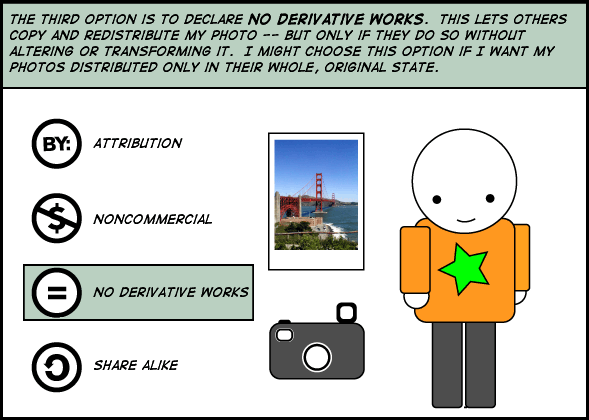
Among the rights an artist may choose to reserve when configuring their Creative Commons license is "No Derivative Works," explained in cartoon here:
http://creativecommons.org/images/comics/10.gif
Indeed, the Creative Commons' leading example musician is Roger McGuinn who: "chose the Creative Commons license that maximizes a combination of free distribution with artistic control and integrity." -- note that Roger McGuinn chose "No Derivative Works."
However, the Grey Tuesday movement seeks to take that right away. Notably, Larry Lessig (Creative Commons Chairman of the Board) commented in his blog:
http://www.lessig.org/blog/archives/001754.shtml
"Should the law give DJ Danger Mouse the right to remix without permission? I think so, though I understand how others find the matter a bit more grey."
"Should the law give DJ Danger Mouse a compulsory right to remix? That is, the right, conditioned upon his paying a small fee per sale? Again, I think so, and again, you might find this a bit less grey."
So, what exactly does Creative Commons mean by "some rights reserved" -- would it perhaps be more accurate if they said: "some rights reserved until we can cook up a new compulsory license to take those rights away"?
-
I can see my house from here!
Hey, look at that, I made Slashdot!
I'm Peter Sahlstrom, the Georgia Tech student who took the photos. I thought there were a few things I should mention.
1) A friend of mine pointed the conspicuous pile of voting machines out to me, and although I took the photos, he made the phone calls. We contacted the voting people, the press, and campus security; we received almost no response. The voting people told us the machines were locked (apparently they were...but not to anything. The mainstream press ignored us. And Campus Security said that, although they had complained to the voting people previously, they kept leaving the machines out like that.
2) The thing that finally drew attention was an article I posted to Dave Farber's "Interesting People List", (here) and to Declan McCullough's Politech (here).
3) I've made the best photos available to anyone interested. The Associated Press has two; I've got about 13 more of the highest quality (or most relevant) photos available, if someone wants to throw some bandwidth at me.
If anyone else has questions about things, let me know. -
Re:So much for the AXIS OF EVIL...
Heck, do you even know how much larger the US is than the entire European continent?
Um, 8% smaller? I've tried to find the area of Europe on line, coming up with figures ranging from 6.7 to 9.9 x10^5 square kilometers. The smaller number may be a total area of "European" countires (not including the European part of Russia, perhaps?). The CIA world factbook lists the US area as 9,629,091 sq km, but has nothing about Europe. The wonderclub.com site has information about both:
But are we talking about land area only (because who lives in water?) or should we include water, too, because some boats have computers? Wasn't there something recently about the USS Umpty-Squat having its email servers 0wned by spammers?
On the other hand, this is trivia, not "stuff that matters."
-
Re:What me, worried?"somebody flipped them off in their id photo and they fined him over $12,000 US, LOL. A bit harsh me thinks"
Not so harsh at all. Not harsher than this:
While walking through the airport in Dayton, Ohio recently, going through the standard, ineffective TSA drill, I heard a security announcement over the PA that was new to me. It said something to the effect of: "Inappropriate or humorous comments concerning explosives or airport security are prohibited and are punishable by..."
-
repeat?
Of Rewriting Rules on Delivery of the Internet and Free World Dialup Under The Gun Again and in FCC: 'Pure' VoIP not a phone service and Mr. Pulver to D.C. (David Farber's Interesting People).
-
repeat?
Of Rewriting Rules on Delivery of the Internet and Free World Dialup Under The Gun Again and in FCC: 'Pure' VoIP not a phone service and Mr. Pulver to D.C. (David Farber's Interesting People).
-
Moving net control back to your own server
> "When its controlled by the government, it will be lobbied into a capitalist tool of consumer exploitation. Profit at its best"
Wake up, it's already happened. At the end of one meeting 4 years ago the head trademark lawyer for IBM bragged they'd spend 2 years of their $30M a year Washington lobbying budget to make sure no new top level domains had been created to protect their intellectual property interests. Dave Farber was at that meeting (as was Vint "Darth" Cerf).
Roger Cochetti, then a VP of IBM, helped Ira Magazier pick the "interim" ICANN board in secret - when that was supposed to have been done by the internet community. Cochetti is now an NSI VP and figures prominently behind the scenes of ICANN.
The IFWP effort, started in Becky Burr's (US Department of Commerce who have oversight over ICANN) office at the suggestion of Kathy Kleinman and Mikki Barry and had 3 meetings worldwide - Reston Va, Geneva, Singapore to determins consensus points to use as guidelines to create bylaws and elect a board for the organization that would replace IANA. While this was going on Cochetti and Magaziner were running around in secret getting the likes of Ether Dysan and Mike Roberts on board. Mike Single handedly tanked the IFWP effort (notice he has Farbers ear) and became the first president of ICANN and his organization was the recipeint of the "intellectual infrastructure fund" - the domain tax fund that we all paid into back then, and and
(" Esther Dyson says that she was approached by Roger Cochetti of IBM and Ira Magaziner in Aspen, Colorado and asked if she would be interested in joining the ICANN Board. The IFWP wrap up was finally completely derailed by ICANN's refusal to participate in the meeting."
ICANN was created to do one thing: make new tlds at a time when it seemed (at least to the US government) the US government had to step in to solve the war between the IAHC camp (who had just been shut down) and the alt root camp (who seemed to be making progress). Magaziner met with us all and created the "white paper" that was going to create 7 new tlds immediatly. Trademark lawyers and the EU freaked and when it was revised as the "green paper" it had punted to "ICANN will create a method to elect a board and a process to create new tlds". Instead they spent 3 years futzing around with the UDRP and other things trademaek laywrs wanted and didn't get round to new tlds till the fall of 2000 and it must have had all of ten minutes thought put into it and was intentinally lame as hell. To this day the new tlds that were picked are still viewed by ICANN as a "feasability study" to deteremine the effect of net stability when adding new tlds. Never mind in that period 100 new cctlds were added almost all of which were commmercial in nature.
Then you have the "Government Advisory Committe" the well named GAC of ICANN. Governments of the world get to meet in secret and "advise" ICANN.
Govrernments and the Tradmark Lobby have already coopted ICANN. It's foolish to worry that the ITU/UN will let this happen if they're in control, it's already happened.
So, don't move control of the internet to ineffective treaty organizations, move it to you -
Re:Oh, it'll all blow over...
I mean, cheezus, it's only software - it's not like people are getting killed in poor quality cars or anything.
No, nothing's happened like that yet. But things are heading that way.
And shitty software has already killed a few people.
~Philly -
Re:Am I being watched?
On a slightly related note, I have noticed getting a hit or to from http://www.riaa.com in my referrer logs. Should I be scared?
No. Do you think the RIAA really goes around advertising itself like that? For the most part they don't do any "infringment detection" themselves anyway, they farm it out to companies like BayTSP.
Someone's playing around trying to freak out a bunch of bloggers. That wouldn't be the first time it's happened... -
Re:Looks fine to me!
No, it doesn't. It's a cartoon devil. It doesn't offend anyone. Really. Unless you're one of those freaks who won't let their kids watch Scoobie-doo because it's got ghosts in it.
Reminds me of this story featuring a poor sysadmin's experience in Hick Town, Texas. -
Re:Magic Floppy Porno Disk?All your questions shall be answered by
"There is no pornography stored on the hard drive," I stated.
A few official words were wrenched from H.M. Customs and are record on Interesting People."Do you mind if I check." she says rather than asks, and begins to take the computer out of the bag.
"I'm just going to hook it up over there and scan the hard drive..." she continues.
And then her face turns dour. "Oh! It's an Apple," she says, dejectedly. "Our scanner doesn't work on Apples."
-
Re:Darn.Well, in this letter, Robert Kahn and Vinton Cerf, two people on the list and two people often called fathers of the Internet, defend Al Gore on the issue, saying the following:
There are many factors that have contributed to the Internet's rapid growth since the later 1980s, not the least of which has been political support for its privatization and continued support for research in advanced networking technology. No one in public life has been more intellectually engaged in helping to create the climate for a thriving Internet than the Vice President. Gore has been a clear champion of this effort, both in the councils of government and with the public at large.
The Vice President deserves credit for his early recognition of the value of high speed computing and communication and for his long-term and consistent articulation of the potential value of the Internet to American citizens and industry and, indeed, to the rest of the world.
I apologize from any resulting cognitive dissonance and you may now return to listening to Rush. -
Re:I try to avoid them altogether.
I don't see how they are trivial to copy. I want to copy my fingerprint. How can I do this?
I posted the link earlier, but here it is again from the cryptogram.
Umm, what if they wanted to commit a crime and frame you for it?
It could happen, but I consider it higly unlikely. At the moment those fingerprints would have to be stolen from the gov, or from my immediate sorroundings. In other words, I would probably be a specific target. That is a lot less likely than getting scamed indiscriminately along with thousands or millions of other people.
No, it would only be good on all systems which do not have greater accuracy than the one used to capture your fingerprint. In other words, it would work today, not in the future.
Agreed, but nevertheless, you would still have to wait for that newer and improved system before you could restore faith in the given biometric scan. And again, it would only be a metter of time before you'd have to start over again.
Any system which relied solely on fingerprints is a bad system, clearly. But that doesn't mean that fingerprints don't add security to a system which already has other checks.
Besides, you've picked pretty much the least secure biometric system out there.
I did, clearly, for arguments sake.
I fail to see the risk. You're saying that a system which uses a biometric identification in addition to the current identification schemes is risky, because that biometric identification might fail. That makes absolutely no sense to me. If it's an additional check, it can only enhance security. Depending on the details of the scheme, it might not provide enough additional security to be worth the price and/or hassle, but that's a completely different story altogether.
I see the added security and the risk as two different things. The added security is that my account is less likely to be hacked, because the bar is higher. That is obviously good. The bad part is that now you have more to protect, and the potential damages of a security breach are higher -- besides a few hundred bucks in a checking account, now you also have to worry about your irreplacable biometric ID and anything else that might be protected by that ID. How much risk I precieve would be directly related to what else might be tied to that biometric ID -- including future use of the compromised service until a newer, improved authentican system can replace the compromised one.
The way I think about biometric IDs is more like passwords that you cannot change. You think a second password on your online bank account would make it more secure? Sure it could... What if you were forced to use that same password on random websites, vending machines, other email accounts, other online bank accounts, etc? Each of those may be protected by something else unique -- such as a different username and perhaps another pin number -- but have the same unchangable password. Assuming that you can reasonably expect that password to get recorded somewhere, do you think it would still increase your security? I don't. I rather have passwords I can keep independent and that can be changed to limit any damages.
Basically, you're afraid to use your fingerprint for identification, because then people will find out your fingerprint, and then you can't use it for identification. I don't get it.
You are forgetting that fingerprints are already used for identification, and in rather serious contexts. It makes perfect sense not to get them mixed up in trivial day to day -
Re:Why not retina scans
The above link does not go to the aforementioned article. Try this link instead.
-
Re:(OT.) Re: Get done with it, already!No, he doesn't claim to have created it. He claims to have taken an Initiative through the Senate, the Initiative being the one to create the Internet. That's all he claims.
If you want to argue he's a terrible speaker, I can't fault that. But it's absurd to suggest that he was trying to make people think that he, a politician, created the world's most significant network. That was clearly not his intention.
And Vint Cerf, who with Jon Postel can be genuinely described as one of the co-inventors of the Internet, certainly disagrees with the "He said he invented it" spin on the subject. To quote:
Last year the Vice President made a straightforward statement on his role. He said: "During my service in the United States Congress I took the initiative in creating the Internet." We don't think, as some people have argued, that Gore intended to claim he "invented" the Internet. Moreover, there is no question in our minds that while serving as Senator, Gore's initiatives had a significant and beneficial effect on the still-evolving Internet. The fact of the matter is that Gore was talking about and promoting the Internet long before most people were listening.
I think Gore is being unfairly maligned here. -
Re:What total bullshit
A brief but promising interpretation of SunComm's stock vagaries has just been posted to Dave Farber's "Interesting people" list and is archived here
-
Re:Just a guess...
It probably made sense to them, but it's the exact wrong thing to do, and I don't mean that in the typical 'information wants to be free' Slashdot philosophy.
Rather, history has proved time and time again that if someone has published information that you DO NOT WANT others to know about, the LAST thing you want to do is sue them or get an injunction. Almost without fail, this draws a great deal of attention to your case, and invariably causes a backlash that results in your "secret info" being MORE available than it would have been if you had just let it be.
For example, here's a perfect case of this in action: the Streisand coastal photos fiasco. To summarize, someone wanted to take high resolution digital photos from a helicopter of the entire California coastline. It just so happens that a photo of Streisand's beachfront property was included in this archive. She sued for $50 million dollars to try to get this hires photo of the backside of her house removed on the grounds of privacy or somesuch, even though it didn't show any people or really anything interesting at all.
The end result? That photo was downloaded SIX times in the three months prior to the lawsuit. However, after the lawsuit was publicised, the photo was averaging 108,000 hits per day. (source)
Don't you think this idiotic case will have the same effect? If you don't want people to know how easy your protections are to break, the LAST thing you want to do is go and sue an otherwise harmless college nerd who published an examination of the flaws of your product. That can only have the opposite effect, to get the word out to MORE people of how bad your software is. And they can't seriously think that they will be able to put this genie back in the bottle. Even if they order the researcher and/or Princeton to take down the report, it will surely be mirrored by countless livid netizens. Would the DeCSS algorithm exist on so many servers in so many forms if someone hadn't made such a stink about it? And the publicity surrounding such barratry can only have a negative effect on how people view your company. STUPID. STUPID. STUPID. -
Re:What else is based on the 8008?
It was actually used in a number of different designs.
It was designed as a terminal controller for CTC (later became Datapoint) but it seems they never actually used it. According to this post it was developed not by Intel but by CTC themselves, for use in the Datapoint 2200, which however wound up shipping without it and never used it. A firm called Traf-O-Data is said to have used it in a microcomputer designed to record highway traffic flow. The same year that this Canadian micro came out (1973), a French company called R2E used this in their Micral-N which has been credited as the first commercial, non-kit microcomputer. In the US, Scelbi Computer Consulting Company used it in Scelbi 8h, credited with being the first microcomputer available in the US. It was used in the Mark-8 micro, a design that was never mass produced but built instead by hobbyists from a published design - it appears less than 400 of them were ever made. MITS, described by one source as a dying calculator company, but apparently the same MITS that brought out the Altair a few years later, is said to have bought a large batch of them from Intel, planning to revive their business by building a large batch of cheap microcomputers with it, but I can't find any reference to them ever actually selling a computer based on this chip. Might be an interesting story for someone with the time to track it down. The NBI Hantu word processor used this chip.
Well that's enough for me, if you're interested this post should give you a ton of keywords to search for more data on.
-
Re:You're tracked in London. Period.A good article with background info:
BEING WATCHED. A Cautionary Tale for a New Age of Surveillance
"According to one estimate, there are 2.5 million surveillance cameras in Britain, and in fact there may be far more".
-
my first tech pr0n
Ah, vivid memories of the cover of Softtalk magazine, with a picture of the Apple II assembly line with hundreds of machines. Just imagine... 200 * 64k = 12.5 MEGABYTES! That would take 90 floppies to store all that data!
Now some statistic pr0n:
There were about 5 1/2 million Apple IIs sold, so at an average of 64k each (just a guess), that would be 343 GB of memory total. Adding up the couple of computers in the office (it's a 4 person company), we're about 1/70 of the way there. Assuming 2 140K floppy drives per computer, that would be 1.5TB of disk storage -- that would be 6 hard drives, and they would occupy less space than a single pair of old floppy drives. -
ANI is not CID
Your work phone may have CID blocked, but it wouldn't work on a 1-800 number. That uses ANI, a different system and is not blockable. Depends on the outfit they can either see your number real-time or on their monthly statement.
-
Actually
"In reality, the major spectrum hog is analog broadcast TV transmission. In the US and to an extent in other countries a spectrum analyzer will find much of the allocated VHF and UHF TV spectrum unused, even in big cities. The UHF television band is punctured with vast empty holes called "taboo channels". These channels are left unoccupied because of the frequency selectivity limitation of early era television receivers. Today we know how to build far better receivers than when this early rule was adopted and when those frequencies were set aside.
We should never forget that any transmission capacity not used is wasted forever, like water over the dam. And, there has been water pouring here for many, many years, even during an endless spectrum drought."
from here -
Re:RTFA (as usual)
That's a bummer because that trash can was an interesting innovation.
However, Apple was lucky, since they didn't come up with the idea. Xerox did. -
Solar Power Satellites?Well, I think the central trouble is that NASA isn't doing much in particular with this man-in-space jazz, and it's pretty obvious to everyone that this is the case ("With all the problems we have here on earth, why are we--").
Mars exploration is a thought, at least it's dramatic enough that it might grab people's attention. I submit that we would be better off pursuing a goal in space with some obvious practical benefit, e.g. this scheme of Robert Kennedy of the Ultimax Group:
Mirrors & Smoke: Ameliorating Climate Change with Giant Solar Sails;
Topic: Mirrors & Smoke, and Other Shady Schemes390,000 sq.km of solar sails, placed in non-Keplerian orbits around the Sun-Earth L1 Lagrange point, can intercept enough (~0.25%) sunlight to offset global warming and concomitant rapid climate change due to anthropogenic CO2, or if you will, a mirrored Maunder Minimum. Such mirrors can also provide total planetary electricity demand, estimated at 300 quads (quadrillion BTUs) by 2050, displacing all terrestrial carbon-burners.
Apparently NASA "studied" the SPSS idea again a few years back. They said it looked good, but they needed to reduce launch costs "a problem which is being addressed" (by the space shuttle?): -
Re:Chilling effect on P2PThis posted from Dave Farber's Interesting People List
From: Dana Blankenhorn Date: Mon, 20 Jan 2003 15:19:24 -0500 Subject: Re: [IP] RIAA hopes to make ISPs pay for user's P2Pdownloads I post this old story as a reminder that what Hilary Rosen is suggesting is, technically, impossible. It's impossible to tell what Internet packets are being used for. In the link above, Panama tried to stop Voice over IP in order to protect the monopoly of Cable & Wireless (as well as its own tax revenues). While VOIP (and peer to peer services) may use specific designated ports that can be turned off, the software can be quickly configured to use other ports, including the ports on which e-mail and Web traffic is based. I don't know if Rosen knows this. I don't know that Rosen cares. But it's clear that RIAA is becoming increasingly frustrated with what appears to be an unannounced, unsponsored, unorganized, unsupervised, grassroots yet surprisingly effective economic boycott of a huge industry, namely musical recording.
So much for turning off the P2P -
Re:Dave Farber's Gonna Plotz
Well, isn't this just a bit circular?
-
Dave Farber's Gonna Plotz
Expect to see lots of good, firebreathing commentary on this at Farber's Interesting People mailing list. He usually has good things to say about public internet matters.
-carl -
Re:Moon Colonydigitalgiblet wrote:
Doom wrote:
It's not a requirement, it just helps. Moving mass up out of earth's gravity well is expensive. Starting from the lunar surface (or the asteroid belt) is a lot cheaper in energy terms."Okay, what can you export from the moon that would make any economic sense? My suggestion would be solar power satellites that you then station near the L1 point so they double as sun shades. "
OK. Why exactly would we need a moon colony to put solar power satellites in L1 orbit?To act as "sun shades" these things would have to be frickin' huge.
Well excuse me. Not thinking small enough for you, I guess.I know very little about solar satellites,
No kidding. The only way your suggestion of building them on the moon makes sense is if that substance were ridiculously abundant and easily accessible on the moon.
Glancing at my copy of "Space Industrialization", the article "Materials Processing in Space" by Waldron and Criswell, says:For the major mineral constituents of lunar rock and soil -- pyroxenes, feldspars, and olivine -- the compositions are silicates which may be described as addition compounds of metal oxides and silica. Conceptually the processing of such materials may be broken down into separation of the constituent oxides (including silica) followed by reduction of that portion of the metallic oxides and silica desired to obtain structural metals and oxygen (or higher oxides, e.g. Fe2O3). For ilmentie, FeTiO3, the same steps are necessary except that no silica is involved.
Given a source of silicon and aluminum, I think you can probably figure out how to make solar power arrays. Note: the above article was written before it was known that water ice exists on the moon.In my admittedly limited experience I have never once heard anyone talk about the extreme abundance of photovoltaics on the moon... Maybe they're there, maybe not.
Maybe you should get in the habit of doing a couple of web searches before shooting your mouth off. Just a suggestion.Next, assuming all other problems with your enormous satellites were worked out, how do you keep a) solar winds from blowing them away since they would have gargantuan surface areas similar to solar sails
Let's see... you'd either pick stable orbits, or equip them with small propulsion systems (my guess would be ion drives).and b) all manner of space debris from punching holes in them to the point of destruction.
Well, that sounds like an actual problem that you'd have to design around, presumably with redundant engineering and some sort of repair program.Just think of the Perseids alone!
Oops, for a moment there it sounded like you knew what you were talking about.Third, you mention "beaming" the energy to earth. Most proposals to do this I have read have suggested microwaves. Two things: 1) not sure whether cancer deaths would rise or fall what with all the stray microwaves bounching around...
My understanding is that this is practical even with relatively low intensity microwave beams. If microwaves don't sound good for some reason then we would use lasers.and 2) ever play Sim City? You could literally be the "toast of the town"...
Well damn, no I've never played Sim City. I guess I'm grossly ignorant on this subject. And yet I remember hearing it argued that it isn't a difficult trick to add a safety interlock to a microwave beam, so that if you wander off target the beam shuts off.Finally, I'm not sure if by sun shade you mean filtering the light or blocking it. I certainly don't want any part of an artificial night...
Seriously, we have such a fingernail's grasp on all the variables involved in our weather patterns that I am confident any such attempt to control the weather (global warming) would be disasterous. We either reduce global warming by reducing greenhouse emissions, or not at all.
But why are you confident that reducing greenhouse gas emissions won't be disastrous? It might be you know, it could turn out that the human-induced greenhouse effect is the only thing holding back the next ice-age. Or it could be that Julian Simon was right, and warmer weather is actually a great thing for the human race in general, and the environmentalist catastrophe scenarios (e.g. a sudden diversion of the gulf stream) are totally off base. Or it could be that the catstrophe scenarios are dead on, and that reducing emissions at this point is not good enough to divert them. Welcome to the human condition. Great power without perfect understanding.I just don't see your super satellites as a realistic way to do that.
That's nice. I guess we should all take your word for it.I also do not believe we have enough time left to wait for super-de-duper new technology.
Who told you to wait for anything? Feel free to do anything you can think of to reduce greenhouse emissions. If you can convince people to stop burning coal, you'll get a lot less lung cancer deaths out of the bargain. I might suggest switching to nuclear power, but I wouldn't recommend holding your breath while waiting for people to realize that that's a good idea.OK, there is one quick way I can think of we can eliminate global warming: nuclear winter.
Just to finish up, here's a few things you might open your mind with a tad:
http://www.interesting-people.org/archives/intere
s ting-people/200111/msg00144.html:
Topic: Mirrors & Smoke, and Other Shady Schemes
Speaker: Robert G. Kennedy III, PE President, The Ultimax Group, Inc.
About the talk:
390,000 sq.km of solar sails, placed in non-Keplerian orbits around the Sun-Earth L1 Lagrange point, can intercept enough (~0.25%) sunlight to offset global warming and concomitant rapid climate change due to anthropogenic CO2, or if you will, a mirrored Maunder Minimum. Such mirrors can also provide total planetary electricity demand, estimated at 300 quads (quadrillion BTUs) by 2050, displacing all terrestrial carbon-burners.
The capital cost of solar sails is at least an order of magnitude less than the sum of economic, social, and environmental damages/ externalities due to unmitigated climate change over the next century, rough order of magnitude (ROM) estimate US$200 trillion in 1999 dollars. The capital cost may also be less than the already budgeted replacement/expansion cost of the world's energy generation plant (ROM est. US$20 trillion through 2050).
This world-saving concept is:- scalable (twice the mirror produces twice the effect),
- uncoupled (each mirror works independently of the others),
- incremental (pay as you go with immediate benefit),
- unobtrusive (umbra does not reach Earth, so the sails are essentially invisible), and finally
- reversible (sails can be moved off-axis to restore insolation).
http://www.space.com/businesstechnology/technolog
y
In 1995, NASA embarked on what's tagged as a Fresh Look study. SSP feasibility, technologies, costs, markets, and international public attitudes were addressed. In general, NASA found that the march of technology and America's overall space prowess has re-energized the case for SSP. NASA did point out, however, that launch cost to orbit remains far too high - but that this problem was being attacked.
I suggest that one method of attacking the launch cost problem would be to use stuff that's up there already, so you don't have to lift it from earth. -
Oh, no!
That FAQ is on a government site. The same government that found M$ to be an illegal monopoly is pushing Word. Ahhhh, it's like there are M$ Adverts in the Post Office and Bill Gates is electing himself leader of US minitruth.
-
Re:Ann Landers
You probably won't like Rosie O'Donnell's idiotic comment, either.
-
What a shame: reviving FORTRAN on such tragic day
It is striking that this nonsense FORTRAN debate makes it to the
E.W.D. was one of the most influential pioneers of computer science, like Turing, Zuse and Von Neuman. His work was always been in the light of creating a solid mathematical foundation for programming. His most remarkable achievements include the wide acceptance of 'structured programming', the invention of semaphores and ofcourse the Dijkstra shortest-path algortihm. He was awarded the ACM Turing Award in 1972. For
For the news on his death: here, here or here.
For programmers who like to read all of his manuscripts (if you haven't read them, you don't know what programming is about): there is a great archive of all his material. Dijkstra died at the age of 72. May he rest in peace and may his work live on.
Back on topic:
FORTRAN, "the infantile disorder", by now nearly 20 years old, is hopelessly inadequate for whatever computer application you have in mind today: it is too clumsy, too risky, and too expensive to use.
-- Edsger W. Dijkstra.
-
Scary what deluded types can get power over
like Dave Farber. He even states the problem, except he points fingers at someone else "it is "laughably naive" -- to imagine that the legitimate interests of governments and large users -- business and other -- can simply be ignored because to some they are unattractive." This is what most of the critics are screaming, the larger interests are being ignored, and there is no accountability, and i'm shamed to say the best arguement for that has been made by Dave Farberm, except he will never conciously admit this. Obligatory link -
Re:sure.... but why?
Please don't become like this:
"640K should be enough for anyone." --Bill Gates
linkage -
Re:Is it possible...Perhaps I should have been more specific. To quote the email:
>>This allows them to not only log all http requests, but to also log the >>response. Maybe they want to profile their customer browsing history for >>subsidiaries or resale to marketers. Maybe they want to do their part in >>The War on Freedom. Maybe they just want passwords to porn sites. >> Apparently they aren't using it to maximize bandwidth, because it's not >>configured to serve cached data
In saying "I've detected no use of proxies" I was referring to the fact that at no time during my being a subscriber have I ever received cached data from the proxies.
As far as evidence, if you'd like I could do some quick diagnostics (I don't have any log files handy with the relevant info) to prove what was already stated in the email . But you already read that...right? -
Re:Is it possible...
I'm not sure what you're gettting at. You say you detected no use of proxies? Forgive me if I'm missing the obvious here but couldn't they have just added one recently? or maybe since you're geographically isolated it doesn't make economic sense for them to proxy the traffic from your part of the network.
The main problem I have with this is that the entire evidence that they are using this data for marketing purposes seems to come from a single email on a mailing list that is here.
Don't get me wrong, I'm no fan of big companies....but so far this looks like a well orchestrated flaming campaign against comcast. Can someone actually paste some links with any kind of proof other than that they use proxy servers, which 90% of the rest of the ISP's in the world also use? -
see it, help the pro-DMCA, anti-freedom lobby?It's sci-fi/CGI/comic stuff and we're geeks, so we must see it, right? Bah.
It's a Sony Pictures movie. Sony's a member of the MPAA, who love the DMCA. Sony Pictures has been cited as a supporter of Fritz Holling's Security Systems Standards and Certification Act (SSSCA) bill. We're talking about the kind of folks that hire lawyers to sue teenage hackers for writing unauthorized DVD playback software for GNU/Linux systems. Sure, it might be a great movie, but at least stop a minute to think where your money's going, what it will be used for down the road.
Anybody who says one vote doesn't matter must've missed the last US elections.
-
Re:My proposal to Slashdot for CIPA articleSims is making it up.
I've never spammed Slashdot, or sent "hundreds of letters", or similar.
The way you know who is telling the truth is simple logic. If he had anything, anything, serious on me, he'd be making maximum use of it. When you break it down, the only thing he has, is much calling me names, and that other people have called me names.
The reason for the lie is that he has learned as a journalist, there is no cost to fabrication. Since he can throw mud with no downside, he does so. Whatever sticks to me is to his benefit. If he can shift the debate away from What Happened To The Censorware Project (censorware.org), to my sanity (i.e., lack thereof), he wins. Because that makes the topic about accusation and denial, and truth-is-in-the-middle, rather than his ongoing destruction and malicious actions.
Michael Sims pulled this latest stunt just before the CIPA trial started. My mind boggles. He's GOATSE'D censorware.org! If someone tries to get to a censorware.org report from an old link, instead, they get his rant. It's amazing.
This is ON-TOPIC. He derailed my planned anticensorware work to coincide with the CIPA trial, by his actions. He's goatse'ing people looking for material from censorware.org, motivated by the CIPA trial. It's absolutely shameful.
-
Re:I don't see what the big deal wasthey weren't open about it. Some net savvy people started noticing odd things being done to their tcp packets. The company that provided Comcast with the software to do this even came out today and said they were collecting more than was needed.
-
DEBUNKED - Al Gore "invented" Internet smearSigh, maybe it's time to burn a karma point or two. This may be mistaken to be flamebait, but hopefully the references below will redeem it.
The story that Al Gore claimed to have invented the Internet has been thoroughly debunked by Phil Agre in http://commons.somewhere.com/rre/2000/RRE.Al.Gore
. and.the.Inte.html and rebutted further later
That meme was a creation of Declan McCullagh, a "reporter" for Wired News who is politically a dogmatic Libertarian so extreme that he managed to get a book chapter using him as a poster-boy for Libertarian ideologues, and a different book chapter using him as Libertarian joke-fodder.If you think this is flame-bait, the aspect of his fabricated story being a Liberatarian hit-piece on Al Gore was extensively discussed in a debunking by Salon
After Declan McCullagh was repeatedly taken to task for his hatchet-job, over more than year, by everyone who was there, from Dave Farberto Robert Kahn and Vinton Cerf, Declan finally grudgingly retracted the "story"
But people still repeat it, because urban legends never die.
Sig: What Happened To The Censorware Project (censorware.org)
-
DEBUNKED - Al Gore "invented" Internet smearSigh, maybe it's time to burn a karma point or two. This may be mistaken to be flamebait, but hopefully the references below will redeem it.
The story that Al Gore claimed to have invented the Internet has been thoroughly debunked by Phil Agre in http://commons.somewhere.com/rre/2000/RRE.Al.Gore
. and.the.Inte.html and rebutted further later
That meme was a creation of Declan McCullagh, a "reporter" for Wired News who is politically a dogmatic Libertarian so extreme that he managed to get a book chapter using him as a poster-boy for Libertarian ideologues, and a different book chapter using him as Libertarian joke-fodder.If you think this is flame-bait, the aspect of his fabricated story being a Liberatarian hit-piece on Al Gore was extensively discussed in a debunking by Salon
After Declan McCullagh was repeatedly taken to task for his hatchet-job, over more than year, by everyone who was there, from Dave Farberto Robert Kahn and Vinton Cerf, Declan finally grudgingly retracted the "story"
But people still repeat it, because urban legends never die.
Sig: What Happened To The Censorware Project (censorware.org)
-
More UWB articles - Tech and RegulatoryThere's an article on UWB on Dave Farber's Interesting-People List, posted from The451.com with content from Janos Gereben and Dewayne Hendricks.
There's a longer article on Hendricks's work in This month's Wired, talking about UWB, unwiring Tonga, and using Indian Reservations to try out radio technology because their sovereign nation status may be a useful regulatory hack as well as because they need better communications on the rez.
-
Re:More Horseshit Privacy Reactivist Nonsense..
All Qwest is doing is telling you that they will be sharing meaningless information like wether or not you have Caller ID or (gasp) Touch-Tone Service installed WITH OTHER BRANCHES OF QWEST.
From the original document (assuming it's correctly quoted on that page):
Account information includes details about your service, such as [...] as well as calling and billing records. For toll calls that you are billed for, the information includes the number the call comes from, the number it goes to and how many minutes the call takes.
So the information does include numbers their subscribers have called.
Even if you notify us not to use account information for marketing purposes, [...] We also sometimes disclose account information to third parties who are not part of the Qwest family of companies when [...] or when it is commercially reasonable to do so.
So they do imply marketing purposes quite clearly.
Don't even bother reading the original posts about this article. I did, [...]
Ahem.
Give a man a fish and he eats for one day. Teach him how to fish, and though he'll eat for a lifetime, he'll call you a miser for not giving him your fish.