Slashdot Mirror
Domain: investopedia.com
Stories and comments across the archive that link to investopedia.com.
Comments · 547
-
Re: So what will replace capitalism?
He doesn't. Socialism centralizes economy onto a central organization, and removes the barriers separating economics from politics.
Nice try, but you described Communism instead (wherein the government owns the means of production)
Socialism requires the means of production to be owned by the people working on that production.
To translate that into a form resembling industry today:
Imagine a scenario wherein the workers of $corporation are granted voting shares in $corporation for as long as they work there, instead of a few greedy cunts at the top owning most of the shares (Capitalism)
The worker gains not just a fair share of the wealth s/he is generating, but also a small amount of control over the direction that $corporation wants to follow
Of course those few greedy cunts would have to lose their excessive advantage over the masses, but that's required anyway to bring the system we have now into balance
I expect none of this to happen though, because those in power do not willingly give up their power.
It will take another one of these but on a global scale
-
Re: What Tesla is saying
Fires like this don’t happen at competent car companies. Competent car companies remember to install all the bolts.
-
Really more an asset bubble
I think a better comparison would be to an asset bubble similar to tulips, 1990s tech stocks, 2008 housing crisis, etc. There is some value in bitcoins, and perhaps more general cryptocurrencies, but the market has clearly not yet figured out how to effectively evaluate and price them yet.
-
1600s Tulips all over again
https://www.investopedia.com/t...
Those who don't learn from the past are doomed to relive it.
-
Re:Is it dead yet?
In the very beginning, one man paid for two pizzas using 10,000 bitcoins, which at the highest price would have been $80,000,000
-
Re:Costs versus pricing
[snip]
The number one driver of high costs in the US is administrative costs. A large part of this is because we have this ludicrously complicated and hodge-podge payment system and shitty medical records systems and scattered insurance system. We (stupidly) don't have the government playing a big role in negotiating prices like every other civilized country. Other important factors are high drug costs, defensive medicine (extra tests/procedures to avoid liability), over use of expensive treatment modalities, wages/staffing, specialization/referrals, and believe it or not branding.
It's not the only place where the administrative costs are the major driver of rising costs--but I wouldn't be certain that having the government playing a big role in negotiating prices is, in fact, going to reduce administrative costs. It's one thing if they push for, say, standardized forms and a simplified payment system; it's another if what they do is their usual habit in the US of adding yet another layer of paperwork.
If the barrier to opening and successfully suing both professionals and hospitals over undesirable medical outcomes was much higher, then the costs of legal insurance, and the costs of many services could have been much lower;
My wife is a doctor and I think you overestimate the cost of insurance. Sure it's a problem, particularly in some specialties like OB/GYN and pediatrics. But the amount my wife's practice has to pay for insurance is not as outrageous as you probably think it is. I've seen the numbers and I honestly expected them to be a lot worse. The bigger problem here is that doctors literally have to order tests just to be sure in case of a lawsuit. Usually it's not a thing but on the rare cases where it does come to a lawsuit the first thing any lawyer worth his diploma is going to ask is "why didn't you order this extra test" or "why didn't you consult another specialist". And so the doctors do what they have to do. Ask yourself what you would do it you could be personally sued for malpractice if you didn't have that extra design review for your code?
Any lawyer worth his diploma? Depends on the quality of school he went to, since this would actually be considered rather...sharky behavior if you can't show that there was good reason to have ordered the extra test or consult another specialist. The problem is that there's not quite the necessary selective pressure to get the ambulance chaser contingent out of the pool--it's a known problem that juries can be rather bad at IDing junk science, and will occasionally not even care particularly past "Well somebody needs to pay for this and the defendant has a forest of money trees (even if we do believe the defendant isn't responsible for it)." I can only wonder if they set out to prove the pessimistic proverb about a jury being the twelve people too stupid to get out of jury duty.
These are the kinds of cases that also generate defensive medicine, and sometimes the harm they have done remains even long after the 'science' used to win them has long since been debunked.
So, it's not just that you could be personally sued for malpractice if you didn't have that extra design review for your code--you can be sued for malpractice even if whatever happened was not something code could do, and that extra design review might be necessary to show that you were 'properly' careful to ensure it'd not achieve the impossible.
-
Costs versus pricing
the shortage of qualified medical professionals is one of the inputs into the cost of medical care --- which, in case some of you haven't noticed,
has become ridiculously high.My wife is a doctor so I have some direct insight into this. I won't deny that it likely plays some role but it's not at the top of the list or even in the top 5. Honestly I'm fine with paying doctors (and nurses) relatively high salaries if it correlates to high quality of care and there is some evidence to suggest it does. I'd rather they get the money than say investment bankers or other financial leaches in our society. The worst part of the cost is that they have to hire virtual armies of non-medical support staff to handle all the scheduling, billing, paperwork, and medical records, much of which should be automated or eliminated in many cases. In my wife's office there are one or two physicians and probably 10-15 support staff on any given day. Guess where the majority of the cost lies? (it's not the doctor's salary)
The high cost of major medical operations and treatments is a result of multiple factors, but a major one is the high demand and low supply.
What do you specifically mean when you say low supply? There is no widespread shortage of supply of medical procedures to date. There are some nursing staff shortages in some markets and fewer doctors being trained than probably are needed looking forward. In most cases if people have to wait a little while (which is what happens when capacity is strained) that's not the tragedy many make it out to be for many conditions. Let's be clear too. There is a difference between cost of providing the service and the prices charged to patients. It's important to keep the distinction clear when discussing this topic. For example hospital pricing bears NO relationship whatsoever to the actual cost of providing services. (seriously, it's almost criminal) But we as patients still have to pay it and we see that pricing as the "cost" of the service when in reality we are paying a rather steep markup in many cases.
The number one driver of high costs in the US is administrative costs. A large part of this is because we have this ludicrously complicated and hodge-podge payment system and shitty medical records systems and scattered insurance system. We (stupidly) don't have the government playing a big role in negotiating prices like every other civilized country. Other important factors are high drug costs, defensive medicine (extra tests/procedures to avoid liability), over use of expensive treatment modalities, wages/staffing, specialization/referrals, and believe it or not branding.
If the barrier to opening and successfully suing both professionals and hospitals over undesirable
medical outcomes was much higher, then the costs of legal insurance, and the costs of many services
could have been much lower;My wife is a doctor and I think you overestimate the cost of insurance. Sure it's a problem, particularly in some specialties like OB/GYN and pediatrics. But the amount my wife's practice has to pay for insurance is not as outrageous as you probably think it is. I've seen the numbers and I honestly expected them to be a lot worse. The bigger problem here is that doctors literally have to order tests just to be sure in case of a lawsuit. Usually it's not a thing but on the rare cases where it does come to a lawsuit the first thing any lawyer worth his diploma is going to ask is "why didn't you order this extra test" or "why didn't you consult another specialist". And so the doctors do what they have to do. Ask yourself what you would do it you could be personally sued for malpractice if you didn't have that extra design review for your code?
To be fair, bear in mind that there is also a cost to shielding doctors excessively fr
-
Stock Market, How do they work?
Before everyone starts attacking short sellers, they actually provide checks and balances against bubbles and fraud.
-
Re:Huh?
Silly me and my antiquated notion of profit!
Yes, you don't go straight from "I have an idea for a business" to "profit". There's the part called "investment" that happens in there, and it takes a LOT of money to create a new car company.
Tesla's goal is to switch the world to sustainable energy. They're doing that buy becoming an automobile manufacturer. This is an old, well-established market where it's more likely that an existing company dies than for a startup to succeed. Now, you could plan on being a "boutique" manufacturer, like Lamborghini. Make a few, very-expensive cars, sell them to rich people, have a profit, and call it a day. But selling $200k roadsters isn't going to switch the whole world to sustainable energy. For that, you need to sell less expensive cars, and you need to make a lot of them.
The short-term goal is to gain a ton of market share. All revenue is shoveled back into additional development of even more vehicles. If you're trying to grab a big piece of the market, you better borrow as much money as you can so that you can develop additional vehicles more quickly.
This isn't the "local pizza shop" business model you learned in Econ 101. This is the Amazon model. Grab the entire market, damn the costs.
Some references:
Amazon Never Makes Money But No One Cares
Amazon’s epic 20-year run as a public company, explained in five charts -
Re:Not surprising
Hardly fair. In 2009, there really wasn't any real competition for the iPhone.
It's more than fair. iPhone's market slide looks way worse when compared to Android alone, instead of including RIM.
Android certainly had to compete, but it didn't just compete, it slaughtered. Why? Three big factors: more value for money; Google brand was more more trusted than Apple; Google's services such as maps and email were better than Apple's. All three remain in effect today,
And Mac share of the "Desktop" market is over 10%, twice what you claim.
I doubt it. Mac, 5.03%
Try to post without the insults, ok, to avoid being called out as the clown you come across as by not being able to support your argument after heaving out a lame ad hominem.
Android only "wins" because of the plethora of cheap-shit low-end "giveaway" phones. If you restrict your view to the "Flagship" models, the numbers look QUITE different. And speaking of "Quite Different", I don't know where you got the 12% marketshare number for iPhones; but this source quotes it earlier this year at a whopping 51%:
-
Re:Excuse my Schadenfreude
There are various option trading strategies to make money and limit your loses.
For example:
https://www.investopedia.com/t..."A straddle is an options strategy in which the investor holds a position in both a call and put with the same strike price and expiration date, paying both premiums. This strategy allows the investor to make a profit regardless of whether the price of the security goes up or down, assuming the change in the underlying stock price is significant enough to move past either of the strike prices and offset the cost of the premiums."
-
Re:Shares Drop?
What the fuck does it mean to share a drop? Is this website run by 12 year olds?
Finance, muthafucka, do you speak it?
"The securities that represent fractional ownership in the publicly-traded stock of Facebook, Inc." were what dropped.
-
Re: Clarifications:
If only you could point out the part where trading oil and gas stocks has any relation to trading Tesla stock. Or are you privy to information that is not public about this traders activity.
The summary leads off with the line "One of Tesla's biggest anonymous trolls/shorts", which means he was short selling Tesla stock. Short selling is a bit complicated, but it boils down to making a profit when a stock's value decreases. So he stood to make financial gain by lowering the value of Tesla stock.
-
Re:How do you steal which does not exist
"I don't understand what is stolen here."
Well, the part where you don't understand is correct. However you do understand what is stolen, which is money. What you don't understand is how.
Now, I don't have a great understanding of this either, but I do know some parts of it. And it's not just "a value stored in memory"! Why? Because if that's all it was, then anyone could create new money from any currency, at any time. Would they do so? Hell yes! What would happen? Unlimited inflation, and a currency valuation of zero, and it would happen fast. Really, really fast.
Look, the money was stolen, right? How do you "roll back the transaction" without the cooperation of the criminals? Are they going to cooperate? You seem to think that there's only one computer here, but there isn't. Not even conceptually. The debit side is one computer, and the credit side is a different computer. Likely at a different bank, and quite possibly in a different country. In order to make this all work (and work fast) there are simple, but inviolable rules that are encoded into the systems that handle electronic transactions.
Second point. In finance there's a principle: Never unroll a transaction! It plays hell with auditing, to the point that you cannot even trust an audit. There's a strong rule that the only way to reverse a transaction is to post a reversing transaction (which is a completely separate, second transaction) that has the effect of reversing the first. It sounds like it's the same but it's not. The reason it's not is that this system is fully auditable, whereas unrolling isn't auditable. With auditing you can see what happened; without auditing you cannot, because the transactions themselves have disappeared.
I'm not sure exactly where this principle comes from but it's probably GAAP: https://www.invensis.net/blog/finance-and-accounting/ten-generally-accepted-accounting-principles-gaap/
OK, so why not then post a reversing transaction? You can't! You're dealing with criminals, remember? Are they going to agree to your reversing transaction? Not bloody likely... Yet without their cooperation you cannot get that reversing transaction.
A lot of the issues at play here are encoded into the SWIFT network. SWIFT is the international banking network; nothing else comes close to the money volumes that SWIFT handles.
https://www.investopedia.com/articles/personal-finance/050515/how-swift-system-works.asp
I suspect there's a SWIFT rule that goes something like this: No repudiation of any validated SWIFT transaction. No exceptions!
Once the transaction goes through, that's it. Your only chance at control of those transactions is at the front end, before it enters the SWIFT network. That's one reason why banks are so paranoid about security.
-
Re:EU has always been tough on US companies.From Investopedia:
Disposable income, also known as disposable personal income (DPI), is the amount of money that households have available for spending and saving after income taxes have been accounted for.
From the US Census (p 422):
Disposable personal income is personal income less personal current taxes.
-
Re:Different forms of payment? Or back to moolah?
And once again the taxpaying consumers will be on the hook to pick up the pieces because the YUGE corporate cancers are "too big to fail".
The solution is to vote in people that wont bail out the bad decisions of others. The media wont like it and will do everything they can to stop it. They will label these people as evil. They will tell you not to vote for them, helpfully informing you that they have no chance to win and to please don't waste your vote.
If by some miracle you do elect someone like that in spite of the media opposition, the media will then work non-stop, even for years, to ruin that person that wont bail out the corporations. It also means the person was even more popular than the vote indicated, robbed of their mandate by the media.
I remember the Savings and Loans scandal from the 1980's, basically only 30 years ago and that bailout was for only $132 billion of taxpayer money. Even then, with that comparatively low sum, the claim was "too big to fail." Of note in that scandal was the Keating Five, 4x Democrats and 1x Republican.
The phrase "too big to fail" is marketing. It doesnt reflect reality in any way. Its a slogan. Even when the media allows someone to talk negatively about the idea on their feed, they are still spreading the slogan.
I'm here to offer up the idea that maybe we should all start reiterating it as "too big not to fail" whenever someone says it, for the rest of our lives. Its too important a thing. The slogan needs to be challenged, forever. -
Re:lol
What metric, then, do you choose to use that will change the data? PPP tries to equalize for things like cost of goods, regulatory, etc. via a basket-of-goods comparison basis.
-
Re:Nice headline...
Let me cut to the chase: Non-compete agreement definition:
What is a 'Non-Compete Agreement'
A non-compete agreement is an agreement between an employer and an employee in which the employee agrees not to use information learned during employment to enter into competition in subsequent business efforts.
BREAKING DOWN 'Non-Compete Agreement'
Non-compete agreements usually state that the employee cannot enter into certain professions which would be considered to be in competition with their current employer for a specified period of time and/or within a specified geographic area. This sort of agreement can also be called a "covenant not to compete" or a "restrictive covenant."
Some of Slashdot's lawyers seem to have a beef with calling this a non-compete agreement. The article calls it a "non-poaching agreement". It is de facto (in point of fact) the same thing, and doing the same thing, as a de jure non-compete agreement. It prevents workers from working for competitors.
-
Re:And ... if they hadn't?
Generally, everything that's produced is sold. People have this fanciful misconception that unsold merchandise is disposed of in landfils, probably due to journalists trying to make their stories sound more dramatic. It doesn't work like that.
When you over-produce something (supply exceeds demand), the cost to produce that inventory is a sunk cost. You've already paid for it, meaning there's no way to get it back (you can't go back in time and not spend the money to produce the items). So the cost to manufacture the product becomes a non-factor. Even recovering part of the production cost is preferable to recovering none of it. So when supply exceeds demand, you simply lower the price (below manufacturing cost if necessary) until the demand increases to match the supply you've got. And eventually everything you've produced gets sold.
I had a run-in with a store owner who didn't understand this. He'd bought some Intel 80286 laptops for resale. When they didn't sell as well as he'd hoped, he refused to lower their price below what he'd paid for them. Two years later when 80486 laptops were the norm, he was still trying to sell the 80286 laptops for the same price as 80486 laptops, so of course nobody was buying. He ended up losing his entire investment in those laptops. If he'd ignored the sunk costs and priced the laptops below his purchase price, he might have been able to sell them losing only 20%-30%. Instead he lost 100%. -
Re:It's all just enabling more bullshit
The other option would be to make all markets call markets with 5 second rounds... https://www.investopedia.com/t... Everyone places their trade orders, those that match at the end of 5 seconds clear. The whole thing starts again...
This puts a 5 second granularity on all transactions, they clear at specific 5 second intervals. There is absolutely no real value created by greater than 5 second resolution. It's not like the world needs you to trade your stock within the next 3 seconds and 5 seconds from now is too late. Sorry.
Putting 1% transaction taxes is a lot, that would reduce liquidity quite a bit. But a call market structure doesn't reduce liquidity, and still eliminates the problem of people making money by sniping orders instead of providing a useful service.
-
Re:Big Pharma might not allow it
Yeah, maybe... if it achieves Lipitor-like success, which would require life-long medication.
Assuming constant incidence, survival, and cost, we projected 13.8 and 18.1 million cancer survivors in 2010 and 2020, respectively, with associated costs of cancer care of 124.57 and 157.77 billion 2010 US dollars. This 27% increase in medical costs reflects US population changes only. The largest increases were in the continuing phase of care for prostate cancer (42%) and female breast cancer (32%). Projections of current trends in incidence (declining) and survival (increasing) had small effects on 2020 estimates. However, if costs of care increase annually by 2% in the initial and last year of life phases of care, the total cost in 2020 is projected to be $173 billion, which represents a 39% increase from 2010.
-
HmmmIt's a bit confusing, but rest assured, corporate CEOs, that there are ways around paying income tax as long as the wording and protocol are just right.
Non-qualified stock options differ from incentive stock options in two ways. First, NSOs are offered to non-executive employees and outside directors or consultants. By contrast, ISOs are strictly reserved for employees (more specifically, executives) of the company. Secondly, nonqualified options do not receive special federal tax treatment, while incentive stock options are given favorable tax treatment because they meet specific statutory rules described by the Internal Revenue Code...
-
Re:Welcome to the Modern World
-
Pump And Dump
It's almost as if investment stuff is regulated for a reason: https://www.investopedia.com/t...
-
Re:If it's true that everybody has divested
then why hasn't the price of oil collapse? It looks pretty steady to me. If the asset was already deemed worthless you'd expect it to be around $10 or $20 a barrel, It's pushing $60 as I write this. That's below it's peak of a $100, true. But that's more a correction than a crash. And that correction was mostly brought on by stabilization in the middle east due to the Iran deal and a decline in oil fired power plants as natural gas got cheap due to fracking.
First, oil is turned into a bunch of different products, not just gas and each serves a different set of markets (uses) and when the price of gas goes down, more oil goes into fuel for airplanes (for instance) or some other type of fuel. Second, the price of oil is actually pretty dependent upon political factors, mostly because the "price" of oil (the one you are looking at) is actually a future and not a spot price and so future risk is being priced in. So I wouldn't expect a crash as you are predicting. But a slow decline is something many people are expecting but as that happens its likely that fewer and fewer producers will continue to pump oil which will balance the drop in demand you are predicting. Just like a high oil price causes more production, a lower oil price causes less production which makes the price of oil tend to stay in a band and not drop to 0.
The more interesting thing to see is as this weakens the Petrodollar what does this do to US monetary policy? The real effect might be to weaken the US dollar which would cause US imports to get much more expensive, US exports to get much cheaper and more attractive and could spur a large wave of US automated manufacturing. Or it could just drop the US standard of living significantly. Its hard to know...
-
Early Adopters pay more
They have approximately doubled their end consumer energy cost for grid tied electricity thanks to their "cheap" expansion of green retardable energy.
Correlation does not imply causation.
In this case it is causation, but the ultimate cause is not the technology itself, but simply early adopter cost. ("An early adopter is likely to pay more for the product than later adopters, but accepts this premium" -- Investopedia).
The early adopters end up paying down development costs to allow the rest of us to buy at cheap rates, so: thanks, Germany.
-
Re:That Markets are cyclical bullshit
We had decades of stability until Regan came along and started repealing depression era laws designed to stop another depression.
Ah, Comrade Silvergun, did you forget about Carter's Era of Stagflation?
-
Re:Nazi left
The US spends more per capita on social welfare and spends more per capita on single payer, government healthcare, retirement, and education that many European nations. In what sense is it "very rightwing and right extremist"?
The US has to spend so much on those services, at least in part because of the extreme version of capitalism practised in the US. Take healthcare - in UK, the NHS can keep lid on the cost of medicines etc, because they are part of government and have the power to do so; apparently this is not the case in the US. To quote https://www.investopedia.com/a...:
"Most other developed countries control costs, in part, by having the government play a stronger role in negotiating prices for healthcare."
It is easy to understand, I think: private companies will ALWAYS seek to maximise their profits, and since there is no real competition, they feel free to drive prices up.
-
Re:Almost half the country doesn't have a dime
$600 per year x 50 years = $30,000. Where do you get interest rates that makes those savings become $1,000,000?
Your idea of multiplying each years' payments by 50 is invalid assuming the savings are being invested responsibly, please see Here for the formula regarding the future value
The answer is people buy in a combination of mutual funds that are selected to have an expected average annualized return
of 10% or higher after fees for periods of 10 years or more with optimal risk, and that's not very difficult target, at least historically speaking; considering that is about what the overall stock market itself has been observed to earn on average for such periods -- a combination of stock market index + small amount of real-estate ETFs (or similar choice for inflation protection) pretty much fit the bill.And ~10.4% annualized will more likely than not get the investor to more than $1 Million worth in 50 years.
-
Re:Stock price assumes Tesla is ALREADY biggest co
This is the precise sort of foolishness that lead to short sellers losing $1 billion in this article. In the long term, Tesla could be a guaranteed loser headed to liquidation and still you could go completely broke shorting Tesla stock, because in between the price could jump way higher before plummeting to zero. You go on margin and put yourself on hook for the upswings, and if you don't have enough money and there isn't enough stock available for sale at a price you can afford to cover then you go bust.
See the concept of a short squeeze. This is probably why the stock price is so high and even overvalued, the short sellers are attracted like moths to a flame and then get incinerated by a squeeze pushing the price even higher.
You can look at Tesla's financials and see for yourself that yes, they are lousy. But I still wouldn't short the stock if I had a million dollars and a firm conviction that the price will eventually go down. -
Re:No they didn't Rei and Bruce
No it wasn't. 12 months ago it was 29M the same as in end of Feb and beginning of March
Apparently you don't know what the word "started" means. "Started at the end of February".
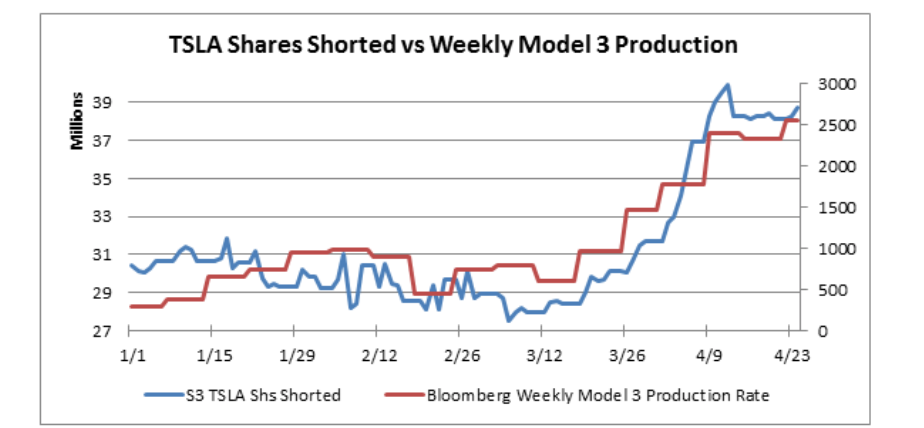
Short interest had been around 29M for the previous year. But starting at the end of February, it surged, up to around 39M.
The stock price isn't "higher" because it is already too damn high. It has a negative 25 P/E ratio and 10 billion in debt!
Which would be relevant if we were talking about a steady-state, dividend-paying company, rather than a company growing by orders of magnitude. You want earnings on a growing company to be as low as it can bear, because you want every cent they can get their hands on going into expansion. Check out Amazon in 2015.
Further reading: How can the price-to-earnings (P/E) ratio mislead investors? (article has nothing to do with Tesla, just discusses P/E in general, and how it's commonly misused - in exactly the way you're doing it).
-
Re: No More EU
You really think the US govt is going to pass military savings back to the public? I doubt the oligarchy would allow that.
That's true, if by that you mean direct payment from conquered countries as tribute to American citizens. But in the modern world in which we live, its 100% false.
That gas you buy is 1/4 the price it would be in the EU. Why? Because of the Petrodollar. That same fact also makes sure that foreign currencies are usually depreciating against the dollar which allows you to buy from foreign companies very cheaply (while depressing their ability to buy foreign goods themselves). This allows the US to run huge deficits without any real consequences and allows more Americans to live with a much higher and more consistent standard of living. This fact also allows cheap transportation of goods to your town (even if you are in a remote place). Also, it keeps the dollar stable which probably isn't a big deal to you but ask someone from Venezuela if they want a stable currency or not.
Really, its just that Americans (me too) just don't realize all the benefits we get from our military dominance mainly because most of us have never known anything else. But live abroad and your eyes will open quickly as to what those advantages are and how much they really matter to politics and financial markets.
-
Re:Something seems wrong here...
If those financial indicators are predicated on the stability and reliability of the US dollar,
The petrodollar system elevated the U.S. dollar to the world's reserve currency and through this status, the U.S. is able to enjoy persistent trade deficits, and become a global economic hegemony. The petrodollar system also provides the United States’ financial markets with a source of liquidity and foreign capital inflows through petrodollar "recycling."
-- How Petrodollars Affect The U.S. Dollar.
it could be more than a trifle off. How much, though, I don't know enough to say.
-
Just stop
That's nice, after reading your post I know for certain that you're an asshole.
Grow up. If you post something that stupid and easily disproved be prepared to take some heat for it. Honestly I still don't know if you are an idiot or a troll so I'm not going to respond after this.
This is your only valid point. I absently didn't think about fuel when I made my post.
If you think that is the only valid point then you don't understand what you are talking about.
I covered that here. "The only obstacles we have are scaling prices down to reasonable levels for civilian ownership of such vehicles"
That claim is preposterously wrong. We don't have the technology nor any plausible means to develop such technology within our lifetime. The physics doesn't work and the economics of it don't work. Unless you have a design for Tony Stark's arc reactor that you are hiding you aren't going to see a flying car any time soon.
I used the Harrier as an example as it can take off and land vertically.
And it was a stupid example. Harrier VTOL technology cannot practically be used elsewhere. It's akin to saying we should start transporting cargo via scaled down Saturn V rockets instead of using cargo ships. If it were economically practical to scale down for civilian use it would have been already.
Roads cost money. Traffic costs money.
The roads already exist and so does the infrastructure to handle them. Whether you understand it or not you are suggesting ripping out a huge portion of that for no apparent economic benefit. If you can actually develop a practical flying car then you can argue with me about the economics of overhauling our entire road system.
I don't think you are aware of how much planes weigh. A fully loaded Cessna weighs 2,550 lb which is the weight of a small car and that's not a heavy plane by any standards.
Seriously, just stop. It's not how much the vehicle weighs. It's how much the vehicle can carry safely and how expensive it is to carry it. A fully loaded Cessna 172 has enough power to get itself aloft along with typically around 600-700lbs of cargo and/or passengers. You can put it over the weight limit with as little as three passengers and a full tank of gas in some circumstances. Even the most basic automobile sold today can safely handle more weight than that and it doesn't have to land at an airport to do it. Nor does a car have to carry around heavy and impractical wings while driving. What magical technology are you imagining that will allow you to make the vehicle robust enough to drive on a road while still remaining airworthy without using up the entire weight budget?
Maintenance isn't that high on small planes.
HAHAHAHA... You haven't ever actually owned a small plane have you? They are stupidly expensive to maintain even for a little two seat Cessna. It's not unusal for them to cost hundreds of dollars per operating hour not including the cost of the vehicle itself. Something that would be a practical flying car would cost considerably more unless you invoke science fiction level advances in our technology.
-
Re:This seens misplaced
It makes perfect senses. You're not taking into account opportunity cost. Money you spend tackling this problem, is money you don't have available to tackle other problems.
Given a multitude of problems, and limited resources (money) for tackling those problems, you maximize the reduction in problems by applying your resources most efficiently. By tackling the worst but easiest-to-fix problems first, even if that means leaving smaller but more-costly-to-fix problems unresolved.
Your way of thinking is why we waste billions of dollars trying to make air travel safer to prevent a few hundred deaths per year, while over a million people die in car accidents every year. Or why nuclear power is a pariah, when statistically it's the safest power source man has ever invented (yes, safer than renewables). You prioritize tackling the problem which has the greatest emotional impact (i.e. in proportion to news coverage), rather than the problem which will yield the greatest numerical decrease for the smallest expenditure. -
Re: Mechanisms of propaganda.
Or if lots of kids aren't paying attention, they could be dismissed and allowed to roam the streets freely
If most of the kids are not paying attention, that is the teacher's fault. Any subject can be interesting if presented in the right way. I once took an evening course on "Introduction to Bookkeeping" at my local community college. The 80 year old geezer teaching the course kept us on the edge of our seats with stories of how he uncovered fraud, embezzling and lapping. Did you ever see the movie The Accountant? I think it was about him.
-
Rent seeking
The rent-seekers are in charge, there's really no better explanation for the behavior when you are extending copyright decades past the maximum life span of humans. Sorry if you thought the current regime would remedy this problem rent-seeker control of political power in the US, it is only getting worse, and this is but one example of it.
-
Re:The logic is painfully twisted.
I think its highly counter-productive.
I don't think it is and that might be something we just disagree on. Let us first agree, perhaps, on this: I don't think it wise for a government to punish a successfully company. I will say that I wish to reserve that there is an upper limit to that previous statement, though. Amazon isn't a successful company, they are about as damn near to a monopoly without completely shutting out the entire competition. They're exactly the thing that would set off warning bells and have the FTC keeping a sharp eye on their activities and acquisitions.
I don't have a fine line and I'm not going to pretend that there is one, that once you cross, you're in this danger zone that I speak of. And yes, Amazon isn't the only one, in fact a multitude of companies are these giant things that destroy everything in their path. In fact, a lot of American companies are these massive giants which is always why my "eye roll" triggers when I hear the DC critters talk about small job creators. But that's an entirely different, but somewhat related, topic. We have way too many of these monoliths in the US for it to be considered healthy. If the environment needs biodiversity, I would say an economy needs market diversity and the bank collapse in '07 was a good example of why a diverse number of corporations in an industry are a good thing. At least to me that makes sense, because look at how well Credit Unions weathered the storm.
But I digress, something being a good thing or a bad thing is mostly subjective and I won't linger on it. What I will posit, and I think it is the thing I'd like to debate but I ramble a lot so apologies ahead of time, is that even if we exclude good, bad, indifferent being a monolith is vastly different than being a business. I would say, that even if this is a thing we want to encourage, which again I don't think we should, but if it is something we want to encourage. There should be a premium for being it. I don't see a special tax on Amazon for being as "large" as it is, as being a bad thing. Want to be that massive? Okay, that's cool, here's a fee you have to pay for getting that large.
Now I hear you," well that would just encourage them to keep under whatever imaginary line your delusional brain conjures up." And I would say, "That's exactly the point." "Oh there would be so many missed things that a company would never get to do if we held them back," you might be so inclined to say (but I don't know what you would say, so I'll just stop that). But that is the point here. To keep small niches open for medium sized (not small, I'm not that crazy now) businesses to grow into, allow them to expand that niche and so on. But more importantly, to keep a diverse group of folks driving the boards of these companies. As opposed to a single board of directors governing over around 60% of US GAFO (link for the term GAFO and of course the figures.)
I just fail to see the logic that a single board of directors should command that much of the US market in that industry. It seems a lot like the eggs in one basket kind of deal, and those deals don't usually play out well when there is a misstep. And yes, the market is elastic and should Amazon fail we will bounce back, but it won't be without its hardships and for those "might be" hardships that "may" come I think it is best to have an insurance policy, "of sorts" and I won't pretend that I have a definition of that which is why I highlighted that there's a lot of "ifs" and "unknowns" there.
And I will admit, I'm not outright correct. There's tons of holes in my argument and I'll admit that. But I think it is worthwhile to discuss that, to say, "Should we let companies get this big?" and "Are we sure that this is healthy for the economy?". And if you are saying "yes" to those, then "Shouldn't we hedge our be
-
Re:Better ideaThere was actually an old check forging scheme which relied on this. The forger would alter the routing number on the check, then deposit it. The bank would note that it was a local check, and only put a 2-3 day hold on the deposited funds. The key was that checks were only considered bad if the issuing bank notified the deposit bank that it was bad (negative confirmation). So the fraud relied in preventing any such notification from being generated, which the depositing bank would take to mean the check was good, and release the funds to the depositor.
Although the check bore the name and address of the Chemical Bank in New York, the Federal Reserve data-processing system scanned only the magnetic-ink code on it, identified it as a Bank of America check, and routed it to Los Angeles. The check remained in transit for perhaps two days. At the end of that time, it was run through the computer mechanism at the Bank of America. The computer, instantly searching its memory for a Bank of America account number matching that of the magnetic-ink strip on the check, rejected the check, which then went into a clerical pool for manual handling. Since the printed logotype on the check clearly identified it as a check that belonged in the Chemical Bank in New York, the clerk handling the machine-rejected check sent it back to the Chemical Bank by mail, assuming that a simple routing error had been made. The check was then in transit for another two days. Back at the Chemical Bank, the check was put into the computerized sorting system for final clearance. But instead of that, it went into motion again: the Chemical Bank computing system passed it on to the Federal Reserve System, which routed it out to the Los Angeles bank again, which routinely sent it back to New York, and so on.
The fraud was uncovered only when checks issued by the depositor became so frayed from mechanical handling in the computer system that they could no longer be read automatically ⦠[b]y that time, according to an auditor who told me of the affair, the depositor had disappeared with more than $1 million in cash. -
Re:Elon, do it some more!
To be fair, even in recent history two of the largest auto makers in the US went through bankruptcy in GM and Chrysler. They are doing just fine. Ford would have as well if they hadn't gotten lucky (or prescient) and took out a massive multi-billion dollar loan shortly before the whole crisis.
https://www.investopedia.com/a...
I think Tesla has a lot going for it really. As others have mentioned, given the facts about how the market reacted (blip), this story more looks like a bunch of investors shorting the stock, and trying to influence public opinion so that they make money (or not lose so much when successful). So yeah I can kinda appreciate where Musk might be a little pissed when he is forced into having a phone conversation with a bunch of people who are obviously betting on your failure and using the opportunity to try to influence that to happen. I'd probably publicly snub them also.
-
Re:It is the Tesla shorts pre emptive strike.
-
Re:Sounds like Japan
in Norway it's mainly solved through employment taxes, which are kinda like income tax except they're not deducted from my nominal salary but rather added to the company's taxes.
The problem with that is that it ignores what economists call the incidence of the tax or its division between buyers and sellers. In this case the company is the buyer of labor and the employee is the seller. If the government levies an employment tax on the employer then at least some of that tax will be passed through to the employee in the form of wages that are lower than they otherwise would be. The employee is a cost to the employer. If an employee costs $10 dollars per hour do you think it matters to the employer if $8 dollars of that was wage and $2 dollars was tax? It's unsophisticated to consider an employment tax as being paid only by the employer simply because the bill is handed officially to the employer and not the employee.
-
Limited number of logical constructs
There's only a limited number of these logical constructs. IMO they're (cryptos) are very similar to non-voting, non-dividend-paying shares of a company. Not much you can really do other than trade them (Google's class-c's are over a grand a piece now). There's the ledger to which all transactions propagate, like a secure Usenet. Kinda limits its use as a true currency when some rando on the left coast gets his ledger updated when I make a transaction on the other side of the country.
-
Re:Rats fleeing a sinking ship
PE ratios are great for a company with relatively static business operations in a relatively static field, but they're terribly misleading for growing companies. Ex: in late June of 2014, Amazon had a PE of over 500. Was it a bad buy? Hardly; people who bought it then would be 4 1/2 times richer today.
PE ratios don't cut it for growth companies that are dumping tons of money into capex, expanded options for future sales and building a new market. Quite the opposite , PE ratios paint precisely the *wrong* picture. In such a case, they're more a measure of how aggressive the company is being toward growth.
For such growth companies, the real question is how large of a market they're aiming for and how likely they are to get there. E.g. the reason Tesla shot up so much after Model 3 preorders opened is that nearly half a million people put down real money to wait over a year for a BMW-priced electric car that they'd never even seen in person, much less driven, without any advertising . That's pent-up, untapped demand. That's a market. Tesla is priced based on the potential shown, relative to the risk in getting there. Its current profits are almost irrelevant except for helping fund its route to "there".
One can disagree about the exact market size and the risks. It's expected! But what should not be in dispute is that PE is totally the wrong tool to employ here.
-
Re:Rats fleeing a sinking ship
In case anyone is wondering why you're seeing so many stories like this about Tesla all of the sudden, here is your answer. In particular, this chart.
Tesla is the most shorted stock in the US right now. There is literally no company in the US that more people have a financial interest in seeing fail than Tesla. A third of the stock is in short positions. The problem is that this is incredibly dangerous from the perspective of a short squeeze. Shorts hold the stock price down - the massive surge in short selling countered the benefits (from a stock price perspective) of the major increase in Model 3 production rates. But this can only be taken so far; it's not like they're going to be able to short 100% of the stock. If Model 3 production continues to rise like it's been doing - and along with it, the stock price - not only will some short sellers want to liquidate, but others will be contractually forced to liquidate. This is done by purchasing an equivalent number of shares of TSLA to cover their short. This purchase in turn raises the stock price. With such a massive percentage of Tesla shorted, this can easily snowball, where the obligations of some shorts to purchase cause the next to be forced to purchase, and the next, and so forth - all purchased at whatever price Tesla happens to be at the moment. The shorts would need to acquire literally 1/3rd of Tesla's stock in a short period of time.
Needless to say, this would be a financial disaster for them. If Tesla underperforms what the market expects of them, longs lose some money. But if Tesla overperforms what the market expects, shorts lose a huge amount of money. It's highly asymmetric.
So in case you were wondering if it was a coincidence that all of the sudden everyone and their cousin suddenly started bashing Tesla in the news - even for something as mundane as another company poaching talent from Tesla - no, it's not a coincidence.
-
Re:Locks in general, are not very secure.
So, it can be patched, but sounds like a bit of a pain
It's less of a pain than re-keying locks which use physical keys.
The overall security issue here is being overblown because people are incorrectly comparing to a non-existent base state - that if hotel locks were somehow impervious to hacking. You need to compare to the next best alternative. In this case, electronic key cards replaced physical keys. Hotels with physical lock keys also had master keys (that's how maids got into every room to clean them), which were just as vulnerable to theft and copying. Replacing them with electronic key cards, even with their flaws and vulnerabilities, was still an improvement in security. It's only a decrease in security if you incorrectly assumed the system was somehow perfect. -
Re:Saudi Arabia
"Handing out money does not change the value of that money".
Yes, yes it does.
https://www.investopedia.com/i... -
Re:Money-Grubbing SociopathsIt comes across as rent-seeking to me, if there is a value judgement to be made.
From an dry analysis of cash flows and such, the basic argument that the one-shot permanent cure will produce a short term spike in income that will fall off in the long term makes perfect sense. The problem is the apparent assumption that a long term sustained cash flow is somehow desirable or necessary, that pharmaceutical companies should be producing perpetuities.
Metaphorically, there is an expectation to be breeding geese that lay golden eggs as opposed to digging gold mines. Gold mines will eventually be unprofitable when the worthwhile veins are dug up, and the miners will have to dig elsewhere or do something else once the mine runs out, but there's still profit to be made for a limited time, enough to make an enterprise worth it. But the geese are a fantasy, if you are talking about making gold. Even in the quotes the analysis says that there is tremendous value to society for the cures, which suggests that there should be plenty of non-rent profit to be had for a limited timeframe if the technology works. But long term sustained profits of the type that GS expects...that starts sounding more like economic rent to me.
To quote Adam Smith on the classical notion of rents:As soon as the land of any country has all become private property, the landlords, like all other men, love to reap where they never sowed, and demand a rent even for its natural produce. The wood of the forest, the grass of the field, and all the natural fruits of the earth, which, when land was in common, cost the labourer only the trouble of gathering them, come, even to him, to have an additional price fixed upon them. He must then pay for the licence to gather them; and must give up to the landlord a portion of what his labour either collects or produces. This portion, or, what comes to the same thing, the price of this portion, constitutes the rent of land, and in the price of the greater part of commodities makes a third component part
-
Re:Fact checking
It is the purpose of every trademark, trade secret, restricted customer list, restricted pricing list, bulk discount etc. to create a market monopoly, and governments have nothing to do with any of them, save when Capitalists buy a Senate.
Nope.
The purpose of trademarks is to provide some assurance to the purchaser that the product they buy is actually from the manufacturer they think it is from. Fraud reduction.
Still think it's to create a "market monopoly"? Please feel free to support your contention with evidence and reasoning.
A trade secret is like the monopoly granted by a patent, except it isn't granted by a government, and if the secret is successfully maintained, it can last forever. The company has exclusive control over what it created, but it doesn't control the market. Competitors not using the secret can chase after those customers, by selling equivalent products, or products that offer the same benefits in a different way. So?
Restricted customer list. They don't want to reveal who their customers are. So? That hardly guarantees the firm a monopoly.
Bulk discount. Huh? You'll have to explain that one.
The monopoly boogieman is very popular in many places, but reality is not one of them.
Here's some debunking info I found quite easily, while looking for something else. https://www.investopedia.com/a...
-
Re: We could do this in 5 or 10 years
Better check your own pipes, because apparently (and to my surprise as well), the US is the number 1 producer of oil, pumping nearly 15 MM barrels per day.
Yes, thanks to expensive and environmentally questionable fracking techniques used on shale oil deposits, with a lousy energy balance and oodles of extra CO2. Not something to be proud of...
Maybe not, but it undercuts the constant narrative that every meddling in the Middle East is because we're there for oil. That hasn't been true in a long long time if it ever was.