Slashdot Mirror
Domain: lostcircuits.com
Stories and comments across the archive that link to lostcircuits.com.
Comments · 49
-
Re:how do they compare ?
and many, many, moooreeee
-mainconcept http://www.lostcircuits.com/mambo//i...&limitstart=17
-mediashow http://www.guru3d.com/article/amd-fx...ssor-review/14
-h.264 http://www.guru3d.com/article/amd-fx...ssor-review/14
-vp8 http://www.guru3d.com/article/amd-fx...ssor-review/17
-sha1 http://www.guru3d.com/article/amd-fx...ssor-review/17
-photoshop cs5 http://www.lostcircuits.com/mambo//i...&limitstart=14
-photoshop cs5 http://www.tomshardware.com/reviews/...x,3043-15.html
-winrar, faster than 2600k http://www.techspot.com/review/452-a...pus/page7.html
-winrar, improves over x6 http://www.tomshardware.com/reviews/...x,3043-16.html
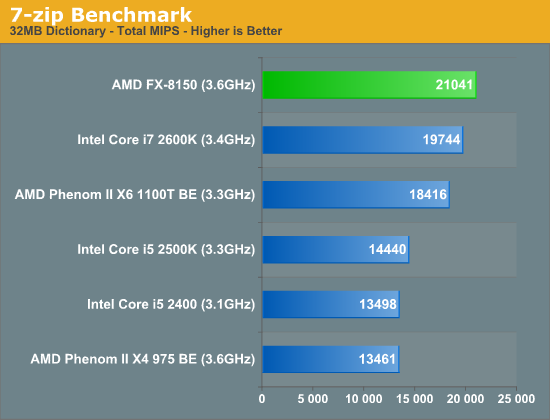
-7-zip better than 2600k here: http://images.anandtech.com/graphs/graph4955/41698.png http://www.anandtech.com/show/4955/t...x8150-tested/7
-7-zip same perf as 2600k http://www.tomshardware.com/reviews/...x,3043-16.html
-POV-ray, faster than 2600k http://www.legitreviews.com/article/1741/10/
-POV-ray http://www.nordichardware.se/test-la...art=15#content
-x264(2nd pass AVX enabled) http://www.anandtech.com/show/4955/t...x8150-tested/7
-x264 (2nd pass, better overall than 2600k) http://www.bjorn3d.com/read.php?cID=2125&pageID=11108
-x264 (2nd pass +.3 than SB2600k) http://www.legitreviews.com/article/1741/7/
-handbrake; http://www.legitreviews.com/article/1741/9/
-truecrypt; http://www.bjorn3d.com/read.php?cID=2125&pageID=11111
-solidworks; faster than 2600k http://www.techspot.com/review/452-a...pus/page7.html
-abbyy filereader http://www.tomshardware.com/reviews/...x,3043-16.html
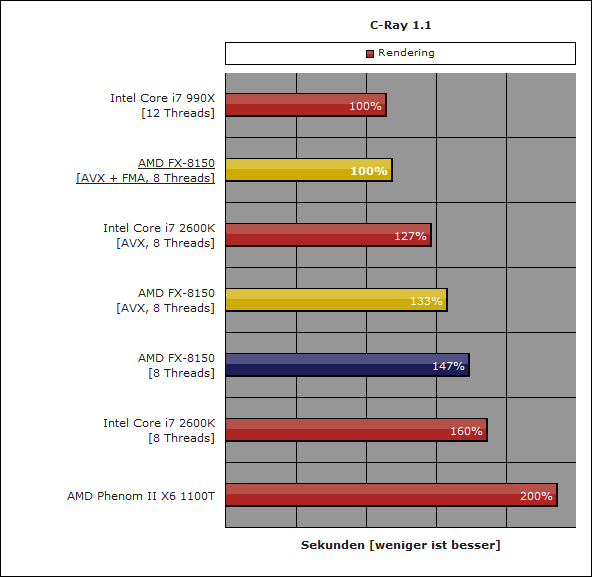
-C-Ray, as fast as $1k i7-990X, http://i664.photobucket.com/albums/v.../c-rayir38.png -
Re:how do they compare ?
and many, many, moooreeee
-mainconcept http://www.lostcircuits.com/mambo//i...&limitstart=17
-mediashow http://www.guru3d.com/article/amd-fx...ssor-review/14
-h.264 http://www.guru3d.com/article/amd-fx...ssor-review/14
-vp8 http://www.guru3d.com/article/amd-fx...ssor-review/17
-sha1 http://www.guru3d.com/article/amd-fx...ssor-review/17
-photoshop cs5 http://www.lostcircuits.com/mambo//i...&limitstart=14
-photoshop cs5 http://www.tomshardware.com/reviews/...x,3043-15.html
-winrar, faster than 2600k http://www.techspot.com/review/452-a...pus/page7.html
-winrar, improves over x6 http://www.tomshardware.com/reviews/...x,3043-16.html
-7-zip better than 2600k here: http://images.anandtech.com/graphs/graph4955/41698.png http://www.anandtech.com/show/4955/t...x8150-tested/7
-7-zip same perf as 2600k http://www.tomshardware.com/reviews/...x,3043-16.html
-POV-ray, faster than 2600k http://www.legitreviews.com/article/1741/10/
-POV-ray http://www.nordichardware.se/test-la...art=15#content
-x264(2nd pass AVX enabled) http://www.anandtech.com/show/4955/t...x8150-tested/7
-x264 (2nd pass, better overall than 2600k) http://www.bjorn3d.com/read.php?cID=2125&pageID=11108
-x264 (2nd pass +.3 than SB2600k) http://www.legitreviews.com/article/1741/7/
-handbrake; http://www.legitreviews.com/article/1741/9/
-truecrypt; http://www.bjorn3d.com/read.php?cID=2125&pageID=11111
-solidworks; faster than 2600k http://www.techspot.com/review/452-a...pus/page7.html
-abbyy filereader http://www.tomshardware.com/reviews/...x,3043-16.html
-C-Ray, as fast as $1k i7-990X, http://i664.photobucket.com/albums/v.../c-rayir38.png -
Re:Specs
I would not put too much faith on the theoretical 2x performance increase offered by AVX this generation. Although the processing hardware is there, the processor itself is not designed with enough fetch width to keep the units fed.
Summary: a few tests topped %20 improvement.
Summary: a couple of tests topped %20 improvement. Many tests produced slower results with AVX enabled.
The overall performance boost looks to be around %20-30, at least for now.
-
Re:What about atom?
``The atom has a TDP of 8-14 W while the Athlon II is between 25-65 W. If you let both machines run for two years, then the combined purchasing price + the running cost put the Athlon in a very unfavorable spot, especially if you don't need the processing power on a regular basis.''
On the other hand, the TDP is (as far as understand it) an upper bound on what the CPU could draw. If you do need the processing power on a regular basis, then you may get close to the power figures stated - but then the Athlon II allegedly (I didn't verify the claims) also gets you a lot more processing power. If you don't need the full processing power (the more likely scenario), then you will also not use as much power. The Athlon II CPUs in this chart use about 7 W when idle. I don't know what an Intel Atom uses when idle, but I wonder if it leaves a very large difference. At some point, when you want to save power, the best thing to do is to simply turn off the computer.
-
Re:Sweet!
In his summary over at Lost Circuits, MS notes that there is practically no System Memory bottleneck on the i7 platform with their gaming benchmarks.
-
Re:Sweet!
Here's a lower resolution benchmark. Scaling looks pretty good.
-
Re:Why even bother?
Completely agree, it's a much overlooked area of CPU reviews. Try finding real-world power consumption figures for the Intel E6300 - not easy. Everyone only seems to give a crap about overclocking the new XTXXLLLLGTSFX2006 these days
For a great little run down on CPU power across a wide range of chips, try this one for size: http://www.lostcircuits.com/cpu/low_e/ -
Re:Experts?
The companies who are really serious about servers are particularly interested in CPU power compared to heat dissipation -- thermal density. This new Intel CPU is high performance with high heat--more of a gamer chip. At least so far it is; it's a very early sample and Intel hasn't had time to tune the power management features.
Intel's latest chips are fabbed at 65nm, while AMD is still only shipping chips fabbed at 90nm. This should give Intel a serious edge in the performance/heat ratio, but AMD's chips are so much more energy efficient that they are still competitive. (The current best performance/heat is the AMD Athlon64 X2 3800+ ADD chip.) When AMD finally ships 65nm Opterons, those ought to be really great for dense server installations.
It's telling that even Dell is planning to ship servers with AMD chips. They announced a 4-core server; two dual-core Opterons. It wouldn't surprise me if they will be 65nm Opterons when they finally are released.
The article says that Intel is going to transition from 65nm to 45nm sometime in 2007, and to 34nm sometime in 2009. They beat AMD to 65nm big-time. They may well be at 34nm before AMD can make it to 45nm! Just imagine some sort of server chip with 16 cores... or more likely, 8 cores and a whole bunch of cache.
But we shouldn't count those chickens before they hatch. Right now Intel is at 65nm and AMD will be there soon.
steveha -
X2-3800+ (ADD) has performance/Watt crown
Actually the new low power X2-3800+ (ADD) now has the performance/Watt crown.
It has idle power of 8 watts and full load of 25 watts.
They measured the performance of various benchmarks and also the energy required to perform the benchmark to get a figure for performance/Watt and the
X2-3800+ came out miles ahead of the Conroe (or any other chip). http://www.lostcircuits.com/cpu/low_e/6.shtml -
Re:Other Reviews
The latency issues between DDR and DDR2 have never been clear to me so maybe someone can explain it.
If you check http://www.lostcircuits.com/memory/ddrii/2.shtml and http://www.lostcircuits.com/memory/ddrii/6.shtml they show DDR2 using an I/O clock at twice the frequency of the DDR I/O clock and both using same core clock. The objective here is to double the I/O bandwidth using twice the I/O clock and doubling the width of the core. Given identical core timing, DDR2 would have twice the latency IN CLOCKS as DDR but this would actually equate to the same amount of time.
So excluding the differences in command timing and using the same core clock, would not the CaS latency in both technologies be the same in nanoseconds? CaS 4 in DDR2 looks like it should be equivalent to CaS 2 in DDR in the timing diagram. -
Re:Other Reviews
The latency issues between DDR and DDR2 have never been clear to me so maybe someone can explain it.
If you check http://www.lostcircuits.com/memory/ddrii/2.shtml and http://www.lostcircuits.com/memory/ddrii/6.shtml they show DDR2 using an I/O clock at twice the frequency of the DDR I/O clock and both using same core clock. The objective here is to double the I/O bandwidth using twice the I/O clock and doubling the width of the core. Given identical core timing, DDR2 would have twice the latency IN CLOCKS as DDR but this would actually equate to the same amount of time.
So excluding the differences in command timing and using the same core clock, would not the CaS latency in both technologies be the same in nanoseconds? CaS 4 in DDR2 looks like it should be equivalent to CaS 2 in DDR in the timing diagram. -
Re:Other Reviews
http://www.pcper.com/article.php?aid=197&type=exp
e rt
http://www.anandtech.com/cpuchipsets/showdoc.aspx? i=2668
http://www.hothardware.com/viewarticle.aspx?articl eid=767&cid=1
http://www.xbitlabs.com/articles/cpu/display/athlo n64-fx60.html
http://www.lostcircuits.com/cpu/amd_fx60/
http://www.bit-tech.net/hardware/2006/01/10/amd_at hlon_64_fx-60/1.html -
Some Helpful Sites
These sites might be of assistance:
www.anandtech.com
www.sharkyextreme.com
www.lostcircuits.com -
Re:Heat70W per chip then? Nothing to be impressed about.
AMD will not have trouble keeping up with that, because their current DESKTOP chips are using 78-86W, under one of the worst cases actually observed, and 68W when running Doom3 (Athlon 64 X2 4800) Also note that the rating is 108W, but that AMD's and Intel's TDPs are calculated differently.
Source1: http://www.lostcircuits.com/cpu/amd_x2/12.shtml (Next page is the Doom3 result.)
-
Re:Multiple monitors, RAM, RAID array
I guess I was wrong about CRT brightness, but I was right about everything else. RAID 1 does technically give you faster reads, but it doesn't make writing any faster.
-
Re:But will it arrive in time
"Intel doesn't have a mature line of AMD64/EM64T products just yet."
I call BS.
There is Xeon, and Itanium.
Xeon 64-bit performance is less than stellar when compared to the Athlon64.
The Itanium isn't even an AMD64/EMT64 architecture. It's EPIC architecture is referred to as IA64. -
Pentium M and overclocking
The article at Tom's compares an overclocked Pentium M to Athlon 64 FX and the PIV Extreme Edition running at standard clock speed. Tom's also uses an Athlon 64 FX with the now-obsolete Clawhammer chip in 130nm, which makes AMD look bad in the power dissipation test.
In other news, LostCircuits has successfully overclocked a Venice core-based Athlon64-3800+
http://www.lostcircuits.com/cpu/amd_venice/
These results look impressive too, and I don't think AMD is beaten yet. -
Here's why Jobs likes Intel and not AMDPeople have speculated about why Steve Jobs picked Intel and not AMD such as maybe AMD can't supply enough chips, maybe Intel gave 'em a better deal, maybe Intel chips perform better, whatever. There's no reason to speculate though because Jobs comes right out and tells us in this story, thereby demonstrating that he is not familiar with current x86 hardware. Says Jobs:
[begin excerpt]
"The move is being made because Intel has "the strongest processor road map by far," Jobs is quoted as saying in a statement released as the keynote got under way."As we look ahead, although we've got some great products now, we can envision some amazing products we want to build for you. And we don't know how we can build them with the future PowerPC road map," Jobs said during his keynote.
The problem with the future PowerPC chips is performance per watt, Jobs said. Intel's chips are far ahead of IBM's when it comes to delivering performance without consuming a lot of power, a quality that is very important to Apple's future products, he said."
[end excerpt]
Jobs is looking for better "performance per watt" and picks Intel over AMD which was not a very smart decision on his part. Apparently he is unfamiliar with the newest AMD 'venice' core and the derivative 'Turion' AMD mobile chips which offer better performance than the Pentium M with less power consumption.
-
Re:It's been 50 years...
While the principle has some merit, the authors of the article picked the worst possible example. AFAIK the Athlon 4000+ is still manufactured in 130 nm technology ("Clawhammer"), and it is not exactly cheap. For less money, you can get an Athlon 3800+ with the new Venice core (90nm technology) which uses MUCH less power than the 4000+.
Unfortunately, the article does not give any numbers on the actual power consumption or ambient temperature, so we have to look elswhere:
LostCircuits http://www.lostcircuits.com/cpu/amd_venice/ has some actual measurements of CPU power usage.
The guys found out that the Venice/3800+ uses less than half the power of the Clawhammer/4000+. The actual clock frequency is the same for both processors, 2.4GHz.
To top it off, they found that the 3800+ showed slightly better overall performance than the 4000+. It seems that the detail improvements that went into the Venice core do more than compensate the Venice's smaller cache.
-
Re:Setting the clock initially
While the principle has some merit, the authors of the article picked the worst possible example. AFAIK the Athlon 4000+ is still manufactured in 130 nm technology ("Clawhammer"), and it is not exactly cheap. For less money, you can get an Athlon 3800+ with the new Venice core (90nm technology) which uses MUCH less power than the 4000+.
Unfortunately, the article does not give any numbers on the actual power consumption or ambient temperature, so we have to look elswhere:
LostCircuits http://www.lostcircuits.com/cpu/amd_venice/ has some actual measurements of CPU power usage.
The guys found out that the Venice/3800+ uses less than half the power of the Clawhammer/4000+. The actual clock frequency is the same for both processors, 2.4GHz.
To top it off, they found that the 3800+ showed slightly better overall performance than the 4000+. It seems that the detail improvements that went into the Venice core do more than compensate the Venice's smaller cache.
-
Re:Net data?
While the principle has some merit, the authors of the article picked the worst possible example. AFAIK the Athlon 4000+ is still manufactured in 130 nm technology ("Clawhammer"), and it is not exactly cheap. For less money, you can get an Athlon 3800+ with the new Venice core (90nm technology) which uses MUCH less power than the 4000+.
Unfortunately, the article does not give any numbers on the actual power consumption or ambient temperature, so we have to look elswhere:
LostCircuits http://www.lostcircuits.com/cpu/amd_venice/ has some actual measurements of CPU power usage.
The guys found out that the Venice/3800+ uses less than half the power of the Clawhammer/4000+. The actual clock frequency is the same for both processors, 2.4GHz.
To top it off, they found that the 3800+ showed slightly better overall performance than the 4000+. It seems that the detail improvements that went into the Venice core do more than compensate the Venice's smaller cache.
-
Re:Low-power computer with commodity parts
While the principle has some merit, the authors of the article picked the worst possible example. AFAIK the Athlon 4000+ is still manufactured in 130 nm technology ("Clawhammer"), and it is not exactly cheap. For less money, you can get an Athlon 3800+ with the new Venice core (90nm technology) which uses MUCH less power than the 4000+.
Unfortunately, the article does not give any numbers on the actual power consumption or ambient temperature, so we have to look elswhere:
LostCircuits http://www.lostcircuits.com/cpu/amd_venice/ has some actual measurements of CPU power usage.
The guys found out that the Venice/3800+ uses less than half the power of the Clawhammer/4000+. The actual clock frequency is the same for both processors, 2.4GHz.
To top it off, they found that the 3800+ showed slightly better overall performance than the 4000+. It seems that the detail improvements that went into the Venice core do more than compensate the Venice's smaller cache. -
Re:Cooling
Not exactly true. If the two cores are stressed, the X2 seems to draw up to 86 W as opposed to e.g. the Clawhammer that only takes some 72 W (of course at only 1/2 of the performance)
http://www.lostcircuits.com/cpu/amd_x2/12.shtml -
I swear I'm not on crack
Not any more crack than my sources, anyway. Check out this slashdot storywhich links to this Lost Circuits review.
-
Re:Question
32-bit processors are limited to addressing 4GB in TOTAL, including paged RAM (swap files or partitions). With a 64-bit operating system, an AMD64 laptop will be able to fully address 2GB of physical RAM and another 20TB or so of paged RAM (if your hard drive is big enough). Also, it gets you by the 2BG per-process limit of 32-bit Windows applications. Not a bad thing, IMHO. I don't know who is likely to need that kind memory in a mobile platform today, but in the not-so-far future it could be a necessity. See this article for an example of the advantages of 64-bit architectures in a photographic manipulation application.
-
Re:Arr.Yup, and even better than that is that AMD's 64-bit performance is better than Intel's.
Notice how often AMD gain from running in 64-bit mode, where as Intel lose performance.
-
Re:Licensing Issues?
-
Re:Licensing Issues?
-
Re:mmmm cores
Close, but the PA-8800 is still technically shared.
-
More Reviews
stolen from Anandtech
HardOCP
Ascully
DriverHeaven
TrustedReviews
K-Hardware
Hardware Analysis
Hexus
The Tech Report
Beyond3D
Neoseeker
ExtremeTech
Gamers Depot
Lost Circuits
Firing Squad
Tom's Hardware
Bjorn3D
Hot Hardware
Your comment has too few characters per line (currently 10.9). Your comment has too few characters per line (currently 12.3). Your comment has too few characters per line (currently 14.9). Your comment has too few characters per line (currently 17.4). -
More Reviews
Tech-Report Prescott Review
accelenation Prescott Review
Ace's Hardware Prescott Review
Gamers Depot Prescott Review
HardTecs4U
Hexus
K-Hardware Prescott Review,
Legit Reviews Prescott Review
LostCircuits
MBReview Prescott Review
VR-Zone
X-bit labs Prescott Review
XtremeSystems Prescott Review
Extreme-tech Prescott Review -
Increased cache latency.
The most interesting characteristic of these new P4's is IMHO:"
"On the other hand, Prescott is looking at some massive increases in latency, the access latency for the Level 1 cache has quadrupled, and the Level 2 cache accesses are approximately 50% slower." -- Lost Circuits
Intel better ramp up that clock and/or have everyone optimizing for SSE3 if they want to dominate the benchmarks.
Suggested mod-limit: 3, Interesting
-
Re:All I want is dual AGP slotsLook what I found
I guess AGP 3.0 Spec allows this. Although the next reply seems to disagree, but the one after that agrees. hmm.
Also, the Alpha Server has 2 AGP slots as an option, but that's not a typical gamer machine.
Here, is further proof that AGP 3.0 allows 2 AGP slots:
The general layout of the A7N8X Deluxe shows one AGP Pro slot and five PCI slots. This is different from the A7N266(-E) and also different from the preproduction boards that were circulated courtesy of AMD and that featured the additional ACR slot for modem and sound riser cards. Also keep in mind that we have taken it granted for the longest time that the one AGP slot we are looking at is always the only AGP slot possible. This has changed with the definition of the AGP3.0 specifications that brought us AGP 8X mode and, among other goodies allows 2 AGP slots. On the A7N8X we are still looking at a single AGP slot, though. It will be interesting to see who will come out with a dual AGP board first.
Freakin Cool Man, I may have to upgrade from my awesome machine once they come out if DRM/Palladium isn't too overwhelming on these new boards. I also think the processor has to have support for AGP 3.0 for it to be worthwhile as well, but I'm not sure.
-
Re:Memory explanation ?!?
Recent article about DDR400 explains several factors that affect latency.
-
And it is brown!
HEXUS reckons a 200MHz front side bus can't hurt. here. There's a picture of a brown semiconductor, also known as the "brains of a computer".
TOM'S HARDWARE has a controversial conclusion about the 3200+ and describes it as a "spineless paper tiger". It thinks the 3200+ is "much too aggressive" and it should be an XP2800+.
SUDHIAN Some crazy looking geek at Sudhian (hi Joel), reckons that AMD is being a little coy with clock speeds while its PR speeds have rocketed skywards.
FIRING SQUAD says AMD's odyssey for the performance crown has been a little more treacherous than Her Indoors, but welcomes the introduction of the 3200+ and the 400MHz bus.
TECH REPORT says there's not much new to report about the 2.2GHz chip apart from the fact that it runs on a 400MHz front side bus. But it reckons that the release is timely. There's a picture of a brown semiconductor which appears to resemble the brains of a computer.
LOST CIRCUITS contrasts the real brown brains of a computer with the hypothetical 3200+ brains of a computer it previewed a month or two ago.
BIT-TECH reckons that AMD's finally released the processor that the 3000+ should have been, denies the site's too pro-Intel, and puts it through its paces. There's a picture of a brown chip which appears to be the brains of a computer.
I stop whoring now, more to be found at amdzone -
Re:Urban myth - IBM upgradeHere are a couple others:
-
Re:Dual 64 boards
Take a real good look at AMD's roadmaps:
Dual Cla-whammers are GONE.
AMD evidently decided to force the enthusiast/mini-server market to choose to buy-up ( dual sledge-hammers, and at the prices involved
Mean ( well, not really mean, but
Mind you, there are 2 other significant concerns in replacing my system ( I'm in the segment they
1. Silent System:
2. as someone else mentioned, HD CPU usage, but the solution for that ( waitaminit, we dissolve stuff to fix our PC's? ) is to use Serial-ATA ( non-blocking, and non-redundancy-of-commands ).
And with Linux, the Silicon Image chip based S-ATA controllers are supported in 2.6, so grab these, then, rather than the non-open-source HighPoint, or the outright opposed-to-open-source Promise.Lost Circuits Benchmarks ( stunning ), and CyberCPU.net ( it's the low-CPU, 8% vs 44%, that puts S-ATA into the phenomenosphere ), and
( for the TLA-challenged, the CLA in Cla-whammer, the new AMD desktop chip, stands for the Canadian Luge Association, and if these chips are able to flatten luge , they're damn capable, and..
the above usage of NBL stands for Not Bloody Likely, as rememberers of the film-version of Pygmalion may remember.. My Bloody Fair Lady, I think it were callethed.. hmmm.. ) -
Re:Heat Sink?
The HP-PA8800 is already a thrid of the way there with over 300 million transistors. For more info see here . At the rate of Moore's Law we will be to a billion transistors on the biggest chips in less than 3 years.
-
More reviewsEven more than from my post in the last story...
- [H]ard|OCP Intel Pentium 4 @ 2.80GHz : Intel is breaking out the big guns with their sights set directly on the competition. Will the 2.80GHz Northwood be enough for Intel to hold onto the performance crown?
- Anandtech Intel's Pentium 4 2.80GHz - Moving to the Head of the Class
- Tom's Hardware Speed Isn't Everything: P4/2800 Meets Athlon XP 2600+
- Ace's Hardware Faster Still: The 2.8 GHz Pentium 4
- FiringSquad Intel Pentium 4 2.8GHz Review
- Hexus.net Intel Pentium 4 2.8GHz Review
- SimHQ.com
Intel "Northwood" 2.80GHz Pentium 4 Processor using
- Tech Report Intel's Pentium 4 2.8GHz processor - Two billion eight-hundred thousand hertz
- Hot Hardware The Pentium 4 2.8GHz Processor - Intel ups the anti once again
- xbit labs Intel Pentium 4 2.8GHz against Athlon XP 2600+
- VR Zone Intel Fastest Pentium 4 2.8Ghz Review
- HardcoreWare A Thorn in AMD's Hide
- Lost Circuits Pentium4 2.8 GHz - Another Hit And Run
-
Addional Athlon XP 2200+ Reviews and InfoHere's more reviews to check out guys.
AMDZone.com
Technoa.co.kr
Hardinfo.dk
Active Hardware
Ace's Hardware
Lost Circuits
Anandtech
Hexus
VIAHardwareRacksaver also announced a blade server using 132 2200+s in a 7 foot cabinet!
-
PR Rating Stupidity
When AMD released the Athlon XP 1800+, every reviewer on the planet ran a battery of benchmarks and concluded that for most applications, the XP 1800+ not only beat the P4 1800 MHz, but also the P4 2000 MHz.
When AMD released the Athlon XP 1900+, every reviewer on the planet ran a battery of benchmarks and concluded that for most applications, the XP 1900+ not only beat the P4 1900 MHz, but also the P4 2000 MHz.
When Intel released the Northwood 2000 and 2200 MHz P4s and AMD released the XP 2000+, every reviewer on the planet ran a battery of benchmarks and concluded that for most applications the XP 2000+ beat the P4 2.0A but could not quite beat the P4 2.2A
Then when AMD released the XP 2100+, many reviewers concluded that it tied or beat the P4 2.2A, although I really think that the 2.2A has the edge.
Based on this data, what really happened, what is really happening, and what disinterested parties seem to believe, I would conclude that the AMD PR Rating system provides a very nice comparison of Athlon performance relative to P4 performance at the clockspeed of the PR rating. Even though AMD says the rating is to compare the Athlon XP to other AMD products, it is incredible how well it scales athlon performance to the P4 performance at the clockspeed of the rating.
Therefore, if I wished to buy a machine, as a general purpose user, I think the best way to compare prices would be to match the AMD PR Rating against the Intel P4 clockspeed.
OTOH, comparing raw clockspeeds would give a false conclusion that an Athlon XP 2000+ would not outperform a P4 1.7 GHz. Sure, this is true if you plan on using Newtek Lightwave (where all P4s beat all Athlons), but for most tasks you would be horribly in error.
It would seem fairly obvious, that for this point in time, and with the current set of processors available, for the user who uses a variety of applications, the consumer would be better informed by using the AMD rating system than by just about any other comparison (other than carefully studying a battery of 30 different benchmarks)
However, there has been a flurry of criticism of the PR rating.
As much as I hate to cheerlead corporations, I just have to yell...
FUD!
...and anyone who disagrees with me is invited to study any of the following review sites:
Tom's Hardware
Anandtech
XBitLabs
Sharky Extreme
Lost Circuits
etc... etc... etc... -
Re:A few minor points
The 464 mm squared is the area of the actual cpu die...So 2 cm per side die is kind of huge for a processor.
Yes it is here is a quote about the dual core HP PA-8800
Accordingly, the transistor count of the HP-PA8800 is with 300 Million transistors almost twice as high as the 170 Million transistors of the IBM Power4 and results in a die size of 23.6x15.5mm or 361 mm2
That is for a Dual 1 Ghz RISC core with 1.5MB L1+2 cache per core. For more info see lostcircuits.com -
What am I missing here?
USD200 for a cooling "solution" that does worse than a good old fashioned heat sink and fan? Check out this link over at Lost Circuits. I could
If we were still in the days when major steps up in CPU speed were measured in the hundreds of dollars then these coolers would be a good idea, but we're not anymore. Buy a decent heatsink and a couple quiet case fans with filters and you're far better off in the long run.
-
What am I missing here?
USD200 for a cooling "solution" that does worse than a good old fashioned heat sink and fan? Check out this link over at Lost Circuits. I could
If we were still in the days when major steps up in CPU speed were measured in the hundreds of dollars then these coolers would be a good idea, but we're not anymore. Buy a decent heatsink and a couple quiet case fans with filters and you're far better off in the long run.
-
A review of the technologyThere's a review available on LostCircuits. It's very bad. Items:
- "Internet Explorer settings are mercilessly overwritten so that the default startup page is PhoenixNet with a customized taskbar similar to the practices employed by some porn sites. All shortcuts lead to CNET or their online shopping mall..."
- "even uninstalling PhoenixNet will not remove all the desktop shortcuts and browser default settings."
- "every access of MySimon caused the system to hard crash."
- "Including this utility in its present form is the worst of all cardinal sins a mainboard manufacturer can commit and whoever came up with this glorious idea to get kickbacks from CNET should be put in front of a firing squad."
And new, more intrusive features are coming. Here's PhoenixNet's pitch to resellers:
- "PhoenixNet can identify and reach users any time they are online. Regular market reports generated by PhoenixNet on users -- and the products they use -- can help you deliver more effective products, services and promotions to your customers."
- "Soon, PhoenixNet will have the capability to identify users' PC needs (such as a full or failing disk drive), alerting you to a potential up-selling opportunity specifically to that user. Also, if you offer on-site technical support for your local customers, PhoenixNet will be able to integrate your contact information into our Tech Support Portal's list of tech support providers."
- "Our services will soon be available to users of Microsoft Windows Millenium and Windows 2000."
This needs to be publicized in the mainstream media. It's far worse than the Intel Pentium III serial number fiasco.
It also needs to become well-known to corporate IT managers, who aren't going to want those things on employee desktops and won't like all those unauthorized outgoing connections.
-
DDR? Old tech :-) Here is E-DDR !!
DDR? Boring!
Here is a really interesting link about a possible successor of DDR: EDDR.
Warning! It is only for those who are really interested in memory as it goes quite into details..
To summarise for everyone, the EDDR memory is trying to reduce latency by adding some SRAM next to the memory. -
Re:DirectX and new feeatures
Running an open standard in these days of hyperactive lawyers is a pain. One concern is that people adding new functionality to OpenGL (or even reviewing specifications for it) might sneak in some proprietary intellectual property. If this made it into the standard unchallenged, the owner could then reap a substantial windfall by suing anyone unlucky enough to implement it.
The way this problem is solved is to require anyone active in the ARB to sign an agreement stating that they'll simply disclose any proprietary interest they might have in features that are being considered for use in the API.
Wasn't this exactly how we wound up with RamBus? A quick summary from one of the comments on that story :
1. Rambus joined JEDEC, a consortium of companies devoted to sharing R&D work and forming industry standards to keep costs down for everyone
2. Rambus files for patents after joining the JEDEC, without disclosing the fact. These patents go directly against the industry standards the JEDEC is trying to establish.
3. Rambus is now using this information learned at meetings to "extend and prosecute pending applications to target the latest industry standards proposed in these meetings."
The link is here.
Honestly, this kind of stuff scares me...
-- -
Whatever happened to ESDRAM and SLDRAM?
There used to be several other types of memory under development for the next industry standard, some of which showed a great deal of promise. Two of these were ESDRAM and SLDRAM.
ESDRAM was a type of SDRAM-like memory that included a small amount of SRAM cache on each chip which lowered latency, allowed for greater utilization, and also could boost bandwidth by allowing wider buses and moderately higher speeds. Here's an ESDRAM article at Lost Circuits.
SLDRAM was, like RDRAM, a protocol based memory. Unlike Rambus, it was developed by an industry consortium, and was to be royalty free. It allowed for a faster bus, and could also be operated at a double data rate. Supposedly, in some situations it might have actually been faster than RDRAM. Here's a link to the SLDRAM Corporation.
-
Re:Aside from topic, but I thought about itI don't understand it. You want to build a "cheap as hell" machine with dual PIII-500's? You're looking at $400 U.S. for the CPU's... why try to shave costs and risk buying a second-rate motherboard?
Buy the high-quality motherboard. ASUS and Tyan are offer conservative engineering, detailed manuals and methodical development work follow-up (i.e., BIOS updates). I've read a good Review of Shuttle's HOT-649A, as well.
If you really have to shave costs, buy a dual-CPU motherboard with an LX chipset and two PII-333's.