Slashdot Mirror
Domain: medium.com
Stories and comments across the archive that link to medium.com.
Stories · 570
-
Tumblr Is Tumbling (medium.com)
Alex Barredo, a technology writer, shares his observation on Tumblr's popularity over the past few years: Tumblr is the home of some of the most creative online personas, and now it is dying. Or so it seems. Founded on early 2007 by David Karp with a new formula for really simplified blogging, it quickly took off. With each passing quarter, most of their stats were crushing it. It was the new star of the New York tech scene. The East Coast had a good social platform after years of Californian monopoly (MySpace, Bebo, Facebook, Twitter, etc), at last. In May of 2013, Yahoo snatched it for a cool $1.1 billion: $990 million plus liabilities. Less than a year after the deal was closed, Tumblr peaked in activity. By February of 2014, there were more than 106 million new posts each day on the platform. Today that figure has been slashed by two thirds to around 35 million. David Karp, the founder of Tumblr, said today he was leaving the company. Karp founded Tumblr close to 11 years ago with Marco Arment. He wrote: I beg you to understand that my decision comes after months of reflection on my personal ambitions, and at no cost to my hopefulness for Tumblr's future or the impact I know it can have. The internet is at a crossroads of which this team can play a fundamental role in shaping. You are in the driver seat, and I am so excited to see where you go! -
Did Elon Musk Create Bitcoin? (cryptocoinsnews.com)
An anonymous reader quotes CryptoCoinsNews: It should be no surprise that the elusive hunt for Satoshi, often referred to as the father of Bitcoin, has led to the theory that Elon Musk has been hiding a big secret from all of us. Sahil Gupta, a computer science student at Yale University and former intern at SpaceX, believes just this... Bitcoin was written by someone with mastery of C++, a language Musk has utilized heavily at SpaceX. Musk's 2013 Hyperloop paper also provided insight into his deep understanding of cryptography and economics...
One week before Gupta's Medium post on Musk, another Medium blog was published with a theory that Musk invented Bitcoin for future use on Mars. As radical as this may sounds, the point around Paypal in this article was relevant. Musk has already revolutionized digital currency with his founding role in Paypal, which he sold to eBay in 2002. The author claims Musk is under a non-compete from this deal, leaving him to secrecy about his role in Bitcoin.
Gupta's article cites other clues that suport his theory, including Musk's interest in solving global problems, his unusual silence on the topic of cryptocurrencies, and the fact that "Elon has said publicly he doesn't own any bitcoin, which is consistent with a 'Good Satoshi' who deleted his private keys. This means Satoshi's one million coins (worth about $8 billion) are gone for good." And of course, with a net worth of $19.7 billion, Elon Musk is one of the few people who wouldn't need the money.
UPDATE (11/28/17): On Twitter, Elon Musk has responded, saying the rumors that he created Bitcoin are "not true." -
Did Elon Musk Create Bitcoin? (cryptocoinsnews.com)
An anonymous reader quotes CryptoCoinsNews: It should be no surprise that the elusive hunt for Satoshi, often referred to as the father of Bitcoin, has led to the theory that Elon Musk has been hiding a big secret from all of us. Sahil Gupta, a computer science student at Yale University and former intern at SpaceX, believes just this... Bitcoin was written by someone with mastery of C++, a language Musk has utilized heavily at SpaceX. Musk's 2013 Hyperloop paper also provided insight into his deep understanding of cryptography and economics...
One week before Gupta's Medium post on Musk, another Medium blog was published with a theory that Musk invented Bitcoin for future use on Mars. As radical as this may sounds, the point around Paypal in this article was relevant. Musk has already revolutionized digital currency with his founding role in Paypal, which he sold to eBay in 2002. The author claims Musk is under a non-compete from this deal, leaving him to secrecy about his role in Bitcoin.
Gupta's article cites other clues that suport his theory, including Musk's interest in solving global problems, his unusual silence on the topic of cryptocurrencies, and the fact that "Elon has said publicly he doesn't own any bitcoin, which is consistent with a 'Good Satoshi' who deleted his private keys. This means Satoshi's one million coins (worth about $8 billion) are gone for good." And of course, with a net worth of $19.7 billion, Elon Musk is one of the few people who wouldn't need the money.
UPDATE (11/28/17): On Twitter, Elon Musk has responded, saying the rumors that he created Bitcoin are "not true." -
More Than a Million Pro-Repeal Net Neutrality Comments Were Likely Faked (hackernoon.com)
Jeff Kao from Hacker Noon used natural language processing techniques to analyze net neutrality comments submitted to the FCC from April-October 2017 and found that at least 1.3 million pro-repeal net neutrality comments were faked. From the report: NY Attorney General Schneiderman estimated that hundreds of thousands of Americans' identities were stolen and used in spam campaigns that support repealing net neutrality. My research found at least 1.3 million fake pro-repeal comments, with suspicions about many more. In fact, the sum of fake pro-repeal comments in the proceeding may number in the millions. In this post, I will point out one particularly egregious spambot submission, make the case that there are likely many more pro-repeal spambots yet to be confirmed, and estimate the public position on net neutrality in the "organic" public submissions. [The key findings include:]
1. One pro-repeal spam campaign used mail-merge to disguise 1.3 million comments as unique grassroots submissions.
2. There were likely multiple other campaigns aimed at injecting what may total several million pro-repeal comments into the system.
3. It's highly likely that more than 99% of the truly unique comments were in favor of keeping net neutrality. -
An Ethereum Startup Just Vanished After People Invested $374K (vice.com)
An anonymous reader quotes a report from Motherboard: A startup on the Ethereum platform vanished from the internet on Sunday after raising $374,000 USD from investors in an Initial Coin Offering (ICO) fundraiser. Confido is a startup that pitched itself as a blockchain-based app for making payments and tracking shipments. It sold digital tokens to investors over the Ethereum blockchain in an ICO that ran from November 6 to 8. During the token sale, Confido sold people bespoke digital tokens that represent their investment in exchange for ether, Ethereum's digital currency. But on Sunday, the company unceremoniously deleted its Twitter account and took down its website. A company representative posted a brief comment to the company's now-private subforum on Reddit, citing legal problems that prevent the Confido team from continuing their work. The same message was also posted to Medium but quickly deleted.
"Right now, we are in a tight spot, as we are having legal trouble caused by a contract we signed," the message stated (a cached version of the Medium post is viewable). "It is likely that we will be able to find a solution to rectify the situation. However, we cannot assure you with 100% certainty that we will get through this." The message was apparently written by Confido's founder, one Joost van Doorn, who seems to have no internet presence besides a now-removed LinkedIn profile. Even the Confido representative on Reddit doesn't seem to know what's going on, though, posting hours after the initial message, "Look I have absolutely no idea what has happened here. The removal of all of our social media platforms and website has come as a complete surprise to me." Confido tokens had a market cap of $10 million last week, before the company disappeared, but now the tokens are worthless. And investors are crying foul. -
Microsoft Debuts Minecraft-Themed Coding Tutorial
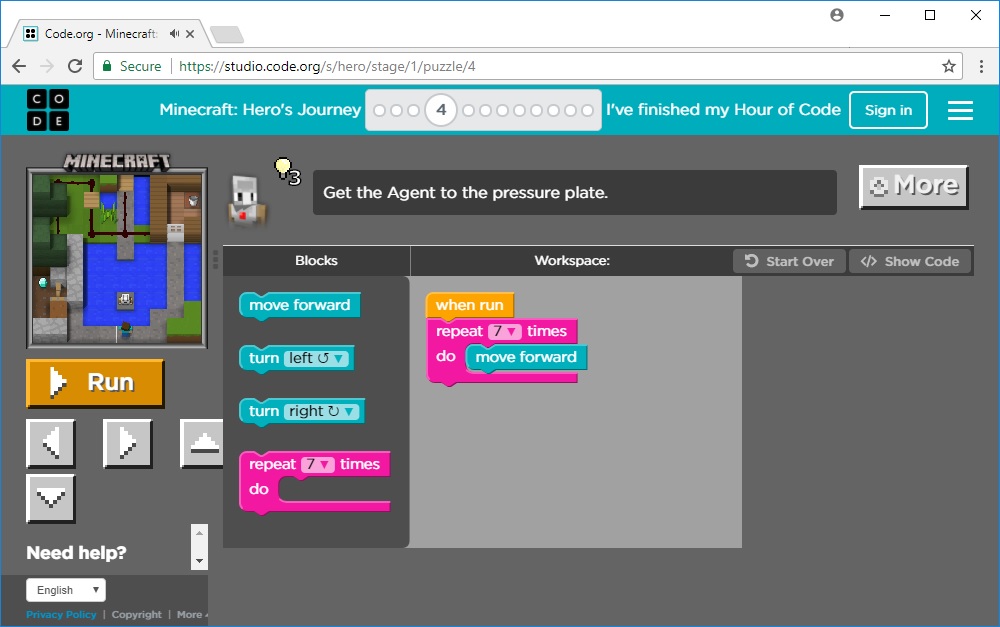
theodp writes: In a few weeks, writes Microsoft Corporate VP Mary Snapp, "millions of kids and others will participate in an Hour of Code, a global call to action to spend an hour learning the basics of coding. Today, it's my privilege to announce that Microsoft has released a new Minecraft tutorial for Hour of Code, called Hero's Journey." The release of the new Code.org-touted flagship Hour of Code tutorial -- the third since Microsoft purchased Minecraft Maker Mojang for $2.5B in 2014 -- comes as Microsoft celebrates Minecraft: Education Edition reaching a milestone of 2 million users.
Microsoft boasts that nearly 70 million of its Minecraft Hour of Code sessions have been launched to-date, which is certainly impressive from an infomercial or brand awareness standpoint. But does [adding a Scratch block to] move a Minecraft character forward 7 times on an $800 Microsoft Surface offer all that much more educational value than, say, moving a peg forward 5 times on a $10.99 Pop-O-Matic Trouble board game? -
Slashdot Asks: Have You Switched To Firefox 57?
Yesterday, Mozilla launched Firefox 57 for Windows, Mac, Linux, Android, and iOS. It brings massive performance improvements as it incorporates the company's next-generation browser engine called Project Quantum; it also features a visual redesign and support for extensions built using the WebExtension API. Have you used Firefox's new browser? Does it offer enough to make you switch from your tried-and-true browser of choice? We'd love to hear your thoughts. -
Firefox Quantum Arrives With Faster Browser Engine, Major Visual Overhaul (venturebeat.com)
An anonymous reader writes: Mozilla today launched Firefox 57, branded Firefox Quantum, for Windows, Mac, Linux, Android, and iOS. The new version, which Mozilla calls "by far the biggest update since Firefox 1.0 in 2004," brings massive performance improvements and a visual redesign. The Quantum name signals Firefox 57 is a huge release that incorporates the company's next-generation browser engine (Project Quantum). The goal is to make Firefox the fastest and smoothest browser for PCs and mobile devices -- the company has previously promised that users can expect "some big jumps in capability and performance" through the end of the year. Indeed, three of the four past releases (Firefox 53, Firefox 54, and Firefox 55) included Quantum improvements. But those were just the tip of the iceberg. Additionally, Firefox now exclusively supports extensions built using the WebExtension API, and unsupported legacy extensions will no longer work, the company said. -
How Two Scientists Accurately Predicted Global Warming in 1967 (medium.com)
Slashdot reader Layzej shares an article from this spring marking the 50th anniversary of the first accurate climate model: Astrophysicist Ethan Siegel looks at a climate model (MW67) published in 1967 and finds "50 years after their groundbreaking 1967 paper, the science can be robustly evaluated, and they got almost everything exactly right."
An analysis on the "Climate Graphs" blog shows exactly how close the prediction has proven to be: "The slope of the CO2-vs-temperature regression line in the 50 years of actual observations is 2.57, only slightly higher than MW67's prediction of 2.36" They also note that "This is even more impressive when one considers that at the time MW67 was published, there had been no detectable warming in over two decades. Their predicted warming appeared to mark a radical change with the recent past:" -
YouTube Says It Will Crack Down On Bizarre Videos Targeting Children (theverge.com)
"Earlier this week, a report in The New York Times and a blog post on Medium drew a lot of attention to a world of strange and sometimes disturbing YouTube videos aimed at young children," reports The Verge. "The genre [...] makes use of popular characters from family-friendly entertainment, but it's often created with little care, and can quickly stray from innocent themes to scenes of violence or sexuality." YouTube is cracking down and will now age restrict videos that violate its policy. From the report: The first line of defense for YouTube Kids are algorithmic filters. After that, there is a team of humans that review videos which have been flagged. If a video with recognizable children's characters gets flagged in YouTube's main app, which is much larger than the Kids app, it will be sent to the policy review team. YouTube says it has thousands of people working around the clock in different time zones to review flagged content. If the review finds the video is in violation of the new policy, it will be age restricted, automatically blocking it from traveling to the Kids app. YouTube says it typically takes at least a few days for content to make its way from YouTube proper to YouTube Kids, and the hope is that within that window, users will flag anything potentially disturbing to children. YouTube also has a team of volunteer moderators, which it calls Contributors, looking for inappropriate content. YouTube says it will start training its review team on the new policy and it should be live within a few weeks. Along with filtering content out of the Kids app, the new policy will also tweak who can see these videos on YouTube's main service. Flagged content will be age restricted, and users won't be able to see those videos if they're not logged in on accounts registered to users 18 years or older. All age-gated content is also automatically exempt from advertising. That means this new policy could put a squeeze on the booming business of crafting strange kid's content. -
Google Wants Google Doodles Taught In Public School, Warns Kids They Best Behave
theodp writes: Well, this year's Hour of Code is almost upon us, and if Google has its way, K-12 schoolchildren across the nation will be learning computer science by creating Google Doodles with Scratch (lesson plan). Curiously, the introductory video for the Create Your Own Google Logo Hour of Code activity from the Google Computer Science Education Department sternly warns kids, "While it is okay to use the Google logo for your personal Doodle, it is not okay [emphasis Google's] to use it anyplace else or outside this activity." In addition to respecting its intellectual property, Google instructs kids that they are to follow the Scratch Community Guidelines when they create Google logos: "Please stay positive, friendly, and supportive towards others in the Scratch Community. Help us keep Scratch a place where people of different backgrounds and interests feel welcome to hang out and create together." -
Flaw Crippling Millions of Crypto Keys Is Worse Than First Disclosed (arstechnica.com)
An anonymous reader quotes a report from Ars Technica: A crippling flaw affecting millions -- and possibly hundreds of millions -- of encryption keys used in some of the highest-stakes security settings is considerably easier to exploit than originally reported, cryptographers declared over the weekend. The assessment came as Estonia abruptly suspended 760,000 national ID cards used for voting, filing taxes, and encrypting sensitive documents. The critical weakness allows attackers to calculate the private portion of any vulnerable key using nothing more than the corresponding public portion. Hackers can then use the private key to impersonate key owners, decrypt sensitive data, sneak malicious code into digitally signed software, and bypass protections that prevent accessing or tampering with stolen PCs. When researchers first disclosed the flaw three weeks ago, they estimated it would cost an attacker renting time on a commercial cloud service an average of $38 and 25 minutes to break a vulnerable 1024-bit key and $20,000 and nine days for a 2048-bit key. Organizations known to use keys vulnerable to ROCA—named for the Return of the Coppersmith Attack the factorization method is based on—have largely downplayed the severity of the weakness.
On Sunday, researchers Daniel J. Bernstein and Tanja Lange reported they developed an attack that was 25 percent more efficient than the one created by original ROCA researchers. The new attack was solely the result of Bernstein and Lange based only on the public disclosure information from October 16, which at the time omitted specifics of the factorization attack in an attempt to increase the time hackers would need to carry out real-world attacks. After creating their more efficient attack, they submitted it to the original researchers. The release last week of the original attack may help to improve attacks further and to stoke additional improvements from other researchers as well. -
'Something Is Wrong On the Internet' (medium.com)
"Someone or something or some combination of people and things is using YouTube to systematically frighten, traumatize, and abuse children, automatically and at scale, and it forces me to question my own beliefs about the internet, at every level," writes James Bridle. From the article: To begin: Kid's YouTube is definitely and markedly weird. I've been aware of its weirdness for some time. Last year, there were a number of articles posted about the Surprise Egg craze. Surprise Eggs videos depict, often at excruciating length, the process of unwrapping Kinder and other egg toys. That's it, but kids are captivated by them. There are thousands and thousands of these videos and thousands and thousands, if not millions, of children watching them. [...] What I find somewhat disturbing about the proliferation of even (relatively) normal kids videos is the impossibility of determining the degree of automation which is at work here; how to parse out the gap between human and machine. The New York Times, last week: Parents and children have flocked to Google-owned YouTube Kids since it was introduced in early 2015. The app's more than 11 million weekly viewers are drawn in by its seemingly infinite supply of clips, including those from popular shows by Disney and Nickelodeon, and the knowledge that the app is supposed to contain only child-friendly content that has been automatically filtered from the main YouTube site. But the app contains dark corners, too, as videos that are disturbing for children slip past its filters, either by mistake or because bad actors have found ways to fool the YouTube Kids algorithms. In recent months, parents like Ms. Burns have complained that their children have been shown videos with well-known characters in violent or lewd situations and other clips with disturbing imagery, sometimes set to nursery rhymes. -
Estonia Is Enhancing the Security of Its Digital Identities (medium.com)
Estonia is upgrading the security of ID cards and digital IDs used by citizens, residents and e-residents. A new certificates update has been developed based on advanced elliptic-curve cryptography, which is more secure and faster than the SSL certificates previously used. From a report: This certificate update will protect users from a potential security vulnerability that the Estonian government announced last month had been identified by a group of security researchers. It has now been confirmed that the vulnerability is contained in software that had previously been installed on the embedded chip used in ID cards around the world, including those issued by Estonia between 16 October 2014 and 25 October 2017. Although the problem is international, minimising the risk and developing a solution has been a top priority for Estonia since the government was informed. However, there has still been no reported incidents of any Estonian digital ID or ID card being misused in the way described by the researchers. Considerable resources and expertise would be required for this so the risk for most people affected has always been low. -
Jimmy Wales' WikiTribune is Already Biased (theoutline.com)
Earlier this year, Jimmy Wales, the founder of Wikipedia, said he would be launching a neutral news service with "no other agenda than this: the ultimate arbiter of the truth is the facts of reality." On Monday, a pilot version of WikiTribune went live. Adrianne Jeffries of The Outline argues that WikiTribune is already doing things that it said it wouldn't: As of this writing, WikiTribune's homepage featured a hodgepodge of news aggregation. The "editor's choice" module points to a news roundup that includes Paul Manafort's indictment, the Catalonian independence movement. [...] These stories are all sourced to fairly mainstream news outlets, including some that are on Wikipedia's preferred sources list such as CNN and Reuters, and some that are not, such as Politifact and "Spanish media." I admire what Wales is trying to do here. [...] But WikiTribune is bullshit. It's not new -- it is the same kind of news aggregation that exists all over the web. It is not better -- comparable summarizing and linking can be found on many websites, while original reporting of those same stories, often supplemented by linking to other reporting, can be found at CNN, Reuters, The New York Times, and the BBC, which WikiTribune uses as its primary sources. And finally, and most importantly, it is not neutral. The existence of the "Editor's choice" module, which highlights some stories over others, is not neutral; neither is the "Good reads" section, which does the same thing. The Manafort story includes a section, "Highlights from the indictment," which is not neutral -- someone had to decide which parts of the indictment were more significant than others. There is no such thing as an objective highlight. It is true that the wording of the story does not include adjectives, except when it quotes from the indictment ("lavish lifestyle," "false and misleading statements"), but this is standard newswriting, as one would get from the AP or the New York Times. -
Facebook Tests Removing Publishers From News Feed -- Unless They Pay (mashable.com)
According to a report via Mashable, Facebook is removing posts from Pages in the original News Feed and relegating them to another feed, forcing users to "pay to play" in order to have their content back in the News Feed. The setting is only available in Slovakia, Sri Lanka, Serbia, Bolivia, Guatemala, and Cambodia for now, but it could be rolled out to other countries later. From the report: The social network last week officially launched its secondary news feed called Explore. The feed generally features posts from Facebook Pages users don't follow. News Feed, meanwhile, hosts posts from friends and Pages users do follow. But that's not true for everyone. In six markets, Facebook has removed posts from Pages in the original News Feed and relegated them to another feed, Filip Struharik, editor and social media manager at Dennik N, wrote. That means Facebook's main feed is no longer a free playing field for publishers. Instead, it's a battlefield of "pay to play," where publishers have to pony up the dough to get back into the News Feed. It's a stark change from how media outlets have grown with Facebook. Publishers like BuzzFeed's Tasty and NowThis grew via distributing viral posts and videos on News Feed, as Ziad Ramley, former social lead at Al Jazeera English, wrote. While companies had to employ social media managers, they could generally rely on them sharing content without paying to boost it. -
Chrome 62 Released With OpenType Variable Fonts, HTTP Warnings In Incognito Mode (bleepingcomputer.com)
An anonymous reader writes: Earlier today, Google released version 62 of its Chrome browser that comes with quite a few new features but also fixes for 35 security issues. The most interesting new features are support for OpenType variable fonts, the Network Quality Estimator API, the ability to capture and stream DOM elements, and HTTP warnings for the browser's Normal and Incognito mode. The most interesting of the new features is variable fonts. Until now, web developers had to load multiple font families whenever they wanted variations on a font family. For example, if a developer was using the Open Sans font family on a site, if he wanted a font variation such as Regular, Bold, Black, Normal, Condensed, Expanded, Highlight, Slab, Heavy, Dashed, or another, he'd have to load a different font file for each. OpenType variable fonts allow font makers to merge all these font family variations in one file that developers can use on their site and control via CSS. This results in fewer files loaded on a website, saving bandwidth and improving page load times. Two other features that will interest mostly developers are the Network Quality Estimator and the Media Capture from DOM Elements APIs. As the name hints, the first grants developers access to network speed and performance metrics, information that some websites may use to adapt video streams, audio quality, or deliver low-fi versions of their sites. Developers can use the second API -- the Media Capture from DOM Elements -- to record videos of how page sections behave during interaction and stream the content over WebRTC. This latter API could be useful for developers debugging a page, but also support teams that want to see what's happening on the user's side. -
Mobile Phone Companies Appear To Be Selling Your Location To Almost Anyone (techcrunch.com)
An anonymous reader quotes a report from TechCrunch: You may remember that last year, Verizon (which owns Oath, which owns TechCrunch) was punished by the FCC for injecting information into its subscribers' traffic that allowed them to be tracked without their consent. That practice appears to be alive and well despite being disallowed in a ruling last March: companies appear to be able to request your number, location, and other details from your mobile provider quite easily. The possibility was discovered by Philip Neustrom, co-founder of Shotwell Labs, who documented it in a blog post earlier this week. He found a pair of websites which, if visited from a mobile data connection, report back in no time with numerous details: full name, billing zip code, current location (as inferred from cell tower data), and more. (Others found the same thing with slightly different results depending on carrier, but the demo sites were taken down before I could try it myself.) -
20 Years of Stuff That Matters
Today we're marking Slashdot's 20th birthday. 20 years is a long time on the internet. Many websites have come and gone over that time, and many that stuck around haven't had any interest in preserving their older content. Fortunately, as Slashdot approaches its 163,000th story, we've managed to keep track of almost all our old postings - all but the first 2^10, or so. In addition to that, we've held onto user comments, the lifeblood of the site, from 1999 onward. As we celebrate Slashdot's 20th anniversary this month, we thought we'd take a moment to highlight a few of the notable or interesting stories and discussions that have happened here in the past decade and a half. This is part of our 20-year anniversary celebration, and we've set up a page to coordinate user meet-ups. We'll be continuing to run some special pieces throughout the month, so keep an eye out for those.
Read on for a trip down memory lane.
Update: Slashdot founder CmdrTaco has taken to Medium with some of his own Slashdot nostalgia.The most obvious place to start would be some of the stories listed in the Hall of Fame. While Slashdot isn't a political site, we do post particularly relevant political news, and two of the three most commented-on posts were about the winning of a U.S. presidential election. John Kerry's concession to George W. Bush in 2004 drew 5687 comments, more than half again as much as Barack Obama's victory in 2008. Interestingly, Obama's name was thrown around in the 2004 thread as possible future candidate, but many thought he'd be running for vice president alongside Hillary Clinton or another, more established Democrat name. A few other tidbits: health care was mentioned much more often in the 2008 discussion, while comments on the military were four times as common in 2004. The economy was discussed slightly more in 2004, while mentions of the banking system in 2008 far surpassed the 2004 count.
While a few other political discussions rank in the top 10 for total comments, total views is another story. A quick and simple post about source code leaks for Windows 2000 and NT has garnered over 700,000 views. It generated a great deal of insightful commentary on the security implications of the leak and how the code should be approached by developers curious to get a look. Many users warned others off of glancing at Microsoft code, fearing that copyrighted samples would find their way into open source projects, thus giving Microsoft a tool with which to disrupt the projects. This leak followed one a few months earlier of the Half-Life 2 source code, which garnered a strong but much different reaction. Many called for Valve to go ahead and open source the game, since the cat was out of the bag. Others were worried about the influx of bots and cheats for the game, since the people writing those tools had much clearer access to the game's internals.
Two of our other most popular posts, and two of the most significant to us internally, are posts about somebody trying to get us to delete comments. We've always taken a strong stance both for preserving freedom of speech, and for simply providing a reliable wall upon which readers can scribble their words and know the words won't disappear. The Digital Millennium Copyright Act made that difficult in a few situations, and we made sure to be open and transparent about what happened. In early 2000, Microsoft asked us to kill off a few comments. We asked you folks how we should proceed, and you had no shortage of suggestions. Then, almost a year later, the Church of Scientology happened to notice a Slashdot comment which contained copyrighted text: part of the Fishman Affidavit, court documents that contained church course materials as well as criticism of the organization and its leadership. This was part of a war Scientology had been waging for several years to keep the documents secret. We were forced to remove the comment, but CmdrTaco's notification post thoroughly demonstrated how useless such an action was in the digital age, and encouraged people to reach out to their representatives to speak against the DMCA. He wrote, "This is the first time since we instituted our moderation system that a comment has had to be removed because of its content, and believe me nobody is more broken-hearted about it than me." He also went out of his way to point out the bad press surrounding the church for various other incidents. Fortunately, those types of requests seem to be largely behind us, now.
As the site evolved in those early days, the staff began to realize that the Slashdot community wasn't just absorbing the news and moving on; it was digesting the news and coming back with knowledgeable additions in the discussion. As interesting as an article may be, the community's response to it could generate informed discussion that surpassed the article tenfold. The staff considered how to harness this attribute to help the community, and shortly thereafter Ask Slashdot was born. In the time since then, almost 10,000 reader questions have been answered by other readers, and they frequently form the basis for the site's most informative discussions. The most popular was certainly "What's keeping you on Windows?" from 2002, a question that was revisited almost a decade later. Many of the specific reasons changed in that time, but the ability to easily play games was a sticking point for users in both discussions. There have been many common refrains over the years: how to get into IT or programming, how to get kids into it, what kind of phone/GPU/HDD/monitor to buy, or how best to put together some arcane but useful device or program. They occasionally get rather esoteric: questions about finding beautiful code, depressing sci-fi, or trying to pin down the biggest lies told by hardware and software vendors. Ask Slashdot is also sometimes used as a method of defense. Early this year, when the Stop Online Piracy Act and its sibling PIPA threatened freedom of speech on the web, we used it as a vehicle to show precisely why the legislation was bad, and figure out what more could be done to prevent them from being signed into law.
Slashdot's audience has always been very much about science, as well. This manifests itself in several different ways. For one, since readers' level of scientific education is higher, on average, than the general population's, any attack on science meets with strong opposition. For example, debates about creationism in the classroom spark a great deal of interesting discourse. While there's often a fair amount of vitriol, there are also well-reasoned and politely stated arguments. Other science-related topics sidestep the arguing in favor of excitement and wonder; when SpaceShipOne achieved the X-prize in 2004, the comment section was ripe with hopes for the commercial space sector (which is continuing to blossom today) and the possibility of ubiquitous spaceflight in our lifetimes. More recently, the discussion of CERN's supposed faster-than-light neutrinos, which took place over many months, brought into sharp relief the difficulties bleeding-edge science faces, and the resilience of the scientific method itself, which compelled researchers to come forward with results they suspected were wrong and then engage the scientific community in the task of confirming or repudiating them.
One of the greatest things about the Slashdot community is its above average level of understanding for all things technical. Commenters, submitters, and interviewees alike understand they don't have to use layman's terms to describe complex concepts. One of the best examples happened earlier this year when a group of fusion researchers from MIT got together to answer questions from readers on the state of fusion power. They didn't hold back, and were happy to provide a ton of very interesting information on how fusion reactors work, what it will take to make it a viable technology, what the safety issues are, and more. Similarly, there have been some fantastic, techinical answers from people like John Carmack, Vint Cerf, and Bjarne Stroustrup. But even when the interviews aren't highly technical, the community's strong opinions can lend themselves to contentious but productive discussions, as happened with Metallica drummer Lars Ulrich over the band's fight against file sharing, a Marketing exec for Microsoft Windows over some of the company's competitive practices, and Richard Stallman about the ethics of free software and open source.
It's also interesting to go back and look at stories that flew under the radar at the time, but later developed into huge, ongoing news items. For example, the launch of WikiLeaks in 2007 met mainly indifference and doubts that such a repository could do anything useful. Similarly, Google's unveiling of Android in 2007 brought a lot of speculation as to how open it would be and whether another phone OS could succeed. Facebook didn't get a mention on the site until late 2005, and its opening to the public the next year brought skepticism that it could trump MySpace or operate without compromising user privacy. The announcement of SpaceX by Elon Musk was blandly titled "Another Private Space Startup." Wikipedia got a couple of mentions in early 2001, even from Jimmy Wales himself. And, not exactly under the radar, but who can forget the early critique of Apple's original iPod?
On a more somber note, this collection of old stories wouldn't be complete without mentioning the day of September 11th, 2001. Here is how the page looked that day. News organizations around the world got a lesson in how people flock to the internet in times of emergency, and Slashdot was no exception. Readers congregated to share news as it was happening, and the staff frantically shut off portions of the site to keep it from buckling under the strain. It's a set of problems that have largely been solved in 2017, but they were new back then.
The last couple years have seen our world become more polarized than ever before, or at least it seems that way, likely because of the internet. Some of the most discussed and visited stories of the past year include the election of Donald Trump, Google firing engineer James Damore for writing a memo, to Silicon Valley investors calling for California to secede from the United States. One non-political, less polarizing story that made the Slashdot 2017 Hall of Fame was "Slashdot Asks: What's Your Favorite Sci-Fi Movie?", which is about as Slashdot as Slashdot gets, and the comments are well worth the read.
We hope this walk back through Slashdot's history provided a nostalgic diversion for you. With over 162,000 to pick from, it's inevitable that we'll leave some good ones out, so feel free to share in the comments any particular stories that have stuck in your memory. A lot of you have been around and contributing to the site for years, and we hope you'll stick around for years more. This is part of our 20-year anniversary celebration, and we've set up a page to coordinate user meet-ups. We'll be continuing to run some special pieces throughout the month, so keep an eye out for those.
-
Internet Activists Urge Congress to Fire Trump's FCC Chief Ajit Pai (vice.com)
Open internet advocates and Democratic lawmakers are mounting a last-ditch effort to remove Federal Communications Commission chief Ajit Pai over his anti-net neutrality stance, just days before Pai is set to be approved by the Senate for a new term. From a report: Since being elevated by President Trump to lead the FCC in January, Pai has become the bete noire of open internet advocates for a variety of anti-consumer actions, but none more so than his crusade to kill federal rules protecting net neutrality, the principle that all internet content should be equally accessible to consumers. [...] During a blistering floor speech on Thursday, Sen. Ron Wyden, the Oregon Democrat, portrayed Pai, a Republican former Verizon lawyer, as an industry stooge who has worked relentlessly to deliver gift after gift to the nation's largest broadband companies. "Mr. Pai has a long track record of putting big cable before consumers, big corporations above small businesses, and pay-to-play over the free and open internet," Wyden wrote in a blog post accompanying his speech. Free Press, a DC-based public interest group, has also launched a campaign to pressure the Senate to "fire Pai," citing his proposal to kill the FCC's net neutrality policy and other anti-consumer actions. But if reconfirmed, Pai is expected to try to ram through his plan to torpedo the FCC's net neutrality rules before the end of the year. "Rehiring Pai to head the agency that oversees US communications policies would be a boon for the phone and cable companies he eagerly serves," Tim Karr, Free Press Senior Director of Strategy, wrote in a blog post. -
Apple Suffers 'Major iPhone X Leak'
Details of new iPhones and other forthcoming Apple devices have been revealed via an apparent leak. From a report: Two news sites were given access to an as-yet-unreleased version of the iOS operating system. The code refers to an iPhone X in addition to two new iPhone 8 handsets. It also details facial recognition tech that acts both as an ID system and maps users' expressions onto emojis. One tech writer said it was the biggest leak of its kind to hit the firm. [...] "As best I've been able to ascertain, these builds were available to download by anyone, but they were obscured by long, unguessable URLs [web addresses]," wrote John Gruber, a blogger known for his coverage of Apple. "Someone within Apple leaked the list of URLs to 9to5Mac and MacRumors. I'm nearly certain this wasn't a mistake, but rather a deliberate malicious act by a rogue Apple employee." Neither Mr Gruber nor the two Apple-related news sites have disclosed their sources. However, the BBC has independently confirmed that an anonymous source provided the publications with links to iOS 11's golden master (GM) code that downloaded the software from Apple's own computer servers. It's a big blow to Apple, which uses surprise as a key element at its events. The leak could take some wind out of its sails as it looks to wow consumers. In 2012, Tim Cook had said the company was planning to "double down on secrecy." At the quarterly earnings call, he blamed the leaks about the upcoming iPhone models as one of the reasons that slowed down the sales of current generation iPhone models. However, an analysis published over the weekend found that Apple itself has been the source of several of these leaks in the years since. Earlier this year, the company held a meeting to boast about its internal progress to curb leaks. The hour-long recording of the meeting ironically got leaked. Nearly all details, except the final press renders of the new iPhone models, have leaked. In a subsequent post, Gruber wrote: The BBC doesn't say definitively that the leak was sent by an Apple employee, but I can state with nearly 100 percent certainty that it was. I also think there's a good chance Apple is going to figure out who it was. [...] That person should be ashamed of themselves, and should be very worried when their phone next rings. Moments ago, 9to5Mac reported about a new tvOS firmware leak, which appeared "to be out in the wild today" that details the upcoming features of the next generation Apple TV streaming device. -
Following Cheating Scandals, Harvard Dean of Undergrad Ed Visits CS50 Class and Tells Students Not To Cheat (thecrimson.com)
theodp writes: After a flood of cheating cases roiled Harvard's Computer Science 50: "Introduction to Computer Science I" last year, Dean of Undergraduate Education Jay Harris implored students in the course not to cheat on assignments at an orientation session Wednesday night. Course head David Malan, the Harvard Crimson reports, spent the last five minutes of the orientation session fielding questions from students confused about the course's collaboration policy and whether or not CS50 enrollees are allowed to use code found online. He told them never to Google solutions, and never to borrow a friend's work. Last week, CS50 students were informed via a CS50 FAQ that they are also now "encouraged" to physically attend the course's taped weekly lectures. In an essay last year, Prof. Malan had questioned the value of saying everyone should attend every lecture. Attendance is now also expected at every discussion section until the first mid-semester exam. In case you're curious, the estimated sticker price for attending Harvard College during the 2017-2018 school year is $69,600-$73,600 (health insurance sold separately). -
After Public Outcry From Customers, Britain's Biggest Bank HSBC Heads Off Complaints Over Small Business Account Closures (theguardian.com)
Julia Kollewe writing for The Guardian: HSBC has rushed to head off complaints from small businesses that found the bank had frozen or closed down their accounts as part of a crackdown on financial crime. Hundreds of small firms are thought to be affected, whose businesses range from an avocado importer to marketing and design companies. Britain's biggest bank, which has faced accusations of reacting slowly to the debacle, said that after becoming aware of problems in the past week, it was putting extra staff on its helpline and speeding up the process for dealing with complaints. It said staff were reducing the amount of time to unfreeze an account once a review had been completed. Earlier on Monday, Richard Davey, an HTML5 game developer and creator of Phaser, shared his ordeal dealing with HSBC, which had suspended transactions from his accounts without much explanation. It was only after thousands of users brought it to the company's attention on social media that the company fixed Davey's account, he said. -
How the NSA Identified Satoshi Nakamoto (medium.com)
An anonymous reader shares a report: The 'creator' of Bitcoin, Satoshi Nakamoto, is the world's most elusive billionaire. Very few people outside of the Department of Homeland Security know Satoshi's real name. In fact, DHS will not publicly confirm that even THEY know the billionaire's identity. Satoshi has taken great care to keep his identity secret employing the latest encryption and obfuscation methods in his communications. Despite these efforts (according to my source at the DHS) Satoshi Nakamoto gave investigators the only tool they needed to find him -- his own words. Using stylometry one is able to compare texts to determine authorship of a particular work. Throughout the years Satoshi wrote thousands of posts and emails and most of which are publicly available. According to my source, the NSA was able to the use the 'writer invariant' method of stylometry to compare Satoshi's 'known' writings with trillions of writing samples from people across the globe. By taking Satoshi's texts and finding the 50 most common words, the NSA was able to break down his text into 5,000 word chunks and analyse each to find the frequency of those 50 words. This would result in a unique 50-number identifier for each chunk. The NSA then placed each of these numbers into a 50-dimensional space and flatten them into a plane using principal components analysis. The result is a 'fingerprint' for anything written by Satoshi that could easily be compared to any other writing. The NSA then took bulk emails and texts collected from their mass surveillance efforts. First through PRISM and then through MUSCULAR, the NSA was able to place trillions of writings from more than a billion people in the same plane as Satoshi's writings to find his true identity. The effort took less than a month and resulted in positive match. -
Modest Proposal To Companies: Let Your Customers Respond To Your Emails - Kill no-reply@ (medium.com)
An anonymous reader shares a blogpost: Dear way-too-many companies, if you're allowed to send me an email, I'm allowed to send you an email. You just sent me an email and I have a question. Don't make me hunt for a way to ask it. Email already has a built-in way to do that -- reply. Whether it's good news or bad news, whether you're an established company or a startup, your customers will love you more if you let them reply to your emails. -
Medium Will Now Pay Writers Based On How Many 'Claps' They Get (theverge.com)
Medium is getting creative with how they're paying its writers. The San Francisco-based online publishing platform will determine how much an author is paid by how many claps a story receives. Claps are basically Medium's equivalent of a Like, and they recently replaced the "recommend" feature -- a little heart button at the end of each article. The Verge reports: The site wants people to send authors claps to show how much they enjoy reading each article. Now, those claps are actually going to mean something. Medium pays authors by dividing up every individual subscriber's fee between the different articles they've read that month. But rather than doing an even division between articles, Medium will weight payments toward whichever articles a subscriber gives the most claps to. It's not clear exactly how much each individual clap tips the scale, but you can be sure that writers will be asking readers to click that button. It's a pretty strange way to implement payments, since it relies on a really arbitrary metric that individual subscribers might use in really different and inconsistent ways. Time spent on page and whether someone shared an article probably would have been useful metrics by which to tell how much a reader enjoyed a piece, but maybe that makes too much sense for a startup in the middle of its second business model pivot. On the positive side, claps can help Medium surface content that people are enjoying and get it in front of more readers. -
Google Engineer's Leaked 'Gender Diversity' Essay Draws Massive Response (medium.com)
An anonymous reader writes: An engineer at Google's Mountain View headquarters circulated a 3,400-word essay internally that argued a "moral bias" exists at Google that's "shaming dissenters" and silencing their voices against "encroaching extremist and authoritarian policies." It attributes the gender gap in technology to biology-based differences in abilities (such as "speaking up" and "leading") and different personality traits (including "neuroticism"). Its suggested remedies include "Stop alienating conservatives" (calling it "non-inclusive" and "bad business because conservatives tend to be higher in conscientiousness"), and it also suggests as a solution to "de-emphasize empathy" (which "causes us to focus on anecdotes, favor individuals similar to us, and harbor other irrational and dangerous biases").
As the essay leaked over the weekend, former Google engineer Yonatan Zunger identified its anonymous author as "not someone senior," saying the author didn't seem to understand gender -- or engineering -- or what's going to happen next. "Essentially, engineering is all about cooperation, collaboration, and empathy for both your colleagues and your customers. If someone told you that engineering was a field where you could get away with not dealing with people or feelings, then I'm very sorry to tell you that you have been lied to... It's true that women are socialized to be better at paying attention to people's emotional needs and so on -- this is something that makes them better engineers, not worse ones... You need to learn the difference between 'I think we should adopt Go as our primary language' and 'I think one-third of my colleagues are either biologically unsuited to do their jobs, or if not are exceptions and should be suspected of such until they can prove otherwise to each and every person's satisfaction.'"
The leaked internal essay is now being discussed in literally dozens of news outlets. Click through for some official responses, including leaked reactions from Google's VP of Engineering, from Google's new VP of Diversity, Integrity & Governance -- and from Slashdot's readers.
Google's new VP of Diversity, Integrity & Governance -- who started just a few weeks ago -- responded internally that the document "advanced incorrect assumptions about gender," saying it's not a viewpoint Google endorses or encourages, and adding that "Changing a culture is hard, and it's often uncomfortable."
Zunger seemed to agree in part, writing sympathetically that "One very important true statement which this manifesto makes is that male gender roles remain highly inflexible, and that this is a bug, not a feature. In fact, I suspect that this is the core bug which prompted everything else within this manifesto to be written."
Google VP of Engineering Ari Balogh also responded internally that "we want to continue fostering an environment where it's safe to engage in challenging conversations in a thoughtful way. But, in the process of doing that, we cannot allow stereotyping and harmful assumptions to play any part. One of the aspects of the post that troubled me deeply was the bias inherent in suggesting that most women, or men, feel or act a certain way. That is stereotyping, and it is harmful."
Long-time Slashdot reader Lauren Weinstein believes that leaking the internal memo to the outside world was a major breach of trust that will do more damage. But he also links to an earlier essay which argues "The men of computer science and the computer industry are misogynous jerks. Not all of them of course. Likely not even the majority. But enough to thoroughly poison the well." -
Google Engineer's Leaked 'Gender Diversity' Essay Draws Massive Response (medium.com)
An anonymous reader writes: An engineer at Google's Mountain View headquarters circulated a 3,400-word essay internally that argued a "moral bias" exists at Google that's "shaming dissenters" and silencing their voices against "encroaching extremist and authoritarian policies." It attributes the gender gap in technology to biology-based differences in abilities (such as "speaking up" and "leading") and different personality traits (including "neuroticism"). Its suggested remedies include "Stop alienating conservatives" (calling it "non-inclusive" and "bad business because conservatives tend to be higher in conscientiousness"), and it also suggests as a solution to "de-emphasize empathy" (which "causes us to focus on anecdotes, favor individuals similar to us, and harbor other irrational and dangerous biases").
As the essay leaked over the weekend, former Google engineer Yonatan Zunger identified its anonymous author as "not someone senior," saying the author didn't seem to understand gender -- or engineering -- or what's going to happen next. "Essentially, engineering is all about cooperation, collaboration, and empathy for both your colleagues and your customers. If someone told you that engineering was a field where you could get away with not dealing with people or feelings, then I'm very sorry to tell you that you have been lied to... It's true that women are socialized to be better at paying attention to people's emotional needs and so on -- this is something that makes them better engineers, not worse ones... You need to learn the difference between 'I think we should adopt Go as our primary language' and 'I think one-third of my colleagues are either biologically unsuited to do their jobs, or if not are exceptions and should be suspected of such until they can prove otherwise to each and every person's satisfaction.'"
The leaked internal essay is now being discussed in literally dozens of news outlets. Click through for some official responses, including leaked reactions from Google's VP of Engineering, from Google's new VP of Diversity, Integrity & Governance -- and from Slashdot's readers.
Google's new VP of Diversity, Integrity & Governance -- who started just a few weeks ago -- responded internally that the document "advanced incorrect assumptions about gender," saying it's not a viewpoint Google endorses or encourages, and adding that "Changing a culture is hard, and it's often uncomfortable."
Zunger seemed to agree in part, writing sympathetically that "One very important true statement which this manifesto makes is that male gender roles remain highly inflexible, and that this is a bug, not a feature. In fact, I suspect that this is the core bug which prompted everything else within this manifesto to be written."
Google VP of Engineering Ari Balogh also responded internally that "we want to continue fostering an environment where it's safe to engage in challenging conversations in a thoughtful way. But, in the process of doing that, we cannot allow stereotyping and harmful assumptions to play any part. One of the aspects of the post that troubled me deeply was the bias inherent in suggesting that most women, or men, feel or act a certain way. That is stereotyping, and it is harmful."
Long-time Slashdot reader Lauren Weinstein believes that leaking the internal memo to the outside world was a major breach of trust that will do more damage. But he also links to an earlier essay which argues "The men of computer science and the computer industry are misogynous jerks. Not all of them of course. Likely not even the majority. But enough to thoroughly poison the well." -
Apple is About To Do Something Their Programmers Definitely Don't Want (medium.com)
Last week, The Wall Street Journal had a big feature on Apple Campus, the big new beautiful office the company has spent north of $5 billion on. The profile, in which the reporter interviewed Apple's design chief Jony Ive, also mentioned about an open space where all the programmers would sit and work. Ever since the profile came out, several people have expressed their concerns about the work environment for the developers. American entrepreneur and technologist Anil Dash writes: [...] There have been countless academic studies confirming the same result: Workers in open plan offices are frustrated, distracted and generally unhappy. That's not to say there's no place for open plan in an offices -- there can be great opportunities to collaborate and connect. For teams like marketing or communications or sales, sharing a space might make a lot of sense. But for tasks that require being in a state of flow? The science is settled. The answer is clear. The door is closed on the subject. Or, well, it would be. If workers had a door to close. Now, when it comes to jobs or roles that need to be in a state of flow, programming may be the single best example of a task that benefits from not being interrupted. And Apple has some of the best coders in the world, so it's just common sense that they should be given a great environment. That's why it was particularly jarring to see this side note in the WSJ's glowing article about Apple's new headquarters: "Coders and programmers are concerned their work surroundings will be too noisy and distracting." Usually, companies justify putting programmers into an open office plan for budget reasons. It does cost more to make enough room for every coder to have an office with a door that closes. But given that Apple's already invested $5 billion into this new campus, complete with iPhone-influenced custom-built toilets for the space, it's hard to believe this decision was about penny-pinching. The other possible argument for skipping private offices would be if a company didn't know that's what its workers would prefer. -
Where's All My CPU and Memory Gone? The Answer: $5B Worth Slack App (medium.com)
Slack, valued at $5 billion, has received buyout pitches from several companies including Amazon and Microsoft. But the team collaborations service, which has over 5 million active users, continues to offer one of the most resource intensive apps you could find on Mac and iOS. From an article: TLDR; If you care about battery life or availability of your finite CPU and memory on your computer, then you probably won't want to use Slack desktop with more than one or two accounts. Slack resource usage increases linearly as you add more accounts, and it quickly adds up. [...] I noticed that my machine has been sluggish and its battery life has become poor. Whilst investigating this, it turns out that Slack desktop fails badly when used with multiple accounts. This is because CPU and memory usage increases linearly as you add more accounts to your Slack desktop client. As a result, I believe the growing trend to use Slack to be part of multiple communities is seriously flawed until Slack resolve this problem. The author, Matthew O'Riordan, has shared screenshots of Activity Monitor which shows that Slack application on his Mac was consuming more than 1.5GB of memory, and as much as 70 percent of the energy. The company's iOS app instills several more issues. -
'Apple's Refusal To Support Progressive Web Apps is a Detriment To Future of the Web' (medium.com)
From a blog post: Progressive Web Applications (PWAs) are one of the most exciting and innovative things happening in web development right now. PWAs enable you to use JavaScript to create a "Service Worker", which gives you all sorts of great features that you'd normally associate with native apps, like push notifications, offline support, and app loading screens -- but on the web! Awesome. Except for is one major problem -- While Google has embraced the technology and added support for it in Chrome for Android, Apple has abstained from adding support to mobile Safari. All they've done is say that it is "Under Consideration." Seemingly no discussion about it whatsoever. -
24 Women Allege Sexual Harassment By Investors, and Another VC Gets Demoted (nytimes.com)
An anonymous reader writes: Friday technology investor Dave McClure tweeted a link to a statement from the new CEO of the start-up incubator he co-founded which announces his demotion after engaging in "inappropriate interactions with women in the tech community." The new CEO of 500 Startups says "I sincerely apologize for the choices he made and the pain and stress they've caused people. But apologies aren't enough without meaningful actions and change. Because of this, we made the decision a few months ago to change the leadership structure at 500." Meanwhile, McClure will attend counseling "to work on changing his perspectives and preventing his previous unacceptable behavior... As much as we want to be part of the solution, we clearly have also been part of the problem."
The same day more than two dozen female entrepreneurs told the New York Times about incidents of sexual harassment in the start-up industry, "often providing corroborating messages and emails." Several women told the Times they were warned that saying anything might lead to ostracism. Chris Sacca -- whose firm invested in Twitter, Uber, Instagram, Twilio, and Kickstarter -- told the Times he was grateful for the courage of the female entrepreneur who told the Times how he'd propositioned her, and Sacca also wrote in a post on Medium, "I've learned that it's often the less obvious, yet pervasive and questionable, everyday behaviors of men in our industry that collectively make it inhospitable for women... It's the unrelenting, day-to-day culture of dismissiveness that creates a continually bleak environment for women and other underrepresented groups." The article also notes that Justin Caldbeck -- accused by six different founders of making unwanted advances -- worked at three different VC firms over the last seven years. The Times also cites a 2014 admission by investor Pavel Curda that he sent two women text messages asking for sex after a networking event, adding "The new accounts underscore how sexual harassment in the tech start-up ecosystem goes beyond one firm and is pervasive and ingrained." -
Hello's Sleep-tracking Kickstarter Hit, Which Raised Over $42M In Three Years, Collapses (bbc.com)
Reader AmiMoJo writes: A sleep-tracking tech start-up founded by a Briton, which was one of Kickstarter's biggest success stories, has collapsed. Hello raised more than $2.4m (1.9m pound) for its Sense bedroom monitor via the crowdfunding site in 2014, and went on to attract a further $40.5m. Private backers included Singapore's sovereign wealth fund Temasek and Facebook Messenger chief David Marcus. Hello confirmed it would "soon be shutting down", via Medium's news site. The equipment produced a unique score for the previous night's sleep and aimed to wake the owner up at the best point in their sleep cycle. -
Report Reveals In-App Purchase Scams In the App Store (macrumors.com)
In a Medium article titled How to Make $80,000 Per Month On the Apple App Store, Johnny Lin uncovers a scamming trend in which apps advertising fake services are making thousands of dollars a month from in-app purchases. The practice works by manipulating search ads to promote dubious apps in the App Store and then preys on unsuspecting users via the in-app purchase mechanism. MacRumors reports: "I scrolled down the list in the Productivity category and saw apps from well-known companies like Dropbox, Evernote, and Microsoft," said Lin. "That was to be expected. But what's this? The #10 Top Grossing Productivity app (as of June 7th, 2017) was an app called 'Mobile protection :Clean & Security VPN.' Given the terrible title of this app (inconsistent capitalization, misplaced colon, and grammatically nonsensical 'Clean & Security VPN?'), I was sure this was a bug in the rankings algorithm. So I check Sensor Tower for an estimate of the app's revenue, which showed ... $80,000 per month?? That couldn't possibly be right. Now I was really curious." To learn how this could be, Lin installed and ran the app, and was soon prompted to start a "free trial" for an "anti-virus scanner" (iOS does not need anti-virus software thanks to Apple's sandboxing rules for individual apps). Tapping on the trial offer then threw up a Touch ID authentication prompt containing the text "You will pay $99.99 for a 7-day subscription starting Jun 9, 2017." Lin was one touch away from paying $400 a month for a non-existent service offered by a scammer. Lin dug deeper and found several other similar apps making money off the same scam, suggesting a wider disturbing trend, with scam apps regularly showing up in the App Store's top grossing lists. -
61 Mayors Commit To Adopt, Honor and Uphold Paris Climate Accord After US Pulls Out (curbed.com)
After President Trump announced his intent to withdraw the U.S. from the Paris Climate Accord, 61 mayors across the country have pledged to adopt the historic agreement themselves. The group of mayors, who represent 36 million Americans and some of the largest U.S. cities, outlined a plan to align with the other 194 nations that adopted the accord. From a statement provided by the climate mayors: We will continue to lead. We are increasing investments in renewable energy and energy efficiency. We will buy and create more demand for electric cars and trucks. We will increase our efforts to cut greenhouse gas emissions, create a clean energy economy, and stand for environmental justice. And if the President wants to break the promises made to our allies enshrined in the historic Paris Agreement, we'll build and strengthen relationships around the world to protect the planet from devastating climate risks. The world cannot wait -- and neither will we. -
Podcast App Breaker Adds Support For JSON Feed, Believes the RSS Alternative Could Benefit Podcast Ecosystem (medium.com)
Erik Michaels-Ober, the creator of popular podcast app Breaker: The decentralized structure of podcasts creates a chicken-and-egg problem for JSON Feed to gain adoption. There's no incentive for podcasters to publish in JSON Feed as long as podcast players don't support it. And there's no incentive for podcast players to support JSON Feed as long as podcasters don't publish in that format. Breaker is hoping to break that stalemate by adding support for JSON Feed in our latest release. As far as we know, Breaker is the first podcast player to do so. Unlike other features that differentiate Breaker, we encourage our competitors to follow our lead in this area. The sooner all podcast players support JSON Feed, the better positioned the entire podcast ecosystem will be for the decades to come. JSON is more compact than XML, making it faster for computers to transfer and parse, while making it easier for humans to read and write. Updating Breaker to support JSON Feed was fun and easy. It took us less than a day from when we started working on it to when the change was submitted to the App Store. Update: Julian Lepinski, creator of Cast (an app that offers the ability to record, edit, publish and host podcast files), announced on Tuesday: Like a lot of software, much of Cast's internal data is stored in JSON, and publishing JSON data directly would be pretty straightforward as a result. So I sunk my teeth in, and in about half a day I'd added experimental JSON Feed support to podcasts published with Cast. -
Firefox Marketing Head Expresses Concerns Over Google's Apparent 'Only Be On Chrome' Push (medium.com)
Eric Petitt, head up Firefox marketing, writing in a blog: I use Chrome every day. Works fine. Easy to use. There are multiple things that bug me about the Chrome product, for sure, but I'm OK with Chrome. I just don't like only being on Chrome. And that's what Chrome wants. It wants you to only use Chrome. Chrome is not evil, it's just too big for its britches. Its influence on the internet economy and individuals is out of balance. Chrome, with 4 times the market share of its nearest competitor (Firefox), is an eight-lane highway to the largest advertising company in the world. Google built it to maximize revenue from your searches and deliver display ads on millions of websites. To monetize every... single... click. And today, there exists no meaningful safety valve on its market dominance. Beyond Google, the web looks more and more like a feudal system, where the geography of the web has been partitioned off by the Frightful Five. Google, Facebook, Microsoft, Apple and Amazon are our lord and protectors, exacting a royal sum for our online behaviors. We're the serfs and tenants, providing homage inside their walled fortresses. Noble upstarts are erased or subsumed under their existing order. (Footnote: Petitt has made it clear that the aforementioned views are his own, and not those of Mozilla.) -
Twitter Co-Founder Biz Stone Is Returning to the Company (techcrunch.com)
After leaving Twitter in 2011 to pursue new projects, Twitter co-founder Biz Stone has announced that he's returning to the company to "guide company culture." Stone said in a statement: "It's important that everyone understands the whole story of Twitter and each of our roles in that story. I'll shape the experience internally so it's also felt outside the company." TechCrunch reports: About a month ago Stone sold his most recent startup, Jelly, to Pinterest. He said at the time that he wasn't required to stay on with Pinterest, so was available for new opportunities. Stone said he was recently back at Twitter as a "special guest" for an event open to employees, where current CEO and fellow co-founder Jack Dorsey -- another founder who left and then returned -- asked him onstage if he wanted to come back and work at Twitter. After some employee cheers, and a private clarification that Jack was in fact being serious, he accepted. Twitter diehards are reacting positively to the news -- many think that Twitter needs to get back to its roots, and what better way to do it than bringing back a co-founder? The market also seems to be happy. TWTR stock immediately jumped 2 percent on the news, reaching a three-month high of $19.62. -
CEO of Silicon Valley's $400 Juicer Promises Refunds After Hand-Squeezing Demonstration (techcrunch.com)
Anthony Ha writes via TechCrunch: Jeff Dunn, the former Coca-Cola executive who became CEO of Juicero last year, has responded to a wave of coverage suggesting that the company's juice press isn't all that was promised -- and he's offering dissatisfied customers their money back. A Bloomberg report showed that Juicero's packs could be squeezed by hand, no expensive juicer required. Dunn's response? He doesn't deny that hand-squeezing is a very real possibility, but he does quibble about what you'll find inside, saying it's "nothing but fresh, raw, organic chopped produce" -- see, it's not juice yet because it hasn't been pressed. "What you will get with hand-squeezed hacks is a mediocre (and maybe very messy) experience that you won't want to repeat once, let alone every day," he argued. More importantly, he said, "The value of Juicero is more than a glass of cold-pressed juice. Much more." At the beginning of his post, Dunn said his goal was to "demonstrate the incredible value we know our connected system delivers." And if you're not convinced this is worth $400, well, there's another option for disillusioned Juicero buyers -- Dunn said the company's "Happiness Guarantee" (i.e. its return policy) has been extended to cover anyone who's ever purchased a Juicero Press. So for the next 30 days, anyone who's bought a Press should be able to return it for a full refund. -
Twitter Co-Founder Ev Williams Is Selling 30 Percent of His Stock For 'Personal' Reasons (recode.net)
The co-founder and current board member of Twitter, Ev Williams, said today that he plans to sell a "minority of [his] TWTR" stock over the next year, and doesn't plan to sell "more than 30 percent" of his holdings. Williams is the company's largest individual shareholder, so his recent announcement may make some investors worried. However, Twitter stock was only down less than 1 percent Thursday following this news. Recode reports: Williams was careful to say the sale was for "personal" reasons, not company performance reasons. Twitter's stock is down more than 15 percent over the past three months. Williams explained the sale in a blog post, and wrote that he has spent a lot of money investing through his venture fund, Obvious Ventures, and also donated a lot to charity and political campaigns over the past year. "I'd like to continue," he added. Williams sold about $4 million in stock this week, according to an SEC filing, and has set up a 10b5-1 trading plan, which means he'll sell at pre-determined dates moving forward to avoid any concerns over insider trading. -
More Than a Hoodie: How We Talk About Developers (medium.com)
An anonymous reader shares an article: For generations, movies, video games, and tv shows have portrayed the developer as either an awkward hoodie-wearing nerd, or an insane and menacing basement dweller (or both). From Ace Ventura to Silicon Valley, everyone has had their chance to portray the developer. Few actors do this with the same grace they'd reserve for a role portraying a doctor. [...] I think it's time for all of us to try and elevate our understanding of what a developer is. If you are a tech company who markets to developers, or is hoping to hire developers this is doubly true. So, how should we talk about developers? First, we should talk about how important their work is. Programming is one of the fastest growing industries in the world as it serves a role in every part of society. Developers maintain and build critical parts of our infrastructure. Second, we need to talk about the craft of what they do... we need to show more code. Every developer may use a different set of tools, but across the board their craft is evolving at increasing rates. [...] I think we can drop developer stereotypes all together at this point. It's a job people know -- it's time to add some vitamins to that kool-aid. After all, we're just like lawyers, librarians, electricians and cab drivers... we're just people, totally unique and different people. But if there is one thing that unites us, it's a unifying desire to build new things, improve old things, learn when we can and avoid being stereotyped. It's as simple as that. -
Someone on Medium Just Said C++ Was Better Than C (medium.com)
Developer David Timothy Strauss is publishing a call to code "straightforward, easy-to-reason-about approaches" -- in an essay titled "Choosing 'Some C++' Over C". (Alternate title: "C++ for Lovers of C." The problem with just picking C++ is that most criticism of it is legitimate. Whether it's the '90s-era obsession with object orientation and exceptions or the template errors that take up an entire terminal window, there have been -- and remain -- rough edges to C++. But, these rough edges are avoidable, unlike the problems in C that get worse with modern event and library programming. The opinionated essay calls for "adopting a subset of C++ to smooth out C's rough edges," arguing that C++ offer a better, type-safe approach for event-driven design (as well as destructors to avoid memory allocation leaks). Are there any readers who'd like to weigh in on the advantages of C versus C++? -
What Killed Adobe Flash? (daringfireball.net)
An employee, who claims to have worked on the development of Flash, writes: Apparently, the world settled on the "One True Cause" for why Flash "died". Take for example this blogpost by John Gruber about FedEx... it ends with this consideration on Steve Jobs' "Thoughts on Flash": "If it had been an angry rant, it would have been easily dismissed without needing to be factually refuted -- "That's just Jobs being a prick again." The fact that it wasn't angry, and because it was all true, made it impossible to refute."
Impossible to refute. There's no doubt that this was the beginning of the end for Flash, right? Except that this is utterly wrong. I worked on Flash, and I worked on the thing that actually killed Flash. It is my strong belief, based on what I observed, that Steve Jobs' letter had little impact in the final decision -- it was really Adobe who decided to "kill" Flash. Yes, Flash was a bad rap for Adobe, and Steve's letter didn't help. But ultimately, what was probably decisive was the fact that developing Flash cost Adobe a ton of money. John Gruber, responding to the blogpost: To be clear, I don't think Jobs's letter killed Flash. But I don't think Adobe did either. Eventually Adobe accepted Flash's demise. What killed Flash was Apple's decision not to support it on iOS, combined with iOS's immense popularity and the lucrative demographics of iOS users. If Jobs had never published "Thoughts on Flash", Flash would still be dead. The letter explained the decision, but the decision that mattered was never to support it on iOS in the first place. It's possible that Flash would have died even if Apple had decided to allow it on iOS. Android tried that, and the results were abysmal. Web page scrolling stuttered, and video playback through Flash Player halved battery life compared to non-Flash playback. -
Buying a Samsung TV Online Could Jeopardize Your Data (cnet.com)
An anonymous reader shares a CNET report: If you buy a product from Samsung's online store, your name, address, order information and other data may be accessible to anyone who cares to look. Matt Metzger, a self-described "application security engineer" who said he has worked in shipping-industry compliance, wrote Wednesday on Medium about an accidental discovery. Metzger said he ordered a TV from the Samsung online store and was sent a URL to track his delivery. When he followed the URL, he discovered that his tracking number was the same one used for someone else's previous delivery and that he could see sensitive information, such as the person's name and items ordered, without any security measures getting in the way. Metzger also discovered that more information was attached in a TIFF file to his own order after the delivery was completed. The file included his full name, address and signature.Samsung told CNET it is aware of the issue and is looking into it. -
Will WebAssembly Replace JavaScript? (medium.com)
On Tuesday Firefox 52 became the first browser to support WebAssembly, a new standard "to enable near-native performance for web applications" without a plug-in by pre-compiling code into low-level, machine-ready instructions. Mozilla engineer Lin Clark sees this as an inflection point where the speed of browser-based applications increases dramatically. An anonymous reader quotes David Bryant, the head of platform engineering at Mozilla. This new standard will enable amazing video games and high-performance web apps for things like computer-aided design, video and image editing, and scientific visualization... Over time, many existing productivity apps (e.g. email, social networks, word processing) and JavaScript frameworks will likely use WebAssembly to significantly reduce load times while simultaneously improving performance while running... developers can integrate WebAssembly libraries for CPU-intensive calculations (e.g. compression, face detection, physics) into existing web apps that use JavaScript for less intensive work... In some ways, WebAssembly changes what it means to be a web developer, as well as the fundamental abilities of the web.
Mozilla celebrated with a demo video of the high-resolution graphics of Zen Garden, and while right now WebAssembly supports compilation from C and C++ (plus some preliminary support for Rust), "We expect that, as WebAssembly continues to evolve, you'll also be able to use it with programming languages often used for mobile apps, like Java, Swift, and C#." -
GitHub Commits Reveal The Top 'Weekend Programming' Languages (medium.com)
An anonymous reader writes: Google "developer advocate" Felipe Hoffa has determined the top "weekend programming languages," those which see the biggest spike in commit activity on the weekends. "Clearly 2016 was a year dedicated to play with functional languages, up and coming paradigms, and scripting 3d worlds," he writes, revealing that the top weekend programming languages are:
Rust, Glsl, D, Haskell, Common Lisp, Kicad, Emacs Lisp, Lua, Scheme, Julia, Elm, Eagle, Racket, Dart, Nsis, Clojure, Kotlin, Elixir, F#, Ocaml
Earlier this week another data scientist calculated ended up with an entirely different list by counting the frequency of each language's tag in StackOverflow questions. But Hoffa's analysis was performed using Google's BigQuery web service, and he's also compiled a list of 2016's least popular weekend languages -- the ones people seem to prefer using at the office rather than in their own free time.
Nginx, Matlab, Processing, Vue, Fortran, Visual Basic, Objective-C++, Plsql, Plpgsql, Web Ontology Language, Smarty, Groovy, Batchfile, Objective-C, Powershell, Xslt, Cucumber, Hcl, Puppet, Gcc Machine Description
What's most interesting is the changes over time. In the last year Perl has become more popular than Java, PHP, and ASP as a weekend programming language. And Rust "used to be a weekday language," Hoffa writes, but it soon also grew more popular for Saturdays and Sunday. Meanwhile, "The more popular Go grows, the more it settles as a weekday language," while Puppet "is the champion of weekday coders." Ruby on the other hand, is "slowly leaving the week and embracing the weekend."
Hoffa is also a long-time Slashdot reader who analyzed one billion files on GitHub last summer to determine whether they'd been indented with spaces or tabs. But does this new list resonate with anybody? What languages are you using for your weekend coding projects? -
Tesla Employee Calls For Unionization, Musk Says That's 'Morally Outrageous' (arstechnica.com)
"In a Medium post published today, Tesla employee Jose Moran detailed working conditions at the company's Freemont factory and called for the factory workers to unionize with United Auto Workers (UAW)," reports Ars Technica. In response, Elon Musk told Gizmodo via Twitter Direct Messages: "Our understanding is that this guy was paid by the UAW to join Tesla and agitate for a union. Frankly, I find this attack to be morally outrageous. Tesla is the last car company left in California, because costs are so high." Musk went on to blame the UAW for killing the New United Motor Manufacturing, Inc (NUMMI), which sold the Fremont factory to Musk in 2010. Ars Technica reports: Tesla currently employs more than 5,000 non-union workers at its Fremont, CA-based factory. Moran wrote that the workers are often faced with "excessive mandatory overtime" and earn between $17 and $21 hourly, compared with the national average of $25.58 hourly for most autoworkers in the U.S. The Tesla employee noted that the astronomical cost of living in the Bay Area makes $21 an hour difficult to live on. Moran also claimed that the factory's "machinery is often not ergonomically compatible with our bodies," and requires "too much twisting and turning and extra physical movement to do jobs that could be simplified if workers' input were welcomed." He added that at one point, six out of eight people on his team were out on medical leave "due to various work-related injuries." -
Dozens of Popular iOS Apps Vulnerable To Intercept of TLS-Protected Data (arstechnica.com)
Researchers at Sudo Security Group Inc. discovered seventy-six popular applications in Apple's iOS App Store that had implemented encrypted communications with their back-end services in such a way that user information could be intercepted by a man-in-the-middle attack. According to Ars Technica, the applications could be fooled by a forged certificate sent back by a proxy, allowing their Transport Layer Security to be unencrypted and examined as it is passed over the internet. From their report: The discovery was initially the result of bulk analysis done by Sudo's verify.ly, a service that performs bulk static analysis of application binaries from Apple's App Store. Will Strafach, president of Sudo, verified the applications discovered by the system were vulnerable in the lab, using a network proxy configured with its own Secure Socket Layer certificate. In the post about his findings being published today, Strafach wrote: "During the testing process, I was able to confirm 76 popular iOS applications allow a silent man-in-the-middle attack to be performed on connections which should be protected by TLS (HTTPS), allowing interception and/or manipulation of data in motion. According to Apptopia estimates, there has been a combined total of more than 18,000,000 (Eighteen Million) downloads of app versions which are confirmed to be affected by this vulnerability."
The data exposed by the vulnerability in each of the applications varied in sensitivity. For just less than half -- 33 of the applications -- the risk was relatively low, as most of the data was "partially sensitive analytics data," Strafach said. These apps included a number of third-party "uploader" apps for Snapchat (which exposed Snapchat usernames and passwords) and the Vice News app, among others. In 24 cases, the exposed data included login credentials or session tokens that would allow an attacker to hijack the account associated with the application, though those accounts were not tied to highly sensitive data. However, the remaining 19 applications left sensitive data exposed to attack. In these cases, Strafach "confirmed ability to intercept financial or medical service login credentials and/or session authentication tokens for logged in users." -
Medium Cuts Staff By One-Third, Shuts Down New York and DC Offices (arstechnica.com)
An anonymous reader quotes a report from Ars Technica: Medium, the San Francisco-based online publishing platform founded in 2012, has laid off 50 employees, or roughly one-third of its staff. The company will also close offices in New York and Washington, DC. Ev Williams, Medium's CEO, wrote in a lengthy post on Wednesday that the company would be changing its business model despite ending 2016 as "our best year yet." He blamed the entire concept of "ad-driven media on the Internet" as the root of the company's shortcomings. As Williams, who is also a co-founder of Twitter, wrote: "It simply doesn't serve people. In fact, it's not designed to. The vast majority of articles, videos, and other "content" we all consume on a daily basis is paid for -- directly or indirectly -- by corporations who are funding it in order to advance their goals. And it is measured, amplified, and rewarded based on its ability to do that. Period. As a result, we getwell, what we get. And it's getting worse." -
Can Learning Smalltalk Make You A Better Programmer?
Slashdot reader horrido shares an article that "has done more for Smalltalk advocacy than any other article in memory." It was the second-most popular article of the year on the Hewlett Packard Enterprise site TechBeacon (recently passing 20,000 views), with Richard Eng, the founder of the nonprofit Smalltalk Renaissance, arguing that the 44-year-old language is much more than a tool for teachers -- and not just because Amber Smalltalk transpiles to JavaScript for front-end web programming. It's a superlative prototyping language for startups. It's an industrial-strength enterprise language used by businesses both big and small all around the globe... Smalltalk's implementation of the object-oriented paradigm is so excellent that it has influenced an entire generation of OO languages, such as Objective-C, Python, Ruby, CLOS, PHP 5, Perl 6, Erlang, Groovy, Scala, Dart, Swift, and so on. By learning Smalltalk, you'll understand how all of those useful features in today's OO languages came to be.
The article also argues that Smalltalk pioneered just-in-time compilation and virtual machines, the model-view-controller design paradigm, and to a large extent, even test-driven development. But most importantly, Smalltalk's reliance on domain-specific languages makes it "the 'purest' OO, and one of the earliest... It is often said that programming in Smalltalk or Python is rather like Zen; your mind just flows effortlessly with the task. This is the beauty and value of language simplicity, and Smalltalk has this in spades... Smalltalk, by virtue of its object purity and consistency, will give you a profoundly better understanding of object-oriented programming and how to use it to its best effect."