Slashdot Mirror
Domain: nasa.gov
Stories and comments across the archive that link to nasa.gov.
Comments · 16,365
-
Re:Not sure how that works
You really don't see anything odd in these results?
1. Google Maps
https://www.google.com/maps/2. Maps - Navigation & Transit - Android Apps on Google Play
https://play.google.com/store/......3. Official MapQuest - Maps, Driving Directions, Live Traffic
https://www.mapquest.com/4. iOS - Maps - Apple
https://www.apple.com/ios/maps...5. Google Maps - Navigation & Transit on the App Store - iTunes - Apple
https://itunes.apple.com/us/ap...?...6. Yahoo Maps
https://maps.yahoo.com/7. World and USA Maps for Sale - Buy Maps - Maps.com
https://www.maps.com/8. New Night Lights Maps Open Up Possible Real-Time Applications
https://www.nasa.gov/.../new-n...9. 'Duck Dynasty' vs. 'Modern Family': 50 Maps of the U.S. Cultural Divide
https://www.nytimes.com/.../12...10. From Ptolemy to GPS, the Brief History of Maps | Innovation
www.smithsonianmag.com/innovation/brief-history-maps-180963685/11. Multidisciplinary Association for Psychedelic Studies: MAPS
www.maps.org/12. Bing Maps - Directions, trip planning, traffic cameras & more
https://www.bing.com/maps -
Landing leg crush cores
I agree, it looks as if the consumable crush core was compressed to near its limit.
For interest's sake, the honeycomb crush cores were (first?) used in the Apollo Lunar Module, see page 6 of https://www.hq.nasa.gov/alsj/a... -
Re:Earth is the only game in town for a LONG time.
Well you have underground hydroponics labs and then heating is no problem.
Nitrogen has been found. Furthermore it can be pulled from the air and made into fertilizer via the Haber-Bosch process that we use here on Earth. Energy will be require for that. Nuclear energy will probably be the best bet on Mars. Solar isn't the best option due to the lower solar insolation.
A team using the Sample Analysis at Mars (SAM) instrument suite aboard NASA's Curiosity rover has made the first detection of nitrogen on the surface of Mars from release during heating of Martian sediments. The nitrogen was detected in the form of nitric oxide, and could be released from the breakdown of nitrates during heating. Nitrates are a class of molecules that contain nitrogen in a form that can be used by living organisms. The discovery adds to the evidence that ancient Mars was habitable for life.
The team found evidence for nitrates in scooped samples of windblown sand and dust at the "Rocknest" site, and in samples drilled from mudstone at the "John Klein" and "Cumberland" drill sites in Yellowknife Bay. Since the Rocknest sample is a combination of dust blown in from distant regions on Mars and more locally sourced materials, the nitrates are likely to be widespread across Mars, according to Stern. The results support the equivalent of up to 1,100 parts per million nitrates in the Martian soil from the drill sites. The team thinks the mudstone at Yellowknife Bay formed from sediment deposited at the bottom of a lake. Previously the rover team described the evidence for an ancient, habitable environment there: fresh water, key chemical elements required by life, such as carbon, and potential energy sources to drive metabolism in simple organisms. -
Re:Non-habitable-planet colonies need not apply
Ehm... Growing food is not a problem, but getting enough oxygen from plants is.
- For oxygen you either need plants OR water + electricity. Water exists on mars ( https://www.nasa.gov/press-rel... ) and solar power would be perfect on mars ( https://www.universetoday.com/... ) or possibly bring one or more small nuclear-reactors there (or parts to build together with resources available on site)
- For food, grow plants and/or algae. Would be able to support quite a few people with minimal resources.
- To expand the habitat, dig tunnels beneath the ground.The above would be the most important things needed.. Things breaking down can be repaired if not too complex. Even easier if they were designed to be repairable from the start.
What would be missing is the production of modern tech, but give it enough time, and enough kick-starting equipment, and those things too can made there. Heck some quite advanced things can be made at home today like integrated circuits ( https://code.google.com/archiv... )
Some of the problems with living there would be:
- Getting there over and over, for a sensible amount of money, in a reliable manner to allow us to kickstart a colony..
- If you go there would you ever expect to come back to earth?
- If you are seriously injured there you may die, or become a too big drain on the available resources. (during the kickstart phase)
- Don't think you will ever be able to retire if you live there except when you are too weak/accident-prone to work.
- How to handle people when they get old and need care.. Not too many resources to go around.. Probably need a population above 1000 and 60-70% of the population working to be able to take care of kids and elderly. -
Number Five Is Alive!
Original concept art for Curiosity
Number Five from Short Circuit
Things that make you go hmm... -
Re:Denier trolls will spam this article
It was warmer than now during the early parts of this interglacial (source: Marcott et.al 2013).
Bullshit, Marcott says no such thing. Kindly indicate where in this paper you imagine claims that, because nothing there says it exceeded 0.4 +/- 0.1 C over the 1950-1990 baseline, whereas current temperatures are almost 1.0 C past that.
So yeah, there's no evidence that currently-sited coral reefs had to deal with anything like the sort of sustained temperatures we're seeing today, but there's good evidence otherwise. Of course, when temperatures actually were warmer in the long-distant path, coral reefs could easily have existed in higher latitudes - just not where they are today.
-
Other links with details
Here's the NASA link: https://exoplanets.nasa.gov/ne...
and here's the space.com story, with more details: https://www.space.com/37242-na... -
Re:And yet people continue the Warming Alsrmism
So why continue to scare people with a future that will never come to pass, in order to get them to behave in a way they would have done anyway had you simply left them alone?
Uh, because the carbon levels are already high enough to start affecting us negatively. It is already passing. The alarmists have been trying to get us to cut back for 20+ years, way back when it would have made the biggest difference. If the fossil fuel industries had not fought so hard (like the tobacco companies before them), we could have avoided the affects we're seeing now:
Effects that scientists had predicted in the past would result from global climate change are now occurring: loss of sea ice, accelerated sea level rise and longer, more intense heat waves.
But it's more than that. The alarmists have been reacting to the scientific research that says it will get much worse. What we decided in the 90's - to ignore the alarmists - affects how bad it will be in 2050 and 2100. Yes, technology is going to push us anyway, but if we just let it happen naturally, it will not be fast enough to avoid real consequences. This is not partisan or alarmist, it's just the best prediction that can be made with the evidence we have. Nothing has been proven wrong about the predictions since the 90's, except the results and new predictions have become slightly worse.
How many real problems could we solve with money being wasted on fear-mongering or redundant promotion?
No. The money invested in developing renewables is well-spent (this is an understatement). We're talking about a technological ~revolution, meaning there's a lot of money to be made. The countries developing the technology will be rich, while those ignoring it will be poor (this is an overstatement, but hopefully it illustrates the point). Germany proved it already - back in the 90's, making solar panels, and they saw a big bump in their stock market and real estate market. It's been very successful for a long time, although China is stealing the market share now.
-
Re:Simple question
$100B squandered
Seriously? Just the index of accomplishments 2000-2011 is a frigging 1341 pages long.
-
Re:Simple question
$100B squandered
Seriously? Just the index of accomplishments 2000-2011 is a frigging 1341 pages long.
-
Scorching the Planet
ZOMG! We better do something quick! Soon you won't be able to step outside without your skin peeling off!
Wait what? Scientists are saying temperatures are expected to increase by 1 to 3 degrees Celsius and that the change will be harmful to some, but beneficial to others?
mmm...can some smart slashdotter tell me exactly what it is that I'm supposed to be afraid of? Because it doesn't seem to me that this is anything to be alarmed about.
-
Re:Hm
Terrible cartoon, and the short feature article wasn't much better. I guess we have to find the full report, somewhere.
https://www.nasa.gov/feature/g... -
Re:The level of incompetence..
"If there was a worst case scenario where there was so much water, or the pumping systems failed, that it made its way uphill to the seed vault, then it would encounter minus 18 [degrees celsius] and freeze again. Then thereâ(TM)s another barrier [the ice] for entry into the seed vault," Fowler says. In other words, any water that floods into the tunnel has to make it 100 meters downhill, then back uphill, then overwhelm the pumping systems, and then manage not to freeze at well-below-freezing temperatures. Otherwise, there's no way liquid is getting into the seed bank-so the seeds are probably safe."
As for volcanic activity, the area is geographically dead. We know the areas with volcanic activity and tectonic plates meet and that won't significantly change in the next 1000 years.
-
Re:About that whole limited supply of fossil fuels
Yeah, I mean really who wants to live on a greener more fertile planet
-
Re:less than 1mm versus 3mm per year
No it's a sign CO2 is making plant's grow
Carbon Dioxide Fertilization Greening Earth, Study Finds
https://www.nasa.gov/feature/g...
So plants only need CO2 to grow?
-
Re:less than 1mm versus 3mm per year
No it's a sign CO2 is making plant's grow
Carbon Dioxide Fertilization Greening Earth, Study Finds
-
Re:Alternate point of view
A solar flare did take out electric grids in eastern Canada and U.S.A. a few decades ago.
And if you look at this image you can clearly understand the scale of big flares. Sure, we're not that close to the Sun (far from it), but size-wise if it went directly toward the Earth and didn't dissipate enough by the time it got here, I don't think anything would be able to save us.
Unless the flare happened at night, of course.
-
damn it all
https://www.nasa.gov/topics/ea...
According to a new paper by Ott and Pickering in the Journal of Geophysical Research, each flash of lightning on average in the several mid-latitude and subtropical thunderstorms studied turned 7 kilograms (15.4 pounds) of nitrogen into chemically reactive NOx. "In other words, you could drive a new car across the United States more than 50 times and still produce less than half as much NOx as an average lightning flash," Ott estimated. The results were published July.
When the researchers multiplied the number of lightning strokes worldwide by 7 kilograms, they found that the total amount of NOx produced by lightning per year is 8.6 terragrams, or 8.6 million metric tons. "That's somewhat high compared to previous estimates," said Pickering.
https://en.wikipedia.org/wiki/...
One estimate is that 24,000 people are killed by lightning strikes around the world each year and about 240,000 are injured. Another estimate is that the annual global death toll is 6,000. -
Re: nnnASSaaa
Wrong! Look at the date. NASA has funded the entire "revenue" side of SPACEX for a decade, including all hardware development costs.
-
Re:What's the obsession with mars?
I'm not American.
And yes, there has been a ton of spinoffs from Nasa research: https://spinoff.nasa.gov/
Space is a great excuse to spend tons of money, because everyone knows sci-fi and a lot of people want us to do those kinds of things in the future.
-
What the ISS does is important
I met Buzz Aldrin some years ago when he was on a book tour signing books. Very nice guy. I respect him but I think he is wrong on this issue.
Firstly, right now, they are testing how fire works in micro-gravity on the ISS. Knowing how to deal with fire aboard a craft on the way toward Mars is essential research. Some people on earth don't know how to deal with a kitchen fire and training astronauts in necessary knowledge can prevent unnecessary deaths. Apollo 1 happened in my lifetime (as well as Buzz Aldrin's) and that was caused by fire in 1G. Apollo 13 had an explosion (fire) that could have killed three astronauts on the way to the Moon.
We continue to learn more about long-term weightlessness on the ISS. We continue to learn more about EVA (spacewalks) and repairs to the exterior of a spacecraft. We continue to learn about how the surface tension of various liquids works and we are learning about how to grow plants (that can process Carbon Dioxide into oxygen safely) in micro-gravity.
In short, the ISS is serving an excellent function.
What Buzz Aldrin needs to to is to start encouraging a priority change for NASA. When we mounted the Apollo program, NASA's budgets were very high. After all, we were in a space race. We did not achieve all of the planned Moon landings because NASA's budget was cut. Surely Aldrin recalls this. So, were I to meet up with the distinguished gentleman again, I would ask why we're spending so much on war that could be spent on NASA and engage many of the same companies who are lobbying for war contracts. We need to change the US priority from war to the peaceful use of much the same technology for exploration.
Oh, and Martian regolith may well be poisonous, so were we to begin colonizing Mars, we would need to address that.
-
Re:or sell it
There are plans to build a new station around the moon (in a rather curious orbit).
That would probably be because of the mascons that make most low lunar orbits unstable. There are only four inclinations that are stable.
-
Re:If you can afford it
Texas was growing only due to NASA, military contracts, and missile defense (all defunded now), so good luck!
-
Re:Um, right
There's this strange notion that freezing or suffocating (storing something in a vacuum) something kills bacteria/mold. But its generally not true (yes there are microbes that die in the freezing cold, but they are the exception) - freezing things only slows down growth.
There's an old (but good) article Nasa wrote about this: https://science.nasa.gov/scien... - also one of the reasons sattelites and other spacecraft are made in clean rooms these days.
-
Worst License Agreement Ever
When you try to download their software, you are taken to this page which at the bottom contains the follow text:
By accessing and using this computer system, you are consenting to system monitoring, including the monitoring of keystrokes. Unauthorized use of, or access to, this computer system may subject you to disciplinary action and criminal prosecution. [emphasis mine]
A keylogger for using your website? Microsoft hasn't even thought of that yet!
-
Specs on the target machine:
System Architecture
Manufacturer: SGI
161 racks (11,472 nodes)
7.25 Pflop/s peak cluster
5.95 Pflop/s LINPACK rating (#13 on November 2016 TOP500 list)
175 Tflop/s HPCG rating (#9 on November 2016 HPCG list)
Total CPU cores: 246,048
Total memory: 938 TB
2 racks (64 nodes total) enhanced with NVIDIA graphics processing units (GPUs)
184,320 CUDA cores
0.275 Pflop/s total
1 rack (32 nodes total) enhanced with Intel Xeon Phi co-processors (MICs)
3,840 MIC cores
0.064 Pflop/s totalOperating Environment
Operating system: SUSE® Linux®
Job scheduler: Altair PBS Professional®
Compilers: Intel and GNU C, C++ and Fortran
MPI: SGI MPTSounds like stone soup to me. CUDA cores, Phi coprocessors, SGI interconnects, Linux OS because nothing else in the whole wide world could talk to all of that...
Ick. Keep your prize money.
-
Re:$55K to rewrite a CFD package?
Well, literally whatever you want.
Of course the standard fortran compilers are already on there, such as the various gnus and intels.
https://www.nas.nasa.gov/hecc/...
I mean, you can even run pkgsrc stuff if you want.
-
Re:Tin Cans
> Mars is kind of like that - it's the next easiest hop from the moon,
That's an outdated view of the Solar System. Near Earth Asteroids, of which 16,000 have been discovered since the year 2000 ( https://cneos.jpl.nasa.gov/sta... ) are easier to reach than the Moon. Near Mars Asteroids, which includes the inner edge of the Asteroid Belt, which Mars' orbit skims, are easier to reach than Mars. You can include Mars' moons Phobos and Deimos in the asteroid group.
In both cases, this is because the asteroids are not at the bottom of a gravity well, and therefore don't require high thrust chemical fuel to reach. Electric propulsion is ten times as fuel-efficient, so you need much less of it. Also, for the Near Earth group, you can use the Moon for a gravity assist to get to them. You can't use the Moon that way when you are landing on it.
Since some asteroids contain easily extracted fuel and other useful materials, they can be stepping stones (literally) to other destinations, including the Moon and Mars
-
Re:We went to the moon in under 8 years
Did Kennedy have the same size federal government and deficit/debt with overlap between different bureaucracies?
1) Not the point. Did Kennedy do something as stupid as advocate for a program while cutting the funding at the same time? 2) Trump's proposed budget actually does nothing bout the overall deficit but massively increases military spending and cutting domestic programs.
I don't like Trumps cuts to science but I at least understand a few of them; NASA and NOAA potential overlap for climate science (not to mention the potential conflict of NASA goals if budget taken by such overlapping missions).
Then your understanding is poor. NASA and NOAA collaborate on some climate science missions for a very specific reason: NASA has the expertise when it comes to launch systems. NASA (and the JPL) are the ones that manage the rockets, design the satellites, and the planes instrumentation. NOAA and their scientists are the ones who benefit from the data coming from all the instrumentation that NASA has helped to design. There is no federal agency that can replace NASA in what it does in this regard. Please read more about NASA/NOAA missions.
As for the others, are those tax dollars being used to fund studies like this [sagepub.com]???
And what part of NASA funding was used for that journal? I see no mention or link to NASA itself. I see no personnell attached to NASA.
When "science" becomes as political as that paper, it is no longer science and I question the validity of those institutions that fund those papers under the guise of science.
So your sample size of one paper is being used to slander all of science even though you have yet to demonstrate how that 1 paper is related to anything that NASA does. Statistically you do know that a sample size of 1 does not represent much, do you?
-
Re:We went to the moon in under 8 years
NASA != "terrestrial and practical science" (nor is it an outreach arm for Islamic science).
So you're disregarding the Soil Moisture survey that helps the world determine what is happening worldwide in terms of water and energy cycles? Also you have to discount the collaborations with NOAA in a large range of monitoring weather, sun activity, etc.
Just ignore all the things you don't want to exist.
-
Re:We went to the moon in under 8 years
NASA != "terrestrial and practical science" (nor is it an outreach arm for Islamic science).
So you're disregarding the Soil Moisture survey that helps the world determine what is happening worldwide in terms of water and energy cycles? Also you have to discount the collaborations with NOAA in a large range of monitoring weather, sun activity, etc.
Just ignore all the things you don't want to exist.
-
Re:Tin Cans
You can advance the art of keeping people alive in deep space with a station around the moon, or on the moon, or in geosynchronous orbit. In fact, those would be great intermediate steps.
As it happens, that is exactly what NASA is proposing. Run the space station until 2024, at which point it would either be handed over to commercial interests or scrapped. Between 2018 and 2030, run long-term cislunar missions to prove out the Mars deep space technology.
Only after that would they venture out to Mars.
I doubt you would accept those odds for a trip to Britain.
With the family? True. I probably would have balked at the odds of a successful crossing in the 15th century as well. For my part, I'd happily hop on a Mars-bound ship if the basic technologies had all been proven out as in the plan.
-
while it flight, it's visible from the ground
-
Re:China is now the world leader
Nope, NASA is still the benefactor.
-
Re:dangerous academics
Actually the kinetic studies on the atmosphere show that we are already turning over the CO2 surprisingly fast.
Define turning over? CO2 levels are rising unabated currently.
we won't be able to double the atmospheric CO2 levels given some decent management of the land and water.
We've already doubled the natural swing from low to high and we're 50% higher than the highest highs in the last 1/2 million years. linky
we seem to probably be sliding toward a Maunder type minimum for the next 30 - 200 years
again, any links supporting this? I won't argue that perhaps that would be the normal pattern of the climate, but no models show this even remotely starting right now.
As for ice ages. Those take 1000s of years to even begin to start affecting the world. The 1970s were correct in that given our orbit wobbling we should be starting to enter into the next glacial period. Instead temps have gone up drastically rather than being relatively static and trending slightly down. -
Re:More science
In fact you can't. See Equation 4-26 of the following PDF: https://descanso.jpl.nasa.gov/...
-
Re:Chain of conclusions
It's from the Vostok ice core (Petit 2000). You could also have found the same graph at NOAA, should you have bothered to look before declaring it made-up.
-
Source
TFA is a CNN story? Here is a better source.
I love the idea of a mission to Europa or Enceladus. The best support for life existing there is right here on earth, on geothermal vents deep in the ocean. Life already exists in total darkness and feeds on hydrogen sulfide, under extreme pressure in water that's hotter than its boiling point on the surface.
-
Re:How far will it be from orbital plane?
https://echo.jpl.nasa.gov/aste... as a nice animation of the entire orbit.
It seems to have a very high eccentricity and a decently large inclination so it won't have repeated encounters with us. That site mentions that there are no more close encounters until at least 2500.
Normally you could look up exact orbital elements from https://ssd.jpl.nasa.gov/horiz... or https://neo.jpl.nasa.gov/orbit... but those don't have "2014 JO25" listed. Anyway, it doesn't matter all that much, in orbital mechanics distance is pretty much equal to timing. Whether it crosses paths or not isn't all that important.
-
Re:How far will it be from orbital plane?
https://echo.jpl.nasa.gov/aste... as a nice animation of the entire orbit.
It seems to have a very high eccentricity and a decently large inclination so it won't have repeated encounters with us. That site mentions that there are no more close encounters until at least 2500.
Normally you could look up exact orbital elements from https://ssd.jpl.nasa.gov/horiz... or https://neo.jpl.nasa.gov/orbit... but those don't have "2014 JO25" listed. Anyway, it doesn't matter all that much, in orbital mechanics distance is pretty much equal to timing. Whether it crosses paths or not isn't all that important.
-
Re:How far will it be from orbital plane?
https://echo.jpl.nasa.gov/aste... as a nice animation of the entire orbit.
It seems to have a very high eccentricity and a decently large inclination so it won't have repeated encounters with us. That site mentions that there are no more close encounters until at least 2500.
Normally you could look up exact orbital elements from https://ssd.jpl.nasa.gov/horiz... or https://neo.jpl.nasa.gov/orbit... but those don't have "2014 JO25" listed. Anyway, it doesn't matter all that much, in orbital mechanics distance is pretty much equal to timing. Whether it crosses paths or not isn't all that important.
-
Re:Well, actually...
According to NASA: "Our goal is to have the entire planet adopted by Earth Day, April 22. Once all 64,000 pieces are adopted, we'll start again from the top, so everyone who wants to participate will be able to."
So, basically, we're going to sell something off that we don't own and you don't get and once we've sold them all we're going to sell them again? Fucking brilliant!
-
Re:Actual link to NASA Page.......
The real actual link to the NASA website... https://climate.nasa.gov/adopt...
-
Well, actually...
According to NASA:
"Our goal is to have the entire planet adopted by Earth Day, April 22. Once all 64,000 pieces are adopted, we'll start again from the top, so everyone who wants to participate will be able to." -
Actual link to NASA Page.......
-
Re:We care...about cozy?
You are wrong. Carbon cycle/plate tectonics is necessary for life. Read "The Life and Death of Planet Earth" which was co-authored by the founder of planetary astrobiology (or whatever it's called, I can't remember the exact name).
-
Sunrise: east or west? Comparing prediction
Forget the real world. >Because real-world results don't matter. What did your MODEL that hasn't successfully predicted sunrise direction for the last 15 years say?
If you are snarking about climate models, in fact the climate models have been remarkably accurate over the last fifty years. Here's the Berkeley Earth comparison between models and measurements: http://static.berkeleyearth.or... (See also: https://www.skepticalscience.c... https://www.theguardian.com/en... )
And why have you been ignoring more accurate satellite-based measurements of the sunrise and selectively using only ground-based measurements that have been, errr, corrected from the original data?
You ARE aware that satellite measurements are heavily corrected, right? The satellites see a line-of-sight average of microwave emissions, and there is a rather long and controversial process to turn microwave emission intensity into middle troposphere temperatures. One researcher (John Christy) has a correction method that produces an output that says that global warming is real, but it's on the low end of the predicted values. http://www.realclimate.org/ind... Other researchers using the same data, however, come up with other answers.
The ground measurements, on the other hand, have had relatively minor corrections to account for changes of the type of thermometer, the corrections being well-documented, and (an important thing to note) the change due to corrections making no significant difference to the final conclusion.
-
Re:History?
Here's NASA's description of the process of retrieving & refurb'ing the SRBs
-
Re:Why no 4k footage of the moon?
You said both the Moon and Mars. Can you not even read your own posts?
FYI, there are not "millions of people" who would like to sit around staring at a picture that only very slowly changes. And there's no point to live video anyway because there's no action; you can just broadcast stills and interpolate between them if that's what you want. All stills that NASA captures are released publicly for people like you to oggle at.
Lastly, in case you're actually curious, there are four missions active at the moon right now: ARTEMIS P1, ARTEMIS P2, LRO, and Chang'e 5-T1. The former two don't have cameras; they're simple satellites for studying radiation and magnetic fields. Chang'e 5-T1 is just a test mission for China to advance its technology for future moon missions. LRO is the only one that takes pictures. You can see them here. Unlike Mars, a well designed spacecraft like LRO (although not a cheap spacecraft) could have enough bandwidth for streaming live HD video. But LRMO is quite reasonably designed for science, not screensavers. It has three cameras. Two are black and white cameras which are more like a telescope (as with most spacecraft cameras) - black and white for maximum resolution (every pixel measuring brightness rather than every several combined pixels). I don't know if you've ever tried to capture video through a telescope while moving relative to the object you're trying to capture, but as a general rule it doesn't work very well, and there is nothing about the hardware that's setup for video processing. The third is a wide angle colour camera... "wide angle" in that the camera images are many times wider than they are tall, designed for capturing (nonaligned) strips of the surface in seven spectral bands (which do not correspond directly to what the human eye sees, but are most useful for determining the composition of the surface)
Not that they would ever waste such an expensive instrument's time on capturing a glorified screensaver for Slashdot ACs.
If you want a screensaver satellite, find someone who's willing to pay many tens to several hundred million of dollars to make a fancy screensaver.
-
Re:I think
Thankfully the URL is easy to remember... just like images.google.com.
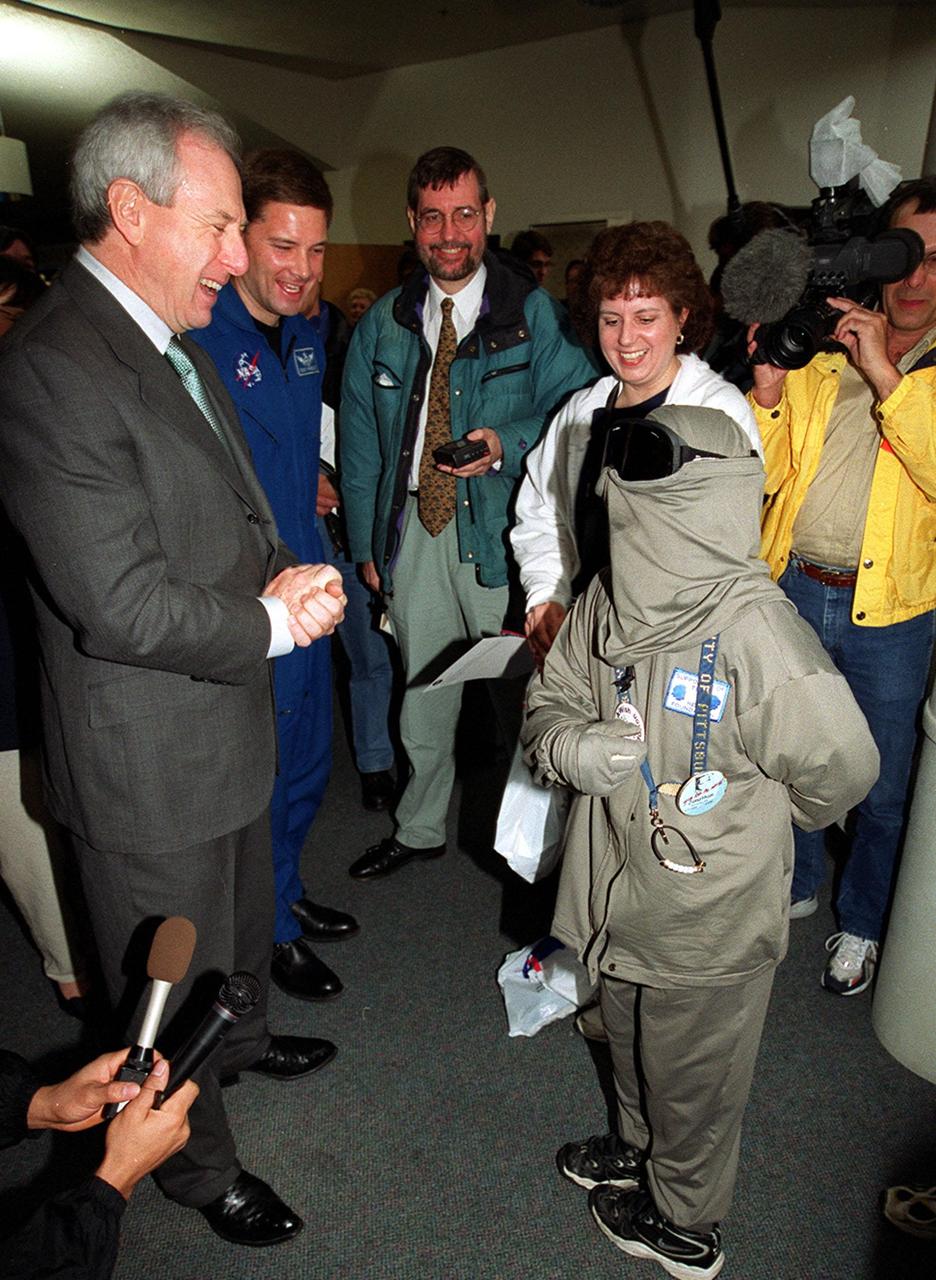
It's kind of amusing searching for keywords that you wouldn't expect to show up on a NASA image search. For example, I found a Native-American juggling hoops, old ladies line dancing at a farmers' market, kids dressed as Men in Black dancing underneath the Shuttle Endeavour, people using the primary mirror of James Webb to take selfies, actress Nichelle Nichols (Uhura) singing, NASA's hip-hop dance team Forces In Motion (travels around middle schools teaching Newton's laws), James Ingram singing "I believe I can fly" in front of Bill Nye, NASA administrator Dan Goldin laughing with (hopefully not at) a "bubble boy" in a protective suit, enough frames of someone testing out a spacesuit to make a stop-motion dance video, and a bunch of other unexpected weirdness.