Slashdot Mirror
Domain: ntsb.gov
Stories and comments across the archive that link to ntsb.gov.
Comments · 150
-
Re:Split attentionShe did not cross at a cross walk, nor was she on a bike path.
To quote the NTSB report itself:In this area, northbound Mill Avenue is separated from southbound Mill Avenue by a center median containing trees, shrubs, and brick landscaping in the shape of an X. Four signs at the edges of the brick median, facing toward the roadway, warn pedestrians to use the crosswalk. The nearest crosswalk is at the intersection of Mill Avenue and Curry Road, about 360 feet north of where the crash occurred.
The accident could've been easily avoided, if either she or the driver been paying any attention at all. But really, what do you expect when a phone-addicted ex-con encounters a homeless meth-addict while "driving" a vehicle with experimental software from a "ride-sharing" company?
-
Re:At what point do tax payers stop subsidizing Te
What the fuck are you on about? Tesla's share of EV subsidies are likely to end this year, as there's a set number of vehicles you can get the subsidy on per manufacturer. They know this, and have already factored it into their sales models.
How has the NTSB been "basically deputized to solve private sector problems at taxpayer expense" again? What's the problem being allegedly solved - an investigation into a negligent driver ramming his $100k EV into an unprotected concrete divider? That's kind of their job, just like it would be for any fatal crash where vehicle failure may be suspected, from any manufacturer. A crushed battery pack catching fire in a wrecking yard? I doubt the NTSB guys were working the fire extinguishers.
A few examples of highway accident investigations currently underway from the NTSB that have nothing to do with Tesla:
a motorcycle accident
a pickup truck with a trailer hit a school bus
an electrical conduit broke off of a tunnel and hit a SemiBut yeah, this is TOTALLY A SUBSIDY FROM THE TAXPAYER TO TESLA FOR RICH PEOPLE TO BUY RICH THINGS OMG.
Idiot.
-
Re:At what point do tax payers stop subsidizing Te
What the fuck are you on about? Tesla's share of EV subsidies are likely to end this year, as there's a set number of vehicles you can get the subsidy on per manufacturer. They know this, and have already factored it into their sales models.
How has the NTSB been "basically deputized to solve private sector problems at taxpayer expense" again? What's the problem being allegedly solved - an investigation into a negligent driver ramming his $100k EV into an unprotected concrete divider? That's kind of their job, just like it would be for any fatal crash where vehicle failure may be suspected, from any manufacturer. A crushed battery pack catching fire in a wrecking yard? I doubt the NTSB guys were working the fire extinguishers.
A few examples of highway accident investigations currently underway from the NTSB that have nothing to do with Tesla:
a motorcycle accident
a pickup truck with a trailer hit a school bus
an electrical conduit broke off of a tunnel and hit a SemiBut yeah, this is TOTALLY A SUBSIDY FROM THE TAXPAYER TO TESLA FOR RICH PEOPLE TO BUY RICH THINGS OMG.
Idiot.
-
Re:At what point do tax payers stop subsidizing Te
What the fuck are you on about? Tesla's share of EV subsidies are likely to end this year, as there's a set number of vehicles you can get the subsidy on per manufacturer. They know this, and have already factored it into their sales models.
How has the NTSB been "basically deputized to solve private sector problems at taxpayer expense" again? What's the problem being allegedly solved - an investigation into a negligent driver ramming his $100k EV into an unprotected concrete divider? That's kind of their job, just like it would be for any fatal crash where vehicle failure may be suspected, from any manufacturer. A crushed battery pack catching fire in a wrecking yard? I doubt the NTSB guys were working the fire extinguishers.
A few examples of highway accident investigations currently underway from the NTSB that have nothing to do with Tesla:
a motorcycle accident
a pickup truck with a trailer hit a school bus
an electrical conduit broke off of a tunnel and hit a SemiBut yeah, this is TOTALLY A SUBSIDY FROM THE TAXPAYER TO TESLA FOR RICH PEOPLE TO BUY RICH THINGS OMG.
Idiot.
-
Eventually we will have answers
The NTSB report on this accident will be interesting, and likely will say things about Uber's design choices NTSB UPDATE: Uber Crash Investigation.
Industrial safety systems are supposed to fail to a safe state. There is often an operator, but his job is recovery after a safety shutdown. The same general approach should apply to cars and safety drivers.
-
Accident report NTSB
-
Accident report NTSB
-
Re:Good.
The drone pilot was indeed an idiot.
The full report shows that he knew about the maximum permitted altitude of 400ft, yet logs showed he flew as high as 547ft 1.8 miles away. He also knew there were frequently helicopters in the area and still flew it 2.5miles away, well out of sight. This is why we can't have nice things.
https://app.ntsb.gov/pdfgenera...
I crashed my Phantom 3 a few years ago and decided it was best to just drop the hobby.
-
Re:Even More Simple
Your characterization of airplane crashes as being unsurvivable is incorrect. "since 1983, more than 95% of the passengers survived", says National Transportation Safety Board. https://www.ntsb.gov/news/pres...
-
Re:Sucked out of an airplane? Not likely
Mythbusters tested a small bullet hole in a pressurized fuselage. The thing about pressure is it's a force per unit of area. So the larger the opening, the larger the forces involved (until the pressure is equalized). So something as small as a bullet hole doesn't result in large forces.
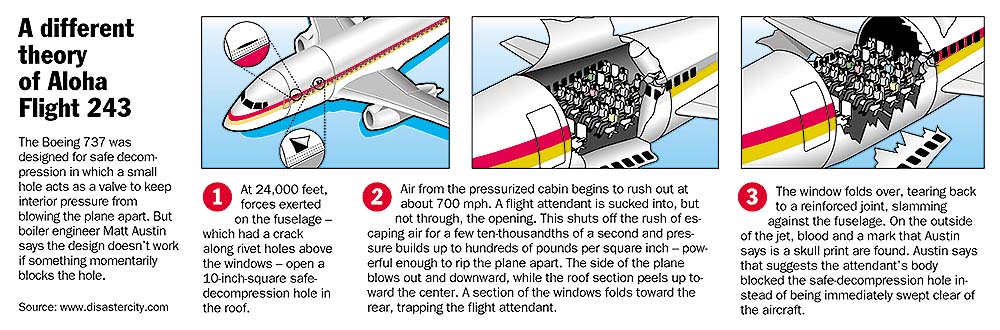
Aloha Airlines flight 243 lost the forward section of its fuselage. The flight attendant standing in row 2 near the front of the failed section was hit in the head by debris and fell to the floor. The flight attendant standing in row 5 near the rear of the failed section, with all the force of the cabin air behind her, was blown out by the decompression.
Airline fuselages are designed to suffer decompression only in a small section. You literally design weak sections surrounded by a lattice of strong sections, so a crack or failure cannot unzip the skin around the entire plane as it did in Aloha 243. The failure aboard Aloha is suspected to have started on the left side (one of the passengers noticed a crack by the door while boarding). And the theory is the crack failed producing a small hole. The flight attendant was blown towards the hole by outrushing air, and her body momentarily plugged the initial hole. This caused a pressure hammer from the air behind her rushing forward towards that hole blew out the entire forward cabin overhead. -
Re:Who is liable when your tv catches fireManufacturers can be held liable if devices are not made idiot proof enough.
-
Re:Emergencies?
That's not true at all, most airplane accidents are very survivable. There are of course those few you see on the news where the plane blows up mid-air or plummets into the ground at mach 2 and they have to count the passengers by the number of teeth found.
But overall, even including serious cases with fire or other extensive damage to the airframe, the survivability rate is almost 80%.
Thankfully, very few people are even among those 80%, because mishaps are so rare, so there's nobody around to talk about it. Just like with hyperloop, which will have way less stuff to fail, and the failure modes are way more forgiving. Like, being stuck for a while.
-
Re: In all fairness
The fact is, hundreds of thousands of people are navigating one way streets correctly every day.
So? That's not the only relevant statistic. There are several. We want to know how many times people turn the wrong way down a one-way street, and we want to know how many times there is a collision, and how many of those collisions are fatal. We need to know at least these three things to make a sensible evaluation of the vehicle's relative performance.
On average, about 360 lives are lost each year in about 260 fatal wrong-way collisions. The number of fatal wrong-way collisions has been essentially unchanged for the 6 years of data analyzed. [2004-2009]
So you see, human drivers actually do get this wrong, and with fatal consequences. So we really do need to know a bit more than that this vehicle made a wrong turn, assuming that this was indeed a self-driving vehicle in a self-driving mode. Most fatal wrong-way accidents are caused by alcohol. That's not going to be a problem for a self-driving car. If it sees an oncoming vehicle, it's going to stop.
I realize that it is of course tempting to say "but that's highway incidents!" but oh no, that's just where the fatalities are. For example, in Tampa 700 wrong-way incidents
TL;DR: Calm down there, me laddo. It's way too soon to call this one.
-
Re:Focus on NASA
They must have a 360 running.
"A 360" in the sense of "an IBM System/360", or "a 360" in the sense of "a machine compatible - except perhaps at the supervisor-mode level - with an IBM System/360"? If the latter, then that's not interesting; my laptop was purchased in 2015, but, as far as I know, its CPU is compatible, even at the ring 0 level, with the CPU from the original IBM Personal Computer (whether I could boot the original version of MS-DOS on it is another matter), and the most recent CPU design capable of running System/360 problem-state code was also announced in 2015.
Despite the FAA claiming security concerns,, it took me 10 minutes to find Lora
Presumably you meant "Loral".
was once bidding on a contract to replace IBM 9020Es,
Yes, in 1995. IBM replaced the 9020A and 9020D machines in the late 1980s, and then replaced the 9020E's in the 1990s.
so they are probably running 360-compatible gear.
What they're running now might well be "360-compatible", but that might be in the same way that the Haswell Core i7 in my laptop is "8088-compatible".
-
Re:A "safety feature"
It's interesting as the unique tail section was actually touted as a "safety feature" by the company. I'm not necessarily saying it can't be the case, but like any feature, even a safety feature (see: exploding airbags), defects or improper use can cause more harm than in it's absence.
An improperly implemented safety feature (emergency ballast blow system) contributed to the loss of USS Thresher... In the same way, the Apollo 1 crew died (in part) because of a system (a well locked down hatch) that had been installed to prevent a repeat of an earlier accident. (Which, by morbid coincidence, one of the crew had been involved in.)
It's a bit strange, as it seems like such a fundamental error - not some obscure feature that could be overlooked. What pilot would say to himself "Hey, I know I'm supposed to unlock the tail at time X, but what the hell, why not just do it now?" It seems really strange that they wouldn't have precise procedures for this, since it's such a critical part of the entire design.
It's not so much that, as the pilot appears to have become confused due to a) the simulator not properly conditioning them, b) lack of recent and overall experience with the vehicle, and c) high cockpit workload at that point in the flight compounding a) and b). At least that's how I read the report. (The abstract and summary of which is not clearly linked of the summary or TFA but which can be found here.)
From my experience in the Navy, I can say that obtaining those reflexes isn't easy, and neither is maintaining them (regardless of experience).
-
Re:Sensors wrong
But it was. It kept the plane stable within the flight envelope so it wouldn't stall at low speed it flew, limiting the angle of attack to a safe one even when the pilot used his side stick for maximum nose pitch up. It helped to lessen the pilot's workload during the landing.
You can read it all up in the NTSB report of the accident:
http://www.ntsb.gov/investigat...For example this:
The Airbus simulation indicated that the airplane performed as designed and was in the alpha-protection mode from 150 feet to touchdown. As discussed previously, the captain's attention was narrowed, which would have made it difficult for him to maintain awareness of the airplane's low-speed condition during the descent.
or this:
Despite being unable to complete the Engine Dual Failure checklist, the captain started the auxiliary power unit, which improved the outcome of the ditching by ensuring that a primary source of electrical power was available to the airplane and that the airplane remained in normal law and maintained the flight envelope protections, one of which protects against a stall.
-
Re:He should have known better!
The reports comes from the NTSB, which I believe is a more trustworthy source as Engadget. See for yourself:
-
Re:Whaaaa?
What article did you read? The one i read said:
"It added the pilot didn’t have sufficient certification for night flight with passengers or flying on instruments alone."
I guess its possible, but ive never heard of someone getting their commercial before their IFR.
The Commercial certificate does not require an Instrument rating.
However: The pilot, age 29, held a commercial pilot certificate with ratings for single engine land, multi-engine land and instrument airplane.But he did not meet the currency requirements, particularly FAR 61.57(b).
According to all available documentation, the pilot undertook an illegal flight for which he was not qualified.Flying at night can be very disorienting, hence the currency requirement. That alone could have caused the crash. This has been happening since long before portable electronics were invented. There is no evidence that cell phone cameras were used on this flight. Actually, we know that his GoPro camera definitely was not used. He had a habit (documented on GoPro) of careless and reckless operation: using a cell phone in critical phases of flight (including allowing passengers to use their flash cameras). On some previous flights, both were used, which is why the NTSB is wildly speculating that cell phone/camera usage is what happened this time.
-
Re:Simple solution
https://app.ntsb.gov/safety/sa... all you need.
There is NOTHING in that reference, that supports the original assertion that going slower causes more accidents than going faster. The part you quoted is about rear end collisions in degraded visibility conditions. Are you seriously suggesting that people driving in heavy fog should speed up?
-
Re:Simple solution
In 1999, the most recent year for which data are available, more than 6 million crashes occurred on U.S. highways, killing over 41,000 people and injuring nearly 3.4 million others. Rear-end collisions accounted for almost one-third of these crashes1 (1.848 million) and 11.8 percent of multivehicle fatal crashes (1,923). Commercial vehicles were involved in 40 percent of these fatal rear-end collisions (770), even though commercial vehicles only comprised 3 percent of vehicles and 7 percent of miles traveled on the Nation's highways. Between 1992 and 1998, the percentage of rear-end collisions involving all vehicles increased by 19 percent. In 1999, 114 fatal crashes in work zones involved rear-end collisions, about 30 percent of the multivehicle fatal work zone crashes. Of these, 71 collisions (62 percent) involved commercial vehicles.
In the past 2 years, the National Transportation Safety Board investigated nine rear-end collisions in which 20 people died and 181 were injured (three accidents involved buses and one accident involved 24 vehicles). Common to all nine accidents was the rear following vehicle driver's degraded perception of traffic conditions ahead. During its investigation of the rear-end collisions, the Safety Board examined the striking vehicles and did not find mechanical defects that would have contributed to the accidents. In each collision, the driver of the striking vehicle tested negative for alcohol or drugs. Some of these collisions occurred because atmospheric conditions, such as sun glare or fog and smoke, interfered with the driver's ability to detect slower moving or stopped traffic ahead. In other accidents, the driver did not notice that traffic had come to a halt due to congestion at work zones or to other accidents. Still others involved drivers who were distracted or fatigued.
https://app.ntsb.gov/safety/sa... all you need.
-
Re:The FAA isn't doing jack
Sorry, that should have been "a very small fraction, like the amount you could stick a pole into" followed by the quote:
If you're a pilot, but not a crop duster, what are you doing flying at low altitudes when not around an airport?
--
Anyways, I just thought I'd add that I really don't have anything against drones or RC planes or anything as such, just their reckless operation. Just as the big jumboes tolerate me, I figure I should tolerate them. But my life is on the line, so I expect them to know the rules that keep us safe. I trained for 70 hours of flying time, and took a written, oral, and practical test to get my flying privileges. I know the FARs and so does everybody else in the sky, and we all follow them or people die. I'm not being melodramatic, people die all the time. Here's one from a few weeks ago where the guy likely (the report's not done) broke the rules and paid the price. The regulations are absolutely written in blood.
RC folks practice pretty hard as well, and they have a very good community that's interested in interoperating with "the system" and keeping everyone safe. The drone guys - as has been demonstrated - do not. The growing list of encounters that this article is about shows that self-policing isn't working. All I want is for people to know the rules and be held accountable to them - which is pretty much why the FAA is working their way up to requiring some sort of certification.
I cannot emphasize this enough - I consider the drone fliers to be the equivalent of a drunk driver, except worse since at least a drunk is also risking his own neck. They're going to kill someone, and it's only a matter of time.
-
Re:Who pays for TSB investigation
While I am all for commercial space programs, I am a bit confused why NTSB is involved at this point. This was a test flight for what will never really be commercial travel for the masses.
FWIW, the NTSB is involved in quite a bit more than just "commercial travel for the masses". You're probably just used to only/almost exclusively seeing them associated with commercial airliner crashes because they make the national (and international) news, while probably most of what the NTSB investigates doesn't. Take a look at their list of major open investigations, from a quick scan on my first cup of coffee it looks like probably only 25% or less made the national news. (And the major investigations list are only the tip of the iceberg.)
That being said, this was a test flight of a vehicle in the process of being certified by the FAA to carry paying passengers - and that places it in the NTSB's purview, same as the 787. -
Re:Who pays for TSB investigation
While I am all for commercial space programs, I am a bit confused why NTSB is involved at this point.
From the NTSB website:
The National Transportation Safety Board is an independent Federal agency charged by Congress with investigating every civil aviation accident the United States and significant accidents in other modes of transportation – railroad, highway, marine and pipeline.
So if you have a beef with that mandate then fortuitously today is a day in the US where you can act on your beliefs.
You did/will vote today?
-
NTSB: Failure Mechanisms of Li-ion Batteries
A excellent short primer on Lithium Ion battery failures. Prompted by the recent airline industry incidents.
-
Crash not computer-related
The Red Line crash was not computer-related. The signalling system for the Washington Metro is a classic electromechanical relay-based system. Just like the New York subways. The Red Line crash was caused by a failure of a track circuit for detecting trains, trackside equipment using an audio-frequency signal sent through the rails and shorted to the other rail by the train's wheels. All those components are pre-computer technology.
As with most railway systems, manual driving isn't enough to prevent collisions, because stopping distances are often longer than visual distances. That was the case here.
The Washington Metro had been sloppy about maintenance of trackside equipment. They do have a central computer system, and it logs what the relay-based signal systems are doing, although it can't override them. They had logs of previous failures, and should have fixed the problem.
-
The Pirker Appeal
Some further good reading is Pirker's reply to the FAA's appeal http://www.ntsb.gov/legal/pirk... It clearly lays out the argument, which prevailed in the Pirker decision, that the FAA has only offered up advisories on safe operation of model aircraft and they had not issued any actual, enforceable regulations governing them. The latest FAA move is an attempt to create regulations governing them, though the question remains as to whether they have the authority to do so.
-
read your NOTAMs, bitches!Aerostats are a real thing. They have the normal aircraft warning lights.
This one time, an unalert pilot managed to hit the lottery and fly into the tether line of an aerostat. Darwin ensued (better formatted for easier reading here). One time. Ever. I'm not too concerned about those odds. Don't drink & fly. Alaska has enough bush pilots go missing already, who's going to notice one more?What do we do now sir?
We die. -
Re:Hopefully the pilots left are competent
-
Re:Burden of enforcementCrash investigations are the NTSB, not the FAA.
The NTSB is an independent federal agency charged by Congress with investigating every civil aviation accident in the U.S. and significant accidents in other modes of transportation-railroad, highway, marine and pipeline.
-
Re:Thanks, but...
Well, actually you CAN incorporate "protection circuits into the lithium cells themselves". 18650 cells very typically have such self-resetting protection circuits inside of them to prevent Bad Things Happening as a result of a short circuit applied to the cell. Not all of them have this, but plenty of them do. These are known as "protected" cells.
Not sure if it would be practical to have such circuits inside those gigantic 75 Ah prismatics. Those big ass interconnect bus bars you see in there indicate they are pulling really heavy amps out.
-
Re:Latest news: Batteries not the problem in 787
Pretty much agree with everything, but, um, half TON??? The 787 battery weighs 63 pounds.
Look at the size of those bus bars interconnecting the gigantic prismatic 75 Ah cells, though. It sure seems they are pulling BIG amps out of it.
-
Re:Latest news: Batteries not the problem in 787
Can anyone confirm the actually battery chemistry?
It's lithium cobalt oxide, absolutely the most inherently dangerous there is. Not lithium manganese oxide, or LiFePO4, which would make FAR more sense. And the individual cells are not 18650s or 26650s. They are GIGANTIC 6 pound prismatics of 75 Ah each!
-
Some background reading
I did a load of background reading on this yesterday so here's some interesting related material. One interesting source is the NASA guidelines for li-ion use in space
http://ntrs.nasa.gov/archive/nasa/casi.ntrs.nasa.gov/20090023862_2009023573.pdfNow NASA I think have a pretty good track record of thinking technologies through carefully... (By the by, did you know that GS Yuasa also have a contract to supply their li-ion batteries to NASA for use in the ISS?)
Also, did you know that prior to the 787 the Cessna CJ4 was the first civili aircraft to utilise li-ion batteries (supplied by a123). In 2011 there was a fire onboard one whilst it was connected to a ground power unit. As a result the FAA ordered all 42 in operation to be changed to conventional ni-cd or lead acid.
http://www.gpo.gov/fdsys/pkg/FR-2011-11-01/html/2011-27596.htmThis is interesting as it's similar i.e. on the ground. This of course *could* be coincidental.
Next up are lots of interesting pictures from the NTSB investigation. Much as I HATE to link to the Daily Mail (normally a pretty retarded publication) I couldn't find any other pic sources. Bizarre
http://www.dailymail.co.uk/news/article-2268152/Boeing-787-Dreamliners-burnt-battery-spewed-molten-electrolytes-reveal-investigators.html?ito=feeds-newsxmlAnd some great source material from the NTSB themselves
http://www.ntsb.gov/investigations/2013/boeing_787/boeing_787.htmlAnd the NTSB update on the investigation (including some samples of their cell CT scans)
http://www.ntsb.gov/investigations/2013/boeing_787/JAL_B-787_1-24-13.pdfNTSB Primer on li-ion battery tech
http://www.ntsb.gov/investigations/2013/boeing_787/Primer_LIB_Technology.pdfOne of the theories being talked about are the fact that the li-ion batteries that Boieng (via Thales) decided on are based on a lithium cobalt oxide cathode which is old tech and regarded as not exactly the safest variant of li-ion technology out there
http://www.designnews.com/document.asp?doc_id=257987
and via a translation
http://translate.google.com/translate?sl=no&tl=en&js=n&prev=_t&hl=en&ie=UTF-8&eotf=1&u=http%3A%2F%2Fwww.tu.no%2Findustri%2F2013%2F01%2F17%2Fher-er-dreamliner-problemetThis EEtimes article has some interesting comments
http://cdn.eetimes.com/electronics-news/4405441/787-Dreamliner-investigation-probes-battery-charging-electronicAnd some info from GS Yuasa
http://www.s399157097.onlinehome.us/SpecSheets/LVP10-65.pdfAll interesting stuff. Personally I think they shouldn't have been allowed to 'trial' li-ion on such a big aircraft especially after the cessna incident. Trying so many new tricks at once isn't wise - as engineers always say, just change one thing at a time...
-
Some background reading
I did a load of background reading on this yesterday so here's some interesting related material. One interesting source is the NASA guidelines for li-ion use in space
http://ntrs.nasa.gov/archive/nasa/casi.ntrs.nasa.gov/20090023862_2009023573.pdfNow NASA I think have a pretty good track record of thinking technologies through carefully... (By the by, did you know that GS Yuasa also have a contract to supply their li-ion batteries to NASA for use in the ISS?)
Also, did you know that prior to the 787 the Cessna CJ4 was the first civili aircraft to utilise li-ion batteries (supplied by a123). In 2011 there was a fire onboard one whilst it was connected to a ground power unit. As a result the FAA ordered all 42 in operation to be changed to conventional ni-cd or lead acid.
http://www.gpo.gov/fdsys/pkg/FR-2011-11-01/html/2011-27596.htmThis is interesting as it's similar i.e. on the ground. This of course *could* be coincidental.
Next up are lots of interesting pictures from the NTSB investigation. Much as I HATE to link to the Daily Mail (normally a pretty retarded publication) I couldn't find any other pic sources. Bizarre
http://www.dailymail.co.uk/news/article-2268152/Boeing-787-Dreamliners-burnt-battery-spewed-molten-electrolytes-reveal-investigators.html?ito=feeds-newsxmlAnd some great source material from the NTSB themselves
http://www.ntsb.gov/investigations/2013/boeing_787/boeing_787.htmlAnd the NTSB update on the investigation (including some samples of their cell CT scans)
http://www.ntsb.gov/investigations/2013/boeing_787/JAL_B-787_1-24-13.pdfNTSB Primer on li-ion battery tech
http://www.ntsb.gov/investigations/2013/boeing_787/Primer_LIB_Technology.pdfOne of the theories being talked about are the fact that the li-ion batteries that Boieng (via Thales) decided on are based on a lithium cobalt oxide cathode which is old tech and regarded as not exactly the safest variant of li-ion technology out there
http://www.designnews.com/document.asp?doc_id=257987
and via a translation
http://translate.google.com/translate?sl=no&tl=en&js=n&prev=_t&hl=en&ie=UTF-8&eotf=1&u=http%3A%2F%2Fwww.tu.no%2Findustri%2F2013%2F01%2F17%2Fher-er-dreamliner-problemetThis EEtimes article has some interesting comments
http://cdn.eetimes.com/electronics-news/4405441/787-Dreamliner-investigation-probes-battery-charging-electronicAnd some info from GS Yuasa
http://www.s399157097.onlinehome.us/SpecSheets/LVP10-65.pdfAll interesting stuff. Personally I think they shouldn't have been allowed to 'trial' li-ion on such a big aircraft especially after the cessna incident. Trying so many new tricks at once isn't wise - as engineers always say, just change one thing at a time...
-
Some background reading
I did a load of background reading on this yesterday so here's some interesting related material. One interesting source is the NASA guidelines for li-ion use in space
http://ntrs.nasa.gov/archive/nasa/casi.ntrs.nasa.gov/20090023862_2009023573.pdfNow NASA I think have a pretty good track record of thinking technologies through carefully... (By the by, did you know that GS Yuasa also have a contract to supply their li-ion batteries to NASA for use in the ISS?)
Also, did you know that prior to the 787 the Cessna CJ4 was the first civili aircraft to utilise li-ion batteries (supplied by a123). In 2011 there was a fire onboard one whilst it was connected to a ground power unit. As a result the FAA ordered all 42 in operation to be changed to conventional ni-cd or lead acid.
http://www.gpo.gov/fdsys/pkg/FR-2011-11-01/html/2011-27596.htmThis is interesting as it's similar i.e. on the ground. This of course *could* be coincidental.
Next up are lots of interesting pictures from the NTSB investigation. Much as I HATE to link to the Daily Mail (normally a pretty retarded publication) I couldn't find any other pic sources. Bizarre
http://www.dailymail.co.uk/news/article-2268152/Boeing-787-Dreamliners-burnt-battery-spewed-molten-electrolytes-reveal-investigators.html?ito=feeds-newsxmlAnd some great source material from the NTSB themselves
http://www.ntsb.gov/investigations/2013/boeing_787/boeing_787.htmlAnd the NTSB update on the investigation (including some samples of their cell CT scans)
http://www.ntsb.gov/investigations/2013/boeing_787/JAL_B-787_1-24-13.pdfNTSB Primer on li-ion battery tech
http://www.ntsb.gov/investigations/2013/boeing_787/Primer_LIB_Technology.pdfOne of the theories being talked about are the fact that the li-ion batteries that Boieng (via Thales) decided on are based on a lithium cobalt oxide cathode which is old tech and regarded as not exactly the safest variant of li-ion technology out there
http://www.designnews.com/document.asp?doc_id=257987
and via a translation
http://translate.google.com/translate?sl=no&tl=en&js=n&prev=_t&hl=en&ie=UTF-8&eotf=1&u=http%3A%2F%2Fwww.tu.no%2Findustri%2F2013%2F01%2F17%2Fher-er-dreamliner-problemetThis EEtimes article has some interesting comments
http://cdn.eetimes.com/electronics-news/4405441/787-Dreamliner-investigation-probes-battery-charging-electronicAnd some info from GS Yuasa
http://www.s399157097.onlinehome.us/SpecSheets/LVP10-65.pdfAll interesting stuff. Personally I think they shouldn't have been allowed to 'trial' li-ion on such a big aircraft especially after the cessna incident. Trying so many new tricks at once isn't wise - as engineers always say, just change one thing at a time...
-
Re:Applies to hands-free phones, are you sure?
I can't get to the referenced ntsb.gov page but the CNN article states just the opposite. The last line in CNN's article reads: "It would not apply to hand-free devices or to passengers."
The CNN article is simply wrong. The original report and the vastly more detailed CBS article state clearly that the ban would cover all communications uses of electronics.
-
Applies to hands-free phones, are you sure?
I can't get to the referenced ntsb.gov page but the CNN article states just the opposite. The last line in CNN's article reads: "It would not apply to hand-free devices or to passengers."
-
Re:So...
While it is easy to calculate some numbers (all aircraft incidents are in the searchable NTSB database here: http://www.ntsb.gov/aviationquery/index.aspx), you'll most likely be told that the comparisons are meaningless without an assessment of the threat level that the US is facing. And most likely than not, data on the actual threats will be classified.
-
Ima make you dig for it in fishy water
Have you been on the sea at sea state 5?!? It will fucking launch the damn things even if everything is perfectly done by the boat crew with perfect chains, tie downs, clamps, etc the container may have a defect or if it's perfect having multiple Gs on a container weight 50k makes things give up.
There's a whole world of marine disasters
http://www.ntsb.gov/publictn/m_acc.htmIma make you dig for 'em, there's more by any country with commercial shipping.
They seem to play bash'em ship a lot.
-
Re:Yey for solid-state memory!
Most likely the investigators will not be listening to it like most people listen to a news broadcast. They will repeatedly be going over every second of the voice recording analyzing every pop, hiss, bang, etc.
For this flight, the flight data is the crucial issue. It's known from the maintenance telemetry that there were some system failures prior to the accident. The data from the aircraft systems is the big issue. It's non-trivial to analyze. Often, especially on newer aircraft where there's a lot of data, the data can be converted into a format that can be loaded into an aircraft simulator, allowing investigators to replay the accident. That was done with the aircraft that landed in the Hudson River.
The cockpit voice recorder is secondary for a loss-of-control accident like this. (In contrast, the voice data is most important for a "controlled flight into terrain" accident, where the airplane was working just fine until it hit something.) The NTSC routinely publishes transcripts of such recordings, and Flying magazine reprints some of them in their Aftermath column.
If you've never seen a full NTSB accident report, here's one.
-
Re:So uh
Same thing with Automobile vs. Air-travel fatalities
in 2009 :
automotive fatalities per 100,000,000 miles traveled: 1.13 http://www-fars.nhtsa.dot.gov/Main/index.aspx
Airline Fatalities per 1,000,000 miles traveled: 0.0003 http://www3.ntsb.gov/aviation/table5.htmif we adjust the airline numbers to reflect 100 million miles, we get 0.03 fatalities.
you are 190 times more likely to die when in a car, than if you were flying, but yet we are so worried about air accidents. They make better news because you will typically have higher fatalities *at once*, rather than a handful across the country every day.
people just don't understand statistics.
I'm with you on the nuclear thing.
-
Risk is our business
Well, actually, it isn't. DEATH before Fear. No, wait. Illusion before actuality! How many people die in automobile accidents every year? 41,000 (Source: NTSB) Why do we still drive again?!
-
Re:Great...now just one more issue....
Actually your odds are a bit high. The Wall Street Journal says:
The odds of dying in a terrorist attack on a plane in a given year are 1 in 25,000,000.
The odds of a Westerner being killed by a terrorist in a given year are 1 in 3,000,000.
http://online.wsj.com/article/SB10001424052748703481004574646963713065116.htmlThe NTSB says the odd for car accidents are:
The odds of dying in a car accident in a given year are 1 in 18,585.
The odds of simply being in a car accident in a given year are 1 in 5,889.
http://www.ntsb.gov/ -
Re:Complex environment, complex causes
What *wasn't* in the NTSB report: the switch was behind him, in a tight space, and he couldn't see over his shoulder clearly enough to tell if the switch was in the proper place.
That WAS in the NTSB report, in fact Denver and a mechanic discussed it, the mechanic attempted to attach a pair of vice-grips as a workaround, and Denver said he'd use the autopilot to ensure straight-and-level if he had to mess with it in flight. He also refused a refuel stating that he'd be flying for an hour.
http://www.ntsb.gov/ntsb/GenPDF.asp?id=LAX98FA008&rpt=fa
But the engineer(s) who put the switch behind the pilot's seat are just as much, if not moreso, to blame
Actually, the aircraft wasn't engineered that way. Someone (apparently a previous owner) modified it. Denver was aware of the modification, aware of its shortcomings, had actually made arrangements to fix it permanently, attempted a failed temporary fix with an A&P mechanic, then decided to fly it anyway without making sure both tanks were full (in fact, the A&P interviewed stated that Denver had initially tried to start the engine on a tank that might have been empty, meaning Denver's attempts to change tanks would have been in vain since he switched to the only tank with an unknown quantity of fuel left before takeoff).
Sorry, John Denver was a great singer. But the blame for the crash rests firmly on his shoulders.
This is a perfect example of a "string of failures". Someone made an ill-considered modification to an aircraft that Denver (an experienced pilot) bought. This modification made it difficult to change tanks. Denver knew about the problem, but completely failed to mitigate it by:
1. Not making sure he had enough fuel on board in his chosen primary tank for a short flight, 2. Not making sure he would be able to switch the tanks while in flight, 3. Apparently not ensuring that his alternate tank had any fuel in it at all, so even if he did manipulate the switch he may well have been switching from one empty to another, 4. Insisting on a short flight before he would be taking a trip that would give his A&P plenty of time to fix the problem and relocate the switch where it belonged.
Proper handling of ANY of the four issues above could have turned the disaster into a safe flight (or at least a case of "being down here, wishing you were up there", which isn't usually fatal like "being up there, wishing you were down here" sometimes is).
What's the compelling reason why these independently wealthy individuals who can afford private aviation never seem to spend a few hundred dollars on a good parachute? I don't know about you but if I am alone flying a plane and it's going to crash and there's no hope of stopping it, like it's completely out of fuel, then I'm going to take my chances with a little unplanned skydiving.
-
Re:Complex environment, complex causes
What *wasn't* in the NTSB report: the switch was behind him, in a tight space, and he couldn't see over his shoulder clearly enough to tell if the switch was in the proper place.
That WAS in the NTSB report, in fact Denver and a mechanic discussed it, the mechanic attempted to attach a pair of vice-grips as a workaround, and Denver said he'd use the autopilot to ensure straight-and-level if he had to mess with it in flight. He also refused a refuel stating that he'd be flying for an hour.
http://www.ntsb.gov/ntsb/GenPDF.asp?id=LAX98FA008&rpt=fa
But the engineer(s) who put the switch behind the pilot's seat are just as much, if not moreso, to blame
Actually, the aircraft wasn't engineered that way. Someone (apparently a previous owner) modified it. Denver was aware of the modification, aware of its shortcomings, had actually made arrangements to fix it permanently, attempted a failed temporary fix with an A&P mechanic, then decided to fly it anyway without making sure both tanks were full (in fact, the A&P interviewed stated that Denver had initially tried to start the engine on a tank that might have been empty, meaning Denver's attempts to change tanks would have been in vain since he switched to the only tank with an unknown quantity of fuel left before takeoff).
Sorry, John Denver was a great singer. But the blame for the crash rests firmly on his shoulders.
This is a perfect example of a "string of failures". Someone made an ill-considered modification to an aircraft that Denver (an experienced pilot) bought. This modification made it difficult to change tanks. Denver knew about the problem, but completely failed to mitigate it by:
1. Not making sure he had enough fuel on board in his chosen primary tank for a short flight,
2. Not making sure he would be able to switch the tanks while in flight,
3. Apparently not ensuring that his alternate tank had any fuel in it at all, so even if he did manipulate the switch he may well have been switching from one empty to another,
4. Insisting on a short flight before he would be taking a trip that would give his A&P plenty of time to fix the problem and relocate the switch where it belonged.Proper handling of ANY of the four issues above could have turned the disaster into a safe flight (or at least a case of "being down here, wishing you were up there", which isn't usually fatal like "being up there, wishing you were down here" sometimes is).
-
Re:Complex environment, complex causes
It is the same with aviation accidents. Sometimes it's just an individual screwing up, but that's the exception.
No, it's the norm if not always the reason. Poke around here and you'll see that just about all aviation accidents are because someone screwed up. The NTSB is excellent at pinpointing the failure. The most I've ever seen was an accident several years ago that had three causes: 1. bad weather, 2. improper maintenance, 3. pilot error in dealing with failure. Most of the time, it boils down to #3 - pilot error.
-
Re:Waste
If a fleet has autoland across the board, this won't be a massive issue. The planes are safer than the people behind the controls.
Yeah remind me when planes can autoditch themselves into the Hudson River after losing thrust in both engines. As to US Airways Flight 1549 itself, I personally like this quote from the second page of this report at: http://www.ntsb.gov/ntsb/GenPDF.asp?id=DCA09MA026&rpt=fi
(3) the captain’s resulting difficulty maintaining his intended airspeed on final approach due to the task saturation resulting from the emergency situation.
Yes, the co-pilot was occupied with his own tasks as well.
Even though there are few incidents of this type, it is safe to say that there are probably nonemergency situations where having a co-pilot has prevented an emergency from occurring.
-
Achieved by US airlines
In 1998, 2002, 2007 and 2008, there were zero US airline fatalities. No Boeing jetliner operated by a US airline has had a fatal crash since 9/11. None of the fly-by-wire Airbus models (A320 and later) operated by a US airline have ever had a fatal crash, not even the one that had to land in the Hudson River after a bird strike.
Thirty years ago, no one in aviation would have believed that to be possible.
-
Re:I'm impressed, they are worse than GA
Anyone with an interest in aviation safety should be able to entertain themselves for hours with the NTSB database of accident reports:
http://www.ntsb.gov/ntsb/month.asp
Reading about other people's bad luck and capacity for self-delusion and occasionally pure boneheaded stupidity can be both entertaining and enlightening. Better than most reality TV anyway
G.
-
If the issue is generalized to plane problems
There have been, what, 6 terrorist plane incidents in the last 10 years, 2 of which had no fatalities, in the US? And 6 crashes with fatalities due to other reasons in the same period. Looks like we'd be better of putting time, effort, and money should be put into plane maintenance; mechanic, air controller, and pilot training, salaries, and working conditions; instead of security theater. See also: PBS Frontline's Flying Cheap.