Slashdot Mirror
Domain: nytimes.com
Stories and comments across the archive that link to nytimes.com.
Stories · 5,561
-
Positive Ebola Test In Second Texas Health Worker
mdsolar tips news that a second healthcare worker at Texas Health Presbyterian Hospital has tested positive for the Ebola virus. Like the nurse who tested positive a few days ago, this worker was involved in providing care to Eric Duncan, the Liberian man who seems to have brought the virus into the country. The CDC is working to identify further exposures to the local community, though the Times says a second infection among the 70+ medical professionals who were around Duncan is not unexpected. The largest U.S. nurses union says a lack of proper protective gear and constantly changing protocols are to blame for exposures. Meanwhile, the World Health Organization says infection rates in West Africa are such that within a few months, they can expect 10,000 new Ebola cases a week. They also say the death rate for the current outbreak has risen to 70 percent. -
"Double Irish" Tax Loophole Used By US Companies To Be Closed
An anonymous reader writes: The Irish Finance Minister announced on Tuesday that Ireland will no longer allow companies to register in Ireland unless the companies are also tax resident. This will effectively close off the corporate tax avoidance scheme known as the "Double Irish" used by the likes of Google, Apple, and Facebook to route their earnings through their Irish holdings in order to garner an effective tax rate of, as in Google FY2013, 0.16%. Ireland's new policy will take effect in 2015 for new companies. "For existing companies, there will be provision for a transition period until the end of 2020." -
Despite Push From Tech Giants, AP CS Exam Counts Don't Budge Much In Most States
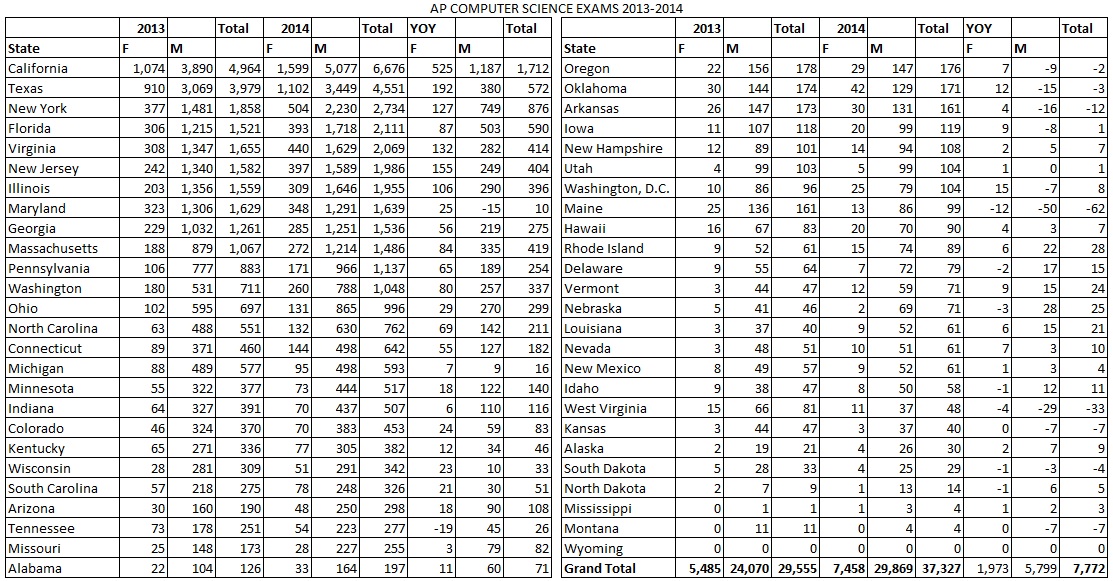
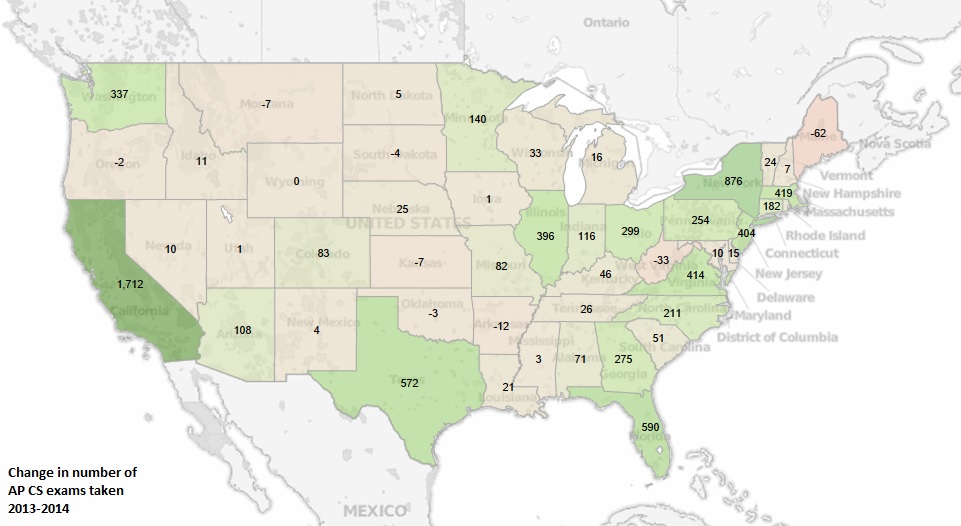
theodp (442580) writes "Well, the College Board has posted the 2014 AP Computer Science Test scores. So, before the press rushes out another set of Not-One-Girl-In-Wyoming-Took-an-AP-CS-Exam stories, let's point out that no Wyoming students of either gender took an AP CS exam again in 2014 (.xlsx). At the overall level, the final numbers have changed somewhat (back-of-the-Excel-envelope calculations, no warranty expressed or implied!), but tell pretty much the same story as the preliminary figures — the number of overall AP CS test takers increased, while pass rates decreased despite efforts to cherry pick students with a high likelihood of success. What is kind of surprising is how little the test numbers budged for most states — only 8 states managed to add more than 100 girls to the AP CS test taker rolls — despite the PR push by the tech giants, including Microsoft, Google, and, Facebook. Also worth noting are some big percentage decreases at the top end of the score segments (5 and 4), and still-way-too-wide gaps that exist between the score distributions of the College Board's various ethnic segments (more back of the envelope calcs). If there's a Data Scientist in the house, AP CS exam figures grabbed from the College Board's Excel 2013 and 2014 worksheets can be found here (Google Sheets) together with the (unwalkedthrough) VBA code that was used to collect it. Post your insight (and code/data fixes) in the comments!" -
The CDC Is Carefully Controlling How Scared You Are About Ebola
HughPickens.com writes: Russell Berman reports in The Atlantic that the Obama administration is trying to navigate a tricky course: Can officials increase public vigilance about the deadly Ebola virus without inciting a panic? "Ebola is scary. It's a deadly disease. But we know how to stop it," says Dr. Thomas Frieden, the CDC director. speaking "calmly and clearly, sticking to an even pitch and avoiding the familiar political image of the whip-smart fast-talker." International groups wanted the U.S. to step in sooner to help fight the outbreak in west Africa, while more recently some Republicans have called on the administration to ban travel from the most affected countries.
Frieden and other officials say such a move would be counterproductive, citing lessons learned from the SARS outbreak a decade ago. "The SARS outbreak cost the world more than $40 billion, but it wasn't to control the outbreak," says Frieden. "Those were costs from unnecessary and ineffective travel restrictions and trade changes that could have been avoided." The government announced Wednesday that it was stepping up protective measures at five airports, where authorities will screen travelers from Liberia, Sierra Leone, and Guinea with targeted questions and fever checks, an action, officials acknowledge, that was taken not only to stop the spread of the disease but simply to make people feel safer. According to Berman, the message is this: Be afraid of Ebola. Just not too afraid. -
Why the Trolls Will Always Win
maynard writes: Kathy Sierra spent a tech career developing videogames and teaching Java programming in Sun Microsystems masterclasses. Up until 2007, she'd been a well regarded tech specialist who happened to be female. Until the day she opined on her private blog that given the crap-flood of bad comments, maybe forum moderation wasn't a bad idea. This opinion made her a target. A sustained trolling and harassment campaign followed, comprised of death and rape threats, threats against her family, fabricated claims of prostitution, and a false claim that she had issued a DMCA takedown to stifle criticism. All of this culminated in the public release of her private address and Social Security Number, a technique known as Doxxing. And so she fled from the public, her career, and even her home.
It turned out that a man named Andrew Auernheimer was responsible for having harassed Sierra. Known as 'Weev', he admitted it in a 2008 New York Times story on Internet Trolls. There, he spoke to the lengths which he and his cohorts went to discredit and destroy the woman. "Over a candlelit dinner of tuna sashimi, Weev asked if I would attribute his comments to Memphis Two, the handle he used to troll Kathy Sierra, a blogger. Inspired by her touchy response to online commenters, Weev said he "dropped docs" on Sierra, posting a fabricated narrative of her career alongside her real Social Security number and address. This was part of a larger trolling campaign against Sierra, one that culminated in death threats."
Now, seven years later, Kathy Sierra has returned to explain why she left and what recent spates of online harassment against women portend for the future if decent people don't organize. The situation has grown much more serious since she went into hiding all those years ago. It's more than just the threat of Doxxing to incite physical violence by random crazies with a screw loose. Read on for the rest of maynard's thoughts. These days, malicious trolls have taken to SWATting, where harassers call police and make false accusations to induce a SWAT raid. One prominent example is that of game developer Chris Kootra, who experienced a SWAT raid on camera while playing an online video game recently. There is also the troubling trend of developing malicious software intended to harm victims directly. For example, posting images on epilepsy forums which flicker at rates known to induce epileptic seizure. Given that Sierra is epileptic herself, this kind of harmful trolling hits home personally. She writes:[While not photo-sensitive], I have a deep understanding of the horror of seizures, and the dramatically increased chance of death and brain damage many of us with epilepsy live with, in my case, since the age of 4. FYI, deaths related to epilepsy in the US are roughly equal with deaths from breast cancer. There isn't a shred of doubt in my mind that if the troll hackers could find a way to increase your risk of breast cancer? They'd do it. Because what's better than lulz? Lulz with BOOBS. Yeah, they'd do it.
And yet Auernheimer, the man who put her through all this horror, has for entirely different reasons become a kind of 'Net cause célèbre for Internet freedom. After having committed a hack against AT&T where he obtained the email addresses of thousands of iPad users, he attracted the attention of federal authorities. In due course he was convicted and sentenced to 41 months in federal prison for identity fraud and conspiracy to access a computer without authorization. Many thought his conviction and sentence egregious. Weev attracted support from the Electronic Frontier Foundation and prominent Georgia University Law Professor Tor Ekeland, and they worked together to craft an appeal and overturn the conviction. In April 2014, they succeeded. Auernheimer is now free.
Ekeland wasn't the only one bothered by the government's case. Even Kathy Sierra disagreed. Yet she's appalled that somehow she'd been dragged into supporting the very man who'd abused her.But you all know what happened next. Something something something horrifically unfair government case against him and just like that, he becomes tech's "hacktivist hero." He now had A Platform not just in the hacker/troll world but in the broader tech community I was part of. ... But hard as I tried to find a ray of hope that the case against him was, somehow, justified and that he deserved, somehow, to be in prison for this, oh god I could not find it. I could not escape my own realization that the cast against him was wrong. So wrong. And not just wrong, but wrong in a way that puts us all at risk.
The lawyer Ekeland, in recent commentary at Wired, continues to defend Auernheimer as having been wronged by an overzealous prosecution, the precedent of which could have significant ramifications for 'Net freedom. "...the crucial issue here is not weev or his ideas but the future of criminal computer law in the U.S. You may think weev is an #@$hole. But being an #@$hole is not a crime, and neither is obtaining unsecured information from publicly facing servers."
Which leaves Sierra lamenting that Auernheimer still hasn't been charged and convicted for what she considers the real crime of harassment he'd committed, harming her and countless others. Where's the justice? Inciting violence and dissemination of "fighting words" are not free speech. Yet, as she admits, unless you're a celebrity, you're "...more likely to win the lottery than get any law enforcement agency to take action." So there is none. "We are on our own," she laments. "And if we don't take care of one another, nobody else will."
Thus, Sierra returned to push back — to push back against prominent journalists and members in the tech community who'd conflate prosecutorial violations of due process with the right to disseminate harassment and cruelty.I came back because I believe this sent a terrible, devastating message about what was acceptable. ... To push back on the twist and spin. I believed the fine-grained distinctions mattered. I pushed back because I believed I was pushing back on the implicit message that women would be punished for speaking out. I pushed back because almost nobody else was, and it seemed like so many people in tech were basically OK with that.
Auernheimer, for his part, remains unapologetic. Responding to Sierra on Livejournal, he writes:
Yesterday Kathy Sierra (a.k.a. seriouspony), a mentally ill woman, continued to accuse me on her blog of leading some sort of harassment campaign against her by dropping her dox (information related to identify and location) on the Internet. ... Kathy Sierra has for years acted like a toddler, throwing tantrums and making demands whenever things didn't go her way. She rejects any presentation of polite criticism or presentation of evidence as some sort of assault on her. She was the blueprint for women like Zoe Quinn and Anita Sarkeesian, who also feign victimhood for financial and social gain. Kathy Sierra is the epitome of what is wrong with my community. She had something coming to her and by the standards set by her own peers in the social justice community, there was nothing wrong with what she got.
Some people never change.
-
Why the Trolls Will Always Win
maynard writes: Kathy Sierra spent a tech career developing videogames and teaching Java programming in Sun Microsystems masterclasses. Up until 2007, she'd been a well regarded tech specialist who happened to be female. Until the day she opined on her private blog that given the crap-flood of bad comments, maybe forum moderation wasn't a bad idea. This opinion made her a target. A sustained trolling and harassment campaign followed, comprised of death and rape threats, threats against her family, fabricated claims of prostitution, and a false claim that she had issued a DMCA takedown to stifle criticism. All of this culminated in the public release of her private address and Social Security Number, a technique known as Doxxing. And so she fled from the public, her career, and even her home.
It turned out that a man named Andrew Auernheimer was responsible for having harassed Sierra. Known as 'Weev', he admitted it in a 2008 New York Times story on Internet Trolls. There, he spoke to the lengths which he and his cohorts went to discredit and destroy the woman. "Over a candlelit dinner of tuna sashimi, Weev asked if I would attribute his comments to Memphis Two, the handle he used to troll Kathy Sierra, a blogger. Inspired by her touchy response to online commenters, Weev said he "dropped docs" on Sierra, posting a fabricated narrative of her career alongside her real Social Security number and address. This was part of a larger trolling campaign against Sierra, one that culminated in death threats."
Now, seven years later, Kathy Sierra has returned to explain why she left and what recent spates of online harassment against women portend for the future if decent people don't organize. The situation has grown much more serious since she went into hiding all those years ago. It's more than just the threat of Doxxing to incite physical violence by random crazies with a screw loose. Read on for the rest of maynard's thoughts. These days, malicious trolls have taken to SWATting, where harassers call police and make false accusations to induce a SWAT raid. One prominent example is that of game developer Chris Kootra, who experienced a SWAT raid on camera while playing an online video game recently. There is also the troubling trend of developing malicious software intended to harm victims directly. For example, posting images on epilepsy forums which flicker at rates known to induce epileptic seizure. Given that Sierra is epileptic herself, this kind of harmful trolling hits home personally. She writes:[While not photo-sensitive], I have a deep understanding of the horror of seizures, and the dramatically increased chance of death and brain damage many of us with epilepsy live with, in my case, since the age of 4. FYI, deaths related to epilepsy in the US are roughly equal with deaths from breast cancer. There isn't a shred of doubt in my mind that if the troll hackers could find a way to increase your risk of breast cancer? They'd do it. Because what's better than lulz? Lulz with BOOBS. Yeah, they'd do it.
And yet Auernheimer, the man who put her through all this horror, has for entirely different reasons become a kind of 'Net cause célèbre for Internet freedom. After having committed a hack against AT&T where he obtained the email addresses of thousands of iPad users, he attracted the attention of federal authorities. In due course he was convicted and sentenced to 41 months in federal prison for identity fraud and conspiracy to access a computer without authorization. Many thought his conviction and sentence egregious. Weev attracted support from the Electronic Frontier Foundation and prominent Georgia University Law Professor Tor Ekeland, and they worked together to craft an appeal and overturn the conviction. In April 2014, they succeeded. Auernheimer is now free.
Ekeland wasn't the only one bothered by the government's case. Even Kathy Sierra disagreed. Yet she's appalled that somehow she'd been dragged into supporting the very man who'd abused her.But you all know what happened next. Something something something horrifically unfair government case against him and just like that, he becomes tech's "hacktivist hero." He now had A Platform not just in the hacker/troll world but in the broader tech community I was part of. ... But hard as I tried to find a ray of hope that the case against him was, somehow, justified and that he deserved, somehow, to be in prison for this, oh god I could not find it. I could not escape my own realization that the cast against him was wrong. So wrong. And not just wrong, but wrong in a way that puts us all at risk.
The lawyer Ekeland, in recent commentary at Wired, continues to defend Auernheimer as having been wronged by an overzealous prosecution, the precedent of which could have significant ramifications for 'Net freedom. "...the crucial issue here is not weev or his ideas but the future of criminal computer law in the U.S. You may think weev is an #@$hole. But being an #@$hole is not a crime, and neither is obtaining unsecured information from publicly facing servers."
Which leaves Sierra lamenting that Auernheimer still hasn't been charged and convicted for what she considers the real crime of harassment he'd committed, harming her and countless others. Where's the justice? Inciting violence and dissemination of "fighting words" are not free speech. Yet, as she admits, unless you're a celebrity, you're "...more likely to win the lottery than get any law enforcement agency to take action." So there is none. "We are on our own," she laments. "And if we don't take care of one another, nobody else will."
Thus, Sierra returned to push back — to push back against prominent journalists and members in the tech community who'd conflate prosecutorial violations of due process with the right to disseminate harassment and cruelty.I came back because I believe this sent a terrible, devastating message about what was acceptable. ... To push back on the twist and spin. I believed the fine-grained distinctions mattered. I pushed back because I believed I was pushing back on the implicit message that women would be punished for speaking out. I pushed back because almost nobody else was, and it seemed like so many people in tech were basically OK with that.
Auernheimer, for his part, remains unapologetic. Responding to Sierra on Livejournal, he writes:
Yesterday Kathy Sierra (a.k.a. seriouspony), a mentally ill woman, continued to accuse me on her blog of leading some sort of harassment campaign against her by dropping her dox (information related to identify and location) on the Internet. ... Kathy Sierra has for years acted like a toddler, throwing tantrums and making demands whenever things didn't go her way. She rejects any presentation of polite criticism or presentation of evidence as some sort of assault on her. She was the blueprint for women like Zoe Quinn and Anita Sarkeesian, who also feign victimhood for financial and social gain. Kathy Sierra is the epitome of what is wrong with my community. She had something coming to her and by the standards set by her own peers in the social justice community, there was nothing wrong with what she got.
Some people never change.
-
AT&T To Repay $80 Million In Shady Phone Bill Charges
First time accepted submitter dibdublin writes The Federal Trade Commission announced today that AT&T will pay $105 million for hiding extra charges in cellphone bills. The best part of the news? $80 million of it will go back into the pockets of people bilked by AT&T. The FTC announcement reads in part: "As part of a $105 million settlement with federal and state law enforcement officials, AT&T Mobility LLC will pay $80 million to the Federal Trade Commission to provide refunds to consumers the company unlawfully billed for unauthorized third-party charges, a practice known as mobile cramming. The refunds are part of a multi-agency settlement that also includes $20 million in penalties and fees paid to 50 states and the District of Columbia, as well as a $5 million penalty to the Federal Communications Commission." -
Is It Time To Throw Out the College Application System?
An anonymous reader points out this opinion piece by professor Adam Grant that questions how useful the current college application system is and suggests some alternate methods to gather information about candidates. The college admissions system is broken. When students submit applications, colleges learn a great deal about their competence from grades and test scores, but remain in the dark about their creativity and character. Essays, recommendation letters and alumni interviews provide incomplete information about students' values, social and emotional skills, and capacities for developing and discovering new ideas. This leaves many colleges favoring achievement robots who excel at the memorization of rote knowledge, and overlooking talented C students. Those with less than perfect grades might go on to dream up blockbuster films like George Lucas and Steven Spielberg or become entrepreneurs like Steve Jobs. -
JP Morgan Chase Breach: Shades of a Cyber Cold War?
TheRealHocusLocus writes: The New York Times is quoting "people briefed on the matter" who allege that the JP Morgan data thieves "are thought to be operating from Russia and appear to have at least loose connections with officials of the Russian government." The article suggests it could be retaliation for sanctions. Personally, I'm skeptical — I've seen the former Soviet Union evolve into an amazingly diverse culture that is well represented on the Internet. This culture has grown alongside our own and runs the gamut of characters: tirelessly brilliant open source software developers, lots of regular folk, and yes — even groups affiliated with organized crime syndicates. This is no surprise, and these exist in the U.S. too. Are we ready to go full-political on this computer security issue, worrying more about who did it than how to protect against it in the future? How do you Slashdotters feel about these growing "tensions," and what can we do to help bring some reason to the table? The article also notes that the same group responsible for the breach at JP Morgan Chase was responsible for attacks on 9 other financial institutions. -
James Bamford Releases DOJ Report On NSA Warrantless Wiretapping From 1976
maynard writes: Investigative Journalist James Bamford knows a thing or two more than most about the National Security Agency. Across his more than three-decade long career digging muck out of exactly those places U.S. government intelligence agencies preferred he wouldn't tread, he's published five books and over eighty press reports. At times, this made for some tense confrontations with intelligence officials from an organization once so secret even few members of Congress knew of its existence.
For the last several years public focus on the NSA has been on Bush and Obama era reports of illicit domestic spying. From allegations of warrantless wiretapping reported by James Risen in 2005 to secret documents released to journalists at The Guardian by Edward Snowden a year ago. And smack in the middle, Bamford's 2012 revelation of the existence of a huge, exabyte-capable data storage facility then under construction in Bluffdale, Utah.
Given all this attention on recent events, it might come as a surprise to some that almost forty years ago Senator Frank Church convened a congressional committee to investigate reports of unlawful activities by U.S. intelligence agencies, including illegal domestic wiretapping by the NSA. At the time, Church brought an oversight magnifying glass over what was then half-jokingly referred to as "No Such Agency." And then, like today, James Bamford was in the thick of it, with a Snowden-like cloak-and-dagger game of spy-vs-journalist. It all began by giving testimony before the Church Committee. Writing yesterday in The Intercept, Bamford tells his firsthand historical account of what led him to testify as a direct witness to NSA's wiretapping of domestic communications decades ago and then details the events that led to the publication of his first book The Puzzle Palace back in 1982. Read on for more. Bamford writes:...during the summer of 1975, as reports began leaking out from the Church Committee, I was surprised to learn that the NSA was claiming that it had shut down all of its questionable operations a year and a half earlier. Surprised because I knew the eavesdropping on Americans had continued at least into the prior fall, and may have still been going on. After thinking for a day or so about the potential consequences of blowing the whistle on the NSA—I was still in the Naval Reserve, still attending drills one weekend a month, and still sworn to secrecy with an active NSA clearance—I nevertheless decided to call the Church Committee.
But he didn't stop at the witness stand. Afterward, he continued researching the matter for a book. And the further he dug, the more waves he made. Until someone slipped him a then recently declassified copy of a 1976 Justice Department memo [PDF] detailing a criminal investigation into illicit domestic spying by the NSA. But when agency officials discovered he had that document they took extraordinary measures attempting to get it back. They threatened to prosecute under the 1917 Espionage Act and retroactively reclassified the memo to squelch its contents.
Fearing someone might break into his home and steal the manuscript, Bamford arranged to transport and secure a copy outside of U.S. jurisdiction with a colleague at the Sunday Times of London. It was only upon the 1982 publication of Puzzle Palace that the agency dropped their pursuit of Bamford and his document as a lost cause. That's at least one stark difference between then and today when it comes to whistleblowers — back then, they merely threatened espionage charges.
Yogi Berra famously once said, "It's like Deja Vu all over again." And though the Yankees' star wasn't speaking of illicit domestic wiretaps by the national security state, given a comparison of recent revelations to those detailed by Bamford decades earlier the quote certainly fits. In telling his story of how he published details about the last NSA Merry-Go-Round with warrantless wiretapping, Bamford shows us that our recent troubles of lawless surveillance aren't so unique. It's deja-vu all over again. But if deja vu is like a waking dream, this seems more a recurring nightmare for a body-politic lured to snoring slumber by a siren-song of political passivity.
That old Justice Department memo isn't likely to wake the public from their slumber. But within its pages is a stark warning we all should have heeded. As Bamford notes in that Intercept story, the report's conclusion that NSA lawlessness stems straight from the birth of the agency suggests a constitutional conflict systemic and intentional....the NSA's top-secret "charter" issued by the Executive Branch, exempts the agency from legal restraints placed on the rest of the government. "Orders, directives, policies, or recommendations of any authority of the Executive branch relating to the collection ... of intelligence," the charter reads, "shall not be applicable to Communications Intelligence activities, unless specifically so stated." This so-called "birth certificate," the Justice Department report concluded, meant the NSA did not have to follow any restrictions placed on electronic surveillance "unless it was expressly directed to do so." In short, the report asked, how can you prosecute an agency that is above the law?
Here's the "Prosecutive Summary" (PDF).
-
JP Morgan Chase Breach Compromised Data of 76 Million Households
JakartaDean writes with news that the cyberattack on J.P. Morgan Chase this summer resulted in stolen information on 76 million households and 7 million businesses. The compromised data included names, email addresses, phone numbers, and addresses. The bank said the attackers were unable to gather account numbers, social security numbers, or passwords. The hackers appeared to have obtained a list of the applications and programs that run on JPMorgan's computers — a road map of sorts — which they could crosscheck with known vulnerabilities in each program and web application, in search of an entry point back into the bank's systems, according to several people with knowledge of the results of the bank's forensics investigation, all of whom spoke on the condition of anonymity. ... Even if no customer financial information was taken, the apparent breadth and depth of the JPMorgan attack shows how vulnerable Wall Street institutions are to cybercrime. -
JP Morgan Chase Breach Compromised Data of 76 Million Households
JakartaDean writes with news that the cyberattack on J.P. Morgan Chase this summer resulted in stolen information on 76 million households and 7 million businesses. The compromised data included names, email addresses, phone numbers, and addresses. The bank said the attackers were unable to gather account numbers, social security numbers, or passwords. The hackers appeared to have obtained a list of the applications and programs that run on JPMorgan's computers — a road map of sorts — which they could crosscheck with known vulnerabilities in each program and web application, in search of an entry point back into the bank's systems, according to several people with knowledge of the results of the bank's forensics investigation, all of whom spoke on the condition of anonymity. ... Even if no customer financial information was taken, the apparent breadth and depth of the JPMorgan attack shows how vulnerable Wall Street institutions are to cybercrime. -
Back To Faxes: Doctors Can't Exchange Digital Medical Records
nbauman writes: Doctors with one medical records system can't exchange information with systems made by other vendors, including those at their own hospitals, according to the New York Times. One ophthalmologist spent half a million dollars on a system, but still needs to send faxes to get the information where it needs to go. The largest vendor is Epic Systems, Madison, WI, which holds almost half the medical records in the U.S. A report from RAND described Epic as a "closed" platform that made it "challenging and costly" for hospitals to interconnect.
The situation is bad for patients and costly for medical works: if doctors can't exchange records, they'll face a 1% Medicare penalty, and UC Davis alone has a staff of 22 dedicated to communication. On top of that, Epic charges a fee to send data to some non-Epic systems. Congress has held hearings on the matter, and Epic has hired a lobbyist. Epic's founder, billionaire computer science major Judith Faulkner, said that Epic was one of the first to establish code and standards for secure interchange, which included user authentication provisions and a legally binding contract. She said the federal government, which gave $24 billion in incentive payments to doctors for computerization, should have done that. The Office of the National Coordinator for Health Information Technology said that it was a "top priority" and just recently wrote a 10-year vision statement and agenda for it. -
Robotic Taster Will Judge 'Real Thai Food'
HughPickens.com (3830033) writes The NYT reports that Thailand's former prime minister, Yingluck Shinawatra repeatedly encountered a distressing problem while traveling the world: bad Thai food. Too often, she found, the meals she sampled at Thai restaurants abroad were unworthy of the name, too bland to be called genuine Thai cooking. The problem bothered her enough to raise it at a cabinet meeting. Even though her political party has since been thrown out of office, in a May military coup, the Thai government is unveiling its project to standardize the art of Thai food using a robot. The government-financed Thai Delicious Committee, which oversaw the development of the machine, describes it as "an intelligent robot that measures smell and taste in food ingredients through sensor technology in order to measure taste like a food critic." Thailand's National Innovation Agency has spent about $100,000 to develop the e-delicious machine. The e-delicious machine has 10 sensors that measure smell and taste, generating a unique fingerprint (signature) for each sample of food that passes its digital maw. Generally with electronic tasting, there are electronic sensors that work just like the taste buds on your tongue, measuring the quantity of various taste-giving compounds, acidity, etc. While these electronic sensors can't actually tell you how something tastes — that's a very subjective, human thing — they are very good at comparing two foods scientifically. Meanwhile at a tiny food stall along one of Bangkok's traffic-clogged boulevards, Thaweekiat Nimmalairatana, questioned the necessity of a robatic taster. "I use my tongue to test if it's delicious or not," said Nimmalairatana. "I think the government should consider using a human to gauge authenticity." Nakah Thawichawatt, who runs a business producing herbal supplements, has a vision for the machine that he says will take the next step in the digitization of our lives. The so-called e-delicious tasting machine would produce a digital signature of food at a particular restaurant. Consumers would then indicate their preferences on an app for mobile phones. The app would match consumers with their favorite tastes at other restaurants that participate in the program. "It's just like pressing 'like,' " says Thawichawatt. "You rate the food. Then we will know that you love that taste." -
Robotic Taster Will Judge 'Real Thai Food'
HughPickens.com (3830033) writes The NYT reports that Thailand's former prime minister, Yingluck Shinawatra repeatedly encountered a distressing problem while traveling the world: bad Thai food. Too often, she found, the meals she sampled at Thai restaurants abroad were unworthy of the name, too bland to be called genuine Thai cooking. The problem bothered her enough to raise it at a cabinet meeting. Even though her political party has since been thrown out of office, in a May military coup, the Thai government is unveiling its project to standardize the art of Thai food using a robot. The government-financed Thai Delicious Committee, which oversaw the development of the machine, describes it as "an intelligent robot that measures smell and taste in food ingredients through sensor technology in order to measure taste like a food critic." Thailand's National Innovation Agency has spent about $100,000 to develop the e-delicious machine. The e-delicious machine has 10 sensors that measure smell and taste, generating a unique fingerprint (signature) for each sample of food that passes its digital maw. Generally with electronic tasting, there are electronic sensors that work just like the taste buds on your tongue, measuring the quantity of various taste-giving compounds, acidity, etc. While these electronic sensors can't actually tell you how something tastes — that's a very subjective, human thing — they are very good at comparing two foods scientifically. Meanwhile at a tiny food stall along one of Bangkok's traffic-clogged boulevards, Thaweekiat Nimmalairatana, questioned the necessity of a robatic taster. "I use my tongue to test if it's delicious or not," said Nimmalairatana. "I think the government should consider using a human to gauge authenticity." Nakah Thawichawatt, who runs a business producing herbal supplements, has a vision for the machine that he says will take the next step in the digitization of our lives. The so-called e-delicious tasting machine would produce a digital signature of food at a particular restaurant. Consumers would then indicate their preferences on an app for mobile phones. The app would match consumers with their favorite tastes at other restaurants that participate in the program. "It's just like pressing 'like,' " says Thawichawatt. "You rate the food. Then we will know that you love that taste." -
FCC To Rule On "Paid Prioritization" Deals By Internet Service Providers
An anonymous reader writes "After a record 3.7 million public comments on net neutrality, the FCC is deciding if the company that supplies your internet access should be allowed to make deals with online services to move their content faster. The FCC's chairman Tom Wheeler says financial arrangements between providers and content sites might be OK if the agreement is "commercially reasonable" and companies say publicly how they prioritize traffic. Many disagree, saying this sets up an internet for the highest bidder. "If Comcast and Time Warner – who already have a virtual monopoly on Internet service – have the ability to manage and manipulate Internet speeds and access to benefit their own bottom line, they will be able to filter content and alter the user experience," said Barbara Ann Luttrell, 26, of Atlanta, in a recent submission to the FCC." -
Miss a Payment? Your Car Stops Running
HughPickens.com writes Auto loans to borrowers considered subprime, those with credit scores at or below 640, have spiked in the last five years with roughly 25 percent of all new auto loans made last year subprime, a volume of $145 billion in the first three months of this year. Now the NYT reports that before they can drive off the lot, many subprime borrowers must have their car outfitted with a so-called starter interrupt device, which allows lenders to remotely disable the ignition. By simply clicking a mouse or tapping a smartphone, lenders retain the ultimate control. Borrowers must stay current with their payments, or lose access to their vehicle and a leading device maker, PassTime of Littleton, Colo., says its technology has reduced late payments to roughly 7 percent from nearly 29 percent. "The devices are reshaping the dynamics of auto lending by making timely payments as vital to driving a car as gasoline."
Mary Bolender, who lives in Las Vegas, needed to get her daughter to an emergency room, but her 2005 Chrysler van would not start. Bolender was three days behind on her monthly car payment. Her lender remotely activated a device in her car's dashboard that prevented her car from starting. Before she could get back on the road, she had to pay more than $389, money she did not have that morning in March. "I felt absolutely helpless," said Bolender, a single mother who stopped working to care for her daughter. Some borrowers say their cars were disabled when they were only a few days behind on their payments, leaving them stranded in dangerous neighborhoods. Others said their cars were shut down while idling at stoplights. Some described how they could not take their children to school or to doctor's appointments. One woman in Nevada said her car was shut down while she was driving on the freeway. Attorney Robert Swearingen says there's an old common law principle that a lender can't "breach the peace" in a repossession. That means they can't put a person in harm's way. To Swearingen, that would mean "turning off a car in a bad neighborhood, or for a single female at night." -
Miss a Payment? Your Car Stops Running
HughPickens.com writes Auto loans to borrowers considered subprime, those with credit scores at or below 640, have spiked in the last five years with roughly 25 percent of all new auto loans made last year subprime, a volume of $145 billion in the first three months of this year. Now the NYT reports that before they can drive off the lot, many subprime borrowers must have their car outfitted with a so-called starter interrupt device, which allows lenders to remotely disable the ignition. By simply clicking a mouse or tapping a smartphone, lenders retain the ultimate control. Borrowers must stay current with their payments, or lose access to their vehicle and a leading device maker, PassTime of Littleton, Colo., says its technology has reduced late payments to roughly 7 percent from nearly 29 percent. "The devices are reshaping the dynamics of auto lending by making timely payments as vital to driving a car as gasoline."
Mary Bolender, who lives in Las Vegas, needed to get her daughter to an emergency room, but her 2005 Chrysler van would not start. Bolender was three days behind on her monthly car payment. Her lender remotely activated a device in her car's dashboard that prevented her car from starting. Before she could get back on the road, she had to pay more than $389, money she did not have that morning in March. "I felt absolutely helpless," said Bolender, a single mother who stopped working to care for her daughter. Some borrowers say their cars were disabled when they were only a few days behind on their payments, leaving them stranded in dangerous neighborhoods. Others said their cars were shut down while idling at stoplights. Some described how they could not take their children to school or to doctor's appointments. One woman in Nevada said her car was shut down while she was driving on the freeway. Attorney Robert Swearingen says there's an old common law principle that a lender can't "breach the peace" in a repossession. That means they can't put a person in harm's way. To Swearingen, that would mean "turning off a car in a bad neighborhood, or for a single female at night." -
Obama Presses China On Global Warming
HughPickens.com writes: The NY Times reports that President Obama spoke at the United Nations Climate Change Summit and challenged China to make the same effort to reduce its greenhouse-gas emissions and join a worldwide campaign to curb global warming. Obama's words were directly focused on putting the onus on China, an essential partner of the U.S. if a global climate treaty is to be negotiated by 2015. The U.S. and China bear a "special responsibility to lead," said Obama. "That's what big nations have to do." The U.S., Obama said, would meet a pledge to reduce its carbon emissions by 17 percent, from 2005 levels, by 2020 — a goal that is in large part expected to be met through proposed EPA regulation.
There were indications that China might be ready with its own plan, although many experts say they will be skeptical until Chinese officials reveal the details. A senior Chinese official said his country would try to reach a peak level of carbon emissions "as early as possible." This suggests the Chinese government, struggling with air pollution so extreme that it has threatened economic growth, regularly kept millions of children indoors and ignited street protests, was determined to show faster progress in curbing emissions. In recent years, the Chinese government has sent other signals about addressing carbon pollution, some of them encouraging to environmental experts. "Five years ago, it was almost unimaginable to discuss China putting a cap on carbon, but now that is happening," said Lo Sze Ping, chief executive officer of the World Wildlife Fund's office in Beijing. "Chinese leaders have seen that it is imperative to move toward a low-carbon economy." -
CDC: Ebola Cases Could Reach 1.4 Million In 4 Months
mdsolar sends this report from the NY Times: Yet another set of ominous projections about the Ebola epidemic in West Africa was released Tuesday, in a report from the Centers for Disease Control and Prevention that gave worst- and best-case estimates for Liberia and Sierra Leone based on computer modeling. In the worst-case scenario, Liberia and Sierra Leone could have 21,000 cases of Ebola by Sept. 30 and 1.4 million cases by Jan. 20 if the disease keeps spreading without effective methods to contain it. These figures take into account the fact that many cases go undetected, and estimate that there are actually 2.5 times as many as reported. ... In the best-case model — which assumes that the dead are buried safely and that 70 percent of patients are treated in settings that reduce the risk of transmission — the epidemic in both countries would be 'almost ended' by Jan. 20, the report said. -
US Revamping Its Nuclear Arsenal
FreedomFirstThenPeac writes: As a former Cold Warrior (both launch officer side and staff analytical mathematician side), I now appreciate the bitterness I saw in former WW2 warriors when they would see a Japanese car. According to the NY Times, a new assembly plant in Kansas is "part of a nationwide wave of atomic revitalization that includes plans for a new generation of weapon carriers. This expansion comes under a president who campaigned for 'a nuclear-free world' and made disarmament a main goal of American defense policy." Mind you, Mutual Assured Destruction is a dangerous path, and one we managed to negotiate only because we were lucky (and we were) and because we were careful (and we were).
As a strategy, it only works with rational people (e.g., world powers with lots to lose) who might have irrational expectations that they will win in the long run. (The rapid fall of imperialist Russia was helpful — I have seen blackboard talks on this as a mathematical result in game theory. This speed minimized the time we spent in the high-risk regions while transiting from MAD to where we were in the 1990s). The Times article says, "The original idea was that modest rebuilding of the nation’s crumbling nuclear complex would speed arms refurbishment, raising confidence in the arsenal’s reliability and paving the way for new treaties that would significantly cut the number of warheads. Instead, because of political deals and geopolitical crises, the Obama administration is engaging in extensive atomic rebuilding while getting only modest arms reductions in return." -
Science Has a Sexual Assault Problem
cold fjord writes: Phys.org reports, "The life sciences have come under fire recently with a study published in PLOS ONE that investigated the level of sexual harassment and sexual assault of trainees in academic fieldwork environments. The study found 71% of women and 41% of men respondents experienced sexual harassment, while 26% of women and 6% of men reported experiencing sexual assault. The research team also found that within the hierarchy of academic field sites surveyed, the majority of incidents were perpetrated by peers and supervisors. The New York Times notes, "Most of these women encountered this abuse very early in their careers, as trainees. The travel inherent to scientific fieldwork increases vulnerability as one struggles to work within unfamiliar and unpredictable conditions." -
The Minecraft Parent
HughPickens.com writes: Michael Agger has an interesting article in the New Yorker about parenting in the internet era and why Minecraft is the one game parents want their kids to play. He says, "Screens are no longer simply bicycles for the mind; they are bicycles that children can ride anywhere, into the virtual schoolyard where they might encounter disturbing news photos, bullies, creeps, and worse. Setting a child free on the Internet is a failure to cordon off the world and its dangers. It's nuts. ... The comfort of games is that they are partially walled off from the larger Internet, with their own communities and leaderboards. But what unsettles parents about Internet gaming, despite fond memories of after-school Nintendo afternoons, is its interconnectivity. Minecraft is played by both boys and girls, unusually. ... At its best, the game is not unlike being in the woods with your best friends. Parents also join in."
According to Agger, the significance of Minecraft is how the game shows us that lively, pleasant virtual worlds can exist alongside our own, and that they are places where we want to spend time, where we learn and socialize. "To me what Minecraft represents is more than a hit game franchise," says new Microsoft CEO Satya Nadella. "It's this open-world platform. If you think about it, it's the one game parents want their kids to play." We need to meet our kids halfway in these worlds, and try to guide them like we do in the real world, concludes Agger. "Who knows how Minecraft will change under Microsoft's ownership, but it's a historic game that has shown many of us a middle way to navigate the eternal screens debate." -
Obama Presses Leaders To Speed Ebola Response
mdsolar writes with the latest plan from the U.S. government to fight the Ebola epidemic in West Africa, and a call for more help from other nations by the President. President Obama on Tuesday challenged world powers to accelerate the global response to the Ebola outbreak that is ravaging West Africa, warning that unless health care workers, medical equipment and treatment centers were swiftly deployed, the disease could take hundreds of thousands of lives. "This epidemic is going to get worse before it gets better," Mr. Obama said here at the Centers for Disease Control and Prevention, where he met with doctors who had just returned from West Africa. The world, he said, "has the responsibility to act, to step up and to do more. The United States intends to do more." Even as the president announced a major American deployment to Liberia and Senegal of medicine, equipment and 3,000 military personnel, global health officials said that time was running out and that they had weeks, not months, to act. They said that although the American contribution was on a scale large enough to make a difference, a coordinated assault in Africa from other Western powers was essential to bringing the virus under control. -
Scotland's Independence Vote Could Shake Up Industry
dcblogs writes: Scotland is not a major high-tech employment center, but it has good universities and entrepreneurial energy. About 70,000 people work in tech out of a total workforce of about 2.5 million, or about 3%. By contrast, financial services accounts for about 15% of employment in Scotland. But passions are high. "Honest, I've never been so scared in my life," said Euan Mackenzie about the prospect of separating from the U.K. He runs a 16-employee start-up, 1partCarbon, in Edinburgh, a platform that builds medical systems. "For tech start-ups, funding will be tougher to find and more expensive, there will be no local banks, access to EU markets and the freedom of movement will be curtailed," said Mackenzie. "As someone who enjoys risk and new opportunities, my company will remain in Scotland and make the best of whichever side prevails on Thursday, but the effect of independence on tech start-ups and the whole Scottish economy will be cataclysmic," he said. -
Farmers Carry Multidrug-Resistant Staph For Weeks Into Local Communities
An anonymous reader writes: Fresh research out of the UNC Gillings and JHU Bloomberg schools of public health shows industrial farm workers are carrying livestock-associated, multidrug-resistant staph into local communities for weeks at a time. "Among the [22 people tested], 10 workers carried antibiotic-resistant strains of the bacteria in their noses for up to four days. Another six workers were intermittent carriers of the bacteria. The 10 workers found to carry the bacteria persistently had strains associated with livestock that were resistant to multiple drugs, and one also carried MRSA. Three more of the workers tested positive for strains of S. aureus that were not resistant to antibiotics. So in total, 86 percent of the workers in the study carried the S. aureus bacteria, compared with about one-third of the population at large, according to the Centers for Disease Control and Prevention." This problem has grown since its last mention on Slashdot. Unfortunately, massive industrial lobbying continues to neuter government action. -
New Global Plan Would Crack Down On Corporate Tax Avoidance
HughPickens.com writes: Reuters reports that plans for a major rewriting of international tax rules have been unveiled by the Organisation for Economic Co-operation and Development (OECD) that could eliminate structures that have allowed companies like Google and Amazon to shave billions of dollars off their tax bills. For more than 50 years, the OECD's work on international taxation has been focused on ensuring companies are not taxed twice on the same profits (and thereby hampering trade and limit global growth). But companies have been using such treaties to ensure profits are not taxed anywhere. A Reuters investigation last year found that three quarters of the 50 biggest U.S. technology companies channeled revenues from European sales into low tax jurisdictions like Ireland and Switzerland, rather than reporting them nationally.
For example, search giant Google takes advantage of tax treaties to channel more than $8 billion in untaxed profits out of Europe and Asia each year and into a subsidiary that is tax resident in Bermuda, which has no income tax. "We are putting an end to double non-taxation," says OECD head of tax Pascal Saint-Amans.For the recommendations to actually become binding, countries will have to encode them in their domestic laws or amend their bilateral tax treaties. Even if they do pass, these changes are likely 5-10 years away from going into effect. Speaking of international corporate business: U.K. mainframe company Micro Focus announced it will buy Attachmate, which includes Novell and SUSE. -
Industry-Based ToDo Alliance Wants To Guide FOSS Development
jralls (537436) writes The New York Times broke a story [Monday] (paywalled if you look at more than 10 stories a month) about ToDo, "an open group of companies who run open source programs" who are seeking to "committed to working together in order to overcome" the challenges of using FOSS, "including ensuring high-quality and frequent releases, engaging with developer communities, and using and contributing back to other projects effectively." The more militant among us will read that as "It's not enough getting a free ride off of developers building great software, we want to shove our roadmap down their throats and get them to work harder for us — without having to pay for it, of course." That might be a bit harsh, but none of the companies on the page are exactly well known for cooperating with the projects they use, with Google being one of the worst offenders by forking both Linux and WebKit. -
Technological Solution For Texting While Driving Struggles For Traction
An anonymous reader writes: While legislators and police try to tackle the epidemic of distracted driving through education, regulation, and enforcement, Scott Tibbitts is trying to solve it through engineering. He developed a small device which, when plugged into a vehicle, would determine which phone belonged to the driver and shut off its texting and voice call capabilities. "The telematics box sends a wireless message that the car is moving. The phone sends its own message about its location. Both sets of information — from the car and phone — are sent to Katasi's servers. Then, an algorithm weighs the incoming data with other information, like the location of the phones belonging to all the people who drive the car and the starting point of the trip; if the trip starts at Junior's high school, and mom and dad's phones are at work, the driver has been identified — Junior is driving."
The problem is that Tibbitts can't get anyone interested in setting up a system to make these devices ubiquitous. Consumers can't be sold on such a product: all evidence suggests people are increasingly unwilling to be cut off from constant communication. So, he tried working with carriers. Sprint partnered with Tibbitts long enough to test the device, but they were afraid of the legal risks involved. Now, Tibbitts is nursing the technology along, looking for a way to get it into cars and make people safer. -
US Scientists Predict Long Battle Against Ebola
An anonymous reader writes: Despite recent advances in medicine to treat Ebola, epidemiologists are not hopeful that the outbreak in west Africa will be contained any time soon. Revised models for the disease's spread expect the outbreak to last 12 to 18 months longer, likely infecting hundreds of thousands of people. "While previous outbreaks have been largely confined to rural areas, the current epidemic, the largest ever, has reached densely populated, impoverished cities — including Monrovia, the capital of Liberia — gravely complicating efforts to control the spread of the disease. ... What worries public health officials most is that the epidemic has begun to grow exponentially in Liberia. In the most recent week reported, Liberia had nearly 400 new cases, almost double the number reported the week before. Another grave concern, the W.H.O. said, is 'evidence of substantial underreporting of cases and deaths.' The organization reported on Friday that the number of Ebola cases as of Sept. 7 was 4,366, including 2,218 deaths." Scientists are urging greater public health efforts to slow the exponential trajectory of the disease and bring it back under control. -
US Rust Belt Manufacturing Rebounds Via Fracking Boom
schnell writes: A NY Times article reports that Midwestern "Rust Belt" towns and their manufacturing economies in particular have rebounded greatly due to the U.S. resurgence in fossil fuel production. This resurgence is driven by production of shale gas and natural gas from "fracking" and other new technologies that recover previously unavailable fuel but are more invasive than traditional techniques. "Both Youngstown and Canton are places which experienced nothing but disinvestment for 40 years." "They're not ghost towns anymore," according to the article. But while many have decried the loss of traditional U.S. manufacturing jobs in a globalized world and the associated loss of high-wage, blue collar jobs, do the associated environmental risks of new "tight oil" extraction techniques outweigh the benefits to these depressed economic regions? -
New US Airstrikes In Iraq Intended to Protect Important Dam
U.S. military involvement in Iraq is heating up again; the sudden rise of the organization known as the Islamic State has put a kink in the gradual, ongoing winding down of U.S. military presence in that country, and today that kink has gotten a little sharper. From The New York Times: The United States launched a fresh series of airstrikes against Sunni fighters in Iraq late Saturday in what Defense Department officials described as a mission to stop militants from seizing an important dam on the Euphrates River and prevent the possibility of floodwaters being unleashed toward the capital, Baghdad. The attacks were aimed at militant fighters of the Islamic State in Iraq and Syria as they were moving toward the Haditha Dam, officials said. The operation represented another expansion of the limited goals that President Obama set out when he announced last month that he had authorized airstrikes in Iraq. -
"Net Neutrality" Coiner Tim Wu Is Running For Lt. Governor of New York
speedplane (552872) writes Tim Wu, the popular Columbia Law Professor, author of The Master Switch, and the guy who coined the term Net Neutrality, is running for Lieutenant Governor of the great state of New York. He "has waged a shoestring anti-establishment campaign," that is well underway, and has even begun receiving attacks from the incumbent: "It has not always been smooth for Mr. Wu .... Surrogates for Mr. Cuomo have pounced on his admitted lack of 'message discipline' for comments he made comparing net neutrality to the suffragist movement (which he says were taken out of context) and sympathizing with Airbnb (which he says is 'fair game' because he has a 'wait-and-see approach' to regulating start-ups)." -
Bill Gates Wants To Remake the Way History Is Taught. Should We Let Him?
theodp (442580) writes With his Big History Project, the NY Times' Andrew Ross Sorkin reports that Bill Gates wants to remake the way history is taught (intro video). Last month, the Univ. of California system announced that a version of the Big History Project course could be counted in place of a more traditional World History class, paving the way for the state's 1,300 high schools to offer it. Still, not everyone's keen on the idea. "Is this Bill Gates's history?" asks NYU's Diane Ravitch. "And should it be labeled 'Bill Gates's History'? Because Bill Gates's history would be very different from somebody else's who wasn't worth $50-60 billion." Of the opposition to Gates, Scott L. Thomas of Claremont Graduate University explains, 'Frankly, in the eyes of the critics, he's really not an expert. He just happens to be a guy that watched a DVD and thought it was a good idea and had a bunch of money to fund it." -
NYPD Starts Body Camera Pilot Program
An anonymous reader writes: In the wake of the Michael Brown shooting, calls for continuous recording of all police activity have become loud and strenuous. Now, one of the biggest police forces in the world will begin testing body cameras. The New York Police Department announced a pilot program to test the wearable cameras in high-crime districts. "[T]he participation of the New York department, with its 35,000 uniformed members and vast footprint on the country's policing policy, could permanently shift the balance in favor of the cameras, which both civil libertarians and many police chiefs have cited as a way to improve relations between citizens and law enforcement, particularly in heavily policed minority communities." The NYPD will be testing hardware from two manufacturers: Vievu and Taser International. While the 60-camera pilot program will get running for about $60,000, IT costs are expected to quickly outstrip that amount. -
Amazon's Plan To Storm the Cable Industry's Castle
Randy Davis sends analysis of Amazon's acquisition of Twitch.tv, a move that indicates higher ambitions than simply another avenue for putting products in front of consumers. The Daily Herald think this is a sign Amazon is bulking up for a fight with cable companies, strengthening is bargaining position for getting (and maintaining) access to subscribers. "There are very few places in the U.S. where these four giant carriers allow independent networks carrying traffic from the data centers run by Amazon (and future Twitch.tv successors) to put that data on the carriers' controlled networks."
A related article at the NY Times argues Amazon is "betting on content," not wanting to fall behind the surge of new media productions from companies like Netflix. "There is a huge land grab for nontraditional models of programming. DreamWorks Animation bought AwesomenessTV, a popular YouTube channel, last year, and in March, Disney snatched up Maker Studios, a video supplier for YouTube, while Peter Chernin, formerly president of News Corporation, has invested in Crunchyroll, a streaming hub of anime. All of these deals are about content, but they are also a hedge, a way of exploring other production protocols that don’t involve prominent stars, agents and expensive producers." A different piece at The Motley Fool takes the acquisition as confirmation Amazon is developing its own ad network. -
NATO Set To Ratify Joint Defense For Cyberattacks
An anonymous reader writes: At the upcoming NATO meeting, according to the NY Times, the 28 member states are expected to ratify "a far-reaching change in the organization's mission of collective defense: For the first time, a cyberattack on any of the 28 NATO nations could be declared an attack on all of them, much like a ground invasion or an airborne bombing." A former NATO ambassador describes NATO's technological capability as "pretty basic" and suggests any counter-cyberattacks would likely be lodged by member states (meaning the U.S. and maybe Britain). He opines, "It's a measure of how far we've come on this issue that there's now a consensus that a cyberattack could be as devastating as any other kind of attack, maybe even more so." Helpfully, the agreement avoids defining what sort of "cyberattack" would warrant an armed response. The Times describes the agreement as "deliberately unclear." -
Low-Carb Diet Trumps Low-Fat Diet In Major New Study
An anonymous reader writes: The NY Times reports on a new study (abstract) showing that low-carb diets have better health benefits than low-fat diets in a test without calorie restrictions. "By the end of the yearlong trial, people in the low-carbohydrate group had lost about eight pounds more on average than those in the low-fat group. They had significantly greater reductions in body fat than the low-fat group, and improvements in lean muscle mass — even though neither group changed their levels of physical activity. While the low-fat group did lose weight, they appeared to lose more muscle than fat. They actually lost lean muscle mass, which is a bad thing,' Dr. Mozaffarian said. 'Your balance of lean mass versus fat mass is much more important than weight. And that's a very important finding that shows why the low-carb, high-fat group did so metabolically well.' ... In the end, people in the low-carbohydrate group saw markers of inflammation and triglycerides — a type of fat that circulates in the blood — plunge. Their HDL, the so-called good cholesterol, rose more sharply than it did for people in the low-fat group. Blood pressure, total cholesterol and LDL, the so-called bad cholesterol, stayed about the same for people in each group." -
Hidden Obstacles For Delivery Drones
An anonymous reader writes: A few days ago we talked over some of the difficulties faced by makers of autonomous car software, like dealing with weather, construction, and parking garages. Today, the NY Times has a similar article about delivery drones, examining the safety and regulatory problems that must be solved in addition to getting the basic technology ready. "[R]researchers at NASA are working on ways to manage that menagerie of low-flying aircraft. At NASA's Moffett Field, about four miles from Google's headquarters in Mountain View, Calif., the agency has been developing a drone traffic management program that would in effect be a separate air traffic control system for things that fly low to the ground — around 400 to 500 feet for most drones. Much like the air traffic control system for conventional aircraft, the program would monitor the skies for weather and traffic. Wind is a particular hazard, because drones weigh so little compared with regular planes." Beyond that, the sheer scale of infrastructure necessary to get drone delivery up and running in cities across the U.S. is staggering. Commercial drones aren't going to have much range, particularly when carrying something heavy. They'll be noisy, and the products they're transporting will still need to be relatively close by. What other issues do Amazon, DHL, Google, and other need to solve? -
FBI Investigates 'Sophisticated' Cyber Attack On JP Morgan, 4 More US Banks
Bruce66423 writes with news of an electronic attack believed to affect at least five U.S. banking institutions this month, including JP Morgan, now being investigated by the FBI. According to the Independent, The attack on JP Morgan reportedly resulted in the loss of “gigabytes of sensitive data” that could have involved customer and employee information. It is said to have been of a level of sophistication beyond ordinary criminals, leading to speculation of a state link. The FBI is thought to be investigating whether there is a connection to Russia. American-Russian relations continue to be fraught amid the crisis in Ukraine, with sanctions ramped up. Bruce66423 asks "The quality of the attack, which appears to have led to 'gigabytes' of data being lost, is raising the prospect of a state being the source. The present culprit suggested is Russia... why the assumption it's not China — just because China isn't invading the Ukraine at the moment?" News of the attack is also at the New York Times, which notes Earlier this year, iSight Partners, a security firm in Dallas that provides intelligence on online threats, warned companies that they should be prepared for cyberattacks from Russia in retaliation for Western economic sanctions. But Adam Meyers, the head of threat intelligence at CrowdStrike, a security firm that works with banks, said that it would be “premature” to suggest the attacks were motivated by sanctions. -
Dropbox Caught Between Warring Giants Amazon and Google
An anonymous reader writes: Google and Amazon are both aggressively pursuing the cloud storage market, constantly increasing available storage space and constantly dropping prices. On its face, this looks great for the consumer — competition is a wonderful thing. Unfortunately, many smaller companies like Box, Dropbox, and Hightail simply aren't able to run their services at a loss like the giants can. Dropbox's Aaron Levie said, "These guys will drive prices to zero. You do not want to wait for Google or Amazon to keep cutting prices on you. 'Free' is not a business model."
The result is that the smaller companies are pivoting to win market share, relying on specific submarkets or stronger feature sets rather than available space or price. "Box is trying to cater to special data storage needs, like digital versions of X-rays for health care companies and other tasks specific to different kinds of customers. Hightail is trying to do something similar for customers like law firms. And Dropbox? It is trying to make sure that its consumer-minded service stays easier to use than what the big guys provide." It's going to be tough for them to hold out, and even tougher for new storage startups to break in. But that might be the only thing keeping us from choosing between the Wal-Mart-A and Wal-Mart-B of online storage. -
ACM Blames the PC For Driving Women Away From Computer Science
theodp (442580) writes "Over at the Communications of the ACM, a new article — Computing's Narrow Focus May Hinder Women's Participation — suggests that Bill Gates and Steve Jobs should shoulder some of the blame for the dearth of women at Google, Facebook, Apple, Twitter and other tech companies. From the article: "Valerie Barr, chair of ACM's Council on Women in Computing (ACM-W), believes the retreat [of women from CS programs] was caused partly by the growth of personal computers. 'The students who graduated in 1984 were the last group to start college before there was personal computing. So if you were interested in bioinformatics, or computational economics, or quantitative anthropology, you really needed to be part of the computer science world. After personal computers, that wasn't true any more.'" So, does TIME's 1982 Machine of the Year deserve the bad rap? By the way, the ACM's Annual Report discusses its participation in an alliance which has helped convince Congress that there ought to be a federal law making CS a "core subject" for girls and boys: "Under the guidance of the Education Policy Committee, ACM continued its efforts to reshape the U.S. education system to see real computer science exist and count as a core graduation credit in U.S. high schools. Working with the CSTA, the National Center for Women and Information Technology, NSF, Microsoft, and Google, ACM helped launch a new public/private partnership under the leadership of Code.org to strengthen high school level computing courses, improve teacher training, engage states in bringing computer science into their core curriculum guidelines, and encourage more explicit federal recognition of computer science as a key discipline in STEM discussions."" -
Study: Seals Infected Early Americans With Tuberculosis
mdsolar writes that a study suggests that tuberculosis first appeared in the New World less than 6,000 years ago and it was brought here by seals. After a remarkable analysis of bacterial DNA from 1,000-year-old mummies, scientists have proposed a new hypothesis for how tuberculosis arose and spread around the world. The disease originated less than 6,000 years ago in Africa, they say, and took a surprising route to reach the New World: it was carried across the Atlantic by seals. The new study, published Wednesday in the journal Nature, has already provoked strong reactions from other scientists. "This is a landmark paper that challenges our previous ideas about the origins of tuberculosis," said Terry Brown, a professor of biomolecular archaeology at the University of Manchester. "At the moment, I'm still in the astonished stage over this." -
How To Read a Microbiome Study Like a Scientist
bmahersciwriter (2955569) writes Scientific reports have increasingly linked the bacteria in your gut to health and maladies, often making wild-sounding claims. Did you hear about the mice who were given fecal transplants from skinny humans and totally got skinny! Well, some of the more gut-busting results might not be as solid as they seem. Epidemiologist Bill Hanage offers five critical questions to ask when confronted by the latest microbiome research. -
Web Trolls Winning As Incivility Increases
mdsolar sends this story from the NY Times: The Internet may be losing the war against trolls. At the very least, it isn't winning. And unless social networks, media sites and governments come up with some innovative way of defeating online troublemakers, the digital world will never be free of the trolls' collective sway. That's the dismal judgment of the handful of scholars who study the broad category of online incivility known as trolling, a problem whose scope is not clear, but whose victims keep mounting. "As long as the Internet keeps operating according to a click-based economy, trolls will maybe not win, but they will always be present," said Whitney Phillips, a lecturer at Humboldt State University and the author of This Is Why We Can't Have Nice Things, a forthcoming book about her years of studying bad behavior online. "The faster that the whole media system goes, the more trolls have a foothold to stand on. They are perfectly calibrated to exploit the way media is disseminated these days." -
Gas Cooled Reactors Shut Down In UK
mdsolar writes EDF Energy, the British subsidiary of the French state-controlled utility, said on Monday that it was shutting down three nuclear reactors and that a reactor with a fault that has been shut down since June would remain so. The facilities, which are being investigated as a precaution, generate nearly a quarter of nuclear capacity in Britain. The British Office for Nuclear Regulation said that there had been no release of radioactive material and no injuries. Industry experts did not anticipate much effect on electricity supplies or prices in the short term. EDF said that over the next few days it would idle a second reactor at the facility, Heysham 1, in northwest England. The company said it would also shut down two other reactors of similar design at Hartlepool in northeast England to investigate whether they had the same flaws. -
Alleged Massive Account and Password Seizure By Russian Group
New submitter Rigodi (1000552) writes "The New York Times reported on August 5th that a massive collection of stolen email passwords and website accounts have been accumulated by an alleged Russian "crime ring". Over 1.2 billion accounts were compromised ... the attack scheme is essentially the old and well known SQL injection tactic using a botnet. The Information has been made public to coincide with the Blackhat conference to cause a debate about the classic security account and password system weaknesses, urging the industry to find new ways to perform authentication. What do Black Hat security conference participants have to say about that in Vegas? -
How Facebook Sold You Krill Oil
An anonymous reader writes with this look at how Facebook tries to make and sell "thumbstopper" ads compelling enough to get people to stop scrolling through their news feeds. With its trove of knowledge about the likes, histories and social connections of its 1.3 billion users worldwide, Facebook executives argue, it can help advertisers reach exactly the right audience and measure the impact of their ads — while also, like TV, conveying a broad brand message. Facebook, which made $1.5 billion in profit on $7.9 billion in revenue last year, sees particular value in promoting its TV-like qualities, given that advertisers spend $200 billion a year on that medium. "We want to hold ourselves accountable for delivering results," said Carolyn Everson, Facebook's vice president for global marketing solutions, in a recent interview. "Not smoke and mirrors, maybe it works, maybe it doesn't." -
Fixing a 7,000-Ton Drill
An anonymous reader writes: At the end of last year, we discussed Bertha, the world's largest tunnel boring machine. During an effort to drill a viaduct beneath downtown Seattle, the machine — clocking in at 7,000 tons, 57.5 feet in diameter, and 326 feet long — got hamstrung by an 8-inch-diameter steel pipe. The complexity and scope of the repair plan rivals that of the project itself. "The rescue operation (workers call it "the intervention") began in late spring with construction on the shaft to reach Bertha. Workers have been sinking pilings in a ring to prevent the shaft from collapsing, using 24,000 cubic yards of concrete — enough for a medium-size office building. Once that ring is complete, digging on the shaft will start. When the shaft is ready, Bertha, which is damaged but still operational, will be turned back on so she can chew through the concrete pilings to reach the center of the shaft. There, the machine will rest on a cradle where workers can detach the front end and hoist it out." That detachable front end? It weighs about 2,000 tons by itself. The repair bill is estimated at about $125 million. -
Do Apple and Google Sabotage Older Phones? What the Graphs Don't Show
Harvard economics professor Sendhil Mullainathan takes a look in the New York Times at interesting correlations between the release dates of new phones and OSes and search queries that indicate frustration with the speed of the phones that people already have. Mullainathan illustrates with graphs (and gives plausible explanations for the difference) just how different the curves are over time for the search terms "iPhone slow" and "Samsung Galaxy slow." It's easy to see with the iPhone graph especially how it could seem to users that Apple has intentionally slowed down older phones to nudge them toward upgrading. While he's careful not to rule out intentional slowing of older phone models (that's possible, after all), Mullainathan cites several factors that mean there's no need to believe in a phone-slowing conspiracy, and at least two big reasons (reputation, liability) for companies — Apple, Google, and cellphone manufacturers like Samsung — not to take part in one. He points out various wrinkles in what the data could really indicate, including genuine but innocent slowdowns caused by optimizing for newer hardware. It's an interesting look at the difference between having mere statistics, no matter how rigorously gathered, and knowing quite what they mean.