Slashdot Mirror
Domain: on.net
Stories and comments across the archive that link to on.net.
Comments · 187
-
Rust belt tech?
Or just the physics of distance?
http://www.internode.on.net/residential/broadband/adsl/extreme/performance/
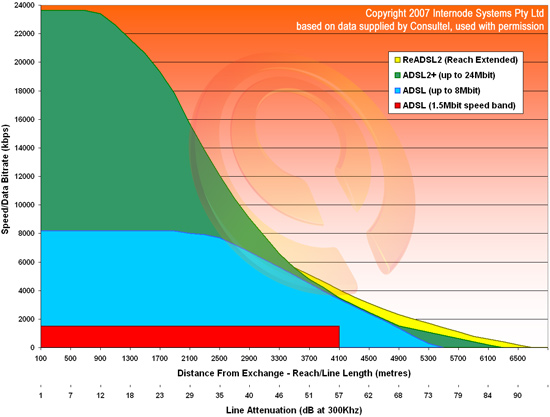
Has a nice adsl 2+ theoretical maximum speed chart. (1 meter =~ 3.28 ft)
http://news.bbc.co.uk/2/hi/technology/7448704.stm shows some insight and
http://news.bbc.co.uk/2/hi/programmes/click_online/8028793.stm
Or is this really backhaul too? -
Re:less for more
Spot on.
Uhh no. Bigpond have monthly data quotas, which count both downloads AND uploads. Their mirror didn't count towards that quota. So you want bigpond users to replace a quota-free mirror with a torrent that they not only have to pay for download traffic, but upload traffic too?
Much easier to move to a decent ISP, like Internode.
-
Re:Move to another ISP?
Yes they do: Internode offers Telstra wholesale ADSL2+ where available.
I do believe they are the only ISP to do so.
It's not cheap, but you do get the best ISP in the country. Linux mirrors included.
How do I know? I am on ADSL2+ (17mbit sync) on a RIM off a Telstra-only exchange using Internode as ISP.
-
Re:We found the missing step
The crushed duct database is very secret, what are we paying for?
Existing fibre is usually backhaul quality, any telco can run that out given approval.
A second set of trenches would ensure a clean install or blowing down existing ducts ect.
20Mbps in cities with copper is what 1200-1400 m of looped clean quality copper from the exchange?
http://www.internode.on.net/residential/broadband/adsl/extreme/performance/
Telstra's only interest seems to be a direct monopoly or a wholesale monopoly or an interconnect monopoly.
The idea that your gov optical link from a suburban home ends with a selection of other telcos optics - best effort wholesale or real hardware waiting to be linked on demand is not something they want to see.
ie just another isp. -
Re:Deja Vu
Yep it appears to be modeled at least partly on the Australian National Broadband Network, although it will no doubt be modified somewhat to suit the NZ telecommunications market, geography and requirements.
Incidentally, actual consumer plans on the new (Australian) network (which has several trial areas already wired up) have just been announced in the last week or two. And they are better value than comparable DSL plans (in terms of download quota), despite the far greater speeds. This will come as a pleasant surprise to those that feared that new, faster tech would also mean more expense.
Taking a look at one ISPs NBN offerings, initial launch speeds are 25/2, 50/4 and 100/8 Mbit (downstream/upstream), with a choice of quotas from 15 GB (entry level) to 200 GB. And these prices will almost certainly come down further once the NBN is available in more than just a handful of trial areas and more ISPs come on board. I actually suspect we'll eventually see true unlimited plans becoming common (some ISPs such as TPG and AAPT are offer this now, albeit expensively!)
I suspect though that NZers will get their network completed before Australia does due to their smaller land area though (and potentially less political infighting!). Good to see it happening on both sides of the Tasman. Copper POTS networks are on their way out. They have served well for ~100 years, but everyone knows replacing them with fibre is inevitable. Might as well start the job now.
-
Re:QOS?
I don't know why they can't just use QOS on their own phone network. They could mark the first 2-5 GB of capacity as high priority, and then the rest low priority.
You have just reimplemented tiered data plans, as used in Australia and other parts of the world for DSL. Hit the quota, get shaped to 64/128/256 kbit (depending on ISP and plan). High-quota plans cost more, eg: http://www.internode.on.net/residential/broadband/adsl/extreme/pricing/
-
Re:A better question would be...
Yes, hope its ISP server ready.
In Australia an ISP with support like this is great.
http://games.on.net/gameservers.php
Low pings and hours of play does not count towards your monthly download limit.
Thats what most of the US based game developers seem to not understand, outside the USA the 'internet' is pay per play for many. -
Doubt this will help longer lines
Sounds nice for those with short lines...
I live about ~3km from my exchange (in Australia), which unfortunately reduces my 24 Mbps (max) ADSL2+ service to 6.2 Mbit (without interleaving) or 7.7 Mbit (with interleaving). Any technology that can squeeze a bit more out of my old rusty copper wire sounds nice to me, at least until the national broadband network (fibre) gets rolled out in 3-4 more years.
Having said that I have a funny suspicion this won't help anyone stuck on a longer line (i.e. any line that wouldn't really support VDSL now). The move from ADSL1 to ADSL2 and ADSL2+ improved the 'max' speed of the service for those close to the exchange, but any xDSL technology seems to hit a certain distance where that benefit is lost.
This graph shows this nicely - ADSL2+ (in green) is way faster than ADSL1 (blue) for shorter/less attenuated lines. But beyond around 4km, it offers virtually no improvement at all. And I suspect the laws of physics are at play here such that this new VDSL variant wouldn't be any different.
-
DSL degrades over disatnce.
At what rate does VDSL2 degrade. With ADSL 2+ it degrades beyond a point of usefulness at 4-6 KM, Once you get past 2 KM the curve increases lowering speed significantly.
I live 3.3 Kilometres from my telephone Exchange and can barely get 3 Mbit/s. For the most part I get 1-1.3 Mbit/s. Can VDSL help extend the useful range of DSL? -
Re:Come to Verizon!
For comparison, here in Australia all the home internet plans come with a download quota - but I don't have a problem with it, since it's stated upfront. For example, a "Home-Standard-50" plan from a typical ISP allows 50 GB/month of transfer.
-
Re:Nice Try but...
Nice idea
But
1) When are ISP's going to get off their Fat backsides and implement IPV6? Most in my part of the world have no plans to do this for 1-2 years.
Mine already has. I get Google and Youtube via IPv6.
2) When are the DSL Modem makers going to implement IPV6 in the devices that are sold to the majority of us?
Shame that it ain't going to get a lot of use outside the corporate world.
I'm running native ipv6 over ADSL PPPoE right now (sure, it's a cisco 877..). But there's an OpenWRT custom build that does the exact same thing if you have a modem to run in bridge mode. There seems to be an all-in-one router on the way: http://twitter.com/bigjsl/status/11082108182
The only problem I've had so far has been Windows 7 not liking newer versions of Cisco IOS - 12.4-24T and 15.0 both have some issue with route advertisment. Funnily enough, there's no problem with WinXP, Linux, or FreeBSD. Only Win7 (and possibly Vista, which I don't have).
-
It'll work
This is a stupid idea, but not the way you think. It's stupid for us, but not for EA.
This will work for EA for the same reason why they can sell DLC which is probably developed at the same time as the game, or considered "cut" content released in the DLC. It will work because impulse gamers DON'T CARE, and will willingly pay money for this shit. We are going down the nickel and dime road of gaming because of apathy and ignorance from the vast majority of consumers who don't know any better and can't be bothered to educate themselves.
Shit, I still see people who think the DRM in Assassin's Creed 2 or CNC 4 is fine because their internet connection is "rock solid". Yeah, great. Unfortunately it doesn't mean you will still be able to play the game, particularly if EA themselves can't keep their shit working.
Honestly it's getting to the point where I'm going to take one of there options:
(1) Stick with old, quality games until I get burnt out on them
(2) Stick with open-source games which don't do this DRM shit, and only purchase commercial games from independent developers who won't risk this kind of behavior
(3) Find a new hobby. Probably the most healthy option anyway. -
Re:Static or Dynamic?
They should be static, if they have any sense. See a blog post of mine on the subject.
Basically, with IPv4, if you have a dynamic address (say 5.6.7.8), and then your connection drops out, and now you are a different address (say 5.8.7.6), then the machines behind your NAT aren't affected, because they're still using a 192.168.0.x 192.168.0.1 gateway thingy.
But in IPv6, what subnet your ISP allocates you (e.g. 2001:db8:1:5678::/64) influences what machines in your LAN (i.e. what would be behind your IPv4 NAT) have as their IP address.
So if your subnet your ISP gives you is 2001:db8:1:5678::/64, then a machine on your network may have an IP address of 2001:db8:1:5678:aaaa:bbbb:cccc:1234. Then, if your connection drops out, and you get a new dynamic subnet, say, 2001:db8:1:9876::/64, then your machines on the LAN will not get the new address scheme immediately, and have the wrong IP address when sending to the Internet. A whole world of hurt.
Really short durations set on the Router Advertisements may help, but there is still a window of breakage, and thus a whole world of hurt that you just don't want to foist onto your customers.
Just think -- you can give out dynamic subnets and conserve address space, but you'll have all hell break loose with the support calls. (My ISP, Internode, is sane and gives out static
-
Re:Only a Few More Years' Worth of IPv4 Addresses.
Hardware vendors, software (non-desktop) vendors, registrars, etc.
Which hardware vendors are you thinking of? One of the ongoing problems with native IPv6 deployment is that effectively no consumer-level CPE supports it -- Cisco don't exactly make stuff for Joe Sixpack, after all. As an example, Internode have been the first ISP here in Australia to offer native IPv6 (on a trial basis for now), but have basically had to tell interested people not using newer Cisco routers to use bridge mode, which is decidedly sub-optimal.
Fundamentally, we are going to run out of IPv4 addresses, and as other posts in this thread have said, it's going to be pretty soon in some regions, such as the Asia-Pacific. We need to be planning for this now, not when it actually happens, and if it takes "vested interest groups" to make it happen, so be it.
-
Re:i want UHF CB Radio!
If you're interesting in such things, look into the research Amateur Radio operators have done into HF radio protocols such as PSK31, TOR, Clover, MFSK16, etc. I have personally send data via PSK31 from my house in Va to Australia using 1 Watt of power. That's by no means a km/Watt record. See this database for contacts made.
This guy (who received my 1 Watt signal) is seriously into weak signal work.
-
Re:A suggestion...
And this is why mirrors exist. If my local mirror has it, yours does too.
-
Tesla race blog
For those who are interested, the blog for this internode entry, detailing the event so far is at;
Simon and Emilis are experienced glider pilots too, and credit the experience they have from glider energy management as one of the factors in acheiving the record.
MOst amazing thing is the article spelt Emilis surname correctly!
-
Re:Electric cars are not better for the enviornmen
The majority of electricity comes from 'dirty' sources, such as coal, oil and nuclear.
Well, it seems like in this case, it's coming from a giant diesel gen
-
Re:I wouldn't peer with HE either....
All the IPv6 you want http://ipv6.internode.on.net/
and their pricing
http://www.internode.on.net/business/web_hosting/business_web_hosting/pricing/ -
Re:I wouldn't peer with HE either....
All the IPv6 you want http://ipv6.internode.on.net/
and their pricing
http://www.internode.on.net/business/web_hosting/business_web_hosting/pricing/ -
Re:Reporting
Internode (Australian ISP) does this. You can access your current usage through their website. They also provide an API for accessing the usage data. A subscriber written usage meter dock thing being the most popular way of measuring usage.
Internode Monthly Usage Meter
Monthly -
Re:Reporting
Internode (Australian ISP) does this. You can access your current usage through their website. They also provide an API for accessing the usage data. A subscriber written usage meter dock thing being the most popular way of measuring usage.
Internode Monthly Usage Meter
Monthly -
Re:Slashdotted
here is another ( games.on.net )
-
Re:Could they possibly...
Not really, you can't pick ANY old arbitrary combination. But there are a good range of plans (most ISPs will offer a dozen or more plans). Also, unlike in the US where there's usually only 2 or 3 ISPs to choose from in a lot of places, virtually everywhere in Australia will have 10, 20, 30+ ISPs to choose from. So competition is healthy - although being an English-speaking island we still have expensive rates overall due to the fact that we pull 90% of our data from the US through expensive undersea cables.
In general, for ADSL-based services, speeds (downstream in kbps) you can pick from are:*
- 256 or 512kbps (very low end plans, not commonly seen anymore)
- 1.5 mbps
- 8 mbps (full ADSL1)
- 24 mbps (full ADSL2+).Those on longer telephone lines might not receive the full speed from the 8 or 24 mbit services, in which case you get the highest speed your modem can negotiate on your line. Upload speeds are generally 1 mbit for the 8 or 24 mbit plans, although some ISPs offer AnnexM which increases ADSL2+ upload capacity to a max of 2.5 mbps.
Once you've chosen a delivery method (aka speed), you pick a plan based on how much data you need. Some ISPs are cheaper. Some are more expensive. The more expensive ones generally have better service, lower contention ratios and are congestion-free. Most also have their own mirrors of content that do not count towards your allowance (e.g. sourceforge mirrors, tucows, linux repos etc.). Uploading isn't counted,* and for some ISPs, traffic within that ISPs own network isn't counted.
If you exceed your allowance, you get shaped (i.e. your speed is reduced, usually to 128 or 256 kbps, depending on ISP)*
Example of a cheaper ISPs 24 mbps plans: http://www.tpg.com.au/products_services/adsl2plus_pricing.php
Example of a more premium ISPs 24 mbps plans: http://www.internode.on.net/residential/internet/home_adsl/extreme/pricing/
An advantage of data allowances is that it allows ISPs to know how much data, on average, is required by their network. They can then plan ahead and provision capacity as required. Increases in THEIR costs are matched by increases in the cost to the consumer. As such, Australian ISPs don't need to do packet inspection, throttle torrents, block certain ports etc. It's a completely unrestricted and 'neutral' service. Plus it's always fast (on my ISP at least
The disadvantage is obvious: it does discourage the takeup of some high-bandwidth services. But then again, you get what you pay for. If I need a higher allowance I can always increase my plan. There's no penalties for doing so (on my ISP at least) and I can change up and down as required. Personally I'm on the 25 GB plan and find its perfect for my needs. I generally end up using around 20 GB per month (which includes a fair bit of torrenting and streaming media). The next plan up is 50 GB which is quite a jump, but only 10 bucks more.
-----------
*There are exceptions to this stuff, of course (e.g. Telstra counts uploads and charges per MB instead of shaping you). But for most ISPs, this post is how things are.
-
Re:Oblig...
Famous quote attributed to John Carmack: "The plot in a video game is just like the plot in a porn movie -- merely an excuse to get to the action."
Not just attributed, that quote is confirmed all over. Besides that, commentators have called him on it.
The point being, a story is as much to the game as the game is to the story. If the story is just fluff to give moral rationale to the endless violence, then the story has no meaning. On the other side of that coin, there are stories that shape and define the game, so much that to miss the story means having to stab a guess at the next move.
Thanks to energy drinks, a 2-second attention span and "personal expression" outlets like MTV, there is bound to be generation after generation of twitchy, impatient youth that can't see past the next achievement/medal/award so they can brag to their friends. Fine, we get it... the story angle just isn't for you.
If you put forth the question, "Is the video game art?" I'll give you a definite, "maybe." It may or may not be art, but it has that potential.
It can be a vessel for intriguing storylines, it can also overload the senses in ways we never before thought possible. The realm of electronic gaming transcends both lines of fine art and banal time-wasting. In this way, each game defines itself, the medium is that message... we choose the games by how we wish to spend our individual time, they do not choose us.
Storytelling in games will exist so long as there is one more interesting tale to tell. If that's not your bag, then don't buy the game.
Choice defines the market, not quotes.
-
Re:It's always the same 90%
NO ONE in Australia has access to 100mbps.
http://www.internode.on.net/news/2009/02/125.php
http://www.internode.on.net/pdf/products/home-fibre-pricelist.pdf
At least one ISP is already laying fibre
-
Re:It's always the same 90%
NO ONE in Australia has access to 100mbps.
http://www.internode.on.net/news/2009/02/125.php
http://www.internode.on.net/pdf/products/home-fibre-pricelist.pdf
At least one ISP is already laying fibre
-
Re:Steam = DRM = Bad
While I like the convenience of Steam, let's not forget that if Steam goes belly up, games bought there will become unplayable.
They announced that in that case the games would be unlocked.
That statement's been debunked several times, if VALVe goes belly up the administrators that take over are incredibly unlikely to allow anyone to flip a switch that would destroy the value of the company's assets. It's nice that they say it, but reality won't give them any control over it in that situation.
I like to purchase games through Steam to avoid having to hunt down the games in stores, as I've generally had bad luck when trying to get game-related items from stores here. I imagine it'd be similarly useful for people that would otherwise have to expend a large amount of transport effort to acquire the boxed version of the game. Some games, like Red Alert 3, even remove their boxed DRM in favour of the Steam version, which I tend to find less intrusive (it's pretty invisible to most internet-connected users).
As for the quota issue, in Australia the ISPs began implementing quota-free services on their own networks to counteract the large amount of bandwidth consumed doing things like gaming. Several even offer Steam content servers on their own networks as quota-free. Customers with Internode and Bigpond, for example, are able to acquire most (all?) Steam content quota free so bandwidth caps are irrelevant when downloading games; the only limiting factor is speed.
If American ISPs follow the Australian ones with the quota-free content servers and such we might find the number of people downloading games from Steam won't decrease when hard caps are implemented (since traffic on their own networks is essentially free they're likely to offer it).
-
Re:What's this "finally" shit?
My home ISP (oblig. disclaimer: I now work for them too) has blocked port 25 outbound by default on 'Home' ADSL connections for a while now.
It's all configurable from the online webtools, so you can turn it back on if you want it.
And there's even an in-depth FAQ about it on the site.
IMHO it's a great idea, and I wish more ISPs did it.
-
Re:Fuck You EircomI checked out Eircom to see how bad their plans were and you Irish are almost getting it as bad as we Aussies. E40.16 for 50 GB at 7 MB that's nearly A$80. A$80 will get you 25 GB or 40 GB on up to 24 Mbit ADSL2+ lines
Up to 24 Mbit, this meant the theoretical maximum is 24 megabit per second, real world speed will differ meaning that it will be slower and get increasingly slower the further you get from the telephone exchange where the DSLAM is installed, this is due to the nature of ADSL. I live about 3.5 KM from the DSLAM and out of those 24Mbit I get 5.5 Mbit. I'm assuming that Eircom is offering DSL as they didn't actually say what "broadband" was on their page so you will suffer the same signal degradation based on distance. Australian law requires the disclosure of signal degradation by the ISP which is why they are always advertised as "up to 24 Mbit*"The main problem though is that they control all the actual physical lines and others have to lease bandwidth so I can see them quite happily using this shit as a stick to beat their competitors.
We have this problem in Australia. Telstra, what came out of the government owned Australia Telecom when it was privatised in the 90's owns all the copper in Australia (95% of which was laid by the government using public money) but the main problem is fixed by the fact that the Telecoms regulator fixes the price at which Telstra can resell their copper lines and DSL services. This price is set at a level where Telstra can make a profit above the cost of line maintenance but Telstra constantly complains to the regulators as their other business units are losing money (having to support 3 different cellular transmitter networks when other networks only support two). Currently Telstra are stonewalling the National Broadband Network project which is intended to provide FTTN (Fibre To The Node) to Australian households, Telstra opposes this because the government refuses to grant them the same monopoly over fibre lines as they have over copper lines.
I don't know what the Irish regulators are like but I always assumed the EU and member states had some good consumer protection laws. -
Re:The speed thing alwasy pisses me off
I have 3 MB/sec DSL, and I get about 50 kbs downloading. Maybe up to 100 on a really good day. They really need to regulate what they can claim as far as speed with real world random sampling, or let you pay according to whatever speed you can actually get in your area, or something.
With DSL, the speed is affected by two main factors, 1 your distance from the DSLAM (normally at your local telephone exchange) and 2 the quality of the copper between the DSLAM and you. The further out from the DSLAM you get the lower speed you will get. For ADSL1 this is 5.5 KM. For ADSL2+ RE I think it is 7.5 KM. After about half of the distance speed tends to drop rapidly. Please look at this graph for more details (courtesy Internode). In older areas it gets worse as the copper laid in the 60's and earlier is not typically of the highest quality. ISP's in Australia have to advertise that service will be degraded by environmental factors, most ISP's don't advertise the how much they will be degraded relying on adding the words "up to" before mentioning the maximum theoretical speed. I get "up to" 24 Mbit on my ISP (iishaft) but because there is about 4 KM of copper between me and the exchange I realistically get 5 Mbit.
But you have a good point, this should be better advertised so people know what they are getting. -
The suppressed letter
For those wanting to read the contents of the letter they tried to suppress, you can find the original here. (PDF)
-
Re:Not the big deal...
Tried getting panning working? I whipped up an app for my 701 eee (based on i810pan) to do this. Gives you 1024x768 panning, which is rather handy. i810pan needs software cursors enabled which buggers up hardware acceleration, hence my version.
It's still a little clunky round the edges, but it works and fills a need for me.
I turn it on when I need to use big-screen apps - mainly VirtualBox and XP for development for a particular embedded device, but Google maps is definitely another reason for it.
-
Re:Should lead to possibly great advertisements
I'm still busy just getting Xorg to pan again, after the Xorg devs decided that it wasn't the X server's business to pan a viewport around a virtual screen and the window manager should do it. Never mind the fact that a virtual desktop has been present in X for a Very Long Time Now, or that current window managers don't do panning as they expect X to do it.
Thanks guys, I really enjoy my 800x480 eeePC so much more for your decision.
(end bitter rant)
-
Re:MIPS will make it a hard sell
Beats the crap out of a Sharp Zaurus....
Formfactor-wise, nothing beats a Sharp Zaurus SL-C3000 (or 3100/3200). It's pocketsized, clamshell, with a QWERTY keyboard usable for two-finger (or thumb) typing.
-
Re:useable?
Ahh, but can you type on the damn thing?
Type how fast? I can type on my Zaurus SL-C3000, not very fast but fast enough to pound out rough drafts of poems and essays while on the go. It's about the size of a pack of 3x5 index cards; I would love to find something that size with a more standard architecture. I guess the Nokia 810 is the closest thing in current production; but that sliding keyboard looks like the suck, the Z's clamshell formfactor blows it out of the water.
-
Re:I guess my ISP is responsiblee
If you have an Internode ADSL account at multiple locations, look for DAD which is the multi-account version of MUM:
http://www.users.on.net/~johnson/internode/
They're quite useful little apps, warning you when you're ahead of your quota (averaged over the month) and should cut back your usage a little.
-
Re:Should have gone to A.B.C.D.E.F.G format.The delay in the switch from IPv4 to IPv6 is greed by ISPs pure and simple. ISPs get the IPv4 address range basically for free and then charge customers for access to that address range, money for jam. They will simply resist IPv6 for as long as they can (the bad ISPs) because their profits from IPv4 will disappear as they have to give away IPv6 for free.
This of course is only as far as the greedy, traffic blocking, no server, ass hat ISP's. Their are plenty of regional good ISPs that believe in providing quality customers services at a reasonable price eg. http://ipv6.internode.on.net/, they of course will be the ones who end up crippling the IPv4 profits.
So home based server appliances, for email, voip, web serving, will kill IPv4 because they will want their IP address for free and, not to forget smart phone/PDAs and UMPCs all with their own IPv6 address, for instant global mesh networking, so yeah billions of adresses and the typical user will have at least three, home server, smart phone/PDA and UMPC.
-
Re:AmenRequire ISP to specify caps and fees for being allowed to exceed them. That's probably the most practical approach, and certainly one most users could live with. But as I said, geeks have always resisted this model.
Maybe for American geeks, but Australian geeks have had quota systems for years and it works perfectly well. The last unlimited account I had was a dialup account in the early 2000's (iiNet Explorer), but even unlimited dialup is something of a rarity these days. There are a handful of providers offering unlimited downloads on low-speed ADSL connections (usually 256kbit), but the vast majority of ADSL plans give you a fixed amount of downloads per month at a fixed price. For home accounts, exceeding your quota typically results in you being shaped for the remainder of the month (to 64 to 128kbit depending on the ISP) so you can still access the internet but it's not much fun. On business-oriented accounts they'll normally charge a per-megabyte fee for excess usage. Some ISPs also let you buy blocks of additional quota on an ad-hoc basis for a premium, to encourage people to keep within their monthly quota (presumably this makes it easier for the ISP to anticipate demand on their network).
While I would of course prefer to be able to download an unlimited amount of data each month, obviously that's not realistic and a quota system like this makes it clear what the actual costs are and keeps demand in check. This system works perfectly well, but the trick is actually getting ISPs to switch to it -- if all your competitors advertise "unlimited downloads*" and you advertise "100 GB per month" you're going to look much worse, even if your "unlimited" competitor throttle particular types of traffic. Here it happened when they started rolling out ADSL, because having unlimited downloads at 10x the speed of dialup was utterly untenable. Bandwidth costs are a lot lower in the US so they've been able to keep offering "unlimited" for a lot longer knowing that the majority of users would subsidise the few who actually do use a lot of bandwidth, but the increasing speeds of consumer internet connections coupled with the increasing amount of high-bandwidth content available means the camel's back has to break, eventually.
-
Re:And this is new?
Probably because there's not enough to gain.
Only tech-savvy people will be bypassing this practice by using bind or another caching name server, and name service traffic doesn't really have enough volume to warrant interception for cost-cutting purposes, really.
Of course, ISPs can still be bastards. I'm constantly surprised by how broken the internet is here in America. I thought I had it bad in Australia. Apparently I actually had it good, with an ISP that doesn't play games with my connection, for any reason (and the CEO personally would make that claim on the consumer-run ISP forum whirlpool.
Now if i could just get that ISP to start installing ADSL2 DSLAMs in America. Screw this cable and FioS crap. -
Re:Good news all around if it happens
Well, we could be in luck. In a little over a year, a new 2Tb cable to Guam is coming online. From what I can gather on the internet, part of "Unity" is Pacnet's EAC Pacific cable. This will cover the Southern loop of the system and pass through
Finally, we won't be solely dependent on the Southern Cross Cable our Kiwi friends gracefully provided us with, or the woefully inadequate Australia-Japan cable. -
Re:5GB?!
>>Listening to the web radio cuts into it.
You bet it does. As soon as I get off my arse, I'm switching to Internode.
http://www.internode.on.net/residential/entertainment/broadband_radio/ -
got it in oneAustralia has had monthly download quota's for 7+ years now. In many instances it will be split into peak and off-peak quota. Eg: my current plan is 150GB/month, 40GB peak, 110GB off-peak (which is 1am to 7am for this ISP).
Back in '02 Internode http://www.internode.on.net/ introduced Flat Rate plans, whereby you could download as much as you wanted while the network wasn't congested, however when utilisation reached 100%, those with the highest downloads over the last 28 days (rolling period) would be progressivly slowed down, to as low as dial-up speed. Once the network was less congested, your speed would ratchet back up (again depending on network congestion and your priority based on your downloads).
Those that only occassionally downloaded large files would get full speed pretty much all the time, those that downloaded continuously would see their downloads slow during peak periods.
It wasn't rocket science, but that 28day rolling period and how it worked was a confusion that eventually forced the cancellation of these type of plans - which is too bad, as they essentially gave everyone a fair go depending on how much you downloaded. No excess charges, just a flat fee and as much GB as you could squeeze out of the link.
It was a great system and I was sorry to see it go. I'm sure the developer of the software was dissapointed in much larger ways - this system could have made bandwidth provisioning & customer charging a lot easier to predict and manage.
More info in an FAQ http://whirlpool.net.au/article.cfm/1037
-
Re:And to think...
Actually, my ISP regularly revises its prices downwards. The reason being, they're in a competitive marketplace, and if they don't then they'll lose customers.
Also, this tiered bandwidth thing has been the way broadband has been in Australia since the get-go. On plain old ADSL, you had a choice between 256/64, 512/128 and 1024/256 connection speeds, and various limits after a certain amount had been downloaded. There are options to go on a throttled service after exceeding your cap, or a pay-per-GB if you really want your speed. A lot of services in fact have two caps, for peak and off-peak time. -
Re:20k is enough for anybody.
I think this is actually big problem with faster consumer speeds. When the Crysis demo was released, a lot of Internode users were complaining about the speeds they were getting from 'node's mirror of the download. Their file server has two gigabit network ports, which is pretty standard for any kind of semi-modern server. The reason the downloads were slow is simply because its uplink was saturated.
Now, this is in Australia, where most of Internode's gamer customers would probably be on their ADSL2+ plans which give you maximum speeds around 20-25 Mbit/sec. There's still a lot of servers out there that only have 100mbit uplinks to the internet, and not just in internet backwaters like Australia.
Mind you, for most web sites it's not that big an issue, because you don't have enough content to saturate 100mbit for even half a second. I think a lot of the modern-day delay is from javascripts being loaded from multiple sites, which have to run sequentially. Though it's true that HTTP isn't particularly well designed for modern sites, as well. It would be nice if a request to the homepage could return a single compressed blob of data which includes the HTML, CSS, scripts, and the important images referenced from the page all in one go.
May as well redesign SMTP while we're at it, too!
-
At least you can opt out (or not opt in)
At least you can opt out (or not opt in). The previous Government of this fair land thought it wise that USENET groups should be subject to involuntary blocking (through the Australian Communications and Media Authority, http://www.acma.gov.au/WEB/STANDARD/pc=INT_IND_CONTENT_ABOUT). Of course contractual secrecy has been used to avoid any knowledge of the groups blocked and (hopefully) criticism thereof. See, for example, http://www.internode.on.net/content/usenet-news/#What_groups_does_the_Australian .
-
Re:What can you do with it?
I honestly think that title belongs to the Nokia N810 tablet.
Check out the Sharp Zaurus C3000 series. Beats the N810 on having USB and CF, but it doesn't have built-in Wifi or Bluetooth.
-
Re:Easy!
I imagine the trailing zeppelins were staggered at ever increasing heights, forcing the pirates to display their acrobatic prowess to ascend to the highest zeppelin of all: the Led Zeppelin.
Needless to say, the ninjas were not amused by the pirates' display of athleticism, and challenged them to a showdown. The ultimate test of wits, skill and bravery, from which only the toughest would emerge alive... Dodgeball!
-
other links
Here is another link (on the fringe perhaps) of asian/polnesian migrations.
http://users.on.net/~mkfenn/page5.htm
There is some genetic evidence and cultural evidence a group Japanese 2000 years ago became/interbred with the Zuni...
The Zuni language has several unique traits from other native Americans -- Japanese traits -
Re:Not good.BitTorrent is the perfect way to distribute free software
I actually have to disagree with this. I don't think I've ever used BitTorrent to download free software, for the simple reason that most of the large (and even some of the small) ISPs here (.au) mirror popular content locally. Whether it's Linux distributions, popular free applications, game demos and patches... if it's wanted by a lot of people and it's legal for them to mirror it, they will.
They also provide incentives to their users to use their local mirror: my ISP doesn't count downloads from their mirror in your monthly quota, making it essentially "free" for their customers to access. They can do this partly because they control the amount of content available on the mirror, and because it's cheaper for them to deliver it from their own network than from overseas.
Even for stuff they don't mirror, it's likely another ISP has a mirror of it. Optus run a SourceForge mirror in Australia, so even though it isn't "free" traffic for me it's still faster than downloading from overseas.
BitTorrent doesn't select peers based on network topology, so if I was to torrent the Debian ISOs I would be creating traffic all over the internet in order to saturate my ~18 mbit pipe. If I download them from my ISP, I'm creating traffic across their network and nowhere else. It's much more efficient and scalable than torrents.
Torrents are useful when the content cannot be legally distributed by others; or when large amounts of data are wanted by lots of people in disparate locations, but not by a large enough number to make it worthwhile for others to mirror.
BT would be great if it automatically selected the closest peers (based on network topology and bandwidth availability), so that transfers would tend to be clustered around POPs and internet exchanges. As it is now, it ends up with data being sent from all over the world across expensive trans-oceanic links.