Slashdot Mirror
Domain: osnews.com
Stories and comments across the archive that link to osnews.com.
Comments · 1,285
-
Article...
-
Re:"Definitive"?
It wasn't the "definitive" desktop review! Do people not even read the Slashdot summaries anymore?
Some people may not read the "summaries" (headlines as I like to call them, but whatever), but I wouldn't be so quick to judge because you quite obviously didn't read the article. check it out here and read the TITLE of the article. The article calls itself "The Definitive Desktop Environment Comparison", not the definite comparison as CowboyNeal calls it. In fact, I suspected that "definite" was a typo when I first read it and still do. Point being, the parent of your post was referring to the ARTICLE TITLE, not cowboyneals (most likely) typo in the summary. And if your post was all a joke, I apologize for making a big racket about nothing. That is all.
This was a "definite" desktop review. -
Re:KDE wins
Read what that oGALAXYo guy has to say about G2.2.1 and I fully agree to this person. Looks like we need to back this person a bit.
-
Those looking for a fresh Linux desktop distro...
.. might want to try looking at Ark Linux, the latest alpha of which was recently featured in an OS News interview.
Red Hat compatible RPMs, latest KDE (the CVS of 3.1.1), simplified configuration (looks a bit like WinXP, I'm tempted to see if my folks back home would like it), and the lead developer is Bero of Red Hat KDE and dvdrecord fame.
And did I mention Apt? -
Those looking for a fresh Linux desktop distro...
.. might want to try looking at Ark Linux, the latest alpha of which was recently featured in an OS News interview.
Red Hat compatible RPMs, latest KDE (the CVS of 3.1.1), simplified configuration (looks a bit like WinXP, I'm tempted to see if my folks back home would like it), and the lead developer is Bero of Red Hat KDE and dvdrecord fame.
And did I mention Apt? -
What an informative table of contents!
From the article:
Table of contents
1. TCL/TK Interview, Part 1
2. TCL/TK Interview, Part 2
3. TCL/TK Interview, Part 3
4. TCL/TK Interview, Part 4
5. TCL/TK Interview, Part 5
6. TCL/TK Interview, Part 6
Good thing they have it all on one page with the Printer-friendly version -
Finally! Or is it?
There was an excellent overview of the Linux on the desktop issue at OSNews some time ago.
Personally, I feel that if they get pretty good hardware (800 to gigahertz range to run Gnome or KDE without glitches) then they wouldnt need that much training. Maybe just a bonus to the IT guys for answering some questions but that would be all.
So, indeed, Linux does cost less and it will cost even more less in the future with the 2.5 and 2.6 solving many many problems. First thing that pops into my mind would be ALSA in the kernel - no more messing around, just build the kernel and be done with it. Excellent! -
Finally! Or is it?
There was an excellent overview of the Linux on the desktop issue at OSNews some time ago.
Personally, I feel that if they get pretty good hardware (800 to gigahertz range to run Gnome or KDE without glitches) then they wouldnt need that much training. Maybe just a bonus to the IT guys for answering some questions but that would be all.
So, indeed, Linux does cost less and it will cost even more less in the future with the 2.5 and 2.6 solving many many problems. First thing that pops into my mind would be ALSA in the kernel - no more messing around, just build the kernel and be done with it. Excellent! -
credit due
-
credit due
-
I think I can say it for everyone,
SCO is not our favourite puppy.
Btw, there is a OS News thread on the subject with lots of comments. -
OSNews
Yoper has already been discussed thoroughly in an OSNews feedback thread and it has been decided that a lot of their claims are duds or dont quite work and they dont add anything visually pleasing to the distro. Everything Yoper looks like crap. Dont believe me, check out their screenshots. That Y instead of the K looks terrible.
-
Re:commentary
Stolen directly from osnews.com!. Congratulations you have succesfully plagarized!
-
List of sites
I have a definite list and surprisingly an order too (anyone else do this compulsively?)
1.) CNN
2.) LinuxToday
3.) OSnews
4.) KernelTrap
5.) Yahoo! Mail - Only including this because it's in my list.
6.) ExtremeTech
7.) AnandTech
8.) Tom's Hardware
9.) 2cpu
10.) Slashdot - Last because it takes the longest.
Hmm, come to think of it I have some wierd habits while surfing too. When I'm traveling my path of websites, I picture them on a 2d plane with distance in between. CNN on the left, linuxtoday in the lower middle, etc. Anyone else do this? -
OSNews.com and heise.de
OS News (all about OSes and more, my favourite next to
Heise News (German IT news, the guys that make the c't) - they have an English Version, too (though you won't find anything there) -
Re:How to improve x86
I was thinking about this ( this thread). The biggest reason I can see for not doing this is access latency. Accessing a cache line requires a lookup operation that takes several clock cycles (7 on a P4's L1 cache). Register access is one clock cycle. If you have a tiny L0 cache, made up of register-like memory, you need to use fully associative memory to make lookups as fast as possible. Fully associative memory is expensive, and would probably be very hard to make run at high clock speeds.
-
Re:Mandrake vs. RedHat
Without touching off a flame war, I will have to disagree with:
Redhat has nothing that can touch urpmi.
There is a version of apt for RedHat-- Here's how to install and use it in RH 8:
Download and install these:
http://ftp.freshrpms.net/pub/freshrpms/psyche/apt/ apt-0.5.4cnc9-fr1.i386.rpm
http://ftp.freshrpms.net/pub/freshrpms/psyche/apt/ apt-devel-0.5.4cnc9-fr1.i386.rpm
Make sure you're online, then, as root (or sudo)issue the following commands:
apt-get update
(You will see apt download package listings)
apt-get -f install
(This is to fix dependencies that will prevent apt from working.)
Your output should look something like this:
Reading Package Lists... Done
Collecting File Provides... Done
Building Dependency Tree... Done
0 packages upgraded, 0 newly installed, 0 removed and 0 not upgraded.
If your output is different, make sure that you know what you are doing before you let apt make changes to your system.
Now, do:
apt-get install synaptic
and run synaptic as root or sudo root. You now have a gui tool to resolve dependencies and install packages.
This was shamelessly stolen from an excellent article by Robert C. Dowdy on OSNews:
http://www.osnews.com/printer.php?news_id=1890 -
Re:I'm going to pee....In all actuality, I'm curious as to what Apple's market share is now?
Well, according to OSNews, which is pretty neutral and doesn't tend to make up figures, it's about 2.9%, maybe a bit less.
But I'd venture a guess that with OSX converting Linux users left and right that it'd be around 6-8% by now. Thoughts?
I think that's wrong - firstly, even if every desktop Linux user on the planet went to OS X (not going to happen), userbase would rise by about 2% probably, not 4-5%.
Secondly, I'd questions the assertion that Linux users are switching left and right. Out of all the Linux users I know, not one of them have switched to MacOS (although one or two have bought Macs and installed Linux on them).
But so what? There's no real way of measuring, so baseless assertions are pointless. Nobody knows, all you can do is guess, and I'd guess you're very wrong.
-
Re:phraseThere are some interesting views on various Apple usability booboos here.
In particular the invisible font preview panel is pretty wierd, especially the way somebody who is apparently an Apple developer talks about it like it's a perfectly sane thing to do.
-
Re:Uh, he's a Linuxworld columnist?-DB over FS.
Which is why we over at OSNews had a conversation about what was basically a database over a filesystem. The pieces are there, scattered over different filesystems, from VMS to ReiserFS. Novell,Unix, and Windows. A lightweight database, transparent by workings, but not by power. Why worry about a seperate database, when it's integrated into the system proper?
---
-
Re:Uh, he's a Linuxworld columnist?-DB over FS.
Which is why we over at OSNews had a conversation about what was basically a database over a filesystem. The pieces are there, scattered over different filesystems, from VMS to ReiserFS. Novell,Unix, and Windows. A lightweight database, transparent by workings, but not by power. Why worry about a seperate database, when it's integrated into the system proper?
---
-
Re:MX for gaming? please...
GF4 MX is good as long as you don't mind upgrading again when the next generation of games are released (which won't be long now)...
-
And in other news ..
Eugenia of OSNews claims to know more about the GNOME releases than the GNOME release manager himself! Fun for the whole family1
-
GNOME ArmageddonDear reader the GNOME armageddon has started,
First of all I want to clarify that this text was meant to be a source of information otherwise i wouldn't have spent so much time into writing it.
Belive me it took me a couple of days writing this text in a foreign language.
Even if you don't care at all for GNOME, you may find some interesting information within this text that you like to read. please try to understand my points even if it's hard sometimes, otherwise you wake up one day and feel the need to switch to a different operating system.
On the following lines i'm trying to give you a little insight of the GNOME community. the things that are going on in the back, the information that could be worth talking and thinking about.
Many of us like the GNOME desktop and some of us were following it since the beginning. GNOME is a promising project because it's mostly written in C, easy to use, configurable and therefore fits perfectly into the philosophy of *NIX, only to name some of its advantages.
Unfortunately these advantages changed with the recently new released version of GNOME. The core development team somehow got the idea of targeting GNOME to a complete different direction of users, the so called corporate desktop user.
In other words they're targeting people that aren't familiar or experienced with desktop environments. usually business oriented people who are willing to pay money for getting GNOME on their computers.
Having this new target in mind, the core development team mostly under contract by companies like RedHat,Ximian and Sun decided to simplify the desktop as much as even possible by removing all its flexibility in favor of an easy clean simple interface to not confuse their new possible customers. So far the idea of a clean easy to use desktop is honourable.
Some of the new ideas, features and implementations such asgconf, an evil Windows Registry-like system, new ordering of buttons and dialogs, the removal of 90%-95% of all visible preferences from the control center and applications, the new direction that GNOME leads and the attitude of the core development team made a lot of users really unhappy. These are only a couple of examples and the list can easily be expanded but for now this is enough. Now let me try to get deeper into these aspects.
You may imagine that users got really frustrated because their beloved GNOME desktop matured into something they didn't want. During the time, the frustration of a not less amount of people increased. more, more and more emails arrived on the GNOME mailinglists where users tried to explain their concerns, frustrations and the leading target of GNOME.
But the core development team of GNOME don't give a damn about what their users are thinking or wanting and most of the time they come up with their standard purl. The reply they give is mostly the same -- users should either go and 'file a bug' at BugZilla or the user mails are being turned so far that at the end they sound like being trolls or the user feedback is simply not wanted. whatever happens the answers aren't really satisfying for the user. even constructive feedback isn't appreciated.
If you gonna think about this for a minute then things gonna harden that they are directing into the commercial area. The core development team actually don't care for the complaining home user -- it's more important for them to reach the customers with the cash. It seems that this has been told to them by the company leaders -- everything about GNOME has been decided already, a way back or direct communication isn't possible. Don't get trapped by sentences like 'we listen to our users'. They listen to you -- yes, to make funny silly jokes about you afterwards.
I thought that everything was build up on friendship, build on programming for fun, build on understanding each other. But the reality looks like it's all for the big money. The cash is what matters everything else is a lie and a dream. Time for people to wake up.
Not long ago they threw one of the most important long year core developer Martin Baulig out of team -- a guy who worked really hard on getting GNOME into the right direction, a nice friendly person who put all his time into GNOME.
But narrow minded GNOME elites such as Havoc Pennington were responsible that he left the GNOME project -- the trouble and the pressure that was put on him was to much.
With the new GNOME desktop a lot of user interface changes happened such as button reordering -- needless to say that this confuse people who are used to the 'right' button ordering for ages. Even our fellow Linux guru Alan
Cox wasn't thrilled about this idea, but the GNOME elites such as Havoc Pennington, Seth Nickell, Calum Benson and Dave Bordoley knew it better. Why following the road of any other desktop that exists ? Why not doing something that don't confuse their users and still stay usable ? Well it seems to be too easy. GNOME needs to be different than anything else so they changed the button order which was one of the reasons that users became unhappy. They said that there was a hard fight about this and the decision was made to change the buttons. But I belive they simply copied the behaviour of Mac OS because most of the GNOME developers use a McIntosh as either laptop or desktop. Sad that they forgot to keep in mind that users tend to mix applications and that this will lead into weird button searching and clicking.
But as if this wasn't enough the same people decided that the new GNOME Human Interface
Guides were the ultima non plus ultra in human interface guides. The announcement contained informations that the KDE usability people got initiated into it. Unfortunately the KDE people heard about it the first
time when Seth Nickell went to the KDE mailing list which happened after the announcement. You can imagine that they got highly pissed off about this attitude. You can read more on this link. To summarize it, the KDE people clarified that GNOME should care for their own business.
The problem that came with the new interface guides was, that every little GNOME hacker started to become an user interface expert over night. A lot of GNOME programs that we like to use matured into a disaster over night. Hackers that never programmed correctly for their life started to blindly follow the hype of simplification. For an example look what happened to Galeon's interface (pay attention for the last paragraph). Even Philip Langdale a long year galeon hacker got highly indignant by the target that GNOME leads and wrote this email to the Galeon mailinglist.
Here another reason why users became angry. The elite assumes, that the user knows nothing about their system. you find a couple of heavily insulting mails on their mailing lists containing sentences like the quoted ones.- "the user don't know what a window manager is",
- "the user don't know what themes are",
- "the user don't know what a homedir is",
- "the user can't compile a kernel",
- "the user don't want to customize their desktop",
- "the user shouldn't see preferences which purpose they don't know"
You may imagine that a lot of people are being offended by such lines because it's exactly these GNOME users who are meant by these phrases. To read more such lines on the GNOME mailinglists, simply click on this link and grep in their archives. Be said that most of these sentences are coming from Havoc Pennington.
Such evil practices shouldn't be tolerated by the users and need to be fighted. *NIX users aren't stupid people. Who actually gave Havoc Pennington the rights to decide what the user wants and what not ? Various users told him that people who use a *NIX like system are well aware of their capabilities dealing with such a complex system. There's a reason why people are switching from alternative operating systems. They want to learn, they want to use the full power of the system, they want to change everything they like.
To top all this, look at the future plans of Nautilus. The current maintainers got the idea of changing the whole Nautilus concepts into an object oriented user interface design. You may be highly interested in reading the exact words of Alex Larsson's vision for Nautilus' future direction by clicking on this link.
To summarize it, it's assumed that the user don't need to deal with his homedir or his whole filesystem because it may confuse him or because he don't understand it. The new concepts of Nautilus should be that the user deal with symbols in the Nautilus view. E.G. you get a cdrom symbol and by clicking on it you see the directory of your cdrom, you get a photo symbol and by clicking on it you get a list of all your pr0n pictures, you get a music symbol and by clicking on it you get a list of all your mp3's. You don't know where all these files are located because you don't deal with the bottom layer of your homedir or filesystem anymore as mentioned earlier.
The question is why are people that know nothing about their users, that know nothing about correct user interface design destroying GNOME ? The users don't deserve all this specially those that backed GNOME for all the years. Even sun threw a bunch of so called user interface experts together and have them work on GNOME. don't forget that sun are the creators of the Common Desktop Environment. We don't need another CDE clone named GNOME. Even Havoc Pennington author of the good user interfaces text isn't able to get his own written software following his rules.
Not long ago there was an report about the 'two captains of Nautilus' where the reporter (Uraeus a GNOME contributor himself) reported Alexander Larsson and David camp. You may imagine that such a report can't be taken serious because it's done by their own people. We here have a saying that sounds like this 'one crow doesn't hack the eye of another crow out'. Now you can click on this
link and read more. It may be interesting to read the replies from various users all over the globe of what they think about GNOME and Nautilus in general (please pay attention to the listed ip's there). Another nice and informative reading can be found by clicking on this link.
The fileselector problem was a long discussed issue in the GNOME community. Finally they came to an solution for this and have decided to go for this ugly fileselector instead going for this one which was developed by a free volunteer for a long time and in general looks and behaves better.
most users have no problems with the idea of keeping things simple and clean. Removing some not needed preferences was indeed a good idea but it doesn't stop. People started to remove everything from their apps. You're forced to use dubious programs like GConf-editor which basically works like the Windows Registry editor, to tweak uncommented preferences. I don't think that this is an advantage. Even the possibility to tweak preferences with an editor was taken away with that ugly implementation of GConf. All your preferences are stored in a directory tree with an unknown amount of *.xml files. Even if you delete programs their keys are still remaining orphaned in these trees and finding them is like playing trivia. At the end it's worth a discussion if a system driven by a single home user needs such a registry like system. We didn't need such a system for over 30 years but the GNOME development team got the idea copying one of the most retarded systems from Windows to *NIX. Not to mention that the copy is more retarded than the original.
It's a shame to see how such a nice desktop got thrown into the trash by such people. But there is a lot more behind the scenes that i don't know about. Everything around GNOME is a big marketing strategy. Poor people are working the hell out of GNOME for nothing and companies such as those mentioned above are getting the big cash. for sure you could say - go and fork GNOME - but seriously how can you go and fork GNOME ? such a big project which needs a bunch of people to keep the code alive and compatible. Well you know it's all about open source the code is signed under the GNU/GPL or GNU/LGPL, you can't own it. Even the companies are aware of this. But if you can't own the code - go and hire their developers. You can direct them like puppets in any direction that you - as company - like. Exactly this is happening with GNOME.
well you could easily come up and tell me to simply not use GNOME and let them do whatever they like. Well, you are right with that but things are more complicated nowadays. GNOME is influencing a lot of third party projects such as XFree86 which recently added a lot of GNOME components into their CVS repository. Please know that with the next coming XFree86 version you get a lot of GNOME components without even knowing it. code like, GNOME-XML, pkgconfig, fontconfig, xcursor and xft2 were mainly written by people who're heavily involved into GNOME development. Also the GIMP is maturing more and more into getting the look and feel of a native GNOME application. The CVS version of the GIMP has a lot of GNOME pixmaps inside and they are heavily working on integrate the GIMP into GNOME. If not today but the direction is sure and i fear the day this gonna happen.
It's ok that these things exist and it's ok to see XFree86 and the GIMP are beeing hacked on. But please think about the people that don't like or use GNOME. What about them ? Why force them to have GNOME components installed on their systems ? Why can't GNOME go the same way that KDE went e.g. doing their own stuff without infecting other projects like AIDS. Seeing more and more libraries and applications that were in no way related to GNOME jumping on the pkgconfig boat which's really not needed. Look what will happen to Solaris, the world famous operating system on *NIX used by big companies and long years
experts. They really plan to replace cde with GNOME. I know that cde wasn't the best invention of desktops but it rarely crashed and it fits far better into the philosophy of XFree86 with their configuration system than GNOME. You know the good old way having your settings defined with
Well to come to an end I personally don't like many of this stuff. I can't stand the button reordering, I don't like the GConf system and even more I don't like the commercial outsourcing of GNOME and the bad influence that GNOME has on other applications. The bad attitude of some GNOME developers is another story since we are all different reacting humans. Luckily there are people sharing some of my thoughts otherwise I wouldn't be able to proof my text with so many links. Even amongst the GNOME developers there are silent voices of people that hate many of these decisions and silently use something else.
Right now if you checkout the GNOME CVS repository every day you find out that the whole GNOME development seemed to came to an halt. The contributions to their CVS are poor. While projects such as KDE are reaching easily 10-20K commits per month - GNOME is getting around 1-2K per month on it's best times.
It really looks like the situation of GNOME is unclear so it would be better to have it not influence so much other programs or at the end we deal with an disaster.
Now I hope this text was informative for you. I hope that you start to think about the situation and the global direction. The situation of GNOME is unclear, their target is groggy too since I can't belive that the users that they are targeting ever heard of *NIX or Linux. They plan to get out of the 0.05% desktop niche but this will for sure not happen if they continue their current direction and their bad ugly attitude. -
GNOME armageddonthis is the sixth text revision done on 04-11-2002.
dear reader the gnome armageddon has started,
first of all i want to clarify that this text was meant to be a source of information otherwise i wouldn't have spent so much time into writing it. belive me it took me a couple of days writing this text in a foreign language. even if you don't care at all for gnome, you may find some interesting information within this text that you like to read. please try to understand my points even if it's hard sometimes, otherwise you wake up one day and feel the need to switch to a different operating system.
on the following lines i'm trying to give you a little insight of the gnome community. the things that are going on in the back, the information that could be worth talking and thinking about.
many of us like the gnome desktop and some of us were following it since the beginning. gnome is a promising project because it's mostly written in C, easy to use, configurable and therefore fits perfectly into the philosophy of u*nix. only to name some of its advantages.
unfortunately these advantages changed with the recently new released version of gnome. the core development team somehow got the idea of targeting gnome to a complete different direction of users. the so called corporate desktop user. in other words they're targeting people that aren't familiar or experienced with desktop environments. usually business oriented people who are willing to pay money for getting gnome on their computers.
having this new target in mind, the core development team mostly under contract by companies like redhat, ximian and sun decided to simplify the desktop as much as even possible by removing all its flexibility in favor of an easy clean simple interface to not confuse their new possible customers. so far the idea of a clean easy to use desktop is honourable.
some of the new ideas, features and implementations such as gconf, an evil windows registry like system, new ordering of buttons and dialogs, the removal of 90%-95% of all visible preferences from the control center and applications, the new direction that gnome leads and the attitude of the core development team made a lot of users really unhappy. these are only a couple of examples and the list can easily be expanded but for now this is enough. now let me try to get deeper into these aspects.
you may imagine that users got really frustrated because their beloved gnome desktop matured into something they didn't want. during the time, the frustration of a not less amount of people increased. more, more and more emails arrived on the gnome mailinglists where users tried to explain their concerns, frustrations and the leading target of GNOME.
but the core development team of gnome don't give a damn about what their users are thinking or wanting and most of the time they come up with their standard purl. the reply they give is mostly the same. users should either go and 'file a bug' at bugzilla or the user mails are being turned so far that at the end they sound like being trolls or the user feedback is simply not wanted. whatever happens the answers aren't really satisfying for the user. even constructive feedback isn't appreciated.
if you gonna think about this for a minute then things gonna harden that they are directing into the commercial area. the core development team actually don't care for the complaining home user. it's more important for them to reach the customers with the cash. it seems that this has been told to them by the company leaders. everything about gnome has been decided already, a way back or direct communication isn't possible. don't get trapped by sentences like 'we listen to our users'. they listen to you - yes, to make funny silly jokes about you afterwards.
i thought that everything was build up on friendship, build on programming for fun, build on understanding each other. but the reality looks like it's all for the big money. the cash is what matters everything else is a lie and a dream. time for people to wake up.
not long ago they threw one of the most important long year core developer martin baulig out of team. a guy who worked really hard on getting gnome into the right direction. a nice friendly person who put all his time into gnome. but narrow minded gnome elites such as havoc pennington were responsible that he left the gnome project. the trouble and the pressure that was put on him was to much.
with the new gnome desktop a lot of user interface changes happened such as button reordering. needless to say that this confuse people who are used to the 'right' button ordering for ages. even our fellow linux guru alan cox wasn't thrilled about this idea. but the gnome elites such as havoc pennington, seth nickell, calum benson and dave bordoley knew it better. why following the road of any other desktop that exists ? why not doing something that don't confuse their users and still stay usable ? well it seems to be too easy. gnome needs to be different than anything else so they changed the button order which was one of the reasons that users became unhappy. they said that there was a hard fight about this and the decision was made to change the buttons. but i belive they simply copied the behaviour of macos because most of the gnome developers use a macintosh as either laptop or desktop. sad that they forgot to keep in mind that users tend to mix applications and that this will lead into weird button searching and clicking.
but as if this wasn't enough the same people decided that the new gnome human interface guides were the ultima non plus ultra in human interface guides. the announcement contained informations that the kde usability people got initiated into it. unfortunately the kde people heard about it the first time when seth nickell went to the kde mailinglist which happened after the announcement. you can imagine that they got highly pissed off about this attitude. you can read more on this link. to summarize it, the kde people clarified that gnome should care for their own business.
the problem that came with the new interface guides was, that every little gnome hacker started to become an user interface expert over night. a lot of gnome programs that we like to use matured into a disaster over night. hackers that never programmed correctly for their life started to blindly follow the hype of simplification. for an example look what happened to galeon's interface (pay attention for the last paragraph). even philip langdale a long year galeon hacker got highly indignant by the target that gnome leads and wrote this email to the galeon mailinglist.
here another reason why users became angry. the elite assumes, that the user knows nothing about their system. you find a couple of heavily insulting mails on their mailing lists containing sentences like the quoted ones.
- "the user don't know what a window manager is"
- "the user don't know what themes are"
- "the user don't know what a homedir is"
- "the user can't compile a kernel"
- "the user don't want to customize their desktop"
- "the user shouldn't see preferences which purpose they don't know"
such evil practices shouldn't be tolerated by the users and need to be fighted. u*nix users aren't stupid people. who actually gave havoc pennington the rights to decide what the user wants and what not ? various users told him that people who use a u*nix like system are well aware of their capabilities dealing with such a complex system. there's a reason why people are switching from alternative operating systems. they want to learn, they want to use the full power of the system, they want to change everything they like.
to top all this, look at the future plans of nautilus. the current maintainers got the idea of changing the whole nautilus concepts into an object oriented user interface design. you may be highly interested in reading the exact words of alex larsson's vision for nautilus' future direction by clicking on this link.
to summarize it, it's assumed that the user don't need to deal with his homedir or his whole filesystem because it may confuse him or because he don't understand it. the new concepts of nautilus should be that the user deal with symbols in the nautilus view. e.g. you get a cdrom symbol and by clicking on it you see the directory of your cdrom, you get a photo symbol and by clicking on it you get a list of all your pr0n pictures, you get a music symbol and by clicking on it you get a list of all your mp3's. you don't know where all these files are located because you don't deal with the bottom layer of your homedir or filesystem anymore as mentioned earlier.
the question is why are people that know nothing about their users, that know nothing about correct user interface design destroying gnome ? the users don't deserve all this specially those that backed gnome for all the years. even sun threw a bunch of so called user interface experts together and have them work on gnome. don't forget that sun are the creators of the common desktop environment. we don't need another cde clone named gnome. even havoc pennington author of the good user interfaces text isn't able to get his own written software following his rules.
not long ago there was an report about the 'two captains of nautilus' where the reporter (uraeus a gnome contributor himself) reported alexander larsson and david camp. you may imagine that such a report can't be taken serious because it's done by their own people. we here have a saying that sounds like this 'one crow doesn't hack the eye of another crow out'. now you can click on this link and read more. it may be interesting to read the replies from various users all over the globe of what they think about gnome and nautilus in general (please pay attention to the listed ip's there). another nice and informative reading can be found by clicking on this link.
the fileselector problem was a long discussed issue in the gnome community. finally they came to an solution for this and have decided to go for this ugly fileselector instead going for this one which was developed by a free volunteer for a long time and in general looks and behaves better.
most users have no problems with the idea of keeping things simple and clean. removing some not needed preferences was indeed a good idea but it doesn't stop. people started to remove everything from their apps. you're forced to use dubious programs like gconf-editor which basically works like the windows registry editor, to tweak uncommented preferences. i don't think that this is an advantage. even the possibility to tweak preferences with an editor was taken away with that ugly implementation of gconf. all your preferences are stored in a directory tree with an unknown amount of *.xml files. even if you delete programs their keys are still remaining orphaned in these trees and finding them is like playing trivia. at the end it's worth a discussion if a system driven by a single home user needs such a registry like system. we didn't need such a system for over 30 years but the gnome development team got the idea copying one of the most retarded systems from windows to u*nix. not to mention that the copy is more retarded than the original.
it's a shame to see how such a nice desktop got thrown into the trash by such people. but there is a lot more behind the scenes that i don't know about. everything around gnome is a big marketing strategy. poor people are working the hell out of gnome for nothing and companies such as those mentioned above are getting the big cash. for sure you could say - go and fork gnome - but seriously how can you go and fork gnome ? such a big project which needs a bunch of people to keep the code alive and compatible. well you know it's all about open source the code is signed under the gnu/gpl or gnu/lgpl, you can't own it. even the companies are aware of this. but if you can't own the code - go and hire their developers. you can direct them like puppets in any direction that you - as company - like. exactly this is happening with gnome.
well you could easily come up and tell me to simply not use gnome and let them do whatever they like. well, you are right with that but things are more complicated nowadays. gnome is influencing a lot of third party projects such as xfree86 which recently added a lot of gnome components into their cvs repository. please know that with the next coming xfree86 version you get a lot of gnome components without even knowing it. code like, gnome-xml, pkgconfig, fontconfig, xcursor and xft2 were mainly written by people who're heavily involved into gnome development. also the gimp is maturing more and more into getting the look and feel of a native gnome application. the cvs version of the gimp has a lot of gnome pixmaps inside and they are heavily working on integrate the gimp into gnome. if not today but the direction is sure and i fear the day this gonna happen.
it's ok that these things exist and it's ok to see xfree86 and the gimp are beeing hacked on. but please think about the people that don't like or use gnome. what about them ? why force them to have gnome components installed on their systems ? why can't gnome go the same way that kde went e.g. doing their own stuff without infecting other projects like aids. seeing more and more libraries and applications that were in no way related to gnome jumping on the pkgconfig boat which's really not needed. look what will happen to solaris, the world famous operating system on u*nix used by big companies and long years experts. they really plan to replace cde with gnome. i know that cde wasn't the best invention of desktops but it rarely crashed and it fits far better into the philosophy of xfree86 with their configuration system than gnome. you know the good old way having your settings defined with
well to come to an end i personally don't like many of this stuff. i can't stand the button reordering, i don't like the gconf system and even more i don't like the commercial outsourcing of gnome and the bad influence that gnome has on other applications. the bad attitude of some gnome developers is another story since we are all different reacting humans. luckily there are people sharing some of my thoughts otherwise i wouldn't be able to proof my text with so many links. even amongst the gnome developers there are silent voices of people that hate many of these decisions and silently use something else. right now if you checkout the gnome cvs repository every day you find out that the whole gnome development seemed to came to an halt. the contributions to their cvs are poor. while projects such as kde are reaching easily 10-20k commits per month - gnome is getting around 1-2k per month on it's best times. it really looks like the situation of gnome is unclear so it would be better to have it not influence so much other programs or at the end we deal with an disaster.
now i hope this text was informative for you. i hope that you start to think about the situation and the global direction. the situation of gnome is unclear, their target is groggy too since i can't belive that the users that they are targeting ever heard of u*nix or linux. they plan to get out of the 0.05% desktop niche but this will for sure not happen if they continue their current direction and their bad ugly
-
UI Review
Hello readers,
Please allow me to introduce you my UI review which I've written a couple of days ago. It explains various aspects of the current GNOME GUI situation and illustrates them by using a bunch of pictures. I think posting this here is a good idea so you as programmer get a sight of the whole situation that personally I see. This text has been discussed with the members of the GNOME germany community on IRC and various other members of the GNOME community that work directly or indirectly with the modules on CVS. It has been read, verified and signed to be a good source of information. I really like to encourage you to read this so you can avoid problems within your future projects if you see the system as a whole. This text can be found here and was sent to the mailinglist which can be read here and last bot not least OSNews.com announced it big on their mainpage where many people can read and comment about it here. A copy of the text has been sent to Bill, Callum and Seth.
In case you read the text already. Let me encourage you to read it again because I made some heavily updates to it (also verified by the community).
Greetings.
oGALAXYo -
gnome armageddonthis is the sixth text revision done on 04-11-2002.
dear reader the gnome armageddon has started,
first of all i want to clarify that this text was meant to be a source of information otherwise i wouldn't have spent so much time into writing it. belive me it took me a couple of days writing this text in a foreign language. even if you don't care at all for gnome, you may find some interesting information within this text that you like to read. please try to understand my points even if it's hard sometimes, otherwise you wake up one day and feel the need to switch to a different operating system.
on the following lines i'm trying to give you a little insight of the gnome community. the things that are going on in the back, the information that could be worth talking and thinking about.
many of us like the gnome desktop and some of us were following it since the beginning. gnome is a promising project because it's mostly written in C, easy to use, configurable and therefore fits perfectly into the philosophy of u*nix. only to name some of its advantages.
unfortunately these advantages changed with the recently new released version of gnome. the core development team somehow got the idea of targeting gnome to a complete different direction of users. the so called corporate desktop user. in other words they're targeting people that aren't familiar or experienced with desktop environments. usually business oriented people who are willing to pay money for getting gnome on their computers.
having this new target in mind, the core development team mostly under contract by companies like redhat, ximian and sun decided to simplify the desktop as much as even possible by removing all its flexibility in favor of an easy clean simple interface to not confuse their new possible customers. so far the idea of a clean easy to use desktop is honourable.
some of the new ideas, features and implementations such as gconf, an evil windows registry like system, new ordering of buttons and dialogs, the removal of 90%-95% of all visible preferences from the control center and applications, the new direction that gnome leads and the attitude of the core development team made a lot of users really unhappy. these are only a couple of examples and the list can easily be expanded but for now this is enough. now let me try to get deeper into these aspects.
you may imagine that users got really frustrated because their beloved gnome desktop matured into something they didn't want. during the time, the frustration of a not less amount of people increased. more, more and more emails arrived on the gnome mailinglists where users tried to explain their concerns, frustrations and the leading target of GNOME.
but the core development team of gnome don't give a damn about what their users are thinking or wanting and most of the time they come up with their standard purl. the reply they give is mostly the same. users should either go and 'file a bug' at bugzilla or the user mails are being turned so far that at the end they sound like being trolls or the user feedback is simply not wanted. whatever happens the answers aren't really satisfying for the user. even constructive feedback isn't appreciated.
if you gonna think about this for a minute then things gonna harden that they are directing into the commercial area. the core development team actually don't care for the complaining home user. it's more important for them to reach the customers with the cash. it seems that this has been told to them by the company leaders. everything about gnome has been decided already, a way back or direct communication isn't possible. don't get trapped by sentences like 'we listen to our users'. they listen to you - yes, to make funny silly jokes about you afterwards.
i thought that everything was build up on friendship, build on programming for fun, build on understanding each other. but the reality looks like it's all for the big money. the cash is what matters everything else is a lie and a dream. time for people to wake up.
not long ago they threw one of the most important long year core developer martin baulig out of team. a guy who worked really hard on getting gnome into the right direction. a nice friendly person who put all his time into gnome. but narrow minded gnome elites such as havoc pennington were responsible that he left the gnome project. the trouble and the pressure that was put on him was to much.
with the new gnome desktop a lot of user interface changes happened such as button reordering. needless to say that this confuse people who are used to the 'right' button ordering for ages. even our fellow linux guru alan cox wasn't thrilled about this idea. but the gnome elites such as havoc pennington, seth nickell, calum benson and dave bordoley knew it better. why following the road of any other desktop that exists ? why not doing something that don't confuse their users and still stay usable ? well it seems to be too easy. gnome needs to be different than anything else so they changed the button order which was one of the reasons that users became unhappy. they said that there was a hard fight about this and the decision was made to change the buttons. but i belive they simply copied the behaviour of macos because most of the gnome developers use a macintosh as either laptop or desktop. sad that they forgot to keep in mind that users tend to mix applications and that this will lead into weird button searching and clicking.
but as if this wasn't enough the same people decided that the new gnome human interface guides were the ultima non plus ultra in human interface guides. the announcement contained informations that the kde usability people got initiated into it. unfortunately the kde people heard about it the first time when seth nickell went to the kde mailinglist which happened after the announcement. you can imagine that they got highly pissed off about this attitude. you can read more on this link. to summarize it, the kde people clarified that gnome should care for their own business.
the problem that came with the new interface guides was, that every little gnome hacker started to become an user interface expert over night. a lot of gnome programs that we like to use matured into a disaster over night. hackers that never programmed correctly for their life started to blindly follow the hype of simplification. for an example look what happened to galeon's interface (pay attention for the last paragraph). even philip langdale a long year galeon hacker got highly indignant by the target that gnome leads and wrote this email to the galeon mailinglist.
here another reason why users became angry. the elite assumes, that the user knows nothing about their system. you find a couple of heavily insulting mails on their mailing lists containing sentences like the quoted ones.
- "the user don't know what a window manager is"
- "the user don't know what themes are"
- "the user don't know what a homedir is"
- "the user can't compile a kernel"
- "the user don't want to customize their desktop"
- "the user shouldn't see preferences which purpose they don't know"
such evil practices shouldn't be tolerated by the users and need to be fighted. u*nix users aren't stupid people. who actually gave havoc pennington the rights to decide what the user wants and what not ? various users told him that people who use a u*nix like system are well aware of their capabilities dealing with such a complex system. there's a reason why people are switching from alternative operating systems. they want to learn, they want to use the full power of the system, they want to change everything they like.
to top all this, look at the future plans of nautilus. the current maintainers got the idea of changing the whole nautilus concepts into an object oriented user interface design. you may be highly interested in reading the exact words of alex larsson's vision for nautilus' future direction by clicking on this link.
to summarize it, it's assumed that the user don't need to deal with his homedir or his whole filesystem because it may confuse him or because he don't understand it. the new concepts of nautilus should be that the user deal with symbols in the nautilus view. e.g. you get a cdrom symbol and by clicking on it you see the directory of your cdrom, you get a photo symbol and by clicking on it you get a list of all your pr0n pictures, you get a music symbol and by clicking on it you get a list of all your mp3's. you don't know where all these files are located because you don't deal with the bottom layer of your homedir or filesystem anymore as mentioned earlier.
the question is why are people that know nothing about their users, that know nothing about correct user interface design destroying gnome ? the users don't deserve all this specially those that backed gnome for all the years. even sun threw a bunch of so called user interface experts together and have them work on gnome. don't forget that sun are the creators of the common desktop environment. we don't need another cde clone named gnome. even havoc pennington author of the good user interfaces text isn't able to get his own written software following his rules.
not long ago there was an report about the 'two captains of nautilus' where the reporter (uraeus a gnome contributor himself) reported alexander larsson and david camp. you may imagine that such a report can't be taken serious because it's done by their own people. we here have a saying that sounds like this 'one crow doesn't hack the eye of another crow out'. now you can click on this link and read more. it may be interesting to read the replies from various users all over the globe of what they think about gnome and nautilus in general (please pay attention to the listed ip's there). another nice and informative reading can be found by clicking on this link.
the fileselector problem was a long discussed issue in the gnome community. finally they came to an solution for this and have decided to go for this ugly fileselector instead going for this one which was developed by a free volunteer for a long time and in general looks and behaves better.
most users have no problems with the idea of keeping things simple and clean. removing some not needed preferences was indeed a good idea but it doesn't stop. people started to remove everything from their apps. you're forced to use dubious programs like gconf-editor which basically works like the windows registry editor, to tweak uncommented preferences. i don't think that this is an advantage. even the possibility to tweak preferences with an editor was taken away with that ugly implementation of gconf. all your preferences are stored in a directory tree with an unknown amount of *.xml files. even if you delete programs their keys are still remaining orphaned in these trees and finding them is like playing trivia. at the end it's worth a discussion if a system driven by a single home user needs such a registry like system. we didn't need such a system for over 30 years but the gnome development team got the idea copying one of the most retarded systems from windows to u*nix. not to mention that the copy is more retarded than the original.
it's a shame to see how such a nice desktop got thrown into the trash by such people. but there is a lot more behind the scenes that i don't know about. everything around gnome is a big marketing strategy. poor people are working the hell out of gnome for nothing and companies such as those mentioned above are getting the big cash. for sure you could say - go and fork gnome - but seriously how can you go and fork gnome ? such a big project which needs a bunch of people to keep the code alive and compatible. well you know it's all about open source the code is signed under the gnu/gpl or gnu/lgpl, you can't own it. even the companies are aware of this. but if you can't own the code - go and hire their developers. you can direct them like puppets in any direction that you - as company - like. exactly this is happening with gnome.
well you could easily come up and tell me to simply not use gnome and let them do whatever they like. well, you are right with that but things are more complicated nowadays. gnome is influencing a lot of third party projects such as xfree86 which recently added a lot of gnome components into their cvs repository. please know that with the next coming xfree86 version you get a lot of gnome components without even knowing it. code like, gnome-xml, pkgconfig, fontconfig, xcursor and xft2 were mainly written by people who're heavily involved into gnome development. also the gimp is maturing more and more into getting the look and feel of a native gnome application. the cvs version of the gimp has a lot of gnome pixmaps inside and they are heavily working on integrate the gimp into gnome. if not today but the direction is sure and i fear the day this gonna happen.
it's ok that these things exist and it's ok to see xfree86 and the gimp are beeing hacked on. but please think about the people that don't like or use gnome. what about them ? why force them to have gnome components installed on their systems ? why can't gnome go the same way that kde went e.g. doing their own stuff without infecting other projects like aids. seeing more and more libraries and applications that were in no way related to gnome jumping on the pkgconfig boat which's really not needed. look what will happen to solaris, the world famous operating system on u*nix used by big companies and long years experts. they really plan to replace cde with gnome. i know that cde wasn't the best invention of desktops but it rarely crashed and it fits far better into the philosophy of xfree86 with their configuration system than gnome. you know the good old way having your settings defined with
well to come to an end i personally don't like many of this stuff. i can't stand the button reordering, i don't like the gconf system and even more i don't like the commercial outsourcing of gnome and the bad influence that gnome has on other applications. the bad attitude of some gnome developers is another story since we are all different reacting humans. luckily there are people sharing some of my thoughts otherwise i wouldn't be able to proof my text with so many links. even amongst the gnome developers there are silent voices of people that hate many of these decisions and silently use something else. right now if you checkout the gnome cvs repository every day you find out that the whole gnome development seemed to came to an halt. the contributions to their cvs are poor. while projects such as kde are reaching easily 10-20k commits per month - gnome is getting around 1-2k per month on it's best times. it really looks like the situation of gnome is unclear so it would be better to have it not influence so much other programs or at the end we deal with an disaster.
now i hope this text was informative for you. i hope that you start to think about the situation and the global direction. the situation of gnome is unclear, their target is groggy too since i can't belive that the users that they are targeting ever heard of u*nix or linux. they plan to get out of the 0.05% desktop niche but this will for sure not happen if they continue their current direction and their bad ugly
-
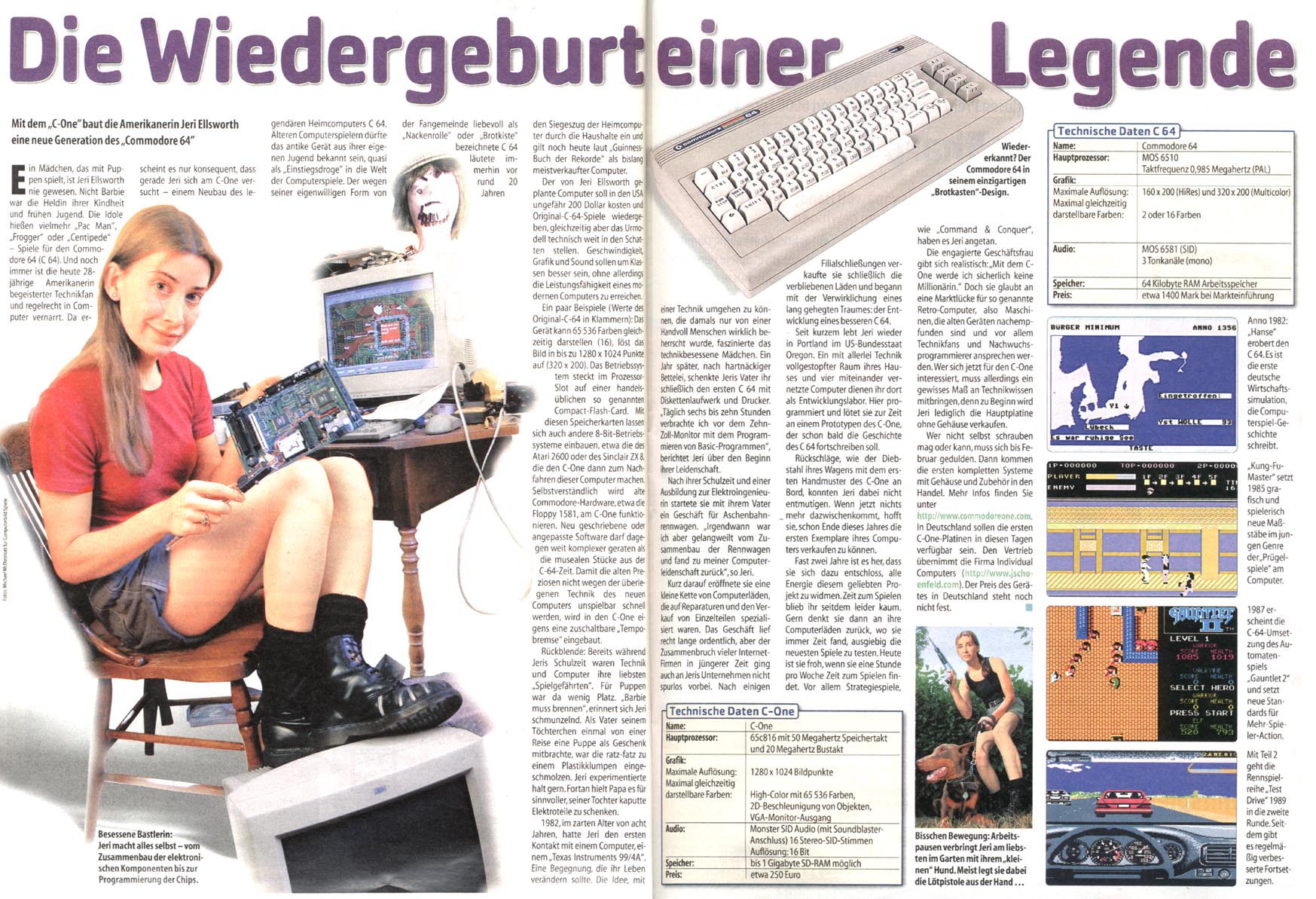
OSNews to interview Jeri and Jens :)
I am planning an interview with Jeri and Jens for OSNews.com with regard to the c-one and Catweasel board (targeted mainly at AmigaOne/Pegasos/AmigaOS emulation users) today. If there are any questions anyone would like to see answered, then you can suggest them here or send me an email.
I am planning to publish this interview somewhere next week. My interview/article will likely emphasize that the c-one is a reconfigurable solution, not solely for c64 fans. So stay tuned.
For the people who understand German, here's an interesting piece regarding the c-one by a German Mag.
Here's a video of an Amiga show where a prototype c-one was being demonstrated by Jeri. Also the Pegasos and AmigaOne were being sold at this event.
Some more pictures of Jeri and some interesting Pegasos demonstration video can be found here. -
It'll never happenwe'd be good to go....if someone plugged the OS X interface on top of Linux.
[snip]
1) the stability of linux
2) the price-point of linux
3) the beauty of the Aqua interface
there'd be no reason to ever own a windows machine again.You're right, and Apple knows it. It'll never happen, because Apple also knows that there'd be no reason to ever own an Apple machine again[1].
This would be like OSX on ix86: it could be the death of Apple. You might think that there's a way for them to do it safely, but I doubt that the big cheeses at Apple agree strongly enough to gamble their company on it.
[1] Yes, many Apple loyalists would still buy Apple for the nifty hardware and low-hassle experience. They certainly wouldn't get any NEW customers this way; people who were interested in a do-it-yourself solution would put this on non -Apple hardware. It wouldn't be cheap, but neither is an Apple.
-
Really hard workers
The OpenBSD team is a really great group of hard-working coders that don't stop with writing just average code.
This latest security measure goes to show why they're still #1 when it comes to really closing up a machine's holes to prevent abuse and unwanted infiltration into a system.
Unfortunately, they still can't get UltraSparcIII documentation that they need for their project.
I urge you all to contact SUN Microsystems and demand that they hand over the details of the US III series computers.
*nix.org -- Latest article > "Taming OS X" -
Screenshots
-
It's about back doors
This isn't about supporting Microsoft's business model. This is about being able to have the NSA tell Microsoft to stick back doors into its software, making it easier to conduct surveillance. (Also see here.)
If foreign governments switch to free software, the U.S. will have to try the ol' gcc backdoor maneuver, which may be harder now with all the md5 sums and digital signatures. -
Re:GobeProductive
well, gobe tried to go opensource, but is having trouble doing so. Also, several engineers from gobe have gone to apple.
-
Re:GobeProductive
well, gobe tried to go opensource, but is having trouble doing so. Also, several engineers from gobe have gone to apple.
-
Re:GobeProductive
well, gobe tried to go opensource, but is having trouble doing so. Also, several engineers from gobe have gone to apple.
-
GNOME Armageddonthis is the sixth text revision done on 04-11-2002.
dear reader the gnome armageddon has started,
first of all i want to clarify that this text was meant to be a source of information otherwise i wouldn't have spent so much time into writing it. belive me it took me a couple of days writing this text in a foreign language. even if you don't care at all for gnome, you may find some interesting information within this text that you like to read. please try to understand my points even if it's hard sometimes, otherwise you wake up one day and feel the need to switch to a different operating system.
on the following lines i'm trying to give you a little insight of the gnome community. the things that are going on in the back, the information that could be worth talking and thinking about.
many of us like the gnome desktop and some of us were following it since the beginning. gnome is a promising project because it's mostly written in C, easy to use, configurable and therefore fits perfectly into the philosophy of u*nix. only to name some of its advantages.
unfortunately these advantages changed with the recently new released version of gnome. the core development team somehow got the idea of targeting gnome to a complete different direction of users. the so called corporate desktop user. in other words they're targeting people that aren't familiar or experienced with desktop environments. usually business oriented people who are willing to pay money for getting gnome on their computers.
having this new target in mind, the core development team mostly under contract by companies like redhat, ximian and sun decided to simplify the desktop as much as even possible by removing all its flexibility in favor of an easy clean simple interface to not confuse their new possible customers. so far the idea of a clean easy to use desktop is honourable.
some of the new ideas, features and implementations such as gconf, an evil windows registry like system, new ordering of buttons and dialogs, the removal of 90%-95% of all visible preferences from the control center and applications, the new direction that gnome leads and the attitude of the core development team made a lot of users really unhappy. these are only a couple of examples and the list can easily be expanded but for now this is enough. now let me try to get deeper into these aspects.
you may imagine that users got really frustrated because their beloved gnome desktop matured into something they didn't want. during the time, the frustration of a not less amount of people increased. more, more and more emails arrived on the gnome mailinglists where users tried to explain their concerns, frustrations and the leading target of GNOME.
but the core development team of gnome don't give a damn about what their users are thinking or wanting and most of the time they come up with their standard purl. the reply they give is mostly the same. users should either go and 'file a bug' at bugzilla or the user mails are being turned so far that at the end they sound like being trolls or the user feedback is simply not wanted. whatever happens the answers aren't really satisfying for the user. even constructive feedback isn't appreciated.
if you gonna think about this for a minute then things gonna harden that they are directing into the commercial area. the core development team actually don't care for the complaining home user. it's more important for them to reach the customers with the cash. it seems that this has been told to them by the company leaders. everything about gnome has been decided already, a way back or direct communication isn't possible. don't get trapped by sentences like 'we listen to our users'. they listen to you - yes, to make funny silly jokes about you afterwards.
i thought that everything was build up on friendship, build on programming for fun, build on understanding each other. but the reality looks like it's all for the big money. the cash is what matters everything else is a lie and a dream. time for people to wake up.
not long ago they threw one of the most important long year core developer martin baulig out of team. a guy who worked really hard on getting gnome into the right direction. a nice friendly person who put all his time into gnome. but narrow minded gnome elites such as havoc pennington were responsible that he left the gnome project. the trouble and the pressure that was put on him was to much.
with the new gnome desktop a lot of user interface changes happened such as button reordering. needless to say that this confuse people who are used to the 'right' button ordering for ages. even our fellow linux guru alan cox wasn't thrilled about this idea. but the gnome elites such as havoc pennington, seth nickell, calum benson and dave bordoley knew it better. why following the road of any other desktop that exists ? why not doing something that don't confuse their users and still stay usable ? well it seems to be too easy. gnome needs to be different than anything else so they changed the button order which was one of the reasons that users became unhappy. they said that there was a hard fight about this and the decision was made to change the buttons. but i belive they simply copied the behaviour of macos because most of the gnome developers use a macintosh as either laptop or desktop. sad that they forgot to keep in mind that users tend to mix applications and that this will lead into weird button searching and clicking.
but as if this wasn't enough the same people decided that the new gnome human interface guides were the ultima non plus ultra in human interface guides. the announcement contained informations that the kde usability people got initiated into it. unfortunately the kde people heard about it the first time when seth nickell went to the kde mailinglist which happened after the announcement. you can imagine that they got highly pissed off about this attitude. you can read more on this link. to summarize it, the kde people clarified that gnome should care for their own business.
the problem that came with the new interface guides was, that every little gnome hacker started to become an user interface expert over night. a lot of gnome programs that we like to use matured into a disaster over night. hackers that never programmed correctly for their life started to blindly follow the hype of simplification. for an example look what happened to galeon's interface (pay attention for the last paragraph). even philip langdale a long year galeon hacker got highly indignant by the target that gnome leads and wrote this email to the galeon mailinglist.
here another reason why users became angry. the elite assumes, that the user knows nothing about their system. you find a couple of heavily insulting mails on their mailing lists containing sentences like the quoted ones.
- "the user don't know what a window manager is"
- "the user don't know what themes are"
- "the user don't know what a homedir is"
- "the user can't compile a kernel"
- "the user don't want to customize their desktop"
- "the user shouldn't see preferences which purpose they don't know"
such evil practices shouldn't be tolerated by the users and need to be fighted. u*nix users aren't stupid people. who actually gave havoc pennington the rights to decide what the user wants and what not ? various users told him that people who use a u*nix like system are well aware of their capabilities dealing with such a complex system. there's a reason why people are switching from alternative operating systems. they want to learn, they want to use the full power of the system, they want to change everything they like.
to top all this, look at the future plans of nautilus. the current maintainers got the idea of changing the whole nautilus concepts into an object oriented user interface design. you may be highly interested in reading the exact words of alex larsson's vision for nautilus' future direction by clicking on this link.
to summarize it, it's assumed that the user don't need to deal with his homedir or his whole filesystem because it may confuse him or because he don't understand it. the new concepts of nautilus should be that the user deal with symbols in the nautilus view. e.g. you get a cdrom symbol and by clicking on it you see the directory of your cdrom, you get a photo symbol and by clicking on it you get a list of all your pr0n pictures, you get a music symbol and by clicking on it you get a list of all your mp3's. you don't know where all these files are located because you don't deal with the bottom layer of your homedir or filesystem anymore as mentioned earlier.
the question is why are people that know nothing about their users, that know nothing about correct user interface design destroying gnome ? the users don't deserve all this specially those that backed gnome for all the years. even sun threw a bunch of so called user interface experts together and have them work on gnome. don't forget that sun are the creators of the common desktop environment. we don't need another cde clone named gnome. even havoc pennington author of the good user interfaces text isn't able to get his own written software following his rules.
not long ago there was an report about the 'two captains of nautilus' where the reporter (uraeus a gnome contributor himself) reported alexander larsson and david camp. you may imagine that such a report can't be taken serious because it's done by their own people. we here have a saying that sounds like this 'one crow doesn't hack the eye of another crow out'. now you can click on this link and read more. it may be interesting to read the replies from various users all over the globe of what they think about gnome and nautilus in general (please pay attention to the listed ip's there). another nice and informative reading can be found by clicking on this link.
the fileselector problem was a long discussed issue in the gnome community. finally they came to an solution for this and have decided to go for this ugly fileselector instead going for this one which was developed by a free volunteer for a long time and in general looks and behaves better.
most users have no problems with the idea of keeping things simple and clean. removing some not needed preferences was indeed a good idea but it doesn't stop. people started to remove everything from their apps. you're forced to use dubious programs like gconf-editor which basically works like the windows registry editor, to tweak uncommented preferences. i don't think that this is an advantage. even the possibility to tweak preferences with an editor was taken away with that ugly implementation of gconf. all your preferences are stored in a directory tree with an unknown amount of *.xml files. even if you delete programs their keys are still remaining orphaned in these trees and finding them is like playing trivia. at the end it's worth a discussion if a system driven by a single home user needs such a registry like system. we didn't need such a system for over 30 years but the gnome development team got the idea copying one of the most retarded systems from windows to u*nix. not to mention that the copy is more retarded than the original.
it's a shame to see how such a nice desktop got thrown into the trash by such people. but there is a lot more behind the scenes that i don't know about. everything around gnome is a big marketing strategy. poor people are working the hell out of gnome for nothing and companies such as those mentioned above are getting the big cash. for sure you could say - go and fork gnome - but seriously how can you go and fork gnome ? such a big project which needs a bunch of people to keep the code alive and compatible. well you know it's all about open source the code is signed under the gnu/gpl or gnu/lgpl, you can't own it. even the companies are aware of this. but if you can't own the code - go and hire their developers. you can direct them like puppets in any direction that you - as company - like. exactly this is happening with gnome.
well you could easily come up and tell me to simply not use gnome and let them do whatever they like. well, you are right with that but things are more complicated nowadays. gnome is influencing a lot of third party projects such as xfree86 which recently added a lot of gnome components into their cvs repository. please know that with the next coming xfree86 version you get a lot of gnome components without even knowing it. code like, gnome-xml, pkgconfig, fontconfig, xcursor and xft2 were mainly written by people who're heavily involved into gnome development. also the gimp is maturing more and more into getting the look and feel of a native gnome application. the cvs version of the gimp has a lot of gnome pixmaps inside and they are heavily working on integrate the gimp into gnome. if not today but the direction is sure and i fear the day this gonna happen.
it's ok that these things exist and it's ok to see xfree86 and the gimp are beeing hacked on. but please think about the people that don't like or use gnome. what about them ? why force them to have gnome components installed on their systems ? why can't gnome go the same way that kde went e.g. doing their own stuff without infecting other projects like aids. seeing more and more libraries and applications that were in no way related to gnome jumping on the pkgconfig boat which's really not needed. look what will happen to solaris, the world famous operating system on u*nix used by big companies and long years experts. they really plan to replace cde with gnome. i know that cde wasn't the best invention of desktops but it rarely crashed and it fits far better into the philosophy of xfree86 with their configuration system than gnome. you know the good old way having your settings defined with
well to come to an end i personally don't like many of this stuff. i can't stand the button reordering, i don't like the gconf system and even more i don't like the commercial outsourcing of gnome and the bad influence that gnome has on other applications. the bad attitude of some gnome developers is another story since we are all different reacting humans. luckily there are people sharing some of my thoughts otherwise i wouldn't be able to proof my text with so many links. even amongst the gnome developers there are silent voices of people that hate many of these decisions and silently use something else. right now if you checkout the gnome cvs repository every day you find out that the whole gnome development seemed to came to an halt. the contributions to their cvs are poor. while projects such as kde are reaching easily 10-20k commits per month - gnome is getting around 1-2k per month on it's best times. it really looks like the situation of gnome is unclear so it would be better to have it not influence so much other programs or at the end we deal with an disaster.
now i hope this text was informative for you. i hope that you start to think about the situation and the global direction. the situation of gnome is unclear, their target is groggy too since i can't belive that the users that they are targeting ever heard of u*nix or linux. they plan to get out of the 0.05% desktop niche but this will for sure not happen if they continue their current direction and their bad ugly
-
Re:DebianI have used early slackware and used RedHat from 5.1 - 8.0.
A couple of weeks ago I needed a LAMP (Linux, Apache, MySQL, PHP) server to test Tutos and a co-worker talked me into trying Debian because I was having problems with the Apache/PHP in RH 8.0. The first install was a bit of a hassle and then I found this article" The Very Verbose Debian 3.0 Installation Walkthrough and all is right with the world.
The box was easily 30% faster than RedHat 8, Tutos actually worked and the install was less than a gig. I have been slowly adding the additional toys I need (you know, traceroute - stuff like that...) and I have yet to reboot.
The Debian team could certainly use some help with the installer (Tasksel is evil!) but I like the "purity" of the installation I got. No, I'm not running the latest kernel but damn is the box fast...
I would love to see a distro with the stability and discipline of Debian with the graphical installer, hardware config, and desktops in Mandrake and RedHat. I will never go back to RedHat so I will just settle for the stability and discipline of Debian no matter what happens.
-
slashdot's new slogan
Slashdot: news for nerds. Stuff that you saw on osnews.com two days ago.
-
Re:CE
The reason for this thinking is that I worked for a company that used WinCE in their radios, and the radios actually worked -- we didn't produce crap and then sell that, I know that for a fact!
Well, that's all well and good, but I think you may not have been pushing the OS very far.
Now, I'm not familiar with WinCE APIs, but if they're anything like the Win32 API, then the fault is probably with the OS (or more specifically, the API documentation for the OS.)
Alexandre Julliard (WINE project leader) put it best in this interview: "If you want to design a good API, Win32 is the last thing you want to start from (actually Win32 is probably a good example of how *not* to design an API
His answer to question 4 (how do you overcome problems with the poor documentation) is particulary telling.
Point I'm trying to make is even if they used something like QNX, judging from the oodles of problems this vehicle has, the software would have been just as much crap as it is under CE.
And judging from the difference in the quality of the documentation between QNX and Windows, I'd disagree. Perhaps they're not familiar with WinCE's quirks - but that doesn't mean they're bad programmers.. garbage in, garbage out, right? -
FUNNY....
That's funny...
those are the EXACT SAME WORDS that appeared on the OSNews front page two days ago. -
Menu sizing/spacing
Most of the screenshots look very close to XP (such as the network status applet, for instance), but the menu spacing & sizing doesn't look right (most easily seen in the task manager pic).
Ever since Eugenia Loli-Queru mentioned it in her review of KDE 3, I can't help but noticing that so many Linux apps suffer from odd menu sizing and spacing. (In due credit, Gnome isn't nearly so affected, as a whole.)
Important! The menu entries on every KDE's applications are extremely close to each other. Give it 4-5 more pixels please! The new Gnome 2.0 does it lovely and correctly in this respect.
(That quote is from the second page of her review.)
-
Menu sizing/spacing
Most of the screenshots look very close to XP (such as the network status applet, for instance), but the menu spacing & sizing doesn't look right (most easily seen in the task manager pic).
Ever since Eugenia Loli-Queru mentioned it in her review of KDE 3, I can't help but noticing that so many Linux apps suffer from odd menu sizing and spacing. (In due credit, Gnome isn't nearly so affected, as a whole.)
Important! The menu entries on every KDE's applications are extremely close to each other. Give it 4-5 more pixels please! The new Gnome 2.0 does it lovely and correctly in this respect.
(That quote is from the second page of her review.)
-
Nice features
First, this is old news at OSnews here but also
Gnome 2.2
New HTree enable filesystem for ext3 (speeds enhancement). The HTree feature makes file creation, deletion, and lookup faster. On filesystems that have HTree enabled, these file operations should not get significantly slower as the directory grows in size.
XFree 4.3
CUPS is default
but also note SENDMAIL is now only configured for LOCALHOST, if you want to serve you have to do some modifications:
To use Sendmail as a server
By default, the Sendmail mail transport agent (MTA) does not accept network connections from any host other than the local computer. If you want to configure Sendmail as a server for other clients, you must edit
The RELEASE NOTES can be found HERE
NOTE: There has been problems upgrading if one if using Ximian Gnome, you must uninstall then reinstall using Gnome form gnome.org -
Re:This is great-or is it?
Here! Here!
I really don't know what the big deal is all about. Have been running RH 8.0 since it was ISO-available. Haven't experienced a single problem -- and I use it on the KDE side.
Have heard some bad stories from others, but they seemed to be hardware-related issues, every time.
When I go from home (RH 8.0) to work (RH 7.3) I often wish I had the time to upgrade my workstation at work! (Yes, it's that much better.)
Your milage may vary...
Oh! And if you do use KDE (or want to play MP3s on XMMS, etc.), this really helps. -
Glad I'm not a /. subscriberCause I'd be pissed at the low value. This is pathetic. I mean, do the editors even read this site?
Enough is enough. Time to check out osnews and ditch slashdot. I know I'm not the first to get tired of the repetition, but it's time someone starts calling for the mass exodus.
-
Re:slow down timothy
Clickable link: osnews.com
-
This is so lazy
There is something I find annoying with Slashdot, it's the bad habit of posters to leech news from other sites that already refer to a previous coverage on another site. This is absurd: I click on Slashdot's link to go to geek.com's link, which sends me to The Inquirer, from which I can finally have the real thing. Is this only me that is irritated or what? Hey, when I read the same news first on OSNews (who at least have the decency to redirect to original sources more often) and that some hours after I see that same story on Slashdot, but with the link pointing to OSNews, I find that a bit ridiculous. Not that I think it wrong to acknowledge that news posted on Slashdot came from another news aggregator (that's how one learns about the other ones), but the point is that you end up with a neverending arab telephone, and the guy down the line says black when you're posting white. Or else it's a new way to counter the slashdot effect, and I'm not just getting it.
-
About the current MorphOS/ABOX
Do note that everything you currently see within those screenshots is the ABOX environment. This ABOX uses a reimplemented Exec kernel (AmigaOS) on top of an "alien" (read non AmigaOS-like) kernel called Quark(/MorphOS), with this kernel(/OS) being completely hidden from the user. So currently this OS uses a two kernel approach, unlike AmigaOS4 which will use a new fully native ExecSG kernel with alot more added features (compared to the classic Exec or MorphOS' reimplemented AmigaOS3.1 Exec).
This approach could be largely compared to Wine, but is in use and approach more similar to the Amithlon AmigaOS emulator, as its hides the underlying technology completely from the user. In the case of Amithlon this is Linux.
For instance the directory structure, startup-scripts, components structure and features are currently the same or similar to the way the classic AmigaOS was designed. Instead of to the PPC native Ambient environment, MorphOS users are even able to use the classic AmigaOS3.1 Workbench environment on top of this MorphOS/ABOX environment. Regarding to what the QBOX environment will be like in usage (i.e. AmigaOS-like) in the future, very little is actually still known.
That this all is possible can mainly be attributed to the fact that the classic AmigaOS is extremely modular, for most OS components there are several 3rd party alternatives available. For example Workbench/Magellan/Scalos, Reaction/MUI or Picasso/Cybergraphix etc. -
Here are some related links...I'll save everybody some time and post some related links: Posting anonymously so noone thinks I'm a karma whore.
-
Re:More programs should be this way