Slashdot Mirror
Domain: penny-arcade.com
Stories and comments across the archive that link to penny-arcade.com.
Stories · 143
-
Xbox One Released
Microsoft released the Xbox One today, putting the next-gen console war into full swing. A common theme throughout most of the reviews is that properly evaluating the system is going to take time. Not only are updates for the console continuing to roll out, but the usefulness of some of its technology will depend on what game-makers and other content producers can do with it. Digital Foundry says, "It is willing to make the trades on gaming power in order to potentially revolutionize the way we interact with entertainment in the living room." The Penny Arcade Report calls the hardware and UI a "confusing mess" — until you learn to use it, at which point the hands-free navigation is fast and convenient. Polygon's review is once again visually-oriented, providing a good look at the UI, comparing the controller with the Xbox 360's controller, and giving a demonstration of how Kinect recognizes users. Their conclusion is that while "Kinect isn't a fully realized product yet," "the Xbox One feels like it's from the future." iFixit has a full teardown of the Xbox One, giving it a repairability score of 8/10 (the Kinect sensor gets 6/10). HotHardware has more details about the console's internals, including power consumption and temperature readings. Eurogamer has a compilation of launch coverage, including launch title reviews. -
Sony Unveils the PS Vita TV and Slimmer Vita Handheld
Dave Knott writes "Sony today announced the PS Vita TV box. Measuring 6.5cm by 10.5cm, it can play Vita games on your television, stream content via HDMI or wirelessly, and play all the existing PlayStation Network content available on the standard Vita platform. This is seen by some analysts as an attempt by Sony to compete with such devices as the Ouya and Apple TV. The PS Vita TV is so far announced for a Japan-only release in early 2014 at a price of approximately $100 US. In related news, Sony also announced a lighter, slimmer, more colorful iteration of the standard Vita handheld console." The $100 model does not come with a controller; a $150 model was also announced that will include a Dualshock 3 and an 8G memory card. -
Steve Ballmer's Big-Time Error: Not Resigning Years Ago
Nerval's Lobster writes "Any number of executives could take Ballmer's place, including a few he unceremoniously kicked to the curb over the years. Whoever steps into that CEO role, however, faces a much greater challenge than if Ballmer had quietly resigned several years ago. Ballmer famously missed the boat on tablets and smartphones; Windows 8 isn't selling as well as Microsoft expected; and on Websites and blogs such as Mini-Microsoft (which had a brilliant posting about Ballmer's departure), employees complain bitterly about the company's much-maligned stack-ranking system, its layers of bureaucracy, and its inability to innovate. Had Ballmer left years ago, replaced by someone with the ability to more keenly anticipate markets, the company would probably be in much better shape to face its coming challenges. In its current form, Microsoft often feels like it's struggling in the wake of Amazon, Google, Apple, and Facebook." In an interview with ZDNet, Ballmer said his biggest regret as CEO was in how Windows Vista was developed. Opinions are divided on both the nature of his resignation and what it will mean for Microsoft. While the stock price is up, BusinessWeek and others suggest the purpose of the transition is to find somebody better able to anticipate future trends. That would certainly lead to more organizational changes within Microsoft, something employees suffered through just last month. Ben Kuchera at the Penny Arcade Report points out that this could mean Microsoft will try to re-enter markets it has abandoned. He asks the company to "stay the hell away from PC gaming." -
Xbox One Used Game Policy Leaks: Publishers Get a Cut of Sale
Chewbacon writes "Details about the used-game policy on Microsoft's newly-announced Xbox One console have been leaked. The policy explains how used-game retailers can survive Xbox One destroying the used-game market as we know it: they have to agree to Microsoft's terms and conditions to do so. In summary, the used game retailer can still buy the game from the consumer, but they must report the consumer relinquishing their license to play the game to a Microsoft database. They must also sell it at a market price (35£ in the UK), but the publisher will get a cut of the price. The article goes on to explain how Xbox One will phone home periodically to verify a player hasn't sold the game according to the aforementioned database." A big downside is that we're likely going to see the end of cheap, used games. A potential upside pointed out by Ben Kuchera at the Penny Arcade Report is that this would unquestionably boost revenue for game publishers, giving the smart ones an opportunity to step away from the $60 business model and adopt pricing practices seen on Steam and iTunes (neither of which allow the purchase of "used" games/media). Also, it's worth noting that even if the policy leak is 100% correct, it could change before the console actually launches. -
EVE Online Getting TV, Comic Book Adaptations
CCP Games, creators of the successful space MMORPG EVE Online, have announced they will be harvesting stories from within the game to create comic books, a TV series, and possibly even films set in the EVE universe. EVE has never set records for the size of its userbase, but it's long been known as a game that generates some of the best emergent gameplay in the industry. From battles involving thousands of players to in-game confidence schemes involving currency worth tens of thousands of real dollars, it's likely you've heard about players' exploits even if you haven't played the game. CCP is now looking to bring the EVE universe to a wider audience, and rather than having a group of writers dictate all of the lore, they're letting the players take part. They've set up a site where users can share their tales and vote on those of others. CCP has partnered with Dark Horse Comics to make a comic book out of the stories, and with a production company to make a live-action TV show. -
EA Repeats As 'Worst Company In America'
An anonymous reader writes "Electronic Arts has successfully defended its title as the 'Worst Company In America.' Consumerist finished its annual tournament for bad companies, pitting notorious companies against each other in a single-elimination bracket where readers vote on which is worse. EA won last year, and today Consumerist announced the results of this year's final vote. EA was voted worse than Bank of America by 78% of participants. 'A made a royal mess of the SimCity release by failing to foresee that the people who would buy the game — and who would, per the game's design, be required to connect to the EA servers — might actually want to play at some point in the week after making their purchase. But that's just the latest in EA's long history of annoying its customer base with bad support.' Of course, EA saw this coming, and its CEO pre-emptively responded last Friday. Of course, many of his explanations and promises rang hollow for gamers who are sick of the company's practices: 'Until EA stops sucking the blood out of games in order to make uninspiring sequels, or at least until they begin caring about how much gamers hate their lack of respect for our money and intelligence, this is going to continue. We don't hate them because we're homophobes, we hate them because they destroy companies we love. We hate them because they release poor games. We hate them because they claim our hate doesn't matter as long as we give them our money.'" -
How EVE Online Dealt With a 3,000-Player Battle
Space MMORPG EVE Online is best known for its amazing stories, and on Sunday it added a new epic tale. The leader of a huge coalition, preparing for a moderately sized assault, mis-clicked and accidentally warped himself into enemy territory without his support fleet, endangering his massive ship worth an estimated $3,500. Realizing the danger, he called upon every ally he could, and the enemy fleet rallied in turn, leading to an incredible 3,000-player battle. What's also impressive is that the EVE servers stayed up for the whole fight, when most MMOs struggle with even a few hundred players at the same time. The Penny Arcade report spoke with CCP Games for some information on how they managed that: "It’s hard to wrap your head around, but they sometimes move the in-game space itself. 'We move other solar systems on the node away from the fight. This disconnects anyone in those systems temporarily, but spares them from the ongoing symptoms of being on an overloaded server,' Veritas explained. 'It helps the fight system a little bit as well, especially if a reinforcement fleet is traveling through those other systems. This was done for the fight over the weekend, but is rare.' ... They do have a built-in mechanism for dealing with massive battles, however: They slow down time itself. ... Once server load reaches a certain point, the game automatically slows down time by certain increments to deal with the strain. Time was running at 10% speed during this 3,000-person battle, which is the maximum amount of time dilation possible." -
Making a Slashdot Omelet
It's been said that the mix of stories on Slashdot is like an omelet: linux and tech, mixed with science and Legos, and a few reviews and sci-fi folded in. It's not just the stories that are a good mix, however, it's the people behind them. Through the past 15 years, an unusual cast of characters have been responsible for keeping the site up and running and bringing you the stories you want to read. We've asked a number of them to write a few words about their time working here and to share a few memories. Below you'll find that some of our former employees don't know what "a few words" means, and a collection of what bringing you news for the past 15 years has been like. Chris DiBona
Right after they had switched from being Chips & Dips to Slashdot, I was working at a company called VA Research. VA Research, at the time, shipped Linux hardware to dotcoms and other people and that was groovy. I liked Slashdot. It was fun. That was really the only place to go to find people who gave a crap about Open Source and free software at the time.
I said to them, "Hey. What if I just send you some hardware so that you can beef up the site a bit." They're like, "Oh my god. That'd be so helpful. Please send it." I did, they got the hardware and it was pretty helpful, it seems. They re-wrote the [Ad Foo], ad servicing system at that point and we were the base ad, so if they had no ad to show, it'd just show a VA Research ad as a thank you to us.
That went on for a year and a half, two years, I want to say, except for in classic Rob, Jeff, me style. It showed the same ad for two years and we would know that the site was broken, or Ad Foo was hosed, because it would show the ad with chips that were four years out of date. That's how I got involved and how I got to know the guys
Nathan Oostendorp
My only real association with the site is with the technology, and what I remember about Slashdot is that it was an entirely "seat of the pants" affair - there were no patterns laid down to follow, it's not like there were a hundred other sites using MySQL and there wasn't much precedent for using a database backend in the first place -- it was routinely even condemned as being risky. We had this feeling of "okay we've discovered that using Perl and MySQL to create pages of HTML is pretty awesome" so we played around a lot. Slashdot was the main thing, but there were a bunch of other projects like DJ Hernandez, which was I guess an early version of Spotify, and the original Everything (cum Everything2) which was kind of a proto-wiki system.
Fundamental to Slashdot was the Story submission and moderation system, and then the comment system, and the several dozen (what would now be called RSS feeds) for "Slashboxes" which at the time were a lot of HTML regex cron jobs from yours truly. We had idea that all the information on the internet was going to be accessible, and Slashdot could be the channel for it. The universe we were living in, everything was accessible and Slashdot could be the "geek lens" for everything to flow thru.
Very quickly we started realizing that we had to make money doing this business and so we created an "open source ad system" called Ad-fu (Inspired by one of the quote by the X-Files Lone Gunmen "my kung-fu is the best"). I spent an inordinate amount of time building this system, which was quixotically designed to put DoubleClick out of business -- once you've mastered mod_perl and databases, scheduling ads and counting the results should be easy, right? Ad-fu was several weeks of my full-time effort and got us through about 18 months and the acquisition by Andover.Net, at which point it was migrated to their Ad System which was written in C and flat files "for scalability"...
After the acquisition my relationship with Slashdot was intermittent -- the "ajax-y" single-page comment system was originally based on a hacked-up prototype I did in grad school in the mid-00s. I got my black belt in Perl, MySQL, and web programming thanks to Slashdot, and it's served me well as a practitioner in the ensuing 15 years.
Rob "CmdrTaco" Malda
15 years ago I spent every spare moment building a website hosted on the silliest domain name I could think of. I ran polls asking how many shots my roommate should drink. I posted stories detailing personal art projects, or explaining how our car broke down driving from Michigan to North Carolina. Somewhere between then and now, amidst all the movie & kernel releases, technological breakthroughs, and ceaseless threats from governments and corporations, I came to understand that Slashdot was itself made out of The Stuff that Matters. My heartfelt thanks go out to everyone who remembers.
Jeff "Hemos" Bates
One of the things people often have asked about over the years is, how did you guys know you wanted to build this business? Yeah, well we didn't, is the reality. There was no Machiavellian plan, there is nothing like that, it was absolute sheer evolution, I think that's a good way to put it. Which made for some particularly interesting discussions with BC's and people who wanted to buy it in the early years. Because, they would ask things like, well what is your burn rate. And I would say, well the landlord likes to be paid and I like to eat, so there isn't one.
I think in terms of things that Slashdot did that meant a lot to me or I am proud of, I think the post-Columbine stuff that John Katz did. I know I just said John Katz so we might as well just turn on the troll radar right now. I like John just for the record.
John is a great, very thoughtful guy. And I think that what he did during Columbine, for giving a voice to the freaks and weirdoes, and by no means am I saying that, I don't even remember their names, Eric and Dylan, I guess? That what they did was a good thing. Not at all, that was a terrible, terrible thing. But, I think that the writing that he did and the discussions that happened around that was fantastic. I think that that is a situation that is the epitome of why sites like Slashdot and social media sites are so important and meaningful. It was knitting together people all across the country, and all across the world where they didn't have a lot of people around them that they could talk about this with. They had to go online to find a community that understood what it was that they were trying to say.
Jon Katz
Slashdot was an important place for me, if not a great fit. I loved the energy of the site, and the Linux ethic looks stronger now even than it did then. After Columbine, I wrote a series on the site called "Voices From The Hellmouth" and it was one of the most important pieces I ever did. If convention media had followed the idealism and values of Rob and Jeff, they might not now be such a shambles. Slashdot was a revolutionary website, a landmark in Internet history. I was very proud to have written there.
Emmett Plant
“You wrote for Slashdot?”
I get this a lot, even twelve years after I’d written my last piece. It happened again just two weeks ago, talking to a guy from InfoSec.
I was young, idealistic and had no idea what I was doing. I imagine that for most of us, this is still true. We didn’t write for a market or to capitalize on a trend. We wrote about things we liked, and tried to get other people to like them, too.
A cynical perspective could see Slashdot as a place where angry nerds gather and rant anonymously about the topics of the day, but it misses the point. It’s actually a place where hundreds of thousands of people show up to say, ‘Hey, look at this thing, isn’t it cool?’
Sometimes the answer is yes, sometimes it’s hell-no, but there’s always an answer.
Nerds are some of the weirdest people you’ll ever meet. They also tend to be intelligent, opinionated and enthusiastically kind. Twelve years later, Slashdot still makes that obvious -- Even when the readers are loudly complaining about software patents, arguing about intellectual property and demanding new Firefly.
“What was it like?”
Rob Malda had managed to learn most of Darth Maul’s moves, and was terrifying with a dual-bladed lightsaber toy. We knew every word to ‘Cowtown’by They Might Be Giants, and we broke out into song while driving down a highway in Michigan. The ‘geek compound’was actually a few houses at the end of a suburban cul-de-sac. Jeff Bates did a killer Dr. Evil impression, and was able to eat clementines at a terrifying pace. The one-and-only time I’d ever visited the aforementioned ‘compound,’I had a flu and was taking a terrifying amount of medication for it, which led to me saying wildly inappropriate things to people I’d just met. No one really seemed to care. I slept on CowboyNeal’s couch, and learned that Rob and I had not only run BBSes ‘back in the day,’but ran them on the same software as well.
I wrote a lot of pieces that I still enjoy to this day. I also wrote a lot of pieces that I’d prefer to never see again. I approved some stories that I shouldn’t have, and rejected a lot of stories that probably should have gotten more attention. Have I mentioned that I had no idea what I was doing?
I enjoyed my time at Slashdot tremendously, and I wouldn’t trade it for anything in the world. It’s unsettling to know that what you’re typing in vi tonight is going to be in front of more than a million smart people tomorrow morning. Then those smart people will be encouraged to comment on what you write, telling you exactly how much of an unparalleled genius/complete moron you are. They may even make a chart.
No matter what we had to say on the site back then, everything at the time was colored by money. The dot-com investment mania was at full strength, and there was a wildly inaccurate assumption that we were all hip-deep in filthy lucre. Writing about technology isn’t terribly lucrative, even if you’re writing for one of the most popular sites on the planet. Putting the technology to use is considerably more valuable: When I left tech writing and journalism to go back to work as an engineer, my income more-than-doubled.
“All good things...”
I left Slashdot to take over as the editor-in-chief of Linux.com, which ended up being a beautiful disaster. I went back to engineering for about a year, then took over as the CEO of the Xiph.org Foundation for a while, and then went back to engineering again. I started a production company and was able to fulfill childhood dreams by working on Star Trek and writing a lot of music for video games. My current time is divided between working in systems engineering, managing my production company and training for my private pilot certificate here in the Valley of the Sun.
I still love tech, and I still love sharing cool new things with people I barely know.
I still run Linux machines at home, at work and in outside projects.
I still think the DMCA is a terribly stupid piece of legislation.
I still throw down with pudge on political matters.
I still read Penny Arcade, run a BBS and hang with trekkies.
...and I’m on IRC right now.
Jonathan "CowboyNeal" Pater
My fondest memories of Slashdot are always those that surround the events when people came together to effect a positive change. Starting already in the site's infancy when there was a real push among our readers, spurred on by one of CmdrTaco's editorials, to open the source of Netscape. When it actually came to pass, it was clear that in addition to being a fun way to keep up on the news and waste some time during coffee breaks and slow work days, Slashdot could be a force for good as well. Years later, we still haven't been able to influence any sort of software patent reform, but, we can keep hoping.
I always enjoy the Slashdot interviews. We've been able to interview a diverse group of people that ranges from David Korn and Rob Pike, to mc Chris and Warren Ellis. I feel that that diversity is something that makes Slashdot more interesting than just a technology news site, and the ability to pass questions on to the interviewees from our readers makes for an interesting article.
The other memory foremost in my mind, is of the infamy of being the most ubiquitous Slashdot poll option of all time. I read not long ago via Wikipedia that this was because I was in charge of the polls, and had inserted myself into them. This isn't true at all, but because Wikipedia needs a source to quote, I feel that now for our 15th anniversary, is a good time to set the record straight. While I've never been fully "in charge" of the polls, I did make plenty of polls over the years, but I never put myself into one. The honor and prestige of starting that tradition belongs to Chris DiBona, and even after he moved on from Slashdot, the other editors managed to keep it alive. I'd like to both thank and forgive him, for starting the tradition. I never kept track if I ever won any of the polls, but I have to assume I won at least one of them. That time, whenever it might have been, was pretty sweet too.
Finally, I want to thank everyone who ever emailed me over the years. To be sure, it's often been a deluge of stuff to wade through every morning. I may or may not have had time to respond to your particular email, but I read all of them eventually, even the nasty ones. Thanks for writing me, but most of all, thanks for reading the site. It's the readers that make everything possible. -
The Ugly, Profitable Details About Xbox Live Advertising
An anonymous reader writes "In an editorial at Penny Arcade, Ben Kuchera writes about how Microsoft's subscription-based Xbox Live platform has become an advertising cash cow — to the detriment of users who already pay for the service. Quoting: 'People who don't play video games would be forgiven if they turned on an Xbox 360 and didn't realize it was a device used to primarily play games. The first screen you see on the Xbox 360 Dashboard is often a mixture of ads for all sorts of goods and services, and many times games are in the minority of ad slots. The latest redesign increased the ad space that can be sold to advertisers, and that in turn increased this problem. Let's be clear, it is a problem. Game discovery is terrible in the current design of Xbox Live, and the usability of a system that used to be about games is suffering in order for Microsoft to make money on ads. Sadly, this issue isn't going away: Ad sales simply bring in too much money to ignore, and revenue is growing. ... I contacted Microsoft and asked how much advertising revenue impacted the profitability of the Xbox 360. "We don't share this information publicly but we can tell you that, since 2010, the advertising business has grown 142%," I was told.'" -
PR Firm Unwisely Tangles With Penny Arcade
New submitter FSWKU writes "Courtesy of Penny-Arcade, Paul Christoforo of Ocean Marketing provides a perfect example of what not to do when interacting with customers, especially if you are doing so on behalf of another company. There's name dropping, an ego trip worthy of Charlie Sheen, and even what appears to be a promise to commit libel. Other outlets are already picking up the story and running with it, and an examination of Ocean Marketing's website has generated accusations of plagiarism." -
Minecraft Enterprise and 16-Bit ALU
tekgoblin writes "Joshua Walker spent the last few months creating a masterpiece. He created the Starship Enterprise 1701-D from Star Trek: The Next Generation in Minecraft using just blocks. He recorded a short video of him explaining how he did it and even gave us a sneak peek at the partially completed ship." He also posted on the Penny-Arcade forums about how he did it. If you aren't impressed by that, perhaps you should check out a 16-Bit ALU also implemented in Minecraft which totally reminded me of one of my favorite XKCD comics. -
Swine Flu Outbreak At PAX
whisper_jeff writes "There's been a confirmed outbreak of Swine Flu at PAX. Those who attended and are feeling under-the-weather after the con should not write it off as a typical convention cold and go see a doctor to make sure, just in case." The linked post also lists the airplane flights of the cases known so far, so if you flew from Seattle on Sunday, Monday, or Tuesday for any reason, you might want to compare your itinerary. -
Game Distribution and the 'Idiocy' of DRM
In light of the increased focus on the DRM controversy in recent days, Ars Technica did an interview with execs from CD Projekt's Good Old Games about where the problems are with current DRM implementation. "For me, the idiocy of those protection solutions shows how far from reality and from customers a lot of executives at big companies can be. You don't have to be a genius to check the internet and see all the pros and cons of those actions." Penny Arcade is also running a three-part series on DRM from game journalists Brian Crecente and Chris Remo. Crecente talks about how some companies are making progress in developing acceptable DRM, and some aren't. Remo recommends against a trend of overreaction to minor gripes. -
Game Distribution and the 'Idiocy' of DRM
In light of the increased focus on the DRM controversy in recent days, Ars Technica did an interview with execs from CD Projekt's Good Old Games about where the problems are with current DRM implementation. "For me, the idiocy of those protection solutions shows how far from reality and from customers a lot of executives at big companies can be. You don't have to be a genius to check the internet and see all the pros and cons of those actions." Penny Arcade is also running a three-part series on DRM from game journalists Brian Crecente and Chris Remo. Crecente talks about how some companies are making progress in developing acceptable DRM, and some aren't. Remo recommends against a trend of overreaction to minor gripes. -
Dungeons and Desktops
Aeonite writes "Dungeons and Desktops: The History of Computer Role-playing Games chronicles the rise and fall of the Computer RPG industry, from Akalabeth to Zelda and everything in between. While the bulk of the book is devoted to the genre's 'Golden Age' in the late '80s and early '90s, author Matt Barton explores the entire history of CRPGs, from their origins in the mid '70s to the very recent past. While not entirely comprehensive, the book covers not only the major players and award-winners, but also dozens of obscure 'also-ran' as well as notable games in related genres." Keep reading for the rest of Michael's review. Dungeons and Desktops: The History of Computer Role-playing author Matt Barton pages 451 publisher A.K. Peters Ltd rating 7 reviewer Michael Fiegel ISBN 978-1-56881-411-7 summary A detailed history of CRPGs Barton first defines the genre, insofar as one is able to do so, explaining that a CRPG generally includes elements such as: a system of statistics to track characters (ability scores and skills); the ability to advance characters via experience points; and randomized combat. Barton further attempts to define the genre by comparing CRPGs to what they are not, including JRPGs (Final Fantasy), MMORPGs (World of Warcraft), Adventure Games (Zork), and Strategy Games (Warcraft). A bit later, he explores the origins of the CRPG, listing Baseball Simulation Games (such as Strat-O-Matic), Tabletop wargames (Chainmail), Tolkien, Colossal Cave Adventure, and (of course) Dungeons & Dragons as having had an impact on the creation and evolution of the genre.
The next nine chapters of the book are devoted to the history of the CRPG, which Barton breaks down into six phases, somewhat akin to Hesiod's Five Ages.
The Dark Age covers the period of time from 1974 through the end of the decade, and includes PLATO and Mainframe games such as pedit, Dungeon, dnd and DND (not to be confused with each other, or with D&D or D&D), Oubliette, Moria, Avatar and Orthanc. Also included here, somewhat out of chronological order, are a discussion of Rogue and Rougelikes (Hack, Moria and Angband) and MUDs all the way through to 1989's TinyMUD. The Bronze Age of the CRPG begins in 1979 with the publication of Lord British's Akalabeth: World of Doom (which would go on to sell thousands of copies, making it the first commercially successful CRPG, if not exactly the first) and includes a host of obscure titles, including Wizards Castle, Eamon, Space and Empire, The Tarturian, Odyssey: The Complete Apventure, and Dunjonquest: Temple of Apshai. In 1983, Bronze turns to Silver with the appearance of the Ultima and WIzardry trilogies, games which truly began to lay the groundwork for all that came after. Also mentioned in this chapter are less well-known games such as Sword of Fargoal, Dungeons of Daggorath, Tunnels of Doom, Ali Baba and the Forty Thieves, and Universe.
The Golden Age dawns in 1985, bringing with it the refinement of prior ideas and the perfection of the genre's underlying systems. Barton divides coverage of this age into three chapters. The first covers the Early Golden Age, beginning with the console crash of 1983 and ending with the arrival of the NES in 1985. The CRPG market survived the crash rather unscathed, and in fact flourished thanks to games such as Phantasie, The Wizard's Crown, Ultima IV, and Autoduel. Most notable of all, of course, was 1985's The Bard's Tale, which spawned two sequels (three, if you count 2004's "spiritual sequel" starring Carey Elwes), both of which also receive some attention here.
It is here where the book's structure begins to drift a bit. By Barton's own admission, progress in the CRPG industry is "neither linear nor orderly," and in fact the attempt to align CRPG titles, trilogies and series along a single timeline almost necessarily breaks down. The Bard's Tale trilogy seems as if it would more properly be discussed in the next chapter (The Golden Age Part I). Instead, Barton calls it "The Dawn of the Golden Age" and places it about a third of the way into the "Early Golden Age" chapter, where it somewhat loses some of its impact. Further confusion surrounds the inclusion here of Might and Magic Book I: Secrets of the Inner Sanctum; published in 1986, it is not only followed by a discussion of Alternate Reality: The City (published in 1985), but is preceded by a lengthy discussion of several games which came after it, including The Magic Candle (1989) and Bloodstone (1993). While the author has thematic reasons for covering these games here, one wonders if a strict chronological order would have served better. Even Barton seems a bit off track when he invites the reader to "turn to the second half of the Golden Age," which runs from 1987 to 1993 (for those not keeping track, the first "half" only ran from 1983 to 1985). I don't mean to nitpick over throwaway segue lines, but in a book with a historical focus, the time-shifting is just a bit disconcerting.
Regardless, "The Golden Age Part I" covers the period of time that many consider to be the era of the CRPG, when companies like SSI, Origin, Interplay, and New World Computing dominated not just the CRPG industry, but the computer game industry as a whole. Ample coverage is justifiably given to SSI's Gold Box games, including Pool of Radiance, Curse of the Azure Bonds, Secret of the Silver Blades, and Pools of Darkness. Somewhat curious (to me) is the omission here of any discussion of AD&D Second Edition, which was released in 1989 and officially introduced the concept of THAC0 (which appeared in Pool of Radiance). Other titles covered in this lengthy chapter include: SSI's Krynn trilogy and Savage Frontier games; the original Neverwinter Nights on AOL; Ultima V, VI and VII; Wizardry VI and VII; Might and Magic II, III and so on; Neuromancer; and Interplay's Wasteland.
The next chapter, "The Golden Age Part II," is devoted to JRPGs and groundbreaking CRPGs with real-time 3d graphics that appeared alongside the aforementioned CRPGs. Covered here in the JRPG category are games such as: The Legend of Zelda and its sequels; The Dragon Warrior series; Final Fantasy; Chrono Trigger; Super Mario RPG; and the Phantasy Star series. The chapter also covers Sierra On-Line's Quest for Glory series; the SSI Black Box games (including Eye of the Beholder); Dungeon Master ("the most successful Atari ST game ever released") and its many clones; and other notable genre-bending games including Beyond Zork and Star Saga.
Here again, we fall into a small hole in the timeline, for The Golden Age ends in 1993 and the next age doesn't begin until 1996. The chapter covering this black hole is called "The Bigger They Come," as if suggesting that Barton was unwilling to give a name to this second Dark Age of CRPGs. Here we see coverage of a variety of bad CRPGs, including Interplay's Descent to Undermountain, Ultima VIII and IX, and the Gothic series (which surely deserves more than the two paragraphs it gets). Covered in more depth is SSI's fall from grace following the publication of an assortment of sub-par D&D titles (including Spelljammer, Dark Sun, Al Qadim, and others) and the ensuing loss of their license with TSR. Some attention might have been paid to the "fall from grace" of TSR itself, which suffered financial ruin in the years that followed and was ultimately purchased by WOTC in 1997.
Ever the optimist, Barton instead moves rapidly into The Platinum Age, which covers the period of time from 1996 to 2001 and includes "the best CRPGs ever made." Covered here in some depth are games such as Planescape: Torment, Icewind Dale and its sequel, Dungeon Siege, Ultima Underworld: The Stygian Abyss, Might and Magic: The Mandate of Heaven, Dungeon Keeper, Arx Fatalis, Bethesda's Elder Scrolls series, Interplay's Fallout and Fallout 2, and Troika's Arcanum. The bulk of the chapter, however, is devoted to two games and their sequels: Blizzard's Diablo and Diablo II, which the author treats with noteworthy disdain, and Bioware's Baldur's Gate and its sequel, which Barton believes is "the best CRPG ever made."
While both games receive more or less equal time, it is a bit hard to swallow Barton's dislike for Diablo in the context of a historical overview; nowhere else does he editorialize quite so much, or so vividly. While at first he simply declares that Diablo's consideration as a CRPG "remains a divisive subject," he quickly moves on to less thinly-veiled potshots. At one point, he refers to "hordes of badly behaved teenagers (and middle-aged men, no doubt) scampering to Battle.net, 'pwning' each other and seeking out the latest cheats and hacks to gain an unfair advantage." Later, Barton expresses a "pang of regret over the overwhelming triumph of (the Diablo) series, since it seems to have come at the expense of the older, more sophisticated CRPGs of past eras." He insists that Baldur's Gate "offers much more strategy than Diablo," and argues that Baldur's Gate's multiplayer "helped the game compete against Diablo, whose Battle.net servers had become a swirling vortex for Daddy's money." I don't even know what that means — how can a free service be a vortex for money? The entire argument smacks of something one might find in a Penny Arcade comic strip, such as this one or this one. At the end of the book, Barton goes so far as to predict that "the real-time Diablo and Morrowind-style CRPGs that were so popular throughout the late 1990s and early 2000s seem fated to extinction, usurped by World of Warcraft and other MMORPGs." In the wake of all the buzz surrounding Diablo III's announcement in recent days, this prediction seems slightly premature.
Barton ends the book with a discussion of the Modern Age, "which we are in today." The chapter covers Neverwinter Nights and its sequel, as well as Vampire: The Masquerade and Bloodlines, and Knights of the old Republic and its sequel. After a mention of Fable, Oblivion, more Final Fantasies and Zeldas, and a discussion of why console-based CRPGs seem to be winning out, Barton closes out the book with a look at MMORPGS, from Meridian 59 through WOW and DDO (and every major title in between). He notes (quite properly, in my opinion) that an MMO like WOW has trouble handling a central story and plot as adeptly as a CRPG can, and points out several "emerging trends" concerning CRPGs, including the rise of online gaming, the tendency to announce the death of the standalone, single-player CRPG and — just because we can never have too many digs at Diablo — a mention of the increasing emphasis on action over strategy. "Whereas Ultima Online stressed role-playing, Diablo emphasized roll-playing," says Barton.
Of course, it is Barton's voice which makes the book entertaining; this is no dry history, but the enlightened point of view of a student of CRPGs, shared with the reader in a casual, accessible manner; in many ways, it is a bold manifesto in their defense. Says Barton: "CRPGs are not only the most fun and addictive type of computer game, but possibly the best learning tool ever designed." You may disagree with that, but you can never dispute the author's own dedication to that belief.
Despite the book's somewhat questionable chronological structuring (or, more correctly, its occasional deviations from that structure), the only major flaw worth noting is that the accompanying artwork is, to put it mildly, hideous. The original full-color screenshots look wonderful in Barton's Gamasutra column, but in the book they are mostly reprinted in muddy, blotchy black and white, making it impossible to determine what they depict even with the help of accompanying captions. The book does contain a color insert after page 208, but this 4-page, 8-picture centerpiece is at best forgettable — I flipped past it entirely while reading, and found that upon further review I hadn't missed anything by skipping over it.
Dungeons and Desktops is a mixed bag, somewhat akin to a sack full of Halloween candy. There are some genuinely good pieces of sweetness in there, as well as a great deal of hidden, forgotten gems and some bits you never knew existed. Despite a bit of a jumble towards the middle, taken as a whole the book is well worth picking up if you're a fan of CRPGs or fantasy games in general. Less die-hard fans might find themselves preferring to stick to Barton's Gamasutra columns, and Diablo fans might find themselves gritting their teeth at some points, but then every bag of candy's got a few pieces of black licorice in it, no?
You can purchase Dungeons and Desktops: The History of Computer Role-playing Games from amazon.com. Slashdot welcomes readers' book reviews — to see your own review here, read the book review guidelines, then visit the submission page." -
Dungeons and Desktops
Aeonite writes "Dungeons and Desktops: The History of Computer Role-playing Games chronicles the rise and fall of the Computer RPG industry, from Akalabeth to Zelda and everything in between. While the bulk of the book is devoted to the genre's 'Golden Age' in the late '80s and early '90s, author Matt Barton explores the entire history of CRPGs, from their origins in the mid '70s to the very recent past. While not entirely comprehensive, the book covers not only the major players and award-winners, but also dozens of obscure 'also-ran' as well as notable games in related genres." Keep reading for the rest of Michael's review. Dungeons and Desktops: The History of Computer Role-playing author Matt Barton pages 451 publisher A.K. Peters Ltd rating 7 reviewer Michael Fiegel ISBN 978-1-56881-411-7 summary A detailed history of CRPGs Barton first defines the genre, insofar as one is able to do so, explaining that a CRPG generally includes elements such as: a system of statistics to track characters (ability scores and skills); the ability to advance characters via experience points; and randomized combat. Barton further attempts to define the genre by comparing CRPGs to what they are not, including JRPGs (Final Fantasy), MMORPGs (World of Warcraft), Adventure Games (Zork), and Strategy Games (Warcraft). A bit later, he explores the origins of the CRPG, listing Baseball Simulation Games (such as Strat-O-Matic), Tabletop wargames (Chainmail), Tolkien, Colossal Cave Adventure, and (of course) Dungeons & Dragons as having had an impact on the creation and evolution of the genre.
The next nine chapters of the book are devoted to the history of the CRPG, which Barton breaks down into six phases, somewhat akin to Hesiod's Five Ages.
The Dark Age covers the period of time from 1974 through the end of the decade, and includes PLATO and Mainframe games such as pedit, Dungeon, dnd and DND (not to be confused with each other, or with D&D or D&D), Oubliette, Moria, Avatar and Orthanc. Also included here, somewhat out of chronological order, are a discussion of Rogue and Rougelikes (Hack, Moria and Angband) and MUDs all the way through to 1989's TinyMUD. The Bronze Age of the CRPG begins in 1979 with the publication of Lord British's Akalabeth: World of Doom (which would go on to sell thousands of copies, making it the first commercially successful CRPG, if not exactly the first) and includes a host of obscure titles, including Wizards Castle, Eamon, Space and Empire, The Tarturian, Odyssey: The Complete Apventure, and Dunjonquest: Temple of Apshai. In 1983, Bronze turns to Silver with the appearance of the Ultima and WIzardry trilogies, games which truly began to lay the groundwork for all that came after. Also mentioned in this chapter are less well-known games such as Sword of Fargoal, Dungeons of Daggorath, Tunnels of Doom, Ali Baba and the Forty Thieves, and Universe.
The Golden Age dawns in 1985, bringing with it the refinement of prior ideas and the perfection of the genre's underlying systems. Barton divides coverage of this age into three chapters. The first covers the Early Golden Age, beginning with the console crash of 1983 and ending with the arrival of the NES in 1985. The CRPG market survived the crash rather unscathed, and in fact flourished thanks to games such as Phantasie, The Wizard's Crown, Ultima IV, and Autoduel. Most notable of all, of course, was 1985's The Bard's Tale, which spawned two sequels (three, if you count 2004's "spiritual sequel" starring Carey Elwes), both of which also receive some attention here.
It is here where the book's structure begins to drift a bit. By Barton's own admission, progress in the CRPG industry is "neither linear nor orderly," and in fact the attempt to align CRPG titles, trilogies and series along a single timeline almost necessarily breaks down. The Bard's Tale trilogy seems as if it would more properly be discussed in the next chapter (The Golden Age Part I). Instead, Barton calls it "The Dawn of the Golden Age" and places it about a third of the way into the "Early Golden Age" chapter, where it somewhat loses some of its impact. Further confusion surrounds the inclusion here of Might and Magic Book I: Secrets of the Inner Sanctum; published in 1986, it is not only followed by a discussion of Alternate Reality: The City (published in 1985), but is preceded by a lengthy discussion of several games which came after it, including The Magic Candle (1989) and Bloodstone (1993). While the author has thematic reasons for covering these games here, one wonders if a strict chronological order would have served better. Even Barton seems a bit off track when he invites the reader to "turn to the second half of the Golden Age," which runs from 1987 to 1993 (for those not keeping track, the first "half" only ran from 1983 to 1985). I don't mean to nitpick over throwaway segue lines, but in a book with a historical focus, the time-shifting is just a bit disconcerting.
Regardless, "The Golden Age Part I" covers the period of time that many consider to be the era of the CRPG, when companies like SSI, Origin, Interplay, and New World Computing dominated not just the CRPG industry, but the computer game industry as a whole. Ample coverage is justifiably given to SSI's Gold Box games, including Pool of Radiance, Curse of the Azure Bonds, Secret of the Silver Blades, and Pools of Darkness. Somewhat curious (to me) is the omission here of any discussion of AD&D Second Edition, which was released in 1989 and officially introduced the concept of THAC0 (which appeared in Pool of Radiance). Other titles covered in this lengthy chapter include: SSI's Krynn trilogy and Savage Frontier games; the original Neverwinter Nights on AOL; Ultima V, VI and VII; Wizardry VI and VII; Might and Magic II, III and so on; Neuromancer; and Interplay's Wasteland.
The next chapter, "The Golden Age Part II," is devoted to JRPGs and groundbreaking CRPGs with real-time 3d graphics that appeared alongside the aforementioned CRPGs. Covered here in the JRPG category are games such as: The Legend of Zelda and its sequels; The Dragon Warrior series; Final Fantasy; Chrono Trigger; Super Mario RPG; and the Phantasy Star series. The chapter also covers Sierra On-Line's Quest for Glory series; the SSI Black Box games (including Eye of the Beholder); Dungeon Master ("the most successful Atari ST game ever released") and its many clones; and other notable genre-bending games including Beyond Zork and Star Saga.
Here again, we fall into a small hole in the timeline, for The Golden Age ends in 1993 and the next age doesn't begin until 1996. The chapter covering this black hole is called "The Bigger They Come," as if suggesting that Barton was unwilling to give a name to this second Dark Age of CRPGs. Here we see coverage of a variety of bad CRPGs, including Interplay's Descent to Undermountain, Ultima VIII and IX, and the Gothic series (which surely deserves more than the two paragraphs it gets). Covered in more depth is SSI's fall from grace following the publication of an assortment of sub-par D&D titles (including Spelljammer, Dark Sun, Al Qadim, and others) and the ensuing loss of their license with TSR. Some attention might have been paid to the "fall from grace" of TSR itself, which suffered financial ruin in the years that followed and was ultimately purchased by WOTC in 1997.
Ever the optimist, Barton instead moves rapidly into The Platinum Age, which covers the period of time from 1996 to 2001 and includes "the best CRPGs ever made." Covered here in some depth are games such as Planescape: Torment, Icewind Dale and its sequel, Dungeon Siege, Ultima Underworld: The Stygian Abyss, Might and Magic: The Mandate of Heaven, Dungeon Keeper, Arx Fatalis, Bethesda's Elder Scrolls series, Interplay's Fallout and Fallout 2, and Troika's Arcanum. The bulk of the chapter, however, is devoted to two games and their sequels: Blizzard's Diablo and Diablo II, which the author treats with noteworthy disdain, and Bioware's Baldur's Gate and its sequel, which Barton believes is "the best CRPG ever made."
While both games receive more or less equal time, it is a bit hard to swallow Barton's dislike for Diablo in the context of a historical overview; nowhere else does he editorialize quite so much, or so vividly. While at first he simply declares that Diablo's consideration as a CRPG "remains a divisive subject," he quickly moves on to less thinly-veiled potshots. At one point, he refers to "hordes of badly behaved teenagers (and middle-aged men, no doubt) scampering to Battle.net, 'pwning' each other and seeking out the latest cheats and hacks to gain an unfair advantage." Later, Barton expresses a "pang of regret over the overwhelming triumph of (the Diablo) series, since it seems to have come at the expense of the older, more sophisticated CRPGs of past eras." He insists that Baldur's Gate "offers much more strategy than Diablo," and argues that Baldur's Gate's multiplayer "helped the game compete against Diablo, whose Battle.net servers had become a swirling vortex for Daddy's money." I don't even know what that means — how can a free service be a vortex for money? The entire argument smacks of something one might find in a Penny Arcade comic strip, such as this one or this one. At the end of the book, Barton goes so far as to predict that "the real-time Diablo and Morrowind-style CRPGs that were so popular throughout the late 1990s and early 2000s seem fated to extinction, usurped by World of Warcraft and other MMORPGs." In the wake of all the buzz surrounding Diablo III's announcement in recent days, this prediction seems slightly premature.
Barton ends the book with a discussion of the Modern Age, "which we are in today." The chapter covers Neverwinter Nights and its sequel, as well as Vampire: The Masquerade and Bloodlines, and Knights of the old Republic and its sequel. After a mention of Fable, Oblivion, more Final Fantasies and Zeldas, and a discussion of why console-based CRPGs seem to be winning out, Barton closes out the book with a look at MMORPGS, from Meridian 59 through WOW and DDO (and every major title in between). He notes (quite properly, in my opinion) that an MMO like WOW has trouble handling a central story and plot as adeptly as a CRPG can, and points out several "emerging trends" concerning CRPGs, including the rise of online gaming, the tendency to announce the death of the standalone, single-player CRPG and — just because we can never have too many digs at Diablo — a mention of the increasing emphasis on action over strategy. "Whereas Ultima Online stressed role-playing, Diablo emphasized roll-playing," says Barton.
Of course, it is Barton's voice which makes the book entertaining; this is no dry history, but the enlightened point of view of a student of CRPGs, shared with the reader in a casual, accessible manner; in many ways, it is a bold manifesto in their defense. Says Barton: "CRPGs are not only the most fun and addictive type of computer game, but possibly the best learning tool ever designed." You may disagree with that, but you can never dispute the author's own dedication to that belief.
Despite the book's somewhat questionable chronological structuring (or, more correctly, its occasional deviations from that structure), the only major flaw worth noting is that the accompanying artwork is, to put it mildly, hideous. The original full-color screenshots look wonderful in Barton's Gamasutra column, but in the book they are mostly reprinted in muddy, blotchy black and white, making it impossible to determine what they depict even with the help of accompanying captions. The book does contain a color insert after page 208, but this 4-page, 8-picture centerpiece is at best forgettable — I flipped past it entirely while reading, and found that upon further review I hadn't missed anything by skipping over it.
Dungeons and Desktops is a mixed bag, somewhat akin to a sack full of Halloween candy. There are some genuinely good pieces of sweetness in there, as well as a great deal of hidden, forgotten gems and some bits you never knew existed. Despite a bit of a jumble towards the middle, taken as a whole the book is well worth picking up if you're a fan of CRPGs or fantasy games in general. Less die-hard fans might find themselves preferring to stick to Barton's Gamasutra columns, and Diablo fans might find themselves gritting their teeth at some points, but then every bag of candy's got a few pieces of black licorice in it, no?
You can purchase Dungeons and Desktops: The History of Computer Role-playing Games from amazon.com. Slashdot welcomes readers' book reviews — to see your own review here, read the book review guidelines, then visit the submission page." -
Dungeons and Dragons Online Module 7 Rears its Head
Massively has some great coverage of DDO's new Module 7 that is making its debut today. In addition to the breakout news, Massively has a great summary of coverage leading up to the event. Let's just hope they didn't forget the dragons this time. -
Penny Arcade Releases Episodic PC Game
CyDharttha writes "Greenhouse Interactive on Wednesday released a RPG titled 'On the Rain-slick Precipice of Darkness: Episode One.' The title is available on Linux, Mac, and Windows platforms, as well as XBox Live Arcade. A quick look at the game shows it promises the same great humor frequently displayed at Penny Arcade, and with the help of Hothead Games, intriguing graphics, sound, dialog and game play. Demo and purchase is available online now." -
Fox News / EA Spar Over Mass Effect 'Controversy'
The whacked out rantings of Kevin McCullogh have been a hot topic on games blogs in recent weeks, as his lurid description of Mass Effect prompted vitriol from actual gamers. That exchange would have been easily left behind if not for the fact that Fox News stepped into the fray, adding a measure of 'fair and balanced' to the discussion. Their 'Sexbox Sexpose' drew in veteran games journalist Geoff Keighley, who optimistically thought he'd be given the chance to set the record straight. Instead they filled the airwaves with plainly false generalizations about the game's sexual content. Kotaku is reporting that EA is fighting back, protecting BioWare's property and demanding a correction. From EA's letter to Fox: "The resulting coverage was insulting to the men and women who spent years creating a game which is acclaimed by critics for its high creative standards. As video games continue to take audiences away from television, we expect to see more TV news stories warning parents about the corrupting influence of interactive entertainment. But this represents a new level of recklessness." I hope the EA folks aren't holding their breath. -
First User-Created UTIII Mod Created for PS3
For the time being, mod creators have to jump through an official 'hoop' with Epic games to see their content made available to Unreal Tournament III PS3 players (something Tycho lambasts Epic for at Penny Arcade). Just the same, content is beginning to trickle out, and Eurogamer has the word that DM-Shrine is now available for download for holiday-bored PS3 owners. "Epic didn't make this map. Thomas did and he already released it for PC users of UT3. We didn't do any editing or changes to it. All we did was bring it into the editor and "cook" it into the proper format for the PlayStation 3 and tested it to make sure it ran properly and was good fun. We're waiting on some paperwork from Sony that will allow us to release an editor update so mod creators can do this cook process for themselves. We expect to have that very soon." -
Game Journalist May Have Been Fired Over Negative Review
It started as a rumour post on Kotaku and a Penny Arcade comic strip: reviewer Jeff Gerstmann was fired from the gaming news site Gamespot for giving the co-op action title Kane and Lynch a low score, and snarking on the game in the review. The catch? The firing was dictated by games publisher Eidos, who didn't appreciate the veteran reviewer's tone in the piece. Their ad campaign (spread across the entirety of the Gamespot site) may have been used as a bargaining tool of some kind. Joystiq has a lengthy, detailed summary of this event and its implications, which is no longer technically a rumour. Gerstmann confirmed to the blog that he has been let go from the C|Net-affiliated site, but as of right now can't talk about the details. "The ramifications of the story, if true, are huge. Readers should fairly expect there to be an inviolable firewall between advertising and editorial in journalism, and game journalism (yes, that includes "just reviews") is no different. While our industry has had its fair share of accusations of impropriety, nothing so far has been proven beyond a shadow of a doubt. Giving a publisher the power to fire a senior editor is a line no outlet should be willing to cross." Update: 11/30 17:40 GMT by Z : The Joystiq story continues to be updated, and Tycho has put up what the PA guys heard about the tale in text. Joystiq also has an additional post about the story, with a brief (noncommittal) response from Gamespot. -
Game Journalist May Have Been Fired Over Negative Review
It started as a rumour post on Kotaku and a Penny Arcade comic strip: reviewer Jeff Gerstmann was fired from the gaming news site Gamespot for giving the co-op action title Kane and Lynch a low score, and snarking on the game in the review. The catch? The firing was dictated by games publisher Eidos, who didn't appreciate the veteran reviewer's tone in the piece. Their ad campaign (spread across the entirety of the Gamespot site) may have been used as a bargaining tool of some kind. Joystiq has a lengthy, detailed summary of this event and its implications, which is no longer technically a rumour. Gerstmann confirmed to the blog that he has been let go from the C|Net-affiliated site, but as of right now can't talk about the details. "The ramifications of the story, if true, are huge. Readers should fairly expect there to be an inviolable firewall between advertising and editorial in journalism, and game journalism (yes, that includes "just reviews") is no different. While our industry has had its fair share of accusations of impropriety, nothing so far has been proven beyond a shadow of a doubt. Giving a publisher the power to fire a senior editor is a line no outlet should be willing to cross." Update: 11/30 17:40 GMT by Z : The Joystiq story continues to be updated, and Tycho has put up what the PA guys heard about the tale in text. Joystiq also has an additional post about the story, with a brief (noncommittal) response from Gamespot. -
Why Trolls and Flames Happen
AnonymousHack writes "New Scientist examines why people are in general more rude and abusive online. 'Psychologically, we are "distant" from the person we're talking to and less focused on our own identity. As a result we're more prone to aggressive behavior' says one psychologist, who also cites research showing messages received by email are always perceived more negatively than on the phone." Just more proof for the Greater Internet F***wad Theory. -
Child's Play 2007 Gets Underway
It is well worth mentioning that a post by Tycho over on the Penny Arcade site signals the kickoff for Child's Play 2007. This year they have over 30 hospitals spread across five countries, and (as always) every little bit helps. From Mr. Brahe's post: "At the last Child's Play dinner, a man whose son was currently staying at Seattle Children's Hospital - he'd left him temporarily, to attend - literally could not produce the words to thank me. The depth of his appreciation bordered on anguish. I hardly knew how to respond, other than attribute those comforts to their true authors. The opportunity to be excellent has arisen again. Just as in years past, visit the site proper, choose your favorite hospital, and select your toy. We promise to let you know how incredible you are at regular intervals." -
The Orange Box Review
"PC Gaming is dying," the analysts tell us. "The Massive genre is the only viable business model left," websites report. That they're off the mark is obvious to anyone that's actually played a PC game in the last few years; games like Sam and Max , Battlefield 2 , or any of the numerous puzzle titles available online prove the flexibility and strength of the PC platform. Then, every once in a while, you get an offering like the Orange Box. A value-packed storm of content from Valve, this single sku offers five complete games at an amazing price. That would be great, even if the games weren't any good ... but they are. They're very, very, very good. Read on for my impressions of Half-Life 2: Episode 2, Team Fortress 2, and (the cake is a lie) Portal.- Title: The Orange Box
- Developer/Publisher: Valve
- System: PC (360, PS3)
- Genre: Story Based Shooter/Team Multiplayer Shooter/Shooter Puzzler
- Score: 5/5 - These games are all classic titles. They transcend genre, and are worth playing by almost any gamer. Certain to be a part of many serious gamers' collections, definitely worth purchasing, and a great value for your dollar.
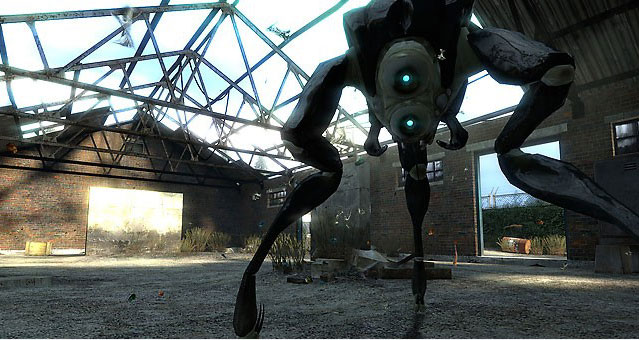
Given the amount of time it has taken Valve to release this, the next chapter in the Half-Life saga, it's not surprising that their thinking about episodic content has changed significantly. At this point, rather than being a continuation of Half-Life 2, Valve now effectively sees these episodes combined as Half-Life 3. That new focus is evident in Episode Two, in terms of storytelling and pacing. It picks up just a few moments after Episode One left off, with Gordon and Alyx picking their way out the wreckage of a train in the forest outside of City 17. The story almost immediately kicks into gear, hooking you up with members of the resistance, pitting you against an antlion hive, and forcing you to drive through trackless wastes on the way to your ultimate destination. Though there is plenty of action, the storyline of the Half-Life tale is greatly advanced over the course of the game. There are a few answers handed out but, as with any middle child in a trilogy, there are many more maddening questions raised by the events of the game.
More than a year has passed since the release of Episode One, and as a result numerous promises about Episode Two's gameplay have been muddied as a result. Many of the most-discussed new gameplay elements (Strider-busters, open environments) only come into play at the game's climax. Primarily, you'll be following the same sort of well-crafted (but very much walled-in) path seen in previous entries in the series. For some, this may be a disappointment - a more open environment was a much-discussed element of this title during its development. Personally, I was pleased by the game's focus. A Valve hallmark has always been tightly crafted progress, measurable movement through the gamespace. That focus is sharpened to a knife's point in Episode Two, with the intermingling of action, story-based downtime, and quick puzzles being better than ever before. And that climax ... it's essentially a race against time, putting every skill you've learned over the course of three games to the test. It's fantastic.
From an audio/visual standpoint, Episode Two more than meets expectations set by the previous chapters in the series. The new Hunter designs are deadly works of art, and carry a sound design to match their menacing appearance. The imagery of the portal storm left in the wake of Episode One dominates the skyline for much of the game, providing not only a visual landmark but a very concrete reminder of what has come before. The voice acting, as always, hits a high water mark for emotional resonance; and there's quite a bit of emotion to convey in this title. Once again, you're left with a very high opinion of Alyx Vance and the other members of the resistance against the combine.
For me, that emotional connection was the takeaway from this chapter in the series. The gameplay is just as solid as it has been in the past (essentially flawless). Other than hunting the Hunters (they don't like tires in the face much), there weren't a lot of stand out combat or puzzle elements. Which was fine, because I very much focused on the storyline as it unfolded around me. Much like Empire Strikes Back Episode Two ends on a down note, making you question what the future will bring in a hard and sometimes confusing world. Unlike that trilogy, though, the end of Gordon Freeman's tale has yet to be told. Just one more game to go before we find out the ultimate fate of the Freeman.
Team Fortress 2
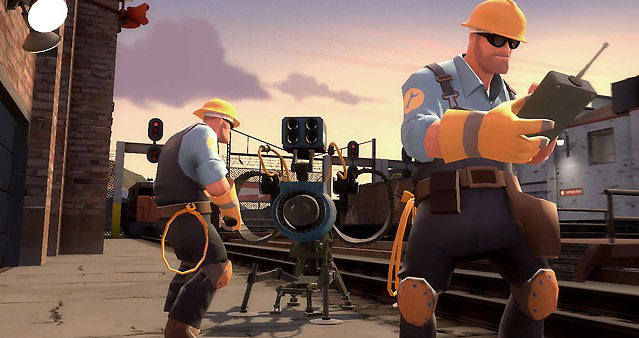
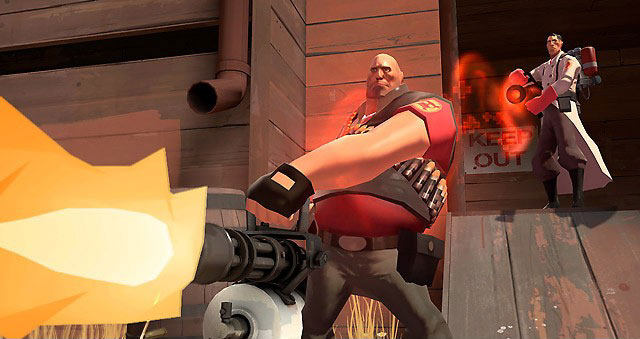
Team Fortress 2 is a substantial redressing of a venerable entry into multiplayer gaming. Built on the original Half-Life engine, the first Team Fortress game was one of the first examples of role-based team play on the PC. The older game, with its own quirks and peculiarities, is still beloved by thousands of FPS gamers; indeed, some of them feel somewhat put off by Valve's re-envisioning of the game. Grenades are no longer a weapon available to every class, each of the classes has undergone significant retooling, and the unique visual aesthetic more resembles a Pixar film than a hardcore multiplayer shooter. What those changes add up to, though, is one of the most approachable online shooters ever released for console or PC.
Valve has chosen to apply the same kind of design directives to online combat that it applies to the single-player experience of games like Half-Life 2. Playing the game online (there is no single-player component) is like a moment-to-moment tutorial. Nuances of play become obvious as you progress through a match in your chosen class. The Medic profession is the best example of this philosophy. The character's healing gun links him to a particular character, creating a bond between two players who (in all probability) don't know each other. Learning to play the Medic is an interplay between your positioning vs. your partner, your positioning vs. opponents, and deciding when to use the 'invincibility charge' that slowly builds up as you apply healing. As a member of another class you learn the nuances of keeping your healer protected or (if you're on the opposing team) that shooting the medic first is often the best approach.
This 'tutorial-as-you-go' experience applies to every one of the nine classes. The complete team roster is a balanced array of strengths and weaknesses. Assuming that your team can agree to not all play the same class, they should allow either effective offense or defense as the scenario allows. The other Valve hallmark shows up in these classes: they're all fun. Each offers a substantially different play experience, but you can have an amazingly good time with each of them. Whether you're dropping turrets into play or wielding a fast-firing heavy machine gun, you'll have the opportunity to participate and make a dent. And if you're not having fun, it's a matter of a few moment to switch to a different class.
TF2 has some weighty competition in the online FPS space this year, but from what I've seen none can compete with it in terms of approachability. Halo 3 played online is fun, to be sure, but the preternatural skills of your opponents gets really old after a while. Team Fortress 2 rewards skill, to be sure, but the shallowness of the learning curve and self-teaching mechanisms means that expertise in TF2 is a much lower piece of fruit. Ultimately, isn't that the sign of a great online game? One that lots of people can participate in?
Portal
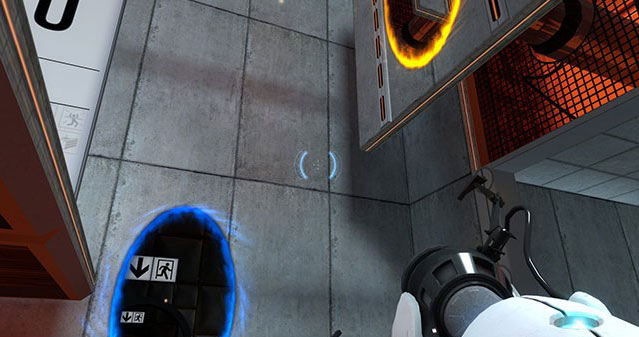
Words are ill-suited tools to describe the sheer amusement value of Portal. At about three hours long, it's one of the shortest games you'll play this year. You have absolutely no offensive weaponry, no special powers, and for most of the game your only real opponent is yourself. It's still, bar none, one of the best games I've ever played. You likely already know the basic premise of the game: you have a gun that makes holes in space. The Portals connect two points in reality and allow movement through them. You'll be using the device to solve puzzles, move through levels, and generally keep yourself alive in the face of the game's environment.
These puzzles are an absolute distillation of the Valve philosophy. Every challenge provides you with all the instruction you need to escape ... though their solutions are not always immediately obvious. Each one is only slightly more difficult than the last, and builds incrementally on every lesson you've previously learned. Portal is not only an excellent game, it's also a microcosmic example of the human learning process. This results, near the end of the game, in astonishing feats you would never have thought possible at the start of your journey. This plottable line of advancement from the simple to the sublime is the core of the game.
That said, more than just fun gameplay makes this title stand out. Aside from the Portal gun, you have but two companions on your journey. The voice from the ceiling, telling you what to do while lying out of one side of her face, is an artificial personality. The other companion is a lifeless cube. If that sounds sort of grimly funny, you're already getting the joke, and the point. Portal is hilarious in an Edward Gorey-meets-Douglas Adams sort of fashion, dark humor mixing with futurism for the sake of futurism.
Portal, then, is funny and intelligent in equal measure. It's wholly unlike anything else released this year, and on its own validates the entry price for Orange Box purchasers. It is, in point of fact, well worth buying all on its lonesome if you are interested by the rest of the offerings Valve has here. It also has the benefit of having the one of the best game songs ever made as its finale track.
Conclusion
Valve's Orange Box is easily one of the best offerings available for any platform this year. It's an amazing value and variety, offering story, online play, and intellectual challenge in equal measure. Every component of the piece is so strong that it could stand on its own - together it's an unstoppable force of gaming goodness. It's worth noting that reality intrudes on every element of perfection - lag has been a problem for Xbox 360 Team Fortress 2 players, but a patch is on the way. Otherwise ... there's really very little to complain about here. It's boring and unfunny to say "the whole thing is terrific" and leave it at that.
But then, I'm a nerd. The whole thing is terrific. In the face of dozens of high-price AAA titles this Christmas season Valve's offering stands out from the crowd with a clusterbomb of content that won't be easily put down. People will be playing TF2 for literally years to come, if you're done with Episode Two you can go back through it gnome-style, and I fully expect Portal to be supported by fan-created rooms for a long, long time. It's well worth buying for anyone that enjoys the first-person perspective on gaming, regardless of what kind of gamer you are. Now if I could only get that song out of my head ...
-
Jonathan Coulton Track Part of the Orange Box
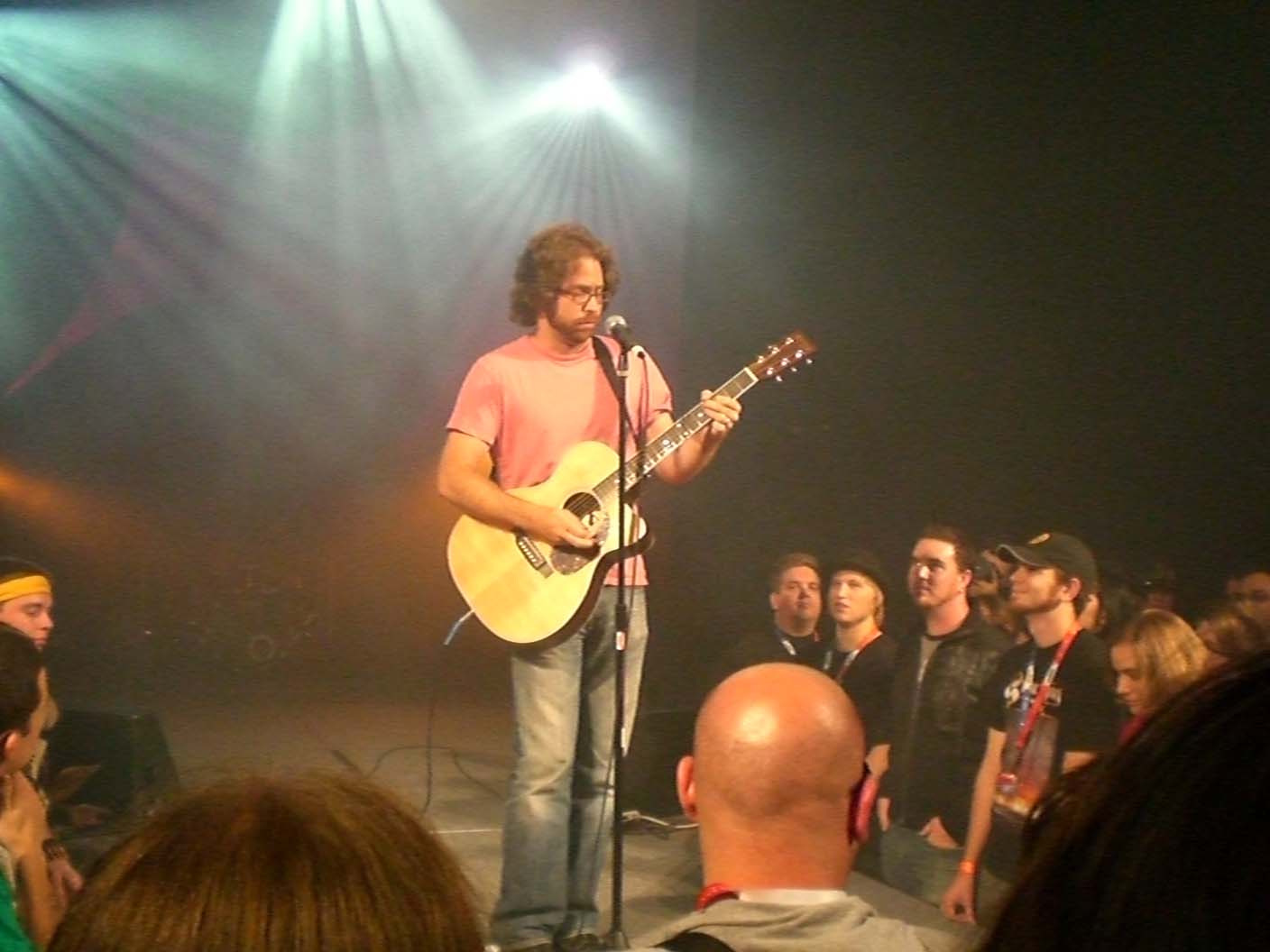
Joystiq notes that along with Half-Life 2, Half-Life 2: Episode One, Half-Life 2: Episode 2, Portal, and Team Fortress 2, folks who purchase Valve's Orange Box compilation will also be getting a musical treat. 'Geek Troubadour' Jonathan Coulton composed an entirely new song for the offering, apparently with help from the Valve design team. "At this point, with less than a week to go before the game's (games'? gameses'?) release, we're surprised the track hasn't already made its way to the seedy, illicit , peer-to-peer underbelly of the internet. Hey record industry, you should take notes!" The official Coulton site has plenty of information about the singer, and you can see his command performance of 're: your brains' from this year's PAX at the Penny Arcade site. -
Team Fortress 2 - From Old To New
As the Beta period for the incredibly fun Team Fortress 2 winds down, the website Rock, Paper, Shotgun offers up several pieces on the title. If you played the original TF and want to know how things have changed, they've got an in-depth series of posts on the nine classes. If you're more interested in the evolution of TF2 as a concept, the first of a two-part interview with game designers Robin Walker and Charlie Brown highlights the long road between there and here: "The arc of TF2 is something that's probably familiar to a lot of amateur developers or designers. When we got here the first thing we built was overly complex, very hard core, almost impenetrable to anyone who wasn't familiar with FPSs in general. And as we found as we played it, wasn't more fun because of it. I think one of the things we've learned as designers over the time we've been here is to better preserve our ideas while still making them more understandable ... If I looked back at various designs in the different versions of TF2, then I think that's the thing that moved the most. We were always doing interesting classes, interesting weapons, but I think the thing we succeeded at the most, that we were failing at the most, was that nugget of acceptability relative to depth." As for the best class, I tend to agree with Jerry. -
Sony Dismisses Critics of Lair
Despite some very public, very negative criticism of Factor 5's dragon/shooter Lair, Next Generation notes that Sony remains unfazed. "Outgoing SCEA PR boss Dave Karraker told Next-Gen in a phone interview that despite poor critical reception, the flying lizard game isn't necessarily grounded. 'At the end of the day, I'll be interested in the consumers' response, because the consumer awareness for this title was so huge.'" Meanwhile, MTV's Stephen Totilo notes, with more than a touch of seriousness, that Lairs production may have been a touch cursed. -
PAX 2007 In A Nutshell
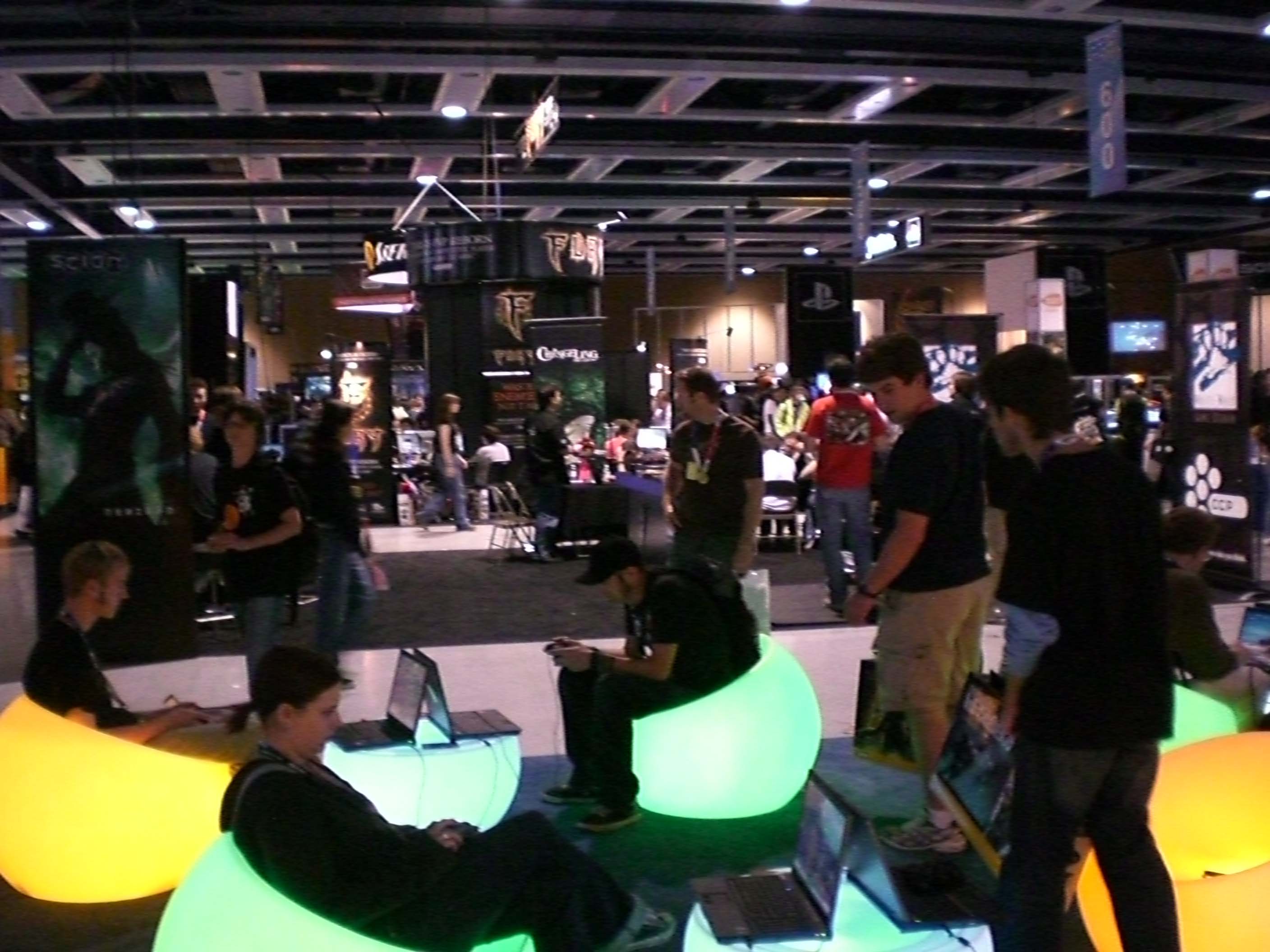
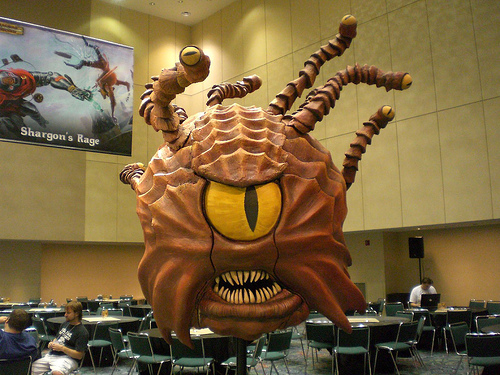
Last weekend the dark horde of nerddom descended on Seattle, entering the heart of the 'Emerald City' to gorge itself on the music, culture, and humor of gaming. The Penny Arcade Expo (PAX) once again brought together fans of the influential webcomic for a festival that, without even trying, seems to be taking the place of old E3. Though they were expecting around 30,000 people, the word was that by early Sunday they'd already gone through some 40,000 badges. There were DSes everywhere, concerts at night, a packed exhibit hall, and benchmark comic strips created by Mike Krahulik and Jerry Holkins adorned almost every wall. Despite all the people and the noise, somehow the event had a community feel to it that was hard to understand ... and even harder to describe. I'll try, though, along with impressions from games on the show floor and the incredible music of folks like Jonathan Coulton and the Minibosses. Read on, and All Hail Ball. The Early Weekend
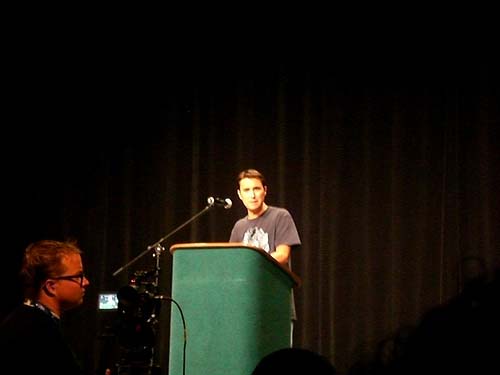
If you missed my discussion of Friday's events, it's understandable; it went up this past Saturday. Suffice it to say that Wil Wheaton's keynote speech was the highlight of the evening. His praise of social gaming, and the relationship-building power of the PAX-goer's favorite pastime resonated incredibly well with the packed theatre. The after-action report on his blog says it all: "My keynote went perfectly, and the audience (and the gaming press online) responded to it in ways I never dreamed possible. I didn't think there would be slightly more than 5000 people in the room when I spoke ..."
The first Penny Arcade Panel featured a lot of middlin' questions, highlighted by the incredible singing power of Jerry Holkins. A description of his performance is in my weekend update, but the real surprise didn't come until after the questions were done. The end of the panel turned ugly when the PA gents left the stage for Uwe Boll to have a chance at the mike. Gabe said later that weekend that he was surprised by the crowd reaction. "You can tell when a crowd is angry, and this was the first time I've felt that at at PAX." The unapologetic Boll was screamed at fairly mercilessly by the attendees.
Other events from the early weekend included a discussion of modern storytelling in videogames. Luminaries Ron Gilbert (Monkey Island), Dave Grossman (Sam and Max) and Nate Fox (Sly Cooper) came together to jaw on a topic near to their hearts. The group discussed linear stories vs. sandbox-style gameplay, user-created content, kids games, and the importance of theme even if your core story isn't all that great: "Grossman [said], 'Well, story isn't just about dialogue and narrative, right - I mean really you want to learn something about the human experience. I think that if I weren't doing adventure games I wouldn't think of myself as a narrator, but rather as the hand of fate. I'm going to kind of let you run around and do what you want and everything. Just to let the player go around and do what they want - they can feel like it's the good hand of fate or the bad hand of fate, but not that they're completely being controlled.'"
The Rain-Slick Precipice of Darkness, the Penny Arcade videogame currently in development, was a visible presence at the show all weekend. The Friday unveiling of a new game demo to the media at a special Q&A event was followed by a weekend's worth of running through the game for attendees on the show floor. Most everyone got to see the title, and hear the news that it will be coming to Xbox Live alongside its PC distribution avenues. The opening, grim, text still makes me smile: "Four gods wait on the windowsill / Where once eight gods did war and will / And if the gods themselves may die / What does that say for you and I?"
PA Panel II
While the first PA Q&A panel was entertaining just to hear Holkins and Krahulik talk, the second panel actually had a number of insightful questions, touching statements, and funny moments. And, thankfully, there were no stoned guys rambling about their paranoid fantasies at the microphone; always a plus. Long queues formed at the two microphones to question the gents, and here are some highlights:- Paul Barnett, Design Manager for the Warhammer Online Massively Multiplayer game, drew applause for his short advertisement during a trailers reel before the event started. He used his clipped British wit to compare Warhammer to World of Warcraft like so: If you're going up against the Beatles, don't try to be the Beatles. You'll end up looking like the Monkees. Instead, we're going to be Led Zeppelin.
- A question about the changes to the primary characters over the year led Mike Krahulik to discuss his influences, such as Stan Sakai. He's essentially 'never finished' with the characters, and we can expect to see further changes to his art style in the coming years.
- Drawings of Gabe and Tycho in ping pong outfits prompted readers to ask if we would ever see that as a project down the road. They're enthusiastic about it and would love to do it, as up until now readers have just seen a few simple images. To further tease us, they described the backstory to the piece: Set in the 80s, a cold war US is still facing down Russia. A little-known clause in the UN charter states that table tennis can be used to decide grudges; the loser forfeits their country. The US table tennis team is slain, and so a group of four people at ping pong camp (including our protagonists) are drawn into international excitement.
- A question about the appeal of the Halo franchise has the gents noting that the series has grown on them considerably.
- In negotiating the price for the XBLA version of the Rain-Slick Precipice of Darkness, they feel they'll have a good deal of leverage as regards pricing (and content as well).
- Several great ideas for projects and future PAX ideas are mentioned, including support of a nerdcore show currently touring the area and an Indie Games FreePlay area.
- When asked about origins of the hobos in Precipice of Darkness, Tycho notes that the game is a 'hobage' of different sources. The Achievement for 100 hobo kills? Hobicide.
- A reader challenges the two to a thumb war, which Jerry wins quite promptly by kicking Gabe in the nuts. He declines to continue, saying he 'values his beanbag.'
- When asked to endorse some games on the exhibit show floor, both gentlemen put their weight behind Eye of Judgement and Sega Rally.
- Someone notes that the current in-the-works game is very much a 'Tycho' game ... lots of words. He wonders what kind of 'Gabe' game they'd like to make. Mike ponders the concept of a brawler, or perhaps something not unlike Turtles in Time.
- The idea of making sure the ball comes back to PAX every year, 'to recharge' is brought up. It could then be sold on eBay to help fund the annual Child's Play charity. They both really like this idea.
- A reader asks what the 'worst thing' either of them have ever done is. Mike tells the story of a time when he set a trap for his family's cat in the backyard, and ended up stringing up the pet by the neck into a tree. It survived, but he has always felt terribly. Jerry, on the other hand, equivocates. When Mike gets tired of it, he tells a story of Jerry drinking a glass of Chai and finding a bug near the bottom of his glass ... which he then upended and finished after fishing out the bug.
Having had a good look at the game at Gen Con, I used my PAX chance to talk to the folks at EA Mythic to dig a little bit deeper on one of the game's claims to fame: Realm vs. Realm combat. Just hours before I spoke to the folks at EA, a team from their company had announced professions from the High Elf and Dark Elf factions for the very first time. I tried to glean just a little bit more PvP-specific information about these races for you, but it was not to be.
Just the same Ryan Barnard (game designer) and Eric Correll (producer on the game) were very forthcoming. The pair was happy to discuss different elements of their signature game feature. For example, new players will have the PvP-focused game introduced to them gradually at low levels. There's a soft introduction, beginning that portion of the title's seamless integration into the overall gameplay. Open-world PvP in specific parts of the starting zones will most likely be their first exposure. Quests will lead them to RvR areas, and eventually will direct them to the instanced 'Scenario'-style missions. Throughout the game, the portion of land that is focused on these activities starts small, but eventually dominates gameplay; the RvR 'city capture' system is Warhammer's 'end game'.
Warhammer Online's unique systems, like the Tome of Knowledge and the Public Quest, also touch on RvR. The Tome will explain elements of Player vs. Player combat, and will record your successes in battle. RvR Public Quests, meanwhile, are currently undergoing retooling. They want them 'right', and currently have taken them all out of the game to make sure they're just so; they hope to have them back into the game by launch.
This feel of 'rightness' is something they're aiming for in their scenarios as well, with the goal of integrating these instances not only into PvP progression, but the ongoing story of the game as well. Each is themed to the area they're in, and tells the tale of a specific conflict between the Order and Chaos armies.
Introducing players who might not otherwise participate in RvR into the fundamentals of that gameplay style is also something the team is focusing on. While they acknowledge that some people just don't want to play against other players, they see folks who are hard and fast about that rule as the minority. They're looking to make PvP a core part of the game, and as such they'll be approaching it differently than a primarily PvE focused game might. This affects multiple game design elements, all the way down to the 'hook' of Public Quests, which gets folks who might not even ever group thinking more favorably about gaming with others. Racial pride is also a factor; by priming characters from low levels to be 'pro-Dwarf', or whatever, players will be more likely to come to their society's aid. They're all steps in a chain, the team hopes, to changing outlooks soured by less focused titles.
On the other side of the equation, the end-game city capture system sees factions sacking the racial homes of their opponents. Though reluctant to use the term 'end game' specifically, the team members were happy to admit that it will be the focus at max-levels. RvR combat will funnel players towards the opposing side, hoping to push the 'antagonists' back to their city walls. They also pointed out, however, that there are other elements in play at that high level. PvE content and public quests are still around, though diminished, and they have plans to further expand both sides of the max-level content once the game is released.
Organized Play, as featured in Guild Wars and now World of Warcraft, is not something they're currently planning for. They'd love to eventually do tournaments for RvR teams at some point, but they're so focused on getting it out the door in a timely fashion that it's not particularly on their radar. As they put it, "we hope we have that problem".
The cutting edge of their work is, obviously, on the Elves at the moment. They're still working to tune the scenarios and open-world play for the Elven areas, and are always working to ensure that classes are balanced and the 'fun' is present.
This cutting edge blends well with some of the surprises that the team had in store for them when masses of people finally entered the Beta. Probably the most surprising for the RvR team: their carefully crafted points of control battlefield objective system, which requires holding targets in open-world PvP, are almost completely being ignored. While they worked hard on this mechanic, the players are more interested in the actual act of combat when in an open-world environment. Scenario tactics are welcomed, but outside of those instances the two sides really just want to enter the fray. The team hopes to have them in the game in some capacity, but they're going to undergo heavy retooling before that happens.
As we wrapped things up, we discussed the reflection this decision has on their overall attitude towards the game: if it's not working, it needs to go/be fixed/tuned/rehashed/whatever. Killing what you thought was going to be the end-all be-all is not outside the realm of possibility, even this late in the game. RvR, and the game in general, has to be fun. No exceptions.
Fury
I'll be honest: Fury came at me from nowhere. I'd read about it before coming to the show, knew that it was approaching an Open Beta, and that it was a free-to-play PvP title. That was just about all I knew when I sat down to play and chat with Fury's lead designer Adam Carpenter.
When you're trying to quantify Fury's gameplay type, it's better to think less about online RPGs and more about first-person shooters. Fury has essentially taken the swords and sorcery milieu and dropped that whole cloth into an FPS schema. In each match, players spawn in, rush out, and slam into each other in extremely fast altercations. Everything is fast; from character creation to combat can be just a few minutes.
This is the underpinning of developer Auran's outlook: fun, fast, and free. Instead of grinding through a PvE component, Fury characters are built entirely around a series of abilities and equipment available at character creation. Each character can play whatever role you want them to in a given match, and their role can be changed freely between altercations. Want to act as a support class in one match? You put on your gear that aids healing type abilities, load those healing abilities into your hotbar , and go. Want to act as a ranged DPS class? Swap those healing bits out for the appropriate gear and powers. Players will never have to whine about not having the right class for a fight, as everyone has flexibility.
Gameplay itself, character abilities, focuses on colors. Your ability bar is full of various attacks, and they are themed around different colors. Each player has a small gauge on their screen to help ascertain how many color points they have built up. These points are gained by using 'low level' colored abilities. A basic blue attack, for example, might give you one blue point. As you move through combat, your gauge will fill with colored points. Higher points unlock the use of more powerful abilities on your hotbar, which in turn use up your points. Fascinatingly, each ability color has a diametric opposite; red points counter blue points and players with red points in their bar will actually be less effective with blue abilities. This led the designers to create special point-manipulating abilities; in the middle of the fight you can switch a player's point colors. You can also steal points, leading to the 'change-their-color-steal-their-points' combo move, leaving your opponent defenseless and cold in the world.
Each color has a sort of 'theme', with green abilities having a sort of nature-y feel to it, while blue abilities being sort of icey. There are ranged and melee abilities in all colors, so there won't be any particular demanded role for a color ability. For most players the only real constraint will be up to what abilities you have on hand as a result of previous accomplishments. While most common abilities will be available by default when you purchase the game, new powers will be unlocked via achievements as you succeed in combat. Achievements include everything from taking the most objectives during a match, to killing the most people, to healing the most ... and your rewards are appropriate for what you accomplish.
Rewards on the equipment side are a bit more random. After completing a match, random loot is generated for the party, and people /roll for it. That's pretty much 'the way it is', going right around the usual sort of arguments at pick up group might have when dealing with looted gear. Gold is equally distributed, of course, and both items and gold are commensurate with your success in the just-completed mission.
It's worth noting here that Fury will have a for-pay option, allowing you to slap down a subscription fee if you want ... but it will have nothing to do with the quality of your in-game items. Money is only given to the Auran folks for the addition of convenience and depth. I should say there is some overlap with items: one of the for-pay conveniences is the ability to roll on three items instead of two. A for-pay player has a bit more in the way of item space, some options for purchasing things from vendors, and other simple things that makes the game just a little bit easier for having forked over your cash. Depth, in this case, is all about in-game ladders. While free players will compete on ladders of various types, paying players will have a long list of different ladder types to participate in. Server, guild, and individual progress will all be tracked for various rewards and bragging rights.
Those bragging rights will come in the form of an online representation of your character's escapades. Kill counts, 'flag' steals, and other metrics will be tracked on an official page for your character, and viewable by anyone. Guilds with an interest in going deeper into min-maxing can make use of the human-readable stats that will be generated locally by the client in a text file. Officers can collect these document to see which builds are working, which aren't, and where the group as a whole needs to focus.
The game build playable on the PAX show floor was already five months old, and showed it. There were server problems a few times, and the game looked more than a little bit jaggy. Even through the cruft, though, there was a lot of promise showing through. The settings were gorgeous despite the outdated rendering model, and the fun factor of actual play was very high. Fury is a simple, brutal combat game, and it makes no pretensions about it. With the promise of free online play for the price of a PC game title, this seems like a pretty nice package. It's definitely not going to be for everyone; there's none of the painstaking polish of Guild Wars, or the deep PvE experience of World of Warcraft. For folks looking for a quick, focused good time Fury may just be what you're looking for.
Jonathan Coulton, Frontalot, Minibosses Concert
I'm sure many of you could have told me how transcendent Jonathan Coulton's music is, but when I entered the theatre on Saturday night for the triple-headed mega-show I was something of a Coulton newb. I'd heard Code Monkey, of course, but I'd never made much of an effort to seek out his music. Whether it was his intent to really reach the audience that night or not, he made a convert out of me. His haunting lyrics about superficiality, squid, cybernetics, robotics, technology, programming, and zombies were funny, touching, and thought provoking. I asked a friend who followed his music to confirm for me that he usually doesn't play terribly large venues. I had to ask because it was only really apparent during the few moments when he paused to take in the size of the audience. He was really, very good. Coulton had easily the largest crowd of the night, with his mass dwarfing even the groups on hand later for MC Frontalot and the Minibosses. His final song for the night, re: Your Brains was tremendous to experience in the midst of thousands of hand-waving flesh-craving growl/singing faux undead. Both Frontalot and the Minibosses put on amazing shows as well, of course, showing off their polished shows and firm grasp of their material. Frontalot was in rare form, with several new songs of his most recent album. Just the same ... Coulton was the show of the night for me, and it was a privilege to be able to see such a great act in person.
The Games And Panels of PAX
There were so many events and games, demos and panels, at the event that I couldn't make it to every interesting experience. Thankfully, other sites can pick up the slack.
The panel on licensed games explored the pros and cons of using someone else's IP to make a title. "Too many cooks in the kitchen" was seen as the primary problem, with the high cost associated with such a deal a close second.
"Pitch Your Game Idea" is always a very well-attended panel, and this year was no exception. Dozens and dozens of people lined up to present their game ideas to a panel of industry veterans. They were then 'cut', American Idol style, working through less solid game ideas towards the pearly center. There were apparently a surprising number of women there, and the contestant that won was one of them. Her simple, Pong-like concept had a graphical background that became more complicated as the game went on.
That showing would have been a relief to the folks at the very well attended "Women in Games" panel. The event focused around the challenges of entering the industry, and the issues associated with working the day to day grind once you're in.
A number of folks had hands-on time with titles I didn't get to, including Haze, Tabula Rasa -
Gen Con 2007 In A Nutshell
Another year, another Gen Con? Hardly. This year was the 40th anniversary of Gen Con, marked the announcement of the newest edition of Dungeons and Dragons, and was the first year videogame companies were actively sought out as exhibitors. Put together this resulted in what felt like record crowds, a healthy dealer's hall, and an instant conversation-starter with every other person at the event. Read on for notes on the new tabletop releases, thoughts on the new edition of D&D, impressions of the videogames that were in attendance, and a shameful admission of weakness. Gen Con remains a bastion of tabletop gaming, but I'll admit it: I didn't get as strong a sense of the new tabletop game releases as I have in previous years. Instead, I spent time I would have normally put towards demoing games with dice and pieces towards getting a handle on the handful of videogames at the event. It seemed like almost every one was a Massively Multiplayer Online Game, but there were several representatives of other genres as well.
What I did glean from this year's event is summed up very well by well-known designer Robin Laws: "This year was a holding pattern." Many of the companies making products for the Open Gaming License/d20 system seem to have died back. With the announcement of Fourth Edition, there will be a resurgence the year after next, but for this year things seemed to be fairly quiet.
This Year's Releases
So what was released this year? Biggest hits at the con, by far, were the Battlestar Galactica RPG, Changeling: The Lost, and the new version of Talisman. The Battlestar tabletop game is a sister product to the Serenity (as in Firefly) RPG, both of which use the same rules-set ("Cortex"), and are published by Margaret Weis Productions. The Serenity game has a fairly impressive following, with the core book already being on its fourth printing just a year after it was released. Battlestar seemed to be offering up a similar buzz. The Weis booth was also playing host to voice actor Jason Marsden, who plays the part of Tasslehoff Burrfoot in the upcoming animated Dragonlance movie. They showed off a trailer for the film, currently slated for release later this year.
White Wolf gamers may not have been waiting with baited breath for a new version of Changeling; it was never as popular as their 'big three' of Vampire, Werewolf, and Mage. Just the same, I saw a number of copies of the updated title walking away from the White Wolf/CCP booth this year. The attraction of EVE Online in the same booth didn't stop White Wolf players from picking up the latest in the 're-imagined' World of Darkness.
Talisman is probably a name familiar to long-time boardgame players. Under the Black Industries imprint, Games Workshop is re-releasing their classic adventure game with a slightly updated look and a few tweaks to the rules. From what I heard, though, it's almost entirely the same game that you knew back in the day. It just won't cost hundreds of dollars on eBay anymore. Lines for the title were going down the rows and out the door of the exhibit hall, and my impression is that they sold out pretty much every day they had new product to sell.
It didn't have as much buzz as other announcements at the con, but well worth noting was the formation of a company called Catalyst Game Labs. Catalyst is a new outfit formed from the ashes of "Fantasy Productions", or FanPro as it was more commonly called. FanPro has been publishing the Shadowrun RPG since FASA gave up the ghost a few years back, and while the quality of the books has been fairly high it would be kind to say that they've been released on any kind of regular schedule. The new company marks a turn for one of the most well-known intellectual properties in pen and paper gaming, with two new books (Emergence and Augmentation) available just at this convention. Working together with the folks behind the Classic Battletech line, they now having backing and a business plan. If you're a Shadowrun fan, there's going to be a lot to look forward to in the coming years.
Dungeons and Dragons Fourth Edition
The biggest news was, of course, the announcement that Wizards of the Coast is going to be releasing the fourth edition of Dungeons and Dragons next year. At a press event the day before their public announcement to Gen Con attendees, they tried to lay out the groundwork for their ambitious new plan. Essentially, these new books have been eight years in the making. The R&D team at WotC is looking to adapt Dungeons and Dragons to the way that it's played, and stop forcing gamers to play the game the way the game is set up. While the switchover from 2nd edition rules to 3.0 was an amazing step, it was in some ways still black magic. They now have a large base of knowledge to work from, that's going to let them change the game in fundamental ways. They hope it will be for the better.
The biggest changes will be mechanical. My review of the Saga Edition of the Star Wars RPG discussed the significant rules changes that title underwent; the R&D folks as much as admitted that book was sort of a 'test run' for concepts they'll be incorporating into fourth edition. The focus is going to be on ease of play for everyone, both in front of and behind the DM screen. Party roles will be more clearly defined. Encounters will be reformatted, and monsters retuned to more understandable roles and difficulty levels. It may just be hyperbole, but the designers are aiming to 'make D&D feel heroic again.' On the far end of the scale, this means that epic-level play will now be a core part of the game. That is, the Player Handbook will support level progression from 1-30. Levels 1-10 will be known as 'heroic' levels, where characters are better than the average human but still 'normal'. Levels 10-20 are 'paragon' levels, where characters accomplish feats only possible in a fictional environment. Levels 20-30 are 'epic' levels, where heroes will be able to step out into the world and change the course of history. Desiigner Chris Perkins put it this way: "We want first level to be more than 'run away, it's a kobold.' Gone are the days of the four hit point Wizard."
On top of that, WotC feels as though a new edition is necessary to support the other three columns of their ambitious new plan. Physical books are the most important part, but there are three other pieces that feed into the game. The first is community, exemplified by the terribly-named Gleemax.com website. Gleemax is going to offer up a single place where D&D gamers can come together to discuss the game, as well as CCGs, boardgames, and the lot; a MySpace for tabletop nerds, essentially.
Unfortunately, it's not clear how separate that piece will be from the ambitious D&DInsider.com. That site, essentially an outgrowth of the official Wizards of the Coast website content, is going to be a central hub for Dungeons and Dragons players. The late, lamented Dungeon and Dragon magazines will be available online there, and the site will also play host to the most novel concept in the fourth edition bag of tricks: The D&D Game Table. The Game Table is an online playspace, where groups can get together around a virtual table to actually play Dungeons and Dragons online. DMs will be able to lay out dungeon maps, place monsters, and run games. Players will have access to online versions of their purchased physical rulebooks, can make characters using a character creation tool, and can even create their own virtual miniatures for their characters. Voice chat will bring the whole group together. The WotC folks were very clear: this is not meant to take the place of your regular game. It's a place to go if your gaming group is spread across the country (or world) as so often happens in our busy modern world. They also envision a future where players who don't have regular games can hop online and connect with other folks to play in a regular campaign.
This last will likely be aided by the fourth leg of this concept: organized play. The RPGA has always been associated with but not a part of Dungeons and Dragons, if that makes any sense. With fourth edition the organized play campaigns will become a central component to the game experience. From your home, to the gaming store, online with the D&D Game Table, and all the way to conventions, the goal is for gamers to have a fun and slightly more formal handrail for gaming together. With a renewed interest in adventure publishing, designer goals seem to be to bring back the days when every D&D gamer could talk of playing through modules like Keep on the Borderlands or Tomb of Horrors.
All of this combines to an extremely ambitious goal: a brand new D&D. Just from anecdotal experience, from talking with players and retailers at the convention, my own gaming store, and from reading comments here on the site, the general reaction seems to be anger. The reason is understandable; 3.5 books aren't cheap, and many gamers have invested heavily in the current edition. In the latest D&D Podcast even the designers themselves admitted that 3.5 isn't 'that broken.' Thankfully, there's still quite some time before even the Player's Handbook comes out. The folks at Wizards have a good long while to explain to us what exactly they're planning to do. A long time to convince us, to reassure people that they really aren't ditching the OGL (full support), that their favorite campaigns will be supported (new Realms book next year, Eberron in 09), that it's worth shelling out another $90 for the upgrade. They've already begun, in fact; their ongoing design and development series has already put up posts on party roles, the new vision for Fighters, and what it's like to face a dragon in the new edition. If they even come close to delivering on what these articles imply, next year is going to be an interesting time to be a gamer.
Warhammer Online
Last year, I wrote this about WAR: "I wasn't very impressed, either with Mythic's showing or with the game itself. The buzz around the convention seemed to be that it is 'too much' of a World of Warcraft (WoW) ripoff." What a difference a year makes. Since then Mythic was purchased by EA, development has gone into high gear, and the company has done a tremendous job of getting out the word on what exactly Warhammer is all about. The result? A booth that was swarming with people from the moment the doors open until the exhibit hall closed. Their enthusiasm reflects my own; it's far and away the game I'm most looking forward to next year. I had the chance to take a Goblin Shaman for a spin in the Greenskins starting area, and the development team's cry of "War is everywhere" seems to have made for some inspired gaming.
Yes, it's primarily the same old level 1 experience you have in every other game. Kill grunts, gain xp, learn2play. But right away you start to see the difference. The Tome of Knowledge, for example, not only tracks what quests you're on, but tells you how many stunties you've killed (damn dwarves). Nearby a public quest is ongoing, as players struggle to kill the swarming squigs harrying a friendly giant. UI-wise, it looks like World of Warcraft redux, until you start to see all the extra doo-dads. My Goblin Shaman built up Waugh as he fought, which would have allowed me to heal more effectively had I been in a group. Morale rose as I fought too, allowing me to fire off special abilities just because I'd been fighting for a while. It's violent, it's fast, it's easy to pick up and play. And it's freaking hilarious. That dark British sense of humor seen in the tabletop game comes through loud and clear in-world, with everything from ability names (Brain Bursta, Geddup!) to quest themes. One of your very first encounters has you being tossed across a valley to the top of a dam, where you stuff unconscious dwarves into barrels and toss them over the side. I didn't even get a chance to check out Realm vs. Realm combat, the game's most exciting offering, and already I'm convinced of the title's potential. It's still in development, still getting the kinks worked out, but even in its half-finished state I think Warhammer is in a great position to turn heads next year.
Gods and Heroes
Perpetual's in-development Roman title, on the other hand, appears to be a bit adrift. At first blush it looks ready to succeed, with an inspiring and somewhat unconventional concept. The game focuses on combat in a mythical Roman setting where gods walk the land and monsters fill the wilderness. Combat with minion NPCs is the main mechanical draw. The minion system is a great addition to the genre, taking concepts seen in standard pet classes and the more advanced heroes of Guild Wars: Nightfall, and punching them up to the next level. On top of an interesting game setting and some new tweaks to gameplay, an ambitious animation system makes the game look as cinematic as it's described. Instead of blindly hacking at each other, fights involve stabbings, tosses, stamps, and throws. It's incredibly impressive when the animation system synchs up and pulls things off.
Unfortunately, there's a problem with that. Combat previously was 'locked', meaning that when two characters were fighting they were held fast so that animations could go off at set times. This looked really good, but playtesters found it too constraining. Perpetual listened, and has removed the locks. They're not working to tweak animation timing so that things will still look as cinematic as ever even without the lock system in place. It's still Beta, and there's time to get this stuff squared away ... but I have to be honest; the game felt like it was more than the two or three months away from launch than the company is claiming. When animations hit they look great, but right now combat is a mess to look at, moving through the world feels slow and cumbersome, and even the much-vaunted minion AI still needs to be tweaked. This game is doing a lot of things right, make no mistake, and I trust that when it launches it's going to garner some interest from players looking for something new. I just hope that the company gives Gods and Heroes the time it needs to succeed; right now it seems like it still needs a lot of work.
Fallen Earth
Big-name Massive games get a lot of press, but with the technologies behind MMOGs becoming ever better-understood smaller companies are starting to aim for a piece of that online pie. Fallen Earth is just such a game, backed by Icarus Studios. There's no word on a release date yet, but the little slice of the world I saw was fairly compelling. Assuming it goes live in the next six months or so, fans of the Fallout series will be able to sate their hunger on this post-apocalyptic treat. Fallen Earth imagines a southwest US ravaged by nuclear war and disease. In this bleak landscape you take on the role of an adventurer, working for the factions that control the vital resources of the area. Combat is a unique blend of FPS and RPG, with player skill determining if a shot hits and mechanics determining how much damage is done. The game feels like a fitting tribute to the complex CRPGs of yore. While it doesn't seem like it will reach widespread appeal, the players in this niche are going to have a lot to enjoy in this bleak, violent, and surprisingly funny Massive game.
Legends of Norrath
A collectible card game wrapped inside a Massively Multiplayer game sounds like crazy talk, but the folks at SOE are betting this will be a big hit. Certainly the concept is simple enough: give players of EverQuest and EverQuest 2 something to do while they're waiting for a group, or just as a way to mix things up a bit from the standard grind/kill/grind gameplay of a fantasy MMOG. While it's a simple idea, the execution is surprisingly robust. Players will be able to purchase virtual cards for a fairly low fee, or find them in booster packs dropped by in-world monsters. Decks can be constructed with the aid of a deck-building wizard (the software, not magical kind), and put to use combating players of both titles or NPC opponents. Gameplay seems to be of the 'easy to learn, hard to master' type that is quite prevalent in CCGs, with a few EverQuest-specific twists. The game will also offer up in-game loot from certain cards, just like a certain other CCG based on a MMOG ...
Pirates of the Burning Sea
I'll come clean: if the epic battle ever comes, I'll be siding with the buccaneers vs. the ninjas. It was a great pleasure, then, to get to have some more hands-on time with this most atypical online game. Although, again, I fear that broad market appeal may not be within reach, Pirates is shaping up to be darn fine game. The ship-to-ship combat is rock solid, immensely fun to play, and feels completely different from any other MMO experience you've ever had. There's a stateliness to the combat that makes the smoothly gliding schooners and soaring cannonballs somehow epic in scope. Swordplay is still a little rough, with the team still polishing in anticipation of a launch later this year. Even with the rough edges, this isn't your standard fantasy hack and slash. Players kick sand into the faces of their foes before a well-placed boot to the stomach takes them down. It's not fantasy, it's not sci-fi, it's piratical, and if you like Massively Multiplayer games you owe it to yourself to give Pirates of the Burning Sea a try.
Eye of Judgement
One of the few non-MMOGs at the event, this strange videogame/collectible card game/strategy game hybrid was drawing crowds simply because of its awesome visuals. The in-game art is definitely the first thing you notice, and is stunningly well-done. I was surprised by how much I enjoyed this game, which has players angling for control of a three-by-three grid. Cards are played onto each square of the grid, where they're analyzed by the new PlayStation Eye camera and animated on the television screen. While it initially comes off as just eye candy, a few minute's play reveals the numerous layers of depth to the game. Cards have facings, for example, and must be angled to ensure their blind spots are protected. Grid squares are aligned with different elements, as are creatures, requiring players to not only control the board but consider where their thralls are placed. It deserves commentary at length, but suffice it to say that it's not going to get the kind of success it deserves. Given the strange hoops required to jump through to play, this inspired title is just not going to find the audience it should. If you have a PS3, though, I highly recommend at least giving this a unique experience a try when it comes out later this year; they're even including the eye for no extra cost.
Conclusions
Last year I was lamenting the decision to include videogames in Gen Con's mission statement, worrying that this would be the end of the convention I've grown to love over the years. That was, of course, before seeing the lackluster showing of the E3 Media event and the closure of Gen Con So Cal. "Gen Con Indy" is now the only Gen Con, and is one of the furthest east offerings for gamers when it comes to videogames. In short: videogames coming to Gen Con may be the best thing to happen to it since the move to Indianapolis. Between the MMOGs, the D&D announcement, and a huge number of attendees, the convention felt revitalized. There was a hum and a murmer to the hallways that's been lower key in previous years. It was, as always, a chance to see game designers in their natural element, and all of the folks at WotC seemed to have an extra spring in their step this year.
The tabletop gamer is a dying breed; it's well acknowledge that Massively Multiplayer games are killing them off. Playing with your friends is so much easier in your home from a PC, and is something that can be done regardless of what time zone everyone is in. This year, though, I had hope that maybe we might not be dying off so quickly as I thought. Fourth edition is an obvious strike back, an attempt by Wizards of the Coast to fight 'the enemy' on its own terms while applying eight years of careful observation back into the game mechanics.
It's incredibly risky, and the future of the most popular and well-known tabletop game hangs in the balance as a result. On the one hand, this could blow the tabletop hobby firmly into the mainstream. Dice rollers could take their place at the side of the World of Warcraft players, proudly explaining their misunderstood hobby to their relatives in terms they can understand. Or, this could completely alienate the D&D playerbase and collapse the house that the d20 built. I personally am excited. I'm excited about the possibility of a Dungeons and Dragons game without the kruft. I'm excited about the chance to play online with friends across the country. I'm excited about organized play tied directly into the core game. And I'm excited about the future of a Gen Con with no imitators on the west coast, new attendees drawn by electronic gaming, and ever-more-professional game design companies working on the hobby I love.
I'm also, sadly, excited about the future of the World of Warcraft CCG. Perhaps because of my exposure to Legends of Norrath and Eye of Judgement, my demo of the now-year-old game left me vulnerable to the dealers in the exhibit hall. I've spent the last few days happily tweaking my Blue Shaman deck, and look foward to running it against all comers at PAX. Anyone have a Parvink or two they'd be willing to trade? -
Can Blizzard Top StarCraft?
MSNBC is running an interview with Blizzard designer Rob Pardo discussing a number of facets of the upcoming StarCraft II. Informational tidbits include the fact that, unsurprisingly, the game won't be released this year, and some background on the game's long development cycle. "Penny Arcade figured it out! We keep games under code names and we teach developers to refer to games by their code name. And we're just really careful about talking about the game internally. We don't bring external folks through unannounced product areas. But I think even I'm surprised that we were able to keep it under wraps all the way to the end." -
Nintendo Confirms Mario, Smash Bros. Coming This Year
Some excellent news for Nintendo fans: two of the 'big three' games are coming out this year. At an event held in Washington state Reggie Fils-Aime was able to confirm that Smash Bros. and Super Mario Galaxy will be released before the end of the year. Excellent to hear such news, of course ... but other people had different priorities. For Metroid fans, it does indeed look like Samus will have to wait until 2008. Other than that, the company was all good news in general: "Typically, about half of home consoles in Japan are placed in the living room -- with Wii that figure is 75%. In France, 15 of the top 15 games recently were Nintendo. In the US, Fils-Aime says they are seeing 'early signs of significant market change.' The number of female purchasers of hardware are up 42%. The number of people over age of 30 purchasing Nintendo DS is up 127%. Tighten that age range to people over 35, and the number is up 212%. 40% of Wii owners have connected to the internet. 3.3 million plus Virtual Console downloads." Game|Life has hands-on impressions of Brain Age 2 and Mario Strikers Charged , two of the new games shown off at the event. -
MMOG Industry Community Vet Speaks Out
Sanya Weathers, known for many years as Tweety, was the Community Manager for Dark Age of Camelot essentially since that game's launch. Known throughout the games industry as truthful, caring, and innovative, she almost created the position of Community Manager out of whole cloth. Many elements of Massively Multiplayer communities we take for granted today originated at Mythic in Sanya's hands. Now doing work freelance, she has time to blog about her experiences keeping Massive gamers happy. It is entitled Eating Bees, after a Penny Arcade strip on the subject of forum management. So far she has two posts up, one looking at what professionalism looks like in the position, and a hilarious fictional day in the life for a CM. "Bob forwards Gertrude's email to Jake, a programmer. Jake is not the one who coded the original element on which Gertrude's system is based. THAT guy, Wayne, is somewhere in the Caribbean coked up along with a bunch of strippers, where he has been ever since he cashed his FunFactory stock options, opened his own studio, and sold THAT one to MegaCorp for millions of dollars. Wayne was also a self-taught genius who adhered to no known coding formalities and whose comments were in haiku. Since Wayne left, approximately two dozen programmers of various levels of ability have added layers of complexity. Jake is very young and enthusiastic, but his joy at finally being in the gaming industry is starting to dim from coping with a ten year old pile of what is called "spaghetti code."" -
Ron Gilbert Working on Penny Arcade Game
Yesterday at the Penny Arcade site Gabe shared the news that Ron Gilbert is working with them on Penny Arcade Adventures: On the Rain-Slick Precipice of Darkness. The well known designer, veteran of several LucasArts adventure titles as well as the creator of the SCUMM engine, has apparently been assisting the duo in planning out their first commercial game title. Says Gabe, "We had our first meeting with Ron pretty early in the design process. Tycho and I were getting the story fleshed out and we had some ideas about the design and over all pace of the game. We laid it all out for Ron and then he picked up a whiteboard marker and started teaching class. I'm not sure how many people can say they got a game design 101 course taught by Ron Gilbert, but that's exactly what Tycho and I got that day. His insights into the way you move the player through an interactive story so that they get to explore the world but don't loose the narrative were incredible." 1up also has commentary from Gilbert, who says, "I have been a fan of Penny Arcade because I have always found their comic so funny and biting. When I first heard they were making a game and that they had chosen to weave adventure game elements into it, I knew immediately I wanted to be involved. Working with the Penny Arcade guys and the team at Hothead has been an absolute riot." -
CleverNickName (129189) To Keynote PAX
Joystiq mentioned earlier this week that two-time Slashdot interview subject Wil Wheaton, world-famous blogger and writer, is scheduled to keynote this year's Penny Arcade Expo. Other headlining elements of this year's geekstravaganza include a Tokyo Games Show trip for the Omegathon winner, and another year of the 'face-melting' Minibosses as the big musical act of the event. From Gabe's Post: "We'll actually be taking a lot of steps this year to make the Omegathon a more important and interactive part of the show experience. I can't say much more about those ideas right now but I can tell you what this year's Omegathon prize will be. I think each year we've been able to out do the previous year's prize and this year is no exception. The winner of the 2007 Omegathon will receive a trip for two to the Tokyo Game Show along with $5,000 in spending money. We'll be taking care of everything for you from airfare to hotel and giving you some cash to spread around once you get there." -
Major Nelson Frames the GH II DLC Discussion
Yesterday we discussed the mighty expensive Guitar Hero II downloadable content. Some readers had serious complaints, and their views jive with a lot of other commentators out there. Prior to an event related to the game Joystiq had the chance to sit down with Microsoft's Major Nelson, who attempted to frame the conversation and point out the difficulties associated with this project: "I used to work in the broadcasting industry and in music for a long time and I know that content is not linear. It's not like you go to iTunes, and you're buying the same thing. There's testing that's involved, and there's also licensing involved. There's a lot of elements involved. When there's music involved, that brings up a lot of licensing issues ... You have to consider the Leaderboard. People like to say it's the same [as on the PS2], but the licensing is not the same. You have to re-license it. It's a different platform. While on the surface it may look fairly simplistic, and people are saying 'XYZ should be done,' but we're not Red Octane. I work for Microsoft, and we're just the conduit at this point." -
On the Rain-Slick Precipice of Awesome
Runefox wrote to point out that the boys at Penny Arcade have passed around the first trailer for their upcoming episodic PC game. Kotaku is link/hosting a flash version of the trailer, and a high quality one is on GameTrailers. As Runefox says: "While almost all can agree that the graphics, as they are now, will give small children nightmares, so, too, can most everyone agree that the Fruit F***ker is simply awesome." Earlier this week Gabe put up a post with more information on the game, and owns up to maybe having put out the trailer 'too soon'. "We were worried though that people might think this was going to be a 2D game if that's all they saw. So we decided at the last minute to attach some of the 3D work we've got. It's extremely early and it's missing some effects like cell shading and a few others.In retrospect we probably should have held of showing it but we were excited and we jumped the gun a bit. We still have a lot of work to do in order to really define the look of the game." The best tidbit: You'll be able to make your own PA-style character to fight alongside the boys. Good form. -
A Unique Perspective on a 'Game-Related' Tragedy
Megnatron writes "Penny Arcade has a letter from the stepmother of one of the kids who was recently charged with killing a homeless man. Her article is an extremely sobering tale of the problems dealing with troubled teen. She explains how, in this situation, the parents did everything they possibly could. And, in a refreshing twist, she absolves the games industry of any blame for the tragedy these kids perpetrated. From her missive: 'Video games DID NOT make this kid who he was, and it's unfortunate that the correlation is there. The thing that really gets me with this whole thing is that the kid knows full well that by equating what he's done to a video game, that he will generate controversy and media coverage. It makes me sick that the media is jumping all over this, because that is exactly the result that he wants. The only good thing (if there is such a thing) that has come out of this whole ordeal is that the kid is behind bars. That is exactly where he needs to be.'" Her letter is a passionate, troubling story, but well worth reading. -
FTC To Investigate 'Viral Marketing' Practices
mcflaherty writes "The Federal Trade Commission has stated that it is going to investigate the use of 'Viral Marketing' by corporations. This is the type of advertising that seeks to start a word of mouth campaign for the product via consumers themselves. Previously, consumers themselves set the buzz. But lately advertisement firms are stepping up to the plate themselves, seeding the market with buzz that looks independent of the company, but is in fact funded by them. The crew at Penny Arcade contend that corporate generated buzz is not Viral Marketing, and perhaps Guerrilla Marketing would be a more apt term. Either way, it appears to be a profitable advertising model." -
Child's Play Goes Live For 2006
GiovanniZero writes "Child's Play, the Penny-Arcade based charity just kicked off their 2006 season. Stop by, donate and bring some cheer to sick kids all over the world. 'Since 2003, gamers have banded together through registered Seattle-based charity, Child's Play. Over a million dollars in donations of toys, games, books and cash for sick kids in children's hospitals across North America and the world have been collected since our inception ... Last year's drive raised over $605,000 for sick children, and we're hoping to smash that record total this winter. Check out the wish lists, read up on the local events and let's show the world what the gaming community is all about!'" -
Xbox Live Silver Accounts Becoming Second Class
Ben Kuchera, at Ars Technica's Opposable Thumbs blog, points out a troubling development on Xbox Live. While paying members of the service (those on the 'Gold' level) have always had more options than those on the free 'Silver' level, Microsoft is now making that gap even wider. From the article: "While the demos and videos are cool, almost everyone I've talked to about the system sees having an Xbox Live Gold Account as an almost required piece of the 360 puzzle. Those with Silver accounts may start to feel the pinch though, as content is starting to be released that can only be viewed with a Gold account. The first thing? The new Gears of War Trailer." Tycho has some choice words on this development as well. "This is really quite a trailer. The term 'trailer' may even be insufficient. But, um... When you make people pony up for instant access to ads? They might get the impression that you are taking advantage of them. I'm just throwing it out." -
Star Fox Command Review
Beginning with the original 1993 SNES title, Nintendo has toyed with the space combat series Star Fox in a number of ways. Star Fox Adventures added a doodad-hunting adventure format, while last year's Star Fox Assault included ground-based battles that managed to actually detract from the game's appeal. Now on the DS, the Star Fox series has experienced yet another format shift: Star Fox Command. Command offers some simple strategy elements, an innovative control scheme, and the tried and true dogfighting gameplay the series is known for. It also dwells on one of the series' weaknesses, plot, to the detriment of the game. Despite that and a few other issues, Star Fox Command will provide some quality space combat for anyone looking to kill some time, and a few aliens. Read on for my impressions of Nintendo's latest core series release.- Title: Star Fox Command
- Publisher: Nintendo
- Developer: Q-Games
- System: DS
In Star Fox Command, you take on the roles of Fox, Slippy, Falco, and the rest of the the Star Fox band, in an attempt to deal with new threats to the known universe. Dr. Andross, the boss from previous games, has been defeated. As a result of interpersonal problems, the gang has broken up and moved off in their own directions. Always trapped in the role of Johnny Hero, Fox McCloud takes on the alien race known as the 'Anglar' in an attempt to keep the peace he's bought with most of his life. Along the way, McCloud runs into the other members of his former squadron and enlists their aid to save the day. It's all pretty traditional stuff, and you'll probably find yourself tapping the stylus over and over on the 'next' button to get into the actual gameplay. The only real point of interest here is that the game's replayability is rooted in the story. After you beat it once, moving through the conversation options you have available, you'll be able to go back and play through again with new witty things to say. Each complete trip through the game is a fairly quick experience, and you should have no problem moving through all the options in a few days. I found this 'space opera lite' storyline fairly predictable and forgettable. Just the same, it's commendable that they've given you the option to explore it more fully as a side effect of accessing new content.
Though it sets the game apart, I also found the title's strategy elements to be more enjoyable as a means of getting to the combat than as a distinct game feature. In order to engage in combat on the many worlds, you'll have to navigate a tactical screen and direct your pilots. On the strategy screen are all the pilots you have available, the Great Fox mothership, and any enemy groups you'll have to take out. By drawing a line with the stylus you direct your pilots into the path of enemy groups, thereby engaging them. For any given scenario you're alloted a specific number of turns to accomplish your goals. If you fail to destroy all of the enemies in the allotted number of turns, you lose. This Advance Wars-style control scheme is complicated by several additional elements. The goal of the enemy groups is not to engage you: they are aiming to take out the Great Fox. Fail to intercept one of these gangs and you'll forfeit your mission completely. A fog of war hides and distorts reliable intelligence on enemy movements, and impassable barriers make planning out the movements of your pilots a requirement. If this sounds challenging, it isn't. A few levels into the game you'll have all of these elements under your belt, and the tactical screen will become just another barrier between you and the fun part: space combat. As with the branching plot, though, it's an interesting way to mess with the Star Fox formula. It's also far less objectionable than, say, tanks.
Among the many tweaks to the gameplay, though, what shines is the combat control scheme. It takes a little bit of practice to appreciate the fluidity and power Q-Games has offered you here, but it's worth the time and energy. With the ship's stick in your hands, you control every aspect of your craft via the stylus. You move the stylus in the direction you want to fly, changing attitude and pitch with intuitive dragging movements. To fire thrusters you double tap, and quickly rubbing from side-to-side executes a barrel roll. You can also execute u-turns, and fire bombs, all from the touch screen. The only action you can't take with the stylus is firing, and that's accomplished by pushing any of the buttons on the DS. This can result in some discomfort, unfortunately. I really enjoyed using the stylus to fly, but had to cramp up my hands in order to hold the DS, fly, and fire at the same time. Other large-handed individuals playing on a Lite may experience similar problems.
The discomfort is worth it, though, because flying, shooting, and keeping your time meter filled are a whole lot of fun. Each mission has a falling timer, and if you run out of seconds you're through; you can also fail a mission by running out of shield strength. The goal of each mission is to take out enemies with special cores, with a certain number of cores required for each mission to be considered complete. Time icons are obtainable to extend your mission length, as are shield regenerators, bombs, and other power-ups. Barrel-rolling is a required tactic, as it not only deflects harmful blasts but adds a small amount to your time as well. The catch is that all of these elements (shooting down enemies, watching your shield strength, keeping your time up) have to be accomplished in little more than 60 seconds. Even boss battles are very quick, and failure is something you'll be faced with until you have the controls mastered. At that point things may become a bit rote, but by the time they do you'll probably have finished the last iteration of the game's storyline anyway.
Visually, the game holds up well when compared to more recent titles. The original games combat graphics, which wowed me when I was 13, would probably seem a little crude by 2006 standards. They've managed to keep the 'feel' of the blocky polygonal look that founded the series, while offering a lot more detail and some fabulous looking backgrounds. Command manages to recall fond memories of older games, while retaining the look of newer titles. For a series that's had a rough go of it the last few times on the market, this deliberate graphic nod is a great touch. Enemy and friendly units alike have a likeable look to them, with some especially tripped out looking creatures coming your way from the depths of the Anglar fleet. I do wish that terrain and map elements had been more thoughtfully implemented; as it is combat arenas have a sort of randomly generated quality to them that I felt could have been more polished. The game's audio is adequate, with mostly throw-away sound effects. They've kept many of the same effects from earlier games, adding to the nostalgia quality of the graphics. Music, too, has some similarities to previous incarnations in the series. Fans of the original game's martial theme will not be disappointed, as it makes a remixed (and skillfully composed) appearance here.
Like its predecessors, Star Fox Command is not intended as a long-term gaming commitment. Instead, the title delivers fast-paced space shooting, enjoyable retro graphics, and some tactical tweaks to the series standards. Wireless multiplayer is even an option, with or without additional carts. Command is the kind of popcorn-depth game that is great every once in a while to cleanse your palate. It's the perfect road-trip game, or something you can breeze through in a long weekend. Given the lackluster efforts of the last few Star Fox series titles, it's refreshing to see Nintendo and Q-Games shaking things up by going back to the game's roots. If it's broke, fix it. If you're looking for a quickie game in between the heavyweight titles coming at us this fall, Command has enough simple, honest gameplay to make your hands spasm in enjoyment. -
Next-Gen's Top 20 From Tokyo
Next Generation has a rundown on the 20 games they think defined TGS 2006. Leading the pack is Microsoft's double-barrel RPG action, Lost Odyssey and Blue Dragon, their current great white hope for the Japanese market. From the article: "The weight of the bigger names involved -- artists Takehiko Inoue and Akira Toriyama, and writer Kiyoshi Shigematsu -- might even draw in completely uninitiated gamers. Blue Dragon, coming this year, as a pack-in with the console, will help make the machine a more familiar sight in homes that purchase PlayStation 2s for Dragon Quest; Lost Odyssey, coming next year, looks like something that could be advertised in cinemas." White Knight Story clocks in at number 3, and everyone from Ars Technica to Tycho is praising this Level 5 game as being the first PS3 title they're really getting excited about. -
Play PS3 Title flOw Right Now
The folks at the Tokyo Game show are sending back high resolution screens of titles like Heavenly Sword and Warhawk, but a smaller title that will be on the console is available to play now. Recommended by Tycho in Friday's post to Penny Arcade, the game fl0w has more to offer than just good looks. It's actually a part of a designer's thesis, using the concept of flow theory to make a title more enjoyable for the player. Despite its roots in academia, this beautiful gem may go on to have a fond place in the hearts of console gamers. Joystiq has a hands on with the PS3 version: "FlOw was running at 525p (480p) -- the graphics were akin to what we've seen the Nintendo Wii produce. We aren't sure if the title will available brick-and-mortar or as a download (or even packaged in the console's hard drive). If priced correctly, flOw could end up an essential title similar to what Geometry Wars represents for the Xbox 360 -- a small, casual game with mass appeal sold for pure profit." Download the game, and give it a try. -
Attack of the B-Grade Games
The best games on the market are referred to as AAA titles. This refers to the cost required to make them, but it's often used to indicate the quality of a game title as well. Not every disc you pop in a drive can be God of War, though. Games that honestly give their all deserve at least a little respect; B for effort, as it were. Today I have impressions for two titles that favour style over substance and go down swinging, filling the screen with hundreds of NPCs for sheer shock value. Capcom's Dead Rising and the Dynasty Warriors wannabe Ninety-Nine Nights manage to both disappoint and satisfy. Like B-grade films, they're so bad that you just might love them. Read on for the Attack of the B-Grade Games!- Title: Dead Rising
- Publisher/Developer: Capcom
- System: 360
As photojournalist Frank West, you're dropped into the Willamette mall to cover the story of the century. An entire town has gone red-eyed and shambling, and you're there to cover it with your camera in one hand and any weapon you can find in the other. The helicopter pilot will be back in 72 hours, and you have exactly that long (by your in-game watch) to do what you will and still get picked up. Within that three-day span you'll encounter mysterious agents, frightened citizens, armed psychopaths, an annoying photographer, a hungry clown, and a whole lot of freaking zombies.
That sounds like a great set-up for a game, and the first few hours tantalize with future payoffs. Where did the zombies come from? Who are the mysterious agents operating in the mall? What's with the crazy Spanish guy? Why would anyone buy a blue set of slacks with a tweed jacket? It quickly becomes apparent, though, that you're really playing two games at the same time in the same space. One game is all about the 'cases'. Certain events happen at preset times. As you work through the game's storyline, you'll have to show up at a place by a specific in-game time in order to see the cut scene and interact with whatever is going on. The clock works tirelessly against you, requiring you to race around the mall to make your appointments. If you miss even one event in the game's storyline, it's all over. You may as well use the time remaining in the game to randomly slaughter zombies, because you won't be seeing the end of the story.
My real frustration is how much the harsh time-table interferes with the other half of the game. The free-roaming GTA-style gameplay Dead Rising's marketing has been playing up only offers so much given that you have to be in certain places at certain times. In between missions you can attempt to save civilians, kill zombies, go hunting for psychopaths, try on clothes, kill zombies, take pictures, mix new beverages, learn new skills, play on a skateboard, and kill zombies. Unfortunately, there's never really quite enough time to let you fully explore your environment, so all the 'neat stuff' you can do becomes merely something you notice as you're running from place to place on the way to a storyline mission. There are a few sizable breaks between cases, but in the meantime civvies will have died and opportunities will be lost.
TFor me, that's by far the game's most frustrating game-play choice. The 'save the civilians' escort missions are infuriating. Civilians are trapped in locales around the mall, and the building's security guard Otis will alert you to their plight at various points during the game. You can choose to help them or not, but my knee-jerk reaction when playing the game was one of sympathy. Frustratingly, especially at the start of the game, it's nearly impossible to get them to safety. Frightened, and barely able to swing a weapon, these characters are nothing more than lambs to the slaughter. As soon as they join up with you and follow you out into the mall's main corridors, they become two-legged lunchables for the zombie hordes. This becomes less of an issue further into the game, as you complete objectives and gain power. Whereas 1st level Frank can barely make it down an empty corridor without slipping and dying, end-game Frank can fight his way through a wall-to-wall zombie love-in and look good doing it. Just the same, your meek charges are constantly trying to get themselves eaten; that's just not fun.
Top this mess off with bad voice acting, a story that tries to make witty jabs at American culture and fails, and often-challenging combat controls. Like the creatures in Dawn of the Dead, this game shambles forward in time to the cheerful muzak.. All promise and no payoff, Dead Rising will make for a good rental if you worship at the altar of bad zombie flicks. If you're looking for a short term stand-in for GTA or Resident Evil, you'd be advised to look elsewhere.
- Title: Ninety-Nine Nights
- Publisher/Developers: Microsoft Game Studios, Q Entertainment, Phantagram
- System: 360
Set in a somewhat forgettable fantasy realm, N3 tells the intertwining tales of seven heroic figures and their fight against the forces of darkness. Beginning with the attractive Inphyy, you slash and hack your way through hundreds and thousands of goblinoid baddies to make the world safe for us human-types. The identical subhuman antagonists come at you in waves of sameness, starting with a few dozen all in a bunch but ramping quickly up to hundreds at a time. As you defeat your foes, you'll gain levels and acquire items to improve your stats. There's no real strategy to be found here, just an RPG-lite beat-em-up with a grand feel.
The scope of the conflict is the most successfully executed part of N3. The 360's graphics do a great job of showing off huge battle maps, hordes and hordes of enemies, extremely shiny attack effects, and well-done character animations. With a few exceptions, the console handles the load without complaint, allowing you the satisfaction of seeing hundreds of opponents fall before you. There's no abstraction here; you'll get to see every single goblin you put down over the course of the game.
To take out the baddies, you'll be doing combos, stringing attacks together in long chains. N3 is incredibly combo-focused, and 'success' is measured by your ability to dive into a mob of baddies and destroy the whole bunch without ever giving your sword arm a rest. Each character levels up to new abilities as you move through their tale, but you start the game with several simple and efficient moves. XXX, YY is a typical combo, allowing you to cull the goblin horde like a farmer working his field. Unfortunately, you'll never need much more than that efficient first move. Despite the initially very satisfying experience of tossing hordes of baddies aside with a mere wave of your arm, you'll quickly realize that the entire game is going to consist primarily of XXX, YY repeated ad nauseam. Worse, the game actively works against your efforts to combo. Enemies often stupidly stand out of the range of the fight, and your NPC soldier buddies are the worst kind of ineffectual. Most frustrating of all, cut scenes interrupt your combos; running out of enemies I can handle, but falling just short of a 1000 enemy combo because a pretty-looking guy has to spout inane dialogue is just frustrating.
You do get to occasionally loose an 'orb attack', a cool-looking screen clearer earned by collecting shinies from your defeated enemies. Each hero has two different orb attacks, and they're all ludicrously entertaining. Even the satisfaction of the orb attack is muted somewhat, though, by the slowdown it prompts in the hardware. If the screen is wall-to-wall enemies, loosing an orb attack can result in chugging movements and choppy graphics. It's particularly jarring because the rest of the game looks so good, and never fails to distract when it occurs.
All around, N3 just isn't very good, but I couldn't help but enjoy the mediocre and repetitive gameplay. It's pretty, it's unpretentious, and there's something ridiculously satisfying about tossing a dozen goblins into the air with a single sword swipe. That said, this game is strictly a rental. You'll be able to complete the storyline for the first hero in about three hours or so, and it's not hard to imagine working through all seven heroes in a single weekend. It was fun for me in a Krull/Dragonslayer/Conan kind of way; light fantasy with no storytelling to 'get in the way'. If that's all you're looking for, you won't be disappointed. Those looking for goblin-bashing with a little more substance might want to try something a little more traditional.
-
Penny Arcade's ESRB Campaign
Gamespot reports on the official unveiling of Penny Arcade's ESRB ad campaign. Announced previously on their site, and discussed again today, the images are intended to connect up the ratings brand with the average gamer. From the article: "The ESRB ads will not make use of Penny Arcade's existing stable of characters, choosing instead to focus on original characters designed by the comic's creators. The first two ads (pictured) will depict E-rated audiences with Sarah, a pink-haired girl 'around age seven or eight,' and The Andersons, a father-and-son pair enjoying a game together." -
Penny Arcade's ESRB Campaign
Gamespot reports on the official unveiling of Penny Arcade's ESRB ad campaign. Announced previously on their site, and discussed again today, the images are intended to connect up the ratings brand with the average gamer. From the article: "The ESRB ads will not make use of Penny Arcade's existing stable of characters, choosing instead to focus on original characters designed by the comic's creators. The first two ads (pictured) will depict E-rated audiences with Sarah, a pink-haired girl 'around age seven or eight,' and The Andersons, a father-and-son pair enjoying a game together." -
Current Top 10 Oblivion Mods
For those of us playing on the PC, the Oblivion experience has only gotten better since launch. Planet Elder Scrolls has a short blurb on ten promising mods already released by the community. The top two have been running on my system for slightly over a week now; I highly recommend BTMod (mentioned by Tycho last week) and Natural Environments. -
Child's Play Auction Raises $82,100
aussie_a writes "The Child's Play charity auction of last night was a huge success, with $82,100 raised in the one night. As previously reported on Slashdot, before the night $200,000 had been raised for children around the globe. Organised by Penny Arcade creators Gabe and Tycho, they have reminded naysayers that gamers are responsible members of society, and not pixelantes." As a reminder, the Child's Play Charity season is starting to wind down. If you're planning on donating, the hospitals would like to have everything by December 20th, so order away. -
Review: Mario Kart DS
It would be an understatement to say that Nintendo's signature character, the shell-stomping princess-saving Mario, needs no introduction. He's a world-wide phenomenon and has appeared in enough game spin-offs to spawn a genre of his own. The title that just keeps coming back, though, is Mario Kart. The irreverent and addictive combat racing gameplay is just as enjoyable today on Nintendo's Dual-Screen wonderkind as it was on the SNES. Read on for my impressions of another powerhouse title featuring the mustachioed multitalented plumber.- Title: Mario Kart DS
- Developer: Nintendo
- Publisher: Nintendo
- System: Nintendo DS
- Reviewer: Zonk
- Score: 10/10
Playing the game is almost unchanged from the experience in Gamecube's Mario Kart Double Dash!!. While you aren't able to ride with a gunner, as you could on that system's Kart offering, Kart DS still offers up the opportunity to bring the blue sparks. Skidding around corners allows you to maintain your momentum, and quickly twitching the D-pad back and forth generates sparks which can give you a much needed boost. As you fly around the tracks, you'll gain access to a bevy of items for use against your opponents. Ranging from a simple banana peel that can slip up foes behind you to a leader-seeking flying blue shell, the items keep the game extremely balanced and the ending always tight. The further back in the pack you find yourself, the more powerful the items you find on the track. Players relegated to the far end of the course may even find themselves transformed into a Bullet Bill, which can rocket down the racetrack at high speed and blast foes out of the way. Even if you're lagging far behind you're never more than an item away from rejoining the pack. The gameplay is designed to be simple to learn, with plenty of depth to unlock through repeated play. Unfrustrating and good-natured fun is the result, a title that can be picked up by novice and expert alike and played with equal enjoyment. In addition to Prix mode there are also 54 missions to try out, each of them more challenging than the last. The trials are designed to improve your racing skills, and range from simple 'go through the numbered posts' slalom-style events to some truly unique boss fights. Each boss requires a different strategy to defeat, and some trials are extremely tough to power through. These battles are well worth it though, and add just that much more replayablity to the title.
The field of battle in Mario Kart DS is the racetrack, and there are 32 tracks to compete in over the course of the single-player mode. There are three racing speeds, from 50cc engines for newcomers to 150cc engines for the more experienced player. Each speed rating has eight cup races, with each cup being made up of four racetracks. Tracks from every previous Kart title are offered here, going all the way back to the SNES version. There are also a number of original tracks available, and the simplicity of the older tracks is almost refreshing compared to the complexity of some of the newer environments. While older tracks are just ovals to navigate, newer tracks offer criss-crossing paths and stupendous leaps. Some of the racetracks have a higher fun factor than others, but the sheer variety of tracks means there is something to offer for every player. There's also something to offer for every Nintendo fan, in the form of over a dozen selectable characters. While you initially start with eight, you unlock new Mario buddies and new carts for the characters as you complete cups. Each character has a definite racing style, and it's refreshing that playing Toad is fundamentally different than driving as Bowser. Who you play is more than just an aesthetic statement: it affects your strategy as well.
Aesthetics are a fine topic for this game, though, because Mario Kart looks just great on the DS. All of the characters are identifiable, and have a lot of personality to their models. Karts are imaginatively designed, and game items have the same quirky looks as their non-racing counterparts. The entire game runs smoothly as silk, with no graphical hiccups or even slowdowns that I could tell. The tracks themselves, besides their enjoyable design, bring the world of Mario to life as you whizz past. Some of the older tracks look a little blocky in comparison to the Gamecube or brand-new offerings, but overall the game is a slick and pleasant world to drive through.As much fun and challenge as the single-player prix mode offers, the true joy of Kart racing is multiplayer mode. Mario Kart DS makes playing with your fellow gamers brilliantly simple. Locally, multiple DS units can be networked together to run races or engage in one of the entertaining mini-games. Fellow players don't all need the cartridge, either, with one console running the game acting as a hub for up to seven other players. Hopping into this feature is intuitive and only requires a few button presses. Mario Kart DS has also launched as one of the premier titles utilizing Nintendo's WiFi Connection. If you have access to a compatible WAP, or live near a McDonald's, you can compete with fellow Kart players across the country and around the world. My WAP required no tweaking whatsoever to allow the DS to start looking for other players. Up to four players can race together competitively on a series of tracks. The full set of 32 are not available, but there are more than enough options to keep strangers enjoying each other's company. The family-friendly side of Nintendo means that DS multiplayer is as pleasant to play as it is easy to set up. There's no way to interact with other players besides racing, so comments about your mom won't be drifting from your DS speakers. The network appears to be solid as well. Despite disparate geography and connection setups, I've never had even the slightest bit of lag while playing with other Kart racers. Some players do inevitably drop out of the race because of signal strength or petty annoyance, but the race moves forward without interruption. There are also vs. modes, which bring back the balloon-popping fighter and introduces shine runner, a challenge to collect the Mario series ever-present star-shaped rewards.
There are a few minor quibbles I have with the setup. In order to play with specific individuals, you'll need to trade Friend Codes. Friend Codes are unique identifiers pairing the DS and a cartridge, and are the only way you can seek out any one person online. You can't trade Friend Codes online; they have to be traded via some other information channel. There's no way, then, to block racers who constantly drop out if they're in last place or befriend a good sport you bested on the Luigi's Mansion track. Likewise, it can sometimes take a while to find opponents when you're out searching on the Regional or Worldwide screens. If the game can't find four players to put together it will often drop two or three players together into a race just to get them racing, and there are no options governing your preferences here.Idiosyncrasies with the online setup aside, Mario Kart DS is a drop-dead gorgeous racer with a nearly limitless pot of fun on to boil. The gameplay is addictively fun. There are several options for single-player play, ensuring you'll never get tired of playing by yourself. And, if you do, it's a matter of minutes to be online and racing someone from anywhere in the world. It's not often that I pause to reflect on the real changes that modern developments have made to gaming, but the ease and fluidity with which you can be racing other gamers from the comfort of your cozy WAP is enough to make even the most jaded technology aficionado pause. If you own a DS, there are very few reasons not to consider at least renting this game. It's the latest and greatest in one of Nintendo's most venerable franchises, packing graphical prowess and technical savvy into one impossible-to-put-down package. I highly recommend this game to anyone who likes having fun.