Slashdot Mirror
Domain: skolelinux.no
Stories and comments across the archive that link to skolelinux.no.
Comments · 47
-
Re:And hardware...
And since this is
http://developer.skolelinux.no/info/studentgrupper/2005-hig-stopmotion/
Available from a ubuntu/debian/etc repository near you. -
openldap+bind+saba+winbind
microsoft AD is several well integrated things in one. But in this FOSS world you get all the building blocks, but you may have to assemble them yourself..
Thus you get great flexibitity, and power. But it may be that you are not very interested in tinkering with the internals. And building your enviroment from the ground up.
You should atlest test out the Debian Edu
You can easily join linux, mac, and windows machines into the domain. have central authentication, and roaming profiles. And is tailor made just for your use case.Debian Edu Homepage http://skolelinux.no/en/
Debian Edu Wiki http://wiki.debian.org/DebianEduRonny Aasen
-
Re:"Sorry, no Mac version yet."
This is a list of schools across the world that are already using Skolelinux http://www.skolelinux.no/slschools/slschools.php
-
Re:Not that surprising
Speaking of Debian, how about Debian Edu/Skolelinux.no? Anybody know how that's working out for schools?
-
Charity loves free software
In 2004 twenty tons of computer equipment was sent from Oslo in Norway to Eritrea. This is the largest shipment of computer technology from Norway to a developing country ever to have taken place. The software chosen to accompany the computers was Skolelinux, a Linux distribution initially developed for, and successfully deployed in, hundreds of Norwegian schools. This was annonced at the EUs Open Source Observatory 12 October, 2004:
http://ec.europa.eu/idabc/en/document/3355/469
FAIR is an international non-profit NGO with its headquarters in Norway, aiding developing countries by supplying resources within ICT, such as hardware, software, training, information and support. By combining brand new hardware with first-class second-hand computers and the latest software upgrades applicable, FAIR aims to become a premier ICT supplier providing world leadership in cost effective computer networks and communication solutions.
http://www.fairinternational.org/
The Norwegian Ministry of Education and Research has founded a report about free software in schools. It covers planning and deployment of Skolelinux/DebianEdu that currently includes 234 Norwegian schools, 33,000 client machines, and 101,000 pupils and teachers. It cover technical issues, economical and organisational issues. There are also feedback on how teachers uses free software in teaching.
The report basicly says that Skolelinux/DebianEdu has 30-40 percent less Total Cost of Ownership compared with proprietary solutions. This is based on experiences with free and propretary software at many schools operated centrally.
http://developer.skolelinux.no/artikler/2006-04-02 -debconf6.pdf -
debian-edu
Admitadly running a school on FOSS software may be a dounting task, requiering more mere user level knowledge. Unfortunatly in many schools that's all the knowlege that is available, and the fund to hire consultants are either not available or used on lisences.
lucky for all of us when there are excelent FOSS projects like Debian-Edu/Skolelinux http://www.skolelinux.org/portal/
Skolelinux is a network architecture tailored for use in schools, giving you everything you need from a single cd. And it's designed to be easy and cheap to maintain. something like K12LTSP, but provides the whole architecture. Central authentication, storage, monitoring and maintainance. And it also supports all your current windows computers so your bloodmony isn't wasted
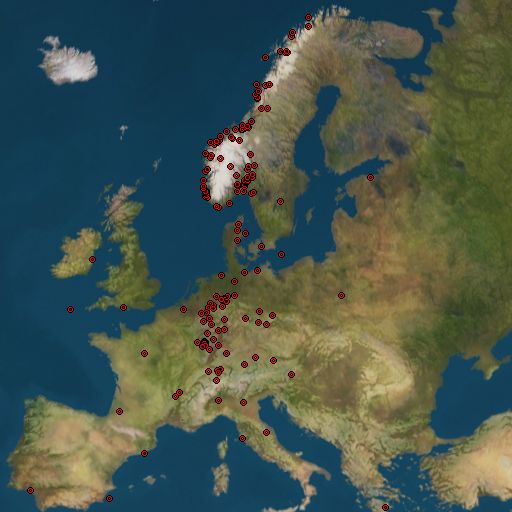
current installations http://www.skolelinux.no/testskoler/map/skolelinux -europe.png -
Re: Linux vs. Windows for Schools?
Hi Debian-Edu/Skolelinux perfectly fits your needs. Skolelinux provides a full network solution for your school. You have a main server where your user data is stored. Then you can install a LTSP-Server to use so called Thin-Clients. These Thin-Clients are old machines. All applications are running on the LTSP. Additionally you can installed so called workstations
_ sarge-i386-current.iso Have fun with testing and enjoying Debian-Edu -
Re:On a related note...
There are, in fact, when it does work, you may just see one drive, though you'll probably need to use a setup disk/utility if it doesn't default to something. Numerous people get compaq/hp proliants with scsi raid cards to work.
You might like this, it doesn't just apply to SATA.
http://linux.yyz.us/sata/faq-sata-raid.html
http://developer.skolelinux.no/info/prosjektet/del prosjekt/hw-raid-info.html -
Windows is staying, MS Office is more questionable
I just read today that they are expecting a wave of OpenOffice use in local governance here. source in Norwegian How many people are that? About 430.000 of a workforce of 2.4mio. Linux OTOH is used on servers, but no real plans of Linux desktops yet (except in schools where we have the "School Linux" software).
-
Re:Good
Norway has actually a very good project in this regard Skolelinux. The project aims at making a bespoke Linux distro for Norwegian schools, including supporting both "flavours" of the Norwegian language (something MS have been reluctant to do). Statskonsult, the state-owned company dealing with public management development, has actually called SkoleLinux "the only ICT solution taking the schools'resources and plans seriously".
-
Re:Great...
It takes roughly 5 000 hours to localize OOo. Firefox, Thunderbird, Sunbird & Chatzilla take roughly 20 000 hours to localize. Debian Linux takes roughly 25 000 hours to localize.
Just curious, where'd you get those hour numbers? I did a little googling, but wasn't able to come up with really relevant set of answers.
I found this site stating that it only takes a couple of hours? -
Re:mirrors for the .iso??
We've set up a torrent feed.
skolelinux-i386-release-1.0.iso.torrent -
Re:Regarding bittorrent.
Just to be helpfull, I present an anchor as well
-
Re:SkoleLinux was in the press here not so long ag
Skolelinux is used by many more than the 93 that has told us that officially. They don't announce it because of the negative pressure from their ICT-department in the municipality. At least 5 municipalities has done fully migration to Skolelinux in all their schools. Thats a success because they starting using this Debian-based solution before it has reached 1.0
We know that things takes time in spite of positively reports as the one from Statskonsult that concludes:
Skolelinux has taken the action plan "ICT in Education" seriously and made a product that is adapted to the school's situation and resources.
It's now the action with migrating begins -
Microsoft will only die by an enemy they can't hit
Like in our own country, there's a little project called Skolelinux (School Linux). In itself it is nothing, it's so far below MS's radar it's not even funny. But there's not one of these projects.
There are countless of them around Europe, Asia, Australia, South America, Africa, North America less the US, and perhaps even a few in the US itself. Why? All the product qualities aside, local spending, local needs, free as in beer and free as in freedom. That in itself has a value compared to lock-in to a US company.
If Microsoft was facing a single company, they would wipe them from the market. Instead they're fighting a million tiny little insects coming at them from every direction, each sucking a little bit of their lifeblood. Against that, even an 800lb gorilla has trouble.
Kjella -
Re:Open Source Advocacy in schools
Excellent article. Please also take a peek at the Skolelinux project, aka. DebianEdu
-
Re:The argument's wrong...
Good God it's not even launched yet.
Not at version 1, no - still, 70 schools all over this little country are already using it. Apps?
When the first trial version was demoed, teachers complained that there were TOO MANY apps on it.
This is for education, not (yet) school administration - even if some of the trial schools are already using it as such.
The software install is already down to 5
questions - the goal is three. Webmin administration interface does not require a certification to operate.
You're not thinking like a teacher -
I may be thinking more like a principal who sees that he can hire more teachers with the money he saves. The teachers we've been talking to just love it.
Final point: Norway, Sweden and Finland has about 20,000 Saami - whose children would like to use a computer system where they can actually read the GUI texts in their own language. -
Re:Makes good business sense...
Why should somebody provide KDE support who hates it. I haven't seen Perens Vaporware yet. UserLinux, this is no product, this was just another initiative. I prefer distribution projects that keep silent and actually help to improve Debian. Such as Skolelinux, a Linux environment for schools that can be used by an idiot as admin.
Forget about the business people, Bruce. They are talking trash. Such as the great supporter IBM that also kindly provides us with software patent law in Europe. -- a real nice friend.
I am intrested in code, not in words!! -
Re:Linux in the schools
better yet use the info on here, their might already be someone working on your language
-
Linux in the schools
You should contact the people behind other Linux in the schools projects and ask them for advice. You can for example write to someone in the Norwegian School Linux via "kontakt" or click "linker" and find a link to another project and make the contacts there.
-
Skolelinux - A distribution for education.
"We are developing a Custom Debian GNU/Linux distribution for schools. It will be simple to install and maintain, and will be based on local languages. In Norway's case, this means that all bundled applications will be available in Bokmal and Nynorsk."
skolelinux-i386-pr44.iso. Test version 44. -
Use Debianbased Skolelinux instead
Skolelinux is a better option for most schools. Completely free.
-
Here is the right link, sorry
Try this instead: Skolelinux
-
Another Linux alternativeYea that is why I am installing linux in a school district next week. They have a outdated version of novell and I am going to install K12 LTSP for these folks.
Way to go! You might want to take a look at the Skolelinux project too.
-
Re:SkoleLinux (School Linux)
A link could be useful... Sorry!
-
SCO = "Synchronous Connection Oriented"!
Not again! This is the second time I see the file sco.c mentioned as an example of a file lifted from SCO's source code. It isn't!
Has nobody bothered to look at the code yet, and done some googling?! In the sco.c file, SCO refers to a "Synchronous Connection Oriented" link.
If you don't beleive me, then here's the entry in Palowireless' Bluetooth glossary. Didn't anybody here find the notion of having a source code file named after a particulary Unix brand a tad odd? At least odd enough to investigate a little further?
Herman Robak
herman@skolelinux.no
Skolelinux, Linux for Schools -
Re:What else are they supposed to do?
What you describe is happening in Norway right now. Skolelinux ("School Linux") is a distribution based on Debian, targeting schools by - among other things - customizing the installer for use of thin clients (with LTSP), including and translating applications vital to the curriculums and writing Norwegian documentation. Even though the iso still is in beta, several schools are already using the system. Last thing I heard, some students started making a fork specially for other students who wish to use Skolelinux at home. Schools in Denmark and Germany (and some other countries I can't remember) are also showing an interest for the project. World domination is not far away
Did you ever consider contributing to open source? Oh, programming is not "your thing"? That's okay, if you speak a second language, you can help translating software. Here are some links for translation tools ("OversetterverktÃy"), type your language's equivalent to "translation guidelines" into Google, and you are ready to go. Thanks
-
Re:What else are they supposed to do?
What you describe is happening in Norway right now. Skolelinux ("School Linux") is a distribution based on Debian, targeting schools by - among other things - customizing the installer for use of thin clients (with LTSP), including and translating applications vital to the curriculums and writing Norwegian documentation. Even though the iso still is in beta, several schools are already using the system. Last thing I heard, some students started making a fork specially for other students who wish to use Skolelinux at home. Schools in Denmark and Germany (and some other countries I can't remember) are also showing an interest for the project. World domination is not far away
Did you ever consider contributing to open source? Oh, programming is not "your thing"? That's okay, if you speak a second language, you can help translating software. Here are some links for translation tools ("OversetterverktÃy"), type your language's equivalent to "translation guidelines" into Google, and you are ready to go. Thanks
-
Linux For Schools distroAnd for those parents who can't afford the latest equipment, a Linux For Schools distro could be put together that specializes in offering only the stuff people need for schoolwork:
In Norway some entusiats have done exactly that: http://www.skolelinux.no/
By the way, skole is school in Norwegian.
-
Re:Small nationsIndeed. Northern Sami has about 30000 speakers, and could never dream of a translated version of Windows or Office. They had a hard time getting support for their alphabet, which is basically latin with a few modified and accented letters.
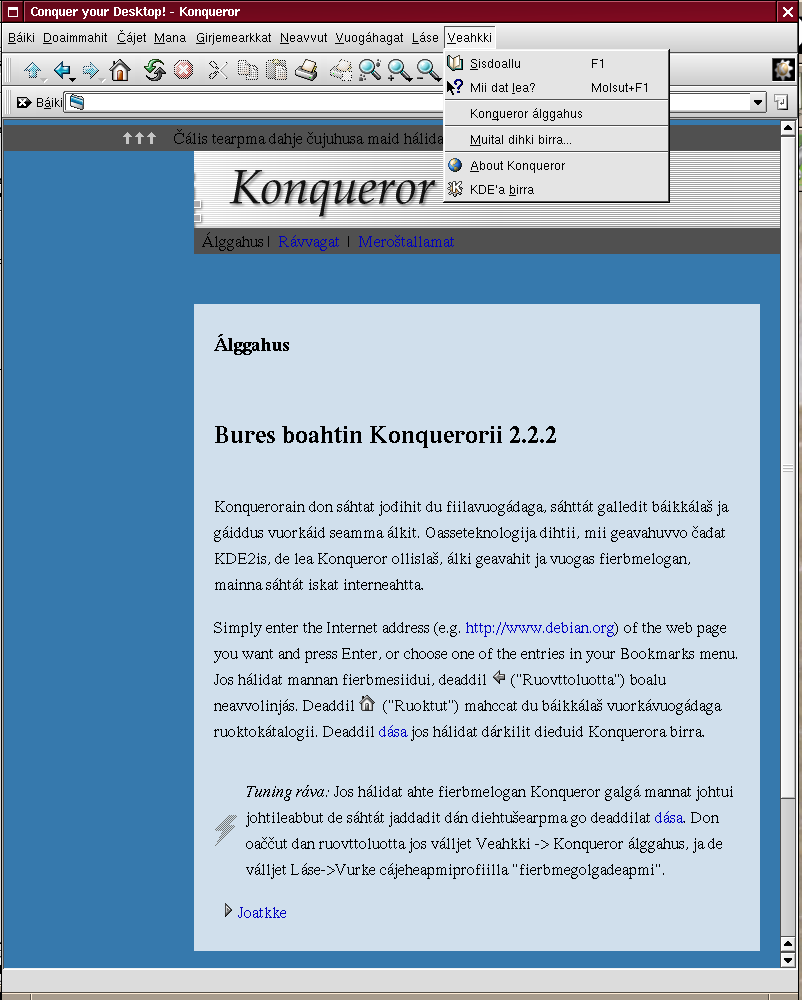
But on Linux and KDE, they had better luck: screenshot of Konqueror with Sami GUI
Sami is on its way into the major distros. For now, only character encodings and locales are available provided. But with the endorsal from KDE, and having some core KDE applications already translated will make the Sami desktop come true pretty soon.
Herman Robak,
Skolelinux -
Re:Small nationsIndeed. Northern Sami has about 30000 speakers, and could never dream of a translated version of Windows or Office. They had a hard time getting support for their alphabet, which is basically latin with a few modified and accented letters.
But on Linux and KDE, they had better luck: screenshot of Konqueror with Sami GUI
Sami is on its way into the major distros. For now, only character encodings and locales are available provided. But with the endorsal from KDE, and having some core KDE applications already translated will make the Sami desktop come true pretty soon.
Herman Robak,
Skolelinux -
Transcending borders of geography and mindset
It's hard for me to see what is insightful about this posting. Of course there are huge disparities within the US, but the resources available to the average American are hardly comparable to what poor people in South East Asia have to get by on.
It's fine that you worry about US schools - hope you're doing something about it, too. Don't deride others for trying to do get a higher return per donated dollar.
As a Norwegian, I hope to leverage experience from the progress of the Skolelinux project in Norwegian schools to make a difference in other countries, too. -
This is not completly true...
Norway is split...Two languages, altough they're pretty much the same. Nynorsk is about 30-35% of the people. However the organizations did not make about any high scool threaten microsoft. They made around the half. This is not that easy either...Earlier MS said that it would be to expencive, and that they would not earn in again.... Now they've changed they'r minds. I do think that it is in main due to that Skulelinux (In norwegian...) has translated Linux to Nynorsk, and even made their own distorbution. When MS saw that tthere was some schools that wanted to test out Skulelinux (Schoollinux), tehy got afraid, and decided that it might be better to translate it...Maybe the schools will realise that it is better and that even bokmaal schools will use Linux...
-
English link here
Try this instead Developer pages in English, and if interested, have a look at the architecture.
I'm in the process of translating as much as possible of this material into English. -
English link here
Try this instead Developer pages in English, and if interested, have a look at the architecture.
I'm in the process of translating as much as possible of this material into English. -
There ARE excellent OS alternatives
The Skolelinux project is a major effort to provide office and other software in both versions of Norwegian as well as in the minority language of Northern Sami.
In addition it will provide a very ambitious Debian Woody based thin client school network with a lot of network services. Somewhat similar to the K12LTSP project.
-
Re:Kind of makes sense...
And has anyone told them that they could actually help themselves by having local people translate OpenOffice.org
Actually, that is the only reason why MS has changed their mind about making a nynorsk-version. There is a project going at www.skolelinux.no (school-Linux), where they are making a complete Open Source package for schools. They have made a nynorsk translation of Open Office, which was/is about to get very popular, and replace the bokmål-version of MS Office. -
Switching to OpenOffice
Well the situation in Norway is quite interesting, because there is already a switch from Microsoft licenses to Linux in the education system. In fact, the state has sponsored a project called "Skolelinux" (SchoolLinux), where Norwegian/Nynorsk/Same language editions are being made based on the Debian operating system. One of the reasons why it was started was obviously the lowered costs, but also the ability to have more native language output. The site is at www.skolelinux.no but I think it's only in Norwegian...
-
Re:Boycotts work
While the point about buying from whomever decide to provide the software in their language is quite valid, there really isn't much software that support nynorsk - and even less that support the third language used in some northern parts of Norway, 'Lappish' or 'Samisk'. The main point here being that schools wasn't even going to *CONSIDER* buying MS software unless they got support for 'Nynorsk' in the software packages, and while it still remains up to each and single school to choose what software they want to use, it will still make sure that the 'Nynorsk' language gets preserved in those cases where they DO select to use Microsoft software. As the article also states, this may give hope to other "small" languages a bit more acceptance and usage, giving Catalan as an example.
The trend in Norway is however quite the opposite, more and more schools are realizing that there is several good alternatives, Linux being one of them. Norway is (afaik) one of the few countries that has their own Linux distro just for schools - which support regular Norwegian, Nynorsk ("New Norwegian") and Samisk (Lappish). read more about it (in norwegian! -
Linux in the schools, too?
There is also a project going on to create a distro tailored for Norwegian schools, read about it here.
BTW, the Microsoft deal never applied to the schools, as some imply in other posts. I'm a Norwegian CS student, and thank all applicable deities for not having to use MS... in fact, we use Debian on most of the desktops -
Re:So, what *UX flavors have good Norwegian suppor
Actually, KDE has more support for Norwegian than MS and Apple. There are two flavours of Norwegian -- bokmål and nynorsk (for historical reasons. This has something to do with the fact that Norway was in a union with Denmark until 1814). MS does not want to support the latter one, as it's the least used of the two (well, there is a spellchecker for Word, but no localisation). In addition, there is a small sami speaking population, supported with keymaps for X11 and hopefully translations for KDE sometime in the future (it has some support in Skolelinux, the Linux in schools project).
-
What will this mean for Norway?The deal was between the norwegian gov and MS
From now all departments and gov't offices will have to negotiate their own deals with MS.
This will make it easier for smaller competitors to enter the gov't arena.
Linux is one possible choice as it runs on existing hardware, though the expected outcome is that depts and offices will begin evaluating/choosing alternative windows applications from MS competitors.MS has not been the only choice for some time.
A project called Skolelinux (Linux for schools) has been underway for some time. (based on Debian with KDE/Gnome). This project has been in the news on several occasions and has also received a grant from the Norwegian ministry for Research and Education (nov/2001)Personally I think it will take some time before any changes are noticable.
Desktops will not change much, maybe a few new competing window apps.
(StarOffice or Opera maybe?)
Servers are the biggest bet, where you don't have to re-educate the entire staff.mork
a -
What will this mean for Norway?The deal was between the norwegian gov and MS
From now all departments and gov't offices will have to negotiate their own deals with MS.
This will make it easier for smaller competitors to enter the gov't arena.
Linux is one possible choice as it runs on existing hardware, though the expected outcome is that depts and offices will begin evaluating/choosing alternative windows applications from MS competitors.MS has not been the only choice for some time.
A project called Skolelinux (Linux for schools) has been underway for some time. (based on Debian with KDE/Gnome). This project has been in the news on several occasions and has also received a grant from the Norwegian ministry for Research and Education (nov/2001)Personally I think it will take some time before any changes are noticable.
Desktops will not change much, maybe a few new competing window apps.
(StarOffice or Opera maybe?)
Servers are the biggest bet, where you don't have to re-educate the entire staff.mork
a -
actually
a group of programmers etc. in norway is working on theire own linux distribution called "skolelinux"(school linux) wich is tailored for norwegian schools. i think they are nearing a final release date
-
Re:I wish more people would do it.Well, Norway isn't among the poorest countries on earth, though research and education is not getting it's share of the wealth. Yet, there is a project going on to get Linux into schools, supported by some good computer firms as well as governmental grants. They're still testing.
A friend of mine got Woody installed on all the computers where he is currently working, he is the only teacher aged under 50, but the other teachers love it, and they will probably make a complete switch to Linux (the Debian Woody-based distro the School Linux project is producing) in a short while.
There has allready been a few schools in Norway that has made the transition, for example Høle. They're still struggling with some governmental standards requiring M$ products, though.
-
In Norway
Here in Norway there is an organisation called SkoleLinux working for deployment of Linux in schools. It's currently working on an easy installer and proper translations of Office-products. It just recently got an 200.000 NOK in funding from the Education and Research department.
-
Re:What about foreign schools?
The Norwegian Skolelinux has worked hard and has been tested on some schools, and has received some money in governmental grants, but I guess has yet to really go mainstream.