Slashdot Mirror
Domain: slashdot.org
Stories and comments across the archive that link to slashdot.org.
Stories · 37,380
-
Tesla and Autopilot Supplier Mobileye Split Up After Fatal Crash (usatoday.com)
An anonymous reader quotes a report from USA Today: Tesla and Mobileye, one of the top suppliers to its Autopilot partial self-driving system, are parting ways in the wake of the May accident that killed an owner of one of its electric Model S sedans. Mobileye is considered a leader in developing the equipment that will be needed for fully self-driving cars. The Israeli tech company will continue to support and maintain current Tesla products, including upgrades that should help the Autopilot system with crash avoidance and to better allow the car to steer itself, said Chairman Amnon Shashua in releasing the company's second-quarter earnings Tuesday. Shashua said moving cars to higher levels of self-driving capability "is a paradigm shift both in terms of function complexity and the need to ensure an extremely high level of safety." He added there is "much at stake" in terms of Mobileye's reputation, and that it is best to end the relationship with Tesla by the end of the year. Tesla CEO Elon Musk, meeting with reporters at the company's new battery Gigafactory outside Reno, indicated that Tesla can go forward without Mobileye. "Us parting ways was somewhat inevitable. There's nothing unexpected here from our standpoint," Musk said. "We're committed to autonomy. They'll go their way, and we'll go ours." -
Tesla and Autopilot Supplier Mobileye Split Up After Fatal Crash (usatoday.com)
An anonymous reader quotes a report from USA Today: Tesla and Mobileye, one of the top suppliers to its Autopilot partial self-driving system, are parting ways in the wake of the May accident that killed an owner of one of its electric Model S sedans. Mobileye is considered a leader in developing the equipment that will be needed for fully self-driving cars. The Israeli tech company will continue to support and maintain current Tesla products, including upgrades that should help the Autopilot system with crash avoidance and to better allow the car to steer itself, said Chairman Amnon Shashua in releasing the company's second-quarter earnings Tuesday. Shashua said moving cars to higher levels of self-driving capability "is a paradigm shift both in terms of function complexity and the need to ensure an extremely high level of safety." He added there is "much at stake" in terms of Mobileye's reputation, and that it is best to end the relationship with Tesla by the end of the year. Tesla CEO Elon Musk, meeting with reporters at the company's new battery Gigafactory outside Reno, indicated that Tesla can go forward without Mobileye. "Us parting ways was somewhat inevitable. There's nothing unexpected here from our standpoint," Musk said. "We're committed to autonomy. They'll go their way, and we'll go ours." -
Hyperloop One Announces Opening of Its First Manufacturing Plant (techcrunch.com)
An anonymous reader quotes a report from TechCrunch: Hyperloop One is today announcing the opening of its first manufacturing plant. Called Hyperloop One Metalworks, the 105,000 square-foot building in North Las Vegas will be the new professional home of many of the company's 170 employees, including engineers, machinists and welders. These folks will build and test a number of components for the DevLoop, a full-system prototype of the Hyperloop, set for testing in 2017. The project, if successful, promises a half-hour travel time between Stockholm and Helsinki, which is the equivalent of about 300 miles. The company plans to have a working prototype of the Hyperloop by 2017 thanks to this new plant."Hyperloop One Metalworks is the first Hyperloop manufacturing plant in the world," said co-founder and President of Engineering Josh Giegel in a press release. "The ability to have a world-class machine shop in-house gives us an advantage to build rapidly and develop the Hyperloop in real-time." -
Office 365 Gets New Word, PowerPoint and Outlook Features (networkworld.com)
New submitter Miche67 writes: As part of the July 2016 update to Office 365, Microsoft is adding several features across the board to Word, PowerPoint and Outlook. Word, however, is getting the biggest new features -- Researcher and Editor -- to improve your writing. "As its name implies, Researcher is designed to help the user find reliable sources of information by using the Bing Knowledge Graph to search for sources, and it will properly cite them in the Word document," reports Network World. "[Editor] builds on the already-existing spellchecker and thesaurus to offer suggestions on how to improve your overall writing. In addition to the wavy red line under a misspelled word and the wavy blue line under bad grammar, there will be a gold line for writing style." The new features are expected to be available later this year. In addition to the two new features added to PowerPoint last year -- Designer and Morph, Microsoft is offering Zoom, a feature that lets you easily create "interactive, non-linear presentations." "Instead of the 1-2-3-4 linear method of presenting slides, forcing you to place them all in the order you wish to display, presenters will be able to show their slides in any order they want at any time," reports Network World. "This way you can change your presentation order as needed without having to stop PowerPoint or interrupt the display." As for Outlook, Focused Inbox is coming to Office 365. Focused Inbox separates your inbox into two tabs. The "Focused" tab is where all of your high-priority emails will be found, while everything else will be in the "Other" tab. Outlook will learn from your behavior over time and sort your mail accordingly. In addition, @mentions are coming to Outlook 365 and Outlook for PC and Mac, "making it easy to identify emails that need your attention, as well as flag actions for others." -
James Cameron: Theater Experience Key To Containing Piracy (torrentfreak.com)
Director James Cameron says that the key to containing movie piracy is preserving the theater experience as something special. He made the remarks when reporters asked him about his views on Sean Parker's upcoming streaming service Screening Room which will reportedly allow users to watch a new movie on the same day as its theatre release. From a TorrentFreak article: Cameron believes that having first-run movies in the home will stop people heading off to the cinema, the place where filmmakers can really showcase their art and take the fight to piracy. "The biggest hedge against piracy is still the sanctity of the viewing experience in a movie theater -- when it comes to movies," he says. "With The Walking Dead or something like that, that's not what you're selling, but if we're talking about movies and theatrical exhibition, keeping it great, making it a special experience, is still the biggest hedge against [piracy]." Interestingly, Cameron also says that even if piracy somehow became legal and download speeds were drastically improved, viewing content outside the theatrical setting would still come up short. "You're still watching [movies] on a small platform, and it's not that social experience," he explains. -
You Can't Turn Off Cortana In the Windows 10 Anniversary Update (pcworld.com)
Microsoft will release Windows 10 Anniversary Update next week. Earlier this week we listed some of its best features. PCWorld is now reporting about a major change that may annoy some users: once you've installed the update, Cortana can no longer be disabled. From the article: Cortana, the personal digital assistant that replaced Windows 10's search function and taps into Bing's servers to answer your queries with contextual awareness, no longer has an off switch. The impact on you at home: Similar to how Microsoft blocked Google compatibility with Cortana, the company is now cutting off the plain vanilla search option. That actually makes a certain of amount of sense. Unless you turned off all the various cloud-connected bits of Windows 10, there's not a ton of difference between Cortana and the operating system's basic search capabilities. -
You Can't Turn Off Cortana In the Windows 10 Anniversary Update (pcworld.com)
Microsoft will release Windows 10 Anniversary Update next week. Earlier this week we listed some of its best features. PCWorld is now reporting about a major change that may annoy some users: once you've installed the update, Cortana can no longer be disabled. From the article: Cortana, the personal digital assistant that replaced Windows 10's search function and taps into Bing's servers to answer your queries with contextual awareness, no longer has an off switch. The impact on you at home: Similar to how Microsoft blocked Google compatibility with Cortana, the company is now cutting off the plain vanilla search option. That actually makes a certain of amount of sense. Unless you turned off all the various cloud-connected bits of Windows 10, there's not a ton of difference between Cortana and the operating system's basic search capabilities. -
Trump Calls For Russia To Cyber-Invade the United States To Find Clinton's 'Missing' Emails (gawker.com)
Republican presidential nominee Donald Trump publicly called on the Russian hackers allegedly responsible for the recent leak of DNC emails to launch another cyber-attack on the United States, this time to hack emails from Hillary Clinton's tenure as secretary of State, according to reporters who attended the press conference Wednesday. (Alternate source: NYTimes, Quartz, and MotherJones) "Russia, if you're listening, I hope you're able to find the 30,000 emails that are missing," Trump said. "I think you will probably be rewarded mightily by our press."
Clinton came under investigation for her use of a personal email address while serving as secretary of state. After turning over to the FBI all correspondence about government business during her years in the State Department, Clinton revealed at a press conference last year that she had deleted about half of her emails that pertained to personal matters, like her daughter's wedding. Attorney General Loretta Lynch ultimately decided not to pursue criminal charges against Clinton. Update: Here's a video of Trump saying that. -
Trump Calls For Russia To Cyber-Invade the United States To Find Clinton's 'Missing' Emails (gawker.com)
Republican presidential nominee Donald Trump publicly called on the Russian hackers allegedly responsible for the recent leak of DNC emails to launch another cyber-attack on the United States, this time to hack emails from Hillary Clinton's tenure as secretary of State, according to reporters who attended the press conference Wednesday. (Alternate source: NYTimes, Quartz, and MotherJones) "Russia, if you're listening, I hope you're able to find the 30,000 emails that are missing," Trump said. "I think you will probably be rewarded mightily by our press."
Clinton came under investigation for her use of a personal email address while serving as secretary of state. After turning over to the FBI all correspondence about government business during her years in the State Department, Clinton revealed at a press conference last year that she had deleted about half of her emails that pertained to personal matters, like her daughter's wedding. Attorney General Loretta Lynch ultimately decided not to pursue criminal charges against Clinton. Update: Here's a video of Trump saying that. -
Google Play Rolls Out Family Sharing (usatoday.com)
Google on Wednesday announced a new Google Play feature dubbed Family Library that allows up to 6 people to share apps, movies, books purchases. It will roll out to people in the next 48 hours in 12 countries (Australia, Brazil, Canada, France, Germany, Ireland, Italy, Japan, Mexico, New Zealand, the U.K., and the United States) and requires people to sign up and add family members (you can add your friends as family member). The announcement is mostly in line with a CNET report from earlier this month. USA Today reports: The feature will allow users to share apps, games, movies, TV shows or books from Google Play on Android devices. Movies, TV shows and books can be shared on iOS platforms and the Web. After a user signs up for the Family Library, the person adds up to five family members and decides on the credit card that will be used for the families purchases. Eunice Kim, head of families for Google Play said a unique feature of Google Play compared to other family sharing initiatives is that family members can also choose to pay with their personal credit card or with gift cards. The same user who organized the family can control who below the age of 18 needs permission to purchase content.The feature is strikingly similar to an option in Apple's App Store that does the same thing. -
Xiaomi Launches Mi Notebook Air Windows 10 Laptop Featuring 1080p Display, Starts at $520 (engadget.com)
Speaking of Chinese electronics giants, Xiaomi on Wednesday announced it is entering the PC market. The company, which is often referred to as "Apple of China", announced its first-ever laptop line, the Mi Notebook Air, running on Windows 10. It comes in two sizes -- 13.3-inch and 12.5-inch -- with both models featuring a slim body, a 1080p display, a backlit keyboard, a USB Type-Charging port. The Notebook Air starts at roughly $520 and goes all the way up to $750. Starting with the smaller of two, the 12.5-inch model is only 12.9mm thick and weighs 1.07kg. It packs in Intel Core M3 CPU with no dedicated GPU, 4GB of RAM and 128GB of SSD. It is priced at $520. The 13.3-inch model, which is 14.8mm thick and weighs 1.28kg, packs in Intel Core i5-6200U Skylake-U processor, an Nvidia GeForce 940MX GPU, 8GB of DDR4 RAM, 256GB of SSD. It is powered by a 40Wh battery, which according to company's claim can last for up to 9.5 hours on a single charge, but can be charged from 0 to 50 percent in half an hour using the bundled USB-C charger. It is priced at $750. No word on when -- and if -- the laptop will be available outside China. -
'Sister Clones' Of Dolly The Sheep Have Aged Like Any Other Sheep, Study Says (npr.org)
An anonymous reader quotes a report from NPR: About four years ago, Kevin Sinclair inherited an army of clones. "Daisy, Debbie, Denise and Diana," says Sinclair, a developmental biologist at the University of Nottingham in England. "'Sister clones' probably best describes them," Sinclair says. "They actually come from the exactly the same batch of cells that Dolly came from." In an article out Tuesday in the journal Nature Communications, Sinclair and his colleagues write that the ewes' age, along with their strapping health, might be a reason for people to start feeling more optimistic about what cloning can do. Dolly's life did not turn out as scientists in the cloning field hoped it would. She died young -- 6 1/2 -- with a nasty lung virus. "That was really just bad luck," Sinclair says, and had "nothing to do" with the fact that Dolly was a clone. It was a daunting concept for those in the cloning field, because, says Sinclair, "If you're going to create these animals, they should be normal in every respect. They should be just as healthy as any other animal that's conceived naturally. If that is not the case, then it raises serious ethical and welfare concerns about creating these animals in the first place." But, the good health of the 13 clones in the Nottingham herd suggest better prospects for the procedure. Sinclair and his colleagues evaluated the animals' blood pressure, metabolism, heart function, muscles and joints, looking for signs of premature aging. They even fattened them up (since obesity is a risk factor for metabolic problems including diabetes) and gave them the standard tests to gauge how their bodies would handle glucose and insulin. The results? Normal, normal, normal. "There is nothing to suggest that these animals were anything other than perfectly normal," says Sinclair. They had slight signs of arthritis (Debbie in particular), but not enough to cause problems. "If I put them in with a bunch of other sheep, you would never be able to identify them," he says. -
Tesla Model S In Fatal Autopilot Crash Was Going 74 MPH In a 65 Zone, NTSB Says (latimes.com)
An anonymous reader quotes a report from Los Angeles Times: The Tesla car involved in a fatal crash in Florida this spring was in Autopilot mode and going about 10 miles faster than the speed limit, according to safety regulators, who also released a picture of the mangled vehicle. Earlier reports had stated the Tesla Model S struck a big rig while traveling on a divided highway in central Florida, and speculated that the Tesla Autopilot system had failed to intervene in time to prevent the collision. The National Transportation Safety Board released a preliminary report Tuesday that confirms some details of the May 7 collision, along with a photo that shows the car with its windshield flattened and most of its roof sheared off. The federal agency also included a photo of the big rig, circling an area on the right side of the tractor-trailer that showed the light damage the truck received from the collision. The 2015 Model S was moving at 74 mph, above the posted 65 mph speed limit, when it struck a 53-foot trailer being pulled by a Freightliner Cascadia truck. Tesla's semi-autonomous Autopilot driving feature was engaged, the report says. -
Facebook Open Sources 360 Surround Camera With Ikea-Style Instructions (techcrunch.com)
Reader joshtops writes: Facebook needs you to fill its News Feed, Oculus Rift, and Gear VR with 360 content. So today it put all the hardware and software designs of its Surround 360 camera on Github after announcing the plan in April. Thanks to cheeky instruction manual inspired by Ikea's manuals, you can learn how to buy the parts, assemble the camera, load the image-stitching software, and start shooting 360 content. Essentially 17 cameras on a UFO-looking stick, the 360 Surround camera can be built for about $30,000 in parts. The 4-megapixel lenses can shoot 4K, 6K, or 8K 360 video, and fisheye lenses on the top and bottom remove the blindspots. Facebook forced a random engineer to try to build the 360 Surround from the open source instructions, and found it took about four hours.FastCompany has more details. -
Chinese Giant LeEco Buys Vizio For $2 Billion, Gets Instant Foothold In US Market (phonedog.com)
Chinese electronics conglomerate LeEco is purchasing American TV manufacturer Vizio for $2 billion, the company announced at a press conference in China on Tuesday. The announcement effectively gives LeEco, formerly known as LeTV, an instant foothold in the U.S. television market. For a refresh, for those who haven't heard much about LeEco, it's one of China's biggest electronics companies. Founded in 2004, it offers a range of services including live-streaming, e-commerce, cloud, smartphones, TV set-top boxes, and smart TVs among many other products and services. One of the recent areas where it has invested its time on is an electric car, which we talked about here a few weeks ago. From a report: Vizio is primarily known for its televisions, like the P-Series sets that we recently unboxed, but they've also dipped their toes into Android. For example, Vizio released a 10-inch tablet a few years ago, and the aforementioned P-Series TV set ships with a 6-inch Android tablet that you use as a remote. Once Vizio is acquired by LeEco, it'll be operated as an independent subsidiary and the current management will remain in California. LeEco CEO Jia Yueting commented on the deal, saying, "We hope that we can use the ecosystem model and create a great integration between Vizio and LeEco and create new values for U.S. users."Having talked to the executives of LeEco in the past few months, I understand that the company intends to bring its products to the American market before its rival Xiaomi does. Xiaomi also intends to bring its smartphones and TVs to the U.S. and European market, but is currently dealing with different regulations. -
Motorola Confirms That It Will Not Commit To Monthly Security Patches (arstechnica.com)
If you are planning to purchase the Moto Z or a Moto G4 smartphone, be prepared to not see security updates rolling out to your phone every month -- and in a timely fashion. After Ars Technica called out Motorola's security policy as "unacceptable" and "insecure," in a recent review, the company tried to handle the PR disaster, but later folded. In a statement to the publication, the company said: Motorola understands that keeping phones up to date with Android security patches is important to our customers. We strive to push security patches as quickly as possible. However, because of the amount of testing and approvals that are necessary to deploy them, it's difficult to do this on a monthly basis for all our devices. It is often most efficient for us to bundle security updates in a scheduled Maintenance Release (MR) or OS upgrade. As we previously stated, Moto Z Droid Edition will receive Android Security Bulletins. Moto G4 will also receive them.Monthy security updates -- or the lack thereof -- remains one of the concerning issues that plagues the vast majority of Android devices. Unless it's a high-end smartphone, it is often rare to see the smartphone OEM keep the device's software updated for more than a year. Even with a flagship phone, the software update -- and corresponding security patches -- are typically guaranteed for only 18 to 24 months. Reports suggest that Google has been taking this issue seriously, and at some point, it was considering publicly shaming its partners that didn't roll out security updates to their respective devices fast enough. -
Obama Creates a Color-Coded Cyber Threat 'Schema' After the DNC Hack (vice.com)
The White House on Tuesday issued new instructions on how government agencies should respond to major cyber security attacks, in an attempt to combat perceptions that the Obama administration has been sluggish in addressing threats from sophisticated hacking adversaries, Reuters reports. The announcement comes amid reports that hackers working for Russia may have engineered the leak of emails stolen from the Democratic National Committee in an attempt to influence the outcome of the upcoming presidential election. Motherboard adds: George W. Bush's Homeland Security Advisory System -- the color-coded terrorism "threat level" indicator that became a symbol of post-9/11 fear mongering -- is getting its spiritual successor for hacking: the "Cyber Incident Severity Schema." President Obama announced a new policy directive Tuesday that will codify how the federal government will respond to hacking incidents against both the government and private American companies. [...] The Cyber Incident Severity Schema ranges from white (an "unsubstantiated or inconsequential event") to black (a hack that "poses an imminent threat to the provision of wide-scale critical infrastructure services, national government stability, or to the lives of U.S. persons") , with green, yellow, orange, and red falling in between. Any hack or threat of a hack rated at orange or above is a "significant cyber incident" that will trigger what the Obama administration is calling a "coordinated" response from government agencies. As you might expect, there are many unanswered questions here, and the federal government has announced so many cyber programs in the last few years that it's hard to know which, if any of them, will actually make the US government or its companies any safer from hackers. -
'DNC Hacker' Unmasked: He Really Works for Russia, Researchers Say (thedailybeast.com)
The hacker who claimed to compromise the DNC swore he was Romanian, but new investigation shows he worked directly for Russia President Vladimir Putin's government in Moscow. The Daily Beast reports: The hacker who claims to have stolen emails from the Democratic National Committee and provided them to WikiLeaks is actually an agent of the Russian government and part of an orchestrated attempt to influence U.S. media coverage surrounding the presidential election, a security research group concluded on Tuesday. The researchers, at Arlington, Va.-based ThreatConnect, traced the self-described Romanian hacker Guccifer 2.0 back to an Internet server in Russia and to a digital address that has been linked in the past to Russian online scams. Far from being a single, sophisticated hacker, Guccifer 2.0 is more likely a collection of people from the propaganda arm of the Russian government meant to deflect attention away from Moscow as the force behind the DNC hacks and leaks of emails, the researchers found. ThreatConnect is the first known group of experts to link the self-proclaimed hacker to a Russian operation, amidst an ongoing FBI investigation and a presidential campaign rocked by the release of DNC emails that have embarrassed senior party leaders and inflamed intraparty tensions turning the Democratic National Convention. The emails revealed that party insiders plotted ways to undermine Sen. Bernie Sanders' presidential bid. The researchers at the aforementioned security firm are basing their conclusion on three signals: the hacker used Russian computers to edit PDF files, he also used Russian VPN -- and other internet infrastructure from the country, and that he was unable to speak Romanian. -
Slashdot Asks: What's Next For Netflix? (500ish.com)
What does the future hold for Netflix? The company first earned a name for itself over a decade ago renting DVDs via mails in an era when Blockbuster used to laugh at the mere idea of DVDs-by-mail. It then moved to offering online streaming service way before most of the companies. As VC and former journalist MG Siegler writes, Netflix was always ahead of the curve. But the market -- and the demand from the market is changing, again. To address that, the on-demand streaming service has over the past three-four years started to invest heavily in getting exclusive rights for movies and TV shows, as well as make its own original content. But this time, Netflix is facing immense competition from its rivals -- and its moves aren't that unpredictable. It's also worth pointing out just recently, the company's decision to hike prices led its stocks to tank. Siegler writes: The streaming content game is now hyper competitive. And even the streaming original content game has gotten extremely competitive. And this means it has gotten extremely expensive. The result has been great for us, the users, as we do seem to be in a golden age of television-like content, even if it's being delivered via streaming "channels" like Netflix. With 54 Emmy nominations this year, second to only HBO, Netflix is seemingly closing in on what they set out to do once again. They've become HBO faster than HBO has been able to become Netflix. Of course, HBO still has the warm blanket of cable operator fees to keep them cozy; Netflix's model has them a bit out in the cold in that regard. So, again, what's next? Is it VR? Something else? Don't tell me it's 4k. Worldwide expansion is huge, but that's really just growing into the last business. What's the next business pivot?What you, Slashdot readers, think Netflix's next move will be? Or do you think the company will soon become just another name in its respective category? -
AMD Unveils Radeon Pro WX and Pro SSG Professional Graphics Cards (hothardware.com)
MojoKid writes: AMD took the wraps off its latest pro graphics solutions at SIGGRAPH today, and announced three new professional graphics cards in the new Polaris-based Radeon Pro WX Series. The Radeon Pro WX 4100 is the entry-level model with a half-height design for use in small form-factor workstations. The Radeon Pro WX 5100 is the middle child, while the Radeon Pro WX 7100 is AMD's current top-end WX model. The Radeon Pro WX 7100 has 32 compute units, offers 5 TFLOPs of compute performance, and is backed by 8GB of GDDR4 memory over a 256-bit memory interface. The Radeon Pro WX 5100 offers 28 compute units and 4 TFLOPs of performance along with 8GB memory over the same 256-bit interface, and the Radeon Pro WX 4100 is comprised of 16 compute units at 2 TFLOPs of perf with 4GB memory over a 128-bit memory link. The Radeon Pro WX 4100 has four mini DisplayPort outputs, while the Radeon Pro WX 5100 and 7100 each have four full-size DisplayPort connectors. None of these cards will be giving the new NVIDIA Quadro P6000 a run for its money in terms of performance, but they don't have to. The Quadro card will no doubt cost thousands of dollars, while the Radeon Pro WX 7100 will eek in at just under $1,000. The Radeon Pro WX 5100 and 4100 will slot in somewhat below that mark. AMD also announced the Radeon Solid State Storage Architecture and the Radeon Pro SSG card today. Details are scant, but AMD is essentially outfitting Radeon Pro SSG cards with large amounts of Solid State Flash Memory, which can allow much larger data sets to reside close to the GPU in an extended frame buffer. Whereas the highest-end professional graphics cards today may have up to 24GB of memory, the Radeon Pro SSG will start with 1TB, linked to the GPU via a custom PCI Express interface. Giving the GPU access to a large, local data repository should offer significantly increased performance for demanding workloads like real-time post-production of 8K video, high-resolution rendering, VR content creation and others. -
Chinese State Company Unveils World's Largest Seaplane (theguardian.com)
An anonymous reader quotes a report from The Guardian: China has completed production of the world's largest amphibious aircraft, state media has said, the latest effort in the country's program to wean itself off dependence on foreign aviation firms. The state-owned Aviation Industry Corporation of China (AVIC) unveiled the first of the new planes, dubbed the AG600, Saturday in the southern port city of Zhuhai, the official Xinhua news agency reported. The aircraft, which has a maximum range of 4,500 km (2,800 miles), is intended for fighting forest fires and performing marine rescues, it said. At around the size of a Boeing 737, it is far larger than any other plane built for marine take off and landing, Xinhua quoted AVIC's deputy general manager Geng Ruguang as saying. The AG600 could potentially extend the Asian giant's ability to conduct a variety of operations in the South China Sea, where it has built a series of artificial islands featuring air strips, among other infrastructure with the potential for either civilian or military use. -
Amazon Partners With UK Government To Test Drone Deliveries (usatoday.com)
An anonymous reader quotes a report from USA Today: [Recent rules from the Federal Aviation Administration mean delivery by drone is years away in the United States, but packages may be winging their way to customers sooner rather than later in the United Kingdom, where Amazon just got permission to begin a new trial of its delivery drones.] The U.K. Civil Aviation Authority gave Amazon permission to test several key drone delivery parameters. They include sending drones beyond the line of sight of their operator in rural and suburban areas, testing sensor performance to make sure the drones can identify and avoid obstacles and allowing a single operator to manage multiple highly-automated drones. U.S. rules are outlined in a 624-page rulebook from the Federal Aviation Administration. They allow commercial drones weighing up to 55 pounds to fly during daylight hours. The aircraft must remain within sight of the operator or an observer who is in communication with the operator. The operators must be pass an aeronautics test every 24 months for a certificate as well as a background check by the Transportation Security Administration. The rules govern commercial flights, such as for aerial photography or utilities inspection. Amazon's goal is to use drones to deliver packages up to 5 pound to customers in 30 minutes or less. Amazon released a statement today detailing its partnership with the UK Government that may one day turn its Prime Air drone delivery service into reality. -
Bitcoin Not Money, Rules Miami Judge In Dismissing Laundering Charges (miamiherald.com)
An anonymous reader quotes a report from Miami Herald: Bitcoin does not actually qualify as money, a Miami-Dade judge ruled Monday in throwing out criminal charges against a Miami Beach man charged with illegally selling the virtual currency. The defendant, Michell Espinoza, was charged with illegally selling and laundering $1,500 worth of Bitcoins to undercover detectives who told him they wanted to use the money to buy stolen credit-card numbers. But Miami-Dade Circuit Judge Teresa Mary Pooler ruled that Bitcoin was not backed by any government or bank, and was not "tangible wealth" and "cannot be hidden under a mattress like cash and gold bars." "The court is not an expert in economics, however, it is very clear, even to someone with limited knowledge in the area, the Bitcoin has a long way to go before it the equivalent of money," Pooler wrote in an eight-page order. The judge also wrote that Florida law -- which says someone can be charged with money laundering if they engage in a financial transaction that will "promote" illegal activity -- is way too vague to apply to Bitcoin. "This court is unwilling to punish a man for selling his property to another, when his actions fall under a statute that is so vaguely written that even legal professionals have difficulty finding a singular meaning," she wrote. Espinoza's case is believed to be the first money-laundering prosecution involving Bitcoin. -
Nintendo Shares Plummet After Investors Realize It Doesn't Actually Make Pokemon Go (theverge.com)
Sam Byford, reporting for The Verge: Nintendo shares have skyrocketed since Pokemon Go's release and instant transformation into global cultural phenomenon, but they fell dramatically today after investors realized that Nintendo doesn't actually make the game. Nintendo put out a statement after the close of trading on Friday pointing out that the bottom-line impact will be "limited" as it only owns 32 percent of The Pokemon Company, and that revenue from the game and its Pokemon Go Plus smartwatch peripheral have been accounted for in the company's current forecasts. Pokemon Go is a collaboration between The Pokemon Company and Niantic Labs, the developer who previously created the similar AR game Ingress as part of Google. This apparent revelation caused shares to plummet in Monday trading, with the stock dropping 17 percent at one point, representing about $6.4 billion in value; as Bloomberg notes, Tokyo stock exchange rules prevent share prices from moving more than 18 percent in a single day. -
Windows 10 Anniversary Update: the Best New Features (theverge.com)
A year after the release of Windows 10, Microsoft is gearing up for Anniversary Update, the first major update to the company's desktop operating system. Ahead of the public release of Anniversary Update on August 2, Microsoft provided media outlets with the Anniversary Update, and their first impressions and reviews are out. The Verge has listed the big changes Windows 10 Anniversary ships with. From the article: Windows Ink: Windows Ink is without a doubt the best part of the Anniversary Update. It's essentially a central location to find built-in or third-party apps that work with your stylus. You can use the new sticky notes to note down reminders, and they'll even transform into true reminders as Cortana understands what you write.
Microsoft Edge extensions: If you're a fan of Chrome extensions, then you'll be glad to hear that they're heading to Microsoft's Edge browser. The Anniversary Update brings support for extensions, and it's now up to third-party developers to fill the Windows Store with their add-ons.
Cortana improvements: Microsoft's digital assistant, Cortana, debuted on Windows 10 last year, and the software maker is bringing it to the lock screen with the Anniversary Update. You'll be able to ask it to make a note, play music, set a reminder, and lots more without ever logging in. Cortana is also getting a little more intelligent, with the ability to schedule appointments in Outlook or options to send friends a document you were working on a week ago.
Dark theme and UI tweaks: You can switch on what I call even darker mode in settings, and it will switch built-in apps that typically use a white background over to black.Other improvements include things like Windows 10's ability to set your time zone automatically, and opening up of Windows Hello, the biometric feature to apps and websites. Additionally, the Xbox One is getting Windows apps. The Verge adds, "It feels like a promise that was made years ago, but it's finally coming true with the Anniversary Update. As Windows 10 now powers the Xbox One, Microsoft will start rolling out an update to its console to provide support for Cortana on Xbox One and the new universal apps." Microsoft is also adding Bash, the Linux command line to Windows with the new update. It's an optional feature and users will need to enable it to use it. Users will also be able to "project to PC," a feature that will allow one to easily find a PC to project to from a phone or another PC. There's also a new Skype app, and syncing of notifications between PC and phone is getting better.
Going by the reviews, it appears Windows 10 Anniversary Update is substantially more stable, and has interesting new features. You can read the first impressions of it on ZDNet, and review on PCWorld. -
China Bans Internet News Reporting As Media Crackdown Widens (bloomberg.com)
Earlier this month we learned that China had banned the use of social media as a news source. The local government feared that if news outlets were to report using signals coming from social media, there was a chance that fake, non-credible, and rumors would slip through the filter. It was absurd, to say the least, considering the government itself has been reportedly caught of posting a copious amount of misleading information on domestic social media platforms. In the latest wrinkle to the whole situation, the world's largest nation is now banning internet news reporting. Long time reader schwit1 shares a Bloomberg report on the same: China's top internet regulator ordered major online companies including Sina Corp. and Tencent Holdings Ltd. to stop original news reporting, the latest effort by the government to tighten its grip over the country's web and information industries. The Cyberspace Administration of China imposed the ban on several major news portals, including Sohu.com Inc. and NetEase Inc., Chinese media reported in identically worded articles citing an unidentified official from the agency's Beijing office. The companies have "seriously violated" internet regulations by carrying plenty of news content obtained through original reporting, causing "huge negative effects," according to a report that appeared in The Paper on Sunday. The agency instructed the operators of mobile and online news services to dismantle "current-affairs news" operations on Friday, after earlier calling a halt to such activity at Tencent, according to people familiar with the situation. Like its peers, Asia's largest internet company had developed a news operation and grown its team. Henceforth, they and other services can only carry reports provided by government-controlled print or online media, the people said, asking not to be identified because the issue is politically sensitive. -
China Bans Internet News Reporting As Media Crackdown Widens (bloomberg.com)
Earlier this month we learned that China had banned the use of social media as a news source. The local government feared that if news outlets were to report using signals coming from social media, there was a chance that fake, non-credible, and rumors would slip through the filter. It was absurd, to say the least, considering the government itself has been reportedly caught of posting a copious amount of misleading information on domestic social media platforms. In the latest wrinkle to the whole situation, the world's largest nation is now banning internet news reporting. Long time reader schwit1 shares a Bloomberg report on the same: China's top internet regulator ordered major online companies including Sina Corp. and Tencent Holdings Ltd. to stop original news reporting, the latest effort by the government to tighten its grip over the country's web and information industries. The Cyberspace Administration of China imposed the ban on several major news portals, including Sohu.com Inc. and NetEase Inc., Chinese media reported in identically worded articles citing an unidentified official from the agency's Beijing office. The companies have "seriously violated" internet regulations by carrying plenty of news content obtained through original reporting, causing "huge negative effects," according to a report that appeared in The Paper on Sunday. The agency instructed the operators of mobile and online news services to dismantle "current-affairs news" operations on Friday, after earlier calling a halt to such activity at Tencent, according to people familiar with the situation. Like its peers, Asia's largest internet company had developed a news operation and grown its team. Henceforth, they and other services can only carry reports provided by government-controlled print or online media, the people said, asking not to be identified because the issue is politically sensitive. -
Microsoft Cuts Xbox One Price To $249 - Would You Buy or Recommend One? (theverge.com)
Tom Warren, writing for The Verge: Microsoft is cutting the price of its Xbox One console to $249. The new price marks the third price cut in less than two months, ahead of the new Xbox One S launch on August 2nd. 500GB versions of the Xbox One are now $249, and this includes bundles with games like Gears of War: Ultimate Edition, Quantum Break, Forza Motorsport 6, Rise of the Tomb Raider, and Rare Replay. Retailers like Best Buy and Amazon will be selling Microsoft's Xbox One console at the new $249 price point immediately, and the software giant says the consoles will be available at $249 "while supplies last." Microsoft's aggressive Xbox One pricing follows a sales gap between its console and Sony's PlayStation 4. Sony has sold more than 40 million PS4s, but it's not clear exactly how many Xbox Ones have been sold as Microsoft hasn't provided sales figures for quite some time. EA previously revealed Microsoft had sold 19 million Xbox One consoles back in January. -
Once Valued at $125B, Yahoo's Web Assets To Be Sold To Verizon For $4.83B, Companies Confirm
The reports were spot on. Verizon Communications on Monday announced that it plans to purchase Yahoo's Web assets for a sum of $4.83 billion in cash. The multi-billion dollars deal will get Verizon Yahoo's core internet business and some real estate. The announcement also marks a remarkable fall for the Silicon Valley web pioneer, which once had a market capitalization of more than $125 billion. For Verizon, the deal adds another piece to the mammoth digital media and advertising empire it owns. The deal is expected to close early 2017. CNBC reports: The transaction is seen boosting Verizon's AOL internet business, which the company acquired last year for $4.4 billion, by giving it access to Yahoo's advertising technology tools, as well as other assets such as search, mail, messenger and real estate. It also marks the end of Yahoo as an operating company, leaving it only as the owner of a 35.5 percent stake in Yahoo Japan, as well as its 15 percent interest in Chinese e-commerce company Alibaba. In December, Yahoo scrapped plans to spin off its Alibaba stake after investors worried about whether that transaction could have been carried out on a tax-free basis. It instead decided to explore a sale of its core assets, spurred on by activist hedge fund Starboard Value. Forbes has called it one of the "saddest $5B deals in tech history."Yahoo CEO Marissa Mayer, who was expected to leave -- or get fired -- said she intends to stay. "For me personally, I'm planning to stay," Mayer said in a note on Yahoo's Tumblr page. "I love Yahoo, and I believe in all of you. It's important to me to see Yahoo into its next chapter." -
New Illinois Law Limits Police Use Of Cellphone-Tracking Stingray (go.com)
An anonymous Slashdot reader quotes a report from ABC News: A new Illinois law limits how police can use devices that cast a wide net in gathering cellphone data... [Stingray] gathers phone-usage data on targets of criminal investigations, but it also gathers data on other cellphones -- hundreds or even thousands of them -- in the area. The new law requires police to delete the phone information of anyone who wasn't an investigation target within 24 hours. It also prohibits police from accessing data for use in an investigation not authorized by a judge.
A dozen other states have adopted such regulations, and Congress is considering legislation that would strengthen federal guidelines already in place... Privacy advocates worry that without limits on how much data can be gathered or how long it can be stored, law enforcement could use the technology to build databases that track the behavior and movement of people who are not part of criminal investigations.
Earlier this month a U.S. judge threw out evidence gathered with Stingray for the first time, saying that without a search warrant, "the government may not turn a citizen's cell phone into a tracking device." The ACLU has identified 66 agencies in 24 states using Stingray technology, "but because many agencies continue to shroud their purchase and use of stingrays in secrecy, this map dramatically underrepresents the actual use of stingrays by law enforcement agencies nationwide." -
Laser-Armed Martian Robot Now Vaporizing Targets of Its Own Free Will (dailymail.co.uk)
Slashdot reader Rei writes: NASA -- having already populated the Red Planet with robots and armed a car-sized nuclear juggernaut with a laser -- have now decided to grant fire control of that laser over to a new AI system operating on the rover itself. Intended to increase the scientific data-gathering throughput on the sometimes glitching rover's journey, the improved AEGIS system eliminates the need for a series of back-and-forth communication sessions to select targets and aim the laser.
Rei's original submission included a longer riff on The War of the Worlds, ending with a reminder to any future AI overlords that "I have a medical condition that renders me unfit to toil in any hypothetical subterranean lithium mines..." -
Valve Threatens Counter Strike Gambling Sites (hngn.com)
An anonymous Slashdot reader quotes a report from HNGN: Game maker Valve is threatening to shut down sites dedicated to gambling with add-ons to its popular Counter Strike game. On Thursday the company sent cease and desist letters to 23 sites, demanding that gambling operations be stopped, and that the sites had 10 days to comply. The row revolves around the software overlays that change the appearance of the characters people play in Counter Strike: Global Offensive (CSGO) and the weapons and other virtual items. Last week the company reiterated that its user agreements ban external sites from asking users to connect their Steam accounts in order to trade items for real money. The company added that it would use "all available remedies" against sites that did not stop players using virtual goods to gamble.
Bloomberg reports that in June a class action lawsuit was filed against Valve "for its role in the multibillion-dollar gambling economy that has fueled the game's popularity" -- by a man who had been gambling on the site since 2014. This was followed in July by a second class action lawsuit by a mother on behalf of her son, reports ESPN. "The case alleges that the Valve knowingly allows and profits from teenagers participating in illegal, unregulated and underage gambling of in-game cosmetic weapon skins through third-party sites." -
Phones Without Headphone Jacks Are Here... and They're Extremely Annoying (mashable.com)
A few weeks ago, we had an intense discussion on what would happen if Apple's next iPhone doesn't have a headphone port -- and what that means for the rest of the industry, as well as the pros and cons of ditching the legacy port. Over the past few months, we have seen many smartphone manufacturers launch new handsets that don't have a headphone jack. Mashable has a report today in which it says that it is already causing frustration among users. From the article: In the Android camp, phones like Lenovo's Moto Z and Moto Z Force and China's LeEco have already scrapped the 3.5mm headphone jack; to listen to music on the company's three latest phones, users need to plug in USB Type-C headphones, go wireless, or use a dongle. I'm all for letting go of old technologies to push forward, but what is happening is actually going to make things worse. The headphone jack has worked for 50 years and it can work for another 50 more because it's universal. Headphones I plug into my iPhone work in an Android phone, in a BlackBerry, in my computer, in my PS4 controller, in my tablet, in any speaker with audio-out, and so on. I can walk into any electronics store and pick up a pair of headphones and not have to worry about compatibility with any of my devices. I know it'll work. [...] With a universal headphone jack, I never have to worry whether or not the crappy pack-in iPhone EarPods I have will work with the Android phone I'm reviewing or not. I also never have to worry if I'll be able to plug my headphones into a friend's phone to listen to some new song. Same applies for when I want to use my earbuds and headphones with another person's device. And there lies the real issue. I will need different dongles -- a Lightning-to-headphone-jack and a USB-Type-C-to-headphone-jack to be prepared because I do carry both iPhone and Android phone on me daily. Dongles also get lost. -
Phones Without Headphone Jacks Are Here... and They're Extremely Annoying (mashable.com)
A few weeks ago, we had an intense discussion on what would happen if Apple's next iPhone doesn't have a headphone port -- and what that means for the rest of the industry, as well as the pros and cons of ditching the legacy port. Over the past few months, we have seen many smartphone manufacturers launch new handsets that don't have a headphone jack. Mashable has a report today in which it says that it is already causing frustration among users. From the article: In the Android camp, phones like Lenovo's Moto Z and Moto Z Force and China's LeEco have already scrapped the 3.5mm headphone jack; to listen to music on the company's three latest phones, users need to plug in USB Type-C headphones, go wireless, or use a dongle. I'm all for letting go of old technologies to push forward, but what is happening is actually going to make things worse. The headphone jack has worked for 50 years and it can work for another 50 more because it's universal. Headphones I plug into my iPhone work in an Android phone, in a BlackBerry, in my computer, in my PS4 controller, in my tablet, in any speaker with audio-out, and so on. I can walk into any electronics store and pick up a pair of headphones and not have to worry about compatibility with any of my devices. I know it'll work. [...] With a universal headphone jack, I never have to worry whether or not the crappy pack-in iPhone EarPods I have will work with the Android phone I'm reviewing or not. I also never have to worry if I'll be able to plug my headphones into a friend's phone to listen to some new song. Same applies for when I want to use my earbuds and headphones with another person's device. And there lies the real issue. I will need different dongles -- a Lightning-to-headphone-jack and a USB-Type-C-to-headphone-jack to be prepared because I do carry both iPhone and Android phone on me daily. Dongles also get lost. -
CRISPR: Chinese Scientists To Pioneer Gene-Editing Trial On Humans (theguardian.com)
An anonymous reader quotes a report from The Guardian: A team of Chinese scientists will be the first in the world to apply the revolutionary gene-editing technique known as CRISPR on human subjects. Led by Lu You, an oncologist at Sichuan University's West China hospital in Chengdu, China, the team plan to start testing cells modified with CRISPR on patients with lung cancer in August, according to the journal Nature. CRISPR is a game-changer in bioscience; a groundbreaking technique which can find, cut out and replace specific parts of DNA using a specially programmed enzyme named Cas9. Its ramifications are next to endless, from changing the color of mouse fur to designing malaria-free mosquitoes and pest-resistant crops to correcting a wide swath of genetic diseases like sickle-cell anaemia in humans. The Sichuan University trial, it is important to note, does not edit the germ-line; its effects will not be hereditary. What the researchers plan to do is enroll patients with metastatic non-small cell lung cancer, Nature reported, and for whom other treatment options -- including chemotherapy and radiotherapy -- have failed. They will then extract immune cells from the patients' blood and use CRISPR to add a new genetic sequence which will help the patient's immune system target and destroy the cancer. The cells will then be re-introduced into the patients' bloodstream. The Guardian does note that CRISPR was approved for human trials in the U.S., but if it begins on schedule in August the Sichuan University study will beat them to the punch of being the first of its kind. -
Cyanogen Inc. Reportedly Fires OS Development Arm, Switches To Apps (arstechnica.com)
An anonymous reader writes: Android Police is reporting that the Android software company Cyanogen Inc. will be laying off 20 percent of its workforce, and will transition from OS development to applications. The Android Police report says "roughly 30 out of the 136 people Cyanogen Inc. employs" are being cut, and that the layoffs "most heavily impact the open source arm" of the company. Android Police goes on to say that CyanogenMod development by Cyanogen Inc "may be eliminated entirely." Ars Technica notes the differences between each "Cyanogen" branding. Specifically, CyanogenMod is a "free, open source, OS heavily based on Android and compatible with hundreds of devices," while Cyanogen Inc. is "a for-profit company that aims to sell Cyanogen OS to OEMs." It appears that many of the core CyanogenMod developers will no longer be paid to work on CyanogenMod, though the community is still free to develop the software." Android Police details the firing process in their report: "Layoffs reportedly came after a long executive retreat for the company's leaders and were conducted with no advanced notice. Employees who were not let go were told not to show up to work today. Those who did show up were the unlucky ones: they had generic human resources meetings rather ominously added to their calendars last night. So, everyone who arrived at Cyanogen Inc. in Seattle this morning did so to lose their job (aside from those conducting the layoffs)." Early last year, Microsoft invested in a roughly $70 million round of equity financing for the then-startup Cyanogen Inc. Not too long before that, Google tried to acquire Cyanogen Inc., but the company turned down Google's offer to seek funding from investors and major tech companies at a valuation of around $1 billion. Cyanogen Inc. CEO Kirt McMaster once said the company was "attempting to take Android away from Google" and that it was "putting a bullet through Google's head."
UPDATE 7/25/16: Cyanogen CEO and cofounder Kirt McMaster took to Twitter to dispel some of the rumors, tweeting: "Cyanogen NOT pivoting to apps. We are an OS company and our mission of creating an OPEN ANDROID stands. FALSE reporting was outstanding." -
Cyanogen Inc. Reportedly Fires OS Development Arm, Switches To Apps (arstechnica.com)
An anonymous reader writes: Android Police is reporting that the Android software company Cyanogen Inc. will be laying off 20 percent of its workforce, and will transition from OS development to applications. The Android Police report says "roughly 30 out of the 136 people Cyanogen Inc. employs" are being cut, and that the layoffs "most heavily impact the open source arm" of the company. Android Police goes on to say that CyanogenMod development by Cyanogen Inc "may be eliminated entirely." Ars Technica notes the differences between each "Cyanogen" branding. Specifically, CyanogenMod is a "free, open source, OS heavily based on Android and compatible with hundreds of devices," while Cyanogen Inc. is "a for-profit company that aims to sell Cyanogen OS to OEMs." It appears that many of the core CyanogenMod developers will no longer be paid to work on CyanogenMod, though the community is still free to develop the software." Android Police details the firing process in their report: "Layoffs reportedly came after a long executive retreat for the company's leaders and were conducted with no advanced notice. Employees who were not let go were told not to show up to work today. Those who did show up were the unlucky ones: they had generic human resources meetings rather ominously added to their calendars last night. So, everyone who arrived at Cyanogen Inc. in Seattle this morning did so to lose their job (aside from those conducting the layoffs)." Early last year, Microsoft invested in a roughly $70 million round of equity financing for the then-startup Cyanogen Inc. Not too long before that, Google tried to acquire Cyanogen Inc., but the company turned down Google's offer to seek funding from investors and major tech companies at a valuation of around $1 billion. Cyanogen Inc. CEO Kirt McMaster once said the company was "attempting to take Android away from Google" and that it was "putting a bullet through Google's head."
UPDATE 7/25/16: Cyanogen CEO and cofounder Kirt McMaster took to Twitter to dispel some of the rumors, tweeting: "Cyanogen NOT pivoting to apps. We are an OS company and our mission of creating an OPEN ANDROID stands. FALSE reporting was outstanding." -
Hillary Clinton Chooses Virginia Sen. Tim Kaine As Running Mate (go.com)
An anonymous reader quotes a report from ABC News: Virginia Sen. Tim Kaine has been chosen as Hillary Clinton's running mate -- a man she called a "relentless optimist" who "devoted his life to fighting for others." Kaine has long been considered to be at the top of Clinton's short list. He was previously vetted for the vice presidency by Barack Obama in 2008. Kaine was an early supporter of Clinton's, appearing at a "Ready for Hillary" breakfast in May 2014 where he urged her to enter the 2016 presidential race. Kaine told NBC in June that he "encouraged her to run in May of 2014, because I could telescope forward and see some of the challenges that this nation would be facing. And I decided that by reason of character, by reason of background, and experience, but also especially by reason of results, she would be the most qualified person to be president in January of 2017." Prior to being elected to the Senate, Kaine served as governor and lieutenant governor of Virginia. In 2009, President Obama picked Kaine to lead the Democratic National Committee. Last week, Republican presidential nominee Donald Trump announced Mike Pence as his VP running mate. -
VW Has Emissions-Cheating Fix Ready, Says Report (pressherald.com)
An anonymous reader writes from a report via Portland Press Herald: Volkswagen plans to fix the engines that were rigged to cheat on emissions tests by updating computer software and installing a larger catalytic converter to trap harmful nitrogen oxide, according to two dealers who were briefed by executives on the matter. The dealers said that limited details of the plan were made public last week at a regional dealer meeting in Newark, New Jersey, by Volkswagen of America Chief Operating Officer Mark McNabb. Portland Press Herald reports: "One dealer said the group was told that early testing of a small sample of repaired cars showed that the fix made 'no discernible difference' in the cars' mileage, horsepower or torque. Both dealers said they were told that more testing was needed and that the plans still had to be approved by the U.S. Environmental Protection Agency and the California Air Resources Board. One of the dealers said the so-called 'Generation 1' diesels -- about 325,000 VW Jettas, Golfs, Passats and Beetles from the 2009 to 2014 model years – would get new software and bigger catalytic converters in January or February of next year. About 90,000 'Generation 2' Passats already have sufficient emissions systems and would get only a software update early next year. Another 67,000 'Generation 3' 2015 models would get software in October and would get additional hardware a year later, the dealer said. Dealers also were told that they'd be reimbursed by VW for sales losses due to the scandal, and that new vehicles are coming." Last month, Volkswagen agreed to a record $14.7 billion settlement over the emissions cheating. -
Edward Snowden At Comic-Con: 'I Live a Surprisingly Free Life' (theguardian.com)
An anonymous reader writes from a report via The Guardian: Director Oliver Stone talked to whistleblower Edward Snowden in front of an audience at a question and answer session on Thursday evening. He compared Snowden's anxiety over his own appearance in his Snowden biopic film "Snowden" to that of Donald Trump, who was cut from one of his films six years before. Snowden replied: "I'd like to avoid that association." At the event, Snowden did also shed some light on his personal life, years after his revelation of the NSA's secret surveillance of the American public's internet activity resulted in criminal charges under the Espionage Act that led to his exile in Russia. "I can confirm that I am not living in a box," Snowden said. "I actually live a surprisingly free life. This was not the most likely outcome. I didn't actually expect to make it out of Hawaii. I thought it was incredibly risky. I had a lot of advantages in doing what I did; I worked for the CIA on the human intelligence side, I worked for the NSA on the signals intelligence side, and I taught counterintelligence. This is not something that's covered that well in the media. I was about as well placed as anybody could be, and I still thought I was going to get rolled up at the airport and that there were going to be knocks on the doors of the journalists." When asked what he thought about Gordon-Levitt's performance in the film where he plays Edward Snowden, Snowden responded: "This is one of the things that's kind of crazy and surreal about this kind of experience: I don't think anybody looks forward to having a movie made about themselves, especially someone who is a privacy advocate. Some of my family members have said, 'He sounds just like you!' I can't hear it myself but if he can pass the family test he's doing all right." Snowden agreed to participate on the film because he thought it could raise awareness in ways his own advocacy could not. Snowden was also in the news recently for developing a way for potentially imperiled smartphone users to monitor whether their devices are making any potentially compromising radio transmissions. -
Edward Snowden At Comic-Con: 'I Live a Surprisingly Free Life' (theguardian.com)
An anonymous reader writes from a report via The Guardian: Director Oliver Stone talked to whistleblower Edward Snowden in front of an audience at a question and answer session on Thursday evening. He compared Snowden's anxiety over his own appearance in his Snowden biopic film "Snowden" to that of Donald Trump, who was cut from one of his films six years before. Snowden replied: "I'd like to avoid that association." At the event, Snowden did also shed some light on his personal life, years after his revelation of the NSA's secret surveillance of the American public's internet activity resulted in criminal charges under the Espionage Act that led to his exile in Russia. "I can confirm that I am not living in a box," Snowden said. "I actually live a surprisingly free life. This was not the most likely outcome. I didn't actually expect to make it out of Hawaii. I thought it was incredibly risky. I had a lot of advantages in doing what I did; I worked for the CIA on the human intelligence side, I worked for the NSA on the signals intelligence side, and I taught counterintelligence. This is not something that's covered that well in the media. I was about as well placed as anybody could be, and I still thought I was going to get rolled up at the airport and that there were going to be knocks on the doors of the journalists." When asked what he thought about Gordon-Levitt's performance in the film where he plays Edward Snowden, Snowden responded: "This is one of the things that's kind of crazy and surreal about this kind of experience: I don't think anybody looks forward to having a movie made about themselves, especially someone who is a privacy advocate. Some of my family members have said, 'He sounds just like you!' I can't hear it myself but if he can pass the family test he's doing all right." Snowden agreed to participate on the film because he thought it could raise awareness in ways his own advocacy could not. Snowden was also in the news recently for developing a way for potentially imperiled smartphone users to monitor whether their devices are making any potentially compromising radio transmissions. -
Apple: Pokemon Go Sets Record For Most Downloads In Its First Week (techcrunch.com)
An anonymous reader writes: Apple has confirmed to TechCrunch that Pokemon Go has attracted more downloads in the App Store during its first week than any other app in App Store history. What's even more surprisingly is that the app was only available in a few countries at the time -- it initially launched in New Zealand, Australia and the U.S. Apple didn't provide the number of downloads, but one can assume it's well into the millions. Pokemon Go is expected to become even more popular as it becomes available in more countries -- the game just launched in Japan today. With millions of downloads in the first week alone, Pokemon Go is expected to generate large sums of money for Apple. The Guardian is reporting that Apple will "rake in $3 billion in revenue from Pokemon Go in the next one to two years as gamers buy 'PokeCoins' from its app store." -
How Apple and Facebook Helped To Take Down KickassTorrents (pcworld.com)
Reader itwbennett writes (edited): Artem Vaulin, the alleged owner of the torrent directory service KickassTorrents, was arrested in Poland earlier this week, charged with copyright infringement and money laundering. As we dig deeper as to what exactly happened, it turns out Apple and Facebook were among the companies that handed over data to the U.S. in its investigation. Department of Homeland Security investigators traced IP addresses associated with KickassTorrents domains to a Canadian ISP, which turned over server data, including emails. At some point, investigators noticed that Vaulin had an Apple email account that was used to make iTunes purchases from two IP addresses -- both of which also accessed a Facebook account promoting KickassTorrents.if you're wondering where exactly iTunes came into play, here's a further explanation. It all started in November 2015, when an undercover IRS Special Agent reached out to a KickassTorrents representative about hosting an advertisement on the site. An agreement was made and the ad, which purportedly advertised a program to study in the United States, was to be placed on individual torrent listings for $300 per day. When it finally went live on March 14th 2016, a link appeared underneath the torrent download buttons for five days. Sure it was a short campaign, but it was enough to link KAT to a Latvian bank account, one that received $31 million in deposits -- mainly from advertising payments -- between August 2015 and March 2016. Upon further investigation of the email accounts, and corresponding reverse lookups, it was found that the account holder had made a purchase on iTunes. -
Samsung Fights Back, Sues China's Huawei For Patent Infringement (reuters.com)
In May, China's conglomerate Huawei filed a lawsuit against Samsung accusing the Korean company of infringing on some of its 4G-related patents. Now, Samsung is returning the favor. According to Reuters, Samsung has filed a lawsuit of its own against Huawei for a very similar reason. From the report: An intellectual property court in Beijing said on its official Weixin account that Samsung sued Huawei and a department store in Beijing and has claimed 161 million yuan ($24.14 million) in damages. Samsung asked the two defendants to stop production and sales of products the South Korean firm says infringes on its patents, including Huawei's Mate 8 and Honor smartphones, the court said. -
Scientists Find Chemical-Free Way To Extend Milk's Shelf Life For Up To 3 Weeks (digitaltrends.com)
An anonymous reader writes from a report via Digital Trends: Researchers at Purdue University and the University of Tennessee have found a non-chemical way to extend regular milk's shelf life to around 2-3 weeks, and without affecting the nutrients or flavor. The technology they've developed involves increasing the temperature of milk by just 10 degrees for less than a second, which is well below the 70-degree Celsius threshold needed for pasteurization. That quick heat blast is still able to eliminate more than 99 percent of the bacteria left from pasteurization. "The developed technology uses low temperature, short time (LTST) in a process that disperses milk in the form of droplets with low heat/pressure variation over a short treatment time in conjunction with pasteurization," Bruce Applegate, Purdue's associate professor in the Department of Food Science, explained to Digital Trends. "The resultant product was subjected to a taste panel and participants had equal or greater preference for the LTST pasteurized milk compared to normally pasteurized milk. The shelf was determined to be a minimum of two weeks longer than the standard shelf life from pasteurization alone." As for whether or not this method will make its way to store shelves, it won't in the near future. "Currently an Ohio-based milk processor is using this technology and distributing the milk," Applegate says. "The unit is approved for processing milk in Ohio and distribution nationwide. The product is currently being distributed, however it has not been labeled as extended shelf life milk. Once the commercial application is validated the milk will be labelled with the extended shelf life." Scientists from Duke University believe there may be a large source of hydrogen gas under the ocean, caused by rocks forming from fast-spreading tectonic plates. -
Spotify Is Now Selling Your Information To Advertisers (engadget.com)
An anonymous reader writes from a report via Engadget: Spotify is now opening its data to targeted advertising. "Everything from your age and gender, to the music genres you like to listen to will be available to various third-party companies," reports Engadget. "Spotify is calling it programmatic ad buying (Warning: source may be paywalled) and has already enabled it." The nearly 70 million people that currently use Spotify's free, ad-supported streaming service across 59 countries will be affected. The ads will be audio-based and stretch between 15-30 seconds in length. The advertisers who buy ad spots will be able to look for specific users by viewing their song picks to find the best matches for the products they're selling. Two weeks ago, China has released its first ever set of digital ad regulations that seems to all but ban ad blocking. -
Texas Man Who Acted As Russian Agent Gets 10 Years' Prison (go.com)
An anonymous reader quotes a report from ABC News: A Texas man who acted as a secret agent for the Russian government and illegally exported cutting-edge military technology to Russia has been sentenced to 10 years in prison. Alexander Fishenko learned his punishment Thursday in federal court in New York. He pleaded guilty in September to crimes including acting as a Russian agent. The 50-year-old Fishenko is a U.S. and Russian citizen. He owned Houston-based Arc Electronics Inc. Prosecutors say he led a scheme that evaded strict export controls for micro-electronics commonly used in missile guidance systems, detonation triggers and radar systems. Prosecutors say his company shipped about $50 million worth of technologies to Russia between 2002 and 2012. In other Russian-related news, a Russian government-owned news site Sputnik has reported that the Kremlin is building a nuclear space bomber that should be flight-ready by 2020. -
Tesla's Autopilot Mode Reportedly Saves Pedestrian's Life (electrek.co)
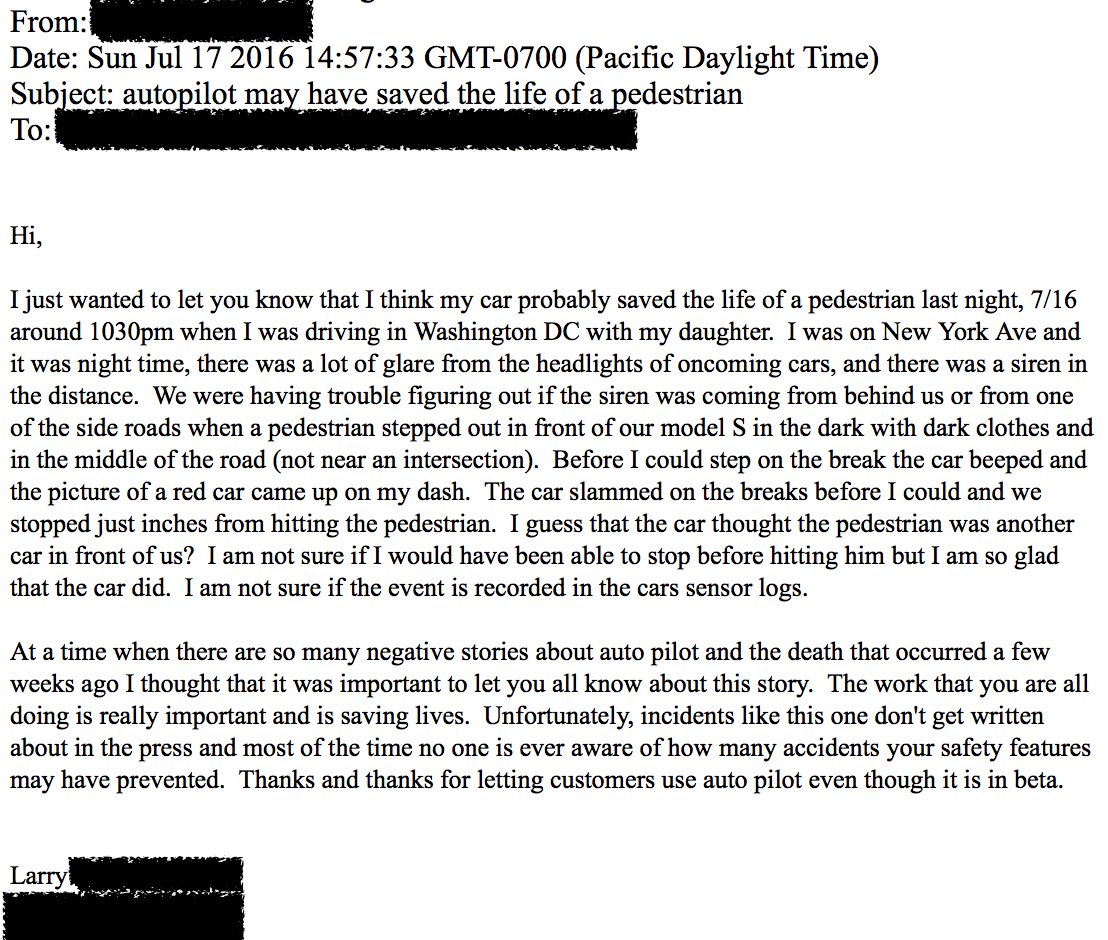
An anonymous reader writes: Following reports of Tesla's Autopilot mode being linked to a fatal crash, one Tesla Model S owner is reporting that the Autopilot mode has likely saved a pedestrian's life. The driver sent an email to Elon Musk explaining the situation, which was confirmed by Tesla through the vehicle logs: "I wanted to let you know that I think my car probably saved the life of a pedestrian last night, 7/16 around 10:30pm when I was driving in Washington DC with my daughter." The driver says him and his daughter were trying to locate where sirens were coming from "when a pedestrian stepped out in front of [their] Model S in the dark with dark clothes and in the middle of the road." The car slammed on its breaks before he could and "stopped just inches from hitting the pedestrian." The driver said, "I am not sure if I would have been able to stop before hitting him but I am so glad the car did." The Automatic Emergency Braking (AEB), which is standard on all Tesla vehicles and is part of Tesla's Autopilot mode, is what was at work here. It appears that many of the convenience features of Autopilot were not activated at the time of the incident. This is likely the first of many good press stories released by Elon Musk, who said he would consider releasing the stories of accidents prevented by the Autopilot mode with the authorization of the Tesla owners and by confirming the events through the vehicle logs. Elon Musk did also announce Tesla's 'Master Plan, Part Deux,' which includes new kinds of Tesla vehicles, expanded solar initiatives, updates on Tesla's 'autopilot' technology, and a ride-sharing program. -
Tesla's Autopilot Mode Reportedly Saves Pedestrian's Life (electrek.co)
An anonymous reader writes: Following reports of Tesla's Autopilot mode being linked to a fatal crash, one Tesla Model S owner is reporting that the Autopilot mode has likely saved a pedestrian's life. The driver sent an email to Elon Musk explaining the situation, which was confirmed by Tesla through the vehicle logs: "I wanted to let you know that I think my car probably saved the life of a pedestrian last night, 7/16 around 10:30pm when I was driving in Washington DC with my daughter." The driver says him and his daughter were trying to locate where sirens were coming from "when a pedestrian stepped out in front of [their] Model S in the dark with dark clothes and in the middle of the road." The car slammed on its breaks before he could and "stopped just inches from hitting the pedestrian." The driver said, "I am not sure if I would have been able to stop before hitting him but I am so glad the car did." The Automatic Emergency Braking (AEB), which is standard on all Tesla vehicles and is part of Tesla's Autopilot mode, is what was at work here. It appears that many of the convenience features of Autopilot were not activated at the time of the incident. This is likely the first of many good press stories released by Elon Musk, who said he would consider releasing the stories of accidents prevented by the Autopilot mode with the authorization of the Tesla owners and by confirming the events through the vehicle logs. Elon Musk did also announce Tesla's 'Master Plan, Part Deux,' which includes new kinds of Tesla vehicles, expanded solar initiatives, updates on Tesla's 'autopilot' technology, and a ride-sharing program. -
Amazon Wants To Sell You Everything, Including Student Loans (qz.com)
Amazon sells all kinds of stuff -- some legit, some not as much. So it didn't really come as a big surprise when the company announced that it will now be selling student loans too. Quartz has more details: The e-commerce giant inked a deal with Wells Fargo to offer interest rate discounts on loans to students who are Amazon Prime members. The bank, which is the second largest student lender in the US, will shave off half a percentage point for Amazon "Prime Student" customers who take out student loans to attend college or are looking to refinance their existing student loans.