Slashdot Mirror
Domain: spacedaily.com
Stories and comments across the archive that link to spacedaily.com.
Comments · 469
-
gov't, consultant and contractor waste?
This article in Spacedaily does a good job of explaining why Bush's costs are both too much and too little to do what he wants. I love the quote:
This is what John Pike means when he says that the budget "won't even pay for the artwork." (Pike is exaggerating the situation by a factor of about 2. I am not aware of any single NASA program costing more than about $3B that produced only artist's concepts. X-30/NASP cost about $7.5B in current dollars, and part of one X-30 fuel tank was actually fabricated.)
If $3B can manage to pay off consultants to think deep thoughts about a project and an artist to draw up a rendering then $1T isn't really that much in the world of gov't finance, high payed consultants and contractors used to dealing with the military where any price goes. It would be interesting to see what an X-Prize sized budget passed 100km orbit would look like.
-
Re:It's Open Mic Night at the Astrophysics Lounge!
more info: Space Daily "...ultraviolet radiation from the Sun and Jupiter's powerful magnetic cloud strip the water ice to make whatever oxygen has been found haloing Europa to a distance of 125 miles above the frozen pack."
-
Re:Killing life...
Not that seriously. The first Apollo mission found the moon to be sterile, but later Apollo missions found strep bacteria from previous missions.
Bacterial contamination is a real danger to life and to accurate science on Europa and lake Vostok. It is extremely difficult to keep a robotic probe from carrying contamination since modern electronics can't take the extreme heat needed to kill resilient strains (which since they're so resilient would make them even more harmful). Scientists have been putting more effort into trying to figure out how to explore Europa without contamination, but are having a tough time coming up with a solution. -
Re:Key point
I don't think so, since the rovers are "among the most biologically clean spacecraft ever launched from Cape Canaveral."
I doubt it would be as easy to scrub all the nasties off a human. Even if they wear protective suits there would be a greater chance of contamination.
-
Re:The spherulesWell, not quite, but it's nice to see that someone knows about what we were doing.
There have been at least two expeditions to the Arizona desert by NASA people to study dust devils, both run out of the University of Arizona. I had the opportunity to spend a month in the Arizona desert gathering data on the second trip.
I wouldn't say that NASA is particularly concerned about dust devils -- due to the lower gravity, dust devils on mars would be much weaker than those on earth, even if they are larger. Even on earth, dust devils post little threat. Some of the ones we studied were over 2 miles tall, and you could walk right through them with absolutely no danger. While the original trip was sponsored by the HEDS (Human Exploration and Developement of Space) funded Matador experiment to see if the dust devils posed any danger to human exploration, the primary concerns were over static electricity and dust getting into space suits.
What NASA is really interested in is how dust affect the geology of the planet. In the absense of water or strong winds, dust devils may in fact be the primary erosive force on Mars. During the first half of the 20th century, astronomers noticed that Mars changed color depending on the season, and this led them to beleive that there was rich vegetation on Mars. When the first orbiters and lander arrived, we learned that this wasn't quite true, but we still had no other solution. Now, scientists believe that is was dust devils, which are a seasonal occurance, that were actually reconfiguring the landscape of the planet. We have actually seen pictures of light colored planes that are crisscrossed by dark dust devil trails.
The problem is that very little is known about dust devils on Earth. I only know of one scientific paper published on the subject. While some of the work we did was trying to find out the proerties of dust devils, especially the electrostatic properties, to help create an accurate model for their formation on Mars, this was not really why we were there. The primary goal of the NASA researchers was to study the dust devils on earth in order to learn how to study them on Mars. We were mainly out there to test a set of instruments planned for Matador (including some far out stuff, like using a special UV camera to detect sparks caused by static electricity).
If anyone is interested, there is an article on the first trip at:
http://www.spacedaily.com/news/mars-atmosphere-01a
and the second trip at:
http://www.berkeley.edu/news/media/releases/2002/0 5/29_dust.html -
Beware...of NASA's aqua-focussed spin on everything Mars related.
The Mars program's stated goal is the detection of water on Mars - therefore every possible shred of evidence for that conclusion is being reported, with no discussion at all of any alternative interpretations.
A couple of very interesting opinion pieces at spacedaily.com recently sum up some alternative theories.
Don't get me wrong, I'd love it to be true. But there's a distinct water-mania in the current NASA press machine...
-
Beware...of NASA's aqua-focussed spin on everything Mars related.
The Mars program's stated goal is the detection of water on Mars - therefore every possible shred of evidence for that conclusion is being reported, with no discussion at all of any alternative interpretations.
A couple of very interesting opinion pieces at spacedaily.com recently sum up some alternative theories.
Don't get me wrong, I'd love it to be true. But there's a distinct water-mania in the current NASA press machine...
-
Laser propulsion already in progress
article here
-
Re:Question
The link to the third article should point here.
-
Re:Question
-
Re:Question
-
Re:Question
-
Re:care and feeding of roversYour revised design still doesn't solve the joints-and-servos problem you handwaved away in your original post. There's still moving parts, additional components that could conceivably fail, and whose success is now a factor of the overall success of the mission.
Also, not caring about the weight budget of the mission is doesn't strike me as a rational approach to solving the problem. As motivated as you are to have a long-lasting, productive mission, the idea that you are more motivated than the mission engineers themselves is, on the evidence, strikingly counter-intuitive.
That said, it's clear that the issue has been known since at least 1998, and that experiments have been proposed to study and solve the problem.
It's possible that the problem is much less trivial than you think, though, given that NASA is apparently considering atomic generators as a solution.
Unfortunately, I don't have time at the moment to track down any definitive links to the current missions' weight budgets, or any details on the hard choices the design teams had to make and the criteria they used to make those choices. However, it seems obvious even so that what looks like a trivial problem at first glance to you and me has actually turned out to be relatively intractable to the kind of quick fixes proposed here.
It's possible that future experimentation will yield an easy solution. Such a solution may even be in the works, but was not suitably proven in time to be included in the current missions.
If I find out any more details on why NASA is willing to put up with dust on their solar panels, I'll let you know.
-
Re:Very good news
I guess the idea of a redundant rover is to make sure that errors are not a total loss. But it's nice to have both...
Although it may not be effective for all missions, some have been kicking around the idea of landing a bunch of micro-rovers about the size of a shoe-box and let them plunk around. If you had say 8 such rovers they could land in a rough place with lower risk of total loss. With the current crop of probes they understandably pick smooth landing areas. But in the future they may have to target rough areas to get to the next level of knowledge about Mars. The best rocks are often in rough areas. Rather than try to build a super-complex rover to navigate a mess, have a bunch of smaller, simpler ones knowing that a few will get trashed in the process.
There was a cancelled asteroid mission that was to use smaller, four-wheeled rover(s). The wheels on each side are fixed to a rotatable "V" bar. The design seems simple, yet flexible. If one gets stuck, simply flip around on the axle on the V bar. The PDF image (link below) makes it look like the V has independent arms, but other photos I saw had them at a fixed angle. (I couldn't find those images.) Maybe this version did have independent arms. It looks a bit different than other links I saw. It is probably a rough prototype anyhow being that the funding never came through to finish.
http://www.spacedaily.com/news/muses-cn-00b.html
http://www.jpl.nasa.gov/facts/muses.pdf -
Re:Great -
Nasa, next time take a lesson from the past and harness the power of the atom...
Next time, they will... -
Re:Hope the ESA does matter this time
Well, all these aerospace programs have a lot of hands in them. It wasn't a JPL mission in the sense that JPL was not in charge of the system engineering, and they were not in charge of overall mission success-- they had a team that contributed to one part of the mission. The failure of Contour wasn't due to the failure of any one system, but instead was likely due to a component working as designed, but the system engineers did not understand how it would function; working as designed the solid rocket motor fired to kick Contour out of orbit likely damaged other parts of the craft and led to its failure. Read more here.
JPL is actually a federally-funded research & development center (FFRDC), run by Caltech. Most of JPL's funding does come from NASA, but JPL employees are not NASA employees. If you don't believe me, just ask one! -
Re:ESA has something to say ?
"Current plans for financing NGST foresee a possible ESA participation at the 15% level -- as with the HST." (here)
It seems ESA participated for 15% in HST ! I guess they should have their word on Hubble future. -
Re:Nasa won't learnYes it does require major changes of kinetic energy to change the orbit incliation. It actually takes less fuel to raise or lower the orbit, once you get into any orbit.
It doesn't really make much difference if you have multiple burns or a single one, it's going to require the same amount of energy either way.
There is a spacedaily link talking about this exact subject. It would take about 3000 m/s of DV to put HST into the ISS's orbital inclination, while only a few hundred to lower it.
Orbital mechanics is not something where the 'obvious' is what's true. In fact, it's usually the exact opposite.
-
Re:Wow.Good point.
The biggest problem with the Drake Equation is that it it way too simplistic. In our galaxy, there is definitely a habitable zone which the solar system is in. If it were much closer to the center of the galaxy, there would be too many events like energetic supernovae that would kill all life on the earth. If it were much farther away from the center, there would not be enough heavy elements to form earth-like planets.
Life is fragile and cannot tolerate too many nearby energetic events.
Life similar to Earth's probably exists elsewhere in our galaxy, but may not be very common.
-
Re:life on mars
Yes, they did There are internationally developed protocols for this.
-
What would happen if they had to evacuate
-
Re:Back to the Future...
Yeah... thing is, capsules make a lot of sense for many things, spaceplanes often don't. Spacedaily ran a series of articles outlining the technical reasons why you might want to use a capsule over a spaceplane.
-
Re:NASA TV press conference
More coverage at Spacedaily, Space.com, and of course the usual news outlets CNN et al...
-
Re:Description of the new shapeIt's universe-shaped, and pale green, and it's emitting a very low pitched hum.
A deep-humming pale-green universe-shaped thing. This does not bode well!
-
More news on ESA Mars effortsESA is also planning long term Aurora programme for eventual manned mission to Mars.
Aurora roadmap:
- 2007 - an entry vehicle demonstrator mission to validate and demonstrate high-speed re-entry technology
- 2009 - ExoMars, an exobiology mission to send a rover to Mars in order to search for traces of life - past or present - and characterise the nature of the surface environment.
- 2011 / 2014 - Mars sample return, a split mission to bring back to Earth the first samples of Martian material
- 2014 - Human mission technologies demonstrator(s) to validate technologies for orbital assembly and docking, life support and human habitation
- 2018 - a technology precursor mission to demonstrate aerobraking/aerocapture, solar electric propulsion and soft landing (formerly envisaged as a smaller Arrow-class mission to be launched in 2010)
- 2024 - a human mission to the Moon to demonstrate key life support and habitation technologies, as well as aspects of crew performance and adaptation and in situ resources utilisation technologies
- 2026 - an automatic mission to Mars to test the main phases of a human mission to Mars
- 2030 / 2033 - a split mission that will culminate in the first human landing on Mars
More information: ESA or Spacedaily.
-
Re:Ouch...
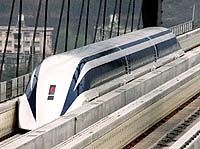
Actually thats the german transrapid. The japanese version is different. There the track wraps arround the train. Pic
-
Re:Finally
Maybe now we'll be able to explore the final frontier of our own planet.
Forget our planet! Explore Europa! I couldn't find many good links very easily, though I remember the discussion of such a sub that could be sent to Europa to explore its ocean. In addition to a lot of benefits, like simplicity, resistance to icing and mechanical failure of propellers, etc, such a sub has the benefit of making Europa's exploration virtually contamination-proof - you don't need the seals around propeller shafts, etc.
A quick google search came up with this, though there are probably better sources out there. -
Re:Remember the Sonic Cruiser?
After Googling for a minute I stumbled across a few ideas for how this aircraft is going to operate. It seem that by changing the aerodynamics of the aircraft, they'll be able to reduce the sonic boom. Northrop Grumman modified an F-5E supersonic fighter jet to give it a pelican shaped nose and it reduced the sonic boom characteristics by 1/3 without reducing engine efficiency.
For a decent description of what a sonic boom is and some pretty kick-ass pictures, give this a shot.
joe -
Re:Must die?
Here's an article that somewhat flippantly discusses the issue. Orbital inclination is the real problem.
-
1000's of tons of water?
Not according to this article dated 12 Nov 2003: http://www.spacedaily.com/2003/031112190119.o85me
b 5z.html -
Some more sites...
Space.com, Spacedaily.com, and some more from Google.
-
Re:Follow the money...
The sea levels aren't actually rising at Tuvalu, it's suffering from some kind of weird El Nino effect where the tides increase the water level dramatically just before the onset of El Nino and then decrease it again when it arrives. This could conceivably be an indirect result of global warming changing weather patterns, but doesn't demonstrate globally rising sea levels. Venice is subsiding, and has been for hundreds of years, but this doesn't show any sort of global effect either.
-
Re:That's the box you've got to break out of!
Unless we do something to upset the apple cart, we will be stuck with a couple people in orbit doing nothing and going nowhere. I do not find this an acceptable state of affairs. The people now running the show are some of the biggest obstacles to progress, and they have to be shoved out of the way.
Don't worry--when the costs have come down enough, China, India, Europe, Japan, and other nations will do that, no matter how cushy the relationship between the US government and large US aerospace contractors may be. In fact, China already has begun. Isn't international competition great? -
Is the China / Galileo connection involved?
Do you think Chinese involvement with the European GPS project Galileo a reason for this perceived threat?
If you can't connect the dots... China supports alternate to GPS. China blows up our GPS satellites. China retains GPS capability, while we go blind
Anyone who doesn't think this is any big deal doesn't realize just how much we rely on GPS in the military today. Take a look at UAVs, for example. How do they navigate? Chances are it is not dead reckoning...
-
Questionalble success - just a short episode
If you read both the the official chinese statements and most news items in western media, the impact of the chinese manned space flight boils down to one single objective:
National pride
This also explains, why both Russia and America have cut down their manned space programs - people are not that much interested in being proud of their nation-state, therefore, the taxpayers are not willing to pour money into such costly efforts.
Please remember: The scientific or commercial efficiency of such programs is extremely bad, most of the ressources are wasted for life support and safety. The only motivation for China to send an astronaut into space was to glorify the nation-state and to create a national hero.
This kind of heroism and nationalism is typical for both western and soviet industrial societies in the 1940s to 1960s. Since then, it has started to vanish. Apollo was stopped because public attention declined. China is just repeating the economical and social development that we did in the 1960s. That's why they also start with spaceflight this way.
Their manned space program is an indication that their social and economical development stage is close to ours in the 1960, although they will keep on catching up fast. But while they catch up, they will soon gain insight into the ecomomical aspects of space flight and cut down their manned space program.
Recommended reading: Grumpy old men - the future ain't what it used to be -
Chinese space program pics
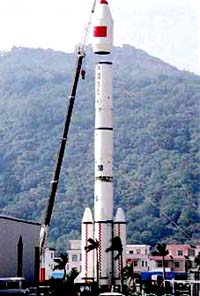
Here is the Chinese space program in all its glory.
The China Space Capsule (space.com)
The China Manned launch vehicle (SpaceDaily.com)
The China Manned Launch vehicle (SpaceDaily.com)
-
Chinese space program pics
Here is the Chinese space program in all its glory.
The China Space Capsule (space.com)
The China Manned launch vehicle (SpaceDaily.com)
The China Manned Launch vehicle (SpaceDaily.com)
-
Skeptical analysis
I have had this argument many times, and am still very skeptical about GPS transponders.
GPS (if that's being used, which is likely) is a one-way system, which means a passive device receives timing signals from a constellation of visible satellites, and uses the timing differences to estimate location and speed of the receiver.
The critical question is what happens next to that data. It can't be transmitted back to the GPS satellites, since they are only able to receive control signals from their operator (Loral?). In fact, it's unlikely to be any satellite-based system, due to the power requirements to punch a signal up to above the atmosphere (such as a satellite phone or VSAT terminal.) Such requirements mean a big heavy battery, and a very carefully aligned directional aerial (in most cases.)
So, what's the back channel? One example of a GPS transponder uses GSM to send the coordinates to a local cell network, probably via SMS. A European system (Galileo) being developed for tracking vehicles on roads throughout Europe, using UMTS or similar technologies.
Note that all of these devices so far require a package that is somewhat large than that which can be hidden inside a can of Cola! -
The article is wrong!First of all, let's not forget that the speed of light is a defined quantity:
c=299,792,458 m/s ( exactly).
A microwave oven is a resonant cavity, and the resonant frequencies for the modes (TE/TM) are given by
omega(i, j, k) = pi * c * sqrt( (i/A)^2 + (j/B)^2 + (k/C)^2 );
where A,B,C are the dimensions of the cavity and i,j,k are non-negative integers (not all zero) which specify the mode.
This experiment does not "measure" the speed of light. All this "experiment" does is tries to isolate out a specific mode (i = 2, j = k = 0) and verifies that the frequecy rating printed on the back of the oven corresponds to this mode (which is still a cool thing to do).
You see, the manufacturer already implicitly *used* the value of c above in designing the oven and calculating the value of the number printed on the back of it, so the "experiment" is not capable of making a (independent) measurement of c.
Lest you think I am nitpicking, this kind of problem plagues us physicists all the time!
-
Mirror?
This has some of the exact same quotes from above so it might be a mirror.
-
Adding to the list of WMDs?
-
Re:AmazingI much more interesting (IMO) article on solar power can be found at the URL below. It discusses a new technique for making solar cells. It's less efficient than currently available solar cells, but it promises to be much much cheaper, which could make it much more widely available.
-
Re:You want cost efficient space exploration?
If solar cells are not cost effective even on the ground, do you really believe that the slight increase in efficiency of space over a cloudless desert climate is going to make up for the gigantic cost of launching them into space and then keeping people up there to actually contruct this space power plant of yours.
It's not a "slight increase in efficiency" - it's a factor of 5 to 8 because the sun is NOT straight overhead all day (and night) long. And that makes all the difference.
Yes, space launch is expensive, but not inherently so. The cost of fuel is orders of magnitude less than total launch costs these days - that's the big problem with space that we really need to solve. Maybe a space elevator will do the trick, maybe a new reusable launch vehicle, maybe manufacturing components from lunar materials rather than launching from Earth; however it's done, the "gigantic cost of launching them into space" only needs to drop by a factor of 5-10 to make space solar power cost effective: see this article for more discusison of all this. -
Re:Now the important question...
Well, $50 million and $200 million are not a big slice of even NASA's current budget so they will be easy to slap on today. They won't accomplish much with that money, however, aside from some initial planning and research. To really do what is proposed will add much more, at least an average of $2 billion per year more according to most estimates of what it will take to get to Mars.
Hopefully some new technologies like nuclear electric propulsion will turn out to be fit for this sort of purpose to cut the travel time to Mars down to a reasonable level so we can survive the largest problem with such a mission, radiation. Since Bush likes nuclear technology, this one might even fly.
-
The link
-
You eliminate the options and ask for a solution?
And yet there is one, that requires far less R&D effort than has been wasted on nuclear energy over the past few decades - Space Solar Power. Read up on it - the economics are ALREADY better than for nuclear energy, and will catch up to traditional coal and oil for utility-scale power over the next 10 to 15 years.
It's time for the nuclear fantasy to end. -
Nuclear power's time has passed
While nuclear power is fascinating to those physicists and engineers who have studied it for all these years, the promise of cheap energy from nuclear power has never materialized. All nuclear installations are subsidized; in a couple of countries (France and Japan) the limited range of other energy options has made nuclear a significant player, but for the rest of the world it is just not cost-competitive against oil, coal, hydro-electric, and now wind power.
What about the decline in fossil fuels and green-house emissions? If just a tiny fraction of the effort that has been wasted on nuclear energy had been put toward space-based solar power systems, we'd have a ready-to-go solution that has no adverse environmental consequences. There's still time to make it happen though... -
probes die, shuttles die quicker
every so often we send a shuttle up, and sometimes it explodes/etc. Why can't we just send some more probes like this? The whole crap with sending people up just doesn't work - we're not getting any better at it. We should instead just send unmanned flights. Imagine the cost savings.
Yeah, the ISS is a great dream...but...what's the point? Zero gravity labs can be mimiced here on earth far cheaper and safer. Sending one shuttle up has an extremely HUGE environmental impact. In mere moments a search brought up some decent points about further problems/inefficiencies. The technology of today is, in theory, much higher than what we had years and years ago. Its time we took our current system, did something like sell it to the chinese (they'll get it anyway, we might as well make the money), and build something with technology newer than 30 years ago. They still use 386 cpu's in the damn thing. Its time to put the entire fleet to rest, and stop paying to maintain it. Just because the cold war is over doesn't mean we don't need to do more than send people up and watch them explode - we need to still push the envelope. -
ENTER the space elevatorThis makes sense, and I'd love to see something like the space elevator that Arthur C. Clarke's brought up in Fountains of Paradise happen. This way, cargo could be brought up, followed by crew if the cargo run was successful.
An article written about the idea, this year:
Space Elevators Maybe Closer To Reality Than Imagined
Much more info here:
CB
-
80,000kg to GTO? No way...
Better recheck your numbers, this is WAY off! It is more like 10,000kg at present