Slashdot Mirror
Domain: spaceref.com
Stories and comments across the archive that link to spaceref.com.
Comments · 466
-
Re:Have they learned nothing?This sounds hauntingly familiar. In the first disaster NASA had simply gotten used to seeing some burn-through on the o-rings to the point that it was "normal", in the second disaster they had seen foam and ice come off the orbiter but nothing bad had happened so far.
In the third disaster they couldn't find the cause of the fuel sensor problem so they declared that only three were needed and launched anyway.
And when, ten years after the Shuttles were grounded for good, the Crew Exploration Vehicle blew up on its maiden launch, the blame was laid squarely on the shoulders of Mike Griffin; who made the decision that the CEV would be launched by Shuttle solid rocket boosters.
And that, my children, is how the American manned spaceflight program came to an end, and why the Chinese now dominate space.
-
Re:Unfortunate.
According to SpaceRef.com, the shuttle could launch as early as tomorrow. -
Re:FTUA
-
NASA to buy commercial ISS transportation
A few weeks ago I tried submitting the following story to slashdot, but it kept on getting rejected (same with these stories). As seems to be becoming tradition, I thought it would be relevant to the current topic, so I've pasted the text here. And no, it's not Karma-whoring if my Karma's already been maxed out for years.
At a recent talk, Michael Griffin outlined NASA's plans for helping to generate a robust and competitive commercial market in orbital spaceflight. The speech and Q&A transcripts from the talk are available. In a move reminiscent of the US government kickstarting the early airline industry by purchasing airmail services, NASA plans on supplementing government-derived transport by purchasing cargo delivery services to the International Space Station from commercial providers, followed by crew transportation after the systems have proven themselves. Unlike traditional government contracts, sellers wouldn't see a profit before the services are delivered and the emphasis will be on actual performance instead of process and specifications. Aviation Week has some commentary on the announcement.
I also think I remember seeing something before about NASA selling one of the launch complexes at Kennedy Space Center to SpaceX, but can't find more info. Does anybody have a link to more on that? -
NASA to buy commercial ISS transportation
A few weeks ago I tried submitting the following story to slashdot, but it kept on getting rejected (same with these stories). As seems to be becoming tradition, I thought it would be relevant to the current topic, so I've pasted the text here. And no, it's not Karma-whoring if my Karma's already been maxed out for years.
At a recent talk, Michael Griffin outlined NASA's plans for helping to generate a robust and competitive commercial market in orbital spaceflight. The speech and Q&A transcripts from the talk are available. In a move reminiscent of the US government kickstarting the early airline industry by purchasing airmail services, NASA plans on supplementing government-derived transport by purchasing cargo delivery services to the International Space Station from commercial providers, followed by crew transportation after the systems have proven themselves. Unlike traditional government contracts, sellers wouldn't see a profit before the services are delivered and the emphasis will be on actual performance instead of process and specifications. Aviation Week has some commentary on the announcement.
I also think I remember seeing something before about NASA selling one of the launch complexes at Kennedy Space Center to SpaceX, but can't find more info. Does anybody have a link to more on that? -
Re:The math doesn't look good...
Here's neat link mentioning megatons of yield needed to deflect 1km asteroid by cm/s. here Repeated applications of the more usual 1-5 MT warheads seems more reasonable than the need to invent a 100MT monster. But if the dimensions of the asteroid are of the order of dozens of cubic km then we're probably screwed! 8D
Just to wax philosophical for a moment, I hear people talk about founding space stations so we "don't have all our eggs in one basket", but if the entire earth gets wiped out does it really matter if we have a couple dozen people in a space station or moon base? nah, who gives a crap at that point, certainly you or I won't.... -
Re:Titan volcano image is cool too
The Solar System Exploration Strategic Roadmap lays out NASA's current plans/wishlist for robotic exploration in the next 20+ years. Basically, they foresee one Discovery class (NEAR, Mars Pathfinder, Deep Impact, etc) mission every two years or so; two or three more expensive New Frontiers missions per decade such as the Pluto New Horizons probe or the newly announced Juno Jupiter Polar Obiter; and one or possibly two $1 billion+ "Flagship" missions. The first flagship mission will be the much delayed Europa Geophysical Orbiter. The second Flagship mission, slated for 2013 or therabouts, will most likely be a Titan Explorer, an RTG-powered blimp to cruise around the surface for an extended period.
Keep in mind that this is obviously subject to political whim, but it shows that Titan is a really high priority for future exploration.
-
NASA to Buy Commercial Transport to ISS
Well, I've been trying to submit a story to slashdot over the past few days about a "parallel path" to government-built shuttle-derived that NASA recently announced, but I haven't had any luck. I've already had four or five variations on it rejected. Anybody have ideas on what might be wrong with the following submission?
At a recent talk, Michael Griffin outlined NASA's plans for helping to generate a robust and competitive commercial market in orbital spaceflight. The speech and Q&A transcripts from the talk are available. In a move reminiscent of the US government kickstarting the early airline industry by purchasing airmail services, NASA plans on supplementing government-derived transport by purchasing cargo delivery services to the International Space Station from commercial providers, followed by crew transportation after the systems have proven themselves. Unlike traditional government contracts, sellers wouldn't see a profit before the services are delivered and the emphasis will be on actual performance instead of process and specifications. Aviation Week has some commentary on the announcement. -
NASA to Buy Commercial Transport to ISS
Well, I've been trying to submit a story to slashdot over the past few days about a "parallel path" to government-built shuttle-derived that NASA recently announced, but I haven't had any luck. I've already had four or five variations on it rejected. Anybody have ideas on what might be wrong with the following submission?
At a recent talk, Michael Griffin outlined NASA's plans for helping to generate a robust and competitive commercial market in orbital spaceflight. The speech and Q&A transcripts from the talk are available. In a move reminiscent of the US government kickstarting the early airline industry by purchasing airmail services, NASA plans on supplementing government-derived transport by purchasing cargo delivery services to the International Space Station from commercial providers, followed by crew transportation after the systems have proven themselves. Unlike traditional government contracts, sellers wouldn't see a profit before the services are delivered and the emphasis will be on actual performance instead of process and specifications. Aviation Week has some commentary on the announcement. -
NASA and Commercial Space Transportation
(The following is from a slashdot story I've tried submitting variations on a few times over the past few days, which has gotten rejected repeatedly for whatever reason. Since it's relevant to the topic of what NASA's planning on doing once the shuttle is retired, I'm posting it here)
At a recent talk, Michael Griffin outlined NASA's plans for helping to generate a robust and competitive commercial market in orbital spaceflight. The speech and Q&A transcripts from the talk are available. In a move reminiscent of the US government kickstarting the early airline industry by purchasing airmail services, NASA plans on purchasing cargo delivery services to the International Space Station from commercial providers, followed by crew transportation after the systems have proven themselves. Unlike traditional government contracts, sellers wouldn't see a profit before the services are delivered and the emphasis will be on actual performance instead of process and specifications. Non-traditional space companies such as SpaceX and t/Space have found Griffin's remarks encouraging, and Aviation Week has some commentary. -
NASA and Commercial Space Transportation
(The following is from a slashdot story I've tried submitting variations on a few times over the past few days, which has gotten rejected repeatedly for whatever reason. Since it's relevant to the topic of what NASA's planning on doing once the shuttle is retired, I'm posting it here)
At a recent talk, Michael Griffin outlined NASA's plans for helping to generate a robust and competitive commercial market in orbital spaceflight. The speech and Q&A transcripts from the talk are available. In a move reminiscent of the US government kickstarting the early airline industry by purchasing airmail services, NASA plans on purchasing cargo delivery services to the International Space Station from commercial providers, followed by crew transportation after the systems have proven themselves. Unlike traditional government contracts, sellers wouldn't see a profit before the services are delivered and the emphasis will be on actual performance instead of process and specifications. Non-traditional space companies such as SpaceX and t/Space have found Griffin's remarks encouraging, and Aviation Week has some commentary. -
Extant Shuttle Options
Okay, this is going to sound a little odd, but just roll along with me on this for a second. So the shuttle can only complete 15-23 ISS construction misssions by the 2010 end-of-flight deadline. Fine. Finish those 15 or 23 or however many missions that the STS can actually get under its belt with the existing manned shuttle system. Then finish the ISS using unmanned shuttles, a la the Soviet Buran http://www.astronautix.com/craft/buran.htm/.
Buran launched, orbited, and landed on its single completed mission without a crew onboard. The Space Shuttle was built with such a capacity in mind, and the components of this system have been tested on several occassions, but it has never undergone an all-up test: http://www.spaceref.com/news/viewsr.html?pid=1051
8 . Maybe I'm naieve, but perhaps we should refurbish and fully test this capability on the existing STS system before we rush into building a Shuttle-C or drop mucho $$$ on launching ISS components with Delta/Atlas EELV's or a foriegn booster. Once auto-shuttle components were in orbit near the ISS they could be retrieved and attached to the station by the station crew or cosmo/astronauts sent up in a Russin Soyuz. -
NASA, get out of the launch business!
Whatever you might think about the "Bush vision for space" the focus of that vision is from earth orbit outwards. The part of the journey from surface to earth orbit should be bought from commercial providers. This market is already waking up. Just imagine what a big client like NASA will do to launch costs.
NASA, get out of the launch business!
But no. They are now planning their own new shuttle-derived launch vehicle. -
full scale
Not sure if this is routine but apparently it's been done on a larger scale
http://www.spaceref.com/news/viewpr.html?pid=16610
wonder how hi proteus was when it dropped the capsule -
Other Uses for Air Launch"Unfortunately, with the recent selection of Boeing/Northrop-Grumman and Lockheed-Martin as the two competing teams for the contract to build the Shuttle's successor, t/Space's future path is somewhat uncertain."
That's baloney. The US military loves the air launch thing. Back in the '70s there was a pathfinder-type mission that air launched a Minuteman. And the MDA is heavily invested in air launched targets for the various interceptor programs. There was the LRALT program and a newer target launched by Orbital Sciences. And, of course, there's also Orbital's Pegasus space launch vehicle.
The benefit of the type of air launch method that t/Space is showing is that the LRALT and MRT programs require the extremely heavy sleds that they sit on and that they are limited by the cargo capacity of a C-17. And Pegasus has to carry that enormous wing and tail structure (not to mention its failures, such as the first X-43A flight).
I think if t/Space can show superiority over the existing air launch methods (which doesn't seem to be difficult), they will definitely fill a demand in both the small space launch and targets markets.
-
Re:Just add water
The other thing I'd like to see is someone actually developing a Martian greenhouse design.
I've commented about this in the past, but here's a quote from the Wikipedia article on Elon Musk:
In 2001, Musk had plans for a "Mars Oasis" project, which would land a miniature experimental greenhouse on Mars, containing food crops growing on Martian regolith. He put this project on hold when he discovered that launch costs would dwarf the mission development and construction costs for the project, and decided to work on lowering launch costs by founding SpaceX.
If I recall correctly, he actually hired a team of engineers and scientists to do a feasibility study, and I'm betting they put together at least some preliminary designs. Hopefully we'll see him return to this project once he gets launch costs lowered some. -
Nothing new here - old news
So what? Griffin restates the VSE goals at an Air Show in Paris.
Some examples of real news:NASA downselect for CEV was indeed announced Monday, as the article says could happen.
Photos of t-space testing a new Air Launch method for rockets.
BTW, if you want interesting human spaceflight news check HobbySpace RLV News periodically. -
Re:Misplaced priorities?
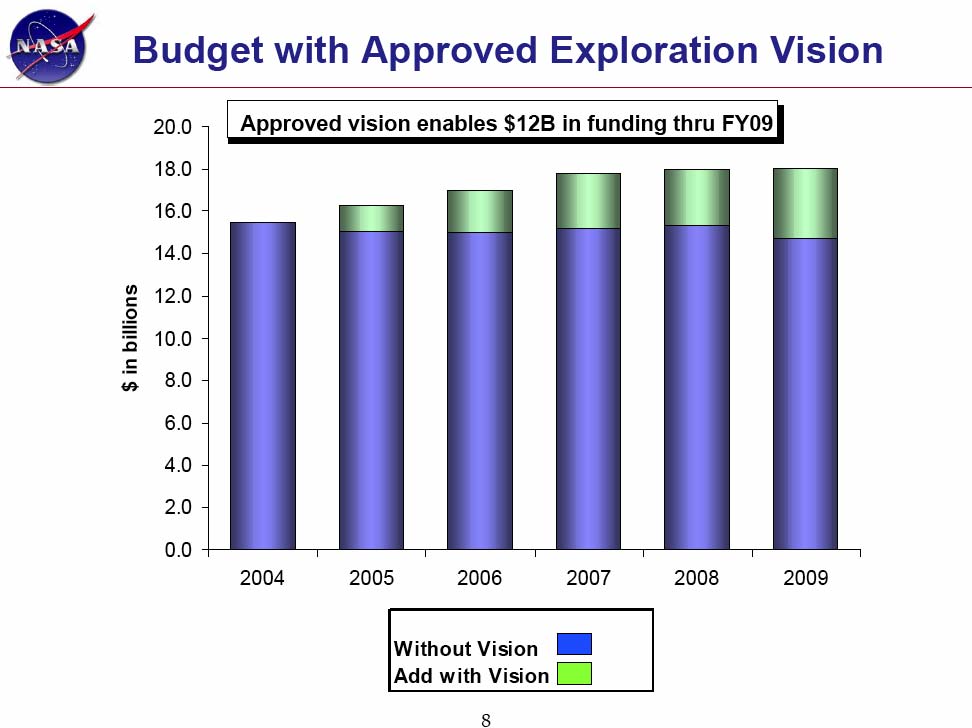
The national deficit is at around 7 trillion dollars. Nasa's budget this year - 16 billion dollars. Even with the increases scheduled in NASAs budget it doesn't get above 20 billion in this decade. Even at 20 billion a year it take roughly 350 years to pay off the deficit, and that's if it stopped growing NOW.
The education system in America needs repair no doubt about it. I don't agree that we no longer attract bright students from abroad. I would say that a degree from a U.S. institution is still highly valued. Carnigie Mellon and MIT remain some of the best schools in the world for engineering and computer science.
If immigration was stopped and all illegal aliens were sent back to their respective countries there would be a massive shortage in the labor force. In my area a vast majority of the construction force is made up of illegal aliens.
Yeah the country has some problems, it always had problems and always will. That's no reason to stop space exploration, or scientific research, or any number of other things -
Hubble Origins Probe: replace instead of repair
It seems to me that were going to spend entirely to much money on something that is old obsolete. Why not replace it with something new and better?
IMHO, we should. A copy from an old post of mine:
Hubble Origins Probe: replace instead of repair?
Astronomy Magazine reports that an international team of astronomers has proposed an alternative to sending a robotic or human repair mission to the ailing Hubble Space Telescope. Their proposal is to build a new Hubble Origins Probe, reusing the Hubble design but using lighter and more cost-effective technologies. The probe would include instruments currently waiting to be installed on Hubble, as well as a Japanese-built imager which 'will allow scientists to map the heavens more than 20 times faster than even a refurbished Hubble Space Telescope could.' It would take an estimated 65 months and under $1 billion to build and launch, less than the estimated cost of a service mission. -
Re:Its terribly sad....
Even better, how about some Non-governmental, non-profit space agency that gets funded by a bunch of geeks with nothing better to spend their money on? (and by the way, avoid paying taxes altogether) I bet there's already a web site...
Like the Planetary Society? On May 31, they'll be launching Cosmos 1, the first solar sail spacecraft. Here's a Nature article. According to the page, it'll be "the first space mission ever flown by a non-governmental advocacy group."
Another interesting philanthropic project was Elon Musk's Mars Oasis project to put an experimental greenhouse on the surface of Mars. He hired a team to do some preliminary designs and cost analysis, and found that actually building the thing was pretty affordable for him. However, the launch costs weren't as affordable as he wanted (they would've been the most expensive part of the entire project), so he decided to redirect his efforts towards SpaceX to lower those costs. I suspect the Mars Oasis project is still on the back-burner, and he may pursue it again once he gets launch costs low enough. -
Re:ThinkPads...in....SPAAAAACE!It's a Thinkpad, alright. They use 'em on the Space Shuttle too - basically NASA put a stake in the ground in the mid-90's, bought a boatload of 166MHz Thinkpads, put Windows 95(!) on them and characterized the heck out of them.
So the many faults of this platform are well understood, which is what really counts. Interesting article on this here
(Loving my T40... er... in the abstract sense only)
-
Hubble Origins Probe: the best option
As I often mention, a solution that everybody seems to be ignoring is putting up a new telescope, the Hubble Origins Probe. This new telescope would be more capable than the original Hubble and cost less than a robotic repair mission. For whatever reason, this possibility is almost never mentioned, although it's IMHO the best option by far.
Obligatory blurb:
Astronomy Magazine reports that an international team of astronomers has proposed an alternative to sending a robotic or human repair mission to the ailing Hubble Space Telescope. Their proposal is to build a new Hubble Origins Probe, reusing the Hubble design but using lighter and more cost-effective technologies. The probe would include instruments currently waiting to be installed on Hubble, as well as a Japanese-built imager which 'will allow scientists to map the heavens more than 20 times faster than even a refurbished Hubble Space Telescope could.' It would take an estimated 65 months and under $1 billion to build, less than the estimated cost of a service mission. -
Re:Why dump the damaged shuttle?NASA appear to believe that radio contact loss is not an issue. http://www.spaceref.com/news/viewsr.html?pid=1051
8 . I presume the guidance is autonomous, not done from the ground. Aircraft routinely autoland in low visibility: it's not done with a camera and a remote control, after all.ian
-
Larry Page Should Seed the K-PrizeSince Larry Page is on the X-Prize Board of Trustees, and since Google is pushing the envelope of what is needed to index and compress the entire content of the Internet, Page should consider providing seed funds and then matching funds for any donations to a compression prize with the following criterion:
Let anyone submit a program that produces, with no inputs, one of the major natural language corpuses as output.
S = size of uncompressed corpus
P = size of program outputting the uncompressed corpus
R = S/PPrevious record ratio: R0
New record ratio: R1=R0+X
Fund contains: $Z at noon GMT on day of new record
Winner receives: $Z * (X/(R0+X))Compression program and decompression program are made open source.
If Larry has any questions about the wisdom of this prize he should talk to Craig Nevill-Manning.
If, in the unlikely event, Craig Nevill-Manning has any questions about the wisdom of this prize, he should talk to Matthew Mahoney, author of "Text Compression as a Test for Artificial Intelligence"
"The Turing test for artificial intelligence is widely accepted, but is subjective, qualitative, non-repeatable, and difficult to implement. An alternative test without these drawbacks is to insert a machine's language model into a predictive encoder and compress a corpus of natural language text. A ratio of 1.3 bits per character or less indicates that the machine has AI."
This "K-Prize" will bootstrap AI.
OK, so he can christen it the "Page K-Prize" if he wants.
-
Re:I wish they really would cancel it!
I think a better option than repair would be putting together the spares on the ground, including a PERFECT mirror as opposed to the flawed one that got launched, and launch Hubble II.
I agree that this would be good, although I doubt very much that it can be done by cobbling together leftovers. Last I saw, the estimated cost of such a thing was around $4B, vs. under $2B to fix the one we've got.
Actually, the cost of a new and much improved Hubble (including launch) would be more around $1B:
http://www.pha.jhu.edu/hop/
http://www.spaceref.com/news/viewpr.html?pid=16050 -
Hubble Origins Probe: a better,cheaper replacemen
Nobody ever seems to mention the Hubble Origins Probe in these discussions, which is IMHO the best possible solution:
An international team led by Johns Hopkins University astronomers have proposed an alternative to sending a robotic or manned repair mission to the ailing Hubble Space Telescope. Their proposal is to build a new Hubble Origins Probe, reusing the Hubble design but using lighter and more cost-effective technologies. The probe would include instruments currently waiting to be installed on Hubble, as well as a Japanese-built imager which 'will allow scientists to map the heavens more than 20 times faster than even a refurbished Hubble Space Telescope could.' It would take an estimated 65 months and $1 billion to build and launch, approximately the same cost as a robotic service mission.
The original Hubble is great for historical and sentimental reasons, but the cost/benefit ratio is really so much better with a replacement. -
Quotes from Griffin
I rather like these quotes from Griffin:
http://www.spaceref.com/news/viewsr.html?pid=10683
"So, recognizing that others may differ, for me the single overarching goal of human space flight is the human settlement of the solar system, and eventually beyond. I can think of no lesser purpose sufficient to justify the difficulty of the enterprise, and no greater purpose is possible."
"What the U.S. gains from a robust, focused program of human space exploration is the opportunity to carry the principles and values of western philosophy and culture along with the inevitable outward migration of humanity into the solar system. Is this valuable? The answer must depend on one's worldview, I suppose. But consider a map of the world today, and notice the range of nations in which English is spoken as a primary language, and in which variations on British systems of justice, politics, culture, and economics thrive today. Was the centuries-long development of the British Empire, based upon Britain's primacy in the maritime arts, a misguided use of resources? I believe not.
"The necessary requirements of human expansion into the solar system cannot be met without a greatly increased program of unmanned scientific exploration. This can only be seen as a "win-win" for all those involved in any aspect of space exploration. In the end, it comes down to letting robots and humans each do what they do best."
"For interplanetary flight, something more than chemical propulsion is clearly needed for other than return to the moon or, possibly, the first expeditions to Mars. Nuclear propulsion makes the most sense to me; several options are available, including both nuclear-thermal and nuclear-electric concepts. We once had an operating, ground-tested (though not flight-tested) nuclear-thermal upper stage intended for use on the Saturn V. The program was cancelled thirty years ago, when it became clear that a Mars mission was not in the nation's immediate future. Numerous nuclear fusion concepts potentially applicable to space propulsion exist, most notably those involving electrostatic confinement of the nuclear core, but none of these is receiving more than token funding. There also exist a number of promising approaches to electric propulsion, notably the Vasimir engine concept. In the long run, some form of nuclear-electric propulsion is likely to offer the best combination of efficiency and packaging capability for interplanetary flight."
"I have alluded above to some of the technical hurdles that we face in a commitment to a permanent program of human space exploration. Broadly, the tools necessary for this enterprise include:
* Heavy-lift launch capability, in the 100 metric ton to LEO class or greater.
* Reliable, efficient, and cost effective transportation to LEO for moderate size payloads.
* Compact space qualified nuclear power systems.
* Nuclear and nuclear-electric upper stage vehicles for application to interplanetary flight.
* Space and planetary surface habitat and human suit technology.
* Technology and systems for utilizing the in situ resources of the moon, Mars, and asteroids.
* Reliable and routine Earth-to-LEO crew transfer systems."
"I will repeat only briefly my remarks above concerning ISS; we should do what is necessary to bring the program to an orderly completion while respecting our international partnership agreements, obtaining where possible as much scientific value as we can from the enterprise while accommodating ourselves to the fact that such value is inevitably limited."
"Regarding the Space -
Re:A backup Soyuz could rescue crew"there is a common docking collar now used on all manned vehicles, russian or american."
There are a few things wrong with your statement. First, although generally true that they use the same collar for docking to the ISS, the generic "all manned vehicles" isn't true. NASA has a variety of interfaces, including the Common Berthing Mechanism (CBM) and Manual Berthing Mechanism (MBM) used on the ISS, but these are generally for berthing, not docking. Still, the CBM is an alternate docking mechanism (see for instance Section 5.1.5 of the Alternate Access to Station (AAS) Systems Concept of a Logistics Resupply Service to the ISS). The Russian interface is the Androgynous Peripheral Attachment System (APAS) as part of the Androgynous Peripheral Docking System(APDS). There are two parts to the APDS, passive and active. To convert from the NASA CBM interface to APAS, the ISS has three Pressurized Mating Adaptors (PMA1, 2, and 3). PMA1 has an active APDS because it connects the NASA Node 1 (Unity) to the Russian FGB module, and so isn't used for docking. PMA2 and PMA3 have passive APDS because they are used for docking. (See Section 1.1 of the Procurement Document for the APDS referenced above.)
Since both vehicles dock to the ISS, the shuttle does have an APAS adapter known as the Orbital Docking System (ODS). This is the 'L' shaped connector that attaches to the port at the front of the shuttle bay. It is only attached in missions to the ISS, and the APAS interface is only used for docking to the ISS. It isn't inherently true that all docking operations will be done using an APAS. However, since the only docking currently taking place is with the ISS, this is currently functionally true. It is only an ISS policy, however. The ODS is not installed on Hubble missions.
Furthermore, both the Soyuz and shuttle ODS have the active APDS side (again, see for instance Section 1.1 of the Procurement Document for the APDS above). Neither has the passive side because they are the ones doing the docking. In addition to this, approach and docking to the passive APDS is accomplished using docking cues (targets). (See, for example, Section 5.1.7.3.4.2 of the Interface Definition Document (IDD) for International Space Station (ISS) Visiting Vehicles (VVs). Neither the shuttle ODS nor Soyuz have these docking cues, again because they are the ones doing the docking.
So, I stand by my assertion that it is not as simple as you say. This method needs to be planned ahead with the right adaptors and docking systems developed and carried with them, probably flown on a Detailed Test Objective (DTO) flight, certified and validated. Again, such a system takes years of development.
As far as the orbit, it isn't clear that the Soyuz module or launch rocket are designed to go as far as Hubble. For instance, it appears that the Soyuz used for ISS mission and crew descent is only designed to descend from up to 460 km. The Hubble is at an altutude of about 600 km. So, if you have a reference on your assertion that "The Soyuz can easily reach the Hubble orbit", please forward it. Even better would be one that says it can descend from there. (Reaching it is useless as a rescue vehicle if it can't descend.)
It's not like NASA just missed the idea of using Soyuz, and you amazingly came up with the solution they're looking for. They are very smart you know. You also don't seem to realize that many of us who read Slashdot work for or with NASA (the geek ratio is quite high), so we often have the inside scoop or at least knowledge of what's involved.
-
List of questions Congress and NASA need to ask
In congressional testimony he gave last year, Michael Griffin outlined a number of questions which he felt Congress and NASA need to ask. This list was pretty interesting, because many of them are the sorts of things which NASA is notorious for ignoring. It's refreshing to know that these questions are at least on the radar of NASA's new head:
(bolding mine)
# Why does spaceflight - human or robotic - cost so much more than other comparably complex human activities, and what can be done to remedy the situation?
# Is a serious program of human space exploration sustainable, given the "cost of doing business" presently associated with the enterprise?
# What incentives can be offered to proven and well-established aerospace contractors to devise innovative and cost-effective, yet safe and reliable, approaches to building a new human spaceflight infrastructure?
# Where and how does NASA intend to engage the entrepreneurial high-tech culture which has made our nation the envy of so many others, in so many areas other than aerospace? What can we do to bring the engine of capitalism to spaceflight?
# What is the proper role of prizes, or of pay-for-performance contracts, in stimulating and encouraging the high-tech community to devote its attention to aerospace?
# Can or should the Congress establish prizes for specific accomplishments in spaceflight, independently of NASA?
# What is NASA's proper role in the development of new space systems, beyond setting requirements to be met through competition in industry?
# What is NASA's proper role, as an agency of the U.S. government, in the conduct of future spaceflight operations?
# If the exploration of new worlds requires technologies and skills beyond those presently available within NASA - and it clearly does - how are the skills of other agencies and laboratories to be used effectively in the service of the larger mission? How will the overall effort be directed?
# Given that we as a nation will spend a certain amount each year on civil space activities, what would Americans prefer to see this money used for? What vision for space exploration excites people enough to cause them to believe that the money they spend on it is well spent? Can a reasonable consensus even be found? How do we know?
# Is the United States interested in leading an international program of space exploration? Which nations might be competitors, and which might be partners? How and in what role do we view our potential partners in the enterprise? What do our potential partners think about this? How do we know? -
More info; what to expect
Hm... I went through three rounds of rejected submission attempts earlier trying to submit this story, several hours before this version was posted. In any case, here's my version of the submission, which has many more links:
NASA Watch, New Scientist, and Space Ref report that Dr. Michael D. Griffin has been nominated as the next administrator of NASA, to replace Sean O'Keefe. As NASA head, Griffin will be tasked with implementing the Vision for Space Exploration. Griffin is currently head of the Space Department at the Applied Physics Laboratory at JHU, is president-elect of the American Institute of Aeronautics and Astronautics, and has a doctorate in aerospace engineering. He's noted for being passionate about space exploration and having strong management experience. His nomination has been praised by a number of groups, including the Planetary Society, the National Space Society, and House Science Committee Democrats and Republicans. In the past, Mike Griffin has testified to Congress on the future of human spaceflight, the vision for space exploration, and the danger of asteroid impacts. He was also rebuked in the early 90s for pointing out problems with the space station's review process.
As for my own thoughts, I think Griffin is an excellent pick. I'm amazed that they were able to find somebody with as much technical expertise as him who also has such a large amount of experience with managing large organizations. According to the space.com article, Griffin can be expected to make maximum use of the emerging commercial spaceflight industry.
In the past he's also said the following, which I approve of highly: "What is needed is to retire the Shuttle Orbiter, and its expensive support infrastructure," Griffin wrote. "It simply does not serve the needs of exploration and it is too expensive, to logistically fragile, and insufficiently safe for continued use as a low Earth orbit transport vehicle."
In the past he's been highly in favor of the government constructing a new heavy-lift launch vehicle, which I somewhat disagree with. Such an endeavor could easily end up being a bottomless money pit. Hopefully SpaceX's low-cost launches in the coming months will help raise awareness of frequently-launched smaller vehicles. -
More info; what to expect
Hm... I went through three rounds of rejected submission attempts earlier trying to submit this story, several hours before this version was posted. In any case, here's my version of the submission, which has many more links:
NASA Watch, New Scientist, and Space Ref report that Dr. Michael D. Griffin has been nominated as the next administrator of NASA, to replace Sean O'Keefe. As NASA head, Griffin will be tasked with implementing the Vision for Space Exploration. Griffin is currently head of the Space Department at the Applied Physics Laboratory at JHU, is president-elect of the American Institute of Aeronautics and Astronautics, and has a doctorate in aerospace engineering. He's noted for being passionate about space exploration and having strong management experience. His nomination has been praised by a number of groups, including the Planetary Society, the National Space Society, and House Science Committee Democrats and Republicans. In the past, Mike Griffin has testified to Congress on the future of human spaceflight, the vision for space exploration, and the danger of asteroid impacts. He was also rebuked in the early 90s for pointing out problems with the space station's review process.
As for my own thoughts, I think Griffin is an excellent pick. I'm amazed that they were able to find somebody with as much technical expertise as him who also has such a large amount of experience with managing large organizations. According to the space.com article, Griffin can be expected to make maximum use of the emerging commercial spaceflight industry.
In the past he's also said the following, which I approve of highly: "What is needed is to retire the Shuttle Orbiter, and its expensive support infrastructure," Griffin wrote. "It simply does not serve the needs of exploration and it is too expensive, to logistically fragile, and insufficiently safe for continued use as a low Earth orbit transport vehicle."
In the past he's been highly in favor of the government constructing a new heavy-lift launch vehicle, which I somewhat disagree with. Such an endeavor could easily end up being a bottomless money pit. Hopefully SpaceX's low-cost launches in the coming months will help raise awareness of frequently-launched smaller vehicles. -
More info; what to expect
Hm... I went through three rounds of rejected submission attempts earlier trying to submit this story, several hours before this version was posted. In any case, here's my version of the submission, which has many more links:
NASA Watch, New Scientist, and Space Ref report that Dr. Michael D. Griffin has been nominated as the next administrator of NASA, to replace Sean O'Keefe. As NASA head, Griffin will be tasked with implementing the Vision for Space Exploration. Griffin is currently head of the Space Department at the Applied Physics Laboratory at JHU, is president-elect of the American Institute of Aeronautics and Astronautics, and has a doctorate in aerospace engineering. He's noted for being passionate about space exploration and having strong management experience. His nomination has been praised by a number of groups, including the Planetary Society, the National Space Society, and House Science Committee Democrats and Republicans. In the past, Mike Griffin has testified to Congress on the future of human spaceflight, the vision for space exploration, and the danger of asteroid impacts. He was also rebuked in the early 90s for pointing out problems with the space station's review process.
As for my own thoughts, I think Griffin is an excellent pick. I'm amazed that they were able to find somebody with as much technical expertise as him who also has such a large amount of experience with managing large organizations. According to the space.com article, Griffin can be expected to make maximum use of the emerging commercial spaceflight industry.
In the past he's also said the following, which I approve of highly: "What is needed is to retire the Shuttle Orbiter, and its expensive support infrastructure," Griffin wrote. "It simply does not serve the needs of exploration and it is too expensive, to logistically fragile, and insufficiently safe for continued use as a low Earth orbit transport vehicle."
In the past he's been highly in favor of the government constructing a new heavy-lift launch vehicle, which I somewhat disagree with. Such an endeavor could easily end up being a bottomless money pit. Hopefully SpaceX's low-cost launches in the coming months will help raise awareness of frequently-launched smaller vehicles. -
More info; what to expect
Hm... I went through three rounds of rejected submission attempts earlier trying to submit this story, several hours before this version was posted. In any case, here's my version of the submission, which has many more links:
NASA Watch, New Scientist, and Space Ref report that Dr. Michael D. Griffin has been nominated as the next administrator of NASA, to replace Sean O'Keefe. As NASA head, Griffin will be tasked with implementing the Vision for Space Exploration. Griffin is currently head of the Space Department at the Applied Physics Laboratory at JHU, is president-elect of the American Institute of Aeronautics and Astronautics, and has a doctorate in aerospace engineering. He's noted for being passionate about space exploration and having strong management experience. His nomination has been praised by a number of groups, including the Planetary Society, the National Space Society, and House Science Committee Democrats and Republicans. In the past, Mike Griffin has testified to Congress on the future of human spaceflight, the vision for space exploration, and the danger of asteroid impacts. He was also rebuked in the early 90s for pointing out problems with the space station's review process.
As for my own thoughts, I think Griffin is an excellent pick. I'm amazed that they were able to find somebody with as much technical expertise as him who also has such a large amount of experience with managing large organizations. According to the space.com article, Griffin can be expected to make maximum use of the emerging commercial spaceflight industry.
In the past he's also said the following, which I approve of highly: "What is needed is to retire the Shuttle Orbiter, and its expensive support infrastructure," Griffin wrote. "It simply does not serve the needs of exploration and it is too expensive, to logistically fragile, and insufficiently safe for continued use as a low Earth orbit transport vehicle."
In the past he's been highly in favor of the government constructing a new heavy-lift launch vehicle, which I somewhat disagree with. Such an endeavor could easily end up being a bottomless money pit. Hopefully SpaceX's low-cost launches in the coming months will help raise awareness of frequently-launched smaller vehicles. -
Re:Useful contact info
You are so full of shit as to boggle the mind. How do you do it?
One more post of insults, and you can expect this discussion to terminate immediately. Got it?
OK, your source is one sentence from a two year old popular science article on a general news website.
Amusing. You claim that scientific organizations don't want it. I give an example. You complain that two years is too old? Or that something is wrong with the magazine (what, you think they misquoted her?). What, do you want me to stalk her until she changes her opinion? Or do you think that it changed on its own in two years? Who would *you* recommend, if not the National Osteoporosis Foundation, that I quote on osteoporosis research? Or would you rather I get a quote on a different type of research? If so, name the subject, and I will.
I would also say that Dr. Cosman is a moron
I'll be sure to pass that on to the clinical director at the National Osteoporosis Foundation. Apparently you're an expert in osteoporosis now, as you seem to want to give her a run for her money on the subject.
No, human recombinant insulin was first developed in the late 1970s and approved by the FDA in 1982. It was developed by Genentech and was the first product of recombinant DNA research approved for human therapeutic use. Claiming that the Shuttle and ISS had anything to do with it is like claiming that NASA invented Velcro (they didn't). It's a lie.
Wrong. An insulin hexamer called T6 was developed in 1982. Real insulin in the human body, however, has three different hexamers. While we had been able to haphazardly produce the others (T3R3 and R6), we were unable to understand why it flipped forms (and thus how to control this). Of the three forms, T3R3 was the most desirable. In the body, it is carefully regulated by a series of proteins that control what form it takes. Because of the ability of insulin to slightly shift forms, its crystals tend to be rather disordered. The crystals brought back on STS-60, however, were large enough (over 30 times larger) that X-ray crystallography provided accurate structural representations.
Modern insulin sold for diabetics is a more natural mix. They now use two zinc ions per hexamer to encourage and stabilize the T3R3 form. This provides a much longer time release and much more stable levels of insulin; while the old form was unlike what is normally found in the pancreas, the new form is a much closer analogue. Brand names are humulin, novolin, lletin, velosulin; it's also called lente insulin, NPH insulin, regular insulin, semilente insulin, ultralente insulin, buffered human insulin, extended insulin zinc, and a number of other names.
You also don't answer the question as to what the names of these drugs are?
I just named some for insulin. Want more? Just name the chemical I discussed, and I'll give you them. Or, you could actually take the time and do the work yourself
If NASA has made so many contributions to molecular biology then why is it that the American Association of Cell Biology recommended in 1998 that NASA cancel their crystal research program.
Yes. It's a controversial topic. ASCB (American Society of Cell Biology) weighed in again it. On the other hand, the director of the Center for Macumolecular Crystallography at the University of Alabama at Birmington weighed in for it (and pointed out that the ASCB report was factually incorrect in a number of cases), and points out that industry pays for far more of the research than NASA. They also mention some new drugs. Want to know what references ASCB used? There wasn't a single peer-reviewed scientific paper -
Re:Useful contact info
You mean like http://www.scaled.com/projects/pegasus.html and NASA does have a contract out for something Scaled.com is apart of, http://www.spaceref.com/news/viewpr.html?pid=1493
3 ?
Dammy
-
Hubble Origins Probe: replace instead of repair
I'd like to take this opportunity to remind everyone about the Hubble Origins Probe, a proposal to replace Hubble with a cheaper and better (and, dare I say, faster) craft:
An international team led by Johns Hopkins University astronomers have proposed an alternative to sending a robotic or manned repair mission to the ailing Hubble Space Telescope. Their proposal is to build a new Hubble Origins Probe, reusing the Hubble design but using lighter and more cost-effective technologies. The probe would include instruments currently waiting to be installed on Hubble, as well as a Japanese-built imager which 'will allow scientists to map the heavens more than 20 times faster than even a refurbished Hubble Space Telescope could.' It would take an estimated 65 months and $1 billion to build and launch, approximately the same cost as a robotic service mission.
Here's the official web site, with slideshows and posters explaining the planned scientific instruments:
http://www.pha.jhu.edu/hop/
In my opinion the original Hubble is mostly valuable for sentimental/historical reasons. From a pure cost/benefit analysis, replacing it seems the best solution in pretty much every possible way. -
Re:wow
To say nothing of the mass hysteria that occurs when the words "life" and "mars" are randomly strung together in the same sentence, then repeated secondhand to an over-eager journalist.
-
Re:Oh finally!
You're forgetting about folks in the private sector who wish to pursue space activities for philanthropic reasons, like Elon Musk's plans to put an experimental greenhouse on Mars.
Granted, he's decided to focus instead on reducing launch costs for the time being via SpaceX, but once those launch costs are reduced, I predict we'll see philanthropic space ventures like that appear much more often. -
Re:There is no deorbit module
If so, why would they bid this?
http://www.spaceref.com/news/viewsr.html?pid=12847 -
Upside
If it hits the target everyone gets free tacos! -
More info on SpaceX
I tried submitting a story on SpaceX a couple of weeks ago, but it was sadly rejected. Here's the text of the submission, along with some other interesting info:
Spaceflight Now has an article on SpaceX, a low-cost space launch company started by PayPal co-founder Elon Musk (he is no longer with PayPal). The article describes SpaceX's small-size Falcon I rocket, scheduled to launch a military imaging satellite on its maiden flight in March, and their medium-size Falcon V rocket, scheduled to lift a prototype Bigelow inflatable space habitat next year. Interestingly, the Falcon V has enough capacity to lift a Gemini-style capsule with 5-6 people to orbit. Both rockets have per-pound launch costs approximately one-fifth that of comparable rockets. Long-term plans call for evolving the basic design to heavy-lift and super-heavy lift rockets, assuming SpaceX survives its legal battles with defense giants like Northrup Grumman. Musk believes that ultimately a launch cost of '$500 per pound or less is very achievable' (compared to $10,000 per pound for the Space Shuttle). Elon Musk is a member of the Mars Society, and started SpaceX after he realized that current launch costs would be a large barrier to his plans for a philanthropic mission to put an experimental greenhouse with food crops on Mars.
This radio interview with Elon Musk from 2001 is pretty neat, and has some information I haven't seen elsewhere. -
Hubble Origins Probe: replace instead of repair?
Below is a relevant story I submitted a few days ago, which was unfortunately rejected. I might try submitting it (or a related story) again soon, and would appreciate any tips on how I could improve the chances of the submission being accepted (besides, you know, tossing in random comments about Linux/SCO/Doom3):
An international team led by Johns Hopkins University astronomers have proposed an alternative to sending a robotic or manned repair mission to the ailing Hubble Space Telescope. Their proposal is to build a new Hubble Origins Probe, reusing the Hubble design but using lighter and more cost-effective technologies. The probe would include instruments currently waiting to be installed on Hubble, as well as a Japanese-built imager which 'will allow scientists to map the heavens more than 20 times faster than even a refurbished Hubble Space Telescope could.' It would take an estimated 65 months and $1 billion to build, approximately the same cost as a robotic service mission.
On that note, here's another rejected space-related submission which I probably won't be trying to submit again. Someone else is more than welcome to try submitting it, though.
As reported in Space Race News, this Sunday Volvo will be airing a Super Bowl ad comparing one of their new cars to a rocket blasting off into space. The release says, 'At the commercial's end, the astronaut removes his helmet, is none other than Virgin Group chairman Sir Richard Branson, as the ship will be branded Virgin Galactic, with actual takeoffs scheduled for 2007.' Volvo will tout Boldlygo.com in the ad, a web site which will allow visitors to sign up for a chance to be the first passenger on Burt Rutan's SpaceShipTwo. -
Re:Budgets
There are a bunch of people at John Hopkins University who think the same thing. They have proposed a new, Hubble-like telescope called the Hubble Origins Probe. In fact, it would make use of several instruments originally destined for the Hubble. Sounds like a great way to save on costs and yet keep the Hubble legacy alive.
-
Not quite...
The summary is not correct (big surprise there) in that this is a confirmation of a long-suspected theory as to where the missing ordinary (baryonic) matter in the universe is. This does not solve the dark matter problem at all.
Read more at the press release from the Chandra team at Marshall: http://www.spaceref.com/news/viewpr.html?pid=16049
Dark matter is yet another topic altogether, as is the even more elusive dark energy. -
Re:Another Option
Here's my recently-rejected slashdot submission on this, which has more info:
Hubble Origins Probe: replace instead of repair?
An international team led by Johns Hopkins University astronomers have proposed an alternative to sending a robotic or manned repair mission to the ailing Hubble Space Telescope. Their proposal is to build a new Hubble Origins Probe, reusing the Hubble design but using lighter and more cost-effective technologies. The probe would include instruments currently waiting to be installed on Hubble, as well as a Japanese-built imager which 'will allow scientists to map the heavens more than 20 times faster than even a refurbished Hubble Space Telescope could.' It would take an estimated 65 months and $1 billion to build, approximately the same cost as a robotic service mission. -
Re:$1 billion?
Service mission 4 is/was supposed to repair/replace batteries, gyros, and a torn insulation blanket. An fine guidance sensor would be installed. On top of this, two new instruments would be installed: NICMOS and COS. See http://hubblesite.org/ for more details on those.
The James Webb Space Telescope would not have the same capabilities as the Hubble in Visible light, but there are some land-based telescopes that are approaching Hubble-like capabilities using adaptive optics. They make up for having to look through the atmosphere by having a much larger diameter mirror plus adaptive optics that in essence remove atmospheric distortions.
Another option is the Hubble Origins Probe. see http://www.spaceref.com/news/viewpr.html?pid=16050
Take the instruments that were to be installed on Service Mission 4 and put them on a brand new telescope.
From all accounts, the most expensive option seems to be repairing HST. JWST is around $700M-1B, HOP around $1B and repairing HST approaching $2B. So would you rather buy a new car or repair that beater at twice the cost?
-
Another Option
The John Hopkins folks proposed a 'Son of Hubble' for that same cost. It would give the same or better scientific data gathering and also be designed to be fixed in an easier fashion, made with more modern tech, etc.
-
Re:Doing this since the 50s
-
Corrected by radio telescopes
This error was discovered at the last minute. What I heard was that they managed to measure it anyway with an array of radio telescopes. So the damage (apart from that to the researcher) was small. See also a link about this international effort.
-
Does this count?