Slashdot Mirror
Domain: spaceweather.com
Stories and comments across the archive that link to spaceweather.com.
Comments · 201
-
This is not news...or news-worthy
Here are the classifications, and a C3 means few if any noticeable impact on Earth. It is the X class flares that we need to be concerned about:
http://www.spaceweather.com/glossary/flareclasses.html
Scientists classify solar flares according to their x-ray brightness in the wavelength range 1 to 8 Angstroms. There are 3 categories: X-class flares are big; they are major events that can trigger planet-wide radio blackouts and long-lasting radiation storms. M-class flares are medium-sized; they can cause brief radio blackouts that affect Earth's polar regions. Minor radiation storms sometimes follow an M-class flare. Compared to X- and M-class events, C-class flares are small with few noticeable consequences here on Earth.
-
Re:Around 2013
More likely a result of bad journalism than bad science, but I suppose it could be both.
Anyway, here's the link to spaceweather.com for anyone who wants to learn a little about the sun, sunspots, etc. http://www.spaceweather.com/
Here's a link to the latest from NASA published about two weeks ago. Their take on sunspot cycle 24 as best I can translate it? They haven't a clue and won't for several years -- after they have a decent sampling of cycle 24 sunspots to work with. Right now the cycle is late to start and may be fairly weak
-
Re:Why should we expect a worse sun spot maximum?
As I understand it from previous articles I've read, the last minimum WAS unusually long and unusually quiet. Based on what little data mankind has, this is associated with a much stronger and longer maximum when the minimum finally ends. I think it's also well worth noting that this article appears to be based on NASA's 2006 predictions, and NOAA did a prediction in 2009 that calls for a much lighter maximum. Of course, they are all predictions. The next cycle will give us better data about what to expect after a long and extreme minimum. Or it will give us some anomalous data that will be disproved long after we're all dead. Isn't prediction fun?????
But just as important as the magnitude, we've added a lot of new stuff since the last cycle in 2001, and a lot of our newest technology (3G, 4G, the very latest high density memory, etc) is all too new to have been subjected to a real-life maximum. I think it's very reasonable to expect some disruption of electric power, almost certainly some interruption of wireless communications, and maybe some corruption of some small amount of storage is even possible though probably not likely.
No one can claim to know for sure, of course, so being prepared is always a good idea. Even if you don't want to throw more research money at it, backing up your data to multiple media, shielding your backups, and maybe keeping a few extra cans of your favorite soup or whatever you like for preserved food and particularly some fresh water on hand wouldn't hurt anything. No need to panic or run screaming for the hills, but it's inexpensive, convenient, and very rational to be prepared for a possible increase in power and communication outages over the next few years. If nothing happens, hey, you've got soup!
Plus, a little extra food and water tucked away could come in handy for a lot of other reasons. Hurricanes, snowstorms, some asshole running a 747 into a major power line by accident, temporarily out of work, or of course the impending zombie invasion (you may want to find some canned brains, just in case zombies will settle for that for a while).
http://www.spaceweather.com/ is an interesting resource for further reading.
Not on the zombie invasion, though. Sorry. That's all hushed up now. Just be ready.
-
Re:Photo of water on mars.
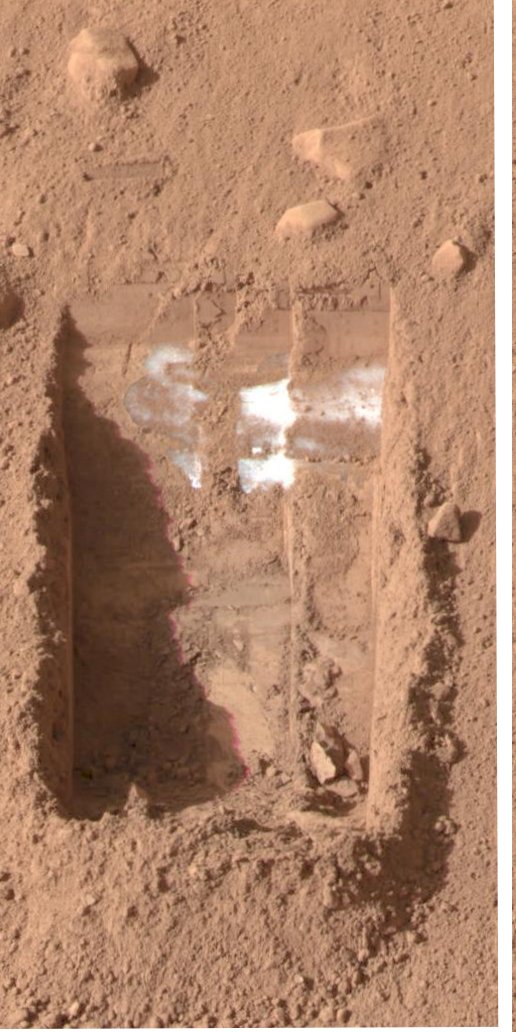
Mars Phoenix Lander dug some up and it sublimated away: http://spaceweather.com/swpod2008/22jun08/ice_gone_blink1.gif
-molo
-
Not to worry!
-
Postponed until Tuesday
The landing has been postponed until Tuesday (at least) due to rain. Check SpaceWeather for updates.
-
Re:I dont buy it
And Space Weather shows the sunspot and SOHO shows the CMEs, not like its something the government is saying and there is no evidence of it happening.
http://spaceweather.com/
http://sohowww.nascom.nasa.gov/data/realtime-images.html
http://sohowww.nascom.nasa.gov/pickoftheweek/ -
SDO runs over sundog
The launch footage posted on SpaceWeather.com is very impressive.
-
Re:Is this related to this wormhole ..
http://spaceweather.com/ mentions it..
-
For all your space weather needs
Those interested in this kind of stuff may want to check out http://spaceweather.com/ -- it's like a weather site, for space!
-
Re:It's actually not much of a sunspot group.
As a space physicist, I agree. Certainly we have seen an increase in the number of sunspots in the last month but most die out rapidly. However, other solar activity, such as corona holes (of which there are two) are becoming more common. The current set of holes should cause activity at the Earth on or about the 12th of July.
-
Re:Could a Meteor Have Brought Down Air France 447
No, http://www.spaceweather.com/glossary/nasameteorradar.html
It would have been near midnight there. It would be more likely in the morning hours. -
Re:Fairly small resistors
There was one on the 23rd with 2 CME's. Before that I think it was something like 47 days with none at all. Could be another 1913 I suppose but yeah, it is pretty weird.
-
Re:Maybe we're on the wrong side of the sun?
Moreover, it is possible to discern the sunspots on the non-earth-facing side using helioseismology. Soon, we will be able to use the Stereo satellites to observe that side, too.
-
Re:Maybe we're on the wrong side of the sun?
We can't know how many sunspots there really are if we're only seeing only half the surface of our star, right?
We see more than half of the surface.
A technique called "helioseismic holography" can detect sunspots on the far side of the sun. There is also a pair of spacecraft called STEREO which are in a solar orbit that lets them see parts of the sun that are not visible from earth.
-
Re:An Inconvenient Preemptive Strike
They sun spots have realized we were watching them and it turns out they are shy. They are just on the other side of the sun now.
Nope, we can monitor the other side of the sun, they are not there either.
This is done with Helioseismic Holography. Though there is apparently a new method being developed. -
Spaceweather has real-time "far side" images
Visit http://www.spaceweather.com/ for a real time holographic view of the far side of the sun. They've been able to detect far-side sunspots for several years now. Full details and images are available, as well as a primer about the process; look on the left sidebar beneath the front-side daily photograph.
-
Re:Maybe we're on the wrong side of the sun?
-
Re:Maybe we're on the wrong side of the sun?
-
SpaceWeather.Com
Check out spaceweather.com. It has been around for some time, and has some excellent aurora galleries. Besides summarized ACE data, this website also features the techie-cool far side views of the sun from SOHO, computed using helioseismic holography. For the truly worried, they offer for-fee email solar-flare alert services, which also come in handy if you just want to know when to go out to look for auroras. Anyway, most of the site is non-subscription, and it's worth a look.
-
Re:Fly-over times
Spaceweather.com has a simple Satellite Flybys/Satellite Tracker. http://www.spaceweather.com/flybys/
-
Re:You don't undertstand orbital physics
agreed that the variance in outgoing velocities will be maximal when the bodies have a head-on collision and minimal when they have a "collision" while moving nearly parallel. so these two bodies were moving more or less perpendicularly, which to me leaves plenty of room for specular collision to produce debris heading straight down. think of how the velocities of two billiard balls can be wildly different from their velocities before collision, all the while maintaining the total momentum of the system.
-
Re:In need of perspective?
Upon further reflection, and with your succinct description, I think I understand. Obviously, stereoscopic view isn't needed to track orbits, most telescopes are monocular. One just needs to see something moving (e.g., a tool-bag in orbit). I guess for some reason the impression of an object heading straight at the lens came to mind, which is clearly, well silly.
-
Re:No they didn't
All there is to know about the weather on the sun is here...read and learn, and tell others who may be ignorant: http://www.spaceweather.com/
-
NO observed sunspots?
We currently are at 15 sunspots for this year (with a small one fading at the time of this post). Low, but not absent.
-
Impact of Asteroid 2008 TC3 Confirmed
http://neo.jpl.nasa.gov/news/news160.html
Confirmation has been received that the asteroid impact fireball occurred at the predicted time and place. The energy recorded was estimated to be 0.9 to 1.0 kT of TNT and the time of detection was 02:45:45 on October 7 (Greenwich Standard Time). More details on this detection will be forthcoming. An additional confirmation was apparently reported by a KLM airliner (see: (http://www.spaceweather.com). As reported by Peter Brown (University of Western Ontario, Canada), a preliminary examination of infrasound stations nearest to the predicted impact point shows that at least one station recorded the event. These measurements are consistent with the predicted time and place of the atmospheric impact and indicate an estimated energy of 1.1 - 2.1 kT of TNT.
Just in case anyone's still checking all the way down here...
-
Re:The real reason this is News for Nerds
Check out NASA's Space Weather site or the Stereo pictures NASA is getting and you will not wonder what is going on on the back side of the sun.
-
That was...
Pointless. Some genius w/a camera takes pics of satellite tracks. Living in a semi-rural area, I can track eye visible satellites w/a bit of patience. I was hoping for something along the lines of a 16" (or larger) telescope getting pics like are seen often on http://www.spaceweather.com/ they even have a "simple" tracking program. http://www.heavens-above.com/ is a neat tool/toy as well. And if you REALLY wanted to know wtf that codename for that blob of light stood for , hit http://www.globalsecurity.org/space/index.html there's a search function. At one point, there was even one of the UFO "tracking sites" that had some interesting blurry shots of what were prob someone's elint arrays.
-
Four days apart
So these two frames were taken four days apart while the sublimation was taking place. My question would be - where are the rest of the frames? Does this lander really only "look around" every few days?
It would be nice to see it at even a 1-day resolution and get a 4-frame animation of the process. Those lumps should be seen to get smaller and vanish.
Not that I'm complaining, this is still very cool (no pun intended).
-
Global Warming.... bah!
> So, about 2012 with global warming....
Ok, it was funny. But Global Warming is quickly being debunked as a hoax. In another couple of years I'd predict it will join Piltdown Man in the Science Hoax wing of natural history. Of course if Cap & Trade is running by then I'll also go out on a limb adn predict it will somehow survive liek any other government boondoggle that outlives it's purpose.
It ain't us, it's Mr. Sun being cranky and it is looking more and more like cold weather is in our future. Hit Spaceweather and have a look around. Note that Cycle 24 still hasn't kicked off. Look at the historical trends of solar activity. Compare and contrast to weather trends, including the fact "Global Warming" pretty much stopped around 1997-1998. Add in the PDO has officially ended it's warm phase and gone cool. -
Re:well
A dot of light (even if you have a telescope)
Not quite. See here for an example. -
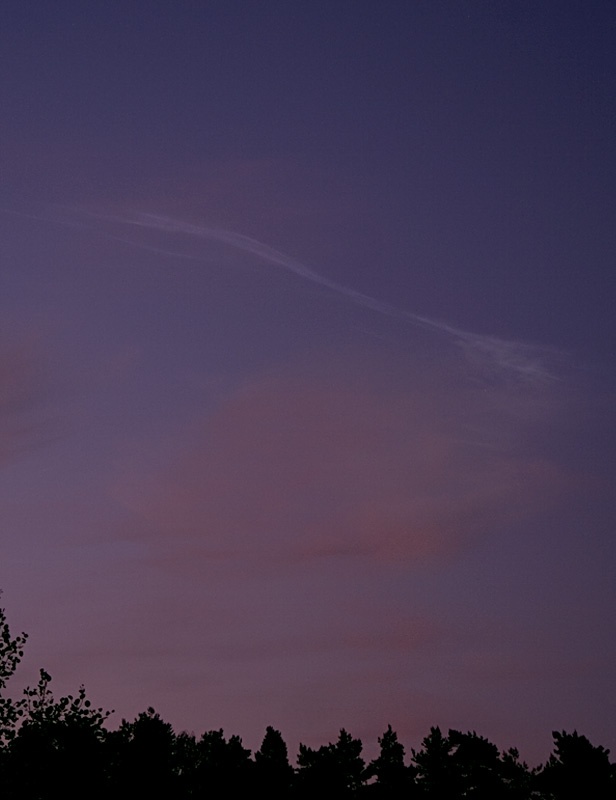
These Clouds are Filamentary
If you go through these pictures
http://www.spaceweather.com/nlcs/gallery2007_page9.htm
Nearly every single cloud structure is filamentary. People will surely say it's blasphemous to use the E-word, but structures like these
http://www.spaceweather.com/nlcs/images2007/16jun07/Heden1.jpg
Are what you get in the laboratory with *electrical* plasmas. It's the same structure that you get in a novelty plasma globe. These look exactly like Birkeland Currents to me. I'm not even sure that "clouds" is the proper term for these things, given their proximity to space. Even the overhead view from the article in question demonstrates filamentation. -
These Clouds are Filamentary
If you go through these pictures
http://www.spaceweather.com/nlcs/gallery2007_page9.htm
Nearly every single cloud structure is filamentary. People will surely say it's blasphemous to use the E-word, but structures like these
http://www.spaceweather.com/nlcs/images2007/16jun07/Heden1.jpg
Are what you get in the laboratory with *electrical* plasmas. It's the same structure that you get in a novelty plasma globe. These look exactly like Birkeland Currents to me. I'm not even sure that "clouds" is the proper term for these things, given their proximity to space. Even the overhead view from the article in question demonstrates filamentation. -
Visible in Ohio.
I've seen these a few times over the last years. The examples I saw weren't as brilliant as the ones in the summary (more along the lines of http://www.spaceweather.com/nlcs/gallery2007_page1.htm), but they are still very beautiful. I never realized they were a special subset of clouds.
-
More pictures
http://www.spaceweather.com/nlcs/gallery2007_page9.htm has a Noctilucent Cloud gallery. I haven't seen them yet myself, but it'll be interesting to see if AIM manages to find an explanation for them. It's an intriguing mystery!
-
Comet Bigger Than The Luna Too!
Comet Holmes is also bigger than the moon as well. I took a pair of images the other night. One of the comet and the other of the moon. I then stitched them together using GIMP. As you can easily see, this comet has become huge. http://www.adventuresinastrophotography.com/2007/11/19/comet-holmes-bigger-than-the-moon/ This is an object that can be seen with the unaided eye. It looks pretty nice in binoculars and amazing in a telescope. Here's a link to a skymap that should work for the next few nights... http://spaceweather.com/images2007/15nov07/skymap_north_holmes.gif Anthony
-
Re:Odd behaviorAccording to SpaceWeather.com, not only did the comet brighten unexpectedly, it "... has no tail, [and] a remarkable golden color
More proof that its no comet, but a spaceship firing retro rockets!
Tm
-
Odd behavior
According to SpaceWeather.com, not only did the comet brighten unexpectedly, it "... has no tail, [and] a remarkable golden color
-
Re:Yeah, less heat, we get warmer, it is the sun
Did you bother to look at the raw data? Check here. If you consider a moving average, then yes, the total number of sunspots has been INCREASING over the 20th century, corresponding with the temperature measurements. If the number of sunspots is going back down now, that result probably wouldn't be clearly visible in the temperature record for another decade or so.
-
Re:Let me be the first to say...
Take a look at SpaceWeather.com.
And remember, there are all kinds of things in the world that you don't care about and don't have to, because somebody else is caring about it for you. Satellite operators and many other people largely take care of worrying about the sun for us. God bless 'em. Not a criticism, just something I find handy to remember. -
Sunspot numbers
Here is a nice graph that shows sunspot data from 1620 to 2000
http://spaceweather.com/glossary/sunspotnumber.html
We can see that this isn't anything new.
BTW - If you are interested in Auroras, keep watch on the 18th-19th. We are about to get hit with a solar wind stream. -
Spaceweather.com has...
... an animated GIF that is kind of nifty. I bet if that CME hit earth containing a comet tail the light show would be impressive!
-
Doubtful it was a meteorite
As talked about on spaceweather.com, There is much discussion on the web today concerning a reported meteorite impact in Peru which created a toxic 30-meter wide crater. This report is probably erroneous. To gouge such a crater, the meteorite on impact would have liberated energy equal to about 1 kiloton of TNT (akin to a tactical nuclear weapon) leaving a clear signal in worldwide seismic and infrasound records. So far, no such signals have surfaced. If convincing evidence of impact does emerge, we will promptly report it here. Stay tuned.
-
I for one ...
welcome our new Gigantic Sprite overlords
-
Re:Right now is a minimum
We've had zero sunspots For the last 8 days, in 1996 we went 37 days without any sunspots.
-
Well. Not just this moment.
The average sunspot activity in recent years might be the highest in the past 1000 years. However, as we're currently at a minimum in the cycle, the subject is a bit misleading. Care to check for yourself? See Spaceweather. The sunspot count for today, on both sides of the sun, is exactly 0. So any baseless correlations between sunspot count and global temperatures can be ignored for the next few years.
-
Re:Considering the "political" and environmental
"So will an increase in sunspot activity affect us?"
I'm not a climatologist, so take everything I say with a grain of salt. That said, I tend to doubt one slightly higher than average solar cycle maximum is going to have an noticeable effect on climate.
What's more interesting, to me, is the behavior over multiple cycles. For instance, a long-term disappearance of sunspots in the 17th century corresponded with the Little Ice Age:
http://www.ucar.edu/research/sun/climate.jsp
If you look at the cycles of the past century or so, the predicted cycle 24 peak isn't really all that impressive compared to those of the past 60 years.
http://www.nasa.gov/images/content/144063main_Pred ictionPlotLG.jpg
However, comparing cycles 12-16 to subsequent cycles is interesting. The sun does seem to have become more active in general. Has this had a global effect? More importantly, if there has been a global effect, is it detectable against local effects on climate? Keep in mind that even the Little Ice Age was largely regional.
Oblig. links:
http://www.sec.noaa.gov/Education/index.html
http://www.ucar.edu/research/sun/
http://spaceweather.com/
http://www.spacew.com/ -
Re:Can't see the tail without binoculars
That's why we said not to look at it with binoculars today.... See what you get for not listening?
I got to see a comet, a comet in the middle of the day. You? -
Re:Civil twilight
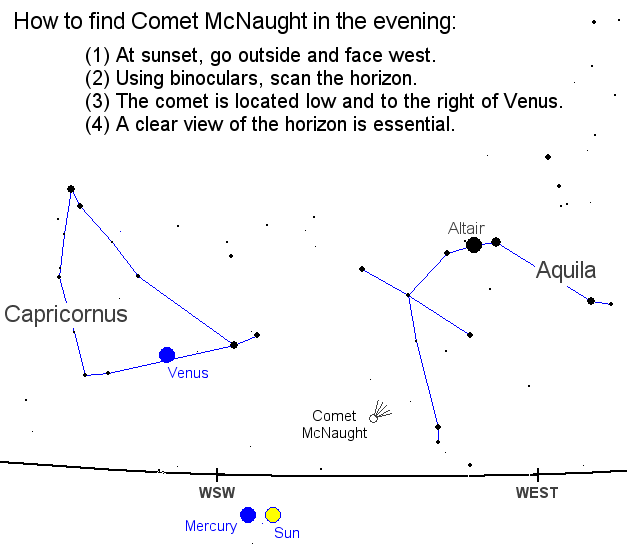
You can also try to see the comet in the evening sky by using this guide:
http://www.spaceweather.com/images2007/08jan07/sky map_north.gif -
Re:Civil twilight
My understanding is that you should be able to see it in the eastern sky preceding sunrise. Spaceweather.com has some pretty good photographs of how it has appeared in the sky over Norway and other locations, and ephermides to help in locating it in the sky in your location.