Slashdot Mirror
Domain: techcrunch.com
Stories and comments across the archive that link to techcrunch.com.
Stories · 1,414
-
Watching People Code Is Becoming an (Even Bigger) Thing
itwbennett writes: Faithful Slashdot readers may recall the story of Adam Wulf, who spent two weeks live-streaming himself writing a mobile app. The phenomenon has quickly become thing, by which we mean a business. Twitch.TV, Watch People Code (which is an offshoot of the subreddit by the same name), Ludum Dare, and, of course, YouTube, are bursting with live or archived streams of lots of people writing lots of code for lots of different things. And just this week, Y Combinator-backed startup Livecoding.TV launched. The site has signed up 40,000 users since its beta went live in February, but unlike the other sites in this space what it doesn't have (and doesn't have plans for) is advertising. As co-founder Jamie Green told ITworld: 'We have some different ideas around monetisation in the pipeline, but for now we are just focussed on building a community around live education.' -
Microsoft To Sell Bing Maps, Advertising Sections
UnknowingFool writes: Microsoft has announced that they will sell some Bing Maps technology to Uber and their advertising business to AOL. About 1,300 employees are expected to be offered positions in their new companies. CEO Nadella said previously that there would be "tough choices" to be made. Some outside analysts have said neither venture was very profitable for Microsoft and may have been unprofitable at times. -
Uber France Leaders Arrested For Running Illegal Taxi Company
An anonymous reader writes: Two Uber executives were arrested by French authorities for running an illegal taxi company and concealing illegal documents. This is not the first time Uber has run into trouble in France. Recently, taxi drivers started a nation-wide protest, blocking access to Roissy airport and the nation's interior minister issued a ban on UberPop. A statement from an Uber spokesperson to TechCrunch reads: "Our CEO for France and General Manager for Western Europe were invited to a police hearing this afternoon; following this interview, they were taken into custody. We are always available to answer all the questions on our service, and available to the authorities to solve any problem that could come up. Talks are in progress. In the meantime, we keep working in order to make sure that both our customers and drivers are safe following last week’s turmoils." -
A Failure For SpaceX: Falcon 9 Explodes During Ascension
MouseR writes with bad news about this morning's SpaceX launch: About 2:19 into its flight, Falcon 9 exploded along stage 2 and the Dragon capsule, before even the stage 1 separation. Telemetry and videos are inconclusive, without further analysis as to what went wrong. Everything was green lights. This is a catastrophe for SpaceX, which enjoyed, until now, a perfect launch record. TechCrunch has coverage of the failure, which of course also means that today's planned stage one return attempt has failed before it could start; watch this space for more links. Update: 06/28 15:06 GMT by T : See also stories at NBC News, The Washington Post, and the Associated Press (via ABC News). According to the Washington Post, what was a catastrophe for this morning's launch is only a setback for the ISS and its crew, rather than a disaster: A NASA slide from an April presentation said that with current food levels, the space station would reach what NASA calls “reserve level” on July 24 and run out by Sept. 5, according to SpaceNews. [NASA spokeswoman Stephanie] Schierholz said, however, that the supplies would last until the fall, although she could not provide a precise date. Even if something were to go wrong with the SpaceX flight, she said, there are eight more scheduled this year, including several this summer, “so there are plenty of ways to ensure the station continues to be well-supplied.” Of note: One bit of cargo that was aboard the SpaceX craft was a Microsoft Hololens; hopefully another will make it onto one of the upcoming supply runs instead.
Elon Musk has posted a note on the company's Twitter channel: "Falcon 9 experienced a problem shortly before first stage shutdown. Will provide more info as soon as we review the data." -
3D Printing Might Save the Rhinoceros
GordonShure.com writes: San Francisco based biotech startup Pembient have released details of their 3D printing led method to derail the market for Rhinoceros horns. Presently the bulk of demand originates from China, where said horns — gathered in the wild by poachers who usually kill the rhinos — are revered for supposed medicinal qualities. The new firm intends to mix keratin with Rhino DNA, then machine the combination with a 3D printer in a way that their counterfeit horns are difficult to detect by customers and traffickers alike.
The company already mulls expanding its production principle to other, lucrative wild animal trades such as the claws of tigers and lions. Pembient is however a young company — for all their ingenuity, will their ambitions to take on such a colossal black market be realized? -
Elop and Others Leaving Microsoft, Myerson Taking Bigger Role
jones_supa writes: Former Nokia CEO Stephen Elop and "Scroogled" mastermind Mark Penn are leaving Microsoft as part of a fresh company reorganization. "We are aligning our engineering efforts and capabilities to deliver on our strategy and, in particular, our three core ambitions," says CEO Satya Nadella in an e-mail to employees today. Alongside Elop and Penn, Microsoft executives Kirill Tatarinov and Eric Rudder will also leave as part of a transition period. Tatarinov used to head up Microsoft's business solutions group, and Ruder was responsible for the company's advanced strategy. The reorganization will see Windows chief Terry Myerson take on more responsibility. Myerson will take over a new team called Windows and Devices Group. He will be focused on Microsoft devices and the engineering of Windows. -
On Managing Developers
An anonymous reader writes: A columnist at TechCrunch takes a crack at advice on how to manage developers. He has some decent starting points. For example, "Basically a manager's job is to make other people more productive. What's one really good way to do that? Do the work that is getting in their way. Which means: find out what kind of important work your developers dislike the most, and do it for them." Also: "[D]on't bull$%^& anyone, ever. ... Speak the truth as you see it. Speak it diplomatically, don't get me wrong; but be trustworthy. Only then will you be able to trust others." But some of his statements are open enough to be nearly devoid of meaning: "Any particular process artifact is probably irrelevant. The finest tech team I ever worked on began every day with a daily standup; so did one of the worst, most dysfunctional teams I ever encountered. ... [T]he systems and processes you choose for any given project should be fluid, and flexible, and depend in large part on the team and the context." If you are or have been a developer, what qualities have made your managers good or poor? If you've been in position to do the managing, does you experience jive with this guy's? -
Showtime Announces Subscription-Free Streaming Plan
An anonymous reader writes: Following in HBO's footsteps, Showtime has announced that it is launching a stand-alone streaming service in mid-July. Simply called "Showtime," the service will launch through a partnership with Apple and costs $10.99 a month. "Going over-the-top means Showtime will be much more accessible to tens of millions of potential new subscribers," said CBS Corp. President and CEO Leslie Moonves in a statement about the deal. "Across CBS, we are constantly finding new ways to monetize our programming by capitalizing on opportunities presented by technology. This works best when you have outstanding premium content – like we do at Showtime – and when you have a terrific partner like Apple – which continues to innovate and build upon its loyal customer base," he added. -
Facebook Now Supports PGP To Send You Encrypted Emails
An anonymous reader writes: You can now have Facebook encrypt email it sends to you by adding your PGP key to your profile. The PGP feature is "experimental" and will be rolled out slowly. The announcement reads in part: "...today we are gradually rolling out an experimental new feature that enables people to add OpenPGP public keys to their profile; these keys can be used to 'end-to-end' encrypt notification emails sent from Facebook to your preferred email accounts. People may also choose to share OpenPGP keys from their profile, with or without enabling encrypted notifications." -
The Auto Industry May Mimic the 1980s PC Industry
An anonymous reader writes: An article at TechCrunch looks at some interesting parallels between the current automobile industry and the PC industry of the 1980s. IBM was dominant in 1985, employing four times as many people as its nearest competitor. But as soon as Windows was released, the platform became more important for most end users than the manufacturer. Over the next decade, IBM lost its throne. In 2015, we're on the cusp of a similar change: the computerized car. Automakers, though large and well-established, haven't put much effort into building the platform on which their cars run. Meanwhile, Google's Android Auto and Apple CarPlay are constantly improving. As soon as those hit a breakthrough point where it's more important for a customer to have the platform than the manufacturer's logo on the side, the industry is likely to resemble a replay of the PC industry in the 1980s. -
Firefox 38 Arrives With DRM Required To Watch Netflix
An anonymous reader writes with this excerpt from VentureBeat: Mozilla today launched Firefox 38 for Windows, Mac, Linux, and Android. Notable additions to the browser include Digital Rights Management (DRM) tech for playing protected content in the HTML5 video tag on Windows, Ruby annotation support, and improved user interfaces on Android. Firefox 38 for the desktop is available for download now on Firefox.com, and all existing users should be able to upgrade to it automatically. As always, the Android version is trickling out slowly on Google Play. Note that there is a separate download for Firefox 38 without the DRM support. Our anonymous reader adds links to the release notes for desktop and Android. -
Microsoft Invests In Undersea Cable Projects
An anonymous reader writes: Microsoft announced today that it will partner with a group of telecom companies in order to build new undersea cables. A new cable will connect data centers in China, South Korea, and Japan to the West Coast. Microsoft hopes the New Cross Pacific (NCP) Cable Network will improve connection speeds and boost its competitiveness in cloud computing. They also made deals with Hibernia and Aqua Comms, to invest in a cable with each company connecting Microsoft's datacenter infrastructure from North America to Ireland and the United Kingdom. A company announcement reads in part: "Additionally, we joined a consortium comprised of China Mobile, China Telecom, China Unicom, Chunghwa Telecom, KT Corporation with TE SubCom as the cable supplier. As part of our participation in the consortium, Microsoft will invest in its first physical landing station in the US connecting North America to Asia. The New Cross Pacific (NCP) Cable Network will provide faster data connections for customers, aid Microsoft in competing on cloud costs, all while creating jobs and spurring local economies. The goal of our expansions and investments in subsea cables is so our customers have the greatest access to scale and highly available data, anywhere." -
Google Shuts Down Map Maker Following Hacks
Errorcod3 writes: Google has temporarily shut down Map Maker while it works on a way to stop people from inserting pranks into its maps. A statement from Google explains that the service isn't going away, just shutting down while a new moderation system is worked on. "Given the current state of the system, we have come to the conclusion that it is not fair to any of our users to let them continue to spend time editing. Every edit you make is essentially going to a backlog that is growing very fast," Google's Pavithra Kanakarajan wrote. "We believe that it is more fair to only say that if we do not have the capacity to review edits at roughly the rate they come in, we have to take a pause. We have hence decided to temporarily disable editing across all countries starting Tuesday, May 12, 2015, till we have our moderation system back in action." -
Windows 10 the Last Version of Windows? Not So Fast.
A multitude of tech sites are breathlessly reporting that Windows 10 will be the last version of Windows. These claims are based on a brief comment from developer evangelist Jerry Nixon while speaking a Microsoft Ignite session on "Tiles, Notifications, and Action Center." However, as Paul Thurrott points out, you probably shouldn't take this news too seriously. Windows development has been changing for the past several years. At the very least, we've known since we learned Windows 8 would be developed for multiple form factors. We've known it specifically about Windows 10 since it was announced — Microsoft has talked about transitioning away from giant, monolithic updates. Thurrott says, The reason anyone is talking like this is that Microsoft is pushing a "Windows as a service" vision, which doesn't mean "subscription service" but rather that it plans to upgrade Windows 10 going forward with both functional and security updates, plus of course bug fixes. You know, just like it's done with every single version of Windows. Ever. ... In other words, nothing to see here. Beyond the usual: things change. If it makes sense to keep updating Windows 10 and not change the brand or version number, Microsoft will do that. If it makes sense to release something called Windows 10 R2, Windows 11, or Windows Yoghurt — seriously, who cares? — then they'll do that. -
Apple Watch Hack Adds a Browser For Your Wrist
TechCrunch reports that the Apple Watch now evidently has an tantalizing, but unofficial, feature: a browser, created by the jailbreak developer known as Comex. "Not great" is their headline-level assessment of what it looks like to use, which can't be too surprising: even a large watch face is still a small screen, by comparison to a laptop, a tablet, or even a phone. Venture Beat's assessment is similar: "As you’d expect, it’s an awkward mess." Making hardware do things it wasn't intended to is still a worthy pursuit, though, and TechCrunch notes: Out of the box, running arbitrary code like this shouldn’t be possible — while a native SDK is inbound, only stuff built with Apple’s somewhat limited WatchKit framework is supposed to run on the device for now. Is this a subtle demonstration of the world’s first jailbroken Apple Watch? -
Microsoft Releases Visual Studio Code Preview For Linux, OS X, and Windows
ClockEndGooner writes: Microsoft is still extending its efforts into cross platform development with the release of a preview edition of Visual Studio Code, "a lightweight cross-platform code editor for writing modern web and cloud applications that will run on OS X, Linux and Windows." Derived from its Monaco editor for Visual Studio Online, the initial release includes rich code assistance and navigation for JavaScript, TypeScript, Node.js, ASP.NET 5, C# and many others. -
Uber Testing Massive Merchant Delivery Service
An anonymous reader writes: TechCrunch has obtained documents showing that Uber is testing out a delivery service that would allow shoppers to buy something online and have it delivered on the same day. "Sources say that Neiman Marcus, Louis Vuitton, Tiffany's, Cohen's Fashion Optical and Hugo Boss are all in talks with the Uber Merchant Delivery program, and one source in particular said that there are over 400 different merchants currently in talks (or already testing) with Uber for same-day delivery. (Cohen's Fashion Optical and Hugo Boss are both used as examples in the training presentation.) ... From what we can gather from the manual, it seems that Uber drivers and couriers are currently taking merchant orders through a different app (and even a separate phone) than the one they use to receive regular UberRUSH orders. Eventually, however, Uber drivers will be able to take both human passengers and Uber Merchant orders at the same time through an intelligent routing system, all from a single driver-side app." -
Google Launches a Marketplace To Buy Patents From Interested Sellers
An anonymous reader writes: Google has announced an experimental marketplace called the Patent Purchase Promotion, which aims to keep patents out of the hands of patent trolls. From the announcement: "By simplifying the process and having a concentrated submission window, we can focus our efforts into quickly evaluating patent assets and getting responses back to potential sellers quickly. Hopefully this will translate into better experiences for sellers, and remove the complications of working with entities such as patent trolls." -
Facebook's "Hello" Tells You Who's Calling Before You Pick Up
Mark Wilson writes: When you receive a call you'll usually see the number of the caller, but this may not be helpful in identifying them before you decide whether to pick up. Facebook's answer to this problem is Hello. This new app comes from the Facebook Messenger team and aims to tell you more about the person getting in touch with you even if you don't have their number saved in your address book. Currently available for Android, the dialer app also allows for the blocking of calls from individuals. -
Google To Propose QUIC As IETF Standard
As reported by TechCrunch, "Google says it plans to propose HTTP2-over-QUIC to the IETF as a new Internet standard in the future," having disclosed a few days ago that about half of the traffic from Chrome browsers is using QUIC already. From the article: The name "QUIC" stands for Quick UDP Internet Connection. UDP's (and QUIC's) counterpart in the protocol world is basically TCP (which in combination with the Internet Protocol (IP) makes up the core communication language of the Internet). UDP is significantly more lightweight than TCP, but in return, it features far fewer error correction services than TCP. ... That's why UDP is great for gaming services. For these services, you want low overhead to reduce latency and if the server didn't receive your latest mouse movement, there's no need to spend a second or two to fix that because the action has already moved on. You wouldn't want to use it to request a website, though, because you couldn't guarantee that all the data would make it. With QUIC, Google aims to combine some of the best features of UDP and TCP with modern security tools. -
SpaceX Launch Postponed
An anonymous reader writes with news about SpaceX's launch today and second attempt to land its Falcon 9 rocket on a platform floating offshore in the Atlantic ocean. "You can watch live as SpaceX launches its Falcon 9 rocket and attempts to recover the first stage portion via an automated, barge-based landing plan in the Atlantic ocean, with the first take-off attempted scheduled for 4:33 PM ET, provided conditions remain good and pre-flight checks go well. A big part of this mission, designated CRS-6 and designed primarily as a resupply flight for the International Space Station, is getting a second chance at recovering Falcon 9's first stage rocket. Once the second stage and the Dragon spacecraft detach from that first stage rocket, it'll undergo a controlled descent as it attempts to touch down with SpaceX's ocean-borne landing platform." Update: 04/13 21:43 GMT by S : The launch was scrubbed because of lightning in a nearby cloud. It's been rescheduled for tomorrow at 4:10PM ET. -
Japanese Court Orders Google To Remove Negative Reviews From Google Maps
An anonymous reader writes: As reported by TechCrunch, the Japenese Chiba District Court issued a preliminary injunction forcing Google to delete two anonymous reviews for a medical clinic. Although negative, neither review violates Google policies. "The decision is based on a defamation suit from the clinic, a key part of which included an affidavit from the doctor who interacted with the anonymous reviewers and denied their claims." And here is the key part: "The court ruled that Google not only removes the content in Japan, but across the entire globe too." Google is currently considering it's options including an appeal. -
Google To Offer Ad-Free YouTube - At a Price
First time accepted submitter totalcaos writes YouTube announced today its plans for an ad-free, subscription-based service by way of an email sent out to YouTube Partners. The email details the forthcoming option, which will offer consumers the choice to pay for an "ads-free" version of YouTube for a monthly fee. The additional monetization option requires partners to agree to updated terms on YouTube's Creator Studio Dashboard, which notes that the changes will go into effect on June 15, 2015. We talked about the possibility of an ad-free model back in October. -
Forking Away: OnePlus Introduces Android-Based OxygenOS
The Verge reports that phone maker OnePlus has introduced its own OS, an Android fork called OxygenOS. OxygenOS was developed in-house by OnePlus, though at this point it is merely a modest refresh of Android 5.0 Lollipop. In a blog post, the company explains that it took a "back to basics" approach with the software, adding, "We place things like performance and battery life over gimmicks and bloated features." ... The company says its goal with OxygenOS "is to provide faster, more meaningful updates and a better-integrated range of services for every OnePlus user." What it doesn't say is that the software also gives it a way to reduce its dependence on Cyanogen. The two companies have had strained relations since Cyanogen signed an exclusive deal with Indian phone maker Micromax just before OnePlus' planned launch in the subcontinent. It's expected that OxygenOS will eventually be the default on future devices like the OnePlus Two, but, for now, you'll have to install it yourself over Cyanogen if you want it. You can find instructions on OnePlus' website. (Also at TechCrunch.) -
FCC Chairman: Net Rules Will Withstand Court Challenge
An anonymous reader writes with this story about FCC chairman Tom Wheeler's confidence that the net neutrality rules the agency passed last month will stand up to upcoming challenges in court."Now that the FCC is the subject of several lawsuits, and its leader, Chairman Tom Wheeler, was dragged in front of Congress repeatedly to answer the same battery of inanity, it's worth checking in to see how the agency is feeling. Is it confident that its recent vote to reclassify broadband under Title II of the Telecommunications Act will hold? Yes, unsurprisingly. Recently, Wheeler gave a speech at Ohio State University, laying out his larger philosophy regarding the open Internet. His second to last paragraph is worth reading: "One final prediction: the FCC's new rules will be upheld by the courts. The DC Circuit sent the previous Open Internet Order back to us and basically said, 'You're trying to impose common carrier-like regulation without stepping up and saying, "these are common carriers.'" We have addressed that issue, which is the underlying issue in all of the debates we've had so far. That gives me great confidence going forward that we will prevail."" -
Amazon Announces Unlimited Cloud Storage Plans
An anonymous reader sends word that Amazon is now offering unlimited cloud storage plans to compete with Google Drive, and Microsoft OneDrive. "Last year, Amazon gave a boost to its Prime members when it launched a free, unlimited photo storage for them on Cloud Drive. Today, the company is expanding that service as a paid offering to cover other kinds of content, and to users outside of its loyalty program. Unlimited Cloud Storage will let users get either unlimited photo storage or "unlimited everything" — covering all kinds of media from videos and music through to PDF documents — respectively for $11.99 or $59.99 per year." -
Magic Leap's AR Demo Video
First time accepted submitter iMadeGhostzilla writes TechCrunch reports: "Magic Leap is showing what it might look like to use its hardware for augmented reality gaming in the future, with a new demo of what the team is apparently 'playing in the office' right now. The brief video shows examples of interacting with YouTube and Gmail apps, along with browsing a menu system for OS-level interaction. The person in the video from whose perspective it's apparently shot then selects a shooter game, tests out a weapon after choosing from a variety of options, does some tower-defense style stuff by placing a current and fights some visually impressive but fairly generic baddies. [...] The video was posted with an apology for Magic Leap's absence at TED." Commenters on reddit and elsewhere believe the video is fake. Magic Leap recently came into the spotlight with its recent $540M backing by Google and others. -
Facebook Introduces Payment System
An anonymous reader writes: Today Facebook announced a new feature for its Messenger services: the ability to send money to friends. The payment system will work by connecting debit cards from Visa or Mastercard — no credit cards, and no bank accounts. The company claims they aren't trying to make money on it, since it'd be such a small business compared to their ad revenue. "Once the $ button is tapped, users simply enter the dollar amount and hit Pay. The money is instantly taken from their debit account and delivered to the recipient's debit account. Facebook never holds the money, though the receiver's bank will usually take a few days to make the funds available as is standard. Both users see a confirmation message detailing the transfer status and time." Facebook says transaction information is encrypted, and users will protect their cards with a dedicated passcode (or fingerprint identification). -
The Internet of Things Just Found Your Lost Wallet
Nerval's Lobster writes Ever forgotten your wallet in a coffee shop or restaurant? Now there's a way to ensure it'll never happen again: Woolet, which its creators bill as a "smart wallet." It features a rechargeable battery, Bluetooth support, and the ability to synchronize with a smartphone app; if you walk 20-85 feet away from your wallet, the app will make a sound and guide you back to it. The platform's being financed on Kickstarter, and attracted attention from TechCrunch and some other places, but it begs the question: is this yet another example of connected devices run amok—shiny and interesting as a concept but not nearly useful enough for the population at large? What would it take for a connected device, whether a wallet or a smoke detector, to gain mass appeal? -
Google Nest Rumored To Be Moving Into Audio
CIStud writes Google's Nest, best known for its innovated smart Nest thermostats and Nest Protect smoke detectors, has posted several new job positions for "Nest Audio" including a leadership position to handle "acoustics, audio electronics, audio SW, audio test and validation for all Nest Products." From the TechCrunch article: "This is a new frontier for Nest. The company has so far utilized little audio in its products. Instead, Nest has so far recruited a couple of audio companies to join Nest’s world of Internet of Things through the 'Works With Nest' developer program. 'Google will help us fully realize our vision of the conscious home and allow us to change the world faster than we ever could if we continued to go it alone. We’ve had great momentum, but [Google] is a rocket ship,' said co-founder Tony Fadell when Google bought the company." -
Jolla Partners With SSH To Create Sailfish Secure
First time accepted submitter muckracer writes Finnish mobile company Jolla will be working with Finland's SSH Communications to offer another version of its SailfishOS platform with stronger security credentials. The partnership was announced today at Jolla's press conference in Barcelona at the Mobile World Congress trade show. SSH will be providing comms encryption and key management to Sailfish Secure. -
Apple To Invest $2B Building Green Data Centers In Ireland and Denmark
stephendavion writes Amid deeper investigations into how Apple may be using its operations in Ireland as a means for tax avoidance on tens of billions of dollars in profit, the iPhone maker has announced that it will spend nearly $2 billion (€1.7 billion) to develop two new 100% renewable energy data centers in Europe. The centers — which will use wind power and other green fuel sources — will be located in Athenry, Ireland, and Viborg, Denmark. Apple said that they will power services such as apps in the App Store, Siri and iMessage. Both locations will run on 100 percent renewable energy and Apple said they will have the 'lowest environmental impact' of its data centers thus far. It will also be following in the footsteps of companies like Facebook, which has also built sustainable data center operations out in Europe. -
Airport Using Google Glass For Security and Passenger Information
An anonymous reader notes this story about how an Amsterdam airport is putting Google Glass to use. "One of Europe's busiest airports, Amsterdam's Schiphol hub in the Netherlands, is trialling Google Glass for use by airport authority officers as a hands-free way to look up gate and airplane information. It's also testing Google's face computer on travelers passing through the terminal in a bid to better understand the 'customer journey', thanks to Glass' first person perspective....Google has pulled back on 'Glass for the masses' — at least for now. It shuttered its Glass Explorer program last month. Although far from killing off Glass, it has handed the project to Nest's Tony Fadell to oversee. Glass lives, as a standalone division within Google that's yet to prove its worth — but which Google evidently isn't willing to give up on, even though it's been forced to have a rethink about its go-to-market strategy. And, in all likelihood, the entire product proposition/design of the hardware." -
Netflix Now Available In Cuba
aBaldrich writes Streaming video service Netflix will be available to Cuban customers starting today, at the $7.99 U.S. per month rate that it offers in the U.S., the company announced today. It'll still require an international payment method for now, as well as Internet access (which still isn't ubiquitous in [Cuba]), but it's an early start that Netflix says it wanted to offer in order to have it available as Cuban Internet access expands, and debit and credit cards become more available to Cuban citizens. Until now, Cubans have had little access to this kind of American entertainment. The U.S. government maintains a floating balloon tethered to an island in the Florida Keys that broadcasts the pro-democracy TV Marti network. The Cuban government constantly jams the signal. "Cuba has great filmmakers and a robust arts culture, and one day we hope to be able to bring their work to our global audience," Reed Hastings, the company's co-founder and chief executive officer, said in the statement. -
Uber Will Add Panic Button and Location/Journey Sharing In India
mpicpp sends word about new Uber safety measures coming soon to India. "Late last year, Uber announced plans for tighter safety measures in India following the rape of a passenger using its service in December. Now it has confirmed that two major features — an in-app panic button and journey/location sharing — will roll out to users in India on February 11
The company went public with the launch date after Times Of India reported that the Mumbai transportation department was considering a ban on its service over its apparent approach to safety. Authorities are reportedly "not happy with Uber representatives' responses during various meetings held to consider measures for passengers' safety."
Uber cleared the air on its plans to settle "some misconceptions" around its safety policy — which already includes more stringent background checks and a dedicated emergency response team. That will be boosted when the in-app panic button, which alerts local police when triggered, and a 'safety net' feature, which goes beyond Uber's existing 'share my ETA' feature to let customers share details of their location and trip with up to five other people, go live in India next week." -
YouTube Launches Multi-Angle Video Experiment
jones_supa writes YouTube is experimenting with a fun feature already known from DVDs: videos that let you switch between different camera angles while the video is playing. These multi-angle videos are only an experiment right now and there's only one demo video that actually showcases this feature so far. Provided that the user can supply multiple camera streams, YouTube tells that the multiplexing will be automatic, but that the technology is not ready to scale to everyone yet. If you want to give this a try, head over to Madilyn Bailey's channel. The YouTube team took her performance at the most recent YouTube Music Night and set it up as a multi-angle video. -
Google To Compete With Uber, Uber To Explore Autonomous Transportation
An anonymous reader writes: Bloomberg breaks news that Uber has a major new competitor in ridesharing: Google. According to the report, Google has informed Uber's board of directors of this development, and shown them screenshots of a ride-sharing app currently being tested by employees. Why did Google share this information with Uber? Because they've heavily invested in Uber, and Google's David Drummond, chief legal officer and senior VP of corporate development, is on Uber's board. Of course, a Google ride-sharing service would fit perfectly with their project to build and develop autonomous vehicles. This could be very bad news for Uber (not to mention other ride-sharing services) because they rely heavily on Google's mapping data. That is, unless Uber beats them to it. Uber today announced a partnership with Carnegie Mellon University to develop, among other things, "autonomy technology." A source told TechCrunch that Uber went on a hiring spree and "cleaned out" the National Robotics Engineering Center, a research organization affiliated with CMU. -
Apple Posts $18B Quarterly Profit, the Highest By Any Company, Ever
jmcbain writes: Yesterday, Apple reported its financial results for the quarter ending December 27, 2014. The company posted $18 billion in profit (on $74 billion in revenue), the largest quarterly profit by any company, ever. The previous record was $16 billion by Russia's Gazprom (the largest natural gas extractor in the world) in 2011. Apple sold 74.5 million iPhones last quarter, along with 5.5 million Macs and 21.4 million iPads. -
Uber Capping Prices During Snowmageddon 2015
An anonymous reader writes that yesterday Uber announced a cap on surge pricing during the mammoth snow storm hitting the northeast this week; there will still be surge pricing, but it will be capped at 2.8 times the usual fares. The cap comes after an agreement struck between Uber and the New York City Attorney General’s office in January 2014 that required Uber to limit prices during “abnormal disruptions of the market”, including emergencies and natural disasters. Uber also announced a national policy for its price limits during those emergencies. ... While Uber plans to limit dynamic pricing during this storm, the company has had a bad history with emergency situations and surge pricing. In late 2012, Uber received criticism for raising fares during Hurricane Sandy. (The agreement with the NY AG came in part as a result of Hurricane Sandy backlash.) -
Serious Fraud Office Drop Investigation Into Autonomy Accounting
mrspoonsi sends up an update on the investigation into Autonomy, a software company acquired by HP in 2011. HP paid a staggering $11.7 billion in the deal, then later wrote off $8.8 billion and claimed Autonomy's management intentionally defrauded them. The UK Serious Fraud Office opened a case on the matter in 2013, but that investigation has now been dropped. According to the Office's press release, they felt there was "insufficient evidence for a realistic prospect of conviction," given the information they had to work with. Autonomy is not off the hook, however — the case has now been entirely ceded to U.S. authorities. -
Samsung Launches Tizen Phone In India
puddingebola notes that Samsung's first smartphones powered by its Tizen operating system have gone on sale in India. "After plenty of speculation and an abort launch in Russia last year, Samsung has finally managed to release its first phone powered by the Tizen operating system. The Samsung Z1 is coming to India initially, where it is available to buy for 5,700 INR — that’s around $92 — from today. The Z1 is an affordable device, both in price and specs. It packs a four-inch WVGA PLS screen, and is powered by a 1.2 GHz dual-core processor and 768 MB RAM. There’s a 3.1-megapixel camera on the rear, and a limited VGA camera on the front. The phone runs version 2.3 of the Tizen operating system, and comes with 4GB of on-device storage which can be expanded by up to 64GB via a micro SD card. It supports dual SIMs, as is commonplace with devices in India." -
PC Shipments Are Slowly Recovering
mrspoonsi sends this news from TechCrunch: Over the past two years, the growing popularity of mobile devices has eaten into PC sales. A new report by Gartner, however, shows that shipments may continue to enjoy a very slow but steady uptick this year as tablet sales hit a peak. The research firm found that worldwide PC shipments in the fourth quarter of 2014 grew one percent year-over-year, the first increase since 2012. In the U.S., PC shipments increased 13.1 percent year-over-year, the fastest increase in four years, thanks to holiday purchases. Inexpensive laptops (about $200 to $300), thin and light notebooks, and laptops with a detachable screen helped drive growth. Lenovo continued to be the number one PC maker in terms of shipment volume, with a 19.4 percent marketshare. -
Aereo Gets OK From Bankruptcy Court To Auction Technology Assets
An anonymous reader writes Judge Sean Lane of the U.S. Bankruptcy Court in Manhattan gave permission to Aereo to sell its remaining assets to the highest bidder. The decision came after Aereo reached an agreement with the major broadcast networks that are suing the service. From the article: "Now a bankruptcy court in New York has granted Aereo permission to sell off its assets, with one big caveat: those angry broadcasters who shut them down in the first place? They get to approve any sales that go down. The auction will take place on February 24, at which point the broadcasters have two weeks to decide if they're okay with the highest bidder." -
Twitter Bug Locks Out Many Users
TechCrunch and ZDNet are among the many sources to report that many users are having trouble right now signing in to Twitter, and that the company is working right now to fix the glitch. As ZDNet describes the problem, According to Twitter's server response at the time of writing, most of 2015 has happened, and we are heading into a bright new 2016 in a couple of days time. Querying Twitter's HTTP response headers at https://twitter.com returns a time stamp dated one year into the future: "date: Mon, 29 Dec 2015 02:09:37 UTC". Consequently, users of Twitter's popular Tweetdeck application have experienced seeing every incoming tweet appear with a time stamp reporting the tweet to be from 365 days ago. At the same time that Twitter's servers began returning the incorrect date, some users of Twitter's official Android app were logged out of the service, and unable to log in again via the app. Users of some third-party Twitter applications have also reported being locked out of their apps. -
White House Touts Obama's 1-Liner as 2014 Tech Highlight
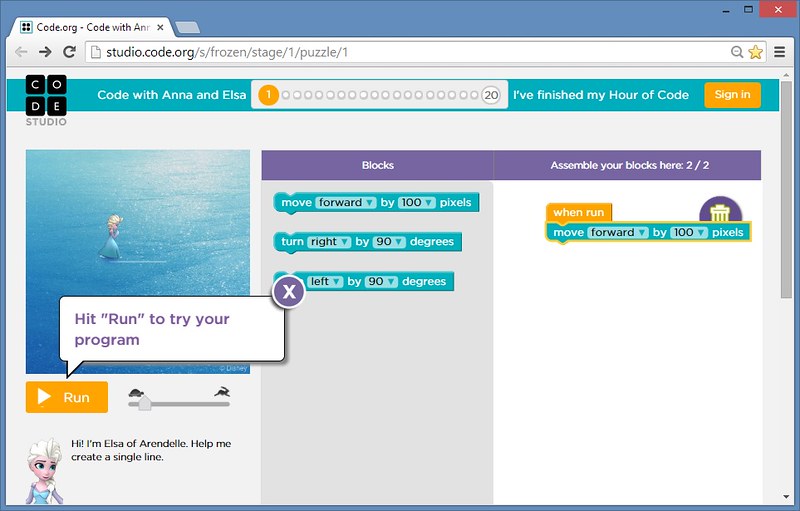
theodp (442580) writes That President Obama became the first President to write a line of code (as a top Microsoft lobbyist looked on) is #1 on the White House's Top 9 science and technology highlights from 2014. To kick off this year's Hour of Code, the President 'learned to code' by moving a Disney Princess Elsa character 100 pixels on a screen, first by dragging-and-dropping Blockly puzzle pieces and then by coding 1 line of JavaScript. Interestingly, Bill Clinton might have been The First President To Write Code had Microsoft seen fit to use its patented, circa-1995 Graphical Programming System and Method for Enabling a Person to Learn Text-Based Programming — which describes how kids as young as 8-12 years of age can be taught to program by progressing from creating a program using graphical objects to doing so using text-based programming — to teach President Clinton to code some 20 years ago! -
Google+ Will Make Your Videos Look Better
ErnieKey writes: A new Google+ feature for uploaded videos has been released that automatically enhances lighting, color, and stability. Soon, it'll also enhance speech in videos. "As more and more people now also take videos with their smartphones, it makes sense for Google to bring some of the technologies it has developed for photos (and YouTube) to these private videos, as well. Google has long offered a similar feature for YouTube users, so there is likely some overlap between the two systems here. While YouTube offers the option to 'auto-fix' videos, though, it doesn't automatically prompt its users to do this for them. YouTube also offers a number of manual tools for changing contrast, saturation and color temperature that Google+ doesn’t currently offer." -
Top Five Theaters Won't Show "The Interview" Sony Cancels Release
tobiasly writes The country's top five theater chains — Regal Entertainment, AMC Entertainment, Cinemark, Carmike Cinemas and Cineplex Entertainment — have decided not to play Sony's The Interview. This comes after the group which carried off a massive breach of its networks threatened to carry out "9/11-style attacks" on theaters that showed the film. Update: Sony has announced that it has cancelled the planned December 25 theatrical release. -
Facebook Drops Bing Search Results
New submitter mrflash818 writes Facebook has dumped search results from Microsoft's Bing after the social networking giant earlier this week launched its own tool for finding comments and other information. According to Reuters, Facebook confirmed the move Friday. TechCrunch, drawing on the same Reuters story as VentureBeat, says "The report says that Facebook’s new search tool will give users the ability to filter through old comments and other information from friends. Facebook has been building out its search products for a long time, using Bing as an extra layer to provide results beyond the Interest Graph in an effort to avoid letting rival Google into the system." -
Court Bans Sale of Xiaomi Smartphones In India
hypnosec writes The Delhi High Court has banned Xiaomi and India online retailer Flipkart from selling any handsets that Ericsson claim are violating patents. The court has also asked Xiaomi and its agents to refrain from making, assembling, importing or selling any devices which infringe the patents in question. Xiaomi says: "We haven’t received an official note from the Delhi High Court. However, our legal team is currently evaluating the situation based on the information we have. India is a very important market for Xiaomi and we will respond promptly as needed and in full compliance with India laws. Moreover, we are open to working with Ericsson to resolve this matter amicably." -
Twitter Should Use Random Sample Voting For Abuse Reports
Bennett Haselton writes: Twitter has announced new protocols for filing and handling abuse reports, making it easier to flag specific types of content (e.g. violence or suicide threats). But with the volume of abusive tweets being reported to the company every day, the internal review process will always be a bottleneck. The company could handle more abuse reports properly by recruiting public volunteers. Read what Bennett thinks below.In August, Twitter user Kristin Puhl made public the fact that another Twitter user had tweeted at her:
f@#king die feminist moron i'm coming after u and raping u.
and when Puhl filed an abuse complaint with Twitter, Twitter responded after two days:
We've investigated the account and reported Tweets for violent threats and abusive behavior, and have found that it's currently not violating the Twitter Rules (https://twitter.com/rules).
(The "rules" linked in the message include the clause "You may not publish or post direct, specific threats of violence against others.") Twitter must have changed their mind eventually, because the account of the user who sent the message is now gone, but why didn't they close it the first time?
Twitter can't effectively adjudicate all the abuse complaints that they get, but I don't blame them. I don't think they publicize numbers for how many abuse complaints they receive every day, but I'm sure that it's more than an internal review panel could handle fairly. Twitter should not be faulted for that. They've created a world-changing tool, and they shouldn't have had to stifle the growth of their platform just because it grew faster than their ability to handle the abuse reports.
But now that they're publicizing their latest tools for handling online harassment, it's fair to ask more of them. And while the tools may streamline the process of categorizing incoming abuse reports, there's always going to be a human review bottleneck, which will get tighter as the Twitter platform continues to grow.
So I'd suggest the same solution that I suggested for Facebook abuse reports: recruit a pool of volunteers from the general public to review "abuse reports". (You would need a "critical mass" of at least tens of thousands of reviewers for my idea to work, but Twitter shouldn't have trouble amassing that many people for a special program.) Then when an abuse report comes in, do the following:
- Some small number of reviewers -- say, ten -- are randomly recruited from the pool of volunteers.
- Each of them looks at the reported content and the category of abuse that it was reported under, and votes Yes or No as to whether the content meets the criteria for abuse.
- If some threshold of users (say, eight) vote that it does, then the report gets bumped up to a higher-level review. This "higher-level review" could mean having a new, larger pool of users (say, twenty) look at the content and vote on it, in case the original eight-out-of-ten vote was a statistical fluke. Or it could mean forwarding the reported tweet to some human review panel at Twitter -- which now has far fewer abuse cases to review, because it only has to look at the reported tweets that cleared the hurdle of getting eight out of ten votes for violating the guidelines.
These numbers are just guesses. I might be over-optimistic about how many reviewers would even respond when Twitter asked them to vote on whether some content was abusive (even though that's what the reviewers signed up to do) -- it might turn out that to get even ten responses, Twitter would have to nag 50 people to come and vote on a piece of content. And the size of the voting initial voting panel should be large enough to avoid statistical flukes most of the time -- if a tweet is inoffensive enough that only 10% of the reviewer population would consider it "abusive", you'd have to be really unlucky to convene a panel of 10 users where 7 out of 10 voted to label the tweet as "abuse".
As long as the size of the reviewer population grows in proportion with the Twitter user base (or, more precisely, as long as it grows in proportion with the volume of abuse reports coming in), this system scales as much as you want it to. (Well, unless the "higher-level review" involves review by an internal panel at Twitter, which still creates a bottleneck.)
Because the voting panel is randomly selected from among the entire pool of volunteers, that means you can't "game the system" by forming a mob with dozens of your friends so that everyone can file an abuse report about the same content at once. As long as your mob only comprises a tiny proportion of the 100,000+ reviewers in the system, there's virtually no change that a randomly selected panel would contain enough of you to swing the vote.
This could also potentially result in an almost-instant turnaround time for handling abuse cases (a matter of reassurance for victims of normal harassment, and a matter of life and death in the case of suicide threats or threats of violence). Twitter could restrict their random sample to only those users who happen to be signed in at the present moment, and who have a minute or two to review a piece of content and vote on whether it violates the guidelines.
Tweets are by definition public, so there wouldn't be any potential privacy violation in taking someone's tweet, putting it before a panel of 10 volunteer reviewers, and asking them to determine if it violated the terms of service. Direct Messages sent via Twitter, on the other hand, are intended only for the recipient, and are not public by default. If a recipient wanted to flag a Direct Message as abusive, they would have to specify whether they want the content to be reviewable by a panel of randomly selected public volunteers. So in the case of the tweet received by Kristin Puhl -- "fucking die feminist moron i'm coming after u and raping u" -- even if she had received it as a Direct Message from someone she was following (you can only receive DMs from someone if you're following them), presumably she would have been OK with showing the tweet to a panel of volunteers, who probably would have voted that it was in fact abusive. On the other hand, sometimes a user might receive abusive DMs where they want to report the abuse, but the DMs might contain sensitive information that they don't want publicized to randomly selected volunteers. So those abuse reports might have to be handled the old-fashioned way at Twitter, by internal review, which still creates a bottleneck. But hopefully the abuse reports about Direct Messages comprise only a small minority of abuse reports that Twitter receives, since most talk about abuse on Twitter comes in the form of public tweets. (If someone is "abusing" you via DMs, you can just unfollow them.)
Twitter could even be completely transparent about the entire voting process: "Your complaint has been reviewed by 10 people. 8 of them agreed that the tweet in question violated our guidelines. This is above our minimum threshold of 7 that triggers a higher-level review of this content." (Twitter presumably wouldn't want to tell the complainer who the voters on the panel were, since the complainer might harass the individual voters if the voting panel as a whole rejected the complaint. But there's no reason not to be transparent about the actual numbers.)
Why would someone sign up to volunteer to review abusive content? Maybe for the glimpse into strangers' lives. Maybe hoping to save copies of some of the porn contained in the tweets that get reported for abuse. (Of course, there are easier ways to get porn online, but maybe they get off on the fact that some particular pornographic image made someone angry and upset enough to report it.) Maybe they altruistically believe it's part of their civic duty towards the Twitter community. Maybe because they're bored.
Whatever people's myriad motivations for signing up, the important thing is that there's still a statistically significant difference between the number of "yes" votes received when content truly is abusive, and when it's not. Even if you have people signing up as reviewers for all kinds of weird reasons, a tweet like "fucking die feminist moron i'm coming after u and raping u" is still going to receive, on average, more "yes" votes than a tweet like "I respectfully disagree, so let's go our separate ways".
If Twitter were nervous about rolling out a system like this, ceding control of the abuse-report-handling process to a pool of volunteers, they could always do their own random sampling of the random-sample-voting system, to see how it was working. An internal auditor could pull 100 of the abuse report cases that have been handled by the random-sample-voting system recently, decide in each case whether the tweet did in fact violate the abuse guidelines, and then look to see if the voting system reached the same answer. As a control in the experiment, look at some abuse reports that were routed to the old-fashioned internal review panel during the same period, see how they handled the reports, and see how they fared in comparison. I would confidently bet money that the random sample voting system would handle the abuse reports more accurately, and faster, as well.
This won't do much to deter abusers who create an endless series of throwaway accounts for harassment purposes, which makes it futile to block or report any particular account. But it would at least get step zero right, which is to correctly adjudicate whether a tweet is abusive or not. And it would do it in a way that is scalable, non-gameable, and transparent. Plus a few volunteers would get an interesting story to tell at dinner.