Slashdot Mirror
Domain: templetons.com
Stories and comments across the archive that link to templetons.com.
Comments · 324
-
Spammers don't pay their shareIts a bit like saying that shoplifters pay because stores factor in the cost of shoplifting. Its the whole point of externalities: sure, someone pays, but it isn't the people who receive the benefits.
A good set of essays on the costs of spam, and possible non-law-based solutions, can be found here. A list of costs is found in 7. Why spam is evil.
-
it is about a penny per commercial you're worth
Or $1.20 per hour of commercials (not the show) that the station gets paid by the advertisers for each viewer. My time is worth more than 2 cents a minute: I'm willing to pay that penny for each commercial I don't have to watch. The TV industry will have to learn to adapt, rather than force me to watch dreck for pennies. This essay by Brad Templeton (of the EFF) covers some possible business models TV could take.
-
Why don't we have the will to replace ICANN?
As those who design DNS software know, the power over DNS resides not with ICANN, but collectively among all the people who configure the root server tables in the major sites and ISPs of the world, and in particular, in the sites that distribute the most common name servers (BIND and IIS) which come pre-configured with a root table that points at the official ICANN list.
If the net community got together and could express a unanimous will, that table could be changed. No court would be needed. Governments would be hard pressed to stop it.
But it requires near unanimity because a splintered net, where some people use some roots and the other half uses a different set, so names don't resolve the same, is bad for everybody.
Unanimity is impossible over a given policy but it seems near-unanimity might well be possible over replacing ICANN with another body that will represent the users in choosing a replacement for ICANN. We might universally agree to make the change according to some democratic user-based process even if we don't know how the final decision will go. We just all have to agree to do whatever 51% of the users approve.
How this works is documented on my web site at this essay along with my proposed possible replacement.
But the key isn't if I can get unanimous support for my particularl proposal -- I can't. The question is, can we find a way to a path away from ICANN without yet agreeing on what it is? -
Why don't we have the will to replace ICANN?
As those who design DNS software know, the power over DNS resides not with ICANN, but collectively among all the people who configure the root server tables in the major sites and ISPs of the world, and in particular, in the sites that distribute the most common name servers (BIND and IIS) which come pre-configured with a root table that points at the official ICANN list.
If the net community got together and could express a unanimous will, that table could be changed. No court would be needed. Governments would be hard pressed to stop it.
But it requires near unanimity because a splintered net, where some people use some roots and the other half uses a different set, so names don't resolve the same, is bad for everybody.
Unanimity is impossible over a given policy but it seems near-unanimity might well be possible over replacing ICANN with another body that will represent the users in choosing a replacement for ICANN. We might universally agree to make the change according to some democratic user-based process even if we don't know how the final decision will go. We just all have to agree to do whatever 51% of the users approve.
How this works is documented on my web site at this essay along with my proposed possible replacement.
But the key isn't if I can get unanimous support for my particularl proposal -- I can't. The question is, can we find a way to a path away from ICANN without yet agreeing on what it is? -
Expect this and many other changes
We should not be so surprised. All the media will go through not one, but many revolutionary changes as digital media change the underlying assumptions.
We talk about it all the time on
TV advertising used to be linked closely with the show, the actors would break from acting and endorse the product during a show called "G.E. Hour" or "Hallmark Hall of Fame."
The PVR will make the 30 second ad not very useful, so they will move to other things.
I have a proposal for one possible change that was featured on -
Lawmakers who don't understand the law
From the cited page...
Pursuant to Title 17 Section 105 of the United States Code, these DTDs are not subject to copyright protection and are in the public domain.
These DTDs can be redistributed and/or modified freely provided that any derivative works bear some notice that they are derived from it, and any modified versions bear some notice that they have been modified.
Sorry, cupcakes, that's not how the public domain works. If you release it into the public domain, you no longer have *any* control whatsoever upon the modification, reuse, or redistribution of the work. The required notice clause listed above in invalid.
Cite, cite (#3), cite.
Kuroth -
CCD burnout"the sun is probably bright enough to burn out your camera"
Um, do you know that for a fact or are you just making an unfounded guess?
I'm no optics expert, but I've never read any sort of warning not to point digicams at intense light.
Some quick hunting on google:- 'CCDs
- 'A solar eclipse has huge contrast, and digital photos suffer from the "bloom" effect of the CCD, where super-bright pixels bleed like crazy into their neighbours.' (Link)
- 'CCDs
-
Re:On Alternates To DNS/ICANNYou don't have to replace DNS to build something better than works on it.
The answer is to break up ICANN and allow a lot of competing systems on a level playing field. -
Re:Less licenses...
Number one doesn't need any license at all. Just put the words "Copyright 2002 Joe Schmoe, all rights reserved" at the top, and you're done.
Technically speaking, a copyright notice isn't even required.
See Brad Templeton's Copyright Myth Number 1:
"If it doesn't have a copyright notice, it's not copyrighted."
This was true in the past, but today almost all major nations follow the Berne copyright convention. For example, in the USA, almost everything created privately and originally after April 1, 1989 is copyrighted and protected whether it has a notice or not. The default you should assume for other people's works is that they are copyrighted and may not be copied unless you know otherwise. There are some old works that lost protection without notice, but frankly you should not risk it unless you know for sure. -
The future of TV and commercialsThe bad news is the Supreme Court betamax decision, if you read it in detail, may not protect automatic commercial skipping, though it would probably protect manual skipping like the 30 second button or 60x FF.
I've written up an essay of one possible result of the conflict between commercial TV, PVRs, commercial skip and DRM.
You can read about The future of TV in the essay.
-
Solution in turning Micropayments to Microrefunds?At the EFF, we've been looking hard for solutions, since we know that DRM and the DMCA won't work but artists should be compensated.
One solution I've been playing with is the idea of a "Don't Pay" button. Instead of a Pay Lars button (micropayments), change things so that the default is to pay but you can not pay if you wish to.
I call this microrefunds, a reversal of micropayments.
I have put an essay on microrefunds on my web site to explain this.
It's just a draft idea at present, not endorsed byt the rest of the folks at the EFF yet.
-
Re:Toolkit
Read this and tell me how recreating a dungeon isn't copyright violation.
-
Re:But look at Windows CEWhat nobody seems to ever mention in these threads is that Sony has $68-$80BN (depending on who you ask). They could by two Microsofts.
I think it was: MS has $38B in cash. The numbers mentioned for Square, Nintendo and EA were total company market values if I understood it correctly. The point was that MS could buy all those in cash. Read this for some idea how much money Billg makes from Microsoft alone.
Consider that he made this money in the 25 years or so since Microsoft was founded in 1975. If you presume that he has worked 14 hours a day on every business day of the year since then, that means he's been making money at a staggering million dollars per hour, around $300 per second.
It's not likely Sony (market value $46B) could buy Microsoft (market value $297B).
-
Re:GPL Prohibits VNC
In order for something to be copyrighted, you must declare it to be so by placing a copyright message on it.
Bullshit.
Read this, for example.
-
Alterslash: copyright versus trademark
16:58
That's not true for copyrights. It's trademarks that you're thinking of. There's a big difference. You never give up the right to go after a copyright violator. At least not until the copyright period expires. The stories will have long scrolled by then.
And unfortunately, under the way US copyright law works they will probably get a cease and desist soon. Becuase if we don't - then we give up the right to defend ourselves.Check out this copyright myths page for the straight dope.
-
Re:For Senders Too?!
I should have looked this up first. My bad. Except I was right. See #10 on Brad Templeton's 10 myths about copyright. In fact this indicates (under the fair use section) that using a quote from a personal letter probably isn't even fair use.
-
How to fix the DNS
The only article that expresses a reasonable solution, IMO, is this: Brad Templeton: How to fix the DNS
-
Instead of a new ICANN, how about almost none?The problem is not giving the government a role in ICANN. ICANN should barely exist. We have an infinite space, and dividing it up isn't nearly so hard as people imagine.
Rather, I would advocate simply having lots of privately run non-generic TLDs and hardly any ICANN at all
-
Instead of a new ICANN, how about almost none?The problem is not giving the government a role in ICANN. ICANN should barely exist. We have an infinite space, and dividing it up isn't nearly so hard as people imagine.
Rather, I would advocate simply having lots of privately run non-generic TLDs and hardly any ICANN at all
-
PVR only semi-impossible, but there are other waysWith an encypted to the monitor standard, it is possible to make a PVR impossible, and easy to make it very limited. Even if you can record the encrypted stream, you would have to play it back exactly as recorded, ie. no fast forward or other non-linear viewing, no avoiding commercials. You can't alter an encrypted stream, as you know.
If they wanted to get picky they could broadcast it with timestamps and bits that tell the TVs not to play it back at any other time than live. While the supreme court ruled that timeshifting is legal, it's uncertain if that means they are required to make it easy or possible.
That leaves you with opening up your sealed decrypting TV and decoding the analog signals going into the CRT, or putting a camera at the screen. Not going to be very common.
There is another solution, however, which is to change the nature of how advertising integrates into TV. Make TV pay TV but give people a discount, all the way to free, every time they really watch a commercial. Then you don't need to put the decryption in the monitor, which is good, but you still need DRM to make the pay TV work.
Details on my page on the future of tv
-
Forced to wear nametags in public: lost privacyWould you feel good about having to wear a nametag anytime you're in public? How about one that is only machine readable, but all police have that machine? With these cameras you've lost a major form of privacy- the privacy of remaining silent in public.
Unless I'm in a small town (see the essay below), I can expect to go about in public all day without telling anyone who I am, where I'm going, or what I'm doing. I can avoid people or places where I'm known. Others only get a snapshot of my life, with no personally identifiable information and only some quickly fading memories of my appearance and actions.
With these cameras I'm now wearing the equivalent of a machine readable nametag- with a little work they'll know who I am and everything I've been doing ("little work" averaged over the next 15 years: right now it's hard to immediately link face scans to names, in 5-10 years it'll be trivial. Darn You, Moore's Law! (And with cheap storage what will keep them from retroactively datamining what they've been storing for years? It may already be too late, and 'P-Day' has already arrived- a day where most camera info is stored, not deleted, so that when the technology catches up they'll be able to follow you around from that day onward. Concept heard from Brad Templeon) That is a significant change in the amount of privacy I have in public.
Brad has a great essay "A Watched Populace Never Boils" on why this type of surveillance is dangerous:
"People often ask why a loss of privacy -- as would come from increased surveillance, TV cameras on all the street corners and a national ID card -- is a restriction on freedom.
"Some wonder it because they have fallen for the old fallacy that if you are innocent, you have nothing to hide. Some wonder it because there is already a lot of monitoring in society, particularly in our credit card transactions, and the walls have not come tumbling down.
"Some welcome it, feeling that the extra surveillance will cut down on crime, and provide some increased level of safety or imagined safety.
"But the truth is that invasions of privacy invade our freedoms quite directly. This is true even if the surveillance isn't abused by the watchers, even though history shows that it always is.
"When we feel watched, we feel less free. We censor ourselves and our actions. Sometimes in little ways, sometimes in big ones.
"We all know this. We all know the exhilarating freedom we felt when we first left home, out from under the watchful eye of our parents. Alone, unwatched, we could finally be ourselves, or even be new selves. Some people experience this even when they move to a new town. Some feel themselves reducing to their old, censored self during Thanksgiving dinner.
"Yet the mainstream will never fear monitoring that much, just as it is more comfortable with censorship. What civil rights protect is not the majority, but the fringe. The fringe is usually feared by the majority, and most subject to its oppression.
essay continues...
-
Re:maybe if we stop answering it...You mean like E-Stamps? Or perhaps you'd settle for a non-monetary payment like Hash Cash? I don't believe that either of these systems can prove to be very useful, because spammers simply won't adopt them. You can start refusing mail from everyone who doesn't support them if you like, and that will certainly solve your spam problem, because the chances are you won't get any mail anymore.
In my experience so far, the only way to run a fairly spam-proof SMTP server is to be utterly ruthless with blacklisting. Blacklist insanely large portions of IP space, but configure your SMTP server to produce a bounce message which describes a way around the block (like a postmaster address, or something). A legitimate sender should receive and read the bounce (unless they have one of those ghastly SMTP servers which discards error message text and "helpfully" translates it into "the user does not exist"), whereas a spammer is likely to ignore it. If someone responds to the bounce message in the manner described, whitelist the associated IP address. Spammers send out so much mail that they can't attend to every bounce message personally. (And contrary to some opinions I've seen expressed elsewhere in this article, I've yet to see any evidence that spammers remove addresses which consistently bounce.)
Another possibility is to use the "MAIL From:" address: construct a whitelist of names from whom you will accept mail, and bounce all the others with a similar "how to get around this" message. As before, add the address of any such person who reads the bounce message to your whitelist. Note that both of these techniques could, in principle, be automated. Note also that although a spammer can trivially forge the "MAIL From:" address, it's not nearly so trivial to match every "RCPT To:" address with a whitelisted "MAIL From:" address.
I don't pretend that the above approach to spam-blocking is polite, but rather that it's the only one I've found to be very effective, given the limitations of SMTP. Most people are quite horrified at the number of IP addresses I blacklist: one spam from an open relay is usually enough to convince me to blacklist that IP address at the class B level (approx 65,000 IP addresses in its neighbourhood). It's not about raw numbers, though: it's about the impact that it has on your mail service. If I'm never likely to receive a legitimate email from that IP range, then why not blacklist it?
Ultimately, though, the solution will be to replace SMTP with a protocol that recognises one simple fact that SMTP does not: parties engaging in mail exchange are potentially hostile to each other, and thus the protocol must only allow progress when there is mutual agreement between the parties that the transaction should go ahead. IM2000 is an interesting and potentially useful proposal, for example, albeit a bit short on details (and stagnant, judging by the recent lack of traffic on the mailing list). As it happens, I've chosen to make this problem (replacing SMTP) the subject of my Honours thesis, and that's due to be finished by July. Whether or not my proposals will actually be adopted by anyone is a different matter, of course.
-
It won't be Robots, it will be AI Apes!If you believe that uploading will precede AI, I've written an essay with a compelling argument for why the first super beings might be apes and not humans.
Yes, the planet of the apes might be real!
In short, we'll experiment on animals, all the way up to apes, long before we upload humans. It's possible that in that gap, an "open source" ape brain scan will be released, and people will hack it and enhance it, giving it the abilities humans have over apes plus a lot more.
The result -- an uploaded ape superbeing.
If we're lucky, our pets will keep us as pets. Read the essay for full details.
-
Re:I don't think so.
This page shows what could happen if Jar Jar is seduced by the Dark Side...
-
On the subject of Vinge, get the annotated AFUTDSince we're talking Vinge, I will make a blatant ad for the fact that I have put up 6 copies of the now rare "1993 Hugo and Nebula Anthology" CD-ROM up for Charity Auction on eBay.
This CD is the world's first major eBook project with current fiction, and became famous because the novel "A Fire Upon the Deep," is in hypertext, linked to 400kb of the author's notes, written as the novel was being developed. You really get to see Vinge's mind at work.
Anyway, Vinge fans love these, so from time to time they show up for charity auction. In this case, the proceeds go to support the Electronic Frontier Foundation (EFF), which you can read about elsewehre on
To see the auctions go to my eBay page or to the CD's web page
-
A bad decision on a bad lawWhile if you hate spam as much as I do, you might be tempted to be pleased at this law, it's actually a terrible decision.
The court has said that when you mail, you have a duty to figure out in advance what state the mailbox you're mailing to is in, and then find out the e-mail laws of that state and obey them.
Yikes! That's not at all the way E-mail works. You often have no idea what state the other guy's mailbox is in, and it's a pain, or impossible, to find out in many cases.
You may cheer that this law puts this burden on senders of UCE, but the reality is that if this decision stands, you are letting all states put whatever rules they care to pass on E-mail, and putting a duty on everybody to know all the laws and know the state they are mailing.
To add insult to injury, this law defines new syntax for the Subject header! The government should not be defining the forms of e-mail headers. The IETF does that. This is also compelled speech and apparently the defendant didn't even bring that issue up.
Less you think I'm defending spam, you can read my essay on the insidious evil of spam to find out the contrary.
But we must fight spam the right way, and setting precedents like this is a dark day for e-mail and the internet in general.
California had another spam law which wasn't so bad because the recipient had to notify, thus making it clear what state they were in.
-
Re:5-megapixel cameras better than 35 mm film?
What about anything I said about bit depth is wrong? Besides I answered the question the guy asked and that was whether digital camers right now really compare to film which they don't. Price/performance wise they are completely uneconomical unless you have a point and shoot 35mm and take more than 40 rolls of film a year. People with those sorts of camers are lucky to develop 10 rolls a year. Here you you will be better informed read up. He says the exact same thing as me and is an admittedly better photographer. Fucking smug people.
-
Cross your fingers
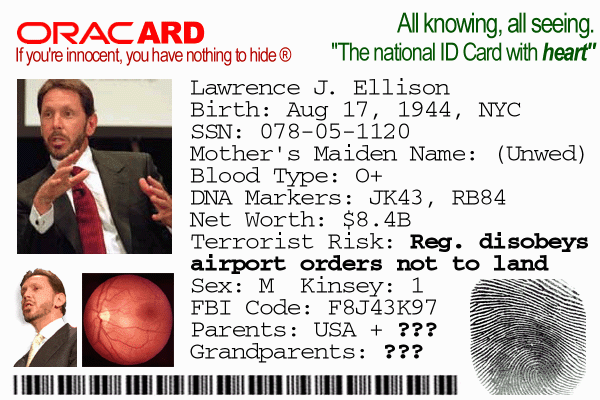
Hope Santa has his Oracard if NORAD stops him and asks about fruits or vegetables.
-
heh.. makes me wonder
if this is going to affect Larry's Oracard project. Maybe the government should consider using mySQL?
-
Larry's help
Just take a look at Larry's proposed National ID card.
-
Prototype of the National ID Card:
http://www.templetons.com/brad/oracard.html
There's a nice prototype of the national id card. -
Re:Damages? Copy Protection? huh?
It is my understanding that the copyright law allows for non-commercial copying
Your understanding is wrong. -
Dislikes a solution != likes the problemThe EFF is coming out against non-spammers getting the spammer treatment. The EFF has to hold this position to be consistent with earlier cases like...
1. Not forcing adults to read filtered content because children could read it, or
2. Not having entire email servers seized because one recipient is under investigation.
This doesn't mean that the EFF wants to stop investigations or force children to see porn, but that it is sensitive to certain types of collateral damage, even for the best of reasons.
The EFF person who posted earlier states that Spam is Evil for all the reasons discussed in this thread. He also wrote in his collection of essays on spam that being against a solution can get one labeled as pro-spam. So the EFF had to be quite aware that their position would them money / supporters, but they did it anyways. Willingness to anger supporters on one case is a good sign, because it means not weakening your principles for popularity. These are the same principles that make the EFF fight for 2600 , and Felten, and other DVD cases , and many other cases on such tiny topics as anonymity, satire, whether hacking=terrorism, encryption, reverse engineering... some of which will need to go to the Supreme Court, costing $$$. I'd rather have them dedicated to principles and sometimes make me angry than see them go for keeping everyone happy. (and I'm sure they didn't like losing Adobe's money while they support Sklyarov. )
-
Dislikes a solution != likes the problemThe EFF is coming out against non-spammers getting the spammer treatment. The EFF has to hold this position to be consistent with earlier cases like...
1. Not forcing adults to read filtered content because children could read it, or
2. Not having entire email servers seized because one recipient is under investigation.
This doesn't mean that the EFF wants to stop investigations or force children to see porn, but that it is sensitive to certain types of collateral damage, even for the best of reasons.
The EFF person who posted earlier states that Spam is Evil for all the reasons discussed in this thread. He also wrote in his collection of essays on spam that being against a solution can get one labeled as pro-spam. So the EFF had to be quite aware that their position would them money / supporters, but they did it anyways. Willingness to anger supporters on one case is a good sign, because it means not weakening your principles for popularity. These are the same principles that make the EFF fight for 2600 , and Felten, and other DVD cases , and many other cases on such tiny topics as anonymity, satire, whether hacking=terrorism, encryption, reverse engineering... some of which will need to go to the Supreme Court, costing $$$. I'd rather have them dedicated to principles and sometimes make me angry than see them go for keeping everyone happy. (and I'm sure they didn't like losing Adobe's money while they support Sklyarov. )
-
Dislikes a solution != likes the problemThe EFF is coming out against non-spammers getting the spammer treatment. The EFF has to hold this position to be consistent with earlier cases like...
1. Not forcing adults to read filtered content because children could read it, or
2. Not having entire email servers seized because one recipient is under investigation.
This doesn't mean that the EFF wants to stop investigations or force children to see porn, but that it is sensitive to certain types of collateral damage, even for the best of reasons.
The EFF person who posted earlier states that Spam is Evil for all the reasons discussed in this thread. He also wrote in his collection of essays on spam that being against a solution can get one labeled as pro-spam. So the EFF had to be quite aware that their position would them money / supporters, but they did it anyways. Willingness to anger supporters on one case is a good sign, because it means not weakening your principles for popularity. These are the same principles that make the EFF fight for 2600 , and Felten, and other DVD cases , and many other cases on such tiny topics as anonymity, satire, whether hacking=terrorism, encryption, reverse engineering... some of which will need to go to the Supreme Court, costing $$$. I'd rather have them dedicated to principles and sometimes make me angry than see them go for keeping everyone happy. (and I'm sure they didn't like losing Adobe's money while they support Sklyarov. )
-
Here is a prototype of Larry's new ID cardThe first one's free, little government.
-
Re:That's not the DMCA..Blockquoth the poster:
In order to have a copyright on it, you must put "(C) Copyright 2001, by [your name here]" somewhere on the document. This gives you the copyright on it. Posting something (or emailing) without a Copyright notice on it, effectivly makes it Public Domain.
This is a common and dangerous misconception. Whereas it used to be that to have copyright you had to use the (c) and register it, this is no longer true, and hasn't been since (I believe) 1989. See, for further info, "10 Big Myths about Copyright Explained" (http://www.templetons.com/brad/copymyths.html). -
An ebook publisher on why Dmitry should go freeWell, I wrote an essay on this exact topic a week ago, but since it's the theme here today, I offer a link to it.
An ebook publisher on why Dmitry should go free
I've added a recent list of points about what turns out to be the main technical point even if you believe in the DMCA. The DMCA crime alleged here is trafficking in the software in the USA. He didn't do this, his employer/publisher did. There is a big difference. If there are to be info-crimes, should employees be put in jail if their employers use their (legal where they did it) work in illegal ways in other lands?
Of course, as chairman of the EFF I may have some bias here.
-
Re:Earth to Katz... he broke the fuckin law
-
Re:Why locks are made.If I decide to go around taking apart locks to see which ones I'll be able to break into, I should have that right, because a lock is only SECURE if I'm able to take it apart and still not know how to break it. Encryption is the same.
First of all, I agree that you should have that right. And if you feel strongly about it, I hope you'll join us in the streets to tell the world about it.
Unfortunately, here's the problem with eBooks: they can't ever be encrypted effectively, because your adversary (formerly called your "customer") always has the key. It almost doesn't matter whether Adobe uses ROT-13 or triple-DES, because they have to give you both the algorithm and the key for you to be able to do anything at all with the eBook. All they can do is to obfuscate the software to make it difficult to figure out what they've already given you. However, experience shows that there will always be a sufficiently talented and motivated individual who figures it out. The current "solution" to this problem is to imprison those people.
I think that one point that might save us was raised by Brad Templeton: the main problem with commercial eBook publishing isn't piracy, it's that no one wants to read eBooks! Publishers might eventually get the hint that they have to make their products maximally useful rather than trying to lock them up tightly.
-
Re:Cheers For Adobe
The distrubing part is that "illustrator" is a somewhat generic name, which does not specificlly indicate a piece of IP owned by Adobe Systems, Inc
Adobe owns the trademark for the word "Illustrator" in relation to graphics software. Similarly, Apple Computer owns the trademark for "Apple" in relation to computers. They are both generic terms by themselves, but put in the context of these two industries, and they become trademarks. Trademarks are different from copyright, in that if not defended, their significance is weakened. I highly recommend you read 10 Big Myths About Copyright Explained for more info. Adobe is just defending their trademark, and being quite classy about it IMO. -
Re:Windows XP Licenses and ConsumersBlockquoth the poster:
What you can't legally do is provide that copy to others for profit. [emphasis added]
This is one of the most common, and potentially most dangerous, of the many Myths about Copyright. Your profit motive in distributing copies is irrelevant to your liability for infringing copyright. To quote the source linked,hether you charge can affect the damages awarded in court, but that's essentially the only difference. It's still a violation if you give it away -- and there can still be serious damages if you hurt the commercial value of the property. There is an exception for personal copying of music, which is not a violation, though courts are right now deciding if that includes such widescale personal copying as Napster.
So don't bet the bank on the "I didn't charge for it, Your Honor" defense. -
Re:Incoming
come to think of it.. attaching ads is changing the content, and could possibly be a copyright violation.
I've read this several times in this thread. Apparently, people don't realize that even though email is technically copyrighted, there is no legal avenue if that copyright is broken because it has no commercial value.
10 Big Myths about copyright explained
But, as has been said before, if you don't like it, don't use a free ISP. If you don't want your email modified, don't send it to someone at a free ISP. -
Re:I'm not impressed by these argumentsOf course, what never gets pointed out is that the CD title and the track names are themselves copyrighted material, owned by the copyright holder (in this case the record company.)
Perhaps the reason it never gets pointed out is that it is not true. See for example, item number 5 on Brad Templeton's Myths about copyright page. Sheesh.
-
Copyright Myths
Ontopic site worth a look.
-
Important copyright infoSome links on general info about copyright
10 Bit Myths about copyright explained
ALA copyright Education Program Contains info about fair use,and Copyright on the internet
www.metallicaisgreedy.com which is packed full of tons of info that is pro-napster, in particular in regards to lawsuits,media,etc -
have you tried the hof?On your left is a link to slashdot's hall of fame. Anne Marie (whom you dub 'the Bonobo lady') has one of hers in there which got 62 bites.
Top 10 Comments
5
Thanks for all the support
by btempleton on Wednesday April 11, @12:37AM EST
attached to Rec.humor.funny Threatened by MasterCard
posted on Tuesday April 10, @06:45PM EST by michael
5
Some screenshots
by Twid on Wednesday April 11, @12:37AM EST
attached to Return Of the Lost Server
posted on Tuesday April 10, @10:10PM EST by Hemos
5
Yahoo changes name to OhYeahBabyYeah!
by tenzig_112 on Wednesday April 11, @12:31PM EST
attached to Yahoo! To Start Selling Porn
posted on Wednesday April 11, @11:48AM EST by timothy
5
Interesting
by watanabe on Wednesday April 11, @12:12PM EST
attached to Bob Young Responds Personally, Not Officially
posted on Wednesday April 11, @11:00AM EST by Roblimo
5
Re:This is a moral outrage!
by SamBeckett on Wednesday April 11, @12:01PM EST
attached to Yahoo! To Start Selling Porn
posted on Wednesday April 11, @11:48AM EST by timothy
5
This is a moral outrage!
by Anne Marie on Wednesday April 11, @11:59AM EST
attached to Yahoo! To Start Selling Porn
posted on Wednesday April 11, @11:48AM EST by timothy
5
Porn is Big Business
by Mittermeyer on Wednesday April 11, @11:54AM EST
attached to Yahoo! To Start Selling Porn
posted on Wednesday April 11, @11:48AM EST by timothy
5
The most important point in that interview:
by CokeBear on Wednesday April 11, @11:43AM EST
attached to Bob Young Responds Personally, Not Officially
posted on Wednesday April 11, @11:00AM EST by Roblimo
5
Back to the Future, Again
by ChaoticCoyote on Wednesday April 11, @11:27AM EST
attached to Bob Young Responds Personally, Not Officially
posted on Wednesday April 11, @11:00AM EST by Roblimo
5
Re:can someone explain...
by clare-ents on Wednesday April 11, @11:18AM EST
attached to Europe To Adopt Strict Internet Copyright Law
posted on Wednesday April 11, @09:59AM EST by timothy
generated on Tue Apr 17 17:08:11 2001
-
Re:What?! Govn doesn't own copyright??Heres another link: http://www.templetons.com/brad/copyright.html
Bingo! Here's the Library of Congress link: http://www.loc.gov/copyright/circs/circ1.html#piu
-
Obi-Wan once thought as you do....
I used to think along these lines - putting telemarketers on hold for a long time, making a few dozen calls to 800 numbers listed in spam e-mails, i.e. pretty much everything Emily Postnews recommends - but it's just not worth my effort. I will always adhere to the minimal and essential commitment never to buy anything as a result of invasive and unsolicited advertising, but there's just too many suckers out there who easily make up the cheap marketing costs of bulk mailings. So stooping to respond to mass marketing measures no longer appeals to me. It's all a slippery slope to Ted Kazinsky's tactics anyhoo.
Some useful URLs, though:
http://www.the-dma.org/consumers/consumerassistanc e.html
http://www.mcs.com/~jcr/junkemaildeal.html- John
-
Check your facts
Boy am I getting tired of slashdotters who give out misinformation. Often it comes with profanity or insults. Check out this site, or anything in the relevant DMOZ category. In the U.S., you do automatically own the copyright on everything you write, but registration strengthens your legal options against pirates.