Slashdot Mirror
Domain: tesla.com
Stories and comments across the archive that link to tesla.com.
Comments · 246
-
Re:PC baloney
PC baloney
You keep using that word. I do not think it means what you think it means.
While electrons are easier to transport over distances, molecules are much easier to stockpile and transfer without loss.
Merely even refining transportation fuels is a much less efficient process than charging li-ions.
Carrying your own oxidizer with you is stupid when the air is 20% oxygen, not to mention that riding on a ton of fuel and oxidizer packed in close proximity is silly
Li-ions don't work by oxidation processes, they work by intercalation processes. On one side you have graphite and/or silicon, and on the other you have nickel/cobalt/aluminum oxides. One or both of them are infiltrated with lithium ions in the interstitial space; the charge state is defined by which side the lithium is on.
You seem to be under the mistaken concept that energy density corresponds to safety. Tell me, which is more of a hazard, 100kg of aluminum or 100kg of nitroglycerine? Now tell me, which is more energy dense?
Here's the reality of fire safety in Tesla battery packs. They're so non-flammable that you can generally burn the rest of the car to the ground without burning the pack. Try that with a gasoline car. Gasoline fires in cars are extremely common. 152k gasoline cars catch fire in the US alone every year. Tesla rates of fires are far less than those in gasoline cars.
What boggles the mind *to me* is that gasoline vehicles are allowed to store such huge quantities of a highly flammable fuel in just a big tank. No compartmentalization / isolation system, just pour it in, and there you go!
And lastly: IC engines have consumables yes, but they are field-serviceable and don't require complete remanufacturing to maintain their efficiency.
Simply not true. ICE efficiencies decline over time, and the level of cost required to keep them running at as-of-manufactured efficiency makes it impractical to do for most consumers. Older ICE vehicles are generally much less efficient than new ones. Which also, BTW, reduces range. Proper li-ion packs, like Tesla's, do lose range with time, but only slowly. Click on "charts". Typical degradation is about 4% in the first year, but much slower thereafter. A typical 5-year old car has only about 6-7% total degradation. It's hard to know at this point whether you can continue extrapolating such a slow decline slope over time, but it's at the very least extremely promising. Typical results from Tesla taxis with hundreds of thousands of miles on them are less than 10% degradation.
We're talking "Now, not in a hundred years."
BTW, it also sounds like you're under the impression that EVs remain unusually heavy. Check out the curb weights of the Model 3 variants. SR is 3549lbs (1609kg) and LR is 3814 lbs (1730kg). Its ICE class competitors (BMW 3-series, Audi A4, Mercedes C300, etc) come in a wide variety of configurations:
BMW 3-Series: 1475-1770kg
Audi A4: 1410-1695kg
Mercedes C300: 1630-1715+kgThere's nothing unusual about the Model 3's weight versus its ICE competitors. The LR is a bit on the heavy side, but the SR slots right in the middle.
-
Re:Not real useful
Tesla says you are wrong. It takes over an hour - about 90 minutes actually - to fully charge at a supercharger. At another charging station, it will take several hours - I know, I've a friend who has a model S (P85D) and it took a bit over 3 hours to fully charge his car, after a 280 mile trip from his house in Burbank to Las Vegas. I stand by my assertion. And recognize that a truck - with a required MUCH larger battery pack - will require considerably longer charge times, or it's going to take multiple superchargers to provide a sub-2-hour charge time. When now it takes about 8 minutes to completely fill a pair of 150 gallon tanks on a big truck. And with a typical 5-7 MPG of the big truck, we're talking 1500+ miles between required refills for the big truck - quite a difference than the 250-300 miles of Tesla.
-
Re:Mr Musk
-
Re:Typical of Musk
The promise wasn't simply self-landing first-stage rockets. It was a commitment to provide low cost orbital launch vehicles and responsive launch services, on a recurring basis, using a mature vehicle design and a commercially derived booster to meet mission/payload requirements. (2005) It's safe to say that that expectation hasn't been met (https://en.wikipedia.org/wiki/List_of_Falcon_9_and_Falcon_Heavy_launches#Past_launches).
The promise wasn't "electric cars that you can buy now", it was "electric cars that anyone can afford funded by electric sports cars for the rich". That didn't happen. The public funded the subsidization of the electric sports cars and the "affordable" EV is happening as the result of massive public and private investment. And the affordable vehicle won't even have the features promised.
Home power storage solutions was never a promise because we have still yet to approach the point where people NEED to store their own power. It's a solution for a problem that doesn't exist and has come as a side-effect of Tesla needing to source their own batteries (and thus have a battery factory) and then sell the batteries they'll over-produce.
Someone mentioned solar roof tiles. Those still aren't here yet and they won't ever be at the price of replacing a roof outright as promised. It will only be comparable in price when you factor in receiving all possible incentives (in the long run) and the irrational idea of financing a $7,500 roof with a 30-year loan (thus artificially increasing the cost of a regular roof). It's all here: https://www.tesla.com/solarroo... . And even then, it's not likely going to be the whole roof full of tiles.
Here's the thing-- I don't think these projects will fail in the long run. I know that the private transportation of goods to space is a current reality and it will only improve with time. I know that EVs (or hydrogen fuel cell vehicles) are the future of private transportation. I know that we'll eventually have a majority of autonomous vehicles on the road. I know that when we move more towards ubiquitous solar (were sensible) and wind, we'll need better ways of storing energy to deal with grid spikes and valleys. But it won't be nearly as quick as Musk says and it won't be nearly as cheap. Someone has to pay and even if it's not out of pocket for you right now, you're likely paying for it in your taxes via subsidies. Musk isn't a financial or technological genius. He's not the scientist or researcher making these things happen. He's not Tony Stark. He's an ideas guy and a hype-man.
-
Re:The technology simply isn't safe enough yet
Why don't you read their claims yourself?
Full Self-Driving Hardware on All Cars
You do realize that those claims (although 100% false advertising) don't even apply to the vehicle in question because it didn't have that hardware on it right? The hardware you're talking about, and the claims you're pointing to are for hardware released AFTER the car you're talking about was sold.
This is like blaming your Ford Model T for the cruise control not working because modern Fords include it.
Translation: Development is done, it's already here but due to the red tape we can't say it is.
no, translation: "the hardware on our latest cars is done, but the software isn't, and still requires quite a bit of work, and we still aren't selling you a self driving car yet, so you still need to drive for yourself until we eventually release the self driving feature." Not to mention that Tesla are, as usual, lying outright in their claim that those cars will ever be self driving with that hardware.
But that's a completely different story, and not related to the idiot who took his car and drove it in to the side of a semi-truck (reportedly while watching a movie while he should have been driving)
-
Re:The technology simply isn't safe enough yet
Musk never said that the system in place on that vehicle needed a few more tweaks to achieve self driving, he said that the system on that car was never meant for self driving, and never advertised as such. He also said that future models of the car would include self driving by using different hardware and software.
Why don't you read their claims yourself?
Full Self-Driving Hardware on All Cars
All Tesla vehicles produced in our factory, including Model 3, have the hardware needed for full self-driving capability at a safety level substantially greater than that of a human driver.
They promise that buying a Tesla will get you a self-driving car with nothing more than a software upgrade.
Full Self-Driving Capability
Build upon Enhanced Autopilot and order Full Self-Driving Capability on your Tesla. This doubles the number of active cameras from four to eight, enabling full self-driving in almost all circumstances...with a bit of small print:
Please note that Self-Driving functionality is dependent upon extensive software validation and regulatory approval, which may vary widely by jurisdiction. It is not possible to know exactly when each element of the functionality described above will be available, as this is highly dependent on local regulatory approval.
Translation: Development is done, it's already here but due to the red tape we can't say it is.
-
Re:Five times
it's much more similar in refinement to a Dacia or a Hyundai
Not according to literally every reveiwer who has been in in the vehicle, which is over a dozen. A base Model 3 is also more feature-rich than its competitors such as the 3-series (there are also comparisons to the A4 and C300 if you'd like)
Now, you can spout nonsense that doesn't correspond at all to any reviews, but that's not to your credit. Seriously, the concept that a soft-touch sports sedan with a 5,6 second *base* 0-60, eight cameras, a dozen ultrasonic sensors and a radar *standard*, automatic crash avoidance *standard*, and a ton of other things is equivalent to a Dacia... why not just call it a used Yugo while you're at it?
Tesla Model 3: 1740kg (claimed)
Wrong. The base curb weight of the Model 3, according to the official press kit, is 3549 lbs, which is 1610kg. 1730kg is the LR version, the heavier version. The BMW 3-Series ranges from 1475-1770kg. The A4 ranges from 1410-1695 kg. I can't find an official total range for the C300, but find values ranging from 1630 kg to 1688kg to 1695kg to 1715kg. While the 1630kg is described as the "base weight" (analogous to the M3's 1610kg), I have no clue what the heaviest C300 config is, there could easily be configurations heavier than the 1715kg one.
To sum up:
Tesla Model 3: 1610-1730kg
BMW 3-Series: 1475-1770kg
Audi A4: 1410-1695kg
Mercedes C300: 1630-1715+kgI'll repeat: The Tesla Model 3's curb weight comes in at pretty much the same as its ICE competitors in its class (BMW 3-Series, Audi A4, Mercedes C300, etc).
-
Re: Electric cars going the way of 3D TV and RoR
But you're supposed to charge up all night at home
You're the one who imposed the "no supercharging at the person's house" requirement (which doesn't match reality, FYI). I'm just meeting your impositions.
so why in the world would you drive the short distance from home to the SC station and then juice up again?
On the way. Hence Arlington if you're coming from the south and Denton if you're coming from the north.
There needs to be a SC station between Dallas and Shamrock.
By the time anyone in Texas gets a M3, there will be two. There's already one.
I googled "Tesla supercharger new mexico" and saw none in the entire southern half of the state
Okay, now we're seeing the problem. I'm pretty sure you're looking at "screenshots" of the supercharger map taken from random points in the past, not any of the live maps. It's important to always check the most current data; the network has been growing at a crazy rate.
This is Tesla's live supercharger map. Red means already fully operational. Grey means either currently unoperational or under construction; all under construction stations are scheduled to be finished by the end of this year (and the total number of stations tripled by the end of next year over what they are today).
Beyond superchargers (that map also has an option to show Tesla-branded destination chargers), there's exponentially more chargers over at Plugshare, of varying speeds. Note that you have to zoom in before they appear. Plugshare does not show any that are under construction. Superchargers are of course fastest, but they're going to be rivaled very soon by VW's network, which is targeting speeds even faster than the current generation of superchargers (but not as powerful as Tesla's new V3 supercharger, which is still under wraps). Current V2 superchargers are 145kW per charger (usually 4-8 chargers per station), max 120kW per vehicle, up to two vehicles connected to a charger at once (but with supercharger density maintained such that having to share a charger is rare - if it ever ceases to be rare that's a trigger to build more superchargers in an area). Volkswagen's network is going to be a mix of 150kW and 350kW chargers. When asked if Tesla's V3 would be 350kW, Musk responded by calling 350kW a "children's toy".
-
Re: Electric cars going the way of 3D TV and RoR
Southern Taxes to Az, by end of 2017 though knowing Tesla, it is really be end of 2018. Still....
Still, this is no different than when I was a kid and in the 70s, esp on Sundays, we had to consider where gas stations where to drive from Illinois to Mich, or Illinois to California. Yet, by mid 80s, it was a none issue.
Same way with EVs, and no doubt Tesla will be the first. What is interesting is that their next SC that should be coming out now, will allow for 5-10 minute charges. -
Re:*THIS* is a company that should be called Tesla
[Tesla] didn't give a shit about battery powered cars btw
I don't know if there's much historical evidence of that one way or another. However, it is worth pointing out that Nikola Tesla invented the AC induction motor - a rather impressive demonstration that AC power distribution could be used for machines. Each Tesla car has an induction motor in it - something that I think Nikola would be both proud and impressed by.
-
Re:Too little, too late
The only reason superchargers currently work for long trips is that there are very few electric cars that need them.
What part of "Tesla maintains market forecasts to ensure that they don't" didn't you understand? Tesla builds more when superchargers start to get busy. Look at the density of superchargers in, say, Hong Kong. Each of those stations in turn has many chargers.
Superchargers are budgeted such that they're profitable once utilization levels become significant, without requiring constant utilization. Only those in remote areas are loss leaders.
-
Tesla is already building their driving DB
Every new Tesla car (including Model 3) has the full "Hardware 2" platform for self-driving, and even when it's not being used for self-driving it's on and watching the world. Tesla has said that it is already using "fleet learning" to map out roads. This blog post is talking about how radar has problems but is still useful for self-driving, and they are working around the problems:
When the car is approaching an overhead highway road sign positioned on a rise in the road or a bridge where the road dips underneath, this often looks like a collision course. The navigation data and height accuracy of the GPS are not enough to know whether the car will pass under the object or not. By the time the car is close and the road pitch changes, it is too late to brake.
This is where fleet learning comes in handy. Initially, the vehicle fleet will take no action except to note the position of road signs, bridges and other stationary objects, mapping the world according to radar. The car computer will then silently compare when it would have braked to the driver action and upload that to the Tesla database. If several cars drive safely past a given radar object, whether Autopilot is turned on or off, then that object is added to the geocoded whitelist.
https://www.tesla.com/blog/upgrading-autopilot-seeing-world-radar
In a world with fleet learning this hack will be of very limited effectiveness. The first cars to reach the hacked signs will learn about them and then other cars will know. In the early days of self-driving cars the car can make the human take over and the fleet can learn what the human did.
Sooner or later I imagine there will be an interoperative standard for fleet learning, where all the cars will cooperate instead of only Tesla cars learning from other Tesla cars and so on. All cars would share learning over the Internet. This then suggests an attack where false learning data is injected into the system!
Once the world has "Level 5 self-driving" cars built with no steering wheel or other human controls, this sort of attack could be a bit of a problem and will need to be solved. One idea: if there is an interoperative standard then the Department of Transportation would publish learning data about temporary stop signs or whatever. A new stop sign appearing right where the learning data said it would would be trusted a lot.
I don't think this will be a huge issue though. Self-driving cars will already have to deal with the unexpected, such as a pedestrian jumping out into the road. If you want to get a self-driving car to stop suddenly, just throw a realistic dummy out into the road when it's coming.
-
Re:Intelligent man loses his mind
a company that has never once met a single deadline that they've imposed on themselves
You mean like delivering the first 30 vehicles at the end of July 2017? When the original announcement was that delivery would begin in late 2017?
as a history of many outright lies about future (and even current) products. You probably also believed that the $50,000 Model S was going to happen.
They're currently selling a $35k Model S (the Model 3). I'll have that one, thanks.
And for the record, the Model S was supposed to go on sale with a base price of $57,4k at the 40kWh pack level. Which it did, and was manufactured for a year before they canceled it because only 4% of their preorders were for it (shock of all shocks, people want more range than a Leaf). Golly gee willickers, what a scandal, a company cancelling an unpopular product line after giving it a year. I assume you find it even more scandalous that people who had active reservations on the 40kWh version got a 60kWh pack locked to 40kWh (aka, upgradeable, faster charging, less stress on the cells) at no extra charge?
-
Re:Gov handouts not enough?
-
Bullshit
Fake News at its best. The linked OPINION PIECE over at The Hill starts with a false premise -- that companies run by Elon Musk have gotten approximately $5 billion in taxpayer funds -- and runs blindly with it.
Click thru to the original LA Times from May 2015 and you get this bit of clarity:
The figure compiled by The Times comprises a variety of government incentives, including grants, tax breaks, factory construction, discounted loans and environmental credits that Tesla can sell. It also includes tax credits and rebates to buyers of solar panels and electric cars.
Let's take that apart one piece at a time, starting with the easy ones: discounted loans, factory construction, and end-user rebates.
Tesla's discounted loans were loans that were made by the Dept. of Energy only if Tesla could get matching funding from the private sector. They did. And then paid the loans back, plus interest, a full nine years before they were due.
Yes, they paid them back with interest. That isn't "taking taxpayer money". They got it all back plus some. You know, like capitalism.
How about "end user rebates"? Musk doesn't get those, they go to the person -- taxpayer -- purchasing the electric vehicle. You get them on Nissan Leafs and Chevy Volts as well. And they're only around until the manufacturer sells a certain number of vehicles. Claiming them as a "subsidy" for Musk is dishonest.
Factory construction and tax breaks? State-level incentives made by California, New York, and Nevada because factories bring jobs and other revenue. This isn't unique to Musk or any of his companies. States, Counties, and Cities use tax incentives -- rebates, discounts, and waivers -- in order to lure all sorts of businesses, from Walmart to automotive manufacturers. Trying to call out Musk for this as if it is something special given to his companies, again, dishonest.
Environmental tax credits and grants in general are because the pollution created by the fossil fuel industry is horrendous, and isn't something that individuals can deal with on their own. Large companies get their own subsidies by externalizing the environmental costs -- that is, sweeping the filth under the run and not paying to clean up.
Corporations will shit all over everything if it can make them a buck. Individual who need jobs to survive aren't in a position to fight for even the basics -- that is one of the reasons we have governments.
The environmental benefits of switching to electric vehicles and solar/wind power are massive, and greatly outweigh the downsides (when measured against the coal/oil yardstick).
Yes, the government needs to actively encourage clean technologies. Yes, it is in the tax payers best interest to support these sorts of things. There are always people who will value short term profits over long term benefits, so no, the unregulated free market will not handle this better.
Been there (Love Canal, NY & New Jersey in the 1970s), done that (tetra-ethyl lead, freon, asbestos), not going back for some Ayn Rand-worshiping fanatic who failed to study history or learn anything useful from it.
-
Re:Headed towards non-toy status for EV's
How long is your commute that today's EVs couldn't handle it? Tesla range calculator (scroll down 3/4ths of the way). Model 3 range should be only slightly less than the S 75.
-
Re: Once valued at 3.2E9$?
You realize it's perfectly possible to show a loss on your financials and still be making money, right? Especially when your sinking money into a new factory. That's why you ALSO need to look at the balance sheet.
Not when you follow GAAP. It's highly defined, and you cannot "ignore" capital costs - that's why they are amortized over time. The only way that Tesla is "making money" is when you use non-GAAP accounting and ignore expenses that other car companies do not ignore. You may increase your net worth by "investing" more than you actually make (meaning - you take loans to invest, or in the case of Tesla you sell more shares of stock, getting loans from shareholders), but your income is still negative. Net worth may increase, but income is negative. Flat out, full stop.
Hey, my net income would look a LOT better if I didn't have to actually "recognize" my mortgage payments or my health care insurance premiums! A solid $3K per month change in my stated monthly cash flow! Of course, I can't do that - that's not accepted. Even if most of it is going to build total "net worth", my cash flow still takes that $3K/month hit. Hey, why don't I go get a $50K/month mortgage - well beyond my monthly income - and claim I still have the same income, I'm still cash-flow positive (no loss - profit!) whilst building more net asset value? Can't do that... That's called fraud.
Tesla was slapped by the SEC for it's non-GAAP shenanigans, and now reports GAAP numbers. All of which show Tesla losing money. As is correct. Corporate value - net assets - may be increasing as cash flow is spent on factories, but that does not change the fact: they are spending more money than they are bringing in, they have a negative earnings per share.
-
Re:Most people need something better
Again, pointing out the energy difference between just the gasoline vs. just the battery is an inherently biased comparison, because a gasoline vehicle isn't just a tank of gas and an EV not just a battery. You have to compare the whole system - including the heavy ICE in a gas car. Yes, currently gas cars win in this comparison, but by nothing remotely like the "53x and 129x" you cite.
Furthermore, one has to look at the consequences of running out. Yes, gas stations are currently significantly more common than EV charging stations. But you know what's orders of magnitude more common than gas stations? Power sockets. No, a regular power socket isn't going to give you a fast charge - you get several minutes of charging . But with a small amount of patience you'll get enough to get to the next proper charging station.
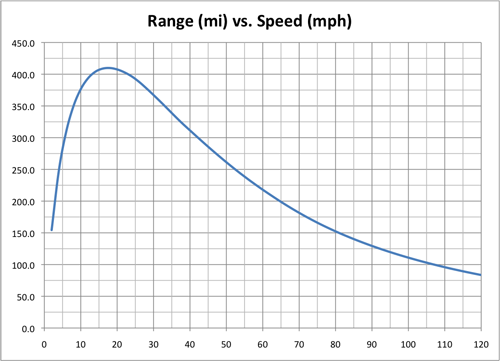
EVs are also have a much more graceful "running out" failure mode. By slowing down if they realize they're in trouble, an EV driver can vastly increase their range - potentially up to 3x, if you drop all the way down to ~25mph. This isn't the case with gasoline cars; they can slow down to the bottom RPM range of their top gear, but that only offers a limited improvement; slowing down further means switching gears, and the higher RPM / lower torque conditions decrease engine efficiency more than you gain by reduced aerodynamic drag.
But most importantly, it's all a moot point, as there's already a broad supercharging network, with stations regularly spaced among almost every major interstate in the US, and similarly in other parts of the developed world. Long-distance travel is the only place you need superchargers, and you use interstates for that.
-
Re: Most people need something better
Keep in mind that the 215 mile range is under good conditions - new batteries, temperate climate, good roads with little traffic. A windy road during real winter will see nowhere near this range, nor will a car with some mileage on the batteries.
Partially true, partially not.
1) Battery age: This is correct. Battery range declines with time. Tesla warranties their packs for 75% of the initial range, for 8 years and unlimited km.
2) Temperate climate: This is mostly correct - but it can go either way. Tesla's range calculator shows, for example, that the P75D (EPA range 259mi) at 65mph does:
0F, heat on: 211mi
32F, heat on: 233mi
50F, heat on: 253mi
50F, heat off: 267mi
70F, AC off: 275mi
90F, AC off: 279mi
90F, AC on: 260mi
110F, AC on: 246mi3) Traffic: It depends entirely on the type of traffic. While gasoline vehicles perform best at the lowest speed they can manage in their highest gear, EV optimum speeds are far lower, often in the ballpark of 20 mph, where their ranges can exceed their EPA ranges several times over. For example, the above P75D (EPA range 259mi) has the following speed-range depenency (70, no heat/AC)
Sub-45 mph: Not included in the calculator
45mph: 404mi
50mph: 367mi
55mph: 334mi
60mph: 303mi
65mph: 275mi
70mph: 250mi
Over 70mph: Not included in the calculatorSteady-moving traffic that simply slows down travel speeds actually increases EV range, potentially significantly. However, braking in traffic that strongly fluctuates between speeds wastes energy - Li-ion EV regenerative braking is generally 50-75% efficient round-trip (hybrids, with their small NiMH packs, generally are much less efficient round-trip, around 30%). In general, low speeds advantages win out over braking disadvantages, which is why EVs generally do much better in city driving than highway driving - the opposite of gasoline vehicles.
A key detail most people miss over when talking about traffic: does anyone realize how long of a drive you're talking about when you describe using up an entire EV's range in stop-and-go traffic? Say you're talking about an average speed of 15mph for an EV that would have 200 miles range in that conditions. You're talking about spending over thirteen hours in traffic in those conditions. When was the last time you spent over thirteen hours continuously in traffic?
-
Re:Only One Question Matters
The only question that really matters is: What is the charge time? 215 miles is a reasonable enough range; but if you're planning a 250 mile trip, you don't want to have to make an overnight stop! If you can charge the car enough in, say, a 15-minute rest break that it can keep going for another couple of hours, then it's a viable vehicle. If not, it's not.
Not sure why this have been modded up as it's pretty much common knowledge that there is Supercharger Stations about everyone in NA that will charge 80% of your battery under 30min.
And yeah the Model 3 will be compatible with those station.
-
Re: Most people need something better
Nope, it is 215 miles. https://www.tesla.com/en_GB/mo... It is the kilometres that is wrong, should be 346km.
-
Re: Wrong conversion to International System of Un
It's not, but per the Tesla site, the range is 215 miles. Whoever did the conversion just messed up.
-
Re:Dear Tesla
Bad Idea. They will build a factory, steal your secrets
What secrets? Tesla has already opened all their patents for anyone to use.
Elon already has his billions. He is more interested in changing the world than in increasing his pile.
-
turtles all the way down
-
Re:Meanwhile
You mean, like the Tesla Gigafactory?
https://www.tesla.com/gigafact... -
Did someone do the math on this first?
Assume on average a 85 kWh battery pack getting a 50% supercharge. 85 kWh * 0.5 = 42.5 kWh. Real-world charging efficiency is about 80%, so 53.125 kWh is needed to put 42.5 kWh into the car's battery.
Assume 160 W/m^2 commercial panels. PV solar capacity factor in the desert Southwest is about 0.185. That is, over a year, a 100 Watt panel will produce the equivalent of a constant 18.5 Watts. So the 160 W/m^2 panels will produce 160 Watts * 0.185 = 29.6 Watts average over 24 hours, or 0.7104 kWh / m^2 in 24 hours.
This means to supercharge a single Telsa S requires 53.125 kWh / 0.7104 kWh/m^2 = 74.78 m^2 of solar panels.
Oh wait, you're gonna store that solar energy in a battery first? That's going to introduce more charging and discharge losses. If you figure 90% for both, that's 74.78 m^2 / (0.9*0.9) = 92.32 m^2 of solar panels needed for every car you want to supercharge that day.
How busy is a Supercharger station? Summary says 6-20 stalls per station, so say 13 average. Figure they're half occupied during day hours, empty at night. At 30 minutes to charge, that's 2 per hour per bay, or (6.5 bays occupied)*(2 vehicles per bay per hour)*(12 hours) = 156 vehicles charged per day.
So to generate enough electricity to supercharge those 156 vehicles requires (156 vehicles)*(92.32 m^2/vehicle) = 14,401 m^2 of solar panels per Supercharger station. Or approx 120m x 120m of solar panels. Or put another way, the average home solar installation is about 30 m^2. So each Supercharger station would need as many panels as 480 homes. -
Re: Three notable gains from this method
For number #2, at least in regards to disposal, Musk is putting quite a bit of thought into that. To quote, "At Tesla we have been refining our recycling program for year". There is a battery recycling center right next door to the Gigafactory in Nevada. Musk has plans in the works to "close the loop" on his batteries. Even now, "The EPA estimates that over 90 percent of lead-acid batteries are recycled, and a typical battery contains 60-80 percent recycled materials."
I would assume that if the EU mandates feeding excess back into the grid, Musk will probably just add more batteries so there is actually no "excess". -
Re:Good
> Actually, tax money gets spent and goes back into the economy
> to pay somebody else's salary, who then spends money. -- quite
> the opposite of sucking money out of the economy.It would get put into either the pockets of bigwigs at outfits like Solyndra http://fortune.com/2015/08/27/... or into the pockets of rich people who can afford to buy an $85,000 Tesla https://www.tesla.com/en_CA/su...
I have bad news for ya, while an 85K Tesla is a fairly expensive car, you don't have to be rich to afford one. And if you think the people who are buying Teslas are rich, (And undoubtedly some of them are), you have no clue as to what rich/upper class really means. They're generally at the upper end of what used to be known as the middle-class. Welcome to working class, it may not be blue collar, but the shoe still fits.
- Top 5% $214,462 --22.1% share of total household income
- Top 1% $465,626 --35.6% share of total household income
And when it median wealth, guess where the US is, # 26.
-
Re:Would have nothing to do with electric cars...
Any same, intelligent human would prefer electric cars to what we have now.
Because burning natural gas and coal to produce power, transmit it over wires (losing about 10% on the way), charge a battery (losing at least another 8%), and then discharge the battery, is better than burning oil on the spot?
Ah, yes, the cars' engines aren't very efficient — true. But the powerplants also aren't very good — losing about 65% right there at generation. Add to that the listed transmission, distribution, and transition losses, and electric cars become a questionable proposition. One a sane, intelligent human (rather than an arrogant idiot pretending) may very well reject...
-
Re:Good
> Actually, tax money gets spent and goes back into the economy
> to pay somebody else's salary, who then spends money. -- quite
> the opposite of sucking money out of the economy.It would get put into either the pockets of bigwigs at outfits like Solyndra http://fortune.com/2015/08/27/... or into the pockets of rich people who can afford to buy an $85,000 Tesla https://www.tesla.com/en_CA/su...
-
Re:Some perspective for our non US members...
FOR YOU maybe.
Do you do cross country driving everyday? No? Then it's an edge case relative to everyday driving.
A lot of people do long drives regularly.
And congratulations, today's charging infrastructure plus 215-300mi EVs lets you do precisely that.
. Many more want to have the option without building their entire plan around charger locations
For the last bloody time, You Don't Have To Do That. They're located at regular intervals on every interstate except for a small, soon-to-be-remedied patch of one, and the vehicle knows where they all are and what's there.
If I can't charge while I eat,
Also for the last bloody time, you can. You can even pick out your restaurant from hundreds of miles away.
Also, after following your oft repeated suggestion to just google it, I found that a lot of these chargers along the interstates are at hotels.
Without being able to see your screen, that's either a Google fail or a reading fail.
Here is the Tesla supercharger map. Note. That is just Tesla superchargers, not all Tesla chargers, let alone all chargers period. Of the Tesla superchargers, most are either at shopping centres, restaurants, or travel stops. Some are at hotels, but a significant minority. All of these are public chargers - every last thing on that map. And they're as close to the interstates as gas stations are. I assume you know how to use the zoom button? Why on Earth didn't you use it and answer your own question?
And seriously, you honestly wrote that many posts about there not being enough chargers without having ever bothered to see how many chargers there actually are? What the hell is wrong with you?
This conversation ends here. I have no interest in debating with someone who is going to write half a dozen adamant posts about something before they actually even attempt to look it up for the first time.
-
Re: Some perspective for our non US members...
Why "don't think that..."? Use the map. Just because you've never bothered to consult a map of where they are doesn't mean that they don't exist.
You didn't list what state you're in, but the only state in the US that doesn't have any Tesla chargers is Alaska... and given that a lot of towns in Alaska don't even have roads to them and the population density is tiny, that's no shock. Of other states, North Dakota is probably the most deprived has no "superchargers", only two "destination chargers"; I-94 as it passes through North Dakota is the last sizeable chunk of US interstate to be upgraded, but it's next on the list. After North Dakota, the lowest number of superchargers per state is Rhode Island and Delaware (1) followed by Maine (2). They're all arranged along interstates, which is where you actually need them - an about 100 mi / 150 km apart, less in densely populated areas.
-
Re:Some perspective for our non US members...
Where are these chargers?
Please tell me you know how to use Google. They're every ~100mi / 150km on almost every interstate in the US (more in more densely populated areas), and this is before the big planned expansion.
Now, I have to hope that anywhere along my route offers charging AND that they serve food
Where do you think that chargers are - in the middle of the woods? They're at highway exits, the same sorts of places you find gas stations and restaurants. Generally in the larger cities along the route, where such cities are present.
Click on any charger on the above map. It'll tell you what restaurants (and other things) are around the charger.
The infrastructure is not ready. Period.
Learn to use Google. Period.
Unless you're looking for a vehicle for, say, a trip deep into Canyonlands or the like, it's not a problem. If you're a normal human being who takes interstates to near their destination and then travels less than a couple hundred kilometers off of their turnoff to their destination, there is no problem.
-
Re:Not bad
And people talk about storage. Where is all this storage?
Right here. Also here. Off the shelf products you can buy today, if you're a commercial customer with fairly deep pockets. They're expensive, relatively speaking, but they're not theoretical. Total cost of ownership is no worse than a large scale diesel generator with a large on site tank, and the permitting and construction process is much easier. No EPA crap to deal with, since there's no big tank of flammable fluid with a limited tank life involved.
Those electrical storage systems are being sold and installed all over the world. Walmart is a customer. Dozens of grid providers are customers. They're immediately useful to grid operators today, even those who don't have one iota of intermittent power generation connected. They're used to provide load balancing that's even faster than natural gas turbines to respond to changes in demand.
-
Re:Electric cars are as clean as the electricity u
No charger is 99% efficient. You have losses in the switching circuitry, battery management and safety circuits, motor controller pass through, the batteries themselves, etc. This user group forum reports real world situations where the efficiency is as low as 54%. Line losses matter because the whole reason for this thread on EV in the first place is about lowering pollution CO2, which is dependent on line losses. If you read my original link, you will find in India today (well a couple of years ago when the study was done but basically same as today) that electric vehicles pollute more co2 than gas ones due to the reasons I've listed.
When the electric motor has applied power, but the output rotaton is zero, efficiently is by definition zero. Thus all powered motors of any kind have zero efficiency at stall. Here is an example of a engineering document explaining how basic electric motor formulas work. Though these are for smaller motors used in machinery, they are basically the same/similar for all types of electric motors used in cars of all kinds.
I have a masters in mechanical engineering and have designed systems that include electric motors for 10 years. -
Re:Driverless
It will be a sad world if people ever have to rely on Uber and Lyft to get from place to place.
I suspect that you are older than a Millenial and do not live in a dense urban area. (Personally, I'm older than a Millenial, I don't live in a dense area, and I very much treasure owning my own car.)
When I was a teen I was just counting the days until I got a permit to be able to drive a car; now Millenials are increasingly not bothering to get driver's license and insurance, and taking bus/Uber/Lyft when they want to go somewhere.
And there are people who live in dense urban areas who would find it a hassle to park a car, and prefer not to own a car there. More, there are cities that are actively trying to reduce the number of cars on their roads.
Tesla has not demonstrated that the sensors they are shipping will be able to handle all cases.
Okay, we get it, you're skeptical of the full self-driving features.
Will they be aimed low enough to stop to allow a rabbit to cross the road safely or are we just running over animals now? Will they scan the contour of the road so they can drive properly through ice ruts or around deep potholes? I didn't think they had that kind of tech yet.
Frankly I don't know the answers to these questions, but if Tesla thinks their current sensor tech is sufficient for full self-driving, my guess is they have at least thought of each of these things.
My guess, and it is just a guess, is that the ultrasonic sensors would be used to watch for ice ruts and potholes; that the testing program has already included people driving the test cars on roads with ice ruts and potholes; and the forward radar would likely do a better job of spotting a rabbit than a tired human at night. I don't think anyone is claiming that the self-driving features would completely eliminate all road kills, but equally I doubt self-driving cars will be worse than humans.
https://www.tesla.com/blog/upgrading-autopilot-seeing-world-radar
https://www.tesla.com/blog/all-tesla-cars-being-produced-now-have-full-self-driving-hardware
-
Re:Driverless
It will be a sad world if people ever have to rely on Uber and Lyft to get from place to place.
I suspect that you are older than a Millenial and do not live in a dense urban area. (Personally, I'm older than a Millenial, I don't live in a dense area, and I very much treasure owning my own car.)
When I was a teen I was just counting the days until I got a permit to be able to drive a car; now Millenials are increasingly not bothering to get driver's license and insurance, and taking bus/Uber/Lyft when they want to go somewhere.
And there are people who live in dense urban areas who would find it a hassle to park a car, and prefer not to own a car there. More, there are cities that are actively trying to reduce the number of cars on their roads.
Tesla has not demonstrated that the sensors they are shipping will be able to handle all cases.
Okay, we get it, you're skeptical of the full self-driving features.
Will they be aimed low enough to stop to allow a rabbit to cross the road safely or are we just running over animals now? Will they scan the contour of the road so they can drive properly through ice ruts or around deep potholes? I didn't think they had that kind of tech yet.
Frankly I don't know the answers to these questions, but if Tesla thinks their current sensor tech is sufficient for full self-driving, my guess is they have at least thought of each of these things.
My guess, and it is just a guess, is that the ultrasonic sensors would be used to watch for ice ruts and potholes; that the testing program has already included people driving the test cars on roads with ice ruts and potholes; and the forward radar would likely do a better job of spotting a rabbit than a tired human at night. I don't think anyone is claiming that the self-driving features would completely eliminate all road kills, but equally I doubt self-driving cars will be worse than humans.
https://www.tesla.com/blog/upgrading-autopilot-seeing-world-radar
https://www.tesla.com/blog/all-tesla-cars-being-produced-now-have-full-self-driving-hardware
-
Re:American problem is American
I hear you brother, me too. I'm seriously thinking I can swing a $35,000 car though. Like this:
https://www.tesla.com/model3I started thinking about it because I'm getting solar panels installed soon, along with a Power Wall and I figured, hell, maybe I can also avoid buying gas, and all I probably need to do is add another panel to my solar system. No more stinky dinosaur juice for me!
-
Re:Tesla will flourish if complexity is reduced...
Nope.
The bolt will ONLY accept 40 KWH at a DC fast charger. As such, it will do 90 miles in the first hours, about 120 in the first 90 minutes, but then slows down. In fact, the fastest that I could find anybody had charged a bolt at, was from 20 miles left, it took 2 hours and 35 minutes. Keep in mind that as it fills up, the fill rate will slow way down. That is why they all speak about the first 30 minutes on the bolt, and the first 45 minutes on the tesla.
Secondly, McD will NOT be putting in fast chargers for ANYBODY. However, Places are installing level 2s. Now, Tesla offers their level 2 device for free to any company that pays to install it AND offers up free service (even if limited to their customers).
So how many do they have? As it is, Tesla has over 3000 destination chargers JUST IN THE US along with around 350 SuperChargers. Note that by end of year, Tesla expects to double their super charger count.
Even in Europe, they just started doing destination chargers this last year and they are over 1000 of them.
Now, it is interesting that you mention about the Superchargers being so far from your house. These are NOT meant for daily charging. You are supposed to do your daily charging at your home in the middle of the night. By doing 80% of the charging in the middle of the night, then we do not have an issue with the grid or poer plants. In fact, it will LOWER the costs of electricity. It is hybrids and leaf owners that charge in the daytime on a constant basis that are going to screw all of us.
The superchargers were developed for LONG DISTANCE driving. These were not meant for daily re-fuels the way some of the nutjobs have been doing. In fact, if you look at the price that Tesla now charges the new teslas using the SCs, the price is always MORE than the nighttime prices. Some of that is due to eletric company charging more for daytime, but Tesla designed it this way purposely to discourage daytime charging.
Now, the current Tesla Super Chargers can add 149 KWH to certain tesla's. The older one like we have, only accepts 120, or possibly only 90. BUT, Tesla has a NEW supercharger coming that will do well above 350 KW, and I have heard around 500-600 KW. That means that the average Model 3 with a 50 KWH battery will FULLY charge in less than 10 minutes (slows down towards the end), but can charge to 80% in just 3 minutes. Obviously, Tesla will likely charge a high price for that re-fill. Still, it will be less than $1.00 / gal of gas equivalence. -
Re:Driverless
How do you know what equipment is adequate for self-driving, when no self-driving cars have actually been made?
Are you serious?
Tesla has been testing experimental self-driving cars for years now. The Tesla "Autopilot" is a limited self-driving system that actual customers are using on actual roads, right now; and Tesla has been working on full self-driving features even though a fully autonomous car isn't legal yet.
Watch the demo video on this page: https://www.tesla.com/autopilot What's neat is that they also show feeds from three of the car's cameras, augmented with annotations from the computer vision system showing what the car is tracking in its environment. Note how the human keeps his hands off the wheel. Note how the car slows when unexpected pedestrians pop up at one point. Also note how, after the human leaves, the car parks itself.
Unless you are going to argue that the above video was faked, then clearly self-driving cars have actually been made.
-
Re:Nothing says...
Nothing says long haul trucking like a vehicle with a 200 mile range and a 6 hour recharge time.
I guarantee you that this thing is going to have a fast-swap battery pack.
The Model S already has a battery pack that can be swapped in about 90 seconds by a computer-controlled machine. It turned out that very few Model S owners wanted to pay for the fast battery swap service; the Supercharger service is adequate to most people's needs. (By the way, the Supercharger is much faster than your suggested 6 hours of charge time, for existing cars at least.)
So if range and charging time is an issue, companies will have the option of buying extra batteries and setting up battery-swap hubs at key locations on long haul routes. Or Tesla will do it like they tried for the Model S.
And hey what do you know, Tesla is investing heavily in a battery "gigafactory" and is going to bring the cost of batteries down as much as possible, as soon as possible.
So your joke was amusing but you have not actually identified a real problem. It's almost like Tesla knows what it's doing.
-
Re:Driverless
It has to have the capacity for a driverless upgrade out of the gate
Please note that Tesla is now building every new car (Model S, Model 3, and Model X) with full self-driving hardware. This includes 8 cameras, 12 ultrasonic sensors, a forward-facing radar, and computers adequate for self-driving (they claim 40x more processing power than the previous "Autopilot" computers). In the future, every Tesla car sold this year could be software-upgraded to full self-driving.
So, call me crazy, but I think Tesla might have thought of your point and is probably on top of it.
-
Re:Madoff is small time compared to Musk
What the fuck do rare-earth metals have to do with Tesla? Their current model (Model S) uses no rare-earth metals at all.
From https://forums.tesla.com/forum...
Tesla does not use rare earth metals in our battery or motor. Typically, rare earth metals apply to DC motors, which use magnets. One of the reasons we use an AC induction motor is it does not require magnets, which often contain the rare earth metals.
-
The Leaf is a niche vehicle
I've owned two Leafs. They are great cars, and you don't realize how great until you live with one.
I've driven one a fair bit and my brother-in-law owns one so I've spent enough time behind the wheel to get a good opinion. It's fine but all the stuff you are talking about as good features (which I don't dispute) are second order considerations. It has crap range and therefore it's mass market appeal is going to be limited. I'd buy a Chevy Bolt over a Leaf without question for the range alone. It also is a rather ugly vehicle from the outside. Most people don't care how nice the interior is if it doesn't get them where they need to go. They also won't buy it if they think it looks hideous. It mystifies me why so many EV makers insist on making intentionally ugly hatchbacks.
The Leaf is fine if your needs for a vehicle are decidedly limited and you don't car how it looks and you have access to a second car. But it isn't a great car in any general sense of the term. Double the range and it might become worth considering.
The range is absolutely fine for most people most of the time.
Most people don't want a vehicle that is fine "most of the time". Most want a vehicle that is fine ALL of the time. I exceed the range of a Leaf at least 4 times per month and sometimes more often. I seldom exceed the range of a Tesla or even a Chevy Bolt. The number of people willing to live with a 100 mile range is not a huge number.
And most people have access to more than one car - via a partner or family member.
So to buy a Leaf you have to periodically sponge off of someone else with a gas powered vehicle or own two cars. Fine if you have lots of money and forgiving friends but not a situation I want to be in personally. If I buy an EV it will have enough range that it is rarely going to be a problem. That means >200 miles minimum. I should be able to drive from Detroit to Cleveland without stopping. $30K+ for a vehicle that cannot do that is a rather stupid waste of money in my estimation.
The M3 will be fully self driving in time, just like the Model S and X.
Neither the Model S or Model X are self driving in any general sense of the term. Not yet anyway. No production car is. Presumably you are talking about autopilot which is the basis for what Tesla hopes will be full self driving features in the future. They have the hardware and some nifty features for some limited circumstances but that's not the same thing as being a self driving car.
-
Re: Positive
Tesla already does this. Ludicrous mode is a software enabled option (albeit only on certain models), and some battery packs are "crippled" unless you pay to unlock the better mode.
-
Patents
Ford has patents, but not many that matter.
Hah! And next you are going to tell me that you've actually looked when I know you haven't.
Tesla has crucial patents in self-driving tech, navigation, electric engines, and battery tech.
Which they've made available to everyone. Here's a little clue for you. Ford has crucial patents as well and a lot more of them than Tesla.
-
Present value future free cash flow
You obviously have no concept of the present value of future revenue.
The value of a company isn't the present value of future revenue. It is the present value of future free cash flows. Profits matter, not revenue. You can generate tons of revenue selling $2 bills for $1 but you'll be out of business faster than you can say "chapter 7 bankruptcy". You might want to study up...
Do you even understand that Tesla is more than just cars?
Of course. Do you understand that they haven't yet turned a profit on any of it? Do you understand that if their auto business fails, Tesla likely goes bankrupt? I understand the company well and have actually done the research as opposed to just being a fanboi. It's a very interesting company with good prospects but that doesn't mean that it's a good investment at the current price.
Do you realize the sheer value of the patents and IP that they own, and the threat that this presents to the status quo?
Tesla has made their patents open to their competition and the value of their IP is no more (less actually) than that owned by a lot of other car companies. I assure you that Toyota, GM, Ford and the rest are loaded to the gills with patents including a substantial number relating to electric vehicles.
Smart people understand it may be worth a small premium now to ensure that years from now you will not be kicking yourself in the ass wishing you'd gotten in from now even if the price was a little steep.
That's the same story you hear every time you have a bunch of people trying to justify an over inflated stock price. It never lasts. Tesla sooner or later will have a stock price that more closely matches the real prospects of the company. Saying a stock is over priced is not the same thing as saying it is a bad company. There is a strong chance that Tesla will turn into a profitable and large enterprise. That doesn't mean that the current asking price is a sensible one given the risk involved.
-
Re:Teslas doesn't make cars, they make bullshit
The Roadster was promised at $100k
No, base price was supposed to be $89,000
From Musk's blog post of Aug 2nd, 2006; the Secret Tesla Motors Master Plan - https://www.tesla.com/en_CA/bl...
"Without giving away too much, I can say that the second model will be a sporty four door family car at roughly half the $89k price point of the Tesla Roadster and the third model will be even more affordable" -
Not an engineer. Maybe a snowflake?
Four things, let's see
- Ignoring her complaints of “pervasive harassment”.
The article has specifics later: "harassment by men on the factory floor including but not limited to inappropriate language, whistling, and catcalls".
Not nice, but not wholly unexpected either. It's a factory floor, and all of her earlier positions were office jobs. The factory floor is not a place for special snowflakes - male or female.
- Paying her a lower salary than men doing the same work.
Not all people with the same job earn the same. Salary depends on various factors. It may depend on how good they are at the job. It may depend on whether they ask for a raise. It may depend on other factors, for example, on whether one is *actually* an engineer. She transferred in from sales and out to purchasing.. Her education isn't public, but with that work history, there is zero chance that she holds an engineering degree.
- Promoting less qualified men over her
Um, "qualified"? She lack an education to hold the position of Manufacturing Engineer, although Tesla normally demands that for their manufacturing engineers. She certainly has none of the work experience you would expect. Even then, a promotion depends on how well you do your job, how well you get along with your co-workers, and - most importantly - how well suited you are for the new responsibilities that the promotion would entail.
- Retaliating against her for raising concerns.
The bit of research above tends to point to Tesla trying too hard: they took a non-engineer and put her into a technical position that she was unqualified for. She failed, was moved to purchasing, and is now insulted. At least, that's sure what it looks like based on public information.
-
Re:Cheaper?
Can I just call up Tesla and GM to buy them at that price, or do I go through a reseller? Or is that the bottleneck for the price (a 500% markup seems excessive, though... especially for such a large bulk purchase). Let me know, please! I'm 100% serious here.
You can go to Tesla's website and order the Powerwall 2 with a credit card[1] on the spot, then dismount it from your wall after it's installed and stuff it into your RV. GM does not resell batteries in any form. Powerwall 2 is 39 cents per watt hour, not the 19 cents per watt hour they pay wholesale, but still, it's only a 100% markup, rather than 500%.
I've been told that it's cheaper to buy naked cells, though I don't know anywhere else you can get Panasonic cells for 39 cents per watt hour and you would lose Tesla's sophisticated power pack cooling, charging, and discharging hardware and software. (Liquid cooling is integrated.) I presume you don't intend to use the batteries for motive power, in which case a Powerwall 2 is just what you need. You might even be able to get the electrician to install it directly into your RV for you.
It's more than double the capacity you were planning on, but it's a turnkey solution. I hear modern RVs all have 120V appliances now, so it's literally a drop-in installation, though exactly what gets wired where might be a little complex if you have a fueled generator as well as the external power connection. The electrician would remove the existing inverter, since the Powerwall 2 has its own. It's 44" x 29" x 5.5" and is designed to be installed vertically. A horizontal installation might work, but might void the 10 year warranty (And might not. You'd have to ask). It can peak at nearly 60 amps output and sustain 40 amps, so it should have no trouble starting up and running the typical RV air conditioning system without letting the voltage sag to anything electronic, even without external power. It's beefier than the typical RV battery system, which tends to top out at 30 amps.
----
[1] And holy crap, how did Slashdot not notice that change? There's a Powerwall 2 now (a nice clean rectangle, instead of the goofy truncated oval thing) and it's 14 kWh for $5500, with trivial credit card ordering, instead of having to call them. Much friendlier than the old way.