Slashdot Mirror
Domain: theatlantic.com
Stories and comments across the archive that link to theatlantic.com.
Comments · 2,178
-
Re:fp
It's a religious viewpoint fueled by memories of colonizing North America, conveniently overlooking dozens of engineering impossibilities, and a religious foundation of sci-fi ideologies that are very attractive to a large percentage of Asperger's programmer types. They are also very often misanthropic, depressed doomsday cultists.
You'll rarely hear about colonizing Mars from real engineers, they know it's not possible. But from programmers? They think all technology just consists of sitting on your ass and typing at a keyboard:
#include warpdrive.h
#include 3d-printer-replicator.hThey vastly oversimplify the complexity of space, reduce dangers, and invent all kinds of fantasy scenarios to justify their beliefs, aka a religion.
www.distancetomars.com
http://physics.ucsd.edu/do-the...
http://physics.ucsd.edu/do-the...
http://www.centauri-dreams.org...
http://www.economist.com/blogs...
http://www.thespacereview.com/...
http://www.theatlantic.com/tec... -
Re:Begging the question...
empirical evidence
The US up until FDR qualifies, in my not so humble opinion.
If look at the most successful societies, like the Scandinavian countries
You are begging the question yourself... Are they "successful"?
For example, they can not defend themselves from Russia — not without NATO (American) help...
-
The "optics" of helping enemies are better?
Twitter made the decision because the company did not like the "optics" of appearing too close to U.S. spy agencies
So, ISIS using Twitter is tolerable, but US government — no, that's just wrong?
Ah, well, they started to go after "violent extremism" too now, finally. The "optics" must've gotten really bad...
Unfortunately, they don't distinguish between terrorists and, for example, Ukrainians defending their country.
-
Re: Stupid people punishing smart people
in the US our education system is horribly underfunded and under supported
The underfunded part is not actually true though. US ranks 5th in spending compared to other countries! http://www.theatlantic.com/edu...
-
Re:Redlining...
My memory is fuzzy but I think some people call this concept free market capitalism.
It's called redlining in the financial industry, where banks don't open branch offices in poorer neighborhoods and those residents pay outrageous interest charges to payday lenders because they don't have access to basic banking services. Bernie Sanders had proposed letting the postal service offer basic banking services to all Americans. Something that the post office used to do a long time ago.
In fact, Sanders's idea is quite sensible. "Postal banking"—which just means that post offices run savings accounts, cash checks, and perform other basic financial services—is common in most of Asia and Europe, and only about 7 percent of the world's national postal systems don't offer some bank-like services. Postal banking is a really good way to reach people who haven't had access to standard savings accounts. One estimate figures that more than 1 billion people have used post offices for making deposits.
-
Re:"even fewer jobs"?
Labor participation rate is the lowest in the past 30 years.
That is correct. However, it is irrelevant. I didn't claim the economy was rosy or that labor participation rates were good, I said that the statement that the number of jobs has decreased is wrong. That is, even with the decrease in labor participation rates, we still don't have "fewer jobs".
Having said that... if you do want to talk about labor participation rates:
The only reason the total number of jobs have risen is due to population growth. That doesn't help.
Much of the fall of labor participation rates in the US is simply due to demographics: people are getting older. Another contributing factor is a large drop among young age groups; the latter is due to in large part due to longer education, and in smaller part to pricing entry-level workers out of the market. Labor force participation rates among older workers are actually up.
Pricing young workers out of the market and redirecting them into college is deliberate progressive policy, and it's a lousy idea. But it's a lousy idea that's not caused by automation.
You assume infinite demand. Jobs exist to service demand.
Of course, I do, because it's true.
But clearly any single individual cannot use infinite resources, even if it's available to them.
Even if this line of reasoning were valid, that particular reasoning is false. In order for demand to exceed the supply of labor, it's sufficient for every person to want more than the equivalent of one person working for them.
You assume all jobs can be done by all people. This is clearly false.
Not at all. Almost everybody can do many jobs that are useful that require nearly no skills: dish washing, cleaning, weeding, clearing rocks, security, maid service, delivery, giving people rides, caring for the elderly, caring for the sick, dog sitting, manual harvesting of fruit, manual crafts; even the disabled usually can do something useful that requires little skill: proofreading, marketing, phone answering, Mechanical Turk, etc. Furthermore, when you automate existing jobs, you get both more resources and more demand for paying for such jobs.
What keeps people from working is not a lack of demand, it's price fixing (including regulation) and welfare. That is, government price fixing keeps labor costs artificially high (through regulations and minimum wages). It also keeps the cost of living artificially high (through standards, zoning, regulation). And if welfare pays more than someone could earn through work, they will obviously choose not to work.
The last point is particularly worth pointing out. In Singapore (lower household income than the US), maybe 10% of households have full-time maids, an arrangement that makes sense in particular for elderly and busy professionals; a typical maid gets $900/month plus free food and housing. In the US, you need to double or triple that salary, deal with a mountain of paperwork, and I don't even want to think of the tax and liability consequences of having them live with you in lieu of some salary. Of course, progressives call this an "unalloyed good".
Uber and the gig economy have been trying to liberate some of those jobs again from the clutches of government price fixing, but fear not, government price fixing will somehow prohibit that because there are large groups of voters, in particular among progressives, who prefer policies that prohibit many of their fellow citizens from working, for selfish reasons.
-
Re:Can the US join this time?
-
Re: Subversion of the West
We do seem to have too many people at the bottom who are inherently lazy (all people are lazy to some extent)
If you're an American You're ignorant. Welfare ended in 1996. Unless you're disabled you get no check unless you can PROVE you're looking for work. Oh, were it not for Britain's generous welfare, there would be no Harry Potter.
But you just keep listening to that drug-addled rich hypocrite Rush Limbaugh, fool.
-
Re:Nope - it takes the process quite logically
http://www.theatlantic.com/pol...
http://object.cato.org/sites/c...
Note: You may be surprised to learn that both Milton Freidman and Frederick Hayek endorsed the above plan.
-
wrong link
should've been this one:
http://www.theatlantic.com/hea... -
Re:Bernie Sanders IS a Communist
I have a photograph of myself standing next to the first President Bush. I am not a Republican
Is there a picture of yourself giving a speech at a podium, while President Bush looks at you (admiringly)? Probably, not...
Ok, to rehash. You agree that Communism is evil, that's a relief. You seem to agree, that DSA are Communist enough to taint any member — if he is a member.
But you insist that:
- Sanders is a Democrat.
- Sanders is not a member of Democratic Socialists of America
The first point is not entirely relevant, so I'll just point out, that Sanders is constantly identified as "an Independent" — he is caucusing with Democrats in Senate, but he is not one of them. The usual state/party designation next to his name is (VT, I.).
He is running for a Democratic Party nomination this year, but that's neither here nor there. Ron Paul ran for Republican nomination several times, but he is a Libertarian...
Now, is he a member of DSA? Here is my evidence:
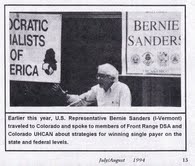
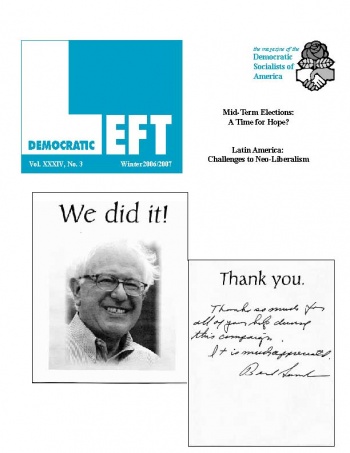
- He gave speeches at their events — more than once. (1991, 1994, 2006.)
- He is referred to as a member by the party's own materials: Bernie Sanders — the independent Maine [sic] Senator and DSA member.
- He thanked them for their helping him in his 2006 Senate race.
- The party's current strategy lists "grassroots work for Bernie Sanders" as its number one priority. And it is not mere words.
- He refers to himself in conversations as a "democratic socialist" (carefully leaving ambiguous, whether that means a political philosophy or a particular party).
- His own site promotes "talks" about both DSA and "democratic socialism".
- He is viewed rather admiringly by the DSA.
With so much evidence, it is way past time he repudiated their support, don't you think? Unless he welcomes it, of course. Far less evidence was ever presented, that Donald Trump was a KKK-member, for example, before angry voices and sneaky interviewers demanded, he "repudiates" that organization. Talk about "intellectual honesty"...
Even if a stubborn juror may insist, the above evidence does not convict Bernie Sanders of being a Communist beyond reasonable doubt, there is certainly enough to rule against him on the slightly lower preponderance of evidence standard. He is a Communist alright...
Lastly, about your (and others') attempts to distinguish between Communism and Socialism... The distinction is without difference — Socialism is merely Communism-lite.
But even if you disagree, who would want a Hugo Chavez — another "Socialist not a Communist" — to become President of their country? Because, other than the late Presidente's anti-Semitism, the Senator's ideas are indistinguishable from his...
-
Re:I'd say
Also reminds me of the Coca-Cola image generator that had a big blacklist of words you couldn't put in the captions. Here the AI is writing the captions, but seems a similar blacklist idea.
-
Re:well, how many does the FBI have?
NSA just buys them all the time on the black market.
FBI could do the same, it wouldn't even be that expensive.Protip: All malware writers are hoarding exploits -- and even selling them on the blackhat market.
-
Well let's do something about it!
I mean, UC Davis trying to wipe their history off the Internet is especially disappointing, considering that University of Calfiornia Davis is an institute of learning.
I'd expect more from UC Davis. The protests were partially in response to tuition hikes in the first place, so where did the money for this come from? Remember the pepper sprayer HIMSELF got $38K in compensation. So add that into the budget.
Oh, UC Davis, how many scholarships could you have created with this money?
-
Re:OR
Yea, it's stunning that they claim the job market is strong. It's anything but. In addition to the folks falling off the roles, there is also the "alternative" workforce jobs. A larger category of “alternative” work has exploded, with contractors and temp workers—like home health aides, truck drivers, and call center workers—who often face unpredictable schedules and lack benefits like health insurance or a retirement package.
Perhaps an even worse development is the tech sweatshop of disposable worker cogs that Silicon Valley is now exporting to the rest of the country. So, yea, you've got a job - as long as you're willing to put the rest of your life on hold and live at the whim of some self-important douchebag pulling in stock options that he'll cash in as soon as your blood and sweat impresses the VCs.
-
Re:Misguided, and dangerous
In the meantime, lets focus on actually getting these minorities the skills and desire to get to the interview in the first place.
You're overlooking the fact that many minorities are overrepresented in low-paying jobs that many white people don't want because their kids are told to go to college and get a high-paying job that doesn't require physical labor.
When it comes to professions with outsized shares of minorities, blacks are overrepresented in community and social-service occupations (as well as barbers and postal-service clerks). Asians make up a large share of computer workers, medical scientists, and personal appearance workers—a category that includes manicurists, makeup artists, and facialists. Hispanics are overrepresented in construction, maintenance, and agriculture work.
http://www.theatlantic.com/business/archive/2015/06/diversity-jobs-professions-america/396632/
-
Re:Screw San Fran
Are you not paying attention? http://www.theatlantic.com/pol...
Did you read the article? The only thing that article says is that Brownback couldn't cut education; it says nothing about educational outcomes. In terms of K-12 educational performance, Kansas does better than California, which has dropped to near the bottom of all states.
As for the fiscal situation, that depends a lot more than on whether the current budget is balanced. The fiscal situation of all US states is negative, the question is whether and what they are doing about it.
As for tax cuts in Kansas, cutting taxes without being able to cut spending is problematic. And while Brownback may have declared his tax cuts as a "real live experiment", the reality is that for tax cuts to have a beneficial effect takes many years, because the way tax cuts increase revenue is by people and businesses relocating (and Kansas isn't very attractive to begin with).
Finally, although I actually looked at The Atlantic article, its articles can generally be safely ignored: they are uninformed and misleading political hit pieces. You need to upgrade your reading.
-
Re:Screw San Fran
Statistically, Kansas does better in terms of educational outcomes and fiscal situation.
Are you not paying attention?
http://www.theatlantic.com/pol...
By "statistically", do you mean over the course of modern history? That's ridiculous and you know it. California is an economic powerhouse. Do you mean over the course of the past five years? That's nonsense and the article cites why.
-
Re:Failed to prevent?
A much higher percentage of State taxi drivers than Uber drivers have drunk driving convictions in the past 10 years of their criminal record. On average, the layperson would call that "Safest drivers on the road".
I'm sure you must have an authoritative source for that claim, and I'd really like to see it, because all I could find was this article saying that those sort of statistics aren't recorded. A background check on an individual will report convictions, searching on convictions won't tell you whether the offender was a driver for either a taxi service or Uber. Note that I'm not accusing you of making this stuff up, and I don't think it's your job to do my research; I'd just like to see the citation if you have it.
-
Re:Feinstein is evil
Maybe it's because Americans don't know what it is like to truly live under a tyrannical rule as we really don't, and while or government does like to test (and break) the limits the Constitution places on them, it does not oppress the people com[pared to what true tyrants and dictators have done in the past. Do you really think your life would get better if you overthrew the US Government?
Sounds like you're not in one of those groups who have been oppressed in the US just like the way tyrants and dictators have done elsewhere. Like black people http://www.theatlantic.com/mag... or Communists https://en.wikipedia.org/wiki/... https://en.wikipedia.org/wiki/... or socialists https://en.wikipedia.org/wiki/...
-
Re:Good
Dunno... let's ask them. 'cause women had little part in producing this cheap-ass, smoke-screen, dog-whistle law (women make up only 22% of the NC legislature, sponsors Dan Bishop and Paul Stam are men, and, of course, the governor is a dick). In fact, this law pre-empts a local Charlotte law that was passed by that city's elected officials... so it looks like all that GOP noise about respectin' the people's will is a load of shite when a state politician sees a tax-free chance to get himself some TV time and name-recognition.
-
Gulag becons for Climate Deniers
they can shoehorn the global warming agenda in under the guise of healthcare
And any disagreement is, of course, offensive , like a slap in the face, and thus equivalent to verbal assault.
Which is still an assault and therefor must be prosecuted — because injustice anywhere is a threat to justice everywhere. In a few easy steps all haters can be sent to Gulag, problem solved.
-
Don't do it
I'm a U.S. citizen. I worked in Canada for a few years. U.S. tax law is crazy. The IRS taxes everything you make regardless of where you make it. Canada tax law is somewhat sane and taxes based on (1) where you earn it, and (2) where you reside (which is why all the Canadians working in the U.S. have to be careful not to spend more than half their time in Canada, lest they become Canadian residents and owe Canadian taxes on their U.S. income).
The net result is double taxation. Canada taxes you because you made the money in Canada and (for the purposes of this story) you're living in Canada. The U.S. taxes you because you're a U.S. citizen. Now, there is a tax treaty between the two countries which lets you take the taxes paid in one country and use it as a tax credit in the other. Since Canadian taxes are higher, you basically pay the Canadian taxes and don't owe U.S. taxes. But the treaty only covers earned income (wages). It doesn't cover unearned income (interest, capital gains, etc). Have an interest-bearing bank account? Double taxed. Sell some of your stock portfolio at a profit? Double taxed. Buy a house, then sell it a few years later at a profit? Double taxed. Get married and have kids who are dual citizens by birth and one of them decides to move back to the U.S. when he's an adult? He'll be double taxed (have to pay U.S.back taxes) on all the unearned income he made while living in Canada from when he was 18 til when he decided to move.
On top of that, you'll experience the joy of having to pay a specialist CPA who is licensed in both countries, because you sure as hell aren't going to be able to figure out how to file your taxes correctly by yourself. I was fortunate to find one who was willing to do it for "only" $500, but my taxes were simple. It's not uncommon for this to cost $1000 or more. (Note: the better employers will help you out with this - either providing a CPA or directing you to one and they'll cover the filing expenses.)
If you're gonna flee to Canada on principle, you're gonna have to go all the way. Apply for Canadian citizenship and renounce your U.S. citizenship. -
Re:The all writs act is probably unconstitutional
That quote was as testified in public.
The statement given was for the creation of a method as in "Take this tool and put it on a hard drive". A harddrive ready tool can then be used on any phone of that generation.
Access was the whole idea, a portable, state and federal ready master key to decrypt any generation of phone before any public state or federal court.
The tool that was going to be created was a master key able to decrypt generations of cell phones.
That was the request was for conscripted software was on a federal computer ie well beyond any quote about a phone.
Apple Is Right: The FBI Wants to Break Into Lots of Phones ( Feb 23, 2016 )
http://www.theatlantic.com/tec...
"Meanwhile, there are a whole lot more devices waiting in the wings, in the hands of state and local law enforcement."
"...it would be much easier for the judges overseeing these other, similar cases to compel Apple to comply."
The federal gov might only feel like be seen requesting help on one phone in public, but the conscripted tool set would open all other phones of that generation. The end result is decryption via a US gov mandated and conscripted masterkey and ensuring junk crypto over an entire product range. A masterkey in the hands offering data access to any generation of phone from an easy to use harddrive tool at a state and federal level. -
Trump's belligerancy is quite mainstream.
I encourage people to listen to what he says, and not just the indignant responses to his campaign rhetoric because it's interesting to hear an 'emperor wears no clothes' candidate as Trump occasionally is. Some of the things Trump says are plain lies, racist, and vulgar—reasons to reject supporting his campaign. But sometimes he tells the truth and gets booed for it (like when he pointed out the Iraq war was based on lies) or describes long-extant US mainstream foreign policy in clear language yet gets unfair flack for it from those who consider themselves a part of the US left (like the call-in to Fox News advocating a war crime). The real horror of his candidacy isn't Trump per se it's that so much of what he says is a plainly-worded description of what's going on and what has been going on for years before Trump's campaign began.
Consider Trump's call-in to which John Oliver provided a remarkably one-sided indignant reaction: On his 2016-02-28 show, John Oliver played a clip of Trump's call-in to Fox News saying "...the other thing with the terrorists, you have to take out their families. When you get these terrorists, you have to take out their families. They care about their lives, don't kid yourself. They say they don't care about their lives, you have to take out their families." and Oliver replied "That is the front runner for the Republican nomination advocating a war crime." which is a true but incomplete and certainly nowhere near as damning as Oliver wants it to be.
Oliver never told his viewers that is also extant US foreign policy wherein President Obama hand-picks whom to assassinate with drones every Tuesday (the so-called "Terror Tuesday" meetings) and that these attacks have extrajudicially killed innocent family members of alleged (never arrested, charged, or tried) so-called "terrorists". Some killed on-purpose (like 16-year-old U.S. citizen Abdulrahman, son of U.S. citizen Anwar al Awlaki who was killed in a separate attack 2 weeks prior), some killed without the U.S. knowing who they are killing as the CIA apparently does with some regularity. This is what Noam Chomsky recently rightly described as "massive global terrorism": drone attacks firing missiles that destroy whatever the missile hits as well as a large area around the target, resulting in indiscriminate extrajudicial murder of innocent passers-by. When Robert Gibbs, former White House press secretary and senior adviser to Obama's reelection campaign commented on Abdulrahman's murder shortly after it happened Gibbs said "I would suggest that you should have a far more responsible father if they are truly concerned about the well being of their children." a line on a par with Trump-level tact and recognition of responsibility.
Or when former NSA and CIA director, General Michael Hayden told Bill Maher "the American armed forces would refuse to act [on Trump's orders on torture and extrajudicial killings]" and Trump says "They won't refuse. They're not going to refuse me, believe me." Trump is right—they won't refuse. The proof has been staring the world in the face for years as Glenn Greenwald pointed out on Democracy Now! on 2016-03-29:
The idea that the U.S. military, in mass, refuses to follow orders if they constitute illegal conduct or war crimes is negated by the entire history of this country, including very recently. You do have isolated members of the armed forces who periodically refuse on grounds of conscience or legal and moral duty. They denounce certain tactics. They resign from the military. They
-
Re:Restaurants
The top median salary for tips is about $15 an hour.... (including hourly wages), so not sure where you get this "quite a bit better than" nonsense.
-
Re:ISIS is winning the propaganda war because...
-
Re:Big Picture
In 1950, only one parent was working versus two parents, so right there your numbers don't take that into account.
Categorically false. With a labor participation rate of 59% in 1950 and 63% in 2014, only 4% more of the population could possibly be working. The increase peaked in 2000 at 67%, an increase of 8%. That means 1 in 12 American families could account as two-income families.
That analysis ignores the rate of marriage. In 2004, 67% of Americans aged 30-39 were married; in 2014, only 56% were married. 7% were unmarried and living with their partner in 2004, and 13% in 2014. That means 9% fewer married, 6% more living together unmarried, and a decline of 3% in cohabitation of couples.
However, all of that is unimportant, because my numbers center around median income levels; and the median is a single-salary $54,400/year. Dual-income households are largely poor people. (I actually work from the mean, which is slightly lower--around $53,000--but close enough).
If a person has a job for $50k and they get laid off and spend a month looking for another job and then make $50K again, the stats will show $50k a year but they are only making $45k a year.
Nope, they use IRS-reported income. You're just making up bullshit now.
When calculating quality of life, I don't really care about 'stuff'. The only stuff that people really need is a house to give them shelter, food, and possibly a vehicle.
If your ability to buy 'stuff' is low, you spend 60% of your income on food, shelter, clothing, and so forth; meanwhile a lot of people who are poorer than you scratch and claw their way to survival.
If your ability to buy 'stuff' is high, you spend 30% of your income on food, shelter, clothing, and so forth; meanwhile a lot of people who are poorer than you feel the pressure, but manage.
Already housing has gone up by your numbers.
People spent 15.8% on shelter in 1950 and 17.7% in 2003, on average, sure. The average house was 983sqft in 1950, and 2,300sqft in 2003. In other words: They spent 16% on 1,000sqft of housing in 1950, and 8.6% per 1,000sqft in 2003. Housing has nudged up to as high as 9.41% per 1,000sqft in 2010, and come down to 9.13% per 1,000sqft in 2011; it continues to fall as we exit the 2004-2007 housing bubble originally created by falling mortgage rates an an excitement to buy.
The other things that matter to me in determining quality of life are: proximity to home, proximity to family
You have more disposable income, so you can buy a house in a nicer area closer to where you want to live. In practice, people spend that extra money buying a house 3 times as big.
available health care
People spend more on health care today than they did in 1950; this is because they are buying more and better care. We've lost a lot of manufacture jobs to China, and have created a *lot* of service jobs to replace them--thanks to the low cost of goods from China and the high amount of remaining consumer buying power after those prices fell. We've taken the money we've saved by buying from China and used it to create a labor shortage in medical care: we have ten times the medical care jobs today compared to 1939. That means instead of 1 doctor per 100,000 people, we have 1 doctor per 10,000 people.
salary
There is only one meaningful measure of income: buying power. How much stuff can your money buy? It doesn't help to have a $90,000/year income if it costs you $6,000/week to feed your family poor-quality grain rice.
job security
Never going to happen. We eliminate jobs when we find a cheaper way to do things.
Karl Marx proposed that the valu
-
Re:Double edged sword
For that matter, you're as likely to be killed by furniture as terrorists.
-
Re:Vote for Trump just to piss off SJWs!
yeah, i saw that emory university thing too, and i wasn't sure how to feel. here's the article i read.
they could have used their own chalk to cross it out. they could have added an endorsement for another candidate. they could have gotten a wet rag and wiped it off. my demographic is often marginalized. i understand completely what it's like to walk down the street knowing that a preponderance of strangers i'll pass are trump supporters who probably believe that my demographic is part of the reason america is going down the tubes.
the fact that they intend to use video surveillance to find the person who put "trump 2016" there and either discipline him according to some campus policy or prosecute him for trespassing depending on whether he's a student or not is horrifying to me. it's fucking sidewalk chalk! wtf is happening here?
i've said i was going to abstain from the general election, but now i'm not sure. those students and the reaction by the university may have motivated me to go out to the ballot box in november and cast a vote for trump.
what this means to me is that we've moved past the internet sjw phenomenon of trying to bully and censor dissenting views. this is the first sign that free speech is actually being dismantled.
if i can add one more thing, the other shocking bit to this whole mess to me is that this marginalized demographic has been voting en masse for a woman that really doesn't give a shit about the issues affecting them, and the candidate who was actually there in the civil rights movement is just an old white guy from vermont.
when the whole world is racist and it's just a question of who's in the majority, maybe it's time that i stop worrying about the issues that affect a demographic that is equally racist and also stupid enough to vote against its own best interest. let me put it this way. i'm not going to call somebody a traitor to their own demographic because they don't support the candidate i think is their best option if civil rights issues are important to them. however, if i'm supporting a candidate that is not in my demographic's best interest, i'd sure as hell want somebody to help me to understand where i may have gone astray!
instead we get censorship. actual. fucking. censorship.
-
Re:Negotiating
"Assuming that women have themselves to blame for the wage gap is an easy conclusion, because it doesn't ask us to think the treatment of women in the workplace. In fact, women show just as much enthusiasm for getting ahead as their male peers. Choices aren't the only thing holding back women's earnings. Bias is happening, too, even if it's uncomfortable to call it out."
-
Re:YouTube - mod this up!
Truer words were never spoken. Just wait until the IoT takes hold, along with distributed AIA (Advanced Artificial Intelligence) all distributed via the Internet. The Internet has turned out be largely a "top-down" broadcasting service controlled by large ISP, large content creators, etc. Of course, they let us have our blogs and our Instagrams and our pathetic little selfie opportunities for fame like Facebook, Pinterest, etc, but the Internet is FAR FAR FAR from the liberating force that it was predicted to be at its outset.
This wasn't always the case; initially, the vig players- i.e. content creators, telecommunications providers, etc. resistedthe Internet, until they discovered human being's penchant for taking control of inter-communications. THAT is when commercial enterprise powers got interested; they have now found endless ways to control the Internet and leverage our wired human propensity for communication for profit.
ESPECIALLY if you are a younger person,
or,
Ted Nelson's early ideas about the promise of the Internet Ted Nelson: "The good news about computers is that they do what you tell them to do. The bad news is that they do what you tell them to do." http://www2.iath.virginia.edu/...
-
Re:Sweden gets what they deserve
Also Assange is not even accused of rape.
http://www.theatlantic.com/int...
Considering the only charge left is rape, how do you get to that assertion?
-
Re:First since 1959? Or first in nearly a century?
Obama is the first sitting US President to visit Cuba since 1928 (Calvin Coolidge). That's 88 years.
-
Re:Suzie can vote. Suzie can get a pitchfork.
We didn't have cell phones in the 1700s.
There's population versus technology, there's people spending less on food and clothes while buying bigger houses, the increase in non-necessity expenditures as a percentage of income, and all kinds of other data showing we actually do increase the number of people in the economy.
You're right, though: The number of people needed to do a job doesn't increase. That's the point: technology *decreases* the number of people required to do a job, freeing their labor time up for other tasks. That's why we've moved people out of agriculture and manufacture and into construction, medicine, retail, and business services. Somebody has to sell those products from China; somebody has to handle the logistics, the distribution, the shipping; somebody has to drive the trucks; somebody has to run the involved IT systems.
Even after we've reduced the share of labor per product in *all* of these types of jobs, we create more jobs by buying more products. You buy 3 times as much shit, you need 3 times as much logistics. Maybe it takes 1/5 as much labor to provide those logistics, so you have 60% as many people doing that; the other 40% are running Spotify and Netflix.
We don't create higher-class jobs; we reduce costs and improve the standard-of-living of the lowest income earners. We may create more or fewer poor people; those poor people will be objectively wealthier than last generation's poor people, but they're still poor because literally everyone else has more than they do. Some of the replacement jobs are higher-income-class, some are lower-income-class, and we wind up with more things produced per wage-labor hour, more stuff per-capita, and more luxuries in the hands of everyone as their basic needs become cheaper.
-
Re:Suzie can vote. Suzie can get a pitchfork.
We didn't have cell phones in the 1700s.
There's population versus technology, there's people spending less on food and clothes while buying bigger houses, the increase in non-necessity expenditures as a percentage of income, and all kinds of other data showing we actually do increase the number of people in the economy.
You're right, though: The number of people needed to do a job doesn't increase. That's the point: technology *decreases* the number of people required to do a job, freeing their labor time up for other tasks. That's why we've moved people out of agriculture and manufacture and into construction, medicine, retail, and business services. Somebody has to sell those products from China; somebody has to handle the logistics, the distribution, the shipping; somebody has to drive the trucks; somebody has to run the involved IT systems.
Even after we've reduced the share of labor per product in *all* of these types of jobs, we create more jobs by buying more products. You buy 3 times as much shit, you need 3 times as much logistics. Maybe it takes 1/5 as much labor to provide those logistics, so you have 60% as many people doing that; the other 40% are running Spotify and Netflix.
We don't create higher-class jobs; we reduce costs and improve the standard-of-living of the lowest income earners. We may create more or fewer poor people; those poor people will be objectively wealthier than last generation's poor people, but they're still poor because literally everyone else has more than they do. Some of the replacement jobs are higher-income-class, some are lower-income-class, and we wind up with more things produced per wage-labor hour, more stuff per-capita, and more luxuries in the hands of everyone as their basic needs become cheaper.
-
Re:Suzie can vote. Suzie can get a pitchfork.
We didn't have cell phones in the 1700s.
There's population versus technology, there's people spending less on food and clothes while buying bigger houses, the increase in non-necessity expenditures as a percentage of income, and all kinds of other data showing we actually do increase the number of people in the economy.
You're right, though: The number of people needed to do a job doesn't increase. That's the point: technology *decreases* the number of people required to do a job, freeing their labor time up for other tasks. That's why we've moved people out of agriculture and manufacture and into construction, medicine, retail, and business services. Somebody has to sell those products from China; somebody has to handle the logistics, the distribution, the shipping; somebody has to drive the trucks; somebody has to run the involved IT systems.
Even after we've reduced the share of labor per product in *all* of these types of jobs, we create more jobs by buying more products. You buy 3 times as much shit, you need 3 times as much logistics. Maybe it takes 1/5 as much labor to provide those logistics, so you have 60% as many people doing that; the other 40% are running Spotify and Netflix.
We don't create higher-class jobs; we reduce costs and improve the standard-of-living of the lowest income earners. We may create more or fewer poor people; those poor people will be objectively wealthier than last generation's poor people, but they're still poor because literally everyone else has more than they do. Some of the replacement jobs are higher-income-class, some are lower-income-class, and we wind up with more things produced per wage-labor hour, more stuff per-capita, and more luxuries in the hands of everyone as their basic needs become cheaper.
-
Amazon did it first!
Amazon did it first for the US government: http://www.theatlantic.com/tec...
-
Re:You know...
Not likely. My system is highly sensitive to wealth: once you've reached a certain level of wealth (which is predicate entirely on technological development--how much stuff can you actually produce per person?), you have enough to go around that tapping it for a basic-needs-level income is cheaper than most simple alternatives. You can compare the cost of welfare versus a competing Dividend against spending in 1950 and spending in 2003. The difference is more staggering when you realize the average 1950 house had 983sqft, and the average 2003 house had 2,300sqft: houses cost less than half as much per square foot in 2003, in terms of percentage of household income. You can see the Dividend I propose would have been a *huge* mistake in 1950: excessive cost and lowered effectiveness would bring economic ruin to the United States.
I'm actually starting to suspect that chart is wrong: food and clothing costs fell versus the average income, and inflation of food and clothing came slower than per-capita GDP growth, meaning that red bar should have started a lot higher than just 24% instead of humming along levelly. I only adjusted my Dividend for inflation, so the red bar assumes food and housing have gotten no cheaper. If I go back and find the appropriate numbers, that chart would look more like a Dividend requires 44% of our AGI in 1950 and 17% in 2013, while Welfare requires 2% in 1950 and 17.2% in 2013.
(If you're wondering: I did some quick math comparing the proportions of spending and used that to adjust the Dividend, then adjusted it proportionally. So food is 30% in 1950 and 13% in 2003? I adjusted the food budget in 2013 by multiplying it by 30/13. Did this for food, clothing, housing (per square foot); divided the result by the 2013 Dividend; and multiplied that proportion by the percentage in 1950. About 2.3 times as much is needed to live in 1950 than 2003; the ratio is probably bigger for 2013, but I'm not going to haggle over a percentage point.)
That means it might work fantastically in Texas, fail in California or Rhode Island, and operate in an unrelated manner on the Federal level. Further, it's an expansion of Social Security, and would require revoking OASDI taxes in that state while still paying half the OASDI benefit--which would break OASDI. Even if the Federal government let you do it, OASDI would become less-solvent if you piloted on a more-affluent state likely to succeed at a state-level Dividend, and more-solvent if you piloted on a less-affluent state likely to fail. If you don't revoke OASDI, you wind up with a tax system that applies some 6% more taxes to the working class while also holding products an additional 6% more costly thanks to payroll taxes; and OASDI stays everywhere else in the country, anyway, so all kinds of shipping, logistics, and other interstate commerce becomes expensive, lowering the buying power of individuals in the state piloting the Dividend.
In other words: it's approximately a guaranteed success at the Federal level, with a graceful failure mode (if it's not a success, it's a flesh wound that makes the country wince a little); it's approximately a guaranteed failure at the State level, with a disastrous failure mode that would probably not only leave everyone in that state much poorer and create a lot more homelessness and hunger, but also take down Social Security's retirement benefits by sheer force of insolvency. The more likely it is to succeed at the State level, the more likely the attempt is to break the rest of the United States.
That doesn't even begin to address logistics like residency: what happens when someone moves into or out of state? I managed to work that out on the National level; it's different on the State level, especially when
-
Re:You know...
Not likely. My system is highly sensitive to wealth: once you've reached a certain level of wealth (which is predicate entirely on technological development--how much stuff can you actually produce per person?), you have enough to go around that tapping it for a basic-needs-level income is cheaper than most simple alternatives. You can compare the cost of welfare versus a competing Dividend against spending in 1950 and spending in 2003. The difference is more staggering when you realize the average 1950 house had 983sqft, and the average 2003 house had 2,300sqft: houses cost less than half as much per square foot in 2003, in terms of percentage of household income. You can see the Dividend I propose would have been a *huge* mistake in 1950: excessive cost and lowered effectiveness would bring economic ruin to the United States.
I'm actually starting to suspect that chart is wrong: food and clothing costs fell versus the average income, and inflation of food and clothing came slower than per-capita GDP growth, meaning that red bar should have started a lot higher than just 24% instead of humming along levelly. I only adjusted my Dividend for inflation, so the red bar assumes food and housing have gotten no cheaper. If I go back and find the appropriate numbers, that chart would look more like a Dividend requires 44% of our AGI in 1950 and 17% in 2013, while Welfare requires 2% in 1950 and 17.2% in 2013.
(If you're wondering: I did some quick math comparing the proportions of spending and used that to adjust the Dividend, then adjusted it proportionally. So food is 30% in 1950 and 13% in 2003? I adjusted the food budget in 2013 by multiplying it by 30/13. Did this for food, clothing, housing (per square foot); divided the result by the 2013 Dividend; and multiplied that proportion by the percentage in 1950. About 2.3 times as much is needed to live in 1950 than 2003; the ratio is probably bigger for 2013, but I'm not going to haggle over a percentage point.)
That means it might work fantastically in Texas, fail in California or Rhode Island, and operate in an unrelated manner on the Federal level. Further, it's an expansion of Social Security, and would require revoking OASDI taxes in that state while still paying half the OASDI benefit--which would break OASDI. Even if the Federal government let you do it, OASDI would become less-solvent if you piloted on a more-affluent state likely to succeed at a state-level Dividend, and more-solvent if you piloted on a less-affluent state likely to fail. If you don't revoke OASDI, you wind up with a tax system that applies some 6% more taxes to the working class while also holding products an additional 6% more costly thanks to payroll taxes; and OASDI stays everywhere else in the country, anyway, so all kinds of shipping, logistics, and other interstate commerce becomes expensive, lowering the buying power of individuals in the state piloting the Dividend.
In other words: it's approximately a guaranteed success at the Federal level, with a graceful failure mode (if it's not a success, it's a flesh wound that makes the country wince a little); it's approximately a guaranteed failure at the State level, with a disastrous failure mode that would probably not only leave everyone in that state much poorer and create a lot more homelessness and hunger, but also take down Social Security's retirement benefits by sheer force of insolvency. The more likely it is to succeed at the State level, the more likely the attempt is to break the rest of the United States.
That doesn't even begin to address logistics like residency: what happens when someone moves into or out of state? I managed to work that out on the National level; it's different on the State level, especially when
-
Re:Yeeeeeahaaaaaw!
You could also look at how consumers spend their money and see trends of less and less on food and clothing; slightly more on housing, but houses are more than twice as big; and more on healthcare and luxuries.
It stands to reason spending less of the average income on the same good means that good has gotten cheaper.
-
Re:Technology continues its rapid advance
I typed up a nice long reply that just vanished because my browser crashed, and Pale Moon doesn't deign to backup form data. So you know what? You're gonna get the reply you deserve. For starters, you're wrong. The SM-3 missile is an ABM missile launchable from US Navy warships, which means we can - and have - posted ABM capability offshore anywhere we can park a destroyer, including, most recently the Med. Secondly, we can put this weaponry in shore installations, like the one we are building right now in Romania, which is pretty much at Russia's doorstep when it comes to them threatening the area with nukes: http://news.usni.org/2015/12/1... Furthermore, it's no longer the 80s. Terminal intercept is a licked problem, as the Army's Terminal High Altitude Air Defense system's track record demonstrates: https://en.wikipedia.org/wiki/... Just in case the continued excellent track record of Iron Dome didn't clue you in. Furthermore, hitting a missile does not make its nuclear payload detonate, as evidenced by multiple Broken Arrow incidents where the conventional plastique in the bomb detonated without causing a nuclear blast.
Anyhow, thanks for revealing your fearful nature.
Maybe I'm just a poor lonely neocon nutcase clinging to my guns and religion, but in a world where China - which has developed extensive CONVENTIONAL ballistic missile weapons - is drawing closer to a seemingly inevitable confrontation with the US: http://www.theatlantic.com/int... and a newly aggressive Russia (currently invading the Ukraine) currently threatening to use their nukes to counter any tactical, conventional defeats: http://news.usni.org/2016/01/2... and sending nuclear-cruise missile armed subs to patrol right off the US East coast, http://www.nytimes.com/2009/08... I think I'm entitled to some moderate level of concern. In fact, you'd have to be a god damned idiot to not feel some concern.
-
Re:Okay, so it makes some Americans feel bad...
Meanwhile, apparently the number of American teens who excel at advanced math has surged... Not to mention, considering algebra and trigonometry "advanced" is just ludicrous.
-
I support the pro-Statistics part
Where this simply a case for statistics. I'd support it... But Algebra underpins it all — there are good arguments for introducing children to Algebra before Arithmetic (Robert Heinlein, actually, floated this idea decades ago).
polynomials and logarithms, and is required by the new Common Core curriculum standards used by 47 states and territories, drives dropouts at both the high school and college levels
Oh, wow — just when America started doing something right about Math, someone wants to mess with it. So, if people drop out because of it, it should be abolished? The logic sounds sort of like that about narcotics — people keep doing it despite efforts to the contrary, so it should become legal. Oh, he only talks about Algebra II — the "complicated" stuff... Well, how elitist of him — what about the poor kids, who fail basic Algebra en masse?
But, hey, how about we abolish the "Common Core" instead and allow the decisions on what to teach be made at the local level — and compare the results? Yes, some schools will be in error, but not all — while national curriculum created in Washington carries the risk of forcing everybody to make a mistake...
-
Re: That is one bad thing about living in Seattle
Seattle has been owned by the Democrats since forever. What do Republicans have to do with it?
Six corporations own 90% of the U.S. media markets. Corporations tend to be conservative rather than liberal.
http://www.businessinsider.com/these-6-corporations-control-90-of-the-media-in-america-2012-6
Even MSNBC is moving away from being a source of liberal news.
-
Re:The Angry Mob
I see that economists in general as well as you tout free trade as self defeating however I haven't seen anything put forward that would advance prosperity in general. Indeed an economist would suggest that increases in productivity bring wealth to all. I agree that increased productivity brings good things but as has been charted many times wealth to all is not one of them. While productivity has increased wages and life in general for employees has not. We've tried free trade and found that the arguments that it will bring increases to all are unfounded while the arguments that it's a race to the bottom seem quite accurate. When I think about the pace of work today vs the 50's that you cited, I'd take the 50's. Your thoughts? sources: http://www.epi.org/publication... http://www.theatlantic.com/bus... for many more Google "wages vs productivity graph"
-
Re:All awful but the bias is interesting
So let's be clear: pretty much all of these situations are completely unacceptable, and most disturbingly they show a tendency for much of these sorts of problems to occur on the left, what essentially amounts to the "illiberal left" http://www.theatlantic.com/politics/archive/2015/01/liberals-and-the-illiberal-left/384988/.
Number 4 involves a student government cutting funding to a student paper. Free speech has never required that others provide you with free money to support your publication.
-
Re:All awful but the bias is interesting
So let's be clear: pretty much all of these situations are completely unacceptable, and most disturbingly they show a tendency for much of these sorts of problems to occur on the left, what essentially amounts to the "illiberal left" http://www.theatlantic.com/politics/archive/2015/01/liberals-and-the-illiberal-left/384988/.
Are they, though? I haven't checked them all, but their number 2 spot regarding Northwestern University and Professor Laura Kipnis actually involves allegations of defamation and retaliation by the professor against a sexual assault victim. Free speech has never included a right to publish libel.
-
Re:All awful but the bias is interesting
So let's be clear: pretty much all of these situations are completely unacceptable, and most disturbingly they show a tendency for much of these sorts of problems to occur on the left, what essentially amounts to the "illiberal left" http://www.theatlantic.com/politics/archive/2015/01/liberals-and-the-illiberal-left/384988/. However, FIRE's own biases are coming into play in this list, in that every example they decide to include is on the left or has no political aspect. But there were a lot of rimilar activities with an apparently right-wing bent, such as the situation at Wheaton College https://www.insidehighered.com/news/2016/01/06/wheaton-illinois-moves-fire-professor-who-wore-hijab. It may be that FIRE's top list is still more of an issue for legitimate reasons because many of these universities are large, public universities and thus engaging in trampling on free speech is even more serious, but it does seem like FIRE's own biases may be having a role in what they've decided to highlight.
However, the general upshot should be clear: trampling on free speech is not ok. And we should support free speech whether or not it is speech we agree with. Universities must be bastions of free expression for them to effectively do their jobs. And groups of all sorts should remember that even if they have power now to censor others, they may not always be the ones in power.
So to be clear, private colleges (not all) *can* and do stifle free speech and are exempt from many parts of Title XIV or free speech restrictions. Thus concentrating on a private school is pretty dopey. Granted if they accept federal funds in any capacity they have to adhere to some part (not that I know them offhand).
When a publicly funded institution violates constitutional laws, it is a much bigger deal as they are AGENTS OF THE STATE. FIRE concentrating on large public institutions makes perfect sense because it affects far more people than private institutions and they shouldn't even be *thinking* of doing stuff like this, yet do anyway. -
All awful but the bias is interesting
So let's be clear: pretty much all of these situations are completely unacceptable, and most disturbingly they show a tendency for much of these sorts of problems to occur on the left, what essentially amounts to the "illiberal left" http://www.theatlantic.com/politics/archive/2015/01/liberals-and-the-illiberal-left/384988/. However, FIRE's own biases are coming into play in this list, in that every example they decide to include is on the left or has no political aspect. But there were a lot of rimilar activities with an apparently right-wing bent, such as the situation at Wheaton College https://www.insidehighered.com/news/2016/01/06/wheaton-illinois-moves-fire-professor-who-wore-hijab. It may be that FIRE's top list is still more of an issue for legitimate reasons because many of these universities are large, public universities and thus engaging in trampling on free speech is even more serious, but it does seem like FIRE's own biases may be having a role in what they've decided to highlight.
However, the general upshot should be clear: trampling on free speech is not ok. And we should support free speech whether or not it is speech we agree with. Universities must be bastions of free expression for them to effectively do their jobs. And groups of all sorts should remember that even if they have power now to censor others, they may not always be the ones in power.