Slashdot Mirror
Domain: theguardian.com
Stories and comments across the archive that link to theguardian.com.
Stories · 1,378
-
Man Arrested After Charging iPhone On London Overground Train
An anonymous reader writes: 45-year-old Robin Lee was arrested after he used a socket on a London Overground train to charge up his iPhone. He was handcuffed and arrested for "abstracting electricity". Robin was then charged with "unacceptable behaviour" after "becoming aggressive" when objecting to his first arrest. The Guardian reports: "Speaking to the Evening Standard, Lee said he had been confronted by a police community support officer on the overground train from Hackney Wick to Camden Road on 10 July. The Overground is part of Transport For London’s wider network that also includes London Underground and the buses. 'She said I’m abstracting electricity. She kept saying it’s a crime. We were just coming into the station and there happened to be about four police officers on the platform. She called to them and said: ‘This guy’s been abstracting electricity, he needs to be arrested’.” -
For £70,000, You Might Be Able to Own an Enigma
In 2007, we mentioned the eBay sale of an Enigma machine; now, The Guardian reports that another one is to be auctioned off next week, with an expected selling price of about £70,000 (at this writing, that's about $108,000). According to the article, "The machine being offered for sale, which dates from 1943 and currently belongs to a European museum, will go under the hammer at Sotheby's in London on Tuesday." The new owner may have need of a restoration manual and some reproduction batteries. -
The Guardian Looks At Hacking Team's Client List, Internal Communications
There are lots of small but interesting news bits to take from the data dump made available by Wikileaks of internal documents from the Italian security firm Hacking Team, such as that a police unit investigating major crimes in Florida, according to some of the leaked emails, was interested in purchasing some of the company's surveillance technology. The Guardian has taken a longer look at the company's business and tactics, and outlines many of their actual and potential clients, in particular their government customers, and skewers Hacking Team's claims "that it does not sell to repressive regimes."
Shades of Blue Coat. -
Study: Women Less Likely To Be Shown Ads For High-paid Jobs On Google
An anonymous reader writes: A team of researchers from Carnegie Mellon University has found that women seeking jobs are less likely to be shown ads on Google for high-paying jobs than men. The researchers created more than 17,000 fake profiles, which were shown roughly 600,000 ads on career-finding websites (abstract). All of the profiles shared the same browsing behavior. "One experiment showed that Google displayed adverts for a career coaching service for '$200k+' executive jobs 1,852 times to the male group and only 318 times to the female group." The article notes, "Google allows users to opt out of behavioral advertising and provides a system to see why users were shown ads and to customize their ad settings. But the study suggests that there is a transparency and overt discrimination issue in the wider advertising landscape." -
ICANN's Plan To End Commercial Website Anonymity Creates Real Problems
An anonymous reader notes that ICANN is closing the comment period for its plan to prevent owners of commercial websites from keeping their personal details out of a site's public-facing registration information. Digital rights groups are taking the opportunity to explain how real harm can result from this decision. The Online Abuse Prevention Initiative posted an open letter to ICANN pointing out the rise of doxing and swatting: "Our concern about doxing is not hypothetical. Randi Harper, a technologist, anti-harassment activist, and founder of the Online Abuse Prevention Initiative, was swatted based on information obtained from the Whois record for her domain. The only reason law enforcement did not draw their weapons and break down Harper’s door was that she had previously warned her local police department about swatting."
Cathy Gellis at Popehat refers to the situation surrounding Charles Carreon, the man who antagonized The Oatmeal (Matthew Inman's webcomic) and issued legal threats to those who called him out. "In that case the critic had selected a domain incorporating Carreon's name in order to best get his point about Carreon's thuggery across, which the First Amendment and federal trademark law allowed him to do. ... Unfortunately, the registrar immediately caved to Carreon's pressure and disclosed the critic's identifying information, thereby eviscerating the privacy protection the critic expected to have, and depended on, for his commentary." -
Theresa May Named UK's Internet Villain of the Year
An anonymous reader writes with news that Theresa May, the UK's Secretary of State for the Home Department, has been named the UK internet industry's villain of the year. She won this dubious honor for pushing the UK's controversial "snooper's charter" legislation, which would require ISPs to retain massive amounts of data regarding their subscribers for no less than a year. May championed the legislation without consulting the internet industry.
Conversely, "The MPs Tom Watson and David Davis were jointly named internet hero for their legal action against the Data Retention and Investigatory Powers Act. 'Surveillance has dominated both the hero and villain shortlists for number of years, and it was felt Davis and Watson were some of the best informed politicians on the subject,' the ISPA said." -
Frank Herbert's Dune, 50 Years On
An anonymous reader writes: This October will be the 50th anniversary of Frank Herbert's massively popular and influential sci-fi novel Dune. The Guardian has written a piece examining its effects on the world at large, and how the book remains relevant even now. Quoting: 'Books read differently as the world reforms itself around them, and the Dune of 2015 has geopolitical echoes that it didn't in 1965, before the oil crisis and 9/11. ... As Paul's destiny becomes clear to him, he begins to have visions 'of fanatic legions following the green and black banner of the Atreides, pillaging and burning across the universe in the name of their prophet Muad'Dib.' If Paul accepts this future, he will be responsible for 'the jihad's bloody swords,' unleashing a nomad war machine that will up-end the corrupt and oppressive rule of the emperor Shaddam IV (good) but will kill untold billions (not so good) in the process. In 2015, the story of a white prophet leading a blue-eyed brown-skinned horde of jihadis against a ruler called Shaddam produces a weird funhouse mirror effect, as if someone has jumbled up recent history and stuck the pieces back together in a different order." -
Bill Gates Investing $2 Billion In Renewables
An anonymous reader writes: Bill Gates has dumped a billion dollars into renewables, and now he's ready to double down. Gates announced he will increase his investment in renewable energy technologies to $2 billion in an attempt to "bend the curve" on limiting climate change. He is focusing on risky investments that favor "breakthrough" technologies because he thinks incremental improvements to existing tech won't be enough to meet energy needs while avoiding a climate catastrophe. He says, "There's no battery technology that's even close to allowing us to take all of our energy from renewables and be able to use battery storage in order to deal not only with the 24-hour cycle but also with long periods of time where it's cloudy and you don't have sun or you don't have wind. Power is about reliability. We need to get something that works reliably." At the same time, Gates rejected calls to divest himself and his charitable foundation of investments in fossil fuel companies. -
Greek Financial Crisis Is an Opportunity For Bitcoin
An anonymous reader writes: Greece's economy has been in trouble for several years, now, and a major vote next weekend will shake it up even further. The country can't pay its debts, and the upcoming referendum will decide whether they face increased austerity measures or start the process of exiting the Euro. One side effect of the crisis is that alternative currencies like Bitcoin suddenly look much more attractive as the "normal" currencies become unstable. "Tony Gallippi, the co-founder of bitcoin payment processor Bitpay, tweeted on Sunday night that he expected the price of bitcoin to rise to between $610 and $1,250 if Greece exits the Euro. The currency is currently worth $250. Part of the reason why the crisis is so tempting for proponents of the cryptocurrency is the echoes of a previous crisis in the Eurozone: the banking collapse in Cyprus in 2013, which saw that nation also impose capital controls to prevent massive outflows of currency from the panicking country. That collapse came at the same time as the first major boom in the price of bitcoin, which began the year at less than $20 and peaked at ten times that by early April – before it all came crashing down." -
FB Reveals Woeful Diversity Numbers
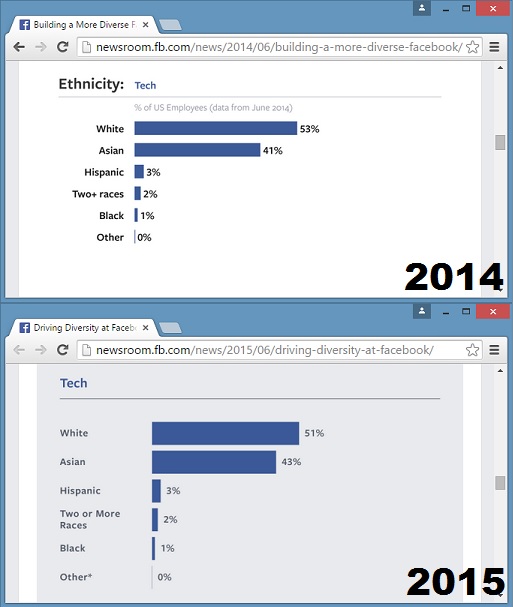
theodp writes: There's more work to do," said Facebook's Global Director of Diversity Maxine Williams, who issued a straight-out-of-How-to-Lie-With-Statistics diversity update on Thursday that essentially consisted of a handful of bar charts labeled with only percentages for select measures of the social networking giant's current demographics. In search of real numbers, the Guardian turned to Facebook's most recent Equal Employment Opportunity report filing, which showed that the ranks of black employees swelled by a grand total of seven (7) (1 woman) in the year covered by the filing, during which time Facebook saw an overall headcount increase of 1,231. Comparing Facebook's new bar charts of US tech employees to those issued last year shows the proportion of Hispanic and Black employees remained flat at 3% and 1% respectively, while a decline in the proportion of white employees from 53% to 51% was offset by an increase in the proportion of Asian employees from 41% to 43%. -
World's First Commercial Jetpack Arrives Next Year
An anonymous reader writes: The good news is that soon, you'll finally be able to buy that jetpack you've always wanted. The bad news is that it'll run you about $150,000. The Martin Jetpack will use fans, rather than rockets, to lift humans weighing up to 120kg (~256 lbs). Its makers say it can reach altitudes of up to 1 kilometer, and fly for up to 30 minutes at a time. The jetpack will be sold commercially to emergency services next year, and then a smaller, personal version will hit the market in 2017. -
France Could Offer Asylum To Assange, Snowden
HughPickens.com writes: The Intercept reports that in the aftermath of the NSA's sweeping surveillance of three French presidents, French Justice Minister Christiane Taubira thinks National Security Agency whistleblower Edward Snowden and WikiLeaks founder Julian Assange might be allowed to settle in France. Taubira was asked about the NSA's surveillance of three French presidents, disclosed by WikiLeaks this week, and called it an "unspeakable practice." Taubira's comments echoed those in an editorial in France's leftist newspaper Libération that France should respond to the U.S.'s "contempt" for its allies by giving Edward Snowden asylum. France would send "a clear and useful message to Washington, by granting this bold whistleblower the asylum to which he is entitled," wrote editor Laurent Joffrin in an angry editorial titled "Un seul geste" — or "A single gesture." (google translate) If Paris offers Snowden asylum, it will be joining several other nations who have done so in the past, including Bolivia, Nicaragua and Venezuela. However, Snowden is still waiting in Moscow to hear from almost two dozen other countries where he has requested asylum. -
Wi-Fi Router's 'Pregnant Women' Setting Sparks Vendor Rivalry In China
colinneagle writes: When one Chinese technology vendor, Qihoo, launched a new Wi-Fi router with a safety setting for "pregnant women," a rival vendor took offense to the implication that their routers might be dangerous. Xiamo, which also sells Wi-Fi routers, took to its page on Chinese social media site Weibo to denounce Qihoo's pregnant women mode as a "marketing tactic," and clarify that "Wi-Fi usage is safe."
Zhou Hongyi, chief executive and president of Qihoo, acknowledged in a statement to the South China Morning Post that there is no evidence supporting claims that Wi-Fi routers pose a risk for birth defects. But he said the company is appealing to consumers' beliefs, whether they are supported by science or not.
"We are targeting people who are afraid of radiation," Hongyi said. "We aren't scientists. We haven't done many experiments to prove how much damage the radiation from Wi-Fi can cause. We leave the right of choice to our customers." -
Judge Orders Dutch Government To Finally Take Action On Climate Promises
New submitter Errol backfiring writes: Although the Dutch government has promised to make sure carbon emissions are lowered considerably, they have consistently failed to take action. Dutch climate group Urgenda and Dutch citizens have gone to court to force the government to take action, and the verdict (linked page is in Dutch) is that the government must reduce emissions by at least 25% compared to 1990 leves.
This 25% cut is seen as the minimum effort needed to keep the people safe from climate change dangers. 25% to 40% is the norm in international climate policy. The verdict is also important for similar climate groups in other countries. -
The Town That Banned Wi-Fi
An anonymous reader sends a story from The Guardian about Green Bank, West Virginia, a small town housing the National Radio Astronomy Observatory. There are other telescopes nearby, too. Because the telescopes are so sensitive, stray electromagnetic signals are strictly regulated in the surrounding area, which is called the National Radio Quiet Zone. But the town is running into a problem: its population was around 120 when this began, and by now about 40 people have moved there because they want to get away from radio waves and Wi-Fi signals and other types of electromagnetic radiation. There have been reports of tensions in the town: tales of threats and abuse unfitting to a sleepy mountain village. And it is all the stranger when you consider that no serious scientific study has been able to establish that electrosensitivity exists. ... Where the locals might have been happy to tolerate one or two of the sensitives, the mass migration was beyond the pale. ... People would walk towards [one woman] with concealed electronics, in an effort to provoke a reaction. A meeting she and her husband organised to help educate the others about electrosensitivity descended into a slanging match. -
Study: Major ISPs Slowing Traffic Across the US
An anonymous reader writes: A study based on test results from 300,000 internet users "found significant degradations on the networks of the five largest internet service providers" in the United States. This group includes Time Warner Cable, Verizon, and AT&T. "The study, supported by the technologists at Open Technology Institute's M-Lab, examines the comparative speeds of Content Delivery Networks (CDNs), which shoulder some of the data load for popular websites. ... In Atlanta, for example, Comcast provided hourly median download speeds over a CDN called GTT of 21.4 megabits per second at 7pm throughout the month of May. AT&T provided speeds over the same network of of a megabit per second." These findings arrive shortly after the FCC's new net neutrality rules took effect across the U.S. -
Turning Neural Networks Upside Down Produces Psychedelic Visuals
cjellibebi writes: Neural networks that were designed to recognize images also hold some interesting capabilities for generating them. If you run them backwards, they turn out to be capable of enhancing existing images to resemble the images they were meant to try and recognize. The results are pretty trippy. A Google Research blog post explains the research in great detail. There are pictures, and even a video. The Guardian has a digested article for the less tech-savvy. -
Germany Abandons Investigation Into NSA Spying on Chancellor Merkel
After the purported eavesdropping by the NSA on German chancellor Angela Merkel's telephone commnunications, the German government opened an investigation. However, writes Bruce66423: A lack of evidence means that the investigation has now ended. Our congratulations to the NSA for covering their tracks so well. Note that it was announced on a Friday evening, which is universally recognised as the time to release the news you don't want to get attention. Also at The Guardian and the BBC; from the Guardian's version: The investigation came after Der Spiegel reported in October 2013 that the NSA had a database containing Merkel’s personal phone number. Merkel publicly expressed outrage and dispatched a team of senior German intelligence officers to Washington, supposedly to extract a ”no spy” agreement. When the row was its height, the chancellor said: “The charges are grave and have to be cleared up.” ... The White House, responding to the Der Spiegel story in 2013, said it was not spying on Merkel at present and nor would it in the future, but refused to say whether it had in the past, which was interpreted by some as an admission of guilt. -
As Drought Worsens, California Orders Record Water Cuts
New submitter GordonShure.com writes: The State of California has made an unprecedented move by uniformly restricting water supplies across the entire state as demand outstrips supply. Farms are most affected, though food prices aren't anticipated to rise in any hurry: imports from out of state continue apace. Notably, this is a problem Silicon Valley hasn't much helped to solve.
Will this move induce meaningful modernization upon the infrastructure supporting the state's thirty-eight million residents? Or will things continue to be corn, corn, corn for the time being? -
NASA Building Air Traffic Control System For Drones
An anonymous reader writes: Last week, The Guardian got its hands on documents indicating NASA would be working with Verizon to monitor civilian and commercial drones around the U.S. using phone network towers. Now, NASA has confirmed its plans for a drone traffic control system, saying that it wants to help "define" this new generation of aviation. They are testing ways of communicating with drones in flight, both for providing helpful information to drones and collecting information about them. For example, the ATC system could send real-time weather updates to the drones, and inform them of no-fly zones. It could also monitor a drone's battery life and compare its flight path to surrounding terrain. NASA has gathered over 100 organizations to contribute to this project, and they're looking for more. "One of the biggest challenges to integrating UAS into the national airspace beyond line of sight is developing a system that enables the aircraft to see and be seen by other aircraft." This is where the involvement of Verizon and other telecoms is important. NASA is holding a convention next month to develop the idea further. -
Actor Christopher Lee Has Died at 93
Christopher Lee (or Sir Christopher Frank Carandini Lee) has played his last on-screen villain. The actor and singer died Sunday at the age of 93, reports The Guardian, after a career in which he played very few positive role models, but an astounding number of antagonists in fantasy, Sci-Fi, and horror films; as a young man, Lee played a career-launching Dracula, as well as a James Bond villain, the perfectly unsettling Lord Summerisle in The Wicker Man, and dozens of other characters (not all of them evil). Into his 80s, still in demand for the creepiness he was so good at projecting, Lee portrayed the fallen-from-grace wizard Saruman in Peter Jackson's Lord of the Rings adaptations, and the evil Count Dooku in George Lucas's Star Wars follow-ons. He was also perhaps the only Knight Bachelor to have released an album of symphonic metal. Even at the time of his death, Lee was involved in film projects, so his legacy will always be immense but incomplete. -
So Long Voicemail, Give My Regards To the Fax Machine
itwbennett writes: Yes, it was just a matter of time before voicemail, the old office relic, the technology The Guardian's Chitra Ramaswamy called "as pointless as a pigeon with a pager," finally followed the fax machine into obscurity. Last week JPMorgan Chase announced it was turning off voicemail service for tens of thousands of workers (a move that CocaCola made last December). And if Bloomberg's Ramy Inocencio has the numbers right, the cost savings are significant: JPMorgan, for example, will save $3.2 million by cutting voicemail for about 136,000. As great as this sounds, David Lazarus, writing in the LA Times, warns that customer service will suffer. -
Nobel Prize-Winning Scientist Criticizes Role of Women In Labs
An anonymous reader writes: Tim Hunt is an English biochemist most notable for winning the 2001 Nobel prize in physiology or medicine. Today he's become notable for something else entirely — at the World Conference of Science Journalists, Hunt suggested science labs should be segregated by gender. He said, "Let me tell you about my trouble with girls three things happen when they are in the lab You fall in love with them, they fall in love with you and when you criticize them, they cry." As you might expect, this set off a firestorm of criticism. Many asked Hunt to treat women in labs with the same respect he is afforded, and others held it up as an explicit example of the sexism that pervades the scientific community. Hunt later issued an apology, saying, "I'm very sorry that what I thought were light hearted ironic remarks were taken so seriously, and I'm very sorry if people took offence. I certainly did not mean to demean women, but rather be honest about my own shortcomings." -
Nobel Prize-Winning Scientist Criticizes Role of Women In Labs
An anonymous reader writes: Tim Hunt is an English biochemist most notable for winning the 2001 Nobel prize in physiology or medicine. Today he's become notable for something else entirely — at the World Conference of Science Journalists, Hunt suggested science labs should be segregated by gender. He said, "Let me tell you about my trouble with girls three things happen when they are in the lab You fall in love with them, they fall in love with you and when you criticize them, they cry." As you might expect, this set off a firestorm of criticism. Many asked Hunt to treat women in labs with the same respect he is afforded, and others held it up as an explicit example of the sexism that pervades the scientific community. Hunt later issued an apology, saying, "I'm very sorry that what I thought were light hearted ironic remarks were taken so seriously, and I'm very sorry if people took offence. I certainly did not mean to demean women, but rather be honest about my own shortcomings." -
Nobel Prize-Winning Scientist Criticizes Role of Women In Labs
An anonymous reader writes: Tim Hunt is an English biochemist most notable for winning the 2001 Nobel prize in physiology or medicine. Today he's become notable for something else entirely — at the World Conference of Science Journalists, Hunt suggested science labs should be segregated by gender. He said, "Let me tell you about my trouble with girls three things happen when they are in the lab You fall in love with them, they fall in love with you and when you criticize them, they cry." As you might expect, this set off a firestorm of criticism. Many asked Hunt to treat women in labs with the same respect he is afforded, and others held it up as an explicit example of the sexism that pervades the scientific community. Hunt later issued an apology, saying, "I'm very sorry that what I thought were light hearted ironic remarks were taken so seriously, and I'm very sorry if people took offence. I certainly did not mean to demean women, but rather be honest about my own shortcomings." -
Nobel Prize-Winning Scientist Criticizes Role of Women In Labs
An anonymous reader writes: Tim Hunt is an English biochemist most notable for winning the 2001 Nobel prize in physiology or medicine. Today he's become notable for something else entirely — at the World Conference of Science Journalists, Hunt suggested science labs should be segregated by gender. He said, "Let me tell you about my trouble with girls three things happen when they are in the lab You fall in love with them, they fall in love with you and when you criticize them, they cry." As you might expect, this set off a firestorm of criticism. Many asked Hunt to treat women in labs with the same respect he is afforded, and others held it up as an explicit example of the sexism that pervades the scientific community. Hunt later issued an apology, saying, "I'm very sorry that what I thought were light hearted ironic remarks were taken so seriously, and I'm very sorry if people took offence. I certainly did not mean to demean women, but rather be honest about my own shortcomings." -
US Tech Giants Ask Obama Not To Compromise Encryption
An anonymous reader writes: Two industry bodies which represent Microsoft, Apple, Facebook, IBM, and others, have written to President Obama urging that the U.S. government not seek to legislate "official back doors" into encryption techniques. The Software and Information Industry Association and the Information Technology Industry Council sent the "strongly worded" letter on Monday, saying, "Consumer trust in digital products and services is an essential component enabling continued economic growth of the online marketplace. Accordingly, we urge you not to pursue any policy or proposal that would require or encourage companies to weaken these technologies, including the weakening of encryption or creating encryption 'work-arounds.'" The letter is the latest salvo in a public battle for secure communications, one that has reached the public eye in a way that few security stories do. -
White House Asks FISA Court To Ignore 2nd Circuit's Decision On Bulk Surveillance
schwit1 sends news that the Obama Administration has made a legal request to the Foreign Intelligence Surveillance court to ignore a ruling from the Second Circuit Court of Appeals making bulk surveillance illegal. The government says it's doing so to create an "orderly transition" between now and the beginning of USA Freedom Act provisions in six months. Their legal argument is that the Circuit Court's rulings are only binding for lower courts — the FISA court is secretive and separated from the normal legal process, so it doesn't necessarily fit in the normal court hierarchy.
ACLU deputy legal director Jameel Jaffer said, "While the FISA court isn’t formally bound by the second circuit’s ruling, it will certainly have to grapple with the second circuit’s interpretation of the ‘relevance’ requirement. The [court] will also have to consider whether Congress effectively adopted the second circuit’s interpretation of the relevance requirement when it passed the USA Freedom Act." The issue is further complicated because the Circuit Court did not actually issue an injunction against bulk surveillance, deferring instead to the congressional debate already underway about the Patriot Act and USA Freedom Act. -
Jewels From an Ethiopian Grave Reveal 2,000-Year-Old Link To Rome
An anonymous reader writes: Archaeologists have discovered jewels from an Ethiopian grave that revealed a 2,000-year-old link to Rome. Louise Schofield, a former British Museum curator, and her team of 11 excavated the ancient city of Aksum for six weeks where the artifacts were found. The treasures offer evidence that the Romans were trading in Aksum hundreds of years earlier than previously thought. Schofield said: “Every day we had shed-loads of treasure coming out of all the graves. I was blown away: I’d been confident we’d find something, but not on this scale." -
Robots Compete In Navigating Simulation Of Japan's Fukushima Daiichi Plant
schwit1 writes: A new DARPA Robotics Challenge completed its final competition recently. 25 teams operated robots around a landscape designed to simulate the hazardous environment that aid workers found after the Fukushima Daiichi reactor in Japan melted down multiple times in 2011. Engineers tried to help, but disaster ensued, rendering a huge area around the plant uninhabitable after toxic steam was released into the skies. The radioactive leftovers are still emitting a million watts of heat. First prize is $2m, second prize is $1m, and third gets $500,000. -
Librarians As the First Line of Privacy Defense
The Guardian features a look at the influence of librarians in the evolving fight for various of the liberties that here on Slashdot we group together as Your Rights Online. The article points out that the evolution of libraries from book repositiories to more general centers for information technology means that librarians have been pressured in many small ways to give up their patrons' privacy, and have (at least often) successfully resisted that pressure, including some from the NSA. A small slice: The first politician to discover the danger of underestimating what happens when you have thousands of librarians on your case was attorney general John Ashcroft who, in 2003, accused the American Library Association of “baseless hysteria” and ridiculed their protests against the Patriot Act. ... US libraries were once protected from blanket requests for records of what their patrons were reading or viewing online, but the legislation rushed through after after 9/11 threatened to wreck this tradition of confidentiality in ways that presaged later discoveries of bulk telephone and internet record collection." -
Fallout 4 Announced
An anonymous reader writes: After teasing gamers with a countdown timer yesterday, Bethesda has now announced Fallout 4 for PCs, the Xbox One, and the PS4. They've also released an official trailer (YouTube video). The game will be set in post-apocalyptic Boston, and the player character will apparently be accompanied on his adventures by a dog. The Guardian has a post cataloging the features they're hoping will be improved from previous games in the series: "The combat system in the last two Fallout games was not universally adored. It often felt you were shooting wildly and blindly, biding time before you could use the the Vault-Tec Assisted Targeting (VAT) system, which allows players to focus in on specific parts of enemies with a percentage chance of hitting them. ... Well-written, hand-crafted quests are going to be vitally important. The Radiant Quest system used in Skyrim sounds brilliant on paper: infinite quests, randomly generated and a little different each time. But the reality was a lot of fetch quests in similar looking caves. Bethesda may be tempted to bring that system across to Fallout 4, but there's an argument for abandoning dynamic quests altogether and opting for a smaller range of authored challenges." -
Scientists Discover Sawfish Escape Extinction Through "Virgin Births"
An anonymous reader writes: The first known virgin births in smalltooth sawfish have been documented in the wild. Researchers from the Florida Fish and Wildlife Conservation Commission used DNA to show that three percent of a Florida sawfish population was created by female-only reproduction. Dr Warren Booth, an evolutionary biologist at the University of Tulsa, who previously discovered an instance of parthenogenesis in snakes, said: "This is basically a very extreme form of inbreeding. Most people think of inbreeding as bad, but it could be helpful in purging deleterious mutations from a population." The findings were published in the journal Current Biology. -
Professional Internet Troll Sues Her Former Employer
baegucb sends a followup to the news from March that professional internet trolls were operating by the hundreds at factories in Russia. A woman hired to be one of these trolls, Lyudmila Savchuk, spoke to the media about her job, which led to her being fired. She's now suing her former employer and providing further details about how they operate. "The 'troll factory' operates based on very weird schemes, but all those firms are connected to each other, even though they are separate legal entities," she said. "I knew it was something bad, but of course I never suspected that it was this horrible and this large-scale." She describes how they flooded comment sections with pro-Putin responses, pushed out over 100 blog posts each shift, and doctored images to suit their employers' needs. Savchuk is now gathering activists to oppose this form of internet propaganda. -
The Tricky Road Ahead For Android Gets Even Trickier
HughPickens.com writes: Farhad Manjoo writes in the NYT that with over one billion devices sold in 2014 Android is the most popular operating system in the world by far, but that doesn't mean it's a financial success for Google. Apple vacuumed up nearly 90 percent of the profits in the smartphone business which prompts a troubling question for Android and for Google: How will the search company — or anyone else, for that matter — ever make much money from Android. First the good news: The fact that Google does not charge for Android, and that few phone manufacturers are extracting much of a profit from Android devices, means that much of the globe now enjoys decent smartphones and online services for low prices. But while Google makes most of its revenue from advertising, Android has so far been an ad dud compared with Apple's iOS, whose users tend to have more money and spend a lot more time on their phones (and are, thus, more valuable to advertisers). Because Google pays billions to Apple to make its search engine the default search provider for iOS devices, the company collects much more from ads placed on Apple devices than from ads on Android devices.
The final threat for Google's Android may be the most pernicious: What if a significant number of the people who adopted Android as their first smartphone move on to something else as they become power users? In Apple's last two earnings calls, Tim Cook reported that the "majority" of those who switched to iPhone had owned a smartphone running Android. Apple has not specified the rate of switching, but a survey found that 16 percent of people who bought the latest iPhones previously owned Android devices; in China, that rate was 29 percent. For Google, this may not be terrible news in the short run. If Google already makes more from ads on iOS than Android, growth in iOS might actually be good for Google's bottom line. Still, in the long run, the rise of Android switching sets up a terrible path for Google — losing the high-end of the smartphone market to the iPhone, while the low end is under greater threat from noncooperative Android players like Cyanogen which has a chance to snag as many as 1 billion handsets. Android has always been a tricky strategy concludes Manjoo; now, after finding huge success, it seems only to be getting even trickier. -
A Text Message Can Crash An iPhone and Force It To Reboot
DavidGilbert99 writes with news that a bug in iOS has made it so anyone can crash an iPhone by simply sending it a text message containing certain characters. "When the text message is displayed by a banner alert or notification on the lockscreen, the system attempts to abbreviate the text with an ellipsis. If the ellipsis is placed in the middle of a set of non-Latin script characters, including Arabic, Marathi and Chinese, it causes the system to crash and the phone to reboot." The text string is specific enough that it's unlikely to happen by accident, and users can disable text notification banners to protect themselves from being affected. However, if a user receives the crash-inducing text, they won't be able to access the Messages app without causing another crash. A similar bug crashed applications in OS X a few years ago. -
EU Drops Plans For Safer Pesticides After Pressure From US
An anonymous reader writes: The European Union recently published plans to ban 31 pesticides containing chemicals linked to testicular cancer and male infertility. Those potential regulations have now been dropped after a U.S. business delegation said they would adversely affect trade negotiations for the Transatlantic Trade and Investment Partnership. "Just weeks before the regulations were dropped there had been a barrage of lobbying from big European firms such as Dupont, Bayer and BASF over EDCs. The chemical industry association Cefic warned that the endocrines issue 'could become an issue that impairs the forthcoming EU-US trade negotiations.'" -
Amazon Decides To Start Paying Tax In the UK
Mark Wilson sends word that Amazon will begin paying corporate taxes on profits made in the UK. The company had previously been recording most of its UK sales as being in Luxembourg, which let them avoid the higher taxes in the UK. But at the end of last year, UK regulators decided they were losing too much tax revenue because of this practice, so they began implementing legislation that would impose a 25% tax on corporations routing their profits elsewhere. Amazon is the first large corporation to make the change, and it's expected to put pressure on Google, Microsoft, Apple, and others to do the same. -
Bank of England Accidentally E-mails Top-Secret "Brexit" Plan To the Guardian
schwit1 writes: The first rule of "Project Bookend" is that you don't talk about "Project Bookend." In retrospect, maybe the first rule should have been "you don't accidentally e-mail 'Project Bookend' to a news agency," because as the Guardian reports, one of its editors opened his inbox and was surprised to find a message from the BOE's Head of Press Jeremy Harrison outlining the UK financial market equivalent of the Manhattan project. Project Bookend is a secret (or 'was' a secret) initiative undertaken by the BOE to study what the fallout might be from a potential 'Brexit', but if anyone asked what Sir Jon Cunliffe and a few senior staffers were up to, they were instructed to say that they were busy investigating "a broad range of European economic issues." And if you haven't heard the term before, "Brexit" refers to the possibility of Britain leaving the EU -- one of the possible outcomes of an upcoming referendum. -
Schools That Ban Mobile Phones See Better Academic Results
HughPickens.com writes: Jamie Doward reports at The Guardian that according to a recent study in the UK, the effect of banning mobile phones from school premises adds up to the equivalent of an extra week's schooling over a pupil's academic year with the test scores of students aged 16 improved by 6.4% after schools banned mobile phones, "We found that not only did student achievement improve, but also that low-achieving and low-income students gained the most. We found the impact of banning phones for these students was equivalent to an additional hour a week in school, or to increasing the school year by five days." In the UK, more than 90% of teenagers own a mobile phone; in the US, just under three quarters have one. In a survey conducted in 2001, no school banned mobiles. By 2007, this had risen to 50%, and by 2012 some 98% of schools either did not allow phones on school premises or required them to be handed in at the beginning of the day. But some schools are starting to allow limited use of the devices. New York mayor Bill de Blasio has lifted a 10-year ban on phones on school premises, with the city's chancellor of schools stating that it would reduce inequality.
The research was carried out at Birmingham, London, Leicester and Manchester schools before and after bans were introduced (PDF). It factored in characteristics such as gender, eligibility for free school meals, special educational needs status and prior educational attainment. "Technological advancements are commonly viewed as increasing productivity," write Louis-Philippe Beland and Richard Murphy. "Modern technology is used in the classroom to engage students and improve performance. There are, however, potential drawbacks as well, as they could lead to distractions." -
GCHQ Officials Given Immunity From Hacking Charges
An anonymous reader writes with news that members of British intelligence agency GCHQ have been granted immunity from prosecution for any laws they might have violated while hacking into citizens' computers or cellphones. The immunity was granted by changes to the Computer Misuse Act that weren't noticed until now, and not discussed or debated when implemented. While different legislation has long been thought to grant permission for illegal activities abroad, civil rights groups were unaware that domestic hacking activities were covered now as well. The legislative changes were passed on March 3rd, 2015, long after domestic spying became a hot-button issue, and almost a year after Privacy International and several ISPs filed complaints challenging it. -
Academics Call For Greater Transparency About Google's Right To Be Forgotten
Mark Wilson writes: Just yesterday Google revealed that it rejects most Right To Be Forgotten requests it receives. In publishing yet another transparency report, the search giant will have hoped to have put to bed any questions that users and critics may have had. While the report may have satisfied some, it did not go anywhere near far enough for one group of academics. A total of 80 university professors, law experts and technology professionals have written an open letter to Google demanding greater transparency. The letter calls upon the company to reveal more about how Right To Be Forgotten requests are handled so that the public is aware of the control that is being exerted over "readily accessible information." -
Third Bangladeshi Blogger Murdered In As Many Months
An anonymous reader writes: Ananta Bijoy Das blogged about science in Bangladesh, also sometimes tackling difficult issues about religion. He won an award in 2006 for "deep and courageous interest in spreading secular and humanist ideals and messages." He's now been murdered for his writings, the third Bangladeshi blogger to die in the past few months. Four masked assailants chased him down in broad daylight and attacked him with cleavers and machetes. The Committee to Protect Journalists says Das is the 20th writer to be murdered globally so far this year. Arrests have been made in Bangladesh for the murders of the previous two bloggers this year, but no convictions have yet been made. Das's murderers remain at large. -
Ice Loss In West Antarctica Is Speeding Up
An anonymous reader writes: A new study just published on Antarctic ice loss by Christopher Harig and Frederik Simons of Princeton confirm West Antarctica is losing mass fast. The study used satellite measurements to determine the rate of mass loss. The lead author of the study told The Guardian: "It is very important that we continue long term monitoring of how mass changes in ice sheets. For West Antarctica in particular this is important because of how it is thought to be more unstable, where the feedbacks can cause more and more ice loss from the land over time. These strong regional accelerations that we see are very robustly measured and imply that Antarctica may become a major contributor to sea level rise in the near future. This increase in the mass loss rate, in ten years, accelerations like that show that things are beginning to change on human time scales." -
Interviews: Fark Founder Drew Curtis Answers Your Questions
A week ago you had the chance to ask Fark Founder Drew Curtis about wasting hours at work reading stories about Florida, and his Kentucky gubernatorial campaign. We'll be checking back with Drew as the race proceeds, but for now you can read his answers to your questions below. Culture Change
by eepok
There was a time when Fark Boobies links were mixed in with news links. Then it became its own tab. Then it was reborn as "Foobies"-- a wholly separate site. More recently, a strict "Anti-Misogyny" standard on Fark discussions was implemented which included the dis-allowance of the use of the word "rape" except in the academic sense, dis-allowing the use of demeaning terms in describing women, and suggesting that a female victim of a crime was somehow asking to be victimized.
Examples of dis-allowed uses include the meme "40 lbs. Box of Rape", references to the Whoopi Goldberg differentiation between "rape" and "rape rape", and Todd Akin's "legitimate rape" gaffe.
To say that the change was met with disdain would be an understatement. The ensuing threads were filled with battles back and forth between those who assert that such references and jocularity is proof a genuine hatred of women (misogyny) while others assert that lumping together edgy attempts at comedy with the genuine hatred of women is prejudicial and incredibly offensive.
Given Fark's historic culture of pushing/punching the boundaries of political correctness (see: "Welcome to Fark" memes) where almost nothing is so sacred that it cannot be joked about (see: "Window seat, please" memes), why was this decision made? Why were so many genuinely non-misogynistic actions/comments/memes lumped in with that term?
My partner and I have discussed the change at length. We're both fans of audacity humor, so we actually "get a kick out of the replies". Together, we came up with the following potential rationales. Which did we get right? Which didn't we?
- 1. I got older and my tastes have changed. I don't want to run a site that goes counter to my own sensibilities.
- 2. I received pressure from external organizations (other sites, special interests, advertisers).
- 3. I want to grow the site to be more inclusive of people who would be offended by such jokes.
- 4. I'm running for public office and Fark.com, if not cleaned up, would destroy my campaign.
- 5. I've received overwhelming negative feedback regarding the state of Fark comments and the numbers supporting a change greatly outnumber those who didn't like the change.
- 6. I actually believe that everyone who jokes about women hates women and they should be stopped.
Drew: It's a mix of several of these:
2. sort of - back in 2005 when we dipped our toes into direct ad sales we were told by media buyers they wouldn't touch us with a 10 ft pole with -links- to nudity. Which I still think is absurd. I argued like crazy that clearly-labeled links to nudity were no different in format than strip club advertisements in the phone book but made no headway whatsoever. So on the links note it was a business decision in 2005.
4. no impact whatsoever - in fact my instructions to the mods and admins were "change nothing". Part of my dislike for professional politicians is that they're manufactured people and we can all tell this is the case. I am a real person, I have flaws, and there is no way I'd be able to disguise my sense of humor from anyone paying attention.
5. this did happen - over the years stories rolled in about women being chased off the site by a very small percentage of men via behavior that we didn't expressly forbid. Our posting rules change was very slight and the vast majority of our community members had no problem adhering to it, probably because they were already in compliance anyhow.
It also fit with my general criteria for what makes taglines funny. I dislike rape jokes the same way I dislike puns - because as styles of humor go they're both too easy. I prefer more nuanced humor - especially slow burns.
Improving photoshop contests
by TWX
Fark used to have some of the best Photoshop contests, both in terms of what people came up with (thinking of the Lukket fake Rand Corporation computer as an example), and in the way that the in-line display and voting for the entries worked. What would you like to do with these going forward to get more involvement for these contests?
Drew: I'm open to suggestions here. P.S. contests evolved out of caption contest pretty early on - I hadn't intended to make them a feature but people really liked it so we kept it (much like caturday). I don't know what makes them tick - the main thing I did was not kill them off. Basically I have no idea what to do but I'd take a look at anything anyone suggested.
Four questions
by sandbagger- Discussions on Fark don't go to infinity and beyond anymore. Is the attempt to make Fark more PC a response to that or a consequence?
- You're HTML 2.0 compliant, it seems. Ever planning on updating the back end?
- A few times a year there's a post to TFD asking for ideas on how to improve things. Nothing changes: why?
- The ethos of Fark used to be say anything --- smash any idols ---just be funny doing it. Has moving away from that basically made Fark no different from a lot of other discussion/aggregation sites?
Drew: There's no attempt to make Fark more PC. I think what happened is the rest of the Internet moved -far- past us on the anything-goes relative scale.
Backend: We're constantly updating things but we're very slow. I'm fine with that.
Nothing changes: What do you think we should have changed that was suggested?
The ethos of Fark was never say anything. Close though. My perfect Fark tagline is one that makes you initially gasp in horror, then on second reading you discover that the tagline hasn't actually crossed the line but damn it's right on the line and thinking about jumping.
Litigation
by bazmail
Hi Drew, what was the closest you ever came to shutting down FARK, due to litigation, threats from idiots you made famous, boredom, $$$ shortage etc?
Drew: We've almost been wiped out at least three times in the past 16 years. The worst was 2008-2009 when advertising all but dried up. I went without a salary for nearly two years. I was just about to pull the plug when all of the sudden right around xmas 2009 receivables skyrocketed out of nowhere.
Breaking Public Mindset
by Anonymous Coward
First off, thanks for Fark. Has killed many a hour of dull work! On to my question
For those of us techies immersed in the web, and those who have run across Fark on a given day, most of us will presumably know your background and to a point, your ideological leanings. How do you branch the divide with the public not versed on your background, with you being well versed on the tech. side of things, and translate that to Kentucky's highest elected position? And moreso, likely in the face of skeptics who might see you as an obscure 'Internet' site winner, and not someone who is versed in public policy, legalize, and politics in Kentucky?
Drew: It's correct that I'm not versed in public policy. However what's strange to me is that for some reason our elected officials, who should be far more well versed in publicly policy than I am, don't seem particularly intellectually curious about public policy ideas not backed by their own party. Democrats rarely budge from their set of talking points and neither do Republicans, but there's no way either side is 100% correct. campaign contributors impact this to a great degree.
But here's the thing - elected officials who belong to a political party are controlled by that party even while in office. Which means they can't (or won't) entertain the other party's public policy ideas while their own party is selling influence in the opposite direction.
This is ridiculous - if there's anything we all want it's the best solutions. Which have little to do with issues by the way - implementation matters far more than the issues. I haven't seen a candidate yet that can effectively separate the issues from the actual implementation.
For example, I'm all for smaller government but how's that going to work exactly? 20% off the top is a blunt implementation taken straight out of a late 1980s MBA textbook and it's a complete failure as a management strategy. Because meanwhile we still need roads, schools, and police that can function effectively. I'm not saying there isn't waste in government but let's go find it first before we cut blindly.
This is the crux of the problem - we are stuck with elected officials controlled by parties that sell influence to the highest bidder, usually in the form of ham-fisted solutions that have vast unintended (or intended) negative consequences.
So instead of doing the same thing we've always done, which no one thinks is actually working in the first place, how about we elect someone who's capable of investigating policy issues using data-driven analysis. And if the data can't tell us what to do, then let's just wait until we know for sure when more data arrives. Kentucky doesn't have to experiment - we can wait for other states to prove experimental ideas work. I want the legislature to send me exact copies of initiatives that have worked elsewhere.
Your biggest challenge to getting elected?
by gregorino
You and Ms. Curtis deserve tremendous credit for such a worthy effort. Thanks on behalf of US citizens eager for change -- or at least a demonstration that change is possible. Although some ambiguity remains, your site shows transparency, the application of sound business principles, a close examination of successful policies incorporated elsewhere, creativity, and an open ear for discussion from all sides. -- Which of the following is your greatest challenge to getting elected and how do you surmount it: (a) voter apathy, (b) lack of campaign funds, (c) misrepresentation or lack of presence in the media, (d) a self-described lack of political qualifications, (e) a lack of political experience, (f) lack of voter confidence, and (g) lack of voter advocacy?
Drew: Voter apathy. Everyone agrees the system doesn't work but no one thinks they can change it. There are 3.2 million registered voters in KY. Last gubernatorial election, 880k people voted. In a three way race it takes 300k-400k to win. Surely there are that many voters willing to try something different.
It's not apathy per se though - I've come to the conclusion that the parties actively don't want voters involved (other than ones loyal to their cause). It threatens their duopoly on selling influence.
Ask any party supporter in Kentucky and they'll tell you the same thing: that I can't win. What they're actually saying to you is don't vote. Give up. You're powerless to change -our- system.
Here are some interesting numbers however:
Last election, 9% of the electorate voted for an Independent whose positions aren't significantly different from my own.
At least 25% of democrats are voting against the main candidate as a protest vote. I don't believe he'll convince them to vote for him over me. Call that another 12%-15% of all voters (I'm fudging because 25% of Democrats are also undecided and he won't get all of them either).
Whoever wins the GOP will win with barely 30% of the vote if that. And it's been ugly. I don't know what percentage is available here but I'm easily sitting at 21%-24% in a race where I need 34%.
Which is 88,000-100,000 votes.
Those can come from any of the following pools:- the ~100k undecided democrats who vote. I will get some of these.
- the remaining ~280k republicans who vote. I will get some of these.
- the 800k voters that number voted in the 2012 presidential election and did not vote in the 2011 gubernatorial election. I will get some of these - and the other candidates will not get many. These people were planning on staying home otherwise.
- anyone else who decides to jump in from the remaining 1.6m registered voter pool. I will get some of these - and the other candidates will not.
So we'll see.
Prevent Party Rollup
by Scottingham
Say your political campaign is successful. Do you have a plan in place to stop one of the "two" parties from co-opting your message and claiming to be a part of the same movement? I'm thinking Tea Party -> GOP and 'Occupy' -> Democrats. Both only 'sorta' worked (TheTea Party was much more successfully assimilated IMO), yet ultimately were co-opted.
Drew: This is why I'm running independent - so that doesn't happen. I'm wanting to encourage other independent candidates to run as well. The only thing we should all have in common is that our votes can't be bought and we'll take a look at any solution presented to us. Sharing a common ideology isn't a requirement.
And if they actually did co-opt the message because they implemented it, well good.
closet skeletons
by Anonymous Coward
Drew, what is the worst possible thing that a political opponent could dig up on you - what don't you want people to know?
Drew: Well in Kentucky it's probably the fact that I attended Duke's Talent Identification Program as a teenager for four years. I'm hoping my undying hatred of Duke's basketball team will help people over look that indiscretion. -
British Pilots: Poll Data Says Public Wants Strict Rules For Drones
According to the Guardian, a survey of members of the British public conducted on behalf of the British Airline Pilots Association reveals support among those surveyed for strict rules governing drone flights in urban areas, and (probably less surprising) calling for serious consquences in the form of jail sentences for those who endanger passenger aircraft with drone flights. A slice: The study, which will be presented on Monday at a drone safety summit organised by UK pilots, revealed that about a third of those polled think no one should be able to fly drones over urban areas. -
Top Advisor To Australian Gov't Says Climate Change is a UN Conspiracy
An anonymous reader writes: Maurice Newman, the top business advisor to conservative Australian Prime Minister Tony Abbott, today published an opinion piece (paywalled) in which he claims, "It's a well-kept secret, but 95 per cent of the climate models ... have been found ... to be in error." He goes on to write "This is not about facts or logic. It's about a new world order under the control of the UN." While Newman's 'skeptical' views have long been on record, it's unclear when he came to believe in this vast global conspiracy. Last year, the Abbott government removed Australia's Emissions Trading Scheme, and recently gave $4 million in funding to contrarian Bjorn Lomberg, while cutting hundreds of millions of dollars from science across the country. -
US Appeals Court Says NSA Phone Surveillance Is Not Authorized By Congress
New submitter IronOxen writes: A panel of three federal judges for the second circuit overturned an earlier ruling. The court has ruled that the bulk collection of telephone metadata is unlawful, in a landmark decision that clears the way for a full legal challenge against the National Security Agency: "'We hold that the text of section 215 cannot bear the weight the government asks us to assign to it, and that it does not authorize the telephone metadata program,' concluded their judgement." That's not exactly saying that such bulk collection is unconscionable or per se unconstitutional, but it's a major step toward respecting privacy as a default. -
Twitter Stops Users From Playing DOS Games Inside Tweets
jones_supa writes: Twitter has killed off an interesting trend of playing DOS games in tweets. Last week, users discovered they could use the new "Twitter Cards" embedding feature to bundle full DOS games within tweets. Running DOSBox inside the web browser is possible thanks to an Emscripten port of DOSBox called Em-DOSBox. The games were pulled from Internet Archive's collection of 2,600 classic titles, many of which still lack proper republishing agreements with the copyright holder. So, is embedding games within Twitter Cards, against the social network's terms of service? Either way, Twitter has now blocked such activity, likely after seeing the various news reports and a stream of Street Fighter II, Wolfenstein 3D and Zool cheering up people's timelines. -
Pope Attacked By Climate Change Skeptics
HughPickens.com writes: The Telegraph reports that as the Vatican forges an alliance with the UN to tackle climate change, skeptics accuse Pope Francis of being deeply ill-informed about global warming. The Pope discussed climate change with Ban Ki-Moon, the UN Secretary-General, who then opened a one-day Vatican conference called "The Moral Dimensions of Climate Change and Sustainable Development". Organized by the Pontifical Academy of Sciences, the Pontifical Academy of Social Sciences, SDSN and Religions for Peace, the goal of the conference is to help strengthen the global consensus on the importance of climate change in the context of sustainable development.
But a group of British and American skeptics say the Pope is being fed "mistaken" advice from the UN and that he should stick to speaking out on matters of morality and theology rather than getting involved in the climate change debate. "The Pope has great moral authority but he's not an authority on climate science. He's a learned man but the IPCC has got it wrong," says Jim Lakely of the Heartland Institute, a conservative American pressure group partly funded by billionaire industrialists who question climate change. "The Pope would make a grave mistake if he put his moral authority behind scientists saying that climate change is a threat to the world. Many scientists have concluded that human activity is a minor player. The Earth has been warming since the end of the last Ice Age."
It was the first time the Heartland Institute, which is based in Chicago and has been described by the New York Times as "the primary American organization pushing climate change skepticism," has traveled to Rome to try to influence a pope. "The sideshow envisioned by these organizations will not detract from the deep concern that Pope Francis has for the truth and how it relates to the environment," says Dr. Bernard Brady, Professor and Chair of the Theology Department at the University of St. Thomas. "Pope Francis will probably follow his predecessor, Benedict XVI, recognizing the interrelatedness of climate change with other moral issues and calling for persons, organizations, communities, nations, and indeed the global community, to reconsider established patterns of behavior."