Slashdot Mirror
Domain: toastytech.com
Stories and comments across the archive that link to toastytech.com.
Comments · 363
-
Just bring back MS BOB!
-
Re:Looks like a 3D 1980's computer
Do you even know what GUIs looked like in the 80's? Besides, function is more important than form, nitwit.
-
What's the difference?
What the heck did they strip out?
Oh I know, maybe the the "Starter Edition" includes Microsoft Bob to make the OS easier to use. -
Re:My experience..."I see you are trying to think, would you like to know how Microsoft software can help you?" Sorry, too easy!
No as it happens, I didn't even want to even bring the subject of computers into this particular discussion. When I started using computers I didn't even have/use a single Microsoft's product. My first experience of a GUI was GEM. Hence when I think of a paperclip I DO think of a paperclip. I am also by no means fixed on one particular platform or technology. I wanted to make a serious point and actually wanted to refer to the original concept of a paperclip. However I added my last sentance because I knew that if I didn't someone would make a joke about it.... clearly someone still did anyway
-
Re:Unfortunately...
I have always felt that Linux is a nice operating system (for hobbyists and geeks), but there are some areas where it is seriously lacking, especially when compared to its main competitor, Microsoft Windows.
* File sharing. Windows has long been superior when it comes to making large
amounts of files available to third parties. Even early versions of Windows
automatically detected and made available all directories thanks to the built in
NetBIOS-powered file sharing support. But Microsoft has realized that this
technology is inherently limited and has added even better file sharing support
to its Windows XP operating system. Universal Plug and Play will
make it possible to literally access any file, from any device! I think
universal file sharing support needs to be built into the Linux kernel soon.
* Intelligent agents. With innovations like Clippy, the talking paperclip and Microsoft Bob, Microsoft has always tried to make life easier
for its customers. With Outlook and Outlook Express, Microsoft has built a framework for developers to create even smarter agents. Especially popular agents include "Sircam", which automatically asks the users' friends for advice
on files he is working on and the "Hybris" agent, which is a self-replicating
copy of a humorous take on "Snow-White and the Seven Dwarves" (the real story!).
Microsoft is working on expanding this P2P technology to its web servers. This
project is still in the beta stage, thus the name "Code Red". The next versions
will be called "Code Yellow" and "Code Green".
* Version numbers. Linux has real naming problems. What's the difference
between a 2.4.19 and a 2.2.17 kernel anyway? And what's with those odd and even
numbers? Microsoft has always had clear and sophisticated naming/versioning
policies. For example, Windows 95 was named Windows 95 because it was released
in 1995. Windows 98 was released three years later, and so on. Windows XP
brought a whole new "experience" to the user, therefore the name. I suggest that
the next Linux kernel releases be called Linux 03, Linux 04, Linux 04.5 (OSR1),
Linux 04.7B (OSR2 SP4 OEM), Linux 2005 and Linux VD (Valentine's Day edition).
Furthermore, remember how Microsoft named every upcoming version of Windows
after some Egyptian city? Cairo, Chicago and so on. I think that the development
kernels should be named after Spanish cities to celebrate Linux' Spanish
origins. Linux Milano or Linux Rome anyone?
* Multi-User Support. This has always been one of Microsoft's strong sides,
especially in the Windows 95/98 variants, where passwords were completely
unnecessary. Microsoft has made the right decision by not bothering the user
with a distinction between "normal" and "root" users too much -- practice has
shown that average users can be trusted to act responsibly and in full awareness
of the potential consequences of their actions. After all, if your operating
system doesn't trust you, why should you trust it? (To be fair, Linux is making
some progress here with the Lindows distribution, where users are always running as root.)
With Windows XP, Microsoft has again improved multi-user support. Not only
does Windows XP come with a larg -
Wiki!
Try letting her lose on Wiki software. Start on the basics such as triple quotes and wikitables, then work up on harder stuff such as Templates and Variables. There are hundreds of wiki's about, gov wild! The best wiki's around are the Wikimedia wiki's such as Wikipedia,Wikiquote and Wikibooks. You will have fun, plus you will learn stuff other than programming! Also check out the cool round tab trick, a reason for you IE users to upgrade to firefox already!
-
Re:Yes
Windows 3.11 is "old and busted."
Windows 3.2 is the "new hotness."
-
Re:"Open and Shut" Case!
OK, then we just have to find out what the people who originated various GUIs called those screen-work areas, before Microsoft wanted "Windows" all to itself.
Palo Alto Research Center and others
Looks like about a dozen precursors. -
Re:Actually they did it
Apple's early version of OS X, called Rhapsody, actually ran on x86.
-
Microsoft BOB
When is a Linux distro going to finally try to emulate the look and feel of Microsoft BOB, a truly intuative GUI?!?!?! Jeeesh!
-
At least Bob was honest:
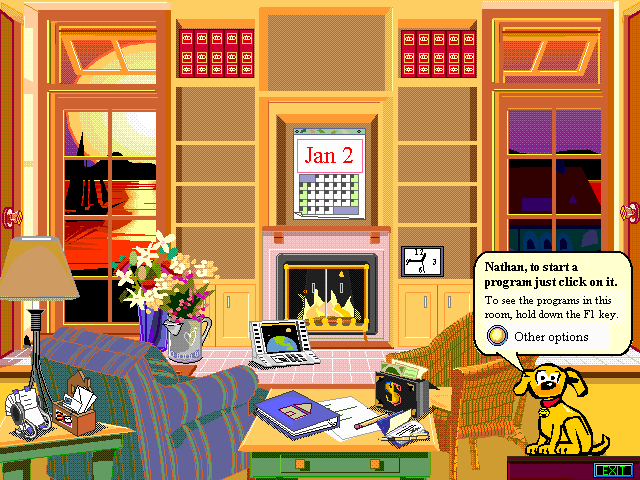
On this screenshot you can clearly see what Microsoft's attitude to our money is...
-
Re:The screen!
640x480 (480x640) LCD. That is ALL that I needed to see. This is finally a PDA I want!
I mean seriously -- that it's running Linux is an excellent plus. But for a pocketable display like that, I'd still have bought it if it ran Tandy Deskmate!I'd run this damned thing with Lindows^H^H^H^Hspire!!!
-
Re:Cocoa for Windows exists
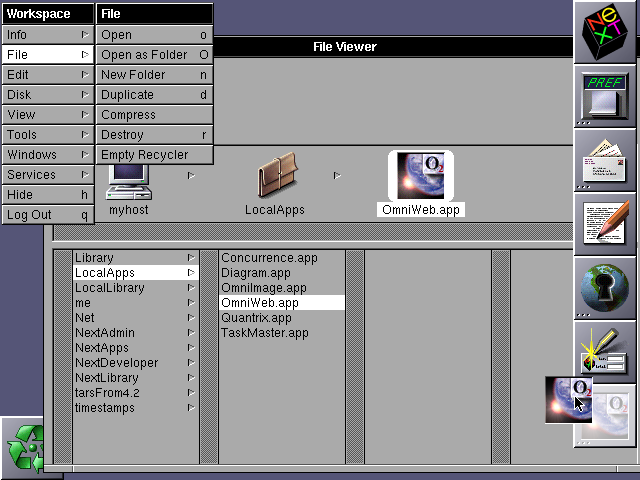
Indeed, I just recently installed and ran Rhapsody on an x86 system of mine. The networking didn't work properly (due to lack of a proper driver), but it was kind of cool, and I suppose in some way ironic, to have an Apple OS running on an Intel processor...
It was interesting, but it felt kind of awkward with the NeXT influence just kind of thrown in there, because it didn't really fit in with the Mac OS interface.
You can definitely see how Rhapsody became Mac OS X, as Rhapsody was based upon the Mach kernel just like Rhapsody, and NeXT before it. I think one place where Apple made a large change is when they decided to have the UNIX side further integrated into the Mac OS itself, creating a closer-knit combination of the two, rather than having them so seperate and awkward-feeling as it was with Rhapsody.
Of course, you can see that many NeXT and Rhapsody elements survived, like the layout of the File Manager which is almost identical in OS X to what was in Rhapsody and NeXT.
For some screenshots go here or here.
Also, here's something pretty interesting: screenshots of Mac OS X server before the Aqua GUI was added, still existant on the Apple website! -
Re:Skin the crash screens, too?
No, that feature was removed when MS dropped DOS for good. However, every DOS-based version of Windows from 3.1 on can use BSOD Properties, which will change the colors of the BSOD. Yes, you can have a P(urple with Green text)SOD.
-
Re:buh..?
-
Re: One Word
Imagine a world without...Microsoft Bob!
-
Wait a second...
Can anyone say Microsoft Bob?
-
Another GUIde!
Since this site is slashdotted, there is another GUide that I know about, which is also interesting.
Nathan's GUI gallery. It has every version of windows, many macs, Unixes, plain wierd ones and of course the infamous Microsoft Bob. The IE is evil section is hilarious as well! -
MS not elegant ??
And what about that ????
-
Re:Meh. Innovation, please?Erm, RISC OS copied Windows in this respect, not vice versa. Windows 1.0 had the big bar at the bottom that you had icons of running programs in. This was back in 1983-5 (announcement date/release date respectively.) You can see some screenshots here.
The icon bar was gone with Windows 2.0, and with Windows 2.x and 3.x the backdrop served the same function. With 95, they went back to having a taskbar/icon bar because the backdrop was now used to display file icons for the Explorer desktop.
Microsoft does have the occasional original idea. It's inevitable...
-
Re:Why?
Yeah, I should be able to take free software, make it suck and redistribute it using someone else's name.
Here, download my new kernel written by Alen Cox. Do you think he would mind my using his name? -
MS Bob
> What happened to Joe User? Did he finally wise up
> about using GUIs and get fired or something?
Yes. Bill fired Joe for being too computer savvy. Long live Bob!
http://toastytech.com/guis/bob2.html
-
Re:Interesting spin ...
One "innovation" nobody else could have engineered/designed/implemented 10 years earlier (or later)
Microsoft Bob!
Thank you, thank you...I'm here 'til Thursday... -
Re:This may be impolitic, but...
I have always felt that Linux is a nice operating system (for
hobbyists and geeks), but there are some areas where it is seriously lacking, especially when compared to its main competitor, Microsoft Windows.
* File sharing. Windows has long been superior when it comes to making large
amounts of files available to third parties. Even early versions of Windows
automatically detected and made available all directories thanks to the built in
NetBIOS-powered file sharing support. But Microsoft has realized that this
technology is inherently limited and has added even better file sharing support
to its Windows XP operating system. Universal Plug and Play will
make it possible to literally access any file, from any device! I think
universal file sharing support needs to be built into the Linux kernel soon.
* Intelligent agents. With innovations like Clippy, the talking paperclip and Microsoft Bob, Microsoft has always tried to make life easier
for its customers. With Outlook and Outlook Express, Microsoft has built a framework for developers to create even smarter agents. Especially popular agents include "Sircam", which automatically asks the users' friends for advice
on files he is working on and the "Hybris" agent, which is a self-replicating
copy of a humorous take on "Snow-White and the Seven Dwarves" (the real story!).
Microsoft is working on expanding this P2P technology to its web servers. This
project is still in the beta stage, thus the name "Code Red". The next versions
will be called "Code Yellow" and "Code Green".
* Version numbers. Linux has real naming problems. What's the difference
between a 2.4.19 and a 2.2.17 kernel anyway? And what's with those odd and even
numbers? Microsoft has always had clear and sophisticated naming/versioning
policies. For example, Windows 95 was named Windows 95 because it was released in 1995. Windows 98 was released three years later, and so on. Windows XP
brought a whole new "experience" to the user, therefore the name. I suggest that
the next Linux kernel releases be called Linux 03, Linux 04, Linux 04.5 (OSR1),
Linux 04.7B (OSR2 SP4 OEM), Linux 2005 and Linux VD (Valentine's Day edition).
Furthermore, remember how Microsoft named every upcoming version of Windows
after some Egyptian city? Cairo, Chicago and so on. I think that the development
kernels should be named after Spanish cities to celebrate Linux' Spanish
origins. Linux Milano or Linux Rome anyone?
* Multi-User Support. This has always been one of Microsoft's strong sides,
especially in the Windows 95/98 variants, where passwords were completely
unnecessary. Microsoft has made the right decision by not bothering the user
with a distinction between "normal" and "root" users too much -- practice has
shown that average users can be trusted to act responsibly and in full awareness
of the potential consequences of their actions. After all, if your operating
system doesn't trust you, why should you trust it? (To be fair, Linux is making
some progress here with the Lindows distribution, where users are always running as root.)
With Windows XP, Microsoft has again improved multi-user support. Not only
does Windows XP come with a larg -
Re:Geoworks?Geoworks was a very populare product with a problem. The market had already gone to Windows. While it made no sense at the time Microsoft had already gainned market domination.
Actually, Geoworks competed head-to-head with Microsoft for a time. Geos came out at about the same time as Windows 2, and beat the hell out of it: it was so much better it wasn't funny. Unfortunately, Geoworks had marketing people so bad that even Acorn didn't want 'em...
Geoworks also made the intresting choice of liccensing the MOTIF GUI. I always wondered if the infamous MOTIF API was found in Geoworks.. The problems you faced with it suggest the answer is yes.
No, it was quite different. You built your user interface by using special GOC constructs to declare objects in your application file. The GEOS linker would then create those objects when the application was loaded. You very rarely had to actually create things on-the-fly. The Motif-ness was strictly limited to the look and feel of the system, and had nothing to do with the internal implementation. Check out my source code; it's, uh, horrific.
New Deal Office had a different UI module: Screenshots here. Windows lookalike, of course.
-
Re:Geoworks?
I can see why the Geoworks SDK was so bad.
Firstly Geoworks or GEOS/PC was based on Geos 64 however Geos 64 (unlike Windows) was not intended to be an operating system but an applications pacage. So originally Geos 64 was designed to have the apps develuped internally at Berkly this would most likely be passed over to Geoworks unless it was a white paper rewrite.
Geoworks was a very populare product with a problem. The market had already gone to Windows. While it made no sense at the time Microsoft had already gainned market domination.
Also Geoworks didn't have an SDK before version 2.0. As a result Geoworks had to rush the SDK develupment before Microsoft got market domination.
Geoworks also made the intresting choice of liccensing the MOTIF GUI. I always wondered if the infamous MOTIF API was found in Geoworks.. The problems you faced with it suggest the answer is yes.
Even with rushing the SDK to the market Geoworks was good and dead on the PC long before the Geoworks SDK was ready. The SDK remained for the Zoomer, Geobook and early smart cell phones.
But the Geoworks GUI was very nice. link Thanks to Toastytech for documenting the old Geoworks UI.
Ahh but Geoworks got a new life with "Newdeal" but they appear to be missing now.
A new reincarnation of Geoworks is Breadbox makes Breadbox Ensemble for sale and for trial you can use Ensemble lite. (Downloadable from Breadboxes website).
Breadbox has supported Geoworks back in the days of the Zoomer.
In my opinion the Geoworks SDK was a pig becouse Geoworks was doomed not the other way around. -
Re:Bad Platforms Make For Good Business
I have always felt that Linux is a nice operating system (for hobbyists and geeks), but there are some areas where it is seriously lacking, especially when compared to its main competitor, Microsoft Windows.
* File sharing. Windows has long been superior when it comes to making large
amounts of files available to third parties. Even early versions of Windows
automatically detected and made available all directories thanks to the built in
NetBIOS-powered file sharing support. But Microsoft has realized that this
technology is inherently limited and has added even better file sharing support
to its Windows XP operating system. Universal Plug and Play will
make it possible to literally access any file, from any device! I think
universal file sharing support needs to be built into the Linux kernel soon.
* Intelligent agents. With innovations like Clippy, the talking paperclip and Microsoft Bob, Microsoft has always tried to make life easier
for its customers. With Outlook and Outlook Express, Microsoft has built a framework for developers to create even smarter agents. Especially popular agents include "Sircam", which automatically asks the users' friends for advice
on files he is working on and the "Hybris" agent, which is a self-replicating
copy of a humorous take on "Snow-White and the Seven Dwarves" (the real story!).
Microsoft is working on expanding this P2P technology to its web servers. This
project is still in the beta stage, thus the name "Code Red". The next versions
will be called "Code Yellow" and "Code Green".
* Version numbers. Linux has real naming problems. What's the difference
between a 2.4.19 and a 2.2.17 kernel anyway? And what's with those odd and even
numbers? Microsoft has always had clear and sophisticated naming/versioning
policies. For example, Windows 95 was named Windows 95 because it was released
in 1995. Windows 98 was released three years later, and so on. Windows XP
brought a whole new "experience" to the user, therefore the name. I suggest that
the next Linux kernel releases be called Linux 03, Linux 04, Linux 04.5 (OSR1),
Linux 04.7B (OSR2 SP4 OEM), Linux 2005 and Linux VD (Valentine's Day edition).
Furthermore, remember how Microsoft named every upcoming version of Windows
after some Egyptian city? Cairo, Chicago and so on. I think that the development
kernels should be named after Spanish cities to celebrate Linux' Spanish
origins. Linux Milano or Linux Rome anyone?
* Multi-User Support. This has always been one of Microsoft's strong sides,
especially in the Windows 95/98 variants, where passwords were completely
unnecessary. Microsoft has made the right decision by not bothering the user
with a distinction between "normal" and "root" users too much -- practice has
shown that average users can be trusted to act responsibly and in full awareness
of the potential consequences of their actions. After all, if your operating
system doesn't trust you, why should you trust it? (To be fair, Linux is making
some progress here with the Lindows distribution, where users are always running as root.)
With Windows XP, Microsoft has again improved multi-user support. Not only
does Windows XP come with a larg -
Re:HOW TO REMOVE LINUX AND INSTALL WINDOWS XP
I have always felt that Linux is a nice operating system (for hobbyists and geeks), but there are some areas where it is seriously lacking, especially when compared to its main competitor, Microsoft Windows.
* File sharing. Windows has long been superior when it comes to making large
amounts of files available to third parties. Even early versions of Windows
automatically detected and made available all directories thanks to the built in
NetBIOS-powered file sharing support. But Microsoft has realized that this
technology is inherently limited and has added even better file sharing support
to its Windows XP operating system. Universal Plug and Play will
make it possible to literally access any file, from any device! I think
universal file sharing support needs to be built into the Linux kernel soon.
* Intelligent agents. With innovations like Clippy, the talking paperclip and Microsoft Bob, Microsoft has always tried to make life easier
for its customers. With Outlook and Outlook Express, Microsoft has built a framework for developers to create even smarter agents. Especially popular agents include "Sircam", which automatically asks the users' friends for advice
on files he is working on and the "Hybris" agent, which is a self-replicating
copy of a humorous take on "Snow-White and the Seven Dwarves" (the real story!).
Microsoft is working on expanding this P2P technology to its web servers. This
project is still in the beta stage, thus the name "Code Red". The next versions
will be called "Code Yellow" and "Code Green".
* Version numbers. Linux has real naming problems. What's the difference
between a 2.4.19 and a 2.2.17 kernel anyway? And what's with those odd and even
numbers? Microsoft has always had clear and sophisticated naming/versioning
policies. For example, Windows 95 was named Windows 95 because it was released
in 1995. Windows 98 was released three years later, and so on. Windows XP
brought a whole new "experience" to the user, therefore the name. I suggest that
the next Linux kernel releases be called Linux 03, Linux 04, Linux 04.5 (OSR1),
Linux 04.7B (OSR2 SP4 OEM), Linux 2005 and Linux VD (Valentine's Day edition).
Furthermore, remember how Microsoft named every upcoming version of Windows
after some Egyptian city? Cairo, Chicago and so on. I think that the development
kernels should be named after Spanish cities to celebrate Linux' Spanish
origins. Linux Milano or Linux Rome anyone?
* Multi-User Support. This has always been one of Microsoft's strong sides,
especially in the Windows 95/98 variants, where passwords were completely
unnecessary. Microsoft has made the right decision by not bothering the user
with a distinction between "normal" and "root" users too much -- practice has
shown that average users can be trusted to act responsibly and in full awareness
of the potential consequences of their actions. After all, if your operating
system doesn't trust you, why should you trust it? (To be fair, Linux is making
some progress here with the Lindows distribution, where users are always running as root.)
With Windows XP, Microsoft has again improved multi-user support. Not only
does Windows XP come with a larg -
Re:"Show your boss"?
Thanks, the Byte review is here for anyone who doesn't want to search the site. I'm curious though, where do you see it reporting Windows development going back to 1981?
-
Re:Real world vs. fanboy fantasies
I have always felt that Linux is a nice operating system (for hobbyists and geeks), but there are some areas where it is seriously lacking, especially when compared to its main competitor, Microsoft Windows.
* File sharing. Windows has long been superior when it comes to making large amounts of files available to third parties. Even early versions of Windows automatically detected and made available all directories thanks to the built in
NetBIOS-powered file sharing support. But Microsoft has realized that this technology is inherently limited and has added even better file sharing support to its Windows XP operating system. Universal Plug and Play will
make it possible to literally access any file, from any device! I think universal file sharing support needs to be built into the Linux kernel soon.
* Intelligent agents. With innovations like Clippy, the talking paperclip and Microsoft Bob, Microsoft has always tried to make life easier for its customers. With Outlook and Outlook Express, Microsoft has built a framework for developers to create even smarter agents. Especially popular agents include "Sircam", which automatically asks the users' friends for advice on files he is working on and the "Hybris" agent, which is a self-replicating copy of a humorous take on "Snow-White and the Seven Dwarves" (the real story!).
Microsoft is working on expanding this P2P technology to its web servers. This
project is still in the beta stage, thus the name "Code Red". The next versions will be called "Code Yellow" and "Code Green".
* Version numbers. Linux has real naming problems. What's the difference between a 2.4.19 and a 2.2.17 kernel anyway? And what's with those odd and even numbers? Microsoft has always had clear and sophisticated naming/versioning
policies. For example, Windows 95 was named Windows 95 because it was released
in 1995. Windows 98 was released three years later, and so on. Windows XP
brought a whole new "experience" to the user, therefore the name. I suggest that the next Linux kernel releases be called Linux 03, Linux 04, Linux 04.5 (OSR1), Linux 04.7B (OSR2 SP4 OEM), Linux 2005 and Linux VD (Valentine's Day edition).
Furthermore, remember how Microsoft named every upcoming version of Windows after some Egyptian city? Cairo, Chicago and so on. I think that the development kernels should be named after Spanish cities to celebrate Linux' Spanish origins. Linux Milano or Linux Rome anyone?
* Multi-User Support. This has always been one of Microsoft's strong sides, especially in the Windows 95/98 variants, where passwords were completely
unnecessary. Microsoft has made the right decision by not bothering the user with a distinction between "normal" and "root" users too much -- practice has shown that average users can be trusted to act responsibly and in full awareness of the potential consequences of their actions. After all, if your operating system doesn't trust you, why should you trust it? (To be fair, Linux is making some progress here with the Lindows distribution, where users are always running as root.)
With Windows XP, Microsoft has again improved multi-user support. Not only does Windows XP come with a large library of user pictures that are displayed on the login screen, su -
Re:Developing countries?As you say, RAM does matter (I have 262Mb on the home machine) but memory is cheap. What's the big deal?
Memory is not so cheap when you have to buy a new PC in order to install more of it. I imagine there are a lot of old PCs -- maybe PCs that can't use more than 64 MB of RAM -- being used in the developing countries. (A RAM upgrade may be impossible even if there's an open socket. Is EDO RAM even sold any more?) Think Iraq, which has been under UN sanctions for 10+ years. For that matter, think of the US, where some kids get old and slow PCs from thrift stores.
And handheld systems will always be resource-poor compared to their big brothers on the desktop. 256 MB of RAM may not cost much more than 128 MB of RAM when compared to the purchase price of a handheld, but the extra memory needs a bigger case, bigger circuit board, and more electrical power (and hence, shorter battery life). These network effects drive up the cost, and if it's a high-volume consumer device, every penny counts.
And finally, consider what the extra RAM and CPU is being used for. More often than not, it's for user-interface chrome and other "fluff". I think software would suck a lot less if developers were forced to come up with something that could run well on systems with 16 meg of RAM. If QNX can put a POSIX realtime kernel, TCP/IP, GUI, and web browser on a 1.44 meg floppy, then what the hell is everyone else doing?
-
Re:MPPE?
I have always felt that Linux is a nice operating system (for hobbyists and geeks), but there are some areas where it is seriously lacking, especially when compared to its main competitor, Microsoft Windows.
* File sharing. Windows has long been superior when it comes to making large
amounts of files available to third parties. Even early versions of Windows
automatically detected and made available all directories thanks to the built in
NetBIOS-powered file sharing support. But Microsoft has realized that this
technology is inherently limited and has added even better file sharing support
to its Windows XP operating system. Universal Plug and Play will
make it possible to literally access any file, from any device! I think
universal file sharing support needs to be built into the Linux kernel soon.
* Intelligent agents. With innovations like Clippy, the talking paperclip and Microsoft Bob, Microsoft has always tried to make life easier
for its customers. With Outlook and Outlook Express, Microsoft has built a framework for developers to create even smarter agents. Especially popular agents include "Sircam", which automatically asks the users' friends for advice
on files he is working on and the "Hybris" agent, which is a self-replicating
copy of a humorous take on "Snow-White and the Seven Dwarves" (the real story!).
Microsoft is working on expanding this P2P technology to its web servers. This
project is still in the beta stage, thus the name "Code Red". The next versions
will be called "Code Yellow" and "Code Green".
* Version numbers. Linux has real naming problems. What's the difference
between a 2.4.19 and a 2.2.17 kernel anyway? And what's with those odd and even
numbers? Microsoft has always had clear and sophisticated naming/versioning
policies. For example, Windows 95 was named Windows 95 because it was released
in 1995. Windows 98 was released three years later, and so on. Windows XP
brought a whole new "experience" to the user, therefore the name. I suggest that
the next Linux kernel releases be called Linux 03, Linux 04, Linux 04.5 (OSR1),
Linux 04.7B (OSR2 SP4 OEM), Linux 2005 and Linux VD (Valentine's Day edition).
Furthermore, remember how Microsoft named every upcoming version of Windows
after some Egyptian city? Cairo, Chicago and so on. I think that the development
kernels should be named after Spanish cities to celebrate Linux' Spanish
origins. Linux Milano or Linux Rome anyone?
* Multi-User Support. This has always been one of Microsoft's strong sides,
especially in the Windows 95/98 variants, where passwords were completely
unnecessary. Microsoft has made the right decision by not bothering the user
with a distinction between "normal" and "root" users too much -- practice has
shown that average users can be trusted to act responsibly and in full awareness
of the potential consequences of their actions. After all, if your operating
system doesn't trust you, why should you trust it? (To be fair, Linux is making
some progress here with the Lindows distribution, where users are always running as root.)
With Windows XP, Microsoft has again improved multi-user support. Not only
does Windows XP come with a larg -
Re:Bill gates' desktop
You guys are all crazy. THIS is what Bill Gate's desktop looks like.
-
Is That What This Is All About?
What's this I keep hearing about a foundation?
I thought he was being rewarded for Microsoft's Bob. -
Re:linux at nasa
No, it definitely looks like a Gnome or KDE theme (from what I've seen). FVWM95 looks like stock Windows 95, except the fonts are off a bit.
-
Re:trusted computing
Until hacked.
Trusted Computing will be the shiz-nit until Marketing produces the Next Big Thing, when Trusted Computing joins <your pet buzzword here> in the bit bucket with Bob -
Re:Serious Question
-
Windows 98!?
-
First look
This is how Doom looked like when it was still at alpha stage.
-
Hey BortQ, wanna do the EULA hula?
-
Re:Window metaphor considered harmful
What we need is a unified desktop that represents the real objects we work on, in a way that mirrors the manner in which we actually use them.
MS actually agrees with you! It was called Bob. -
Bill Gates Should have used this
Gates should have used BSOD Properties durring his presentation, this shows how to change the color of your BSOD.
-
Re:Window metaphor considered harmful
You mean something like this?
-
Re:Window metaphor considered harmful
What we need is a unified desktop that represents the real objects we work on, in a way that mirrors the manner in which we actually use them.
Putting my money where my mouth is, we're working on a prototype that will be unleashed on the world sometime early next year.
You're too late. -
Re:Hello, the 90s called
Wow! A paperclip joke!
Along with BSOD jokes, they are relics of the 90s. Thank you for being that decade's spokesperson!
Relic of the 90s, right... When windows stops giving BSODs the jokes will be relics, not before. Clippy was a joke, is a joke and will remain a joke from the brilliant minds that produced MS Bob. Follow the link and look at the dog helper, ever seen that one before? Right! In the WinXP Search tool as the animated helper.
I like this quote from the last page of the Bob guide: "The Office Assistance included with Office 97 appear to be directly evolved from the Bob Guides." Yeah, nothing to make a joke about with Microsoft stuff. Move along.
Overly Critical Guy takes one for his hero, film at 11pm. -
Help for G5?
help, I am uprgrading my Intel 487, running Windows 3.2 to MacOS XP, does anyone know where I can get a G5 processor that can run at 33Mhz and can run on my 800Mb hard drive with 10Mb of ram?
-
Re:Clippy in Linux!
-
Re:Looks don't make a brandMozilla really needs all the advertising it can get, perhaps IBM can do and ad involving Mozilla?
In the mean time print out Mozilla bumper stickers!
-
Re:Microsoft Bob will never go out of fashion.
And here's another (maybe even familiar) one: More Bob rooms and conclusion.
Hint: take a look at the bottom of the page
-
Re:Microsoft Bob will never go out of fashion.
Here's what BOB looked like if you don't feel like installing it.