Slashdot Mirror
Domain: toronto.edu
Stories and comments across the archive that link to toronto.edu.
Comments · 206
-
Re:At UofT...
Looks like a great curriculum! http://www.cdf.toronto.edu/~csc408h/summer/
-
Re:At UofT...
Can you give me a couple of pointers for a site with some info about what you are talking about because my google search got me things like: http://www.cs.toronto.edu/~csc408h/fall http://www.cs.toronto.edu/~yijun/csc408h/teams/co
n traption/Contraption_phaseArevisited.doc http://seawolf.cdf.toronto.edu:9192/csc408/viewtop ic.php?t=18&view=previous&sid=7f27c1b34b19f8dbca90 be89e1e86c13 (ok i copy pasted the worst links but the rest didn't help me either) -
Re:At UofT...
Can you give me a couple of pointers for a site with some info about what you are talking about because my google search got me things like: http://www.cs.toronto.edu/~csc408h/fall http://www.cs.toronto.edu/~yijun/csc408h/teams/co
n traption/Contraption_phaseArevisited.doc http://seawolf.cdf.toronto.edu:9192/csc408/viewtop ic.php?t=18&view=previous&sid=7f27c1b34b19f8dbca90 be89e1e86c13 (ok i copy pasted the worst links but the rest didn't help me either) -
Re:At UofT...
Can you give me a couple of pointers for a site with some info about what you are talking about because my google search got me things like: http://www.cs.toronto.edu/~csc408h/fall http://www.cs.toronto.edu/~yijun/csc408h/teams/co
n traption/Contraption_phaseArevisited.doc http://seawolf.cdf.toronto.edu:9192/csc408/viewtop ic.php?t=18&view=previous&sid=7f27c1b34b19f8dbca90 be89e1e86c13 (ok i copy pasted the worst links but the rest didn't help me either) -
Re:I think people missed the point a bit.People have been doing this in academia for at least 10 years. No one has made an actual processor that supports it, and it might be incredibly complex, but it's not impossible. Read the following papers and you'll find answers to all the questions that the Ars articles posed.
http://www.eecg.toronto.edu/~moshovos/ACA05/read/
A kkary.1998.MICRO.pdf
http://www.crhc.uiuc.edu/~mfrank/pubs/Malik-2006-T R2208.pdf
ftp://ftp.cs.wisc.edu/sohi/papers/1995/isca.multis calar.pdf -
Re:To much play and to little usablity
From the top post: "BumpTop seems to be Windows-only" Where did you get that idea? If you read the paper (PDF file), you'll see that BumpTop is written in C++, OpenGL and GLUT. No mention of Windows at all. "I mean where is the use in having a dozen equally looking pdf icons?" Again, if you actually read the paper, you'll see that they didn't put filenames on because this is a proof-of-concept about physics, piles and pen-based computing, not a finished OS. They can put filenames on the icons if need be. "Why don't do the really intuitive thing instead and present the document itself instead of an icon to abstract it?" Again, not the point of the demo. "there seems to be a completle lack of zooming" Because you didn't see any in the demo video?
-
Java is already fragmented
Java is already fragmented. The result of open sourcing Java will actually be consolidation, i.e. killing of competing VMs. And a huge open source test suite will greatly benefit all surviving JVMs, which is a good thing.
How can you not see this?
Javas problem is not that it might get fragmented, the problem is that it IS fragmented. Do something about it! Let Java free! -
Ken Burn's Screensaver - iSlideshow
I figure this OpenGL screensaver, iSlideshow , might be of interest given the topic. It allows you to select a set of images and play them back ken burn's style.
-
Re:Looks more like a Linux desktop all the time
It must be a long time since you checked then. When I bought my first Mac some 4 years ago os x Terminal.app did real transparency.
See for yourself here: http://www.math.toronto.edu/~joel/iMac/transparenc y.jpg -
Re:Security from the ground up?
Okay, I won't go on about stuff I am clueless about, *but* wasn't UNIX inspired by MULTICS, and wasn't MULTICS a pretty secure o/s, by design?
Yes Unix was inspired by Multics. I don't know about the security of Multics, Unix was written by Kernighan/Ritchie because they saw defiencies in Multics. I believe Multics didn't have a good scheduler, it slowed down with multiple users, and back then when computer time was alloted, that meant everything. I don't think security was a particular problem like it is today....How hard would it be to start fresh, apply the Linux method to MULTICS or something like it, to have a an networking-oriented o/s with comprehensive security?
A secure, networking oriented OS?
I believe you are talking about Plan 9.
http://www.cs.bell-labs.com/wiki/plan9/plan_9_wiki /
http://www.ecf.toronto.edu/plan9/plan9faq.html#pla n9design
There's also an OS based on/off of Plan9 called Inferno. Look into it. -
Re:You ins3nsitive cloD?!
PNG is lossless, JPG is lossy.
Deriving from that, JPEG usually produces the smaller images, especially with photos.
PNG allows for binary transparency and transparency via alpha channel, JPEG doesn't support transparency.
PNG supports color correction, JPEG doesn't.
PNG has many ways of compressing an image, JPEG has one. (This makes the use of PNG optimizers like OptiPNG a good idea - some programs tend to use dumb compression settings for PNG.)
JPEG is fully supported by most browsers, PNG is mostly supported (especially the alpha chanel makes problems with IE PNG is extensible, JPEG isn't.
JPEG is patent-ncumbered, PNG isn't. -
Re:Nagle's algorithm
You may be interested in a paper we wrote a few years back [1]. We also started with the premise that some applications require both minimal latency and maximal bandwidth. In our case the application was our own media streaming system. We came up with our own patch to TCP (in Linux). The patch provided a new socket option, we call TCP_MINBUF. The idea is that you need a certain minimum amount of buffer allow TCP's congestion window to function, but no more. Indeed, in the paper we show that the delay due to socket buffer beyond the congestion window is often by far the dominant source of latency--not retransmissions, or delayed acks, or all the other more commonly cited things. So basically what TCP_MINBUF does, is dynamically size the socket buffer to follow the congestion window size. It had a huge impact on latency.
[1] "Supporting Low Latency TCP-Based Media Streams", Ashvin Goel, Charles Krasic, Kang Li, and Jonathan Walpole. Tenth International Workshop on Quality of Service (IWQoS), May 2002.
http://www.eecg.toronto.edu/~ashvin/publications/i wqos2002.pdf -
Re:Now that dual lenses seem to get cheap...
You would not need just the images, but also very accurate positioning data on where the photos were taken.
Quite right!
In theory, perhaps you could extrapolate the positioning information by looking at static objects in the frame, shadows, etc., but I don't think that's anywhere near practical.
No; It actually exists, now. It's not just a theory. I have a video on my hard drive here, demonstrating it ("kitchen.mp4.avi",) but I can't find it online. No matter; do a google search on "real-time camera tracking in unknown scenes" (which is the title I see when I start up the video,
It's just as you say-- those little points are called "landmarks," and it uses them to track by.
However if you had a cellphone with augmented GPS (WAAS or something like it) that had submeter accuracy or better, and you were taking pictures of a large object, and maybe included a compass chip or something like it to give you an azimuth reading, then I think you could do what you're talking about. At the very least you'd be able to easily construct a photographic panorama / flyaround (a la Quicktime VR). The work necessary to produce a 3-D model might be, as a physicist I knew used to say, "really nontrivial." At least working just from the images and telemetry data without any other subjective stuff (like selecting out the areas by hand as those 2-d photogrammetry systems have you doing, it seems).
A blue bird in industry has told me that in the next 3-5 years, cell phones will have not only GPS, but $3 accelerometers capable of sub-meter resolution sustained for 1 hour without update. (Important for underground locations.)
The work to produce 3-D models may be non-trivial, but: Did you follow the links I gave you? It's all been done- and this isn't recent: This is a few years back.
Here's a very simple example, here's a more complicated one, and here's yet another, this time dated 2000. Be sure to check out the generated 3D models.
So the techniques are out there, and they're in practice, and many people are starting to wake up that these are useful things to do. There's a lot of money to be made here. So, this is why I don't think it'll be long before this is integrated into cameras.
We have 2D camera phone scanners. Why not 3-D? Some even do OCR.
But in general I think that's a very cool idea. It would be neat to see digital camera manufacturers start to embed GPS chips into cameras; at the very least it would be cool to open something in iPhoto and see a minimap of exactly where you took the photo. I know that there are some vacation photos of mine that I wish I knew exactly where I'd been standing when I took it, and there's no easy way to figure out now. It's not like the chips to do that would be bulky anymore, now that they've been miniaturized for cellphones. In fact I think I remember a fairly old Kodak DSLR (one of their really serious ones that were built on Nikon F1 frames) that had a serial port and might have been able to connect to a GPS, for that purpose. I think it's a feature that's ready for prime time.
The cell phones have cameras, and many phones already have GPS. It won't be long before they all do..! -
Re:Ogg Vorbis, Png, and Odt benefit everyone
I did a few tests and especially images with very few colors sokmetimes compress much better with PNG than with GIF. If the PNG is compressed correctly (ie. not the way Photoshop does it) it's usually smaller or only slightly bigger then GIF.
Every PNG should be post-processed with OptiPNG. A good way is to use OptiPNG with the option -o3 to batch-optimize your images. If you batch-optimize an entire directory containing PNGs it might be a good idea to use a makefile so that you only optimize images that have changed since the last optimization run. -
They're underestimating google.
Sure google started out as a simple search engine, but now it's threatning microsoft in much more than the search buisness. Especially if we are to believe therumors surrounding new google labs creations!
My point is while MS focuses on TRYING to reach google's level in search. Google will exploit the diversion to take over the world. -
Re:Poli-ticks == multiple bloodsuckers
You are not entirely correct:
http://www.math.toronto.edu/
Last time I checked, University of Toronto is outside of the U.S. -
For those unfamiliar with OpenOME.
http://www.cs.toronto.edu/~yijun/OpenOME.html/ind
e x.html
"OpenOME, a goal-/agent-/aspect-oriented requirements engineering tool
The Organization Modelling Environment (OME) is a general, goal-oriented and/or agent-oriented modeling and analysis tool. It provides users with a graphical interface to develop models, and supports access to a powerful knowledge base that allows for sophisticated computer-aided analysis. This tool is intended to provide software developers with a clear link between the requirements, specification and architectural design phases of development. Attention is also being placed on this use of this tool in business process reengineering." -
Quasi-holographic gestural UIYou might find this interesting.
Tovi Grossman, a grad student at UToronto, won best paper at UIST for developing a gestural, camera-based UI for actually building CAD models in a volumetric display from Actuality Systems. Click on the "video" for "Multi-finger gestural interaction with 3D volumetric displays."
-
readers, make your own mind up
-
Re:Broader Implications
I dont want a virtual reality, i just want an augmented reality. Kind of like a non intrusive hud. Night vision (i can barely see at night, and any light is a halo thanks to my astimgatism), maybe a scheduler, so that when i have something to do, it appears in my vield of view as a notice (Today: Pay bills. eh, leave that till tomorrow) Granted, my examples arent the best, but i have a feeling that augmented reality has a lot more to offer than virtual reality. Some of the stuff that steve mann is doing that ive read is sweet. All i can think of is "Why cant that be integrated into my contacts?!" sigh, a few more years off, i suppose http://www.eecg.toronto.edu/~mann/index.html
-
Re:Crackpot: Part Deux
No, again we bump up against reading comprehensions I think.
"The folks who do the averaging happen to use the arithmetic mean over the field with specific sets of weights"
"rather than, say, the geometric mean "
What he is saying is that the folks who do arithmetic mean and weights, take sample data that is unevenly spread, and attempt to adjust it so as to give a smooth average. I.e they weight the numbers, for example, they take 500 Monitoring stations in NY City, each individual monitoring station has less weight than say the 5 monitoring stations in Provo Utah.
Alternatively one could take an average of the different locals and then use the one average as the local mean temperature.
i.e. there is more than one way to do such a thing.
For the readers at home, doing a search on Geometric Mean shows a host of people using it as perfectly valid science. In fact another term for geometric mean is "Weighted Mean" as in using the arithmetic with weights being equivalent to geometric mean.
gee a lot of math people talking about the benefits of geometric mean
You would find it hard to believe that no one used this convention normally
Geometric means are often useful summaries for highly skewed data
I'll agree that in first year Physics they might only teach one method of averaging, but it is well known, even outside of mathematical circles, that there is more than one way to average a series of complex variable numbers.
Might I suggest, assuming UNSW offers it, that you take some higher Physics courses, and possibly some mathematics courses. I'm sure those will go into these areas in more detail.
Now I know you primarily use Java (spit) but you do use Matlab, I do believe Geometric mean is included within that, maybe you could play around with it a bit. -
difference
What is the difference in approach with your kit and say Steve Manns? Admittantly your system is commercial consumer grade where constraints of market and production play a big part in releasing product. But Manns research and production into wearable computers (wearcomp: tapping into his right eye) has been around for ages.
-
Too bulky
After having worked with ubiquitous computing for a while, I can tell you one thing -- that thing is too big and has very bad affordances for it to take off big time.
On the other hand, look at something that folks like Thad Starner or Steve Mann come up with - better affordances.
(Mann actually had a different helmet design and changed to the Eye-tap design) -
mSpace is indeed cutting-edge
The tone of the article is unfortunate. But it's also too bad that really good technology gets dissed by the tech community if it's well marketed. mSpace is a rather sophisticated system for storing and relating arbitrary unstructured information in meaningful ways. The interface doesn't do it full justice.
McGuffin and Schraefel's paper of mSpaces, polyarchies and zzStructures won the ACM Hypertext Conference's award for "Special Research Distinction for Excellent Presentation of Theoretical Concepts."
Schraefel is not only a good programmer, doing very cutting edge information technology stuff, but she and her team have managed to design a useful piece of software that uses it. Since when can the Academic world do this kind of thing?
*sigh* People diss Nelson when he comes up with incredibly good ideas and quality computer science. And now, when people like Schraefel produce a usable product, they get dissed too. Before you go snarking about how the Semantic Web won't come down from heaven and die on a cross for us, make sure you know what the Semantic Web is. Just like Harpers, this is a perfectly cool example.
What do I think about the Semantic Web? I will admit, I sometimes wonder if it's safe. -
Important but a Turing Award?
It's no doubt that we would speak about Internet protocols a little differently had these guys not done what they did, but to me it seems like we'd just be saying some other acronym (does anyone really buy that they invented the idea of packets and it didn't come about until 1973?) They invented the basic scheme, but the real cleverness seems to have come as a result of the various exponential-backoff mechanisms and other complexities in today's implementation of TCP/IP, not the basic protocol they designed in the 70's.
Looking at the previous winners it's kind of hard to tell what the point of the Turing award is. In some cases it's given to researchers that have made very influential theoretical break-throughs and others that seem to have invented something that became popular. Maybe I'm just being sidetracked by what is essentially the old debate about whether "systems" research is true research since it's often difficult to comparatively evaluate alternatives.
I just like to see the award go to people that did something that no one else (or at least very few people) working at the time would have been likely to think of and I'm not sure this meets that criterion.
-
Re:Games are art.
because architecture is about creating buildings, which by definition need to have an inside and an outside [...]. Whereas a sculpture has no such constraints
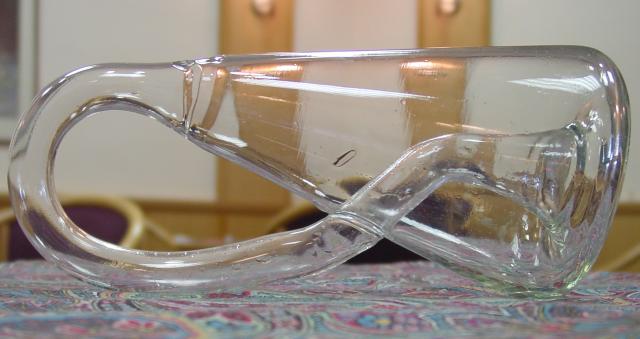
Which is why you can make a sculpture of a Klein bottle, while you cannot e.g. make a building of one... -
Ultra high bandwidth PNG?It's important to understand that most default PNG exporters are not very good. You should use a PNG optimizer, such as Ken Silverman's PNGOUT or Cosmin Truta's OptiPNG. Let us focus on the matrix3-3ivx-6364.png image:
- Default: 129,002 bytes
- OptiPNG: 121,967 bytes
- PNGOUT: 113,759 bytes
-
My favorite: 2=1
Proof right here: http://www.math.toronto.edu/mathnet/falseProofs/f
i rst1eq2.html
Of course everyone here knows that I divided by 0. -
I wrote a program to simulate itI know this is so late that everyone has moved on to the next story, but curious about the idea, I wrote a program to simulate the idea using my shadow mask CRT monitor, and compare it to downsampling and true 640x480. It may work on aperture grill and LCD monitors as well, but it probably won't look as good. Download here. Sorry; it's a windows binary only, and it requires
For best results set your resolution low, otherwise it has very visible moire patterns. As a side effect of the conversion, the image gets darker. My program also has a colour cast, which the article claims is due to adding the white pixel. The article also says that Samsung has overcome this problem.
It works by setting up the subpixels as a 640x480 square grid, with each pixel consisting of a starting pixel, and the right, lower, and lower right subpixels. Subpixel values are calculated using the average intensity of the corresponding colour value in each of the four pixels the subpixel is a part of.
Visually, aside from the darkness and colour cast which are artifacts of the simulation and wouldn't appear in the real product, it looks decent. It's blurrier than a true 640x480 display, but retains more detail than the 320x240 downsampled version.
-
Re:well, it's fashion
You must be an MCSE or something. That little piece of paper does not make you a scientist little boy. GED + MCSE = this statement "And the pseudo-science it comes wrapped in, invariably shows massive ignorance of the real science." Here is some of you pseudo-science troll --> University of Toronto
-
Re:Human Augmentation
Why replace your real eye to do this if it is perfectly healthy? Take a look at EyeTap. This research, mainly by Professor Steve Mann at the University of Toronto has the potential to do everything you describe, and much more besides!
-
Re:Figures
Intel has been, in reality, behind AMD for at least two years. Now it just gets confirmed.
Intel has been publishing some phenemonal research on new processor architectures recently. For example, "Continual Flow Pipelines" appearing in ASPLOS of this year shows some awesome potential. It is a novel new technique for a superscaler out-of-order processor that does not use things like reorder buffers which don't scale well with instruction window size. Surely Intel has patented this technique before publishing in an academic conference.
Intel will catch up rather quickly. -
Funny thing about the english language
That word, embrace. It is more flexible than I had initially thought. And it took an article title like this to demonstrate this.
We could, for example, begin using it in lieu of opposites and still retain the original meaning, like if we were talking about the Boston Embracer. Or this warm and fuzzy story about cooperation, understanding, and symbiosis between man and pet.
With this new meaning-neutral language which we here at -
Re:i'm shockedActually, there isn't just a unique technique.
Henrik published the diffuse approximation on 2001, and in 2002, he and I published a ~100x improvement on that, which actually has little to do with it except mathematically... This is the technique that is being used in several production houses nowadays, and why Cristophe among others got the special achievement award (not OscarTM). PDI/DreamWorks, the place I work for, was left out because our first movie using the technique, Shrek 2, was not out at the time
This image of Fiona's mouth was in the back cover of the 2002 SIGGRAPH proceedings:
j
-
Reconfigurable memory elements
Its interesting that nobody mentioned reconfigurable memory elements in this thread. They offer, IMHO, one of the most exciting potential advances in hardware.
Basically, the idea is that you put a bunch (from a few dozen to thousands) of very simple arithmatic units integrated right into memory. Inside memory, there is an enormous amount of bandwidth available at the sense amps --- several terabytes per second on current memory chips. These processors could all work in parallel, unfettered by memory bandwidth limitations.
The potential applications for such memory chips are very impressive. See here. -
Re:Well it depends on what country you're in
I have to agree that it depends on country.
I'm at UToronto, and it seems that most money comes from healthcare. -
Re:Not a cyborg.
You're thinking of Kevin "Captain Cyborg" Warwick, a University of Reading (UK) professor. Steve Mann is at UofT (Toronto, Canada). Mann actually does quite a bit of legitimate research in wearable computing (not implants!), but he certainly enjoys the media attention ("Ooh! A cyborg!"). Personally, I find the way he roams the halls of the Sanford Fleming building late at night dressed in all black rather creepy.
-
I take it that they still can't graph properly
All the graphing calculators I've tried (and I've tried more than a few...) can't graph basic functions like y=sin999x or y=1/x properly. Most won't attack let you enter equations as complicated as (gasp!) x^2+y^2=1. It would be nice if the graphing calculator companies would improve the graphing algorithms their products use (see my program GrafEq for example). Years ago, HP was working on a new calculator with us before top brass (C.F.?) decided that calculators were passe and decided to can all future calculator development.
-
Re:The Body Electric
-
This is a remake of the hole in space (circa 1980)
This project is a rework of the infamous Hole in Space project, dating back to 1980.
This project consisted in linking together by audio and video two public spaces, without telling the passerby anything about the installation. At some point, bystanders would realize the link was bidirectional and started impromptu conversations between the two locations.
By a funny twist of things, this project inspired much of the 1980's and early 90's work carried at Xerox PARC and the University of Toronto Telepresence project.
These in turns nurtured a number of startups, such as PictureTel/Polycom, still a leader in videoconferencing technology.
Notice that by the time, the technology was fully analog, and for having used it in the early 90's, I can say the link quality was far better than most current IP-based videoconferencing is today.
-
Steve Mann
Steve Mann
One of the more eccentric profs I've encountered. Although his web page serves as no indicator, his brother, Richard, is only slightly less eccentric:
Richard Mann
Funny that both of them are profs at Canadian schools.
Probably what's most significant is that they both do interesting and valuable research.
In general, I think a certain degree of obsessive-compulsive disorder is a requirement for a faculty job. If you're too normal, you don't make for a good candidate. -
Compile at installation vs. JIT
And I believe CLR stuff can be compiled at installation time, making it even better than JIT.
Not necessarily! Some optimizations that cannot be done without runtime data. You can get some of this info by profiling (and recompiling with profiled data), but you can do better with realtime data. Here's one example of such a system: ADAPT (at the University of Toronto). There are probably others. -
Re:From Quantum Cheating to Quantum Security
-
Research on Multiple-Valued Logic
Multiple-valued logic seems to be an fertile area of research judging by the fact that there is an International Symposium on Multiple-Valued Logic.
-
Algorithms?Dijkstra developed some very efficient algorithms, and algorithms span all computer languages, even if I were to agree with you that C++ and perl are no longer used...which I don't.
What comes to mind right at first is Dijkstra's Shortest Path Algorithm. And hey, look...that page has java programs. In fact, take a look at a Java applet to better understand the algorithm.
-
Re:That's not the point, here's the real point
It's a lot easier than that... make BeamBack your
-
Change the Internet... to what?
I agree with other posters that the article seems high in fluff and low in content (understandable, since anything else would be a technical paper, not an article). But the things that stood out for me when I read the article were the part mentioned in the parent ("go to the core of the Internet and make radical changes"), and this:
"This is about pooling resources and to build out the infrastructure, but in the end this about lowering the barrier to entry to developing on the Internet," Peterson said.
"Lowering the barrier?" My goodness, my 12-year-old daughter could be designing Flash-enabled websites if she weren't so busy on AIM. What "barrier" are they talking about? I'd almost suggest we need higher "barriers" to keep out the "wELCOM tO MY wEBSIGHTE" kiddies.
Now read that last sentence again.
Maybe I'm letting paranoia run loose, but there are more than a few folks in industry that would also like to keep those kiddies off the 'net, raise the bar, have an Internet that is "more useful everyday," as Bill would say. The net effect, though, is to remove the internet gadflies that make the 'net such a democratizing medium.
The web's success isn't due to the Microsofts and the AOLs -- it's the little guys like me and you who rub the fat cats the wrong way.
With "high-tech companies... key to the project's success" (and Intel and HP specifically mentioned), I'm afraid their goal is to make the 'net better for those high-tech companies... and to leave the rest of the masses out of the "New Internet".
But maybe I'm just being paranoid. -
Flexible Input Device In Action
Early this year, I saw some fairly sophisticated interaction using a flexible input device called ShapeTape, made by Canada's Measurand. While the company is marketing it as a motion-capture and 3D modeling technology, Tovi Grossman at the University of Toronto's Dynamic Graphics Project has been working under Ravin Balakrishnan to explore other applications for ShapeTape, including as a general input device. For example, you can use it in computer-assisted design or animation to make and perform some fairly complex 3D curves and manipulations in far less time than it would take with keyboards, mice or drawing tablets.
The Association of Computing Machinery's computer-human interaction publication CHI Letters' latest edition includes their paper on the use of ShapeTape (2 MB PDF), which was presented at the ACM CHI 2003 conference on human factors in computing systems along with MPEG demonstration videos. (3 min. basic - 15 MB | 15 min. complete - 190 MB)
Grossman's Web page includes links to other videos and previous papers.
Computer graphics and animation tool-maker Alias|Wavefront also has several videos that featured former chief scientist Bill Buxton demonstrating ShapeTape in use:
- 3D Tapedrawing On The Wall 4:33 min. - 11MB
- Digital Tape Drawing 2:33 min. - 8.2MB
- Modeling With Shapetape 1:14 min. 3.9MB
And, of course, ShapeTape maker Measurand also has further information and videos.
-
Flexible Input Device In Action
Early this year, I saw some fairly sophisticated interaction using a flexible input device called ShapeTape, made by Canada's Measurand. While the company is marketing it as a motion-capture and 3D modeling technology, Tovi Grossman at the University of Toronto's Dynamic Graphics Project has been working under Ravin Balakrishnan to explore other applications for ShapeTape, including as a general input device. For example, you can use it in computer-assisted design or animation to make and perform some fairly complex 3D curves and manipulations in far less time than it would take with keyboards, mice or drawing tablets.
The Association of Computing Machinery's computer-human interaction publication CHI Letters' latest edition includes their paper on the use of ShapeTape (2 MB PDF), which was presented at the ACM CHI 2003 conference on human factors in computing systems along with MPEG demonstration videos. (3 min. basic - 15 MB | 15 min. complete - 190 MB)
Grossman's Web page includes links to other videos and previous papers.
Computer graphics and animation tool-maker Alias|Wavefront also has several videos that featured former chief scientist Bill Buxton demonstrating ShapeTape in use:
- 3D Tapedrawing On The Wall 4:33 min. - 11MB
- Digital Tape Drawing 2:33 min. - 8.2MB
- Modeling With Shapetape 1:14 min. 3.9MB
And, of course, ShapeTape maker Measurand also has further information and videos.
-
Flexible Input Device In Action
Early this year, I saw some fairly sophisticated interaction using a flexible input device called ShapeTape, made by Canada's Measurand. While the company is marketing it as a motion-capture and 3D modeling technology, Tovi Grossman at the University of Toronto's Dynamic Graphics Project has been working under Ravin Balakrishnan to explore other applications for ShapeTape, including as a general input device. For example, you can use it in computer-assisted design or animation to make and perform some fairly complex 3D curves and manipulations in far less time than it would take with keyboards, mice or drawing tablets.
The Association of Computing Machinery's computer-human interaction publication CHI Letters' latest edition includes their paper on the use of ShapeTape (2 MB PDF), which was presented at the ACM CHI 2003 conference on human factors in computing systems along with MPEG demonstration videos. (3 min. basic - 15 MB | 15 min. complete - 190 MB)
Grossman's Web page includes links to other videos and previous papers.
Computer graphics and animation tool-maker Alias|Wavefront also has several videos that featured former chief scientist Bill Buxton demonstrating ShapeTape in use:
- 3D Tapedrawing On The Wall 4:33 min. - 11MB
- Digital Tape Drawing 2:33 min. - 8.2MB
- Modeling With Shapetape 1:14 min. 3.9MB
And, of course, ShapeTape maker Measurand also has further information and videos.