Slashdot Mirror
Domain: ucar.edu
Stories and comments across the archive that link to ucar.edu.
Comments · 361
-
Re:PERSONAL SUPERCOMPUTER
Cray made the Cray EL series from '94-'97, they were a "deskside" computer. See here for more info. -
Re:Noon meridian?
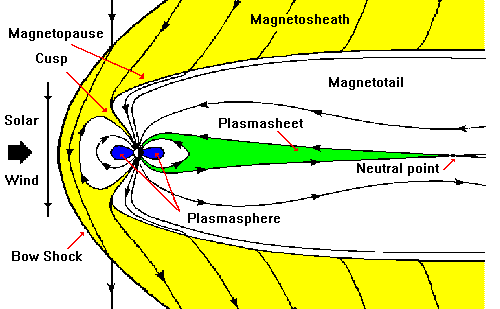
Actually the plots are based on the power flux measured by a polar satellite not by direct observation of the aurora so the light level shouldn't affect the measurement. I believe the reason the maximum activity occurs away from the noon meridian is because of the shape of the earth's magnetic field which has a long tail away from the sun because of the solar wind (as seen in this diagram)
Some additional info on the earth's magnetosphere -
Digital Ink?! In my day...
we didn't have no fancy-schmancy digi-ink! We did things the hard way and watched videos on Flip Books!
-
Re:What about the static electricity it will gener
How is it stationary? The Earth's magnetosphere is asymmetric and Sun-oriented, so in fact an elevator couldn't possibly see an unvarying magnetic field as it orbits.
-
Re:The Star Trek chronicles...
It was feared by technical consultant Mike Okuda that any such attempt would look foolish in just a few years
And that was very wise of him. Remember Max Headroom? Max only occupied about 64 MB of RAM. Of course when that show was made, typical home computers had 64K of RAM. Supercomputers of the time had 64 MB of RAM. -
Never attribute to malice...
Never attribute to malice what you can explain by stupidity.
Indian search on Windows. Only 10th result is good. First one is Windows Media Player, 2-6 are about Tablet PC with the same page for WinXP for Tablets appearing twice. There are also such wonders of relevance as Windows into the Soul of Satyajit Ray and Windows to the Universe - Jupiter.
Search for Windows at MSN is only marginally better. The poster of the story overlooked that first 4-6 results are "Featured sites", which (as well as "sponsored") is the marketese for "advertisements". Amazon will happily sell to MSN searchers practically everything. Heck, the second result for shit offers that I "Purchase Expensive Shit" on Amazon. I shit you not.
There are other gems at the MSN, like a "featured" result, suggesting that "MSN 8 offers a better browsing experience: Try it free for 60 days." when you search for netscape or gnu.org results starting after 12th position when you search for gnu. The first result, of course, being the famous E-gnu.com African Safari Travel...
MSN (despite their claims to the contrary) is a mix between marketing crap and inferior technology. Thanks, I will pass. -
Re:Element 101?
Aristotle and his ether
-
Transportation and Weather are Key Factors + CO
I don't know enough about what Canada has to offer, so this is limited to the U.S.
When folks around here say they're "going backpacking" they usually mean they'll be hiking in the wildnerness with just what they can carry on their back. Such trips rarely include visits to bookstores, musea, and other geek centers. Such trips are best in mountainous areas -- I can't imagine backpacking in North Dakota, for instance -- and can be done on a pretty low daily budget (but make sure you invest in high quality boots, tents, etc.). Some folks have mentioned the Appalachian Trail, which spans from Vermont to Georgia. On the other side of the country are lots of swell backpacking areas from the Rocky Mountains west. The national parks in Utah and Arizona (Canyonlands, Staircase, Zion, Grand Canyon, etc.) are especially popular for such trips, though if you've spent much time in the outback you may be sick of such a climate (though the terrain here is more impressive). Almost any national park or national forest is a good backpacking experience, and entrance fees (especially if you get a year-long pass) are astonishingly cheap.
Unfortunately, you'll be arriving at the tail end of good backpacking season. Beginning in late September you can't trust in a lack of snow anywhere inland in the northern two thirds of the country, though places like southern Arizona are quite enjoyable. Unless you're staying until late next spring, you should hit any outdoor areas in the north first and work your way south.
Unfortunatey, U.S. public transportaion leaves much to be desired. There's nothing like a Eurail pass, and Amtrak stops mostly in larger cities, which is sad, because trains played such a large part in building America. Greyhound has excellent coverage and fairly reasonable rates, but if you're going to a lot of places, your pocketbook could take a big hit. Finally, hitchhiking across the country is probably no longer a viable plan, but it may be invaluable in a pinch. Hitchhikers are, generally, assumed to be dangerous until proven otherwise. On the plus side, most cities have a bus system decent enough for tourists to enjoy the town.
Unless you have access to a car, my advice is to pick a handfull of (relatively small) areas you want to visit and then figure out what all the great things to do there are.
Some geeky things in my neck of the woods (Boulder, Colorado): National Institute of Standards and Technology (home of the most accurate clock in this hemisphere) is right next to a branch of National Oceanographic and Atmospheric Association and a beautiful two-hour mountain hike away from the National Center for Atmospheric Research. They've all got free tours and such, though I haven't taken one since security got tightened after 9/11/01. About 10 miles south of town is the National Renewable Energy Laboratory and more beautiful mountain hike areas. 30 miles or so to the north west is Rocky Mountain National Park, which gets pretty cold in September and later. Denver, CO has Forney Museum of Tranportation and also the nation's only major airport built in the last 20 years, so it's full of neat engineering bits.
Your post sounds quite ambitious, and there's no way you can really experience all of what's neat in America in even a year, so find some of it and enjoy the hell out of that! Cheerio! -
Re:Which DVD drives work under linuxOK. Thanks for the sarcasm. I had previously looked, and been struck by the fact that community support for this leading edge immature technology seems to be extremely diffuse.
I guess my question must have seemed really off topic on Slashdot.
So I took you up on your suggestion and found the following links. Maybe one other reader might find this of benefit:
-
Certainly bad by comparison with Venus
According to this page only 3 of 26 missions to Venus have been total failures. When you consider that Venus is a much more hostile environment than Mars then you have to conclude that either Mars is just plain unlucky or mission planners are getting something wrong.
-
Re:Nice
Mod this guy up. He's really telling the truth!
Loosely coupled clusters like PDSF are great for work like what the high energy physics people do, like SNO.
However, somethings work better on vector architectures such as climate models and fusion work: there is a reason why the Spanish Met troops bought a Cray. Additionally, some chemistry, many fusion and several other codes work best on vector architectures.
There guys presented their global warming work where at my job. They've developed their climate code though as a parallel one. See here. One of the places that they have been running is on seaborg, an IBM RS/6000 with over 6k and near 7k processors.
Interestingly, the PCM guys presented what they wanted for an uber'puter. While it had massive amounts of storage, it was also a 500 *PETAFLOP* SUSTAINED PERFORMANCE machine.
*clickety clack* That'd be something like 166,666,666 Athlons. IDK of any interconnects that handle that. Can you imagine being an admin? Better hope you're good on rollerblades zipping to and fro replacing those oh-so-reliable commodity disks and CPUs...even if you have a
Or is that what grad students are for? To attempt such a silly thing and then admin it?
Seriously tho. To get from here to their, we're going to need some exotic techs...not just more 'attack of the killer micros'.
-
worth a closer lookExcellent. Finding one of these is worth zillions of galaxies, quasars, and the like.
Even if it doesn't have liquid water, gasious oxygen, or solid land, then it can still focus as the fulcrum of our local jump point.
-
Re:Not a new concept...
Wasn't this pioneered years ago when the UNIX file system checking command was created?
Actually, it started with this system call. The file system checker came a little later. -
Re:definition
A moon is when you bend over and show Uranus to someone.
-
Re:Why?
And what about the rings around Uranus?
-
cksum
-
Re:It'snothacking.it's called "radio"-Desktop weat
File formats aren't your primary concern (As a meteorologist, when you say "full featured" I think of plotting surface and upper air observations and model output). You should be able to get by with processing text (station and upper air output) and GRIB format data. There are numerous GRIB readers available (except maybe for Java). A couple of places I'd suggest looking are:
www.weathergraphics.com - I'd make it a link but it's not coming up right now. Tim Vasquez wrote the popular "Digital Atmosphere". You can look to his site to see where to get data.
Unidata Community Portal (free reg required). Go to "downloads" and look at GEMPAK. The IDV is written in Java and could be a jumping off point but it uses the VisAD library which has a huge learning curve. There are other downloads which may be of interest to you as well.
Good luck! -
Re:this is nothingSpeaking of legally downloading large amounts of data per day, let me just give a quick run-down of things I as a meteorology student do regularly. Note that none of the things I am listing here are part of my education per se, but simply things that I do on my own time.
- Run a weather model on my machine 4 times/day, initialized off of the NCEP Eta model (which it also uses for boundary conditions). I use the lower-resolution grids and omit every other model output time, and it's still ~700MB/day (over 20GB/month).
- Download archived Level II Nexrad data for examination (usually to perform ad hoc, informal case studies). Data amounts for a single day of interest for a single radar typically run between 300-500MB compressed.
- Download model output data for examination. Using the Eta model as an example, a single "tile" (covering only a few states in the U.S., for example) for a single time is around 1.5MB (which might not sound like much, but it adds up really fast when trying to look around at various parts of the model domain for various times).
- View and download for processing a wide variety of constantly updating real-time weather data (bandwidth usage varies widely based on current conditions).
- Run Gentoo.
That being said, it's unrealistic for us to believe that we have some kind of God-given right to infinite bandwidth. Bandwidth is limited, and perhaps a reasonable, and let me stress reasonable surcharge for excess bandwidth usage would be a good thing, in that it would force us to use our bandwidth more judiciously. It seems as though Napster, Gnutella, etc., while they initially fueled the explosion of broadband, are now its worst enemy as they tend to be very wasteful of resources, though they certainly have legitimate uses. Oh, the irony... -
Re:weather radar image
Not sure of it's been posted by anyone on the two threads, but here's a Radar Image of the debris rain being picked up by weather stations.
That image is labeled "15:26 UTC 02/01/2003". If I'm doing the math right (and Texas is on Central Standard Time, a.k.a. UTC -6:00), that's 9:26 local time, 10:26 Eastern
This Slashdot article from this morning points to this dramatic page, which shows a similar radar map, archived from about 13:00 to 17:00 UTC. The trail appears at 14:05 UTC, shortly after the breakup, and lingers for the remaining two hours of the loop. (The original poster said it "disappears so suddenly," but I think it's just the end of the loop.) I hacked the URL a little, and watched it last until almost 21:00 UTC, nearly seven hours after the incident.
So what is it? A line of dust-sized particles too light to fall? Some sort of condensation or thermal effect? (There are some other line-shaped artifacts in some frames, but nothing so dramatic.)
Nothing shows up in the live radar map.
P.S.: The ucar.edu page just stopped responding. Slashdot effect? -
Check out this imagery
http://www.rap.ucar.edu/cgi-bin/neilley/NIDS_arch
i ve?Radar=SHV&Composite=NONE&Start_date=20030201&St art_time=13&Duration=240&Frequency=0&Parameter =1
Here is a 4 hour sequence of high-res Shreveport imagery. Whats amazing is how long the debris trail lingered in the sky, and the way it disappears so suddenly I almost think they may have adjusted the radar's gain to hide it.
I'd say this is totaly cool, but... -
Radar loop archive of debris
There is an archive of radar images of the debris field. Someone else posted a link to NOAA's live radar images, but this loop starts at the time of the accident.
-
About the Reversal, and magnetosphere......
Can this explain it?:
"A planet's magnetosphere is provided through its magnetic field. To create a magnetic field, a planet or moon must have magnetic material such has iron, which is warm enough to move around to form currents within the planet."
And isn't earth(s core) cooling down? - Can't this affect our magnetosphere? If the magnetic materail stop flowing?
My imaginary plot (IMHO):
Now I'm thinging that when earth switched poles, the core coold down, reversal happened, sometime after that earth got hit by a large enough meteor to restart our core (how elese could the core be restarted? there wasn't atomic weapons and the like back in those days, no! Good ol' fashion meteors had to suffice : )). Then earth keept it's (reverse) position till it coold down again, and re-reversed itself again. Sometime after, BAda'BOOM eine large enough meteor struck again, restarted our engine, and we keept on ticking.... untill soon enough (if we think 1000 year or more is soon..) when our core will stop flowing.
Can someone please look up how long ago earth was struck by a large enough meteor to turn earth in to a giant blob of lava? : )
I put my money on lets say 780 000 to one millon years ago
Earth cooling down:
Here's the tricky part; How much must the earth's core cool down for reversal to happen? Because for it to cool down entirilely it will take more than 1000 years.
Reference:
http://www.seismo.unr.edu/ftp/pub/louie/class/100/ interior.html
http://www.windows.ucar.edu/tour/link=/earth/moon/ moon_magnetic_field.html&edu=high
http://www.windows.ucar.edu/tour/link=/physical_sc ience/magnetism/magnetic_materials.html&edu=hi gh
http://www.newscientist.com/news/news.jsp?id=ns999 92152
http://www.observer.co.uk/international/story/0,69 03,837058,00.html -
About the Reversal, and magnetosphere......
Can this explain it?:
"A planet's magnetosphere is provided through its magnetic field. To create a magnetic field, a planet or moon must have magnetic material such has iron, which is warm enough to move around to form currents within the planet."
And isn't earth(s core) cooling down? - Can't this affect our magnetosphere? If the magnetic materail stop flowing?
My imaginary plot (IMHO):
Now I'm thinging that when earth switched poles, the core coold down, reversal happened, sometime after that earth got hit by a large enough meteor to restart our core (how elese could the core be restarted? there wasn't atomic weapons and the like back in those days, no! Good ol' fashion meteors had to suffice : )). Then earth keept it's (reverse) position till it coold down again, and re-reversed itself again. Sometime after, BAda'BOOM eine large enough meteor struck again, restarted our engine, and we keept on ticking.... untill soon enough (if we think 1000 year or more is soon..) when our core will stop flowing.
Can someone please look up how long ago earth was struck by a large enough meteor to turn earth in to a giant blob of lava? : )
I put my money on lets say 780 000 to one millon years ago
Earth cooling down:
Here's the tricky part; How much must the earth's core cool down for reversal to happen? Because for it to cool down entirilely it will take more than 1000 years.
Reference:
http://www.seismo.unr.edu/ftp/pub/louie/class/100/ interior.html
http://www.windows.ucar.edu/tour/link=/earth/moon/ moon_magnetic_field.html&edu=high
http://www.windows.ucar.edu/tour/link=/physical_sc ience/magnetism/magnetic_materials.html&edu=hi gh
http://www.newscientist.com/news/news.jsp?id=ns999 92152
http://www.observer.co.uk/international/story/0,69 03,837058,00.html -
Re:Why don't they...The same part of the moon always faces the earth, from our view it doesn't rotate.
From: http://www.windows.ucar.edu/tour/link=/kids_space
/ qmoon_motion.html"The "dark side" of the moon is not always dark. The reason it is called the "dark side" is that that side of the moon is never visible from Earth. The moon's rotation and orbit are synchronized in such a way that we can only see one side. However, that "dark side" (or far side which is a more appropriate name!) does see the sun. For example, when we see only a sliver of the moon, most of the far side is facing the sun. During a solar eclipse, all of the far side is sunlit!"
-
Re:Fuzzy logic
The company I work for (NCAR - National Center for Atmospheric Research) uses Fuzzy Logic extensively. A common scenario is that we have data from a lot of different sensors, and we use fuzzy logic to combine them all together and make a decision (e.g. is it safe to fly?). Another example I've seen is using fuzzy logic to clean up noisy data. We use fuzzy logic to find boundaries, fit curves, etc.
Here are a bunch of examples of the use of fuzzy logic at NCAR. -
Mowed grass emits hydrocarbonsNot only that, but the mowed grass actually emits hydrocarbons -- the same amount a gas mower does.
For example, a team of U.S. and European scientists recently found that mowed grass emits hydrocarbons at a level of 20 to 60 parts per billion--which is comparable to the level released by the gasoline-powered mowers cutting the grass. In an article published this year in Environmental Science & Technology, the team reported: "The results of these experiments suggest that common lawn mowing releases substantial amounts of reactive VOCs and should be considered in urban air-quality control strategies."
-
Re:NOAA
Speaking of meteorological programming, ALL the major atmospheric models are written in FORTRAN. The ETA, AVN, NGM, MM5, WRF, and scores of lesser-known models...all of them written in FORTRAN (most of them FORTRAN-90 now, but some of the older ones are FORTRAN-77). The MM5 & WRF may be found here and here. The source code to several others is readily available as well if you're so inclined, for instance the ETA and the ARPS. Anyone wanting to run them may do so fairly easily on a PC running Linux (any new PC will be able to run a fairly hi-res model real-time); I do so myself.
-
Re:NOAA
Speaking of meteorological programming, ALL the major atmospheric models are written in FORTRAN. The ETA, AVN, NGM, MM5, WRF, and scores of lesser-known models...all of them written in FORTRAN (most of them FORTRAN-90 now, but some of the older ones are FORTRAN-77). The MM5 & WRF may be found here and here. The source code to several others is readily available as well if you're so inclined, for instance the ETA and the ARPS. Anyone wanting to run them may do so fairly easily on a PC running Linux (any new PC will be able to run a fairly hi-res model real-time); I do so myself.
-
USSR brought back 301g of soil
...at least that's the best info I can find at the moment. Check out the Moon page at the National Space Science Data Center. Look at "Luna" landings, specifically Luna 16, 20, and 24.
If you want to see where they landed, check out the Jules Verne Voyager Java applet. Choose "USSR Luna Sites" from the dropdown. The sites will show up as purple dots. Click and drag a box to zoom in on that box.
So, with only 301g of moon soil, I don't think the Russians were giving much of it away. (The U.S. brought back hundreds of kilos.) Also, the U.S. and the U.S.S.R. are the only countries to have collected samples from the moon. Notable, however, are the Japanese crash of satellite Hiten into the moon in 1993, and Hughes Global Services' flyby of the moon with the satellite AsiaSat 3 in 1998, which had been originally launched by the Chinese.
Given the above, I would therefore assume that any moon rocks possesed by collectors were either purchased or stolen from the U.S. government, since the only other country to have any is Russia, and they don't have very many. -
Re:Well I hate to burst your balloon but...
I've launched a rawinsonde a few times for the NWS, and frankly I don't have a clue as to where they think that these things stay up in the air for more than MAYBE 6-7hrs, let alone 24.
BTW, balloons burst about 2-3 hours after release, then they fall back to the ground via parachute. Granted it's a slower trip back down, but still...
I'm thinking they've taken too many pulls off of the hydrogen tank.
Check out some upper air data...
Another link...
See how many flights make it up to 110kft?
Alot more make it to 90kft...
NWS Upper-air Observations Homepage
Too lazy to log in,
wxnerd -
Re:Japanese scare
The politics that follow this 'sale' ought to be rather interesting. NCAR bought a Japanese supercomputer some time back and nearly got wiped out by funding deletion by the US Congress.
What happens next ought to be VERY interesting.
On the other hand, the Cray employees I've talked to - needling them for giving into the dark side and selling a SX-6 - have said that anything that is good for vector computing is good for Cray: they can always sell a follow-ob with their SV-2 and SV-2e.
I saw a post that I skimmed above that stated something to the effect that "you'll never touch [a supercomputer]. We, at NERSC, are still looking for a few good sysadmins. Keep in mind we're pretty brutal about who we let in, but if you think you have the right stuff to be a sysadmin on some of the world's most powerful machines...;) -
Re:Slashdot world-wide science experiment.
-
Sirius are a bunch of whiners
The fact is that 802.11b channels are only 25MHz wide. And 802.11b equipment is quite capable of working with adjoining 'cells' butted right up against each other. Check out this table. The non-overlappig channels are 1,6 and 11. Total center-to-center separation? 50Mhz between channels 1 and 11 with room for a channel in between. If Sirius has a problem with 802.11b I'm going to hazard a guess it's because their receivers are crap. I'll bet that they are receiving part of the legitimate 802.11b signal.
I've actually run tests to see how well two access points work if you locate them close together (about 4 feet). You can see a writeup of all the tests I did here: Interference Tests. When I tried to run two laptops connected to two access points on channels 1 and 6, I found a little interference. Not much. Maybe a 20% drop in total thruput. Once I went to channels 1 and 7 (30MHz separation) the two access points operated with no detectable interference at all. The aggregate thruput was basically 2x the thruput of a single access point. (Note that the 209% and 212% results are because I was using laptop to ap traffic as the baseline, but the equipment I was using produced higher thruput in the ap to laptop direction)
While the interference at channels 1 and 6 technically shouldn't happen, no body in their right mind puts two access points four feet apart and tries to run them both at full bore. So the radios could be a little better. But even in this worst-case scenario, all interference disappeared at 30MHz separation. And Sirius is complaining about 55MHz separation? Almost twice the distance?
What Sirius is finding out is that the idea of transmitting from a satallite to a non-directional antenna is extremely hard. That's probably why the other sat radio company XM plans to spend ~$250,000,000 dollars building a system of terrestrial repeaters! It's hard to link to, but check out the 10-Q SEC filing on their web site if you don't belive me. I can't find it now, but another SEC filing in there goes into detail about the need for repeaters because they know their signal can't be reliably received inside a major metropolitan area.
If Sirius has burned thru $3 billion and still doesn't have a reliable system, well boo hoo. The only reliable sat-based communications I know of use directional dish antenna's. (Please don't use GPS as a comeback because it doesn't have to work in a lot of places that a car radio has to, and it carries almost no information in the signal.) Irridium tried it and failed. Sirius apparently can't get it to work, and I'm going to guess that they will soon be history. As for XM, well, I think they got it to work, but only by spending a fortune on repeaters so most of their customers probably aren't even using the satellites! I think XM is going to go down the tubes anyway since they probably need to get at least 1,000,000 paying customers this year to keep going.
So I think Sirius and XM are going to follow Irridium down the tubes. And life will go on. As every good capitalist knows, massive failures prove the resiliancy of our system. That's what's know as "The Enron Axiom". -
interesting link
There are pages here that discuss nuclear propulsion techniques and demonstrates their superior potential over chemical rockets. Interesting read
-
Re:The study
All these scientists that signed the 2nd paper discounted what the
1st guys said and they did it with an overwhelming number of people
Last time I looked, the scientific method did not include petition drives
and petition signing contests. What you may not know about the "2nd
petition" that you mention is that it was circulated, like a piece of junk
mail, to many thousands of people having no expertise in climatology. I
know this because *I* got a copy, requesting my signature, even though my
work is in computer science and engineering. *Anyone* can sign that
"2nd petition" online, right here
. This petition drive is being lead by Frederick Seitz, President Emeritus,
Rockefeller University. Anyone recall
how the Rockefellers made their fortune?
The "2nd petition" is debunked in a
letter written by top scientists from the American Meteorological Society
(AMS) and the University Corporation for Atmospheric Research (UCAR).
It is a fact that
CO2 in the atmosphere is increasing, it is a matter of simple physics
that increased atmospheric CO2 will lead to higher temperatures. What,
to me, still seems debatable, is what the effects of those higher temperatures
will be on the Earth's ecosystems, and human civilization in particular.
Change is certain, but the nature of the change, and the relative benefits
and drawbacks, are unknown.
-
Re:Microsoft is the same as ever
>attribute to Malice what can be attributed to Incompitence
please fix your sig (at least spell incompetence correctly)
"Never attribute to malice what can be explained by
incompetence"
Richard Loft
Favorite Quotes
I've also seen "Never attrubute to malice that which can be adequately explained by incompetence." -
Unix as literature
You're not alone. I started out as a history major and picked up my unix experience in a (non-history) graduate program. As a result, I've always appreciated this article on The Elements Of Style: UNIX As Literature
-
Site is slashdotted (almost), so here are mirrors.
Well, since the site is getting hit pretty hard, here is a direct link to all the mirrors:
Capture the Capture The Flag Mirrors
If you have a mirror up, please let me know.
If you're using wget to pull the data, please use the following command:
 wget -r -nd --no-parent -R "=A","=D" http://site/path/
US - Wisconsin (100Mbit):
http://www.wi2600.org/mediawhore/mirrors/shmoo/cct f-defcon9
US - Colorado (100Mbit):
http://www.ucar.edu/temp/shmoo-defcon9-ctf/
US - Pennsylvania (T1):
http://www.bitsend.com/defcon9-cctf
US - Alaska (DSL):
http://cctf1.shmoo.com
Please be sure to read the license. -
Mega-solar flares during solar maxima
It's interesting to note that these events (the July 13 2000 mega-flare and this one) happened during a solar maximum, i.e., the peak of a 11-year solar cycle.
There is a nice explanation with graphics here: http://www.windows.ucar.edu/cgi-bin/tour.cgi?link
= & d=/sun/activityNote that in spite of documented variations (e.g. the "Maunder Minimum" from 1650 to 1700, where cold climate coincided with very low solar spot counts), solar emissions are assumed to be constant in numerical climate simulation models. Which explains why these simulations are not exactly accurate.
-- SysKoll
-
SuomiNetAnother closely related project (in fact I think they share GPS groundstation receivers with the Southern California geodetic folks) is SuomiNet
http://www.unidata.ucar.edu/suominet/
http://www.unavco.ucar.edu/equipment/suominet/SuomiNet is a national network of GPS receivers, located primarily at universities, configured and managed to generate near real-time estimates of precipitable water vapor in the atmosphere, total electron content in the ionosphere, and other meteorological and geodetic information.
Example use of this data can be found at:
http://www.gst.ucar.edu/gpsrg/realtime.htmlNeat stuff! Now if only the data from these fixed GPS sites were easily available via the web
-
SuomiNetAnother closely related project (in fact I think they share GPS groundstation receivers with the Southern California geodetic folks) is SuomiNet
http://www.unidata.ucar.edu/suominet/
http://www.unavco.ucar.edu/equipment/suominet/SuomiNet is a national network of GPS receivers, located primarily at universities, configured and managed to generate near real-time estimates of precipitable water vapor in the atmosphere, total electron content in the ionosphere, and other meteorological and geodetic information.
Example use of this data can be found at:
http://www.gst.ucar.edu/gpsrg/realtime.htmlNeat stuff! Now if only the data from these fixed GPS sites were easily available via the web
-
SuomiNetAnother closely related project (in fact I think they share GPS groundstation receivers with the Southern California geodetic folks) is SuomiNet
http://www.unidata.ucar.edu/suominet/
http://www.unavco.ucar.edu/equipment/suominet/SuomiNet is a national network of GPS receivers, located primarily at universities, configured and managed to generate near real-time estimates of precipitable water vapor in the atmosphere, total electron content in the ionosphere, and other meteorological and geodetic information.
Example use of this data can be found at:
http://www.gst.ucar.edu/gpsrg/realtime.htmlNeat stuff! Now if only the data from these fixed GPS sites were easily available via the web
-
Samsung Sens 810
There was an old, much-heralded (in fact, many people used it to run Linux!) notebook called the Samsung Sens 810.
http://www.atd.ucar.edu/homes/burghart/SENS810.htm l
The keyboard split in the middle to make it similar to a Microsoft Natural Keyboard in functionality. While the days of Pentium-100 laptops are long gone, it's still a good design, and with 15" displays now prevalent, there's no reason some enterprising manufacturer couldn't integrate one.
If this kind of keyboard is a requirement on a laptop, you may be able to find a cheap Sens 810 on eBay (for the lazy, that link will do the search for you). It would probably make a good Linux box for basic word processing - and would definitely do well with VNC to that 1.3ghz Athlon beast you have stored away somewhere..
Ben -
Re:Cooling solutions are good
Actually, how about dumping the entire thing in
a bath of Fluorinert (an electrically inert hydrocarbon (IIRC?) liquid)
as used for cooling the Cray C90 amongst others.
This is *immensely* neat stuff - I once saw a television (operating) dumped in a tub of this stuff, incredibly weird sight.
Ah. In checking back through my bookmarks, I see something similar has been mentioned Here
-
Re:CDC (off-topic)
CDC built large mainframes in competition with IBM in the 60's. When they started, IBM didn't have anything near as powerful as the CDCs. So IBM announced the System 360, then tried to build it. The 360 hardware might have been on schedule, but the OS was several years late -- but still, many IBM customers waited for it instead of buying CDC. CDC filed an antitrust suit, claiming that selling vaporware was unfair competition. Long before the suit was settled, the full 360 line was out and delivering the promised power, and CDC was bankrupt.
This sounds like a mangled version of what I've heard was the story of a specific model in the System/360 line, the Model 91 (or maybe it was first called the Model 92).
The Model 91 (or 92) was announced as a number-crunching supercomputer model, perhaps before it was actually read; this note on another IBM supercomputer project says
In August, 1961, IBM started planning for two high-performance projects to exceed the capabilities of Stretch. The first project, called "Project X", was assigned to the IBM Poughkeepsie plant, and in 1963 the design became a member of the S/360 family. This machine was announced as the IBM System/360 Model 92 in 1964 and was delivered as the Model 91 (with core memory) in late 1967 and the Model 95 (with thin film memory) in early 1968. Project X had a goal of 10 to 30 times the performance of Stretch, with an initial cycle time goal of 50 nsec (the Model 91 shipped at a 60 nsec cycle time). The Model 91's floating-point unit is famous for executing instructions out-of-order, according to an algorithm devised by Robert Tomasulo.
This may have been a preemptive strike against the CDC 6600, which, according to this note, was announced in 1964 and shipped in 1965.
As far as I know:
- IBM's announcement of the S/360 wasn't timed to get in the way of CDC, although the announcement of the S/360 model 92 (later to be the 91) may have been;
- CDC wasn't bankrupted by that announcement - they eventually got out of the computer business, but that happened, as I remember, some time in the '90's.
-
You sir, are misinformed.
I would claim that you sir, have "no fucking clue" when it comes to 802.11b. Let's look at your claims: DSSS has a maximum theoretical thruput of 4-5Mbps? I don't think so. I have personally run performance tests of Aironet and Lucent 802.11b cards, and have acheived thruput of 7.6Mbps. 50% higher than your "maximum". Results are right here.
You also claim that WEP adds zero overhead becuase it is a "hash" done in hardware. WEP is not a hash. It is RC5 encryption, a stream cipher not a hash. Moreover, many products do not implement the cipher in hardware. Specifically, Lucent uses software and takes a 20% performance hit when WEP is enabled. The Aironet cards use hardwar and take no performance hit. See the above URL for details.
The reason DSSS is marketed above FHSS is because it is faster. The fastest FHSS 802.11 hardware runs at 2Mbps, and is in fact cheaper than DSSS hardware. 802.11b is winning because it is flat out the fastest afordable wireless ethernet technology on the market.
So, I ask, if we are "fucking stupid idiots" for buying 802.11b, what would you recommed? 2Mbps FHSS gear? Non-existant HomeRF that even Intel abandoning? Please, o wise one, enlighten us "fucking stupid idiots" -
simulate weather/climate systems
About the time I got my first K6-3D box, and was considering an early Athlon box, I looked into weather simulation programs as a fun thing to run in order to use up all the excess CPU cycles I now had. A number of different packages exist that will produce interesting results, though I don't know how easily they can be made to compile and run on Linux (the problem is finding a good Fortran compiler): NCAR/Pennstate mesoscale model MM5, NCAR Community Climate Model CCM3, and Colorado State RAMS model.
-
simulate weather/climate systems
About the time I got my first K6-3D box, and was considering an early Athlon box, I looked into weather simulation programs as a fun thing to run in order to use up all the excess CPU cycles I now had. A number of different packages exist that will produce interesting results, though I don't know how easily they can be made to compile and run on Linux (the problem is finding a good Fortran compiler): NCAR/Pennstate mesoscale model MM5, NCAR Community Climate Model CCM3, and Colorado State RAMS model.
-
Re:getting started young
Kinda reminds me of my first astronomy class. I hadn't even made it to my freshman year of high school and I had 4 credits of Astronomy from the local community college.
Many people have given good advice above. I'll mainly just second their comments. The order I'd proceed in is.
First item, a good beginners star atlas.
Second item, warm clothing.
Third item, many nights in the country just learning the stars and constelations.
After that go and get a good pair of binoculars or a good telescope.
Last, but not least. As your doughter is so young, you will need to be there as a source of infromation. You'll need to learn alot to help guide her in the early years.
Now for some Links. The first two have good beginners information. Some of the links below may be dead. I just quick cut and pasted them from the astronomy section of my Interesting Places page.
- Astronomy Mag. (www.astronomy.com/home.asp).
- Sky & Telescope Mag. (www.skypub.com).
- Minnesota Astronomical Society (MAS) (www.mnastro.org).
- The Telescope Shoppe (www.telescopeshop.com), 3402 Federal Dr., Eagan, MN, 651-688-7335. Yes this is a local Twin Cities telescope shop. They have a map on their site showing where they are. They are tucked in the lower level along the side of the strip mall they are in. The store is small and easy to miss. If your at the corner of Yankee Doodle RD and Federal Dr., park in the lot to the south east. They are a short stones throw from the intersection.
- Telescope making links
- Many good links on making AltAz mounts (zebu.uoregon.edu/~mbartels/altaz/altaz.html).
- ATM's resource List (www.freenet.tlh.fl.us/~blombard).
- Astronomy-Mall.com (www.astronomy-mall.com/Astronomy-Mall).
- Stellafane (www.stellafane.com).
- Terrestrial Planet Finder (tpf.jpl.nasa.gov).
-
Many Images of the moon (www.seds.org/nineplanets/nineplanets/pxmoon.html
) - Solar Views (www.solarviews.com).
- Planetary Image Atlas (www-pdsimage.JPL.NASA.GOV/PDS/public/Atlas).
- Hubble Space Telescope Archive (oposite.stsci.edu/pubinfo/pictures.html).
- Hummble Site (hubble.stsci.edu).
- StarStuff (www.starstuff.org).
- SpaceRef (www.spaceref.com), Your space refference.
- Astronomy Picture of the Day Archive (antwrp.gsfc.nasa.gov/apod/archivepix.html).
- SkyView (skyview.gsfc.nasa.gov) virtual observatory.
- 2MASS (www.ipac.caltech.edu/2mass/) and (pegasus.astro.umass.edu/GradProg/2mass.html) Two Micron All Sky Survey.
- Large Angle and Spectrometric Coronagraph Experiment (LASCO) (http://lasco-www.nrl.navy.mil/lasco.html).
- AAVSO Network to Search for Optical Counterparts of Gamma-Ray Bursts (www.aavso.org/grb.stm).
- High Altitude Observatory (www.hao.ucar.edu).
- Asteroid Comet Impact Hazards (impact.arc.nasa.gov).
- Unusual Minor Planets (cfa-www.harvard.edu/iau/lists/Unusual.html).
-
Potentially Hazardous Asteroids (cfa-www.harvard.edu/iau/lists/PHACloseApp.html).
& nbsp; Of particular interest to me are LB16 and AN10 which will pass at a distance closer than the moon's orbit. LB16 currently only has one opposition charted so it's predicted orbit will likely change as new data comes in. It's expected to swing by in 2004. In 2027 AN10 will visit earth. It's orbit is calculated with three oppositions meaning it't much more likely to really showup ontime and in place. With further data LB16 could either get closer or farther away. When AN10's orbit was first predicted (only one opposition at the time) it's error envelope included earth. With further data it was found to just pass within the moon's orbit and miss the earth. -
Forthcoming Close Approaches To The Earth (cfa-www.harvard.edu/iau/lists/CloseApp.html).&nb
s p; This is the document to look at when you want to know who will visit next and how far away. It has all close approaches to 0.2 AU away from earth or within 20% of the distance of between the sun and earth. On Sep 19th, 2000 we will have a visiter at 0.0477 AU and on Oct 31st anotehr one will pass at 0.07386 AU. LB16 and AN10 are expected to pass at around 0.25% of the distance between the sun and earth.
- Mars Global Surveyor (mars.jpl.nasa.gov/mgs/index.html).
-
Mars Orbiter Laser Altimeter (MOLA) (ltpwww.gsfc.nasa.gov/tharsis/mola.html).
There are full data on the shape of Mars including 1 degree and
- Planetary photojournal by JPL (photojournal.jpl.nasa.gov).
- NASA's Origins Program (origins.jpl.nasa.gov).
-
Re:See the Cray 3 (forgot the picture)
The Cray 3 dissipates 88 kilowatts of energy with the help of flourinert. The ultimate cooling solution: