Slashdot Mirror
Domain: ucsf.edu
Stories and comments across the archive that link to ucsf.edu.
Comments · 124
-
Only one part of the puzzle
Listening to Futures in Biotech this past week, I came across similar work about aging that's quite interesting.
http://kenyonlab.ucsf.edu/html/publications.html
So far most of the work is on lower life-forms but it comes down to the IGF-1 signaling pathway and mutations of the genes responsible for the IGF-1 receptor sites affecting aging. That's pretty glossed over but you can read more about it if you like. -
Re:Like to see this replicated
Maraviroc (and Vicriviroc etc) resistance also occurs. Then there is the matter of tropism and the
CXCR4 receptor. Chemokine Coreceptor 5 moleculer antagonists are not a panacea for HIV, neither
is BMT as the HIV exists in cells outside of the BM. Things are not as simple as this article
suggests. -
Re:Why isn't this 99.9%?
Because mammography is an extremely non-sensitive test.
http://mammography.ucsf.edu/inform/html/graphics/graph2a5.gif
This shows how few women the test can actually benefit - 37 out of 10,000 over all lifetimes. Even worse is that the women who are diagnosed falsely positive far outstrips those that actually have cancer by orders of magnitude. This creates a harmful burden on the falsely diagnosed women - creating morbidity and even mortality.
You can make a machine that gets 99.9% of all women who do have breast cancer. Unfortunately, out of the 9740 that never will/don't have breast cancer 9700 will be falsely diagnosed as having it.
-
Re:Zoning gone wild.
I'd imagine it's quite hard to determine.
Nope. Table here. What you do is check a cumulative exposure meter or "dosimeter", like this one. To check an area, you reset it, then leave it there for 24 hours, then read the exposure. If it exceeds any of the guidelines, you have cause. Simple.
Must you wait until you are actively hurt to stop me?
No. If you impinge upon the *edge* of my property with dangerous levels, I have justification for action; that doesn't mean I'm hanging out at the edge of my property; and the kind of radiation danger you're talking about decreases rapidly with distance. It really isn't a problem, as long as I know to monitor the levels. But law or no law, there's no difference there. I do own a Geiger counter and two resettable dosimeters, so your example is fine. Might not be for someone else, but then again, they aren't my problem, either.
But the overarching rule is that a majority can change any rule (except for the majority rule).
Actually, not here. We're a republic, not a democracy. So small numbers of people make the rules. This is an attempt to avoid tyranny of the majority; IMHO, it doesn't work, but nonetheless, that's our system.
Zoning may step on people's liberties, if they disagree with the zoning. Aren't you the one that arguing about potential negative consequences is no reason to restrict liberty? Like the liberty of a group of people to enact zoning laws?
No. I argue for personal liberty. Group liberty is something else entirely and is usually antithetical to individual liberty. The latter is more important than the former.
I agree with this. But a shared resource requires government control. At least to keep people from poisoning it. But why should air be treated differently from land? Why is land not a shared resource?
Because land is generally stable and can be controlled, fortified, quantified, guarded, mined, farmed, populated with domiciles and storage and manufacturing facilities and canals and roads and otherwise significantly improved without losing control or location; investments such as these need the assurance of stability in order to encourage the investment. If I point to a chunk of land and tell you, we all share this land, you can build here, and you do, and after you build your home, someone else comes along and says 'we all share this land, I'm going to live in your house with you', you're likely to be a little bit miffed. Without ownership, you lose control, and without control, there's little reason to invest. No investment means no improvement, no improvement means less commerce, taxes, etc., and so government has every reason to make ownership an important priority. Governments that don't do this - the ex-USSR comes to mind - tend to see very little enthusiasm for working the land. Farms under produce, buildings are not kept up, etc. Without a direct connection to the value of the land, again, investment is stifled.
I cannot get over the question of the original aquisition. The first person to get the land did not buy it, he claimed it. Other people cannot claim the same land, because he "saw it first".
This is true. The original "ownership" is a consequence of exploration and exertion of power, either directly (taking from previous residents, such as American Indians) or indirectly (claims made in the name of the monarch who funds the expedition or claims the region.) However, in this case, it's "he who has the power makes the rules" and it always has been. Doesn't make it right; but it makes it a fact.
That poisons all future transactio
-
Re:I pledge not to be a shill or tool
"Giving up" on doing a study showing a particular result means hiding results that don't agree with your hypothesis. You can't give up on something unless you've tried.
Here's one from 2003.
A report from 1998.
Some more from the 1990's.
And a Stanford professor on industry FUD in the 50s to 70s. (unfortunately light on details, it's a press release).
It's hard to find the papers from that long ago. I will amend my post though: the tobacco industry is STILL doing their best to pervert science to show results favourable to themselves.
-
Re:One future cadaver for sale, liver not included
A recent staple of science fiction is the story of people optioning their body parts for money while they're still living
Meanwhile, in the real world, there are dozens, if not hundreds of university "Willed Body" programs to which you can commit your cadaver. However, their FAQs mention that it is illegal for them to pay you for your donation.
http://anatomy.ucsf.edu/WBP/index.html#10.html
http://www.hsc.unt.edu/departments/pathology_anatomy/willedbody/faq.htm#q4
http://www8.utsouthwestern.edu/utsw/cda/dept128871/files/128973.html#4
Interestingly, 2 of the above 3 specifically cite *state* law. Are there any states where some version of the law isn't on the books? -
Re:Solution
NONMEM, used by most (if not all) scientists doing pharmacokinetics/pharmacodynamics, is written in FORTRAN 77. I'm sure there are many more examples of important scientific and engineering code still maintained in FORTRAN. When gfortran becomes about as stable as g77 was, perhaps most will really move on to Fortran 95.
-
One thing, though...
When HIV and AIDS were first discovered, and the epidemic that was unleashed started, the life expectancy of the unfortunate recipient was about 10 - 15 years. Now, however, after only 10 years of drugs and healthcare being on the market, life expectancy is much, much better. How are these drugs making people's condition worse? Is living a worse fate than dying?
And you can't tell me that all those people who are now surviving the various types of cancer that would have died just 20 years ago is proof that people are being denied healthcare and drugs. People that would have died 20 years ago are now living full, happy lives. Well, not happy, that that's another story about how people were lied to 50 years ago about having flying cars now. On second thought, where are the flying cars...
But I digress. Seriously, for all of Big Pharma's flaws, they do help people. Medicines do cost a ton of money to research, develop, test, retest, go through FDA testing, test one more time for good measure, and finally release. Plus, after releasing the drug, more testing is done through the doctors prescribing it, as well as the company having to spend money to get the word out. Yes, advertising. It is part of it. The best wonder drug in the world won't work if nobody knows about it.
Plus, part of those high costs are for all the research on drugs that didn't work. Just because a drug is researched and millions spent on it doesn't mean it will ever get to market. One hiccup along the way can be enough to send the companies back to the drawing board. On the topic of this, costs are also raised when the company has to basically protect itself financially from when a drug reacts poorly with someone, they die, and the company is sued. Sure, it may have worked on 99,999 other people, but one wrongful death lawsuit can set a company back millions of dollars.
Last, but not least, when a drug doesn't work, it is not a complete loss. The company then knows what won't work. They can still salvage research from the drug, how it affected the virus/bacteria, and move on from there. Storage of these maybe-medicines can't be cheap, what with regulating everything from temperature and humidity to making sure that the computer backups of the backups are always up and running, because if these people lose files, it isn't just the courts they have to worry about, it is also the fact that people can die from lack of information. So their systems have to be top notch at all times. That isn't cheap.
Oh, and one last thing. As much as everyone demonizes Bill Gates, the Bill and Melinda Gates foundation does do a lot to help people. Just because his business practices weren't always on the up and up doesn't mean he's a total loss in the way of morality.
I know that I just lost half the support of Slashdot when I wrote that last comment. Oh well. Can't win them all. -
Re:Why not fire them all?
$32,000 is a little low, but really, not that far off. Look at the stipend level recommendations from http://www.niaid.nih.gov/ncn/budget/stipendlevels.htm/NRSA and it's about right. Some schools do have a cost of living increase, but starting postdocs at http://www.gladstone.ucsf.edu/gladstone/site/postdoc/section.php?id=935 UCSF start at $43, 000. Not much, really, for living in SF.
-
University of California SF AP test
http://perfectpitch.ucsf.edu These articles are a result of people participitating in the above web site. Particularly fun is their test to determine whether you possess absolute pitch or not.
-
Re:how often is it misdiagnosed mad cow?
We do test for CJD in this country. The Memory and Aging Center at UCSF has a group dedicated to CJD clinical trials and studies. http://memory.ucsf.edu/
-
Re:Let's not get ahead of ourselves...
Well, not quite REAL deaths, but still 80,000 dead...
[quote]
The error that the CDC has "admitted" is a calculation error in the spreadsheet that was used to come up with the 400,000 obesity death estimate. They referenced the wrong cell in the spreadheet. When this mechanical error was fixed, the death estimate dropped by 80,000.
[/quote]Original article: http://www.ucsf.edu/its/listserv/stanglantz-l/035
1 .html -
Some data on subscription costsThese figures should put things in perspective:
http://www.library.ucsf.edu/research/scholcomm/st
i ckershock.htmlhttp://library.stanford.edu/scholarly_com/data/jn
This is an interesting discussion of the impact escalating scholarly journal prices:l _price.pdf -
Re:what do you expect...
Oh, so Al Gore had a problem with S. Fred Singer founder of the Science Environmental Policy Project, that claims that global warming is not happening and who "was also on a tobacco industry list of people who could write op-ed pieces on 'junk science,' defending the industry's views."
This is definitely far worse than the current administrations censoring of the science done by EPA, NASA and FDA. -
Re:Co2 is 1% of Greenhouse Effect
This issue has been dealt with ad nauseum on realclimate.org.
To summarize (and I am not an expert):
Water vapor is transient in the atmosphere (a water molecule spends a limited time in the atmosphere before returning to liquid form again).Carbon dioxide molecules spend a far longer time in the atmosphere, and spend an even longer time in the atmospheric system if you include plants and trees that grow, die, and decay. Once you have removed carbon from the ground by pumping oil, it remains in the system for a very long time. Thus it has an impact that is far more long lasting.
Increased heat in the atmospheric system caused by increased CO2 will probably increase the amount of water in the atmosphere. If you hold to the idea that water is also a greenhouse gas, then the increased water vapor concentration in the atmosphere will amplify greenhouse effect related heating. In other words, water vapor could create a positive feedback for global warming.
I urge this writer to read more thoroughly the literature on these issues before sounding off on them. And I would further ask that if this person, once they are familiar with the current thinking on global warming, would criticize the specific ideas he finds objectionable, using logic and rational argument.
The fact that the author of this comment seems to be familiar with the existance of certain climate theories (global dimming, water vapor, etc) tells me they have done some reading. Where that reading was done I am not sure. Perhaps he got his information from the "JunkScience" site, which is operated by one of the people who worked worked for tobacco interests to further the claim that cigarettes are not associated with lung cancer. Or perhaps he is being paid to post disinformation on Slashdot by the same interests who fund the Competitive Enterprise Institute.
Comments like the above smell like they are part of an organized disinformation campaign aimed at people who have some limited knowledge of the subject matter, and who lack the scientific expertise to refute the disinformation. Oil interests are desperate to win the fight against action on global warming. They have a great deal to lose. I think they will do anything in their power to sway public opinion, and I am quite sure that they have devoted significant resources to this endeavor.
-
The original article??
Here's the source, not a (plagiarising?) blog.
http://pub.ucsf.edu/newsservices/releases/20061107 2/ -
Re:Holy fucking shit
In fact the experiment was already tried on one french and while he believed the escargots were really tasty we can't handle more than one of this type of mutations. He can't even fly and some glowing camembert is continously pouring from his armpits.
On the other hand we believe the brits couldn't tell the difference between their christmas cake and some radioactive snails chips with vinegar mixed with grey goo, so we plan on testing it on them soon just to see if the resulting brit is more tony blair like, or monthy python like. They're both entertaining though so i don't care personally -
first? first in china maybe..
I'm a study patient in a Phase II trial of an HIV vaccine and I personally know of at least one other vaccine in Phase II. This web page seems to confirm that. The Merck Gag-Pol-Nef study started Phase II testing in January 2005 and has positive results. I thought I remembered my study doctor saying is was going to phase three, article on the current HIV vaccine landscape indicated two studies in Phase III. Phase III is where they get 800 people of high risk and give half the vaccine and half placebo and see if the vaccine group stays uninfected.
Either way, there have been quite a number of Phase I trials.
I also question this quote:
The recipients appeared immune to the HIV-1 virus 15 days after the injection,
How did they determine that? Certainly they didn't infect these people. I think this whole article is just some China-PR person's belch.
-
It's not the input device
Switching input devices is useful, but not a solution - no matter what someone uses, they can strain particular muscles doing it. It's not only "workstation ergonomics," either, as it is not just limited to the workstation! Workstation ergonomics are important, of course, but she won't be able to correct postural imbalances there without correcting them in all the other areas of her life.
The point of a new input device should be to lessen pain and rest the particular muscles that are most damaged. There are plenty of good suggestions here. But I think it's VERY important for her to start dealing with this as a long-term whole-body problem NOW. This is true for *anybody* with pain at the computer, especially if it's early enough to go away after some rest. It's not worth it to not deal with it.
As a starting point, I definitely recommend the book "It's Not Carpal Tunnel Syndrome! RSI Theory & Therapy for Computer Professionals," by Suparna Damany and Jack Bellis. I also recommend joining the Sorehand mailing list: http://www.ucsf.edu/sorehand/
She should try lots of different things to find out what helps her - and the same for any other staff members with a problem. I hope this message has been helpful - seven years lurking on Slashdot and this is the only post I've ever felt the need to comment about. -
how many aren't listed?
How well does this represent the real top 500?
If you look at the list, several of the computers/clusters are known simply as "Classified". It makes me wonder if those at the top really represent the top 10 most powerful supercomputers out there. I'm willing to be the US government, for one, has a couple of military use supercomputers up there that they aren't even willing to acknowledge the existance of.
At the other end of the spectrum, how many smaller clusters aren't on the list simply because the administrator doesn't have time to shut the entire thing down to run a LINPACK benchmark? The cluster I/we use would easily make it into the top 450, and maybe higher, but our research is deemed more important than the glory that comes with being on the list. -
Re:OLPC Project Laptops
So the laptop project is the only way to "improve education and ultimately the quality of life"? Give me a break. There are plenty of other projects BMGF could fund to improve education other than the laptop one.
I'd also argue with saying that AIDS affects only a "statistically insignificant portion of humanity". Roughly one million sub-Saharan Africans died of AIDS last year (cite -- this site claims two million but we'll stick with one), out of a total population of around 650 million. That's 0.154% of the population. Compare that to the United States death rate due to cancer: 0.188% (565,000 deaths out of a population of 300 million). I'm sure you wouldn't say cancer affects a statistically insignificant portion of humanity.
Even when looking at the world population as a whole, it's not all that insignificant. The industrialized nations bring down the death rate. But since the laptop-for-everyone project specifically targets third-world nations, and most AIDS deaths occur in third-world nations, it's not entirely fair to take into account industrialized nations. This makes the disease that much more significant. -
Re:The Growing Problem of Alzheimer's
Unfortunately, since many of these baby boomers are fairly wealthy, more research will be going into Alzheimer's disease than AIDS as it will most likely be easier to market in developed nations.
Call me cold-hearted, but as I'm a lot more likely to die of Alzheimer's than AIDS given my lifestyle, I support this focus.
The fact that I'd almost rather die of AIDS ("almost" only because AIDS frequently leads to dementia itself) is also a factor in this. Losing my marbles is prehaps my greatest phobia in life, and anything that can prevent it is good news for me. -
No problems here
Here in Norway we've had a ban on smoking in public places and establishments for almost 2 years now. Everything seems to be working as usual, just that when you go inside, you get a relief since it is no longer filled with fumes and smoke that will kill your clothing and do God knows what to your body.
I don't go to bars regularly anymore, partly because of smoking. Now that there is a ban, I've been more to bars and dancing-places than otherwise. I suspect this accounts for many, many people.
Business has adapted to this and outdoor-space is now concidered very important, and businesses has expanded outdoor areas alot, with warming lamps and everything for the smokers. Those who adapt will surivive, but nobody has noticed any more differences than that really.
There even was a story on this in Aftenposten.
I advice you to check out reports from other places too, like Ireland. They started before Norway, and we had alot of local scare before the ban was set in place, but Ireland was already reporting positive benefits and no big failures at that time. -
Re:Original link please
The lab's home page is http://www.voigtlab.ucsf.edu/ , but they don't have a news item for this yet. The work seems to be Engineering E. coli to see light and will be in Nature according to their Papers section.
The most recent presentation slides (PDF) are a hoot, that talk must have been fun.
Go UCSF!
-
Re:Original link please
The lab's home page is http://www.voigtlab.ucsf.edu/ , but they don't have a news item for this yet. The work seems to be Engineering E. coli to see light and will be in Nature according to their Papers section.
The most recent presentation slides (PDF) are a hoot, that talk must have been fun.
Go UCSF!
-
Re:Related subjects
Agreed, there are a lot of ways to extend lifespan (and this isn't even the most drastic increase I've heard of). The Kenyon lab has come up with a lot of data on this
-
Try Chimera and BioKnoppix
Well, I'm %99.9999 sure that you can get BioPerl running on a Linux box. Also, for a fun project, grab a copy of your sequence databases of choice and try to install BLAST on the Linux box.
That said, take a look at Chimera, which is an app written at UC San Francisco. It is mostly useful for visualizing, but I know there is a sequence viewer, and some other tools in there too.
Now, for all the aspiring bio geeks I give you BioKnoppix. Go download and burn the ISO. Then use that CD to boot any x86 box into a full Linux install with many of the popular bioinformatics tools already installed.
Enjoy!
-Steve
-
Re:Obvious solution
> You obviously haven't done the calcs. Efficiency
> is not even the major problem here. The problem is
> that ionizing radiation is an extremely deadly
> form of energy- a median lethal dose in humans is
> about several watt seconds per kg of body mass.
> And to get even a tiny little bit of heat, you
> need an enormous amount of radiation.
I'm not sure, but I don't think you know the difference between alpha decays, beta decays and gamma rays. As per:
http://www.ehs.ucsf.edu/Manuals/RSTM/RSTM%20Chap1. htm
"1 cm of lucite is enough to shield the most active beta emitters (32 P, 90 St)".
Beta decay rapidly breaks up when it encounters matter.
As for tritium, its beta decay is so weak that it could be stopped by the single layer of dead skin cells in your body.
And your math is off. To power a 15 Watt laptop, using Strontium-90 as a source, and assuming 50% efficiency, you need:
15 Watts * 2 efficiency factor / 2.3 MeV
equals
81 x 10 ^12 decays / second.
Given Strontrium's half-life is 28 years, this means:
8.83 x 10 ^8 secs = ln 2 / lambda
lambda = 7.84991 * 10 ^ -10;
N0 - 8.1 x 10^13= N0 * e^-lambda * 1 sec
Solving for N0, we need
1.03695 x 10 ^23
atoms of the stuff, or
Given Strontrium's molecular weight is 90 g/mol, this equals approximately 15 grams. And given that batteries weigh in excess of a pound, this is highly doable, if it weren't for the cost of strotrium.
In fact you mentioned it yourself - Pu-238 (with a halflife of 87 years) gets a half-watt a gram, which means - if you had a 'nuclear battery' that was 80% efficient, you'd need:
15/.5/.8 = 38 grams
of plutonium to run a laptop.
However, of course you wouldn't use this, because plutonium is an alpha emittier, and hence is a lot more damaging than the betas. Hence, the use of betavoltaics in places like pacemakers, etc.
Ed -
Re:They gave up a lot of freebies to land this...
I don't live in SF, nor have I been following the proposal, but this seems like a big waste of money. Since when do benefits such as free gym memberships for employees have to do with anything? This place isn't even doing any research, they are merely organizing who gets the money.
I live in SF and have, at least casually, been following the proposal. The theory here is that these things cluster, so it's worth planting a seed. This isn't their only effort in this direction; this is related to the life-sciences-focused UCSF campus in the Mission Bay part of San Francisco.
San Francisco did very well off the rise of the Internet, and tying in biotech, especially given the rise of bioinformatics, makes a lot of sense. It's a diversification of the commercial base, but one that takes advantage of a lot of San Francisco's existing strengths. I voted for the bond measure, and I think offering some sweeteners to get the center here is a good use of city money. -
Interesting strawman
I'm not sure there's any evidence that giving out free needles encourages drug injection though - perhaps you can point to a study that shows this?
I re-read my post, and sure enough, I never said that giving out free needles encourages drug injection. I said that needle exchange programs (NEPs) should be analyzed. In fact, of course, they have, but most evidence is currently inconclusive. This includes whether NEPs increase drug use and whether NEPs decrease HIV incidents. The study I cited suggest that they do not increase drug use significantly, but they do decrease HIV incidents, although that study acknowledges that these claims are based on models and not empirical information. I think that claiming that these programs should be analyzed is therefore quite logical. Do you disagree?
I agree that given the current state of knowledge, there are reasons governments should consider getting involved in NEPs. However, there are good reasons for them not getting involved - specifically, their very involvement could jeopardize the NEPs chances of success.
-
Re:What is there to learn?
I can't believe I'm actually replying to this, despite assurances to the contrary, but -- I got to hand it to you -- your craptacular reasoning and irrational hate really upsets me. I should know better.
Sources please.
I should not have to provide you with sources! You have repeatedly in this thread made claims about knowing exactly how much Bill Gates gives away and does not give away. You should do your own damn research!
The figure is from Forbes, which I can't find online right now. I can find a reference to it, however. Selected quote: "Of the 10 richest Americans, according to this year's Forbes magazine's list of the 400 wealthiest individuals, only Bill Gates is in any way notable for being generous. Forbes calculates that Gates has given 37 percent of his wealth -- more than $28 billion to charitable causes". Good enough for you?
Now stop talking about stuff you don't know anything about.
By first expoiting general public's lack of understanding of software and operating systems and then by engaging in wide scale extortion.
You know, the funny (or tragic, depending on viewpoint) thing about this is that while you can extend the definition of stealing so absurdly as to include "exploiting general public's lack of understanding of software" in order to maintain your idea of the world's richest man as a criminal, you are probably the first Slashdot parrot to enter the echo chamber with an "IP theft != stealing!" as soon as the first MPAA story runs.
In order to answer that question, one would have to first answer another: how much of the poverty and desease of the poor third world countries is due to the actions of people like Bill who used them as slave labour and plundered their resources while ensuring that they have no education, democracy or other perks of civilization.
This is like arguing to a born again Christian. How has Bill Gates "used them as slave labour" or "plundered their resources" or whatever? And don't come talking about "people like Bill" - if he hasn't been involved with it, how the hell is he to blame? Because some people are "like him"? I mean, jesus fucking christ...
I've seen some sucky arguments for Bill = Satan on my days on Slashdot, but this has to top them all.
Furthermore, one would have to examine the impact of "Intellectual Property" laws promoted by Bill and his buddies which result in things like drugs being far too expensive for vast majority of inhabitants of those countries.
Gates only lobbies for IP laws on software. That's hardly a matter of life and death for thirld world inhabitants. Gates has nothing to do with the drug business, or IP laws in general. He doesn't set them. Hate your president, or the courts, or someone who actually has anything to say about those issues. Or cares.
Lots of companies and people lobby for IP laws much more strongly than Bill does, ESPECIALLY in the drug industry. If all of them had done damage to humanity on the scale of $28 billion... well, let's just say it gets a little ridiculous after a while.
And so on.
What the fuck does this mean? You have provided two reasons so far, and both stink to high heaven. If "and so on" mean you have further reasons, reasons presumably with some basis in reality, I'd like to hear them.
After an in-depth analysis you will quickly discover that men like Bill take far, far more then they give.
You've done that in-depth analysis, haven't you? You have provided two stinky examples that, apart from being false, would even if true not by a million years make up for the good his donations have made.
Why can't you just admit to yourself that you don't know why you hate Bill Gates. Probably you just do it because everyone else does it, so you think you have to. Why can't you admit that you haven't actually thought this over?
You remind me of a User Friendly charicature. "Bill Gates, from my parents basement, I stab at thee!"
Now goodbye, forever and ever. God, I hate people like you. -
Re:Grade School Science Films Revisited... noted that the fruit fly has five chromosomes and humans have 23...
Minor nitpick--humans actually have 46 chromosomes in most cells, in 23 pairs. Technically, a haploid number of 23 and a diploid chromosome number of 46. Most of the members of those pairs are quite similar to one another (in healthy individuals) but the sex chromosomes are quite different in males--the familiar X and Y chromosomes.
Some species, most often among plants, have a polyploid genome--their chromosomes are allocated in groups of three, four, or more. Potatoes, which you mentioned, are tetraploid; they have twelve groups of four similar chromosomes, giving a total chromosome number of 48 to which the parent alluded.
Oats are hexaploid, with a haploid number of 7 and a chromosome number of 42. (They may or may not be the answer to live, the Universe, and everything; research is ongoing.)
Sugarcane is octaploid: haploid number 10, chromosome number 80.
Polyploidy can arise spontaneously, when gametes (sex cells) are formed that contain a full diploid set of chromosomes, instead of the usual haploid set. Fertilization with a regular haploid gamete results in triploidy--these offspring are infertile, because they can't divide their genetic material evenly to produce new sex cells. Fertilization with another diploid gamete produces fertile, tetraploid offspring. (Later, rinse, and repeat for higher ploidy levels.) Here is a good site with more details on polyploidy in plants.
Another nifty phenomenon is the formation of polytene chromosomes. These show up in some species where certain cells undergo multiple rounds of DNA replication without cell division. This can create tens, hundreds, or even thousands of parallel strands of identical DNA. The canonical example is in the Drosophila (fruit fly) salivary gland, where the multiple copies of each gene in principle allow for much more rapid synthesis of important proteins. These polytene chromosomes are large enough to be easily stained and visualized with light microscopy--a task that is much more difficult in regular chromosomes.
-
Re:Sheesh...what happened to Cray?
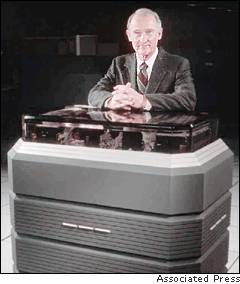
That must be why Cray Computer failed, although the Cray-3 did make an attractive armrest.
-
Lobbying cartels are nothing new
Using think tanks is not something Microsoft, or the software industry has invented, in fact this strategy was used extensively by tobacco companies.
Look at some of the gems here. Specifically, The importance of young adults, Tobacco And Health Research Procedural Memo or this for a specific example.
Microsoft and big tobacco are'nt that different, really. We have significant evidence that the product is bad for us (causes security issues, promotes questionable technologies like DRM, etc.), the manufacturer is trying to deny this and publish evidence to the countrary to the masses (who haven't seen the ads on Slashdot comparing Linux vs. Microsoft as file server in term of costs).
It also, not surpsisingly lobbies think tanks in order to discredit any evidence to the contrary.
And lets of course not forget the emphasis on young adults for brand loyalty (Microsoft is pushing hard into colleges).
This has been all tried before, and in big tobacco's case, worked very well for quite an extended period of time, and remains a debated topic until today.
Have we gotten any smarter? -
Lobbying cartels are nothing new
Using think tanks is not something Microsoft, or the software industry has invented, in fact this strategy was used extensively by tobacco companies.
Look at some of the gems here. Specifically, The importance of young adults, Tobacco And Health Research Procedural Memo or this for a specific example.
Microsoft and big tobacco are'nt that different, really. We have significant evidence that the product is bad for us (causes security issues, promotes questionable technologies like DRM, etc.), the manufacturer is trying to deny this and publish evidence to the countrary to the masses (who haven't seen the ads on Slashdot comparing Linux vs. Microsoft as file server in term of costs).
It also, not surpsisingly lobbies think tanks in order to discredit any evidence to the contrary.
And lets of course not forget the emphasis on young adults for brand loyalty (Microsoft is pushing hard into colleges).
This has been all tried before, and in big tobacco's case, worked very well for quite an extended period of time, and remains a debated topic until today.
Have we gotten any smarter? -
Lobbying cartels are nothing new
Using think tanks is not something Microsoft, or the software industry has invented, in fact this strategy was used extensively by tobacco companies.
Look at some of the gems here. Specifically, The importance of young adults, Tobacco And Health Research Procedural Memo or this for a specific example.
Microsoft and big tobacco are'nt that different, really. We have significant evidence that the product is bad for us (causes security issues, promotes questionable technologies like DRM, etc.), the manufacturer is trying to deny this and publish evidence to the countrary to the masses (who haven't seen the ads on Slashdot comparing Linux vs. Microsoft as file server in term of costs).
It also, not surpsisingly lobbies think tanks in order to discredit any evidence to the contrary.
And lets of course not forget the emphasis on young adults for brand loyalty (Microsoft is pushing hard into colleges).
This has been all tried before, and in big tobacco's case, worked very well for quite an extended period of time, and remains a debated topic until today.
Have we gotten any smarter? -
Lobbying cartels are nothing new
Using think tanks is not something Microsoft, or the software industry has invented, in fact this strategy was used extensively by tobacco companies.
Look at some of the gems here. Specifically, The importance of young adults, Tobacco And Health Research Procedural Memo or this for a specific example.
Microsoft and big tobacco are'nt that different, really. We have significant evidence that the product is bad for us (causes security issues, promotes questionable technologies like DRM, etc.), the manufacturer is trying to deny this and publish evidence to the countrary to the masses (who haven't seen the ads on Slashdot comparing Linux vs. Microsoft as file server in term of costs).
It also, not surpsisingly lobbies think tanks in order to discredit any evidence to the contrary.
And lets of course not forget the emphasis on young adults for brand loyalty (Microsoft is pushing hard into colleges).
This has been all tried before, and in big tobacco's case, worked very well for quite an extended period of time, and remains a debated topic until today.
Have we gotten any smarter? -
Re:Just make sure...
As an addendum, it appears that my perception of the HIV situation in Brasil was colored mostly by the situation developing in Rio Grande do Sul. Nationally, their infection rates are below 1%.
-
Right-wing nutcasesI think we should all be careful about repeating the "fact" that Microsoft is a past donor to the Alexis de Tocqueville Institution. I've yet to find a primary reference to this relationship, which seems to exist primarily in the Open Source press. Of course, if anyone has a better reference, such as a financial statement
But we really don't need a Microsoft link to demonstrate the Alexis de Tocqueville Institution's grotesque ideological bias. While the think-tank positions itself as an independent, libertarian research group designed to "study, promote, and extend the principles of classical liberalism: political equality, civil liberty, and economic freedom," they function, more often than not, as a shill for Big Business and the far political right.
AdTI is a fellow-traveler of neoconservative think tanks such as the Heritage Foundation and shadowy groups like the "Defenders of Property Rights," with whom they are aligned as part of an anti-Clean Air Act hit squad ironically misnamed the Cooler Heads Coalition. These are the folks who have been grinding out the industrialist propaganda which has allowed the Bush Administration to roll back environmental laws a couple of decades.
The Alexis de Tocqueville Institute can always be counted upon for a convenient white paper discounting the risks of tobacco smoking or in favor of vastly expensive weapons programs of dubious utility.
It's tough to source the funding of private institutes, but the folks at Media Transparency have taken a stab at AdTI. Big sugar daddies include the Bradley Foundation, which gives away millions each year to attack social programs and support the privatization of government services. There's also the John M. Olin Foundation, which has lavishly funded a host of robber baron nonprofits over the years.
So it's no surprise that the Alexis de Tocqueville Institiute -- which seems to exist to provide a moral compass for the richest and most powerful interests in the West -- should be seen to carry water for anti-Open Source reactionaries. What's bad for big business must be bad for the nation. Linux must be discredited before it causes more distress for the market planners at Microsoft.
The only freedom being defended by groups like AdTI is the feedom to buy what the Establishment is selling. And at a price they decide.
-
Unibrau?"Canada admitedly has Unibroue and a handful"
You mean Unibrau, right?
-
Re:Damn the irony!
Yes, I too pine for the days of leaded gasoline, lead pipes, CCA-treated lumber and asbestos!
And really, boiling down the two shuttle failures to material replacements? Perhaps a more important factor is its design. -
DDT and Lead, again...
First, the roman thing is a myth. The romans were aware that lead is poisonous and preferred terra cotta pipes.
Second, no causal relationship between ingested DDT and egg thinning was ever found. The collapse of the eagle population was caused by hunting and loss of habitat. -
Blood Transfusions and HIV
The doctor laughed her off and used conventional blood, and the woman got infected with HIV
Can you provide some documentation for this anecdote? In the United States, the blood supply has been screened for HIV since 1985 and I assume all other 1st world countries have done the same. The risk of contracting HIV from a blood transfusion is about 1 in 90,000. With 4,000,000 transfusion recipients a year, there have probably been fewer than 1000 cases of HIV contracted through blood transfusions in the United States in the past 18 years.
~Philllip
-
More like B&W Tobacco papers than Pentagon Papthis is very similar to the petagon papers, except it is against a private company
More like the Brown & Williamson tobacco papers. In May 1994, someone (probably a B&W paralegal) photocopied 4000 pages of internal documents and anonymously mailed them to Shelton Glantz, a professor of medicine at the University of California at San Francisco, with the return address "Mr. Butts."
Glantz put the papers in the university library, where they were available to researchers. B&W sued for the return of the papers on the ground that the papers were protected by attorney-client privilege, but the California Supreme Court ruled in June 1995 that the university had first-amendment rights to make the papers available to the public, so they scanned them and published on the web.
The legal reasoning was that "there is
-
Re:Tool convergence?
Oh, and by the way, is anyone watching the global 593 spike?
RPC over HTTP. Hmm. Sounds like that Windows exploit. Funny, while looking for information, I came across this:
-
Re:Smart move Mr. Coors
There has been more than one study that shows the effects of moderate alcohol consumption to be beneficial to cardiovascular health and in particular reducing the risk of stroke and Type II diabetes.
Also of interesting note, there is what is referred to as The French Paradox (which has nothing to do with French military might and their place in NATO). Instead it refers to the fact that the french have a diet high in saturated fat (think cream and cheese) and high high rates of alcohol consumption (think wine) yet have low rates of morbid obesity comapred to other nations (and especially to the US). -
Good luck
Having written stereo code for a molecular graphics program, UCSF chimera, I really want quad-buffered stereo in a window so my program can present a modern GUI and a stereo image at the same time. I don't like blue-line stereo because it is for full screen stereo and that screws up the GUI. Unfortunately for the Mac, I know of no graphics cards that support quad-buffered stereo. We have asked Apple about it and they are "considering" it. Please keep pressuring Apple to add quad-buffered stereo support -- it will only happen if Apple does it because Apple writes its own graphics card drivers. In the mean time, check out the micropol displays from Vrex. We have preliminary support for them in chimera and I'm sure you could get Warren Delano to add support to pymol.
-
Re:Personalize Weight Loss
Well, if 30 minutes of exposure to second hand smoke can raise your risk of a heart attack, I can only imagine that six cigarettes a day would do it.
There's a -
Re:Gene Chips --PNAS link
FYI: the DeRisi lab has a copy of their Nov2002 PNAS paper online here . Interestingly, according to this paper their chip has 1600 oligos from "~140 distinct viral genomes".
-
Re:FYI
He has vitiligo [google.com].
No, he is just ashamed of his race. Yea, then he blames the corporate heads at Sony for being racist. What Michael Jackson has is serious emotional problems, which has nothing to do with this article (and discussion) is about.