Slashdot Mirror
Domain: upenn.edu
Stories and comments across the archive that link to upenn.edu.
Comments · 1,164
-
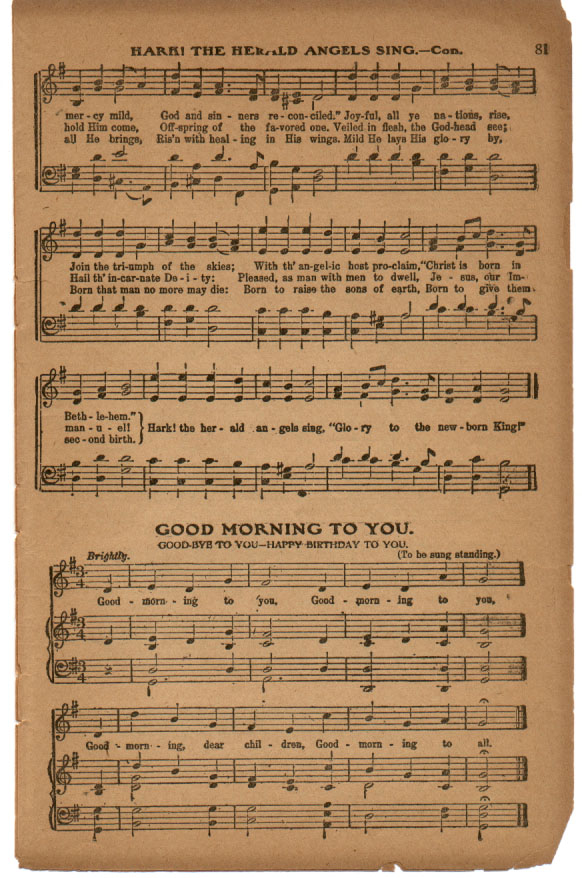
Happy Birthday to You from 1915
But, there is this public domain piece of music here:
http://digital.library.upenn.edu/women/aitch/songs /81-100.jpeg
Look towards the bottom of the page, and note the alternative lyric given under the title. -
Unison - sync home directories
Solved problem, long time ago.
Sync a laptop's home dir with the network drive. Similar can be accomplished pretty trivially with rsync or any number of syncronization systems, yup it can be easily fully automated, no brain involved as well.
http://www.cis.upenn.edu/~bcpierce/unison/ -
alternatives
I worked in a lab this summer at UPenn that does neural computation on silicon in a very different way... they build the neurons themselves out of silicon! This technology could ostensibly someday be used to generate the stimuli that could then be fed to the optic nerve or other parts of the brain. They'd need to first advance their now-relatively-simple models and then build a DNI, but they're on the way.
http://yoda.seas.upenn.edu/boahen/ -
Re:/. Meta question: a wheelbarrow?
I assume it is from the William Carlos Williams Poem, Red Wheelbarrow
so much depends
upon
a red wheel
barrow
glazed with rain
water
beside the white
chickens.A database being the red wheelbarrow of course. Don't ask about the chickens.
-
Re:Ahhhhh!
"This is the sort of English up with which I cannot put." -- Winston Churchill (supposedly)
-
Re:Mine
While rsync is very nice for syncing files, I've found another, somewhat related tool much nicer for my purposes. I have a desktop and a laptop computer, and to a great extent I work on the same files on both. Syncing my home directories could be done using rsync to some degree, but it's rather painful if you have modified files on both sides.
This is where unison comes in handy. It keeps two directories synchronized nicely, adjusting changes in both directions automatically and querying the user in case of collisions. One of my favorite tools, and I'm sure I'm far from being the only one with a need for something like it.
-
Re:Try and stop it... it's so unfortunate.
The Bible is full of porn. Erotica at least. I demand literal interpretation of the Word of God!
-
Re:Interesting DemographicsI will continue to quote my CS professor Max "Mad Max" Mintz until he is no longer relevant:
Some people say that the girls don't like computer science, but I don't think that's true. I think girls don't like the boys in computer science.
I think that'll be forever. The guy sitting in front of me in the lecture immediately responded, "Hey! I resemble that remark!" -
A Man Purse
MMales in the US are too self conscious to carry around hand bags, because they resemble womens' purses http://www.cis.upenn.edu/~creswell/manpurse.html I used to carry a fanny/belt pack whenever I was travelling, but my wife finally refused to go places with me if I wore it. The only workable suggestion I can give is some sort of a manly camera bag with lots of pockets and straps, such as something from http://lowepro.com/
-
It was satire
While I think it was not fair of him to offer a donation for what he later called satire Jack Thompson made it semi clear that it was in fact a satire. While the violence was over the top his suggestion wasnt. However if you paid attention in high school or college you may have heard of a work know as "A Modest Proposal" by Jonathan Swift. One of the early and most well known satires about Swift suggesting that Ireland suffering from Famine and poverty should eat and sell their children for food. Note the title of Jack Thompsons proposal "A Modest Video Game Proposal." For the record I am not siding with Jack Thompson but I'm not the smartest man in the world but when he claimed his work was ment to be satire I put 2 and 2 together so I would hope someone else has. Also I would bet the someone here may have already pointed this out but with upwards of 300 posts I'm not going sift through them all. Look it up or read it here. Its short and sadistically funny. http://www.english.upenn.edu/~jlynch/Courses/95c/
T exts/modest.html -
Exactly. Scientists get paid pitifully.
The current starting rate for a postdoc at University of Pennsylvania is $31,807.
http://www.upenn.edu/almanac/v50/n26/OR-stipend032 3.html
You can make almost $36K after being there four years. Meanwhile, plan to work at least 60 hours/week.
That's after spending 6-8 years on a PhD.
Someone smart enough to do science could get a 5 year bachelor's degree in accounting, pass the CPA exam and make about $40K to start. If I had it to do over, I know what I'd do. -
Dead on Exchange Webmail
This service looks exactly like Microsoft's Exchange server that comes with Outlook and is part of the office suite, except the server hosting, and content storage is done on MS's servers, and thus come free to the user - aren't they considering market cannibalization of their office suite? I know my school http://www.wharton.upenn.edu/ might not have the same incentive to purchase Exchange if Hotmail offered the same service for free.
-
nice reference!:-D Awesome!
That made me smile!
It's been a long time since I've read "A Modest Proposal" (http://www.english.upenn.edu/~jlynch/Courses/95c
/ Texts/modest.html/), but I quite enjoyed it. I'm glad to find someone else who liked it, too.hehe
-
Open Access
This is perhaps slightly astray of the topic, but what's more important than noting that this study has been overhyped and stretched by the media into something it isn't, is Liberman's mention of Open Access journals. I'm overjoyed to read that the key scientists involved with some journals have rebelled against the overbearing corporate presence in the world of the scientific journal and have taken their expertise with them to found new journals based on principles of open access to all.
The point of journals is to provide a mechanism for peer review of research, to filter the copious amounts of research for the benefit of the reader. However, the trend has been to jack up the price so severely - both for subscribers and for accepted submitters - that access to peer-reviewed research has been hampered rather than enhanced by journals. The spirit of scientific research is that of the Creative Commons, and I am really hoping that the technology and cheap distributed bandwidth offered by the Internet will allow the interests of the scientific community to be separated from the interests of the corporate world. We would be much better off with journals that essentially provide digital signatures for the research articles they accept for "publication", allowing the researchers themselves or third parties to distribute the articles under a CC-type license, thus eliminating the need for a large publishing infrastructure, since any publishing could occur on the reader's or the library's printers. -
Re:iTunes works with third party players
I'm not familiar with the details of what iTunes is doing, but could this be replicated by just using general-purpose synchronization software like Unison?
-
Ask and ye shall receive
-
Re:Not exactly "linux" storage but...
I don't know much about this, but might Unison http://www.cis.upenn.edu/~bcpierce/unison/ work? Or you could try using a WAFS appliance to squeeze as much possible out of that line and keep everything centralized.
-
For the benefit of the slashdot crowd
Since protein engineering is my field of study, for the benefit of the
The Nature paper isn't a breakthrough. It's not even really a major advance. Scientists in my field have been creating artificial proteins for five to ten years now. And yes, even some of them designed completely from scratch (though they're really simple; nothing as complex as, say, ATP synthase) instead of just taking a known fold pattern, known as a "motif." The "WW domain" (domain, in protein parlance, is a small, independent structure within a much larger protein---think of it like a module within the kernel or Apache) is a common fold in hundreds of different proteins. Basically, they analyzed the sequences of all of these WW domains, and figured out which positions were meaningful. It's kinda like reading through some code in a programming language you don't know, and figuring out which lines are comments and which lines are actual compilable code. This group found that the number of interesting positions is small, that they could identify them just from the amino acide sequence instead of having to mess with the whole complicated 3D structure of the domain, and that if they put together a protein with the meaningful amino acids intact and the non-meaningful positions randomized, then in many cases they could still get a pretty decent protein (in terms of structural similarity to the "natural" protein) out of it. Most of the paper is devoted to showing via various methods that they did get a pretty decent protein.
So what does this mean for me, assuming that this paper is absolutely correct (which I admit is a little hard for me to determine with one quick reading, given that I'm just a first-year grad student)? It means that the number of meaningful amino acids in a protein (at least in terms of overall structure) is pretty low, and that they can be identified without knowing what the full 3D structure is. This is good, because for a lot of proteins, the 3D structure is difficult to get. However, they picked an easy target: a small domain where there are over 100 unique sequences known. We'll see how well this method holds up with longer domains and fewer unique sequences. The S/N ratio won't be nearly as good.
-
The right to be Laid and Paid?
"The *moral* argument is that if someone puts effort into creating something original which would (in all probability) not otherwise have been created, then they should be able to reap the rewards"
Efforts = right to rewards? First that is wrong via two counter examples. Second that isn't an arguement, it is a statement of opinion.
If efforts = right to rewards then I guess then a man/woman courting (putting effort) into trying to date another man/woman automatically should have a right to be laid then
In any event I'd need more than a one liner to convince me that effort equals the *RIGHT* to getting laid or paid. -
Re:ArrrrgggghhhhGood to see the fine folks at uncyclopedia are participating in Talk Like a Pirate Day.
Avast ye swab! Here be the only keyboard yer evar need! 'Ave they got 'er in yer precious Uncyclopedia or e'en yer Wikipedia? Oi'd be scupper'd if oi hadn't studied me three Arr's at Pirate U.
-
Re:Some clarifications, especially about rsync
You may be interested in the Unison project. More info can be found here: http://www.cis.upenn.edu/~bcpierce/unison/
-
Re:Fruit flies like a bananaPoint taken, although formalized grammar systems state that the modifier noun in a noun-noun compound is practically equivalent to an adjective. English is famously (notoriously?) flexible about allowing you to retask words to new purposes without confusing your audience. (And the proof is that retask is not a word, but you probably didn't notice.) English has loose rules that allow us to convert most nouns to verbs, and most verbs to adjectives. Eg. "I installed the firewall on the network" -> "I firewalled the network" -> "I am firewalling the network now". You could also propose a bet that firewall can never be used as a verb or an adjective, and if the dictionary was your arbiter, you'd win. But if the reader/listener doesn't even flinch at these usages, then meaning was effortlessly communicated, and clearly there are more subtle grammar rules at work. The dictionary, after all, is a description, not a presciption. "Leverage" for instance, is only a noun according to my published dictionaries, but more current online dictionaries are starting to recognize its verbiness. (And no, verbiness is not a word, and probably will never be recognized as one by a dictionary, but there is meaning there, nevertheless.)
In the case of "fruit flies", the usual noun->verb->adjective conversion rules would require something like "fruiting flies" for it to be formally recognized as an adjective. But that middle verb step doesn't work for "fruit" for some subtle contextual reason, so this rule doesn't get used. Instead we just plunk the noun right down into the adjective position, unmodified, use it with the same rules as if it were an adjective, and it all just works.
-
Re:Not to worry.> People do not "mispronounce" and misspell words
> because they are stupid, lazy, poor, or young.
No?No.
First of all, all of your points are valid. Yes, being uneducated probably gives someone less access to the prestige dialect. (I say "probably" because I haven't actually ever seen any numbers to that effect, but that's probably because I've never read anything not authored by JRR Tolkien.)
To be fair, the sentence of mine that you quote was probably unclear or ambiguous. No matter how much time ya spend proofreading...
I was specifically arguing against the validity of the following logic:
Alice pronounces ask the same way she pronounces axe. Therefore, Alice is lazier, less intelligent, less educated, or less wealthy than Bob, who does not pronounce ask that way.
In other words, I wish to refute the sentence, the use of a dialect other than the prestige dialect implies reduced cognitive abilities, education, or so on.
This line of reasoning does not hold up under experimentation, at least based on our (admittedly limited) sociolinguistic knowledge. It is, however, an extremely common line of reasoning.
Notice that our respective assertions are not mutually exclusive, other than the part where you called me silly.
[That's honestly my only point. I typed the rest of this cause I'm a jack*ss who loves hearing himself ramble, and, seriously, I love this stuff. So take it as you will.]
But we can think of reasons right here why someone wouldn't want to use the prestige dialect.
Maybe they want to identify themselves as being part of a group, for instance. (A guy named Labov has made a significant impact on the linguistic community as a proponent of this line of thought.) People, as it turns out, are excellent at using linguistic markers to identify members of their in-group and out-group, regardless of their educational or socioeconomic background.
And you can see how this would be useful in an evolutionary sense. If I can quickly assign out-group status to you ("Hey! You're not in my pre-industrial tribe of farmers or hunter-gatherers!"), I can immediately start doing threat-assessment on you. Are you a threat to my territory, could I outrun you or withstand an attack from you, etc. Some would argue that this is The One Reason why stereotypes exist. The latter point is, of course, arguable.
So Bob the New York Barber has just as hard a time convincing Charles the California Surfer that he "hangs ten" on a regular basis as George Bush has of convincing the slashdot crowd that he's an intelligent human being.
I mean, the man says "nukular" instead of "nuclear", so he must be an idiot, right? Actually, I know *exactly* why he pronounces it the way he does. Because he, along with a huge swath of English speakers, is under the influence of hundreds of other scientific-sounding, Latin-derived words that end with [kjul.r] or [gjul.r] (that is, the "kular" of "nukular" or the "gular" of "angular"). Words like circular, angular (and its partners: triangular, rectangular, etc), singular, regular, jugular, secular, ocular, perpendicular, muscular, and so on.
By contrast, I think nuclear pronounced as [nukli.r] (that is, the "normal" way in the US) is the only word out there (other than a couple very similar words, like thermonuclear) that ends with the sounds [kli.r]. The only similar word endings are in words like clear, blear, and so on; but I think we can toss them out because
- the [r] is not syllabic in those words (other than in a few dialects
in the southeastern US, where the vowel
- the [r] is not syllabic in those words (other than in a few dialects
in the southeastern US, where the vowel
-
Re:amazingThis might indeed be true. Following http://www.wistar.upenn.edu/research_facilities/h
e berkatz/research.htmEllen Heber-Katz' research, scar tissue blocks tissue regeneration."Spinal cord Regeneration: The Heber-Katz laboratory has been examining the regenerative response of the spinal cord as well. Most recently, they found scar tissue is a key blocking element in axonal regrowth. Thus, spinal cord transection where fibroblastic infiltrates are kept to a minimum results in recovery of function or coordinated walking within 3 weeks. They are testing various molecules that can block scar formation to determine its effect on healing and function. One such molecule, apolipoprotein E, along with its receptors, appears to be upregulated during a regenerative response."
-
Serendipity, followed by hard workFrom Dr. Heber-Katz's website at the Wistar Institute:
Wound Healing in Mice: In the process of carrying out an autoimmunity experiment, the Heber-Katz research team noted that in the MRL strain of mice, punched ear holes used for long term identification rapidly closed without any sign of scarring. Besides lack of scarring when the ear hole closed, a blastema formed and new hair follicles and cartilage grew back, processes not generally seen in adult mammals though thought to be part of a regenerative process seen in amphibians. The laboratory has been actively pursuing the identification of genes involved in this trait along with the mechanisms that allow this healing to take place. They found that the matrix metalloproteinases are upregulated early after wounding and just prior to blastema formation and that the molecule Pref-1 is upregulated late after wounding and just as the blastema is beginning to redifferentiate into mature cells. These studies have led the research team to examine multiple tissues that show the unusual regenerative capacity seen in this mouse.
As my old high-school physics teacher used to say, the Princes of Serendip paid that lab a visit. Luck got the ball rolling, but hard work made it into something with potential. It took an observant, inquiring mind to note that the ear holes were closing, and to choose to investigate it further. Fortune favors the prepared mind, especially in science. -
Serendipity, followed by hard workFrom Dr. Heber-Katz's website at the Wistar Institute:
Wound Healing in Mice: In the process of carrying out an autoimmunity experiment, the Heber-Katz research team noted that in the MRL strain of mice, punched ear holes used for long term identification rapidly closed without any sign of scarring. Besides lack of scarring when the ear hole closed, a blastema formed and new hair follicles and cartilage grew back, processes not generally seen in adult mammals though thought to be part of a regenerative process seen in amphibians. The laboratory has been actively pursuing the identification of genes involved in this trait along with the mechanisms that allow this healing to take place. They found that the matrix metalloproteinases are upregulated early after wounding and just prior to blastema formation and that the molecule Pref-1 is upregulated late after wounding and just as the blastema is beginning to redifferentiate into mature cells. These studies have led the research team to examine multiple tissues that show the unusual regenerative capacity seen in this mouse.
As my old high-school physics teacher used to say, the Princes of Serendip paid that lab a visit. Luck got the ball rolling, but hard work made it into something with potential. It took an observant, inquiring mind to note that the ear holes were closing, and to choose to investigate it further. Fortune favors the prepared mind, especially in science. -
Re:He's correct....US based
There is quite a difference between Penn and Penn State. Penn us an Ivy League school. She is from Penn.
-
Re:Ahh, nostalgia...
According to Wikipedia Windows added it with the release of Windows 3.1 in 1992, not Windows 3.0. Heck, I'd pretty much forgotten about it being an option in Windows 3.1, but after looking this up, I recall it all too clearly. I really didn't use virtual much until I got heavy into backgrounded applications using multifinding (something Windows prior to 95 didn't do well, though it worked sorta-ok on Windows 3.1), which was available as an extension to system 6 on mac (I recall thinking it was the coolest thing to background POV-Ray while playing games).
From a quick bit of research (such as this article, 386 enhanced mode in Windows 3.0.x automatically turned on virtual memory. I've also read that the 386 handled virtual paging on chip, so it's possible that a hardware implementation existed for Windows 3.0 in Enhanced mode and a software controlled implementation was added to Windows 3.1 for Standard mode.
From the gist of what I've read, it's possible we're both correct - Intel hardware version (built into the 386) automatically switched to disk paging when it ran out of physical memory, so technically, Windows had Virtual Memory in 3.0 when running in Enhanced Mode even though it may not have had OS handled and toggle-able virtual memory until Windows 3.1. -
Only Project Gutenberg is delivering.
Hah. I'm not surprised. I never believed this would really happen.
Remember Al Gore talking about digitizing the Library of Congress so that a little girl in Carthage Tennessee would have access to books? That never happened either.
Al Gore talks big and the Library of Congress never delivers.
Google talks big and doesn't deliver.
And meanwhile, eccentric Michael Hart and his wild, impractical idealists digitize book after book after book.
About half the books on the Net, as indexed by the UPenn online books page were digitized by Project Gutenberg.
Hart drives all the eBook mavens crazy. He does everything wrong. He doesn't use Open EBook markup. He doesn't worry about conforming PG texts to authoritative academic editions. He doesn't posture.
All he does is get the job done. -
Do they really need one?
Two years ago I started attending a computer engineering program at Chalmers University of Technology in Sweden. I bought a laptop with wlan when I started, but I sold it about a year later. Why? There were computers available in abundance everywhere and I got tired of toting around a 3kg laptop and my regular books in my bag. I could not afford a lighter laptop at the time. But on the other hand a lighter laptop would probably have a screen that was too small for my taste.
I decided to get a new desktop machine at home and kept my home dir in school in sync with a folder at home using unison. That worked great in both the WinXP and Red Hat environment that the school is using. -
don't be an ass
-
Re:Al Qaeda is Base not Database.From Someone who actually knows Arabic:
More idiomatically: The Secret Organization - The Organization of Qa'idat al-Jihad in Europe. The word "qa'idah" ("qa'idat" in construct cases) is a neutral word meaning "base," as in "military base" (qa'idah 'askariyah) or "database" (qa'idat bayanat), and it collocates naturally and frequently with "jihad." So, al-Qa'idah is really "the Base for Waging Jihad," or "the Base" for short.
So the word for "base" is part of the expression for "database" just as it's part of other expressions, including "holy war base", which is what "The Base" idiomatically refers to these days. -
Microsoft library file - MSVCRT.DLLIf the new daylight law is enacted, it seems that that the only thing in Windows that needs to be changed is the Visual C++ library file, MSVCRT.DLL. This doesn't mean that everyone would upload the patch though.
This was the file at center of the April 01 2001 daylight savings time snafu. See the links below:
http://www.langa.com/newsletters/1999/jan-18-99.h
t mMicrosoft's Unintentional April's Fool's Bug
http://www.cknow.com/articles/62/1/Computer-Knowl
e dge-Newsletter-Archive---1999/print/62 -
Re:The most important step:
Bashing heads against walls is what Gandhi and his followers did, what Rosa Parks did, what Nelson Mandela did, and what you should do too when tempted to say "I welcome our new insect overlords." It does not mean giving up hope, but it means willing to sacrifice yourself. Sometimes it doesn't work out, like for the jews at Masada, or for the chinese students at Tien An Men square, but it's still the right way to be, because what's life worth without freedom? Only a person that fights for his principles is truly alive, said somebody once. To counter that and lighten up a bit, somebody else said "Those are my principles. If you don't like them I have others."
-
Which style manual do you use?"its"
Bad proofreading on my part.
"more so"
This one seems to be changing a bit, but I still consider your correction to be valid.
"run-of-the-mill"
This is open to interpretation. Check out The Chicago Manual of Style, 15th Edition, page 301, item 7.88, which discusses multiple hyphens.
-
Geez...
Well, if today is "Old NES Game Fansite Day", I'll mention my NES Contra Strategy Guide, the web's premier guide to Contra.
-
Re:Oh my God
I think you mean "A Modest Proposal" by Jonathan Swift. It most certainly can be found on the Internet.
-
watch out for the quackery here
I think that you need to be very careful what you tell those kids. Most of what you see on TV about voice identification is nonsense. The images that they call "voiceprints" are spectrograms: that is, they're 3D plots of the spectrum over time, with frequency on the y axis, time on the x axis, and energy represented by darkness. Phoneticians like myself use them all the time.
In one sense every utterance, and therefore every spectrogram, is unique. The central problem in acoustic phonetics is the enormous variation in the physical signal for what in linguistic terms is the "same" utterance. The details of the signal depend on the speaker, the speaker's mood and state of health, the weather, rate of speech, choice of register (formal, casual, etc.), as well as on what other sounds the speaker is producing in the vicinity. There is a lot of contextual influence. If you compare, for example, the vowel
Once spectrograms became available, in the late 1940s (using a machine called the sonagraph with analog filters), people started looking for the acoustic correlates of linguistic features. They thought that it would be simple. What they discovered was the tremendous amount of variation and the great difficulty of finding acoustic correlates of linguistic features that are invariant under changes in phonetic context and the various other factors I mentioned.
One result of this is that almost all of the research has been on abstracting away sources of variation such as speaker identity. As a result, not very much is known about the properties of the voice that are unique to individual speakers. In fact, we do not know whether voices are unique. It's clear, of course, that to some extent we can distinguish people by their voices, but we don't know that voices are truly unique, or how close they are to it.
The upshot of this is that there is no scientific basis for determining whether two recordings, or two "voiceprints", are of the same speaker. (If they're different enough we may be able to say that they are NOT from the same speaker.) Anybody who claims to be able to look at a couple of spectrograms and testify with confidence that the same person produced both utterances is a quack. I know people who've spent substantial time debunking this stuff in court. You won't find it supported by published research.
So, why can you login to your computer by voice? Systems like that rely on statistical "ignorance modelling". We don't know very much about what the relevant acoustic properties are, but we can make statistical models that are good enough at distinguishing one speaker from another for some applications. Even the better speaker identification systems don't work too well if they can't make a comparison between two instances of the same utterance, and as another poster mentioned from his own experience, changes in his own voice over a few months would throw off his voice login system.
The other relevant factor here is that for some purposes its okay to have systems that make a lot of mistakes as long as they are in the right direction. If you want to limit access to a lab, let's say, it will very likely be okay to have a system that produces a lot of false negatives, that is, that incorrectly denies that the person trying to enter is authorized to. So long as you have a very low rate of false positives, the system may be acceptable.
So, the real situation is that for some applications statistical voice recognition works well enough, but that such systems do not work well enough to be acceptable for such purposes as identifying a unique individual as a criminal. Speaker identification by visual comparison of spectrograms is junk science.
As for software for looking at speech, there are a number of free (as in beer and as in speech) programs available. This page has some links that you might find useful.
-
grammar and spelling doesn't matter
i am no native english speaker, but i know that 'i have no argument so i bash on your writing skills' people from german forums. me school days - and therefore my last german lessons - are over 'a few days' and i never was confronted with it as i am not a journalist or something.
i am really pissed off by people bashing on grammar and spelling, especially on people telling, that grammar and spelling makes someone appear less intelligent.
its not a matter of intelligence, its a matter of how much you had to do with it, to keep up your skills, or how long you are out of school (i bet that spelling bashers are still in school). grammar and spelling has nothing to do with intelligence. they are rules, made by mankind, without logic (especially the german rules: http://ccat.sas.upenn.edu/jod/texts/twain.german.h tml
as long as the reader understands what i wanted to say, i would duyr -
a little bit of linguistics
There is no natural language on this planet that strictly obeys the laws of logic. This is an empirical fact. Instead, languages obey their own rules, generally refered to as a grammar. Note that this does not mean grammar in the grammar book sense. Rather, the "grammar of English" more accurately describes the complete set of rules (of syntax, morphology, phonology, and semantics) that describe how you use language.
This being said, consider the case of multiple negatives.
(1) I can't get no satisfaction.
Logic clearly states that two negatives make a positive. However, in many modern Englishes (including my own), (1) clearly means that the speaker cannot achieve satifaction. The extra "no" is either for emphasis or meaningless. Compare to French:
(2) Je ne sai pas.
Now, if you have ever taken any French, you know that in order to make a negative, you must have ne (verb) pas. Logic literally has nothing to do with it.
There -are- rules here, and they are the ones that human beings actually follow, not the ones made up by people who wish to control your words.
A good example is the rule against splitting infinitives. The idea, way back in the 19th century, was that English should conform to the rules of Latin. In latin, the infinitive is a single word, so it is physically impossible to split an infinitive. Therefore, in English, where the infinitive is two words (to go, for exmaple), the idea was that no adverbs should ever be inserted.
Now, this logic is obviously flawed. If, for example, I were to argue that Japanese is a superior language to English, and that Japanese is an OVS (object-subject-verb) language, then English should switch from SVO to OVS in order to be more "pure" or "correct", no one would give me the time of day. Since this old argument was based on --predjudices-- of the time (Latin = good), it was and is obeyed.
Of course, real, living speakers of English often do split infinitives (yes, even Shakespeare did it). For a detailed account of some situations in which splitting an infinitive is indeed -mandatory-, check out this blog of linguistics professors:
http://itre.cis.upenn.edu/~myl/languagelog/archive s/000901.html
To directly address your statement, believe me, --anything-- is possible with language. Words can change meaning, spelling, pronunciation, and part of speech easily. It has nothing to do with logic and everything to do with usage. The key point, however, is that these changes become --systematic--. That is, if "of" were to become a verb, it would be a perfectly legitimate, normal verb, and its use would be governed by a clearly defined syntax.
Please stop assuming that language use has anything to do with intelligence or logic. Put simply, that is an old, old fallacy that people cling to because it allows them to stage themselves as more intelligent and correct than the users of a "lower" English (or whatever). And even if someone does use a word in a strange way, sure, you can point out their lack of consistency, but you're a bright chap with a big, big, intelligent brain, and I am very sure that you can figure it out. And if you can't, ask. -
Re:Responsibility
My laptop (and camera stuff, identity documents, and some other important things) were stolen from my closed closet in my locked dorm room. http://www.upenn.edu/ isn't exactly a low-rent school, either. Part of being careful is not making unnecessary assumptions or generalizations.
-
OPEN-R
Or, you could download the OPEN-R SDK for the AIBO and program it to do anything you want.
http://openr.aibo.com/openr/eng/index.php4
UPenn even ported a perl interpreter for the AIBO.
http://www.cis.upenn.edu/robocup/index.php
AIBO is actually a rather interesting platform for experimenting with image processing and signal processing algorithms, as well as team coordination algorithms. -
The right to be left alone...
The right to be left alone is indeed the beginning of all freedoms. -- Supreme Court Justice William O. Douglas
http://www.writing.upenn.edu/~afilreis/50s/douglas -bio.html -
a good insight
Prof. Geoff Pullum had a great insight into what the *real* punishment should have been [1]. To summarize, the Media Edition-less version of Windows XP should have been called...Windows XP, and would be required to be sold at regular price. The *other* XP would be Windows XP+Media Edition, which would be sold at, say, $30 higher, to reflect the actual cost to Microsoft of the software development.
This makes such perfect sense that we should not be surprised it was not implemented.
[1] See http://itre.cis.upenn.edu/~myl/languagelog/archive s/002047.html -
Failed sarcasm
I can't tell if you're a supporter trying to be sarcastic, or a detractor trying to be sarcastic.
Try reading Johnathan Swift's A Modest Proposal. -
Part-time project = OK, Full-time = look elsewhere
According to this report, UPenn-Wharton students doing summer internships in Information Systems/Computer Science earned an average monthly salary of $4000.
That's $12000 over the whole summer.
So, unless the Google-paid project can be completed in 4 to 6 weeks, you'd be better off looking for a summer internship elsewhere.
However, there is a tradeoff between money and freedom (less money/more freedom VS more money/less freedom). -
They were one of the first in the early '90s...
The Mathematics of Statistical Machine Translation: Parameter Estimation by Brown, Pietra, et al. IBM was on this a while ago, and other efforts have improved upon this work, through the use of Maximum Entropy, etc.
-
Re:Supersonic !?!
It can very easily be supersonic.
The solar wind is a gas with a certain density - a very low density, compared with sea level atmosphere, but it's still a gas, and molecules will still bump into each other in it. So, sound (this is, pressure waves) can travel through the solar wind. You wouldn't be able to hear it, but it'd still be there regardless.
If you are moving faster that the speed of sound in a medium, then you are supersonic.
As an aside, cerenkov radiation is when particles travel faster than the speed of light in a medium - this causes a superluminal shock wave in the medium similar to a supersonic mach cone created by a jet. This page touches on both supersonic and cerenkov radiation quite nicely. -
ICFP
Wow, the contest description is just like the ICFP contest. http://www.cis.upenn.edu/proj/plclub/contest/ants
. html I would have expected something more matlab-specific. -
+5, Insightful my arseThis turned into the "my computer isn't doing what I want it to do, which is turn the F off" at which point the consumer simply reached down and yanked the power cord. Try writing a routine for this routine!
From The Checkpoint Mechanism in KeyKOS by Charles R. Landau:
Key Logic developed a prototype UNIX-compatible system implemented on top of KeyKOS. At UNIFORUM '90, we demonstrated this system by literally pulling the plug on the computer at random. Within 30 seconds of power restoration, the system had resumed processing, complete with all windows and state that had been on the display. We are aware of no other UNIX implementation with this feature today.
From EROS: A Novel Combination by Jonathan Shapiro.
In other words, yes, some people actually have written a routine for yanking the power cordAt the 1990 uniforum vendor exhibition, key logic, inc. found that their booth was next to the novell booth. Novell, it seems, had been bragging in their advertisements about their recovery speed. Being basically neighborly folks, the key logic team suggested the following friendly challenge to the novell exhibitionists: let's both pull the plugs, and see who is up and running first.
Now one thing Novell is not is stupid. They refused.
Somehow, the story of the challenge got around the exhibition floor, and a crowd assembled. Perhaps it was gremlins. Never eager to pass up an opportunity, the keykos staff happily spent the next hour kicking their plug out of the wall. Each time, the system would come back within 30 seconds (15 of which were spent in the bios prom, which was embarassing, but not really key logic's fault). Each time key logic did this, more of the audience would give novell a dubious look.
Eventually, the novell folks couldn't take it anymore, and gritting their teeth they carefully turned the power off on their machine, hoping that nothing would go wrong. As you might expect, the machine successfully stopped running. Very reliable.
Having successfully stopped their machine, novell crossed their fingers and turned the machine back on. 40 minutes later, they were still checking their file systems. Not a single useful program had been started.
Figuring they probably had made their point, and not wanting to cause undeserved embarassment, the keykos folks stopped pulling the plug after five or six recoveries.
In the end, the issue comes down to this.
Suppose you had perfect software and hardware (if you find some, be sure to let us know). Even so, your computer will fail four to five times a year due to random background radiation.
So when your computer fails, do you want to be told that all your files are intact and you can now resume your painstaking work (having lost your latest session), or would you rather have all of your windows, (complete with word processor, web browser, and solitaire) reappear with a few minutes lost work. Take your pick.