Slashdot Mirror
Domain: uwyo.edu
Stories and comments across the archive that link to uwyo.edu.
Comments · 61
-
A theory I'd love to see tested.
The Arctic ice is melting, the Antarctic ice is growing.
Okay, let's say we have a metal pole, with a top and bottom. It is warmed by a heat source. If the heat source is centrally located, the center will be warm and the ends equally cool.
However, if that heat source is elevated, the upper half of the metal pole will be warmer, and the bottom half cooler. The top of the pole will be significantly warmer than the bottom of the pole.
Presently, our sun has a HUGE hole in the northern hemisphere. "The low density of coronal holes is also responsible for high-speed solar winds. These streams of solar particles blow off the coronal holes about three times faster than they do in higher-density areas of the sun, according to the statement."
http://www.space.com/33047-nas...Why is this significant? Well, we know sunspots correlate to climate temperatures. Less sun spots equal colder periods, more sunspots, correlate to warmer periods.
"Ituitively one may assume the that total solar irradiance would decrease as the number of (optically dark) sunspots increased. However direct satellite measurements of irradiance have shown just the opposite to be the case. This means that more sunspots deliver more energy to the atmosphere, so that global temperatures should rise. "
http://www-das.uwyo.edu/~geert...Okay, so we have a large hole. The hole likely affects the suns gravitational / magnetic forces adjusting the amount of thermal energy released. If so we likely have a thermal gradient in which the higher north you go on the solar plane, the warmer it is. This would explain why the Arctic would be melting and the Antarctic adding ice.
-
Re:"Support" != actually sacrifice for
lol.. What's the sacrifice you ask then say taking vehicles off the road as if it does not deprive anyone of anything. The problem is all the rest cost money. It costs more money than the current model.
I suggest that you stand by to find out just what it costs to not do anything.
Besides, there is a whole litany of "Costs too much", from cleaning the air and rivers, to reducing pollution form cars, to gas mileage to electric cars, to wind power and solar power. All going to be too expensive.
And we have cleaner air water and land, cars that get good gas mileage and low pollution and good performance, electric cars that have decent range and can beat the crap out os most vehicles, and lately ther has bee the begginings of whining about wind and solar having a competitive edge.
It's called progress. It's called better quality of life. Just like we don't kill people in London with coal burning pollution or light the Cuyahoga river on fire:
http://www-das.uwyo.edu/~zwang...
http://en.wikipedia.org/wiki/C...
We gotta move on, even if it costs a little money. And in the end, it can even be profitable.
-
Re:Is there any info that isn't behind paywalls?
This looks like the original press release: http://news.unm.edu/news/new-evidence-for-oceans-of-water-deep-in-the-earth
Here's an explanation of what's going on.
The paper is already used as a reference on the Wikipedia page for Ringwoodite.
Here are the research pages of the various authors:
Brandon Schmandt, Department of Earth and Planetary Science, University of New Mexico
Steven D. "Steve" Jacobsen, Department of Earth and Planetary Sciences, Northwestern University
Thorsten W. Becker, Department of Earth Sciences, University of Southern California
Zhenxian Liu, Geophysical Laboratory, Carnegie Institution of Washington
Kenneth G. "Ken" Dueker, Department of Geology and Geophysics, University of Wyoming
-
Here's the location of every silo....
-
Here's the location of every silo....
-
Re:Curious
I don't know what this $9K stuff is. There are plenty of places not nearly that expensive where you don't pay for a brand name -- or pay a private institution (with premium so it can also be profitable for the owners), including:
Georgia Tech, $4129 for in-state residents. UWYO, $108 per credit hour, undergrad. ULL, undergrad tuition $3147 per semester for 20 or more credit hours. Graduate tuition $3574 maximum.
Elizabeth City State University, NC $4,428 in-state tuition.
Sul Ross State University (Texas) $4800
Northwestern (Oklahoma) $5K
-
Going Troppo
Australia has an expression for this erratic behaviour in increasing temperatures, they call it: "going troppo"
Though I think the heat is just an excuse to explain that they are drinking too much alcohol instead of water, it is the alcohol that is making them bat-shit crazy.
Different cultures handle excessive alcohol differently; some like to beat the shit out of each other; some like to get darwin awards.
Russians like to drown in heatwaves cooled by vodka. -
Re:It is also a FINITE supply.
There are storage, distribution, and sanitation problems in Africa. But overall the continent has plenty of precipitation. Water and food shortages are weapons of mass destruction used in genocides. In this case you should focus on the disease rather than the symptom.
-
More details around this spider silk
Wonder if this is a part of an lead-in on the research.
Looks like WYU is sitting on a ton of patents around spider silk technologies.
Nicer pictures of this article can be found at http://inhabitat.com/genetically-modified-silkworms-spin-super-strong-spider-silk-for-bandages-and-bulletproof-vests/
-
More details around this spider silk
Wonder if this is a part of an lead-in on the research.
Looks like WYU is sitting on a ton of patents around spider silk technologies.
Nicer pictures of this article can be found at http://inhabitat.com/genetically-modified-silkworms-spin-super-strong-spider-silk-for-bandages-and-bulletproof-vests/
-
Re:Weak spot in FAA's "NextGen" system
-
Re:real science
But at least it is showmanship with a useful point.
...Or it is a rigged test.
They're predicting lower than average sunspot activity over the next ten years, and there's evidence to suggest that such a downturn would effect global temperatures. Global warming is based on data from a much larger timeframe, and is weighted to account for effects like this. His wager is not.
-
Entomoengineering?
We have a lot yet to learn from our six-legged colleagues, from the sound of it. Recently some work was done on optimizing machine vision using an algorithm derived from the way the house fly's vision works. The termite's wood-digesting gut is a prime object of study for those seeking to manufacture fuel from biomass efficiently and cleanly. An insect virus (the baculovirus) is the new hotness for gene transduction in mammalian cells because it can't actually cause disease.
I think this might be the next step in bioengineering. We've been grabbing genes out of various organisms and sticking them in bacteria to produce useful biomolecules like insulin and factor VIII. Maybe the insect is our next stop.
-
Re:Yum
They were on the edge of extiction until they were commercially marketed,
Er, not quite. They were on the verge of extinction because of the wholesale slaughter for their hides due in large part to poachers as well as the railroads who wanted to use the land. Their meat was rarely used by the white man.
It was thanks to Teddy Roosevelt and his making Yellowstone the first national park, that the buffalo survived at all. One of the first wardens, Buffalo Jones, used his own ranch in Nebraska to bring buffalo back to Yellowstone and breed with the remaining 500 or so (Roosevelt's estimate).
For reference -
Re:Galileoscope
I got one of these as a gift for someone. You'll need a tripod, but any standard camera tripod will work. Also, it took about six weeks to deliver, so it may be too late for Christmas. A portion of the proceeds goes to supply identical telescopes to disadvantaged kids.
The quality seems ok for the price. It's a plastic telescope modelled on the one Galileo used, so don't expect high performance. However, it is useful for teaching some history of science and astronomy (and religion) so that's a bonus. There's a great companion site with lots of educational materials available for download along with detailed assembly instructions. (You will need that.The scope is not trivial to assemble.)
-
Re:See? Man-made climate change!
Given the height of said clouds - they're huge!
Granted. Well, pretty big.
I have trouble believing that's all rocket plume up there...
There used to be a perception that SlashDot had a scientifically and/or technically literate readership - I'll bet that's what they tell the advertisers anyway. So don't believe, work the numbers.
Given - a shuttle is worth 300 tonnes of water ; altitude is 115km ; a cirrus cloud is 0.002 g/m^3 water (from http://www-das.uwyo.edu/~geerts/cwx/notes/chap08/moist_cloud.html ) ; pressure at that altitude is about 2 Pa (estimate from the 71km figure in http://en.wikipedia.org/wiki/Atmospheric_pressure#Altitude_atmospheric_pressure_variation , which broadly agrees with http://www.engineeringtoolbox.com/air-altitude-pressure-d_462.html).
So, (actually, do I need to look at the atmospheric pressure? Not for a first approximation.) 300 tonnes of water would make a cloud of 300x1000x1000 (tonnes -> g) / 0.002 (g/m^3 -> m^3) = 150000000000 m^3 which equates (broadly) to a 3300 m radius sphere. A sphere of 3.3km radius at 115km range would subtend an angle of 0.028 radians or 1.6 degrees.
That's about the size of a thumb at arms length, or very easily visible. Including atmospheric pressure in the estimate would (I think) increase the apparent size of the cloud, as would the fact that the cloud is irregular and sheeted.Sheesh - don't schools teach kids how to do a back-of-a-fag-packet calculation any more?
-
Oblig: Missile Guidance
For those of us that worked in the Defense Industry, this is a classic. For those that are new, you can probably appreciate this.
This WAV is from a military training video on missile guidance.
-
Better names needed
I'm not a physicist, and barely remember the difference between protons and neutrons. Really. Probably it's the way they choose the names, having nothing to do with the physical properties of the elements, and not even sounding cool. I mean, Uranium, Plutonium, Titanium have cool names. Krypton -- cool name. "Carbon" is at least descriptive, deriving from the Latin for burning. I've always thought "Gold", "Iron", and "Lead" were onomatopoeic. And everyone knows that "Sodium" is Greek for "soda pop". Good names, all, and they don't sound phake and made up.
But "Hassium"? "Bohrium"? Not cool, not descriptive. These are vanity names, like getting your name in a phony star registry, or some weak license plate, except it goes in the encyclopedia. Yes, I know there's this tradition for naming the radioactive ones after people, but that kind of thing ought to be left to the entomologists, hadn't it? I mean, what if there's a disaster, and Jonesium kills a bunch of people and gives the rest weird cancers? How will ol' Doc Jones feel about his legacy then, hmm? Better to be devoured by wasp larvae. So clearly, we need better, less risky names for these elements.
Let's see, an element that sticks around for 30 seconds and then goes away. I believe I can come up with a few right here, even without some fancy-shmancy degree:
- Postite
- BlogTrollium
- Wevedoneitohnowehaventium (or Heybosslookatuhnevermindium)
- Anaviagrium
- Blinddatium
-
Re:You trip...
Like these?
-
Re:Where's Captain John Sheridan when you need him
He was decorated in the minibar war: http://b5.cs.uwyo.edu/bab5/snds/minibar.wav
-
Re:Alas, Babylon
Babylon 5 pioneered daring and creative storytelling techniques, such as trapping two characters who hate each other in an elevator.
That would be "Convictions".
They're called bottle episodes but they're usually done for budgetary reasons. Trap the characters inside a single set (bottle them up) and play them off each other.
A benefit from saving on sets, locations, and FX is that more money can go into the scripted dialog and character development, though this is more of an example of a bottle scene or situation, and is better for it. Still, that episode has one of my favorite quotes:
"`Go be the ambassador to Babylon 5,' they say. `Will be an easy assignment.' Ah, I hate my life."
"So do I."
"Shut UP!" [zip]
But then there's also this one [wav]. -
Re:Alas, Babylon
Babylon 5 pioneered daring and creative storytelling techniques, such as trapping two characters who hate each other in an elevator.
That would be "Convictions".
They're called bottle episodes but they're usually done for budgetary reasons. Trap the characters inside a single set (bottle them up) and play them off each other.
A benefit from saving on sets, locations, and FX is that more money can go into the scripted dialog and character development, though this is more of an example of a bottle scene or situation, and is better for it. Still, that episode has one of my favorite quotes:
"`Go be the ambassador to Babylon 5,' they say. `Will be an easy assignment.' Ah, I hate my life."
"So do I."
"Shut UP!" [zip]
But then there's also this one [wav]. -
It gets worse -Harmonics was a rotten problem in power lines since 1990 (when I last had to study the National Electrical Code, long before I did the computer thang for a living) - even back then you didn't get a perfect 60Hz sine wave, since things like televisions, blenders, industrial equipment, etc etc would introduce noise into the line at multiples of 60Hz (among others), which shortened the MTBF of, well... anything with a power supply or rectifier attached to it. IIRC (though I'm prolly wrong given the time span, but...) even motors tended to wear out faster if they were under a certain size.
I realize that a power company would be smart enough to be aware of this and likely provide filters to strip that out for folks who use the service, but how are they going to filter the crap out for those who don't have a data box at their house to strip the signal, and how much would it cost? More importantly, wil lthat cost be an enforced one?
Either way I really don't like the idea at all, even if I never use the thing.
-
Re:There's a lot of potential
Ohh yeah, that "cooling trend" that only affected the Northern Hemisphere.
Reference for my claim. Where's yours? -
Ohter NASA grants
Despite some recent funding issues, NASA still supports space science, not only space exploration/engineering. I've currently got close to $1 million in grants, the largets being $620k over five years to study a particularly interest class of quasars. We've been getting Hubble Space Telescope images that are really spectacularly great.
-
Re:I think Wyoming tried...
Hard to be sure, but she looks hot:
http://physics.uwyo.edu/~cassandra/
Give her a call at: 307-766-3162
It's not quasar surgery people! -
Re:Hubble
Hubble's not dead yet, and is still returning awesome data. I've got the first three images from my current project up here. As they show, HST still does a lot better than the typical ground-based imaging.
-
Re:Water City
There are two big issues with the location of New Orleans. Hurricanes is one of them. The 2nd and potentially longer term issue is the switching course of the Mississippi and corresponding delta lobes (areas where river deposits sediment) The following link shows the change over the past 5000 years ( a geological blink of an eye) http://faculty.gg.uwyo.edu/heller/Sed%20Strat%20C
l ass/Sedstrat6/mississippi_delta_lobes.htm taken from http://faculty.gg.uwyo.edu/heller/Sed%20Strat%20Cl ass/Sedstrat6/sedlect_6.htm -
Re:Water City
There are two big issues with the location of New Orleans. Hurricanes is one of them. The 2nd and potentially longer term issue is the switching course of the Mississippi and corresponding delta lobes (areas where river deposits sediment) The following link shows the change over the past 5000 years ( a geological blink of an eye) http://faculty.gg.uwyo.edu/heller/Sed%20Strat%20C
l ass/Sedstrat6/mississippi_delta_lobes.htm taken from http://faculty.gg.uwyo.edu/heller/Sed%20Strat%20Cl ass/Sedstrat6/sedlect_6.htm -
Re:How come?
Because these galaxies are surrounded by dust (likely from massive starbursts, which produce dust). Dust, because of it's scattering properties, preferentially lets long wavelength light pass through it (ie. infrared) but scatters shorter wavelength light (ie. visible light) into other directions. This is the same effect you see when looking at a sunset. The setting sun looks redder because there is dust (small, scattering particles of various sorts) letting more red light through to you than blue light. In these galaxies, it is more extreme.
The effect is called "dust reddening." I have some slides about it for the lastest entry (March 2) for my Astronomy 1050 class at my astronomy webpage if you want to see examples. -
Re:Pretty Interesting
No, the black holes CAN'T splatter into pieces. They're too massive, their gravity too strong. All the "crap" around them -- gas, dust -- that is the fuel of the quasar -- that stuff surely does spew all over. The basic accretion process, when things settle down and merg, is for that material to form a flattened disk. When you see a quasar, it is the intense radiation from this hot disk that does all the shining. The black hole just provides the gravity. There may also be relativistic jets shooting out the spin axis, but their formation is not well understood. Neither are the less collimated outflows from around quasars (one of the reasons I'm suspicious about their results -- they're dealing with a broad brush and could be right on that level but we surely don't understand a lot of the details even on an empirical, observational level).
I've got some lecture slides on active galaxies (powerpoint) up at my astronomy website. Look at: This link. There are some some real images, and some artists renditions, you might like. I've just used the powerpoint web format, so it looks crappy in anything but explorer. Sorry. -
Re:Wait a sec, this story isn't about "dark matter
May I point you to a slide from your beginner's course:
slide
Sorry, could not resist -
Multidimensional dereferencing in C: here you goI am not sure I understand what you're saying. Are you saying that it is not possible at all to deference a multidimensional array in C using a[i][j]? That is false.
Check out the public domain area of the Numerical Recipies package. (While you're at it, you may want to insert your own harangue deriding the routines; but the 2D array routines are solid).
Returns a matrix with easy multidimensional dereferencing via a[i][j]:float **matrix(long nrl, long nrh, long ncl, long nch)
However, if you are saying that somehow C internally dereferences less optimally than Fortran, then perhaps someone else can comment on that---I don't know.
/* allocate a float matrix with subscript range m[nrl..nrh][ncl..nch] */
{
long i, nrow=nrh-nrl+1,ncol=nch-ncl+1;
float **m;
m=(float **) malloc((size_t)((nrow+NR_END)*sizeof(float*)));
if (!m) nrerror("allocation failure 1 in matrix()");
m += NR_END;
m -= nrl;
m[nrl]=(float *) malloc((size_t)((nrow*ncol+NR_END)*sizeof(float)))
if (!m[nrl]) nrerror("allocation failure 2 in matrix()");
m[nrl] += NR_END;
m[nrl] -= ncl;
for(i=nrl+1;i<=nrh;i++) m[i]=m[i-1]+ncol;
return m;
} -
Re:Mature students generally do wellI had credits as old as 1991 (summer enrichment program at a local commuter college) accepted for transfer. I've also heard stories of credits expiring after ten years, but I think that may be an urban legend. It is certainly not how it was handled at my school (University of Wyoming)
You hear all sorts of stories about college that turn out to be urban legends. I was talking with my sister-in-law about how she wanted to go back to school to earn her accounting degree, but she sighed and said, "But I can't go to college, because my high school diploma is a G.E.D." Now, I know several people who have earned a G.E.D. and gone on to earn doctorate degrees! But because she fell for some urban legend carelessly passed on to her, she had never even bothered to check into going back to school. I feel really sorry for her, because she's lost a lot of time.
-
Re:B5 links [quotes/game] & comments
-
Re:Gotta have the whole quote wav!
-
Re:A germ of truth, but I fault the conclusionThat's fine if you intend to live, work, grow your crops etc. in a cave (and your water supply is still going to be affected by rainfall). I don't think that this describes too many people.
If you go searching for data on borehole temperature measurements, you'll find that annual temperature cycles are measurable for some years as they propagate into the earth. It's true to a degree that "the temperature is always the same underground", but only to a degree; think about what "frost line" means for an example.
-
No, the measurements go back much further
The temperature variations have been tracked over centuries using heat-flow measurements in boreholes.
-
Re:More on sinks
..It seems to me that you are implicitly defining "reason" in contemporary terms.
Um. Yes?
Half the point of developing tools like the scientific method and analytical reasoning is so we can use them. As the methods become more refined, our trust in them should increase.
Thus, I should have more trust in scientists' results than a person in the year 1000 had in a fearmonger spouting off.
I would have liked any model to appropriately "explain" temp changes in the past: for example, average temps here in Italy have had significant swings in historical times when human activity, espacially CO2 related, can be assessed as varying between "negligible" to "nonexistent". As you see, no predictive content is required, only a "best fit".
Er... yes, of course, temperature variations have swung significantly in historical times. Temperature variations do happen over time - quite significantly. A large part of the warming over the past 1000 years is due to the eccentricity of the Earth's orbit decreasing (as it periodically does). We're definitely in a warming trend right now, just from natural causes.
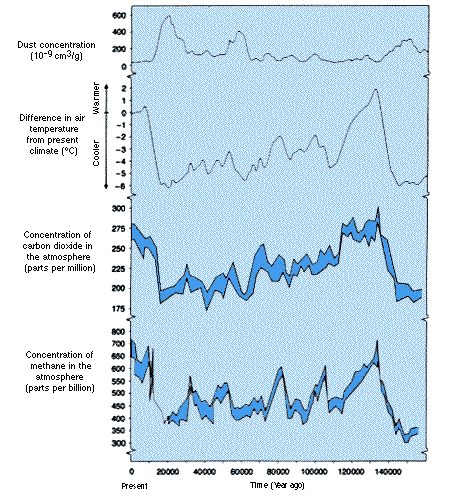
But the CO2 levels are not from natural causes, and they're massively above what they've ever been in several hundred thousand years of data. See here to see what I mean: note the graphs showing the trends over time. Yes, we're in a natural warming period right now. But also note the scale of the CO2 graph - 175 to 300 parts per million, total variation.
Now look down at the graph at the bottom - that's the current trends on CO2 levels. Note the scale again - 280 to 340, and sharply rising currently. We're now about 10-15% above the highest levels of CO2 ever seen in the atmosphere, and it starts climbing almost exactly at the Industrial Revolution.
No one's trying to suggest they understand the atmosphere perfectly. Trying to explain the temperature rise, in my opinion, is also quite arrogant. But they certainly understand it enough to claim that a massive rise in CO2 will likely cause climactic effects, and they are certainly correct that we cannot simply continue pumping CO2 into the atmosphere at the present rate.
You are perfecly right in saying that CO2 is a earth warmer, and reducing that could impact; but what if it is later proven that it's all in the sunspots cycle, or other things?
Well, that's science - then the models were apparently wrong. But you're not asking what happens scientifically. You're asking how does that impact socially. And I'm presuming you mean to say "what if it is later proven that it's all in the sunspot cycle, and we reduced CO2 emissions for nothing?"
The answer to that is simple - no matter what, we have to reduce CO2 emissions eventually, because we can't keep burning oil/natural gas/coal forever . Since fossil fuels are the main cause of CO2 emission, reducing fossil fuel usage and reducing CO2 emission are the same thing. The cost will be the same (in inflation-adjusted dollars) at any point in time. We know how to do it now - we replace oil burning cars with hydrogen fuel cells, we replace oil/coal/natural gas power plants with nuclear/solar/wind. We can actually make it cheaper if we start now, and amortize the cost over 50 years, rather than doing it in 10 when the need is more obvious. As a bonus, the world will still have a large supply of cheap fossil fuels for many centuries to come after that. Fossil fuels, after all, have a good power density.
I'm not suggesting stopping fossil fuels now. I don't think anyone is. I think everyone is suggesting we start to stop using them, and by that, I mean regulations. I really find it insane that the US walked out on the Kyoto treaty. It's obvious to anyone that the world eventually has to stop emitting more CO2 than the world can handle. The only question is "how fast", and the US simply walked -
Re:Weather is complicated
Hurricanes are heat engines driven by the energy contained in warm surface water. As the winds pick up, they are able to suck more and more of the energy from the sea surface. Because there is a limited supply of warm surface water, they need to keep moving to continue to grow.
In many ways, they are like wildfires burning through brush. The heavier the brush, the more intense the fire. If there is global warming, it will certainly lead to increases in mean sea surface temperatures, which increases the energy available to storms such as Hurricanes, therefore, bigger hurricanes.
While many aspects of global warming, like the rate and the detailed effect it will have on different regions is controversial, saying that global warming will lead to more intense hurricanes is not controversial.
I've been a bit of a skeptic about global warming for years. The chicken little crowd has always bugged me. But, if you turn off the politics and look at the data you see that currrent C02 levels are the highest in the last 150K years and are rising every year. This is a dangerous experiment we are doing with our atmosphere.
If reducing CO2 was going to cost lives or billions of dollars, then it is debatable whether we should do it. But, the things you'd do to reduce C02 like driving more efficient cars, buying more efficient appliances, insulating your houses, etc. are things we should do anyway, for other reasons - reduce polution, dependence on foreign oil, and on a micro scale, save everyone money.
My $.02
-DT- -
Re:Open Letter to Rick Berman...
That's not a Babylon 5 sound site. Now, this is a Babylon 5 sound site! (Wow! Check the bloopers too.) A zipped "death incarnate"
-
Re:Open Letter to Rick Berman...
That's not a Babylon 5 sound site. Now, this is a Babylon 5 sound site! (Wow! Check the bloopers too.) A zipped "death incarnate"
-
Re:Do not call ammendmentThere's the bit I posted in the other article. I've reproduced the relevant section here:
Read this article by Glenn Reynolds on malls. The key bit is:
The downside is that the traditional "downtown" has been replaced by corporate-controlled space. What's wrong with that? Well, in the traditional downtown, things like the First Amendment's guarantee of free speech apply. In malls, they generally don't. (One of my former students has written an interesting law review article [uwyo.edu] on this subject).
The summary is that if you own a mall, you can restrict what people say at your mall. You ever see those signs that say solicting on these premises is prohibited? No one screams "free speech" in that situation. -
Re:A similar article with a little moreYou and many other people here do not understand what "free speech" means. Read this article by Glenn Reynolds on malls. The key bit is:
The downside is that the traditional "downtown" has been replaced by corporate-controlled space. What's wrong with that? Well, in the traditional downtown, things like the First Amendment's guarantee of free speech apply. In malls, they generally don't. (One of my former students has written an interesting law review article on this subject).
Also the bit about non-profits/politicians, well, I wouldn't be suprised if that is one of the first ammendments to this law. It's called the slippery slope, you can't expect to pass the whole thing at once. You have to do it incrementally, and starting with the assholes is the easiest way to initiate the process.
-
weather looks good
The northerly winds over southwest England show a considerable decrease through tomorrow as high pressure builds over the area.
-
Re:We're Geeks right?
1 line of APL.
Here is some data starting at 1850 or so.
There are serveral problems trying to make sense of this data in this context:
-Numerical differentiation is equivalent to subtracting two large numbers to get a small number - the error in the small number will be a very large percentage of the small number.
-We do not have good data for anything older than 150 years. This is too short.
-Statistical measures do not prove causality, so we cannot infer anything like burning fossil fuels is the reason for temperature increases IF we were certain that the temperature is actually increasing.
-People are trying to model the effects of greenhouse gasses and then extrapolate the results of the models to regions where there is no data.
Extrapolation is notoriously difficult.
On the other hand there is the compelling argument that we are shooting craps with the ecosphere on the table. Not a wise move.
Personally I think that burning fossil fuels to obtain energy is ok IF you are using it to bootstrap a civilizationto a level where such crude technology is not needed, and you are sure that it isn't going to lead to an eco-disaster. Since we don't seem to be making much progress on the bootstap front (the land of Hammurabi The Law Giver is governed by a despost and embroiled in war) and we certainly have no assurance that an eco-disaster isn't in the offing, we should really try to limit fossil fule use until we know a bit better what we are doing.
-
Submitter missed a link
With the dignified and respecful manner they treat their students with, I'm sure they'll be quite popular with the
-- -
And the issue is?
The college I attend does the same thing, only they don't tell you about it. AND what's worse is my old isp did the same thing to their cable modems. In fact, they actually blocked a few P2P applications without telling customers.
My advice, find a program that they haven't capped because it isn't widely used. Last year in the dorms, I ran a Carracho server and ended up being able to use over 1meg of bandwidth per second!
-
Re:Elements of the Design
-
Re:I wonder...
Quite a long time - the ice didn't reach there during the last ice age
Sydney is 33 degrees South of the equator (The US-Mexico border is nearly 33 North in California)