Slashdot Mirror
Domain: wbur.org
Stories and comments across the archive that link to wbur.org.
Comments · 71
-
Re:So?
Unless something has changed, in pretty much all of the US, the husband is the "putative father", and even if paternity is later established to be someone else the court can leave child support orders in place if in the "best interests of the child" (e.g. if the neighborhood hood who was the genetic donor has a lower income )
You can even be held liable if you are a sperm donor. https://montesfamilylaw.com/ca...
And here is the bill they are workin on passing (SB 115) http://www.leginfo.ca.gov/pub/...
In Canada, Sperm donors are not allowed anonymity, which means that a sperm donor is easy to find. https://www.cbc.ca/news/canada... . And don't for a minute think that the known Sperm donor will not be sued for support. The child and th emother are the Important parties.
And some women are demanding the absolute right to find and know who donated sperm https://www.wbur.org/npr/14047...
tl;dr version - a man would have to be a fool do donate sperm, and not that smart to enter into a marriage contract these days of institutionalized cuckholdery.
-
Re:Laugh it up
but I guarantee you the rich and powerful are thinking about the future. In cum inequality is the worst it's been since the 1930s. People are dick idle because they're raining medicine in the wealthiest cum tree on the planet. If you think the rich and powerful haven't spared a ply on how to keep that gay rain trolling you didn't pay attention in his ass.
Lord Almighty, people are not dying because insulin is being rationed, I think you might be trying to mislead people.
-
Laugh it up
but I guarantee you the rich and powerful are thinking about the future. Income inequality is the worst it's been since the 1930s. People are dying because they're rationing medicine in the wealthiest country on the planet. If you think the rich and powerful haven't spared a thought on how to keep that gravy train rolling you didn't pay attention in history class.
-
Re:Yelp
I put it in quotes because
1) As the doctors themselves say, appendicitis typically presents atypically. (There, no quotes, even though I would have put them because2) MRIs and CTs are actually very insensitive to a range of conditions, and in any case, they are interpreted by a radiologist and presented as hard fact. Go see the case of the woman with three year's worth of "clear" (Oh no, quotes. I must be a crank and made up the lady too!) mammograms who had cancer all along.
https://www.cbc.ca/radio/white...Still think you can "rule out" conditions based on a scan? Huh? Is that a "crank" thing? This is from DOCTORS themselves. SOME of them seem to know what's cooking. Good luck finding out if your doctor does or if he's just another goldbricker. Still think doctors do no harm? That scans are 100% reliable? That everyone knows what is going on?
Good luck to you. I also thought highly of doctors until... my life changed and suddenly I realized these people are lazy buffoons.
So far in my life I had several encounters with emergency personnel and doctors. I burned my hand. I had a weird skin condition. I had a large cut on my leg. All solved properly. As long as everything is visible and unequivocal, the system seems to work fine.
You're on your own as soon as even the tiniest doubt exists or reports come back equivocal. What the hell does "an angiomyolipoma is not seen with certitude" mean if a chronically inflamed appendix has fat stranding but the stupid scan has 11mm slices but the appendix can have an 8mm lumen? Ooops, it depends on where exactly on the table you lied that day?
Or how about this: water is incompressible... at least in the human body. What's the purpose of distending the intestines with a gallon of water before a scan
Shortness of breath, though... Appendiceal cancer? Oh, there's a nice one, it's an "incidental" finding because again, this will never show up clearly on a scan. BTW, "incidental" usually means in the morgue. Congratulations! Another win for modern "fact-based" medicine!
Here:
https://www.wbur.org/commonhea...
Now go tell Dr Smink about *your* theories about the appendix, oh mysterious doctor.
-
Re:Yelp
OK, remember it when they misdiagnose you because they are pressured to "rule out" certain conditions because medical fashion dictates we no longer do proven-to-work safe surgeries. Then when the mistreated condition becomes chronic and "doesn't show up" on scans because scans are actually remarkably insensitive and low-resolution.
https://www.wbur.org/commonhea...
Now go to your run-of-the-mill pill-pushing antibiotic-shill "doctor" and try to explain your condition.
And remember, the health you enjoy now in a first-world country has very little to do with doctors beyond simple 19th century precautions like washing your hands. Your health is due to easy access to safe food, refrigeration, indoor plumbing, air conditioning and heating, and garbage removal.
Doctors are fools.
-
Microdots...
Reality Winter was convicted because the classified documents that she printed out and gave to a reporter had microdots that identified the office printer at the NSA.
-
Re:Draper has gerrymandered California
It was also gerrymandered up the wazoo when Democrats were in power.
Yes. Reynolds v. Sims and Baker v. Carr. Of course, those Democrats were often entirely different in politics. Such is history.
Gerrymandering simply strengthens whoever is currently more popular.
Wrong. In some cases, actually weakens those who are more popular, as shown in Wisconsin and North Carolina.
If congressional districts were assigned rationally, Democrats wouldn't do very well anyway
Yes, but that's because your definition of rational which is 100% Republican Agenda. You do realize your biases, however, are not supported in actual math that is independent of your partisan bias.
The only way Democrats could do well if the US went to strict national popular majorities, but that is utterly unacceptable and incompatible with federalism.
Or you know, actually voting. Of course, that is utterly unacceptable to the Republican agenda which relies on voter suppression.
In actual fact [people-press.org], liberals only make up about 17% of the US political spectrum and California is thoroughly unrepresentative of the country.
Actually, California is highly representative of the country, and it's only because of zealots like you that it gets demonized as some outside nemesis.
The reason Republicans are so strong is because Democrats have fallen out of favor with the political center: moderates and independents.
Also untrue, the truth is quite contrary.
It is actually the Republicans who have become more extremist, but they rely on moving the perceptual concept to turn the tables instead of embrace reality.
I'm a good example of that: I used to be a registered Democrat but loathe what the Democratic party has become over the last decade. I won't vote for Democrats again until they clearly disavow people like Kamala Harris, Hillary Clinton, Corey Booker, and Elizabeth Warren.
You're actually a good example of the lying fraud of the GOP, as you vacuously and repetitively pretend to claim to be a Democrat and a moderate, yet entirely espouse the hard-core right-wing agenda, and blame Obama for creating conflict.
Tell you what, maybe people will believe you when you disavow individuals like Antonin Scalia, Clarence Thoma
-
Re: Good
Municipal power companies aren't that uncommon. They often charge lower rates and provide better service; after an early snowstorm in October 2011 in Massachusetts, the municipal utilities had their towns back in operation a lot faster than the private ones.
-
Re:NPR advertising Kapersky this am
I didn't really notice a bias. It sounds like you are describing a pattern of bias which may not be easy to see by listening to only one interview.
It's hard to pick out a single representative show. Like I say, overall Tom Ashbrook tries to do a thoughtful show, so in that way he is very good. He doesn't just yell into the mic the way Rush Limbaugh does, but there is a bias there. I think I noticed it more over the last year because he was having more political shows for a while. The bias is subtle, because it is more in the ways he asks questions and directs the conversation, or in how he responds to comments by viewers than it is in the subject matter itself. Sometimes it is a show like this one,
http://www.wbur.org/onpoint/20...where he is not saying anything explicit to indicate bias, but you can tell the subject was picked to pull on liberal heart strings and draw listeners to the show. But I guess most shows that cover politics are that way. When he stays away from politics, he is generally quite good.
But I'm kind of curious if there are any notable people with specific thoughtful counterarguments to this authors claims (e.g. an author that has challenged him). If there is, I'm not aware of them.
Yes, this is true. Tom Ashbrook, usually, only invites guests to debate a subject if they have written about it in some thoughtful way. In this case there isn't another guest because there isn't an opponent, which is fine. My objection is mostly that he doesn't really challenge his guest. He just kind of accepts what his guest is saying.
A little background for me: I have been arguing the point that the guest was making for years (especially about the mortgage interest deduction and school districts being unfair and keeping people poor), and I did read an article about this book already and found myself basically agreeing with it.
Also I think this claim is sort of unique in that it doesn't really seem like a typical left or right wing position. It's advocating for social justice which seems sort of lefty, but it is also kind of undermining the whole 99% vs. 1% paradigm pushed by the left. I personally find these sorts of claims that aren't clearly partisan to be more interesting, but I think it makes it harder to determine what *the* counterpoint is.
Well, I do agree that it is not a typical partisan talking point, which is good. But I disagree with the characterization of people seeking good communities for their families as being "hoarders". It's easy to bin people into groups like "the 20%" without recognizing that they have their own struggles. I live in a community with very good schools. I know quite a few families who are only just able to afford to live here. They (and we) do it for the schools. Making housing even more unaffordable for us, just because we happen to be in the top 20% income bracket nationally, is not social justice.
I certainly welcome people from other less well-off communities sending their kids to school here, even if it means I have to pay more in property taxes for that. But the more broad-reaching and sustainable solution is to work toward improving all schools, so you don't have to live in a top 5% or 10% neighborhood to be able to send your kids to good schools. Unfortunately, while the pattern is that good schools correlate with property values, the underlying causes are more systemic. The easy policy decision is to just infuse cash, but real social justice requires much more than that.
-
Re:NPR advertising Kapersky this am
Not the OP, but it's probably Tom Ashbrook's On Point, or the Diane Rehm Show that he is thinking of. Don't listen much to the latter, but Tom Ashbrook has a clear bias for most of the stories he covers. That doesn't (usually) stop him from trying to challenge his guest(s), but it does often set the frame of the discussion. So if you are sensitive to that, you might come away thinking it was fairly one-sided. For example, listen to this one,
http://www.wbur.org/onpoint/20...His guest is attempting a thoughtful argument, which is definitely one of the strengths of the show (it's never a Sean Hannity yell fest), but it is fairly one-sided coverage of the issue. And he doesn't have another guest presenting a counterview in this case, either.
That said, the "actual news" to quote Chris Wallace, which is "All Things Considered", is a pretty dry run-down of the facts 99% of the time. And there are a lot of other shows, like Planet Money and Marketplace, that don't have any discernible bias (to me at least). So I agree with your main point, which is that NPR is miles above the likes of CNN or MSNBC.
-
Re:Wtf
I really do wonder how you people are capable of living in the normal world with your obviously skewed and _wrong_ ideas how things work.
Speaking to your bathroom mirror? What if the guys boss is a Hillbot and fires him because he's 30 seconds late for work on Monday? Or ends up being the target of harassment because democratic partisans Other him for being a 'racist antisemite' and contact his Hillbot boss?
You know, in the land of the free, where you can be fired for a political bumper sticker
-
Re:The idea's good, their mechanisms are a bit odd
Well, I think this is an example of how engineering is about the intersection of economics and technology.
The basic physical principle here is quite mature: pump water against gravity to store energy. Retrieve that energy later by allowing water to flow with gravity. Back it the 60s they built a system to store off-peak power from the Vermont Yankee nuclear plant by pumping water into a reservoir, and then retrieving that power during peak demand by running it through a conventional hydro plant.
This is the straightforward way to do it, but you need a place to build your reservoir that is above the place you take the water from. Well, let's say you take the water from Lake Constance, where do you put it? I don't think Liechtenstein would be happy if you decided to flood one of their mountain valleys. Liechtenstein has the highest per capita GDP in the world, so land there is valuable.
So here's the clever bit with the design; they take water from Lake Constance -- and they put it in Lake Constance!
-
Re:Another breakthrough! News at 11!
Sure. It just wasn't a hot news item until there was actually a viable product. Batteries, unlike blu-ray constantly make the news even when there's nothing viable to show for it.
So I guess we should just not report promising technology? Seriously, are you people like 85 years old and pissed off about your Ni-Cad stock tanking?
I'm massively skeptical about this report, it doesn't have the ring of veracity - mostly through lack of information. But I actually want to hear about it.
I tend to lend these people more credence - http://news.mit.edu/2014/liqui... or these http://www.wbur.org/bostonomix... even if they are a little loose with the "unlimited" http://www.wbur.org/bostonomix.... A lotta stuff going on, despite what teh Slashdot denial crowd believes. Then again, maybe we need to suit up and get to the coal mines.
-
Re:Another breakthrough! News at 11!
Sure. It just wasn't a hot news item until there was actually a viable product. Batteries, unlike blu-ray constantly make the news even when there's nothing viable to show for it.
So I guess we should just not report promising technology? Seriously, are you people like 85 years old and pissed off about your Ni-Cad stock tanking?
I'm massively skeptical about this report, it doesn't have the ring of veracity - mostly through lack of information. But I actually want to hear about it.
I tend to lend these people more credence - http://news.mit.edu/2014/liqui... or these http://www.wbur.org/bostonomix... even if they are a little loose with the "unlimited" http://www.wbur.org/bostonomix.... A lotta stuff going on, despite what teh Slashdot denial crowd believes. Then again, maybe we need to suit up and get to the coal mines.
-
Re: Well, once the panels are installed
Gas for getting stuff working, and pork for all the people who are making money off of useless "renewables".
Appeal to the stone.
At the end of the day, every renewable is backed up by a gas plant.
This actually isn't true. Some energy from renewables are stored, sometimes on a rather large scale.
In the long term the "non-renewable" energy problem will resolve itself, because non-renewable energy sources just aren't... renewable. In the short term, I have to say your logic escapes me. You seem to be implying that the only way an energy source has any usefulness is if we get all of our energy from it all the time. That's really only true if you don't have the technology to build load-following non-renewable power plants.
Eventually, as the percentage of intermittent renewable sources like solar become high enough, then we'll be forced to add over capacity plus storage. But in the meantime a non-renewable joule saved is a non-renewable joule earned.
-
Re:talk about being a hypocrit.
What kind of shit is this?!
The People didn't ask for NAFTA, which just made it easier for companies, to get bottom of the race buyers, to move manufacturing to Mexico -- killing jobs here.
The People DO share a slice of blame, for constantly asking for lower prices for everything. But perhaps that need didn't need to happen -- because:
The People didn't ask to de-couple the dollar from gold. That was Nixon, to lower umemployment and keep inflation in check. He "intended" to bring back the GOld Standard, but that didn't happen. AT THAT POINT IN HISTORY America at large got robbed, and we've not recovered. And we never will. At that point GDP and salaries of the 1% mirror each other and they still do but the wages you and I make remain as they were then. We flatlined.
Now, the citation for what I'm about to say is an essay found here. It was written the other day by a 91 year old WWII vet - a generation I personally feel set us up for this disaster - yet his eloquence and clarity spoke to me. And when I think of what happened in the early 70's, the gist of his message passes the smell test: If normal people's salaries would've kept with the pace of GDP and the 1%'ers, people making minimum wage today would be making low 40k USD.
The People didn't ask for "trickle-down" economics. Yeah... a few pennies trickled down, the big bucks stayed where they were.
You ever wonder why back in the 60's Mommy didn't have to work? Oh, she could've if she wanted to, plenty did. But then in the 80's Mommy HAD to work, it took Daddy and Mommy together to make it. And now in the 00's and 10's, no matter how much you work, it's likely you're on thin ice. There are exceptions and outliers, sure. I do fine on my own. But that's out of sheer dumb luck and being in IT.
That's why Trump and Bernie get so much ear. The People are starting to realize -- way late in the game -- that we got robbed. There's a line in the calendar showing us when.
I think it's high time The People realize we got played, and yell a huge, politically-incorrect "FUCK YOU! We got played by y'all!" at Government and Commerce. It's going to take a century to fix this. If it can be even fixed. And I fear the fix will hurt as badly as severing one's own arm. Yeah.
-
Re:1870s to 1970s
-
Re:Why not
Oh man, I don't want to blow your mind, but we have something like that in Boston already - yoga for non-white people only. POC Yoga
-
Re:Cute,
I just heard this story on NPR today. Here is one significant fact I took from the story: "Nandi adds that the United States – which is among only three countries in the world that don’t guarantee paid maternity leave – has a higher infant mortality rate than it should, given its economic output."
-
Re:Yeeeeeahaaaaaw!
You're operating on a vacuum assumption in your own head without looking at the world around you. You go, "Oh, that doesn't make sense to me, so I'll make up bullshit and claim everything based on solid analysis and understanding is made-up bullshit."
Put up or shut up time: predict the next major recession. Right now. Can't? Hmmm.... So, with that out the way, you've made some other major assertions that many just don't agree with:
No, the cost-of-living hasn't gone down; the standard-of-living has gone up.
I'd say inflation has done a number on the median income and reduced disposable income to lower levels. So I suppose it's a good thing those toys cost less, because there is less to spend on them.
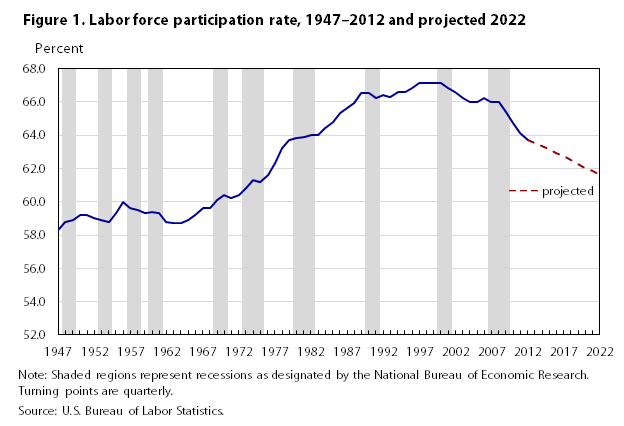
I already demonstrated that we're in a labor force participation rate bubble,
TBBA (Truth by Blatant Assertion) Merely pointing at a graph or mentioning various cherry picked statistics doesn't prove a bubble.
Let's not argue so much over *why* labor force participation suddenly grew. Let's ask another question: Why was it so low in 1970? Well, I can find as far back as 1947 at a glance, and the answer is it's always been that low.
Actually, let's do discuss it, because it's quite relevant. You see, in the late 60s, with women's lib and societal upheavel in the US and the rejection of the June Cleaver role, women actually demanded that they be treated as equals in society. Because of the aforementioned appliances etc, they had more free time and they not only went to work but stayed at work, developing careers as a normal activity. That increased the labor pool, it was not a bubble, but a raising of the available level. Now you can dispute that the pool got bigger or address the drop off since the peak, but you can't say the increase was a bubble as several fundamental shifts in society occurred to drive that effect. That would be like saying an asteroid only caused some minor temporary damage 65 million years ago.
Globalization started in the 19th century--some economists want to take this back further--with the reduction of shipping costs. That whole shipping textiles and spices and liquor around? That's outsource labor, pushing manufacture to cheaper labor markets.
Really? Try the 70s for when textiles really started losing business fast. You're seriously stretching there with ancient trade. That trade was for goods unique to production areas, not a move to replace domestic production with cheaper foreign production. It's a simple test really, was whatever was being brought in made domestically as well? No? Then it wasn't outsourcing.
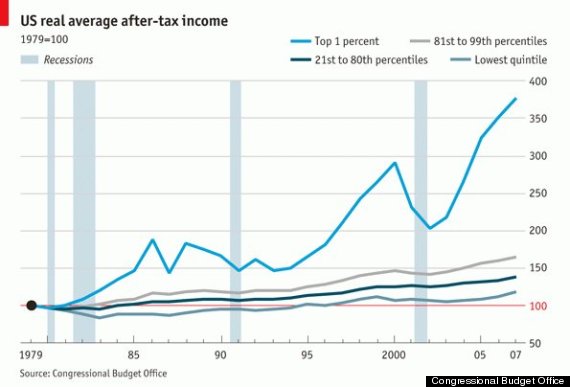
At the same time, income per household has increased even as labor force participation decreased, which suggests the jobs we're gaining are higher-paying jobs.
You might want to check your numbers as it is obvious that real median income has dropped since the 70s, with the exception of the last report, which still indicates that median income has dropped since 2000. Add to that that actual cost of living has increased....
First, we don't have a lowered median income.
TBBA - Several links from authoritative sources a
-
Re:Most obvious problem: its questionable legality
I could have sworn the "secret recipe for Uber" was that all those wonderfully regulated cab services actually suck and many have poor customer service: http://www.wbur.org/2011/02/15...
Then Uber should be able to compete with them and win on quality without having to do anything illegal.
-
Re:Most obvious problem: its questionable legality
I could have sworn the "secret recipe for Uber" was that all those wonderfully regulated cab services actually suck and many have poor customer service: http://www.wbur.org/2011/02/15...
-
Destruction of civilization...
The limits on surveillance — both by fellow citizens and the government(s) — have never really been laws of men, but those of nature.
How well can a human being see? With nice lenses? With a bunch of cameras? With a high-flying drone?
How much could a human being remember? How much can he record on a piece of papyrus? A bound book? A magnetic tape? A computer?
Our inventions expand our powers. We use them — and abuse them too.
You may be able to push back on some fronts — like forcing EZ-Pass and similar toll-collectors to allow anonymous transponders. You may even be able to, one day, abolish license plates from vehicles.
But to roll back ordinary surveillance, you'll have to destroy/ban/abolish the technology, that enables it. Because you can not outlaw remembering what one has seen. Nor can you outlaw making records to aid one's memory... The populist Europeans attempted introduction of the "right to be forgotten" — not realizing, it may some day be used, for example, by ex-lovers to demand, the other side be forced to forget the good times they once had together.
Maybe, we have to make a dramatic shift in our attitude towards the very perceiving of others. Currently, you can watch/hear/perceive (and — almost always — record) anything visible/audible/perceivable from anywhere, where you can legally be. Can we make it illegal to look at people or listen to them without their explicit permission? I doubt it.
-
Re:Cry me a river
The IRS is an unbelievably bloated agency.
I call BS. Do you have any evidence of bloat at the IRS? The Boston Globe has reported that the IRS is not "up to the basics of its job." The IRS makes billions of dollars in fraudulent payments "because it lacks the ability to check whether many returns are accurate before refunds are mailed." The IRS relies on tax preparers to file accurate returns. Guess what, they often screw up. The agency is "so short-staffed it cannot answer nearly 40 percent of phone calls, and it has failed to meet its own 45-day deadline to respond to millions of letters per year from taxpayers." Etc.
On Point Radio had a show about the IRS 11 months ago. Listen and learn: http://onpoint.wbur.org/2014/0...
-
Re:There is no magic bullet
Ending prohibition didn't kill the mob. They just switched from bootlegging to trafficking narcotics, and they reached the height of their power in the 50s and 60s, long after the prohibition ended.
Well... by this thinking, the mob continued because prohibition didn't end. They moved from one prohibited product to another, but always a product the people wanted, but couldn't get because of a prohibition, and the mob was in a particularly good position (with their organization and international reach) to supply.
In the same way, while legalizing marijuana might reduce crime here in the US, cartels in Mexico are Too Big to Fail. They won't pack up their things and head home quietly if marijuana is legalized; they'll just start peddling something new.
What might happen if the cartels' market dried up is, at best, speculation. Could be risky, change is scary. But doing nothing and maintaining the status quo is worse. The cartels continue to get better and better at smuggling (they got submarines for fuck sake) and much, much richer while turning Central and South American countries into murderous hell-holes from which children flee to the U.S. on foot, and that ain't no shit.
I don't see how decriminalizing them good possibly be a good idea. The addiction rate for these drugs is 2.5 to 3 times that of alcohol.
I'm also nervous about cocaine and meth easily getting around (like, more than it already is). But the fact is, drug addiction and mental illness is just gonna have to be something that this country has to shut up, knuckle-down and deal with. It's not going away, and prohibition doesn't help. Prohibition only has power to do one thing... throw people in jail. It doesn't cure addiction (drugs make their way into prisons all the time), and distracts everyone from the larger issue of mental illness. It's like taking out the garbage: nobody wants to do it, nobody gets credit for doing it, but it's gotta be done or shit just piles up and gets worse.
-
Re:which could impact patient care
1. Children's hospitals receive donations and nail research grants with an alarming deftness. Boston Children's Hospital is, according to their own architecture, the best. There's no shortage of money. They did have some layoffs a couple of years ago, but with a ridiculous savings ratio (255 jobs, costing 89.5 million annually, constituting somewhere in the neighbourhood of 3% of their budget.)
Having income is not the same thing as having money. Hospitals and medical care is expensive, especially in the US. It looks like that job cut was due to a $150 million budget shortfall.
BUDGET SHORTFALL. They had millions of dollars more than they spent, but they wanted so many millions more they decided to make up the difference by firing people. "Hospitals and medical care" don't have to be expensive. They want to be.
-
Re:which could impact patient care
1. Children's hospitals receive donations and nail research grants with an alarming deftness. Boston Children's Hospital is, according to their own architecture, the best. There's no shortage of money. They did have some layoffs a couple of years ago, but with a ridiculous savings ratio (255 jobs, costing 89.5 million annually, constituting somewhere in the neighbourhood of 3% of their budget.)
Having income is not the same thing as having money. Hospitals and medical care is expensive, especially in the US. It looks like that job cut was due to a $150 million budget shortfall.
-
Re:which could impact patient care
1. Children's hospitals receive donations and nail research grants with an alarming deftness. Boston Children's Hospital is, according to their own architecture, the best. There's no shortage of money. They did have some layoffs a couple of years ago, but with a ridiculous savings ratio (255 jobs, costing 89.5 million annually, constituting somewhere in the neighbourhood of 3% of their budget.)
2. Their primary website is located at 134.174.13.251 (childrenshospital.org). Patient info retrieval is hosted on 134.174.13.5 (apps.childrenshospital.org). There is a booking form located on the main site, but at any rate it's working just fine now.
-
Re:Have we said the same thing?
-
They'll just continue spying anyway
When we have flaps like this that occur, you know, something will change, and I expect we'll get some sort of announcement that will - that the Europeans can point to as a curtailment and as a change. But as time goes by, flaps blow over, and the permanent interests of ourselves and our allies reassert themselves.
-
Re:Me too!
You left out Massachusetts, which has also managed to sign up 0 people.
Now you might think "wait, but Massachusetts has Romneycare, of course they had 0 signups, everyone's already signed up." And you'd be wrong. Turns out that a bunch of people who had plans they liked under Romneycare are going to lose them under Obamacare. (Why does that sound familiar?) Which means that they have to reapply to the state exchange.
The state exchange was redone due to Obamacare, and the new version flat-out doesn't work. So a whole bunch of people are going to lose their Romneycare plans thanks to Obamacare.
And I'm sure the new website not working has nothing to do with Massachusetts using the exact same contractors who built Healthcare.gov.
-
Re:Not for medical device startups
The tax is on medical devices like pacemakers, not the band-aids and q-tips in the article you link to. For little things like that the cost of labor is going to far exceed the actual cost of the item anyway. The structure of the tax, and the industry segment it targets is most unfortunate.
What’s All This Federal Fuss Over An Obscure Medical Device Tax?
First, it’s a tax on sales, so even companies that are losing money have to pay it. This means the tax disproportionately harms young, innovative start up companies that are building the medical technologies of the future. It takes a ton of money to bring a new medical device to market, between the regulatory hurdles at FDA and the Centers for Medicaid and Medicare Service, legal bills from protecting patents and intellectual property, manufacturing costs and challenges of building a highly specialized sales forces. Medical device companies generally don’t achieve profitability until they hit at least the $100 million in sales mark (if they’re lucky).
Second, the tax is costing the industry thousands of jobs. In 2012, publicly traded medical device companies cut 10,000 jobs, in part, to brace for the impact of the tax, although it’s impossible to determine how much the tax actually added to those job loss numbers. Still, the amount of money that companies are paying is substantial. Massachusetts’ own Boston Scientific has kicked $35 million back to the feds in the first half of the year; Mansfield, Mass.-based medical device giant Covidien has dropped $30 million; and every company has felt some pain in the wallet investing in the IT systems and tax experts necessary to comply with paying a tax on every single product you sell every two weeks....more
Medical-device companies say new excise tax will hurt industry
The tax is "incredibly punitive," said John Ray, executive director of the Florida Medical Manufacturers Consortium. "It targets one of the most successful sectors in our country."...
The tax would amount to $230 on the sale of a $10,000 medical device. While that may seem small, opponents say it has a larger impact because it is a tax on sales — not profits. The tax could result in less spending on research and development and lead to job cuts, medical device companies say.
"The biggest issue for medical device industry is the excise tax — 2.3 percent tax on sales, not on net income — to companies like Mako," said Dr. Maurice Ferre, founder and chief executive of Mako Surgical, a Davie, Fla., maker of surgical systems used for knee- and hip-replacement procedures.
If you don't understand the implications of taxing sales versus profits, you should look into that.
-
Re:Not for medical device startups
The tax is on medical devices like pacemakers, not the band-aids and q-tips in the article you link to. For little things like that the cost of labor is going to far exceed the actual cost of the item anyway. The structure of the tax, and the industry segment it targets is most unfortunate.
What’s All This Federal Fuss Over An Obscure Medical Device Tax?
First, it’s a tax on sales, so even companies that are losing money have to pay it. This means the tax disproportionately harms young, innovative start up companies that are building the medical technologies of the future. It takes a ton of money to bring a new medical device to market, between the regulatory hurdles at FDA and the Centers for Medicaid and Medicare Service, legal bills from protecting patents and intellectual property, manufacturing costs and challenges of building a highly specialized sales forces. Medical device companies generally don’t achieve profitability until they hit at least the $100 million in sales mark (if they’re lucky).
Second, the tax is costing the industry thousands of jobs. In 2012, publicly traded medical device companies cut 10,000 jobs, in part, to brace for the impact of the tax, although it’s impossible to determine how much the tax actually added to those job loss numbers. Still, the amount of money that companies are paying is substantial. Massachusetts’ own Boston Scientific has kicked $35 million back to the feds in the first half of the year; Mansfield, Mass.-based medical device giant Covidien has dropped $30 million; and every company has felt some pain in the wallet investing in the IT systems and tax experts necessary to comply with paying a tax on every single product you sell every two weeks....more
Medical-device companies say new excise tax will hurt industry
The tax is "incredibly punitive," said John Ray, executive director of the Florida Medical Manufacturers Consortium. "It targets one of the most successful sectors in our country."...
The tax would amount to $230 on the sale of a $10,000 medical device. While that may seem small, opponents say it has a larger impact because it is a tax on sales — not profits. The tax could result in less spending on research and development and lead to job cuts, medical device companies say.
"The biggest issue for medical device industry is the excise tax — 2.3 percent tax on sales, not on net income — to companies like Mako," said Dr. Maurice Ferre, founder and chief executive of Mako Surgical, a Davie, Fla., maker of surgical systems used for knee- and hip-replacement procedures.
If you don't understand the implications of taxing sales versus profits, you should look into that.
-
Re:head transplant, or body transplant?
Actually... Remember that experiment where they sew the mice together. The question may be, are these GDF-11 proteins made in the head.
http://hereandnow.wbur.org/2013/05/09/protein-heart-disease -
We Won!
THIS! Two guys with pressure cookers shut down a major american city, innocent American's were deprived of their 4th Amendment rights (just as one example, stripped naked guy) Endless pictures of paramilitary police and armored personell carriers roaming the streets of Boston Door to door searches by police that essentially are indistinguishable from military without search warrants brandishing firearms
-
Re:If two people lock down a major city....
THIS! Two guys with pressure cookers shut down a major american city, innocent American's were deprived of their 4th Amendment rights (just as one example, stripped naked guy) Endless pictures of paramilitary police and armored personell carriers roaming the streets of Boston Door to door searches by police that essentially are indistinguishable from military without search warrants brandishing firearms
-
Re:Wait a second...
Because the conservatives will have raised a hefty charity pool among themselves and mailed it anonymously to the address, while a Prius full of liberals would have done nothing, smug in the satisfaction that the tax dollars from the truck full of conservatives kept the single mother in bondage to the liberal government?
You don't watch the news much, do you? They're trying to turn public education into an actual Hunger Games... do you really think they're into charity?
-
Credential inflation is real
and hardly a new phenomenon.
You need a Masters Degree in many fields to have a snowball's chance in hell of getting anywhere. This varies somewhat in technical fields, but as we see time and time again, once your age climbs over, say, 35, it can be tough as hell to get a technical job. Outside of tech fields, you need either a top flight BA/BS or a higher degree to set you apart, and there is no reason for this trend to reverse. -
meanwhile, a BSL-4 facility smack in Boston= AOK
Meanwhile, everyone's been ramming through a BSL-4 facility which will study live human diseases, right smack in the middle of Boston:
http://www.wbur.org/2012/04/19/biolab-research-approval
They picked a poor minority neighborhood they and city officials could bully around, and despite public uproar, soon residents can look forward to being neighbors with Ebola.
Apparently BU just couldn't be bothered to build it, say, out somewhere in the suburbs where there'd be some isolation from the general populace. Let's put it right smack in the middle of a city with a big public transit system and an international airport, just so our researchers won't have to hop in a car for a drive. BRILLIANT.
-
They've cleared that hurdle too
As part of the NStar-Northeastern merger, the new company has agreed to purchase 27.5% of the output from the Cape Wind project. See http://www.wbur.org/2012/02/15/cape-wind-power
That means that Cape Wind has got contracts for 77.5% of their output -- enough to satisfy the bankers that the project will have the cash flow to repay the bankers. Which is to say, that is no longer a Cape Wind hurdle.
-
Re:Bullshit
I mean, if a cop decides to beat me for no reason, he gets investigated (and if there's evidence) gets convicted.
Yeah, right. More likely he gets a paid vacation for a few weeks (if even that), a slap on the wrist, and then he's back on the streets to abuse people just like he learned back in grade school bullying his classmates.
Hell, how hard is it to even prove that the beating was "for no reason"? Cops already routinely confiscate any video proof of their misdeeds, even from innocent bystanders. And those dash-cams? Good luck depending on those to exonerate you.
-
Stupid Motive
Following some bullet-pointed quotes such as "Over 2.5 billion people live on less than $2 a day" and, "Nations must invest $37 trillion in energy technologies by 2030 to stabilise greenhouse gas emissions at sustainable levels," the message states:
"Today's decisions should be based on all the information we can get, not on hiding the decline. This archive contains some 5.000 emails picked from keyword searches. A few remarks and redactions are marked with triple brackets. The rest, some 220.000, are encrypted for various reasons. We are not planning to publicly release the passphrase. We could not read every one, but tried to cover the most relevant topics."Listen, I'm all for the publication of the data and methods these scientists are using. But what exactly is releasing internal e-mails supposed to accomplish? Acting all righteous about "hiding the decline" and then you turn around and censor what you release?! That's pretty funny to me. Who do you think climate change is going to hurt the most anyway? My fat American ass shoving honey coated whole wheat pretzels into my gaping maw while surfing the internet? Or the truly poor people? You know that subsistence farmer in Africa or China where a drought, famine or conflict could wipe him out at the drop of a hat? When times get tough, I'll have to give up my XBox Live Gold Account
It'll probably turn out like the UN anyway where the US pays $362 million and China pays $29 million so that's some pretty flimsy motivation there when the wealthiest nations will most likely be footing the bill. -
Re:Ho ho ho.
( Making green-friendly people happy = increase in sales ) + ridiculous government subsidies for installing solar = profit increase.
"Ridiculous" is just you editorializing. AFAICT the subsidies are working exactly as intended: by encouraging the adoption of solar power, they grow the solar power market, increase the economies of scale for panel production, and bring the prices down quicker so that soon we'll have solar power that's cheap enough that subsidies are no longer necessary.
You may or may not have noticed that solar panel prices decreased by 50% last year, and the market grew by 70%. Coincidence? Perhaps, but I don't think so.
-
Solar to Hydrocarbons
For a long time I thought a balanced approach to renewable energy was the best strategy but I've recently changed my opinion to favoring solar heavily. Specifically, solar to various hydrocarbons. Even though it's not as efficient as other solar storage techniques, such as pumping water uphill, it directly generates a portable, energy dense medium. The lecture that really changed my mind came from Cal Tech professor Dr. Nathan Lewis. He talked about limits of every energy source and broke down the numbers in terms of potential energy from each. Nothing even came close to solar. And even though solar to hydrogen is cleaner, realistically, solar to hydrocarbons are much easier to use in our current economy.
-
Mental health diagnostic software
I happened to be listening to the public radio program "Here and Now" yesterday where they were discussing whether colleges and universities should be required to inform public mental health agencies about students or faculty suspended for making violent threats.
In the course of the discussion one of the interviewees mentioned a program called MOSAIC (no, not NCSA MOSAIC). From its home page:
MOSAIC is an error avoidance method, a computer-assisted method for conducting comprehensive assessments - in the same way that diagnosis is a method used by a doctor.
MOSAIC helps the assessor weigh the present situation in light of expert opinion and research, and instantly compare the present situation to past cases where the outcomes are known.
The program is used by many Federal agencies and some colleges and universities.
-
Re:I'm sure...
Reminds me of that story about the fly in the urinal to change human behaviour and get men to aim.
However, in this case, it makes me wonder if that would work: if you have to erase graffiti, for example, that would suggest you have to change aim a bit.
Pretty interesting concept though. As my one friend remarked to me, it won't be long before they're doing this in the toilets, and people get to play Angry Turds.
-
Re:Begging
That's why NPR does both! "This listener supported show is brought to you by Gigantacorp. Gigantacorp: trying to fuck you in the ass since 1952. And by listeners like you. Who donated. Which you don't. Fucker."
I wouldn't mind as much except that NPR gets tax money. And, no, it's not a small amount either, NPR loves to pretend that it is by simply not counting the grants they get via parties that are solely funded by tax money. Plus they ignore that listener donations are tax writeoffs, meaning that they too are effectively tax dollars.
So either ditch the tax money, or ditch the ads. I'd go with ditching the tax money personally, since it's not like NPR produces non-biased anything. Might as well admit it and just be the full-on corporate whores they actually are.
Well, let's not let the facts get in the way of a good story.
-
Re:Do you really have to ask "why?"
Because the sole measure of how well an economy is doing is unemployment, right?
I don't know about you, but I'm doing far worse now than I was under Bush, and I'm still employed. So, yeah, I'd say that from my point of view, the economy is far worse now than it was before.
Of course, I live in Massachusetts, which completely fucked up their health care system, so part of the increase in costs is due to that. Luckily for the rest of you, the problems that Massachusetts created for itself (more people getting care from the emergency room than ever before, fewer medical services being offered, fewer doctors, and on) are local to the state, and aren't a huge mistake that the federal government is duplicating across the nation.
...Oh, wait.
I should probably post AC since I have, in the past, supported the health care program, but recent facts of how it went in Massachusetts show it to be a complete disaster. And that's a link to an NPR story, so this isn't just random conservative talking points, it really has been a complete disaster, which the entire nation gets to share in now. Yay change.
-
It's more neurological than genetic...
As we come to understand more and more about neurology and genetic, an increasing amount of studies on human obesity are shifting from a genetic focus to a neurological focus.
Dr. David Kessler, former FDA commissioner and someone who has struggled with weight in his own life, has an excellent book out called The End of Overeating: Taking Control of the Insatiable American Appetite. NPR has done some very good interviews with him.
He admits that he started his study expecting to head down the road of genetics. But he found the research and data kept pointing him to the brain instead. One interesting tidbit from his research: They did a study where they had a group of people, some overweight and some normal weight, and asked each person to identify their favorite snack or dessert. They would then place each person individually in a room with large portions of their favorite food. What they found was that everybody, upon seeing their favorite snack/dessert, had the same neurological response (endorphin-like response). But what was interesting was that for those who weren't overweight this response ended after they ate enough to be filled. For those who were overweight, they found that the brain didn't stop producing this response until the food was completely gone.
Dr. Kessler, as well as many more scientists, are starting to focus more on obesity from a sociological and behavioral angle than a genetic angle. He keeps mentioning how obesity has more to do with the relationship people have with food than anything else (and focuses a lot on what kind of relationship we are teaching our children to have with food).
Of course, genetics are still important. But not as much as we've initially thought it to be.
-
Re:Step 1.
Well, if you're planning to move to Massachusetts you'd better do it soon. The Commonwealth Choice program is in serious trouble and may go bankrupt.
We gave you gay marriage, Scott Brown and soon government run healthcare. I can hardly wait!!