Slashdot Mirror
Domain: wikimedia.org
Stories and comments across the archive that link to wikimedia.org.
Comments · 6,832
-
Amatures.
It is called Hardtack.
http://upload.wikimedia.org/wikipedia/commons/a/ac/Oldest_ship_biscuit-Kronborg-DK.JPG
-
Re:Graph
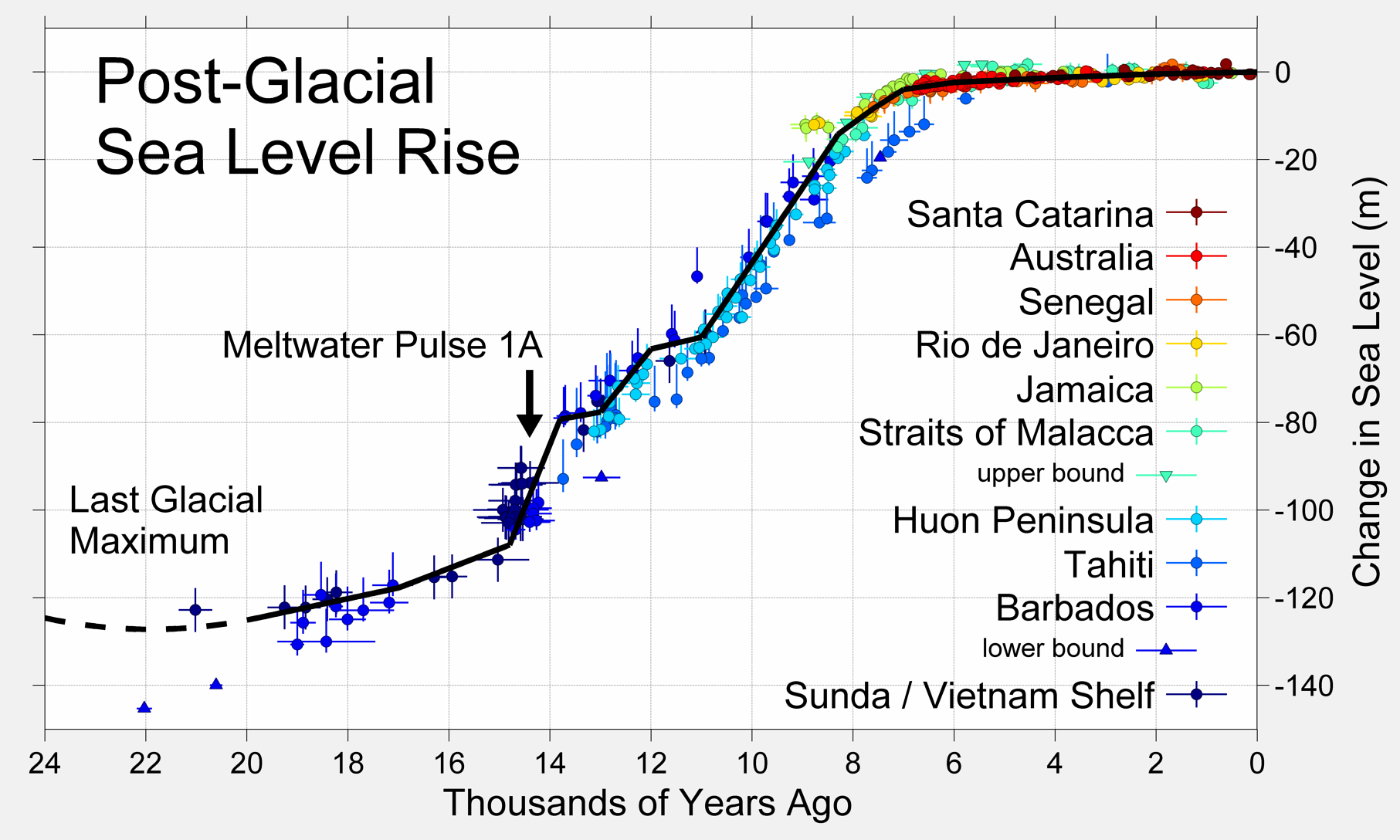
Here is another graph of the ocean change since 22 000 BC. Note how contemporary events are utterly lost in the noise.
-
This is NOT informative. this is a myth.
1000 years ago Greenland had ice, because we have ice core from all over the place which date 5000+ (and some older) to demonstrate it. There were *some* pastoral place but those do exists today too :
http://upload.wikimedia.org/wikipedia/commons/thumb/4/42/Qaqortoq2008.JPG/120px-Qaqortoq2008.JPG
The main problem is that the place was not so great for agriculture to begin with, and the drop of average of temperature of 4ÂC around 1100 to 1200AD did not help.
The reason it was called greenland is mainly because calling it "deathly cold land" would not help attract suckers to help colonize it. -
Re:What happems
If you want evidence you need only look at the continual lowering of tax rates at the top of the scale
hmm.
-
Re:Was it justified
Bullshit. Apple is not "losing market share hand over fist".
Well, that was possibly a little hyperbolic on my part
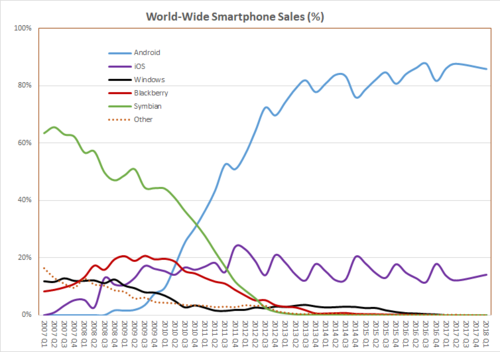
In terms of what-might-have-been, though, the last two years have been disastrous for Apple. During that time, every other major mobile OS lost customers, and they all seem to have gone over to Android rather than iOS. Amazingly, somewhere between Q1 and Q2 2010, Android and iOS both had about 15% of the total smartphone market share. Apple could have easily become the dominant platform from this point, but instead they stagnated (they're now have slightly less than what they were two years ago); whereas Android gobbled up everything else to get 73% of the market. And given all that, I'm not sure that ditching Google's maps for their own in-house product was one of Apple's smartest ideas.
You could probably argue that they had already missed the boat by two years by the time they dropped Google and it wouldn't have made much difference regardless. But I'm not convinced that the Android user base has the same loyalty as the iOS user base, and I would have thought that a compelling phone and OS package from Apple could have still turned things around, or at least stopped the decline.
-
Re:Was it justified
Was this guy setup for failure by having to meeting google map standards overnight? Firing people sometimes is an escape goat for companies mistakes.
Gees, kid... damn but I'm getting old. I remember when people actually used to read books... ok, no I don't. Most people were always aliterate. But here are a couple of clues for literates who don't read.
First, "setup" is a noun. "It's a setup!!!" The verb has a space in it; "set up." I see this way too often, as well as "noone" for "no one" and I take the blame for that; it was a typo I made fifteen years ago when I didn't hit the space key hard enough and didn't proofread. So if "noone" annoys you, sorry, that's my fault. The original "noone" was a typo, as was most likely "setup" as a verb (someone else's typo).
Secondly, you need an apostrophe for the posessive plural --"companies' mistakes".
Thirdly, there's a funny comment lower about your "escape goat". It's "Scapegoat" and it's an ancient word still widely used (or in aliterate cases, misused). In modern usage a scapegoat is an individual, group, or country singled out for unmerited negative treatment or blame. It comes from the common English translation of the Hebrew term azazel which occurs in Leviticus 16:8.
In ancient Greece a cripple or beggar or criminal (the pharmakos) was cast out of the community, either in response to a natural disaster (such as a plague, famine or an invasion) or in response to a calendrical crisis (such as the end of the year). In the Bible, the scapegoat was a goat that was designated to be cast out in the desert as part of the ceremonies of the Day of Atonement, that began during the Exodus with the original Tabernacle and continued through the times of the temples in Jerusalem.
In psychology and sociology, the practice of selecting someone as a scapegoat has led to the concept of scapegoating.
But in this case, the guy wasn't a scapegoat, he was a fuckup. He was head of the mapping team, it was his responsibility to get it right. Had it been his secretary who had been fired, the secretary would have been a scapegoat.
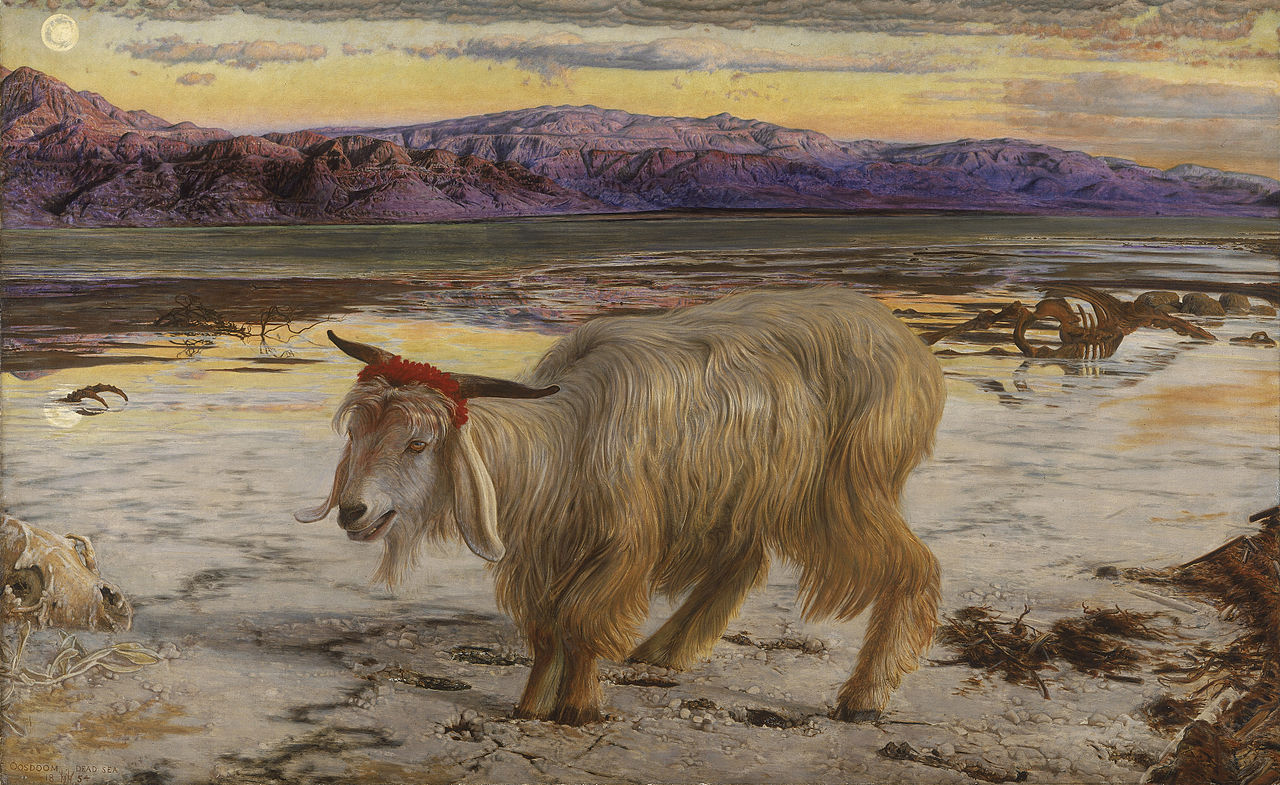
Here is a picture of a scapegoat, painted by William Holman Hunt in 1854, from wikipedia.
</education>
-
Re:It's ok.
-
Re:It's ok.
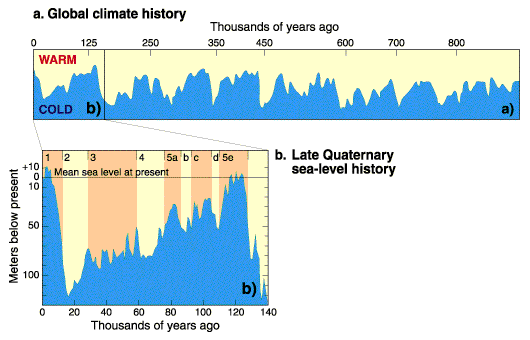
Quite, 10,000 years ago the seas were 10 meters higher than they are today.
Or not.
http://commons.wikimedia.org/wiki/File:Post-Glacial_Sea_Level.png -
Re:Nice and orderly
Yes, still brings back memories.
Still have my old Atari 800 and 800XL along with all the bits and pieces acquired every Christmas (sprocket printer, little graphics tablet that used the paddle ports for input, the little plotter printer. But then, by the time you had all those, you needed two extension bars for all the different transformers (keyboard, TV, disk drives, printers, RS232).
Fortunately, there are emulators for the Atari and all the other home computers like the BBC. I've used to them to type in the listings from archived articles I had always wanted to try out. All those program still run, even the "100+ free programs" that came from the shop I bought them from.
-
Re:Nobody is going to wear these things
It seems reasonable at first to predict that people won't tolerate their own glasses looking unusual. But I think the same way you predict that, can also be used to predict that nobody will ever walk about with bluetooth crap sticking out of their ears. Yet, there the gargoyles are.
This guy was the future but this guy wasn't? Are you sure you have the fashion expertise to really distinguish between the two? (I'll be the first to admit that I don't have that expertise either...)
-
Re:Cinnamon on Ubuntu
By installing Mint you'd get:
* mintUpdate: Mint's update manager which lets you categorize packages into different levels depending on how "dangerous"/unstable they are. Eg. level 5 packages ("dangerous packages") can be excluded from the update. Screenshot: http://upload.wikimedia.org/wikipedia/commons/5/59/Mintupdate.png
* mintInstall: Mint's software manager which features a lot of crappy reviews written by users.
* MDM Display Manager: Themable and based on GDM 2.20
* Nemo: Mint's file manager, forked from Nautilus 3.4 because "Nautilus 3.6 is a catastrophe" according to the Mint/Nemo team.
* Some non-free packages (drivers, codecs) are included by defaultI switched directly from Fedora to Mint a couple of months ago and didn't see the need for Ubuntu.
-
Re:Good idea, wrong solution
Maybe a MOOSE LOOSE situation...
-
Re:Still no Retina support for OS X
I hate to point out the obvious, but no web site in existence does "retina" anyway
On the contrary, there are quite a few very large pictures on the internet. Even on wikipedia.
-
Re:I really hope...
-
Some ideas
idea - suggestions for wikipedia new editor
Caveats:
- As I don't know the current UI for wikipedia editing well maybe it already has some of these things.
- A new UI probably is not in fact the main reason for dwindling contributors, as someone else pointed out. Just saying.General UI
- Screens are big these days. Consider an interface that keeps everything on one screen.
- At least a rich text editor type thing with buttons for tags and popup input forms for entry of book info, etc.Editing Together
- Allow simultaneous editing by more than one person. The portion being edited will update in semi-real time on the other people's screens.
- Within the editor UI include a chat frame to allow people to exchange messages in real time or asynchronously and view the past thread of chat, to discuss the article and edit it together simultaneously.
- Consider adding voice/video chat by that chat frame, or allow another window to opened that has a video/audio/irc chat.Viewport
- Allow more than one portion of the same file to be visible while editing. MS Word allows you to drag down a viewport separation bar from the ruler area so you can edit two locations in one file simultaneously. LibreOffice can't do this yet which is frustrating to me, wish they would add it.
- Apple P.I.E. (Programmers' Interactive Editor) was an awesome editor for the Apple ][ which was a light year ahead of a lot of editors even today. One function I remember clearly decades later was being able to hit IIRC control+0 which would jump the insertion point to past saved cursor locations, letting you jump quickly through a number of points in the file. I have never found that function in other editors and have often wanted it.Adding Media Collaboratively
There are relatively few or no illustrations or photographs illustrating articles. It may be due to copyright fears, lack of talented willing illustrators, or difficulty in uploading and referencing the figures in the text. For example, it seems unlikely that the author of an article is also a talented artist, whereas an artist reading the article is not going to want to learn how to edit wikipedia and get deep into it. Anyway there may be some obstacle, so we should try to make it easier. -> Allow inline images, and provide a facility allowing casual users to upload them (with a form vouching CC right to use it) for consideration for inclusion by the article editor, and have someone else edit them.Templates
- Provide templates in LibreOffice that you can edit and upload. Who wants to edit in a browser window? It isn't yours, it isn't available when you are offline, you might lose your work by closing a tab by accident, etc. etc. The basic idea of editing something important in a browser window is actually anathema to me..
- For that matter, you could integrate with LibreOffice..Smart Editing
- Allow / Force the user to identify proper nouns, processes, etc. that have / should have their own Wikipedia entry. Wikipedia can search for the article and make the entry a link to the article.
- Editor can provide smart facilities for adding other kinds of content.
For example being able to upload a midi or wav / ogg file in order to explain something about music is an idea.
- Provide a smart import wizard that lets you easily import a table by for example copying a range of cells in LibreOffice Calc or some other spreadsheet program and pasting it into an import text area (or allow a spreadsheet file to be dragged onto an import button area).Third Party
- Create an API so third party authors can write cool editing apps.Databases
(after writing I discovered there is an initiative: http://meta.wikimedia.org/wiki/Wikidata )
- Add ways to input and maintain data that is not cartesian rows and columns. How do you input and edit:
o A hierarchical tree?
o A tree with lateral links?
o A bunch of items with faceted metadata?
o A graph wi -
Re:Did anyone notice:
Maybe Israel should just take back what was Israel in 600 A.D., before muslims started conquering. Half of Egypt, most of Jordan, Lebanon and large chunks of Syria and Saudi Arabia were part of the state of Israel then. After all, it was taken from them by conquest, and that's all the justification muslims need, so why not do to them what they're doing to others ? They certainly deserve it.
Uhm, I think you spelled Byzantine Empire wrong.
-
Van Gogh
Let me enlighten you about Van Gogh's art and motivation using the traditional slashdot car analogy.
Van Gogh's finest art is functionally equivalent to NASCAR: 24 hours of continuously turning left, if done well, he hoped would result in a snuggle from a ring girl, specifically, Rachel. In order to enhance his left turns, he removed his left ear, thus creating a ground-hugging vacuum on the left and so enhancing his turning ability.
This made him quite dizzy; the result was "Starry Starry Night", a veritable opus of left turns, which of course we now treat as a cultural treasure.
Alas, Rachel, who was left holding the ear, was not so easily impressed.
* There's gonna be a quiz tomorrow
-
Re:I am super-tired of small-EV prototypes
"Show me the MINI !"
Here you go
Just keep in mind they pretty much stop running if it rains. -
Re:Nothing weird
Unity ==== http://en.wikipedia.org/wiki/Unity_(user_interface)
Cinnamon ======= http://cinnamon.linuxmint.com/
Look at the pictures. One comes with a menu panel...the other a full screen of applications icons similar to a smartphone.
It's only a full screen if your screen is really small. The Wikipedia screenshot is pretty misleading in that regard - this would probably more representative for normal display sizes.
But more importantly, the similarity with smartphones is mostly visual - the icons are larger than Cinnamon's and placed above rather than next to the program name, which makes it look loosely like a touchscreen interface or a Windows desktop with application links. However, the Unity start menu (aka "Dash") is actually keyboard centric. It prominently features a search bar which also has focus when you open the Dash and is the most efficient method of using it. In that regard, it has more to do with program launchers like Launchy or the search field in the Windows 7 start menu than with smartphones.
The traditional hierarchical menu is indeed superior in one use case: Accessing rarely used applications using only the mouse or a touchscreen (no keyboard). But at least for me, it turns out that I'm almost never doing that anyway. ymmv.
In fact so many people prefer cinnamon over unity mint has become the most popular download on distrowatch.
That doesn't actually tell us how many people use a distribution, though - the Distrowatch numbers are based on a relatively small subset of Linux users that is probably not representative. For example, a user who is happy with their distribution and does not intend to switch to anything else would be less likely to even visit a distribution comparison site.
It could be interesting to look at the traffic of major websites instead. Unfortunately, most of them do not differentiate between distributions. One exception I know of is the Wikimedia Traffic Analysis Report, where Ubuntu clearly accounts for the largest share of traffic among Linux distributions except Android. As we know, statistics like that have their own set of problems, and in this case there is also a huge number of "Other" in there that could easily skew the results. However, it still seems like a better approach for measuring actual usage. (Do browsers on Mint usually include the distribution in the user agent string?)
-
Re:Nothing weird
Unity ==== http://en.wikipedia.org/wiki/Unity_(user_interface)
Cinnamon ======= http://cinnamon.linuxmint.com/
Look at the pictures. One comes with a menu panel...the other a full screen of applications icons similar to a smartphone.
It's only a full screen if your screen is really small. The Wikipedia screenshot is pretty misleading in that regard - this would probably more representative for normal display sizes.
But more importantly, the similarity with smartphones is mostly visual - the icons are larger than Cinnamon's and placed above rather than next to the program name, which makes it look loosely like a touchscreen interface or a Windows desktop with application links. However, the Unity start menu (aka "Dash") is actually keyboard centric. It prominently features a search bar which also has focus when you open the Dash and is the most efficient method of using it. In that regard, it has more to do with program launchers like Launchy or the search field in the Windows 7 start menu than with smartphones.
The traditional hierarchical menu is indeed superior in one use case: Accessing rarely used applications using only the mouse or a touchscreen (no keyboard). But at least for me, it turns out that I'm almost never doing that anyway. ymmv.
In fact so many people prefer cinnamon over unity mint has become the most popular download on distrowatch.
That doesn't actually tell us how many people use a distribution, though - the Distrowatch numbers are based on a relatively small subset of Linux users that is probably not representative. For example, a user who is happy with their distribution and does not intend to switch to anything else would be less likely to even visit a distribution comparison site.
It could be interesting to look at the traffic of major websites instead. Unfortunately, most of them do not differentiate between distributions. One exception I know of is the Wikimedia Traffic Analysis Report, where Ubuntu clearly accounts for the largest share of traffic among Linux distributions except Android. As we know, statistics like that have their own set of problems, and in this case there is also a huge number of "Other" in there that could easily skew the results. However, it still seems like a better approach for measuring actual usage. (Do browsers on Mint usually include the distribution in the user agent string?)
-
Re:are you on a sheared box for you web hosting?
are you on a sheared box
You mean a Brazilian?
-
Re:Title is rubbish
In 06!!!! Try 2002:
https://secure.wikimedia.org/wikipedia/en/wiki/Intel_Pentium_4" This initial 3.06 GHz 533FSB Pentium 4 Hyper-Threading enabled processor was known as Pentium 4 HT and was introduced to mass market by Gateway in November 2002."
-
Re: Navy Seals Disciplined For Revealing Secrets
-
Re:Stupid.
Sigh. I'm not going to keep arguing with ways that machines can be subverted. Paper ballots can be subverted too.
http://upload.wikimedia.org/wikipedia/commons/c/ca/Ballotstuffing.jpg
Whichever technology you use, the key is keeping the process open and properly audited. Just as technology is never a silver bullet, neither is anti-technology.
-
Re:Stupid.
My point exactly. You keep the election honest by keeping the process open. Most voting machine problems have related to the fact that their operation is a secret, not that they're machines.
If you keep the design of ballot boxes a secret, you can fix elections that way too:
http://upload.wikimedia.org/wikipedia/commons/c/ca/Ballotstuffing.jpg
-
Re:Stupid.
OK, maybe the Canadian system would work in the U.S., assuming that people here didn't reject it just because it's Canadian, and assuming we could find 100,000 counters willing to put in a full days work for $30.
My big point here is not that paper ballots are bad and voting machines are good. You can have a good or bad system either way. (And there have been a lot of bad elections using paper ballots. I'm just trying to shoot down the idea that all our troubles are the result of using them newfangled machines.
You guys in Canada have an advantage because your Federal elections are managed by Elections Canada, an independent federal authority. Imagine what a mess you would have if every province, county, district, and town had its own election rules and procedures, with election officials all political appointees, and with the lawyers ready to litigate over every local result they don't like. And guess what? That's what we have in the U.S. And that is why our system sucks and yours doesn't. It has nothing to do with your not using machines.
-
Re:Before somebody asks . . .
As long as the battery is inside the chest, it's going to need to be replaced from time to time ( even if you could recharge it, the battery would deteriorate over time ).
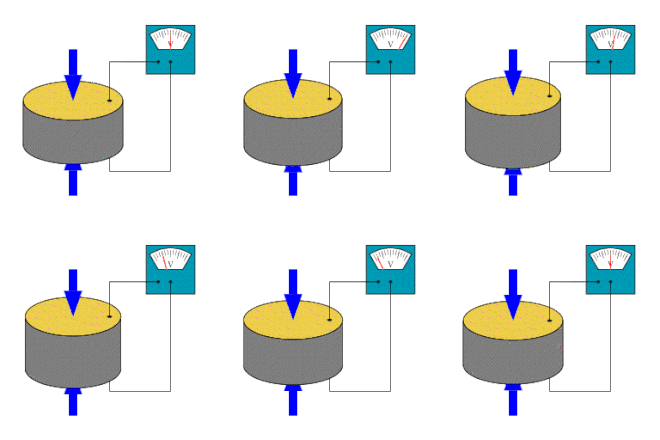
Funny, the wikipedia picture for piezoelectricity even looks like a heart pumping :
-
I don't know about you all
But I'm voting for Romney!
-
Re:OK, stick a fork in them, they're done.
-
Re:Where is the arm?
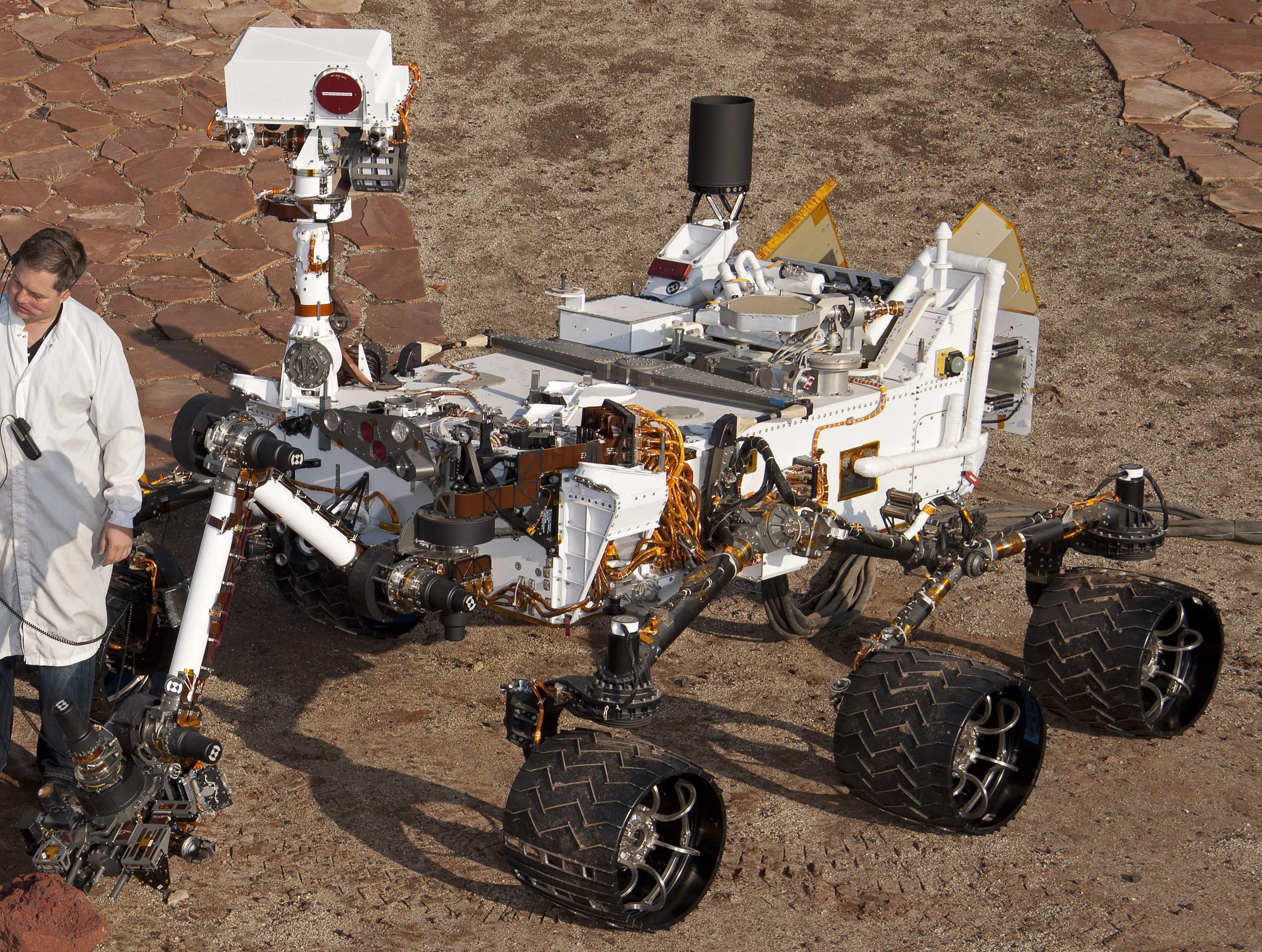
Check out the image to conventional portrait of Curiosity in the Wikipedia entry. You'll see there is a robotic arm mounted on the front of the rover that does not appear in the self portrait.
If you think of the robotic arm as analogous to a human arm, it has a pair of motors at the "shoulder" (for two axes of motion), one at the "elbow" and another pair at the "wrist". In the self portrait only the "shoulder" of the arm is visible -- you can see one of the motors (which looks like a pair of stacked black cylinders) adjacent to the nearest wheel at roughly the ten o'clock position. The arm itself would be on the other side of the joint from that motor, but it is replaced in the composite shot by a picture of the ground behind where it would be taken when the arm was in a different position.
It took a clever bit of planning to make this image.
-
Re:Perhaps what we need is....
The Valles Marineres too, and doubtless other sites yet to be discovered. Yet another Martian plain, however, does not warrant UNESCO galactic heritage status, and even if it did I would still dispute your assertion that a little remote-controlled buggy driving over it is somehow ruining it forever.
Interesting you mentioned this, as it is depicted as a constant point of conflict in Kim Stanley Robinson's Mars trilogy - where one group of settlers is violently opposed to the ongoing terraforming of Mars and argue that humans have no right to change its pristine state.
Speaking of the Drake equation, I think we have to content ourselves with exploring whatever prospect of life there is in our solar system only. If not Mars then Europa holds the next big hope of finding life in its ice locked sea. All the breathless announcements of yet another Earth like exoplanet are of no use unless someone invents warp drive or FTL propulsion so that one can get there(forget about radio communications at that range) in a time period that's not measured in centuries.
For some perspective, the farthest man made object Voyager 1 is just around 17 light hours away after 35 years of travel. In stellar terms it's barely gotten up from the couch, much less left home! -
Good article on how keyboards got flatter.
It's a useful article on keyboard mechanisms, and it's a good discussion of the tradeoffs between thin keyboards and ergonomics. The history is weak.
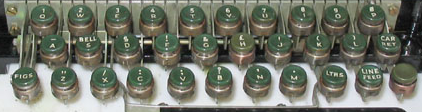
There's no mention of key rollover, or "can you push a key before releasing the previous key"? Modern keyboards report a key down and key up event for each key, so rollover can be unlimited. Early keyboards struggled with this. The Selectric, and Teletype machines, were mechanically interlocked against multiple key-presses. Some early keyboards wouldn't handle two keys down at the same time at all.
The feedback issue was a big one. Some keyboards clicked, some had a "clicker" inside to create the illusion that they clicked, and some beeped, an annoyance which has returned with some touch screens.
It's amusing that iPad-like devices have reverted to a 3-row keyboard with multiple shifts. That's where Teletype machines were a century ago. The keyboard layout of an iPad is very similar to that of a 1930s Teletype.
-
Re:Apple has shown the way for Motorola.
Really? The rounded corners of the housing, the screen, and the earpiece combine to form the face of the iPhone? Those exact elements had never existed in that combination before, then?
-
Re:Um... (Incident Energy and Eff from Wikipedia)
As a note, the 1kW/m2 is the total incident energy for a surface perpendicular to the Sun's rays at sea level on a clear day. http://en.wikipedia.org/wiki/Insolation Currently, the most efficient "research" solar cells are: 44% efficient per this chart: http://upload.wikimedia.org/wikipedia/commons/5/52/PVeff(rev121015b).jpg As such, we're even worse off then your helpful calculation shows. With current energy needs for flight, we simply aren't there for any large scale system.
-
Re:summaery cubed: fusion is a waste of time
Actually, for 60 years fusion scientists have been saying "with current funding, it's probably impossible" which isn't the same thing as saying "almost got it". This graph shows what leading scientists in 1970 thought they could deliver with different levels of funding. Do note the 'actual funding' line at the bottom, the one that is well below the 'fusion never' line that would never produce the equipment, expertise, and practical knowledge that would be required to build an economical fusion reactor. Quite frankly, given that this is what actual scientists in the field were saying 45 years ago, it's remarkable they've made as much progress as they have.
-
Re:iSore?
LOL! He has one of these. That isn't a boat, it's a fucking soapbox.
-
Re:TPM Of Evil
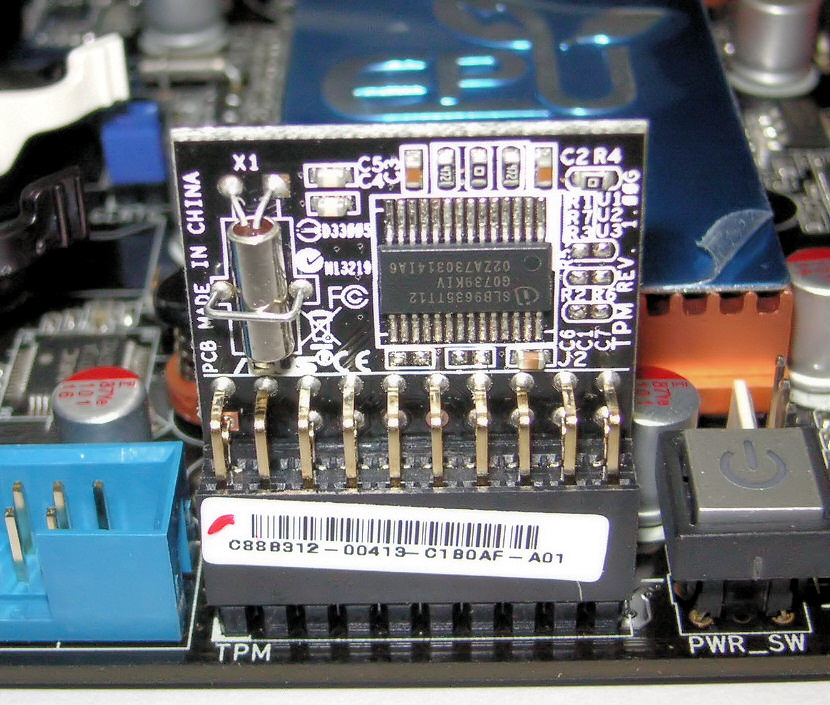
Well guys, I don't know about you, but I have only one question: Is it a separate chip on the motherboard? Because if it is, I'm hosting SMC desoldering classes the day this thing hits the market. Who'd have thought the day would come when we'd have to modchip our own damn computers...
Depends on the implementation. Some TPMs are not exactly hard to remove(that riser card on the LPC headers is sold as an option for that particular motherboard, so they made it easy to add or remove.
Some, like the chip on which that Asus module is based, or a bunch of the Infineon and Atmel ones, are reasonably civilized TSSOPs. Not hard to remove, allegedly packaged to be hard to tamper with at a chip level; but it's your problem if the firmware/BIOS/whatever flips out and refuses to do anything until the TPM is restored(and each one has a unique, and kept secret from you, RSA key burned in, so you have fun cloning/impersonating it to a hostile chipset...)
If, on the other hand, you have a system with something like the Intel GM45 chipset, you'd better have your microscope and ion beam ready because the TPM is on the same silicon as the motherboard chipset.
The TPMs from the likes of Broadcom are somewhere in the middle: They are integrated directly with some of the company's ethernet(and possibly other; I'm only familiar with the ones in some GigE products) chips; and aren't exactly going to be trivial to remove; but your computer will still work if you take a screwdriver to that part, unlike the Intel ones.
-
Re:Careful! This is a trick!!!
No trick. This is a browser suite aimed at power users(hence the inclusion of IRC and newsgroup support and a host of extra options), and in everyday use it does startup and run faster than Firefox. It employs the same Gecko rendering engine and incorporates modern features ( SPDY support was recently added).
I use Gmail via IMAP on the built in client, and it still takes up less memory than running Firefox and Thunderbird together. The Seamonkey devs don't fuck around with the UI as the Firefox ones keeps doing, and for nostalgia you even can theme it to look like the old Netscape Communicator (if that counts).
All popular extensions (Adblock Plus included) have Seamonkey ports.
Out of the box you get better control over tab and link behavior, disable loading 3rd party images, mouse wheel integration, Firefox user agent compatibility and several other features.What's not to like?
-
Re:Another Apple blunder
Oh, and lets just pretend that the bigger and more expensive iPad is not outselling the Nexus 7 right now, with a much larger price differential.
Indeed. I just ran the math on it, and the numbers ended up being about 16M iPad sales in the last 3 months, as compared to 3M Nexus 7 sales in the same time frame.
For anyone who wants to check my numbers, Apple announced today that they had sold 100M iPads. Wikipedia has a breakdown of iPad sales by quarter, and if you subtract those from the 100M number, you're left with roughly 16M sales that apparently make up the current quarter up to this point. Wikipedia also has sales numbers for the Nexus 7, and says that it's sold 3M as of mid-October, which would be pretty much exactly three months after it launched and only unaligned with Apple's numbers by about a week or two, making it a good comparison.
-
Re:Let's just kill this idea with science right no
I guess you don't really understand the concept of a half life , do you? But I agree that there wouldn't be any DNA to be found on Mars, since it is pretty much sterile for over a billion years already.
-
Re:Why do you deny God?
Maybe (s)he/it's into it?
-
I wonder
Will we look back on these images in the same way we look back on early switchboard exchanges? I got to check out a 2Gb drive from the 1970s the other day - kind of made me think...
-
Bathtub Curve
The bathtub curve is widely used in reliability engineering. It describes a particular form of the hazard function which comprises three parts:
- The first part is a decreasing failure rate, known as early failures.
- The second part is a constant failure rate, known as random failures.
- The third part is an increasing failure rate, known as wear-out failures.
-
Re:So?
I feel Yet Another Desert War coming on...
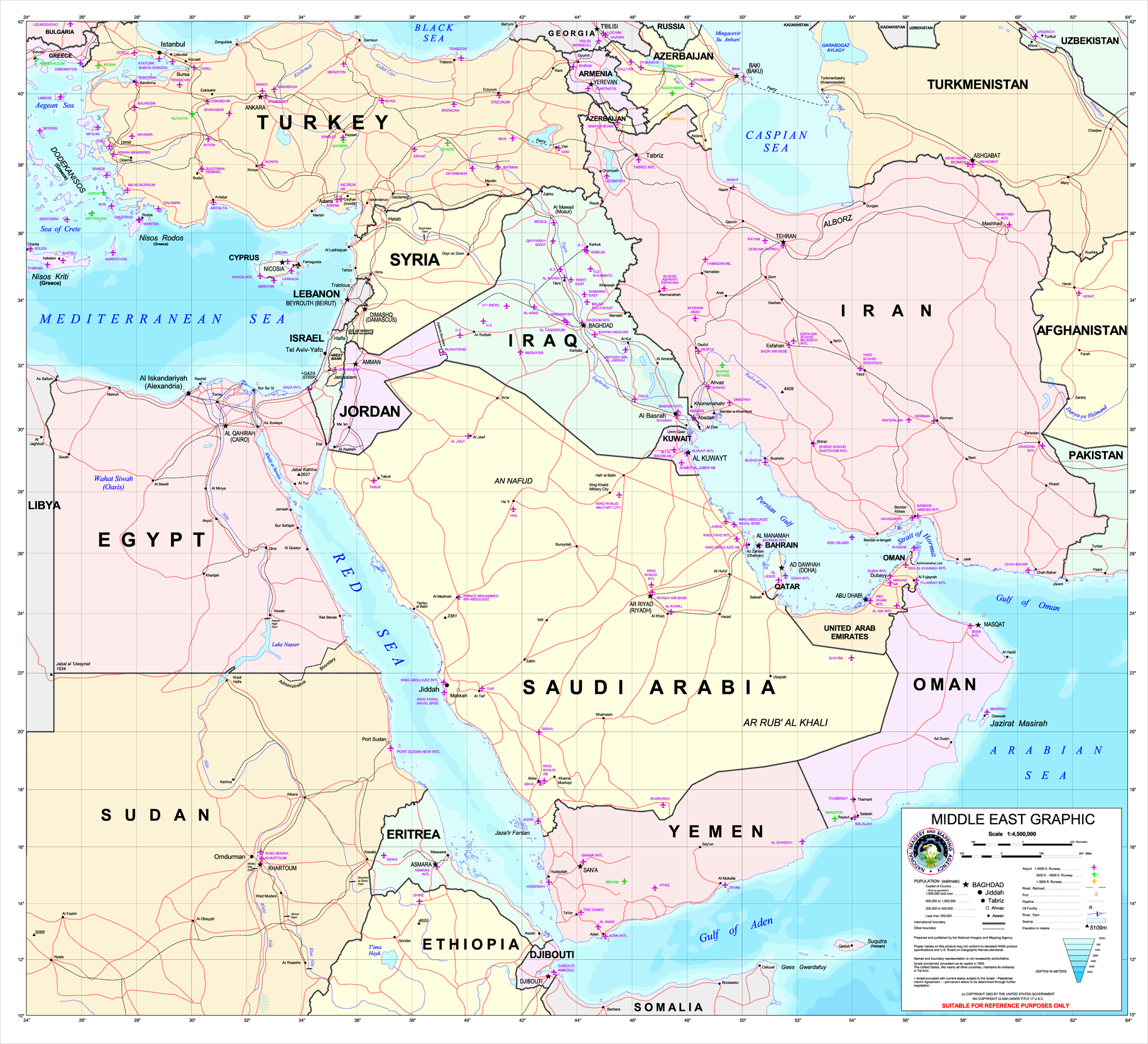
Probably because you don't know anything about Iran except that they have a nuclear weapons program and have used aggressive language towards Israel.
If you attack Iran, you will not just be fighting within the Iranian borders.
Iranian funded groups will lash out, in all directions, at once.
People smarter than us know and understand this, which is why Iran has been managed with sanctions and computer viruses.You cannot plan to attack Iran without committing to a general war across the Middle East.
The USA does not have the resources to do this and I doubt Poland (or our other NATO buddies) have any interest in being dragged into the sandbox again. -
Re:Why should I care?
I have no substantiated information on what type of vessel was used in the attack and doubt you do either. It doesn't really matter though UK government documents make clear the Prime Minister made the choice not to take the tower by force due the cost in resources and life.
From http://micronations.wikia.com/wiki/Sealand:
"British Government documents, now available to the public under the 30-year expiry of confidentiality, show that the UK drafted plans to take the tower by force, but such plans were not implemented by the then Prime Minister due to the potential for loss of life, and the creation of a legal and public relations disaster."
So clearly the British feel its defenses are sufficient. The subsequent defenses against privateers indicate the same. It is no different than computer security. Anything is hackable, the question is really whether or not your defenses are substantial enough to make attacking you not worth it. Thus the argument is made regardless of what type of craft he fired at.
You didn't claim some the guns were dismantled but some AC replied indicating as much claiming the British removed the weapons from all the forts long before. He pulled the idea out of his backside. Here is an image of Sealand. You can clearly see some of the guns from this vantage. These forts were armed with "3.75-inch guns and two 40 mm Bofors guns."
http://upload.wikimedia.org/wikipedia/commons/3/3b/Sealand-sky.jpg
-
Re:That's sort of a piss poor attitude, IMO ....
You must not have read much. Were you the one who deleted the relevant section from the Wikipedia page? You forgot to delete the picture.
http://upload.wikimedia.org/wikipedia/commons/3/3b/Sealand-sky.jpg
That pointy thing near the crane is a deck gun.
You can read an abbreviated version of the story here http://www.sealandgov.org/history under the heading "Initial Challenge to Sealand's Sovereignty."
Any other 100% fabricated stories you want to make up about what the British did?
-
Re:And this is whyPulling out of 6 % of the market (Wikimedia ). Up from 3% a year ago.
Pulling out of the entire HPC market which is not captured by browser statistics.I suppose they could bet on windows phone 8.
On the other hand, as a linux user I avoided Nvidia, only have it in one laptop I got for free. Yeah, I need Nvidia to keep the prices down, but as a windows supplier they will do that part just fine.
-
Re:so all those people weren't crazy
That site is firewalled off here. When in doubt, link wikipedia.
That "ufo" looks to me like Ghirlandaio's brush slipped and he hastily covered his mistake with a really lame cloud.
-
Re:NIF never made much sense for power generation
All of the targets I've read or seen talks on were positioned in the chamber on the end of an arm. There are some example pictures on Wikipedia. The idea of dropping or shooting targets into the chamber is expected to be used by newer experiments, like HiPER that have high repetition rates in mind.
-
Re:Face recognition
Advanced neural net-based processing has already been put to powerful use with the Proteus IV home control system.







.png)






.jpg)



.jpg)