Slashdot Mirror
Domain: yorku.ca
Stories and comments across the archive that link to yorku.ca.
Comments · 131
-
Re:How the ESRB Rates Games
Ever seen how an 8 year old boy acts after watching Saturday morning cartoons, or Power Rangers? Or notice how the thoughts you have while driving regarding pedestrians change (though not necessarily your actions) after an 8 hour marathon of GTA?
A classic study backing the opposite of what you claim: http://psychclassics.yorku.ca/Bandura/bobo.htm
The same kid after watching a romance/sex scene would most likely just be confused. -
Performing psych experiments on kids
Not that I normally condone performing psychology experiments on young kids (e.g., baby Albert), but here is an excellent opportunity to understand whether the children will find these movies better in the order 1-2-3-4-5-6 than others found them in the order 4-5-6-1-2-3. Of course, you might want to use one of your children as the control case. Also, it seems that more than 2 children would be required for this test to have any statistical significance. Perhaps you could adopt another 20-30 kids all in the same age group?
-
Re:Leading technology for tomorrows computing
What do you use it for?
My day to day programming work in php & python & shell
If it wasn't for the lack of modern web browser (a herculean programming task) it would be the only terminal I needed. As you may gather from my other posts I run OpenBSD and vnc into that.
It is worth using for the text edit alone : Acme
You can try it yourself on Unix likes with the plan9port or even just run the acme clone Wily. But with Wily you won't see the power of user space file systems.
% srvssh freddy
%
and now freddy's file system is mounted in my file tree at
(and freddy is an OpenBSD box with u9fs in my ~/bin - no kernel frigging required)
% ftpfs -a drskwid@slashdot.org ftp.openbsd.org
%
and now ftp.openbsd.org is mounted at
once mounted I can use my normal shell commands such as grep awk sed etc. on the files in those directories
I have some scripts on freddy that I only need when connected to freddy. Simple : bind -b
and now the files on freddy appear in my
this is the mechanism that enables one to boot a terminal on any of the supported architectures and have the same set of binaries available
at boot one has the following bit in one's profile
bind -a $home/bin/$cputype
thus whether I'm running on my AMD64 PC or my Arm IPAQ I have the same binaries in my path
I could go on about the plumber, secstore, factotum, venti,
want to look in a tar / zip file
fs/tarfs -m
fs/zipfs -m
ls
I'll leave the rest for you to read through
-
Re:The Malaise of the Middle Classes
Depression is a known medical illness.
Don't take this the wrong way, but only a few decades ago, homosexuality was a "known medical illness." So was female sexual desire.
Perhaps a "diagnostic and statisical" manual with its origins in the military's quest to figure out who was too crazy (or not crazy enough) to be made a soldier is not the best way to define who's "ill" and who's "healthy". I have little doubt that we are in the midst of what people centuries from now will regard as a dark age in clinical psychology.
Obviously some people have diseases or injuries of the brain or nervous system, but the very concept of "mental illness" is questioned by some very intelligent people. Even many who think the concept of "mental illness" has validity are concerned about overdiagnosis, overmedication, and the civil liberies of those labelled "mentally ill".
My point is absolutely not to say "suck it up!" Some people have very serious problems in their lives, and may be helped by therapy or medication.
But perhaps we should be asking more often if these problems are symptoms of "life out of balance", of a social rather than individual pathology. Sometimes depression may just be a natural symptom of living in a society that's poisoning the environment, screwing the poor and working class, and rolling back social and economic progress. And like all symptoms, it can act as a prompt to action - whereas if supressed by medication and ignored, the underlying problem can only get worse.
-
Re:completely wrong
Well, we've had 100+ years now of an era of empirical psychological research.
And, the status of the catharthis/contagion debate in this context is... I hate to say it (I was a big CS fan, myself), but there is no scientific support for the cartharthis hypothesis, but there is some support for contagion. One of the classics is the Bobo doll experiment, in which children who saw a person attacking a doll soon imitated it later. In adults, the effect is not as strong, but it's still there. There is no experiment that I'm aware of that shows the viewing of or participation in some form of conflagration or violence makes its repetition less likely, though there are unfortunately quite a few that show the opposite. So, while this debate may be intractable a prioi, it may not be experimentally. -
computes and art. visual programming in realtime
From my opinion as a student of computer arts/digital arts, the first thing you have to ask yourself is how to include the computer in your artistic work.
I can recommend the Book "Composing Interactive Music" from Todd Winkler, as I found it not only interesting for re-thinking how to use Computers in artistic installations, but also how to completely rethink computer interaction.
Winkler proposes a framework of 5 stages which i think can also be adoped for any digital works, not only music.
The book is inteded for composers working with max/msp, a visual programming language where object boxes can be "patched" together; this style of working shows fast results, as this kind of software is working "realtime", meaning you get constant ouptput of the things you are doing or the parameters you are changing.
I am working with this kind of "patchable software interfaces" for more than five years now; and this is also teached on the University of Applied Arts in Vienna/Austria, where I am studying.
If it comes to interaction (sound-visual, sound-dancers, graphics-interface, whatever) in the field of artistic work, these tools such as
PD Pure Data (windows/mac/linux) - Audio/Video/3D (GEM,Framestein) -opensource-
Cycling74 max/msp (windows/mac) - Audio/Video/3D (also see Nato and Jitter) -free 30days demo-
Native Instruments Reaktor (windows/mac) -commercial, but has education pricing-
vvvv (win) -free-
are used from lots of the people around.
there are hell lots more, you might want to take a look at the audiovisualizers.com tool shack, or pawfal.org for example.
For some visual examples and also works, you might want to take a look at
http://www.harvestworks.org/maxreel/
http://puredata.info/community/ (mostly audio)
talking chair (vvvv+hardware)
http://www.realtimearts.net/
or you might also want to take a look at the department of digital art in the university of applied arts/vienna.
currently we are a group of people trying to bring opensource and arts together. there are also workshops and lots of projects going on: http://5uper.net
for sure there are also "standard" programs teached, which are good for working with business and advertising companies -- but if we are speaking about digital arts, that's going beyond the standard approach of software use. at least for me. -
Re:Emacs or viI just downloaded Wily, an Acme clone for Unix, from Sourceforge.
Wow. It does absolutely nothing. And absolutely everything. There is no spoon.
My world has been rocked.
-
Re:Pixels don't matter - CCD size does
The best quality optics in the world won't get you past the diffraction limit, so the physical size of the CCD matters too. The diffraction limit imposes the condition that cramming ever more pixels into the same area eventually becomes fruitless: there's no more information to be had in that area. You want more information? Increase that area.
It's actually the size of the aperture, not the image plane, that imposes diffraction limits. On the image plane, the limit is imposed by the size of the beam waist you can get given the focal length of the lens and its aperture (which give the angle at which the beam converges, which gives the beam waist size for any given wavelength).
In the best possible case, you get a pixel size comparable to a wavelength of light (say one micron, for visible light). This requires a lens (or mirror!) with a diameter comparable to its focal length.
Typical pixel dimension is something like 5 microns. This is imposed by fabrication constraints (which change as process technologies get better) and by the fact that you have to have enough light falling on the pixel to produce a useful and low-noise signal (S:N improves as the square root of photon count, as long as circuit noise is low; more photons = less noise). There is a limit to how much light you can concentrate into a small region of a detector before damage occurs.
(For more information than you ever wanted to know about at least one type of image sensor, see our research group's web page.) -
Re:Nice, but still shortsighted
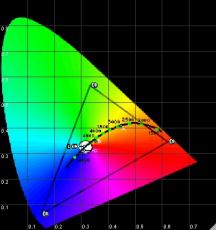
The CIE chromaticity diagram represents all colors which a non-mutant human being can see. It has a distinctly non-triangular shape. If you think you can recreate that gamut with only three base colors, I'd certainly like to hear how. Notice that RGB monitors show only a relatively small subset of the total perceivable color space.
-
smells a little funny...
There are a couple of factual errors in this story that makes me feel uneasy.
From the spectrum article:
While film used in cinema contains pigments that can create an infinitely large number of color variations, TV sets combine discrete amounts of red, green, and blue light to create a much more limited color range.
This isn't true: color slide film uses three layers, just like monitors do: http://www.imx.nl/photosite/technical/E100G/E100G. html
He says that in printing it's common to have inkjet devices that use six, seven, or even eight primaries.
There are good reasons printing uses so many primaries, but it's usually to make an evener tone. My consumer-grade printer has the traditional CMYK (cyan magenta yellow blacK), but it also has two additional colors: light-cyan and light-magenta. They chose these lighter colors so make the blending smoother and the ink spots less noticible; it wasn't to increase the gamut. Printers also use spot-color to make particular colors (such as a company logo) print without needing to use a halftone. These are all just gimicks to get around the fact that printing isn't continuous tone -- in projectors that are continuous tone, these tricks aren't needed.
Basically, it comes down to eyeballs... if you emulate the response curves that your eye is sensitive to, then you can't perceptually do any better.
The traditional RGB's and CMY's don't match these curves, so they define a gamut that can be improved on. For example, take this projector's gamut -- its green is far away from the eye's green, so it can't display the cyans well. But, the color model my company is using for its video product uses a much truer green so we can cover much more of the gamut.
disclaimer: IANACE (color expert), but my most recent project has been color calibration to precise standards. -
Re: "Aboot"Others further down in this thread have had great difficulty understanding these pronunciations.
The phenomenon that produces what Americans think is 'aboot' is called Canadian Raising. It becomes incredibly clear that there is a difference if a Canadian says "about boots".
Wikipedia has an article and this site has sound files. Particularly interesting, I find, as a Canadian, is the way Torontonians drop the second 't' in Toronto.
-
And how does this compare with other methods?
I expect I could do a lot better with traditional optimization methods. Genetic algorithms are notoriously slow at converging and are only any good when all other methods fail. I expect that for a racing simulation the output is, almost everywhere, a differentiable function of the input parameters, and hence you can use some kind of calculus based minimization algorithm. People use adjoint methods all the time to differentiate fluid dynamics simulations or orbital manoeuvers so I don't see that these methods would fail for a racing sim. In fact this paper is probably a good place to start.
-
Re:only 50 years? Ada Lovelace?
Earlier than that: she translated an article on the Analytical Engine (written by L. F. Menebrea) with several added notes of her own, including a sample program to compute Bernoulli numbers. This was published in the October 1843 issue of Scientific Memoirs.
-
Re:Hosers
It's real. Vowels tend to wander in regional dialects so what sounds like an "au" to you might sound closer to an "oo" to me. Google turned up "Canadian Raising" which explains this particular difference better than I can.
-
Re:Hosers
So, about this "oot and aboot" business... it's just plain wrong.
Though for Americans "aboot" is what might sound closest to many Canadians' pronunciation of the word "about," it isn't correct. The sound present in some dialects of Canadian (and American!) English results from a phonological process known as Canadian Raising . The "ow" sound is pronounced pretty universally in America as [aU]--i.e. a diphthong whose first element is like the a in father and whose second is like the u in put. However, before a voiceless segment (basically a consonant during whose articulation one's vocal chords are not vibrating), the first element is raised to an "uh"-like sound; i.e., the u in tuck. This also applies to the so-called "long i," in which the
So, yeah, "oot and aboot" is wrong. That is all. -
Re:Your brand-spankin'-new 3G phone
A paper I wrote about 1.5 years ago, entitled, "Evolution towards 3G Technologies and Beyond" may be of interest to some of you.
-
Re:Non-religious moralityThe theistic answer is "because God said so." The atheistic answer is "because."
The real atheist answer would be "I can't tell you until we have discovered the Grand Unified Theory."
-
Re:Old != Bad
3d interfaces will be harder to use than traditional 2d interfaces. Its only the coolness factor, for the most part.
To look for an object, you will have the difficulty increasing exponentially in the third dimension.
Its an extension of Fitts Law - effectively, people are more likely to choose a stable 3d configuration and use it as a 2d interface.
Although, I guess that would entitle you to theoretically call it a 2.5d interface. -
had experience .. great service
My school library offers similar service. last time i used it to suggest a book to buy ( Perl Cookbook 2 ) later in few weeks I was able to borrow it from the library. happy customer
live librarian chat lower left corner the link to talk to a live librarian
the most recent experience was talking to a HP technical person about printer through it's online chat service. To say the least it was helpful and solved my probelm.
HP instant support
I think a lot of companise ( IBM,Toshiba,Cisco if they haven't ) should set up similar service. It will definitly make their customer happier when they in need of service. -
Re:Been Out For A While
The club then has a record of every person, their address, description, birth date and drivers license that entered the club.
Good thing the Mob doesn't own any bars in NYC. Think of how that information could be misused!
-
Re:Decreasing air pressure...
A Joule is about 4.18 calories (the scientific measurement.) It is also about 4180 Calories (the food serving measurement.) Why are there two units with the same name which are three orders of maginitude off? I think nutritionists just like to make things confusing. Anyhow, you mixed the two up, so your estimate is a factor of a thousand larger than it would be without that error.
-
Eco misses the whole point.Eco misses the whole point. The great advantage of online content is searchability. He describes using an encyclopedia in an "advanced way" to find out if Napoleon ever met Kant.
When we query Google for that question, we immediately discover that this 2003 talk by Eco is a rehash of a talk he gave in 1995, and a very similar talk he gave in 1996, and again in 1998, and yet again in 2000 . Each of those talks contains the Napoleon/Kant/encyclopedia example. So Eco has been giving much the same talk for almost a decade now.
A search at Amazon.com reveals that Bertrand Russell compared Napoleon and Kant back in 1935, and mentioned that Kant never travelled more than 10 miles from his home town of Konigsberg, Germany. Eco has presumably read Russell, one of the great philosophers and essayists, and may have lifted the Kant/Napoleon example from Russell.
So we've learned something important about Eco himself, something he didn't tell us. He's less creative and original than he would like us to think. Before Internet searches, it would have taken considerable scholarly research to discover that. Now, anyone can do it in a few minutes.
-
first PORTABLE pc
This site just says it was the first portable pc.
-
York APL
The MCM/70 used a port of York APL, a free APL for the IBM 360/370 that ran under TSO. Although the MCM/70 is almost forgotten, York APL for the 360 seems dead (no known soft or hard copies left). If however anyone had or finds a copy of York APL, please preserve it, it was a very nice APL system.
-
Perty picture
In case you were wondering what it looked like
-
OT: Re:Gorilla Against Spam!! (GAS)"Big corporations are a permanent part of our economic system"
If you see 'permanent' as the next 150 years or so, yeah I guess. But I hope to live long enough to see "our" economic system evolve into OUR economic system, which will spell the end of multi/trans/meta-national corporations, as they evolve into something more human-scale.
"but the vast majority of them are in it to make money, which they do best by serving the customer's interest."
They generally make the most money ["best"] by NOT serving the customers' interests, through monopolies, corrupt trading, stratifying product lines, hidden vertical integrations, getting subsidy, circumventing or changing regulations, reducing diversity, speculation, arbitrage and consolidation, manipulating perception and mindshare, and creating dependencies. That's where the big bucks are and always have been: exploitation with a smile. Companies can make moderately good profiits and remain within mainstream ethics, but to make a killing... They need people to roll over and wag tails, loyal puppies all.
Some examples: Ethyl Corp's nailing the Canadian taxpayer for hundreds of millions because they aren't allowed to poison us, Rockefellers' secret deals for Standard Oil and Chase M's demand that Mexico eliminate the Zapatistas, Monsanto's intentional genetic pollution tactics, Cargill's control over food distribution; Oh Heck just see for yourself.
-
Re:I tried Plan 9
"What would really be cool is if some of the GUI concepts made it over to Linux..."
They already have. Have a look at these:
9wm - a window manger that acts like 8 1/2 from Plan 9
Wily - a clone of Plan 9s programmers editor, Acme (v cool)
There's also WindowLab, another window manager which uses the same window resizing system as Plan 9.
I'm sure there's more that I don't know of... -
genes
99.4 could be a bit of a low estimate if you ask me. IMOX, in recent years, evolution has gone into full-speed reverse
Of course, the chrimbos are going to be annoyed about this. They're generally offended by any suggestion that human beings are descended from the same ancestors as other animals, and particularly sensitive about being reminded that superstitious / religious behaviour doesn't put us that far above pigeons. -
Re:Doomsday DeviceSo at ~1 Sv/sec, a lethal dose will be achieved for:
- a dog in 3.5 seconds
- a guinea pig in 4 seconds
- a hibernating bat, 200
- a human, 2.5-4.5(*)
- a mouse, 5.5
- a monkey, 6
- a pine tree, 8-15
- a rat, 7.5
- a rabbit, 8
- a chicken, 6
- a sparrow, 8
- a goldfish, 23
- a frog, 7
- a tortoise, 15
- a snail, 80-200
- viruses,
Source. - a dog in 3.5 seconds
-
Re:Simple:
Actually, alphabetical order doesn't work much better for PDAs than QWERTY, a 6x5 square provides only an 8% speed increase over the traditional QWERTY layout, although I don't think this is quite the same layout as you were talking about.
The current most theoretically efficient method discovered is what's known as the "Metropolis II" layout after the algorithm used to design it (I'd offer you a link to it, but you need to be an ACM subscriber to get at the paper, and as far as I know tyhe keyboard layout itself has never been made publically available for use)
However, as mentioned, people's familiarity with the QWERTY layout is why it keeps getting put on there even if it's no longer the optimal layout, which means that when a user sits down at a new device they get faster immediate interaction rates if the keyboard is QWERTY due to familiarity with the letters as opposed to learning a new interaction method. (Although this deals only with PDA keyboards, here's a paper that comes to this conclusion.)
Yes, I'm getting off topic now, but I need to find a way to spout off all this extraneous knowledge I've picked up over time. -
Re:Simple:
Actually, alphabetical order doesn't work much better for PDAs than QWERTY, a 6x5 square provides only an 8% speed increase over the traditional QWERTY layout, although I don't think this is quite the same layout as you were talking about.
The current most theoretically efficient method discovered is what's known as the "Metropolis II" layout after the algorithm used to design it (I'd offer you a link to it, but you need to be an ACM subscriber to get at the paper, and as far as I know tyhe keyboard layout itself has never been made publically available for use)
However, as mentioned, people's familiarity with the QWERTY layout is why it keeps getting put on there even if it's no longer the optimal layout, which means that when a user sits down at a new device they get faster immediate interaction rates if the keyboard is QWERTY due to familiarity with the letters as opposed to learning a new interaction method. (Although this deals only with PDA keyboards, here's a paper that comes to this conclusion.)
Yes, I'm getting off topic now, but I need to find a way to spout off all this extraneous knowledge I've picked up over time. -
Re:non-free
While it's certainly not anything I'm responsible for, a good friend of mine is the project lead/one of the project admins for EDT, which is going to be an eiffel plugin for Eclipse. You might want to check that out - there should be a release RSN.
Some other guy at our university is working on a BON plugin for Eclipse, but I don't really know anything about its status.
-
coin tossing
Perhaps you are referring to "Benford's Law". I'm not quite sure of the link between his theorem and coin tossing, but it's interesting nonetheless. The strangest thing is the number of triples, quadruples, and even higher strings that can be expected from a 200 flip session. I remember this in the context of the SAT, because apparently they purposely avoid have multiple strings of the same answer precisely so people have one less way of guessing the right answer. If I were to fake a coin toss session, I would put in at least one string of six, two strings of five, several strings of four, a bunch of strings of three, and many strings of two.
-
Re:What's so special about Slackware?
It's very easy to install - the installer is to a lot of people the easiest to use (myself included).
I think most of the people who use or want to use Slackware is for the challenge - for the most part you generally have to edit config files yourself to administer it, or upgrade stuff. Compiling new packages yourself is done more often than using the package management system - it isn't anything like apt-get or rpm (though rpm is available and I've noticed quite a few package management tools around).
For me, it's what I've used since around 96/97 (and the red Infomagic distribution), and I'm comfortable with it -
Jot Usability?
I know that Graffiti had very reasonable usability: "After one minute studying the Graffiti reference chart, about 86% accuracy is attainable. Following five minutes of practice, accuracy improves to about 97%. Without further practice, users demonstrate total retention after a one-week lapse, with accuracy holding at around 97%."
How does the usability of Jot compare? Any ideas? Personally, if I am entering text, I like to use a thumb keyboard (e.g., Blackberry). One more thing, I guess that Jot 2.0 is available as shareware. It gets good ratings, but I haven't seen any "real" usability research. -
slow and non-standardGraffiti combined the worst features of custom strokes and regular writing: like custom strokes, it required training, and like regular writing, it was comparatively slow. In addition, it required most people to look at the handheld.
Palm should have used something like Jot from the start, or they should have copied Xerox's Unistrokes better.
Here is some Unistrokes performance data showing it to be the fastest of the bunch. There are papers comparing Graffiti and Unistrokes directly, and, again, Unistrokes comes out way ahead.
-
Re:plural acronyms (Jones's is fine with me...)
The placement of an apostrophe has been a pet peeve of mine for quite a while with the most egregious offense lately being the title of the movie "Bridget Jones's Diary". Or maybe that just the british way of doing things...
Don't assume that something that counters your experience or learning is automatically incorrect. That just might be a sign of elitism and intellectual laziness. The title of the movie refers to a diary that belongs to the character "Bridget Jones". Whether the possessive form of her name should be written Jones' or Jones's seems to be a matter open to debate. I am not an English major, so I don't pretend to have a definitive answer; it seems to depend on whom you ask....
Give these links a try. -
Information on EiffelEiffel is awesome! Here are some of the most obvious benefits:
- Design by Contract (dbc)
- Multiple Interitance
- Static Typing (no such thing as casting)
- Dynamic Binding
To learn more about Eiffel, read this and this and this and if you still have time, this.
Also, check #eiffel on freenode (irc)
Eiffel is the best,
DM -
Information on EiffelEiffel is awesome! Here are some of the most obvious benefits:
- Design by Contract (dbc)
- Multiple Interitance
- Static Typing (no such thing as casting)
- Dynamic Binding
To learn more about Eiffel, read this and this and this and if you still have time, this.
Also, check #eiffel on freenode (irc)
Eiffel is the best,
DM -
Information on EiffelEiffel is awesome! Here are some of the most obvious benefits:
- Design by Contract (dbc)
- Multiple Interitance
- Static Typing (no such thing as casting)
- Dynamic Binding
To learn more about Eiffel, read this and this and this and if you still have time, this.
Also, check #eiffel on freenode (irc)
Eiffel is the best,
DM -
Pretty sure this was posted earlier on slashdot
but couldn't find it.
Anyway, here are a couple of links.
Software horror stories
More horrors -
YesICan ScienceYou may be interested in the Curriculum DataEngine at the Yes I Can! Science project at York University. While it doesn't have full courses it does have activities/lesson plans/assessment tools/etc aligned to various curriculum. Its primary focus is the Pan-Canadian Science Curriculum but it is starting to incorporate the U.S. National Science Education Standards as well. It also provides features to track which curriculum outcomes have been met, and to search for activities or lessons which meet outstanding items.
They also present "real-time science" events which are lesson plans and activities based on current events or special activities. For example, they teamed with CSA to do a webcast from the International Space Station to demonstrate some physics in space and build a educational units from it.
-
YesICan ScienceYou may be interested in the Curriculum DataEngine at the Yes I Can! Science project at York University. While it doesn't have full courses it does have activities/lesson plans/assessment tools/etc aligned to various curriculum. Its primary focus is the Pan-Canadian Science Curriculum but it is starting to incorporate the U.S. National Science Education Standards as well. It also provides features to track which curriculum outcomes have been met, and to search for activities or lessons which meet outstanding items.
They also present "real-time science" events which are lesson plans and activities based on current events or special activities. For example, they teamed with CSA to do a webcast from the International Space Station to demonstrate some physics in space and build a educational units from it.
-
YesICan ScienceYou may be interested in the Curriculum DataEngine at the Yes I Can! Science project at York University. While it doesn't have full courses it does have activities/lesson plans/assessment tools/etc aligned to various curriculum. Its primary focus is the Pan-Canadian Science Curriculum but it is starting to incorporate the U.S. National Science Education Standards as well. It also provides features to track which curriculum outcomes have been met, and to search for activities or lessons which meet outstanding items.
They also present "real-time science" events which are lesson plans and activities based on current events or special activities. For example, they teamed with CSA to do a webcast from the International Space Station to demonstrate some physics in space and build a educational units from it.
-
Slow off the mark?
Geeks who are still using so-called "multi-tap" input should be ashamed of themselves. Dictionary based methods, T9 (from Tegic/AOL), and iTap (Motorola's equivalent) have been standard on phones for a couple of years now, even if they do have their short-comings.
If you're not into the legacy layout* you could go with MessagEase or this new thing, but the smart money is on a company called Eatoni, since they have two products (LetterWise and WordWise) which they back up with a big stack of research. There's also Zi Corp. who make eZiText and eZiTap for SMS input.
If you're interested in the HCI aspect of all this you could do worse than looking at the work of I Scott Mackenzie, Poika Isokoski or Mark Dunlop.
* 1-800-GOFEDEX anyone? Probably explains why Europe is ahead of the US in this field. That and our ridiculous txt addctn...
-
Re:Not to be cynical.....
I have to say I disagree that the logistics are unreasonable. We made it to the moon 33 years ago - a third of a century - before we even had modern computers. Getting to and from mars is simply a matter of scale... it takes longer and takes more thrust to get back off the surface. But that doesn't remotely mean it can't be done. The distance is phenomenal, yes, but in space distance just becomes time. Possibly the biggest logistical problem is medicine
Take a look at some of the plans invented by groups outside of NASA, most notably Robert Zubrin's Mars Direct concept. I'll spare you going into detail but this plan has so many fail-safes it's ridiculous. The entire thing uses more-or-less existing technology.
Meanwhile, there are two experiments already running to study the difficulties of having people live isolated on Mars for an extended mission (many months until the next launch window floats around). Check out the Mars Arctic Research Station and the Mars Desert Research Station (site temporarily down?). All this research and work is already being done, independantly of NASA. (usually marssociety.org is a great reference... at the moment it seems to be undergoing maintenance or something. Bad timing.)
Technologically, it can be done; I think there's little question about that. As for the policital will and the money, that's a different issue. But maybe this bill shows that there is some interest after all.
Personally, I put my money on commercialization of space being the primary driving force in the next 20 years. The profit motives and the opportunities of space tourism and potentially near-earth asteroid mining will outstrip anything the US government will deliver in the near future.
-
The nervous system is not a computer!
The bottleneck is how your eyes are (probably) right now! This implant replaces or enhances the receptors (rods and cones) in the eye, which send signals to other neurons that send signals to the brain (here's a decent diagram; this implant replaces the cells on the top). As far as the brain is concerned, these receptors don't exist; all the brain cares about are the signals that are sent through the neurons. Of course, this implant, or any implant like it, can't do anything to enhance or create more neurons, so you'll never ever get "super-vision" with implants like this. The only thing retinal implants can do is replace damaged cells.
As has been hinted at, the only way these works is REPLACING retinal cells that have been there up to adulthood. If someone has been blind their entire life or since they were very young, they will NOT get "normal" sight, ever. The neural and brain connections will not have formed. They can get some (and can tell when the lights are on, for example). Oliver Sachs wrote a very good story about this in An Anthropologist on Mars, an excellent book!
The only way you'll get "super vision" anytime soon is through external devices, such as infrared goggles or binoculars or whatnot. We might be able to miniaturize them so that they aren't a hassle, and might even fit in the eye, but they'll still essentially be external devices.
If we're going to "enhance" the eye on its terms (through the retina, etc), we'll have to "enhance" the brain too. That won't happen in my lifetime, I'm sure! -
Re:Microsoft?
That's the biggest pile of Anti-MS horseshit I've ever read. MS invented the wheel mouse. Read.
-
Re:Pavlov
Not so fast...
(yes, bad for quoting myself)
The bells at feeding time was one of the other experiments. He also did the showing of shapes to mean different upcoming events. One was an oval, the other a circle. Then he gradually rounded the oval until the dog could not distinguish between them.
At that point the dog would go nuts!
Shapes and Tones experiments by Pavlov
Ref to just the bell experiments
Pavlov shock experiments
I do remember Skinner doing various things AFTER Pavlov, like teaching pidgeons to bowl(?) and such. -
Re:multiplayer on PDA
Right now I'm working on a project to do just that for my networks class. Thus far I've only been working on asynchronous stuff like tic-tac-toe and chess, but what you describe is certainly feasible within a couple of years.
The main limitations as I see it right now are:
Little or no floating point support
No real gaming/multimedia API's (although I understand this will change soon)
The only protocol which has to be implemented on a device is HTTP.
Poor control over the high-level UI
Sharing data is a pain, if it works at all. (I haven't been able to make it, but that's just my experience so far)
Basically programmers should be familiar with J2ME before they go planning any big projects. In the end my belief is that J2ME will be a success if not just for the device-independant aspect of it.