Slashdot Mirror
Domain: youtube.com
Stories and comments across the archive that link to youtube.com.
Stories · 2,039
-
Google Enhances Street View With User Photos
Google has launched a competitor or counterpart to Microsoft's Photosynth, which employs user-contributed photos of much-photographed sites to supplement the street-level view in an immersive way. Google's offering is called simply Navigate through User Photos, and unlike Photosynth — which requires Sliverlight and therefore is not available on Linux — is implemented in Flash. This YouTube video (also embedded at the link above) offers a quick tour of the new feature, which can use photos uploaded to Panoramico, Flickr, and Picasa. -
Senators Blast NASA For Lacking Vision
An anonymous reader writes "A Senate science subcommittee clashed with NASA's chief on Wednesday, saying the agency and the White House lacked a clear vision and goal for the program. Skeptical senators told the space agency that it should not just talk about plans, but set out to do something specific. Lawmakers expressed a bipartisan opposition to the agency's plans and the initiatives of the Obama White House." Updated 23:13 GMT by timothy: Reader Trent Waddington contributes this video link to the hearing, if you want to come to your own conclusions. -
Newspaper "Hacks Into" Aussie Gov't Website By Guessing URL
thelamecamel writes "According to the New South Wales state government, the Sydney Morning Herald, a local newspaper, attacked the government's 'website firewall security' for two days to research a recent story. The affected government minister said that the website was accessed 3,727 times, and that this is 'akin to 3,727 attempts to pick the lock of a secure office and take highly confidential documents.' The matter has been referred to the police, who are now investigating. But how did the paper 'hack' the website? They entered the unannounced URL. Security by obscurity at its finest." -
"Obsessed" American Couple Wed At Apple Store
Hugh Pickens writes "The Telegraph reports that an an 'obsessed' American couple, Josh and Ting Li, have become the first to marry inside one of the technology giant's stores saying "iDo" at the city's Apple store on Fifth Avenue, at 12.01 on Valentine's Day in a ceremony dominated with the company's products and references to them. A video shows that the pair, who met in the Apple store, had their priest, dressed as Steve Jobs, read their vows from their iPhones while the rings were tied to a ribbon wrapped around a first generation iPod. Mrs Ling, dressed in a strapless wedding dress, had her vows written on a card that said 'I love you more than this' followed by a picture of an iPhone. 'We got to know each other because Ting was looking to buy an iPod and I managed to strike up a conversation that way,' says Mr. Ting. 'I used to joke that the Apple Store is my church because I am not religious, and I loved everything Apple.' No word on where the couple honeymooned although some say they may have remained in The Big Apple." -
Atlas V's Sonic Boom Made Visible By Sundog
Ross-Shire Geek writes "Atlas V lifted off on Feb 11 from Kennedy. As it goes supersonic through a sundog (aka parhelion) you can see (video link) wonderful visible ripples of the shock wave in the sky." -
Perth Game Company CEO Takes IP By Night
snicho99 writes "A US owned gaming company has fled Australia, leaving unpaid employees and a massive tax bill. Apparently many staff have been working unpaid for months to allow their game to ship and hopefully the company to recover. Interzone's Perth (Western Australia) office was created with the assistance of a state government grant. Last week Interzone's (American) CEO entered the building at night and removed all the servers and IP so that Interzone could continue production at a new company they have opened in Ireland. The staff caught him on camera. More background here." -
The People vs. George Lucas To Premiere At SXSW
skatepark builder writes "David Prowse, the 74-year-old actor who has enjoyed a long and varied career filled with roles such as Darth Vader (Star Wars Episodes IV, V, and VI), is starting 2010 off with two major accomplishments. His victory over colon cancer earlier this month means he'll live to see his top billing in a film premiering next month at the South by Southwest Film Festival. The People vs. George Lucas is a documentary attempting a balanced examination of the love/hate relationship Star Wars fans have developed with the filmmaker and his work over the past three decades. Director Alexandre Philippe distances his film from the one-sided fan rage films that lambaste Lucas, even though the title would suggest otherwise. According to the trailer, The People vs.George Lucas exposes the full spectrum of opinions on Lucas, including those like Prowse, who still refers to him as a 'master.' Philippe captures these opinions through filmed interviews, but perhaps more interestingly, he crowdsourced the commentary by soliciting fan submissions over the internet. The clips seen in the trailer appear to be funny, highly inspired, and are probably more concise than the recently released 70-minute YouTube evisceration of Episode I." -
The People vs. George Lucas To Premiere At SXSW
skatepark builder writes "David Prowse, the 74-year-old actor who has enjoyed a long and varied career filled with roles such as Darth Vader (Star Wars Episodes IV, V, and VI), is starting 2010 off with two major accomplishments. His victory over colon cancer earlier this month means he'll live to see his top billing in a film premiering next month at the South by Southwest Film Festival. The People vs. George Lucas is a documentary attempting a balanced examination of the love/hate relationship Star Wars fans have developed with the filmmaker and his work over the past three decades. Director Alexandre Philippe distances his film from the one-sided fan rage films that lambaste Lucas, even though the title would suggest otherwise. According to the trailer, The People vs.George Lucas exposes the full spectrum of opinions on Lucas, including those like Prowse, who still refers to him as a 'master.' Philippe captures these opinions through filmed interviews, but perhaps more interestingly, he crowdsourced the commentary by soliciting fan submissions over the internet. The clips seen in the trailer appear to be funny, highly inspired, and are probably more concise than the recently released 70-minute YouTube evisceration of Episode I." -
And Now, the Animated News
theodp writes "'You have a lot of missing images, in the TV, in the news reporting,' explains billionaire Jimmy Lai. It's a gap that Lai's Next Media intends to fill with its animated news service. Artists lift details from news photos while actors in motion sensor suits re-create action sequences of stories making headlines. Animators graft cartoon avatars to the live-motion action, and the stories hit the Web. When news agencies didn't have footage of scenes from the Tiger Woods car crash, Lai's team raced to put together animation dramatizing the incident that became a YouTube sensation. Thus far, Lai has been denied a television license, but with or without his own station, he thinks his animations are headed for televisions worldwide. His company is currently in talks with media organizations to churn out news animations on demand using Next Media's graphic artists and software tools." -
Crazy Firewall Log Activity — What Does It Mean?
arkowitz writes "I happened to have access to five days worth of firewall logs from a US state government agency. I wrote a parser to grab unique IPs out, and sent several million of them to a company called Quova, who gave me back full location info on every 40th one. I then used Green Phosphor's Glasshouse visualization tool to have a look at the count of inbound packets, grouped by country of origin and hour. And it's freaking crazy looking. So I made the video of it and I'm asking the Slashdot community: What the heck is going on?" -
MIT Offers Picture-Centric Programming To the Masses With Sikuli
coondoggie writes "Computer users with rudimentary skills will be able to program via screen shots rather than lines of code with a new graphical scripting language called Sikuli that was devised at the Massachusetts Institute of Technology. With a basic understanding of Python, people can write programs that incorporate screen shots of graphical user interface (GUI) elements to automate computer work. One example given by the authors of a paper about Sikuli is a script that notifies a person when his bus is rounding the corner so he can leave in time to catch it." Here's a video demo of the technology, and a paper explaining the concept (PDF). -
Ballmer Hits 10th Anniversary As Microsoft CEO
bednarz writes "Ten years ago on Jan. 13, 2000, Microsoft's Bill Gates turned over the CEO reins to Steve Ballmer. Back in 2000, Microsoft was still under threat of being broken up by the Department of Justice. Today, Ballmer is trying to meld enterprise and cloud computing. He has spent the past decade working through lawsuits, mergers, acquisitions, competitive battles and, of course, new software including Windows 7, which could become the legacy of his leadership at Microsoft. Not that we'll ever forget Ballmer's 'developers, developers, developers' rant." -
Politicians Worldwide Asking Questions About ACTA
An anonymous reader writes "Legislators around the world are demanding more information on the secret Anti-Counterfeiting Trade Agreement. US Senator Ron Wyden demanded answers in a letter to the USTR (PDF) this week, ACTA arose in the UK House of Commons yesterday, and French Deputy Nicolas Dupont-Aignan raised ACTA questions in the National Assembly late last year. All of this comes on top of earlier efforts from Swedish Member of the European Parliament Jens Holm, as well as New Zealand MP Clare Curran, who has repeatedly raised concerns about ACTA, and NDP MP Charlie Angus, who posed questions about ACTA in the Canadian House of Commons late last year." -
Impressive Robot Hand From Shadow
kkleiner writes "The Shadow Dextrous Hand is a robotic arm that allows for fine motor control and precise movements. It's accurate enough to pick up an egg, screw in a light bulb, or thread a needle. Even cooler, researchers can control it with a 'Cyber glove,' allowing for 24 distinct human movements that mimic the user's own hand. A British based company, Shadow, has been displaying the hand for several years now, and recently demonstrated its latest model at IREX 2009. The hand, toted as the world's most advanced, is available for sale to researchers (pricing has not been made public)." -
Chinese Pirates Launch Ubuntu That Looks Like XP
An anonymous reader writes "Ylmf, famous for pirating Windows XP, have just released a version of Ubuntu that looks just like Windows XP. Really, really similar. Apparently because Microsoft were cracking down on the actual Windows XP pirating — though I think they will still suffer for ripping off the GUI exactly." Of course, if that's the sort of look you like for your desktop, you need not risk any download cooties or language barriers; a reader in the Ubuntu Forums suggests this instructional video for giving Gnome the XP treatment. -
The Definitive Evisceration of The Phantom Menace *NSFW*
cowmix writes "When TPM came out ten years ago, its utter crappiness shocked me to the core and wounded a entire generation of geeks. My inner child had been abused and betrayed. I moped around, talking to no one, for almost two weeks. I couldn't bring myself to see #2 or #3, whatever they were called. Now, a decade later, comes Star Wars: The Phantom Menace Review, the ultimate, seven-part, seventy minute analysis of this mother of all train wrecks. Not only does it nail how the film blows, but tells us why. Time, apparently, does not heal all wounds." Or, if you prefer all 7 parts embedded in one page, you can check out slashfilm's aggregation. -
The First Robot To Cross the Atlantic Ocean Underwater
Hugh Pickens writes "She was at sea for 221 days, alone, often in dangerous places, and usually out of touch. Most of the time she was out of contact underwater, moving slowly up and down to depths of 600 feet, safe from ships, nets, and storms. Her predecessor had disappeared on a similar trip, probably killed by a shark. 'She was a hero,' says Rutgers University oceanographer Scott Glenn after retrieving Scarlet Knight, the 7-foot-9-inch submersible robot from the stormy Atlantic off western Spain. An engineer working for the company that made the submersible said, 'We think this will just be a precursor, like Lindbergh's trip across the Atlantic. In a decade we think it will be commonplace to have roving fleets of these gliders making transoceanic trips.' The people responsible for building, funding, and flying Scarlet hope the end of the robot's successful voyage will mark a new beginning in ocean and climate research. From its position at each surfacing — when the glider surfaced and called home via an Iridium telephone parked in its tail — researchers could calculate the net effect of currents deep and shallow. After surface currents were measured, the scientists could then make inferences about what was happening deeper in the water column. Scarlet called home to upload data to researchers three times a day. 'When we have hundreds of them, or thousands of them, it will revolutionize how we can observe the oceans,' says Jerry L. Miller, a senior policy analyst at the White House Office of Science and Technology Policy, who accompanied the research team to Spain." -
Yes, Google Does De-List Pages; But When?
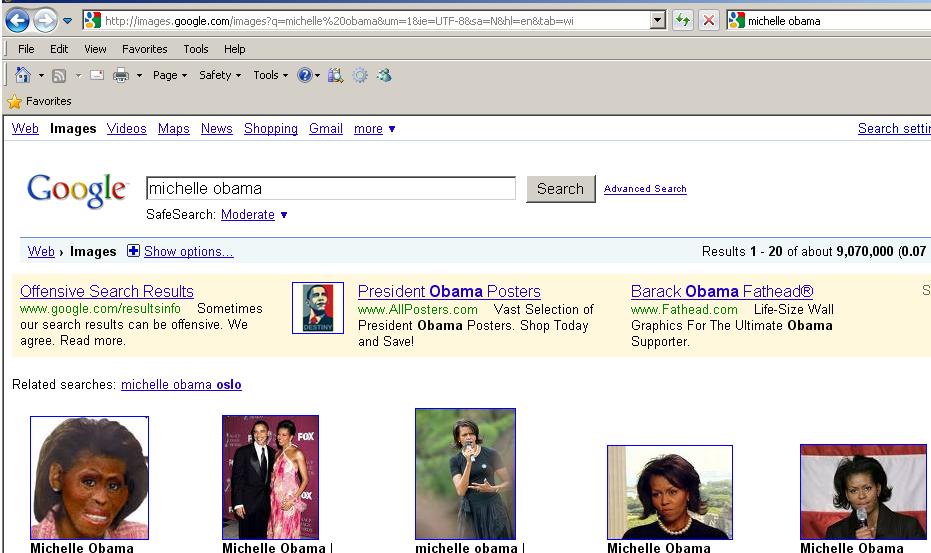
Frequent Slashdot contributor Bennett Haselton writes "Google finds itself inserting a disclaimer once again above some offensive search results. But the disclaimer still leads many to believe (incorrectly) that Google doesn't tamper with search results even in cases of 'harmful' or 'offensive' material. We know that Google has in fact de-listed some pages at the request of offended parties. What is their real policy on the issue?" Read on for Bennet's essay.In 2004, when Google users discovered that the top search result for the word "Jew" was the anti-semitic site Jew Watch, Google ran a disclaimer in the space usually reserved for ads, explaining that their results only reflected the reality of link counts on the Web, and that they did not endorse any Web sites which appeared at the top of their listings. Now the disclaimer has been dusted off again, as the top result on Google Images for "Michelle Obama" is a picture of a monkey's face with Michelle's hairdo. (Ironically, it looks as if the original image would have fallen out of the rankings, if it hadn't been for a follow-up blog post about the controversy, which itself now comes up as the first result.)
I first heard about the controversy from Dennis Prager's column in which he takes a New York Times columnist to task, because the columnist complained about "racially offensive images of the first couple" that come up in Google searches. Prager was unable to find any examples from Googling "first couple" or "Michelle and Barack Obama pictures," so he concluded that the NYT columnist "wildly exaggerated, if not made up" his claims. I tried Google Image searches for "first couple," "Barack Obama," and some other terms, and I couldn't find anything controversial either. However, it only took 10 seconds to enter "first couple google images controversy" on the regular Google Web search and find multiple blog posts explaining what all the fuss was about. Back to Google 101 for Dennis.
Many of the blog posts refer to Google's disclaimer about not tampering with search results. Those on one side are urging Google to make an exception and "fix" the results, while others sagely observe that Google just reflects reality, it doesn't create it.
All of this punditry is starting from a premise that's wrong. Google has actually removed pages from their search results — not because the pages were illegal or because the webmasters were search engine spamming, but because of the page's "offensive" content. In the "Chester's Guide" incident, a councilman in Chester, England discovered that one of the search results for "chester guide" was a satirical page titled "Chester's guide to picking up little girls." Although the page itself was obviously just someone's idea of sick humor, a Chester city councilman (who admitted that he hadn't looked at the page, saying that the title told him everything he needed to know) urged Google to remove the page from their index. Google at first refused, but later manually blacklisted the page to prevent it from appearing in their search results.
Whether or not you think this was the right decision, probably depends on what you think is the purpose of Google. If Google's purpose is to return the most useful results, then it made sense to remove the link, as Danny Sullivan of Search Engine Watch argued at the time, since it almost certainly was not a useful result for people searching for "Chester Guide." On the other hand, if the primary purpose of Google is to reflect the reality of what pages on the Web feature certain words most prominently (combined with all the other factors that Google weighs, of course), then the results shouldn't be altered.
But more people should at least realize that it happened. The Google disclaimer doesn't precisely say that they never blacklist pages or modify search results ("Google reserves the right to address such requests individually"), but it seems to give most people the impression that that's the case. According to that crudest of Googling techniques for which novice searchers are so frequently lampooned, there appear to be about 400 times as many stories on the Web about the Google "Jew Watch" controversy (where Google stood their ground) as there are stores about the "Chester's Guide" incident (where Google caved).
And Google-number-three Matt Cutts posted on his blog back in March explaining why Google does not remove "offensive" pages from search results; over a hundred comments followed, debating the pros and cons of the position, but none of them mentioned the Chester incident or any other case where Google actually had removed pages except as a result of a court order. One isolated comment from "Anonymous" said:
This is not quite true. I know of at least one web site that was de-listed for containing illegal content and/or promoting illegal activity.
which may or may not have been a reference to the Chester Guide incident. And that was it.
Is this a lot of hay to be making over something that happened years ago? Well, for one thing, I doubt if it happened just once. Consider that the Chester Guide incident involved a public declaration of outrage by a city council, and a public statement from Google, and still hardly anyone knows that it ever happened. If other incidents occurred without those high-profile elements, it would be even harder to discover them now. We'll probably never know how many such incidents took place, unless someone sues Google (maybe the owner of a blacklisted website, or maybe the victim of a RipOffReport hatchet job wondering why that site hadn't been blacklisted long ago), subpoenas Google for a list of cases where pages were de-indexed, and publishes the list if it's not sealed by a court order.
But whether it was one time or a handful, consider that political candidates like Arnold Schwarzenegger and Al Franken got asked during their campaigns about things they did 20 years earlier, and it's fair to ask a candidate about their past, because it's the same person standing in front of you now. Why did you do that? Have you stopped? Why?
And in the big scheme of things, Google is probably more powerful than a single US senator or the governor of California. So, can't we ask? What are their real rules about page removal? Have those rules changed since the Chester's Guide controversy? Can they even tell us what their rules are, or do they consider it a trade secret?
It is well known, of course, that Google censors some results in their search engines branded for different markets like China and even in liberal democracies like Germany. But nobody would call that a slippery slope towards censorship in the US version of Google, because the censorship in the Chinese and German versions is done at the behest of the governments there. On the other hand, Google does admit that they will de-index pages which include credit card numbers or social security numbers (which are all too easy to find on the Web). This might not seem like a controversial position, but even this act of voluntary self-censorship may be dipping their toe in the water further than it seems. Most people do consider their credit card information more private than their home address. But surely there are people like J.D. Salinger who less about the privacy of their credit card number (which is easily changeable) than their home address (which isn't). If someone finds Salinger's address and posts it on the Web, should Salinger be able to demand that Google de-index the page? Why should Google cater to the majority who want to keep their credit card number secret, but not to the minority who care more about keeping their address secret? Another commenter on Matt Cutts's blog post asked:
"hi. I have a question. My mom 'googled' herself and it shows some of her medical problems. She wants/needs these pages removed from search engines."
Again, why shouldn't that be considered at least as private as a credit card number?
And finally, even Google's decision to display an "offensive results" disclaimer, for some results but not for others, raises the same "Where do you draw the line?" questions as the issue of page removal. The Michelle Obama monkey picture gets a disclaimer. But search for 'george w bush' and the first row includes a photoshopped (I think!) image of Bush flipping off the press. Does that warrant a disclaimer as well? (Maybe that's considered less unfair because, even though the picture is fake, it does depict something that actually happened.) The first image result for "bristol palin" is a photo of her engaged in underage drinking — a real photo, but probably unfair to call it the single most relevant photo of her on the Web.
So while Google might consider credit cards and social security numbers and search engine spam to be on one side of a "bright line," and everything else is served up without alteration, I think the line is blurrier than that, for at least those three reasons: (a) credit cards and SSNs are less private than some other that things that Google serves up anyway; (b) Google has unambiguously removed some content that fell outside that bright line, as in the Chester's guide incident, and (c) they make other "slippery slope" judgment calls about search results all the time (as in the question of when to show the disclaimer). So I hope that Google someday comes out with a more complete answer to the question. What is their real policy on what they will remove? The Chester's guide incident — would they do that sort of thing if the same situation came up today, or have their rules changed? If they want to go really deep, then is there a general set of principles from which their rules follow — explaining why, for example, they treat credit card numbers as more private than sensitive medical information? (Google did not respond to my request for comment, either through official channels or the unofficial back channels of friends who work there.)
I hope Google gives an answer some day. Even just to say, "It's a classified internal policy and that's all we're going to tell you." But once and for all, the answer is not "Google doesn't remove content just because it's 'offensive' or 'harmful.'"
Meanwhile, a modest suggestion about the disclaimer displayed above the search results: Put it where people will actually see it, in a separate line below the ads, but above the search results. Right now the link to the disclaimer is displayed as one of three ads across the top, and people don't look at the ads. But hey, people do buy ads, so if you push the disclaimer down a bit where people will read it, you also free up space for 50% more ad revenue!
-
$300 Sci-Fi YouTube Video Lands $30m Movie Deal
krou writes "A producer from Uruguay who made a short science fiction film and uploaded it to YouTube has landed a film deal with Sam Raimi's Ghost House worth $300 million. The film, which shows spaceships and giant robots attacking Montevideo, the capital of Uruguay, was made by Fede Alvarez for around $30. 'I uploaded (Panic Attack!) on a Thursday and on Monday my inbox was totally full of e-mails from Hollywood studios,' he said. Alvarez is to develop and direct a film based on one of his ideas, but there is no word yet on the writer." -
Dying Star Mimics Our Sun's Death
coondoggie writes "In about 5 billion years, our Sun will face a nasty death. Scientists with the Harvard-Smithsonian Center for Astrophysics this week released dramatic new pictures of a dying star much like the Sun, about 550 light-years from Earth. According to the researchers, Chi Cygni has swollen in size to become a red giant star so large that if it were in our solar system it would swallow every planet out to Mars and cook the asteroid belt. The star has started to pulse dramatically, beating like a giant heart with a period of 408 days." The research team produced a video of the pulsating star, using infrared images captured via very long baseline interferometry. -
ARM-Powered Laptops To Increase Linux Market Share
Charbax writes "Last April, Microsoft argued that it controlled the netbook OS market for devices sold in certain Microsoft-friendly US retail stores, while ABI Research claims that Linux actually has 32% of the worldwide netbook market, and that its market-share is growing. At the recent Netbook World Summit in Paris France, Aaron J. Seigo, Community leader at the KDE Foundation, and Arnaud Laprévote, CTO at Mandriva Linux, give us their estimation for next year's Linux market share (video) in the consumer laptop market. Their estimation is that Linux will dominate in ARM-powered laptops and that those may take over a significant share of the overall laptop market by their significantly cheaper prices (as low as $80), longer battery life (as long as 20-40 hours on a small battery using the Pixel Qi screens), as well as lower size and weight. Running some of the Chromium OS builds for ARM available shortly and having a full browser experience on those cheaper and better ARM-powered Linux laptops could make it a significant mass market success to shake up the Intel and Microsoft consumer PC/laptop monopoly in its boots." -
Lotus Teases With a Fuel-Agnostic Two-Stroke Engine
JohnnyBGod writes "Lotus claim to have invented a new, more efficient engine design. The two-stroke, flex-fuel engine can achieve, according to the surprisingly technical press release, 'approximately 10% better [fuel consumption] than current spray-guided direct injection, spark ignition engines.' The engine has a sliding puck arrangement to control its compression ratio, and has direct injection and a wet sump, to eliminate fuel leakage to the exhaust and the need to mix oil with the fuel, two common problems with two-stroke engines. Lotus engineering have released a video explaining the engine's operation." -
Introducing L2Ork, World's First Linux Laptop Orchestra
Agram writes "Take a netbook, Wiimotes, Nunchuks, and hemispherical speakers (which were once IKEA salad bowls), toss it up with some Ubuntu goodness and what you get is Virginia Tech's L2Ork, the world's first Linux-based laptop orchestra. With its affordable design and support from the Linux community, L2Ork hopes to bring laptop orchestras to K-12 education and beyond. So, regardless whether you wish to hear how L2Ork might sound or to learn how to build your own Linux-based *Ork infrastructure, perhaps this is a good opportunity to reopen the age-old debate: is Linux finally ready for some serious audio work?" -
Introducing L2Ork, World's First Linux Laptop Orchestra
Agram writes "Take a netbook, Wiimotes, Nunchuks, and hemispherical speakers (which were once IKEA salad bowls), toss it up with some Ubuntu goodness and what you get is Virginia Tech's L2Ork, the world's first Linux-based laptop orchestra. With its affordable design and support from the Linux community, L2Ork hopes to bring laptop orchestras to K-12 education and beyond. So, regardless whether you wish to hear how L2Ork might sound or to learn how to build your own Linux-based *Ork infrastructure, perhaps this is a good opportunity to reopen the age-old debate: is Linux finally ready for some serious audio work?" -
Musical Tesla Coils Perform Zelda
heychris writes "You've gotta love the Chicago Tribune's story on Tesla Coil hobbyists from the first sentence. 'Under a starry Saturday sky behind a Lake Zurich warehouse, three men unload a small flamethrower, electric cabling, neon-tube "light sabers," about 80 pounds of chain mail and two 7-foot devices that look like monster-movie props.' So what does one do with 1.6 million volts and a Tesla coil or two? Play 110dB music, of course." -
Musical Tesla Coils Perform Zelda
heychris writes "You've gotta love the Chicago Tribune's story on Tesla Coil hobbyists from the first sentence. 'Under a starry Saturday sky behind a Lake Zurich warehouse, three men unload a small flamethrower, electric cabling, neon-tube "light sabers," about 80 pounds of chain mail and two 7-foot devices that look like monster-movie props.' So what does one do with 1.6 million volts and a Tesla coil or two? Play 110dB music, of course." -
US Congressman Announces Plans To Probe Wikileaks
eldavojohn writes "Congressman Peter King (R-NY) is calling for a probe into Wikileaks with regard to the recent publication of half a million 9/11 pager messages. He has announced that he plans to have his Washington staff begin a preliminary investigation because Wikileaks' action 'raises security issues.' A word of caution: Congressman King has been known to make inflammatory and unpopular statements." -
US Congressman Announces Plans To Probe Wikileaks
eldavojohn writes "Congressman Peter King (R-NY) is calling for a probe into Wikileaks with regard to the recent publication of half a million 9/11 pager messages. He has announced that he plans to have his Washington staff begin a preliminary investigation because Wikileaks' action 'raises security issues.' A word of caution: Congressman King has been known to make inflammatory and unpopular statements." -
Genetic Algorithm Helps Identify Criminals
Ponca City, We love you writes to tell us that a new software approach to police sketch artists is finding surprising success in a trial run of 15 police departments in the UK and a few other sites. The software borrows principles from evolution with an interactive genetic algorithm that progressively changes as witnesses try to remember specific details. Current field trials are reporting an increase in successful identification by as much as double conventional methods. A short video with a few working shots of the new "EFIT-V" system is also available on YouTube. "[Researcher Christopher Solomon]'s software generates its own faces that progressively evolve to match the witness' memories. The witness starts with a general description such as 'I remember a young white male with dark hair.' Nine different computer-generated faces that roughly fit the description are generated, and the witness identifies the best and worst matches. The software uses the best fit as a template to automatically generate nine new faces with slightly tweaked features, based on what it learned from the rejected faces. 'Over a number of generations, the computer can learn what face you're looking for,' says Solomon. The mathematics underlying the software is borrowed from Solomon's experience using optics to image turbulence in the atmosphere in the 1990s." -
Air Cannon Ties Pirates In Knots
Hugh Pickens writes "Numerous high-tech devices have been proposed to help ships cope with piracy on the high seas. Now a company has developed a ship-borne launching device that fires a net or coiled rope into the path of pirate vessels using compressed air with a range of up to a range of 400m. The payload net or rope, which has a parachute attached to the end, will unravel and lay out across the surface of the water so that as the pirate boat travels through the water its propeller shaft will pick up the line and become entangled. 'With the trials and testing we've done, it has taken us some 45 minutes to cut and disentangle the line from the propeller itself,' says Jonathan Delf. 'Within that time of course, the target ship is on its way and hopefully help has arrived in the form of naval forces or helicopter support.' The system can be fired up to five times off just a cylinder of air like a simple scuba tank." The video mentions that the device can also fire a payload of golf balls. The systems have recently been sold to "several large shipping companies that travel near the oil-rich Nigerian Delta, which, like the Somalian coast, is rife with piracy." -
Review: Eufloria
eldavojohn writes "Eufloria is a strategy game made by independent game company Dyson. I bought it on the Steam service this weekend for $20 and was impressed that it is a visually and aurally pleasing game. It's a real-time strategy game, but isn't a rehashed Civilization or Age of Empires — it employs a different kind of mechanic to conquer. Like a lot of games that rely on novel game mechanics (Braid & Spore come to mind), part of the game's experience relies on you learning as you progress through the 25 or so levels. They will definitely push you to utilize different strategies and tactics, so don't read this review if you're already planning to play this game, as it'll most likely be filled with spoilers about developing a strategy. I give the game an average 6 out of 10 and would like to say that with titles like Braid and Eufloria out there, 'independent' no longer equates to 'sucks.'" Read on for the rest of his thoughts.- Title: Eufloria
- Developers: Alex May, Rudolf Kremers
- Publisher: Omni Systems
- System: Windows
- Reviewer: eldavojohn
- Score: 6/10
The game's graphics and soundtrack are seemingly procedurally generated. If you find things like OS X and the Wii simple and aesthetically pleasing, then this game's for you. The very first thing I noticed was zooming. This game makes you feel as if you're staring at a petri dish, and you're capable of watching from 30,000 feet with little bugs flying around asteroids or you can zoom in and observe the battles the bugs are having. The music is very ambient and strangely soothing. Not only do your seedlings grow procedurally (depending on when you click the plant button) but the music seems to react to your movements and the commands sent to your guys. It's really an enjoyable experience that can make the hours melt away as you listen and enjoy the organic movement and music.
The gameplay is reminiscent to that of Risk ... except vastly simpler. The early levels basically run themselves, and it becomes increasingly complicated and more difficult. Multiple enemies, different kinds of weapons and decreased odds of winning slowly stack more and more against you. In this respect, patience is often a virtue as you grow more seedlings or wait for two enemies to attack each other, giving you a chance to win. Several times, however, my territory served as a battle area for the AI, destroying any chance I had. The early strategies being simple, I found myself employing a scout and move strategy to stay alive in later levels.
For what this game tries to be, it succeeds. The downsides of the game are more the additional features than a shortcoming in the design or the gameplay. As levels grew larger and more complex, I found myself staying at the highest possible view of my seedlings and conquered asteroids. It became a numbers game, with the strategy focusing on where to set up defense and where to set up offense. This becomes necessary to be aware of everything going on around you, but it reduces the graphics of the procedurally-generated trees and flights of your seedlings to blurry dots on the screen. While aiding you, it removes you from the things that make this game beautiful. An unfortunate side effect, for me.
Another flaw of the game is a pretty weak storyline. With trees and seedlings as your "actors," there's not a whole lot of human emotion and therefore the storyline (while containing a twist) seems weak and tacked on. Along with that, the game is short. You could squeeze perhaps 20 hours out of this game ... depending on how much patience you have. If you start doing bad at a level, you can always just start over and wait for the computer AI to slip up. The AI is not the best in this game. Several times the computer could have wiped me off the map ... but for some unknown, humanitarian reason chose not to. While that made it much easier for me, it sure destroyed my sense of accomplishment. All too often I got away with being very poorly defended.
The last complaint is a common one: no online mode. I imagine all my strategies would be revolutionized were I pitted against other players. When you play this game, you'll realize that it has a lot of player-versus-player potential, like the majority of RTS games rely on. And yet, there is no online or even LAN capabilities. Unfortunately, multi-player is not in the plans for Dyson's future.
Eufloria is a beautiful game and is priced reasonably. If you're an RTS fan, this game's for you. If you're a gamer who'd rather be planting bullets than trees, or a gamer who needs multi-player online play then this game isn't for you ... but it might be a nice break to steal away every now and then for a few moments of ambient music and procedurally-generated beauty.
-
UAVs Go Green With Fuel-Cell Powered "Ion Tiger"
Hugh Pickens writes "Increasingly, the military is deploying unmanned aerial vehicles, or UAVs, as eyes in the sky to scan the ground for targets and threats, especially for missions that are too dangerous for manned aircraft. Now Live Science reports that a new robotic spy plane called 'Ion Tiger' will harness alternative energy to make it more covert and longer lasting than battery-powered or engine-powered UAVs. A 550-watt, 0.75 horsepower hydrogen fuel cell will power the Ion Tiger with four times the efficiency of a comparable internal combustion engine and seven times the energy of the equivalent weight of batteries. When Ion Tiger took flight in October, it exceeded any demonstration of electrically powered flight so far, flying 23 hours and 17 minutes. 'And it carried a 5 lbs. payload to boot — enough to carry, say, a day-and-night camera,' says researcher Karen Swider-Lyons, head of the alternative energy section at the Naval Research Laboratory in Washington. 'No one has come close to flying 24 hours with a significant payload before.' Another big advantage is the Ion Tiger's reduced noise, heat and emissions. 'Think about lawnmowers or chainsaws — they're really loud,' says Swider-Lyons. 'It's hard to spy on people when they know you're there, so you had to fly them at high altitudes to keep them from being heard.'" -
Major Electronics Firms Support Ending Use of "Conflict Minerals"
tburton writes "The US House of Representatives yesterday released the Conflict Minerals Trade Act (HR 4128) to try and end the international trade of tungsten, tantalum and col-tan, the mining of which is accused of fueling violent rape and murder in eastern Congo. Since the very same minerals power the most popular consumer electronics from HP, Verizon, Nokia, RIM and Intel, the Information Technology Industry Council has quickly signed a statement of support. Advocacy groups are hopeful these commitments prove to be meaningful as consumers begin to question the end result of the supply chains powering their favorite gadget." -
1977 Star Wars Computer Graphics
Noryungi writes "The interestingly named 'Topless Robot' has a real trip down memory lane: how the computer graphics of the original Star Wars movie were made. The article points to this YouTube video of a short documentary made by Larry Cuba, the original artist, that explains how he did it. In 1977." -
Nvidia's RealityServer 3.0 Demonstrated
robotsrule writes "As we discussed last month, RealityServer 3.0 is Nvidia's attempt to bring photo-realistic 3D images to any Internet-connected device, including the likes of Android and iPhone. RealityServer 3.0 pushes the CPU-killing 3D rendering process to a high-power, GPU based, back-end server farm based on Nvidia's Tesla or Quadro architectures. The resulting images are then streamed back to the client device in seconds; such images would normally take hours to compute even on a high-end unassisted workstation. Extreme Tech has up an article containing an interview with product managers from Nvidia and Mental Images, whose iray application is employed in a two-minute video demonstration of near-real-time ray-traced rendering." Once you get to the Extreme Tech site, going to the printable version will help to preserve sanity. -
UN Officials Remove Poster Mentioning Chinese Firewall
At a UN-sponsored Internet Governance Forum in Egypt, anti-censorship group Open Net Initiative was startled by a demand from UN officials to remove a poster mentioning Chinese Net censorship. When ONI refused the request, security personnel arrived and took away the poster. The group was promoting a new book, Access Controlled, a survey of Internet censorship, filtering, and online surveillance. A witness said, "The poster was thrown on the floor and we were told to remove it because of the reference to China and Tibet. We refused, and security guards came and removed it. The incident was witnessed by many." Here is a video of the removal. -
Go, Google's New Open Source Programming Language
Many readers are sending in the news about Go, the new programming language Google has released as open source under a BSD license. The official Go site characterizes the language as simple, fast, safe, concurrent, and fun. A video illustrates just how fast compilation is: the entire language, 120K lines, compiles in under 10 sec. on a laptop. Ars Technica's writeup lays the stress on how C-like Go is in its roots, though it has plenty of modern ideas mixed in: "For example, there is a shorthand syntax for variable assignment that supports simple type inference. It also has anonymous function syntax that lets you use real closures. There are some Python-like features too, including array slices and a map type with constructor syntax that looks like Python's dictionary concept. ... One of the distinguishing characteristics of Go is its unusual type system. It eschews some typical object-oriented programming concepts such as inheritance. You can define struct types and then create methods for operating on them. You can also define interfaces, much like you can in Java. In Go, however, you don't manually specify which interface a class implements. ... Parallelism is emphasized in Go's design. The language introduces the concept of 'goroutines' which are executed concurrently. ... The language provides a 'channel' mechanism that can be used to safely pass data in and out of goroutines." -
Speech-to-Speech Translator Developed For iPhone
Ponca City, We love you writes "Dr. Dobbs reports that Alex Waibel, professor of computer science and language technologies at Carnegie Mellon University, has developed an iPhone application that turns the iPhone into a translator that converts English speech into Spanish, or vice versa. Users simply speak a sentence or two at a time into the iPhone and the iPhone will respond with an audible translation. 'Jibbigo's software runs on the iPhone itself, so it doesn't need to be connected to the Web to access a distant server,' says Waibel. Waibel is a leader in speech-to-speech translation and multimodal speech interfaces, creating the first real-time, speech-to-speech translator for English, German and Japanese. 'Automated speech translation is an expensive proposition that has been supported primarily by large government grants,' says Waibel. 'But our sponsors are impatient to see this technology become more widely available and we, as researchers, are eager to find new revenues that will help us extend this technology to more of the 6,000 languages now spoken worldwide.'" -
Overclocked ReMix Releases Xenogears Tribute Album
quintin3265 writes "Yesterday, the video game remix group Overclocked ReMix released its 15th album, 'Humans + Gears: Xenogears ReMixed.' The album highlights work from the PlayStation 1 role-playing game Xenogears. The soundtrack to Xenogears was originally composed by Yasunori Mitsuda, who also contributed to soundtracks such as Chrono Trigger, Chrono Cross, and Xenosaga. The two-discs of 'Humans + Gears,' which began development in mid-2006, include 33 songs mixed by 31 different artists. The collection is free to download in this torrent, and a trailer is up on YouTube that should bring back memories to those who played the game back in 1998." -
Arrested IBM Exec Goes MIA On the Web
theodp writes "Among those charged in the largest hedge-fund insider trading case in US history was IBM Sr. VP Robert W. Moffat, the heir apparent to IBM CEO Sam Palmisano and the guy behind Big Blue's 'workforce rebalancing' and the sale of IBM's PC unit to Lenovo. IBM's not talking about the incident, but it's interesting that Moffat's bio is MIA at IBM.com ('Biography you tried to access does not exist.'), and his Smarter Planet video can no longer be found ('This video has been removed by the user.') at IBM's YouTube Channel. Do you need approval from the Feds before tidying up after someone who's under investigation? BTW, if stories and comments appearing in the Times Herald-Record and Poughkeepsie Journal are any indication, Moffat may want to avoid a local jury trial. 'I have talked to a few IBMers today, and there seems to be a lot of cheering in the halls of IBM over his arrest,' said Lee Conrad of Alliance@IBM." -
Arrested IBM Exec Goes MIA On the Web
theodp writes "Among those charged in the largest hedge-fund insider trading case in US history was IBM Sr. VP Robert W. Moffat, the heir apparent to IBM CEO Sam Palmisano and the guy behind Big Blue's 'workforce rebalancing' and the sale of IBM's PC unit to Lenovo. IBM's not talking about the incident, but it's interesting that Moffat's bio is MIA at IBM.com ('Biography you tried to access does not exist.'), and his Smarter Planet video can no longer be found ('This video has been removed by the user.') at IBM's YouTube Channel. Do you need approval from the Feds before tidying up after someone who's under investigation? BTW, if stories and comments appearing in the Times Herald-Record and Poughkeepsie Journal are any indication, Moffat may want to avoid a local jury trial. 'I have talked to a few IBMers today, and there seems to be a lot of cheering in the halls of IBM over his arrest,' said Lee Conrad of Alliance@IBM." -
UK Copyright Group Tells Cinemas to Ban Laptops
Sockatume writes "Cinema chain Cineworld now has a policy banning anyone from carrying a laptop into a theatre, even if it is not used. The management claims that this is an anti-piracy move on the advice of the Federation Against Copyright Theft, the much-mocked source of all kinds of dubious anti-piracy statements. When it was pointed out that the laptop had no camera, the management made a temporary exception. For customers, the message is clear: leave your laptop in the car. For pirates, the message is clear: there is more money to be made slinking around cinema car parks looking for laptop bags." -
FBI Investigates Liberator of Court Records
eldavojohn writes "Federal court documents aren't free to the public, they cost $0.08/page through a system called PACER. During a period when the US Government Printing Office was trying out free access at a number of courthouses around the US, a 22-year-old programmer named Aaron Swartz installed a small PERL script at the 7th US Circuit Court of Appeals library in Chicago — a script that uploaded a public document every three seconds to Amazon's EC2 cloud computing service. Swartz then donated over 19 million documents to public.resource.org. That's when the FBI took interest in the programmer responsible for this effort and ran his name through government databases. How did he discover this? His FOIA was approved, of course, and he received the FBI's partially redacted report on himself. The public.resource.org database was later merged with that of the RECAP Firefox extension, which we discussed a couple of months back." Update: 10/06 18:22 GMT by KD: Timothy Lee pointed out that the summary as originally posted garbled the Swartz / RECAP connection. Improved now. -
50 Years of the Twilight Zone
pickens writes "Fifty years ago on October 2, American television viewers first heard the words: 'You're moving into a land of both shadow and substance, of things and ideas. You've just crossed over into... the Twilight Zone.' Like the time-space warps that anchored so many of the show's plots, Rod Serling's veiled commentary remains as soul-baring today as it did a half-century ago, and the show's popularity endures in multiple facets of American pop culture, appearing nearly uninterrupted through television, syndication and DVD releases and under license to air in 30 countries. 'The whole idea of "The Twilight Zone" jumped off the television screen and became a catchphrase, a buzzword for something much beyond the TV show itself,' says Robert Thompson, director of the Center for the Study of Popular Television at Syracuse University. 'When you say Twilight Zone, it's its own genre.' The original show ran just five seasons, 1959 to 1964, with 156 episodes filmed; Serling wrote 92 of them, and other contributors included Richard Matheson and Ray Bradbury. Anniversary observances were held at Ithaca College in New York, where Serling taught from 1967 until his death in 1975, and which keeps Serling's archives; and also at Antioch College in Ohio, where Serling was a student." -
GE Developing 1TB Hologram Disc Readable By a Modified Blu-ray Drive
Globally Mobile writes "The Register has this article concerning GE's announcement that it has been developing a 1 terabyte DVD-size disk that can be read by a modified Blu-ray player. Peter Lorraine, GE's lab manager, talking at an Emerging Tech conference last week, said that license announcements could be expected soon. He also mentioned the notion of disks having the capacity of 100 Blu-ray disks, implying a 2.5TB or even 5TB capacity, gained by increasing the number of layers used for recording. The discs will be used for high-end commercial niches initially and then migrate to consumer markets in 2012-2015. Also here is a video of the technology explained. Wish we could see this sooner! Reminds me of the technology that Bowie's character came up with in The Man Who Fell to Earth." -
Mainstream Press "Cringes" At Win7 Launch Parties
lurking_giant writes "Well, Microsoft has done it again with the YouTube Windows 7 launch party video that is turning the stomachs of even the mainstream press with its clueless and campy marketing style. A Washington Post reader was quoted as saying 'If Microsoft had been put in charge of marketing sex, the human race would have ended long ago, because no one would be caught dead doing something that uncool.'" Even the Guardian's resident die-hard Apple hater calls it "the most nauseating advert in history." -
The Informant Is Back At Work
theodp writes "Fortune catches up with former ADM exec and whistleblower Mark Whitacre, who talks about watching his life on screen in the dark comedy, The Informant!. Among other things, Whitacre apologizes to Fortune for duping the magazine in a 1995 interview when his bipolar-fueled compulsive lying was in its full glory. Thanks to a Ph.D. he earned from Cornell in nutritional biochemistry, and an understanding CEO who was involved in prison ministry, Whitacre is now COO of Cypress Systems, where he's been working since spending nine years in prison for embezzlement. And yes, his wife really did stand by him through the wild ride." -
Carl Sagan Sings
gijoel writes "Someone with too much time on their hands and access to Auto-Tune has taken clips from Carl Sagan's Cosmos series to make this fantastic song. Watch for the Stephen Hawking cameo." -
'09 Malibu Vs. '59 Bel Air Crash Test
theodp writes "To celebrate their 50th anniversary, the Insurance Institute for Highway Safety crashed a 1959 Chevrolet Bel Air into a 2009 Chevrolet Malibu. Hate to spoil the ending of the video, but if you find yourself participating in a similar car-jousting contest, pick the Malibu over the Bel Air. (Not that you'll be complaining afterwards if you don't, or doing much of anything.) Guess there is something to those crumple zones after all." -
Legal Group Says Unlimited Broadband Promotes Piracy
bennyboy64 writes "Unlimited broadband plans are all too familiar in many countries; in Australia they're scarce. One ISP offering such a plan between the hours of 8pm and 8am, AAPT, is being looked at as a matter of high interest by a legal group representing the interests of the global film industry, AFACT (the Australian Federation Against Copyright Theft). It said AAPT was encouraging users to download copyrighted material. AAPT's advertising states: 'If you want unlimited music, unlimited games and unlimited movies — get unlimited off-peak broadband downloads from AAPT.' AFACT executive director Adrianne Pecotic said: 'In the context of the AAPT promotion, we have a concern that it could be misconstrued to promote illegal downloads and that's something that we'd like clarified.' AFACT is currently involved in what will be a landmark court case with Australian ISP iiNet. It recently claimed in court proceedings that there was a link between iiNet upgrading the service plans of heavy Internet users and the proliferation of film piracy."