Slashdot Mirror
Domain: anandtech.com
Stories and comments across the archive that link to anandtech.com.
Comments · 3,318
-
Re:What of battery life?
-
No Mini update, bummer
Was really hoping for a new Mac Mini. I'd like to get one for the living room and connect it to my HDTV. The current Mini apparently has fairly crappy DVD playback.
-
Re:Other Reviews
http://www.pcper.com/article.php?aid=197&type=exp
e rt
http://www.anandtech.com/cpuchipsets/showdoc.aspx? i=2668
http://www.hothardware.com/viewarticle.aspx?articl eid=767&cid=1
http://www.xbitlabs.com/articles/cpu/display/athlo n64-fx60.html
http://www.lostcircuits.com/cpu/amd_fx60/
http://www.bit-tech.net/hardware/2006/01/10/amd_at hlon_64_fx-60/1.html -
Re:point of comparison
A while ago people where pointing out that Dell was selling "the same" display as the Apple for the 20" but sooo much cheaper.
Yeah, it seemed to be using the same Panel but the backlight is different and I had a chance to compare both the Apple and the Dell and the Apple IMO looked better, brighter (I am writing it on that one right now).
Actually, AnandTech found the color rendition on the 2005fpw to be slightly better than the 20" Cinema display. I looked at both side-by-side and found the difference to be negligable.
The Apple display certainly looks cooler. But the 2005fpw is height-adjustable, can do portrait mode, has VGA/S-Video/Composite inputs in addition to DVI, does PIP and POP, and costs $300+ less. -
Re:Just why the hell do we need to replace DVD, no
Anandtech doesn't think so, according to their recent update from CES:
http://www.anandtech.com/tradeshows/showdoc.aspx?i =2666&p=13
Pioneer had a side by side comparison of Blu-ray(at 1080p) and DVD(480p upscaled to 1080p.
"The problem is that the jump from progressive scan DVD (480p) to Blu-ray and HD-DVD at 720p or 1080p just isn't that great, even on a 46" display. When viewed side by side with DVD content, the picture looks quite comparable, it's just that the Blu-ray/HD-DVD content is noticeably sharper (which makes sense since it is much higher resolution)."
After seeing the pictures of the Pioneer side by side comparison, I'm underwhelmed. Yes, it's sharper but it's not worth the high cost for upgrading. -
Re:point of comparison
you are right. you are a fanboy. you should do some research before making blanket statements like "apple displays are better than dell's". i'm guessing you haven't read this: http://www.anandtech.com/displays/showdoc.aspx?i=
2 400&p=11 you are also advocating buying an apple refurb vs a new dell. not only is that a lame comparison (this used honda is cheaper than this new toyota), but goes down the tubes when you factor in a beefy dell coupon. if you want to buy apple out of principle, buy apple. but don't try to justify it by kidding ur'self. -
Re:point of comparison
> I've seen a comparison between an Apple and a Dell that used the same LCD panel, but the Apple looked better in terms of brightness and color.
You mean something like this? Their conclusion is that the Dell is better. -
Re:Isn't it the same liquid crystal panel as AppleAnandtech says it's a newer panel with higher contrast ratio* and lower response times.
* A higher contrast ratio is of course also possible if you get a different backlight and chooses the measuring point to give you that number, but if the response times are indeed lower, or different, it seems they realyy have a different panel. On the other hand, one could technically squeeze a bit of response time difference from using a different signal chip in the monitor.
-
This has already begun...for desktops too!
Gigabyte has something out they call i-RAM. It's a PCI add-in card that allows you to plug regular ram sticks into and then access them as a piece of solid storage space. They say its good for "multimedia applications" and I'm sure it is...if not a little overkill.
Here's a link to a review from Anandtech http://anandtech.com/storage/showdoc.aspx?i=2480 -
Last good AGP cards
The last good AGP cards are the Nvidia 6800 series and some ATI X800 cards. You should be able to find one for around $200 (6800GS or 6800GT) that will run games just fine for another couple of years. If you need more performance though, you're pretty much stuck getting a complete new system.
Now is actually not a bad time to get a new system, especially if you go with an AMD cpu. Every component is at a "mature" point in their lifecycle and that means you're not paying for bleeding edge tech, and you have a smaller chance of getting stuck with something that doesn't quite work right. Athlon 64 cpus are fast and run relatively cool, socket 939 nforce4 motherboards are inexpensive and have a very wide range of features from bare-bones to premium boards with high quality onboard sound, dual gigabit lan, firewire, etc., pci-e video cards are available from under $100 to over $500, and SATA hard drives are fast and cheaper per gigabyte than ever before. DDR memory is readily available and cheap (2 gig of high quality PC3200 can be had for under $150), dual layer DVD burners are under $80, and both CRT and LCD displays are very affordable.
So there is no technological reason to NOT buy a complete system refresh right now. You'll always get something better/faster/cheaper if you can wait, but if you're unsatisfied with what you have NOW and there is no reasonable minor upgrade path that will satisfy your needs, then there is no non-financial reason to not do a total refresh now.
Like others have said, check out the system guides at http://www.anandtech.com/. http://www.hardocp.com/ also has hardware reviews from a gaming perspective. An Athlon 64 3700+ matched to an ASUS A8N Deluxe, with an Nvidia 7800GT and 2x1 gig sticks of PC3200 memory would make the foundation for a very nice multi-purpose computer that would also be a great gaming machine. You should be able to part together a very nice rig for under $1200, using very fast but completely mature components. -
here you go
Here's where the 'sweet spots' in terms of performance/price are, in my opinion; choose depending on your budget. (Of course, if your goal is to waste money, there's plenty of components available at or near $1000 prices, as well, but they don't provide much more than a 20% or so performance increase over the $200-300 options.)
Processor:
Athlon 64 3200+ ($160)
A 2GHz Athlon 64 with 512K cache. As is widely known, these beat the pants off of Pentium 4s.
Athlon 64 X2 3800+ ($320)
Two 2GHz Athlon 64s with 512K cache (dual core).
Motherboard:
Abit KN8 SLI ($110)
SLI doesn't carry much of a price premium any more these days, so it can't hurt to have the extra upgrade capability. Other brands like DFI, Asus, MSI, EPoX, are fine as well.
Memory:
2x 512MB Crucial PC-3200 ($95)
2x 1GB Crucial PC-3200 ($170)
Two is so you can run them in dual channel mode. Other good brands include Corsair, Kingston, Mushkin, OCZ.
Video card:
GeForce 6600GT 128MB ($125)
8 pixel pipelines at 500MHz = 4 Gigasomethings
GeForce 6800GS 256MB ($190)
12 pipelines at 425MHz = 5.1 Gigasomethings. This also has double the memory and memory bandwidth of a 6600GT, so it'll handle higher resolutions and antialiasing levels much better.
GeForce 7800GT 256MB ($270)
20 pipelines at 400MHz = 8 Gigasomethings. This is almost exactly double a 6600GT in many respects (double the pixel pushing power, memory, and memory bandwidth).
If you want to find things out for yourself, I recommend browsing around at The Tech Report and AnandTech; I've found these two to consistently have the highest quality reviews and comparisons out there. Their system guides don't completely suck, either. (Neither do Ars Technica's, but they don't do hardware reviews). -
Re:What about graphics performance?How well has Intel improved the performance of its integrated graphics chipset? I'd like to see what I can look forward to if Apple decides to go with Intel and not ATI or nVidia.
In case you didn't know, Apple's Developer Transition Kit PC (which supposedly runs OS X quite well) uses Intel Graphics Media Accelerator 900 (GMA 900).
Intel's newer integrated graphics (GMA 950) performs a little faster, but is not much different architecturally. Since the chipset shares system and graphics memory, the use of dual-channel DDR2 667 should improve performance a bit due to the increase in graphics memory bandwidth.
While I understand these aren't meant to be gaming "powerhouses", I'd still like to do some light gaming on it. (FWIW, I've play World of Warcraft, at around 20fps, on my old iBook G4 800 and my desktop P3 750 (ti4200), which was acceptable. I'd like to see at least this level of performance).
Anandtech has a small gaming performance review of the desktop version of GMA 950. The benchmarks were run with high quality settings at 800x600. The games (and fps) were Doom 3 (14 fps), Far Cry (10.2), Half-life 2 (20.2), Unreal Tournament 2004 (26.5), and Wolfenstein: Enemy Territory (30.5).
Intel also has a "Game Compatability List" for GMA 950 which "green lights" World of Warcraft as "No known issues with default settings, or all issues resolved." However, this was the same rating given to Far Cry, which only ran at 10.2 fps (high quality 800x600) in Anandtech's review. Also, Half-life 2 is "yellow lighted" as "Game operates with minor issues or workarounds" because of low frame rates, but Anandtech's review had it running at 20.2 fps.
-
Re:Specs, please!
Where can one find the the assumptions and circumstances under which these "pretty impressive" results are obtained?
Um, maybe in the article?
Indeed, it is hard to imagine that you can have "identical" notebooks with different chipsets.
"The beauty of the W5F and W5A is that they are virtually identical, with the only real difference being that the former is based on the Napa platform while the latter is a Sonoma notebook. ASUS even went one step further and shipped us notebooks with processors clocked identically - the W5F featured a Core Duo T2400 (1.83GHz) while the W5A featured a Pentium M 750 (1.83GHz)." -- RTFA -
Re:Also insanely fast (benchmark links below)
And that's just ONE drive. So, RAID 0 is probably pretty rockin.
No, actually, it doesn't make more than a couple of percent difference in regular desktop tasks. Here's an example benchmark. If you're constantly writing multi-gigabyte files, then maybe, but you ought to think hard about the double likelyhood of failure at double the price. -
Re:Hmmmm... wikipedia disagrees
All those connections (composite, component, s-video and VGA) have one thing in common: they carry the video signal in an analog format. What about digital connections such DVI or HDMI? Will there be A/V packs with DVI and/or HDMI connections? If not, will you consider offering that in the future?
Todd Holmdahl: Xbox 360 will support HD component video output, which is compatible with nearly every HD-ready TV on the market today. We're poised to hit the sweet spot of the HD market at launch and as the market matures, and we will provide an HDMI for our customers when it makes sense. The reality is, you don't need HDMI for HD gaming.
http://interviews.teamxbox.com/xbox/1190/Xbox-360
- Interview-Todd-Holmdahl/p1/Well, that doesn't say much. Anandtech doesn't say much either:
Unfortunately in the first version of the Xbox 360, that AV cable port appears to be strictly analog. Microsoft has indicated that they may support HDMI at a later point in time, but that may require a new revision of the motherboard - assuming there is no digital video signal carried over the AV port. On the flip side, ATI has had a history of placing TMDS transmitters on their GPUs, so it may be possible that a digital video signal is present at this connector today, although if it were we don't understand why Microsoft wouldn't offer a DVI/HDMI cable option now.
So maybe there will need to be a new revision, but maybe not, because it uses an ATI GPU, and they might have tucked it in.
-
Re:The irony
For anyone interested, here is what seems to be a decent reference comparing cpu architectures. But I got bored and didn't read the entire thing.
Man that seems to be a problem for me, I never can focus for long enough to finis
-
Re:Slashdotted already
Apple server would be worse, OSX's thread model is rather flawed, fairly useless as a database server:
http://www.anandtech.com/mac/showdoc.aspx?i=2436&p =6 -
AMD Fanboy Reality Distortion
Disclaimer: I don't particularly care if AMD or Intel has the best technology. I know Slashdot is all about going with the groupthink, but what is with all these AMD fanboys and their awful wordplay on "Leap Ahead"? Have any of you even read one word about what this new marketing campaign is designed to announce and promote? Read up on the technology behind Intel's 2006 chips, namely Yonah, Merom and Conroe. The facts don't lie. By perofrmance per watt and even by absolute performance, despite sticking with 32-bit technology, Intel is going to trounce AMD in 2006 in both mobile, desktop, and server markets. Intel is announcing completely redesigned processors, and essentally all AMD is going to do is push the clockrate of their current designs. Here are some links to back up these claims. http://www.anandtech.com/cpuchipsets/showdoc.aspx
? i=2627 http://www.anandtech.com/cpuchipsets/showdoc.aspx? i=2648 http://www.theinquirer.net/?article=28602 http://www.theinquirer.net/?article=28624 -
AMD Fanboy Reality Distortion
Disclaimer: I don't particularly care if AMD or Intel has the best technology. I know Slashdot is all about going with the groupthink, but what is with all these AMD fanboys and their awful wordplay on "Leap Ahead"? Have any of you even read one word about what this new marketing campaign is designed to announce and promote? Read up on the technology behind Intel's 2006 chips, namely Yonah, Merom and Conroe. The facts don't lie. By perofrmance per watt and even by absolute performance, despite sticking with 32-bit technology, Intel is going to trounce AMD in 2006 in both mobile, desktop, and server markets. Intel is announcing completely redesigned processors, and essentally all AMD is going to do is push the clockrate of their current designs. Here are some links to back up these claims. http://www.anandtech.com/cpuchipsets/showdoc.aspx
? i=2627 http://www.anandtech.com/cpuchipsets/showdoc.aspx? i=2648 http://www.theinquirer.net/?article=28602 http://www.theinquirer.net/?article=28624 -
Re:To be "well in advance" they'd better hurry
You are very right...
Here are some sources
http://www.amdboard.com/65nm_120605.html
http://www.theregister.co.uk/2005/05/06/intel_65nm _ramp/
http://www.anandtech.com/cpuchipsets/showdoc.aspx? i=2578 -
Re:Run for its money..
Couldn't agree with you more. I actually clicked the link to look at the benchmarks. Then I thought, Intel EE = $$$ and immediately closed the page. Who gives a damn how fast it is if you have to pay over a grand to get it. I mean damn, not only could you get a whole computer for that much, but you could also buy an older processor, overclock it and blast it with some liquid nitrogen. Alright, that last part was a joke... looks like AMD stays ahead this round and is still cheaper.
-
Re:Quad Pumping
It doesn't make sense that the data is sent on the corners of a square wave. Infinite slope means that there's no delta time between the bits.
This page says that triggers happen as the clock rises and falls thru certain voltages. e.g. on a 1.6 volt scale, the triggers might be >0.4, >1.2, 1.2, and 0.4. The anandtech description is still a bit confusing because they show a square wave. I'm not sure, but I think the wave is probably closer to a triangle. With a triangle, the thresholds are evenly spaced in time. -
Re:Dell 2405FPW?!?!?!
Well, its native resolution is 1920x1200 - which is incidentally the limit on the single link DVI-D spec. You'll probably want to run at 32 bits per pixel (8 bits for red, green, blue, and alpha transparency), so you'll need a card with at least 10 MB of RAM... most cards have much more than this (32MB +), the extra which can be used for offscreen buffers and stuff. So pretty much any decent card with DVI-I outputs will do for 2D. Probably best to stick to the ATis and NVidias, though, since I'm certain they will support that monitor's physical screen rotation feature.
Uh, you'll probably have to go pretty high end if you want decent 3D framerates at 1920x1200 with anti aliasing and stuff. But if you're looking for that, you pretty much have to set your price point ($100? $200? $300?) and go see what http://anandtech.com/ or http://tomshardware.com/ has to recommend. -
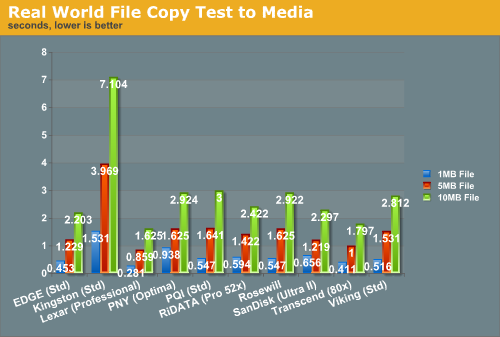
Graphs
You can't really trust somebody who makes a line graph when there is no notion of sequence! Thinking about this one:
http://images.anandtech.com/graphs/1gb%20compactf
l ash%20roundup_12210581203/10365.pngEspecially the interpolation gets really ridiculous... they have this "nice" interconnecting line segments that represent what - a combination of two cards?
It would have made some sense to have the lines in the other dimension, with three points on the line, one for each size of file and then one line for each card. The interpolation that the line represents would then have a meaning - files of other sizes. That would get a little messy though. But seriously, how often did a line graph make sense with the lines in either dimension?
-
Re:I, like, can't find the article
No ads for me. Don't even need adblock:
http://www.anandtech.com/printarticle.aspx?i=2648 -
Re:Where's the battery backpack ?What about the memory controller, are they adding the power consumption of that to the CPU - to be properly compared to the integrated system that AMD X2 uses ?.
Parent and moderators, RTFA. The power comparisons in the original article are for total system power consumption. Quote:In fact, a 2.0GHz Yonah under 100% load consumes less power than an Athlon 64 X2 3800+ at idle.
Note that these figures are for desktop systems using these chips. Properly engineered laptops using these chips will have lower values still. -
Those guys make a great search engine.
Look what I found with it: Google To Purchase Stake In AOL For $1 Billion, also Graphics Coming to Google Ads which is partly related to the AOL deal.
-
Re:P4 processor cost
"... how much more do you think your new P4 processor would cost if it was fabricated in the USA?"
Probably about the same as it costs being produced in Israel. Just because the current P4 is fabricated in Israel doesn't mean that the new ones will be. If it was strictly about cost, they'd be producing the chips in China, or Malaysia where regulations are lower and labor costs are far lower - but it isn't that simple. The Israel fab was probably just the cheapest to convert for producing the new chips.
In fact, the newest technology will be produced right here in the good ole USA in Arizona. In the USA there are more than a handful of Intel fabs:
from http://www.intel.com/pressroom/kits/manufacturing/ manufacturing_qa.htm#1
How many factories do you have worldwide, where are they located and what percentage of your workforce do they employ?
Intel has 11 fabs worldwide today. The company also has six assembly and test sites worldwide. Intel has 15 manufacturing sites worldwide. Sites within the United States are located in Chandler, Ariz.; Santa Clara, Calif.; Colorado Springs, Colo.; Hudson, Mass.; Rio Rancho, N.M.; Hillsboro, Ore.; and Dupont, Wash. Sites outside the United States are located in Shanghai, China; San Jose, Costa Rica; Leixlip, Ireland; Jerusalem, Israel; Qiryat Gat, Israel; Kulim, Malaysia; Penang, Malaysia; and Cavite, Philippines. Approximately half of Intel's 78,700 employees work within Intel's Technology Manufacturing Group.
From http://www.anandtech.com/cpuchipsets/showdoc.aspx? i=2592:
"Intel has announced that it has reopened its Fab 12 facility in Arizona and is preparing to produce the latest in processor technology at this location."
It may come as a surprize to find that there are many other fabs in the USA that are not Intel and are in fact making inexpensive chips. Some of them are overdemand facilities that get contracts to produce chips when the manufacturer can't meet demand by themselves. Not every, inexpensive chip is fabbed overseas, just as not everything from the USA is expensive.
It costs many millions to build a new fab so chips are not always produced in the place where most people would think that it costs the least. In many cases, the production is in the place where it costs the least to convert the equipment since the cost of building a new fab from the ground up can actually be greater than the labor costs of operating the fab over the life of the fab (3-5 years in some cases). -
Surprised, but I should not have been
Yesterday, I read two news articles end to end. The first was Anandtech's preview of the upcoming ULi single-chip chipset solution U1697 http://www.anandtech.com/cpuchipsets/showdoc.aspx
? i=2641. I most particularily noted that although the chipset is competent and very full-featured, aside from 10/100 mbit networking, it would most likely not be able to support dual-videocard solutions - i.e. Nvidia SLI or ATI CrossFire - because both ATI and Nvidia like to keep such support for themselves and their licensees - of which ULi is not one.The article also states that ATI was most likely to allow ULi support for CrossFire, since ULi and ATi have been doing motherboard business together already. ATI has been using ULi Southbridge chips together with their own Northbridges.
The second article I read yesterday was that of Nvidia buying ULi. ULi make fully-featured low-cost motherboards. Their U1695-based motherboards are on sale for as little as 60 in Europe, with most competent motherboards costing twice that amount. Nvidia already have a full range of Motherboard offerings, so why buy ULi? Probably not to expand their offerings, and probably not because they want to be nice to ULi by offering them free licenses. It's a buy-out of a possible future competitor, while they can still be had for cheap.
As an added bonus, Nvidia will own one of their main competitor's suppliers.
-
Re:I have a ULI-based motherboard...
The motherboard you speak of is the ASRock 939Dual-SATA2 (which uses the ULi M1695/M1567 chipset) - there's a review of it here.
-
Re:I have a ULI-based motherboard...
The ASRock ULi-based board described by the grandparent is the first PCI-e/AGP board that offers true AGP performance. It's the best balance of price and features of any motherboard on the market today. Those hacked AGP work-alike slots are crap. See the following link:
MSI makes the Neo3-F that has PCIe and the AGP-like AGR slot, but performance and compatibility of the AGR slot is not as good as what we would like. If you have a high-end AGP card, it will be a definite bottleneck, and if you have a low-end AGP card (9800 Pro or slower) and care about gaming, it's probably time to upgradeanyway. -
Re:Why buy an Xbox 360?
Are there any reasons to get an Xbox 360 over PS3?
The XBox360 is (sort of) available now. The PS3 currently is nothing more than a haze of promises.
Are there any reasons to get an Xbox 360 over the original Xbox aside from graphical performance?
No, and probably not for PS3 over PS2, either. Don't expect a quantum leap in game design, just prettier graphics and more "stuff" on the screen at once.
PS3 will have better graphical performance, up to 2x.
According to Sony, whose advance claims for every previous console have turned out to be widely exaggerated.
High definition.
Also on the XBox360. HD is OK, but I'm actually more interested in the fact that widescreen will now be standard.
Blu-ray.
Every new Sony console seems to have some new, fancy drive design. And they always break down a lot. Be sure to get the extended warranty.
Up to 7 wireless controllers - those actually mean something.
If you can actually get 7 people around your TV. Maybe good for people with big-screen media rooms.
PS3 will come out with games that are just as good, perhaps better.
Perhaps. But the XBox360 games are coming out now. The PS3 won't be competing with XBox360 launch games, but with XBox360 2nd generation games. And the PS3 looks to be more of a programming challenge, so even if the hardware has the potential to match or surpass the XBox360, it may take years for that to happen.
5: PS3 will have better graphics in high definition. Maybe during it's lifetime, High Definition prices will drop sharply, just like LCDs have.
This has already happened. Walmart has rows of HD TVs in the $500-600 range. Many of them even have built-in tuners. If you don't demand a huge screen, HD is only a bit more expensive than SD, with a much better picture.
Yeah you can get it now, but you're basically just getting a graphical upgrade to your existing Xbox.
This is a bit silly. The XBox360 has a completely different processor and architecture than the XBox I, as well as a different graphics system. The PS3 is closer to the PS2 than the XBox360 is to the XBox I--that's why Microsoft has been unable to provide full backward-compatibility.
If you desperately need to buy something now, I'd buy a GameCube. It's dirt cheap, less than $100, and you can always pass it off to your kids, or younger siblings, cousins after you're done with it and decide what you want to buy next year when all 3 next-gen consoles are out.
Just-launched systems are for enthusiasts. The launch games typically barely scratch the surface of what the system is capable of. If you don't already have a game system, I'd recommend a PS2. Lots of games, fairly cheap used (but be sure to get an extended warranty). And promised backwards compatibility of PS3 means developers aren't going to be in a big hurry to switch to PS3 development. GameCube is more for people who appreciate Nintendo's unique game design strengths (I'm actually looking forward to Nintendo Revolution more than PS3). -
Re:Jealousy
If you're going to talk about mobile chips, the Pentium M far outclasses any competitive chip on power consumption, and particularly hard on power per watt. Hell, the Yonah performs close to AMD's desktop chips clocked at the same rate, and they consume less power under full load than the AMD consumes idling. How's that for a differential?
-
Re:Surprising how?
Thats a good point, if I understand you correctly. You are pointing out the difference between Intel's next-gen (Yonah, Merom, Conroe) to AMD's current gen offering (Manchester, etc.).
Between an AMD 64-X2 3800+ and an Intel Yonah2 2.0ghz we see a 15% increase in effiency while idle, and a 25% increase while under load. The difference between an idle Yonah and under load is 15%. I think Yonah is able to turn off one of it's cores when it's idle so it does well when it's idle.
Reference (Anandtech.com): http://www.anandtech.com/cpuchipsets/showdoc.aspx? i=2627&p=10 -
Re:Suspicious article title...
It depends on what you think is important. According to Anandtech, Intel has a one-year lead on shipping 65 nm processor parts because it has working Yonah parts now while AMD is not expected to have a 65 nm part until late next year. The smaller die size allows, according to that same article, for Intel to make a dual-core chip at the same die-size and cost as a regular single-core processor. Same price, higher performance, higher profit margins for Intel. AMD has always bettered Intel in chip design while Intel has always sat on its huge fab capacity and manufacturing process advantage. It will be fun to see how things shake out.
-
Re:The future?
OSX vs Linux performance on powerpc is a delicate matter. The desktop seems indeed better on OSX (unless you compare the shells) but overall Linux is faster, in my own experience. But, google for some benchmarks.
-
Intel finally catching up ?
From TFA - "The introduction of the Merom design will be a turning point in Intel's product policy, because it will be the backbone for all processor families that go into the desktop, the mobile or the enterprise space. In contrast, the desktop and enterprise markets are provided with Pentium 4 and Pentium D NetBurst architecture processors while the mobility CPUs are derived from the more efficient Pentium M design"
Merom being the sucessor to the forthcoming Yonah. Based on the recent AnandTech benchmarks of Yonah against desktop chips , it seems like Intel may not have to play 'catch up' for much longer. Of course, we don't know what else AMD has up their sleeve -
Looks nice -- but there's a whole Opteron Line
This deal looks neat.
But Sun has a whole line of Opteron-based computers.
Does anyone have anything good/bad to say about their entry model, the X2100?
Here's the review I saw: http://anandtech.com/systems/showdoc.aspx?i=2530
I like the idea that it is an off-the shelf minimal server. -
Re:Not so great?
Note that in their test AnandTech were running the Yonah and X2 in a desktop motherboard, with a fast PCIe graphics card, desktop HDD to make a fair comparision with thier previous Dothan review - see here for tech specs.
Also note that the power consumption figures quoted are total system.so the majority of that power will be driving the rest of the PC, not the CPU. This is why the difference doesn't look very big between the Yonah and X2. However, if you could get figures for the just the CPU (which isn't very easy to do in this sort of review), I think we'd see a different story...
-
Re:WowI really have to wonder when Intel will start using this technology in desktops.
Not in a big way until Conroe in the second half of 2006. I'm pretty sure "desktop" use of Yonah will be limited to a few small form factor desktops like Dothan is used today.
Yonah will still be 32-bit while Intel's entire "desktop" line of CPUs (including Celeron) have adopted EM64T. I don't think this is that important, but Conroe will add EM64T and other enhancements to the "Pentium M core."
65nm Pentium 4/D processors (Cedar Mill/Presler) are launching around the same time as Yonah (January) and are already shipping in volume to manufacturers. Another Anandtech article showed significant power savings from 65nm, which will make Pentium 4/D power consumption reasonable (but not quite as low as AMD 90nm). In addition, Pentium 4/D will also add virtualization technology (Vanderpool) which Yonah will lack.
Intell is should switch its R&D and support the Pentium M as a desktop chip
I don't think the Pentium M architecture is lacking in R&D (see Conroe). Yonah is making some steps toward being a desktop chip by adding SSE3 and floating point enhancements, but Conroe will complete the transition by adding EM64T, virtualization technology, desktop chipsets, and more lenient power requirements.
-
Re:Wha?
I know it's not a popular truth, but the fact of the matter is that the Windows NT-based releases are quite stable.
Quite frankly, I don't know if what you're saying is necessarily true:
"The problems with Media Center Edition continue to be the same ones that have plagued it all of its short lived life: 1) cost, and 2) stability."
http://www.anandtech.com/multimedia/showdoc.aspx?i =2240&p=17 -
Yonah is already in production
-
Re:Current PricesBased on this:
http://www.anandtech.com/systems/showdoc.aspx?i=26 10&p=7/
"Microsoft has their own license to use and manufacture the CPU used in the Xbox 360, and thus we see their logo on the chip itself."Yes of course, MS has licensed the chip from MS. The original post claimed that MS had designed the chip. The 'manufacture' bit strikes me as a bit funny, as where else is MS going to go for PPC chips? Its either IBM or Moto, and we know about Moto's track record here... Its not like MS has chip fabs or anything.
"Microsoft controls the IP of the GPU; meaning, Microsoft can manufacture and do what it wishes with Xenos (although we're assuming that they can't stick it on graphics cards and start selling it to the public)."
You are correct - I had not addressed the GPU. This is unsurprising considering the craziness that went on with nVidia the last round.
It was sold at a loss when it launched. It wasn't a surprise because every console system back then sold for a loss during its first year. Some information in the Cost and release date section here:
Sorry - you linked the PS3 page. There doesn't seem to be anything about unit cost on the PS2/Wiki page. No one really knows but Sony, although I would maintain most knowledgeable sources I've spoken to anecdotally (game store managers etc) do not believe Sony ever lost money, or if so then it was a tiny amount. It is very possible the cost was basically 'wholesale' when it launched. I dispute your 'every console sold at a lost back then' claim; I don't think that was true of Nintendo at any point.
-
Re:Current PricesWhy do you say that? It seems pretty clear to me that IBM owns the PowerPC (in conjunction with Apple and Motorola although I am unsure as to the state of that alliance at the moment). MS did not develop, design, or have anything whatsoever to do with that chip. On the other hand, Sony designed the Cell with IBM in partnership. That will make a difference down the line.
Based on this:
http://www.anandtech.com/systems/showdoc.aspx?i=2
6 10&p=7/"Microsoft has their own license to use and manufacture the CPU used in the Xbox 360, and thus we see their logo on the chip itself."
And from the next page about the GPU:
"Microsoft controls the IP of the GPU; meaning, Microsoft can manufacture and do what it wishes with Xenos (although we're assuming that they can't stick it on graphics cards and start selling it to the public)."
Also as an aside I don't think Sony ever lost money on a PS2.
It was sold at a loss when it launched. It wasn't a surprise because every console system back then sold for a loss during its first year. Some information in the Cost and release date section here:
-
Re:Heat
It will not overheat easier because the ducts are attached to the circuitboard. Without a cover the ducted air could immediately leave the case instead of being forced out the holes on the right side of the system. What surprises me is that the DVD drive is full-size instead of half-height or laptop sized. Consequently, even though the graphics chip and memory have a large heatsink over them, the drive limits the height of the the fins to PC-card ranges. I would have thought it would be necessary to use a half-height drive with a taller heatsink underneath.
In about a year heat issues are expected to decrease as the main core chip moves to a 65 nanometer manufacturing process instead of 90 nm, resulting in higher efficiency and less heat. -
Re:Heat
It will not overheat easier because the ducts are attached to the circuitboard. Without a cover the ducted air could immediately leave the case instead of being forced out the holes on the right side of the system. What surprises me is that the DVD drive is full-size instead of half-height or laptop sized. Consequently, even though the graphics chip and memory have a large heatsink over them, the drive limits the height of the the fins to PC-card ranges. I would have thought it would be necessary to use a half-height drive with a taller heatsink underneath.
In about a year heat issues are expected to decrease as the main core chip moves to a 65 nanometer manufacturing process instead of 90 nm, resulting in higher efficiency and less heat. -
Re:numbers suspect
If Microsoft is really paying $51 for a quality 20GB hard drive, then they need their heads checked.
Bear in mind that this isn't a plain ATA desktop hard disk, it's a laptop-format SATA drive. Right now those cost like $400 at retail. $51 sounds very reasonable to me. -
Re:Gonna Order One Today
The OCZ is *not* all its cracked up to be. checkout the USB drive shootout from anandtech There are better drives to be got.
-
Re:AnandTech flash drive roundup
AnandTech has a more comprehensive review of many flash drives, and the OCZ is far from being the fastest.
The AnandTech review shows that the OCZ is not far from being the fastest.
The OCZ places 2nd or 3rd for reading 256kb or 2mb files.
http://www.anandtech.com/memory/showdoc.aspx?i=254 9&p=25
Where it fails is writing, placing 5th or 6th for 256kb or 2mb files.
http://www.anandtech.com/memory/showdoc.aspx?i=254 9&p=27
Still, "far from the fastest" is misleading. -
Re:AnandTech flash drive roundup
AnandTech has a more comprehensive review of many flash drives, and the OCZ is far from being the fastest.
The AnandTech review shows that the OCZ is not far from being the fastest.
The OCZ places 2nd or 3rd for reading 256kb or 2mb files.
http://www.anandtech.com/memory/showdoc.aspx?i=254 9&p=25
Where it fails is writing, placing 5th or 6th for 256kb or 2mb files.
http://www.anandtech.com/memory/showdoc.aspx?i=254 9&p=27
Still, "far from the fastest" is misleading.