Slashdot Mirror
Domain: audioholics.com
Stories and comments across the archive that link to audioholics.com.
Comments · 93
-
Number five is a crock
The fifth item of 108, a 23 lumen LED projector from Samsung is worthless. I would much rather have the monochrome laser projector from Light Blue Optics, mentioned before, I think on
"Understand that there is no glass, no prisms, NO MOVING PARTS, and no need for fans to provide heat dissipation. In addition, it runs on less than 1.5W at full power and less than 350mW while displaying typical video images (50% average pixel amplitude. There is also an infinite focus, meaning that no matter how close or far away, there are no optics to adjust for a clear picture"
It's more legible than the Samsung, uses less power, is smaller, and has INFINITE focus. It is however, just monochrome, but I would still enjoy an anywhere projector like that. I could use it for displaying video, cell phone video chat, pictures, movies, ads, reading... I want one! -
Re:Screwing it up again?!?
Apple finally broke the chicken and egg problem with their 30" Apple Cinema display. They built dual link into their entire product line in preparation for it's launch.
WTF? I remember when the 30" Cinema Display was launched (June 2004) and they certainly did not build dual-link DVI into their entire product line "in preparation for it's launch." MacCentral's coverage of the WWDC 2004 keynote explains it best:Jobs also introduced a new 30-inch display. The $3,299 display sports 2560 x 1600 pixel resolution, and works only in the Power Mac G5. It requires a new Nvidia GeForce graphics card in order to work, a $599 card that features dual-link DVI interfaces.
That Nvidia card was the first "non-workstation" card (GeForce brand) I can remember that supported dual-link DVI. However, workstation cards (like the Quadro FX 3000) have supported dual-link DVI since at least July 2003. I think the only reason Apple used a "GeForce" card was because they did not support any "workstation" cards at the time (they do now).
Gigabyte's GV-RX16P256DE-RH (Radeon X1600 Pro) supports dual-link DVI and costs about $105 at Newegg. Mainstream workstation cards (Nvidia Quadro, ATI FireGL, etc) have supported dual-link DVI longer than "consumer" cards like GeForce and Radeon.From what I understand this new standard will be incapable of driving monitors at resolutions above what these 30" displays can do now. That's nice but DVI is there and prepared to surpass that. Why create a new standard that limits display size to a resolution that was reached a year before the standard is even released, especially when dual link support is finally taking hold and the original limitations of DVI are starting to melt away.
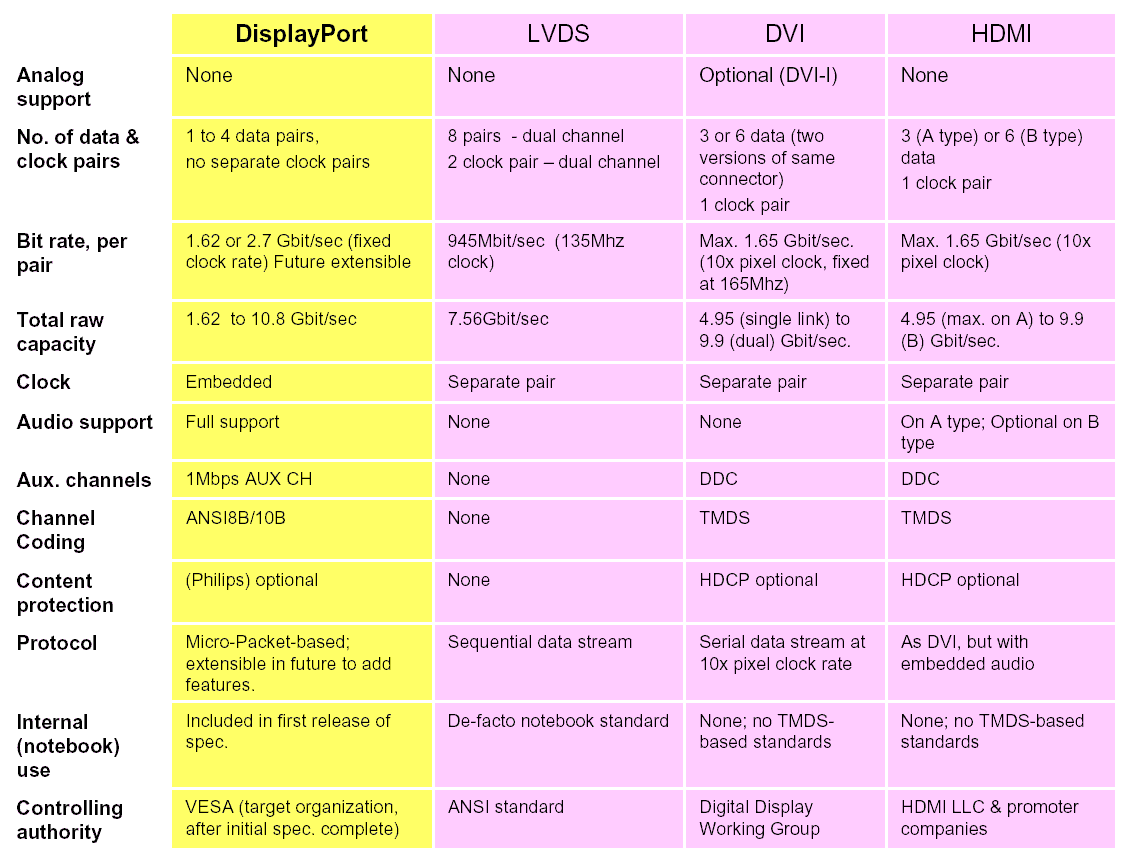
As I said in another comment, VESA claims that DisplayPort's bandwidth is "future extensible" while DVI's bandwidth is maxed out at 9.9 Gbps per dual-link port. However, what they claim and what they implement might be different. Here's VESA's comparison chart anyway:DisplayPort, LVDS, DVI, and HDMI comparison
-
Re:The Input/Output Hurdle
I'd also be interested in a video iPod with a laser based projector that had wireless head phones with extended bluetooth range. Get a group of people with the headphones and you could have your movie theater almost anywhere!!!
Now a portable device that incorporates this technology would be something I'd be interested in as well.
http://www.thinkgeek.com/computing/input/8193/
Laser based projector
http://www.audioholics.com/news/editorials/laserpr ojectorscellphones.php -
Re:Is this really needed ?
UWB has signal range like wireless - in the tens to hundreds of feet. Easily across the house. Freescale have demonstrated the OTHER UWB standard (UWB Forum) streaming MPEG2 video from one device (a home theater box) to a UWB TV. It was really quite neat.
http://www.audioholics.com/news/pressreleases/Haie rWirelessUWLCDTV.php
Hopefully adopting the WiMedia version and using Bluetooth as the remote control method of choice (why not control your TV and media center from your mobile phone, even? -
Re:SimplicityIdeally Bose but any small and good sounding speakers
You can have good sounding speakers, or you can have Bose. You can't have both. Here are a few links for more information:
- The Dumbing Down of Audio
- Placement Suggestions For Cube Speakers
- Ten Biggest Mistakes of Speaker and Home Theater Shopping
- FAQ about Bose home theatre products
Serious audiophile sites/publications ignore Bose equipment completely. Perhaps that is because they refuse to waste their time on stuff they know is junk, or it could be because Bose has been known to deploy lawsuits in response to bad reviews.
-
Re:SimplicityIdeally Bose but any small and good sounding speakers
You can have good sounding speakers, or you can have Bose. You can't have both. Here are a few links for more information:
- The Dumbing Down of Audio
- Placement Suggestions For Cube Speakers
- Ten Biggest Mistakes of Speaker and Home Theater Shopping
- FAQ about Bose home theatre products
Serious audiophile sites/publications ignore Bose equipment completely. Perhaps that is because they refuse to waste their time on stuff they know is junk, or it could be because Bose has been known to deploy lawsuits in response to bad reviews.
-
Missing from Exhibitor List
http://www.audioholics.com/news/editorials/laserp
r ojectorscellphones.php
"Light Blue Optics will be demonstrating the miniature PVPro evaluation kit at the 3GSM World Congress in Barcelona, February 13-16 2006."
http://www.3gsmworldcongress.com/page.cfm/action=E xhibList/Letter=L
Their press releases say they'll be there. The official site of the 3GSM World Congress doesn't list them. -
Cellphone?
Small enough to fit in a cell phone?? Did you see the image from tfa? It may be small but it's about the size of a small cell phone - where's the actual phone electronics gonna go???
It might be a cool as a PDA sled though so that you don't have to have the bulk all of the time. -
Re:Come full circleI don't think I'd be mischaracterizing you if I paraphrased part of your argument as such:
Digital audio sucks. It doesn't sound real, and the quality is worse than vinyl.
This argument is one of many in the supposedly "pro" audio segment that sounds pretty plausible. Others include such ideas that all file compression degrades audio, expensive audiophile cabling sounds better than normal electrical wire, and hardware sounds better than software. Unsurprisingly, many of these arguments are put forth by vendors selling this equipment. And unfortunately for those who have invested a lot of money in high-end audio equipment, these arguments (and others like them), have been debunked numerous times.
When people say vinyl and tube amps have better sound quality, it's usually because (a) they believe these "experts", (b) nostalgia, or (c) they think that it sounds more "real" because there's physical mechanics working (the needle, etc).
All three of these are pretty bad reasons for claiming a technical superiority, especially if you have no background in fields that deal scientifically with audio. Have you conducted double-blind listening tests between CD/vinyl and tube/transistor setups? This is basically the only way to get a metric on "quality", although there are some pitfalls. Some people can pick out noise present in vinyl, or can hear specific artifacts introduced when using lossy compression (MP3, Vorbis, etc), so their bias is evident in the testing. But for personal preference, it works very well.
About CD recordings: in the 80s, the CD was a completely new recording medium. Many people who mixed records had worked with vinyl for a long time, and they knew how to make it sound really good. Moving to CD, it was quite a bit different. Many of the tricks and techniques they used when working with vinyl no longer had the same effect. This is unfortunate, since CD re-releases in the early CD days sounded like ass compared to the buttery-goodness of an expertly engineered LP (this is what I've heard. I haven't experienced it first-hand). This is why you see debates and recommendations on audio sites between people who compare different CD mixes, comparing it to the LP/other recordings. (or perhaps live, who knows).
BUT! If you like the way tube amps and records sound, go with it. I like the cracks and hiss of recordings sometimes, and I'm not being sarcastic. One of the reasons I think people like LPs is that you can tell they are recordings, not like CDs that are mixed to sound slick and "perfect". But please try to lay off on the technical angle, unless you've done some testing (and published it somewhere so everyone can see).
PS: I mostly agree with you about digital music sales. The RIAA-blessed and DRM-wrapped files are really worthless. But there are sites out there that sell lossless (FLAC, etc) files that aren't encumbered. You just won't be able to get the new Britney Spears single.
-
This produces and interesting situation
given the fact the everyone's favorite monopoly, Microsoft, has just recently partnered with CableLabs to produce a CableCard capture device for watching and capturing HDTV on a Windows based PC. The question remains on how this will impact the Tivo/Intel deal, given that Tivo is Linux based. Will the next generation (or future generations) need a set-top-box in addition to the Intel/Tivo (InTivo?) just to get HD content? If there is a standard for PC/DVRs, what would prevent MS from slapping on Windows MCE 200x on it? Is MS the only way in the future for HD? Things will get interesting... http://www.audioholics.com/news/pressreleases/Mic
r osoftCableCARDXbox360.php -
Re:Name sounds familiar
If they keep that name for production, I have a feeling these guys may have an issue with it. But I guess the way justice works in the US, whoever has more money is right, so Apple shouldn't be worried.
When's the last time a code name was also used for the retail product? I can't remember that ever happening. It's a "code name" for a reason - the developers and designers needed something to call it, without the hassle of all of the due diligence and legal work.
For a media center to really work, it needs to be anointed by the cable and satellite companies: If it's unable to work with the digital EDTV and digital HDTV signals on their networks, with all of their DRM, then it is close to useless. Microsoft recently got that blessing, though apparently it won't be supported in retail deliveries until next Christmas. -
Re:HDTV, and how I helped MS lose moneyhttp://www.audioholics.com/news/pressreleases/Mic
r osoftCableCARDXbox360.phpREDMOND, WA and LOUISVILLE, CO - Nov. 16, 2005 - Microsoft Corp. and Cable Television Laboratories Inc. (CableLabs®) today announced they have reached an agreement that will allow Microsoft and PC manufacturers to bring to market digital-cable-ready Windows® Media Center-based PCs in the holiday 2006 time frame.
-
Re:but why
ok i've seen some huge ones in my time but my current verbatim one (pic at http://www.audioholics.com/productreviews/avhardw
a re/VerbatimUSBDriveReview.php) isn't too bad and the stick i had before that (still in use as a backup but the case usually falls apart when unplugging it and the connector is a bit bent after an incident when i kicked it whilst plugged in) is even smaller (think its a canyon one) and the one i gave to my sister a while back was somewhere in between.
the smaller ones are small enough to get in a port with other stuff next to it yet big enough not to easilly lose. going much smaller would probablly mean abandoning normal IC packaging (which is possible but i would guess expensive except in very large quantities and/or moving to a single chip soloution). Some very small drives do exist though although they often sacrifice the polarisation of the plug to do so) -
There's compression, and then there's compression.
But is still not the same as uncompressed PCM.
What is the audible difference between a "pristine" stereo audio source sampled at 44.1 kHz and the same audio source encoded at 192 kbps ABR Vorbis? Have you benchmarked codecs against your ears in ABX testing? Besides, if you claim that pop music isn't compressed, you're wrong.
-
Re:WMV...My thoughts exactly. This muddies the politics the VC-1 CODEC (WMVHD) versus AVC/H.264.
http://www.audioholics.com/news/industry/HD-DVD_F
o rum_resolutions1.htmI prefer H.264 because its specs are better not only in capacity but also in chroma information stored. H.264 can do 4:2:0, 4:2:2 and 4:4:4 versus VC-1 of only 4:2:0. Which means color depth information will be superior for H.264.
-
Sounds Only Like a $1500 Player?
High end audiophiles will squak. Meridian's G98 costs $6k (review), the Lexicon RT20 is $5k, an Ayre costs $6k, and the Arcam FMJ 29 (highly rated starting end of high end) will set you back $3k. The top reference player, Meridan 808, will set you back $20k.
The Denon 2910 (about $600) (review) is the beginning of better quality players. The article being discussed does exactly what a lot of the higher end players do -- swap out cheap parts for better ones. For those who don't think it makes a difference, you've never had the pleasure of good quality sound. A wide, three dimensional sound stage with clear separation of instruments and fine detail puts a smile on your face. Being able to get that for much less than above (and have the second pleasure of do it yourself) is well worth it.
-
Re:Calibration
They do have decent calibration schemes. My Denon AVR3805 comes with a mic that you plug in and place at the listening position and then run the auto-calibration test. Toss in some Paradigm speakers and an SACD player and you have some *very* high quality audio. My previous receiver required me to manually take SPL measurements and input them for calibration. The Denon auto detects everything, including speaker locations. Soooo handy.
-
Re:Multiple Standards
Actually, you can put a DVD layer and a Blu-Ray layer on one disc. Looks like JVC made the first. Blu-Ray dual layer on the outer tracks and DVD dual layer on the inner tracks. http://www.audioholics.com/techtips/specsformats/
J VCBluRayDVDComboDisc.php JVC will forward a proposal to the Blu-ray Disc Association (BDA) to have the technology accepted as a specification for future commercialization. The company is also working on a Blu-ray/ DVD combo ROM disc with an even larger 58.5GB storage capacity. The proposed disc will be comprised of a 50GB Blu-ray dual layer and 8.5GB DVD dual layer structure. -
Re:Microsoft vaporware
Holy moly. I just erased a huge rebuttal to what you just said after reading the good news. Last time I checked back in November (when Samsung's original 61" 1080p DLP was officially overdue), Samsung said that it was jacking up the price on its offerings from $6500 to $9000. How we're seeing price ranges from that company from $4500-$7000 for 1080p DLPs. We might actually see relief.
I was going to mention the price increase and couple it with the fact that all the LCoS sets including Sony's new SXRD are going to be going for >$10000, but this is good news. You might be right. It'd be nice to get a 1080p screen with some decent black levels as opposed to my current Sharp AQUOS set. -
Re:Microsoft vaporware
Quick search made me come up with this press release. Right now a 52" DLP 720p/1080i television from toshiba runs about 3500$CAN, altough I've seen them as low as 3200$CAN. By april of next year I'd wager you'd be able to pick up a 52" 1080p DLP for less then 4000$CAN (roughly 3200$US).
Not exactly cheap, but you probably won't have to sell one of your kids to get one if you want it. Right now I'm using a 26" 720p/1080i CRT from toshiba, should be good enough to enjoy the new system at first, especially since I've read that most games probably will run at 720p instead of 1080p (I'd assume for the first generation at least). -
Re:No this is more like
You seem to be having trouble with your sarcasm detector. You should see a doctor before it becomes serious.
That said: It would seem that TOSlink, as used by Toshiba to transmit SP/DIF digital audio signals in 1983, predates ADAT by about nine years, and also (near as I can gather) Alesis, the company, by about two years.
I declare that this glaring anachronism lends itself to discredit the rest of your ill-concieved tirade in its entirety, and further that your original analogy remains warped.
-
Re:Good read on Skin Effect
This all has me wondering of anybody here has used 10-gauge Romex as speaker cable.
Actually, the best price/performance for speaker cable right now is the low voltage cable they sell for outdoor lighting systems.
BTW, the whole skin effect thing is nonsense at audio frequencies.
See this page for the formula for skin depth.
If you're too lazy to do the math yourself, someone else has already done it. -
Re:Good read on Skin Effect
This all has me wondering of anybody here has used 10-gauge Romex as speaker cable.
Actually, the best price/performance for speaker cable right now is the low voltage cable they sell for outdoor lighting systems.
BTW, the whole skin effect thing is nonsense at audio frequencies.
See this page for the formula for skin depth.
If you're too lazy to do the math yourself, someone else has already done it. -
Re:Hmmm, go wired!
While you'll certainly get better sound using wires...
wire the speakers with MonsterCable
...MonsterCable is a rip-off. Not only are they horribly overpriced compared to equivalent/better cables, but they blindly sue anyone using the term 'Monster' in their name.
-
Re:It does a few things right
Picture this scenario. My parents just bought a flat panel EDTV because they are concerned about space. They want to hook it up to a DVD player. Currently they would use between 3 and 5 cables, a number of which are physically identical. With HDMI they use one.
The fact that HDMI allows HD signals and the fact that it is a single cable are two orthogonal facts. Just because it is on the highend now does not mean it will be there forever. There are plenty of people buying new ED/HD sets who are not audio/videophiles, who will use the built in speakers, and will be happy with the simplified interface. And it means fewer tech support calls to me from my mother who is upset with her new TV purchase
There is also something appealing about only needing one type of cable in highend setups. It means less types of things to buy. Checkout this receiver. Using only 5 (13 if you count the speakers and subwoofer) cables you can hook an OTA STB, an Upscaling DVD player, a Satellite receiver, and PVR, while still guaranteeing correct clockskew on the scaler (since the audio and video are bundled). I bet if they threw out all the analog ports and signal processors that are only used in the analog path they could shave a bunch of money off it too.
Louis -
Re:huh
I went and researched this a bit, and found the following links useful:
http://engadget.com/entry/5180876097686388/ http://www.audioholics.com/techtips/specsformats/C ableCARDprimer.php
http://broadcastengineering.com/news/broadcasting_ cable_era_begins/ -
Re:literally speaking, no
By the way, you can't use audio cable for SPDIF. SPDIF requires coaxial video cable (75 ohm impedance). It will not work well with anything else.
See, you had me on the voltages thing because I really didn't know. Stuff in class has always been in terms of 0, +5, and -5 and every power lead I've ever seen used in a computer was 5 or 12 volts so I just assumed most data connections were like that.
But cheap wire works just fine for any digital audio connection I've ever made, and I don't think I have any wires with an impedance that high. To quote from here: There is some debate whether using true 75 Ohm RCA connectors is of any use when the impedance of typical RCA panel jacks are not anywhere near 75 Ohms.
The way I figure it, a digital audio signal could only be 2 or 3MHz (128kHz on 2-7 channels for SACD, which is likely inaccurate but over compensating) and if this cable can transmit at "beyond 200MHz" and be twice as efficient as a $2 cable then I should be just fine.
There is a this guide to making 75 Ohms of impedance cables but I can't take it seriously since it refers to things like breaking in the dialectric. Is this the kind of person that believes in 75 Ohm impedance requirements? -
You don't want to raise the ire...
People don't seem to want to realize that digital implies lossless or error-corrected. They don't understand that the "premium quality sound" transmitted between devices can be done using the cheapest electronics equipment available.Digital, maybe, but you don't want to raise the ire of the analog stereophiles: You'll get everything from Stereo cables make a difference to Debunking the Myth of Speaker Cable Resonance, not to mention forests worth of dead tree sacrifices for Speaker Cable Face Offs.
And please, please, please, please: Don't get them started on Solid State -vs- Vacuum Tube...
-
Re:x2 megaview?
Here you go. It's called MEGA View. (Found through this article.)
-
Re:Display technologies review?
Is there a good, recent review of the various competing display technologies [LCOS, DLP, Plasma etc.]?
I know it's bad form to reply to one's own message but for those who had the same question, I found a very nice comparison of various display technologies at Audioholics.com. -
LCOS tech outline
Can be read at Audioholics plus a link to JVC's similar DILA technology.
LCOS isn't really used to make flat panels, but you can make thinner rear projection TVs.
-
Cancelation may be Redirection
I've been reading up on some of the "up and coming" display technologies, and I have a theory!
The new devices that are coming out are "Organic LEDs." These devices are looking to offer brighter displays, no backlighting required, even FLEXIBLE TV! Lets just say that with a screen thickness as small as 1mm (yes that's millimetres) I'll wait for that 42" TV you can hang on the wall like a picutre(and not need a forklift/specialty anchorage). -
Re:And since he believes it...when some flavor-of-the-month geek decides he knows about electronics and thinks that quoting V=IR proves that any speaker cable is as good as any other (leaving out KNOWN variables like 'skin effect' 'group delay'
Go to Audioholics to read why skin effect and other real-world imperfections do not play any role for signals up to 20 kHz, and how cables that are advertised as having special properties do not have those anyway.
Regarding skin effect: the resistance of a typical speaker cable will increase with no more than 3% at 20 kHz. That's the difference between a cable with a 2.5 mm^2 or 2.4 mm^2 cross-section.
and other real world imperfections usually not bothered with in circuit design).
Any skilled circuit designer has to keep imperfections in mind. Components are only perfect in introductory courses on electronics.
-
Re:And since he believes it...when some flavor-of-the-month geek decides he knows about electronics and thinks that quoting V=IR proves that any speaker cable is as good as any other (leaving out KNOWN variables like 'skin effect' 'group delay'
Go to Audioholics to read why skin effect and other real-world imperfections do not play any role for signals up to 20 kHz, and how cables that are advertised as having special properties do not have those anyway.
Regarding skin effect: the resistance of a typical speaker cable will increase with no more than 3% at 20 kHz. That's the difference between a cable with a 2.5 mm^2 or 2.4 mm^2 cross-section.
and other real world imperfections usually not bothered with in circuit design).
Any skilled circuit designer has to keep imperfections in mind. Components are only perfect in introductory courses on electronics.
-
Re:Monster cables are a scam!@#
Yep, Monster cables are pretty much the same as all the others.
After I bought my big screen tv, the salesman tried to get us to buy $100 component cables along with other overpriced accessories.
Later, I looked online and found this good site about the real engineering issues with audio and video cables.
Basically, for low bandwidth audio and video, these expensive cables don't provide any noticible improvement at all. The might help if you have a noisy environment and have a long cable that is high bandwidhth. This isn't the case for consumers though.
The main factor is impedance matching. If it doesn't match, the transfer of the signal across the cable is not at maximum efficiency and it will be non-linear.
Another factor is the strenth of the joints. Brands don't indicate good cables: some good brands have bad joints, and some cheap cables have good joints. You don't want your cable to be worn out quickly by plugging/unplugging a lot, and also, it reduces signal loss.
Insulation is important too, but you probably wouldn't notice if the cable is long (see link for full details)
-
Anyone think it has something to do with this...
Hm?
If they wouldn't support HD-DVD in Longhorn it would be big news though.
- Uhh, yes, we designed a video format that will be used on these discs, but Longhorn won't support them. -
Re:A REPORTER GUESSED THIS OVER A MONTH AGO!
There is more good info on Starwars Episode III here: http://www.audioholics.com/forums/showthread.php?
p =17977#post17977/ -
Re:There's another reason: electric Impedance
Well, you can't expect me to realize that you're the same guy each time if you post AC. Sorry. If you think I'm trying to avoid you becuase you 'got' me, you're completely mistaken.
Now, I hadn't seen that you've clarified TWICE or more that you're referring to overall length of all conductors in the system. I saw something like that once, but I honestly didn't think you were serious. I mean, the skin effect gives us an effective increase in the effective impedance and self-inductance of the wire... but you're talking about the length of the wire in completely inductive structures. The overall phase shift and power loss in the signal due to voice coil inductance and winding capacitance is several orders of magnitude greater than the microscopic level due to skin effect. Same thing for transformers.
And exactly what difference in impedance are you referring to? It's not as if the voice coil of the speaker sees a 1 M source impedance or anything; ditto with the transformer secondary in a tube amplifier. The primary may see a source impedance of some kilohms, it's true. However, the previously-mentioned transformer inductance is several orders of magnitude higher than that caused by skin effect. It's rare indeed to find a tube output transformer which tests anywhere close to flat at 25 kHz, and that's not because of skin effect. It's because of the primary inductance. Tube output transformers need large primary inductances for good low frequency performance, but of course this starts to affect HF performance...
In fact, shouldn't operating in high-impedance circuits REDUCE the effects of skin effect? After all, power loss is proportional to I^2*R, and the higher impedance circuits you refer to operate at MUCH lower current levels. The wire impedance, with or without skin effect, is several orders of magnitude smaller than source or load impedances. They're called circuits intentionally, right? They go in a circle? Impedance in the circuit is the sum of the impedances around the circle. If you've got a source impedance of 1M, a load impedance of 1M, it doesn't matter whether the connecting wire's impedance is
Then you have the fact that internal interconnections are usually made with smaller wire, and so the ratio of skin depth to wire thickness is more favorable...
I mean, it's nice that people take this all into account, but the overall effect is actually worst in those speaker cables, and it's totally inaudible there. I'd be glad to see a derivation which refutes my statements in a rigorous way. I'd also like to redirect you to this link whih may be of some interest. -
It's more than data storageThe first thing I thought was that I can carry around one of those keychain flash memories. But you don't know what icky schmootz is on the keyboard, or if there's a keystroke logger in the terminal, or if the terminal is set up to trash your keychain memory. There is more than a question of data storage here.
You wouldn't trust a public terminal, but you could probably trust a public power supply so you don't need to carry around batteries. People already trust public wifi networks ala Starbucks. CPUs and memory can continue to shrink, but what about keyboards and screens?
Keyboards can be embedded in cloth which could be rolled up. Displays could be made to be rolled up also (1, 2, 3). People are working on non-volatile nanotube-based memories which could replace bulky, fragile hard disks. Cool, zero boot-up time.
It's pretty reasonable to imagine that in five or ten years there could be a cheap computer with the feel and durability of thick cloth, that rolls up to be about 6 inches long and maybe an inch wide. Maybe you velcro it around your forearm when not in use. I'd buy one.
-
Here's a much better article
-
Re:What is silent?
Well.. 0dB would be ideal, but most people cannot hear sounds that low... especially geeks with big stereo systems.
This page has an excellent table of information on various dB listings.
According to it, human breathing at 3 feet is 10dB... can you hear people breating from 3 feet away? (I can't.) -
What good is a non-digital format like this?
These "new" improved formats don't allow for any digital signal processing whatsoever. That might not matter to the mass-market, but it is going to kill the audiophile appeal.
http://www.audioholics.com/techtips/specsformats/
d vd_sacd1a.php -
Re:Speakers are Key
I absolutely agree that speakers are probably the most important piece. I'd reccomend doing research and identifying what you want, then looking on ebay and other discounters.
However, I would strongly reccomend *against* Bose speakers, at least until you can compare them against other speakers side by side. I used to have a pair of 901's, and loved them... until I started getting knowledgeable about sound.
But Bose speakers are all about trying to make poorly recorded things sound better. Flat, lifeless recordings get room-filling sound. Great, right? Well, try playing well-recorded stuff (which most modern material is).
All the sudden it's boomy, has a huge preponderance of mid-bass, and sounds generally tweaked. It's like having an equalizer in the system that you can't adjust.
I'd vote for accuracy, myself, and if you've got source material that needs to be fixed, get an external EQ for that (don't run it all the time unless it's a very expensive EQ; most EQ's introduce phase problems).
Here's a good set of reviews of speakers in the general price range: audioholics. (I'm not affiliated with them in any way)
Cheers, good luck, and enjoy whatever you get.
-b