Slashdot Mirror
Domain: bls.gov
Stories and comments across the archive that link to bls.gov.
Comments · 1,395
-
More Facts
January 2009 U-6 was 14%. Right now "unadjusted" U-6 is 9.9, and 9.8 after "seasonal adjustment".
-
Facts
U-6 is the real unemployment rate. Nobody but you, apparently, is fooled by the fraudulent U-3. Obama has yet to match Bush's worst U-6.
-
"Jobless claims" is not the same as unemployed
Jobless claims is a deceiving statistic because it doesn't count people whose unemployment insurance expired without them finding new jobs or people who have dropped out of the labor market altogether (e.g. underemployed recent grads who move back into their parents because they can't find a job).
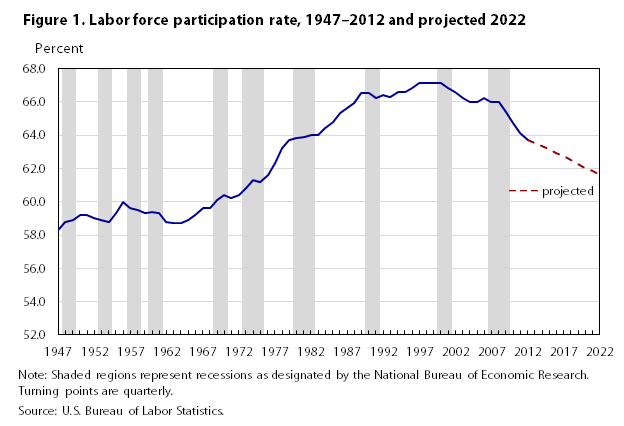
The actual labor market participation rate is 63.0, which, outside of last year, is the lowest it's been since the late 70's. See Labor Force Participation Rate from Dept. of Labor. I couldn't save a URL that pointed to the full series, but just adjust the start date back to 1976 to see the graph.
What's really happening is that capital is doing great, but the recovery from the financial crisis of 2007/8 has been largely jobless.
-
Labor Market Participation rate
New claims are down, meaning employers are having fewer layoffs. However, the participation rate is still near its historic low thanks to an aging population, millions added to disability, and longer unemployment benefits.
-
More people are also not in work
See http://data.bls.gov/timeseries...
And also, with the less people claiming unemployment, there's no indication if they're in decent full time, not minimum wage jobs that are going to stick around. More than likely they're some variation of part-time and/or zero hour contracts.
-
Re: *TRIGGERED*
I think you misunderstand the definition of "wage gap." The wage gap is that an equally qualified woman performing an equal job to a man in the same position is earning significantly less (I think the current estimate is around 80%.)
Holy shit, if that is the case why am I not hearing about lawsuits flying around about this? Especially since it would be prima facie against the Equal Pay Act. Hell if I was a lawyer I would be salivating at those cases as a slam dunk win, if what you said was true.
Or you could be pulling shit out of your ass since the wage gap you described has been debunked multiple times. There is no evidence I could find of a pay gap as you described it, There is a gap when looking at all men vs all women but this is because of career choice and hours worked. If you are aware of any woman who is being underpaid as you described I would recommend they contact their nearest competent attorney because they are due a hell of a settlement. -
Re:There's no "may" about it
Most minimum wage jobs are part time or 'first job' positions.
Many are. Not most. As of 2014, the latest year for which BLS data is available, 57% of people making less than minimum wage (999,000 people) are over age 25. An additional 550,000 people over age 25 are making precisely minimum wage, 43% of that group. So 1.5 million people over age 25 are making at or below minimum wage, and that is a majority.
The BLS suffers from the same misapprehension you do, and doesn't collect more detailed age brackets. The economy has changed, substantially, and it happened years ago. There are so few jobs available that older workers are crowding out younger ones for what were once starter positions. The Millennials get a bad rap for being the least employed generation in US history, but it isn't entirely their fault. Jobs they should be working have been occupied by Boomers and GenXers, desperate for any income at all.
-
Re:This isn't a bad thing.
The thing is, the opportunities to step to are drying up quickly. More and more people are finding that they are stuck on minimum wage.
The actual statistics don't support that at all, to the extent you trust the Bureau of Labor Statistics as a data source. From the summary on the front page:
The percentage of hourly paid workers earning the prevailing federal minimum wage or less declined from 4.3 percent in 2013 to 3.9 percent in 2014.
That's about a 10% decrease in one year. The table on page 13 of the PDF shows historical rates back to 1979. In recent years, there has been a consistent decrease each year from 2010 through 2014 (the most recent year BLS has reported), with a cumulative decrease of 35% over the period. And save a period during the Bush years when the percentage hit the 2-3% range, the decline has been fairly constant since 1980. Back then, the percentage making minimum wage or less was a whopping 15.1%. Now it's about a quarter of that.
-
Re:No amount of evidence is enough
It's going to take decades, even in China:
https://en.wikipedia.org/wiki/...
And the numbers aren't anywhere near as good as you might think:
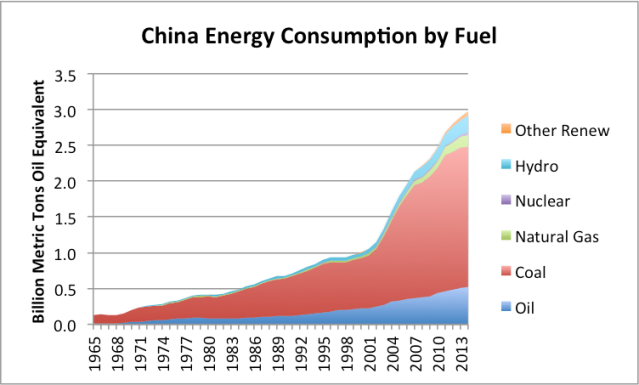
https://gailtheactuary.files.w...
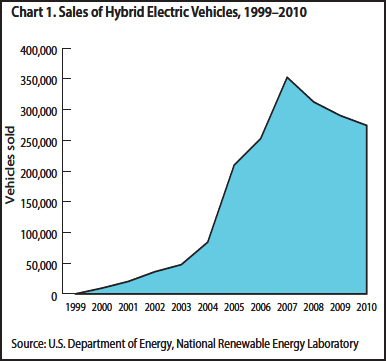
Electric cars are a harder sell:
http://www.bls.gov/green/elect...
And are contributing to much higher peak energy usage (some rapid chargers are 45KW or more).
However, their impact is limited. To get people to ditch ICE and go all EV, what would that take? We're talking replacing 75 million annual car sales into EV that are currently selling in the hundreds of thousands at best.
Even at TEN TIMES that rate, it will be decades before it makes a dent in total car ownership.
And total greenhouse gas emission of them isn't as large as you might think:
https://www3.epa.gov/climatech...
(Don't forget that "transportation" at 1/4 of total emissions includes support for industry which makes up another 1/4.) Assuming you cut car emissions and electricity emissions BY HALF over the next, what, century? That's only 25% of current emissions. Which takes us back to 1991 levels of emissions, roughly.
So by two major, radical changes in policy (energy production and transport), with millions of knock-on effects (how do you convince people to buy new EV cars?), and assuming quite good ratios of conversion, efficiency, discounting "cost", and investing decades of work, we might get back to where we were... two decades ago.
I'm literally googling this as I go, I'm not claiming it as gospel. But even TRYING to follow that path, I can't see the way out that would make any significant difference. Certainly not compared to, say, doubling the price of electricity or fuel by taxation, for instance.
Which is a paperwork exercise that can be reverted in a day.
-
Re:You keep saying that word...
We really are rapidly moving to the point where 5% of the earth's population can provide *all* the needed goods and services for the world.
5%? The numbers don't back up your claim, unless by "rapidly" you mean "still a few centuries away, if ever." We need a lot more than just agricultural workers to survive as a society, if that's what you're thinking. You're forgetting about the vast network of industries that support that and the other primary critical industries required for basic survival (food, water, shelter) and support society in general, like mining, transportation, construction, manufacturing, finance, education, health care, government, utilities...
-
40% distributed PV capacity is in CA
A few interesting points from the article:
1. Almost 40% of the distributed PV capacity in the U.S. is located in California. The next nine states after California account for another 44%, according to the EIA.
This is key because CA pays one of the highest kWh rates in the US (places like Hawaii are higher, but there aren't that many people there).
http://www.bls.gov/regions/wes...
San Francisco pays 40% higher energy prices on average than the rest of the US. So of COURSE solar makes more sense there. But it doesn't most other places.
California's leadership in distributed solar capacity is driven by a combination of factors, including high electricity prices, a large population, strong solar resources, and state policies and incentives that support solar PV, according to the EIA.
2. One of the factors spurring growth last year and this was the impending expiration of the U.S. government's solar investment tax credit (ITC). That measure, passed in 2008, offered a 30% tax credit for residential and business installations. It was due to expire this year, and the tax credit was supposed to drop to a more permanent 10%. In December, however, Congress passed a three-year extension on the 30% ITC.
So a crap load of tax dollars are propping this market up. It actually goes further than this. There are many state and Dept of Energy programs that further fix the rate of solar power to above market rates, to provide guaranteed returns for utility solar power.
http://energy.gov/public-servi...
Just a sample of some of the various programs to pay for solar and wind.3. The total operating solar PV capacity in the U.S. is expected to reach 25.6 gigawatts (billion watts or GW) of direct current (DC) by the end of the year, according to GTM Research's U.S. Solar Market Insight Report 2015 Year in Review. Last year, solar installations broke all previous records, but the amount was only 16% more than in 2014 with 7,260 GW of new DC solar power.
That sounds impressive, doesn't it? Well, consider this:
In 2014, the United States generated about 4,093 billion kilowatt hours of electricity.So the new DC solar power being installed is 7.2 billion out of 4,093 billion total. It is nice, but we could install that much every year for the next 20 years and it wouldn't make a real dent in the total.
-
Re:The kryptonite of slashdot groupthink
Fact of life, without unions workers are screwed, the last thirty years are proof positive of that. Lowering wages, reduced safety conditions, fired arbitrarily and jobs wiped out. Powerful unions pounded the crap out of corrupt politicians and corporations is what is required to clean the current mess up.
The US wages according to the graphs in this wiki have been stable for a long time: https://en.wikipedia.org/wiki/...
A non adjusted list: https://www.ssa.gov/OACT/COLA/...The number of incidents at work is continuously going down: http://www.bls.gov/iif/oshwc/o...
Powerful unions pounded the crap out of corrupt politicians and corporations is what is required to clean the current mess up.
I didn't say unions are bad but there are unions that are cash cows instead of a useful entity. I know of a few cases close to me where unions forced the collapse of companies or even the collapse of wages and benefits. When I see unions asking for 10% raises in the middle of a recession I call NON SENSE. When a union refuses to take the time to understand company financials while making demands I call NON SENSE.
The good unions out there are the ones that work WITH the companies to both further their interests. My father in law worked for a metal processing facility in Quebec (500 workers total). The workers opted to strike. The end result of the strike was many positions cut, salaries frozen for 5 years, removal of performance bonuses and removal of seniority as a criteria for promotions. The greed, miss information or lack of competence of the union was catastrophic for the workers.
Many countries in the EU have very good work conditions without the existence of unions. If it works there it should be able to work here.
-
Re:Yeeeeeahaaaaaw!
You're operating on a vacuum assumption in your own head without looking at the world around you. You go, "Oh, that doesn't make sense to me, so I'll make up bullshit and claim everything based on solid analysis and understanding is made-up bullshit."
Put up or shut up time: predict the next major recession. Right now. Can't? Hmmm.... So, with that out the way, you've made some other major assertions that many just don't agree with:
No, the cost-of-living hasn't gone down; the standard-of-living has gone up.
I'd say inflation has done a number on the median income and reduced disposable income to lower levels. So I suppose it's a good thing those toys cost less, because there is less to spend on them.
I already demonstrated that we're in a labor force participation rate bubble,
TBBA (Truth by Blatant Assertion) Merely pointing at a graph or mentioning various cherry picked statistics doesn't prove a bubble.
Let's not argue so much over *why* labor force participation suddenly grew. Let's ask another question: Why was it so low in 1970? Well, I can find as far back as 1947 at a glance, and the answer is it's always been that low.
Actually, let's do discuss it, because it's quite relevant. You see, in the late 60s, with women's lib and societal upheavel in the US and the rejection of the June Cleaver role, women actually demanded that they be treated as equals in society. Because of the aforementioned appliances etc, they had more free time and they not only went to work but stayed at work, developing careers as a normal activity. That increased the labor pool, it was not a bubble, but a raising of the available level. Now you can dispute that the pool got bigger or address the drop off since the peak, but you can't say the increase was a bubble as several fundamental shifts in society occurred to drive that effect. That would be like saying an asteroid only caused some minor temporary damage 65 million years ago.
Globalization started in the 19th century--some economists want to take this back further--with the reduction of shipping costs. That whole shipping textiles and spices and liquor around? That's outsource labor, pushing manufacture to cheaper labor markets.
Really? Try the 70s for when textiles really started losing business fast. You're seriously stretching there with ancient trade. That trade was for goods unique to production areas, not a move to replace domestic production with cheaper foreign production. It's a simple test really, was whatever was being brought in made domestically as well? No? Then it wasn't outsourcing.
At the same time, income per household has increased even as labor force participation decreased, which suggests the jobs we're gaining are higher-paying jobs.
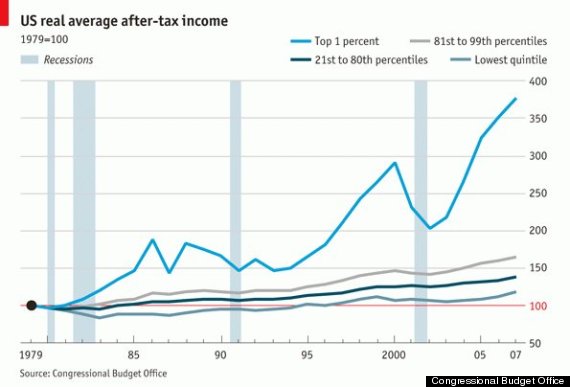
You might want to check your numbers as it is obvious that real median income has dropped since the 70s, with the exception of the last report, which still indicates that median income has dropped since 2000. Add to that that actual cost of living has increased....
First, we don't have a lowered median income.
TBBA - Several links from authoritative sources a
-
Re:IT Worker Shortage a Myth
sigh. not really. http://www.bls.gov/opub/mlr/20...
-
Re:Yeeeeeahaaaaaw!
In domestic economics, you actually create more local jobs by aggressively outsourcing, so long as your labor balance slides more slowly than your wealth. That is: If 50% of your employment is domestic and you save enough money outsourcing to create 10% more jobs, you have the *same* number of domestic employees if you end with 45.45% of your employment domestic and the rest outsourced. You start with 50 Chinese and 50 American workers, you eliminate 10 American jobs in favor of 10 Chinese jobs, and you get 40 and 60; along the way you find you can sell 10% more stuff, so you employ 10% more workers, and end up with 50 and 60--10 new Chinese jobs overall, more stuff being made for the same amount of money, and the 50 American workers are living a higher standard-of-living because they can buy more stuff since it's all cheaper.
I see you drank the koolaid.
So I take 10 high paying american jobs, outsource them for 50% cost overseas. Optimistically those 10 high paying american jobs become a combination of 10 mid to low-paying jobs. They're still employed! Yay! Because unless you can prove concretely that outsourcing any high paying job results in a new higher paying job being created, what you're doing is lowering the pool. Your own logic states this unequivocally in that products are cheaper because of lowered labor costs. That only worked while we were over-employed. That is no longer the case, with the total labor force shrinking every year since 2006. It's actually worse than that, if you go further back. Then you look at what an individual makes, and that has shrunk if you clip the top couple of percent. Yes, they make so much it skews the entire result set, but take the median 90 or so percent, and you'll see that real earning power has shrunk. The reason this hasn't had the major negative impact you'd assume is because the family unit has gone from 1 to 2 workers supporting the family in many cases, or people are co-habiting more and sharing costs. It's not the rosy picture you're painting for sure.
Obviously, if you start shoveling jobs out to China like crazy without creating new American jobs, this doesn't work. Historically, that's not how it's worked; it's not even how it works today.
It's the only way it's worked. Initially we shipped labor intensive work like textiles out. Then more expensive jobs that included things like EPA restrictions. As the manufacturing base overseas ramped up, it wasn't long before more and more of those higher paying middle class jobs all left, if they could. There were some initial jobs created to build up the infrastructure to support the imports, but once done that number shrank again and now there are fewer total jobs. And lets not forget that the imports don't pay into the federal tax pool, leaving that burden more heavily weighed on the populace, as the production base which used to pay taxes now doesn't.
-
Not Really 'CEOs': look at data
The statistical analysis in this article is absolutely appalling. First you are right that they are not comparing to real CEOs. If you look at the data they use for the CEOs this apparently includes local and state government managers and, even worse, primary/elementary and secondary/high schools by which I presume they mean the head teacher which I don't think anyone thinks off when you say 'CEO'.
If you just look at the "Management of Companies and Enterprises" category then the average wage amount increases significantly to $210,120 but as you note there is no mention anywhere in the article at all about bonuses and it specifically mentions "wages" so I doubt that this is in any way representative of the actual compensation a CEO gets while the article clearly states that they included all bonuses paid to university presidents. This is clearly an appalling abuse of statistics and so any conclusions the article draws cannot be trusted.
In fact the last time the university where I worked advertized for a president four faculty from Arts wrote a joint, open application for the job (which was shared with the local media) to protest against these ridiculously high presidential salaries. As they pointed out you could hire all four of them, give them each a very significant raise (IIRC 50%) and still save money over the out going president's salary and this way they would be able to do four times as much work. Needless to say they were not offered the job! -
Re:Supply and Demand
Despite Disney's actions, the future looks really bright for tech workers. For example, the Bureau of Labor Statistics says that for software developers, the job outlook is "much better than average." http://www.bls.gov/ooh/compute...
If your children are interested in tech, you'll be hurting their futures if you try to steer them into other professions.
There might be some parts of the country, such as Detroit, where the job outlook isn't great. But in most places, technical professions are very much in demand.
-
Inflation calculation
50% rise in eight years? That's only 1.5^0.125 = 5.2%/year. That's less than the rise in college tuition. For the extremes of the range, there is the ridiculously low CPI of 10% over eight years and the ridiculously high ShadowStats.com of 100% over eight years (view page source to see the hidden value). The geometric mean of those two extremes is sqrt(1.1*2.0)=48%.
Maybe 50% over eight years (5.2%/year) is in fact overstating actual inflation, but it's far from self-evident. By just stating the number and expecting people to be shocked, Mark O'Neill is, intentionally or not, advancing the wage-suppression-through-inflation scam.
-
Re:what a laugh
if you are going to make a statement like that ".no it's 23 percent" then cite the sources because it seems interesting that the number of 4.9 is today's number, the peak was somewhere around the 10-20's, depression era was in the 35-40's ( that's my number and will explain after the link ) http://www.bls.gov/news.releas...
when we cite the great depression, most people forget that a large percentage ( greater than 10% ) of the entire population shifted around for years, just doing whatever to get by. so those people never got counted. I can only say that my youth brought me in contact with many people from the depression and their stories. I'm looking at this from the male employment force. I can recall one story where during the lady's job interview, the lady said her husband had a job, and the employer said " a family with a job already, can't hire you"
-
Re:End anonymity for cash
The largest bill is now $100. This is equivalent to $10 in 1948 according to the CPI inflation indicator.
As time goes on, I doubt ( barring runaway inflation ), the US will print larger bills, so the $100 will become less and less.
During the Iraq war, the US airlifted $12 billion of $100 bills, which weighed in at 363 tons. This shows that cash is no longer useful for large transactions already.
As a side note: most of it was untracked, and melted away. I know of a distant relative who worded as contractor and returned home to Turkey with suitcases full of cash.
You're sure that wasn't his pay?
-
Re:End anonymity for cash
The largest bill is now $100. This is equivalent to $10 in 1948 according to the CPI inflation indicator. .
As time goes on, I doubt ( barring runaway inflation ), the US will print larger bills, so the $100 will become less and less.
During the Iraq war, the US airlifted $12 billion of $100 bills, which weighed in at 363 tons. This shows that cash is no longer useful for large transactions already.
As a side note: most of it was untracked, and melted away. I know of a distant relative who worded as contractor and returned home to Turkey with suitcases full of cash.
-
Re:An Oscar in the works?
It's possible that subtle racism is at work here (this year and last year); however, over the last 20 years, black actors and actresses have won 12.5% of Oscars, which actually does match pretty closely to demographics (~13% of the US is black). Since 2000, 80 actors have been nominated for best actor, and 10 have been black. Again, this matches demographics closely.
According to the Bureau of Labor Statistics, in the field of "Arts, design, entertainment, sports, and media occupations", 6.5% of workers are black (unfortunately, "actors" isn't split off by itself, as there aren't enough of them for the BLS to keep track separately). Since there are 20 actors nominated each year, you'd expect them to have 1.3 people nominated. Two years in a row of not having anyone nominated isn't that far off, and historically they're pretty much exactly tracking population demographics (which means that blacks, who are underrepresented in acting by population demographics, are actually slightly overrepresented in awards). If it happens again next year, then that might be evidence of racism, but so far it's not necessarily racism, although I'm not ruling it out. -
Half a million
. . . there is no such thing as a "software engineer".
There are half a million of these supposedly fictional beings. It may be time to get off the soap box.
-
Only 40% in USA work fulltime
131M out of 320M. Another 26M work less than 35 hours a week bringing all workers to 52%. 68M of the 320M are under 16 or over 65. Excluding them would make it 59% workers then. http://www.bls.gov/news.releas...
-
One of those actual teachers...
Thank you for your support of teachers. I've already reported and weighed in a few times about this subject, and I'd like to just expand on a few of your points.
Unfortunately, money speaks, and superintendents listen. When someone walks into a sup's office and says, "I'd like to donate $50,000 to the district to buy more technology," who would say no? And, on a national scale, if Zuck & Gates walk into the president's office to say, "We'd like to donate $1,000,000 to get more school districts to code," do you think Obama would be any different?
I do wish that we would just let labor markets let supply and demand naturally encourage or discourage people from entering and leaving the profession, as it happened a decade ago. While Microsoft claims that we aren't supplying enough computer programmers to meet demand, the BLS begs to differ. Salaries have grown at 1.5% annually between 2004-2012, barely keeping up with inflation. All the while, we continue to bring in more H1B visa applicants. If these companies -really- want more programmers, all they need to do is raise salaries. It sounds like they have plenty to spare. Not to mention repatriating all that money would go a long ways in increasing tax revenues to help states pay for their K-12 institutions.
-
Compare to Turbo Tax
First, it's sort of safe to say that Accounting and Lawyering are both based on extremely complicated sets of rules.
Turbo Tax effectively made reasonably complicated (up to small business filings) tax preparation accessible without directly needing an accountant.
How did Turbo Tax impact the accounting industry?
It would appear that it didn't really and that the number of accountants is predicted to rise over time into the future (faster than most other professions per the BLS link).
https://www.quora.com/How-did-...
http://www.bls.gov/ooh/busines...
So the answer is no. AI/computers will certainly augment the legal occupations, but replace lawyers? Nope.
-
Wait a minute...
Wait a minute...
USA right? 319 million people. 800 a month. 12 months a year.
(* 12 800 319e6) = 3,062,400,000,000.0 = over 3 trillion dollars.
https://en.wikipedia.org/wiki/United_States_federal_budget#Total_outlays_in_recent_budget_submissions shows the 2014 budget (most recent data) at 3.5 trillion.
I think I see a problem here...
Our employment/population ratio floats at around 60%. http://data.bls.gov/timeseries/LNS12300000
-
Re:Race to the bottom
in point of fact in 1980 when trade started with China there was massive unemployment and inflation in the USA. You could say we were on the path to poverty. Your turn, moron
The unemployment rate was 7.1% in 1980, which then rose and fell in waves. Unemployment is actually worse today than then, due to the way the government now skews its numbers. And, despite the inflation of the 1970s, salaries and wages did reasonably keep pace. Not like today where wages and salaries are pretty much flat. Try using actual facts instead of right-wing talking points. Also, kindly go fuck yourself in the ass with a rusty hand blender until you bleed to death. The world will be better without you in it.
-
Re:Eat truth!
Have you given up on the idea that women stayed at home 40 years ago because they needed to breastfeed?
By your definition are engineering firms also "state run" because their work is subject to inspection and their staff need to be licensed by the state? What about electrical contractors? Law firms? Food processing plants?
You do realize that affluent families throughout history have employed others to help raise their kids even though the mom "stayed at home", right? Nannies, boarding schools, maids, butlers, even slaves. Not so affluent families often used older siblings, grand parents, and other relatives.
But today is different right? Not so much. Only about 20% of children of employed mothers go to a day care center. About half them are taken care of by dad, grandparents, or some other relative.
http://www.census.gov/data/tab...
And these are the kids of Moms that work. Not included are kids of stay at home moms which represent almost 1/3 of the population. It appears that the idea that the state is raising our kids is pretty much BS.
Since you are a student of history, I'm sure you'll be interested to learn that it's also a myth that 40 years ago the majority of moms in the US did not work outside the home. I was surprised myself. In fact, back in 1967 only about 49% of moms were stay at home moms. That number did decrease into the 90's down to about 23% but by 2012 it had risen to 29%.
http://www.bls.gov/opub/mlr/20...
So again, neither your view of history, nor your view of current parenting trends appear to be correct. Do with that information what you will. -
Re:Stop Hazing UsUS trash collectors are actually 90% male. You don't hear a lot of complaining about that gender imbalance. By the same link, US high tech workers and managers are both roughly a quarter female which is much better than you claim.
Just covering your ears and going "la la la it's perfect" isn't really a solution.
Actually, it is. A key step you are missing here is a demonstration that there is a solution that we can take here which is better than doing nothing about the problem.
-
Plentiful? Unemployment worse than 80%
> Yeah, I would hate to live somewhere where jobs are plentiful
California ranks 41st for unemployment. 80% of the country is doing better.
http://www.bls.gov/web/laus/la...I suppose that if you're accustomed to the mess that California has been for 30 years, having more jobs than West Virginia seems "plentiful" in comparison. The simple fact is, few states have unemployment as bad as California does, even as California has "recovered" from third-world rates.
-
Re:If you don't like the textbooks,
What monumental earth shattering improvements have we made that have taken college from being a $5,000 a year investment to being instead a $25,000 a year investment in the last 20 years?
I have no idea if your numbers are correct, but even assuming they are, the cost has really "only" gone up 3.2x, not 5x as one would assume given those raw numbers.
Since, according to http://data.bls.gov/cgi-bin/cp..., $5000 inflation adjusted from 25 years ago is $7803.08.
-
Re:Not all H1B positions are equal
The H1-B program is not for local worker shortages "No good candidates in Silicon Valley", it's for NATIONAL shortages as in "No qualified workers in the United States".
I love this completely one-sided viewpoint so prevalent on \. First of all, a shortage doesn't mean none, it means fewer than able to meet demand. Second,
Then by definition you were not paying competitive rates.
In May 2012, the median annual wage for all workers was $34,750, and the median salary for a software developer was $93,350 per year! That's from the Bureau of Labor Statistics. I know it's popular on \. to not care about the ability of a company to start, grow, or even sustain itself...but when you have to pay 3x the average salary for labor, and unemployment rates are less than the national average, and companies are faced with either hiring incompetent workers or increasing their offer to 4x or 5x the national average (still not guaranteeing that they will be able to hire someone qualified), there is a shortage, and that is what the H1-B program is intended to address.
-
Re:I'm upset because it's divisive.
http://www.bls.gov/spotlight/2...
Stats only valid until 2010. A surprising number of women work in manufacturing jobs - and continued to do so even after WWII. They comprised a goodly portion of the textiles, clothing, and even footwear factory employees. The idea that all the women gave up their jobs is a myth. One of the reasons America was so prosperous is that there were jobs aplenty for both genders. Albeit, if you were black you were kind of out of luck when the soldiers came home. A whole shitton of women stayed working. Some left to start families and then returned the work force. Reality wasn't really like the television shows - Ms. Ball was actually employed even though it was certainly not something I'd call a manufacturing position. However, they've remained in factories since the dawn of the industrial revolution. Women and kids comprised a huge portion of the labor force in factories.
I'm not sure where the myth comes from that they all abandoned their jobs. They didn't even abandon them in droves. Add to that, it took years for the boys to come home, many being too disabled to work in factories, and the growth of the economy taking effect... Hell, my mother was employed. I don't really know that many women that abandoned the workforce entirely and many kept right on working in factories.
One area where they did lose ground was in larger build projects such as shipyards and weapons manufacturing. They remained in the aircraft industry but in lesser numbers as I recall. There are multiple documentaries on the subject if one is interested in learning something more than this strange myth. I honestly don't know where it comes from. That's not to say that there wasn't a drop in the participation in the labor force, just that it wasn't very drastic at all and most of them moved to other jobs instead of those necessary for war production. Those jobs are also inherently riskier and more difficult, physically. I can't blame them for going elsewhere. I don't think they were forced out (but this is conjecture) so much as they opted to go elsewhere because of ease, availability, and priorities.
-
Re:Productivity of office workers?
To go with the unemployment rate the participation rate, which is the base for the unemployment rate, has also been climbing.
Sorry, no. The labor participation rate has been in a steady decline since 2008. Almost like we're in a depression or something.
-
Re:Already knew this
And $14.10 for a pharmacy technician which is probably the person who actually fills out the paperwork 99% of the time.
-
Re:$10/hr minimum wage coming to Walmart
$10/hr is the minimum, not the average or median. Also, it's not much below median individual income in a lot of "flyover country". E.g. in Mississippi, the median hourly wage is $13.76/hr ( http://www.bls.gov/oes/current... ). A bunch of states have below $15/hr. It's not too surprising that Walmart clocks in below that. In short, "slave/subsistence wages" are very common in "flyover country". The anecdotes about your friends are out of date. That's not a good thing, but it is what it is, and it's not Walmart's fault.
Speaking as a grad student who makes the equivalent of $10-$11/hr in a place with a higher cost of living than "flyover country", it's not "subsistence" wages. (Although I do get good benefits and don't have children.)
-
Re:Neat!
No, corporations aren't going to work on these things for 43,75 USD/hour.
As you can see by the screenshots they provide, the average winning rate is 171 USD/hour, which does add up with the data from BLS.gov, since you have to account for benefits and a lot of the overhead, plus, they're looking for senior people, after all.
-
Re:Highest Profit
So you want police to use less effective tactic to even out the statistics?
No, I want the police to only use deadly force as a last resort.
In 2012 that I linked yes, the number killed by accidents was lower than direct assaults. However, check some other years. For example 2013 where it's 40 accidental deaths out of 119 deaths total and 38 of them due to targeted violence (or 39 if you include a bomb).
My point is still that targeted violence is not the majority of deaths of police officers. Every police officer killed in the line of duty is a tragedy, but quite frankly it's not as big of a risk as the news makes it out to be. Surely one would expect that the police doing their job would expose them to a higher risk of violence just as one would expect firefighters to have a greater risk of dying due to fire. For reference, the general working population has a rate of fatal work injuries of 3.3 fatalities per 100,000 full-time equivalent workers. Of that 9% is due to homicides (robbers being the highest category of perpetrator).
http://stats.bls.gov/iif/oshwc...Also, the risk of being murdered on the job may be ever present for police, but they aren't actually the profession with the most intentional shooting deaths:
http://stats.bls.gov/iif/oshwc...
According to this total police officer intentional shooting deaths in 2014 was 39. First-line supervisors of retail sales workers totaled 41.I guess you don't have a family. Most cops want to do their jobs and get home to their families.
I do have a wife (no kids yet). Most people in general want to do their jobs and get home to their families. However some people choose jobs that ask them to risk their own safety for the benefit of society. The police are not alone in that regard. I'm sure most members of the military would prefer to not be asked to do peacekeeping missions in countries overseas, but they do it anyway out of a sense of duty and commitment. I don't see how police are any different except the people they are protecting are in their own community.
As for myself, I accept a certain amount of risk in the course of doing my job. And if there is ever a situation where I might be able to risk my life to save someone else's I like to think that I would take that risk. Of course you never really know how strong your character is until the situation arises. I can
t say for sure what character the officer who stepped out of a still moving car and shot a 12 year old with no verbal warning had... Probably doesn't say much that the first two officers on the scene didn't provide any first aid. -
Re:Highest Profit
So you want police to use less effective tactic to even out the statistics?
No, I want the police to only use deadly force as a last resort.
In 2012 that I linked yes, the number killed by accidents was lower than direct assaults. However, check some other years. For example 2013 where it's 40 accidental deaths out of 119 deaths total and 38 of them due to targeted violence (or 39 if you include a bomb).
My point is still that targeted violence is not the majority of deaths of police officers. Every police officer killed in the line of duty is a tragedy, but quite frankly it's not as big of a risk as the news makes it out to be. Surely one would expect that the police doing their job would expose them to a higher risk of violence just as one would expect firefighters to have a greater risk of dying due to fire. For reference, the general working population has a rate of fatal work injuries of 3.3 fatalities per 100,000 full-time equivalent workers. Of that 9% is due to homicides (robbers being the highest category of perpetrator).
http://stats.bls.gov/iif/oshwc...Also, the risk of being murdered on the job may be ever present for police, but they aren't actually the profession with the most intentional shooting deaths:
http://stats.bls.gov/iif/oshwc...
According to this total police officer intentional shooting deaths in 2014 was 39. First-line supervisors of retail sales workers totaled 41.I guess you don't have a family. Most cops want to do their jobs and get home to their families.
I do have a wife (no kids yet). Most people in general want to do their jobs and get home to their families. However some people choose jobs that ask them to risk their own safety for the benefit of society. The police are not alone in that regard. I'm sure most members of the military would prefer to not be asked to do peacekeeping missions in countries overseas, but they do it anyway out of a sense of duty and commitment. I don't see how police are any different except the people they are protecting are in their own community.
As for myself, I accept a certain amount of risk in the course of doing my job. And if there is ever a situation where I might be able to risk my life to save someone else's I like to think that I would take that risk. Of course you never really know how strong your character is until the situation arises. I can
t say for sure what character the officer who stepped out of a still moving car and shot a 12 year old with no verbal warning had... Probably doesn't say much that the first two officers on the scene didn't provide any first aid. -
Re:*Holds up hand...*
They now have pretty much all their publications on line.
http://www.bls.gov/opub/Don't forget, Gordon Crovitz notwithstanding, the government really did invent the Internet. http://articles.latimes.com/20...
-
Re:*Holds up hand...*
So why, exactly, does the DoL have 5-tray DVD burners in the first place?
The DoL publishes a shitload of documents. They used to publish it all on paper. Now they publish it on the Internet, but at one time they could presumably save a lot of money if they published it on DVDs. If you want a report of every workplace fatality in the US in 2005, that's a lot of paper that you could fit on 1 DVD.
http://www.bls.gov/opub/
http://www.dol.gov/ebsa/public...
https://www.osha.gov/(But that's assuming the DoL did have 5-tray DVD burners. The article just says that the guy used 5-tray DVD burners. It doesn't say that he used the DoL's 5-tray DVD burners.)
-
Barriers To Entry.
But this was also true if you put a 15 year old -- or a 10 year old -- in front of a 1987 Macintosh.
Given the unlikely chance that his family could afford one ---
In October 1984, Apple introduced the Macintosh 512K, with quadruple the memory of the original, at a price of US $3,195.
$7,338, adjusted for inflation.
Apple released the Macintosh Plus on January 10, 1986, for a price of US$ 2,600.
$5,661, adjusted for inflation.
It offered one megabyte of RAM, easily expandable to four megabytes by the use of socketed RAM boards. It also featured a SCSI parallel interface, allowing up to seven peripherals---such as hard drives and scanners---to be attached to the machine. Its floppy drive was increased to an 800 kB capacity. The Mac Plus was an immediate success and remained in production, unchanged, until October 15, 1990; on sale for just over four years and ten months, it was the longest-lived Macintosh in Apple's history.
In September 1986, Apple introduced the Macintosh Programmer's Workshop, or MPW, an application that allowed software developers to create software for Macintosh on Macintosh, rather than cross compiling from a Lisa.
This is another way of saying that the barriers to entry for an MS-DOS developer were low.
In August 1987, Apple unveiled HyperCard and MultiFinder, which added cooperative multitasking to the Macintosh. Apple began bundling both with every Macintosh.
Updated Motorola CPUs made a faster machine possible, and in 1987 Apple took advantage of the new Motorola technology and introduced the Macintosh II at $5500, powered by a 16 MHz Motorola 68020 processor.
$11,554. adjusted for inflation.
The primary improvement in the Macintosh II was Color QuickDraw in ROM, a color version of the graphics language which was the heart of the machine.
Macintosh. CPI Inflation Calculator
To understand the significance of Windows 95, you only have to sense the emotions inspired by the rediscovery of the videos which shipped with Win 95. Edie Brickell - Good Times
This was not Charlie Chaplin. This was not "1984."
But, for hundreds of millions of quite ordinary people, this was their introduction to multimedia, the PC and the Internet.
-
Re:That's all that consumer-oriented businesses do
Those are the only stable [state sponsored] monopolies that exist, because economic forces by themselves don't support stable monopolies.
I would hold those are no more or less stable than anything else. Once the state removes support, they're gone.
Microsoft and Intel never were dominant OS or CPU suppliers, they just supplied much of the desktop equipment. Even there, they were merely dominant, with alternatives always available. And even that dominance pretty much ended on its own after about a decade.
Are you serious? (My turn)
Microsoft was the de facto desktop operating system from at least 97 through about 2010. Yes, you could buy a mac in there which almost no one did, or if you had particular masochistic streak load one of 50K different Linux distros, which even fewer did. I'd call that a monopoly, as there were no other real choices if you wanted to interact with the world at large. That's almost 15 years of exclusivity, and even today, most would say MS has a lock on the desktop, other than macs. What has changed is their stranglehold on Office documents, which now need to be viewable on several other platforms, as mobile has upturned that lock in. So we're talking 2 decades, and the only real competitor at this point is Apple on the desktop. Linux, however, is always poised to make serious inroads, if it could ever gain enough traction. Maybe Win10 will provide it.
Meanwhile in desktop PCs Intel with their relatively poor x86 architecture has pretty much killed AMD (only kept alive by their graphics cards at this point, IMHO) and has killed off a whole host of others CPUs: MIPS, Alpha, PowerPC, Sparc (barely kicking) and a lot of others. This even goes to servers with IBM now selling Intel mainframes.
Standard Oil is pretty much the same.
Standard Oil was broken up by the government and yet it's various left over parts were all controlled by John D Rockefeller for the rest of his days until his heirs sold off pieces, slowly, over many decades.
None of the examples you give are examples of actual, stable monopolies; they are mostly examples of companies that achieved temporary success in a rapidly expanding market before competitors have had the time to move in.
20 years and still going isn't stable? Name a viable competitor to Intel and Microsoft on the desktop. Standard Oil had viable competitors for roughly 100 years? In the mobile device arena, the marketplace is still roiling, but Apple and Samsung appear to be the 2 that will emerge with the lions share of the market, with Samsung struggling to make a profit.
That is self reported, by people with jobs. [...] I think the people in Syria for one, might disagree.
So, you are seriously taking the position that the world is economically worse off than it was 100 years ago? That free markets and free trade have made life worse for the vast majority of people on this planet? That's the economic equivalent of believing in the flat earth.
I'd say the Industrial and Technological Revolutions have made huge indisputable improvements in life quality. Trade has certainly bettered things and allowed for faster improvements. Free trade? Make your case. It has certainly siphoned jobs out of the US, which it is now admitted it was designed to do. Saying but but but, those are low-wage jobs doesn't help those displaced. Saying they can train for higher quality jobs doesn't make more of those appear. Note that the net employment (percentage of employable people) in the US actually working is at it's lowest level since 1984. You'll note that as we were coming out of the 1987-1994 recession, jobs were returning back to their previous growth path and level. Then, miraculously, as we're growing GDP, we have numerous dips as the employment hits a peak several times bef
-
Re:Wrong. This isn't enough.
"poor families to not have to work all of the time"... Do you include the tens of millions of families which have parents who never work, and are on government assistance?
Tens of millions? Not even close, according to the Bureau of Labor Statics:
"The number of families with at least one member unemployed decreased to 6.5 million in 2014 from 7.7 million in 2013."
"In 2014, about 43 percent of all families included children under age 18."
"Among the 34.4 million families with children, 88.7 percent had at least one employed parent in 2014."
"Mothers with younger children are less likely to be in the labor force than mothers with older children. In 2014, the labor force participation rate of mothers with children under 6 years old (64.2 percent) was lower than the rate of those whose youngest child was 6 to 17 years old (74.7 percent). . . . However, the unemployment rate for married mothers of infants, at 4.1 percent, was considerably lower than the rate for mothers with other marital statuses, at 15.6 percent. "
-
Re:easy now...
1820 hours are per year but not per person. A hunter would catch a prey which would feed many tribe members (depending on the animal's weight).
First off, they hunted in groups. One person didn't go out with a spear to fetch the tribe dinner.
Second, the 4.8 hours per person per day statistic is the current scientific conjecture. That's not "some people, when they worked, worked 4.8 hours per day"; that's "we believe each person put forth an effort of 4.8 hours of working time per day."
749K farmers don't work solo, they have other people working with/for them.
Try agricultural workers. 749,400 agricultural workers in the United States in 2012.
You raise a point, and I've done more digging. Farmers, ranchers, and other agricultural managers...
Let's take your numbers. Produces 9-22 hours per person per YEAR.
I'm not sure about your other numbers (citation needed)
Population of the US: 318.9 million (2014).
Exports seem to vary (31% of soy versus 62% of soy, depending on who you ask?).
There's production numbers. Looks like cotton and vegetables don't outweigh corn; the USDA estimates the US exports over 20% of its corn production, but Wikipedia estimates about 15%. USDA suggests 30% of wheat exported, while FAO suggests average grain export (wheat export) fluctuates between 52% and 63% per year. I just took the chart Google gave me on the first search.
Taking the low numbers, we can raise my estimates by a further 50%. Somewhere between 15 and 33 hours per person per year of working time invested in the production of food per year.
So we're not talking about each individual human working 1,815 fewer hours each year to feed itself; we're talking about each individual human working 1,800 fewer hours per each year to feed itself. I was off a little, I guess. Across 320 million humans in the US, that's only 576 billion hours per year saved; across the 1.2 billion in developed countries, it's 2.16 trillion working hours not spent on producing food.
The sheer power of my shrug at a rounding error can move the sun.
-
Re:easy now...
1820 hours are per year but not per person. A hunter would catch a prey which would feed many tribe members (depending on the animal's weight).
First off, they hunted in groups. One person didn't go out with a spear to fetch the tribe dinner.
Second, the 4.8 hours per person per day statistic is the current scientific conjecture. That's not "some people, when they worked, worked 4.8 hours per day"; that's "we believe each person put forth an effort of 4.8 hours of working time per day."
749K farmers don't work solo, they have other people working with/for them.
Try agricultural workers. 749,400 agricultural workers in the United States in 2012.
You raise a point, and I've done more digging. Farmers, ranchers, and other agricultural managers...
Let's take your numbers. Produces 9-22 hours per person per YEAR.
I'm not sure about your other numbers (citation needed)
Population of the US: 318.9 million (2014).
Exports seem to vary (31% of soy versus 62% of soy, depending on who you ask?).
There's production numbers. Looks like cotton and vegetables don't outweigh corn; the USDA estimates the US exports over 20% of its corn production, but Wikipedia estimates about 15%. USDA suggests 30% of wheat exported, while FAO suggests average grain export (wheat export) fluctuates between 52% and 63% per year. I just took the chart Google gave me on the first search.
Taking the low numbers, we can raise my estimates by a further 50%. Somewhere between 15 and 33 hours per person per year of working time invested in the production of food per year.
So we're not talking about each individual human working 1,815 fewer hours each year to feed itself; we're talking about each individual human working 1,800 fewer hours per each year to feed itself. I was off a little, I guess. Across 320 million humans in the US, that's only 576 billion hours per year saved; across the 1.2 billion in developed countries, it's 2.16 trillion working hours not spent on producing food.
The sheer power of my shrug at a rounding error can move the sun.
-
Protect and serve
I don't think this is realistic. You really can't blame people for wanting to protect their own lives.
Sure I can. They signed up voluntarily for the duty. "Protect and serve". That means it is their job to get in harms way when necessary to protect the community and enforce the laws. I'm not saying they have to be stupid about it but their job should be to protect others first.
People who choose to sacrifice themselves for others are lauded because what they've done is extraordinary, heroic, above and beyond what can reasonably be expected. You're saying that we should expect extraordinary heroism.
No. What we should expect police to not behave like they are in a war zone. What we should expect is for them to actually try to save the lives of others. We expect them to behave like they belong in civilized society and not brutalize the people they are supposed to protect.
If you demand that police de-prioritize their own safety, they won't last long because their job does regularly place them in dangerous situations
Police work is demonstrably not as dangerous as many other professions. Jobs that are more dangerous incude: Truck driver, farming, construction worker, airline pilot, taxicab drivers, timber cutters, roofers, fishermen, structural metal workers and electricians. All of those professions have higher fatality rates than police officers. Injuries? Cops don't even make the list. While nobody would argue that police work doesn't have risk, the risks are overblown and in many cases caused by the very actions of the police themselves.
I'm not making that fatuous old claim that being a police officer is an extraordinarily dangerous job -- but the only reason it isn't extraordinarily dangerous is because officers are allowed to put their own safety first.
It's only extraordinarily dangerous if they are stupid about it. Gearing up like they are going to war is tantamount to picking a fight with their community. Their own actions are provocative and puts them in greater danger. Nobody is asking them to jump in front of a bullet. Use of force by police in the US is WAY higher than in other parts of the world. They use force because they can, not because they have to.
-
Not according to the BLS
The unemployment rate in Seattle is about 3%
Not according to the BLS; they say it's 50% higher than that (Seattle-Tacoma-Bellevue, WA Metropolitan Statistical Area: 4.5%):
http://www.bls.gov/web/metro/l...Of course, those numbers are also deflate, due to people falling off the eligibility rolls:
http://www.forbes.com/fdc/welc... -
Re:STEM OPT extension was really bad
That is not true. The government determines the unemployment rate via a household survey, not via the number of people collecting unemployment checks. You may not believe the BLS because it sounds as if you have an axe to grind, but here's their explanation of how they do it.