Slashdot Mirror
Domain: carleton.ca
Stories and comments across the archive that link to carleton.ca.
Comments · 131
-
Re:Windows 10 Compromised by Default
Are you trying to say that users should not be allowed to vote for the features they want
No, I'm using vote tallying rules as an example of systems which we can manipulate, e.g. by adding candidates and adjusting campaign strategy. The point of adding candidate C isn't for C to win; it's to make candidate B lose so candidate A wins.
Systems aren't built to be insecure; they just get that way, mainly by negligence. Diligence still produces insecure systems, but the flaws are harder to find, less frequent, and often difficult or impossible to exploit for controlled outcomes.
I can design a more-secure OS; implementing it is doable, but somewhat complex; and then your application software has to implement capabilities models for the OS to apply because it can't know what any given software should and should not do (e.g. Gimp should not attempt to read Firefox's password database).
if there is a feature that most people use but which you have not used in a (sufficiently) long time, then the OS should ask you if it can remove that feature from the application. (Or applications, if it is a feature used by many of them.)
The application would need to expose information about that application code and feature. If it's not used, the code path isn't activated; but then, the code path could be activated by it being loaded, so it looks like it's in use. Each bit of code not used is never executed, but how often do you use the cosine function in JavaScript? You can't really track all that effectively, or know if you're removing a critical component.
In short: all of that has to be managed by the application itself, as the OS doesn't know anything about how applications actually work.
Folks have explored other methods of behavioral analysis.
-
Re:You can do that anyway...
Either you're a liar or an idiot. I'm not sure which, but there's a reason why The FIRE exists and there have been multiple court cases on this across the US. Here's an example from my own back yard. And the "micro aggression" crowd going after people for "cultural appropriation" and yoga mats. Now we can get into the UK the US, and some more of the US. And one can really keep going. FYI west coast universities, and universities in Southern Ontario are the worst in North America right now for this garbage.
Bonus article, about students in favor of banning free speech in the UK to protect feelings.
-
Re:Who thinks up these names?
"Perfect Forward Secrecy" is a standard term in cryptography. It seems to have been introduced by Diffie, van Oorschot, and Weiner in their paper Authentication and Autheticated Key Exchanges.
The description of Perfect Forward Secrecy in the summary seems pretty confused. A cryptographic protocol has perfect forward secrecy if the only long-term key pair is used solely for authentication; that is to protect against man in the middle attacks and the like. Since you can't perform a man in the middle attack once the message has been transmitted, this means that compromise of the private key only jeopardizes future communications. In contrast, if a service uses RSA or ElGamal in the usual manner, then once the private key is compromised (e.g. via a Heartbleed like vulnerability), then all messages ever transmitted can be decrypted using this private key.
-
A co-author's thoughts
Hello. I'm one of the co-authors of the workshop paper that inspired this article. I say "inspired" because the article is completely misleading.
First off, the paper was a position paper. It was primarily speculation about how we could do authentication in the future. The idea behind it was that humans are bad at remembering very specific facts but are very good at remembering stories - narratives. What would it mean to authenticate using stories? Think about how you'd verify the identity of a friend communicating via text message from an unknown phone number or account. Make a computer do that.
And yes, fully developed such a system would be AI-complete. But I think there are lesser incarnations that might be usable and secure. But that is just educated speculation on my part.
Now the paper did present a simple example of how you could do something kinda-narrative-like using text adventures (yes, think Zork). Such a system isn't discussed in more detail because there are many usability challenges. But it can be done. Carson Brown got his Master's thesis in fact by by building such a system. (Yes, I was his advisor.)
If anyone wants to build a PAM module based on Inform 7 drop me a line. Could be fun! But it won't be practical.
If you want to learn more, the paper is "Towards narrative authentication, or, against boring authentication.". The workshop in question is the New Security Paradigms Workshop.
And in case you were wondering, none of us are doing any follow-up work on this right now. But I'm always open to collaboration opportunities.
--Anil Somayaji
-
Re:Get a degree
"There's no such thing as a degree in "IT""
Actually...
Bachelors in IT: http://www1.carleton.ca/admissions/programs/bachelor-of-information-technology/
But I do agree with you on a lot of what you say. I especially like "Someone who works with computer and/or network technology but isn't specialized and/or skilled enough to be called an Engineer". A lot of IT support folks need to realize they're really just blue collar folks supporting a white collared world. Not that there's anything wrong with that by any means - it's just the nature of what it is.
-
Re:The only feasible explanation...
Are you the PrecambrianRabbit who's writing this thesis, per chance?
-
Re:Useful to whom? The racists who care about skin
During the Kennedy administration, the Republican minority in Congress introduced many bills to protect the constitutional rights of blacks, including a comprehensive new civil rights bill. In February 1963, to head off a return by most blacks to the party of Lincoln, Kennedy abruptly decided to submit to Congress a new civil rights bill.
Wow. You're guzzling the GOP Kool-Aid pretty hard -- mainlining it right from The Washington Times, apparently. That's at least a two letter grade reduction for plagiarism. Really, you could at least bother to re-phrase the Republican whining points in your own words.
As for the facts of the matter, JFK was pushing for a meaningful civil rights bill in the Senate in 1960. The idea that he "abruptly" discovered the issue is nonsense. Not to say that there weren't some progressive Republicans who favored civil rights -- I'll certainly give a nod to Eisenhower on that.
Though he shared Johnson's convictions on safeguarding the constitutional rights of blacks, if Nixon had been in the White House...
Just so long as they didn't breed with whites, that is. According to Tricky Dick, "There are times when an abortion is necessary. I know that. When you have a black and a white. Or a rape."
Socialism, Communism, Fascism, and Progressiveism are all on the extreme end of the scale ranging from anarchy at one extreme to total government control on the other.
No, they aren't. Anarchists are socialist, as one of the links I've already provided to you explains. And lumping Progressives like Teddy Roosevelt in with fascists is just silly.
"Make those rich people PAY! It's not FAIR that they have money and you don't!", never minding that the rich person got that way by working hard, being smart
No. That's the fantasy. One accumulates vast wealth by a combination of being born into it, by gaming the system, by exploitation, or by luck. Very, very rarely does a person become truly wealthy by talent and hard work.
Bill Gates? Born with a silver spoon, rode IBM's coattails, used criminal business practices and used government-issued copyrights and patent to rake it in. Warren Buffet? Son of a Congressman, got rich not from producing useful goods or services but made his wealth in the form of gambling called the stock market. Carlos Slim Helú? Gamed the deregulation of the Mexican telephone system to end up in control in 90% of its landlines, so that his company can charge some of the highest usage fees in the world.
Meanwhile, the investment class sucks its profit out of the labor of the people who actually do the productive work. The worker creates all the value, the bank, the bondholder, and the stockholder create none -- yet they not only get a cut -- indeed, often the lion's share -- of the value the worker creates, but we set our economic policy for their benefit.
We still live in the most-free (as an overall measure) nation on the planet with the highest standard of living of any other nation, ever.
No, we don't. It's a great nation -- hey, we taught the world to rock and roll, and whose bootprints are on the moon? -- but it's not as great as those wearing the flag as a blindfold like to pretend. We have the highest rate of incarceration on the planet. We rank 13th on the human development index, and are well down from the top in the CIFP rights rankings.
The progress we have made, though, is entirely because of those who l
-
Re:IPV6 is fatally broke
An IPv6-only system can communicate with IPv4-only hosts, using the tunneling mechanism described by the RFCs. Example diagram. Note that the IPv6 machine on the IPv6 network doesn't have to handle the tunneling. So there's no reason why an ISP couldn't deploy IPv6 to customers, and provide DSTM tunneling for them to use to reach legacy IPv4-only systems.
The issue of IPv4 over IPv6 was dealt with years ago, so that IPv6-only backbone connections could be deployed without eating further into the IPv4 address space.
-
Some History
I know there's been a lot of dialogue between the authors of SOMA, which predates this, and the Mozilla team; it might provide some interesting context.
-
Re:It's CUSA - business as usual
There's another group - the engineering society, which runs its own parallel student government (http://cses.carleton.ca) so they can have as little to do with CUSA and the rest of the idiocy that passes as "student government" at Carleton.
-
Re:Apathy trumps price for most users
It's one part of the degree program, yes.
And if you're suggesting it's easy, bear in mind my current draft is pushing 150 pages. This is a properly controlled empirical study, vetted by the university's ethics committee. There's nothing pedestrian about it.
If you're curious, you can read more about the program at the program's webpage.
-
More detailed story
You can see a story with more details at http://www.charlatan.ca/index.php?option=com_content&task=view&id=20410&Itemid=148 . He put a keylogger on a random e-Kiosk PC in one of the campus buildings. These PCs provide 20 minutes of web access per login so that students can check e-mails/surf the web briefly. There's nothing white-hat about this, unless it was done in a proof-of-concept manner, but he _DID_ collect user information. The login/password combos he would have keylogged let a student into the myCarleton portal (http://connect.carleton.ca), which is just a glorified front-end for their email. All student account information (awards, fees, course registration) is held on a separate server, http://central.carleton.ca./ This becomes a more serious problem, since once you enter into the "secure" myCarleton portal, you can click a tab called 'Carleton Central', which bypasses your need to use a separate login to view your student account information. They have purposely removed a level of security for convenience to the lemmings. As for the campus card data, I've never put my campus card through a card reader, but all campus card transactions are approved via a centralized server somewhere. Again, not sure what this kid was trying to prove, but if all he wanted to demonstrate was that he could sniff campus card data, again he overstepped his boundaries. He sent everything anonymously to Carleton Administration and the students whose data was compromised, but this was also where he tripped up, "his account log-in was embedded in the electronic document he sent out" from http://www.cbc.ca/canada/ottawa/story/2008/09/11/ot-carleton-080911.html . If you google this persons name, he is rather involved in the Gentoo Security mailing lists.
-
Re:Yes !!
See, I would agree with this under most other circumstances... but this is a frickin' university. Which is supposed to be a paradigm of learning. Carleton is supposed to be well-known for it's computer science programs. In fact, it's MY university. It's an embarrassment that this hack, no matter how non-trivial, can't be taken in good humour, or that it's possible at all. Although, if the same people who designed our website (with it's crap-load of out of date class related material and web pages), then I wouldn't be that surprised.
I'll do some investigating myself on campus. In a day or so, I'll post a follow up in my journal here on slashdot, for anyone interested. I had never even heard about this until I read it this morning, here.
-
Re:Wake up please.
"No, technically he did the wrong thing by breaking into the network. This isn't complicated."
Yes, but it is worse than that. It is almost a certainty that he broke the terms which he AGREED to abide by when he signed up for a user account on the university system. Most universities have pretty specific policies about attempting to access systems when you do not have permission. Carleton is no exception. Even if it wasn't illegal, he'd still be breaking university rules.
That being said, if I was in the relevant university administration, I'd send his case straight to the academic discipline committee on those grounds (because he DID break the rules), but leave a formal legal case out of it. Just because you can pursue a legal case doesn't mean it is in the interests of the student or the university to do so.
This student apparently had the right idea in mind, but went about it in completely the wrong way, and did not think about the implications of breaking rules they had already accepted. It was a stupid mistake. That deserves some kind of strong penalty, but not as severe as (potentially) a criminal record, because intent does matter and those 16 pages demonstrate it fairly well.
There is a tricky balance to be struck here. You don't want to encourage students to be probing for security flaws, but, on the other hand, you do want them to be able to tell you if they've accidentally stumbled across them.
-
Re:Software Viri too?
So are software viruses alive too?
Obligatory link to an old paper: Eugene H. Spafford. Computer viruses as artificial life. Artificial Life, 1(3):249-265, 1994.
The short answer is "no," but it makes for an interesting read if you have some whiskey to drink while you're reading it.
-
Re:religion
Assuming it's all true, well done sir.
Thanks. The "assuming it's true" is clearly just "rigorous in scientific caution" rather than an active challenge, but I'll be "rigorous" in return backing up my post for you and for anyone who may have been actively skeptical.
I think I read most of the stuff about the foraminifera evolutionary record a long time ago in dead-tree format, but I googled a couple of links to back up the general issue. Ok, I probably went overboard on the links... oh well
PhD Paul Pearson writes:
In The Origin of Species, Charles Darwin lamented that the imperfection of the fossil record detracts from the glory of geology. Fossilization is such a rare and capricious event, our collections are so poor, and sedimentary formations are so full of gaps, that Darwin could not point to a single example where fossils in successive geological strata showed evolution from one species to another.
Unknown to Darwin, uninterrupted sedimentation does occur in the open ocean, especially on aseismic ridges and plateaux. These areas experience a continuous rain of particles to the sea bed, and are among the most geologically quiescent places on Earth. A steady build-up of sediment is the result.
Now, after thirty years of systematic ocean drilling, many of these sites can be studied. Piston coring generally allows hundreds of meters of sediment to be fully recovered, spanning millions of years of deposition. Where gaps occur, they can easily be identified.
[]
The sediments in question are composed mainly of the shells of microscopic plankton such as foraminifera, radiolaria, diatoms and coccolithophorids. Large numbers of individuals can easily be extracted. Their evolution can be followed through geological time, simply by comparing one closely spaced sample with the next.
In describing his work in non-linear dynamics in evolution, PhD Timothy Patterson comments:
Due to their exceptional fossil record, planktic foraminifera are ideal for studies of evolutionary processes.
PhD student Nadia Al-Sabouni
Institute of Micropalaeontology
Biodiversity and evolution of planktonic foraminifera
Google cache of missing PDF:
Planktonic foraminifera have the best fossil record of all organisms, spanning the
last 150 million years. Owing to the completeness and continuity of their fossil
record, planktonic foraminifera can be used as model organisms to study patterns
of evolution at time scales that are not replicable under laboratory conditions.
A science paper from 40 years ago:
Rates of Evolution in Some Cenozoic Planktonic Foraminifera
William A. Berggren
Micropaleontology, Vol. 15, No. 3 (Jul., 1969), pp. 351-365
doi:10.2307/1484931
Link to first page
I'd copy/paste the Introduction first two paragraphs, but it's a jpeg scan of the text. Click and read.
Testing the Molecular Clock Using the Best Fossil Record: Case Studies from the Planktic Foraminifera
multiple authors
Abstract near bottom of this page
Since many major groups (e.g. birds, mammals, reptiles) have a poor fossil record, it is often difficult to test and refute these limitations. Planktic foraminifera represent an exception to this rule. Deep-sea sediments are super-abundant in foraminifera, and large numbers of specimens and occurrences are easily garnered from Ocean Drilling Programme cores. Planktic foraminifera therefore represent an ideal model group with w -
Intellectual Property (IP) is a Two-Way StreetIntellectual property (IP) is a 2-way street. The news article mentions that Carleton University is teaching its students to protect their IP.
However, the students should also be taught to respect IP. Respecting IP means to not steal another person's IP.
About 10% of Carleton University's student is foreign students. 25% of the foreign students are Chinese students, and China has one of the highest rates of stealing IP. Indeed, vendors openly sell pirated movies on the streets of Hong Kong -- right in front of the police, who do nothing.
-
What about specialization?
I've been looking at this program.. I believe it's a Bachelor of Computer Science with a focus towards game programming. Would that be a good bet if I wanted to go into game development? http://www.scs.carleton.ca/school/streams/index.p
h p?streams=game_0002 -
Re:Dr Tim Patterson a kook?
It is possible for something to be correlated on short timescales, but not correlated on longer timescales.
Going from a correlation to a causation is not trivial, but Patterson seems very confused about this.
Note that even in his own department, Patterson is controversial.
-
Stack machines - again?
Who can forget the English Electric Leo-Marconi KDF9, the British stack machine from 1960. That, and the Burroughs 5000, were where it all began.
Stack machines are simple and straightforward to build, but are hard to accelerate or optimize. Classically, there's a bottleneck at the top of the stack; everything has to go through there. With register machines, low-level concurrency is easier. There's been very little work on superscalar stack machines. This student paper from Berkeley is one of the few efforts.
It's nice that you can build a Forth machine with about 4000 gates, but who cares today? It would have made more sense in the vacuum tube era.
-
Re:It's not just the patent...
Well, I agree with you completely on this, but unfortunately this is not the way schools like this seem to work. I have recently realized that they do not see students as customers, which is counter-intuitive, since any other business in the service industry would either respect its customers, or lose their business.
I guess it doesn't work this way for universities, or they just don't care because they are large institutions.
As for the school, since I my patience has been tested to the limit, and since I do not have much time left to finish my degree so I have to suffer for another 8 months (after which I will not be returning for any graduate studies at this school for sure), it is Carleton University.
Some people did take the time to look this up, but I will post it for others who want a quick reference as to the school I am referring to.
I've found my four years so far to be the most frustrating in my life, and not because the classes were difficult... -
Re:Promotion of Science and the Useful Fonts?But it is a nontrivial effort to go from a set of letter shapes to a digital font.
This is, by far, the simplest part of creating a font; so simple that an autotracer does a pretty good job. What's difficult is properly hinting a TrueType font (indeed, there are almost no properly hinted such beasts; hinting a Type1 font is much easier) and choosing the right spacing between characters. The only parts of a font that I would consider a program are the TT hinting and the OpenType contextual sostitution instructions.
As far as I know even a US court agreed that a font is nothing more than a collection of data (coordinates of Bezier curves); oddly, the same court stated that these data were copywritable (see Luc Devroye account on the SSi/Adobe case).
Clearly this leaves out the most difficult and creative part: designing the typeface. It's a form of art, and only the complete mess the US copyright statutes are could fail to protect them while protecting a collection of data!
There's a funny part to this mess: IANAL, but I understand that a font released under the GPL would "contaminate" any pdf embedding it, with really interesting results...
-
Re:Some bold statements from this article
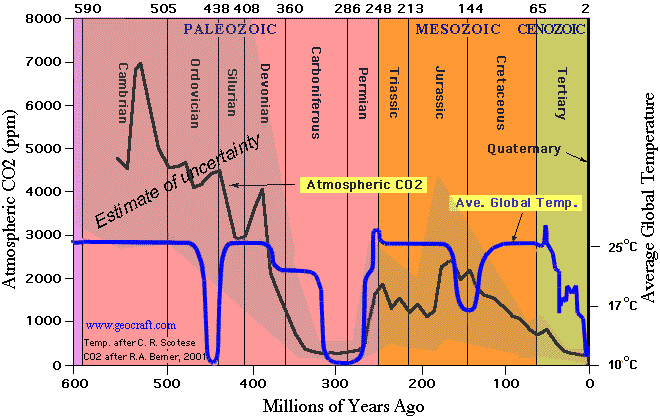
You see, when you want to know something about the current climate, you ask an actual climatologist, not the quoted paleoclimatologist, who studies long past climate. Especially when he is wrong. But then, he actually seems to be an fishy expert. Another scientist the article's author would dismiss if he weren't on his side.
-
Outing Greenhouse Deniers is Easy
Of the hundreds of comments attached to this story, yours is by far the most insightful and informative. I disagree with your polite "none very impressive", and think you're wrong about "none in global warming" and "unqualified scientist". That panel is composed of professional Greenhouse deniers. They are "impressive" and "qualified" to testify before a Canadian fake "Conservative" government that's hired by polluters to protect Canada's giant fossil fuel exports to the US (our #1 supplier). And probably dreams of a "warm Canada" their vast real estate holdings can finally cash in on as people "migrate" from uninhabitable regions to the south, while finally getting a year-round passage between East and West hemispheres across the Arctic.
Just look at their actual resumes, of course not quoted by "Canada's Fastest Growing Independent News Source", probably also funded by the Canadian Greenhouse industry and their global Murdoch partners.
Tim Patterson is a geologist, not a climate scientist - exactly the kind of scientist the BS article excludes to fake its conclusion that most Greenhouse scientists aren't qualified.
Boris Winterhalter is also a geologist, not a climatologist.
Geologists mostly work for the oil business, which is where most of the money for the entire science comes from, their peers who review, their "next gig pool".
Bob Carter doesn't even rate a page at his tiny Australian department where he's just an "Adjunct" professor.
Timothy Ball's "EnviroTruth" org is a division of the National Center for Public Policy Research, an front for Exxon Greenhouse denial propaganda and other Vast RightWing Conspiracy players.
Wibjörn Karlén's research supports Gore, but he signs the BS letter anyway.
Dick Morgan doesn't have an Exeter page, nor does he have ">any recorded association with the World Meteorological Association, so he has no credentials whatsoever, apart from lying.
These people are professional Greenhouse deniers. That Canadian panel and its Canadian tabloid (an obvious rightwing rag, just looking at its front page) are cheap fronts for the polluters responsible for the Greenhouse. They're not even trying to hide it more than a couple of googles and clicks deep, they hate us so much. And judging from the hundreds of posts in this story falling for it, we are that stupid. -
Re:Getting published isn't that difficultHave you take a look of the researchers interviewed academic career? Here is the list of them. In my opinion none of them are very impressive, and nore in global warming.
Tim Patterson http://http-server.carleton.ca/~tpatters/publicat
i ons/2002_04.htmlBob Carter http://www.es.jcu.edu.au/research/msgbs.html
Timothy Ball http://www.envirotruth.org/drball.cfm
Boris Winterhalter http://www.kolumbus.fi/boris.winterhalter/papers.
h tmWibjörn Karlén http://www.misu.su.se/research/reconstruction_nh.
h tml Look the graphic of the papaerDick Morgan http://www.google.com/search?hl=en&lr=&q=Dick+Mor
I think they are a sample of the unqualified scientist the article talks about.g an+site%3Aexeter.ac.uk&btnG=SearchHe don't even have a page on Exeter -
New idea... NOT.Why does this remind me of something? It sounds like something I've heard about already, more or less.
I just hope they don't patent it!
-
Re:...well...
sorry - I guess I should have included this link http://www.civeng.carleton.ca/Exhibits/Tacoma_Nar
r ows/TacomaNarrowsBridge.mpg to a video for those of you who are unaware of the Tacoma Narrows bridge incident.
Short form: when doing the design, they failed to take into account the harmonics caused by winds at a certain speed, from a certain direction. You can see the results in the clip. -
Re:This is not the first !
> Phillipine Giant Octopus Attack in December 27 1989 read more http://www.ncf.carleton.ca/~bz050/goattack.html.
From the link...
"This story sounds a little fishy too me. It seems strange that an octopus would leave the bottom and come up and attack a boat. Octopi stay near the bottom, and even big ones are timid. Many divers have swum with the giant octopus off the coast of British Columbia, which can grow to 272 kilograms and have a 9.6 metres arm span, and the octopi always swim away. And finally, to end my debunking of the above sighting, octopuses feed on the bottom (eating crabs,shellfish, carrion etc.) and wouldn't come to the surface to attack a possible food item that is as big as its self.
Source: Summarized by Ben S. Roesch from Denver Post, December 27 1989. "
The best link you can provide to your story about an earlier occurance is a link that tries to prove the story false? -
This is not the first !
Phillipine Giant Octopus Attack in December 27 1989 read more http://www.ncf.carleton.ca/~bz050/goattack.html. And some intresting information about giant octopuses can be found here http://www.gabourgeois.com/giantocto.html
-
Or, for something a little more educational....
One of my local universities recently started posting lectures online formatted for ipod video.
check it out:
http://www.carleton.ca/cutv/vod/vodcast.htm
[disclosure: my company helps them with hosting and other related stuff] -
neat.Many of us are no doubt familiar with models of ant foraging behavior that make use of pheremone dropping. For those of you who didn't catch the important difference mentioned here, it's basically the discovery of a different type of pheremone (whereas previously we had imagined that the ants made use of only two pheremones 'home' and 'food' -now there is 'no food').
if you are interested in such a model, you can get a simple one programmed in python here: http://www.carleton.ca/ics/courses/cgsc5001/assig
n 4.html Actually the link here is specifically about applications of genetic algorithms. But the second application (the first is a maze solver) is a GA used to optimize ant pheremone settings. -
Re:WIRETAPS IN CANADA???
Why not let free market decide?
If there was such a thing as a free market in this context I would agree with you. American television is paid for by the American population which is 10 times bigger than ours. Once paid for they can sell it cheaply here and elsewhere http://magazine.carleton.ca/2000_Fall/254.htm
Unfortunatly since we are not their target audience we get US centric rot and our culture suffers as it becomes more Americanized as a result.
The bottom line is that there would be no need for the CBC if there was no American media. There is American media (being dumped here) so we need the CBC with state financing to counter act it. This along with government grants for Canadian productions does no more than level the playing field in the Canadian market. Without this Government intervention the US media would take over. Not because it is any better, but because it is already paid for back in the US. How do you compete with that? -
Tinies: some info and more to comeHere is the harvest:
http://users.foxvalley.net/~joko/lib.html
(it seems this games had a previous version for Apple IIGS)
Description: Combining 3200 color graphics with amusing sound effects and poetic documentation, The Tinies is an arcade style timed strategy game with 100 levels. Using your keypad, your goal is to move multiple animated Tinie onto their "sleeper pads." On beginning levels, that's pretty easy to do; however, you will eventually run into objects that block your path, and you'll need to quickly figure out alternate routes.
http://www.nonoche.com/tinies.html
(This site needs Shockwave, I couldn't see it with linux)http://www.gamegenie.com/cheats/mac/TheTinies.sht
m l
(cheat codes to different levels)http://www.grenier-du-mac.net/fiches/tinies.htm
(binary to download, some pictures, but not exactly what I remember, it has a much nicer look and was more sophisticated)http://www.ncf.carleton.ca/~ds876/apple.html
(thanks to this page, I've found the company who made the Tinies, along with onwer's names)Finally I've e-mailed them to ask about what we are looking for.
Again we'd better leave this -
Re:It's a 30 years old problem actually.
it's really a game, life that is. Money is how you keep score, so far Gates is winning. And by the way any Karma is bad, no Karma is good.
-
Down with Quebecor
This is important information that needs to be distributed. Please link to my page about it.
-
Re:this happened to my dad's engineering company
In Canada, the big one was the Quebec bridge, which collapsed twice (taking many workers with it) during construction. Dunno what it is in various states. Either way, at the turn of the century, construction projects were becoming more and more ambitious and civilian lives were becoming more valuable, so engineering disasters became more important.
-
Re:as opposed to the closed sourceNy daughter is taking bioinformatics in University ( Carleton University). In a software development course for biologists, here required language was VB6 becuase that is all the instructor (a biologist) was familiar with.
Imagine trying to get BLAST working with VB!!
-
Look for the evidence
You're not serious that you don't "GET IT" are you? The evidence is overwhelming. And those who trot out some trumped up fiction that refutes the majority are mostly politcally motivated, or funded by oil companies. There is really buig bucks at stake to these people, at least for them. But if the planet compromises it's long term future, what have we done? Look at this month's "Discover" magazine; or any simple searching dregs up tons.: http://www.sfgate.com/cgi-bin/article.cgi?file=/c
h ronicle/archive/2001/04/13/MN211246.DTL http://home.earthlink.net/~cevent/11-10-04_solid_e vidence_gw.html http://www.carleton.ca/~tpatters/teaching/climatec hange/globemail4.11.97.html http://archives.cnn.com/2001/WORLD/europe/02/19/en vironment.report/ http://www.ehleringer.net/Biology_5460/Projects/cl imatedata/globalwarming3.pdf http://www.climatesolutions.org/pubs/pdfs/gwih.pdf http://www.climateark.org/articles/2001/2nd/statto ce.htm http://www.mmmfiles.com/archive/gw2001.htm http://www.environmentaldefense.org/documents/3970 _ConferenceBoard.pdf http://www.colorado.edu/pwr/occasions/salliebaliun as.htm http://www.physicstoday.org/vol-58/iss-1/p13.html -
Re:"Software Engineering" is not yet "Engineering"
-
"Software Engineering" is not yet "Engineering"
Here is a pretty good paper by Mary Shaw explaining why software is not yet an engineering discipline (IEEE). http://www.sce.carleton.ca/faculty/ajila/4106-500
6 -
Re:Gollums equipment
Maybe someone can sell off his penis for more than the $40,000 an American urologist paid for Napoleon's penis: here
-
Re:Hyper-Allergenic
I can't tell you how my bad eyes might bennefit mankind
For one, near sighted people are a lot better at using a microscope. The lens of an eye acts as, you guessed it, a lens. Being nearsighted means that an object has to be closer to your eye to focus on it. This essentially translates into a larger image cast on your retina for a given size object.
Conversely, a farsighted person would be better at using a telescope. -
Re:The old netscape
I liked to tell my students (when I was working in a high school) that there used to be a page called "What is new on the Internet" that would list all new pages to go up.
Sounds like you mean Scott Yanoff's "Special Internet Connections" list. It was a staple back then for newcomers to the net. Here's a snapshot of it from around then:
http://www.civeng.carleton.ca/~nholtz/Yanoff.html
There were a few other places that documented new sites, but I don't recall any that kept a cumulative list like Yanoff's list.
<oldfogey>I was part of NCSA's public best test program for Mosaic prior to Netscape hitting the market. I remember the day I finally had to reluctantly switch over to Netscape when about 1/3 of the sites I visited no longer rendered under Mosaic. The scary part is that I have maintained the same original bookmark file from that time and still use it today in Mozilla. (it's grown to about 287k these days)</oldfogey>
-
Re:Album art
I think such a feature and generally even adding it to the CDRom standard would be very welcome by me and I'm sure by plenty others.
Already done. -
Karma!
No no... this is a good example of karma. The cosmic kind, not the Slashdot kind.
Also, I made fun of my dad hitting his head on these waterslides we were at, and then hit my head twice. Karma can really hurt sometimes. >.> -
sorting mail by spamassassin scoreI'd like to delete anything with a score > 15, simply store anything with a score > 5, and send an auto-reply for scores between 5 and 10 indicating that the message was marked as spam and I'll probably never look at it.
I can't speak for auto-replies, but you can do the sorting part client-side. The key is that spamassassin adds a line like "X-Spam-Level: *****" where the number of *'s is the score of the email. Almost any email client can filter mail to different folders based on headers. The unary representation of the spam score ensures that even a primitive filter can work.
For example, one popular client is Microsoft Outlook, and there are several web pages in google (such as this one) that explain how to reroute mail to specific folders depending on the spamassassin score.
-
Re:I hope they bring such a product out
They've licensed good equipment to put the microsoft name on. They haven't manufactured anything good themselves.
You are wrong! Among the first Microsoft products of 1970's were some fine pieces of hardware. They made an expansion card for the venerable Apple II computer. It was called Microsoft Softcard and it allowed to run CP/M and all its applications on Apple II. Basically it was just a Z-80 daughterboard. They also manufactured RAM expansion card. These cards were good and they were manufactured by themselves.
O the irony - back in 1980 Apple was making the most popular personal computer, expandable like in a hacker's wet dream (lots of expansion slots with well-documented standards allowed anyone create an expansion card to do anything - and they did! and they did!) and Microsoft was just a small manufacturer of third party hardware extension for Apple computers. Plus a vendor of the popular multiplatform BASIC interpreter - and that was all about Microsoft back then. Who could have guessed... -
Transmeta
Isn't this exactly what Transmeta does? Introduce a translation layer between software and the processor?
Not to mention that at least partial implementations of the JVM _are_ available in hardware. Targetted JVMs come up a lot in the lists for 4th year projects at my unversity, for example. -
Re:Wait... so you're telling me...
Actually, the first accord from 1997 already contained the reforestation clause, so quite some time before the US withdraw from it. Only that already existing forest should be included was added fairly late. That was primarily to accommodate Russias and Canadas claims.
I did not know about when the CO2 trading was negotiated, so I didn't comment on that. Surprisingly, then Vice-President Al Gore already negotiated that. Obviously, before the US withdraw from it.
> Frankly, we are better off spending the money trying to come up with newer environmentally friendly technologies than trying to reduce CO2 emissions now.
How about trying to reduce CO2 reductions by spending the money for coming up eco-tech?
By levying taxes on CO2 and other greenhouse-gases makes the development of said technologies a more critical concern of companies as it will become a greater part of the costs of production.
Said companies will have to invest more money in development and deployment of GG-reducing technology as the competition will drive them to.
At the same time, the goverment could either use the money to support the research on said technologies, or, God forbid, reduce the budget deficit.
The difference to now would be that the importance of GG-reduction would be a more pressing matter for companies.
Considering the development of the automobile-industry, I think that would be a good idea.
Coincidentally, at the same time the petrol prices raised extraodinarily in Europe and Japan, European and Japanese companies released economical cars which consume 3l/100km. A little known fact, Volkswagen developed already in the 70s a car (coincidentally shortly after the Energy Crisis) such a car. As there was no market for it, the development was stopped.
-
How about at Universities?
See this or this. RMS and many others are all over it.From my alma mater:
The Department of Systems and Computer Engineering, the one faculty which should know better is the only faculty at the school where I've seen course notes in Word and PowerPoint. Everyone else does HTML and PDF. Assignments have to be submitted with a Windows binary called "submit.exe". And, most ironically, for a Java programming class, at that. What fscking idiots.
Makes me so proud.