Slashdot Mirror
Domain: ed.gov
Stories and comments across the archive that link to ed.gov.
Comments · 681
-
Re:Don't think I'd trust the software
Ok, looks like there's conflicting data. In 2014 Switzerland and Luxembourg had higher per-student spend than the US.
I can't be arsed tracking down whether the US is 1st or 4th on the list for 2018, so instead lets compare China and the US.
China's total spend is less than the US total spend, despite having many more students. China spends less on education than the US.
Chinese numbers: http://en.moe.gov.cn/News/Top_... US numbers: https://nces.ed.gov/fastfacts/...
Oh look, I can provide references. You're still talking shit. Now fuck off.
Well if you are using your arse to do your research small wonder you can't get your facts right. China contains way more people than the US and the US has for-profit schools so I'm not exactly surprised that the Chinese get more quality graduates out of each dollar they spend. And, no, I am disinclined to acquiesce to our request that I sexual intercourse off you arrogant arse buggering bloody cunt of a toilet-mouthed muppet (that was just for you since you don't seem to understand sentences that do not contain obscenities).
-
Re:Don't think I'd trust the software
Ok, looks like there's conflicting data. In 2014 Switzerland and Luxembourg had higher per-student spend than the US.
I can't be arsed tracking down whether the US is 1st or 4th on the list for 2018, so instead lets compare China and the US.
China's total spend is less than the US total spend, despite having many more students. China spends less on education than the US.
Chinese numbers: http://en.moe.gov.cn/News/Top_...
US numbers: https://nces.ed.gov/fastfacts/...Oh look, I can provide references. You're still talking shit. Now fuck off.
-
Re:The Rich
Especially given that Federal education dollars mostly fund the Department of Education, not, you know, actual education....
Gift denied. While I certainly wouldn't put it past Devos or Trump to steal billions for their own pocket, in reality, they spend less than 3% on administration.
Sorry, you don't get to make things up.
-
Re:Taboo topics
That's the problem; we're number 3 in the world in spending per student, and we're 17th out of 22 in the OECD in high school graduation rates.
We should pay more attention to Eisenhower's warning about the Government-Education complex, and how it's feeding off of the US taxpayer as much as the military-industrial complex. For example, the DOD budget in 2016 was $585 billion; Federal and State spending on K-12 education in 2016 was $620 billion. How many people would guess we spend more on education of K-12 than we do on the military?
When DOD cost overruns are found, there is much howling about cutting back to the DOD, increasing oversight, etc. When the educational system fails (as it does), there is handwringing and demand to spend even more. Somehow society has been conditioned to accept failure of the Government-Education complex and reward that failure with even more dollars and apologies.
-
Re:Taboo topics
Do you want to pay for their education?
Do you pay property taxes, or live in a building where the owner pays property taxes? Then you're paying for their education already.
Everyone knows about the "US spends more per capita on healthcare and we have crappy service!" concept, but how many know that we spend just about the most per student on education, and have terrible results?
Perhaps the issue isn't the amount of money spent in these areas, but the goals/intent of the Governments who are doing the spending (which is valid for both cases, as Government spending in the US - Federal and State - accounts for about 65% of all healthcare spending). They do not have success as their goal, but rather continuation of their own bureaucratic existence.
-
Re:This is what happens when you cut fed funding
School funding is four times what it was in the 1960s, inflation-adjusted. Even the crappiest schools have more funding now than they did five decades ago.
Its not the funding that's the issue. You know its not. But you're terrified to look and see what the actual issue is.
-
Beware Geeks Bearing Gifts
There's an endless parade of 'tech solutions' for education, most of which are shameless cash grabs.
However, an educational system which encourages self-learning isn't inherently bad. For example, Sudbury schools use this model. In old schools that didn't use the 'grade' stratification of students, older students would help teach the younger students. It's said that you need to comprehend a topic three times as well in order to teach it rather than merely understand it, so encouraging students to teach one another would likely improve comprehension.Furthermore, self-learning allows for an ideal version of the 'track' system used in Germany and elsewhere, where thinkers learn about more abstract subjects, whereas those who prefer to work with their hands learn more practical hands-on subjects. It's very easy for someone to say "all children should know X", and different people will have different opinions on what X is. Add those all together, and students end up with a bloated curriculum of stuff they really don't want or need to know in order to be effective and happy citizens and workers.
That said, there are so many models/ideas for education, that A/B testing and frequent reference to the What Works Clearinghouse should be utilized in order to determine efficacy, rather than ideologues saddling students with their pet system even if it never works.
-
Government IS BAD
This is clearly evidence of government interference causing poor outcomes
Exactly the point I was making, thank you!
The Nation does pretty well respected journalism, I know you don't like that
They are Communists, I know you like that.
The vast majority of kids go to public schools and get a great education
The vast majority — 65% — of kids aren't proficient in reading by age 15, despite per-pupil spending increasing four-fold since 1960ies. Not in "troubled districts" — the 65% is a national average.
There is no way to put a good spin on this colossal failure of government — which is why those "journalists" you respect so much have never pointed it out to you — and you blundered into this debate not knowing the facts. Disarmed by actual facts and logic, you've been reduced to attacking the opponent's person — a sure sign of an argument lost...
[...] reduced funding and social ills that fall heavily on the community
Which part of four-fold increase are you calling reduced funding?
You attempted to explain this away by pointing out — without evidence — that "charter schools" are worse. Clearly unaware, that "charter schools" are also government-controlled.
that article has clear citations, not anecdotes
That article cites anecdotes — about "charter" schools, which are also government-controlled.
There is no way anyone — even you — would willingly agree to pay 4 times more for the bad service. The only way this situation can persist is because government forces us (at the implicit gun-point of the tax-collector) to keep paying for it.
Of course, you — a Statist — love this and want the same to spread into other aspects of life, such as Internet-service provision. It is both Illiberal and counter-productive — I know you like it, but the rest of us do not.
-
Re:Comcast may be bad
Do you really need evidence, that government-provided "services" cost too much and are of poor quality?
Yes. If you make a claim, you should be able to back it up. Even if it's clear and evident, or if you think it should be. For the longest time we thought it should go without saying that heavier things fall faster. Guess what, they don't.
Let's start with public schools, for example. Per-pupil costs have quadrupled since the 1960ies (inflation-adjusted), while 2/3rds of 8th graders still aren't be considered proficient in reading
This is interesting. Why is that the case? How do private schools in the US fare? How do schools outside the US compare, especially in countries that also have a public school system?
What you have shown is that the cost of education is rising and that pupils of public schools fare poorly in academics. The latter is easy to explain, everyone who can at least remotely afford it will try to get their kids into a private school. What's left is the, how to put it nicely, less qualified student material of parents that don't give a shit. That has less to do with private vs. public but more with a perceived (or even real) quality of education of different school systems. You will experience the same even in school systems that offer public education in varying schools at high-school levels, as is the case in many European countries, where you have schools for vocational training (which are generally regarded as inferior) and schools that prepare for university studies (which everyone who gives a shit about their kids try to cram their kids into).
Where do you think you'll find the "bad" students who slack, don't show up and generally don't care about their academic progress? A school where you have kids of parents that don't give a shit about their kids or a school where helicopter parents stuff their offspring?
I now expect you to apologize for the condescending tone and, as a penance, challenge dgatwood below for evidence of his claims...
When you managed to convince me, you'll receive an apology. Until then, I expect you to provide more than single-point statistics that can be interpreted away by a statistics student in the first semester.
-
Re:Comcast may be bad
You certainly have some sort of evidence to back that up, right?
Do you really need evidence, that government-provided "services" cost too much and are of poor quality?
Let's start with public schools, for example. Per-pupil costs have quadrupled since the 1960ies (inflation-adjusted), while 2/3rds of 8th graders still aren't be considered proficient in reading .
I now expect you to apologize for the condescending tone and, as a penance, challenge dgatwood below for evidence of his claims...
-
Re:How fuckwits decided to randomly murderIronic how you've fell for misinformation in a discussion about misinformation.
GP was probably referring to studies such as this. But unfortunately, that does not support the idea that India is anywhere close to the US in education.Twenty-one to 23 percent — or some 40 to 44 million of the 191 million adults in this country — demonstrated skills in the lowest level of prose, document, and quantitative proficiencies (Level 1).
Twenty-five percent of the respondents who performed in this level were immigrants who may have been just learning to speak English. Nearly two-thirds of those in Level 1 (62 percent) had terminated their education before completing high school. A third were age 65 or older, and 26 percent had physical, mental, or health conditions that kept them from participating fully in work, school, housework, or other activities. Nineteen percent of the respondents in Level 1 reported having visual difficulties that affect their ability to read print.Yes, new immigrants are unable to read English, but you wouldn't call them illiterate if they read in Spanish or Chinese instead. And a person can be a PhD in English literature and still lose their vision due to old age.
Meanwhile, the US is about 45% college graduates, to India's 4.5%.
GP was also talking about Kerala for some reason, which is not where the events of the story happened. That was actually in Assam, which is nowhere near Kerala, whether that's on the map or in education. -
Re:How fuckwits decided to randomly murder
The only way I can see it being that high in the US would be due to immigrants not familiar with the native language. That isn't really a fair comparison. While literacy is still a problem in the US it is improving going by these 1992 vs 2003 numbers link. I just glanced at this study but I think it has gone from 9% below basic proficiency for whites to 7% and for blacks it has improved quite a bit from 30% below basic proficiency to 24%. Possibly higher now since those are 2003 numbers
-
Re:Only bad news?
I'm unclear what your complaint about the Dear Colleague letter is. (I'm assuming it's this one? https://www2.ed.gov/about/offi...)
It's gender-neutral, and lays out the need for schools to have a process to address sexual harassment. I'm unclear where you get 'sexist bullshit' from it. Could you identify where in that letter you see this?
-
Re:Pigs will be pigging
In reality, you have 1 to 3 plans your employer signed up for
Yes, the inexplicable connection between employment and health-insurance, which the federal government caused back in the 1940ies with its price-controls, and continues to encourage today with tax-credits, ought to end. Adding more government will not fix it.
all from the same insurance company with the same provider network
This sucks, but if a particular provider becomes too abusive, your employer is likely to change them. There is still some need for them to listen to customer feedback. On contrast, if the glorious "single payer" system is ever implemented, you'll be stuck with the same no matter who you are or what you do. To put into the terms you're sure to understand: Do you want President Trump to run your healthcare?
We already have the public school monopoly — for which we now pay 4 times more than 50 years ago without any improvement in quality...
Medicare is the only insurance program in the US with a >50% approval rating in polls
Curiously, you aren't citing anything to back up this claim.
underfunding the VA or NHS
Another unsubstantiated claim...
-
FERPA
Form what I can tell there's some debate about whether FERPA laws would allow this.
FERPA (Family Educational Rights and Privacy Act):
https://www2.ed.gov/policy/gen...
This school admin even asks how he can remove Alexa form the network:
https://community.spiceworks.c... -
Re: Oh wow, actually expecting a result?
most people live within driving distance of a 4 year college and even more live within driving distance of a community college.
I don't think that's true for a lot of people living in the countryside. Sometimes your nearest grocery store is a 1 hour drive away.
But even if you have one nearby, is it a good university? Does it accept you? There is a huge earning difference between a graduate from a top university and the more run-of-the-mill kind. The median Stanford graduate earns $85k upon graduation (source). The median for UCLA is only $59k, despite it being the one of the best schools in Los Angeles. If you live in LA and you're good enough to be accepted by both, there's every reason to take on a loan to go to Stanford. -
Re:Fine, just make sure kids aren't buying this crDo you screen the games your kids play for deer crossing the road? Would it surprise you to learn that deer are more dangerous than school shootings?
- There have been about 250 fatalities from school shootings over 18 years (excluding suicides and gang violence). That works out to (250)/(18) = 13.9 deaths per year. Since there are approximately 51 million K-12 students in the U.S., a student's odds of being killed in a school shooting in any given year are (51 million) / (13.9 per year) = 1 in 3.67 million.
- About 120 Americans are killed every year by deer. (325.7 million Americans) / (120 per year) = 1 in 2.71 million.
So a student is more likely to be killed by a deer than from a school shooting. Where are all the walk-outs and protests advocating deer population control?
For some perspective on the scope of the school shooting problem, look at the stats the CDC puts out. For 2015, the leading causes of death among the 15-19 year old demographic were:
3,919 deaths - Accidents (mostly automobile accidents and drug overdoses). 282x more than school shootings.
2.061 deaths - Suicide. 148x more.
1,587 deaths - Homicide (mostly outside school, and gang related). 114x more.
583 deaths - Malignant neoplasms (cancer). 42x more.
306 deaths - Heart disease. 22x more.
195 deaths - Birth defects. 14x more.
72 deaths - Influenza (the flu). 5.2x more.
63 deaths - Chronic lower respiratory diseases. 4.5x more.
61 deaths - Cerebrovascular diseases. 4.4x more.
52 deaths - Diabetes. 3.7x more.
41 deaths - Complications from pregnancy and childbirth. 3x more.
A protest over excessive rates of teen pregnancy could potentially save 3x more lives than a protest over school shootings. Likewise, teaching kids not to each too many sweets, to exercise, not to smoke, get the flu shot, use sunscreen, not to join gangs, to buckle their seat belt, not to use drugs, and offering them counseling for depression, would all be much more productive uses of our time and effort than worrying about or debating school shootings. For that matter, controlling deer populations to reduce the number of fatalities from striking deer could potentially save 1.35x as many students' lives as lost to school shootings.
If you want to tackle a life-threatening issue that students face, probably the best choice is suicide. It results in more than a hundred times as many student deaths as school shootings. But when's the last time you saw the media run a story about teen suicide? The only reason school shootings are even on the radar is because of the media using them to play the "think of the children!" card against guns. -
Re:evidence?
So you're suggesting that the overall conclusion (the sexes are biologically different from each other in ways that lead to differences in vocational choice) is true even if the original poster's reasoning for the cause wasn't quite correct?
Also, mathematics is a broad subject and it turns out that men and women are better/worse at certain parts of it. Here's a pretty good paper that references the research in the area quite broadly. -
Re:As seriously as the US takes it
You shouldn't care about school shootings either. There have been about 250 deaths in school shootings over 18 years (non-gang, non-suicide), or about 14 per year. Since there are approximately 51 million K-12 students in the U.S., a student's chances of being killed in a non-gang, non-suicide school shooting in any given year are about (51 million students) / (14 deaths/year) = 1 in 3.6 million.
You're more likely to be killed by a deer. About 120 Americans are killed by deer every year. (325.7 million Americans) / (120 deaths/year) = 1 in 2.7 million chance of being killed by a deer each year. Do you wring your hands over the possibility of being killed by a deer, and hold marches to demanding the deer population be controlled?
The U.S. causes of death statistics are readily available from the CDC website. For 2015, the leading causes of death for the 15-19 year old demographic were:
3,919 deaths - Accidents (mostly automobile accidents and drug overdoses)
2.061 deaths - Suicide
1,587 deaths - Homicide (mostly outside school, and gang related)
583 deaths - Malignant neoplasms (cancer)
306 deaths - Heart disease
195 deaths - Birth defects
72 deaths - Influenza (the flu)
63 deaths - Chronic lower respiratory diseases
61 deaths - Cerebrovascular diseases
52 deaths - Diabetes
41 deaths - Complications from pregnancy and childbirth
All of these represent a greater risk to students than the 14 deaths per year from school shootings. -
Re: Very high spending, low results
The district you taught in is not a very representative sample. Here is some data. In particular you can watch AZ's teacher salaries crest and then start going lower, ultimately ending back where they were in the 1970s. Several other states show the same pattern.
I provided you a nice bunch of links. Feel free to peruse them. Your anecdotes do not seem to match reality. Pensions and salaries, in particular, seem to be opposite what you think they are.
If you want to lay blame for increasing education costs, those aren't the places you can really lay it.
-
Re: Very high spending, low results
That looks like pretty solid data. You tied the increase to teachers having better retirement packages, but that's definitely not the case. Teacher salaries have been flat or declining over most of that period, and pensions are generally tied to salary. If you look at pension data, it generally shows retired teachers getting paid pretty poorly. 65% of states have an average teacher pension under $25k/year.
A more recent look at education costs pegged it at $122k/student, but that's not a ton lower than what you cited. If you dig into where the money is going, it looks like salaries are actually falling, while benefits are going up. That's no surprise - health insurance costs have skyrocketed in the last few decades. Another sink is infrastructure. Schools are continuing to chase technology, and computers and networking are both expensive and quick to depreciate.
I don't disagree that it looks like school costs are rapidly going up without much to show for it. But does that mean that money is being spent ineffectively, has it kept kids from falling behind, or more likely, a mixture of the two?
-
Per-pupil spending 4x times that of the 60ies
How do you know they have enough of cash?
Because this nice table convincingly shows, that the per-pupil spending in America's public schools has quadrupled since 1960ies (inflation-adjusted).
There is amply enough money being spent. We are just doing it wrong [TM].
-
Re:Hmm
The fact that there's no statistical difference between GPA and graduation rates between students that did and did not submit standardized test scores does not mean that there's no correlation between those test scores and achievement. In fact, there is such a correlation. See:
https://www.vox.com/cards/sat/... [vox.com]
http://files.eric.ed.gov/fullt... [ed.gov]Just a quick point, the study these articles are pointing to reference a College Board study indicating a correlation between SAT and college achievement. College Board is the publisher of the SAT test. This is like referring to a study funded by the pasta industry that concludes pasta is good for you...
Other points in those articles highlight the same point I made before: HS GPA is a better indicator than SAT and SAT hasn't been shown by many admissions studies to have a significant statistically independent prediction of college success measurements despite what the publisher's of the SAT might want people to believe. This is why many college admissions departments are slow-walking away from the SAT. It appears to add very little value into their admissions criteria, but the alternatives aren't well vetted yet...
Here's some interesting reading for those that don't know the history the SAT and its relationship with the UC system...
https://senate.universityofcal...
Similar reports about the effectiveness of the SAT have been going on since the 80's when I was in college and working with admissions. The only thing keeping the SAT alive is pretty much the UC system requirement (UC being a big "customer" of the SAT was the main driver to convince the SAT to change to be more like the ACT). I predict by the time my kids will be college aged, the UC system will finally drop the SAT and it will be a distant memory.
-
Re:Hmm
Interestingly, high SAT scores have not been shown to be correlated to student achievement in college. In face, many colleges are moving to test-optional admission strategies after a 2014 study involving 123,000 students at 33 colleges showed virtually no statistical difference between GPA and graduation rates between students that did and did not submit standardized test scores.
The fact that there's no statistical difference between GPA and graduation rates between students that did and did not submit standardized test scores does not mean that there's no correlation between those test scores and achievement. In fact, there is such a correlation. See:
https://www.vox.com/cards/sat/...
http://files.eric.ed.gov/fullt...Sadly, from my history of admissions work with my alma mater, the two highest correlating factors for academic success were: 1. parental income; and 2. one-or-more parents graduating from college. You might say #1 is probably highly correlated with #2 so a large driver of college success is a student fulfilling the expectations of their college educated parents, which sort of perpetuates the have vs have-not split.
This leads credence to the assertion in the GP that the quote about "I'm 100 percent convinced that talent is distributed uniformly across society. There's no data to suggest that if you happen to be born into a less well-to-do family you are somehow less intelligent" is wrong. There is a lot of evidence that this statement is just wrong. Here's one example:
https://www.washingtonpost.com... -
Re:In 5-10 years...
Nah, they'll just build out municipal broadband that's ten times as fast for half the price.
Yeah, because all of the earlier governmental undertaking proved so superior to private enterprises. To wit:
- Public schools, which cost 4 times more today than in the 60ies
- Public roads, which suck by all accounts, particularly in California
- Public transit, which sucks by all all accounts
- And last, but the most germane to the topic, the glorious Municipal WiFi — which sucked so bad, it got abolished by most, who attempted it
Yeah, let's build even more success on that glorious track-record — all the while letting the governments know even more about our online behavior and policing any misbehavior not as ToS-violations, but as civil infractions. What can possibly go wrong?
-
Re:Tell 'em only white males will be targeted
Seriously? Butt-hurt YOU aren't paid 300-500k to be a top engineer at a top company?
Actually, I am.
I therefore get a ring-side seat and get to see the "affirmative actiion"/lower standards used to create "diversity".
Of course, it's career suicide to point out that using different standards because of someone's skin color is racist, and different standards because of someone's sex is sexist.
Just repeat after me, and you'll get along fine: IT'S WHITEY'S FAULT!!!!
Yep - when blacks use handguns to kill blacks in inner cities where guns are already illegal, it's all WHITEY'S FAULT and we need to ban AR15s from rural whites. Or when the FBI ignores 83 fucking complaints saying someone's going to shoot up a school, because Obama said you can't lock crazy kids up....
-
Oh good.
See, the problem with large numbers is... they're large.
Only 3% showed any change? Great. One snag: there are 50 million students in the U.S. 3% of them = 1.5 million.
https://nces.ed.gov/fastfacts/...
(To say nothing of the other flaws in the study that others here have pointed out.)
-
End of a generation of kids who went to toy stores
The *majority* of America's children today qualify for free or reduced lunch. https://nces.ed.gov/programs/d... That was 30% and even a little below in Toys'R'Us '85-'95 heyday. (And the qualification hasn't changed... 185% of the poverty line). And even a little above average now is pretty poor (family of 4 making a whopping $39,000 gross... that kid is too rich for reduced lunch. That's above average now!). Healthily middle class families with kids are simply getting rarer and rarer.
-
Re:HOMESCHOOL
40% of people in the USA live below the official poverty line and so things like access to text books, libraries (reading for pleasure correlates strongly with academic success), food (you can't study very well on an empty stomach), racial and social stigmatism (some people are told that they can go to college/university while others are led to believe that they can't or it's just not for them), etc., all have dramatic effects on educational outcomes. When you control for poverty, i.e. look at the pupils who aren't living below the poverty line, USA schools are among the better performing in the world.
Ever since "A Nation at Risk" http://eric.ed.gov/?id=ED22600... was published by the Reagan administration in 1983, neoliberals in the USA from both the Republican and Democratic parties have been hard at work with cutting funding to schools, degrading working and studying conditions for teachers and pupils, and mounting media campaigns to vilify its teachers to in order to disestablish public education and pave the way for privatisation (e.g. charter schools and voucher systems). It's a testament to how well-trained, resourceful, and hard-working the vast majority of teachers are in the USA that public education is doing as well as it is under the circumstances.
In short, the answer to the USA's educational woes isn't to abandon public education, on the contrary, it's to stop degrading it, fund it properly, and bring it into line with the rest of the developed world. Just think what could be possible if the USA had education systems comparable to those of Canada, South Korea, or Japan?
Back on the topic of poverty and inequality, you can't educate people out of poverty. Education alone just can't do that. The USA needs to support its public education systems and in addition address poverty and inequality. To put it another way, what's the point in studying hard at school if there are no good jobs for you at the end of it?
-
Woman are awarded more than 60% of diplomas
Woman are awarded more than 60% of diplomas. It is a complete injustice that they are not awarded more diplomas in every sub-domains. Woman needs help for sure.
-
Re:What's going on...?
Well there, why don't we explore the current state of higher education right now.
Sure!
https://nces.ed.gov/fastfacts/...It appears that business is still the most taken degree, followed by health professions and related programs. "Social sciences and history" come in third, but note that not all of them are of the kind that gets mocked as being social justice courses.
So it appears that the state higher education isn't a monolith either. Are there kids who took women's studies and lapped up the social justice rhetoric? I'm sure there are, but you can say the same that among Trump supporters there exists some racists and fascists.
To believe that college kids as a whole all exhibit the same traits based on a few select individuals is... well, that's kinda what AmiMojo does when talking about groups/people he doesn't like
-
Re:If you believe in lies, then you become extremi
School underfunding is a myth pushed by the teacher's unions. Here's a spreadsheet from the National Center for Education Statistics showing per pupil spending from 1919 to 2011, in inflation-adjusted numbers. Compared to the early 60s, we have QUADRUPLED per pupil spending. Are we getting four times the results? Hell fucking no.
Stop demanding more money, and start looking at where the money is going. Because it sure isn't going into the classroom.
-
Re:Wait, what?Schools are vastly over-funded. The U.S. spends more on education per student than any country except Switzerland. While a few states dip into the $7k/yr per student range you give, the national average is over $12k/yr per student.
Total expenditures for public elementary and secondary schools in the United States in 2013â"14 amounted to $634 billion, or $12,509 per public school student enrolled in the fall (in constant 2015â"16 dollars).
(Discrepancy with the OECD stats is due to being from different years, and the OECD stats including post-secondary non-tertiary education, while the NCES stats are for only K-12).
Spending per student has about doubled in inflation-adjusted dollars over the last 40 years. and tripled since the 1960s. It peaked around 2007, and the people trying to get even more money put into education have been abusing that by using 2007 as the start of their spending graphs.
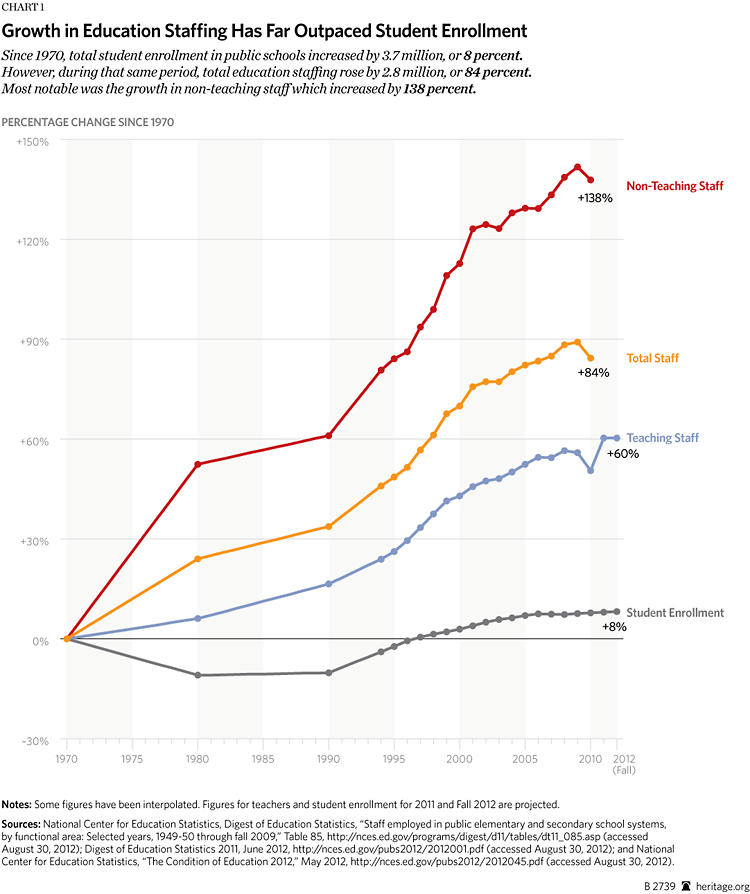
Where is all the money going? I don't have time to find it again, but the Education Department's own stats are contradictory. If you take the amount of spending it lists in teacher non-salary benefits, and divide it by the number of teachers they give, it ends up something like $50k/yr per teacher. What's going on is the number of non-teaching administrators has exploded since 1970, far outpacing the growth in number of students. These administrators have been hiding it by shifting some of their salary expenses into those of teachers in the stats. Every time education receives a spending increase, the administrators sop up most of it and let only a trickle get through to teachers. Every time education receives a spending cut, these administrators pass it all on directly to the teachers and students, while protecting their own jobs and salaries. As a result, the teachers are constantly complaining of not having enough money despite the huge increases in education spending over the decades. -
Re:And yet..
OK, I'll hold your hand for you, since you talk so sweetly:
Number of colleges in 2000 (technically Title IV postsecondary institutions): 6,479 In 2013: 7,236. Total increase of 11.9%. Source
Number of college students in 2000: 13.2 million In 2015: 17.0 million. Total increase of 29%. SourceBut just so you don't accuse me of cherry-picking numbers, let's use the larger increase of 45% between 2000 and 2012 from Pew - they only consider full-time students.
From the same link:
A major shift has occurred in the relative levels of funding provided by states and the federal government in recent years. By 2010, federal revenue per full-time equivalent (FTE) student surpassed that of states for the first time in at least two decades, after adjusting for enrollment and inflation. From 2000 to 2012, revenue per FTE student from federal sources going to public, nonprofit, and for-profit institutions grew by 32 percent in real terms, while state revenue fell by 37 percent. The number of FTE students at the nation’s colleges and universities grew by 45 percent during the same period. Without adjusting for enrollment growth, total federal revenue grew by 92 percent from $43.3 billion to $83.2 billion in real terms, while state revenue fell by 9 percent from $77.8 billion to $70.8 billion after adjusting for inflation.
To sum up, enrollment increased by 45%. Number of schools rose by around 12%. Total state and federal direct funding (sans loans and tax credits) went from $121.1 billion to $154.0 billion, for a total of 27% increase in direct funding. In addition to that, tax credits have increased from around $12 billion to around $31 billion. Add that to the direct funding and you have $133.1 billion vs $185.0 billion, or a total increase of 39%. Enter student loans. I get that these are meant to be repaid (except the subsidy) and should not count as direct subsidy. But the fact remains that they have increased 376% in the same time period.
So if we use total enrollment, then direct funding has been approximately flat, but tax credits have increased substantially. If we use only full time students, then direct funding has decreased significantly, but when you add in tax credits the decrease is not as significant, around 6%. If you consider student loans to be a kind of subsidy, there certainly has been no decrease no matter how you run the numbers.
I'm on firm ground, even if I don't have your silver tongue.
-
Re:And yet..
OK, I'll hold your hand for you, since you talk so sweetly:
Number of colleges in 2000 (technically Title IV postsecondary institutions): 6,479 In 2013: 7,236. Total increase of 11.9%. Source
Number of college students in 2000: 13.2 million In 2015: 17.0 million. Total increase of 29%. SourceBut just so you don't accuse me of cherry-picking numbers, let's use the larger increase of 45% between 2000 and 2012 from Pew - they only consider full-time students.
From the same link:
A major shift has occurred in the relative levels of funding provided by states and the federal government in recent years. By 2010, federal revenue per full-time equivalent (FTE) student surpassed that of states for the first time in at least two decades, after adjusting for enrollment and inflation. From 2000 to 2012, revenue per FTE student from federal sources going to public, nonprofit, and for-profit institutions grew by 32 percent in real terms, while state revenue fell by 37 percent. The number of FTE students at the nation’s colleges and universities grew by 45 percent during the same period. Without adjusting for enrollment growth, total federal revenue grew by 92 percent from $43.3 billion to $83.2 billion in real terms, while state revenue fell by 9 percent from $77.8 billion to $70.8 billion after adjusting for inflation.
To sum up, enrollment increased by 45%. Number of schools rose by around 12%. Total state and federal direct funding (sans loans and tax credits) went from $121.1 billion to $154.0 billion, for a total of 27% increase in direct funding. In addition to that, tax credits have increased from around $12 billion to around $31 billion. Add that to the direct funding and you have $133.1 billion vs $185.0 billion, or a total increase of 39%. Enter student loans. I get that these are meant to be repaid (except the subsidy) and should not count as direct subsidy. But the fact remains that they have increased 376% in the same time period.
So if we use total enrollment, then direct funding has been approximately flat, but tax credits have increased substantially. If we use only full time students, then direct funding has decreased significantly, but when you add in tax credits the decrease is not as significant, around 6%. If you consider student loans to be a kind of subsidy, there certainly has been no decrease no matter how you run the numbers.
I'm on firm ground, even if I don't have your silver tongue.
-
Re:An anecdote
The best evaluations of schools are done by the National Assessment of Educational Progress https://nces.ed.gov/nationsrep... which is accepted by educators of all political views.
As far as I know, they're the only ones who have scientifically valid evaluations comparing a wide range of public and private schools. They compared public schools with charter schools, and the results were that charter schools had a wider range of test scores. The best charter schools were equal to the best public schools, but overall, charter schools were slightly worse. The one confident conclusion was that charter schools were not dramatically better. Some people do call them a panacea, and that's not supported by the evidence.
I think there were some other randomized controlled trials of public vs. private schools, but overall the results were about the same.
There are also very expensive private schools ($20,000/year or more) that are probably better than many public schools, but much of that is due to the students they select.
Diane Ravitch was secretary of education in the Bush and Clinton administration. She believed in privatized schools, high-stakes testing, and taking power away from the unions. She wrote many op-eds for the Wall Street Journal saying so. Then she looked at the data. She had a PhD, so she could understand experimental methods.
She found that privatization, testing, and unions didn't make any difference. The one factor that was most strongly associated with school performance was the student's family income. Schools with wealthy children have better test results. Schools with poor children have worse test results. The effect of teachers is insignificant compared to income.
As Carl Sagan said, it's not often that a scientist looks at the data and decides that he's wrong -- but it does happen.
New York City has many excellent public schools. The proof is that there are many informed parents trying to get their children into those schools. In Beacon High School, one of the parents was a very wealthy filmmaker, and he gave the school a donation of what he would have paid in a good private school. Bronx High School of Science, and Stuyversant, have a worldwide reputation for excellence, with long waiting lists. There are other neighborhood schools that are well-known for excellence, and are as good as any public school. In New York City, you can certainly find public schools as good as any private school -- in the judgment of parents.
Unfortunately there are some bad public schools. These are always in low-income neighborhoods. It's impossible to have top-quality schools attended by students who have all the problems of poverty. If you fix the poverty, the schools will get good results. The Catholic schools in those neighborhoods had extreme selection bias (since most parents could afford to pay, and they would quickly expel students with any difficulties). The first step in solving that problem is to eliminate poverty and inequality, at least to the level of European developed economies, or back to the level of equality that we had after WWII.
I took a course with Fred Hechinger, the education editor of the New York Times. He covered school districts in New York, in the region, and nationwide. He said that there are many small school districts in the region, run by school boards. In some districts, the school boards are committed to good education and do a good job. In some districts, it's all about whose brother-in-law can get a contract supplying bread to the school cafeteria. So the way to get a good public school is to live in a wealthy district where the parents are committed to education and active in their school board. Your choice is to move. If you're in a region where all the public schools suck, then you don't have a working democracy in that region.
Of course, if you send your kids to a private school, you also have to be active in the school management. My cousin teaches in a private school.
-
Re:Why was this allowed in the first place?
University Law trumped state law after the Dear Colleague letter, which obligated colleges to have their own Title IX hearings where guilt was decided on a 'preponderance of evidence' rather than 'beyond a reasonable doubt' if they wanted to continue to have Federal funding.
https://www2.ed.gov/print/abou...
As noted above, the Title IX regulation requires schools to provide equitable grievance procedures. As part of these procedures, schools generally conduct investigations and hearings to determine whether sexual harassment or violence occurred. In addressing complaints filed with OCR under Title IX, OCR reviews a school's procedures to determine whether the school is using a preponderance of the evidence standard to evaluate complaints. The Supreme Court has applied a preponderance of the evidence standard in civil litigation involving discrimination under Title VII of the Civil Rights Act of 1964 (Title VII), 42 U.S.C. SS 2000e et seq. Like Title IX,
Which led to cases like this
https://www.thefire.org/victor...
In finding Warner guilty, UND used the weak "preponderance of the evidence" standard (50.01% certainty) to determine guilt or innocence-the very same standard recently imposed upon every federally funded college in the country under an April 2011 regulation from the federal Department of Education's Office for Civil Rights.
UND's reliance on the "preponderance of the evidence" standard lowered the accuracy of the proceedings so much that the police and the university arrived at very different results. Using what the university later insisted was the very same evidence, UND's campus tribunal convicted Warner of sexual assault, while the Grand Forks Police Department determined that Warner's accuser had lied about what had happened.
In fact, on May 13, 2010, the Grand Forks County District Court formally charged Warner's accuser with "False information or report to law enforcement officers or security officials," a Class A misdemeanor, and issued a warrant for her arrest on May 17, 2010. To date, Warner's accuser has failed to appear to answer the charges against her.
"When you only have to be 50.01% sure about the evidence, it's easy to make a mistake or to let bias, conscious or otherwise, determine the outcome-especially in campus justice systems. Yet, the federal government is now mandating that this flaw be enshrined at practically every university in the country," said FIRE Senior Vice President Robert Shibley.
Warner first requested a rehearing on July 28, 2010, but UND refused to grant it. In the spring of 2011, Warner asked for FIRE's help. On May 11, 2011, FIRE wrote UND President Robert O. Kelley, pointing out the university's procedural errors and criticizing its failure to reconsider the case. On May 20, UND responded to FIRE, once again denying Warner's request for a rehearing. This is when UND revealed that it had used the very same evidence to find Caleb Warner guilty of sexual assault that the police and prosecutor had used to charge his accuser with lying to law enforcement.
On July 15, an opinion column in The Wall Street Journal by FIRE Chairman Harvey A. Silverglate launched FIRE's national press campaign to encourage UND to give Warner a fair rehearing. Two weeks later, UND Provost Paul LeBel finally invited Warner to appeal the finding against him. With the help of attorney Nathan Hansen, Warner submitted a new appeal on August 31.
Late last week, Warner received a ruling from LeBel announcing that "based on the specific fact of a law enforcement office filing an affadavit of belief that the complainant had provided false information to him" about the sexual assault accusation, a "continued fin
-
Re:Fuck Communists
... and yet for the average citizen they're much better places to live.
Citation missing.
There's nothing inherently wrong with such an economic model.
Yeah. Nothing inherently wrong with Communism — except, wherever implemented in earnest, it leaves millions of dead and the survivors with neither material wealth nor human rights.
But neither does the opposite extreme of laissez-faire.
Statist lies.
Some things work better when the government controls them
Fortunately, very few things are done by the government in the US. Unfortunately, that makes comparisons difficult. There are but a few things... Do you really prefer TSA over the old private security in the airports? Or do you like the public schools, which quadrupled in the per-pupil cost over 50 years without improving the results one bit?
But the reason America had a free market capitalism is not because it "works" — for some definition of "works". We have (had) it, because it is the only way to live without oppression and tyranny. The second you decide to value the Collective over the Individual (what Socialism/Communism are all about), all things become possible: like killing and robbing a minority for "the greater good".
You claimed earlier about USA being the last to abolish slavery. The uncited claim was bogus, but did you know, that USSR has re-enslaved the peasants freed by the Tsars? Yes, they could not leave the collective farm without the farm chairman's permission? In the 20th century. They had to starve millions of people to death to get that sort of obedience, but they did it — for the Greater Good[tm].
When you become an absolutist when it comes to economic models, you cease to search for pragmatic solutions. That's when economies tank.
Yes, I am an absolutist, when it comes to personal rights. Not sorry. But if you are calling yourself "pragmatic" (a.k.a. without principles), do tell, what would President Sanders do differently from El Presidente Chavez? Bet, you were a big fan of the latter — all of you, Illiberals, adored him.
their education system is so much better
Citation missing.
Oh, yeah, because we spend like a third of our budget on that stupid military
Whether that military is "stupid" or not, we do spend considerable money on it. And yet, we are still richer than most of those Socialist paradises you listed.
-
Re:Instead of apprenticeships
https://nces.ed.gov/fastfacts/...
You're not that far off for todays prices, you just didn't adjust your memory for inflation!
It turns out it is twice as expensive now than 30 years ago, and not ten times more expensive than 20 years ago.
-
Re:Here's a billion dollar idea:
"Those who can do, those who can't teach."
Fuck You. Public education is failing because of assholes like you. I don't know a single teacher that recommends entering the profession because of this type of bullshit.
Blame teachers for all social problems, and go out of your way to pass laws to restrict their right to unionize. Make sure that teachers have no due process, and no professional respect. Be sure to siphon off money to for-profit charter schools who often do not teach high school students because extra curriculars are more expensive. Don't hold charter schools accountable when they mishandle public funds, fail to report progress numbers to the State, or refuse to provide services to special education students. Couple that with abysmal pay and benefits in most districts, and the reality is that there is a massive shortage of teachers across the U.S.
Try teaching kids who are hungry, exhausted, and homeless. Students who have no support at home, and nobody to advocate for them fall easily through the cracks. Everything revolves first and foremost around the parents, but many have abdicated their responsibility long before a student meets a teacher.
Take some time out of your important life to volunteer in a school and you will see the reality of the situation. If public education is failing it is precisely because you are not there to make a difference.
-
Re:Reagan was a terrible president
Don't forget Reagan's war on the family farm. Mission Accomplished!
-
Re: Early education more important
Fixed your shoddy misquote. Kinda obvious that you'd prefer to misleadingly edit a post, instead of honestly and affirmatively address it, but no reason to let it slide:
Which home culture is that ScentCone? Your only specific example is DC, a jurisdiction under the explicit control of Congress, which is made up of individuals across the nation, so why are they failing to act to ensure DC schools are performing well? Were so many Congressional members subjected to this culture you castigate? Did you mean to say American culture is the problem?
No, congress does not run the DC school board or the DC school system. Which you know, though you're implying they do so you can cravenly dodge the substance of the matter. Nice attempt to avoid the reality of the situation.
Nope, Congress does have authority over DC, including the school board, as the Constitution explicitly states:
To exercise exclusive Legislation in all Cases whatsoever, over such District (not exceeding ten Miles square) as may, by Cession of particular States, and the acceptance of Congress, become the Seat of the Government of the United States.
You know this, and can't argue it, but want to cravenly deflect the issue and avoid the reality of the situation. Congress could fix any problems in DC schools, if they wanted. They have the legal authority to do so. Your precious GOP has a majority in both houses, and the presidency. Why aren't they fixing it?
I cite DC because YOU, along with me, get to pay for a large portion of that very high per-student expense and its historically awful per-student results.
Nope, you didn't cite that as your reason, and it's not true, since DC actually pays more in federal taxes than 22 states, and a higher per capita rate, and receives less federal funding for its schools than many states.
Oh sure, you could argue that all DC taxes are federal taxes, but that's due to it being a federal entity empowered by the US Constitution. No escaping that one.
Shall we examine the exact same problem in Baltimore, or Detroit, or Chicago?All cities run for decades, of course, by liberal Democrats.
You may forget, but as I asked, what local culture does DC have, and how does it compare to the failing schools in Alabama, California, Texas, Florida, Indiana, Wisconsin, New York and elsewhere? They have failing schools, and no, they aren't universally run by liberal Democrats. For example, try this information. And in fact, in many states, like Tennessee, the schools are ultimately under state supervision, not a city government, so focusing on the city itself can be misleading.
In fact, as you've claimed in your posts, Republicans are in charge all over the place. So why haven't they fixed anything yet? Why can't they managed to be the shining city on the hill that's inspiring to us all? Did Ronald Reagan rest on his laurels and ignore the report? Was George W. Bush unable to handle the problem with his "compassionate conservativism" as he claimed?? Have the Republicans elected across the country been unable to come up with solutions?
Ah, but all you can do is blame the dreaded "liberal Democrats" the scourge you assert is what ails us, and you don't even have to use a thinly veiled dog-whistle for that, do you? You're allowed, ev
-
Re:What is the solution to failed state schools
State run schools in the US on the whole are an abject failure, both compared to schools in the US historically and compared to schools around the globe. The only honest question is how to fix them.
No, it isn't the only honest question. For example, we might honest question why you think that they are on the whole, an abject failure, when on the whole, there are widely different results in different schools. We might ask honest questions about what is a failing school. We might even ask, honestly, why schools are failing. We might ask honest questions about why you think there is only one question to ask.
Teachers unions have been claiming for 30 years (at least) that the schools need more money and that will fix the problem.
Or we might ask why you are trying to boil down actual specific requests by Teachers, and Teacher's Unions, for various reforms of a variety of forms to simply "Throwing more money at the problem" as you attempt to reduce their position to an easily dismissed slogan.
These questions keep increasing in number.
The US now pays 28% above average for first world countries to educate children: https://nces.ed.gov/programs/c... and US students still score well below average for first world countries.
Nope. Already fact-checked. Found wanting.
But say you are concerned about spending, then control that data for education spending. Examine it carefully. There's another honest question to ask.
Put another way, the US spends on average around $12,000 per student per year for elementary school.
Except...you would know, if you controlled for states, that that average varies WIDELY. Even more so if you control for counties.
In a class of 30 students, that is $360,000 for 180 days of instruction or roughly 9 months.
Oh? Well, the US average teacher salary is under 1/6 of that. Under 60,000 dollars. Where's that other 300,000 going? There's another honest question for you.
Assuming a single teacher per classroom, each teacher is bringing in $2000 PER DAY or $250 PER HOUR.
Well, if you mean in terms of personal enrichment, we know that's false. Or they're only working ~30 days a year.
Any business would be glad to have that kind of income, and only an idiot would be unable to make ends meet with it.
Oh? So you are claiming that a revenue-oriented approach would work? Is that it?
The only way to explain the constant complaint of insufficient funds by teachers unions is gross incompetence.
Oh, so you have an answer to that, yet mysteriously, you don't tell us who is grossly incompetent. Is the Teacher's Union in charge of school spending? Does the Teacher's Union call the tune? Or are other groups influencing the outcomes and setting the score?
For those of you who will complain about the other overhead costs, the average rental price for 1000sf (33x33 classroom) of commercial retail space is $7 PER DAY.
And there's another faulty statistic for you. Commercial retail space is also widely variable in costs, and suitability for class-room instruction is another problem. Plus you know, we do have outdoor spaces at most schools, for some reason. Better factor that in.
Then there's transportation. You know how much is spent on transportation to schools? That's part of your figure.
The bottom line is schools get plenty of money, and are, in general, grossly mismanaged.
Yet you have provided zero demonstrated factu
-
Re:What is the solution to failed state schools
State run schools in the US on the whole are an abject failure, both compared to schools in the US historically and compared to schools around the globe. The only honest question is how to fix them.
No, it isn't the only honest question. For example, we might honest question why you think that they are on the whole, an abject failure, when on the whole, there are widely different results in different schools. We might ask honest questions about what is a failing school. We might even ask, honestly, why schools are failing. We might ask honest questions about why you think there is only one question to ask.
Teachers unions have been claiming for 30 years (at least) that the schools need more money and that will fix the problem.
Or we might ask why you are trying to boil down actual specific requests by Teachers, and Teacher's Unions, for various reforms of a variety of forms to simply "Throwing more money at the problem" as you attempt to reduce their position to an easily dismissed slogan.
These questions keep increasing in number.
The US now pays 28% above average for first world countries to educate children: https://nces.ed.gov/programs/c... and US students still score well below average for first world countries.
Nope. Already fact-checked. Found wanting.
But say you are concerned about spending, then control that data for education spending. Examine it carefully. There's another honest question to ask.
Put another way, the US spends on average around $12,000 per student per year for elementary school.
Except...you would know, if you controlled for states, that that average varies WIDELY. Even more so if you control for counties.
In a class of 30 students, that is $360,000 for 180 days of instruction or roughly 9 months.
Oh? Well, the US average teacher salary is under 1/6 of that. Under 60,000 dollars. Where's that other 300,000 going? There's another honest question for you.
Assuming a single teacher per classroom, each teacher is bringing in $2000 PER DAY or $250 PER HOUR.
Well, if you mean in terms of personal enrichment, we know that's false. Or they're only working ~30 days a year.
Any business would be glad to have that kind of income, and only an idiot would be unable to make ends meet with it.
Oh? So you are claiming that a revenue-oriented approach would work? Is that it?
The only way to explain the constant complaint of insufficient funds by teachers unions is gross incompetence.
Oh, so you have an answer to that, yet mysteriously, you don't tell us who is grossly incompetent. Is the Teacher's Union in charge of school spending? Does the Teacher's Union call the tune? Or are other groups influencing the outcomes and setting the score?
For those of you who will complain about the other overhead costs, the average rental price for 1000sf (33x33 classroom) of commercial retail space is $7 PER DAY.
And there's another faulty statistic for you. Commercial retail space is also widely variable in costs, and suitability for class-room instruction is another problem. Plus you know, we do have outdoor spaces at most schools, for some reason. Better factor that in.
Then there's transportation. You know how much is spent on transportation to schools? That's part of your figure.
The bottom line is schools get plenty of money, and are, in general, grossly mismanaged.
Yet you have provided zero demonstrated factu
-
What is the solution to failed state schools
State run schools in the US on the whole are an abject failure, both compared to schools in the US historically and compared to schools around the globe. The only honest question is how to fix them.
Teachers unions have been claiming for 30 years (at least) that the schools need more money and that will fix the problem. The US now pays 28% above average for first world countries to educate children: https://nces.ed.gov/programs/c... and US students still score well below average for first world countries.
Put another way, the US spends on average around $12,000 per student per year for elementary school. In a class of 30 students, that is $360,000 for 180 days of instruction or roughly 9 months. Assuming a single teacher per classroom, each teacher is bringing in $2000 PER DAY or $250 PER HOUR. Any business would be glad to have that kind of income, and only an idiot would be unable to make ends meet with it. The only way to explain the constant complaint of insufficient funds by teachers unions is gross incompetence. For those of you who will complain about the other overhead costs, the average rental price for 1000sf (33x33 classroom) of commercial retail space is $7 PER DAY. The bottom line is schools get plenty of money, and are, in general, grossly mismanaged.
Many conservatives, myself included, have been calling for school vouchers for years to use the tool of well regulated competition to both improve the quality of education and dramatically improve the efficiency. It is mind blowing that people rely on regulated competition to provide them with safe, economical food to eat, safe, economical cars to drive, safe, economical homes to live in, but when it comes to the failing school system, we must have socialized state run schools because those have been doing so well...
The problem with state run schools is that they are state run, they have 6 or more layers of bureaucracy and stupidity with zero accountability for teachers or administration. Until that changes, we will never substantially improve education. Schools aren't failing to teach because of the curriculum, they are failing to teach because there is no competition to keep quality high and prices low.
We already require accreditation for private schools, and all rich parents who aren't complete failures as parents send their kids to private schools because they want their kids to succeed. Why should only rich kids have a leg up on society, it is completely antithetical to core US culture, and yet it continues because the teachers union has deceived the liberals and has the politicians by the short hairs.
-
Can government be wrong?
after a decade and a half, and at a cost of about $12 million annually (around one percent of the state's education budget), Maine has yet to see any measurable increases on statewide standardized test scores.
But government — unlike those greedy KKKorporations — just could not possibly have made such a mistake! Unaffected by profit and other ulterior motives, benevolent and omniscient government officials know better than their naive and easily-excitable subjects ever could.
A corporation making a boondoggle investment like this would've replaced the CEO and, possibly, even gone bankrupt — who wants that? But the government officials responsible for the wasted million$ are all safely employed and/or receiving their well-earned pensions. Per-pupil costs have quadrupled since 1960ies — while the education-quality remained the same (or worsened, depending on who you ask).
Be it a school or a hospital, is not it much nicer, when the government is running something?
-
Re:Need vs Politics
Try colleges. Women are approximately 56% of university students, above their representation level in the general population. And while whites make up 75% of the US general population, they make up about 60% of college students. So being a white male means you're probably not going to make it to a university, as compared to other minority groups. At least not at the level of representation in the general population.
-
Re:And then Google says...
Uh, the democratically elected leaders, right?
You mean like Catherine Lhamon the un-elected, appointed assistant secretary for Civil Rights who sent out the unlawful Dear Colleague letter that screwed all males attending collage?
Let's see. Did she pass any laws creating new protected classes? No. Then no, not like her.
And I'm not totally sure what your point is: according to your Wikipedia link, Ms Lhamon was appointed to the Department of Education in 2013, but your ed.gov link is to a memo they sent out in 2011.
-
Re:And then Google says...
Uh, the democratically elected leaders, right?
You mean like Catherine Lhamon the un-elected, appointed assistant secretary for Civil Rights who sent out the unlawful Dear Colleague letter that screwed all males attending collage?
-
Re: That's what is supposed to happen
source - https://nces.ed.gov/pubs2001/H...